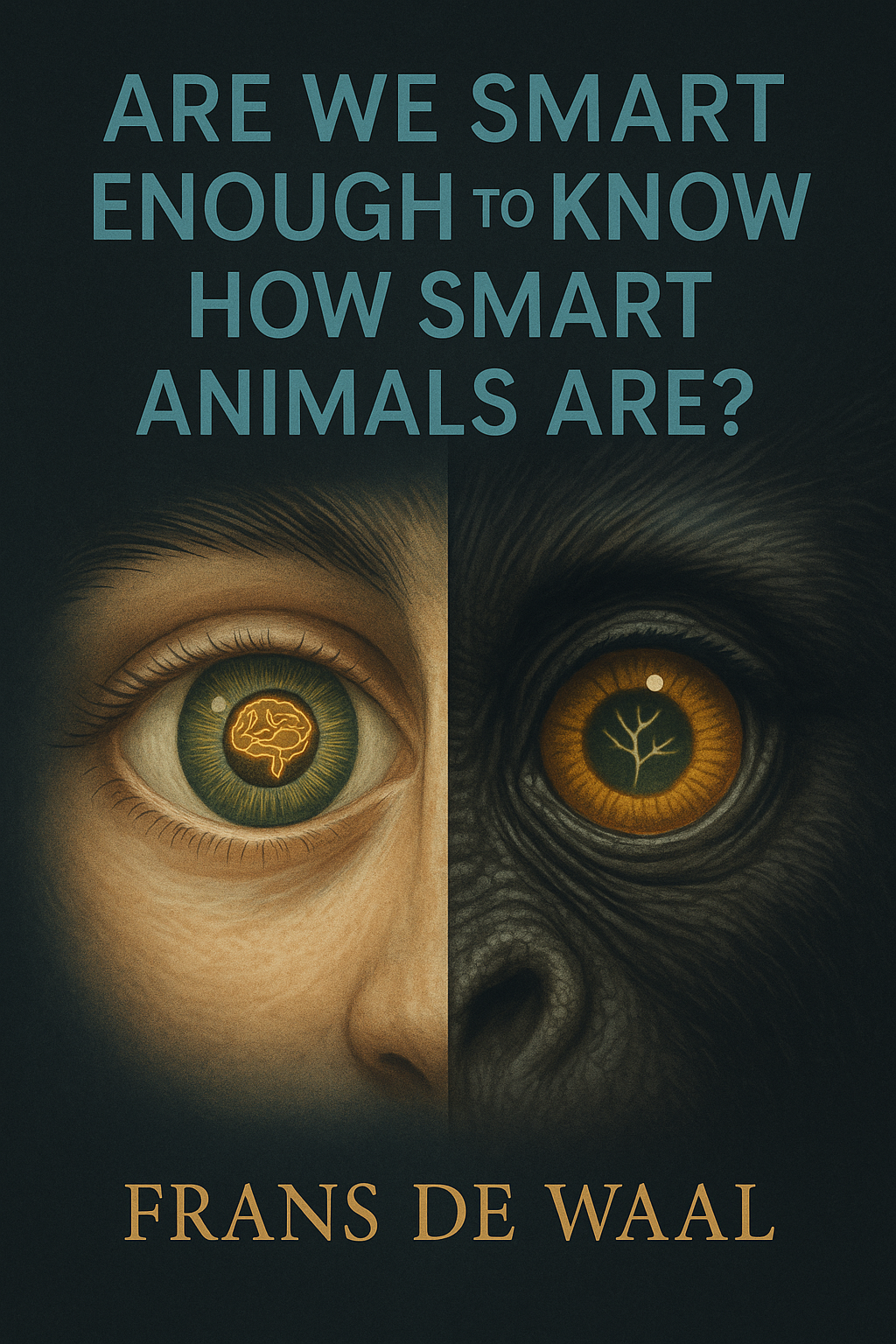
Are We Smart Enough to Know How Smart Animals Are?
Chapter Summaries
What's Here for You
Prepare to have your perception of intelligence fundamentally reshaped. In "Are We Smart Enough to Know How Smart Animals Are?", Frans de Waal doesn't just present fascinating facts; he invites you on a captivating intellectual adventure that dismantles the ingrained human-centric view of cognition. This book is your gateway to understanding the world through the eyes of other creatures, exploring their unique "Umwelt" and challenging the notion that we are the sole proprietors of complex thought. You'll journey through pivotal scientific debates, from the rigid stimulus-response of behaviorism to the more nuanced ethological approach, witnessing de Waal's own intellectual evolution alongside these groundbreaking shifts. Discover the "aha!" moments of chimpanzees, delve into the surprising sophistication of animal communication, and witness astonishing feats of memory that rival our own. You'll explore the intricate social dynamics and "Machiavellian" politics within animal groups, revealing a profound capacity for social intelligence that mirrors our own. Beyond mere observation, this book empowers you to appreciate the future-oriented behaviors and the surprising self-awareness of animals, as evidenced by mirror tests and complex problem-solving. "Are We Smart Enough to Know How Smart Animals Are?" offers a profound intellectual awakening, fostering a sense of wonder and a deeper, more empathetic connection to the animal kingdom. It's an invitation to embrace a more inclusive understanding of intelligence, celebrating the rich cognitive lives that surround us. Get ready to be amazed, enlightened, and perhaps a little humbled.
MAGIC WELLS
The author, Frans de Waal, invites us to peer through the lens of the 'Umwelt,' a concept introduced by biologist Jakob von Uexkll, which describes the unique, self-centered world each organism perceives. This journey begins by challenging our ingrained human-centric view of intelligence, a perspective echoed in philosophical debates like Thomas Nagel's question, 'What is it like to be a bat?' De Waal illustrates how our understanding of animal capabilities is often limited by our own perceptual biases, much like the classic parable of the six blind men and the elephant. He recounts how early experiments with gibbons and elephants failed to reveal their true cognitive abilities until researchers adapted their testing methods to suit the animals' specific anatomies and natural behaviors. For instance, gibbons, whose hands are adapted for brachiation, initially failed tasks requiring manipulation from flat surfaces, and elephants, whose trunks are crucial for sensory input, struggled with tool-use tests that obstructed their sense of smell. This highlights a crucial insight: **our method of questioning shapes what we observe**, a principle borrowed from physicist Werner Heisenberg. De Waal emphasizes that intelligence isn't a single scale, but a diverse ecosystem of specialized adaptations, likening each species' unique cognitive landscape to a 'magic well,' as coined by Karl von Frisch for bee communication and echoed by Donald Griffin for bat echolocation. He argues against the 'scala naturae,' the hierarchical ranking of life, asserting that judging animals by human standards is unfair and unproductive. Instead, he advocates for 'critical anthropomorphism,' a tool to generate testable hypotheses by applying human intuition and knowledge of an animal's natural history, particularly for species closely related to us, like apes, where behaviors like kissing or laughter show striking parallels. Conversely, he introduces 'anthropodenial' – the a priori rejection of human-like traits in other animals – as a barrier to understanding. The chapter resolves with a call for 'evolutionary cognition,' a less anthropocentric approach that studies intelligence across all species from an evolutionary perspective, recognizing the abundant, diverse forms of intelligent life on Earth rather than seeking it solely in outer space. It's a profound shift, urging us to move beyond our own limited Umwelt and appreciate the rich tapestry of minds that share our planet.
A TALE OF TWO SCHOOLS
The author, Frans de Waal, embarks on a journey through the foundational debates in animal behavior, contrasting the rigid, stimulus-response framework of behaviorism with the more holistic, ecologically-minded approach of ethology, a narrative that mirrors his own intellectual evolution. He recounts his early fascination with the zigzag dance of the threespined stickleback, a simple behavior that science, through ethologists like Niko Tinbergen, took seriously, revealing that watching animals could indeed be a profession. This led him to a brief but formative period in a psychology lab dominated by behaviorism, where the prevailing dogma, championed by figures like B.F. Skinner, dismissed any notion of animal desires or feelings, reducing behavior to a history of incentives and treating minds as black boxes. De Waal found this perspective stifling, viewing animals as active seekers rather than passive recipients of rewards, a view challenged by observations of species-specific natural proclivities – how a dog's enthusiasm for a ball is innate, unlike a rabbit's lack of interest, or how kittiwakes, unlike ground-nesting gulls, fail to recognize their young because their ecology doesn't demand it, highlighting how learning is adapted to specific needs. This stark contrast between the two schools—behaviorism's sterile, controlled environments versus ethology's focus on natural behavior—became a central theme, exemplified by the contrasting styles of Konrad Lorenz, the charismatic storyteller, and Niko Tinbergen, the meticulous empiricist. De Waal illustrates the limitations of behaviorism through the story of Clever Hans, the horse seemingly adept at arithmetic, only to reveal its true talent lay in reading subtle human cues, a discovery that paved the way for more rigorous, blind testing in animal cognition studies. He further critiques the behaviorist tendency to use deprivation as a motivational tool, as seen in early studies at the Yerkes Primate Center, contrasting it with more ethical, curiosity-driven approaches. The chapter then delves into the development of animal cognition, exploring how experiments on chimpanzees and self-recognition in mirrors, and the spread of traditions like sweet potato washing in Japanese macaques, challenged simplistic, behaviorist explanations. De Waal argues that while behaviorism emphasized control, ethology embraced spontaneity and the 'why' behind evolved behaviors, leading to a synthesis that now integrates controlled experimentation with ecological observation. The narrative culminates in the understanding that 'simplicity' in explanation is relative, especially when considering species with advanced cognition, and that a true understanding requires empathy and immersion, much like the Japanese primatologists who named and tracked individuals, recognizing that the initial animosity between schools gave way to a richer, integrated field of evolutionary cognition, a testament to the power of combining diverse perspectives to truly know how smart animals are.
COGNITIVE RIPPLES
The author, Frans de Waal, guides us on a journey that begins in the sun-drenched Canary Islands with Wolfgang Khler's groundbreaking work on chimpanzee cognition. Khler, observing a chimpanzee named Sultan, witnessed moments of profound insight, the 'aha experience,' where the ape would suddenly devise novel solutions to reach a banana, such as fitting sticks together or stacking boxes. This wasn't mere trial and error; it was evidence of thinking, a flash of understanding that challenged the prevailing scientific dogma. Robert Yerkes later corroborated these observations, noting the startling suddenness of problem-solving in primates. Despite pushback and accusations of anthropomorphism, as exemplified by Emil Menzel’s compelling footage of chimpanzees scaling walls using tools, the evidence mounted. Menzel himself emphasized the importance of deep observation, stating that an anecdote is simply someone else's observation, highlighting that direct experience often removes doubt about an animal's cognitive capabilities. De Waal further illustrates this with a nuanced example of social tool use: a mother chimpanzee enlisting the help of an alpha female to quell a fight between their offspring, demonstrating a sophisticated understanding of social dynamics and authority. These insights, however, are not confined to apes. The chapter reveals a phenomenon de Waal terms 'cognitive ripples,' where capacities once thought uniquely human or Hominoid are found to be widespread across the animal kingdom. Face recognition, for instance, initially considered a human hallmark, is now observed in primates, crows, sheep, and even wasps, each species adapting the capacity to its ecological niche. The author posits that this widespread emergence of similar cognitive functions, like tool use in chimpanzees, capuchin monkeys, and New Caledonian crows, is a testament to convergent evolution, where different species independently arrive at similar solutions to similar problems. The chapter meticulously details various forms of tool use, from chimpanzees cracking nuts with stones to crows bending wires to create hooks, and even octopuses using coconut shells for protection. A crucial distinction is made between mechanism and function; while the *how* might differ vastly, the *what*—the cognitive outcome—can be remarkably similar. The author challenges the notion of a linear cognitive scale, suggesting that the intelligence of an octopus might be as astonishing as any mammal’s. The narrative builds tension as it dismantles the anthropocentric view of intelligence, revealing profound cognitive abilities in species we often dismiss. The resolution lies in recognizing a shared cognitive heritage, a testament to evolution's ingenuity, urging us to look beyond our own species to appreciate the diverse tapestry of animal minds. De Waal concludes by emphasizing that every cognitive capacity discovered is likely older and more widespread than initially thought, a powerful reminder of the interconnectedness of life and the depth of intelligence that surrounds us.
TALK TO ME
Frans de Waal, in 'TALK TO ME,' invites us on a journey into the intricate world of animal communication and cognition, challenging long-held assumptions and revealing the profound intelligence that lies beyond human language. We begin in the shadow of Stalinist Russia, where Nadezhda Kohts, a brilliant scientist, bravely studied ape facial expressions and intelligence, even comparing a young chimpanzee, Joni, with her own son, Roody, a groundbreaking endeavor hidden from the oppressive regime. Her work, though overshadowed by Wolfgang Köhler's, laid crucial groundwork, prefiguring modern cognitive paradigms like the match-to-sample task, a testament to her pioneering spirit. Deeper into the chapter, the narrative shifts to the remarkable Alex, an African grey parrot, whose decades-long study by Irene Pepperberg shattered the prevailing notion that birds, lacking mammalian cortices, were mere creatures of instinct. Alex's ability to label objects, discriminate shapes, colors, and even perform simple arithmetic, demonstrated a cognitive flexibility previously unimagined, forcing a reevaluation of avian intelligence. This exploration then broadens to question the very essence of language and its assumed primacy in thought, with the author himself expressing a healthy skepticism about relying solely on verbal accounts, even from humans, and finding greater clarity in direct observation. The author posits that while human language, with its capacity for symbolic communication and recursion, remains uniquely powerful for transcending the 'here and now,' its underlying cognitive building blocks—referential signaling, intentional gestures, and even rudimentary syntax—are observable in other species, from vervet monkeys' alarm calls to apes' varied hand signals. The chapter navigates the tension between the desire to anthropomorphize animal communication and the need for rigorous scientific evidence, cautioning against 'red herrings' and 'cherry-picked' interpretations, as seen in the overblown claims surrounding Koko the gorilla's grief. Ultimately, the narrative resolves with a profound appreciation for animal minds, not through the lens of human language alone, but by embracing a broader understanding of cognition, emotion, and communication, exemplified by the emerging field of dognition and the promise of non-invasive neuroscience, reminding us that the quest to understand animal intelligence is an ongoing, humbling exploration of shared evolutionary heritage.
THE MEASURE OF ALL THINGS
The author, Frans de Waal, invites us to peer into the intricate world of animal cognition, challenging the long-held human-centric view that we are uniquely intelligent. He begins by introducing Ayumu, a chimpanzee whose astonishing memory on a touchscreen task shatters expectations, outperforming humans in speed and accuracy, a feat that understandably caused distress in the scientific community. This discomfort, de Waal explains, echoes past scientific upheavals, like DNA studies revealing our close kinship with other primates, forcing a reevaluation of our place in nature. The core tension arises from the persistent idea, which de Waal dubs 'Neo-Creationism,' that while we evolved physically, our minds remained divinely separate, a notion echoing Alfred Russel Wallace's 'Problem' – the idea that human intellect possesses a surplus beyond what natural selection could explain. This exceptionalism, de Waal argues, leads to a constant redefinition of traits like imitation and theory of mind, moving the goalposts to maintain human uniqueness. He illustrates this with the 'Clever Hans' phenomenon in reverse, where flawed methodologies and a human-centric bias in testing obscure the true cognitive abilities of animals. The author compellingly argues that our fascination with unique human traits often blinds us to the vast 'submerged part of the iceberg' – the shared emotional and cognitive capacities we possess with other species, such as empathy and perspective-taking. He shares poignant examples, like dolphins supporting a stunned companion or chimpanzees strategically manipulating others for food, demonstrating a deep understanding of others' needs and knowledge. The narrative pivots towards resolution as de Waal champions a 'continuity' approach, emphasizing embodied cognition and the importance of species-specific methodologies, suggesting that comparing apes and children using the same tests is like comparing fish and cats. He advocates for a moratorium on human uniqueness claims, urging us to study cognition as a general biological phenomenon, recognizing that evolutionary forces have shaped all minds, not just our own. Ultimately, de Waal reveals that the measure of intelligence is not a singular peak, but a vast landscape, and that by understanding the cognition of other species, we gain a richer, more accurate picture of ourselves and the intricate tapestry of life.
SOCIAL SKILLS
Frans de Waal, in his chapter 'SOCIAL SKILLS,' invites us into the intricate, Machiavellian world of chimpanzee politics, revealing that beneath the surface of instinct lies a profound capacity for social intelligence that mirrors our own. He begins with the compelling story of Yeroen, an older male chimpanzee, who faced a strategic dilemma: align with the mighty, established alpha male for an easy life, or gamble on an ambitious, young upstart. Yeroen, demonstrating a keen understanding of power dynamics, chose the latter, becoming the 'kingmaker' and regaining prestige and mating opportunities. This narrative serves as a powerful lens through which de Waal explores the sophisticated coalition-building and alliance-making that permeates chimpanzee society, challenging the long-held notion that such complex social maneuvering is uniquely human. He argues that hierarchical structures are not merely social constructs but are deeply ingrained biological tendencies, observable even in seemingly egalitarian human groups. De Waal contrasts the social dynamics of males, where power is constantly contested, with that of females, where rank is often inherited, illustrating that even in the absence of direct intervention, social relationships are a form of long-term investment, as Hans Kummer's work on baboons suggested. The author emphasizes that understanding these animal societies requires moving beyond passive observation to acknowledge their goals and strategies, a perspective he championed in his book 'Chimpanzee Politics,' which drew parallels between ape behavior and human political philosophy, notably Machiavelli. He highlights the concept of 'triadic awareness' – the ability to understand not just direct relationships but also the connections between third parties – as a critical skill for navigating social complexities, evident in how chimpanzees recruit allies and appease opponents' friends. This nuanced view extends to wild chimpanzees, where a male's rank isn't solely determined by size but by the strength of his alliances, sometimes requiring significant diplomatic effort like grooming to maintain support, as seen in Kalunde's strategic maneuvering. De Waal underscores the necessity of integrating fieldwork with controlled experiments to truly grasp animal cognition, likening the study of animal intelligence to measuring a child's intellect not just by observing play but by presenting specific tasks. He reveals how experiments on cooperative pulling tasks, initially flawed in their setup when comparing apes and humans, have evolved to demonstrate that chimpanzees, despite facing competition and potential freeloaders, exhibit remarkable cooperation, actively managing conflict to achieve shared goals. This capacity for cooperation is not limited to primates; de Waal draws parallels with the mutualistic relationship between cleaner wrasses and larger fish, and the coordinated hunting strategies of coral trout and moray eels, suggesting that similar social needs can lead to convergent cognitive solutions across vastly different species. Ultimately, de Waal's exploration of social skills in animals, from the political gambits of chimpanzees to the cooperative fishing of whales and humans, dismantles the idea of human uniqueness in cooperation, revealing a shared evolutionary heritage of complex social intelligence that binds us to the rest of the animal kingdom.
TIME WILL TELL
The author, Frans de Waal, invites us to explore the intricate relationship between animals and time, challenging the long-held notion that they are merely creatures trapped in the present moment. He begins by painting a picture of animal behavior that is inherently future-oriented, from a monkey calculating a leap between trees, relying on past experience and future landing, to an elephant matriarch remembering a distant water source during a drought. De Waal highlights the pioneering work of Edward Tolman, who in the 1920s, bravely proposed that animals possess 'cognitive maps' and are 'purposive,' guided by goals and expectations, a stark departure from the prevailing behaviorist view of simple stimulus-response. This idea was vividly illustrated by Otto Tinklepaugh's experiment with a macaque, which displayed clear disappointment and recall when a expected banana was swapped for lettuce, demonstrating an expectation that was violated. The chapter then delves into the concept of episodic memory, long thought to be uniquely human, presenting compelling evidence in animals. De Waal recounts experiments with chimpanzees, like Socko and Natasha, showing remarkable recall of specific food-hiding events from years prior, and Gema Martin-Ordas's work with apes recalling tool-fetching tasks years later. This contrasts with 'vague' learning, akin to avoiding a traffic jam without remembering the specific event, and instead points to the recall of particulars, much like Marcel Proust’s evocative remembrance of a madeleine. Further supporting this, Karline Janmaat's research on wild chimpanzees reveals an excellent recall of fruit tree locations and timing for optimal foraging, even involving complex decisions like nesting and waking early for distant trees. The narrative shifts to future planning, a concept even more contentious than memory. De Waal introduces Endel Tulving's 'spoon test' criteria: behavior not driven by immediate needs and preparation for a future situation in a different context. He illustrates this with chimpanzees like Franje gathering straw for an outdoor nest while still indoors, Steward bringing a stick to experiments, and particularly Lisala, a bonobo, carrying a heavy rock for nearly a kilometer to crack nuts, fulfilling all criteria for planning. Santino the chimpanzee's habit of collecting rocks for projectile displays also exemplifies spontaneous future preparation. This advanced planning in apes is contrasted with the more instinctual, evolved hoarding of squirrels, which is triggered by environmental cues rather than conscious foresight. The chapter then explores self-control and delayed gratification, examining how animals, like humans, can resist immediate rewards for future gain. Experiments with capuchin monkeys choosing a banana over a carrot with a mere fifteen-second delay, and chimpanzees waiting up to eighteen minutes for more candies, demonstrate significant willpower. Even large-brained birds, like crows and ravens trading beans for sausage, and Irene Pepperberg's parrot, Griffin, waiting patiently for better treats, showcase impressive restraint. The fascinating coping mechanisms during these waits, from displacement activities to cognitive distractions like playing with toys, mirror human strategies. Michael Beran's work on chimpanzee self-control, particularly the reversal pointing experiments where chimps failed with candy but succeeded with numbers, highlights the role of cognitive representation. Finally, the chapter touches upon metacognition, or 'thinking about thinking,' evidenced by animals like dolphins and rats hesitating or opting out of tests when they lack confidence, and jays and monkeys seeking more information when unsure. De Waal concludes by advocating for a continuity stance, suggesting that the differences between human and animal cognition are largely a matter of degree, not kind, and that our reluctance to attribute consciousness or complex mental states to animals is more a reflection of our own biases than objective scientific reality. The tension lies in overcoming anthropocentric views to appreciate the sophisticated temporal awareness and cognitive abilities present across the animal kingdom.
OF MIRRORS AND JARS
Frans de Waal, in his chapter "Of Mirrors and Jars," invites us to peer beyond the familiar confines of human exceptionalism and explore the intricate tapestry of animal cognition, challenging long-held assumptions about intelligence and self-awareness. The author begins by recounting the poignant example of Pepsi, an Asian elephant who, through a series of mirror tests, demonstrated a remarkable ability to connect his reflection with his own body, even tasting the paint on his forehead—a subtle yet profound act of self-recognition. This sets the stage for a broader exploration of how our ingrained biases, favoring easily studied species, have limited our understanding of the animal mind, creating what de Waal terms a "small-brain perspective." He reveals that while elephants, like primates and dolphins, can pass sophisticated tests, their unique sensory world—largely acoustic and olfactory—demands novel approaches to study, moving beyond the traditional laboratory setting. Deeper still, the chapter delves into the concept of perception and its inextricable link to cognition, positing that each creature constructs its own reality based on its sensory inputs. This is vividly illustrated by the African elephants' ability to distinguish human languages and even the gender and perceived threat of speakers, reacting defensively to Maasai male voices, a testament to their sophisticated auditory processing and learned experiences. The narrative then pivots to the contentious mirror test itself, often seen as the ultimate arbiter of self-awareness, a view de Waal deconstructs. He argues that self-recognition is not an all-or-nothing phenomenon but a spectrum, a layered development akin to an onion, with species like monkeys demonstrating a functional understanding of mirrors as tools, even if they don't achieve spontaneous self-recognition. This nuanced perspective extends to invertebrates, particularly the octopus, a creature of "alien" intelligence with a decentralized nervous system that allows for remarkable problem-solving, such as escaping jars or manipulating prey based on olfactory cues rather than sight, showcasing how different evolutionary paths can lead to complex cognitive abilities. The chapter further illuminates the power of social learning and conformism, drawing parallels between chimpanzees developing distinct "cultures" through imitation and human societal norms, and the remarkable adaptation of wild vervet monkeys who adopt local food preferences, even when a better option exists. This highlights that fitting in, the drive to belong, often outweighs immediate reward, a principle echoed in the seemingly non-beneficial, yet culturally transmitted, habits of primates and even the development of "accents" in chimpanzee vocalizations. Ultimately, de Waal champions a gradualist approach to understanding consciousness, urging us to appreciate the diverse ways animals navigate their worlds and recognize that self-awareness, like intelligence, is not a singular, human-exclusive trait but a multifaceted phenomenon woven into the very fabric of life, challenging us to widen our lens and embrace the "When in Rome" wisdom that governs so much of animal behavior, from the subtle social cues of whales to the individual "names" dolphins use to call each other, reminding us that individual recognition is the bedrock of any complex society, a capacity often underestimated in the animal kingdom.
EVOLUTIONARY COGNITION
The author, Frans de Waal, embarks on a journey through the often-contentious history of understanding animal cognition, revealing a profound shift from outright denial to enthusiastic acceptance. He paints a picture of a scientific landscape once dominated by skepticism, where proposing that animals possess complex mental lives—politics, empathy, even rudimentary political strategies—was met with accusations of naivete and anthropomorphism. This resistance, de Waal explains, was often rooted not in a lack of evidence, but in an entrenched disbelief, a reluctance to see humans as part of a continuum rather than a separate creation. Early pioneers like Köhler and Yerkes, and later generations including de Waal himself, faced an uphill battle against prevailing theories, often based on simpler models derived from pigeons and rats in Skinner boxes, which, while seemingly parsimonious, could become convoluted when they failed to explain observed behaviors. De Waal introduces the concept of 'slayers,' those who actively deny any possibility of progress in cognitive ethology, often conflating the difficulty of research with its impossibility. He notes how this resistance sometimes stems from a desperate need to maintain humanity's unique position in the cosmos, a position increasingly challenged by scientific discoveries. Yet, as the walls between human and animal cognition crumble, revealing shared capacities, the evolutionary approach has gained prominence. This perspective recognizes that each species possesses a unique cognitive toolkit shaped by its ecology and lifestyle; there is no single model for all. The author illustrates this with the example of brain size and energy consumption—larger brains, like those of apes, demand greater energy, suggesting they are adapted for greater cognitive challenges, a utilitarian view of biology. He emphasizes that cognition is not static but adapts to ecological requirements, even influencing physical evolution, as seen in the New Caledonian crows' specialized bills and forward-facing eyes for tool use. The narrative then shifts to a resolution, where the 'cognitive revolution' is reframed not as a refutation of learning theory, but as a marriage, an essential integration. The field has moved toward a more nuanced, bottom-up approach, seeking to understand the building blocks of cognition rather than solely focusing on grand claims like 'theory of mind' or 'self-awareness.' This requires breaking down complex capacities into smaller, observable components, often with the aid of neuroscience, which promises to test the continuity assumption by revealing shared neural mechanisms. Ultimately, de Waal suggests we are returning to a more egalitarian human-animal relationship, akin to our hunter-gatherer ancestors, observing animals on their own terms, seeking ecological validity, and fostering empathy to truly understand their world, discovering 'magic wells' of cognition beyond our current imagination.
Conclusion
Frans de Waal's "Are We Smart Enough to Know How Smart Animals Are?" serves as a profound intellectual and emotional journey, dismantling the edifice of human exceptionalism and inviting us into a richer, more nuanced understanding of the animal kingdom. The core takeaway is a radical redefinition of intelligence: it's not a singular ladder we ascend, but a diverse, multifaceted landscape where each species has evolved its own unique 'magic wells' of cognitive prowess, shaped by their specific 'Umwelt.' De Waal masterfully illustrates how our anthropocentric biases, our 'anthropodenial,' have blinded us, leading us to impose human standards and reject evidence of complex thought, emotion, and sociality in other beings. He champions critical anthropomorphism not as a flaw, but as a vital tool for generating hypotheses, urging us to approach animal minds with empathy and an 'insider' perspective. The emotional lessons resonate deeply. We are confronted with the humbling realization that capacities once deemed uniquely human—insight, tool use, complex social navigation, empathy, even rudimentary forms of planning and self-awareness—are far more widespread than we dared to imagine. This recognition fosters a profound sense of connection, dissolving the perceived chasm between ourselves and other creatures. The book challenges us to shed the discomfort of recognizing ourselves in animals, to embrace the evolutionary continuity that binds us, and to move beyond the intellectual dead end of seeking a unique human 'spark.' Practically, de Waal equips us with the wisdom of rigorous, species-appropriate scientific inquiry. He underscores the necessity of moving beyond simplistic behaviorism and the limitations of human-centric tests, advocating for a synthesis of ethology's ecological observation and comparative psychology's experimental rigor. The 'Clever Hans Effect' serves as a constant reminder of the need for blind procedures and careful interpretation, while the exploration of embodied cognition and triadic awareness offers new frameworks for understanding how animals navigate their worlds. Ultimately, the book is a call to intellectual courage, urging us to persevere in uncovering the astonishing diversity of minds on Earth, recognizing that every discovery of a cognitive capacity in an animal likely represents an ancient and widespread phenomenon. It's an invitation to see the world not just through human eyes, but through the myriad, equally valid perspectives of all living beings.
Key Takeaways
Our perception of animal intelligence is inherently limited by our own Umwelt, meaning our methods of questioning profoundly shape the observations we make.
Intelligence is not a single, linear scale but a diverse array of specialized cognitive abilities, each species possessing its own unique 'magic wells' of adaptation.
Anthropodenial, the rejection of human-like traits in animals, acts as a significant barrier to understanding, while critical anthropomorphism, when applied thoughtfully, can be a powerful tool for generating testable hypotheses.
Judging animal capabilities requires species-appropriate testing that accounts for their unique anatomy, sensory capacities, and natural behaviors, rather than imposing human standards.
Recognizing the evolutionary continuity between humans and other animals is essential, shifting the focus from human exceptionalism to a broader understanding of intelligence as a spectrum.
The study of animal cognition should be approached from an evolutionary perspective, acknowledging the rich diversity of intelligent life on Earth and moving beyond anthropocentric biases.
The limitations of behaviorism, which reduces animal behavior to stimulus-response and ignores internal states, highlight the need for a more holistic approach that considers species-specific ecology and innate proclivities.
Ethology, by focusing on natural behavior within its ecological context, offers a richer understanding of why animals behave as they do, emphasizing evolved adaptations rather than solely learned responses.
The 'Clever Hans Effect' underscores the critical importance of blind experimental procedures to avoid unconscious cueing and ensure accurate interpretation of animal cognition, demonstrating that apparent intelligence can sometimes stem from sensitivity to human signals.
Interpreting animal behavior requires acknowledging species-specific cognitive abilities; a 'simplest explanation' is not always the most accurate, especially for highly intelligent animals, suggesting a need for context-dependent explanations.
The synthesis of ethology's ecological observation and comparative psychology's experimental rigor, combined with the detailed, individual-focused methods of Japanese primatology, forms the foundation of modern evolutionary cognition, enabling a more comprehensive understanding of animal minds.
True scientific progress in understanding animal intelligence arises from overcoming the initial animosity between divergent approaches, weaving complementary strengths into a new, robust whole.
Understanding animal intelligence necessitates empathy and immersion, adopting an 'insider' perspective (Umwelt) rather than maintaining a detached, overly critical distance that risks anthropomorphism or underestimation.
Chimpanzee problem-solving, as demonstrated by Wolfgang Khler, reveals flashes of insight ('aha moments') that challenge simplistic explanations like trial-and-error learning, suggesting genuine cognitive understanding.
Cognitive abilities once deemed uniquely human or primate, such as face recognition and complex tool use, are surprisingly widespread across diverse species, illustrating 'cognitive ripples' and convergent evolution.
The distinction between the *mechanism* (how a task is achieved) and the *function* (the cognitive outcome) is crucial for understanding animal intelligence, as different species can achieve the same cognitive goal through vastly different means.
Tool use is not a singular human trait but a spectrum of behaviors observed across many species, including primates, birds, and even invertebrates, indicating that technology's origins are far more ancient and distributed than previously believed.
The capacity for sophisticated problem-solving and tool manipulation arises independently in different evolutionary lineages due to similar ecological pressures and cognitive demands, a phenomenon best understood through the lens of convergent evolution.
Our understanding of animal cognition is continually expanding, suggesting that every discovered cognitive capacity is likely older and more widespread than initially assumed, challenging anthropocentric views of intelligence.
The human tendency to equate language with intelligence, while a powerful cognitive tool for humans, can obscure the sophisticated cognitive and communicative abilities of non-linguistic species.
Scientific progress in understanding animal cognition is often hindered by preconceived notions and the 'fear of new ideas,' necessitating courage and perseverance from researchers.
While human language possesses unique qualities for abstract thought and communication beyond the immediate, its foundational elements, such as referential signaling and intentionality, are present in other species.
Rigorous scientific inquiry into animal communication requires careful analysis of raw data and probabilities to avoid anthropomorphic biases and 'cherry-picked' interpretations.
The study of animal cognition has evolved from a language-centric approach to a broader exploration of tools, social relations, and environmental knowledge, with domesticated animals like dogs offering new avenues for research.
The shared evolutionary heritage of mammals is reflected in homologous neural structures and cognitive processes, challenging human-animal dualism and opening doors for non-invasive neuroscience in animal studies.
Human exceptionalism in intelligence is often maintained by a biased methodology and redefinition of cognitive traits, rather than by inherent differences.
The human tendency to seek a unique 'spark' for our intellect, rather than accepting gradual evolutionary continuity, hinders our understanding of animal cognition.
Empathy and perspective-taking are fundamental, widely shared capacities across species, not exclusive human achievements.
Fair comparison of animal and human cognition requires species-specific methodologies that respect each animal's biology and social context, rather than imposing human-centric tests.
Focusing solely on human uniqueness is an 'intellectual dead end'; understanding cognition as a general biological phenomenon applicable to all species offers a more comprehensive scientific path.
Embodied cognition, which considers how the body's interaction with the world shapes thought, provides a richer framework for understanding intelligence than purely cerebral approaches.
Social hierarchies and political maneuvering are not solely human constructs but deeply ingrained biological tendencies observable in animal societies, particularly among primates.
Triadic awareness, the understanding of relationships beyond direct interactions, is a crucial cognitive skill enabling complex social navigation, alliance formation, and conflict resolution in animals.
True understanding of animal cognition requires integrating observational fieldwork with controlled experimental methods to move beyond mere behavior to underlying intent and strategy.
Cooperation is a widespread phenomenon in the animal kingdom, often driven by mutual benefit and reciprocity rather than solely kinship, challenging the notion of human uniqueness in collaborative efforts.
The ability to manage internal conflict and regulate social tensions is essential for sustained cooperation, with many species demonstrating sophisticated strategies to balance individual interests with group harmony.
Animals exhibit sophisticated temporal orientation, demonstrating goal-directed behavior and future planning that extends beyond immediate needs, challenging the anthropocentric view of them being solely present-bound.
Episodic memory, the recall of specific past events (what, when, where), is present in animals, suggesting a richer, more detailed recollection of experiences than previously assumed.
Future planning in animals is not merely instinctual but can be a flexible, context-dependent cognitive strategy, involving tool use, resource anticipation, and social maneuvering.
Self-control and delayed gratification are evident in various animal species, indicating an ability to suppress immediate impulses for future rewards, mirroring human willpower and strategic decision-making.
Metacognition, or knowing what one knows (and doesn't know), is demonstrable in animals through uncertainty responses and information-seeking behaviors, suggesting an awareness of their own cognitive states.
The persistent anthropocentric bias in science leads to an unnecessary dichotomy between human and animal cognition, hindering a full appreciation of the continuity of mental capacities across species.
Intelligence and self-awareness exist on a spectrum, not as binary states, necessitating a move beyond rigid tests like the mirror mark test to understand the nuances of animal cognition.
Our anthropocentric biases limit scientific inquiry into animal intelligence, leading to a "small-brain perspective" that overlooks the cognitive capabilities of species outside conventional research settings.
Perception and cognition are deeply intertwined, with animals constructing unique realities based on their specialized sensory worlds, making direct comparison across species challenging but crucial for understanding diverse minds.
Social learning and conformism play a significant role in shaping animal behavior and culture, often driven by a desire to belong and align with group norms, even at the expense of immediate personal benefit.
Individual recognition, whether through visual cues, vocalizations like signature whistles, or even mimicry, forms the foundation of complex animal societies, a testament to sophisticated cognitive abilities.
The study of invertebrates, particularly creatures like the octopus with decentralized nervous systems, reveals that complex problem-solving and intelligence can arise through vastly different evolutionary pathways than those seen in vertebrates.
The historical resistance to animal cognition was often ideological, rooted in a desire for human exceptionalism, rather than purely scientific limitations.
Understanding animal cognition requires an evolutionary perspective that acknowledges each species' unique adaptations to its specific ecology and lifestyle, rejecting a one-size-fits-all model.
Cognition and physical evolution are intertwined; cognitive specializations can drive physical adaptations, and vice versa, demonstrating a reciprocal relationship.
The study of animal cognition necessitates a shift from grand, spectacular claims to a bottom-up approach that deconstructs complex capacities into smaller, observable cognitive mechanisms.
True scientific progress in animal cognition relies on a synthesis of different approaches, integrating learning theory and ethology within an evolutionary framework, rather than maintaining false dichotomies.
Moving beyond anthropocentrism requires observing and understanding animals on their own terms, fostering empathy and ecological validity to reveal their true cognitive landscapes.
Action Plan
When observing or testing animals, consciously question how your own biases and methods might be influencing your observations.
Seek to understand the natural behaviors and ecological niche of a species before designing experiments to test its cognitive abilities.
When encountering apparent cognitive differences between species, consider if the test itself is species-appropriate rather than assuming a deficit in the animal.
Practice 'critical anthropomorphism' by using human concepts as hypotheses to be tested, rather than as definitive explanations, especially when studying closely related species.
Actively challenge instances of 'anthropodenial' by considering the possibility of human-like traits in animals, particularly when evidence suggests similarity.
Embrace the idea that intelligence exists in many forms, and strive to appreciate the unique cognitive 'magic wells' of different species.
When observing animal behavior, consider the species' natural ecology and innate tendencies before attributing actions solely to learned responses or external incentives.
Design or interpret animal experiments with extreme care to avoid unconscious human cueing, employing blind procedures whenever possible.
When evaluating an animal's actions, consider explanations that are appropriate to the species' known cognitive capacities, rather than defaulting to the simplest possible explanation for all species.
Seek out and integrate diverse perspectives on animal cognition, blending observational techniques with experimental rigor.
Cultivate empathy and an 'insider' perspective when studying animals, aiming to understand their world (Umwelt) rather than imposing human assumptions.
Recognize that scientific progress often involves the synthesis of initially opposing viewpoints, valuing collaboration over entrenched dogma.
When encountering anecdotal evidence of remarkable animal behavior, use it as a starting point for rigorous research rather than an end in itself.
Observe animals in your environment with an open mind, looking for instances of problem-solving or tool use beyond what is commonly assumed.
When encountering a complex behavior, consider whether it might be a result of genuine insight rather than just learned responses or instinct.
Reflect on the concept of convergent evolution and how similar challenges might lead to similar solutions across vastly different species.
Challenge your own assumptions about which cognitive abilities are uniquely human or primate.
When reading about animal behavior, pay attention to the distinction between the mechanism of a behavior and its underlying cognitive function.
Seek out further research or documentaries on animal cognition to deepen your understanding of the 'cognitive ripples' the author describes.
Practice patience and detailed observation, similar to Khler's approach, when trying to understand complex behaviors, whether in animals or humans.
Cultivate curiosity and intellectual courage by questioning assumptions about animal intelligence and communication.
Seek out diverse research methodologies, beyond language-centric studies, to gain a fuller picture of animal cognition.
Practice critical evaluation of anecdotal evidence and 'feel-good stories' in animal research, focusing on empirical data.
Recognize and appreciate the communicative abilities of animals that extend beyond human language, such as body language and vocalizations.
Support research that explores the cognitive capacities of a wider range of species, including birds and domesticated animals.
Consider the ethical implications of research and our relationship with animals, moving towards a less dualistic view of minds.
Engage in direct observation of animal behavior to foster a deeper understanding and connection, rather than relying solely on verbal interpretations.
Challenge assumptions about human uniqueness by seeking out research on animal cognition.
Critically evaluate methodologies in comparative studies, questioning human-centric biases.
Practice empathy and perspective-taking in daily interactions, recognizing these as shared capacities.
Consider the embodied nature of cognition, observing how physical actions and environments shape thought.
Advocate for and apply species-specific testing approaches when evaluating animal behavior.
Reflect on the 'moving goalposts' phenomenon when new discoveries challenge established ideas about human superiority.
Observe social interactions within your own community or workplace, looking for patterns of alliance formation and conflict resolution.
Consider how understanding the relationships *between* individuals (triadic awareness) might inform your own social strategies.
Seek out controlled experiments or detailed case studies that explore animal cognition to broaden your perspective on intelligence.
Reflect on instances where cooperation, rather than competition, led to successful outcomes in your own life or teams.
Challenge anthropocentric assumptions by actively looking for examples of complex social behavior and intelligence in non-human animals.
When faced with a social dilemma, consider the 'strength is weakness' paradox: is aligning with the most powerful always the best strategy?
Observe animal behavior in your environment for instances of planning or memory recall, looking beyond immediate actions.
Consider the 'what, when, and where' of your own daily routines to appreciate the nuances of episodic memory.
Practice delayed gratification in small, everyday choices to build self-control, reflecting on the strategies animals use.
When faced with uncertainty, pause and assess your own knowledge, similar to how animals signal their confidence levels.
Challenge assumptions about animal intelligence by seeking out further research and evidence that supports continuity across species.
Engage in 'thinking about thinking' by reflecting on your decision-making processes and how you weigh future consequences.
Consider how your own perceptions of intelligence might be limited by your species' biases.
Seek out studies on species that are not typically considered "easy" to research, such as elephants or octopuses.
Observe interactions within social groups (human or animal) to identify patterns of social learning and conformity.
Reflect on how different sensory inputs might shape an individual's (or animal's) experience of reality.
Explore the concept of a "spectrum" of consciousness rather than absolute categories when evaluating intelligence.
Recognize the importance of individual recognition in fostering complex social bonds, both in human and animal communities.
Challenge your own assumptions about what constitutes 'intelligence' by considering species-specific cognitive needs.
Seek out research that applies an evolutionary lens to animal behavior, recognizing the importance of ecology and lifestyle.
Practice observational skills by watching animals in their natural or semi-natural environments, paying attention to their specific behaviors and interactions.
When evaluating claims about animal cognition, look for converging lines of evidence rather than relying on single spectacular findings.
Consider how physical adaptations might support or be driven by cognitive specializations in different species.
Engage with scientific literature that breaks down complex cognitive abilities into smaller, testable components.
Approach the study of other species with a mindset of empathy and a desire to understand them on their own terms, rather than solely through a human-centric perspective.