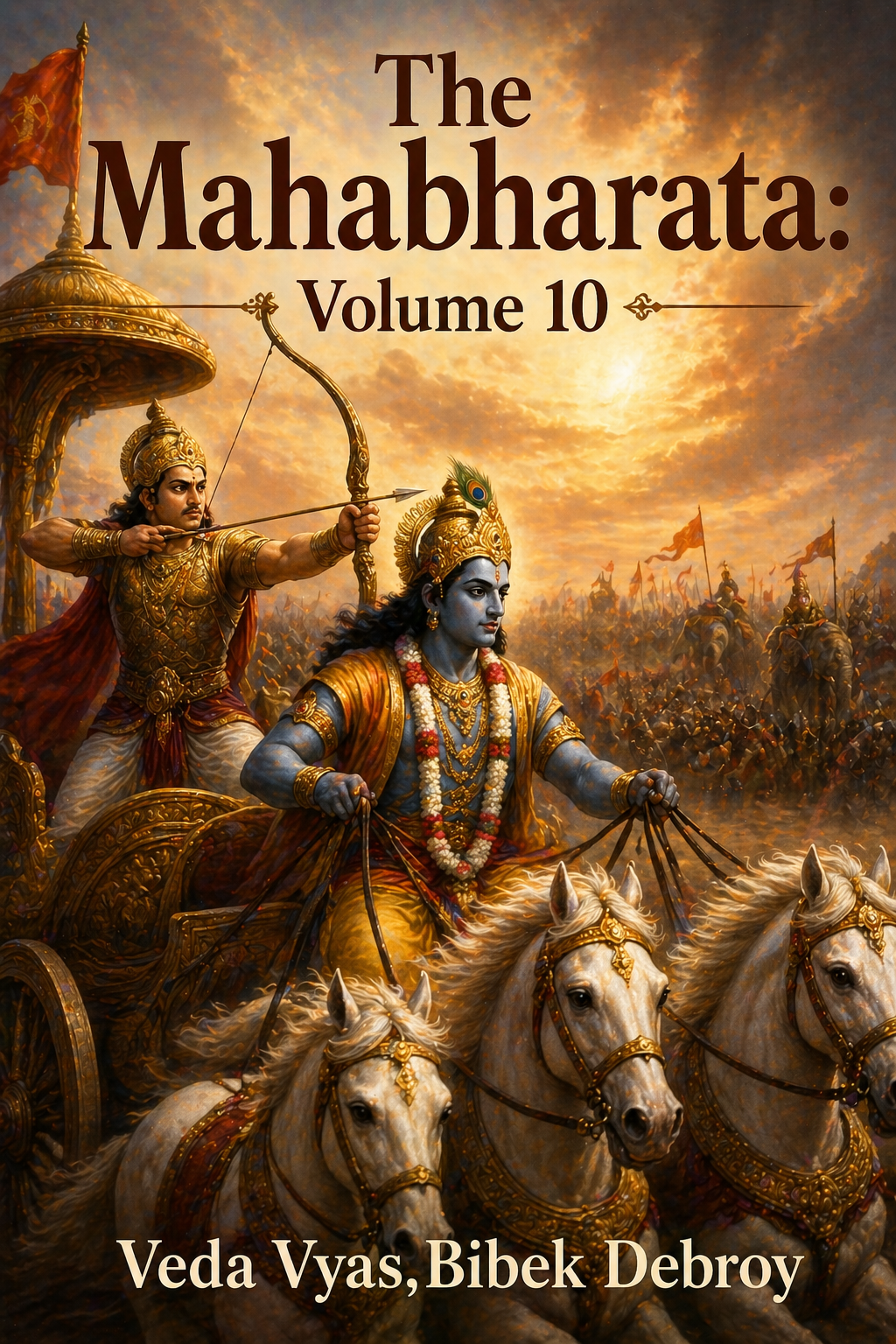
The Mahabharata: Volume 10
Chapter Summaries
What's Here for You
Prepare to be moved by the concluding chapters of the Mahabharata, a profound exploration of duty, loss, and the elusive nature of righteousness. This volume delves into the aftermath of the Kurukshetra war, where grief-stricken kings seek solace and grapple with the weight of their actions. Witness Bhishma's final teachings on dharma, Dhritarashtra's poignant departure, and the Pandavas' ultimate renunciation. Through trials of fire and celestial ascents, you'll confront uncomfortable truths about justice, forgiveness, and the complexities of the human heart. Expect a journey that is both spiritually enriching and emotionally resonant, inviting deep reflection on the cyclical nature of life, death, and the enduring quest for meaning.
Dana Dharma parva
Part 1: In the *Mahabharata's* "Dana Dharma Parva," Bhishma, the wise patriarch, addresses Yudhishthira's torment over the massive death toll of the war and his desire for atonement. Bhishma, a beacon of dharma, illuminates the path of *dana*, or giving, as a means to purify oneself and attain higher states of being. He explains that heaven, fame, and longevity are all fruits of austerity, while donations lead to enjoyment, refraining from violence to beauty, and initiation into vows to birth in good families, thus revealing that every action plants a seed with corresponding consequences. The chapter paints vivid scenes of those who obtain kingdoms by subsisting on fruits and roots, or heaven by subsisting on leaves, and offers a glimpse of the transformative power of simple acts. Bhishma emphasizes that assurance to all creatures, compassion for the suffering, and selfless giving are the highest forms of *dana*, gifts that follow the giver, thus suggesting *dana* as a means of extending one's self beyond mortal limits. He cautions against pride and indifference, advocating for honoring those who seek help and satisfying the hunger of the learned, even if it means aiding those who do not ask, thus revealing that true generosity anticipates need. He underscores the importance of serving and honoring Brahmanas, considering them akin to gods, whose blessings are vital for the kingdom's prosperity and dharma's preservation, thus placing the act of giving within a broader social and spiritual context. The narrative then shifts to Yudhishthira's specific questions about the best forms of gifts, prompting Bhishma to extol the virtues of giving land, food, and water, each act carrying its own profound merits and cosmic consequences, and thus transforming material donations into pathways for spiritual growth. He recounts ancient tales, such as Narada's teachings to Devaki, to illustrate how different *nakshatras* (lunar constellations) influence the efficacy of various gifts, adding a layer of astrological significance to the act of giving. The chapter culminates with detailed accounts of the fruits obtained from donating cattle, sesamum, lamps, and garments, each act a step towards transcending earthly limitations and attaining divine grace, thus resolving Yudhishthira's initial turmoil with a comprehensive guide to ethical action and spiritual redemption.
Bhishma-Svargarohana parva
In the poignant "Bhishma-Svargarohana Parva," Veda Vyas and Bibek Debroy guide us through Bhishma's final moments and ascent to heaven, a narrative steeped in dharma and familial duty. As Yudhishthira honors the fallen and reclaims his kingdom, he remembers Bhishma's prophesied time of death, marking the shift to uttarayana. The procession to Kurukshetra becomes a somber parade, a river of grief flowing towards the inevitable. Bhishma, lying on his bed of arrows, embodies resilience even in decline. He reminds Yudhishthira of the importance of dharma, urging him to remain truthful and honor the wise. Addressing Dhritarashtra, Bhishma underscores the futility of grief, acknowledging that while the Pandavas embody dharma, his own sons were consumed by greed. Then, in a powerful moment, Bhishma seeks permission from Krishna, recognizing him as the ultimate protector and the embodiment of dharma itself, understanding that wherever Krishna exists, victory follows. As Bhishma prepares to cast off his mortal coil, he grants his blessings, emphasizing truth as the supreme strength, and the importance of honoring the Brahmanas. The narrative reaches its climax as Bhishma, through yoga, sheds his wounds and ascends to heaven like a meteor piercing the sky, leaving behind a world in awe. The Pandavas, along with the Kurus, perform his funeral rites, a blend of sorrow and reverence. The goddess Bhagirathi emerges, her lament echoing the pain of a mother losing her son, highlighting Bhishma's unparalleled strength and adherence to dharma, even in death. Krishna consoles her, revealing Bhishma's divine origins as one of the Vasus, cursed to live a mortal life, but now returned to his celestial home. This chapter serves as a profound reflection on duty, dharma, and the acceptance of mortality, resolving in the understanding of life’s cyclical nature and the ultimate return to the divine.
Ashvamedhika parva
Part 1: In the Ashvamedhika Parva, Veda Vyas and Bibek Debroy present Yudhishthira grappling with the immense grief and guilt following the Kurukshetra war. Dhritarashtra urges Yudhishthira to rise above his sorrow and embrace his dharma as a king, yet Yudhishthira remains consumed by the slaughter he has caused. Krishna then steps in, reminding him that excessive grief is torment and that performing sacrifices can purify him, like soma satisfying the gods. Vyasa reinforces this, asserting that no mortal acts independently, but is driven by divine will, thus, repentance is misplaced; instead, Yudhishthira should focus on performing great sacrifices to atone for the violence, suggesting the riches from King Marutta's sacrifice in the Himalayas could provide the means. Vyasa recounts Marutta's history, a king of unparalleled valor and wealth, whose sacrifice was so grand that the brahmanas left riches behind in the Himalayas, offering Yudhishthira a path to redemption. Krishna then reveals that diseases, both physical and mental, arise from imbalance, and Yudhishthira’s grief stems from dwelling on past miseries, urging him to fight the internal battle with his soul, free from external crutches. Vasudeva emphasizes that true success lies not in abandoning external objects, but in relinquishing the sense of ownership, and that one must recognize the internal and external enemies to be free from fear. As the narrative tension peaks, Krishna recounts a tale of Vritra enveloping the earth, stealing its essence, to illustrate how internal confusion can arise, and how Vasishtha restored Indra's senses with the rathantara hymn. Finally, Krishna underscores that even those of lower birth can attain the supreme destination through dharma, urging Yudhishthira to perform a horse sacrifice and other prescribed rituals to find peace and fame, resolving the initial dilemma of grief with a call to action and spiritual duty. It’s as if Yudhishthira, initially frozen in sorrow, slowly begins to thaw, guided by the warmth of wisdom from Krishna and Vyasa, towards a path of action and atonement.
Ashrama-Vasa parva
In the Ashrama-Vasa Parva, Vaishampayana recounts the poignant tale of Dhritarashtra, Gandhari, and Kunti's departure for the forest, marking a significant transition after the tumultuous events of the Mahabharata. The Pandavas, having gained the kingdom, grapple with their duties towards the aged Dhritarashtra, a constant reminder of the past and their complex familial obligations. For fifteen years, they serve him with utmost respect, seeking his guidance and ensuring his comfort, yet Bhima's simmering resentment casts a shadow, a constant tension between duty and unresolved grievances. Dhritarashtra, aware of Bhima's barely veiled animosity and tormented by the memory of his sons' misdeeds, feels a deep yearning for purification and seeks Yudhishthira's permission to embrace the ascetic life in the forest, a decision fraught with sorrow and resistance from the Pandavas, particularly Yudhishthira, who sees Dhritarashtra as a father figure and fears being left alone. Vyasa intervenes, urging Yudhishthira to grant Dhritarashtra his wish, emphasizing the appropriateness of such a path for one of his age and station, a release from worldly duties as the twilight years approach. Dhritarashtra, Gandhari, and Kunti, leave for the forest, a procession filled with grief and lamentation, a final severing of ties with the world they once knew, like a ship sailing into the fog, unsure of what awaits. The narrative shifts to the forest, where Dhritarashtra, Gandhari, and Kunti embrace a life of austerity, their days marked by devotion and self-denial, a stark contrast to their previous royal existence. Vidura's death and merging with Yudhishthira symbolizes the transfer of wisdom and dharma, a passing of the torch to the next generation. As time passes, Narada visits them, foretelling Dhritarashtra's eventual attainment of Kubera's abode, a prophecy that brings solace amidst their austere existence, promising a future of peace and honor. Yudhishthira, yearning to see his mother and the elders, journeys to the forest, a reunion marked by both joy and sorrow, a reminder of the sacrifices made and the paths chosen. Ultimately, the Ashrama-Vasa Parva underscores the themes of duty, renunciation, and the cyclical nature of life, offering a poignant reflection on the complexities of dharma and the search for inner peace amidst loss and regret.
Putra Darshana parva
In the Putra Darshana Parva, Veda Vyas, through his yogic powers, orchestrates a poignant reunion, allowing Dhritarashtra, Gandhari, and Kunti to see their deceased sons and loved ones, a spectral balm on their inconsolable grief. Janamejaya inquires about the events following the Pandavas' forest sojourn with Dhritarashtra, setting the stage for Vyasa's arrival, accompanied by a host of celestial sages. Dhritarashtra voices his unending sorrow and questions the fate of those who perished in battle, his lament echoing the universal pain of loss. Gandhari, Kunti, Droupadi, and Subhadra, each burdened by their own grief, implore Vyasa to alleviate Dhritarashtra’s suffering, revealing the depth of their shared sorrow. Kunti confesses her secret—the divine birth of Karna—lifting a weight she has carried in shame, Vyasa absolves her, clarifying the divine interplay between gods and humans, a crucial understanding to diminish her mental anguish. Vyasa grants Gandhari the boon to witness her sons, offering a temporary respite from her unending grief; he explains that the slain warriors were incarnations of gods, gandharvas, and rakshasas, each fulfilling a divine purpose on earth before returning to their celestial abodes, offering a cosmic perspective on earthly conflicts. As night falls, Vyasa leads the assembly to the Bhagirathi River, where, through his power, the slain warriors rise from the waters, radiant and free from earthly animosity, a vibrant tableau against the somber backdrop of loss. Dhritarashtra, gifted with divine sight, beholds his sons, while families reunite in a moment of bittersweet joy, a fleeting glimpse of peace amidst the ruins of war. The night culminates as the warriors return to their respective realms, leaving behind a sense of closure and the promise of reunion in the afterlife, emphasizing the cyclical nature of existence. Vaishampayana concludes by underscoring the impermanence of form and the enduring nature of deeds, urging detachment from sorrow and the pursuit of dharma, the path to lasting peace. The chapter serves as a reminder that even in the face of profound loss, understanding the deeper cosmic forces at play and upholding dharma can lead to solace and eventual reunion.
Naradagamana parva
In the wake of the Pandavas' return, Narada arrives, bearing news that casts a long shadow, like a solitary raven crossing a twilight sky. He recounts the final days of Dhritarashtra, Gandhari, and Kunti, who, having retreated to the forest to embrace asceticism, met their end in a forest fire. Vaishampayana narrates how Dhritarashtra, burdened by the weight of his past actions and the loss of his sons, sought solace in severe austerities, his body reduced to skin and bones, a stark contrast to his former kingly stature. Gandhari and Kunti followed suit, their devotion unwavering even in the face of extreme hardship. The fire, a sudden and merciless force, engulfs the forest, leaving them with a fateful choice: to flee or to accept their destiny. Dhritarashtra, with a sense of resignation, chooses the latter, facing the flames with Gandhari and Kunti, while Sanjaya escapes, later recounting the tale to Narada. Yudhishthira and his brothers are overcome with grief upon hearing of their elders' demise, grappling with the seeming futility of Dhritarashtra's end despite his past power and the piety of Gandhari and Kunti. Narada consoles Yudhishthira, clarifying that Dhritarashtra's death was not futile but a voluntary act of self-sacrifice, a final offering in his ascetic journey. The Pandavas, accepting this, perform the water rites and funeral ceremonies, honoring the departed souls and acknowledging the complex tapestry of duty, devotion, and destiny that defines their lineage. The chapter underscores the idea that true renunciation sometimes demands the ultimate sacrifice, that grief, while natural, must give way to acceptance and the performance of one's dharma, and that even in death, there can be a form of liberation, a release from earthly burdens. It highlights the profound impact of choices made in life and death, and the enduring power of duty and devotion, even amidst immense suffering, and that true understanding requires seeing beyond the immediate tragedy to the underlying spiritual journey.
Mousala parva
In the twilight of the Yadava clan, Veda Vyas, through the narration of Vaishampayana, unveils a haunting tableau of destruction in the Mousala Parva. As the thirty-sixth year wanes, ominous portents engulf the land, setting the stage for a self-inflicted annihilation foretold by cursed sages. The Yadavas, once vibrant, are now puppets of destiny, their fate sealed when Samba births an iron club, a grim symbol of their doom. Like a creeping vine, Death infiltrates their lives, manifesting as a dark, shaved figure, a constant reminder of their impending end. The descent accelerates as the Yadavas, fueled by liquor and hubris, descend into infighting, old scores resurfacing with fatal consequences. Yuyudhana's disrespect towards Kritavarma ignites a spark, leading to a conflagration where brother turns against brother, the very grass underfoot morphing into deadly clubs. Krishna, witnessing the carnage, understands the futility of intervention, recognizing the inescapable grip of time. He directs Daruka to inform Arjuna of the Yadu's demise, setting in motion the Pandava's final act. Arjuna arrives to find Dvaraka a ghost of its former glory, a city soon to be swallowed by the ocean's wrath. The journey to Indraprastha becomes a tragic procession, as abhiras, driven by greed, attack the vulnerable Vrishni women, revealing the stark reality of Arjuna's diminished powers. The once invincible warrior struggles to string Gandiva, his divine weapons fading like memories. Ultimately, the Mousala Parva serves as a somber reflection on the cyclical nature of time, the ephemerality of power, and the inevitability of fate, leaving the reader to ponder the delicate balance between free will and destiny. Vyasa later consoles Arjuna, reminding him that even the most radiant stars must eventually fade, and that his time, too, has come to embrace the path of renunciation.
Maha-Prasthanika parva
In the twilight of the Vrishnis' destruction and Krishna's ascent, the Pandavas, guided by Yudhishthira, resolve to relinquish their kingdom, marking the beginning of their 'maha-prasthana'—the great departure, as Bibek Debroy narrates. Yudhishthira entrusts the realm to Parikshit and Vajra, a poignant transfer of power, before the brothers, clad in bark, embark on their final journey, a stark contrast to their former glory. As they traverse the landscape, Agni appears, demanding Arjuna return the divine bow Gandiva, symbolizing the shedding of earthly attachments. The brothers continue, a somber procession shadowed by a loyal dog, each step a meditation on renunciation, as Droupadi, Sahadeva, Nakula, and Arjuna succumb to their past flaws, their bodies failing under the weight of human imperfection; Droupadi's partiality, Sahadeva's pride, Nakula's vanity, and Arjuna's boastfulness each become a reason for their fall. Yudhishthira, unyielding in his dharma, presses on, teaching us that true detachment requires confronting one's deepest flaws. Bhima, too, falters, his gluttony and arrogance revealed as burdens, and Debroy illustrates how these failings, once masked by power, now dictate their fate. Finally, only Yudhishthira and the dog remain, reaching Indra's chariot, a gateway to heaven, but Yudhishthira refuses entry without his loyal companion, a powerful testament to unwavering compassion. Dharma, revealed in the form of the dog, praises Yudhishthira's righteousness, a final test passed, proving that true dharma transcends worldly rewards. Yudhishthira ascends, not for glory, but for unwavering integrity, a beacon illuminating the path to true transcendence, teaching us that ultimate peace lies not in reaching a destination, but in the choices made along the journey.
Svargarohana parva
In the Svargarohana Parva, the final book of the Mahabharata, Vaishampayana recounts Yudhishthira's ascent to heaven, a journey framed not as a reward, but as the ultimate test of dharma. Initially, Yudhishthira finds Duryodhana in celestial glory, a stark contrast that ignites his intolerance, a tension Narada resolves by explaining that heavenly justice transcends earthly grievances, demanding the destruction of all enmity. Yudhishthira, however, yearns for his brothers and Droupadi, a desire that leads him down a nightmarish path, a sensory overload of darkness and suffering, revealing a profound insight: true righteousness lies not in blindly accepting reward, but in unwavering loyalty and compassion, even when faced with apparent injustice. The voices of Karna, Bhima, Arjuna, and Droupadi echo through this hellish landscape, their pain a haunting melody that compels Yudhishthira to reject heaven itself, choosing instead to share in their suffering. This act of ultimate selflessness triggers a divine intervention; the illusion of hell dissolves, revealing that all kings must confront the consequences of their actions, and Yudhishthira's brief glimpse into darkness was merely a test, a crucible to prove his unshakeable dharma. Dharma himself appears, validating Yudhishthira's unwavering nature, explaining that the trials were designed to test his devotion, truthfulness, and self-control. Finally, bathed in the sacred Akashaganga, Yudhishthira sheds his human form, witnessing the true celestial forms of Krishna, Arjuna, Karna, and his brothers, each in their rightful place, a harmonious resolution where earthly identities merge into divine roles, illustrating that dharma ultimately leads to cosmic order and eternal unity. Vaishampayana concludes by explaining the eventual departure of these figures from heaven as the fruits of their deeds are extinguished, each merging with their divine origins, a cyclical view of existence where actions shape destiny, and even the mightiest heroes are subject to the ebb and flow of cosmic time.
Conclusion
The Mahabharata, culminating in Volume 10, offers a profound meditation on duty, consequence, and the cyclical nature of existence. Through trials and tribulations, characters grapple with grief, guilt, and the weight of their actions, seeking solace and atonement through selfless *dana* and unwavering adherence to dharma. Ultimately, the epic emphasizes that true strength lies not in earthly power or material possessions, but in inner purification, compassion, and the recognition of the divine within. Actions, driven by forces beyond individual control, shape destiny, underscoring the importance of ethical conduct and acceptance of consequences. Even in death, there is liberation, releasing individuals from earthly burdens, and offering the opportunity to return to the cosmic order. The journey, marked by self-awareness and ethical conduct, holds greater significance than the destination, guiding one toward inner peace and spiritual fulfillment.
Key Takeaways
True atonement and spiritual growth are achieved through selfless *dana*, or giving, which extends beyond material donations to encompass compassion and assurance to all beings.
The highest forms of *dana* are those given without expectation or self-interest, reflecting a deep understanding of others' needs and a commitment to their well-being.
Honoring and supporting Brahmanas is essential for the preservation of dharma and the prosperity of the kingdom, highlighting the interconnectedness of spiritual and societal well-being.
The efficacy of *dana* is influenced by factors such as the recipient's worthiness, the timing of the gift, and the alignment with astrological influences, adding layers of complexity to the act of giving.
Material gifts like land, food, and water carry profound spiritual significance, serving as pathways for transcending earthly limitations and attaining divine grace.
Every action, whether an act of *dana* or a transgression, plants a seed with corresponding consequences, emphasizing the importance of ethical conduct in shaping one's destiny.
Upholding dharma, even in the face of death, provides a moral compass for righteous action and leadership.
Accepting the consequences of one's actions, both good and bad, is essential for inner peace and resolution.
Recognizing the divine within individuals, as Bhishma does with Krishna, brings clarity and purpose to one's path.
Truthfulness and integrity are the ultimate strengths, guiding principles that transcend mortal existence.
Honoring wisdom and experience, particularly from elders and mentors, enriches one's understanding and decision-making.
Grief, while natural, should not overshadow the recognition of the deceased's achievements and virtuous life.
Understanding the cyclical nature of life and death allows for acceptance and a deeper appreciation of existence.
Acknowledge that excessive grief, while natural, can become a form of torment, hindering one's ability to fulfill their dharma.
Understand that atonement for past actions, especially those causing immense suffering, can be achieved through selfless acts and significant sacrifices.
Recognize that external riches are meaningless without internal balance; cultivate detachment from possessions to find true freedom.
Embrace the concept that actions are often driven by forces beyond individual control, shifting focus from blame to responsibility and atonement.
View dharma not as a rigid set of rules, but as a path to purify the soul and attain a higher state of being, accessible to all regardless of birth.
Serve those who came before you with respect, even if they caused you pain, as duty transcends personal grievances.
Seek inner purification through renunciation and austerity when burdened by past actions and regrets.
Embrace the natural progression of life by releasing worldly possessions and responsibilities in old age.
Recognize that true wisdom comes from understanding and integrating dharma into one's actions and decisions.
Find solace in devotion and self-denial as a path to spiritual fulfillment, even amidst loss and hardship.
Understand that grief and sorrow are inevitable parts of life, but they can be tempered by faith and acceptance.
Acknowledge grief but seek understanding of the larger cosmic order to find solace.
Confession and absolution can release long-held shame and promote inner peace.
Recognize that earthly conflicts may serve a larger divine purpose.
Embrace the impermanence of physical forms and focus on the enduring impact of deeds.
Uphold dharma (righteous conduct) as a path to overcome sorrow and achieve lasting peace.
Forgiveness and reunion, even if temporary, can provide profound emotional healing.
True renunciation may demand the ultimate sacrifice, reflecting a profound commitment to spiritual ideals.
Grief, while a natural response to loss, must eventually give way to acceptance and the fulfillment of one's dharma.
Even in death, there can be a form of liberation, releasing individuals from earthly burdens and sufferings.
Choices made in life and death have enduring consequences, shaping the narrative of individuals and their legacies.
Duty and devotion possess immense power, guiding actions and decisions even amidst immense suffering.
Understanding requires looking beyond immediate tragedy, seeking deeper meaning and spiritual context.
Asceticism, while rigorous, offers a path to self-discovery and liberation, transforming earthly existence.
Recognize that external signs often foreshadow internal decay, prompting introspection and course correction.
Understand that unchecked hubris and intoxication can dismantle even the strongest bonds, urging mindful self-regulation.
Acknowledge that time's cyclical nature dictates the rise and fall of all things, fostering acceptance of impermanence.
Realize that even divine intervention may not alter predetermined destinies, encouraging humility in the face of fate.
Accept that diminished capabilities can signal a shift in purpose, prompting reassessment and adaptation.
Understand that true strength lies in accepting life's inevitable transitions, fostering inner peace and resilience.
True renunciation involves shedding not just material possessions, but also ego and personal flaws.
Past actions and attachments inevitably shape one's final journey and ultimate fate.
Unwavering compassion and loyalty are paramount, even when faced with the promise of personal glory.
True dharma lies in consistent integrity and moral choices, not merely in reaching a desired end.
The journey itself, marked by self-awareness and ethical conduct, holds greater significance than the destination.
Heavenly justice requires transcending earthly grievances; true dharma demands the destruction of all enmity.
Righteousness is measured by unwavering loyalty and compassion, even when faced with apparent injustice.
All kings, and by extension all individuals, must confront the consequences of their actions, facing a period of reckoning.
Tests and trials, though painful, can serve as crucibles to prove and strengthen one's commitment to dharma.
Earthly identities eventually merge into divine roles, illustrating that dharma ultimately leads to cosmic order.
Actions shape destiny, and even the mightiest heroes are subject to the ebb and flow of cosmic time.
True happiness is found not in personal reward, but in sharing the suffering of loved ones.
Action Plan
Identify an area where you can offer assurance and support to those around you, fostering a sense of safety and compassion.
Reflect on your motivations for giving and strive to cultivate selfless generosity, focusing on the needs of others rather than personal gain.
Seek opportunities to support and uplift those who are learned and virtuous, recognizing their importance in preserving and promoting dharma.
Become more mindful of the timing and context of your gifts, considering the recipient's needs and the astrological influences at play.
Find creative ways to transform material possessions into acts of spiritual significance, viewing them as opportunities for transcending earthly limitations.
Commit to ethical conduct in all your actions, understanding that every choice has consequences and contributes to your overall spiritual growth.
Practice active compassion by seeking out those who are suffering and offering them support, even if they do not explicitly ask for it.
Cultivate gratitude for the blessings in your life and express that gratitude through acts of generosity and service to others.
Reflect on your own adherence to dharma in daily actions and decisions.
Identify and honor the wise figures in your life, seeking their guidance and wisdom.
Practice acceptance of life's cyclical nature, including the inevitability of death.
Cultivate truthfulness in all interactions, recognizing it as a source of strength.
Seek out and recognize the divine qualities within yourself and others.
When facing grief, remember and celebrate the positive qualities and achievements of the departed.
Strive to embody ethical principles in your leadership and personal conduct.
Identify a past action causing significant guilt and commit to a selfless act of atonement.
Practice daily detachment from material possessions, focusing on inner peace and contentment.
Reflect on the concept of divine will in your own life, seeking to understand your role in larger events.
Engage in regular acts of charity and service to others, embodying the principles of dharma.
Cultivate emotional balance by acknowledging and processing grief without allowing it to become all-consuming.
Study sacred texts or philosophical teachings to gain deeper insights into the nature of suffering and redemption.
Reflect on your own familial obligations and identify areas where duty may conflict with personal feelings.
Identify a past regret or burden and commit to a practice of self-denial or purification to seek inner peace.
Contemplate the concept of renunciation and consider what material possessions or responsibilities you might release as you age.
Study the principles of dharma and seek to apply them to your daily actions and decisions.
Embrace a practice of devotion or self-reflection to find solace amidst loss and hardship.
Practice forgiveness, both towards others and yourself, to release resentment and cultivate compassion.
Reflect on personal losses and seek to understand their place within a larger spiritual framework.
Identify any hidden shames or secrets and consider seeking absolution through confession or self-compassion.
Practice detachment from material possessions and focus on cultivating virtuous actions.
Engage in acts of dharma (righteousness) to promote inner peace and contribute to the well-being of others.
Cultivate forgiveness towards oneself and others to release resentment and foster healing.
Seek opportunities for reconciliation with estranged loved ones to mend broken relationships.
Reflect on personal values and identify areas where greater renunciation might lead to spiritual growth.
Acknowledge and process grief through rituals or practices that honor the departed and promote healing.
Examine current responsibilities and recommit to fulfilling dharma, even in the face of adversity.
Seek guidance from trusted sources or spiritual texts to understand the deeper meanings of life events.
Practice detachment from material possessions and worldly desires to cultivate inner peace and freedom.
Engage in acts of service or devotion to honor ancestors and contribute to the well-being of others.
Cultivate acceptance of life's impermanence and find strength in the face of inevitable change.
Reflect on the 'contrary portents' in your own life, identifying areas needing attention or change.
Practice mindful self-regulation to avoid hubris or intoxication that could harm relationships.
Accept the cyclical nature of time by letting go of attachments to outcomes and embracing impermanence.
Cultivate humility by acknowledging that some events are beyond your control.
Reassess your strengths and purpose when facing diminished capabilities, adapting to new roles or challenges.
Seek wisdom from trusted sources or mentors when navigating difficult transitions.
Embrace the path of renunciation by letting go of material possessions or ego-driven desires.
Reflect on your own attachments and identify areas where you can practice detachment.
Examine your past actions and consider how they might be shaping your present journey.
Cultivate unwavering loyalty and compassion towards those who are devoted to you.
Make a conscious effort to act with integrity in all your daily choices.
Identify and address personal flaws that may be hindering your spiritual growth.
Practice self-awareness to recognize and manage ego-driven thoughts and behaviors.
Prioritize ethical conduct over personal gain in all your endeavors.
Embrace the journey of self-improvement, recognizing that it is more important than the destination.
Reflect on your own feelings of intolerance and identify steps you can take to forgive those who have wronged you.
Consider how your actions impact others and strive to act with compassion and loyalty in all situations.
Embrace challenges and trials as opportunities for growth and to strengthen your commitment to your values.
Examine your motivations and ensure that your pursuit of personal happiness does not come at the expense of others.
Cultivate a sense of detachment from earthly rewards and focus on living a life of dharma.
Practice selflessness by finding ways to alleviate the suffering of those around you.