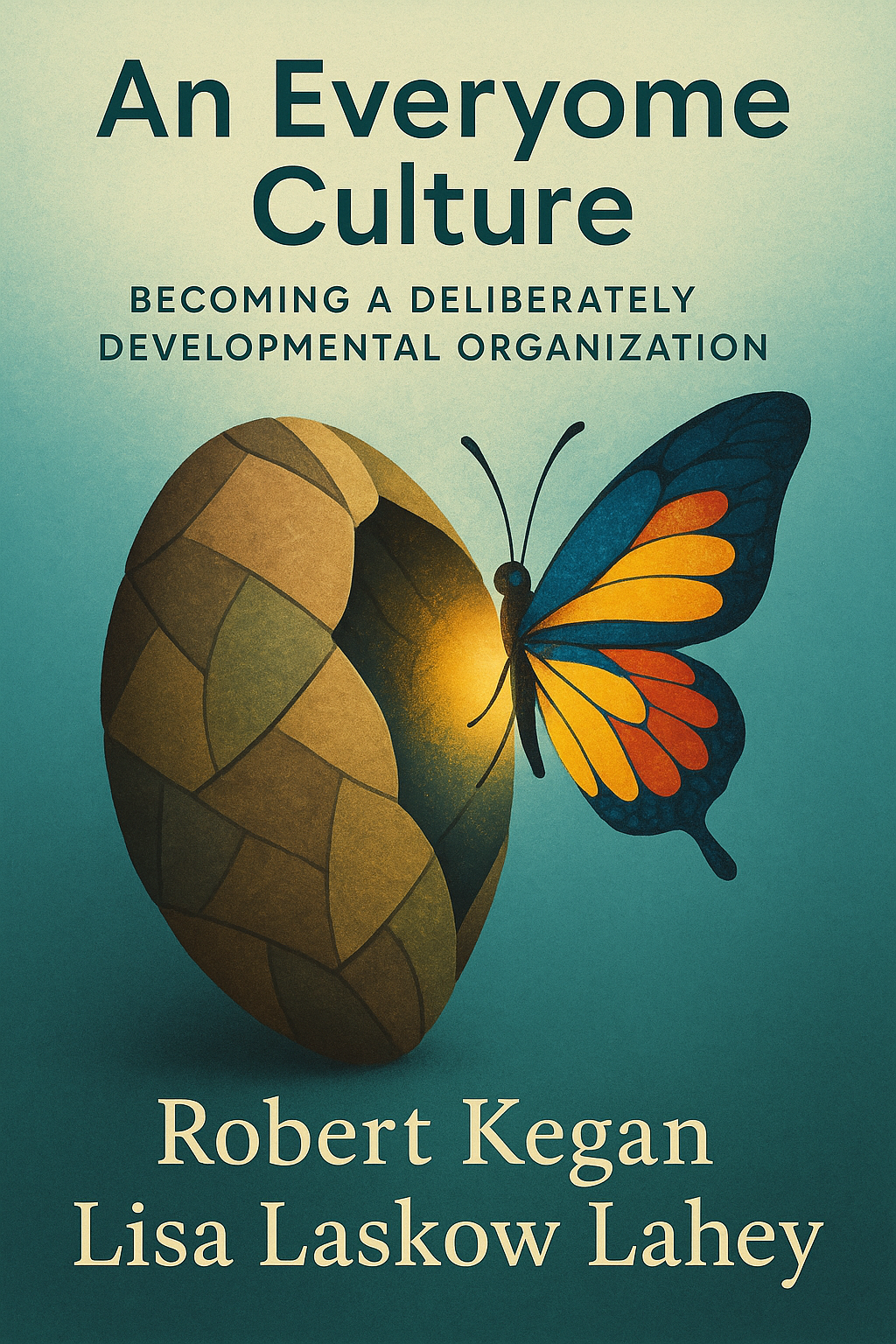
An Everyone Culture: Becoming a Deliberately Developmental Organization
Chapter Summaries
What's Here for You
Are you ready to fundamentally transform your organization and, in doing so, unlock unprecedented levels of human potential and business success? "An Everyone Culture" invites you on a groundbreaking journey into the heart of Deliberately Developmental Organizations (DDOs) – companies like Next Jump, Decurion, and Bridgewater that are not just succeeding, but thriving by prioritizing the deep, personal evolution of their people. This book promises more than just a new management strategy; it offers a profound redefinition of organizational growth, moving beyond superficial metrics like revenue and career ladders to explore the true development of the individual at the core of your business. Prepare to be challenged and inspired as you discover the interconnected dimensions of a DDO: the 'Edge' where growth happens, the 'Home' that fosters psychological safety, and the 'Groove' that embeds developmental practices into the very fabric of daily work. You'll learn to move beyond simply mimicking the practices of successful DDOs to understanding and cultivating their underlying spirit. This isn't about a softer, less demanding workplace; it's about creating a more robust, resilient, and high-performing business by embracing the inherent complexities of human development. Through compelling real-world examples and a deeply insightful conceptual framework, you will gain practical tools to uncover your organization's—and your own—biggest blind spots, those hidden patterns that hinder progress. You'll learn how to build the foundational 'Home' of a DDO, creating an environment where vulnerability is a strength and continuous learning is the norm. The tone is one of intellectual rigor, empathetic guidance, and transformative potential. It's a call to action for leaders and teams ready to move beyond the status quo and build organizations where everyone can grow, and in doing so, achieve extraordinary results. This is your invitation to a more meaningful, effective, and developmental way of running a business.
Meet the DDOs
The authors invite us into the heart of three uniquely structured organizations—Next Jump, Decurion, and Bridgewater—to witness firsthand what it means to be a Deliberately Developmental Organization, or DDO. This isn't a top-down overview, but a plunge into the raw, often uncomfortable, experience of these workplaces, where the central tension lies in confronting our automatic defenses against vulnerability. Robert Kegan and Lisa Laskow Lahey prepare us for this immersion, acknowledging that for many, especially leaders, the idea of embracing vulnerability at work can trigger alarm, leading to automatic self-protection—fleeing the text, distancing, or fighting against the ideas presented. They caution that these automatic reactions are not considered thoughts but rather forces that 'have you,' urging us to simply observe them for now. We first meet Next Jump, an e-commerce tech company that boldly reshapes its hiring through 'Super Saturday,' a rigorous process designed to reveal character over mere technical skill, exemplified by Nayan Busa's journey from insecurity to confident leadership through constant feedback and practice, embodying the principle that 'there is no way to get better other than to first do it, however poorly.' Next, we step into Decurion, a real estate and entertainment company, where the 'Theater Work Group' meeting, with its circular seating and deep 'check-ins' and 'check-outs,' fosters authentic engagement and community, as seen in the 'fishbowl' exercise where conflicts are not solved but allowed to reveal deeper patterns of thinking, illustrating their axiom that 'work is meaningful, that work gives meaning to peoples lives.' Finally, we encounter Bridgewater Associates, the high-performing hedge fund, where 'radical truth and radical transparency' are not just values but the very engine of their success, as demonstrated in the 'diagnosis' of Sergio's 'reliability issue,' pushing beyond surface behaviors to unearth root causes, reminding us that 'pain, reflection, progress' is the necessary cycle for true growth. Despite their diverse industries and distinct cultures—from Next Jump's 'no firing' policy to Bridgewater's machine-like operational view—these DDOs share a profound commonality: they are built for human development, integrating personal growth directly into the business of doing business, creating a seamless fusion of business excellence and the evolution of people into more capable versions of themselves, a radical departure from ordinary organizations that often relegate vulnerability and personal growth to the shadows.
What Do We Mean by Development?
Robert Kegan and Lisa Laskow Lahey, in their chapter 'What Do We Mean by Development?', invite us to look beyond the common business metrics of growth—revenue, size, or career advancement—and delve into a more profound concept: the development of the person having the career, the evolution of the organization into a better version of itself. For over a century, researchers have charted the human capacity to construct reality, observing how this construction becomes more expansive, less distorted, and less reactive over time, a journey that extends well into adulthood, challenging the old notion that mental development plateaus in our twenties. Their research reveals a trajectory of adult development marked by distinct plateaus—the socialized mind, the self-authoring mind, and the self-transforming mind—each representing a unique way of knowing and operating in the world. The socialized mind, shaped by external expectations, can lead to phenomena like groupthink, where alignment with others overrides individual judgment, as seen in the cautionary tales of individuals needing to please or save face. In contrast, the self-authoring mind develops an internal compass, a personal authority that evaluates external demands against its own belief system, enabling focus and direction, though it can also lead to rigidity if the plan is flawed or the world shifts. The self-transforming mind, however, can step back from its own ideology, embracing contradiction and seeing its own framework as partial, allowing for continuous adaptation and a deeper engagement with complexity. This nuanced understanding of mental complexity, they argue, is not merely theoretical; it directly correlates with work competence and effectiveness, particularly in leadership roles navigating today's volatile, uncertain, complex, and ambiguous world. The prevailing demand in modern organizations, shifting from an emphasis on following directions to needing innovation and self-direction, requires a populace operating at least at the self-authoring level, and leaders capable of self-transformation. Yet, the data suggests a significant gap: a majority of adults operate at or below the socialized mind, and even promising managers and CEOs often struggle to transcend the self-authoring stage, creating a profound disconnect between organizational demands and individual capacity. Therefore, a deliberately developmental organization (DDO) is not just about business expansion, but about cultivating this deeper form of personal and collective evolution, acting as an incubator for development through practices like continuous, deep feedback that probes underlying mindsets, not just behaviors, and by valuing disturbances that spur transformation. This scientific approach to organizational design, focused on development rather than mere efficiency, offers a powerful lens for understanding how organizations can truly foster growth, moving individuals and the collective toward more complex, capable, and insightful ways of being and working.
A Conceptual Tour of the DDO
Robert Kegan and Lisa Laskow Lahey invite us on a conceptual tour of the Deliberately Developmental Organization, revealing a dynamic system built on three interconnected dimensions: Edge, Home, and Groove. They explain that a DDO isn't merely an accelerated version of business as usual, nor is it solely about employee benefits or conscious capitalism; instead, it fundamentally rethinks the very place of people development in organizational life. The core insight is that adults, like children, can and need to grow continuously, a principle that challenges the deeply ingrained organizational norm of preserving personal standing and hiding weaknesses. Instead, DDOs like Bridgewater, Decurion, and Next Jump actively transform weaknesses and errors into opportunities for growth, viewing them as valuable assets. This is exemplified by Bridgewater’s requirement to log failures, or Next Jump’s compensation model tying 50% to cultural contribution, demonstrating a commitment to relentless people development over mere process improvement. These organizations are not run on slogans but on deeply held developmental principles that animate daily decisions, ensuring that the 'bottom line' is not a choice between profit and development, but a single, integrated pursuit where each fuels the other. The 'Groove,' the set of developmental practices, actively cultivates this by embracing constructive destabilization, pushing individuals beyond their comfort zones, and minding the gaps—those silences and hidden assumptions that hinder progress. By setting the time scale for growth, not closure, and recognizing the interior life as manageable, DDOs foster environments where individuals can bring their whole selves to work. This is made possible by the 'Home,' a community where rank does not shield individuals from honest feedback, and where everyone, not just HR, is responsible for people development. This communal structure, built on trust and goodwill, is vital for supporting the vulnerability required for growth. Ultimately, Kegan and Lahey reveal that a DDO is a demanding yet exhilarating environment, a place where the hard work of confronting limitations, supported by a trustworthy community and driven by developmental aspirations, leads to profound personal and organizational flourishing, transforming the very fabric of work life.
In the Groove
Robert Kegan and Lisa Laskow Lahey, in their chapter 'In the Groove,' invite us to move beyond merely copying the practices of Deliberately Developmental Organizations (DDOs) and instead to understand the very spirit of 'practice' itself, revealing how these organizations cultivate a culture where continuous growth is not an add-on, but the very fabric of work. They explain that unlike traditional performance-oriented cultures, where the aim is to showcase expertise and hide flaws, DDOs are designed for 'practice' – a mindset of repeated effort with the intention of becoming better, embracing experimentation, and welcoming feedback as fuel for learning. This shift from performance to practice, they illustrate through vivid examples from Bridgewater, Next Jump, and Decurion, is transformative. At Bridgewater, tools like the Dot Collector and Issues Log create a 'pointillist picture' of individuals, fostering radical transparency and self-awareness, while digital 'baseball cards' map out strengths and weaknesses, serving as a guide for development rather than a fixed destiny. Next Jump emphasizes 'character as a muscle,' using 'Talking Partners' and 'Situational Workshops' to help individuals confront their 'backhands' or limitations, fostering humility and confidence through structured rituals and peer coaching. Decurion, particularly within its ArcLight cinema settings, uses 'touchpoints,' 'pulse-check huddles,' and 'competency boards' to integrate personal growth into the daily workflow, believing that every role, no matter how seemingly simple, is an opportunity for profound development and that people are 'ten times more capable than you think.' The core tension lies in moving from a culture that rewards what you already know and can do, to one that thrives on what you are learning and striving to become, a shift that requires creating a 'holding environment' where vulnerability is well-held, feedback is continuous, and growth is supported across every stage of development. Ultimately, Kegan and Lahey show that these practices, when deeply embedded and systemic, don't just improve business results; they foster a pandevelopmental culture, an 'everyone culture,' where individuals are constantly challenged and supported to evolve into better versions of themselves, transforming the very nature of work into a continuous journey of becoming.
But Is This Any Way to Run a Business?
Robert Kegan and Lisa Laskow Lahey, in their chapter 'But Is This Any Way to Run a Business?', delve into the often-misunderstood value of Deliberately Developmental Organizations (DDOs), challenging the notion that their focus on employee growth detracts from business success. The authors present compelling evidence from companies like Bridgewater, Next Jump, and Decurion, demonstrating that these organizations not only achieve conventional business success but often do so precisely *because* of their developmental cultures. The central tension arises from the common skepticism that investing heavily in employee development is a costly indulgence, a distraction from the hard realities of profit and loss; however, the authors reveal that this is a fundamental misunderstanding, likening the DDO’s approach to a sophisticated business strategy rather than a mere philanthropic impulse. They illustrate how Next Jump transformed its business by continuously transferring authority downward and reconstituting the role of the coach, effectively turning its operations into a 'captain-creating machine' and radically altering its work curriculum and pedagogy, much like a school redesigns its teaching methods. Similarly, Bridgewater's CEO, Greg Jensen, asserts that their culture is not merely a contributor but the very *cause* of their success, enabling independent thought, deep insight, and humility—qualities crucial for navigating complex markets, as evidenced by their performance during the 2008 economic crisis. Bridgewater’s radical transparency, exemplified by its 'issues log' where mistakes are cataloged for collective learning rather than punishment, and its practice of taping conversations to foster direct communication, combats two corrosive workplace dynamics: hiding weaknesses and speaking negatively behind colleagues' backs, thereby redirecting immense energy toward actual work. Decurion further illuminates this by framing development and profitability not as a trade-off but as 'one thing,' an axiom of integrity that fuels engaged employees and memorable customer experiences, transforming roles from mere job functions into opportunities for profound personal and business growth, as seen in their ambitious Hawaii real estate project and senior living facilities. Ultimately, the authors posit that while many paths may lead to business success, the DDO model, with its focus on adaptive challenges that require fundamental shifts in mindsets—a 'jet engine culture'—may be uniquely suited to navigating the increasingly complex and uncertain business landscape of the 21st century, suggesting that what is often perceived as a 'nice-to-have' developmental focus is, in fact, the engine driving sustainable, long-term business excellence.
Uncovering Your Biggest Blind Spot
Robert Kegan and Lisa Laskow Lahey invite us into a profound exploration of self-awareness in 'Uncovering Your Biggest Blind Spot,' a chapter designed to illuminate the hidden patterns that unconsciously hold us back. Much like a seasoned documentary narrator guiding us through a complex landscape, they introduce the Immunity to Change (ITC) exercise, a powerful tool for self-discovery. It begins with identifying a personal growth goal, your 'one big thing,' a commitment to becoming a 'better me,' as Charlie Kim of Next Jump might say. But the real journey unfolds as we are prompted to honestly inventory the actions, and inactions, that sabotage this very goal. This is where the tension truly builds, forcing us to confront our own 'backhand,' the embarrassing or painful truth we might otherwise avoid, much like Jackie's realization about her own arrogance. The authors reveal that transformational change doesn't stem from mere willpower, but from excavating the deeper anxieties and fears that drive these self-sabotaging behaviors. These fears, when examined, lead to the identification of 'hidden competing commitments' – unconscious strategies designed to protect us from perceived danger, creating an internal immune system that, while intelligent, can misfire. Nora Dashwood’s struggle with being less controlling, or Bob Prince’s challenge with project execution, exemplify this. Dashwood’s fears of not being seen as valuable or losing her sense of self, and Prince’s fear of being held back by others, reveal the unseen brakes on their conscious goals. The crucial insight here is that these hidden commitments are not irrational; they are sensible self-protections, albeit ones that paradoxically keep us stuck. The narrative then guides us to uncover the 'big assumptions' – the core beliefs that sustain this immunity, the deeply held truths we operate under, such as Dashwood’s assumption that her value comes from having the 'right view,' or Prince’s that he 'knows best.' These assumptions, when brought into the light, can be examined, tested, and potentially dismantled, much like a scientist testing a hypothesis. The authors emphasize that this process, while potentially uncomfortable, is essential for genuine growth, offering a glimpse into the spacious context of our unfolding development and the freedom that comes from understanding our own internal immune system, ultimately enabling us to move beyond cognitive understanding to genuine, embodied transformation.
Creating Home
Robert Kegan and Lisa Laskow Lahey, in their chapter 'Creating Home,' guide us through the nascent stages of organizational transformation, emphasizing that the journey toward becoming a Deliberately Developmental Organization (DDO) begins not with grand pronouncements, but with the cultivation of a 'home'—a supportive environment for vulnerability and growth. They reveal that initiating this profound shift requires leaders to act as enthusiastic exemplars, visibly participating in their own developmental journey, a principle exemplified by pioneers like Bridgewater and Next Jump. Even without formal authority, individuals can champion DDO ideals by forming developmental partnerships, seeking feedback, and sharing their growth aspirations, a practice illustrated by the 'Being Deliberately Developmental without a DDO' box. The narrative then immerses us in the story of XYZ, Inc., a colossal multinational that, despite immense success with a top-down, efficiency-driven culture, courageously decides to pivot towards innovation and collaboration, embracing the adaptive challenge of changing mindsets, not just skill sets. This monumental undertaking involves creating a 'new kind of home' for vulnerability, starting with top leadership and cascading through the organization via workshops and digital platforms, ultimately demonstrating that even vast corporations can foster personal and collective learning. The authors introduce the 'Four-Box Model' as a heuristic for a holistic perspective, reminding us to attend to the organizational and individual, the external and internal dimensions of change. Frazier Deeter, a CPA firm, embarks on a 'middle-out' approach with its 'Lead FD' pilot, focusing on developing future business drivers by fostering a culture where people development is both a means and an end, using the Immunity to Change (ITC) map to address deeply ingrained assumptions. WellMed, a physician-led healthcare company, confronts its own 'organizational interior' by encouraging doctors to examine their own discomfort with vulnerability and internal conflict, creating a collective 'home' for candid self-examination. Suncor's Strategic Innovation division, though small, becomes a deliberate developmental 'island' within a larger corporation, using its physical space and reflective practices like fishbowl conversations to foster 'leadership in the nude' and address tensions between individual growth and collective purpose. Finally, Georgia Tech's Flashpoint startup studio exemplifies how a structured curriculum, integrating DDO and ITC principles, can create a crucible for entrepreneurs to confront their assumptions and develop the 'mindset change' essential for realizing their visions. Across these diverse examples, Kegan and Lahey underscore that starting a DDO is not about a checklist but about engaging head, heart, and hand, building a safe, dependable, and collectively ascribed-to 'home' where practices like ITC can thrive, transforming violations into curriculum and fostering a continuous, adaptive journey of growth.
Conclusion
An Everyone Culture fundamentally redefines organizational success by positing that true business excellence is inextricably linked to, and indeed fueled by, the continuous, deliberate development of its people. Kegan and Lahey present a compelling argument that organizations can, and must, integrate human growth directly into their operational fabric, transforming challenges, feedback, and even errors into potent catalysts for individual and collective advancement. The emotional core of this paradigm shift lies in embracing professional vulnerability; acknowledging that our automatic defensive reactions to critique or new ideas are not impediments, but rather signposts pointing toward deeper, more ingrained mindsets and ego defenses that require gentle, yet persistent, exploration. This journey necessitates moving beyond surface-level behaviors to diagnose and address the root causes of limitations, fostering a culture where the 'personal' and 'public' spheres merge, allowing individuals to bring their whole, imperfect selves to work. The practical wisdom gleaned is profound: organizations must cultivate a 'home'—a safe, trustworthy environment where vulnerability is supported and development is a shared responsibility. This involves shifting from a performance culture to a culture of practice, where continuous learning, experimentation, and honest feedback are the norm. The authors offer a roadmap, including the Immunity to Change process, for individuals and organizations to uncover their 'blind spots,' challenge deeply held 'big assumptions,' and design experiments to foster lasting transformation. Ultimately, An Everyone Culture champions a holistic vision where organizational effectiveness, innovation, and resilience are not achieved *despite* a focus on employee growth, but *because* of it, creating a mutually reinforcing pursuit of human flourishing and profitability.
Key Takeaways
Embracing professional vulnerability, though uncomfortable and automatically resisted, is the crucible for genuine personal and organizational development.
Deliberately Developmental Organizations (DDOs) integrate human growth directly into business operations, viewing challenges and feedback as essential tools for development, not impediments to productivity.
The pursuit of business excellence and personal growth are not separate goals but intrinsically linked, with each fueling the other within a DDO framework.
Automatic defensive reactions to challenging feedback or new ideas signal an opportunity for self-awareness, rather than a reason to dismiss the information.
True development requires moving beyond surface-level behaviors to diagnose and address the root causes of limitations, often rooted in ego or deeply ingrained mindsets.
The 'personal' and 'public' spheres are not to be separated in a developmental workplace; bringing one's whole self, including imperfections, is essential for authentic engagement and growth.
True organizational and personal development transcends mere growth in size or revenue, focusing instead on qualitative advances in mental complexity and the ability to construct reality more expansively.
Adult mental development is a continuous, non-linear journey, progressing through distinct plateaus—socialized, self-authoring, and self-transforming minds—each characterized by a different way of making meaning and interacting with the world.
The demands of the modern world necessitate a higher level of mental complexity, particularly the self-authoring and self-transforming mindsets, to foster innovation, self-management, and adaptability.
A significant gap exists between the mental complexity demanded by contemporary organizations and the actual capabilities of most adults, creating a critical challenge for both individuals and leadership.
Deliberately Developmental Organizations (DDOs) actively cultivate deeper personal development through practices that challenge existing mindsets, such as continuous, probing feedback and the strategic use of 'disturbances' to foster growth.
Organizational effectiveness, especially in leadership, is directly correlated with higher levels of mental complexity, as individuals capable of more sophisticated meaning-making can navigate complex environments more adeptly.
A Deliberately Developmental Organization (DDO) fundamentally rethinks organizational design around continuous adult growth, challenging the norm of hiding weaknesses.
DDOs transform errors and weaknesses into valuable assets, viewing them as prime opportunities for individual and collective development, rather than threats to personal standing.
Developmental principles, deeply embedded in daily practices and decisions, guide DDOs, integrating human flourishing and profitability into a single, mutually reinforcing pursuit.
Constructive destabilization and actively closing organizational 'gaps' are crucial practices that foster growth by pushing individuals beyond comfort zones and encouraging authentic communication.
A DDO's 'Home' community is vital, providing a trustworthy environment where vulnerability is supported, rank does not confer immunity from feedback, and people development is everyone's responsibility.
The 'time scale' in DDOs is set for growth and learning, recognizing that addressing root causes of limitations, though seemingly inefficient, leads to greater long-term effectiveness and success.
Organizations must shift from a culture of performance, which emphasizes displaying existing expertise, to a culture of practice, which embraces continuous learning, experimentation, and the acceptance of feedback to foster growth.
Deliberately Developmental Organizations (DDOs) employ systemic practices that embed personal development into the daily workflow, making growth an integral part of job requirements rather than an add-on.
Radical transparency and objective self-awareness, facilitated by tools like feedback aggregation and documented strengths/weaknesses, are crucial for individuals to understand and address their limiting patterns of thinking and behavior.
Character development, viewed as a muscle that can be strengthened through consistent practice and peer support, is a critical component of effective leadership and decision-making.
A 'holding environment' that offers well-held vulnerability, continuous feedback, and opportunities for 'letting go' and 'sticking around' is essential for supporting individuals at all stages of their developmental journey.
The most effective developmental practices challenge individuals to move from simpler, concrete thinking to more complex, systemic analysis, helping them to organize information and transcend current mindsets.
DDOs cultivate unique languages and routines that normalize and support the challenging work of self-improvement, making it a shared endeavor rather than an isolated struggle.
Deliberately Developmental Organizations (DDOs) achieve business success not *despite* their focus on employee growth, but *because* of it, integrating human development as a core business strategy.
The core of DDO success lies in transforming work itself into a learning environment, characterized by a continuously evolving 'curriculum' (complex challenges) and 'pedagogy' (supportive coaching and feedback), mirroring educational reform.
Radical transparency and direct feedback, as practiced by DDOs like Bridgewater, are essential for combating the hidden costs of impression management and gossip, freeing up energy for productive work.
The principle of 'oneness' in DDOs, as exemplified by Decurion, dissolves the false dichotomy between employee development and business profitability, viewing them as interconnected and mutually reinforcing.
DDOs are uniquely equipped to address 'adaptive challenges'—those requiring fundamental shifts in mindsets and operating systems—rather than just 'technical challenges,' making them resilient in volatile environments.
The 'developmental pull' created by DDOs uses business growth requirements to inspire individuals to overcome limiting assumptions and achieve higher levels of capability, benefiting both the employee and the organization.
Identify your 'one big thing' (OBT) for personal growth, a concrete improvement goal, not a desired outcome, to serve as the foundation for self-discovery.
Uncover your 'backhand' by listing specific behaviors (doing and not doing) that unconsciously undermine your OBT, requiring brutal honesty and often external feedback.
Explore the fears and worries associated with acting opposite to your undermining behaviors to reveal hidden competing commitments, the unconscious self-protective strategies that create your 'immunity to change.'
Recognize that these hidden commitments are not signs of weakness but sensible, albeit often misguided, self-protections that paradoxically prevent you from achieving your conscious goals.
Identify the 'big assumptions' – core beliefs about yourself and the world – that underpin your hidden commitments, as these assumptions are the bedrock of your resistance to change.
Testing these big assumptions through deliberately designed experiments is crucial for disrupting your immune system and enabling genuine, lasting transformation beyond willpower.
The genesis of a Deliberately Developmental Organization (DDO) lies in creating a 'home'—a safe, dependable, and collectively embraced environment that fosters necessary vulnerability for deep learning and growth.
Transitioning to a DDO is an adaptive challenge requiring a fundamental shift in mindsets, not just skill sets, necessitating the unearthing and transformation of deeply held, often hidden, personal and collective assumptions.
A holistic approach, as embodied by the Four-Box Model, is crucial for DDO transformation, demanding simultaneous attention to organizational aspirations (upper-left), individual capabilities (upper-right), and the internal dynamics of both collective and individual mindsets (lower-left and lower-right).
Initiating DDO practices, such as the Immunity to Change (ITC) process, must be supported by robust, repeatable structures and community agreements ('home') to ensure they become self-sustaining organizational norms rather than dependent on external consultants.
The journey toward becoming a DDO is a continuous, iterative process of practice, reflection, and adaptation, where 'violations' of norms become opportunities for collective learning, and where individual development is intrinsically linked to organizational progress.
Leaders initiating DDO efforts must serve as visible, enthusiastic exemplars, demonstrating openness and vulnerability to foster trust and encourage participation from all levels of the organization.
For any organization, cultivating a developmental culture requires establishing shared norms and agreements that explicitly support interior work and mutual development, transforming potential conflicts into catalysts for growth.
Action Plan
Identify your automatic reactions (fleeing, distancing, fighting) when confronted with challenging feedback or new ideas.
Practice 'checking in' at the start of meetings to acknowledge your presence and internal state before engaging with the work.
When facing a problem, resist the urge to jump to solutions; instead, pause to diagnose the root causes of the issue.
Seek opportunities to give and receive candid feedback, focusing on specific behaviors and their underlying patterns rather than personal attacks.
Consciously invite vulnerability into your professional interactions, even when it feels uncomfortable.
Reflect on a recent 'painful' work experience, analyzing what it reveals about your limitations and how you can learn from it.
Explore how your personal growth can be intentionally integrated into your daily work tasks and challenges.
Reflect on your own 'meaning-making logic' by considering how you interpret and respond to feedback, expectations, and challenges, identifying whether you lean towards aligning with others (socialized), directing your own path (self-authoring), or questioning the path itself (self-transforming).
Challenge a deeply held assumption or belief by actively seeking out perspectives that contradict it, and observe your internal reaction to this dissonance.
Identify a situation where you typically react predictably and consciously experiment with a different approach, even if it feels uncomfortable or less efficient in the short term.
Practice offering feedback that probes beyond behavior to the underlying assumptions or mindsets, asking 'why' questions that encourage deeper self-reflection in yourself and others.
Seek out experiences that intentionally create 'disturbances' or introduce complexity, such as taking on a project outside your comfort zone or engaging with individuals who hold significantly different views.
Analyze a recent work challenge or organizational demand through the lens of mental complexity, considering how a socialized, self-authoring, or self-transforming mindset might interpret and address it differently.
Consciously observe how information flows around you in your workplace, noting who shares what, how it's received, and whether the underlying mental complexity of the participants influences the communication.
Identify one personal limitation or 'weakness' and reframe it as a potential learning opportunity.
Seek out opportunities to provide and receive candid, constructive feedback within your team or organization.
Practice open communication by sharing your thoughts and feelings more authentically, even when it feels uncomfortable.
Actively look for 'gaps'—misalignments between words and actions, or unspoken assumptions—and initiate conversations to address them.
Ask yourself and others, 'What are we learning from this situation?' rather than solely focusing on the outcome.
Consider how your current role might be 'destabilizing' you in a productive way, pushing you to develop new skills.
Identify and embrace one specific practice from your daily work that you can approach with a mindset of 'practice' rather than 'performance' (e.g., a recurring meeting, a communication task).
Seek out opportunities to give and receive feedback with a focus on learning and improvement, rather than judgment or defense.
Begin documenting your own 'strengths' and 'watchoutfors' (areas for development) to foster self-awareness, perhaps in a personal journal.
Engage in a 'talking partner' or peer coaching conversation, focusing on mutual support and candid feedback about developmental challenges.
Reflect on a recent work situation and try to identify the underlying mindset or assumptions that led to your actions, rather than just focusing on the outcome.
Actively look for ways to connect your personal growth goals to your current work responsibilities, even in small ways.
Consider how you might create a 'holding environment' for yourself or others, where vulnerability is met with support and inclusion.
Identify and communicate a clear vision where employee development and business goals are seen as one integrated pursuit, not separate or competing objectives.
Actively transfer authority downward, assigning more complex responsibilities to individuals at lower levels and providing the necessary support for them to succeed.
Reconstitute the role of coaching and feedback within your organization, ensuring it is integrated into daily work and delivered by individuals who understand the context.
Implement practices that foster radical transparency, such as creating systems for openly discussing mistakes and challenges, encouraging direct communication over gossip.
Assess your organization's primary challenges: are they technical (requiring new skills) or adaptive (requiring mindset shifts), and tailor your approach accordingly.
Create 'developmental pulls' by setting ambitious business goals that inherently require employees to stretch their capabilities and grow beyond their current limitations.
Identify your 'one big thing' – a specific, actionable personal growth goal that feels important to you.
List concrete behaviors (what you do and don't do) that work against your improvement goal, seeking feedback from trusted sources if needed.
For each undermining behavior, imagine doing the opposite and name the fears or worries that arise.
Restate your fears as hidden commitments, expressing what you are committed to doing to prevent those feared outcomes.
Identify the 'big assumptions' – core beliefs about yourself and the world – that support these hidden commitments.
Design a safe and modest test to challenge one of your big assumptions by acting contrary to your usual behavior or hidden commitment.
Reflect on the results of your test, gathering data to see if your big assumption holds true.
Identify and articulate a clear organizational aspiration or challenge that requires a shift in mindset and behavior.
Begin cultivating a 'home' by fostering psychological safety and encouraging vulnerability among team members, starting with your own example.
Utilize tools like the Immunity to Change (ITC) map to explore personal and collective assumptions that may be hindering growth.
Establish clear, shared norms and agreements that support developmental work and open dialogue, even when it involves uncomfortable conversations.
Practice active listening and empathetic inquiry to understand colleagues' perspectives and underlying assumptions, rather than solely focusing on solutions.
Seek or provide regular, constructive feedback that addresses mindsets and behaviors, viewing challenges as opportunities for collective learning.
Experiment with new practices and structures that encourage continuous learning and adaptation, integrating developmental work into daily routines.