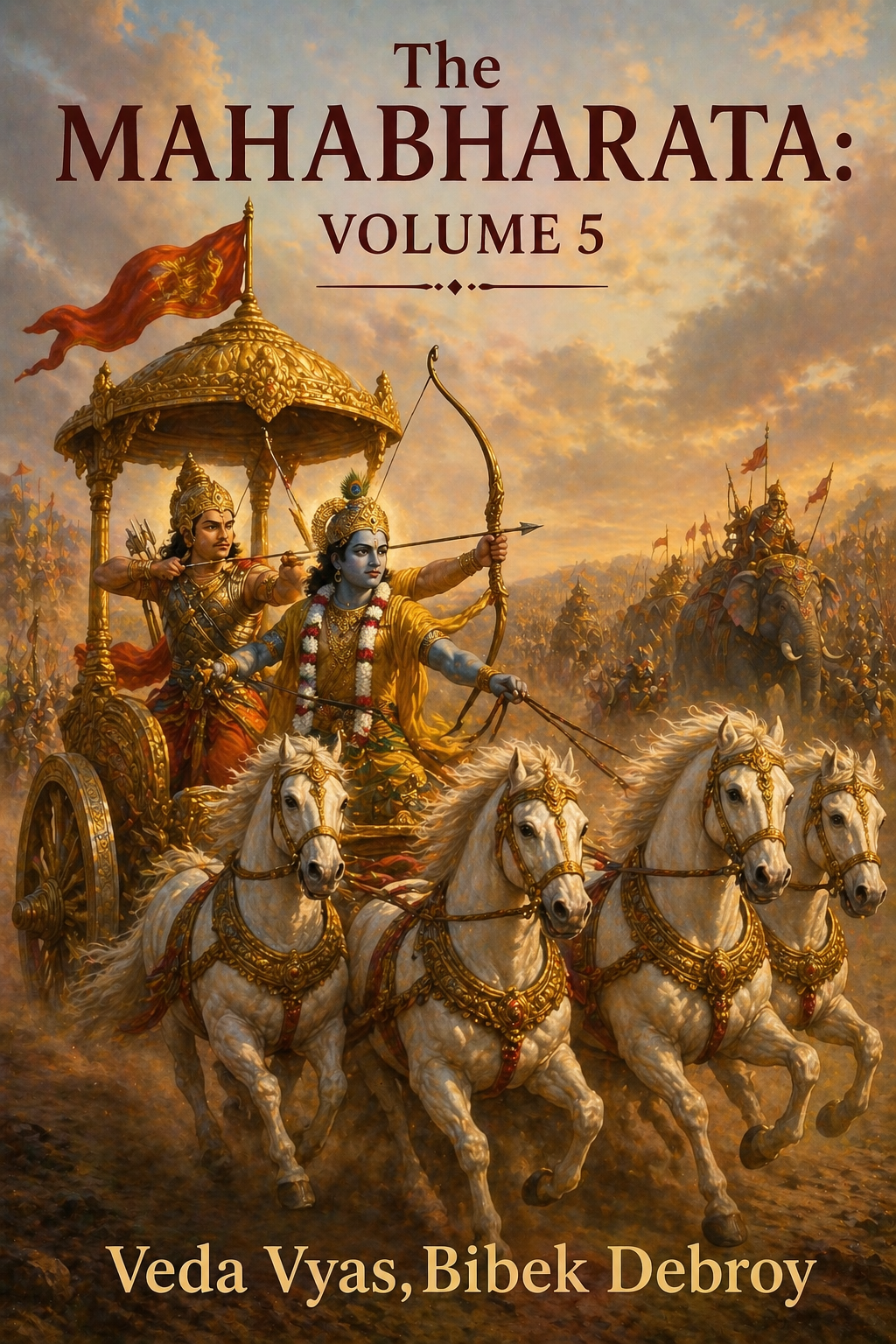
The Mahabharata: Volume 5
Chapter Summaries
What's Here for You
Venture into the heart of the Mahabharata's tumultuous turning point with Volume 5. Here, amidst the clash of armies and the fall of titans, you'll witness the unraveling of destinies woven with revenge, prophecy, and profound moral dilemmas. Through vivid narrations and geographical expositions, the epic unfolds, revealing the fall of Bhishma, the rise of Drona, and the unwavering oaths that drive men to self-destruction. Prepare to grapple with grief, ambition, and the very essence of dharma as the stage is set for the war's most decisive moments. This volume offers not just a story of battle, but a deep exploration of human nature, fate, and the agonizing choices that define an era. Expect a journey filled with somber reflection, strategic intrigue, and the relentless pursuit of vengeance, all rendered with the epic scope and emotional depth that defines the Mahabharata.
Amba-Upakhyana Parva
In the *Amba-Upakhyana Parva* of *The Mahabharata*, Veda Vyas, as narrated by Bibek Debroy, unveils a poignant tale of revenge and destiny, setting the stage for the impending war. Duryodhana questions Bhishma's reluctance to fight Shikhandi, prompting Bhishma to recount the story of Amba. Bhishma abducted Amba and her sisters, Ambika and Ambalika, for his brother Vichitravirya, only for Amba to reveal her love for King Shalva. Released to Shalva, she is then rejected, caught between societal expectations and personal desires, a predicament that leaves her feeling like a discarded snake skin. Amba's anger simmers, hardening into a vow of vengeance against Bhishma, whom she sees as the root of her suffering. She seeks refuge and guidance, her pleas echoing through the hermitages, a constant reminder of her plight. The narrative tension rises as Amba's determination intensifies, leading her to Rama, the ascetic warrior, setting the stage for a confrontation with Bhishma. Rama's intervention proves futile, and Amba, embodying relentless resolve, undertakes severe austerities, sacrificing her body to be reborn as Shikhandi, a catalyst for Bhishma's downfall. The instructor highlights that Amba's story underscores the power of *karma* and the cyclical nature of destiny, illustrating how choices, even those made with noble intentions, can lead to unforeseen and devastating consequences. The chapter reveals that societal norms can trap individuals, forcing them into roles that contradict their true desires, leading to profound suffering and a burning desire for retribution. It emphasizes that true strength lies not only in physical prowess but also in unwavering determination and the willingness to defy societal expectations in pursuit of justice. The narrative illustrates that revenge can consume a person's life, driving them to extreme measures and reshaping their very existence. Additionally, the author highlights that divine intervention and boons often come with conditions, reminding us that even supernatural forces are bound by the laws of *dharma*. The chapter serves as a reminder that individuals, when wronged, may go to extraordinary lengths to seek justice, even if it means sacrificing everything. Finally, the story of Amba becoming Shikhandi reveals the complex interplay between fate and free will, suggesting that while destiny may set the stage, individuals have the power to shape their own roles in the unfolding drama.
Jambukhanda-Vinirmana Parva
In the Jambukhanda-Vinirmana Parva of the Mahabharata, Vaishampayana recounts the prelude to war and Vyasa's somber prophecies. Janamejaya inquires about the Kurukshetra battle, setting the stage for a description of armies gathering, vast as Jambudvipa itself, and the establishment of war's dharma—rules of engagement meant to temper the coming slaughter. Vyasa, the seer, witnesses omens, a sky filled with headless torsos and blazing stars, portending destruction and advising Dhritarashtra, blind in sight and perhaps in spirit, of the impending doom. Dhritarashtra is offered sight to witness the war, but declines, unable to bear the vision of his kin's annihilation, choosing instead to hear of it through Sanjaya’s divinely granted sight. Vyasa details the ill omens, nature itself revolting—cows birthing asses, trees flowering out of season—a world turned upside down, reflecting the moral inversions to come. He speaks of planetary alignments, comets, and a sun swallowed by Rahu, painting a canvas of cosmic imbalance reflecting earthly chaos. Vyasa urges Dhritarashtra to choose dharma, to restrain his sons, yet acknowledges the pull of destiny, a river dragging them toward inevitable destruction, highlighting that where dharma exists, victory resides. Sanjaya then describes the earth, its beings, its elements, and the island of Sudarshana, a world of circular form, rich with rivers and mountains, mirrored in the moon’s disc. He details the mountains, the varshas, and the divine Mount Meru, a golden axis mundi, always circled by the sun and moon, a sensory image of the world’s structure. Dhritarashtra seeks to know Bharatavarsha, the land for which his son hungers, and Sanjaya describes its rivers, mountains, and the people dwelling within, a land coveted by kings, a prize worth dying for, yet a source of endless greed. Sanjaya explains the nature of time itself, the yugas cycling through ages of virtue and decay, emphasizing that the present age, fraught with wrath and greed, is nearing its end, and the earth, if cared for, is a milch cow yielding desires, but in the hands of the greedy, it becomes a battleground, a space where dharma is forgotten.
Bhumi Parva
In Bhumi Parva, Sanjaya embarks on a detailed geographical exposition for Dhritarashtra, painting a cosmic cartography of the earth. He begins by delineating Jambukhanda, then expands outward, describing the dimensions and characteristics of Shakadvipa, Kushadvipa, Shalmalidvipa, and Krounchadvipa, each doubling in size, surrounded by oceans of salt, milk, clarified butter, curd, liquor, and even sweat. Sanjaya navigates through these lands, revealing their unique mountains, rivers, and inhabitants, each dvipa a mirror reflecting different aspects of dharma and existence. He explains that in Shakadvipa, the Magas are devoted brahmanas, while the kings of Mashaka are devoted to dharma, revealing a society where roles are intrinsically tied to spiritual and ethical conduct. However, Dhritarashtra’s questioning reveals a tension: the reason behind the diverse complexions of people in different regions; Sanjaya clarifies that dvipas host fair, dark, and mixed complexions, each contributing to the unique identity of their land. Sanjaya further describes the mountains, like Goura made of red arsenic, and the rivers, each sustaining life and dharma in its unique way. The narrative crescendos as Sanjaya shifts from terrestrial to celestial dimensions, describing the planets and Svarbhanu, detailing their sizes and orbits, illustrating a cosmos governed by balance and order. He notes that Rahu's periodic enveloping of the moon and sun serves as a cosmic reminder of the cyclical nature of existence. Ultimately, Sanjaya’s vivid descriptions serve not only to educate Dhritarashtra but also to offer a path to peace, urging him to pacify Duryodhana, suggesting that understanding the universe's vastness can lead to harmony in earthly affairs, and reminding us that listening to such accounts can increase life expectancy and honor ancestors, connecting the listener to a lineage of wisdom and virtue.
Bhagavad Gita Parva
In the Bhagavad Gita Parva of the Mahabharata, as narrated by Vaishampayana, the story opens with Sanjaya's somber announcement to Dhritarashtra: Bhishma has fallen, a blow that reverberates through the Kuru lineage and the entire kingdom. Dhritarashtra, grief-stricken, seeks to understand how such an invincible warrior could be defeated, setting the stage for the Bhagavad Gita's teachings. The tension rises as Arjuna, faced with the prospect of fighting his own kin, is overcome by doubt and refuses to engage in battle. It's here that Krishna steps in, offering profound wisdom, revealing that true victory lies not in physical strength but in adherence to dharma, truth, non-violence, and earnest endeavor; the path to triumph, Krishna suggests, transcends mere valor. Like a skilled charioteer guiding his chariot, Krishna leads Arjuna through the complexities of duty and detachment, emphasizing that one must act without attachment to the fruits of action, understanding that the soul is eternal, indestructible, and beyond the reach of earthly weapons. Krishna further elucidates the concept of yoga, urging Arjuna to perform his prescribed action with an equal mind, viewing happiness and unhappiness, gain and loss, victory and defeat with equanimity, thereby freeing himself from sin. As their dialogue deepens, Krishna unveils the path of knowledge, revealing the importance of understanding the self and the nature of the universe, distinguishing between the transient and the eternal, and stresses that those who act without ego, dedicating their actions to the divine, achieve liberation. The crescendo of their discourse arrives with Krishna revealing his divine form to Arjuna, a dazzling display of cosmic proportions, solidifying Arjuna's understanding of the divine's omnipresence and omnipotence; this vision is a sensory awakening, a reminder that the divine pervades all existence. Finally, Krishna summarizes the paths to liberation, distinguishing between divine and demonic qualities, and urges Arjuna to embrace his duty with unwavering devotion and faith, emphasizing that by surrendering to the divine will, one can overcome all obstacles and attain the supreme goal. Thus, the Bhagavad Gita Parva offers timeless wisdom, guiding individuals towards a life of purpose, detachment, and devotion, even amidst the chaos of conflict.
Bhishma Vadha Parva
Part 1: In the *Bhishma Vadha Parva*, Sanjaya recounts the initial ten days of the Mahabharata war, a period marked by intense conflict and moral questioning, where victory seems as elusive as grasping smoke. The narrative opens with Yudhishthira's unsettling act of seeking permission from his elders before battle, an act that confuses and dismays his own army, but is revealed by Krishna as a gesture of respect rooted in ancient wisdom: true victory, Krishna suggests, comes from honoring those you must fight. This sets the stage for a series of daily conflicts, each a microcosm of the larger war's complexities. Bhishma's dominance creates a palpable tension, a seemingly insurmountable obstacle for the Pandavas, leading Yudhishthira to directly confront Bhishma, Drona, and others, seeking a path to overcome their might. These encounters reveal a central insight: even the most powerful are bound by duty and honor, creating vulnerabilities that can be exploited, as Bhishma himself hints at his weakness to Shikhandi. Drona admits that only the abandonment of weapons will lead to his downfall. The first day brings Uttara's death, a stark reminder of war's cost, while the second sees Bhima's destructive power unleashed. Days of back-and-forth battles culminate in Arjuna's restraint of Krishna's wrath, highlighting Arjuna’s commitment to dharma. Krishna’s counsel to Karna and Yudhishthira's acceptance of Yuyutsu underscores the fluidity of allegiances in war, where choices determine destiny. The chapter crescendos with descriptions of the armies clashing, a maelstrom of chaos and destruction where even familial bonds are overshadowed by duty. Bhishma remains a towering figure, his palm tree standard a symbol of the Kuru's might, yet the seeds of his downfall are sown through the Pandavas' desperate quest for guidance, a testament to the idea that even the mightiest can be undone by their own code.
Dronabhisheka Parva
In the Dronabhisheka Parva of the Mahabharata, Veda Vyas and Bibek Debroy chronicle the aftermath of Bhishma's fall and Drona's ascension as commander, a transition steeped in both hope and foreboding. Dhritarashtra, consumed by grief and anxiety, seeks solace from Sanjaya, desperate for any sign of advantage amidst the Pandavas' seemingly inexorable advance. The chapter reveals how the Kouravas, like cattle without a herdsman, turn to Karna, a figure both revered and resented, whose entry into the fray promises a resurgence of strength. Duryodhana, acknowledging Drona's wisdom and prowess, installs him as commander, hoping to leverage his skill to capture Yudhishthira alive, a strategic gambit rooted in both martial ambition and a twisted sense of familial manipulation. Drona, bound by his duty and a complex web of loyalties, accepts the charge, yet his pledge is tempered by an awareness of Arjuna's unmatched skill. The narrative tension escalates as the battle lines are drawn, with Drona's formidable presence on the field met by the Pandavas' unwavering resolve. Sanjaya vividly describes the ensuing carnage, a maelstrom of clashing armies and devastating weaponry, where the fate of kings and kingdoms hangs in the balance. The instructor reveals that even in the midst of such chaos, individual acts of bravery and strategic brilliance offer fleeting moments of hope amidst a landscape increasingly shadowed by death and despair. The chapter illustrates how leadership transitions in times of crisis are fraught with uncertainty, demanding both tactical acumen and the ability to inspire unwavering loyalty, and reveals that true strategic thinking involves understanding not only the strengths of one's allies but also the hidden vulnerabilities that can be exploited in the heat of battle. The narrative emphasizes that even the most skilled warriors are subject to the whims of destiny, and that in the face of overwhelming odds, courage and determination are often the only weapons available, and reveals that the pursuit of victory can be a double-edged sword, leading to both triumph and tragedy, and that true strength lies not only in martial prowess but also in the ability to temper ambition with compassion and wisdom. The chapter serves as a stark reminder that even the most carefully laid plans can be undone by unforeseen circumstances, and that the ultimate measure of a leader lies not only in their ability to command but also in their capacity to inspire hope and resilience in the face of adversity.
Samshaptaka Vadha Parva
In the *Samshaptaka Vadha Parva*, Veda Vyas, through Sanjaya's narration to Dhritarashtra, unveils a day of intense battle and strategic maneuvering, focusing on the Trigartas' oath to kill Arjuna or die trying, illustrating how oaths, when born of pride and anger, often lead to self-destruction. Drona, ever the strategist, sees Arjuna as the key obstacle to capturing Yudhishthira, thus setting the stage for the Samshaptakas' fateful pledge. The narrative tension escalates as Arjuna, bound by his own vow not to retreat from a challenge, is drawn away from Yudhishthira, a dance of honor and obligation that leaves the Pandava king vulnerable. We learn that true courage isn't merely about battlefield prowess, but about discerning which battles to fight, as Yudhishthira advises Arjuna to prioritize protecting the kingdom over personal vendettas. The chapter crescendos with the graphic descriptions of battle, a sensory overload of clashing weapons and fallen warriors, highlighting the chaotic and destructive nature of war, where valor and death intertwine, a reminder that violence begets violence. Krishna, in a moment of divine intervention, reveals his multifaceted role in preserving cosmic order, justifying his actions to protect Arjuna from Bhagadatta's vaishnava weapon, thus teaching us that sometimes, bending the rules is necessary to uphold a greater dharma. Ultimately, the fall of Bhagadatta, despite his formidable power and divine weapon, underscores the ephemerality of strength against destiny, while Arjuna's victory, though hard-won, exemplifies the triumph of skill and divine grace over blind resolve, a lesson in humility amidst even the most glorious victories. The earth drinks blood as honor and strategy collide, leaving a field of bodies like fallen wheat after a storm.
Conclusion
Volume 5 of The Mahabharata, as presented through these summaries, reveals a complex tapestry of dharma, destiny, and human fallibility. It underscores the societal traps that can ensnare individuals, forcing them into roles that clash with their inner selves, and highlights the consuming nature of revenge. The intertwined nature of destiny and free will suggests a universe where individuals shape their paths within a larger cosmic drama, emphasizing that even divine interventions are bound by rules. We learn that true strength lies not only in physical power but in unwavering determination and ethical conduct, that even in war, establishing rules of engagement is crucial, and that earthly pursuits can lead to destruction if they overshadow dharma. The cyclical nature of time, the interconnectedness of geographical and spiritual realms, and the importance of ethical conduct for societal harmony are recurring themes. Ultimately, true victory stems from adherence to dharma, truth, non-violence, and earnest endeavor, acting without attachment to results and seeking knowledge of the self and the universe. The narrative illustrates that even formidable figures possess vulnerabilities, often tied to their sense of duty, and that moral actions can disarm adversaries. The fluidity of allegiances, the power of neutrality, and the impact of individual acts of valor are all portrayed within the context of war. The summaries emphasize the importance of strategic thinking, inspiring loyalty, and understanding allies' strengths and vulnerabilities. However, it cautions against oaths fueled by pride, recognizing which battles to prioritize, and understanding that even skill and divine grace may be subject to destiny. The overarching lesson is that true victory requires humility, understanding one's limitations, and aligning oneself with dharma, even when it requires bending rules for a greater good. The narrative serves as a timeless guide to navigating life's complexities, urging readers to seek knowledge, act ethically, and strive for balance amidst chaos.
Key Takeaways
Societal expectations can create inescapable traps, forcing individuals into roles that contradict their true desires, leading to profound suffering.
True strength resides not only in physical power but also in unwavering determination and the willingness to defy norms in pursuit of justice.
Revenge can become a consuming force, driving individuals to extreme measures and reshaping their very existence.
Divine interventions often come with conditions, highlighting that even supernatural forces are bound by laws.
Individuals, when wronged, may go to extraordinary lengths to seek justice, even if it means self-sacrifice.
Destiny and free will intertwine, suggesting individuals have the power to shape their roles in life's unfolding drama.
Establish rules of engagement to mitigate the brutality of conflict, even when war seems inevitable.
Recognize that natural and cosmic disturbances often mirror deeper moral and societal imbalances.
True sight comes not just from seeing, but from understanding and choosing the path of dharma, even when it is difficult.
Understand that the pursuit of earthly possessions can lead to destruction if it overshadows dharma and ethical considerations.
Be aware that time and the yugas cycle through periods of virtue and decay, influencing human behavior and societal values.
Realize that the proper care of the earth yields prosperity and fulfillment, while greed leads to conflict and destruction.
Understanding the interconnectedness of geographical and spiritual realms fosters a more holistic worldview.
Different regions and their inhabitants embody unique aspects of dharma, highlighting the diversity within a moral framework.
The cyclical nature of celestial events, like eclipses, mirrors the transient nature of earthly existence, urging acceptance and balance.
Ethical conduct and devotion to dharma are essential for societal harmony and individual well-being.
Listening to and understanding ancient narratives can lead to personal growth, prosperity, and honor of ancestors, linking past wisdom to present life.
True victory stems from adherence to dharma, truth, non-violence, and earnest endeavor.
Act without attachment to the fruits of action, understanding the soul's eternal nature.
Practice yoga by maintaining equanimity, viewing happiness and unhappiness, gain and loss, victory and defeat with balance.
Seek knowledge of the self and the universe, distinguishing between the transient and the eternal.
Act without ego, dedicating actions to the divine, to achieve liberation.
Recognize the divine's omnipresence and omnipotence to strengthen faith and purpose.
Embrace duty with unwavering devotion and faith, surrendering to the divine will to overcome obstacles.
True victory requires honoring your opponents, acknowledging their strength and the traditions that bind them.
Even the most formidable figures possess vulnerabilities, often tied to their sense of duty, that can be strategically addressed.
Moral actions, like Yudhishthira's respectful approach, can disarm adversaries and create unexpected opportunities.
Allegiances in conflict are fluid, and embracing those who choose righteousness can shift the balance of power.
Desperation can drive innovation and creativity in overcoming seemingly insurmountable obstacles.
The appearance of neutrality can be a powerful strategy, masking deeper intentions and observing opportunities.
Even in the midst of chaos, individual acts of valor and strategic alliances can alter the course of battle.
Leadership transitions during crises demand both tactical skill and the ability to inspire loyalty.
Strategic thinking involves understanding allies' strengths and exploiting hidden vulnerabilities.
Even skilled warriors are subject to destiny; courage and determination are essential in overwhelming odds.
The pursuit of victory can be a double-edged sword, requiring ambition tempered with wisdom.
Carefully laid plans can be undone; a leader's measure is inspiring hope in adversity.
Oaths fueled by pride can lead to self-destructive ends.
True courage lies in discerning which battles to prioritize.
War's chaotic nature often blurs the line between valor and pointless death.
Sometimes, bending rules is necessary to uphold a greater dharma.
Even formidable power is ephemeral against the currents of destiny.
Skill and divine grace can triumph over blind resolve.
Humility is essential, even amidst glorious victories.
Action Plan
Reflect on any situations where societal expectations have conflicted with your personal desires and identify ways to align your actions with your authentic self.
Identify any injustices you have experienced and consider healthy ways to seek resolution or closure, without allowing revenge to consume you.
Examine your own beliefs about strength and consider how you can cultivate both physical and emotional resilience in your life.
Consider the potential consequences of your choices, both intended and unintended, and strive to act with wisdom and foresight.
Reflect on the interplay of fate and free will in your life and identify areas where you can exercise agency and shape your own destiny.
Practice self-compassion and forgiveness towards yourself and others, recognizing that everyone is doing the best they can with what they have.
Engage in practices that cultivate inner peace and resilience, such as meditation, mindfulness, or yoga, to help you navigate life's challenges with greater equanimity.
Incorporate ethical guidelines into your personal and professional interactions to mitigate potential conflicts.
Reflect on the signs of imbalance in your life and society, and take steps to restore harmony.
Seek deeper understanding and wisdom, not just visual knowledge, to make ethical decisions.
Examine your desires for earthly possessions and ensure they align with your values and dharma.
Recognize the cyclical nature of time and learn from the past to navigate the present and future.
Care for the earth and its resources to ensure long-term prosperity and avoid destructive greed.
Reflect on how geographical understanding can influence your spiritual perspective.
Identify and practice a specific aspect of dharma to enhance personal and societal well-being.
Contemplate the cyclical nature of life and find ways to adapt to change with equanimity.
Explore ancient narratives from different cultures to broaden your understanding of human values.
Dedicate time to learning about your ancestral heritage to connect with past wisdom and traditions.
Reflect on your actions and identify areas where you can act with greater detachment from the outcome.
Cultivate equanimity by practicing mindfulness during both pleasant and unpleasant experiences.
Dedicate a portion of your day to self-reflection and contemplation of the eternal nature of the soul.
Identify a personal 'dharma' or duty and commit to fulfilling it with unwavering devotion.
Practice non-attachment by consciously letting go of desires and expectations.
Seek to understand the interconnectedness of all beings and act with compassion and kindness.
Surrender to a higher purpose or divine will, trusting that your actions are guided by a greater force.
Before engaging in conflict, identify and acknowledge the strengths and values of your opponent.
Seek to understand the duties and obligations that constrain those you face, looking for potential vulnerabilities.
In moments of despair, consult with trusted advisors who can offer alternative perspectives and strategies.
Be open to alliances with those who choose to stand for what is right, regardless of their past affiliations.
When facing overwhelming odds, focus on adapting and innovating to find unexpected paths to victory.
Practice respect and humility even when confronted with animosity, as these qualities can disarm and create opportunities.
In chaotic situations, identify key individuals and alliances that can shift the balance of power.
Reflect on how leadership transitions impact team morale and strategic direction.
Identify hidden vulnerabilities in your own plans and develop contingency strategies.
Cultivate courage and determination in the face of overwhelming obstacles.
Balance ambition with compassion and ethical considerations in decision-making.
Practice inspiring hope and resilience in your team or community during times of adversity.
Reflect on the oaths and commitments you've made; ensure they align with your values.
Evaluate your current battles; prioritize those that contribute to your overarching purpose.
Consider the ethical implications of your actions; strive for a balance between personal gain and the greater good.
Cultivate humility; acknowledge that even your greatest strengths are subject to destiny.
Seek guidance from trusted sources; recognize that sometimes, external perspectives are crucial for navigating complex situations.
Practice discerning the difference between true courage and reckless bravado; choose your battles wisely.
Examine the sources of your anger and pride; ensure they are not driving you towards self-destructive paths.