Think and Grow Rich!
Chapter Summaries
What's Here for You
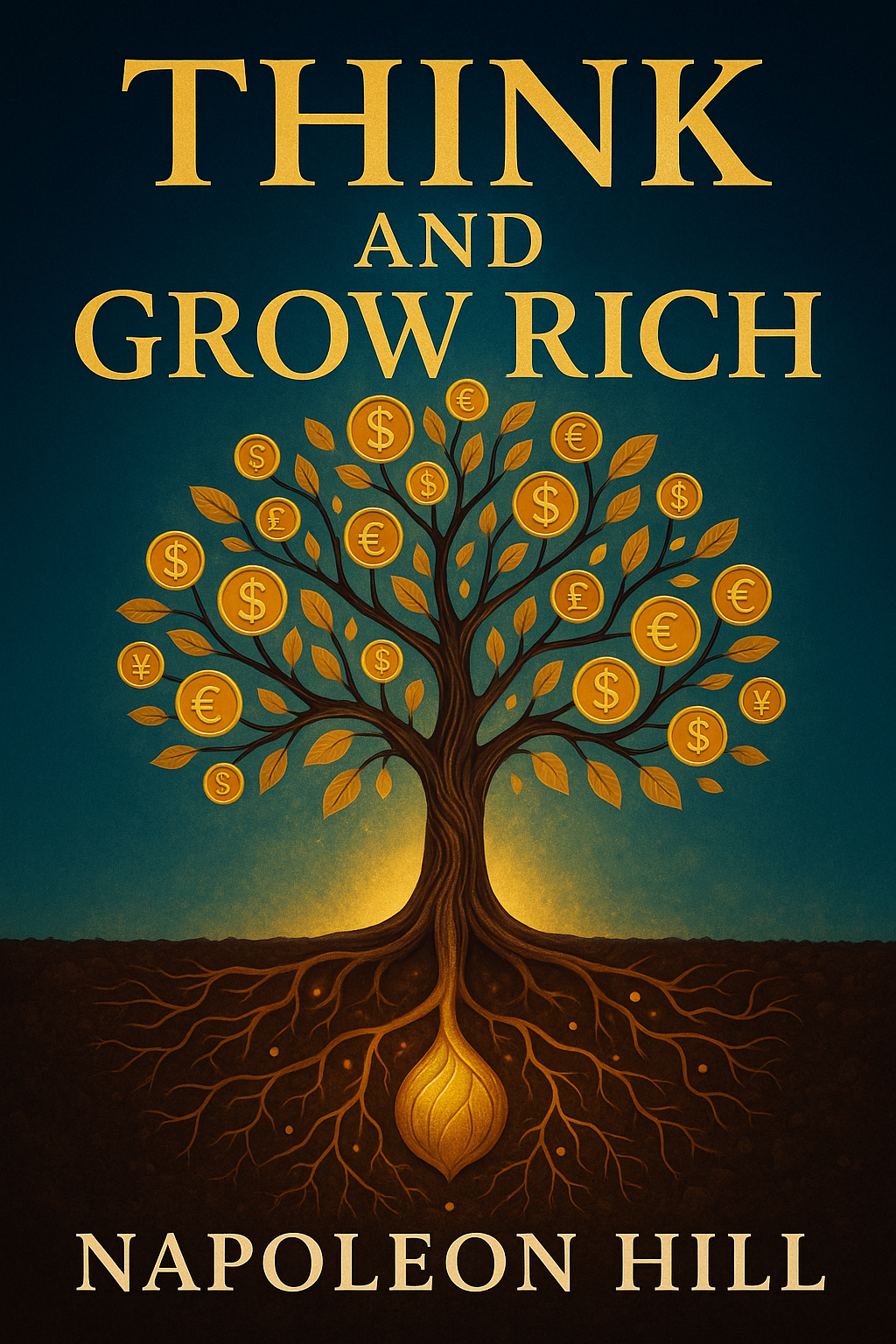
Embark on a transformative journey with Napoleon Hill's timeless masterpiece, 'Think and Grow Rich!' This isn't just a book; it's a blueprint for unlocking your deepest potential and achieving extraordinary success, however you define it. At its core, this book promises to ignite a burning DESIRE within you, the fundamental spark from which all achievement springs. You'll discover how to cultivate unwavering FAITH, transforming your subconscious mind into a powerful ally that can manifest your aspirations into tangible reality. Through the potent practice of AUTOSUGGESTION, you'll learn to influence your inner landscape, planting the seeds of success in the fertile ground of your mind. You'll gain a profound understanding that while SPECIALIZED KNOWLEDGE is important, it's the application and integration of that knowledge, fueled by IMAGINATION, that truly builds wealth. Prepare to harness the power of ORGANIZED PLANNING to crystallize your desires into actionable strategies, and master the art of DECISION-MAKING, overcoming procrastination and indecision that often stand as silent saboteurs of success. Hill emphasizes the crucial role of PERSISTENCE, the unwavering commitment that transmutes effort into reward, and reveals the immense POWER OF THE MASTER MIND, showing how collaboration and collective intelligence can amplify your efforts exponentially. You'll explore the intriguing MYSTERY OF SEX TRANSMUTATION, understanding how to channel one of life's most potent energies into creative and productive endeavors. Discover the profound connection to your SUBCONSCIOUS MIND, the vital link to boundless possibilities, and learn how your BRAIN acts as a broadcasting and receiving station for your thoughts. Ultimately, you'll be guided towards the 'Sixth Sense,' the gateway to true wisdom and intuition. But this journey isn't without its challenges. Hill unflinchingly confronts the 'Six Ghosts of Fear' – indecision, doubt, fear, anger, procrastination, and negativity – providing you with the tools to identify and conquer them, clearing the path to your riches. The tone of 'Think and Grow Rich!' is one of unwavering optimism, intellectual rigor, and profound empowerment. It's a call to action for the ambitious, the hopeful, and anyone ready to move beyond limitations and claim their rightful place of success and prosperity. You will leave this book not just informed, but inspired, equipped with a practical philosophy and a renewed belief in your own capacity to achieve greatness.
DESIRE: The Starting Point of All Achievement The First Step to Riches
Napoleon Hill, in 'Think and Grow Rich!', unveils desire not as a fleeting wish, but as the foundational spark for all human achievement. He illustrates this with the compelling story of Edwin C. Barnes, a man whose consuming obsession to become Thomas Edison's business associate propelled him from a freight train tramp to a partner, a journey that took five years of menial work but was fueled by an unwavering, definite desire. Barnes's success wasn't luck; it was a testament to burning all bridges behind him, leaving no option but to win, a strategy echoed by ancient warriors burning their ships before battle. Hill emphasizes that this burning desire, this relentless pursuit, is the crucial differentiator between those who succeed and those who fail, much like Marshal Field's resolve to rebuild after the Great Chicago Fire while others departed. To transmute this desire into riches, Hill outlines six practical steps: fix the exact amount desired, determine what you'll give in return, set a definite date, create and act on a plan, write it down, and visualize possessing it daily with unwavering belief. This isn't mere hope; it's cultivating a 'money consciousness,' a conviction born from Andrew Carnegie's principles and endorsed by Thomas Edison. The author then delves into the transformative power of desire through a deeply personal narrative about his own son, Blair, born profoundly deaf. Faced with what seemed an insurmountable limitation, Hill refused to accept nature's decree. He nurtured in Blair a burning desire to hear and speak, a desire so potent that it eventually led to the discovery of a hearing aid that revolutionized his life, turning a perceived disability into a profound asset. This story underscores a core tension: that external limitations can be overcome when an internal desire, coupled with unwavering faith, becomes an obsession, reshaping reality itself. Hill argues that dreams, the seedlings of reality, require this fervent desire to blossom, and even great adversities can become stepping stones if one possesses the right mindset. The chapter concludes by reinforcing that while nature may present challenges, the human mind, when fueled by desire and faith, possesses an immeasurable power to transmute obstacles into achievements, urging readers to recognize that 'nothing is impossible to the person who backs DESIRE with enduring FAITH.'
FAITH: Visualization and Belief in the Attainment of Desire The Second Step to Riches
Napoleon Hill, in "Think and Grow Rich!", unveils FAITH as the 'head chemist of the mind,' a potent force capable of translating our deepest desires into tangible reality. He explains that faith is not a passive wish, but an active state of mind, a powerful emotion that, when blended with love and sex, creates a direct conduit to Infinite Intelligence. This chapter argues that faith is a state that can be deliberately cultivated through autosuggestion—the persistent, repeated affirmation of one's beliefs to the subconscious mind. Just as repeated exposure can lead one to embrace crime, so too can consistent positive affirmations ingrain belief, which then guides the subconscious to manifest those desires. Hill illustrates this with compelling historical examples, notably the creation of the United States Steel Corporation, which began as a mere idea in Charles M. Schwab's mind, fueled by his immense faith and a clear plan. Schwab's vision, mixed with unwavering belief, convinced titans like J.P. Morgan, transforming an intangible concept into a billion-dollar enterprise. This narrative underscores a core principle: riches begin as thoughts, and it is faith that removes the limitations we place upon them, acting as the vital element that transforms ordinary thought vibrations into their spiritual, and ultimately physical, equivalents. The author emphasizes that the subconscious mind, a veritable 'chemical laboratory,' makes no distinction between positive and negative thoughts; it will manifest whatever impulse is fed to it with sufficient emotional intensity and belief. Therefore, cultivating a mind dominated by positive emotions, like faith, is paramount. The chapter concludes by presenting a 'Self-Confidence Formula,' a practical guide for readers to develop the unwavering belief necessary to harness the law of autosuggestion, transforming personal limitations into achievements and proving that 'success begins with a fellow's will; it's all in the state of mind.' The narrative arc moves from the abstract nature of faith to its concrete, actionable application, offering a path from doubt to profound self-efficacy.
AUTOSUGGESTION: The Medium for Influencing the Subconscious Mind The Third Step to Riches
Napoleon Hill, in "Think and Grow Rich!", unveils the profound power of Autosuggestion, presenting it not merely as a technique, but as the vital bridge to our subconscious mind, the fertile ground where our deepest desires can take root and flourish. He explains that our conscious mind acts as a gatekeeper, with the remarkable, though often unexercised, power to control what thoughts, perceptions, and stimuli, gathered through our five senses, are allowed to enter the deeper, more impressionable subconscious. This control, he emphasizes, is absolute, and the failure to wield it wisely is a primary reason why many find themselves trapped in cycles of poverty and unfulfilled potential. Autosuggestion, therefore, becomes the deliberate act of feeding this subconscious garden with seeds of creativity and aspiration, rather than allowing the weeds of doubt and negativity to choke out our dreams. Hill revisits the crucial instruction to visualize and audibly declare one's desire, particularly for wealth, not as a mere recitation, but as an act imbued with emotion and unwavering faith. It is this emotionalization, this potent blend of feeling and belief, that transforms plain words into potent commands for the subconscious, which recognizes and acts upon nothing less. He draws a powerful parallel to a child's faith, urging us to approach these principles with a similar unreserved belief, even when they seem abstract. The author stresses that this method is not limited to monetary gain; it is a universal key to manifesting any strong desire, provided it aligns with ethical principles. The process demands persistent effort, a willingness to pay the price through unwavering application, for there is no shortcut to influencing the subconscious. Concentration is identified as a critical component, a fixation of attention that allows us to vividly see and feel our desires as already realized, thereby 'tricking' the subconscious into creating a pathway to achieve them. This is not about passively waiting for plans to materialize, but about actively demanding them from the subconscious and then acting immediately upon the inspirations, the 'flashes of insight,' that arrive, often through the sixth sense, treating them as direct messages from Infinite Intelligence. The author concludes by framing Autosuggestion as the keystone of his philosophy, the essential tool through which we can truly become the masters of our fate, the captains of our souls, by learning to direct the powerful currents of our own minds. He implores the reader to internalize this chapter, to read it aloud nightly, underscoring its resonant phrases, until the principle of autosuggestion is not just understood, but deeply believed and embodied, unlocking a universe of power.
SPECIALIZED KNOWLEDGE: Personal Experiences or Observations The Fourth Step to Riches
Napoleon Hill, in 'Think and Grow Rich!', illuminates a profound truth about wealth accumulation: knowledge itself is not power, but merely potential power, a dormant seed waiting for the right conditions to sprout. He distinguishes between general knowledge, often found in academic halls but rarely leading to riches, and specialized knowledge, the practical, applied wisdom that drives success. The author explains that true education isn't about accumulating facts, but about developing the mental faculties to acquire any knowledge needed, precisely when it's needed, and crucially, how to organize and direct it towards a definite end. Henry Ford's legendary courtroom defense serves as a vivid micro-metaphor: when challenged on his lack of general knowledge, he pointed to the buttons on his desk, a symbol of his command over specialized expertise through his team, demonstrating that true education lies in knowing where to find and how to use knowledge, not necessarily possessing it all. This insight offers a potent resolution to the tension of feeling inadequate due to limited formal schooling; Andrew Carnegie, for instance, famously knew little of the technicalities of steel but masterfully orchestrated a Master Mind Group to harness that specialized knowledge, proving that leadership in wealth creation is often about organization and direction, not personal expertise. Hill emphasizes that the journey to riches requires specialized knowledge of the service or product one offers, and if personal acquisition is limited, the Master Mind alliance becomes the bridge over that gap. This is not merely theoretical; it is a practical blueprint for action. The chapter highlights that while specialized knowledge is abundant and relatively inexpensive, the true challenge lies in acquiring IDEAS and the IMAGINATION to combine knowledge with plans. The narrative arc moves from the potential confusion of knowledge to the clarity of its purposeful application, showcasing how individuals like Stuart Austin Wier, who pivoted from engineering to law by acquiring specialized knowledge, and a resourceful woman who created a new profession by marketing personal services through meticulously crafted portfolios, exemplify this principle. Even Dan Halpin's meteoric rise in sales management, fueled by ambition and strategic positioning, underscores the idea that proactive self-improvement and a refusal to compromise with undesirable circumstances, rather than just starting at the bottom, pave the way for extraordinary success. The core dilemma is how to leverage knowledge for wealth; the resolution lies in recognizing that organized, directed specialized knowledge, often amplified through collaboration and fueled by imagination, is the key, and that continuous learning, even through paid self-study that fosters discipline, is essential. The author concludes by noting that while specialized knowledge is plentiful, imagination is the rarer, catalytic element that transforms potential into tangible riches, urging readers to cultivate this imaginative spark to unite ideas with the knowledge needed for success.
IMAGINATION: The Workshop of the Mind The Fifth Step to Riches
Napoleon Hill, in 'Think and Grow Rich!', unveils imagination as the architect of human achievement, the very workshop where raw desires are forged into tangible realities. He posits that our current age, marked by rapid change, is uniquely fertile ground for cultivating this potent faculty, enabling us to harness forces once beyond our grasp – from flight and instantaneous global communication to understanding the very composition of distant stars. Hill illuminates two distinct forms of imagination: Synthetic, which rearranges existing knowledge into novel combinations, akin to an inventor's toolkit, and Creative Imagination, a direct conduit to Infinite Intelligence, responsible for hunches, inspirations, and the genesis of entirely new ideas. This latter form, he stresses, springs to life most vibrantly when fueled by intense desire, much like a muscle that strengthens with use. The transformation of an intangible impulse, a mere thought of desire, into its physical counterpart, such as wealth, is the central challenge, a process primarily navigated by Synthetic Imagination but occasionally requiring the leap of Creative Imagination. Hill emphasizes that the path to riches is paved with well-defined plans, meticulously crafted through imagination and committed to writing, thereby giving concrete form to abstract desires. He illustrates this with compelling narratives: the story of Coca-Cola, born from a simple idea and the imaginative addition of a drug clerk to a secret formula, which blossomed into a global empire, and the tale of Dr. Frank W. Gunsaulus, whose burning desire for an educational institution led him to vividly articulate his vision, securing the million dollars needed to found the Armour Institute of Technology. These accounts underscore a profound truth: ideas are the seeds of all fortunes, and their transmutation into wealth hinges on definite purpose, precise planning, and a burning desire that transcends doubt and disappointment. The author reveals that the true secret to accumulating riches, evident throughout nature's own evolutionary processes, is not a hidden mystery but an accessible law: the power of ideas, when coupled with imagination, definiteness of purpose, and persistent effort, can indeed shape our reality, much like nature itself organizes energy and matter to create the universe. The power of an idea, once ignited, can grow beyond its creator, influencing generations and reshaping the world, a testament to the boundless potential residing within the human mind's imaginative faculty.
ORGANIZED PLANNING: The Crystallization of Desire Into Action The Sixth Step to Riches
Napoleon Hill, in 'Think and Grow Rich!', unveils the sixth crucial step toward accumulating wealth: organized planning, emphasizing that true riches bloom not from solitary genius, but from the fertile ground of collective intelligence and harmonious collaboration. He posits that desire, once ignited, must be meticulously shaped into tangible plans, a process best undertaken not in isolation, but within a 'Master Mind Alliance.' This isn't merely about gathering like-minded individuals; it's about the deliberate selection of those who complement your vision, the clear articulation of mutual benefits, and the unwavering commitment to perfect harmony, for as Hill stresses, 'The Master Mind Principle cannot obtain where PERFECT HARMONY does not prevail.' The journey is fraught with potential setbacks, but temporary defeat, he insists, is not permanent failure; it is a signal to refine your plans, much like Thomas Edison's ten thousand attempts before illuminating the world. Hill then pivots to the critical art of marketing personal services, distinguishing between leaders and followers, and delineating the eleven essential attributes of effective leadership – from unwavering courage and self-control to a pleasing personality and the willingness to assume full responsibility. He warns against the ten common causes of leadership failure, such as the inability to organize details or the fear of competition, highlighting that true leadership thrives on consent, not force. The author then turns a keen eye towards the evolving landscape of opportunity, identifying fertile fields like politics, banking, industry, religion, and professions, all demanding a new brand of leadership that prioritizes service and cooperation over outdated authority. He underscores that in this new paradigm, jobs are transforming into partnerships, with the public as the ultimate employer, and success hinges on the QQS formula: Quality, Quantity, and the right Spirit of service. The chapter culminates by confronting the thirty major causes of failure, from lack of purpose and persistence to ill health and intemperance, urging a rigorous self-analysis and inventory to identify and overcome these obstacles. Hill reminds us that while America offers unparalleled freedom and opportunity within its capitalistic framework, riches are never a gift; they are the earned reward for rendering useful service, governed by the immutable Law of Economics. This profound insight serves as the bedrock for creating a practical plan, emphasizing that only through persistent, organized action, fueled by a clear purpose and the wisdom of others, can desire truly crystallize into riches.
DECISION: The Mastery of Procrastination The Seventh Step to Riches
Napoleon Hill, in 'Think and Grow Rich!', unveils Decision as the seventh crucial step toward riches, positing that indecision and procrastination are the silent saboteurs of success, lurking at the very head of the list of failure's causes. He reveals a stark contrast between those who accumulate fortunes and those who falter: the prosperous decisively reach conclusions quickly and hold them steadfastly, while the unsuccessful deliberate agonizingly and shift their stances with alarming frequency. Consider the legend of Henry Ford, whose unyielding commitment to the Model T, though initially perceived as obstinacy, ultimately forged immense wealth before the inevitable evolution of design. Hill emphasizes that true success hinges on cultivating an inner compass, steering clear of the cacophony of external opinions, which are often the cheapest commodities, readily offered but rarely valuable. He urges readers to harness their own intellect, to listen more than they speak, keeping eyes and ears wide open while the mouth remains closed, thereby gathering facts without revealing their grander purpose, much like the early architects of American freedom who meticulously planned in the shadows. The narrative then pivots to the profound courage demanded by momentous decisions, drawing parallels from Socrates' choice to embrace poison over compromised beliefs, to Abraham Lincoln's emancipation proclamation, and most strikingly, to the 56 signers of the Declaration of Independence, who pledged their very lives to a shared vision of liberty. Their collective decision, born from a 'Master Mind' of conviction, was not merely a political act but a spiritual force that imbued Washington's armies with an unshakeable spirit, demonstrating that great transformations, whether personal or national, begin with a definite decision in the minds of a few, amplified by organized planning and unwavering faith. Hill laments the educational system's failure to instill this habit of definiteness, leaving countless individuals adrift in occupations they never truly chose, victims of a lifelong indecisiveness that leaves economic freedom perpetually out of reach. He concludes by asserting that riches, like freedom, do not respond to mere wishes but to meticulously crafted plans, fueled by resolute desire and relentless persistence, for every failure, in its wake, carries the seed of an equivalent, and often greater, success.
PERSISTENCE: The Sustained Effort Necessary to Induce Faith The Eighth Step to Riches
Napoleon Hill, in his seminal work 'Think and Grow Rich!', unveils Persistence as the eighth crucial step on the path to accumulating wealth, positing it as the bedrock upon which desire is transmuted into its monetary equivalent. He explains that persistence is not merely stubbornness, but the potent combination of willpower and desire, an irresistible force that drives individuals like Henry Ford, Andrew Carnegie, and Thomas Edison to overcome monumental obstacles. The narrative draws a stark contrast between the majority, who falter at the first sign of opposition, and the select few who press on, demonstrating that persistence is to character what carbon is to steel, lending it strength and resilience. Hill emphasizes that a lack of persistence is a leading cause of failure, a weakness that can be conquered by the intensity of one's desire; as he vividly illustrates, weak desires yield weak results, much like a small fire produces little heat. To cultivate this vital quality, he directs readers to revisit the six action steps from Chapter 1, suggesting that the eagerness with which these are pursued will reveal the true depth of their aspiration. For those struggling with persistence, he advises focusing on the principles of the Master Mind and the Subconscious Mind, forming a Master Mind group to foster cooperative strength and using autosuggestion to embed goals into one's habit nature. The chapter underscores that poverty consciousness will seize a mind not deliberately occupied with money consciousness, and that fortunes, like water, gravitate towards minds prepared to attract them. Hill uses the visceral experience of a nightmare, where one must exert persistent willpower to regain control of one's body muscle by muscle, as a metaphor for overcoming mental inertia, urging readers to move slowly at first, then increase their speed until complete control is achieved. He asserts there is no substitute for persistence, likening it to an insurance policy against failure, and that every defeat carries within it the seed of an equivalent advantage, a lesson learned through the trials of figures like Fannie Hurst, who faced 36 rejection slips from The Saturday Evening Post before achieving success, and Kate Smith, who sang tirelessly until her opportunity arrived. The narrative then distills persistence into eight foundational factors: definiteness of purpose, desire, self-reliance, definiteness of plans, accurate knowledge, cooperation, willpower, and habit, while also detailing sixteen common symptoms of its absence, such as procrastination, indecision, and the fear of criticism, which he identifies as a primary enemy of ambition, often lurking in the subconscious. The fear of criticism, he warns, can stifle ideas at birth, preventing them from ever reaching the planning and action stages, a specter that even he faced when tasked with developing the philosophy of achievement. Ultimately, Hill presents four simple, yet profound, steps to cultivate the habit of persistence: a definite purpose backed by burning desire, a definite plan expressed in continuous action, a mind closed against negative influences, and a friendly alliance with supportive individuals, concluding that these steps are the key to controlling one's economic destiny, converting dreams into reality, and mastering fear, discouragement, and indifference, thereby earning the privilege of writing one's own ticket in life.
POWER OF THE MASTER MIND: The Driving Force The Ninth Step to Riches
Napoleon Hill, in 'Think and Grow Rich!', unveils the ninth pivotal step toward wealth: the Master Mind. He illuminates how raw desire, though potent, remains inert without the organized power to translate it into tangible action. This power, Hill explains, is not merely brute force, but 'organized and intelligently directed knowledge.' It's the synergy born from the coordinated effort of two or more individuals working in harmony toward a definite purpose. Where does this knowledge originate? Hill points to three primary wellsprings: the boundless reservoir of Infinite Intelligence, accessible through creative imagination; the accumulated wisdom of civilization, found in libraries and educational institutions; and the ever-expanding frontier of experiment and research. Yet, assembling and applying this knowledge often demands more than individual capacity. This is where the Master Mind principle becomes indispensable. Hill defines it as the coordination of knowledge and effort in a spirit of harmony between two or more people for a definite purpose. He reveals two crucial facets of this principle: the economic, where cooperative alliances create tangible advantages, forming the bedrock of nearly every great fortune; and the psychic, a more abstract force arising when minds connect, creating an invisible, intangible 'third mind'—a potent blend of spiritual energy. Consider Andrew Carnegie, who attributed his colossal fortune to the Master Mind group he assembled for manufacturing steel, or Henry Ford, who, starting from humble beginnings, rapidly ascended by allying himself with brilliant minds like Thomas Edison, absorbing their intellectual power and forging his own path. Like a collection of electric batteries, a group of harmoniously coordinated brains generates exponentially more thought-energy than a single one, an energy that becomes available to all within the group. This amplified energy can propel individuals across the 'stream of life,' from the currents of poverty to the upward flow toward wealth, driven by positive thought emotions. Even Mahatma Gandhi, a figure of immense influence, achieved his extraordinary power by inspiring over 200 million people to cooperate in harmony for a common goal—a feat Hill likens to a miracle, highlighting the profound challenge and potential of collective action. The author emphasizes that while Infinite Intelligence is the ultimate source, accumulated experience and research are secondary, subject to the fallibility of our senses. Ultimately, riches are shy and must be wooed, not forced; they are attracted by a definite plan, a burning desire, and crucially, the power of the Master Mind, a force that can help one navigate the currents of life toward prosperity, provided one actively engages with its principles.
THE MYSTERY OF SEX TRANSMUTATION: The Tenth Step to Riches
Napoleon Hill, in 'Think and Grow Rich!', unveils the profound mystery of sex transmutation, presenting it not merely as a biological drive, but as the most potent of human desires, a powerful force capable of transforming mediocrity into genius. He explains that 'transmute' means to change or transfer energy, and the sex emotion, often misunderstood and narrowly associated with the physical, holds immense constructive potential for perpetuating the race, maintaining health, and, crucially, elevating the mind. This potent energy, when harnessed and redirected from purely physical expression to other forms of thought and action, fuels imagination, courage, willpower, and persistence—qualities essential for great achievement. Hill posits that individuals of greatest accomplishment, particularly those who amassed fortunes and recognition, were often motivated by romantic love and learned the art of channeling their highly developed sexual natures. He identifies ten mind stimuli, with sexual desire at the forefront, capable of 'keying up' the mind to higher vibrations, thereby unlocking the 'Sixth Sense,' or Creative Imagination. This faculty, he reveals, is the direct link to Infinite Intelligence, where true inspiration and genius-level ideas originate. The author elaborates on how geniuses, unlike ordinary individuals, deliberately cultivate and utilize Creative Imagination, often through heightened mental intensity achieved via these stimuli. Think of it like ascending in an airplane; the perspective shifts, revealing horizons previously unseen, allowing for thoughts of greater scope and clarity. Hill provides evidence through the lives of historical figures and scientists like Dr. Elmer R. Gates, who intentionally created environments to access this deeper wellspring of ideas, demonstrating that genius is not an innate gift but a cultivated faculty. He stresses that while sexual desire is a powerful, natural urge that should not be suppressed, its uncontrolled physical expression often leads to dissipation of energy, explaining why many fail to achieve significant success before the age of 40. It is only when this raw energy is transmuted—blended with love, purpose, and focused intent—that it becomes a controlled, constructive force, leading to poise, accuracy of judgment, and balanced action. This mastery, he contends, is the true path to 'riches,' not just financial, but in the broader sense of profound accomplishment and fulfillment, and it is a path accessible through voluntary self-effort and the conscious redirection of our most primal energies.
THE SUBCONSCIOUS MIND: The Connecting Link The Eleventh Step to Riches
Napoleon Hill, in 'Think and Grow Rich!', unveils the profound mystery of the subconscious mind, presenting it not merely as a passive recipient of thoughts, but as the vital, pulsating link between our finite intellect and the boundless forces of Infinite Intelligence. The author explains that this remarkable inner realm acts as a filing cabinet for every sensation and thought, capable of receiving and classifying them all, whether positive or negative. The central tension lies in our ability, or lack thereof, to consciously direct this powerful force towards our desires. Hill emphasizes that while we cannot entirely control the subconscious, we can voluntarily 'plant' our most dominant, emotionally charged desires within it, much like a gardener sows seeds. These desires, when mixed with unwavering faith and formulated into definite plans, are then transmuted by the subconscious, working day and night, into their physical or monetary equivalents. It's revealed that this process is not mere magic, but a natural law, akin to how radio waves carry sound by transforming it into a different vibration. Our thoughts, especially those imbued with strong emotion, are the 'vibrations' that the subconscious mind understands and acts upon. The author paints a vivid picture: imagine your conscious mind as a radio operator, carefully tuning the frequencies, and the subconscious as the powerful transmitter, sending your message out into the universe. A crucial insight is that the subconscious mind will inevitably feed on whatever thoughts dominate your consciousness; if left unattended, it will readily absorb fear and doubt, hindering progress. Conversely, by deliberately cultivating positive emotions like desire and faith, and using the principles of autosuggestion, we can ensure our subconscious is energized with constructive impulses. This emotionalized thought, Hill asserts, is the 'yeast' that transforms passive mental impulses into active, creative forces. Therefore, the author stresses the necessity of persistent effort in mastering the positive emotions, as they are the very language the subconscious understands. The ultimate resolution offered is that by controlling the influx of thoughts and emotions, we gain the key to unlocking our subconscious potential, thereby influencing our destiny and bridging the gap between our deepest aspirations and their tangible realization. It is a call to mindful cultivation of our inner world, recognizing that every material creation begins as a thought impulse, nurtured and brought to life by the unseen, yet potent, power of our subconscious.
THE BRAIN: A Broadcasting and Receiving Station for Thought The Twelfth Step to Riches
Napoleon Hill, through decades of observation and collaboration with luminaries like Alexander Graham Bell, unveils a profound truth: the human brain is not merely an isolated processor of information, but a sophisticated broadcasting and receiving station for thought impulses. This remarkable faculty, he explains, operates much like a radio, capable of picking up transmissions from other minds under the right conditions. The Creative Imagination, as detailed previously, serves as the brain's 'receiving set,' a crucial interface that processes these external thought stimuli, drawing from Infinite Intelligence, one's own subconscious, or the energized minds of others. When a mind is intensely stimulated, particularly by powerful emotions, its receptivity amplifies, allowing thoughts – modified by feeling – to be transmitted and received. Hill emphasizes that the emotion of sex, when properly controlled and channeled, provides an unparalleled surge of mental energy, elevating the Creative Imagination to a state where it can 'pluck ideas out of thin air.' This energized state not only attracts external insights but also imbues one's own thoughts with the necessary emotional 'feeling' to be accepted by the subconscious mind, which acts as the brain's 'sending station.' The interplay between the subconscious mind (sending), Creative Imagination (receiving), and autosuggestion (the operational control) forms the core of this mental broadcasting system, initiated by a burning DESIRE. The author then pivots to the vast, often overlooked realm of intangible forces, urging us to recognize that our reliance on physical senses limits our understanding of the universe's true power. Forces like gravity, the energy within a thunderstorm, or the intelligence in the soil sustain us, yet remain largely mysterious. He posits that the human brain, with its incomprehensibly vast network of billions of nerve cells and connections – a complexity dwarfing astronomical figures – is likely not solely dedicated to physical maintenance but serves as a conduit for these unseen energies. This idea is supported by research, such as that conducted by Dr. Rhine at Duke University, which provides compelling evidence for extrasensory perception like telepathy and clairvoyance. These phenomena, independent of physical distance and unaffected by sensory barriers, suggest a deeper mode of perception. Hill connects this to his own findings, revealing that a close, harmonious alliance between minds, focused on a common problem – essentially a practical application of the Master Mind principle – can unlock solutions from sources beyond individual experience, demonstrating that the greatest forces truly are intangible and unseen, waiting to be tapped by the prepared mind.
THE SIXTH SENSE: The Door to the Temple of Wisdom The Thirteenth Step to Riches
Napoleon Hill, in the culminating step of his philosophy, unveils the 'Sixth Sense,' a profound connection to Infinite Intelligence, accessible only after mastering the preceding twelve principles. This isn't a mystical apparition, but rather the apex of Creative Imagination, a receiving set for hunches and inspirations that defies simple description. It is believed to be the bridge between the finite human mind and the Universal Mind, a fusion of the mental and the spiritual, capable of warning of danger and revealing opportunity when one is attuned to its frequency. Hill recounts his own journey, a testament to the power of emulating greatness, particularly through his 'Invisible Counselors'—an imagined council of nine esteemed figures like Emerson, Paine, Edison, Darwin, Lincoln, Burbank, Napoleon Bonaparte, Ford, and Carnegie. Through nightly 'Council meetings,' he deliberately reshaped his character by invoking their traits, a powerful application of autosuggestion to his subconscious. He describes how these figures, in his imagination, developed distinct personalities, offering counsel and even unexpected interactions, illustrating the profound impact of focused, intentional thought. This practice, initially aimed at self-improvement, evolved into a method for problem-solving, where Hill would present challenges to his 'Cabinet,' often receiving astonishing results. The Sixth Sense, he posits, is not a sudden gift but a faculty that matures through years of meditation, self-examination, and serious thought, often becoming accessible past the age of 40 or 50. It's the subtle intuition that guides great leaders, inventors, and thinkers, enabling them to transmute desires into tangible reality. While its exact location in the brain remains a mystery to science, its effects are undeniable, particularly during moments of heightened emotion or crisis, akin to a driver's split-second reaction averting an accident. Hill emphasizes that while understanding the Sixth Sense is not essential for accumulating wealth, it unlocks a deeper understanding of oneself, others, and the laws of nature, leading to a richer, more fulfilling life beyond material gain. The chapter concludes by highlighting the fundamental battle between Faith and Fear, urging readers to confront their 'Six Ghosts of Fear'—imaginary constructs that hold immense power over the mind, a crucial step in unlocking the full potential of the Sixth Sense.
HOW TO OUTWIT THE 6 GHOSTS OF FEAR: Take Inventory of Yourself As You Read This and Find Out How Many of the Ghosts Stand in Your Way
Napoleon Hill, in "Think and Grow Rich!", guides us through an essential internal audit, revealing the insidious nature of fear and its six primary manifestations that can derail our pursuit of riches, however we define them. He begins by illuminating the unholy trinity of indecision, doubt, and fear, explaining how they intertwine and grow like unseen weeds, choking the very possibility of success before it can even take root. Hill posits that all other fears are merely branches of six basic ones: poverty, criticism, ill health, loss of love, old age, and death. These aren't abstract concepts but deeply ingrained states of mind, capable of crystallizing into physical realities. Consider the pervasive fear of poverty, a state of mind that paralyzes reason, extinguishes imagination, and breeds a litany of destructive habits like procrastination and indifference. It’s a fear so potent it can manifest as a physical slump in one's shoulders, a visible sign of defeat. Hill emphasizes that thought impulses, whether voluntary or involuntary, begin to translate into their physical equivalents, a profound truth that underscores the danger of allowing fear-based thinking to dominate. He paints a vivid picture of how mass fear, like the fear of poverty during the Great Depression, can crystallize into widespread economic hardship, a testament to the collective power of our thoughts. The chapter then dissects each of the six basic fears, exposing their origins and symptoms. The fear of criticism, for instance, can be traced back to an ancestral urge to justify theft by demeaning the victim, and it manifests as self-consciousness, lack of poise, and an inferiority complex, causing individuals to chase societal trends rather than their own aspirations. Similarly, the fear of ill health, often fueled by suggestion and negative self-talk, can actually manifest physical symptoms, a phenomenon exploited by unscrupulous advertisers. The fear of losing love, perhaps the most painful, stems from our primal need for security and companionship, leading to jealousy and fault-finding. The fears of old age and death, often rooted in societal conditioning and religious dogma, can be confronted by embracing wisdom and understanding that life, as energy, is not destroyed but transformed. Hill introduces a seventh, more insidious evil: susceptibility to negative influences, which he calls "The Devil's Workshop." This is a deeper, more fatal affliction than the fears themselves, a mental attitude that allows external negativity or our own internal doubts to take hold. The key to overcoming these internal adversaries, Hill reveals, lies in the absolute control we possess over our own thoughts. By cultivating a definite chief aim, making prompt decisions, and consciously choosing positive thought impulses, we can build a mental fortress against fear and negativity, transforming ourselves from passive recipients of circumstance into masters of our own destiny. The path forward is not paved with alibis, but with self-analysis and the unwavering decision to conquer self, transforming potential failure into the stupendous reward of achieving whatever we truly desire.
Conclusion
Napoleon Hill's 'Think and Grow Rich!' offers a profound and actionable blueprint for personal achievement, extending far beyond mere financial accumulation. At its heart lies the transformative power of 'burning desire,' not as a fleeting wish, but as an unwavering, ignited purpose that fuels all subsequent steps. This desire, when coupled with unwavering 'Faith,' cultivated through 'Autosuggestion,' becomes the potent force that 'tricks' the subconscious mind into manifesting tangible results. The book masterfully illustrates that specialized knowledge alone is insufficient; it is through 'Imagination' that this knowledge is organized into actionable 'Plans.' The wisdom here is not just intellectual; it's deeply emotional. Hill emphasizes that success is forged in the crucible of our own minds, demanding relentless 'Persistence' to overcome inevitable setbacks. The emotional lesson is one of empowerment: we are not victims of circumstance, but architects of our destiny. The 'Master Mind' principle underscores this, revealing that collective harmony and shared purpose amplify individual potential, creating a synergistic force greater than the sum of its parts. The 'Mystery of Sex Transmutation' highlights the immense, often untapped, creative energy within us, urging its redirection towards constructive pursuits. The 'Subconscious Mind' is presented as the crucial link to 'Infinite Intelligence,' a channel that responds to emotionalized thoughts, not mere logic. Understanding the brain as a 'Broadcasting and Receiving Station' further demystifies this process, suggesting our thoughts can influence and be influenced by unseen forces. Ultimately, Hill guides us towards the 'Sixth Sense,' the pinnacle of mental development, offering not just material riches but true wisdom and fulfillment. The practical wisdom is stark: confront and conquer the 'Ghosts of Fear' – indecision, doubt, and the six basic fears – for they are mental constructs that can be overcome. The core takeaway is that by mastering our thoughts, emotions, and decisions, and by acting with persistent purpose, we can transmute our deepest desires into reality, achieving not only wealth but also a profound sense of mastery over our lives.
Key Takeaways
Definite, burning desire, not mere wishing, is the essential starting point and driving force behind all significant achievements.
Burning all bridges and eliminating retreat options is a critical psychological tactic to cultivate unwavering commitment to a goal.
The transformation of desire into tangible results requires a structured, six-step mental and practical process, including visualization and belief.
Perceived disabilities or adversities can be transmuted into powerful assets when met with a persistent, burning desire and unwavering faith.
Success is not a matter of luck or circumstance, but the direct result of a powerful, focused desire backed by a concrete plan and relentless action.
Faith is an active, cultivated state of mind, not a passive emotion, serving as the 'head chemist' that transmutes thought into reality.
Autosuggestion, through repeated affirmations and visualization, is the primary mechanism for developing faith by convincing the subconscious mind of a desired outcome.
The subconscious mind acts as a universal translator, manifesting both positive and negative thought impulses into physical equivalents based on the emotional intensity and belief invested.
Strong positive emotions, particularly faith, love, and sex, when blended, create a powerful vibration that opens direct communication with Infinite Intelligence.
The creation of great wealth and achievement, as exemplified by Charles M. Schwab and the U.S. Steel Corporation, begins with an idea infused with faith and a persistent plan.
Self-confidence is a cultivable trait, essential for overcoming limitations and enabling the law of autosuggestion to function constructively, leading to success.
The conscious mind possesses absolute control over what enters the subconscious, and neglecting this control leads to unfulfilled potential.
Autosuggestion is the deliberate act of directing positive, creative thoughts to the subconscious, akin to planting desirable seeds in a fertile garden.
The subconscious mind responds only to thoughts and words that are deeply emotionalized with faith and belief, not mere intellectual understanding.
Achieving mastery over one's desires requires persistent, unwavering application of autosuggestion, demanding immediate action on inspired plans.
Vivid visualization, combined with emotional intensity and faith, is crucial for 'tricking' the subconscious into manifesting desired outcomes.
Autosuggestion is the foundational principle for influencing the subconscious, enabling individuals to become masters of their destiny.
Knowledge is only potential power; it becomes actual power when organized into definite plans of action directed toward a specific end.
True education lies not in the quantity of knowledge possessed, but in the ability to acquire needed knowledge and apply it effectively through strategic planning.
A Master Mind Group can compensate for a lack of personal specialized knowledge by providing access to collective expertise and directed effort.
Imagination is the critical catalyst that combines specialized knowledge with ideas to create organized plans for wealth accumulation.
Continuous acquisition of relevant specialized knowledge, coupled with self-discipline and proactive application, is essential for ongoing success and upward mobility.
The value of 'free' resources like public libraries is often underestimated; investing in paid, disciplined learning fosters a greater appreciation and application of knowledge.
Imagination is the fundamental workshop where desires are transformed into actionable plans and tangible results, serving as the primary engine for all human achievement.
The mind possesses two forms of imagination—Synthetic, which recombines existing knowledge, and Creative, which connects with Infinite Intelligence for new ideas—both of which are strengthened through active use, particularly when stimulated by intense desire.
Converting abstract desires into concrete outcomes, such as wealth, requires the deliberate creation of definite plans, which must be committed to writing to give them tangible form and direction.
Ideas are the genesis of all fortunes, and their potential for wealth creation is unlocked through a combination of definite purpose, precise planning, and an unwavering, burning desire that overcomes obstacles.
The power of an idea, once conceived and nurtured, can transcend its originator, becoming a self-perpetuating force that drives action and shapes reality, demonstrating that thoughts are indeed things with world-altering scope.
Success is not a matter of chance or luck, but the result of applying specific principles, primarily the power of imagination to generate meritorious ideas and the will to act upon them.
Recognize that true wealth creation is a collective endeavor, demanding the formation of a 'Master Mind Alliance' built on perfect harmony and mutual benefit, as isolation is the enemy of significant achievement.
Understand that temporary setbacks are not failures but critical feedback loops, necessitating the persistent refinement and adaptation of plans rather than surrender.
Embrace the distinction between leadership and followership, cultivating the eleven core attributes of effective leadership, such as courage, self-control, and cooperation, while actively avoiding the ten common pitfalls that lead to leadership failure.
Acknowledge that the modern marketplace values personal services as partnerships, where success is dictated by the QQS formula (Quality, Quantity, Spirit) and a commitment to serving the public, not just self-interest.
Confront and systematically eliminate personal weaknesses by engaging in rigorous self-analysis against the thirty major causes of failure to clear the path for success.
Appreciate that while opportunities for wealth abound in systems like American capitalism, riches are earned through rendering valuable service, not through passive acquisition or by defying the fundamental Law of Economics.
Develop a definite chief aim and meticulously organized plans, recognizing that the value of one's services is determined by their ability to render useful service and their capacity to inspire others to do the same.
The habit of quick, firm decision-making, followed by slow modification, is a hallmark of success, while slow, frequent changes characterize failure.
External opinions are often unreliable and can dilute or destroy one's own desires and plans; one must use their own mind and gather information discreetly.
Momentous achievements, both personal and historical, are rooted in courageous, definite decisions made by individuals or groups with a clear purpose, often involving significant risk.
The foundational power for achieving significant goals lies in the 'Master Mind' principle and organized planning, where collective conviction amplifies individual resolve.
Educational systems often fail to cultivate the habit of definite decision-making, leading individuals into career paths without clear purpose or choice.
Economic freedom and material riches are attained not through wishes, but through definite plans, backed by strong desire and unwavering persistence, transforming thought into tangible results.
Persistence is the essential bridge between desire and its materialization, forged by the fusion of willpower and unwavering desire.
Lack of persistence is a common yet conquerable weakness, its remedy lying in the intensity of one's underlying desire.
Overcoming mental inertia and achieving goals requires a step-by-step application of willpower, akin to regaining control from a nightmare.
The fear of criticism is a subconscious enemy that can kill ideas before they are even planned or acted upon, necessitating courage to pursue one's vision.
Cultivating persistence involves a deliberate process of defining a clear purpose, creating actionable plans, shielding the mind from negativity, and seeking supportive alliances.
Every setback is not a final defeat but a temporary pause that contains the potential for a greater advantage, provided one possesses the persistence to uncover it.
Poverty consciousness attracts scarcity, while money consciousness, deliberately cultivated through persistent effort and planning, attracts abundance.
Recognize that personal power for wealth accumulation is not inherent but cultivated through organized, intelligently directed knowledge, demanding coordinated effort beyond individual capacity.
Understand that the Master Mind principle, a harmonious alliance of two or more minds for a definite purpose, unlocks both tangible economic advantages and a potent, intangible psychic synergy.
Tap into the three primary sources of knowledge—Infinite Intelligence, accumulated experience, and experiment/research—but acknowledge Infinite Intelligence as the most reliable wellspring for power.
Embrace the concept that a group of minds, when coordinated in harmony, generates amplified thought-energy, akin to multiple batteries producing more power than a single one, which becomes accessible to all members.
Perceive the 'stream of life' as a metaphor for one's financial trajectory, where positive thought emotions propel individuals toward wealth, while negative ones lead to poverty, with the Master Mind as a tool to navigate this stream.
Actively apply the Master Mind principle by selecting a compatible group and fostering harmony, as passive understanding will not attract or retain wealth.
Acknowledge that true power, whether economic or spiritual, is built through collective, harmonious action toward a shared objective, as exemplified by historical figures and mass movements.
The emotion of sex is the most powerful human desire and, when transmuted, serves as the primary catalyst for transforming ordinary thought into genius-level creativity and achievement.
Sex transmutation is the deliberate redirection of sexual energy from physical expression to other constructive mental pursuits, enhancing imagination, willpower, and persistence.
Genius is not an inherent trait but a cultivated faculty, primarily the 'Sixth Sense' or Creative Imagination, which acts as a direct link to Infinite Intelligence and is best accessed through heightened mental states stimulated by powerful emotions.
While sexual desire is a potent motivator, its uncontrolled physical expression leads to energy dissipation and delayed success, whereas its controlled, blended application with love fosters balanced action and profound accomplishment.
Mastery of the mind's creative faculty, essential for genius, is achieved through voluntary self-effort, habit formation, and the conscious choice to focus on positive, constructive emotions over destructive ones.
The period between ages 40 and 60 is often the most productive due to the natural harmonization of love and sex emotions, providing a potent, balanced stimulus for significant achievement, a lesson often learned too late by many.
The subconscious mind acts as a vital connecting link to Infinite Intelligence, capable of transmuting desires into physical reality when properly directed.
Emotionalized thoughts, particularly those infused with faith, are far more potent in influencing the subconscious than purely rational ones.
The subconscious mind operates continuously, both day and night, and will automatically process whatever thoughts and emotions dominate consciousness.
Voluntarily directing the subconscious requires a deliberate and persistent effort to plant clear, written desires mixed with faith and positive emotions.
Mastering the seven major positive emotions and avoiding the seven negative ones is essential for ensuring constructive influence over the subconscious mind.
Prayer or communication with Infinite Intelligence is most effective when the mind is filled with positive emotions like faith, not fear or doubt, and is performed directly, not through intermediaries.
The human brain functions as a dual broadcasting and receiving station for thought, capable of transmitting and receiving mental impulses.
Creative Imagination acts as the brain's receiver, processing thoughts from external sources and facilitating intuition and hunches.
Intensified emotions, particularly a controlled sex drive, significantly amplify mental energy and receptivity, allowing for the transmission and reception of powerful ideas.
The subconscious mind serves as the brain's sending station, broadcasting thoughts imbued with emotion, while Creative Imagination receives them.
Autosuggestion, coupled with the subconscious mind and Creative Imagination, forms the operational mechanism for harnessing one's mental broadcasting station, initiated by DESIRE.
The universe is governed by powerful, unseen intangible forces, and the human brain's complex network suggests a capacity to interact with these forces beyond mere physical perception.
Collaborative mental synergy, as exemplified by the Master Mind principle, allows multiple minds to blend and access knowledge and solutions from sources external to individual experience.
The Sixth Sense is the ultimate stage of mental development, acting as a direct conduit to Infinite Intelligence, accessible only after mastering foundational success principles.
Intentional emulation of admired individuals through focused imagination can profoundly reshape one's character and unlock latent potential.
The subconscious mind, when engaged through consistent, purposeful thought and visualization, can manifest desired traits and provide innovative solutions.
Intuition, often experienced as 'hunches' or 'inspirations,' is a verifiable faculty that can be cultivated through dedicated introspection and practice.
Overcoming the 'Ghosts of Fear,' which are products of uncontrolled imagination, is essential for accessing higher levels of intuition and achieving one's goals.
True wisdom and fulfillment extend beyond material wealth, encompassing a deep understanding of oneself, others, and the natural world, facilitated by the Sixth Sense.
The intertwined nature of indecision, doubt, and fear forms a potent triad that must be eradicated to achieve success.
All other fears are manifestations of six basic fears (poverty, criticism, ill health, loss of love, old age, death), which are fundamentally states of mind that can become physical realities.
Negative thought impulses, whether conscious or subconscious, have a direct tendency to manifest into their physical equivalents, making mental hygiene crucial.
Susceptibility to negative influences, both external and internal, acts as a deeper, more fatal evil than the fears themselves, requiring conscious willpower to counteract.
The only true control an individual possesses is over their thoughts, and by mastering this, they can master their destiny and ward off the six basic fears and negative influences.
The consistent practice of making prompt decisions and holding to a definite chief aim serves as the antidote to worry and indecision, which are byproducts of fear.
Alibis are self-created justifications for failure that prevent self-analysis and growth; true progress requires confronting one's weaknesses directly.
Action Plan
Identify one specific, definite goal you wish to achieve.
Determine the exact amount of money or resources you desire for that goal.
Clearly define what you intend to give in return for achieving your goal.
Set a specific date by which you intend to achieve your goal.
Write down your goal, the exchange, and the date, and read it aloud twice daily, visualizing yourself already possessing it.
Commit to 'burning your bridges' by eliminating retreat options and alternative plans, forcing yourself to focus solely on achieving your primary goal.
Identify a clear, definite purpose or desire you wish to achieve.
Write down a clear statement of this purpose and commit it to memory.
Practice the Self-Confidence Formula daily, concentrating thoughts on the person you intend to become and dedicating time to developing self-confidence.
Repeat affirmations and positive instructions to your subconscious mind daily, focusing on the belief that you will receive what you ask for.
Visualize yourself already in possession of the material thing or achievement you are demanding, acting as if it were already real.
Mix your thoughts and desires with the emotion of faith, believing in the transmutation process.
Monitor your dominant thoughts, consciously eliminating negative impulses and encouraging positive ones.
Write down your specific financial or other desire, including the time limit and the service you will provide in return.
Repeat your written statement aloud twice daily (morning and night), visualizing yourself already possessing the desired outcome.
Infuse your spoken words with strong emotion and unwavering faith, not just reciting them mechanically.
Place a copy of your statement where you can see it regularly and read it before retiring and upon waking.
Practice intense concentration on your desire, visualizing its physical manifestation until it feels real.
Act immediately on any plans or inspirations that arise from your subconscious mind for achieving your goal.
Identify a specific financial goal and determine the exact specialized knowledge required to achieve it.
Evaluate your current knowledge base and create a plan to acquire the necessary specialized knowledge, considering resources like Master Mind Groups, courses, or libraries.
Practice organizing your acquired knowledge into concrete, actionable plans with definite steps toward your goal.
Actively seek opportunities to apply your specialized knowledge, even in small ways, to build confidence and experience.
Cultivate your imagination by observing how others combine knowledge and ideas, and by actively brainstorming novel applications.
Commit to continuous learning, recognizing that the acquisition of knowledge is an ongoing process, not a destination.
If possible, join or form a Master Mind Group to access collective specialized knowledge and support for your goals.
When faced with a challenge, first identify the knowledge gap, then strategically plan how to fill it rather than relying solely on existing expertise.
Identify a strong desire and begin to form a definite plan for its realization, committing it to writing.
Engage in regular exercises to stimulate your imagination, such as brainstorming new uses for common objects or envisioning future possibilities.
Practice combining old ideas and experiences in new ways to solve problems, consciously utilizing your Synthetic Imagination.
Pay close attention to hunches and sudden inspirations, recognizing them as potential messages from your Creative Imagination or Infinite Intelligence.
Read this book at least three times, focusing on assimilating the principles to deepen your understanding and practical application of imagination.
Reflect on the stories of Coca-Cola and Dr. Gunsaulus, considering how a single idea, amplified by imagination and purpose, can lead to extraordinary results.
Form a 'Master Mind Alliance' by carefully selecting individuals who can contribute to your plan, clearly defining the benefits for each member, and scheduling regular meetings.
Commit to maintaining perfect harmony within your Master Mind group, addressing any disagreements with a focus on collaborative problem-solving.
When a plan fails, do not despair; analyze what went wrong, rebuild the plan with new insights, and persist until a workable strategy is found.
Identify whether you are primarily a leader or a follower in your current role and actively cultivate the 11 major factors of effective leadership.
Conduct a thorough self-assessment against the 30 major causes of failure, honestly identifying personal weaknesses that may be hindering your progress.
Define your desired vocation and the specific position you aim for, then research the prospective employer and prepare a compelling offer of what you can provide.
Apply the QQS formula (Quality, Quantity, Spirit) to your work, consistently striving for excellence, offering more than expected, and maintaining a cooperative attitude.
Practice annual self-analysis by reviewing your progress, identifying areas for improvement in your habits and skills, and setting clear objectives for the coming year.
Practice making small, definite decisions quickly each day and resisting the urge to second-guess them.
Identify one area of your life where indecision is holding you back and commit to making a swift decision within 24 hours.
When seeking information, focus on listening actively and observing, minimizing your own talking to gather more valuable insights.
Surround yourself with a 'Master Mind' group whose members are in complete sympathy and harmony with your core purpose.
Write down your major life purpose and commitment to definite decision-making, reviewing it daily.
Choose one of your current plans or goals and commit to taking consistent, persistent action, even if minor, for the next week.
Consciously challenge the influence of others' opinions on your important decisions, relying instead on your own gathered facts and intuition.
Define your most burning desire with absolute clarity and write it down.
Create a definite plan to achieve your desire and commit to continuous action, even if the steps are small.
Consciously close your mind to negative influences and discouraging suggestions from others.
Seek out one or more individuals who will encourage your persistence and support your plans.
When faced with a setback, analyze it to find the seed of an equivalent advantage, rather than giving up.
Practice acts of courage repeatedly to build willpower and overcome the fear of criticism.
Identify your personal symptoms of a lack of persistence from the list provided and take steps to address them.
Identify your definite purpose and the specific knowledge or skills required to achieve it.
Select individuals whose minds, knowledge, and efforts can complement your own, focusing on those who operate in a spirit of harmony.
Formally establish a Master Mind group, clearly defining the shared objective and fostering an environment of mutual support and cooperation.
Consciously engage with your chosen Master Mind group, actively seeking their advice, counsel, and cooperation.
Practice directing your organized knowledge and coordinated effort into definite plans and then into consistent action.
Cultivate positive emotions and thoughts, particularly when facing challenges, to stay on the 'positive' side of the stream of life.
Meditate on the concept of Infinite Intelligence and explore methods to connect with this source for guidance and inspiration.
Regularly review and refine your plans and the dynamics of your Master Mind group to ensure continued progress and harmony.
Consciously identify and acknowledge the powerful emotion of sexual desire within yourself, recognizing its potential beyond mere physical expression.
Practice deliberately switching your mental focus from thoughts of physical sexual expression to other constructive endeavors, such as creative projects or problem-solving.
Cultivate your Creative Imagination by intentionally engaging in activities that heighten your mental intensity, such as focused meditation or deep contemplation on your goals.
Seek to blend the emotion of sex with the emotion of love in your pursuits, understanding that this combination fosters balance, purpose, and sustained constructive action.
Develop willpower through consistent practice to redirect any negative or distracting emotions into positive, goal-oriented thoughts and actions.
Reflect on your past experiences of love, drawing inspiration and emotional resilience from them to navigate present challenges and foster creative thought.
Clearly define your most dominant desire and write it down in detail.
Practice mixing your desires with strong emotional feelings, particularly faith, through autosuggestion.
Consciously monitor your thoughts and emotions throughout the day, deliberately replacing negative impulses with positive ones.
Develop a daily habit of affirming your desires and positive beliefs to reinforce their presence in your subconscious mind.
Engage in regular reflection on your mental state during moments of prayer or focused intention to ensure it is dominated by faith, not fear.
Study and consciously apply the principles of the seven major positive emotions (Desire, Faith, Love, Sex, Enthusiasm, Romance, Hope) in your daily endeavors.
Cultivate a strong DESIRE for your goals, recognizing it as the initial spark for mental broadcasting.
Practice focusing your mind with intense concentration, especially when exploring complex problems or creative ideas.
Explore the power of controlled emotions, particularly the sex drive, as a means to energify your thoughts and enhance receptivity.
Consciously utilize your Creative Imagination to interpret intuitive hunches and 'pluck' ideas from perceived external sources.
Engage in collaborative sessions with others, applying the Master Mind principle to blend minds and uncover synergistic solutions.
Begin practicing autosuggestion to direct your subconscious mind, aligning your thoughts with your desires and intentions.
Maintain an open mind to the existence and influence of intangible forces, looking for their impact in everyday phenomena and personal experiences.
Identify 3-5 individuals whose character traits you deeply admire and wish to emulate.
Dedicate 15-30 minutes each night before sleep to conduct an 'Invisible Counselors' meeting, invoking their wisdom and traits.
When faced with a significant problem, consciously present it to your 'imaginary' advisors for potential solutions.
Practice mindful reflection and meditation regularly to quiet the mental chatter and become more receptive to inner guidance.
Actively identify and challenge your 'Ghosts of Fear,' recognizing them as creations of your mind rather than insurmountable realities.
Review the previous twelve principles of 'Think and Grow Rich!' to ensure a solid foundation for developing your Sixth Sense.
Conduct a thorough self-analysis to identify which of the six basic fears are present and how they manifest in your life.
Consciously challenge negative thought patterns by replacing them with positive affirmations and constructive thinking.
Develop a definite chief aim and a clear plan to pursue it, using this focus to combat indecision and worry.
Practice making prompt decisions, even on minor matters, to strengthen your willpower and reduce susceptibility to fear.
Actively seek out and associate with individuals who possess positive attitudes and constructive influences.
Recognize and actively resist external negative suggestions, whether from others or from media, by closing your mind to them.
Commit to daily mental preparation and self-discipline to build immunity against susceptibility to negative influences.
When confronted with a mistake or failure, analyze it for lessons learned rather than creating an alibi to explain it away.