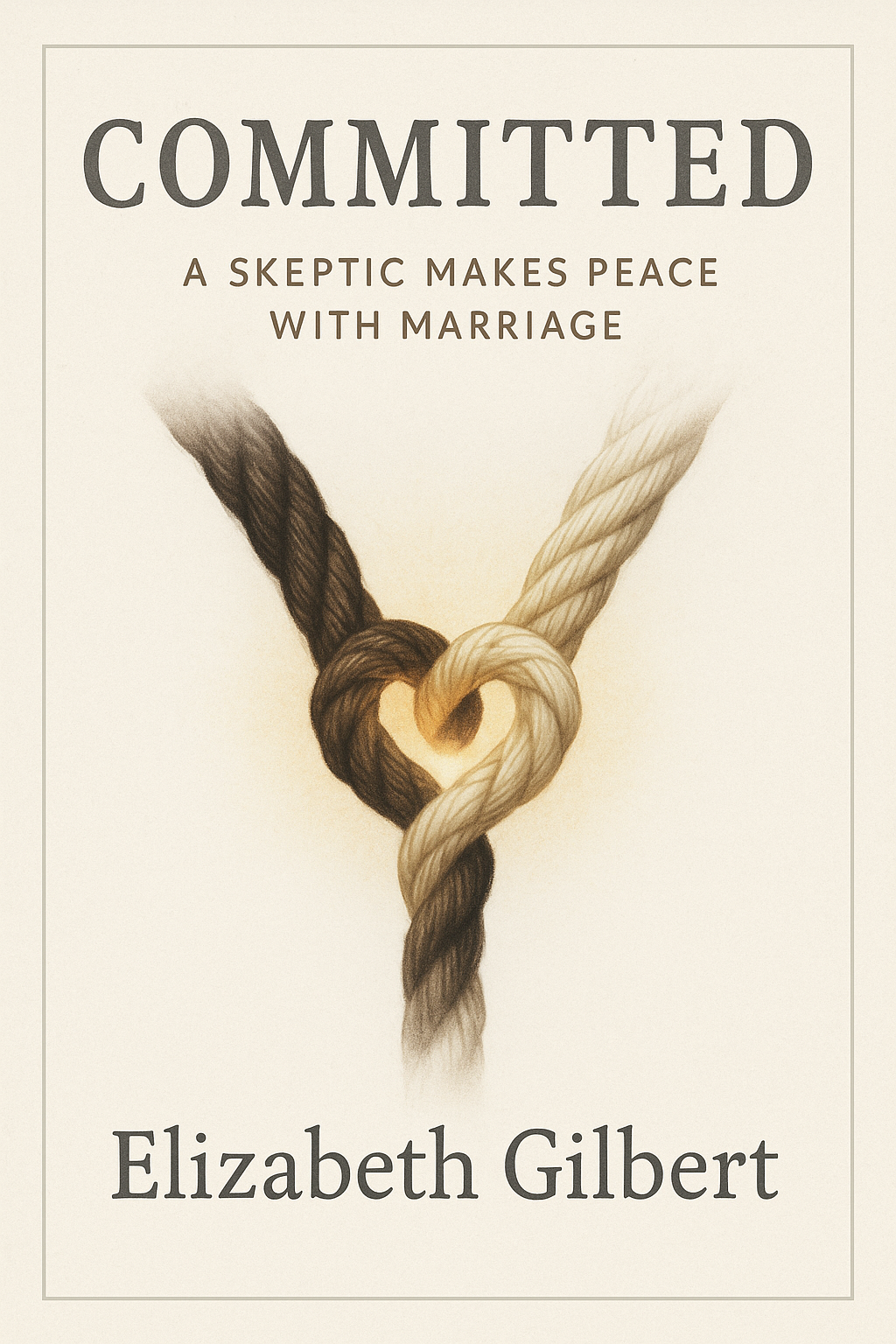
Committed: A Skeptic Makes Peace with Marriage
Chapter Summaries
What's Here for You
Elizabeth Gilbert, a renowned storyteller and a self-proclaimed skeptic of marriage, invites you on a deeply personal and intellectually stimulating journey in 'Committed: A Skeptic Makes Peace with Marriage.' If you've ever questioned the institution of marriage, felt bewildered by its complexities, or wondered if lifelong commitment is truly attainable, this book is for you. Gilbert’s signature blend of humor, vulnerability, and profound insight will transform your perspective. She doesn't just offer a personal narrative; she delves into the vast historical fluidity of marriage, revealing how its purpose and form have shape-shifted across cultures and centuries. You’ll explore the delicate dance between infatuation and lasting love, the intricate societal expectations placed upon women within marriage, and the vital importance of maintaining autonomy within a committed partnership. Through encounters with diverse individuals and traditions, from Hmong villagers to Buddhist monks, Gilbert illuminates the myriad ways love and commitment can manifest. This book promises to demystify marriage, not by offering simple answers, but by encouraging you to embrace its inherent surprises and subversions. Prepare to gain a richer understanding of why people commit, the courage it takes, and the profound beauty that can be found when we choose to enter into this ancient, yet ever-evolving, human contract. The tone is one of honest exploration, intellectual curiosity, and ultimately, a hopeful embrace of love's enduring power, even for the most committed skeptic.
Marriage and Surprises
Elizabeth Gilbert, in her chapter 'Marriage and Surprises,' recounts a pivotal moment that reshaped her perspective on matrimony, transforming a deeply held aversion into a necessary embrace. Initially, Gilbert and her partner, Felipe, a Brazilian gentleman seventeen years her senior, shared a profound love but a visceral fear of legal marriage, stemming from the devastating aftermath of their previous divorces. They had even sworn off blending finances or assets, finding emotional security in their consciously *un*official commitment, a pact that felt like discovering a 'Northwest Passage of Perfect Intimacy.' Their carefully partitioned companionship, however, was abruptly interrupted not by cosmic fate, but by the United States Department of Homeland Security. Due to Felipe’s non-American nationality and frequent short visits to the U.S. for his gemstone import business, they found themselves at the Dallas-Fort Worth International Airport facing a stark reality: Felipe was detained and informed he would be barred from re-entering the United States. The only viable solution offered by a surprisingly empathetic Homeland Security officer, 'Officer Tom,' was marriage. This pronouncement, delivered in a sterile interrogation room, struck Gilbert with the force of a physical blow, shattering her carefully constructed defenses against the institution she had so thoroughly vowed to avoid. It was a moment of being 'caught,' the 'flying fish and diving bird netted,' forcing a confrontation with her own deeply ingrained fears and past traumas. Yet, this unexpected crisis, this 'invitation' from destiny, also presented an opportunity for profound growth. Gilbert realized that her expertise lay not in marriage itself, but in its failure and the terror it evoked, a crowded field indeed. Thus, she embarked on a ten-month journey of 'rootless exile' with Felipe, traveling through Southeast Asia while diligently researching the history of Western marriage. Immersing herself in academic texts, she sought to understand the institution's complexities, hoping that knowledge would diminish her fear and allow her to approach her own impending marriage not as a sentence, but as a conscious, even happy, choice. This profound period of study and shared adversity, far from being a carefree adventure, became the crucible in which her deep aversion to matrimony was slowly, painstakingly, transmuted into understanding and a commitment to embracing the institution with eyes wide open, a testament to the transformative power of facing one's greatest fears head-on.
Marriage and Expectation
Elizabeth Gilbert, embarking on her own journey toward marriage, finds herself in a remote Vietnamese village, seeking wisdom from Hmong women about their marital traditions. She encounters a young girl named Mai, whose directness and Hmong heritage—that of a proud, independent people who have historically resisted assimilation—offers a glimpse into a different way of life, one that feels anachronistic and deeply rooted in community. Gilbert observes the Hmong women's lives, characterized by close-knit families living in shared spaces, a stark contrast to the isolated individualism of modern Western society. This communal living, she posits, might alleviate the intense pressure placed on modern marriages to be the sole source of emotional fulfillment. The Hmong women, when asked about meeting their husbands or falling in love, respond with laughter and confusion, revealing a fundamental difference in perspective: marriage, for them, is less about romantic love and more about fulfilling a role within the community, a pragmatic union where individual emotional biographies are not the central focus. This deeply contrasts with the Western emphasis on personal choice and the expectation that marriage should be a greenhouse for soaring romantic happiness, a belief that, as Gilbert reflects on her own past, often yields a harvest of bitter fruit when expectations are unmet. She contrasts this with the story of Arthur and Lillian Webster, a couple whose pragmatic, arranged marriage, devoid of initial romantic fervor, blossomed into profound love and commitment through years of shared life and unwavering devotion, particularly evident in Arthur's steadfast care for Lillian through her Alzheimer's. The core tension emerges: the Western ideal of marriage as the ultimate personal fulfillment versus a more traditional view where marriage is a partnership, a shared task, and a source of gradual affection built over time, not a singular destination for happiness. Gilbert concludes that while the freedom and choices of modern Western life are invaluable, they also breed a unique anxiety and paralysis, a fear of making the wrong choice and a constant longing for the unlived lives. The Hmong perspective, though not idealized, offers a powerful counterpoint, highlighting how lower expectations and a focus on fulfilling one's role can lead to a profound sense of certainty and contentment, a gift often missing in the modern pursuit of romantic bliss within marriage. Ultimately, Gilbert questions if her own expectations for marriage, like expecting her partner to keep every part of her emotional being warm simultaneously, are too high, suggesting that perhaps marriage was never meant to carry such a monumental cargo of personal happiness.
Marriage and History
Elizabeth Gilbert, in her exploration of marriage, invites us to witness its vast historical fluidity, revealing that the institution we often perceive as immutable has, in reality, been a shape-shifter across centuries and cultures. She explains that marriage has served myriad purposes, from a pragmatic tool for survival and expansion of kin in ancient times, where physical safety and a large family network were paramount, to a sophisticated mechanism for wealth management and social order in the Middle Ages, much like modern corporate mergers. Gilbert highlights the dramatic, almost utopian, shift proposed by early Christianity, which, in its pursuit of heavenly ideals, initially viewed marriage and its earthly ties—sexuality, family—as distractions from spiritual purity, a stark contrast to the procreative imperative of Judaism. This historical perspective, she argues, challenges modern notions of marriage's inherent sanctity, particularly for those who experience divorce and grapple with guilt, suggesting that understanding marriage's complex and often unholy past can offer a measure of peace. The narrative then traces the evolution from church-controlled unions, where divorce was forbidden for centuries, to a more secular, civil contract focused on managing assets and offspring, and further to the modern era where personal happiness and individual choice have become central, leading to increased divorce rates. This shift, while empowering individual expression, also reveals the inherent fragility of love-based unions, as Gilbert poignantly illustrates through her own experiences, suggesting that the very malleability that allows marriage to survive also makes it vulnerable. Ultimately, she posits that the ongoing debate around same-sex marriage is simply another chapter in this long history of evolution, a testament to marriage's persistent, albeit sometimes uncomfortable, adaptability, and that embracing this evolution, even with its inherent risks of heartbreak, is crucial for a society that values personal freedom and connection.
Marriage and Infatuation
Elizabeth Gilbert, in 'Marriage and Infatuation,' navigates the bureaucratic labyrinth of a stalled immigration case while immersing herself in the serene, yet surprisingly complex, world of Buddhist monks in Luang Prabang. This unexpected detour into observation, particularly of a young monk reading a love email, sparks a profound reflection on desire, attachment, and the very nature of human connection. Gilbert draws a stark contrast between infatuation—a chemically induced, all-consuming obsession akin to addiction, which she admits to having a lifelong habit of—and mature love, built on respect and the clear-eyed acceptance of another’s reality. She delves into philosophical and psychological theories, from Plato’s myth of severed halves to Helen Fisher’s research on brain chemistry, illustrating how the human yearning for completion can lead to perilous choices and the mirage of infatuation. The author contrasts this with the wisdom of detachment taught by Buddhism and the historical suspicion of marriage within its traditions, while also exploring the human condition’s inherent desire for union. Gilbert then pivots to her own lived experience, detailing the arduous process of preparing for her second marriage to Felipe. This preparation involved confronting past romantic failures, meticulously discussing finances and fidelity, and bravely revealing her deepest character flaws. She shares insights from Shirley Glass on infidelity, emphasizing the importance of maintaining marital boundaries, and reflects on statistical data regarding divorce proneness, finding solace in their advanced age and shared maturity as mitigating factors. Ultimately, Gilbert posits that true intimacy, and perhaps even transcendence, lies not in perfect union or the absence of desire, but in the daily, deliberate act of accepting and forgiving a partner's imperfections—their ‘worthless, junky, crappy bits’—recognizing that love is often an act of working with the whole parcel, flaws and all, and that shared vulnerability and open communication are the foundations of enduring connection, even amidst inevitable differences.
Marriage and Women
The author, Elizabeth Gilbert, embarks on a journey through Laos, encountering individuals whose lives and marriages offer profound, often contrasting, perspectives on commitment and societal roles, a journey that prompts deep introspection about her own past and future. Gilbert meets Keo, a young man brimming with facts and enthusiasm, who explains the intricate Laotian tradition of weddings as a form of communal banking, where gifts are meticulously cataloged loans meant to circulate and support new couples, revealing a system where marriage itself is a shared community investment. She then visits Joy and her mother Ting in a remote village, where traditional marriages are expected to last forever, with a multi-tiered community intervention system to resolve marital discord, a stark contrast to the author's own divorced past. This encounter triggers reflections on her failed first marriage and the potential benefits of community support, while simultaneously highlighting the evolving landscape of marriage as women gain economic independence, a phenomenon Ting observes with concern as it disrupts traditional village dynamics. Gilbert also shares the story of Keo and his pregnant wife Noi, offering a glimpse into a humble yet hopeful life, where ingenuity and partnership are paramount, and where the author witnesses a profound connection between Felipe and Keo, two men shaped by humble beginnings. Contrasting these experiences, Gilbert delves into the history of her own family, recounting her grandmother Maude's life, a woman who seemingly sacrificed her personal ambitions for marriage and family, yet declared those years as her happiest, a paradox that deeply puzzles the author. This leads to an exploration of the "Marriage Benefit Imbalance," where men statistically gain more from marriage than women, yet women continue to desire it, often for a profound need to feel "chosen." Gilbert then examines her mother's life, a "feminist cusper" who gave up a career for family, and her own deliberate choice to remain childless, embracing the role of an "Auntie" and forging a "Wifeless, Childless, Husbandless Marriage" with Felipe, ultimately concluding that while tidy answers are elusive, finding peace within life's inherent contradictions is a personal triumph, and that fostering life takes many essential forms beyond traditional motherhood.
Marriage and Autonomy
Elizabeth Gilbert, in her chapter 'Marriage and Autonomy' from 'Committed,' embarks on a journey through the complexities of marital commitment, initially tested by the strains of prolonged travel and bureaucratic limbo. As Felipe, her partner, faces powerlessness due to immigration issues, his stress manifests as irritability, creating friction that Gilbert, with her Midwestern upbringing, finds challenging to navigate. This tension highlights a core insight: differing conflict resolution styles and deeply held personal narratives about loved ones can clash, even in stable relationships, but especially under duress. The author observes how external pressures, like a stalled immigration case, can amplify underlying incompatibilities, pushing partners to their emotional limits. A pivotal moment occurs on a grueling bus ride where Felipe’s suppressed misery erupts, not with anger, but with a profound yearning for home, routine, and the simple comfort of a coffeepot—a powerful illustration of how unmet needs for security and provision can fuel a man's sense of helplessness. Gilbert then introduces John M. Gottman's concept of 'Turning Toward Your Partner' as a strategy to defuse conflict, though she notes it doesn't always work when emotions run high. The narrative then shifts as Felipe’s vulnerability reveals his deep-seated need to provide and protect, a need that modern men often feel diminished when they cannot fulfill, underscoring another insight: for many, the ability to offer material comfort is intrinsically linked to their sense of love and self-worth. Gilbert contrasts this with her own need for emotional connection, realizing that different partners prioritize different forms of care. The journey continues with Gilbert's solo trip to Cambodia, a deliberate act to carve out personal space amidst the intense interdependence of their situation, reflecting a crucial insight: establishing personal autonomy, even through brief separations, is vital for maintaining individual identity within a marriage, akin to dividing a garden to prevent conflict. This act, though initially fraught with anxiety about separation, ultimately strengthens their bond, revealing that true marital strength lies not in constant proximity, but in the mindful negotiation of space and independence. The chapter culminates in the understanding that marriage, like a bonsai tree, requires careful pruning and containment to thrive, a delicate dance between entanglement and freezing, as philosopher Zygmunt Bauman suggests. The final insight emerges: love inherently involves limitations and restrictions, and navigating these requires acknowledging that while partners are bound to each other, they can still carve out individual paths, finding a balance that respects both union and autonomy, ultimately reinforcing their 'lifeboat' of togetherness.
Marriage and Subversion
Elizabeth Gilbert, in her chapter "Marriage and Subversion," navigates the complex and often fraught journey toward marriage, revealing how personal history and societal expectations collide. Returning to a familiar house in Bali, Gilbert and her partner, Felipe, sought refuge and a quiet space to await the resolution of his immigration process, finding solace in the shared memories and routines of this haven. This period of waiting, marked by the sounds of a vibrant, sometimes disruptive, Balinese night, becomes a crucible for intimacy. Gilbert draws a parallel to Italo Calvino's "Invisible Cities," where merchants trade stories and intimacies, illustrating how long-term relationships cause us to inherit each other's histories, weaving them into our own biographies. She recounts a poignant memory of Felipe sharing his childhood fishing trips with his father, a story so vivid it becomes her own, demonstrating the profound, almost alchemical, nature of shared experience. As Felipe's immigration case progresses, the prospect of marriage looms, yet Gilbert finds herself deeply resistant to a public ceremony, echoing Anton Chekhov's anxieties about the fanfare and congratulations. Her sister Catherine's gentle attempts to orchestrate a celebration only amplify Gilbert's discomfort, highlighting a deep-seated aversion to the public performance of commitment, especially after previous marital experiences. This resistance stems partly from embarrassment and the tarnished credibility of repeated vows, but more profoundly, from an internal conflict between the Greek and Hebrew worldviews that shape Western culture. Gilbert identifies herself as more Greek—valuing individualism, personal liberty, and reason—while acknowledging the Hebrew emphasis on faith, obedience, and the inviolability of vows. This internal tug-of-war creates confusion, particularly regarding marriage, where Americans simultaneously believe in lifelong commitment and the right to divorce. Her struggle intensifies as she grapples with the idea that marriage itself might be an institution that shapes individuals more than individuals shape it, fearing the loss of her bohemian identity to conventional spousal roles. This tension leads her to Ferdinand Mount's work, "The Subversive Family," which reframes marriage not as an institution imposed by authority, but as an inherently subversive act. Mount argues that nonarranged, Western marriages, driven by personal choice and fostering private intimacy, inherently undermine state and societal control by creating a secret, inviolable world for two. This insight offers Gilbert a profound resolution: marriage, far from being a concession to authority, is a powerful act of personal autonomy and resistance, a space where individuals carve out their own terms of love and commitment. She realizes that her own deeply personal, ritualistic commitments with Felipe, even without legal sanction, were acts of subversion. The chapter culminates in Gilbert's acceptance of marriage, not as a surrender to convention, but as an embrace of its subversive potential, finding comfort in the idea that even within this ancient institution, individuals can forge their own private worlds and continue to practice love on their own terms, a sentiment echoed in the tradition of a Roman serenade where resistance and acceptance intertwine.
Marriage and Ceremony
Elizabeth Gilbert recounts the whirlwind journey towards her marriage with Felipe, a process fraught with bureaucratic hurdles and profound personal shifts, all set against the backdrop of securing his immigration status. As Felipe's visa process inched forward, Gilbert, with a clear vision inspired by a poem about domesticity, found their future home—an 1802 Presbyterian chapel in New Jersey—sight unseen, placing a bid from Bali. This bold act of settling a home before securing a country highlights a core insight: that sometimes, commitment to a vision must precede its full realization. The narrative then plunges into the intricate, often romance-draining, administrative tasks of the immigration process, a stark contrast to the emotional weight of their union. A critical moment of panic erupts when a missing Brazilian police record threatens to derail everything, a tension resolved through the resourceful intervention of their mutual friend, Armenia, illustrating the power of community and serendipity in overcoming obstacles. This near-disaster underscores the insight that even the most meticulously planned paths can require unexpected detours, often navigated by the kindness of others. Felipe's eventual success at the U.S. Consulate in Sydney, marked by a librarian-like thunk of the visa in his passport, brings him back to the United States, where Gilbert, overwhelmed by suppressed fears, experiences an emotional breakdown at the airport—a powerful sensory scene of relief and vulnerability. This moment of catharsis and reunion, a stark contrast to the earlier administrative focus, reveals the profound emotional release that comes with overcoming immense stress. Within days, they marry in their newly acquired chapel, a testament to the unusual ease of marrying when one owns a church. The ceremony itself, though simple, is imbued with meaning, attended by a small, cherished group of family and friends, including their dog, Toby, who curls up between them, a symbol of fidelity echoing medieval tradition. Gilbert reflects that marriage is not merely a private prayer but a public and private concern, belonging not just to the couple but to their families and even the State. By repeating the secular vows of New Jersey, they acknowledge their place in history and reality, a decision that speaks to the insight that our personal commitments are shaped by the historical and societal contexts in which we live. The wedding, complete with a determined flower girl and opera singing, becomes a 'real' wedding by Mimi's exacting standards, a moment of whimsical joy amidst the gravity of their journey. As the guests depart and Gilbert and Felipe are left alone, the feeling of calm and gratitude, despite the unpacked house, signifies the resolution of their immediate tension and the quiet beginning of their shared life, revealing the final insight that true contentment in marriage often lies not in perfection, but in the shared peace found after navigating profound challenges together.
Conclusion
Elizabeth Gilbert's "Committed" masterfully deconstructs the Western notion of marriage, revealing it not as a static, sacred union, but as a fluid, historically contingent institution shaped by cultural, economic, and personal evolution. The book's core takeaway is that deep-seated fears surrounding commitment, particularly marriage, can be transformed not through avoidance, but through knowledge, introspection, and confronting adversity head-on. Gilbert's personal journey, catalyzed by the immigration challenges faced by her partner, Felipe, serves as a powerful narrative arc, demonstrating how external circumstances can compel individuals to re-evaluate and ultimately embrace life choices they might have otherwise rejected. Emotionally, the book offers profound solace to those who have been wounded by past relationships or who grapple with the immense pressure Western culture places on marriage to be the sole source of personal fulfillment. Gilbert highlights the fragility of love-based unions in contrast to historically pragmatic or arranged marriages, suggesting that the relentless pursuit of individual happiness can paradoxically lead to greater dissatisfaction. The wisdom gleaned from diverse cultural perspectives—from the Hmong emphasis on pragmatic unions and clearly defined roles, to the communal nature of marriage in Laos—illuminates the unsustainable burden placed on modern Western partnerships. The practical wisdom lies in understanding that mature love is built on the clear-eyed acceptance of reality and a partner's flaws, rather than infatuation's chemically driven illusion. It underscores the necessity of conscious effort in maintaining boundaries, open communication, and the courage to accept one's own and a partner's imperfections. Ultimately, "Committed" argues that marriage, when approached with understanding, humility, and a willingness to adapt its historical and societal frameworks to personal needs, can become a sustainable, deeply rewarding union, a subversive act of creating private intimacy and shared biography, even amidst the administrative complexities and emotional challenges it inevitably presents. The book leaves the reader with a renewed appreciation for the multifaceted nature of commitment and the enduring human yearning for partnership.
Key Takeaways
Deep-seated fears, particularly around marriage, can be transformed through knowledge and confronting adversity.
External circumstances, like immigration issues, can force individuals to re-evaluate and potentially embrace previously rejected life choices.
A profound love can exist independently of legal or institutional commitment, yet societal or governmental structures may necessitate formalizing that bond.
Understanding the historical and cultural context of institutions like marriage can demystify them and mitigate personal anxieties.
Facing one's greatest fears, especially when propelled by circumstance, can be a powerful catalyst for personal growth and self-discovery.
The experience of trauma, such as severe divorce, can create a strong aversion to commitment, but resilience allows for healing and a renewed capacity for intimacy.
True commitment, even when born out of necessity, requires a conscious decision to engage with and understand the institution being entered.
Western marriages are often burdened by the expectation that one partner must fulfill all emotional needs, a pressure absent in cultures where marital roles are clearly defined and emotional support comes from a wider community.
The Hmong perspective reveals that marriage can be a pragmatic union, fulfilling societal roles and building affection over time, rather than being solely driven by romantic love and individualistic happiness.
Excessive personal choice and the pursuit of profound happiness in Western culture can lead to indecision, anxiety, and a fear of unmet potential, whereas lower, more defined expectations can foster a sense of certainty.
The longevity and depth of commitment in relationships, as exemplified by Arthur and Lillian Webster, can emerge from pragmatic foundations and shared life experiences, not solely from initial romantic passion.
The modern Western emphasis on the 'self' and individualistic yearnings, while offering freedom, can inadvertently place an unsustainable weight of expectation on marriage as the primary source of personal fulfillment.
A marriage's success may be better measured by the contentment found in its later years, built on partnership and gradual affection, rather than the intensity of its romantic beginnings.
Marriage has historically been a fluid institution, adapting its definition and purpose across cultures and eras, rather than a static, universally sacred union.
The primary purposes of marriage have shifted dramatically from ensuring physical safety and tribal cohesion to managing wealth, then to spiritual idealism, and finally to individual emotional fulfillment.
Early Christian thought initially devalued marriage and earthly ties in favor of spiritual purity and celibacy, a perspective that contrasts sharply with historical Jewish views and modern religious conservatives.
The legal and social frameworks of marriage have evolved from church-controlled indissoluble bonds to secular contracts and, more recently, to unions centered on personal happiness and individual choice, leading to increased divorce rates.
Love-based marriages, while prioritizing individual fulfillment, are inherently more fragile than historically arranged or economically driven unions, as the heart's choices can change.
The ongoing expansion of marriage rights, including same-sex marriage, is a continuation of its historical tendency toward greater personal privacy, fairness, and freedom of choice.
The rise of divorce rates in love-based societies is an inevitable consequence of prioritizing individual happiness and personal affection as the primary basis for matrimony.
Infatuation is a chemically driven, addictive state that distorts perception, while mature love is built on respect and the clear-eyed acceptance of reality.
The human yearning for completion, as illustrated by Plato's myth, can lead to seeking impossible union and falling prey to infatuation, especially during vulnerable life stages.
Healthy marriages require conscious effort in maintaining boundaries, sharing intimacies appropriately within the union, and open communication about external connections.
Accepting a partner's flaws, rather than focusing solely on their perfect qualities, is the true test of love and a more sustainable basis for long-term relationships.
Maturity, achieved through life experience and past romantic failures, significantly increases the likelihood of a successful, lasting marriage.
Openly discussing and acknowledging one's own character flaws, and accepting those of a partner, is a vital, albeit uncomfortable, step toward building trust and lasting intimacy.
The communal nature of marriage in some cultures, like Laos, treats unions as shared investments rather than purely private affairs, highlighting the societal implications of partnership.
Women's increasing economic autonomy fundamentally alters traditional marriage dynamics, creating societal tensions as financial independence challenges established gender roles and expectations.
The "Marriage Benefit Imbalance" suggests that while men statistically gain more from marriage, women's deep desire for it often stems from an emotional need to feel chosen and validated.
A woman's perceived happiness in marriage can be complex, potentially arising from indispensable partnership and shared purpose, even amidst significant personal sacrifice.
Choosing a life path outside of traditional marriage and motherhood, such as embracing the role of a childless aunt, is a valid and essential way to foster life and contribute to community.
Reconciling seemingly contradictory feelings about life choices, particularly regarding marriage and motherhood, is a natural and necessary part of personal growth and self-understanding.
Couples must acknowledge and navigate differing conflict resolution styles and personal narratives, especially under external pressure, to prevent resentment from festering.
A man's deep-seated need to provide and protect can be a core part of his identity, and its perceived absence due to circumstances can lead to profound feelings of helplessness and frustration.
Effective communication in marriage requires understanding a partner's fundamental needs, whether they are for emotional connection or tangible security, and recognizing that these needs can differ significantly.
Establishing and respecting personal autonomy within a marriage, even through temporary separations, is crucial for maintaining individual identity and preventing the stifling of personal growth.
Love inherently involves limitations and a degree of 'mutual, quiet, almost velvety oppression,' requiring partners to carefully negotiate boundaries to find a sustainable balance between union and independence.
The 'porcupine dilemma' of intimacy—the struggle to find a comfortable distance between closeness and painful proximity—is a fundamental challenge in relationships that requires ongoing recalibration and compromise.
Recognizing and respecting individual travel styles and needs for space is vital, even for lifelong travelers, to avoid burnout and maintain harmony within the relationship.
Intimacy and shared history in long-term relationships lead to an inheritance and trading of personal stories, effectively weaving individuals into each other's biographies.
Resistance to public wedding ceremonies often stems from past experiences, concerns about credibility, and a fundamental philosophical conflict between valuing individualism versus adherence to tradition.
Western culture is shaped by a tension between the Greek emphasis on individual liberty and reason, and the Hebrew focus on faith, obedience, and communal vows, creating a paradoxical view of marriage as both lifelong and easily dissolvable.
Marriage, particularly nonarranged Western unions, can be understood as an inherently subversive act that creates private, intimate spaces resistant to external control and authority.
The institution of marriage, rather than solely shaping individuals, is ultimately shaped by the individuals within it, who find ways to bend its rules and conventions to their own needs and definitions of love.
The human yearning for private intimacy and partnership is a powerful, persistent force that drives individuals to create their own unions, often on their own terms, despite societal pressures or legal restrictions.
Commitment to a vision, like securing a home before all legalities are finalized, can be a powerful catalyst for progress, even when defying conventional advice.
The meticulous, often unromantic, administrative demands of major life transitions can obscure the profound emotional significance of the journey, requiring a conscious effort to reconnect with the heart of the matter.
Unexpected crises, such as missing crucial documents, can be overcome through resourcefulness, community support, and a touch of serendipity, highlighting the interconnectedness of our lives.
True relief and emotional resolution often manifest as a breakdown of carefully guarded composure, releasing suppressed fears and vulnerabilities once a significant period of stress has passed.
Marriage is a complex tapestry woven with private intimacy, familial bonds, societal obligations, and historical context, requiring acknowledgment of all threads for its full meaning.
Achieving a 'real' wedding, or any significant life event, can be a blend of exacting personal standards and simple, genuine joy, proving that meaning can be found in both the grand gestures and the everyday moments.
Action Plan
Identify personal fears and aversions related to commitment or significant life institutions.
Seek out knowledge and historical context to demystify subjects that evoke fear or anxiety.
Practice empathy by attempting to understand the perspective of those in positions of authority or bureaucracy.
Communicate openly with a partner about fears and hesitations regarding future commitments.
Reframe challenging circumstances as opportunities for personal growth and deeper understanding.
Commit to exploring and embracing significant life decisions with conscious awareness rather than passive acceptance.
When faced with a deeply feared situation, consider the possibility of growth and change rather than immediate avoidance.
Reflect on your personal expectations for marriage and identify which are rooted in cultural ideals versus genuine partnership needs.
Consider the sources of emotional support in your life beyond a romantic partner.
Practice grounding yourself in the present moment and the reality of your current relationship, rather than dwelling on unlived alternatives.
Reframe the concept of 'hard work' in marriage from a burden of constant happiness-seeking to the shared effort of building a life together.
Explore the value of fulfilling defined roles and responsibilities within a partnership, rather than solely seeking individualistic fulfillment.
Cultivate gratitude for the present relationship and the gradual affection built over time, rather than solely focusing on the initial spark of romance.
Reflect on the historical purposes of marriage beyond personal happiness to understand its evolving nature.
Consider how societal shifts, from religious dogma to secular law, have shaped marital expectations and realities.
Acknowledge the inherent fragility of love-based unions and the emotional risks associated with them, fostering humility in relationships.
Recognize that the legal and social frameworks of marriage are constantly evolving, and current debates are part of this ongoing historical process.
Challenge personal assumptions about marriage's 'natural' state by exploring its diverse historical forms and functions.
Approach personal relationship choices with an awareness of both the desire for love and the potential for heartbreak.
Reflect on your own history with infatuation and contrast it with your understanding of mature love.
Identify and communicate your core values and non-negotiables for a partnership, similar to how Gilbert and Felipe discussed fidelity.
Practice accepting your partner's flaws by focusing on their positive attributes and considering if you can 'work with' their imperfections.
Engage in open and honest conversations about finances and personal boundaries, treating them as essential components of marital preparation, not just romantic ideals.
Be willing to reveal your own significant character flaws to your partner, creating a space for vulnerability and informed consent within the relationship.
Recognize that relationship resilience is often built through proactive communication and boundary setting, rather than solely relying on inherent compatibility or passion.
Reflect on the cultural or societal messages about marriage and motherhood that have shaped your own expectations.
Consider the concept of 'community investment' in relationships and how shared responsibilities can strengthen partnerships.
Evaluate the balance of sacrifices and benefits within your own significant relationships and discuss these openly with your partner.
Explore the possibility of "wifeless, childless, husbandless" marriage models by consciously distributing household and financial responsibilities evenly.
Acknowledge and honor personal dreams and ambitions, even when they diverge from traditional expectations or require significant life adjustments.
Identify and nurture your unique contributions to your community or chosen "tribe," recognizing that fostering life extends beyond biological parenthood.
Practice self-compassion by accepting life's inherent contradictions and acknowledging that unmixed feelings about complex choices are not always possible or necessary.
Identify and articulate your own communication style and how it might differ from your partner's, seeking to understand their perspective without judgment.
Reflect on your partner's core needs for security and provision, and how you can support those needs, even in challenging circumstances.
Practice Gottman's 'Turning Toward Your Partner' technique by validating their feelings before expressing your own during disagreements.
Discuss with your partner the need for personal space and autonomy, establishing clear boundaries and expectations for time spent apart.
Consciously practice 'preemptive conflict resolution' by recognizing rising tension and agreeing to pause and choose words carefully.
Acknowledge the inherent limitations of love and commitment, and actively work to find a healthy balance between togetherness and individual freedom.
If traveling styles differ, consciously plan separate activities or trips to honor individual preferences and prevent resentment.
Reflect on personal historical narratives that have shaped your understanding of love and commitment.
Examine your own internal 'Greek' versus 'Hebrew' tendencies and how they influence your views on relationships and tradition.
Consider how your private relationship creates a unique culture and language that is distinct from external expectations.
Identify moments where you have acted subversively to protect your intimate bond or personal choices.
Explore personal rituals or ceremonies that hold deep meaning for you, regardless of their public recognition.
Acknowledge the power of your own choices in defining the terms of your relationships, even within established structures.
Identify and acknowledge the core vision driving a significant life decision, even if external circumstances are not yet fully aligned.
Break down complex administrative processes into manageable steps, while consciously scheduling moments to reconnect with the emotional significance of the goal.
Proactively identify potential 'missing pieces' or critical documents in major life plans and seek advice or support early on.
Allow for and embrace emotional release after periods of intense stress or uncertainty; do not suppress feelings of relief or vulnerability.
Consider the various stakeholders (family, community, society) who are affected by major personal commitments and find ways to acknowledge their roles.
Define what constitutes a 'real' or meaningful ceremony or event for yourself, blending personal ideals with pragmatic considerations.
Practice gratitude for the present moment and the peace found after overcoming challenges, even if the environment is not yet perfect.