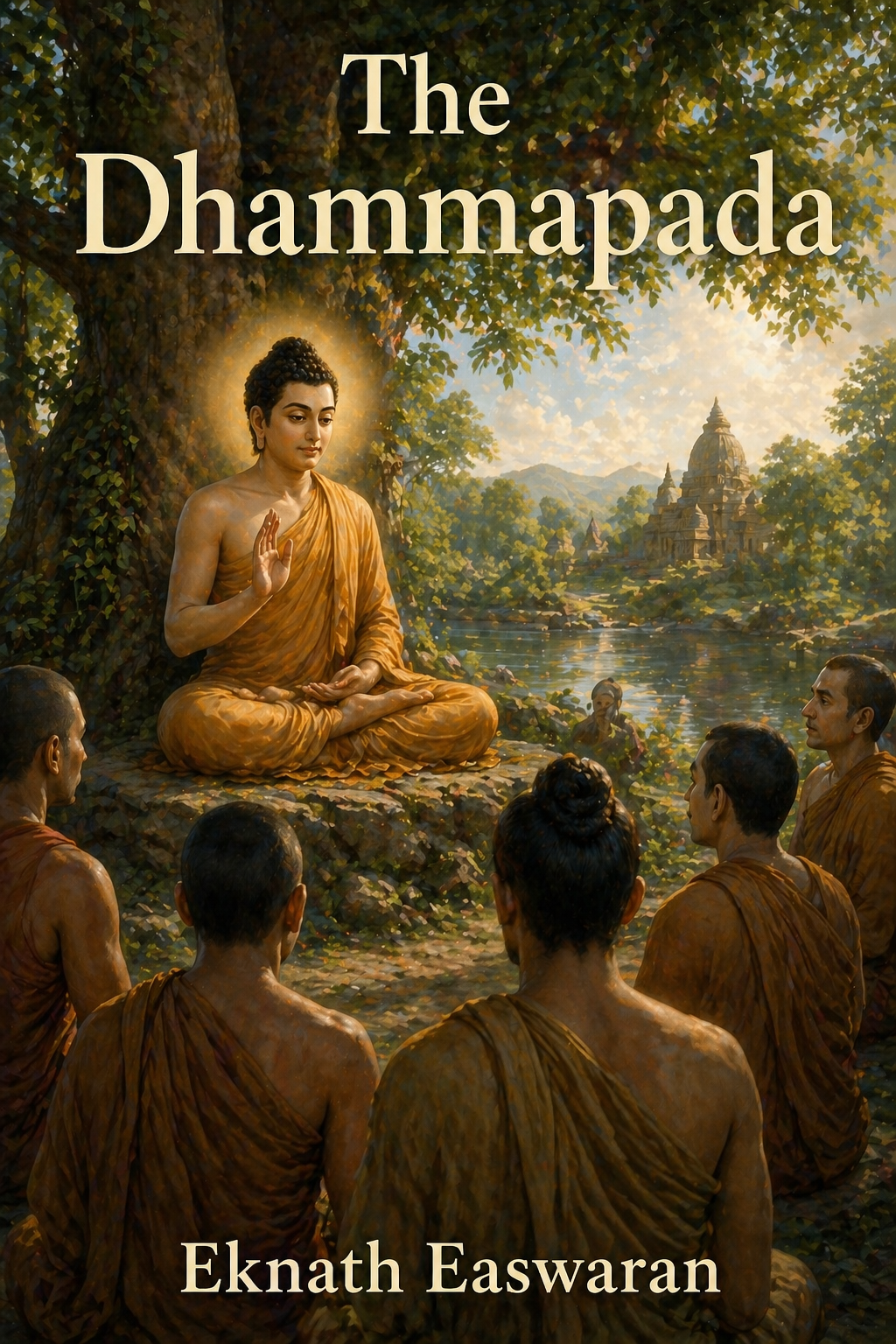
The Dhammapada
Chapter Summaries
What's Here for You
Embark on a transformative journey with Eknath Easwaran's interpretation of *The Dhammapada*, a timeless guide offering practical wisdom for everyday life. This is not just a philosophical exploration; it's an invitation to cultivate inner peace, master your mind, and discover lasting joy. Prepare to confront the inevitability of change, understand the nature of suffering, and redefine your understanding of 'self'. Through insightful analysis and accessible language, Easwaran illuminates the Buddha's teachings, revealing the Eightfold Path as a practical route to liberation accessible to all. You'll gain tools to navigate the complexities of the world, conquer anger and impurity, and ultimately, awaken to your full potential. Discover how to forsake fleeting pleasures for the profound joy of an intentional life, and train your mind like a skilled elephant driver. This journey promises not just intellectual understanding, but a deeply personal experience of growth, compassion, and lasting happiness.
Twin Verses & Vigilance
In Eknath Easwaran's interpretation of *The Dhammapada*, the narrator introduces the essence of the Buddha's teachings, emphasizing that while many sutras targeted monks, the Dhammapada was crafted for everyone, offering a path accessible to all through the Eightfold Path. The chapter's structure, based on twin verses, presents contrasting choices: one aligned with conditioned human desires, the other demanding effort against the grain of human nature. Like Robert Frost's diverging roads, these choices define our destiny. The initial tension lies in the mind's natural inclination towards ease, swimming with the current of selfishness. The Buddha, an incorrigible optimist, understood an eternal principle: hatred ceases not by hatred, but by love. To train the mind, as the Buddha suggests, requires meditation, a practice emphasized even for lay followers, to prevent hostile thoughts from arising, like rain seeping through a poorly thatched roof. The verses illustrate how our thoughts shape our reality, where dwelling on anger perpetuates hatred, while thoughts of love bring lasting joy. The path to overcoming this, though difficult, promises ultimate happiness, urging us to leave aside lesser happiness for a greater one. The narrator highlights the importance of vigilance, contrasting the fate of the immature who lose it with the wise who guard it as their greatest treasure, climbing beyond suffering to wisdom's peak. The chapter resolves with the assertion that earnest effort, like a fire burning all fetters, leads to nirvana, a state of being where one never falls back.
Mind & Flowers
In this exploration of the Dhammapada, Eknath Easwaran illuminates the profound yet challenging path to mastering the mind, a journey he likens to emptying the sea with a teacup, demanding immense patience and persistent effort. Easwaran explains that the mind, far from being a placid surface, is a turbulent ocean, teeming with subconscious desires and drives that dictate our actions; he emphasizes that true freedom arises not from external control but from taming these internal forces through meditation. The author paints a vivid picture: imagine consciousness as raw clay, constantly reshaped by habitual thoughts and desires on the potter's wheel of the mind. Meditation, then, becomes the process of softening this clay, allowing us to reshape our mental landscape and break free from conditioned responses. Easwaran underscores that this mastery requires diligent effort to counter the mind's natural tendency to wander, comparing it to a fish out of water, thrashing desperately. Yet, he assures us that with practice, one can aim thoughts with the precision of a skilled archer, directing them towards wisdom. He draws a compelling parallel between meditation and warfare, asserting that conquering one's own mind is a greater victory than any worldly conquest. Easwaran cautions against the pursuit of fleeting pleasures, urging us to focus on the lasting accomplishment of a stilled and controlled mind, which ultimately leads to liberation from suffering and even death itself. He acknowledges the seeming paradox of stilling the very instrument responsible for human progress, but he argues that uncontrolled thoughts can lead to destruction, while a well-trained mind can reverse destructive courses of action. Furthermore, the author highlights that a disciplined mind fosters compassion and clarity, enabling individuals to positively influence the world and to act as beacons of hope, much like a fragrant lotus blooming in a garbage heap, bringing joy to all who pass by.
The Immature & The Wise
In the *Dhammapada*, Eknath Easwaran illuminates the subtle yet profound distinction between immaturity and wisdom, suggesting that immaturity is not a fixed state but a developmental stage, a crucial reframing that offers hope for growth. Easwaran clarifies that the immature are those who fail to recognize their own errors and struggle to forgive others, trapped in the relentless cycle of *samsara*—the everyday world of incessant change—likening their experience to a long, sleepless night. The central tension lies in the ability to learn and assimilate teachings; the immature, likened to a spoon unable to taste the soup, remain impervious to wisdom even when surrounded by it. However, Easwaran emphasizes that the recognition of one's immaturity is the very first step toward wisdom, a turning point that can prevent much suffering. The wise, in contrast, actively use their experiences to reshape their character, much like a carpenter skillfully carves wood, and seek guidance from those who can reveal hidden truths, even if it means facing criticism. The teacher's role is not to dictate but to advise, empowering individuals to make their own efforts toward enlightenment. Easwaran underscores the importance of self-reliance, reminding us that the Buddha only shows the way, and the effort must be our own. The journey culminates in *bodhi*, a temporary stilling of the mind that brings illumination, paving the way for *nirvana*, the permanent release from suffering, achieved when enlightenment becomes our constant state, fully integrated into our character and conduct. Ultimately, the path from immaturity to wisdom is marked by the conscious cultivation of mindfulness, vigor, joy, serenity, concentration, equanimity, and the penetration of dharma, allowing us to see the workings of dharma in the tapestry of everyday life, guiding us toward becoming truly awake.
The Saint & Thousands
In this chapter of the Dhammapada, Eknath Easwaran illuminates the concept of the arhant, the fully realized human being who has attained nirvana, describing them as graduates from the school of life, profound and unfathomable like the great ocean. Easwaran explains that the path to arhantship involves stages: the stream-winner, the once-returner, and the never-returner, each representing a deeper commitment to the Eightfold Path, moving against the current of human conditioning. The tension arises between the ideal of the arhant, who achieves personal liberation, and the bodhisattva, a figure in Mahayana Buddhism who vows to return to samsara until all beings are saved. Some criticize the arhant as a 'private Buddha,' but Easwaran bridges this philosophical divide by highlighting that both ideals offer humanity the loftiest image of what we can become. He uses the Buddha's interaction with the brahmin Sangarava to illustrate how enlightened beings teach and inspire countless others, creating a ripple effect of spiritual growth. Like birds soaring through the sky, the path of the selfless is hard to follow, yet they live on alms in a world of freedom, their senses under control. The chapter shifts focus to the power of a single thoughtful word or moment of homage, emphasizing that conquering oneself is greater than conquering thousands on the battlefield. Ultimately, Easwaran resolves the tension by asserting that those who have conquered their passions serve humanity ceaselessly, their impact transcending philosophical differences, offering health, happiness, beauty, and long life to those who honor and follow them. A single day lived in virtue and wisdom, Easwaran suggests, outweighs a hundred years of undisciplined existence, urging readers to seek that glimpse of the deathless state, a glimpse of dharma.
Evil & Punishment
In the exploration of "Evil & Punishment" from *The Dhammapada*, Eknath Easwaran elucidates the profound concept of karma, moving it from a distant philosophy to an intimate aspect of our daily existence. He begins by clarifying that Buddhism doesn't envision a judgmental figure dispensing rewards or punishments; instead, karma functions as an inherent law, akin to gravity, where actions inevitably lead to corresponding consequences. The author underscores that karma isn't merely about external events; it's deeply intertwined with our internal landscape, particularly through 'samskaras,' or karma-formed states. These samskaras aren't isolated incidents but mental inclinations that carve pathways in our consciousness, influencing future actions. Easwaran illustrates this with the example of anger: each outburst deepens the neural groove, making subsequent eruptions more likely, gradually embedding anger into our character. Thus, evil is understood not as an external force, but as the internal accumulation of harmful samskaras, subtly eroding our control. The instructor emphasizes the importance of conscious choice, and actively cultivating positive responses like forgiveness and compassion, serves as the antidote to these self-reinforcing patterns. He paints a vivid picture: imagine our minds as gardens, where repeated thoughts and actions are seeds; we can either cultivate a flourishing landscape of virtue or allow thorny weeds of negativity to overrun it. Easwaran also points out that while evildoers might initially experience happiness, sorrow inevitably follows when the karmic debt is due, just as the virtuous may face temporary suffering before the ultimate joy of their good deeds blossoms. The author offers a hopeful resolution, reminding us of the equal potential for cultivating good habits, illustrating that just as a pot is filled drop by drop, so too can we gradually become good through consistent, mindful choices. He concludes by stressing that our lives will be shaped either by our conscious efforts or by the unconscious conditioning of our samskaras, urging us to actively mold our character through the numberless decisions we make each day, guiding us toward the profound possibility of inner transformation.
Age
In Eknath Easwaran's interpretation of *The Dhammapada*, the chapter "Age" opens with a stark confrontation: the inevitability of decay. Easwaran recounts Prince Siddhartha's profound awakening upon witnessing old age, a moment that catalyzed his spiritual quest. The chapter isn't a morbid fascination with decline, but a call to recognize aging as a continuous process, beginning at conception. Easwaran explains that the verses serve as a poignant reminder, urging us to not squander our fleeting existence on trivial pursuits. It’s not about distaste for the body, but about transcending a purely physical existence. Like an aging king's chariot losing its luster, the body weakens. Easwaran illuminates the celebrated 'housebuilder verses,' a pivotal moment where the Buddha, upon enlightenment, identifies selfish craving as the architect of suffering, the force perpetuating endless cycles of birth and death. The instructor highlights that selfish craving, insatiable, demands more even as the body offers less. Bhartrihari’s verse echoes this sentiment: wrinkles deepen, hair grays, yet craving remains eternally youthful. Thus, each life spent indulging craving only intensifies its grip, binding us tighter to the cycle. Easwaran clarifies that enlightenment, in this context, isn't a divine encounter but the dismantling of conditioned existence, a liberation from self-imposed limitations. The Buddha's triumph lies in shattering the chains of karma, freeing himself from the relentless pull of rebirth, a state where self-will is extinguished, and nirvana is attained. Like dismantling a house brick by brick, the Buddha dismantled the self. Easwaran concludes that this liberation is the ultimate goal, a transcendence of the physical to realize perfect freedom.
Self
In Eknath Easwaran's interpretation of *The Dhammapada*, the chapter "Self" delves into the most debated concept in Buddhist teachings: Atman, or Self. The central tension arises from the Buddha's apparent contradiction of Hindu principles, sometimes stating that humans are "anatman" (without a self), while at other times, like in this very chapter, urging reliance solely on the self. Easwaran clarifies that the Buddha's focus wasn't metaphysical debate but rather a practical path to alleviate suffering by eradicating selfishness through the Eightfold Path. The Buddha avoided intellectual positions, likening them to building castles in the sky while the foundation crumbles. He saw them as distractions from genuine spiritual practice, offering no metaphysical crutches, instead encouraging individuals to dive into meditation and discover truth for themselves. The word ‘self,’ depending on the context, could mean the conventional ego or the transcendent Self of the Upanishads. Nagarjuna, a Buddhist dialectician, even suggested that the Buddha used the concept of self merely as a teaching tool, taking no firm stance on its existence. The Buddha's famous "Noble Silence" when questioned about the Self underscores his disinterest in metaphysical speculation. Easwaran emphasizes that the self the Buddha refers to is the human will, the faculty that must be strengthened. He explains that guarding oneself diligently is paramount, requiring vigilance and self-awareness. Like a diamond crushing a hard gem, selfishness destroys the selfish. Therefore, one must learn what is right and teach others, guiding oneself before attempting to guide others, as the journey inward is the most challenging. Ultimately, the chapter resolves with the understanding that one's own self is the true master, and by controlling it, one gains a guide that is incredibly difficult to find, urging readers to focus on self-reliance and moral action, understanding that purity and impurity are individual choices, and no one can purify another.
The World
In this chapter of the Dhammapada, Eknath Easwaran elucidates the Buddha's teachings on 'loka,' or the world, presenting it as a complex environment we navigate from birth. The Buddha, Easwaran explains, likens the world to a gaudy royal chariot, beautiful yet ultimately impermanent, like a bubble or a mirage, a sensory scene that captures its fleeting nature. He draws a crucial distinction between two levels of reality: conventional reality (samvriti-satya), the realm of our daily experiences, and absolute reality (paramartha-satya), an unchanging ground of being. The tension arises because most of us are engrossed in the former, unaware of the latter; we chase shadows, mistaking them for substance. Easwaran emphasizes that the conventional world is real but provisional, its experiences momentary, vanishing into nothingness, like sand slipping through our fingers. Yet, beneath this impermanence lies paramartha, untouched by change. The Buddha compares those who glimpse this higher reality to birds escaping a hunter's net, a potent metaphor for liberation. Nagarjuna’s proclamation that there is no difference between samsara and nirvana encapsulates the Mahayana Buddhist ideal: to live in the world, navigating its temptations and snares, while maintaining awareness of the Absolute. This awareness allows one to remain free while guiding others towards their own liberation, a difficult balance to achieve. Easwaran highlights the importance of waking up, avoiding wrong paths, and following the right one to find happiness both here and hereafter. The wise, he notes, see through the world’s illusions, unlike the immature who are captivated by its superficial beauty. Ultimately, Easwaran concludes, a single step on the path to nirvana is more valuable than ruling the world, attaining godly realms, or being lord of all creation, resolving the initial tension by pointing towards a reality beyond the material.
The Awakened One
In "The Awakened One," Eknath Easwaran delves into the profound qualities of the Buddha, exploring the patience and compassion that define an awakened being. He clarifies that the Buddha's patience transcends mere tolerance, representing an unwavering commitment to dharma, even when facing life-threatening challenges, a resolution cultivated through countless lifetimes. Easwaran recounts the Jataka tales, illustrating the Bodhisattva's journey, such as the story of Megha and his vow to become a Buddha, highlighting the immense effort required to purify the primal instincts, akin to the biological evolution from a unicellular organism to a human being, but on a spiritual plane. The author emphasizes that human birth itself is a rare privilege, gained through lives of undoing animalistic urges, exemplified by the Deer Jataka where the Bodhisattva sacrifices himself for others. Easwaran then pivots to the Three Refuges – the Buddha, the dharma, and the sangha – as inward paths to freedom from fear, noting that these refuges are interconnected, with the Buddha's example guiding followers to embrace the dharma within the community of like-minded individuals. He introduces the concept of Trikaya, the three bodies of the Buddha: nirmanakaya (the human form), sambhogakaya (the body of intense joy), and dharmakaya (the cosmic aspect), a hierarchy of being that offers solace and guidance. Easwaran draws parallels to other traditions, such as the Gospel of John and the Bhagavad Gita, to illustrate the universal principle of divine manifestation in times of need. The chapter culminates in a reflection on the eternal law of love, emphasizing that hatred ceases only through love, a binding, healing force embodied by the Buddha’s ongoing presence in the world through his dharma body, inspiring human instruments to act with compassion. Like lighting a torch from a sacrificial fire, the Buddha's example ignites our own potential for spiritual growth, urging us to avoid evil, cultivate good, and purify our minds to attain nirvana. The wisdom suggests that true refuge lies not in external reassurances but in the internal cultivation of compassion, understanding of suffering, and commitment to the Eightfold Path.
Joy
In "The Dhammapada," Eknath Easwaran explores the profound Buddhist concept of joy, or *sukkha*, distinguishing it sharply from fleeting worldly happiness. He begins by outlining Siddhartha's quest, a prince who scrutinized worldly pleasures only to find them as fragile as a house of cards, dependent on ever-shifting conditions. The author explains that true joy, according to the Buddha, transcends this dependency; it's an internal state untouched by external pleasure or pain. Easwaran illuminates how clinging to transient things people, events, positions only amplifies sorrow when they inevitably change. The Buddha discovered that even natural beauty and familial bonds could not provide lasting contentment because of the inescapable realities of aging, disease, and death. He emphasizes that the path to joy involves recognizing the impermanence of all things, which diminishes the burning desire to hold onto passing sensations. It’s like realizing the futility of grasping water: the tighter the grip, the faster it slips away. Easwaran clarifies that the Buddha saw ordinary experience as a void, *duhkha*, yet paradoxically, real joy can be found within this very stream of change. He notes that the stilling of the mind through meditation allows one to taste the joy of dharma, which is beyond conditioned experience. The author underscores that this realization isn't negative but a crucial step toward *nirvana*, the highest joy. He points out that the Buddha rejected even the subtle joys of heavenly realms, deeming them obstacles on the path to enlightenment, attainable only on earth and in a body. Easwaran illustrates that those who have attained this inner joy live not for pleasure but to relieve the sorrows of others, returning good for evil, exemplified by figures like Mother Teresa and Martin Luther King. Ultimately, he concludes that when we find fulfillment in kindness, compassion, and selfless service, sorrow loses its grip, revealing our native state of intense, abiding joy.
Pleasure
In this chapter of The Dhammapada, Eknath Easwaran clarifies a common misinterpretation: the Buddha doesn't advocate for suppressing affection, but rather warns against self-centered attachment to pleasure, portraying it as a major impediment to spiritual growth. The aspirant, Easwaran explains, risks losing sight of life's ultimate purpose, becoming ensnared in the craving for pleasant experiences and people, unable to cope with life's inevitable hardships. He illustrates that pleasure and displeasure are inseparable facets of life’s ever-changing nature, much like Keats's melancholic beauty, where joy and aching pleasure coexist. It's not the pleasurable experiences themselves that hinder spiritual progress, but the selfish attachment to them; Easwaran shares a Zen story of a monk burdened by another’s simple act of kindness, still carrying the weight of judgment long after the act itself was over, highlighting that our mental state, not the experience, is paramount. Easwaran emphasizes that all dualities—pleasure and displeasure, praise and blame—generate suffering if met without equanimity, without the conditioning of craving or aversion. Drawing from Seng-tsan, he underscores that true understanding lies beyond these dualistic experiences, awaiting discovery by those who can transcend conditioned responses. Easwaran then addresses the skeptic, assuring that even incomplete efforts on the Noble Eightfold Path are not in vain; good deeds, like loyal relatives, await us after death, promising a more favorable context for future spiritual endeavors, suggesting that the spiritual quest is merely paused, not ended, and will resume where it left off, offering solace and continuity to the seeker.
Anger
In this chapter from The Dhammapada, Eknath Easwaran illuminates the Buddha's profound perspective on anger, a perspective that diverges sharply from praising righteous indignation. The Buddha, concerned with mental states, views an angry mind as inherently out of control, a state inextricably linked with duhkha, or suffering. Like a skilled physician, the Buddha advocates a preventive approach, urging us to cultivate gentleness, compassion, and patience, qualities that erode anger's very foundation. Easwaran explains that mastering non-anger isn't about repression, which psychologists rightly caution against, but about channeling raw power for spiritual growth, transforming potential outbursts into conscious choices. Imagine anger as a fire within, capable of consuming all merits and blessings, as the Zen poet Han-shan vividly describes. The path, therefore, begins with right conduct – controlling actions and speech – and culminates in the most challenging feat: eradicating angry thoughts from the mind altogether, even in sleep, leading to a state of Unconditioned consciousness. Mahatma Gandhi’s example shines as a testament, revealing how conserved anger transmutes into a force capable of moving the world. Easwaran emphasizes that the Buddha, a pragmatist, would even welcome anger if it could genuinely end suffering, but because it amplifies it, curbing anger at its source becomes paramount. Ultimately, the journey culminates in the capacity to return love for abuse, a precious ideal echoed across major world religions, a testament to the transformative power of non-anger.
Impurity
Eknath Easwaran, drawing from the wisdom of the Dhammapada, illuminates the concept of impurity not merely as dirt, but as any habit or flaw that erodes our inherent goodness, a gradual corrosion akin to rust on iron. He references Buddhaghosa, who pinpoints greed, hatred, and infatuation as primary impurities, these vices not only dirtying oneself but spreading to taint other aspects of one's being. Like a house falling into disrepair from neglect, our character deteriorates when impurities are left unchecked. The most insidious of these, Easwaran notes, is ignorance, for it blinds us to the other impurities consuming us from within; it's a slow leak, draining our vitality into external desires, much like toddy fermenting, intoxicating the mind until we lose control. The Dhammapada contrasts the path of neglect with the path of purification, urging us to diligently remove these impurities as a silversmith refines silver, instant by instant. Easwaran highlights that focusing on the faults of others is a particularly potent ashrava, a compulsion that drains energy and accomplishes nothing, exacerbating our own compulsions. Therefore, he suggests that cultivating right speech and right conduct are essential to halting this destructive fermentation. The text reminds us that undisciplined actions inevitably lead to suffering, cautioning against greed and vice, which bring lingering pain. Ultimately, the Dhammapada offers a path to becoming an island unto ourselves, untouched by corrosion, by diligently striving to purify our minds and actions.
Established in Dharma
In "Established in Dharma," Eknath Easwaran elucidates the profound concept of dharma, portraying it not merely as the Eightfold Path, but as the very underpinning of existence, the cosmic order connecting all of life. He paints a vivid picture: dharma as the essential support, the moral compass guiding human action. Easwaran reveals that true establishment in dharma transcends external appearances or social standing, challenging the notion that eloquence or monastic vows alone signify spiritual attainment. Like a weathered tree whose roots run deep, the true follower of dharma has moved beyond the duality of good and evil, their actions flowing naturally from a place of deep harmony. The chapter underscores that authority isn't derived from position but from genuine spiritual realization; Easwaran stresses the importance of direct experience through meditation, urging individuals to 'go and see for yourself,' rather than blindly accepting tradition or the words of others. He explains that aligning oneself with dharma’s cosmic order requires extinguishing self-will, that insistent urge to pursue one's desires over the well-being of the whole. This alignment isn't a one-time event but a continuous process, repeating the experience of unity until it overshadows the sensory world. Understanding the reason behind moral laws, seeing life's interconnectedness, makes selfless actions intrinsic, not imposed. Easwaran illustrates that true guardians of dharma lead through nonviolence, understanding right and wrong, and that wisdom isn't measured by words but by patience and freedom from hate and fear. Ultimately, Easwaran concludes that the supreme joy of nirvana comes not from rituals or learning, but from extinguishing self-will, allowing actions to arise from a place of deep, personal understanding of dharma.
The Path
In this chapter of the Dhammapada, Eknath Easwaran illuminates the Eightfold Path, revealing it as the Buddha's central teaching and foremost gift to mankind. He notes a tension: while Buddhist scriptures extensively discuss the insights gained on the path and related philosophical doctrines, they often lack practical guidance on the Eightfold Path itself. Easwaran explains that this path, though seemingly mundane in its components like right occupation, is the very route to ending suffering, a journey the Buddha himself undertook. The author highlights three philosophically significant verses, verses 277 through 279, which present the three marks of all conditioned things: impermanence, suffering, and the absence of a personal self, emphasizing that recognizing these flaws is crucial for right understanding. Easwaran emphasizes that the other seven steps of the Eightfold Path enable individuals to build their lives on the enduring foundation of dharma. It’s a path where personal effort is paramount; Buddhas only show the way, urging followers to meditate and transcend the power of Mara. He warns against the forest of selfish desires, illustrating how even a single trace of lust can bind one to life, much like a calf to its mother. The chapter serves as a wake-up call, particularly to the young and strong, against procrastination and divided minds, advocating for guarding thoughts, words, and deeds as disciplines that accelerate progress on the path to wisdom. Easwaran paints a vivid picture of death sweeping away those absorbed in family and possessions, like a monsoon flood overwhelming a sleeping village, and ultimately resolves that remembering this impermanence should compel one to follow the path to nirvana without delay, guided by one who knows the way.
Varied Verses
In "Varied Verses," Eknath Easwaran illuminates the heart of the Dhammapada, presenting a pragmatic path to greater happiness. He opens with the central theme: the wisdom to forsake lesser, transient pleasures for the profound joy of an intentional life and a well-trained mind. The Buddha, having experienced worldly pleasures, doesn't deny their appeal, yet he urges us to recognize their limitations. Easwaran emphasizes that building happiness on the unhappiness of others creates a net of hatred, a potent image of interconnected suffering. He contrasts this with the path of meditation and sense control, where suffering diminishes. The chapter then transitions to a lyrical description of those who follow the Noble Eightfold Path, painting a scene of disciples wide awake, vigilant, and rejoicing in compassion and meditation, a brotherhood reminiscent of St. Francis's early followers. Easwaran underscores the difficulty of both worldly life and renunciation, suggesting that true freedom comes from reaching the goal, a state where wandering and suffering cease. He highlights that those who are good and pure are honored, shining brightly like the Himalayas, visible even from afar, unlike those who pass unseen. Ultimately, Easwaran resolves the tension between fleeting joy and lasting peace by advocating for solitary self-conquest, where vanquishing the ego leads to abiding joy when all selfish desires end; it’s about choosing the mountain peak of enlightenment over the dimly lit valley of temporary satisfaction.
The Downward Course
In 'The Downward Course,' Eknath Easwaran navigates the complex Buddhist understanding of hell, distinguishing it from the orthodox religious view of eternal damnation. Easwaran clarifies that in Buddhism, hell is not a vengeful punishment but an educative experience, a temporary state where unfavorable karma is exhausted, offering a fresh opportunity for rebirth and learning. The key lies in recognizing that actions causing harm contain the seeds of their own suffering, a concept deeply tied to the truth of duhkha. Easwaran highlights that those sensitive to life's inherent suffering, understanding that pleasure cannot be pursued without pain, bear a greater responsibility, and thus, the pain of wrongdoing can be a personal hell, irrespective of an afterlife. He then shares the story of King Vipashchit, who, upon arriving in what he thought was heaven, discovered it was hell, but his presence transformed the suffering of others into joy, choosing to remain there, thus illustrating that the mental state is paramount, capable of turning any environment into either heaven or hell. Easwaran transitions to the verses of the Dhammapada, emphasizing that falsehood and denial propel one downward, while undisciplined actions, even when cloaked in religious robes, lead to downfall. He cautions against careless actions and unfulfilled vows, urging wholehearted commitment in all endeavors, lest one become covered in 'more and more dust'. Easwaran underscores the importance of guarding oneself internally and externally, like a well-defended fort, as wasted moments lead to ruin. He warns against being ashamed of what is not shameful and vice versa, and failing to recognize wrong where it exists, leading one astray, while those who discern right from wrong correctly ascend the upward course. Ultimately, Easwaran underscores the individual's power to choose their path, shaping their experience through mindful actions and ethical discernment, a personal heaven or hell forged by one's own choices.
The Elephant
Eknath Easwaran, in his interpretation of *The Dhammapada*, draws a compelling parallel between the training of an elephant and the discipline of the mind, painting a vivid picture of the potential for transformation within each of us. He begins by establishing the elephant's revered status in Indian culture, a symbol of strength, loyalty, and intelligence, much like the untapped power within the human spirit. The author explains how the Buddha uses the image of the 'danta,' the trained elephant, to illustrate the arduous yet rewarding path to self-mastery and spiritual growth. Just as a wild elephant can be tamed and directed towards purposeful action, so too can our undisciplined minds be guided toward enlightenment. Easwaran emphasizes that enduring harsh words, like an elephant bearing arrows, is a testament to a trained mind, capable of patience and resilience. The author highlights the idea that while external aids may be helpful, ultimately, it is the well-trained mind that leads to nirvana, an untrodden land accessible only through inner discipline. The chapter serves as a reminder that, like an elephant freed from its bonds, a mind liberated from negativity can roam freely, choosing solitude over the company of the immature, turning away from evil, and ultimately finding joy in virtue, faith, wisdom, and purity of heart. It underscores the importance of good companionship on the journey, but also the acceptance of walking alone when necessary, content like an elephant roaming the forest, highlighting that while friendship is good, transcending sorrow is best.
Thirst
In this chapter of *The Dhammapada*, Eknath Easwaran illuminates the Buddhist concept of *trishna*, or thirst, revealing it as the root of suffering, a relentless craving for personal satisfaction that often harms others; like a parched traveler in a desert, humanity endlessly seeks to quench its desires, often finding only mirages. Easwaran clarifies that *trishna* isn't about denying all desire, but rather distinguishing between selfish cravings and the unselfish desire for spiritual growth. The author explains that the Buddha categorized *trishna* into three types: *kama-trishna* (desire for sense pleasure), *bhava-trishna* (desire for existence as a separate entity), and *vibhava-trishna* (desire for extinction), each a facet of the ego's insatiable hunger. Easwaran underscores that the Buddha saw selfish desire as the catalyst for conflict, both within individuals and on a global scale; he notes that even national policies can be rooted in the base craving for personal or collective aggrandizement. The chapter highlights that *trishna* is not self-limiting; like a vine relentlessly seeking sunlight, it grows stronger with each gratification, conditioning future desires and rebirths. Easwaran emphasizes that true liberation, or *nirvana*, is not the extinction of existence, but the release from the torment of selfish desire, leading to joy and purpose. The author points out that even the seemingly opposite desire for self-destruction, *vibhava-trishna*, stems from the same root of selfishness, offering only temporary escape rather than lasting peace. Ultimately, Easwaran conveys the Buddha's wisdom: by understanding and transforming selfish desires into the vigor for spiritual growth, one can break free from the cycle of suffering and attain lasting joy, a state where the mind finds its natural calmness.
The Bhikshu & The Brahmin
In these concluding chapters of the Dhammapada, Eknath Easwaran guides us through the essence of the Buddha's spiritual elite, embodied by the Bhikshu and the Brahmin. Easwaran illuminates that the Buddha redefines the Brahmin not by birth or status, but by spiritual attainment, emphasizing that true Brahminhood arises from a mind trained to stillness and a heart overflowing with love for all life. It’s a radical shift from the traditional Hindu caste system, where spiritual status is earned through dedicated selflessness rather than inherited. This inner transformation cultivates a patience that becomes an impenetrable armor against life's inevitable blows, a resilience born from transcending the relentless river of craving. The concept extends beyond monastic life, suggesting that such profound freedom is within reach for any householder committed to the Eightfold Path, illustrating that spiritual growth isn't confined to saffron robes or begging bowls, but permeates every aspect of existence. However, Easwaran cautions against the pitfalls of monasticism, where zealous attempts to subdue sensory cravings can lead to harsh treatment of the body, a stark deviation from the Buddha's Middle Path. A vivid image emerges: a monk so eager to empty his boat of attachments that he risks capsizing it, forgetting the importance of maintaining a strong, healthy vessel. The author emphasizes that true Bhikshuship lies in accepting life's offerings with equanimity, dedicating oneself to selfless service rather than relentless acquisition. He clarifies that the verses aren't mere instructions for monks and nuns, but universal truths applicable to anyone striving for Dharma. Easwaran resolves the tension between asceticism and well-being, the Buddha advocated for a balanced life, a long, healthy existence dedicated to the service of all, underscoring that the path to enlightenment isn't about deprivation, but about joyful, conscious living. Ultimately, he suggests that the voluntary simplicity of the Middle Way offers a path to permanent fulfillment, accessible to all regardless of their station in life.
Conclusion
Eknath Easwaran's "The Dhammapada" presents a practical guide to inner transformation, emphasizing that true happiness arises from mastering the mind and cultivating selfless service. The teachings highlight the importance of vigilance, earnest effort, and meditation in overcoming negative thoughts and desires. By recognizing the impermanence of the world and consciously choosing positive responses, individuals can reshape their character, diminish suffering, and attain lasting joy. The path to enlightenment, as illuminated in the text, is not about grand gestures or philosophical debates, but about consistent, mindful choices that lead to self-mastery and compassion. Ultimately, "The Dhammapada" offers universally accessible wisdom for navigating life's challenges with serenity, equanimity, and a deep commitment to the well-being of others.
Key Takeaways
The Dhammapada offers universally accessible wisdom for transforming lives through the choices presented in each moment.
True happiness lies in choosing the path that counters selfish impulses, even though it demands greater effort.
Training the mind through meditation is essential for preventing negative thoughts and cultivating inner peace.
Vigilance, guarding one's mind against sloth and lust, is a treasure that leads to the highest happiness.
Earnest effort and spiritual discipline are the keys to overcoming suffering and attaining nirvana.
True freedom comes from mastering the mind's internal forces through meditation, not from external control.
Meditation allows us to reshape our mental landscape by softening rigid thought patterns and conditioned responses.
Conquering one's own mind is a greater victory than any worldly conquest, leading to liberation from suffering.
A disciplined mind fosters compassion and clarity, enabling individuals to positively influence the world.
Uncontrolled thoughts can lead to destructive actions, underscoring the importance of mental discipline.
Immaturity is a developmental stage, not a fixed state, offering hope for growth and transformation.
Recognizing one's own immaturity is the crucial first step toward wisdom and self-improvement.
The wise actively use experiences to reshape their character, seeking guidance and embracing constructive criticism.
True wisdom involves cultivating mindfulness, serenity, and equanimity to navigate life's challenges.
Enlightenment (*bodhi*) is a process of repeatedly stilling the mind to integrate insights into one's character, leading to lasting liberation (*nirvana*).
The ability to assimilate teachings distinguishes the wise from the immature, enabling them to savor the subtleties of life's experiences.
Self-reliance is essential on the path to enlightenment; teachers guide, but individuals must make their own effort.
Arhantship represents the culmination of spiritual development, signifying a complete mastery over human conditioning and the attainment of nirvana.
The path to enlightenment is a gradual process, marked by distinct stages of commitment and progress along the Eightfold Path.
While the arhant focuses on personal liberation, the bodhisattva embodies selfless service, delaying nirvana to aid others, highlighting different expressions of enlightenment.
True impact lies not in grand gestures but in the consistent, selfless service to others, transcending philosophical differences.
Self-mastery is a greater victory than any external conquest, emphasizing the importance of inner transformation.
Even a single moment of wisdom or virtue can outweigh a lifetime of ignorance or vice, underscoring the value of mindful living.
Honoring wisdom and following the wise brings increasing measures of health, happiness, beauty, and long life, demonstrating the power of positive influence.
Karma is not external judgment but an intrinsic law of cause and effect governing all experiences.
Samskaras, or karma-formed states, are mental inclinations that create habitual patterns of behavior.
Evil arises not from external forces but from the internal accumulation of harmful samskaras, which diminish control over one's actions.
Consciously choosing positive responses, such as forgiveness and compassion, is essential to counteract harmful samskaras.
Consistent, mindful choices in everyday life gradually shape one's character for good.
Ignoring the cultivation of good habits allows negative samskaras to shape one's life unconsciously.
Evildoers may experience initial happiness, but sorrow inevitably follows, while the virtuous may face temporary suffering before ultimate joy.
Aging is not a distant event but an ongoing process that begins at conception, urging us to live with awareness and intention.
The pursuit of purely physical pleasures is ultimately unsatisfying and distracts from the deeper purpose of life.
Selfish craving is the root cause of suffering and perpetuates the cycle of birth and death.
Enlightenment is achieved through the extinction of selfish craving and the dismantling of the conditioned self.
True freedom comes from transcending the limitations of the physical body and realizing the unconditioned state of nirvana.
The Buddha's teachings on 'self' are primarily concerned with eliminating ego and selfishness to alleviate suffering, rather than engaging in metaphysical debates about the existence of a permanent Self.
Self-reliance and personal effort are crucial in spiritual practice, as the Buddha encourages individuals to seek their own understanding through meditation rather than relying on intellectual opinions.
The 'self' that the Buddha emphasizes is the human will and the capacity for moral action, which must be cultivated and guarded diligently.
True guidance begins with self-guidance; one must master oneself before attempting to guide others.
Evil actions, driven by selfishness, ultimately harm the perpetrator, highlighting the importance of ethical conduct for one's own well-being.
The world, though seemingly substantial, is impermanent and akin to a mirage; recognizing this impermanence is the first step towards transcending suffering.
There exist two levels of reality: conventional (samvriti-satya) and absolute (paramartha-satya); discerning the latter is crucial for lasting peace.
True freedom lies in maintaining awareness of the absolute reality while living within the conventional world, allowing one to navigate its challenges without attachment.
Following the right path, as opposed to the wrong, leads to happiness in both this life and the afterlife.
Wisdom involves seeing through the illusions of the world, a capacity that distinguishes the enlightened from the immature.
A single step towards nirvana surpasses the value of worldly power and possessions.
Cultivate unwavering patience, not just as tolerance, but as a deep commitment to dharma, even in the face of life's greatest challenges.
Recognize the rarity and privilege of human birth, using it as an opportunity for spiritual growth and transcending primal instincts.
Seek refuge inward through the Buddha, the dharma, and the sangha, fostering self-reliance and freedom from fear.
Understand the Three Bodies (Trikaya) of the Buddha—nirmanakaya, sambhogakaya, and dharmakaya—as manifestations of the Buddha-principle offering guidance and solace.
Embrace the eternal law that hatred ceases only through love, acting as a binding, healing force in the world.
Strive for spiritual purification by avoiding evil, cultivating good, and purifying the mind, following the path to nirvana.
True joy, unlike fleeting happiness, is an internal state independent of external conditions and the impermanence of the world.
Clinging to transient things intensifies suffering; recognizing impermanence diminishes the desire to control passing sensations.
Meditation stills the mind, allowing one to experience the joy of dharma, which transcends conditioned experiences.
Nirvana, the highest joy, is attainable by purging oneself of impediments and embracing selfless service and compassion.
Fulfillment in kindness and relieving others' sorrows leads to a state of intense, abiding joy, untouched by sorrow.
Self-centered attachment to pleasure, rather than pleasure itself, obstructs spiritual growth by distracting from life's ultimate purpose and fostering an inability to cope with inevitable hardships.
Pleasure and displeasure are inseparable aspects of life's impermanence; recognizing this duality is crucial for understanding the nature of existence.
Our mental and emotional responses to experiences, rather than the experiences themselves, determine our suffering; cultivating equanimity is key to liberation.
True understanding and peace lie beyond dualistic thinking; transcending conditioned responses of craving and aversion allows for a deeper perception of reality.
Efforts on the spiritual path are never wasted; even if incomplete in this life, good deeds create favorable conditions for future progress.
Anger, regardless of its perceived justification, stems from a mind out of control and inherently linked to suffering, emphasizing the importance of mental discipline.
Cultivating gentleness, compassion, and patience serves as a preventive measure against anger, gradually eroding its presence within one's personality.
Mastering non-anger is not about repression, which can have negative consequences, but about channeling raw energy for spiritual growth and constructive action.
Controlling one's actions and speech forms the initial steps in diminishing anger, leading to the more challenging task of eliminating angry thoughts from the mind.
The ultimate goal is to transform the energy of anger into a positive force, such as compassion or constructive action, as exemplified by Mahatma Gandhi.
The capacity to respond to abuse with love represents the highest form of non-anger, a universal ideal across major world religions.
Impurity isn't just about physical uncleanliness; it encompasses any habit, mistake, or foible that corrodes or coarsens one's character, emphasizing the importance of self-awareness and moral vigilance.
Ignorance is the greatest impurity because it prevents us from recognizing and addressing other flaws within ourselves, highlighting the crucial role of wisdom in personal growth.
Unchecked impurities grow stronger, eventually overpowering our will and leading to poor judgment, underscoring the need for consistent self-improvement and discipline.
Focusing on the faults of others is a compulsive drain on our energy and exacerbates our own weaknesses, promoting the practice of self-reflection and compassion.
Cultivating right speech and right conduct is essential for stopping the fermentation of impure mental states, emphasizing the transformative power of ethical behavior.
Removing impurities is a gradual process, like a silversmith refining silver, requiring consistent effort and mindfulness in our daily lives, reinforcing the value of patience and perseverance.
True establishment in dharma comes from aligning with the cosmic order, not external appearances or social status.
Spiritual authority emanates from genuine attainment and direct experience, not merely from position or tradition.
Extinguishing self-will is essential for living in harmony with dharma and acting selflessly.
Direct, personal knowledge of dharma, gained through meditation, leads to intrinsic righteous actions.
Wisdom is demonstrated through patience, freedom from hate and fear, and leading through nonviolence.
The Eightfold Path is the Buddha's primary teaching, often overshadowed by philosophical discussions but essential for ending suffering.
Right understanding begins with recognizing the impermanence, suffering, and absence of self in all conditioned things.
Personal effort is indispensable on the Eightfold Path; teachers can only guide, but individuals must practice meditation and self-discipline.
Selfish desires, even small traces, can bind one to the cycle of life, necessitating their complete removal for liberation.
Awareness of death's inevitability should motivate immediate action on the path to nirvana.
True happiness lies not in fleeting pleasures but in the intentional cultivation of a well-trained mind and compassionate heart.
Actions rooted in causing others' unhappiness create a cycle of hatred and suffering, binding us further to negativity.
Consistent meditation and disciplined sense control are essential practices for diminishing personal suffering and fostering inner peace.
The Noble Eightfold Path offers a tangible route to enlightenment, characterized by vigilance, compassion, and dedicated meditation.
Lasting joy arises from transcending selfish desires and conquering the ego through solitary introspection and self-discipline.
Genuine goodness and purity of conduct earn respect and recognition, setting an example that inspires others.
Hell is not eternal damnation but a temporary, educative state for exhausting unfavorable karma, offering new opportunities for growth upon rebirth.
Actions that cause harm inherently contain the seeds of their own punishment, reflecting the Buddhist concept of duhkha and the interconnectedness of life.
Sensitivity to life's suffering brings greater responsibility; the pain of wrongdoing can create a personal hell, independent of any afterlife.
One's mental state is paramount, capable of transforming any environment into heaven or hell based on their choices and actions.
Ethical discernment—recognizing right from wrong—is crucial for ascending the 'upward course,' while falsehood and undisciplined actions lead to downfall.
Wholehearted commitment is essential; half-hearted efforts and carelessness ultimately lead to negative consequences and spiritual stagnation.
Mindful actions and ethical choices shape one's experience, determining whether one creates a personal heaven or hell.
Inner strength, like that of an elephant, can be cultivated through diligent training of the mind, leading to resilience and patience.
True liberation comes not from external sources but from the internal discipline of a well-trained mind, capable of leading one to enlightenment.
Enduring harshness with patience, mirroring an elephant on the battlefield, signifies a mind's mastery over its impulses.
While companionship is valuable, the ability to walk alone with contentment, like an elephant in the forest, is essential for spiritual growth.
Transcending sorrow, rather than merely seeking happiness, is the ultimate goal of spiritual practice.
Guarding the mind against negative thoughts and pulling oneself out of bad habits is a continuous process, akin to an elephant raising itself from mud.
Selfish desire (*trishna*) is the root cause of suffering, driving individuals to seek personal satisfaction at the expense of others.
Not all desire is negative; the key is to distinguish between selfish cravings and the desire for spiritual growth and selfless service.
The Buddha categorized selfish desire into three types: craving for sense pleasure (*kama-trishna*), craving for continued existence (*bhava-trishna*), and craving for extinction (*vibhava-trishna*).
Selfish desire fuels conflict, from personal clashes to international wars, as individuals and groups pursue self-aggrandizement.
*Trishna* is insatiable; satisfying desires only strengthens them, perpetuating a cycle of craving and rebirth.
True liberation (*nirvana*) is not the extinction of existence, but the release from the torment of selfish desire, leading to joy and purpose.
Transforming selfish desires into the vigor (*virya*) for spiritual growth is the path to breaking free from suffering and attaining lasting peace.
True spiritual status is earned through dedicated selflessness and inner transformation, not inherited or based on external characteristics.
Patience cultivated through spiritual practice acts as a powerful defense against life's challenges and negativity.
The principles of Bhikshu and Brahmin extend beyond monastic life, offering a path to profound freedom for anyone committed to the Eightfold Path.
Overzealous asceticism and harsh treatment of the body contradict the Buddha's Middle Path, which emphasizes balance and well-being.
True Bhikshuship is found in accepting life's offerings with equanimity and dedicating oneself to selfless service.
The path to enlightenment is not about deprivation but about joyful, conscious living and dedicating oneself to the service of all.
Action Plan
Identify a recurring negative thought pattern and consciously replace it with a positive affirmation.
Practice mindfulness meditation for 10 minutes each day to train your mind and increase self-awareness.
Choose the more difficult but ethical option in a daily decision, consciously resisting selfish impulses.
Reflect on the consequences of past actions, both positive and negative, to inform future choices.
Cultivate vigilance by regularly assessing your mental state and identifying potential triggers for negative emotions.
Incorporate acts of kindness and compassion into your daily routine to counteract feelings of hatred or anger.
Make a conscious effort to remember that life is finite, motivating you to let go of quarrels and focus on what truly matters.
Commit to a daily meditation practice, even if it's just for a few minutes each day.
Observe your thoughts without judgment, noticing when your mind wanders and gently redirecting your focus.
Identify a specific negative thought pattern you want to change and practice reshaping it through meditation.
Practice mindfulness throughout the day, paying attention to your breath, senses, and surroundings.
Reflect on the potential consequences of uncontrolled thoughts and the benefits of mental discipline.
Cultivate compassion for yourself and others, recognizing that everyone struggles with their own minds.
Choose one action each day that embodies kindness and compassion to train the mind.
Before reacting to a situation, take a pause to examine your thoughts and choose a more skillful response.
Reflect on your own mistakes and identify areas for personal growth.
Practice forgiveness, both towards yourself and others.
Seek out wise mentors or advisors who can provide guidance and constructive criticism.
Cultivate mindfulness through meditation or other contemplative practices.
Strive to understand and apply the principles of dharma in your daily life.
Identify and address selfish behaviors that bring remorse and suffering.
Prioritize the path to enlightenment over material gains and fleeting pleasures.
Engage in activities that promote serenity, joy, and equanimity.
Practice disciplining your senses and detaching from worldly attachments.
Reflect on your current stage in life and identify where you are on the path to spiritual development.
Practice the Eightfold Path, focusing on areas where you can improve your mindfulness and ethical conduct.
Identify opportunities to serve others selflessly, even in small ways, to embody the bodhisattva ideal.
Cultivate self-awareness and work towards mastering your thoughts, emotions, and actions.
Seek out and honor wise individuals who can guide you on your spiritual journey.
Incorporate moments of mindfulness and reflection into your daily routine to cultivate inner peace.
Prioritize living in virtue and wisdom, even if only for a short time each day.
Choose thoughtful words over empty chatter, and strive to bring peace to the minds of others.
Identify a negative habit or 'samskara' in your life that you want to change.
Actively practice choosing a positive response (e.g., forgiveness, patience) when faced with situations that trigger the negative habit.
Reflect on the consequences of your actions and how they contribute to your overall well-being and the well-being of others.
Make a conscious effort to repeat good actions and cultivate positive habits daily.
Practice mindfulness to become more aware of your thoughts and actions in the present moment.
Cultivate compassion for yourself and others, recognizing that everyone is subject to the law of karma.
Take responsibility for your past actions and commit to making amends where possible.
Visualize your mind as a garden and consciously plant seeds of positive thoughts and actions.
Seek out resources and support to help you stay on track with your efforts to change negative habits.
Contemplate the reality of aging and impermanence to cultivate a sense of urgency and purpose.
Identify and examine your own selfish cravings, observing how they drive your actions and decisions.
Practice mindfulness to become more aware of your thoughts, feelings, and sensations without judgment.
Engage in activities that cultivate wisdom and compassion, rather than solely pursuing physical pleasures.
Dedicate time each day to spiritual practice, such as meditation or reflection, to move closer to enlightenment.
Reflect daily on your motivations and actions to identify and reduce selfish tendencies.
Practice meditation to cultivate self-awareness and gain deeper insight into your own nature.
Focus on personal responsibility and avoid blaming others for your suffering.
Prioritize self-guidance by setting clear ethical standards and striving to live by them.
Identify one specific area in your life where you can become more self-reliant and take concrete steps to achieve it.
Commit to guarding your thoughts and actions, like protecting a precious treasure.
Make a conscious effort to do good deeds, understanding that these actions benefit both yourself and others.
Reflect daily on the impermanent nature of worldly possessions and experiences.
Practice mindfulness to cultivate awareness of the present moment and detach from fleeting desires.
Seek to understand the difference between conventional and absolute reality through study and contemplation.
Identify and avoid wrong paths or beliefs that lead to suffering and delusion.
Commit to following the right path by embodying ethical behavior and cultivating wisdom.
Dedicate time each day to practices that lead towards nirvana, such as meditation or selfless service.
Cultivate detachment from the superficial beauty and allurements of the world.
Practice patience in daily interactions, seeing it as a spiritual discipline rather than mere tolerance.
Reflect on the rarity and value of human birth, committing to use your life for spiritual growth and positive impact.
Identify and engage with a sangha or community of like-minded individuals to support your spiritual journey.
Meditate on the Three Refuges (Buddha, dharma, sangha) to cultivate inner peace and reduce fear.
Actively practice compassion by extending kindness and understanding to all beings, even those who are difficult.
Make a conscious effort to avoid evil, cultivate good, and purify your mind through ethical behavior and mindfulness.
Reflect on the Four Noble Truths and commit to following the Noble Eightfold Path to alleviate suffering.
Practice daily meditation to still the mind and cultivate inner peace.
Reflect on the impermanence of things to reduce attachment and clinging.
Engage in acts of kindness and selfless service to alleviate the suffering of others.
Cultivate compassion for oneself and others, recognizing our shared humanity.
Identify and challenge conditioned patterns of seeking happiness in external sources.
Practice gratitude for what you have, rather than longing for what you lack.
In moments of stress or anxiety, focus on your breath and return to the present moment.
Identify a specific pleasure you are attached to and observe your craving for it, noting the associated suffering.
Practice equanimity by consciously observing your reactions to both pleasant and unpleasant experiences without judgment.
Meditate on the impermanence of all things, including pleasures, to weaken your attachment to them.
Engage in selfless acts of kindness to cultivate detachment and reduce self-centeredness.
Reflect on your past actions and identify the 'good deeds' you have accumulated, visualizing them as a source of future support and joy.
When experiencing a strong craving, pause and ask yourself: 'Is this attachment truly serving my well-being or causing suffering?'
Practice gratitude for the simple, non-material aspects of life to shift your focus away from fleeting pleasures.
Practice mindfulness to become aware of the early signs of anger arising in your mind and body.
Cultivate compassion by actively seeking to understand and empathize with others' perspectives, even when you disagree.
When feeling angry, consciously choose gentleness in your words and actions, avoiding harsh or hurtful responses.
Engage in regular meditation to train your mind to remain calm and centered in the face of provocation.
Identify the root causes of your anger and address them through self-reflection or therapy.
Practice forgiveness, both towards yourself and others, to release resentment and promote healing.
Develop a habit of responding to anger with kindness and generosity, breaking the cycle of negativity.
Use physical exercise or creative expression to channel the energy of anger into productive outlets.
Identify one habit or thought pattern that you recognize as an impurity in your life.
Practice mindfulness throughout the day to become more aware of when these impurities arise.
Cultivate right speech by consciously choosing words that are kind, truthful, and helpful.
Engage in acts of generosity and compassion to counteract greed and selfishness.
Practice self-reflection to identify and address the root causes of your own ignorance.
Set small, achievable goals for personal growth and celebrate your progress along the way.
When you notice yourself focusing on the faults of others, gently redirect your attention back to your own actions and intentions.
Practice daily meditation to cultivate direct experience of dharma.
Reflect on your actions and identify areas where self-will influences your choices.
Seek to understand the underlying reasons behind ethical principles rather than blindly following them.
Cultivate patience and strive to respond to situations without hate or fear.
Lead through nonviolent means and consider the impact of your actions on others.
Examine your motivations and strive to act from a place of selfless service.
Prioritize inner purity and self-control over external appearances or social status.
Question traditional beliefs and seek personal validation through direct experience.
Practice mindful awareness throughout the day to observe the interconnectedness of life.
Commit to studying and understanding the Eightfold Path.
Practice mindfulness to recognize the impermanence, suffering, and lack of self in daily experiences.
Dedicate time to daily meditation to cultivate wisdom and detachment.
Identify and actively work to eliminate selfish desires.
Reflect on the inevitability of death to motivate living with purpose and urgency.
Guard your thoughts, words, and deeds with mindfulness and intention.
Seek guidance from a teacher or mentor who embodies the principles of the Eightfold Path.
Identify a 'lesser happiness' you frequently pursue and consciously choose a 'greater happiness' alternative, such as meditation or acts of kindness.
Reflect on how your actions impact others and commit to minimizing harm in your pursuit of happiness.
Dedicate even a few minutes each day to meditation and cultivating mindfulness to increase sense control.
Practice compassion by actively seeking opportunities to help those in need, even in small ways.
Engage in regular self-reflection to identify and challenge ego-driven desires.
Spend time in solitude to cultivate self-awareness and inner peace.
Set a clear, achievable goal aligned with your values and take consistent steps towards reaching it.
Make a conscious effort to embody goodness and purity in your daily conduct, acting as a positive example for others.
Reflect on your actions and identify any that may be causing harm to yourself or others.
Cultivate mindfulness to become more aware of your thoughts and their impact on your mental state.
Practice ethical discernment by consciously choosing actions that align with your values and promote well-being.
Commit fully to your endeavors, avoiding half-hearted efforts that lead to stagnation.
Guard your mind and body by setting boundaries and protecting yourself from negative influences.
Examine your fears and determine whether they are based on reality or false doctrines.
Take responsibility for your mistakes and seek to learn from them, rather than denying or justifying them.
Strive to transform negative mental states into positive ones through practices such as meditation and self-compassion.
Seek out opportunities to help others and transform their suffering into joy, as King Vipashchit did.
Practice mindful breathing for 5 minutes daily to begin training the mind and increasing focus.
When faced with criticism, consciously pause and respond with patience, visualizing an elephant enduring arrows.
Identify one negative thought pattern and actively work to replace it with a positive affirmation.
Spend time in solitude, reflecting on personal values and goals, embracing the peace of walking alone.
Seek out a mentor or wise friend who can offer guidance and support on the spiritual path.
Engage in acts of kindness and compassion to cultivate a pure heart and mind, fostering inner joy.
Practice self-compassion, acknowledging imperfections and treating oneself with the same kindness one would offer a friend.
Identify a recurring selfish desire in your life and observe its impact on your thoughts, emotions, and behaviors.
Practice mindfulness to become more aware of cravings as they arise, without immediately acting on them.
Reflect on the potential consequences of indulging in selfish desires, both for yourself and for others.
Cultivate the desire for spiritual growth and selfless service as an alternative to selfish cravings.
Engage in activities that promote compassion, empathy, and connection with others.
Practice detachment from sensory pleasures and material possessions.
Meditate on the nature of desire and its role in creating suffering.
Set intentions to transform selfish desires into positive action and spiritual growth.
Regularly reflect on your motivations and ensure they align with your values and goals.
Practice daily mindfulness to train your mind to be still and cultivate inner peace.
Identify one area in your life where you can practice selfless service and commit to taking action.
Reflect on your own definition of success and fulfillment, and adjust your path accordingly.
Cultivate patience by consciously responding to challenges with understanding and compassion.
Examine your attachments and identify one thing you can let go of to simplify your life.
Practice equanimity by accepting both pleasant and unpleasant experiences with an open mind.
Train your senses by mindfully engaging with the world around you, appreciating the simple joys of life.