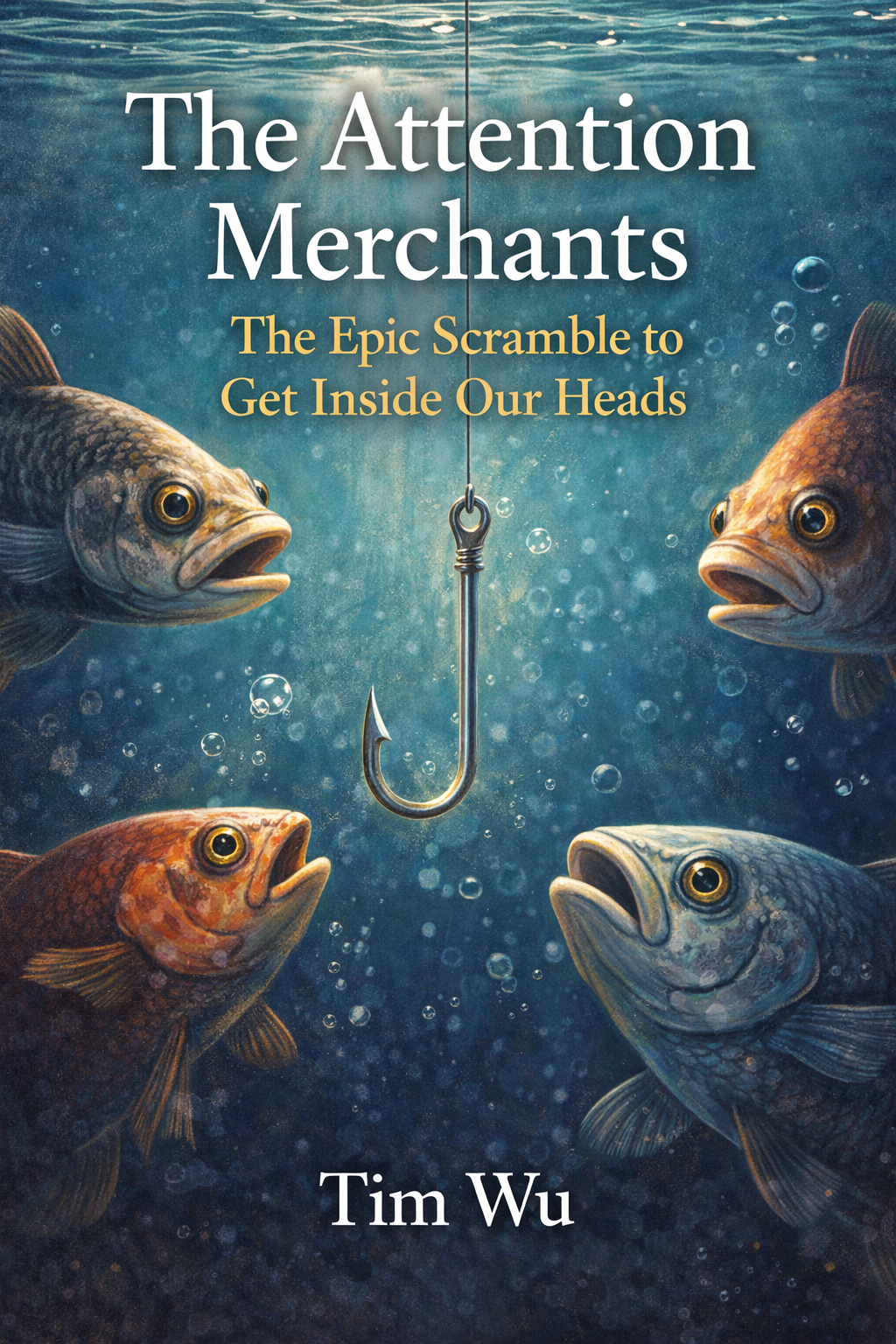
The Attention Merchants: The Epic Scramble to Get Inside Our Heads
Chapter Summaries
What's Here for You
Prepare to have your mind opened, your assumptions challenged, and your understanding of the modern world fundamentally reshaped. In 'The Attention Merchants,' Tim Wu embarks on an epic journey, tracing the centuries-long, often clandestine, battle for our most precious resource: our attention. This isn't just a history book; it's a revealing exposé of how we arrived at a moment where our focus is the ultimate commodity, constantly mined, manipulated, and sold. From the penny press of 19th-century New York to the dazzling, disruptive innovations of radio, television, and the internet, Wu uncovers the ingenious, and sometimes alarming, strategies employed by media titans, advertisers, and technologists to capture and hold our gaze. You'll meet the pioneers who turned mass communication into a science, the advertisers who engineered demand, the radio barons who invented prime time, and the digital architects who built the very platforms that now command our every waking moment. What will you gain? A profound insight into the forces that shape your daily experience, from the ads you see to the news you consume and the very way you interact with technology. You'll understand the 'madness of crowds' and the psychological triggers that make us susceptible to influence. You'll emerge with a critical lens, able to discern the subtle art of attention manipulation and reclaim your own mental space. The tone is intellectually rigorous yet remarkably accessible, blending meticulous historical research with a sharp, often witty, critique of our hyper-stimulated present. Wu doesn't just present facts; he weaves a compelling narrative that will leave you marveling at the sheer audacity of the 'attention merchants' and, more importantly, empowered to navigate their world with newfound awareness. This is your guide to understanding the invisible war for your mind.
THE FIRST ATTENTION MERCHANTS
In the bustling, yet un-digitized, New York of 1833, before the titans of modern media had even dreamt of their first editions, a radical idea began to take shape. Tim Wu explains that the established newspapers, costing six cents, served only the elite, leaving most of the city untouched by their influence. Into this quiet market stepped Benjamin Day, a print shop owner with a vision far removed from journalistic crusades or vanity projects. Day saw not a platform for ideas, but a business opportunity. His audacious gamble? To sell a newspaper for a single penny, a price point that promised mass appeal but guaranteed a loss on each copy sold. This wasn't about selling news; it was about selling the attention of the news-readers. Day understood a profound truth: his audience, though they believed themselves to be customers, were in fact the product, their attention to be resold to advertisers. While advertising existed, early forms were informational, akin to classified ads. Day aimed higher: to sell the collective attention of a massive readership en bloc. To achieve this, he needed to make the *New York Sun* irresistible to everyone. The Sun's first issue, a compact, cost-saving affair, immediately signaled its intent with sensational headlines like 'MELANCHOLY SUICIDE' and dramatic tales of jilted lovers and marital disputes, effectively drawing readers in with the raw, often lurid, pulse of city life. Wu reveals that Day even hired George Wisner, arguably the first full-time news reporter in the U.S., to scour the police courts for these compelling, often tragic, stories. The paper's coverage of the slave trade, too, though apolitical otherwise, took a principled stand for abolition, adding another layer of engagement. Within three months, the Sun's circulation soared, threatening the established order. The core dilemma emerged: the penny price meant a constant financial drain, making the paper entirely dependent on growing advertising revenue. When this revenue finally surpassed production costs, the *New York Sun* took flight, proving that a newspaper could thrive as a freestanding business, independent of political agendas or wealthy patrons. This success birthed the 'public sphere,' a new phenomenon reliant on the nascent attention industry. But as rivals like James Gordon Bennett's *Morning Herald* emerged, employing similar sensationalist tactics—Bennett even pioneering on-the-scene crime reporting with a graphic account of a prostitute's murder—the industry faced its first great tension: the race to the bottom. Wu illustrates this with the *Sun's* infamous 1835 'Great Moon Hoax,' a five-part series detailing discoveries of life, including 'man-bats,' on the moon. This elaborate fabrication, presented with scientific flair, sold out editions and propelled the *Sun* to become the world's most widely read newspaper, cementing Benjamin Day as the first true attention merchant. The narrative then shifts to Paris in the late 1860s, where Jules Chéret revolutionized poster advertising. His massive, vibrantly colored, and dynamically depicted posters, often featuring semi-nude women, transformed city walls into 'chromolithographic salons.' These were not mere announcements but mass-produced, static screens designed to seize attention in the 'in-between moments' of daily life—a concept rooted in our brain's powerful, yet limited, capacity to ignore. Wu highlights that this exploitation of attention, using triggers like motion, color, and sexuality, became a potent commercial tool. However, this relentless harvesting eventually led to a backlash. The sheer ubiquity of posters in Paris became overwhelming, sparking a 'revolt' led by aesthetic and preservation groups decrying the commercialization of public space. This resistance, Wu explains, represents a recurring dynamic: when attention industries push too far, audiences react severely. The Parisian authorities eventually imposed restrictions, recognizing that the appropriation of attention can feel like a violation. This historical arc, from Day's penny paper to Chéret's captivating posters, reveals the fundamental tension of the attention economy: the perpetual quest for engagement often leads to extremes, inevitably sparking a pushback against the ceaseless intrusion into our minds.
THE ALCHEMIST
The story of Claude C. Hopkins, an unlikely figure with a timid demeanor and a penchant for licorice root, reveals a profound transformation that reshaped the landscape of commerce and human attention. Once destined for the ministry, Hopkins experienced a crisis of faith, rejecting the strictures of his evangelical upbringing to embrace the 'harmless joys of life.' This break, marked by a heretical sermon and estrangement from his mother, cast him as an outsider, a role he seemed to embrace, finding solace and purpose in relentless hard work, a love for labor that mirrored an addict's devotion. His early career as a 'scheme man' for companies selling carpet sweepers, where he famously conceived the Santa Claus advertisement, marked his true calling, a stark departure from his clerical past. Before the commercial age, human attention was a largely untapped resource, with organized religion standing as the dominant incumbent, its very mission centered on capturing and holding the minds of believers through rituals and moral injunctions, a practice especially pronounced in monotheisms demanding undivided attention. Yet, as the Enlightenment waned and faith declined, this sacred domain proved vulnerable to new claimants. Enter the patent medicine industry, a crucible of early advertising innovation. Figures like Clark Stanley, the flamboyant 'Rattlesnake King,' peddled dubious snake oil elixirs, not just promising cures but performing theatrical spectacles, transforming the mundane into the miraculous. This era, while rife with fraud, was a fertile ground for developing potent advertising techniques, a kind of alchemy that transmuted base desires into commercial gold. Hopkins, drawn to this field, honed his craft at Dr. Shoops Restorative, mastering the art of 'reason-why' advertising, anticipating doubts and offering seemingly irrefutable solutions, a strategy echoing biblical parables of healing and hope. He understood that the power lay not just in the product but in the promise, the seductive allure of a cure for life's infirmities. He pioneered direct mail campaigns, flooding the nation with pamphlets, effectively turning the U.S. Post Office into an early platform for attention harvesting, a precursor to modern spam. His work with Liquozone, a germicide rebranded as a panacea, pushed these techniques to their zenith, employing free samples and audacious claims of curing everything from dandruff to cancer. Yet, this burgeoning industry, built on what Samuel Hopkins Adams would expose as 'The Great American Fraud,' faced a reckoning. Adams's investigative articles in Collier's Weekly, starkly detailing the poisons and deceptions within patent medicines, ignited public outcry and led to the passage of the Pure Food and Drug Act of 1906. This legislative crackdown, coupled with growing public skepticism, dismantled the patent medicine empire, transforming snake oil from a cure-all into a byword for deceit. Hopkins himself, though initially disgraced, would eventually find a new path, but the potent methods he helped forge—the art of capturing attention and converting it into demand—would endure, finding new life in the hands of government and commerce, a testament to the enduring power of the human desire for a quick fix and the ingenuity of those who learn to exploit it.
FOR KING AND COUNTRY
The author, Tim Wu, in "The Attention Merchants," unveils a pivotal moment in the history of mass attention capture during World War I, beginning with Lord Herbert Kitchener's anxious pacing in Dover. A summons from Prime Minister Asquith rerouted Kitchener, thrusting him into the role of Secretary of State for War just as Britain declared war on Germany. The chapter illuminates the stark reality of Britain's unprepared military, a mere fraction of Germany's vast forces, setting the stage for an unprecedented challenge: raising a million-man army without conscription. Wu explains that this necessity spurred the first state-run attention harvest, a systematic propaganda campaign aimed at the civilian population, a concept then considered repellent and virtually unheard of, as rulers traditionally relied on mystique rather than public appeal. This marked the State's entry into the game of attention, wielding vast resources and a monopoly on force. Kitchener, a living icon of British imperialism, personally appealed to the public with the iconic "Your King and Country Need You" poster, an effort so successful it yielded 30,000 recruits daily in its first month. However, as this initial fervor waned, the need for a more sustained approach became clear, leading to the creation of a special Parliamentary Recruiting Committee and a systematic, totalizing propaganda effort. Wu details the proliferation of government war posters, blanketing the country and appearing everywhere, with the "I Want You" poster, featuring Kitchener's pointing finger, becoming a near-impossible-to-ignore call to arms, a vivid sensory scene of collective obligation. Aggressive open-air propaganda, like massive parades and rallies featuring speeches by figures such as Rudyard Kipling, stoked deep-seated fears of German domination, compelling men like George Coppard to enlist as if drawn by a magnet. The government even innovated with specialized cinemotor vans, birthing the drive-in movie not from romance but existential threat, and orchestrating synchronized messages to millions via cinemas. Wu emphasizes that the sheer scale and organization of these efforts, anticipating Jacques Ellul's insight that propaganda must be total to succeed, were the defining features. Despite these masterful efforts, the military ultimately resorted to conscription, yet Kitchener's voluntary recruitment drive was historically unprecedented, converting attention into compliant service, even unto death, a lesson eagerly copied by governments worldwide. Wu recounts Kitchener's own tragic end, lost at sea en route to Russia. The narrative then shifts to the United States, where George Creel, under President Woodrow Wilson, spearheaded the Committee on Public Information, America's first federal propaganda agency, embracing modern advertising techniques to foster "war will" and a passionate belief in the nation's cause. Creel's "carpet bombing" approach utilized every medium—print, spoken word, film, posters—reaching an estimated 134 million people through the "Four Minute Men" program alone. The chapter vividly describes the American adaptation of the Kitchener poster with Uncle Sam's iconic "I want YOU," and the visceral "Destroy This Mad Brute" poster, playing on primal fears. Wu notes that this success, coupled with the Espionage and Sedition Acts silencing dissenters like Eugene Debs, profoundly impacted observers like Walter Lippmann, who recognized the "manufactured consent" and the gap between complex reality and public narratives, coining the term "stereotype." This realization led to a deeper understanding of how easily public opinion could be shaped, prompting figures like Justice Brandeis to champion free speech. Conversely, others like Edward Bernays saw this as an opportunity for "enlightened manipulation," particularly for commercial interests, as the government's campaigns "cleansed" advertising's reputation. The chapter concludes by noting that even the defeated Axis powers, particularly Adolf Hitler, learned from these potent propaganda techniques, recognizing their power to create fervent, unwavering public support.
DEMAND ENGINEERING, SCIENTIFIC ADVERTISING, AND WHAT WOMEN WANT
The dawn of the 20th century witnessed a profound shift in how commerce touched the human mind, a transformation eloquently detailed in Tim Wu's 'The Attention Merchants.' Following World War I, advertising, once a nascent art, blossomed into a burgeoning science, a 'cornerstone of the most respectable American institutions,' as S. N. Behrman observed. The industry's newfound confidence was captured in Claude C. Hopkins' 1923 manifesto, 'Scientific Advertising,' which boldly proclaimed advertising's arrival as a science based on fixed principles, where 'nothing, in advertising, was now left to chance.' Hopkins, a former patent medicine schemer, masterfully adapted his techniques to sell everyday products, demonstrating that the persuasive power of 'reason-why' advertising could transform national bestsellers from unknown commodities. He asserted that from their desks, admen 'sway millions,' dictating not just trade currents but customs and fashions, creating demand where none existed. This era saw the rise of large, sophisticated agencies like J. Walter Thompson and BBDO, functioning as 'private laboratories of attention capture and demand generation,' turning advertising into a machine for mass attention, akin to Ford's assembly lines for production. This industrialization of attention fueled the rise of consumer societies, dramatically increasing household spending. At its core, 'scientific advertising' comprised three key strategies: demand engineering, creating desire for products that might not otherwise exist; branding, fostering loyalty through manufactured impressions of uniqueness; and, crucially, the targeted appeal to the 'female consumer.' Demand engineering, exemplified by Hopkins' campaign for orange juice as an infant elixir or Listerine's creation of the 'halitosis' problem, often preyed on subconscious anxieties, turning previously unknown issues into perceived necessities, as seen in Listerine's meteoric rise in earnings. Similarly, Pepsodent tapped into fears of decay and aging with its 'film-removing' dentifrice. While some critics, like those at Time magazine, viewed this as a 'pseudoscience,' the public was largely receptive, and figures like Hopkins even framed their profitable endeavors as public service. The chapter then delves into the psychological underpinnings, suggesting that while Freudian ideas were in the air, the advertising industry's embrace of behavioral psychology, particularly the work of John B. Watson at J. Walter Thompson, proved more influential. Watson's theories of conditioning and behavior control offered a framework for predicting and influencing consumer actions, viewing humans as subjects to be conditioned, much like Pavlov's dogs or his infamous 'Little Albert' experiment. Parallel to demand engineering, the 1920s saw the rise of branding, the 'engineering of reputation,' transforming individual merchant reputations into manufactured associations for companies like Cadillac and Coca-Cola, a strategy pioneered by Theodore MacManus, who sought to build trust and loyalty through 'iconography' and the projection of virtuous character. Simultaneously, a profound realization dawned: women, as the primary purchasers of household goods, were the key to commerce. This led to advertising's third major development: a concerted effort to appeal to women. Helen Lansdowne's iconic 'A Skin you love to touch' campaign for Woodbury soap, moving beyond problem-solution to the promise of a 'better life,' exemplified this shift, selling the consumer on herself. J. Walter Thompson institutionalized this understanding by creating a dedicated Women's Editorial Department, staffed by former suffragettes who, ironically, sometimes reinforced stereotypes of female inadequacy even as they sought to understand 'what women want.' This department also pioneered the use of paid endorsements, leveraging the desire to emulate the rich and famous, turning celebrities into powerful tools for selling everything from cold cream to cereals, effectively transforming attention capture into a sophisticated engine for converting desire into revenue, often by offering a 'constantly receding ideal to strive after.'
A LONG LUCKY RUN
The narrative of George Washington Hill and the Lucky Strike campaign unfolds as a pivotal moment in the evolution of advertising, showcasing an audacious 'epic scramble to get inside our heads.' Hill, inheriting the American Tobacco Company and its brand, was consumed by a singular vision: to make Lucky Strike America's leading cigarette, pouring an unprecedented sum into advertising, a staggering $20 million annually by 1931. He enlisted master strategists Albert Lasker, who had honed the 'hard sell,' and Edward Bernays, a proponent of applying wartime propaganda techniques to business. Initially, the campaign leveraged Claude Hopkins' 'It's toasted' slogan, evolving under Lasker to position Luckies as a health tonic, a cure for sore throats, even employing testimonials from opera singers and co-opting medical authority with ads featuring doctors, a tactic reminiscent of patent medicine's deceptive practices. Yet, Hill's ambition took a sharp turn, pivoting towards the burgeoning 'feminine principle' of the 1920s, seeing untapped potential in persuading women to smoke publicly. Bernays, ever the astute propagandist, framed this not just as a commercial opportunity but as a liberation, famously orchestrating the 'Torches of Freedom' march in the 1929 Easter Day Parade, an event whose historical significance, while debated, was amplified by Bernays' own narrative prowess. Simultaneously, Lasker deployed a more direct, yet arguably more potent, strategy with the 'Reach for a Lucky' campaign, cleverly linking smoking to weight control and slender figures, tapping into women's concerns about their appearance. This dual assault, blending social engineering with direct appeals to vanity, dramatically increased female smoking rates, tripling them by the mid-1930s, and propelling Lucky Strike to the nation's leading brand, not through superior product, but through sheer advertising might. This era marked a culmination of advertising's power and arrogance, a time when the industry, having shed the overt charlatanism of its patent medicine roots, began to see itself as a priestly class, ministering to the nation's deepest desires and needs, as President Coolidge himself proclaimed advertising ministers to the spiritual side of trade. The sheer scale of investment, with American companies spending nearly 3 percent of GDP on advertising by 1929, transformed the built environment into a constant commercial ecosystem, a ceaseless barrage of appeals woven into the fabric of daily life. However, this triumph was built on a foundation of potentially dangerous misrepresentations, sowing the seeds for public resentment and regulatory scrutiny, as evidenced by the Federal Trade Commission's eventual intervention regarding medical testimonials. Even Claude Hopkins, the architect of much of this persuasive power, retired to a life closer to nature, perhaps sensing an 'end of history' for his trade, a poignant reflection on the human cost of industrializing attention capture, a phenomenon that, even in its 1920s infancy, had fundamentally altered the tenor of existence, creating a world where being constantly cajoled and sold to became the norm, a precursor to the even more pervasive commercial landscapes of the future.
NOT WITH A BANG BUT WITH A WHIMPER
In 1926, a meeting in a Greenwich Village speakeasy between Stuart Chase, an accountant, and Frederick Schlink, a standards engineer, ignited a shared disdain for the advertising industry's pervasive fraud. They saw consumers, much like Alice in Wonderland, being manipulated into wanting what they were sold, not what they truly needed, believing that "human psychology is an open book" to advertisers. Their collaboration resulted in the explosive bestseller "Your Moneys Worth," a manifesto that became the "Uncle Tom's Cabin of the consumer movement," sparking a significant wave of resistance against deceptive advertising. This movement, far from being radical, sought to defend the integrity of the market itself by exposing how misleading claims and manufactured demand distorted the economy, a sentiment amplified by academics like Rexford Tugwell and consumer groups, notably women, who were often the primary targets of such campaigns. Even insiders like Theodore MacManus and Helen Woodward confessed to the hollowness of their work, with James Rorty likening admen to "dead men" whose souls were degraded by daily "barbarous frivolity." The industry, however, fought back, labeling "Your Moneys Worth" as communist propaganda and attacking consumer clubs as socialist plots, even as a growing skepticism among clients and the devastating impact of the Depression began to bite. As advertising outlays plummeted and firms folded, the industry resorted to desperate "hard-selling" tactics, further validating critics' claims. This period raised a fundamental question: what is advertising's true role? While classical economics assumes informed consumers, the author reveals that advertising's vital function, ideally, is to provide the information necessary for markets and choices to operate, acting as a conduit for attention. However, the chapter exposes the central tension: advertising's primary aim is not market efficiency but profit maximization, often achieved by creating "acquired tastes" and shaping demands that wouldn't otherwise exist, as seen in the rise of brands like Coca-Cola and cigarettes. This pursuit of profit can lead to deception, as with patent medicines, or the creation of "product cults" fostered by branding, where loyalty trumps intrinsic value, turning persuasion into conversion and surrendering choice for a sense of meaning, a phenomenon exemplified by the "Reach for a Lucky" campaign and its insidious health claims. Despite a Supreme Court ruling in 1931 that hampered regulatory bodies like the FTC, the outrage fueled a legal reform movement, culminating in the proposed "Tugwell Bill," which aimed to impose strict rules on false advertising. The industry, in alliance with newspapers and manufacturers, fiercely lobbied against it, fearing the outlawing of their most lucrative techniques. Ultimately, a weaker 1938 law was passed, granting the FTC powers against "unfair or deceptive acts or practices" but falling short of Tugwell's broader vision. Though humbled and facing an audience with diminished purchasing power, advertising survived, poised on the brink of a new era of attention, born from technological innovation, ready to cling to any new source of human focus to sustain itself.
THE INVENTION OF PRIME TIME
In the tumultuous late 1920s, with Pepsodent toothpaste teetering on the brink of collapse due to ineffective ingredients and fierce competition, a new general manager, Walter Templin, found himself staring into the mesmerizing glow of radio. The airwaves, once envisioned as a utopian platform for upliftment, were largely untouched by advertising, viewed by many as a vulgar intrusion. Companies that dared to venture onto the radio typically sponsored musical acts, a crowded field where Pepsodent’s competitors already held sway. Yet, Templin stumbled upon a revelation in the form of a local radio show called Amos n Andy. This fifteen-minute serial, featuring two white actors speaking in Negro voices and recounting the perpetually befuddled urban adventures of its titular characters, captivated entire families, drawing them away from their daily lives and into a shared, rapt attention. Templin recognized this as a profound power: the ability to capture attention not just in public spaces, but within the intimate confines of the home. His audacious idea was to bring Amos n Andy to the NBC network, sponsored by Pepsodent. Despite widespread skepticism and outright derision from industry insiders and network executives who believed radio audiences wouldn't tolerate talk, let alone advertising, Templin persisted. After a grueling nine-month battle, NBC finally agreed to air the show, a massive gamble of over a million dollars for thirteen weeks, marking the birth of the first sponsored serial program on the network. Initially, the show seemed a failure, with low listenership and no discernible impact on sales. But Templin, with nothing left to lose, doubled down. The second time, however, was the charm. By the end of 1929, Amos n Andy had exploded into a national phenomenon, drawing an estimated 40 million listeners nightly by 1931, a feat equivalent to the Super Bowl audience tuning in every single evening. This unprecedented success fundamentally reshaped the media landscape. Firstly, NBC, and by extension broadcasters, definitively transformed from hardware sellers into attention merchants, recognizing that the audience's focus was the true commodity to be developed and resold. Secondly, the triumph of Amos n Andy forged an unlikely but powerful alliance between entertainment producers and advertisers, proving that entertainment could be an incredibly effective vehicle for selling products, thus creating the business model of selling 'eyeballs.' This success emboldened Templin to sponsor another serial, The Rise of the Goldbergs, further solidifying this new paradigm. Most significantly, this marked the dawn of a relentless race for the conquest of time and space, as broadcasters began to own entire segments of the day, like the 7 p.m. slot, and breached the formerly inviolable barrier between public and private life, bringing commerce directly into people's homes. This invention of 'prime time' became a massive, shared ritual of collective attention, forging a new degree of shared awareness and even a shared identity across the nation, driven not by threats, but by the compelling power of entertainment, a force that would ultimately prove as effective as any stick.
THE PRINCE
In the grand theatre of attention, where minds are the ultimate currency, William S. Paley emerged as a masterful merchant, a figure of refined hedonism who, quite by chance, stumbled upon the nascent power of radio. Born into wealth, his initial path seemed set for a life of leisure, chasing pleasures and managing his family's cigar business. Yet, a fateful advertising campaign for La Palina cigars, featuring a glamorous singer, ignited a spark; Paley didn't just create a hit show, he fell in love with the very idea of capturing an audience, driving sales dramatically and convincing his father to purchase the struggling Columbia Broadcasting System (CBS) for him. This seemingly foolish acquisition, a network of mere sixteen part-time stations, became Paley's unlikely kingdom. Facing the formidable David Sarnoff and his powerful NBC, Paley understood a fundamental truth often missed by his rival: broadcasting wasn't just about technology or content, it was about commanding attention. While Sarnoff, a poet of technology and empire builder, focused on dominance through force and technical standards, Paley, a sensualist with sharp inner discipline, recognized the power of appeal. He shrewdly offered affiliates free programming, effectively paying them to carry his content, a strategy akin to the penny press's approach of buying audiences cheaply, which rapidly expanded CBS's reach. This move toward homogenizing content, while later criticized, provided an insurmountable competitive edge. Paley's genius lay not in technical prowess, which he largely ignored, but in his profound understanding of the human element, his "ear for talent." He cultivated stars, understood the delicate balance between highbrow and lowbrow, and, crucially, recognized that respectability could be a powerful differentiator, birthing the "Tiffany Network" strategy to counter Sarnoff's brute force. He astutely used advertising strategically, limiting its share to avoid alienating listeners while ensuring profitability, and understood the burgeoning power of news, building CBS into a credible news service with figures like Edward R. Murrow, whose vivid, immediate broadcasts from London during wartime brought the world into listeners' homes with unprecedented emotional impact. The chapter highlights the central tension between Sarnoff's technological might and Paley's human-centric approach to capturing and holding attention, a dynamic that shaped the very architecture of broadcast media. The eventual introduction of the Audimeter and Nielsen ratings would later transform this landscape, providing a quantitative measure for what had been largely guesswork, a development that, while enabling precise valuation, also carried the risk of disproportionate influence and a potential diminishment of artistic or public interest considerations in favor of pure metrics. Paley's journey reveals that in the battle for our minds, understanding the audience's desires, blending prestige with popularity, and wielding emotional resonance are not mere tactics, but the very essence of the attention merchant's trade.
TOTAL ATTENTION CONTROL, OR THE MADNESS OF CROWDS
Tim Wu, in "Total Attention Control, or the Madness of Crowds," meticulously unpacks the Third Reich's chilling mastery over the public mind, revealing how Adolf Hitler and Joseph Goebbels weaponized attention itself to forge a singular, obedient national consciousness. Picture this: March 17, 1935. Beethoven's Eroica Symphony, broadcast not just from millions of "people's receivers" but amplified through loudspeakers in every public square, factory, and meeting hall, herding citizens into a shared sonic experience. This wasn't mere entertainment; it was the prelude to Hitler's voice, announcing conscription to an estimated 70 percent of German households—a staggering 56 million people, a broadcast audience unprecedented in history. Goebbels declared German radio the "towering herald of National Socialism," a force capable of creating "one public opinion." Wu explains that the Third Reich was, in essence, the first dictatorship to fully exploit every technical means for domination, with Albert Speer lamenting that 80 million people were "deprived of independent thought" through devices like the radio. This chilling efficiency stemmed from Hitler's own early reflections in prison, where he admired British propaganda's ability to shape public perception during World War I, contrasting it with Germany's failed, overly objective approach. Wu highlights Hitler's profound, almost intuitive understanding, honed perhaps by his early work in advertising, that propaganda must appeal not to the intelligentsia but to the "masses," adapting its "spiritual level" to the "least intelligent" and relying on the "thousandfold repetition of the most simple ideas." He grasped that stirring emotion, not teaching complex truths, was the surest path to control, understanding that "the masses love a commander more than a petitioner." This understanding, coupled with his electrifying public speaking style—a carefully crafted arc of vulnerability, blame, and furious unity—transformed a fringe party into a global threat. Wu draws a parallel to William Jennings Bryan's "Cross of Gold" speech, illustrating how the collective energy of a crowd can amplify a message, making individuals susceptible to shared sentiment, a phenomenon echoed in scientific studies of "joint attention." The Nazi regime amplified this effect through "total theatre" at rallies like Nuremberg, using light, banners, and marching men to create an immersive, almost religious experience designed to dissolve individual will into a collective one. Goebbels, recognizing radio's power, aimed to scale these "enrapturing effects" nationwide, transforming it into the "most influential and important intermediary." Unlike private American broadcasting focused on advertising, the Nazi approach was total: programming was dictated by the state, blending light entertainment with political messaging, a "spoonful of sugar" to make the "medicine go down." The introduction of the affordable Volksempfnger, coupled with the "Funkwarte" or Radio Guard ensuring compliance, meant that the state achieved intimate access to homes, mimicking the total experience of worship. Wu posits that this "total attention control" represents the ultimate abridgment of freedom, not by limiting choices, but by shaping awareness itself, making alternative ideas "unthinkable or nonexistent." The Nazi regime, therefore, didn't just sell a product; it sold a comprehensive, monolithic vision of reality, offering the seductive promise of surrendering the self to something larger, a potent counterpoint to the liberal ideal of choice. The chapter concludes by examining the divergent lessons learned by the Soviet Union, West Germany, and the Allied powers post-war, with the Soviets escalating state control, West Germany decentralizing broadcasting to prevent propaganda, and the West becoming deeply wary of official state messaging, a stark testament to the enduring power and danger of attention merchants.
PEAK ATTENTION, AMERICAN STYLE
The post-war era ushered in television, a medium that would fundamentally reshape the American mind and its attention. David Sarnoff of NBC, a fervent believer in first-mover advantage, saw television's potential early, investing heavily to dominate the nascent industry, exemplified by the overwhelming success of Milton Berle's 'Texaco Star Theater.' In contrast, Bill Paley of CBS initially underestimated television, preferring a more cautious, long-term strategy. This rivalry set the stage for the 1950s, a decade that defined television's role in the home and its unparalleled power to capture attention, a power psychologists like Hugo Mnsterberg had already recognized in cinema's ability to stir deep emotions and activate our mirror neurons. As television rapidly infiltrated American households, consuming nearly five hours a day, it fostered a unique, immersive viewing experience, often characterized by silent awe. The author distinguishes between transitory attention, easily provoked and superficial, and sustained attention, deep and voluntary, noting that attention merchants thrive on the former, while personal happiness depends on balancing both. The chapter delves into the strategic battle between NBC and CBS, with Paley positioning CBS as the 'Tiffany Network,' a higher-quality alternative to NBC's content indifference, epitomized by the heavily sponsored and censored 'Camel News Caravan.' Edward R. Murrow's 'See It Now' on CBS emerged as a journalistic powerhouse, famously challenging Senator Joseph McCarthy, demonstrating the private sector's ability to counter state propaganda, a pivotal moment coinciding with the Supreme Court's rediscovery of the First Amendment. The introduction of 'I Love Lucy' became a cultural phenomenon, propelled by Lucille Ball's magnetic performance, and Ed Sullivan's show, despite its unconventional host, leveraged connections to showcase talent, ultimately helping CBS overtake NBC by 1955. This period, the mid-1950s, witnessed 'peak attention,' a historic anomaly where massive audiences were simultaneously engrossed by the same messages, creating a unique form of national convergence, akin to a giant, solitary circus. While not state-imposed, this homogeneity was driven by commercial interests, with television commercials evolving into sophisticated tools for manipulation, as exemplified by the unique selling proposition pioneered by Rosser Reeves and the myth-building strategies of Leo Burnett, who transformed the Marlboro cigarette into a masculine icon through the 'Marlboro Man.' The rise of motivation research, led by figures like Ernest Dichter, further amplified advertising's reach by tapping into unconscious desires, turning advertising into a science of manipulation. Sylvester 'Pat' Weaver at NBC countered Paley's dominance by expanding television's reach into early morning and late night with shows like 'Today' and 'The Tonight Show,' and introducing the concept of 'spectaculars' like 'Peter Pan,' which drew massive audiences and influenced the development of events like the Super Bowl. Weaver's most significant innovation, however, was the magazine format, replacing single sponsors with frequent commercial breaks, a move that benefited networks and advertisers but diminished viewer experience. Paley, driven by a desire to win, responded with 'The 64,000 Question,' a high-stakes quiz show that captivated the nation, eclipsing even 'I Love Lucy,' and sparking a fierce competition, epitomized by NBC's 'Twenty-One' and Charles Van Doren's rise. This intense 'quiz show war' underscored the escalating value of audience attention, transforming programming into a high-stakes gamble where content was increasingly dictated by its ability to attract the largest possible audience and, consequently, advertising revenue. The chapter concludes with a reflection on the erosion of television's potential for higher purpose, as the pursuit of ratings and profits, championed by figures like Paley, led to the suppression of challenging content, a shift mourned by Edward R. Murrow, who saw television increasingly insulating Americans from the world's realities, a stark contrast to its potential as a tool against ignorance and indifference.
PRELUDE TO AN ATTENTIONAL REVOLT
In the mid-20th century, as the airwaves began to hum with the insistent drone of commercial interruptions, a subtle yet profound shift began to stir within the American consciousness. Tim Wu, in his chapter 'Prelude to an Attentional Revolt,' illuminates this dawning awareness through the story of Zenith Radio Company and its enigmatic leader, Commander E. F. McDonald. McDonald, a man of adventurous spirit and maverick inclinations, sensed a growing consumer discontent, a quiet rebellion against the increasing intrusion of advertising into the sanctuary of home entertainment. This unease, like a faint signal on a radio dial, led Zenith engineers to develop what would become the first remote control, the FlashMatic, an invention that, while initially crude and imperfect, represented a nascent desire for control – a desire to 'shoot out the ads' and reclaim one's mental space. This invention, though not a true ad-blocker, became a potent symbol of a popular resistance against the industrialized harvest of attention, a growing demand for a way to defend oneself against the easy access advertisers had gained into our minds. The chapter highlights how this desire for control was not merely about annoyance but about a deeper philosophical quandary: the nature of consent and willpower in the face of pervasive influence. As Jacques Ellul noted, individuals often open the door to propaganda willingly, even if their motivations are complex and they don't explicitly seek to be manipulated. The implicit contract of free entertainment for attention seemed to be revised, leaving viewers feeling like dupes of commerce. This sentiment was amplified by Vance Packard's bestselling book, 'The Hidden Persuaders,' which exposed the sophisticated, often subconscious, psychological techniques advertisers employed, casting figures like Ernest Dichter in a sinister light. Packard's work, though requiring a certain sophistication to grasp its implications, stirred a 'conspiracy consciousness,' revealing that advertisers viewed their efforts as far more than mere persuasion, but as 'mind games.' This revelation forced viewers to confront the possibility that their choices, even those made with confidence, were being influenced far beyond their awareness. The chapter then pivots to the television quiz show scandals of the late 1950s, epitomized by 'Dotto' and 'Twenty One,' where the illusion of genuine competition was shattered by confessions of rigged outcomes. This wasn't just about individual deception; figures like Walter Lippmann argued it was an industry-wide conspiracy, a 'gigantic fraud' designed to sell advertising, revealing a fundamental flaw in television's national policy where competition was solely for audience attention, making the medium a 'prostitute of merchandizing.' Even industry insiders like Pat Weaver and observers like Eric Barnouw voiced concerns, questioning if our culture could afford to be a byproduct of advertising. Wu argues that before the counterculture of the 1960s truly bloomed, the seeds of disillusionment with American institutions, particularly the 'second screen' of television, had already borne fruit, signaling a profound disenchantment with the 'confidence game' played by the attention merchants.
THE GREAT REFUSAL
In the spring of 1966, a pivotal meeting occurred between Timothy Leary, a former Harvard instructor turned counterculture guru, and Marshall McLuhan, the celebrated media theorist, at New York's Plaza Hotel. Leary, then spearheading the International Federation for Internal Freedom with ambitions of an 'attentional revolution'—encouraging a turn inward and away from mainstream media manipulation, often with the aid of psychedelic drugs—sought McLuhan's guidance on reaching the disillusioned youth. McLuhan, in turn, offered a striking piece of advice: to capture attention, Leary needed to master the tools of advertising, even suggesting a catchy jingle. This encounter spurred Leary to consider the power of slogans, culminating in his iconic 1967 exhortation at San Francisco's 'Human Be-In': 'Turn On, Tune In, Drop Out.' While often misinterpreted as a call to hedonism, Leary's message, resonating with thinkers like Herbert Marcuse and his concept of the 'Great Refusal' against repression, was a profound call for an attentional revolt, urging a rejection of institutional authority and a reorientation towards spiritual pursuits. However, the counterculture's challenge to the attention merchants faced a formidable adversary in the established media industries, particularly television. Pepsi Cola, a perennial underdog to Coca-Cola's dominance, masterfully adapted to this shifting landscape. Recognizing the growing discontent with consumer culture, Pepsi launched its 'Pepsi Generation' campaign in 1964, shifting focus from the product itself to the aspirational identity of the user—young, rebellious, and vital. This strategy, selling an image of liberation and individualism, proved remarkably effective, allowing Pepsi to gain significant market share and even co-opt countercultural values, famously advertising liberation itself with slogans like 'You've got a lot to live—and Pepsi's got a lot to give.' This demonstrated a core insight: the attention industries could absorb and commercialize even the most radical desires for freedom, turning a critique of consumerism into a catalyst for it. Meanwhile, the rise of noncommercial television, with pioneers like Fred Rogers and Sesame Street, offered an alternative vision, aiming to use the medium's power for educational and enriching ends, especially for children. Yet, despite these efforts and the counterculture's intellectual ferment, the habit of television viewing, averaging six hours a day by the early 1970s, proved too powerful. Commercial television, particularly CBS under Fred Silverman, adapted by embracing 'relevancy' with shows like 'All in the Family' and 'MASH,' effectively absorbing dissenting voices into its programming and maintaining its hold on public attention. The author thus reveals a central tension: while the counterculture aimed for an attentional revolution, the industries of attention proved more adaptable and ultimately more successful at capturing the public's gaze. Advertisers, like Mary Wells of Wells, Rich, Greene, and campaigns for Virginia Slims, skillfully incorporated anti-establishment themes and feminist ideals into their messaging, proving that capitalism's resilience lay in its ability to chameleon-like adopt and profit from even its most fervent critics' ideas. Ultimately, the chapter concludes that the great attentional revolt of the 1960s, while leaving a lasting mark on individualism, failed to dislodge the dominance of commercial media, as the promise of free, relevant entertainment in exchange for attention proved irresistible, leaving the public accessible to advertisers and ushering in an era where even the language of liberation became a potent tool for consumption, a phenomenon Marcuse termed 'repressive desublimation.'
CODA TO AN ATTENTIONAL REVOLUTION
The author, Tim Wu, unfolds the story of Jonathan Robbin, an idealist of the 1950s and 60s, fascinated by social movements and the burgeoning power of computers. Robbin, much like other fervent believers in data and management as problem-solvers, saw change as a process and values as mere data points, aiming to use computational rigor for humanity's benefit. His academic journey at NYU in the 1950s led him to develop early computer models, drawing inspiration from the Chicago School of Sociology’s view of urban neighborhoods as living ecosystems, aiming to predict phenomena like riots, much like weather patterns. This approach dovetailed with the 1960s and 70s countercultural emphasis on the politics of recognition, a desire to acknowledge and understand the diverse tapestry of American society, especially marginalized groups. Robbin’s work in cluster analysis, a method to understand populations based on shared characteristics in proximate areas, gained traction. By the early 1970s, however, a shift occurred. Driven perhaps by academic disillusionment or sheer opportunism, Robbin founded Claritas, Latin for clarity, commercializing his geodemographic research. He recognized a profound insight: the 'politics of recognition' had a powerful commercial counterpart, the 'business of recognition.' For decades, advertising had largely operated on a broad, imagined commonality, with only rudimentary segmentation like 'youth' or 'women.' Robbin’s breakthrough came in 1978 with PRIZM (Potential Ratings in ZIP Markets), a system that sorted the entire U.S. population into forty distinct clusters, revealing that America was not a monolith but a collection of 'forty distinctive nations.' This system, built on thirty-four factors that explained 87% of national variation, assigned evocative names like 'Bohemian Mix' and 'Young Suburbia' to these clusters, allowing advertisers to understand specific sensibilities, tastes, and even vulnerabilities with unprecedented granularity. The launch of Diet Coke in 1982 served as an early, striking demonstration of PRIZM's power; by understanding the specific clusters that consumed its existing diet drink, TaB, Coca-Cola could craft a marketing strategy for Diet Coke that targeted everyone else, inverting its appeal from a diet drink to a great-tasting beverage. This ability to say different things to different people, winning them all, fundamentally altered the advertising landscape, moving from a scattershot approach to potent, tailored messaging that made messages harder to ignore. As this commercial logic permeated, media followed suit. The advent of cable television in the 1980s, with networks like MTV, ESPN, Bravo, BET, and the Playboy Channel, fragmented the broad middle ground that broadcast television had once commanded. This 'audience fragmentation,' as the industry termed it, was both a reaction to and a cause of a more divided media consumption. While some saw this as a democratizing force, offering more choice, the reality proved more complex. The rise of channel surfing, or 'grazing,' a term coined by Channels magazine, indicated a shift from deep engagement with specific shows to a more scattered, inattentive habit of viewing, a 'bizarre way to spend your time and attention.' This proliferation of choice, amplified by the remote control and later the VCR, allowed viewers to easily 'zap' commercials, creating a crisis for advertisers whose model depended on unavoidable exposure. The response was a push for 'zapproof' advertisements – commercials that were themselves entertaining and engaging, like the iconic Super Bowl ads for Coca-Cola and Apple's 1984 Macintosh campaign. Ultimately, Wu argues, the remote control, a symbol of choice, paradoxically empowered impulsive brain circuits over rational control, making attention redirection almost effortless and leading to a state of distracted wandering that, while frustrating for advertisers, was far from a 'Great Refusal' but rather a 'whimper' of frittered attention, a testament to the attention merchants' enduring, if increasingly desperate, success in harvesting our focus.
EMAIL AND THE POWER OF THE CHECK-IN
In the nascent days of the internet, a quiet revolution began not with a bang, but with a simple digital message. It was 1971, and computer scientist Ray Tomlinson, tasked with making the fledgling ARPANET useful, stumbled upon an idea while tinkering with file transfer programs. He observed the difficulty of reaching people by phone and mused, 'Why not modify my file transfer program to send messages?' This seemingly minor hack, born from a desire for a 'neat idea,' would birth email. The first messages, likely a forgettable 'QWERTYUIOP,' were sent to himself, a stark contrast to the dramatic pronouncements of earlier inventions. Tomlinson's ingenious addition of the '@' symbol, a happenstance choice from his teletype terminal, distinguished messages from remote computers, creating the foundational structure of electronic mail. Within a year, email became the internet's first killer app, consuming 75 percent of network capacity and imbuing the network with a human purpose, a soul. It transformed the internet from a mere connection of machines into a vital conduit for human connection. This utility, however, sowed the seeds of its own attentional pull. Stephen Lukasik, an early adopter, famously carried a thirty-pound portable terminal, becoming perhaps history's first email addict, embodying the nascent impulse to 'check in' wherever he went. This 'check-in' habit, the urge to see if a message has arrived, would become a powerful engine for future attention merchants. The secret to this compulsion, as explained through the lens of B.F. Skinner's operant conditioning, lies in variable reinforcement. Unlike a predictable reward, the intermittent arrival of a rewarding email—a message from a friend, good news—trains the brain to keep checking, much like a slot machine or gambling. Each check is a gamble, a hopeful peck at a digital button, fueled by the possibility of a prize, even if most checks yield nothing. This created a powerful, almost compulsive, ritual that opened the door to commercial exploitation, a path first tentatively trod by Gary Thuerk in 1978. Thuerk, seeking to publicize new computers, sent the world's first unsolicited mass email blast, an act met with swift condemnation and a philosophical debate about advertising on the network. Though initially rebuffed, Thuerk's action foreshadowed the future, highlighting the inherent value in capturing those 'eyeballs' focused on a screen. He, the unwitting father of 'emarketing' and the first spammer, demonstrated that the human mind, once engaged, becomes a prime target for commercial interests. The chapter reveals that the simple act of sending an email birthed not only a communication revolution but also a potent psychological mechanism, the 'check-in,' which would become the bedrock for industries built on harvesting our most precious resource: attention.
INVADERS
The late 1960s found engineer Ralph Baer, gazing at a television, not as a passive viewer, but as a visionary. He saw not just "stupid channels," but a vast, untapped potential – forty million screens in America alone – a fertile ground for something more. This contemplation sparked an idea: "What can I do with this?" The answer, born from a desire to capture even a fraction of that attention, was the home video game. By 1972, this vision materialized as the Magnavox Odyssey, a rudimentary console that, despite its limited graphics and reliance on screen decals, laid the groundwork for a revolution. Meanwhile, the electronic computer, confined to the realm of serious business, held a dormant power. The 1970s saw Atari, under Norman Bushnell, recognize this untapped potential for personal entertainment. Inspired by games like "SpaceWar" and the burgeoning arcade scene, Bushnell transformed a computer into an interactive experience with cabinets like the one for "Pong." However, it was in Japan, with Tomohiro Nishikado of Taito, that the true explosion occurred. Tasked with creating a Japanese "Breakout," Nishikado, working in isolation, infused his game with dynamic action and a palpable sense of threat, initially rejected for its militaristic imagery. Drawing inspiration from the film "Star Wars," he renamed his creation "Space Invaders." Released in 1978, "Space Invaders" became an unprecedented, global phenomenon. The Youngstown Vindicator reported, "Outer Space Invaders are taking over the U.S.," while The Washington Post described an experience that began with a quarter and ended with "Start of addiction." This was not merely entertainment; it was a powerful draw, a mesmerizing challenge that captivated players, leading to widespread concern. Novelists like Martin Amis and psychologists like Dr. Robert Millman observed a deep, almost drug-like engrossment, comparing it to "sniffing glue" in its ability to completely absorb young minds. The game's success was so profound that it was declared the highest-grossing entertainment product in the U.S. in 1982, raking in billions of quarters and fundamentally altering the landscape of the entertainment industry. The author explains that video games, unlike passive media, engaged the visual cortex through fast-flowing stimuli, making them inherently engrossing, especially for those with attention challenges. Crucially, the business model was a direct "cash for an experience," a precursor to the attention merchant model. The core tension lay in the games' difficulty, a deliberate calibration designed to foster a "flow state," that optimal experience of peak ability and contentment, compelling players to return again and again. This success fueled a golden age of arcade games, with titles like "Asteroids" and "Donkey Kong" emerging. Namco, seeking to broaden the appeal beyond male teenagers, tasked Toru Iwatani with creating a more inclusive game. Iwatani, inspired by his girlfriend's love for desserts and the chase dynamics of "Tom and Jerry," conceived of "Pac-Man." This game, with its endearing character and simple maze-based gameplay, became an even more enduring hit, grossing billions and proving that games could transcend their initial demographics. The narrative then circles back to the home, as Atari, now backed by Warner Communications, brought arcade hits like "Space Invaders" to televisions via the Atari 2600. This innovation not only brought gaming into millions of homes but also paved the way for home computers like the Apple II and Commodore 64, with video games serving as the "killer app" that justified the investment, turning computers into a "sleeping giant" in the domestic sphere.
AOL PULLS ’EM IN
In the nascent digital landscape of 1991, four companies—CompuServe, Prodigy, AOL, and GEnie—vied for a slice of American leisure time, a challenging proposition given the clunky, text-based computers that stood in stark contrast to the inviting glow of television. The author explains that these early online services, largely subscription-based, were essentially primitive "Internet-like spaces" requiring arcane commands and occupying phone lines, a far cry from today's seamless connectivity. CompuServe, the market leader, bet on substance with a text-only interface, attracting a male-dominated, computer-savvy audience with its utility-focused pitch. Prodigy, a bold venture backed by Sears, CBS, and IBM, aimed for the mainstream, envisioning a future of online shopping and entertainment, and crucially, recognizing the potential of online advertising as a business model, even building a "virtual palace" with graphical interfaces and branded content. Yet, despite its soaring vision and massive investment, Prodigy stumbled, its reliance on advertising proving a money-loser, and its ambitious retail strategy flawed. America Online, or AOL, initially the smallest and least funded, under Steve Case, adopted a radically different strategy: empowering users to "let a thousand flowers bloom" by focusing on communication tools like chat and email. This approach, born of necessity, tapped into a profound human desire for connection, transforming technology from a "cold place" into a "happy, friendly place." AOL's infamous chat rooms, initially invented by CompuServe but popularized by AOL's open structure, became a "haven" for disaffected youth and a space for exploration, even leading to a reputation for "excitement and transgression," particularly around early forms of cybersex, a development that, while scandalous, fueled its growth. The author reveals that email, however, became AOL's most powerful engine, its "skinneresque check-in habit" fostered by unlimited sending and the iconic "You've Got Mail" notification. This deliberate cultivation of an "addiction" to connection, amplified by a brilliant marketing strategy of mailing out hundreds of thousands of free floppy disks and later CDs, propelled AOL's subscriber base exponentially. While Prodigy, wedded to its advertising model and increasingly restrictive content policies, faltered, AOL embraced the "social" aspect of online interaction, discovering that "traditional content was not the only basis for capturing attention." The true revolution, the author posits, was the realization that "our friends and acquaintances... might have the same potential" for capturing attention as media content, turning personal relationships into "virgin territory for attention merchants." As AOL's subscriber numbers soared, it faced pressure to monetize, hiring Bob Pittman, a "brand master" from MTV, who recognized AOL's millions of users as a "captive audience" ripe for the "attention harvest." Despite initial resistance from programmers who viewed advertising as "darkish Jedi mind control," Pittman and Myer Berlow transformed AOL into an "attention merchant," generating billions in ad revenue through innovative, sometimes ethically questionable, strategies like the "walled garden" and aggressive deal-making with dot-com startups during the IPO-mad late 1990s, effectively "systematic looting." While this "confidence scheme" artificially inflated revenue and hastened the demise of some partners, it cemented AOL's dominance, making it appear the "almighty owner of millions of eyeballs." Ultimately, however, the very openness of the burgeoning World Wide Web, offering a "greater variety of things to see and do," eclipsed AOL's "walled garden," leading to its eventual irrelevance, a stark lesson in how the quest for attention can compromise quality and ethics, yet also how the fundamental human need for connection, once commercialized, reshaped society.
ESTABLISHMENT OF THE CELEBRITY-INDUSTRIAL COMPLEX
Tim Wu, in "The Attention Merchants," unveils the fascinating, and perhaps unsettling, evolution of how our attention became a commodity, focusing on the genesis of the celebrity-industrial complex. We see the crisis at TimeLife Inc. in 1972, with Life magazine hemorrhaging millions and becoming irrelevant to a changing cultural landscape. Its founder, Henry Luce, had once revolutionized news by focusing on personalities, believing "People just aren't interesting in the mass. It's only individuals who are exciting." This philosophy, which placed statesmen, leaders, and cultural figures on Time's cover, was the bedrock of its early success. Andrew Heiskell, Luce's successor, faced with Life's demise, looked to this past for inspiration, but with a daring twist: what if a magazine could be devoted entirely to famous people, stripping away the pretense of news or seriousness? This audacious idea, born from the "if you can't beat 'em, join 'em" logic of the era, eventually materialized as People magazine. While earlier gossip rags existed, People's innovation was to elevate this to a mainstream, respectable format, even if early test issues were deemed "sleazy" and "cheap," resembling a "whorehouse magazine." Richard Stolley, the chosen managing editor, brought a seasoned journalistic background, but embraced the new venture with relish. Launched in 1974, People's success was immediate, selling nearly a million copies of its first issue, a testament to the profound, almost primal, human desire to connect with the extraordinary. This wasn't just about celebrity; it tapped into a deeper craving for transcendence, a secular society's rejoinder to the decline of religion, filling a void with figures who, like ancient demigods, were accessible yet exalted. The author reveals that the real turning point wasn't just the magazine's existence, but the observation that celebrities themselves became willing "attention merchants," transforming their lives and personal details into professional capital. As People's influence grew, and with it, the profitability of celebrity-focused content, a new dynamic emerged: a "veritable arms race of exposure" where revealing personal failings or excessive exhibitionism became a strategy for less secure celebrities. This created a "new confessional culture" where "telling all" became the price of sustained fame, a shift that fundamentally altered the landscape of media and attention, making celebrity the "go-to bait" for any platform seeking to capture our increasingly fragmented focus.
THE OPRAH MODEL
In the bustling media landscape of the early 1980s, a young Oprah Winfrey, then a local Baltimore television personality, was honing her craft, a journey that would redefine the attention economy. As author Tim Wu explains, Winfrey, initially hosted by a young Oprah Winfrey, possessed a raw talent that quickly became evident, even to seasoned observers like Roger Ebert. Her early days on AM Chicago were marked by a bold strategy: to capture attention by embracing the outrageous, booking guests like nudists and the Ku Klux Klan, and engaging in frank discussions on taboo subjects. This audacious approach, while scandalous, proved remarkably effective, catapulting her show to the top of Chicago ratings. Ebert’s advice to take control of her media destiny resonated deeply, and Winfrey seized upon a federal rule that weakened network control, choosing to own and syndicate her show. This move, coupled with her irresistible persona and a burgeoning desire for emotional, confessional content from viewers, laid the groundwork for her empire. Wu details how Winfrey shrewdly transitioned from shock tactics to a more respectable, yet still deeply personal, style, a move that broadened her appeal much like People magazine had gentrified gossip. Her genius lay in framing her professional choices and personal revelations as moral ones, forging a profound connection with her audience. This was not merely about entertainment; it was about creating a space for public catharsis, a 'talk show as a group therapy session,' as one observer noted. Winfrey’s ambition was clear from the outset; she envisioned not just success, but immense wealth and influence, aiming to become a mogul and the richest Black woman in America. While some critics, like those at The New York Times Magazine, dismissed her show as catering to 'losers,' her core demographic, particularly women over fifty, found in her a trusted, sincere, and empathetic confidante. Her own story of overcoming adversity, shared with courageous candor, fostered a deep sense of loyalty. Wu illustrates how Winfrey's success spawned imitators like Geraldo Rivera and Howard Stern, who also leveraged sensationalism and personality to build their brands, often descending into tabloid spectacles. Yet, Winfrey's show maintained its unique hold, its enduring appeal attributed to her 'girl talk' communication style – a blend of supportive listening and spontaneous, emotional reactions – and her unparalleled ability for self-disclosure. Beyond entertainment, Wu argues, Winfrey offered a spiritual dimension, a daily dose of redemption, justice, and the promise of fulfillment, framing her work as a ministry. Her teachings, while rooted in Christian principles of love and forgiveness, diverged significantly by embracing materialism as a path to self-actualization and self-reward, a concept encapsulated in the show's motto, 'Live your best life.' This innovative fusion of faith-like engagement with commercial imperatives became her signature. Winfrey’s endorsements, from a simple reading light that sold 90,000 units in an afternoon to her monumental book club selections that turned modest novels into multi-million sellers, demonstrated an unprecedented market influence, the 'Oprah effect.' Wu highlights her unique strategy: never accepting direct payment for endorsements, she preserved her credibility, allowing her influence to grow organically. This led to elaborate promotions like 'Oprah's Favorite Things,' a spectacle blending religious ecstasy with Black Friday acquisitiveness, and even the gifting of hundreds of cars, which Winfrey defended not as stunts, but as expressions of her vision. The launch of O, The Oprah Magazine further expanded her media empire, proving celebrity power could revitalize traditional sectors. While her advertisers often benefited from her on-air mentions, Wu notes a subtle interplay where editorial direction and business interests converged, creating an environment where 'advertising usually didn't matter, but it didn't not matter either.' As Winfrey amassed extraordinary wealth, Wu explores the tension between her desire to 'do well by doing good' and the spiritual implications of her teachings, particularly her embrace of the Law of Attraction, which drew criticism from religious mainstream figures who saw it as a departure from biblical Christianity. Her endorsement of 'The Secret,' a book promoting the idea that thoughts shape reality, led to accusations of promoting 'risible twaddle' and a 'psychologization' of society. This spiritual divergence, Wu suggests, marked a significant shift, potentially challenging traditional faiths and even rationalist viewpoints. The chapter culminates with Winfrey's influential endorsement of Barack Obama in the 2007 Democratic primaries, an act that some analyses suggest may have been pivotal in securing his presidency, demonstrating her potent, if controversial, political influence. Though her show concluded in 2011, and her subsequent venture, OWN, faced initial struggles, Winfrey’s legacy as an 'Attention Merchant-in-Chief' is undeniable. Wu concludes that while her personal dominance may have waned, the model she perfected—a blend of celebrity, emotional connection, spiritual aspiration, and commercial integration—continues to thrive through successors like Ellen DeGeneres and Dr. Phil, forever altering the landscape of media and influence.
THE PANOPTICON
Tim Wu, in "The Attention Merchants," unveils the pivotal shift in media strategy through the lens of MTV's evolution, specifically in the chapter titled "The Panopticon." He recounts how MTV, under Tom Freston, initially thrived on a genius business model: receiving music videos for free and selling advertising against the captured attention of young viewers. This cost-effective approach, where content was essentially repurposed advertisements, made MTV exceptionally profitable. However, Freston recognized the "disenchantment effect," the inevitable aging of novel concepts, and the looming threat of music labels tightening control over their videos. This spurred a search for new formats. After exploring various ideas, from reruns to game shows, a breakthrough emerged from an unlikely observation: an overlap between MTV's audience and soap opera viewers. This led to the development of a teen-oriented serial drama, a concept that initially faltered on the high cost of content creation. The true innovation, however, arrived when producers Mary Ellis Bunim and Jonathan Murray, inspired by PBS's "An American Family," adapted the documentary format for dramatic purposes, creating a "documentary soap." They assembled a group of young, aspiring artists to live together in a loft, filming their unfiltered lives. This nascent form of "reality television" allowed MTV to maintain its low-cost, attention-harvesting model, paying participants in attention rather than substantial cash. The debut of "The Real World" initially met with mixed reviews, but its raw depiction of twenty-somethings grappling with life's challenges soon captivated audiences, evolving from a "college seminar" into a compelling narrative driven by interpersonal conflict and, later, the deliberate casting of more inherently dramatic individuals. This success paved the way for "Survivor," which fused the documentary approach with game show structure, proving that meticulously crafted, seemingly spontaneous drama could command massive viewership. Wu highlights a core insight: the transformation of celebrity from earned status to a manufactured commodity, accessible to 'ordinary people,' democratizing fame and deeply altering the attention economy. This new model, reality television, became a cornerstone of media, offering high audience capture at significantly lower production costs than traditional programming, fundamentally resetting the television business. The chapter concludes by noting the insatiable nature of attention seeking, suggesting that even this highly successful model, like all attention capture strategies, is ultimately susceptible to the disenchantment effect, a perpetual cycle of novelty and eventual fatigue, yet a critical evolution in the quest to get inside our heads.
THE KINGDOM OF CONTENT: THIS IS HOW YOU DO IT
In 1996, at the zenith of its power, Microsoft, the colossal tech behemoth, declared through Bill Gates that 'Content is King,' a pronouncement that echoed like a prophecy in the nascent digital age. Gates envisioned a future where the internet, then a landscape of amateur pages and technical forums, would explode with creativity, mirroring the transformative power of television's broadcast revolution, and crucially, that real money would be made by those who delivered compelling information and entertainment. Yet, he also cautioned that for users to engage, the content must be exceptionally deep, up-to-date, and interactive, a warning that would soon prove prescient. Microsoft launched a massive, multibillion-dollar endeavor to conquer this emerging 'Internettelevision,' creating a new breed of attention merchant, but their efforts, including the ambitious MSN 2.0 portal and the creation of MSNBC, stumbled spectacularly. They treated the internet as merely another broadcast channel, failing to grasp its fundamentally different nature. The core tension emerged: how to capture and monetize the vast, burgeoning attention of the internet. While Microsoft faltered, a new contender, Google, focused on search, a vital tool for navigating the increasingly vast digital ocean. Google's elegant simplicity and superior algorithm made it a clear leader, but it faced a critical dilemma: how to generate revenue without compromising its purity. The founders, particularly Larry Page, harbored a deep aversion to advertising, viewing it as inherently biased and corrupting, a sentiment solidified by observing rivals like Bill Gross's GoTo.com, which sold search result placement, a practice deemed unethical and misleading. Gross, a product of the rough-and-tumble dot-com culture, embodied a 'new rules apply' ethos, prioritizing immediate revenue through aggressive advertising and data collection, exemplified by ventures like FreePC and NetZero. Google, however, sought a different path, a 'Diet Coke' solution to advertising—all the taste, none of the calories. This led to the invention of AdWords, a revolutionary system that auctioned text-only ads relevant to specific search queries, crucially incorporating a 'quality score' based on click-through rates, ensuring ads were not only relevant but also desired by users. This surgical approach, a stark contrast to television's 'carpet bombing' of ads, allowed Google to monetize attention with unprecedented effectiveness, offering users valuable services like unparalleled search, free email, and maps, all seemingly at no cost. The irony was profound: their very contempt for traditional advertising became the catalyst for their success as the ultimate attention merchant, a Faustian bargain where the promise of free services was balanced by exposure to carefully curated sales pitches and data collection, setting the stage for future challenges as shareholder demands inevitably pressured the original, purist bargain.
HERE COMES EVERYONE
As the early 2000s dawned, the digital landscape was evolving, and the vast expanse of newly accessible internet attention, particularly from bored office workers connected via high-speed connections, presented a ripe new frontier for those seeking to capture minds. This 'Bored at Work Network,' as Jonah Peretti observed, held immense potential, even surpassing traditional media reach. The established players, like newspapers, were slow to adapt, mired in concerns about revenue and the perceived unreliability of the web, leaving a vacuum. Into this space stepped a diverse, unexpected cohort, what Clay Shirky termed 'everyone,' a 'creative class' armed with new digital tools. These pioneers, rooted in the web's non-commercial past, embraced the power of unfiltered speech and connection. They were the bloggers, individuals like Meg Hourihan, who shared personal thoughts on sites like Megnut.com, and others who discussed everything from technology (Slashdot.org) to philosophy and niche interests. This was the dawn of 'mass amateurization,' where the bottlenecks of mass media were dissolved, allowing for a 'boon to society' through widespread public expression. David Weinberger described this impulse as creating a 'Web presence that enabled us to react, respond, and provoke,' making the blog an extension of the self, a digital embodiment. Sites like The Drudge Report, Instapundit, and BoingBoing emerged, each cultivating unique audiences around shared passions, a stark contrast to the demographic categories of old. This era celebrated a 'pioneering spirit' and a 'bracingly amateur affect,' where communities formed not by geography but by common interest, a digital aggregation of 'eccentricity and arcane obsessions.' The core tension here was the shift from centralized, packaged media to a decentralized, user-generated ecosystem, a 'vault in which the public's attention was kept' being blown open. This new model thrived on sharing, akin to gossip or conversation rather than broadcast, fostering a 'social proliferation of information and opinion.' Even platforms like Wikipedia and YouTube, born from this ethos, chose non-commercial paths initially, forgoing potential revenue to maintain their core mission. Wikipedia founder Jimmy Wales saw it as akin to a library, unsuitable for advertising, while early YouTube offered a space for sharing without ads or strict copyright enforcement, becoming the internet's first real challenge to television. This user-driven content wave, whether highbrow or low, felt like an 'upending of the entire attentional dynamic,' a democratization where 'everyone could now potentially be both a speaker and an audience.' Time magazine famously declared 'YOU' its person of the year in 2006, recognizing this shift in control. However, this golden age of user-driven content, this 'paradise,' was not immune to commercial forces. While many creators initially lacked expectations of profit, the material constraints of making a living loomed. The very web that enabled this freedom also contained the seeds of its commercialization, a patient 'attention merchant' waiting to reap its due. The fragmentation of audiences, while celebrated by some as a triumph of choice, also raised concerns, with thinkers like Noam Chomsky and Cass Sunstein lamenting the potential for informational factions and echo chambers, preferring a shared national conversation akin to the broadcast era. Yet, the tide had turned, and the question lingered: how long could this non-commercial, democratized space truly persist against the persistent allure of commercial exploitation?
THE RISE OF CLICKBAIT
In the nascent days of the internet, a former teacher named Jonah Peretti, more interested in pranks than his MIT thesis, stumbled upon a curious phenomenon: the viral spread of information. His playful experiment, ordering Nike shoes with "SWEATSHOP" embroidered on them, and the subsequent email exchange with Nike, which he shared with friends, unexpectedly ignited a global conversation, catapulting him into the media spotlight. This accidental success sparked a deeper inquiry into the mechanics of attention capture, a quest that would define his career and foreshadow the digital landscape to come. At Eyebeam, Peretti, alongside fellow digital provocateurs like Ze Frank and Cory Arcangel, and social scientist Duncan Watts, explored the art of "contagious media." Their "Mass Hoax" workshops and challenges like the "Contagious Media Showdown" yielded viral hits like forgetmenotpanties.com, demonstrating a new form of pop conceptual art where the idea itself was the engine of spread, stripped bare of extraneous details. Peretti distilled these observations into his "Notes on Contagious Media," emphasizing that true success lay not in critical acclaim but in the sheer volume of shared attention. This drive for reach soon intersected with political ambition when Ken Lerer, seeing the right-wing's online dominance, partnered with Peretti and Arianna Huffington to launch The Huffington Post. The site’s formula—minimal costs, maximum traffic, and irresistible content, often featuring sensationalized headlines and provocative images, a tactic soon dubbed "clickbait"—proved remarkably effective, outperforming established media outlets. This strategy, while drawing criticism from traditional journalism as "piracy," fundamentally altered the media ecosystem, forcing even sober publications to adopt more superficial, attention-grabbing tactics. Meanwhile, another form of attention harvesting emerged with the rise of celebrity gossip blogs like Perez Hilton's Pagesixsixsix.com (later Perez Hilton), which leveraged anonymity and snark to command massive audiences and advertising revenue. Similarly, fabricated online personas like Lonelygirl15 on YouTube demonstrated the power of staged authenticity in capturing attention. The early, amateur-driven phase of the web began to wane as professional entities, including major newspapers and curated blogs like Gawker, entered the fray, employing paid writers and established authority to compete for eyeballs. This intensified competition, often favoring the lurid and titillating, pushed the boundaries of sensationalism, transforming the online sphere into a crowded marketplace where only the most attention-grabbing content could survive. As the decade closed, the focus shifted to social networks, which, under the guise of connection, became the most invasive attention capture apparatus yet, luring users into complex agreements with little scrutiny. The underlying tension was clear: the internet, born of open exchange, was rapidly evolving into a sophisticated engine for harvesting human attention, often at the expense of substance and genuine connection.
THE PLACE TO BE
In the nascent stages of the internet revolution, Harvard University's ambitious electronic 'facebook' project, intended to foster student connection, inadvertently sowed the seeds for a revolution of a different kind. A young Mark Zuckerberg, driven by a potent blend of youthful arrogance and programming prowess, saw an opportunity not just to replicate, but to master the nascent art of capturing attention. His initial foray, the provocative Facemash, a 'Hot or Not' for Harvard women, demonstrated a raw talent for gaining notice, albeit at the cost of academic probation and a brush with the Administration Board. Undeterred, Zuckerberg, now the self-proclaimed 'Founder, Master and Commander,' launched Thefacebook, a platform he vowed to build faster and better than the university's own initiative. This youthful, almost amoral drive to prove himself echoed that of a young Bill Gates, yet Zuckerberg possessed a subtler social intuition, a keen understanding of human vulnerability and the dynamics of social desirability, honed by his dual concentration in psychology and computer science. The author explains that Facebook's monumental success wasn't born from a singular, groundbreaking invention, but from a masterful execution of existing ideas, a testament to the power of stable code and the network effect – the principle that a system's value grows exponentially with its user base. This was a stark contrast to the early internet's promise of an anonymous, fantastical 'cyberspace,' a realm often plagued by trolls and spammers, as exemplified by the decline of AOL, which, despite its vast audience, succumbed to the chaos of unchecked online behavior. Facebook, however, emerged as a sanctuary, a place built on real identities and social connections, directly inspired by the success of Friendster, which had already cracked the social networking code by seeking to recreate offline social worlds online. While competitors like MySpace offered a more freewheeling, albeit chaotic, experience, and Friendster stumbled under its own technical weight, Facebook's deliberate campus-centric approach, its stable software, and its intuitive understanding of what made a social platform 'rewarding and essential' propelled its ascent. The allure wasn't just about finding friends; it was about presenting an 'augmented representation' of oneself, a curated highlight reel of social existence, where the accumulation of friends became a quantifiable measure of social cachet. This chapter reveals that Facebook's genius lay in its ability to make existing social networks visible and manageable, offering not just a tool for connection but a 'place to be,' replicating the inherent social ambiguities of college life itself, including the subtle undercurrent of potential romantic encounters without explicit marketing. This strategic indeterminacy, coupled with an early aversion to intrusive advertising—a lesson learned from Google's potential pitfalls—allowed Facebook to cultivate user loyalty. The author highlights that while Google offered utility in search, Facebook offered a profound social experience, an 'attention arbitrage' that transformed users into willing participants in creating a virtual 'attention plantation.' By offering access to friends, Facebook subtly inverted the traditional exchange, with users contributing vast amounts of personal data and attention in return for social connection, making it a near-disadvantage not to be on the platform. This created a powerful network effect, where the self became a brand, and social display, from major life events to simple 'likes,' became a form of continuous social grooming, essential for maintaining reputation and status in an increasingly online world. The chapter concludes by examining Facebook's later challenges in monetizing this attention, particularly its struggle to translate user engagement into direct advertising revenue compared to Google, yet its ultimate triumph lay in establishing itself as a social necessity, a seemingly benign platform that fundamentally reshaped how individuals represent themselves and interact, blurring the lines between virtual and real existence, and where the constant curation of one's online persona, a digital 'Lake Wobegon,' became the norm.
THE IMPORTANCE OF BEING MICROFAMOUS
In the nascent digital age of 2008, as tech and media began their intricate dance, a young Rex Sorgatz arrived in New York, armed with a business card listing every conceivable skill, a testament to the era's fluid professional landscape. He found himself in a city where the pursuit of fame had subtly shifted; it wasn't about Hollywood stardom or royal recognition, but a new, peculiar form dubbed 'microfame' or 'Internet famous'. This wasn't merely a lesser version of traditional celebrity, as Tim Wu explains, but a distinct species where the subject and their audience actively co-created the fame through comments, reaction videos, and digital reputations. Sorgatz, initially not seeking this himself, inadvertently became an expert, gaining followers and media attention, realizing that while he sought unique ideas, he was drawn into the very drama of this emerging fame. The chapter highlights how the early 2000s, with terms like 'blogging' and 'selfie,' dissolved the once-clear lines between the famous and the ordinary, a shift previously hinted at by the 'Dlist' concept, which categorized those straddling the line between obscurity and celebrity, often associated with reality television. As information technology advanced, however, even the Dlist felt crude; Google searches and, more profoundly, Twitter emerged as finely calibrated instruments for measuring fame, from the millions of followers amassed by global figures like Katy Perry to Sorgatz's own 10,000. Twitter's ingenious follower system, which delivered updates directly to interested parties, transformed public self-expression into a quantifiable metric, allowing individuals to be recognized and influential within highly specific 'micropublics,' even if unknown to the vast majority. This democratized attention, as Wu illustrates, promising a mirage of 'fame for everyone,' a utopian vision that, in reality, often led to a pandemic of attention-seeking and the chronic costs of fame without its traditional rewards. The chapter concludes by positing that this era, dominated by Twitter and Facebook, was merely a prelude to a more intense capture of attention, hinting at the arrival of the 'fourth screen' and its profound implications for our longing for recognition and commerce's designs upon it.
THE FOURTH SCREEN AND THE MIRROR OF NARCISSUS
As the new millennium dawned, a curious spectacle emerged on American streets: men and women, often in suits, compulsively pulling out devices with tiny screens, their necks craned in concentration. This was the genesis of the fourth screen, an extension of the check-in habit that began with Mihalis Lazaridis and Doug Fregin's primitive pager, the RIM 900, evolving into the more sophisticated BlackBerry. Initially a tool for an elite—corporations and government—it marked a shift, a new attentional habit that would soon redefine our relationship with technology and each other. Unlike television's broad conquest of time, the BlackBerry and its successors would burrow into our pockets, a constant companion. Research in Motion, the Canadian innovator, soon found itself outpaced by tech giants Apple and Google, who, with their immense resources, transformed the concept into the ubiquitous smartphone—the iPhone and Android. This was not just a technological leap; it was the creation of a new social norm: the inability to part from one's device, a constant downward gaze, a world experienced through a small, glowing rectangle. The attention merchants, ever-vigilant, saw this captive audience as a new frontier, a vast reserve of attention to be harvested. Initially, adaptations were crude, transplants from other platforms, but soon, applications emerged that leveraged the smartphone's unique capabilities. Instagram, born from the vision of Kevin Systrom and Mike Krieger, became a pivotal example. By making photos mandatory and messages optional, and by integrating filters and a photo-centric social network, it tapped into a deep human desire for self-expression and peer validation. The 'like' button became the heart of this new ecosystem, offering an instantaneous feedback loop. This platform, however, didn't just facilitate sharing; it fostered the rise of the 'selfie,' transforming self-portraiture into a cultural phenomenon and a powerful tool for attention capture. The narrative of one's life became a curated, often idealized, visual story, a stark contrast to the more candid portrayals on platforms like Facebook. For many, particularly younger users, this became a relentless performance, a constant effort to craft an 'Instagram life' that garnered attention, likes, and followers, blurring the lines between authentic self-expression and calculated self-marketing. This pursuit of validation, as exemplified by the meteoric rise and subsequent despair of figures like Essena O'Neill, revealed the profound psychological toll of this 'celebrification of everyday life.' The attention economy, once a structured exchange, began to resemble a 'mutual admiration society,' where the self became its own object of worship, a 'crowning achievement' of modern technology serving the individual ego. In this new landscape, the line between watcher and watched, buyer and seller, dissolved, leading to a dystopian vision where self-aggrandizement becomes an objective, warping our understanding of existence and our relation to others, a potent mirror reflecting not just our image, but our deepest desires and anxieties.
THE WEB HITS BOTTOM
Tim Wu, in 'The Attention Merchants,' excavates the digital landscape of the 2010s, revealing a descent into an ecosystem engineered for pure attention capture, epitomized by the rise of BuzzFeed. Wu explains how Jonah Peretti, a pioneer of viral media, conceived of BuzzFeed not as a news organization, but as a 'social news organization' designed for a post-Facebook and post-Twitter world, where content's currency was its shareability on mobile platforms. This era saw viral phenomena like Grumpy Cat and 'Gangnam Style' demonstrate the power of contagious content, with BuzzFeed becoming the undisputed king of clickbait, prioritizing amusement and sharing over meaningful communication. The author details techniques like headline optimization, where sensationalism trumped substance, transforming titles like 'Zach Wahls Speaks About Family' into 'Two Lesbians Raised a Baby and This Is What They Got' to drive millions of views. BuzzFeed's data scientists meticulously analyzed 'viral lift,' the metric of how many new users a shared link generated, refining their understanding of what triggers engagement. This relentless pursuit of attention wasn't confined to BuzzFeed; rivals like Mashable and Upworthy, and even mainstream media outlets, adopted similar strategies, cracking the code of consistent virality. Wu highlights the paradoxical pleasure of sharing often stemmed from high-arousal emotions like awe, outrage, or anxiety, rather than genuine enjoyment of the content itself. The chapter chronicles the scorn heaped upon these 'attention merchants,' with critics like Ben Cohen decrying BuzzFeed's trivialization of serious events, such as the Egyptian revolution, as a profound threat to journalism. The tension between the promise of the web's openness and its reality became starkly apparent when Fox News and BuzzFeed reposted a video of a man committing suicide, prompting the Columbia Journalism Review to question their ethical culpability. By 2015, BuzzFeed's success was undeniable, exceeding competitors in traffic and social media engagement, its techniques widely copied, making it the gold standard for web attention capture, despite its modest profitability compared to traditional media. The author then discusses the union of old and new media, exemplified by Comcast's investment in BuzzFeed, a deal that, while validating the platform, also seemed to diminish the revolutionary potential once attributed to the web. Wu posits that the constant scramble for eyeballs, fueled by the low price of digital ads, degraded content quality, turning the once-promising web into a '99cent store' or an 'outright cesspool,' drowning out exceptions like Wikipedia and smaller, quality publications. This degradation extended to advertising, where invasive tracking technologies evolved to a point that made Soviet-era spies seem transparent, compiling detailed dossiers on users with dubious utility. The ideal of helpful, tailored advertising devolved into intrusive 'stalker' ads, exploiting weaknesses and even preying on personal tragedies. This technological arms race not only slowed websites to a crawl, especially on mobile, but also demanded immense programming talent, leading Jeff Hammerbacher to lament that 'the best minds of my generation are thinking about how to make people click ads.' Wu concludes by framing this as an ancient struggle: technologies initially designed to improve our lives are co-opted by their own emergent motivations, maximizing metrics like 'Time on Site' and 'Pageviews' at the expense of human goals. Google and Facebook emerged as the dominant 'de facto diarchs' of this attention economy, their initial hesitations about advertising replaced by the relentless pressure for quarterly revenue growth, turning platforms like YouTube into ad-laden experiences that stripped away the magic of 'getting great stuff for free.' The chapter closes with the rise of 'native advertising,' or advertorials, where ads mimicked content, blurring the lines between editorial and advertising, a compromise of integrity that even Peretti, in his pursuit of contagion, acknowledged. This Trojan horse approach, embraced by major publications, signaled a profound shift, where the web's potential for openness and individual creativity was seemingly surrendered to commercial interests, leaving many to question if the promised revolution had indeed led to the 'emperor's new clothes.'
A RETREAT AND A REVOLT
In 2011, a seismic shift began to ripple through the digital landscape, orchestrated not by titans of tech, but by aDVD-by-mail company with ambitions to redefine entertainment. Tim Wu, in his chapter 'A RETREAT AND A REVOLT,' recounts how Netflix, then a nascent streaming service, made a bold gamble by acquiring the rights to an American remake of 'House of Cards,' attaching the acclaimed director David Fincher. This move was revolutionary, not just for its scale—a reported $100 million commitment for two seasons before a pilot—but for its fundamental departure from the prevailing business model of the internet. At a time when all commercial online content was driven by advertising, a model Wu terms the 'attention merchant,' Netflix chose a different path. Reed Hastings, the CEO, articulated a vision of putting the viewer in control, rejecting the intrusive nature of advertisements. This was more than a strategic zig while others zagged; it was a rediscovery of a lost human capacity: sustained, deep attention, a stark contrast to the splintered focus demanded by the web and cable TV. The true impact of this decision became palpable in 2013 with the release of 'House of Cards,' not episode by episode, but all at once. This unleashed the phenomenon of 'binge-watching,' a form of immersive engagement where viewers consumed hours of content in single sittings, a stark departure from casual channel surfing. As Wu explains, this wasn't just about convenience; it represented a new form of escapism, a tuning into a different world to escape the 'crazymaking' nature of modern life. This retreat from the attention merchant model coincided with a broader, albeit often misdiagnosed, revolt against the excesses of traditional television. While some proclaimed television dead, premium commercial-free networks like HBO, and later Netflix, began to thrive, attracting audiences with high-quality, deeply engaging content. This mirrored an older, more profound form of viewer engagement, akin to that found in feature films or engrossing novels. Wu highlights how this deep, high-quality attention, once the durable advantage of cinema, was being recaptured by a medium that prioritized the viewer's experience, producing 'hyperserials' that demanded and rewarded sustained focus. The rise of streaming television, commercial-free and story-driven, emerged as a haven in the digital pandemonium, a testament to the enduring human hunger for meaningful engagement over mindless diversion. This chapter, therefore, chronicles a pivotal moment where a company, by retreating from the ceaseless scramble for fleeting attention, sparked a revolt that fundamentally reshaped how we consume stories and, perhaps, how we engage with the world.
WHO’S BOSS HERE?
The year is 2015. Tim Cook, at the helm of Apple, the world's most valuable company, delivers a surprising message from Silicon Valley, challenging the very bedrock of the burgeoning 'attention merchant' economy. "We think that's wrong," he declared, speaking of business models that thrive by 'gobbling up everything they can learn about you' and monetizing personal data, a practice that had become the web's default. This echoed decades of criticism, from artist Richard Serra in 1973 who observed, 'Television delivers people to an advertiser. It is the consumer who is consumed,' to Robin Anderson's 1990s assertion that broadcasters sell audiences to advertisers. Cook's indictment, while a strategic jab at rivals like Facebook and Google, also addressed the deteriorating user experience on the mobile web, choked by bloated ads and invasive tracking technologies that drained batteries, data, and patience. Apple, as a platform owner with no qualm about wielding its influence, saw an opportunity. In a move that sent shockwaves through the industry, they quietly released iOS 9 with Content Blocking extensions for Safari, effectively ushering in ad-blocking to the iPhone. This wasn't just a feature; it was an 'atomic bomb' to the attention merchants' business model. Overnight, ad-blockers became the most popular apps, transforming a trend into a torrent, with millions of users embracing the cleaner, faster web. The reaction from the affected industries was a mixture of outrage and existential dread, with accusations of 'robbery' and dire warnings about the destruction of revenue, even invoking the 'food from entering a child's mouth' analogy. Yet, for many users and developers, this was a necessary rebellion against an 'unacceptably creepy, bloated, annoying, and insecure' web. The core insight here is that when users gain the power to reclaim their attention and privacy, the scales fall from their eyes, and returning to the old model becomes unthinkable. Apple's move, a 'twofer' that protected user experience and strategically wounded competitors, highlighted Google's bind: wedded to an advertising model, they struggled to optimize Android for user experience in the same way Apple could. This conflict underscored Larry Page and Sergey Brin's own early acknowledgment that reliance on advertising could hinder product excellence. As technology becomes more integrated into our lives—becoming 'technological prosthetics'—trust in the platforms and creators of these extensions becomes paramount. The attention merchants face a delicate future, needing to tread lightly as they approach the very core of human experience. Yet, history teaches us that adaptation is remarkable, and what seems shocking today may be commonplace tomorrow.
Conclusion
Tim Wu's "The Attention Merchants" masterfully chronicles the relentless, centuries-long "epic scramble" to capture and commodify human attention. From the penny press and patent medicine's manipulative "alchemy" to the sophisticated psychological engineering of modern advertising and the pervasive digital harvesting of today, Wu reveals a consistent, if evolving, business model: the resale of our focus to advertisers. The book's core takeaway is that attention, once a byproduct of human experience, has become the central currency of the modern economy, driving innovation and shaping societal values with often insidious consequences. Emotionally, the narrative evokes a sense of unease and even outrage as we witness the systematic exploitation of our innate cognitive triggers, our desires, and our fears. Wu highlights how sensationalism, deception, and the "manufacture of consent" have been employed by both commercial entities and states, from wartime propaganda to the "celebrity-industrial complex." The emotional lessons lie in recognizing our own susceptibility, the profound impact of constant exposure to persuasive messaging, and the creeping erosion of authentic connection and independent thought. Practically, "The Attention Merchants" serves as a vital cautionary tale. It equips us with the critical awareness to deconstruct the strategies used to ensnare our attention, urging us to question the "free" services that demand our data and focus. Wu underscores the enduring tension between commerce and genuine human well-being, demonstrating how technological advancements, from radio and television to social media and smartphones, have consistently been bent towards the goal of maximizing engagement, often at the expense of user experience and privacy. The book's ultimate wisdom lies in its call for a conscious reclamation of our attention, recognizing it not as an inexhaustible resource but as a precious commodity vital for preserving individual autonomy and a healthy public discourse in an increasingly noisy world.
Key Takeaways
The fundamental business model of the attention economy is the resale of audience attention, not the product itself, to advertisers.
Sensationalism and lurid content, while effective for capturing mass attention, can drive the attention market towards increasingly extreme or outrageous stimuli.
The industrial harvesting of attention relies on understanding and exploiting innate human cognitive triggers, such as color, motion, and sexuality, to bypass controlled attention.
The relentless pursuit of attention can lead to audience backlash and a 'disenchantment effect' or outright revolt when people feel exploited or overwhelmed.
Technological innovation in media, from penny newspapers to large-scale posters, consistently aims to maximize the reach and impact of attention-grabbing content.
The transformation of attention from a religious commodity to a commercial one was a pivotal shift, driven by innovators like Claude Hopkins who recognized its monetary value.
Early advertising, particularly in the patent medicine industry, served as a crucible for developing powerful techniques of persuasion and demand creation that persist today.
The 'alchemy' of advertising lies in its ability to tap into fundamental human desires and fears, offering seemingly magical solutions to life's problems, a strategy that preys on emotional susceptibility.
The success of deceptive advertising hinges on a lack of regulation, media complicity, and public trust, highlighting the critical role of transparency and oversight.
Techniques honed in the patent medicine era, such as 'reason-why' copy, secret ingredients, and evocative branding, remain foundational to modern marketing, demonstrating the enduring power of psychological appeals.
When advertising techniques are pushed to extremes of fraud and public harm, societal backlash and regulatory intervention inevitably follow, leading to a collapse of trust and the obsolescence of outdated methods.
The desire for quick fixes and miraculous cures is deeply embedded in the human psyche, making individuals susceptible to persuasive appeals, even in a rational, technologically advanced age.
The state's entry into actively harvesting public attention, beginning with World War I propaganda, marked a fundamental shift from traditional rulers' reliance on mystique to a need for direct public engagement.
Systematic, large-scale propaganda, employing diverse media and pervasive messaging, can effectively convert public attention into specific actions and beliefs, even against deeply held individual reservations.
The success of wartime propaganda demonstrated that public attention could be a valuable commodity, convertible not only into cash, as seen with patent medicines, but also into compliant service and unwavering support for a cause.
The pervasive use of propaganda can lead to the "manufacture" of consent, creating simplified public narratives (stereotypes) that obscure complex realities and limit independent thought, a phenomenon observed by Walter Lippmann.
The effectiveness of propaganda lies in its totality and ubiquity, requiring the utilization of all available technical means and media to saturate the public consciousness and preempt dissenting viewpoints.
The powerful demonstration of state-sponsored attention capture during WWI provided a blueprint for future commercial and political manipulation, influencing figures who would shape public relations and totalitarian regimes.
While propaganda can be a tool for achieving state objectives, its success also highlights the fragility of public opinion and underscores the critical importance of robust free speech protections to counter manipulation and preserve democratic discourse.
The post-WWI era transformed advertising from an art into a calculated science, driven by figures like Claude C. Hopkins and institutions like J. Walter Thompson, who developed systematic methods for capturing public attention and engineering demand.
Modern advertising's foundational techniques, including 'demand engineering' (creating perceived needs) and 'branding' (manufacturing reputation and loyalty), were honed in the 1920s, laying the groundwork for consumer societies.
The rise of behavioral psychology, particularly the work of John B. Watson, provided a scientific framework for advertising, emphasizing prediction and control of behavior through conditioning, moving beyond Freudian introspection.
The strategic targeting of women emerged as a critical development, shifting from broad stereotypes to nuanced appeals that promised self-improvement and aspirational lifestyles, exemplified by Helen Lansdowne's work.
Paid celebrity endorsements, resurrected and popularized by agencies like J. Walter Thompson, became a powerful tool by tapping into the fundamental human desire for emulation, particularly among women.
The advertising industry's success lies in its ability to imbue products with emotional and aspirational value, offering consumers a 'constantly receding ideal to strive after' in service of commerce.
Advertising's evolution from patent medicine deception to sophisticated psychological manipulation demonstrates a persistent tension between commercial gain and public well-being.
The strategic reframing of products, such as cigarettes, from mere commodities to solutions for personal anxieties (throat irritation, weight gain, or even freedom) reveals advertising's power to create demand by altering social norms and desires.
The 'Torches of Freedom' campaign exemplifies how public relations and advertising can leverage social movements, or the appearance thereof, to break down taboos and achieve commercial objectives.
The immense financial investment in advertising during the 1920s underscores its growing influence as a major economic force, capable of shaping consumer behavior and brand dominance independent of product quality.
The industry's self-perception as a 'priestly class' or 'missionary' highlights the ethical blurring and self-aggrandizement that can accompany immense persuasive power.
Despite its perceived success, the underlying reliance on potentially harmful misrepresentations foreshadowed future backlash and regulatory intervention, illustrating a cycle of innovation and consequence in attention capture.
The core tension lies between advertising's ideal function of informing consumers for market efficiency and its actual practice of creating demand for profit, often through deceptive means.
True brand advertising aims not to persuade but to convert, fostering irrational attachments and creating "product cults" where brand identity replaces informed choice.
The consumer movement of the 1930s, driven by a desire for market integrity rather than revolution, highlighted how advertising could distort economic realities and harm consumers.
Regulation of advertising faces significant opposition from industry alliances that prioritize profit and 'self-medication rights' over consumer protection and truth.
The creation of "acquired tastes" and manufactured demand is the most valuable function of advertising for businesses, even if it means bypassing genuine consumer needs.
Despite regulatory setbacks and public outrage, advertising possesses a remarkable resilience, adapting to new technologies and economies of attention to survive and thrive.
The perceived utopian destiny of new media can be profoundly reshaped by commercial imperatives, transforming idealistic platforms into engines for attention commodification.
Capturing sustained, intimate attention within the home is a revolutionary power that advertisers can leverage to bypass audience resistance and drive consumer behavior.
The initial resistance to unconventional advertising formats often masks a deeper potential, and doubling down on a successful, albeit initially struggling, strategy can lead to monumental breakthroughs.
The fusion of entertainment and advertising, once deemed incompatible, is a viable and potent business model for any medium seeking to monetize audience engagement.
The deliberate scheduling and delivery of shared content creates 'prime time,' a powerful ritual of collective attention that fosters a sense of shared identity and cultural cohesion, driven by entertainment rather than coercion.
The ability of media to 'own' specific blocks of time and integrate commerce into private spaces signifies a permanent shift in the relationship between consumers and commercial messaging.
The core business of broadcasting, and indeed much of modern media, is not selling content, but selling access to human attention, a principle William S. Paley masterfully exploited.
Strategic generosity, like offering free programming to affiliates, can be a powerful, albeit disguised, method of acquiring audiences and market share cheaply, as demonstrated by Paley's early CBS expansion.
True leadership in attention-based industries often hinges on understanding and cultivating human talent and emotional connection, rather than solely on technological superiority or aggressive market dominance, a contrast between Paley and Sarnoff.
The 'Tiffany Network' strategy illustrates that positioning a brand through perceived quality and respectability can be a potent long-term differentiator, appealing to both audiences and critics weary of pure sensationalism.
Balancing the demand for entertainment with the need for prestige, and managing the volume of advertising, are crucial for sustaining audience engagement without fostering resentment or tune-out, a dilemma Paley navigated with skill.
The introduction of quantitative audience measurement, like Nielsen ratings, revolutionized the industry by providing concrete value for airtime but also introduced the potential for metrics to overshadow qualitative considerations and public interest.
The power of immediacy and emotional resonance, exemplified by Edward R. Murrow's wartime broadcasts, revealed radio's unique capacity to convey the human experience of events, transcending mere information delivery.
Authoritarian regimes can achieve total control not by banning options, but by fundamentally shaping awareness, making alternative choices seem unthinkable or nonexistent.
Propaganda's effectiveness hinges on appealing to the masses' emotional core and simplifying messages to the point of repetition, rather than engaging with complex truths.
The "madness of crowds" amplifies suggestibility by eroding individual responsibility, making collective attention a powerful tool for persuasion and manipulation.
Technological advancements, particularly radio and film, can dissolve physical limitations on attention, enabling unprecedented national-scale psychological influence.
The ultimate goal of total attention control is to sell a comprehensive vision of reality, encouraging individuals to surrender their autonomy to a larger, seemingly glorious collective identity.
The Third Reich's propaganda, by mimicking the total experience of religious worship through controlled attention, aimed to supplant individual spiritual authority with state ideology.
The tension between individual freedom and the urge to belong to something larger is a fundamental human dynamic that skilled propagandists exploit by offering the latter as a superior alternative to choice.
The intense competition for audience attention in the 1950s, driven by television's novel reach, transformed broadcasting into a high-stakes commercial enterprise where ratings and advertising revenue became paramount, often at the expense of content quality and societal engagement.
The strategic decisions of media titans like David Sarnoff and Bill Paley established foundational models for attention capture and monetization, shaping the architecture of the modern attention economy and its inherent tension between commercial imperatives and public interest.
The evolution of advertising from simple product promotion to sophisticated psychological manipulation, employing techniques like the Unique Selling Proposition and motivation research, reveals how deeply media industries began to shape consumer desires and societal values.
The phenomenon of 'peak attention,' where a mass audience simultaneously consumed the same media, created a unique historical moment of cultural convergence, yet also highlighted the paradox of shared experience occurring in individual isolation.
The commercial pressures of television led to a form of self-imposed censorship, where challenging or downbeat content was systematically suppressed to align with optimistic advertising messages, illustrating the trade-offs between profit and the honest portrayal of reality.
The rise of the magazine format and frequent commercial breaks, while a boon for networks and advertisers, fundamentally altered the viewer experience, fragmenting attention and prioritizing sales pitches over uninterrupted engagement.
The invention of the remote control, symbolized by Zenith's FlashMatic, marked a significant, albeit early, assertion of consumer agency against the increasing commercialization of media and the industrialized harvesting of attention.
Consumer discontent with advertising intrusions is not merely an annoyance but reflects a deeper struggle with consent, willpower, and the subconscious influence of pervasive persuasive techniques.
Exposés like Vance Packard's 'The Hidden Persuaders' played a crucial role in raising public awareness about sophisticated advertising strategies, fostering a 'conspiracy consciousness' and revealing the 'mind game' aspect of commercial appeals.
The television quiz show scandals demonstrated a systemic industry-wide deception, revealing that the pursuit of audience attention for profit could lead to a profound erosion of trust and integrity in media institutions.
The core tension lies in the conflict between the desire for free entertainment and the cost of surrendered attention, a 'confidence game' where the terms of the bargain increasingly favor the 'attention merchants' over the consumer.
Disillusionment with mass media, particularly television, in the 1950s served as a critical precursor to the broader cultural revolts of the following decade, signaling a growing skepticism towards major American institutions.
The attention industries can effectively co-opt and commercialize even the most radical critiques and desires for liberation by shifting focus from product features to aspirational user identities.
The enduring power of established media habits, particularly television viewing, can neutralize revolutionary messages by absorbing them into commercial programming, thereby maintaining advertiser access.
Capitalism's resilience and adaptability, its ability to chameleon-like adopt and profit from opposing ideologies, is its greatest strength in maintaining control over public attention.
The 'Great Refusal' and calls for an 'attentional revolution,' while intellectually profound, ultimately failed to break the public's engagement with commercial media due to the irresistible appeal of free, relevant entertainment.
Commercial advertising can skillfully integrate countercultural themes and values, such as individualism and feminism, into its messaging to drive consumption, demonstrating a mastery of converting desire into demand.
The concept of 'repressive desublimation' describes how putative forms of liberation can, paradoxically, reinforce existing power structures and perpetuate the system they aim to challenge.
The commercial imperative to capture attention can transform social or political insights, like the politics of recognition, into a 'business of recognition,' industrializing the understanding of individual desires for profit.
The development of sophisticated data analysis and segmentation tools, like PRIZM, fundamentally shifted marketing and media from broad appeals to hyper-targeted messaging based on granular psychographic and demographic clusters.
Technological advancements designed to increase user control over media consumption, such as the remote control, can paradoxically lead to a loss of focused attention and a more fragmented, inattentive viewing habit.
The fragmentation of media audiences, while offering more choice, can lead to a decline in shared cultural experiences and a rise in 'zapping' behavior, forcing advertisers to create content that is inherently engaging rather than merely unavoidable.
The very technologies that promise to empower individual choice over attention can ultimately undermine executive control, fostering impulsive consumption driven by external cues rather than deliberate selection.
Email's invention was an accidental innovation, driven by a practical need to improve communication, demonstrating that groundbreaking technologies often emerge from tinkering rather than grand design.
The 'check-in' impulse, inherent in email usage, is a powerful psychological hook rooted in variable reinforcement, akin to gambling, which trains users to compulsively monitor for unpredictable rewards.
The early internet's utility was significantly amplified by email, transforming it from a machine-to-machine network into a human-centric platform, thus securing its survival and future growth.
The first unsolicited mass email, though controversial, revealed the latent commercial potential of digital communication by highlighting the value of capturing user attention on digital platforms.
The habit of compulsive 'checking' fostered by early digital communication tools laid the psychological groundwork for subsequent attention-based industries like social media.
The evolution of digital communication technologies, from email to social media, is deeply intertwined with the exploitation of fundamental human psychological drivers, particularly the desire for connection and unpredictable rewards.
The transition from passive broadcast media to interactive entertainment, catalyzed by early video games, represents a fundamental shift in how human attention is captured and monetized.
The design of early video games, particularly their inherent challenge and the potential for achieving a 'flow state,' reveals a deliberate strategy to foster deep engagement and compel repeated interaction.
Video games emerged not just as a new form of entertainment, but as a technological innovation that helped legitimize the personal computer in the home, acting as the 'killer app' for broader adoption.
The commercial success of games like "Space Invaders" and "Pac-Man" demonstrates the power of understanding and catering to fundamental human desires for challenge, mastery, and escape, even in simple, repetitive mechanics.
The evolution of video games from arcade cabinets to home consoles signifies a strategic expansion, moving beyond niche markets to capture a broader demographic and embed technology deeper into daily life.
The core tension in early online services was the difficulty in selling entertainment and utility to a public accustomed to simpler media like television, forcing companies to innovate novel ways to capture attention.
AOL's success stemmed not from superior content or technology, but from its accidental discovery and exploitation of the 'social' element – the inherent human desire for connection through communication tools like email and chat rooms.
The commercialization of personal relationships, through platforms like AOL's chat rooms and email, represented a revolutionary shift, transforming interpersonal domains into a new frontier for attention merchants.
Aggressive monetization strategies, like AOL's 'walled garden' and exploitative deal-making with dot-coms, while generating short-term revenue, ultimately compromised user experience and hastened the platform's decline.
The evolution of online services demonstrates that capturing attention is not solely about content, but significantly about fostering user-to-user interaction and leveraging network effects.
Early pioneers like Prodigy possessed visionary ideas about online advertising and e-commerce, but their failure highlighted the critical importance of execution and adapting to emergent user behaviors.
The 'skinneresque check-in habit' induced by features like 'You've Got Mail' illustrates how subtle design choices can create powerful user engagement and addiction.
The shift from news-driven content to personality-driven content, exemplified by Henry Luce's Time magazine, established the foundational principle that individual fame is a powerful engine for capturing mass attention.
The creation of People magazine represented a pivotal moment, transforming the disreputable gossip rag into a mainstream, respectable platform that monetized the public's fascination with celebrity lives.
Celebrity culture, particularly as amplified by People magazine, functions as a secular substitute for older forms of worship, fulfilling a human craving for connection with the extraordinary and transcending the mundane.
The willingness of celebrities to become 'attention merchants' by revealing personal details transformed fame from a byproduct of achievement into a professional strategy, fueling a culture of self-revelation for commercial gain.
The 'arms race of exposure' among celebrities, driven by the demands of a media landscape that thrives on personal revelation, demonstrates a zero-sum game where increased visibility, even through vulnerability, becomes a primary currency.
People magazine's success and subsequent imitators solidified celebrity as the most dependable 'bait' for capturing attention across various media platforms, fundamentally altering the economics of media creation and consumption.
The 'celebrification' of the mainstream, initiated by publications like People, suggests a societal trend where the pursuit of fame and the commodification of personal lives become increasingly pervasive, regardless of one's actual achievements.
Oprah Winfrey's ascent demonstrates that capturing attention can be achieved not just through outrageousness, but by evolving towards a more respectable, emotionally resonant style that fosters profound audience connection.
The strategic decision to own and syndicate her show allowed Oprah Winfrey to control her media destiny, leveraging federal deregulation and her proven ability to attract an audience to build an independent media empire.
Oprah Winfrey innovatively blended spiritual teachings with consumerism, framing consumption as a form of self-actualization and self-reward, thereby linking personal growth with commercial activity.
The 'Oprah effect' highlights the immense power of a trusted celebrity to influence consumer behavior, particularly in markets like book publishing, by integrating endorsements seamlessly into editorial content.
Oprah Winfrey's refusal to accept direct payment for endorsements, while still strategically aligning content with advertisers, preserved her credibility and amplified her long-term influence as an attention merchant.
The 'Oprah Model' transcends mere entertainment by offering a spiritual dimension that provides redemption, justice, and fulfillment, acting as a secular ministry that competes with, and sometimes diverges from, traditional religious frameworks.
Oprah Winfrey's endorsement power extended beyond commerce into politics, demonstrating that the ability to shape public opinion and mobilize voters is a significant, albeit controversial, facet of her influence.
The 'disenchantment effect' necessitates constant innovation in media formats to maintain audience attention.
Reality television's success lies in its ability to offer low-cost content that mimics genuine human drama, effectively monetizing attention by featuring ordinary lives.
The democratization of celebrity, where fame becomes an attainable goal for 'anyone,' fundamentally reshaped the attention economy and the nature of stardom.
The core tension between high content production costs and advertiser demand for attention drove the development of cost-effective reality programming.
Attention itself became the currency, compensating participants in reality shows and sustaining a business model built on spectacle rather than traditional talent.
Even the most successful attention-capture strategies face eventual obsolescence due to the inherent human desire for novelty.
The internet's true potential for monetization lies not in replicating broadcast models, but in understanding and leveraging its unique interactive and user-intent-driven nature.
Successful attention merchants must find innovative ways to align advertiser interests with user experience, rather than simply maximizing ad exposure.
A deep-seated aversion to the perceived corruption of advertising can paradoxically lead to the development of more ethical and effective monetization strategies.
The 'quality score' and relevance-based advertising model, as pioneered by Google, transforms attention from a commodity to be broadly sold into a precisely targeted opportunity.
The allure of seemingly 'free' services masks an underlying exchange of user attention and data, creating a complex Faustian bargain between users and attention merchants.
While technological innovation can solve revenue problems, the inherent conflict between user value and shareholder demands remains a persistent tension for attention-based businesses.
The internet's early design facilitated a 'mass amateurization' of content creation, breaking down traditional media bottlenecks and empowering individuals to become both creators and audiences.
User-generated content, exemplified by early blogging, fostered communities based on shared interests rather than demographics, creating a new form of 'geographical communities' purely by passion.
The initial non-commercial ethos of platforms like early blogs, Wikipedia, and YouTube represented a 'Great Refusal' of traditional advertising models, prioritizing speech and connection over profit.
The web's architecture, initially intended to be open and free, proved vulnerable to commercial forces, suggesting that wherever attention is paid, the 'attention merchant' will eventually emerge.
While celebrated as a democratization of speech, the fragmentation of audiences through user-driven content raised concerns about echo chambers and the erosion of a shared public discourse.
The internet's architecture enables the rapid, large-scale dissemination of content, transforming accidental viral events into a deliberate strategy for attention capture.
Contagious media thrives on simple, shareable ideas stripped of non-essential elements, prioritizing the social act of sharing over intrinsic content value.
The Huffington Post pioneered a business model based on aggregation, user-generated content, and sensationalized 'clickbait' headlines, fundamentally altering online journalism's economic and stylistic norms.
The rise of celebrity gossip blogs and fabricated online personas demonstrates how manufactured authenticity and sensationalism can become potent tools for capturing massive audience attention and commercial success.
Intensified competition online, driven by both amateur and professional content creators, favors lurid, titillating, and exaggerated content, pushing the media landscape towards tabloid-style sensationalism.
The shift towards social networks represents the most sophisticated form of attention capture, embedding invasive mechanisms into daily life through opaque user agreements.
The success of platforms like Facebook often stems from masterful execution and understanding network effects rather than singular invention, highlighting the power of stable code and user-driven value.
Early internet environments, characterized by anonymity, were vulnerable to 'trolls' and spammers, creating a vacuum for platforms that prioritized real identity and curated social interaction.
Facebook's initial triumph was rooted in its ability to make existing social networks visible and manageable, providing an 'augmented representation' of users' social lives rather than creating something entirely new.
The perceived social validation derived from accumulating friends and curating an online persona became a powerful driver of user engagement, transforming the self into a 'brand' to be marketed.
Facebook's strategic avoidance of intrusive advertising in its early stages cultivated user loyalty, demonstrating that a superior user experience can be a potent competitive advantage.
Platforms that offer profound social experiences, even if they invert traditional exchange terms (user data for access), can achieve immense scale and become social necessities.
The constant curation of idealized online personas, while fostering social connection, can lead to feelings of inadequacy and a distorted perception of reality, akin to a digital 'Lake Wobegon'.
Microfame represents a distinct species of celebrity, co-created by subject and audience, rather than a lesser form of traditional fame.
The advent of social media platforms like Twitter fundamentally altered the measurement and accessibility of fame, enabling granular recognition within specific 'micropublics'.
The pursuit of microfame, while promising a form of widespread recognition, can paradoxically lead to the chronic costs of fame without its commensurate rewards.
The blurring of lines between the famous and the ordinary, accelerated by digital tools, created a new landscape where personal branding and attention became quantifiable currencies.
The early digital age presented a utopian vision of 'fame for everyone,' which often devolved into a pandemic of attention-seeking with significant psychological and social consequences.
The evolution from pagers to smartphones fundamentally altered human attentional habits, shifting focus from external notifications to constant internal engagement with portable screens.
Smartphones, driven by tech giants like Apple and Google, created a new social norm of being inseparable from devices, making them the primary frontier for attention harvesting.
Instagram's success demonstrates how leveraging core human desires for validation and self-expression, amplified by technology, can create powerful, albeit potentially addictive, social platforms.
The 'selfie' and curated online personas represent the 'celebrification of everyday life,' where individuals commodify their own image to gain attention and social currency.
The relentless pursuit of online validation, likes, and followers can lead to a distorted sense of self and reality, causing psychological distress and a warping of authentic human connection.
Technology doesn't create new desires but amplifies existing ones; social media platforms exploit our innate yearning for admiration, leading to a culture of self-aggrandizement.
The blurring lines between consumer, creator, and commodity in the attention economy create a new form of existence where the self becomes its own object of worship and validation.
The relentless pursuit of attention, driven by digital platforms, fundamentally reshaped content creation, prioritizing virality and engagement metrics over substance and journalistic integrity.
Techniques like headline optimization and the analysis of 'viral lift' transformed content into a science of psychological manipulation, designed to trigger emotional responses and involuntary clicks.
The economic model of digital advertising, particularly the low price of ads and the pressure for revenue growth, incentivized invasive tracking and the degradation of user experience, creating a 'cesspool' of commercial junk.
The line between editorial content and advertising blurred through 'native advertising,' obscuring the source of information and compromising the traditional ethical divide in media.
Technological advancements, while promising to enhance user experience, were co-opted by platform motivations to maximize engagement metrics, often at the expense of genuine human goals and well-being.
The initial promise of the internet as an open commons for creativity and connection devolved into an environment dominated by commercial interests and baser human impulses, leading to a collective questioning of its value.
The 'attention merchant' model, pervasive online, extracts value by fragmenting user focus, creating a chaotic digital environment.
Netflix's strategic decision to forgo advertising and invest in high-quality, binge-worthy content represented a 'retreat' from the attention economy, offering viewers a sustained, immersive experience.
The phenomenon of binge-watching is not merely a consumption habit but a form of escapism and a rediscovery of deep, sustained attention, a response to the overwhelming 'crazymaking' of modern life.
The success of commercial-free, narrative-rich television demonstrates a fundamental human need for engaging, alternative realities that prioritize viewer experience over constant distraction.
By offering immersive, story-driven content, streaming services recaptured the deep, rewarding attention that was once the hallmark of cinema and literature, challenging the dominance of fleeting digital interactions.
The 'free service' model, where users are the product, is fundamentally at odds with user privacy and experience, creating a tension that can be leveraged by platform owners.
Technological advancements like content blocking serve as powerful tools for users to reclaim agency over their digital attention and privacy, fundamentally disrupting established business models.
A company's strategic decisions, particularly its reliance on advertising revenue, can create inherent limitations that hinder its ability to optimize its products and compete effectively in evolving markets.
As technology becomes increasingly integrated into our lives, trust and the perceived alignment of interests between users and tech providers become critical factors for long-term success.
The user's ability to easily avoid or block advertising, once experienced, creates a lasting shift in perception, making a return to the old advertising-dependent model difficult to accept.
Action Plan
Reflect on which 'attention triggers' (color, novelty, strong emotion) most effectively capture your own attention and consider why.
Analyze the media you consume daily and identify how your attention is being 'resold' to advertisers or other entities.
Consciously practice directing your 'controlled attention' by setting clear intentions for focus before engaging with media or information.
Be mindful of the 'disenchantment effect' and recognize when a once-captivating form of media has become mere background noise, prompting a search for more meaningful engagement.
Question the underlying business model of any 'free' service or content you consume, understanding that your attention is the actual currency.
Seek out diverse sources of information that challenge your automatic attention responses and encourage deeper, more intentional engagement.
When encountering highly sensationalized content, pause to consider its purpose and whether it serves to inform or merely to provoke a reaction.
Analyze current advertising campaigns for techniques that echo the 'reason-why' or 'secret ingredient' appeals described in the chapter.
Cultivate a critical mindset when encountering claims of miraculous cures or instant solutions, especially in health and wellness products.
Research the historical context of products and services before making purchasing decisions, understanding their origins and marketing history.
Seek out independent reviews and scientific evidence to validate product claims, rather than relying solely on promotional material.
Recognize that 'attention' is a valuable, finite resource and consciously direct it towards activities and information that serve your well-being and goals.
Understand that while innovation can be powerful, its ethical application is paramount to avoid exploitation and harm.
When faced with a persuasive offer, pause to consider the underlying desires or fears it is attempting to leverage.
Actively question the source and intent behind pervasive public messaging, especially during times of heightened national sentiment.
Seek out diverse perspectives and counter-narratives to challenge the simplified "stereotypes" presented in mass media.
Recognize that even seemingly innocuous information consumption requires attention, which is a finite resource that can be influenced.
Be aware of the historical precedent of government and commercial entities leveraging powerful emotional appeals and ubiquitous messaging to shape public opinion.
Cultivate critical thinking skills to discern between factual reporting and persuasive rhetoric designed to evoke a specific emotional or behavioral response.
Cultivate an awareness of how collective experiences, like rallies or shared media events, can influence individual perception.
Understand that historical propaganda techniques, from posters to mass rallies, have evolved but their core principles of attention capture remain relevant in modern media landscapes.
Support and engage with platforms and individuals that champion open discussion and the free exchange of ideas, even those that challenge prevailing narratives.
Analyze current advertising campaigns to identify the use of 'demand engineering' and 'branding' techniques discussed in the chapter.
Reflect on your own purchasing decisions to discern if they are driven by genuine need or by externally engineered desires.
Critically evaluate endorsements and testimonials, considering the motivations behind them and their influence on your perceptions.
Pay attention to how advertising targets specific demographics, especially women, and consider the underlying psychological appeals being made.
Seek out diverse sources of information and opinions to counteract the pervasive influence of commercially driven narratives.
Practice mindful consumption by questioning the perceived necessity of products and their advertised benefits.
Analyze current advertising campaigns to identify underlying psychological appeals and how they attempt to alter norms or desires.
Question product claims, particularly those related to health or personal transformation, and seek objective evidence.
Recognize how social movements or cultural trends are sometimes co-opted for commercial purposes and assess their authenticity.
Be mindful of the sheer volume of persuasive messages encountered daily and consciously choose which ones to engage with.
Practice skepticism towards testimonials, especially those from authority figures or celebrities, and consider potential biases.
Reflect on personal purchasing decisions and identify whether they are driven by genuine need or by external persuasive pressures.
When encountering a compelling advertisement, pause to consider the 'why' behind its creation and its intended impact beyond the product itself.
Critically evaluate advertising claims by questioning the underlying needs or desires being targeted.
Seek out independent product reviews and research before making purchasing decisions.
Be mindful of brand loyalty and consider whether it stems from genuine value or manufactured attachment.
Recognize the role of advertising in shaping desires for non-essential products and consciously resist manufactured wants.
Support and advocate for clear, truthful, and transparent advertising practices.
Understand that the absence of information about a product's downsides is as significant as false claims.
Identify moments where attention is unintentionally captured in your own life and analyze what makes it compelling.
Evaluate existing media consumption habits to understand how scheduled 'prime time' events might be unconsciously influencing your routine.
Consider how the principles of serial storytelling and suspense, as seen in Amos n Andy, could be applied to create more engaging communication in personal or professional contexts.
Reflect on the inherent value of attention and how it is currently being commodified in various industries you interact with.
Explore the historical context of early advertising and media to appreciate the challenges and innovations that shaped modern communication.
Recognize that a product or idea, even if initially met with skepticism, can achieve widespread success with strategic persistence and a deep understanding of audience psychology.
Identify the core 'attention commodity' your work or business offers and consider how to acquire or retain it strategically.
Analyze competitors not just on their product, but on their audience acquisition and retention strategies, looking for 'giveaway' or value-based approaches.
Cultivate a keen 'ear for talent' in your field, recognizing and nurturing individuals who connect with audiences on an emotional level.
Consider how to build perceived value and respectability into your brand, even in a crowded or sensationalized market.
Experiment with balancing 'highbrow' and 'lowbrow' elements in your communication or offerings to appeal to a broader audience without alienating core segments.
Proactively set limits on intrusive or potentially alienating aspects of your business (e.g., advertising, sales tactics) to maintain audience goodwill.
Explore the power of immediacy and narrative in conveying information or experiences, seeking to create a visceral connection with your audience.
Critically evaluate the role of quantitative metrics in your decision-making, ensuring they serve, rather than dictate, your strategic goals and ethical considerations.
Actively seek out diverse sources of information to counter the tendency towards monolithic messaging.
Practice critical self-reflection to identify emotional responses that might be amplified in group settings.
Consciously pause and analyze simple, repeated messages to discern underlying intentions.
Develop media literacy skills to recognize and resist persuasive techniques designed to bypass rational thought.
Prioritize intellectual independence by consciously engaging with complex ideas, even when simpler narratives are more appealing.
Recognize the subtle ways attention can be manipulated, both commercially and politically, and actively choose where to direct your focus.
Consciously observe your own viewing habits and identify the types of attention (transitory vs. sustained) different media forms elicit.
Critically evaluate advertising messages encountered daily, looking for underlying psychological appeals and mythologies being constructed.
Seek out diverse media sources beyond mainstream television to gain a broader perspective on world events and reduce potential insulation from reality.
Reflect on the role of nostalgia in media consumption and consider whether older forms of media offered genuine depth or simply a different kind of distraction.
When choosing entertainment, consider not just its immediate appeal but also its potential to foster sustained engagement or offer a more profound connection to themes or characters.
Recognize that the pursuit of maximum audience attention often prioritizes commercial interests over deeper societal needs or artistic integrity.
Actively question the underlying motivations behind media content and advertising.
Seek out and engage with media that offers critical perspectives on consumerism and persuasion.
Practice mindful media consumption, being aware of your emotional and cognitive responses.
Research the history of advertising and media manipulation to better understand current practices.
Support and advocate for media literacy initiatives.
Cultivate a sense of mental privacy by consciously setting boundaries around media exposure.
Reflect on personal consent and willpower when engaging with persuasive messages.
Actively question the underlying messages and identities being sold by advertisements, rather than accepting them at face value.
Consciously limit or curate television and media consumption, recognizing the power of 'prime time' habits to shape perception.
Seek out alternative media sources and perspectives that challenge dominant narratives and commercial influences.
Analyze personal desires and motivations to discern whether they are genuinely held or have been shaped by commercial pressures.
Practice mindful engagement with media, pausing to reflect on its impact before internalizing its messages.
Support noncommercial and public media initiatives that prioritize enrichment and education over pure attention harvesting.
Practice the 'Great Refusal' by consciously choosing to disengage from or critically evaluate messages that promote anxiety or perpetuate conformity.
Reflect on your own media consumption habits: are you actively choosing content, or passively grazing?
Identify the 'clusters' or audience segments you belong to in marketing communications and consider how messages are tailored to you.
Consciously practice single-tasking when consuming media, resisting the urge to 'zap' or switch channels impulsively.
Evaluate the 'zapproof' nature of advertisements or content you encounter; what makes them engaging enough to hold your attention?
Seek out media that requires deeper engagement and critical thinking, rather than relying solely on fragmented, easily digestible snippets.
Consider how the 'business of recognition' influences your own purchasing decisions and personal choices.
Reflect on your own 'check-in' habits for email and other digital platforms; identify the triggers and potential rewards.
Experiment with scheduling specific times for checking email rather than responding to the impulse, to break the cycle of variable reinforcement.
Practice mindful awareness when using digital devices, noticing the urge to check and consciously choosing to delay or refrain.
Consider the psychological principles of operant conditioning and variable reinforcement when evaluating your engagement with technology.
Seek to understand the history of digital tools to better contextualize their current impact on attention and behavior.
Consciously diversify your sources of reward and connection outside of digital notifications.
Set clear boundaries for digital communication to regain control over your attention.
Reflect on a common, passive technology in your life and consider its untapped interactive potential.
Analyze a task you find engrossing and identify the elements that contribute to your 'flow state'.
Seek out and play a classic arcade game like 'Space Invaders' or 'Pac-Man' to understand its core mechanics and appeal.
Consider how 'cash for an experience' models are present in your own consumption patterns.
Explore the historical context of early home computers and the role entertainment played in their adoption.
Observe how digital games are designed to maintain player engagement and consider the underlying psychological principles.
Analyze your own digital habits: identify which platforms capture your attention and why, considering both content and social interaction.
When evaluating new technologies or platforms, look beyond the surface features to understand the underlying mechanisms designed to capture and retain user attention.
Consider the ethical implications of 'walled garden' approaches versus open ecosystems in digital services and their impact on user freedom and innovation.
Reflect on how communication tools, like email and chat, have shaped your relationships and daily routines, and their potential for both connection and distraction.
When engaging with advertising, be mindful of how it is integrated into content and consider the intent behind its placement.
Evaluate the long-term sustainability of business models that rely heavily on capturing and reselling user attention, especially when they involve aggressive monetization tactics.
Recognize that genuine connection and community can be powerful drivers of engagement, and consider how to foster these authentically in any venture.
Analyze your own media consumption to identify how much attention you dedicate to celebrity-focused content versus substantive news or art.
Reflect on the 'parasocial interactions' you may have with celebrities and consider the nature of these one-sided relationships.
Examine the motivations behind the personal revelations of celebrities and evaluate whether they are driven by genuine connection or commercial strategy.
Consider the role of 'attention merchants' in your daily life, from social media influencers to traditional media figures, and assess their impact on your focus.
Seek out diverse sources of information and cultural content that prioritize depth and substance over fleeting fame.
Practice mindful engagement with media, questioning the 'why' behind the content presented and its intended effect on your attention.
Recognize the inherent value in private lives and consider the implications of a culture that increasingly commodifies personal experience.
Analyze your own platform or communication style to identify opportunities for deeper emotional connection with your audience.
Consider how your core values can be authentically integrated into your professional endeavors to build credibility.
Explore the balance between sensationalism and substance in capturing attention, and identify which approach serves your long-term goals.
Evaluate how consumption is framed in your personal or professional life and whether it aligns with genuine self-actualization.
Reflect on the 'Oprah effect' and consider how trusted endorsements, when handled ethically, can create value for both creators and consumers.
Examine the spiritual or philosophical underpinnings of your own work and how they might resonate with or diverge from traditional beliefs.
Identify potential areas where your influence could extend beyond your immediate field, whether in social causes or public discourse, while being mindful of the responsibilities involved.
Analyze existing media consumption habits to identify personal susceptibility to the 'disenchantment effect.'
Consider how 'attention' can be a valuable currency in professional or personal endeavors, beyond monetary compensation.
Evaluate the 'realness' of content consumed, recognizing the crafted nature of many narratives designed for attention.
Explore opportunities to innovate within established fields by blending seemingly disparate formats or concepts.
Reflect on the evolving definition of celebrity and its accessibility in the digital age.
Anticipate the lifecycle of popular trends and proactively consider future strategies for sustained engagement.
Analyze your own digital consumption: identify which services you use that are 'free' and consider the implicit trade-offs.
When encountering online advertising, observe its relevance and intrusiveness, reflecting on Google's early principles of quality and user intent.
Consider the core value proposition of any product or service: is it designed to serve the user or primarily to capture their attention for resale?
Evaluate the 'purity' of online tools you use: are they transparent about their business models and potential biases?
Reflect on the tension between innovation and ethical compromise in business, drawing parallels to Google's journey with advertising.
Reflect on your own online consumption habits: are you engaging in diverse viewpoints or primarily within echo chambers?
Consider the value of non-commercial online spaces and support initiatives that prioritize content over advertising.
Evaluate the sources of information you trust and understand their underlying motivations.
Experiment with creating and sharing content online, embracing the 'amateur' spirit of early web pioneers.
Engage in conversations online with an open mind, seeking to understand different perspectives rather than just broadcasting your own.
Recognize the power of your own attention and consciously direct it towards meaningful and diverse content.
Analyze your own online content consumption habits to identify what truly captures your attention and why.
When creating content, prioritize clarity and the core message, stripping away unnecessary complexity to enhance shareability.
Critically evaluate sensational headlines and provocative imagery, understanding their role in attention capture.
Seek out diverse sources of information that offer substance beyond mere sensationalism.
Consider the ethical implications of attention-grabbing tactics in your own professional or personal communication.
Be mindful of the terms of service for social networks, recognizing the implicit exchange of attention for access.
Reflect on the core value proposition of any platform or service you use: what is the explicit exchange, and what might be the implicit one?
Evaluate the 'network effect' in your own social or professional circles: how does increased participation enhance value for everyone involved?
Consider the 'augmented representation' you present online; distinguish between curated highlights and authentic self-expression.
Assess the role of 'social grooming' in your online interactions and whether it genuinely strengthens bonds or serves as a competitive display.
Examine your engagement with online advertising: are you an active seeker of information, or are you susceptible to passive brand awareness campaigns?
Recognize that platforms designed to capture attention often exploit social dynamics; consciously choose how much energy you invest in these digital spaces.
Seek to balance your online social life with authentic, in-person interactions to foster deeper, more meaningful connections.
Reflect on your own motivations for seeking attention or recognition, both online and offline.
Analyze how platforms like Twitter and Facebook have changed your perception of fame and influence.
Consider the balance between cultivating an online presence and the potential costs to your well-being and authenticity.
Evaluate the 'micropublics' in which you seek recognition and their true value.
Distinguish between genuine connection and the performance of fame in your digital interactions.
Be mindful of the attention economy's subtle pressures and actively resist the urge for constant validation.
Assess your own daily smartphone usage and identify patterns of compulsive checking or scrolling.
Consciously practice 'digital detox' periods, setting boundaries for device use throughout the day.
Critically evaluate the curated lives presented on social media, recognizing them as often idealized performances rather than reality.
Seek genuine, in-person interactions to counterbalance the superficial validation sought online.
Engage with platforms like Instagram with intention, focusing on authentic connection or creative expression rather than solely on accumulating likes or followers.
Explore alternative activities that foster self-worth and fulfillment outside of digital validation.
Reframe your understanding of 'success' to include well-being and genuine relationships, not just online metrics.
Practice mindful observation of your own desires, recognizing when they are mimetic and driven by external examples rather than intrinsic need.
Critically evaluate the source and intent behind online content, especially that which triggers strong emotional responses.
Be mindful of the 'share' impulse, questioning whether sharing a piece of content aligns with your values or simply reflects an emotional reaction.
Actively seek out and support high-quality, substantive journalism and content that prioritizes depth over virality.
Understand and scrutinize the advertising that follows you online, recognizing it as a product of extensive data collection.
Limit engagement with clickbait headlines and sensationalized content that offers little genuine value.
Adjust browser settings and use privacy tools to mitigate online tracking and data collection.
Consciously allocate time to activities that align with personal goals, rather than passively consuming algorithmically driven content.
Identify opportunities to 'zig' while competitors 'zag' by offering a fundamentally different user experience.
Evaluate your own media consumption habits: are you seeking sustained engagement or fleeting distractions?
Consider how to create or curate content that offers a genuine 'retreat' from the noise of everyday life.
Explore the concept of 'hyperserial' storytelling in your own creative or professional endeavors, focusing on narrative depth.
Consciously schedule periods of deep, uninterrupted engagement with content that truly captivates you.
Evaluate the true cost of 'free' digital services by considering the privacy trade-offs involved.
Explore and utilize available content-blocking tools and privacy-enhancing browser extensions.
Critically assess the advertising and tracking practices of the digital platforms you use regularly.
Consider supporting services or products that offer alternative, non-advertising-based business models.
Be mindful of how deeply integrated technology has become in your life and assess your trust in the entities that provide these 'technological prosthetics'.