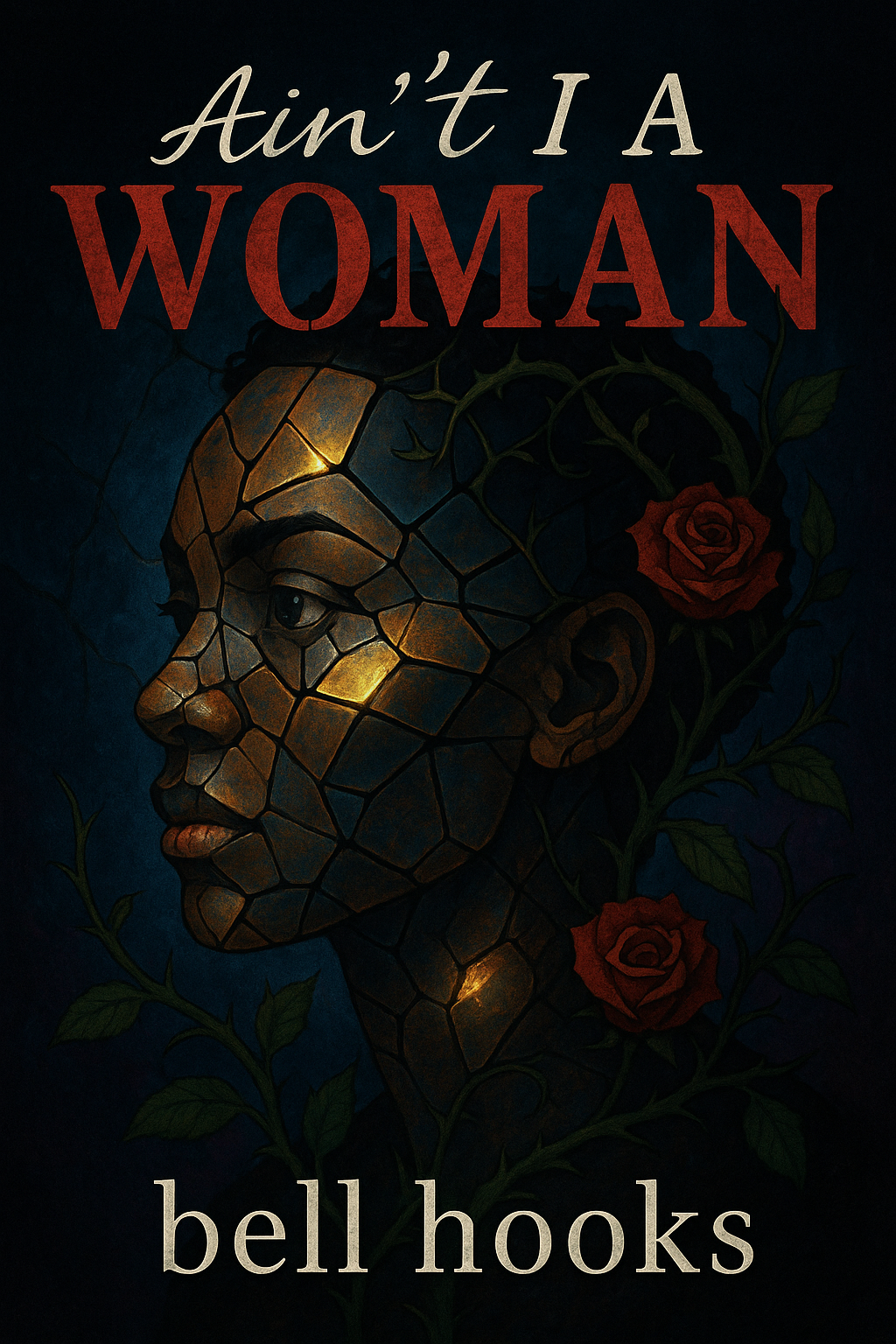
Ain't I a Woman
Chapter Summaries
What's Here for You
Prepare to confront a profound historical silence and embark on an intellectual journey that shatters conventional narratives. In 'Ain't I a Woman,' Bell Hooks unveils the deeply intertwined oppressions of sexism and racism, revealing how Black women have been historically silenced and devalued. This book is an invitation to understand the brutal realities of the slave experience, the enduring legacy of sexual exploitation, and the pervasive imperialism of patriarchy that shapes relationships within and beyond Black communities. You will gain a critical lens through which to examine the systemic nature of racism and how it has been misunderstood, even within feminist movements. Hooks challenges you to move beyond simplistic notions of race hatred and recognize racism as a tool of political oppression. This is not a comfortable read, but a necessary one. It is a call to intellectual awakening and emotional resilience, offering a powerful articulation of Black women's struggles and their unwavering spirit. You will emerge with a deeper understanding of intersectionality, a renewed sense of accountability, and a profound appreciation for the resilience that echoes from Sojourner Truth's iconic question to the present day. This work promises to expand your consciousness and equip you with the intellectual tools to dismantle oppressive structures and advocate for true liberation.
Introduction
Bell Hooks, in the introduction to 'Ain't I a Woman,' illuminates a profound historical silence that fell upon Black women in America, a silence born not just of oppression but of a deep-seated resignation. She explains that during pivotal moments when collective action for women's rights might have flourished, Black women, conditioned by racist and sexist socialization, often saw race as their sole identity, devaluing their womanhood. This led to a painful dichotomy: arguing that sexism was insignificant compared to the brutal reality of racism, clinging to the hope that liberation from racial oppression would suffice. This stands in stark contrast to 19th-century Black women like Anna Cooper, Sojourner Truth, and Mary Church Terrell, who understood that true freedom demanded an acknowledgment of both racial and sexist oppression. These foremothers actively participated in both the fight for racial equality and the women's rights movement, arguing that uplifting Black women would uplift all Black people. Cooper eloquently described the 'heroic struggle' of Black women against 'fearful and overwhelming odds' to protect their dignity and personhood, even when deemed mere chattel. The narrative then traces the fractured solidarity between Black activists and white suffragists, particularly around the issue of suffrage. When Black men were granted the vote while women remained disenfranchised, the underlying racism of some white feminists surfaced, breaking fragile alliances. Black women found themselves in a double bind: supporting white feminists meant aligning with those who had revealed their racism, while supporting only Black male suffrage meant endorsing a patriarchal order that would deny them political voice. Sojourner Truth's powerful insistence that 'if colored men get their rights, and not colored women theirs, you see the colored men will be masters over the women' underscored the persistent threat of sexist oppression. Hooks observes a shift in the 20th century, where the radical spirit of 19th-century Black women activists was quelled, and sexism became an accepted, natural fact of life. Even during the Civil Rights Movement, Black women's contributions were often overlooked, with male leaders revered and patriarchal values upheld within Black communities, defining freedom solely as participation within the existing American cultural value system. The 1960s Black liberation movement, Hooks notes, erected clear boundaries, demanding Black women conform to sexist roles, to 'breed warriors for the revolution' while men wrote policy. This led some Black women to resist, while others capitulated, inadvertently allowing the movement to become a vehicle for establishing Black male patriarchy rather than a path to liberation for all. The chapter critiques the feminist movement's tendency to romanticize the Black female experience, focusing on strength and resilience as coping mechanisms rather than acknowledging the damaging, pervasive impact of dual racist and sexist oppression. This romanticization, the author contends, transformed the 'strong Black woman' stereotype into a 'badge of glory' rather than a dehumanizing burden. In a society where Black women's identities are socialized out of existence, rarely recognized distinctly from Black men or as integral to the broader group of women, their experiences are often obscured. When Black people are discussed, sexism silences Black women's interests; when women are discussed, racism silences Black female interests. The author points to the pervasive tendency in academic and cultural discourse to use 'women' to mean 'white women,' a practice that perpetuates both racism and sexism by denying the existence and specific experiences of non-white women. This intellectual myopia, Hooks argues, prevented many white feminists from truly understanding and overcoming their own sexistracist attitudes, leading to a dismissal of Black women's concerns despite lip service to sisterhood. The chapter concludes by emphasizing that the struggle for Black women's liberation is inextricably linked to the fight against both racism and sexism, a truth often obscured by a society that insists on separating these interconnected oppressions. Hooks's own journey to write 'Ain't I a Woman' was a quest to document the impact of sexism on Black women, to refute antifeminist claims, and to forge a deeper understanding of the Black female experience by examining the intertwined politics of racism and sexism from a feminist perspective, aiming to move beyond racist and sexist assumptions toward the truth of their existence.
Sexism and the Black Female Slave Experience
Bell Hooks, in her profound exploration, unearths the brutal reality of sexism as an equally devastating force to racism in the lives of enslaved black women. The American social structure, built on patriarchy and racial imperialism, deeply embedded sexism from its European origins, profoundly shaping the fate of these women. Initially, the slave trade prioritized male laborers, deeming black females less valuable, a stark economic calculation that would tragically evolve. As the scarcity of labor grew, some white planters coerced immigrant white women into relationships with black male slaves, an act leading to the first anti-amalgamation laws, like Maryland's 1664 statute, which declared that any freeborn woman marrying a slave would serve her husband's master for life, and their children would be slaves. This law, however, was later repealed when its unintended consequence—the subjugation of white women—appalled some in power. With efforts to prevent interracial unions between black men and white women succeeding, planters turned their economic gaze towards the 'breeding' of black slave women. The offspring of any black slave woman, regardless of the father's race, would be enslaved, a legal framework that dramatically increased the market value of black females. White male observers, noting the subjugation of women in African cultures, saw enslaved black women as ideal subjects for slavery, accustomed to arduous labor in fields and domestic tasks, a stark contrast to the idealized, less-laboring white women of the colonies. The horrors of the Middle Passage were amplified for women; they were often left unshackled, making them vulnerable targets for the absolute power and brutal exploitation of white slavers, who feared retaliation from black men but not from black women. Rape became a common tool of terror and subjugation, stripping enslaved women of their dignity and safety, a violation compounded by forced pregnancies and barbaric childbirth aboard ships. The author compellingly argues that scholarly focus has often skewed towards the 'emasculation' of black men, overlooking the unique and intensified oppression faced by black women, who were simultaneously subjected to racism and sexism, forced into masculinized labor roles, and exploited sexually. Unlike black men, who, despite their subjugation, were often allowed to maintain some semblance of their masculinity, black women were forced into roles that colonial American society deemed debased for any woman, laboring in fields and domestic households alike, enduring punishments as harsh as any man. The sexual exploitation of black women, far from being mere indulgence, was an institutionalized form of terrorism, a tool to demoralize and dehumanize, with white women often complicit, either through hostility towards the enslaved women or by internalizing sexist doctrines that blamed the victim. Even within the nascent black slave subculture, patriarchal norms mirrored those of white society, with women taking on domestic duties and adhering to gendered roles, often aspiring to the idealized 'true womanhood' of white society, a stark contrast to their lived realities. Ultimately, Hooks reveals that the black female slave experience was a brutal intersection of racism and sexism, a dual oppression that magnified suffering and resistance, leaving an indelible mark on the human condition.
Continued Devaluation of Black Womanhood
Bell Hooks, in 'Continued Devaluation of Black Womanhood,' masterfully dissects the enduring legacy of sexual exploitation and its profound impact on the perception and social status of Black women. She argues that scholars, like Susan Brownmiller, often frame the sexual assault of enslaved Black women as a historical footnote, a crime of the past, thereby minimizing its pervasive and lasting devaluation of Black womanhood. Hooks reveals how this historical trauma became deeply embedded in the American psyche, manifesting in persistent stereotypes of Black women as inherently promiscuous, a myth used to justify ongoing sexual exploitation and to diminish their worth in the eyes of all Americans, including Black communities. This devaluation, she explains, was a deliberate social control mechanism, a calculated effort to sabotage Black female self-confidence and self-respect, particularly during the Reconstruction era when Black people sought to uplift their race. The chapter vividly illustrates how this societal conditioning led to a racial hierarchy where the sexual assault of a white woman by a Black man was deemed far more significant than the widespread abuse of Black women by white men, a hierarchy internalized across racial lines. Hooks exposes how media, from 19th-century newspapers to 20th-century television, has consistently reinforced these negative stereotypes—the 'fallen woman,' the 'Amazon,' the 'Sapphire,' and the 'Mammy'—each serving to dehumanize and devalue Black women, effectively denying them agency and respect. Even efforts by Black women to emulate white ideals of femininity and womanhood were met with ridicule and abuse, a stark reminder that their inherent worth was consistently undermined. The pervasive myth of the 'bad black woman,' portrayed as sexually loose and immoral, served to grant white men a sense of entitlement to Black women's bodies, while simultaneously discouraging legitimate relationships and marriages. This systemic devaluation, rooted in centuries of oppression, created a complex web of psychological warfare that continues to impact Black women's self-perception and their place in society, making it a struggle for them to develop a positive self-concept amidst a constant barrage of negative imagery, a struggle that transcends both race and class.
The Imperialism of Patriarchy
Bell Hooks, in 'The Imperialism of Patriarchy,' unveils a profound, often uncomfortable truth: the pervasive influence of patriarchal structures extends far beyond the experiences of white, middle-class women, deeply embedding itself within the fabric of Black communities and shaping male-female relationships across racial lines. The chapter begins by critiquing early feminist movements for their narrow focus, arguing that they failed to acknowledge how patriarchal power, the dominance of men over women, is a universal privilege, not exclusive to white men. This oversight, Hooks contends, allowed Black male sexists to deflect criticism by aligning with women against white male oppression, thereby obscuring their own complicity in patriarchal systems. A central tension emerges: the struggle against racism is often presented as the sole oppressive force, making it difficult to acknowledge that Black men can simultaneously be victims of racism and perpetrators of sexism against Black women. This dynamic is historically rooted, as Hooks traces the higher status afforded to enslaved males in the subculture of slavery, a bias reinforced by the prevailing sexist definitions of male roles as protector and provider. Even when Black men were unable to fulfill these roles due to systemic oppression, their male status automatically conferred a higher social standing than Black women, shaping leadership within early Black liberation movements. Figures like Martin Delaney and Frederick Douglass, while advocating for Black rights, often reinforced patriarchal norms, viewing the struggle primarily as one between Black men and white men, and sometimes sidelining women's suffrage or social equality. This historical legacy continues, manifesting in modern Black male leaders who, in the name of Black liberation and cultural reclamation, often publicly advocate for Black women's subjugation, framing it as a necessary step to counter white racist values, as seen in the rhetoric of Amiri Baraka. The chapter powerfully illustrates how this patriarchal ideology is reinforced through male bonding, a learned behavior that solidifies male identity and entitlement to power, often at the expense of women. Hooks argues that this process isn't necessarily biological but socially constructed, where masculinity itself is defined by power, privilege, and prerogative over women. The narrative then shifts to explore the impact of this ideology on Black women, who often internalize the pressure for men to be sole providers, leading to resentment and tension when Black men cannot meet these materialistic demands. This is further complicated by the societal tendency to label Black men as 'emasculated' when they don't conform to the breadwinner role, a label that, paradoxically, doesn't negate their capacity for sexist oppression. The chapter paints a stark picture of how this patriarchal system, fueled by capitalist imperatives and media reinforcement, encourages men to view women as enemies, a mechanism to distract from their own dehumanization in oppressive labor systems. The violence that pervades Black male-female relationships, from domestic brutality to homicide, is presented not just as a symptom of racism but as a direct consequence of internalized misogyny and the glorification of male dominance, a dynamic mirrored in white patriarchal society. Even seemingly progressive movements, like Black nationalism, have often embraced patriarchal structures, seeking to establish a Black patriarchy that mirrors the very system they resist. Hooks concludes by asserting that true liberation for Black men, and indeed for all men, cannot be achieved as long as they advocate for the subjugation of women, highlighting that patriarchal power, in its imperialistic reach, ultimately dehumanizes both oppressor and oppressed, and that genuine freedom requires dismantling both racism and sexism. The imperialistic nature of patriarchy, Hooks reveals, makes the oppression of women a cultural necessity, a mechanism that perpetuates cycles of violence and hatred, and true human liberation can only be realized when this oppressive structure is dismantled entirely.
Racism and Feminism: The Issue of Accountability
Bell Hooks, in "Racism and Feminism: The Issue of Accountability," invites us into a profound examination of how American women, regardless of race, have been deeply socialized to misunderstand racism, often reducing it to mere race hatred rather than a systemic, political tool of oppression. She reveals how historical narratives, taught in schools and reinforced through societal structures, have deliberately obscured the realities of racial imperialism, presenting instead a sanitized version of the American dream. This indoctrination, Hooks explains, has left even well-meaning individuals, including those in the early feminist movement, perpetuating the very systems of oppression they sought to dismantle. The chapter builds tension by exposing how the feminist movement, despite its revolutionary potential, often mirrored existing racial hierarchies, with white women frequently failing to acknowledge or confront their own complicity in racism, thus preventing genuine sisterhood. The core insight emerges: true feminist revolution demands an unflinching reckoning with white female racism, a realization that systemic injustice is not merely an abstract evil but is woven into the fabric of individual psyches and collective actions. Hooks illustrates this with the poignant observation that even a beloved teacher, unknowingly, can implant the seeds of racial imperialism by teaching children to admire the very system that oppresses them. The narrative then shifts towards resolution, urging a move beyond superficial understandings and towards a courageous, accountable embrace of shared humanity. This requires acknowledging that sexism, while pervasive, has often been overshadowed by racial imperialism in America, granting white women a complex position of both victim and potential oppressor. The author emphasizes that the historical narrative of white women's rights advocates, often romanticized as champions of the oppressed, masks a deeper truth: their activism was frequently rooted in moral reform or a desire to elevate their own status relative to Black men, rather than a genuine commitment to racial equality. Even in the workplace, the chapter illuminates how white women often benefited from or actively participated in the exclusion and exploitation of Black women, demonstrating a consistent pattern of prioritizing their own perceived advantage. The chapter concludes with a call to action, asserting that genuine feminist solidarity can only emerge when all women, irrespective of race or class, confront their own socialization, reject superficial metaphors like "women are niggers," and actively work to dismantle the divisive forces of racism, classism, and sexism, recognizing that true liberation lies not in mirroring male power structures but in forging a new reality built on authentic unity and shared responsibility.
Black Women and Feminism
Bell Hooks, in her profound work 'Ain't I a Woman,' unfurls a historical tapestry woven with the struggles and resilience of Black women, particularly within the context of feminism. The narrative begins with the iconic Sojourner Truth, whose powerful declaration, 'aint I a woman?' echoed not just a personal plea but a collective indictment of a society that denied Black womanhood its very humanity. Hooks reveals how, even in the nascent stages of the women's rights movement, racial prejudice from white feminists barred Black women from full participation, highlighting a central tension: the intersection of racism and sexism that often forced Black women to fight on multiple fronts. This chapter illuminates how historical accounts, often written by white scholars, have systematically excluded or minimized the contributions of Black women to feminist movements, a profound oversight that distorts our understanding of progress. We learn that Black women’s organizations, though often racially segregated, were deeply rooted in the fight for women’s rights, even as their efforts were miscategorized by historians who prioritized racial uplift over gender equality. The narrative then delves into the complex relationship between race and sex in the suffrage movement, where the promise of the ballot for all women was often undermined by white suffragists’ desire to maintain white supremacy, a painful lesson in political expediency. Hooks compellingly argues that the fight for Black liberation in the mid-20th century, particularly in the wake of the Moynihan Report, saw many Black women pushed into a more subordinate role, mimicking patriarchal structures they had long fought against, a stark resolution to the earlier tension. This period, marked by a societal push for idealized femininity, saw Black women pressured to conform to passive roles, a stark contrast to their historical independence and strength, a dynamic vividly illustrated by the societal pressures that informed characters in Lorraine Hansberry's 'A Raisin in the Sun.' The chapter concludes with a call to arms, urging a reappropriation of feminism as a truly radical ideology committed to dismantling the pervasive systems of domination—sexism, racism, and classism—and forging a path toward collective liberation, a poignant insight into the ongoing, evolving nature of feminist struggle. The narrative emphasizes that true progress requires confronting contradictions, not evading them, and that the fight for women's liberation must be inextricably linked to the liberation of all oppressed peoples, a testament to the enduring spirit of Black feminist pioneers.
Conclusion
Bell Hooks' 'Ain't I a Woman' delivers a searing, indispensable critique of American society and the interwoven oppressions of race and sex. The core takeaway is the undeniable, inseparable nature of racism and sexism, particularly as they converge to create the unique and historically silenced experience of Black women. The book dismantles the myth of the 'strong Black woman' archetype, revealing it not as a source of empowerment but as a dangerous erasure of profound suffering, a confusion of endurance with genuine liberation. Hooks meticulously illustrates how societal structures, legal frameworks, and even academic discourse have systematically devalued Black womanhood, perpetuating harmful stereotypes that justify ongoing exploitation. The emotional lessons are profound: a call for empathy towards those whose pain has been historically ignored, a recognition of the deep psychological toll of dual oppression, and a profound sadness at the missed opportunities for solidarity born from ingrained biases. The practical wisdom lies in the imperative for a truly intersectional feminism, one that demands rigorous self-examination and accountability from white women regarding their own complicity in racial hierarchies, and from Black men regarding their role in perpetuating sexism within the Black community. Hooks argues forcefully that genuine liberation for any group is contingent upon the liberation of all, and that dismantling all systems of domination—racism, sexism, and classism—is not an option but a necessity. The book compels readers to confront uncomfortable truths about historical narratives, the limitations of past social movements, and the urgent need to center the voices and experiences of those most marginalized. Ultimately, 'Ain't I a Woman' is a foundational text that demands a radical reimagining of freedom, one that acknowledges the full humanity and multifaceted struggles of Black women as central to any authentic pursuit of justice and equality.
Key Takeaways
Black women's historical silence on sexism stemmed from a socialization that devalued womanhood, making race the sole perceived identity, thus hindering collective action for women's rights.
True liberation for Black women necessitates acknowledging and actively fighting against both racism and sexism, as these oppressions are inseparable facets of their lived experience.
The failure of both mainstream feminist and Black liberation movements to adequately address the unique dual oppression of Black women led to their marginalization and the perpetuation of patriarchal structures.
The tendency to romanticize the 'strong Black woman' archetype obscures the damaging impact of oppression, confusing endurance with transformation and failing to recognize the systemic nature of the harm.
Societal and academic discourse often erases the distinct identity and interests of Black women by defaulting to 'women' meaning 'white women' and 'Black people' meaning 'Black men,' thereby perpetuating racist and sexist assumptions.
The interconnectedness of race and sex is an immutable truth that cannot be separated; attempts to divorce these issues distort the understanding of sexism, sexist oppression, and women's place in society.
Sexism, as deeply embedded as racism, formed a foundational pillar of oppression for enslaved black women, dictating their economic value and social subjugation.
The legal and social structures of slavery were weaponized to control black female sexuality, transforming their bodies into instruments of economic gain and terror.
Scholarly emphasis on the 'emasculation' of black men often obscures the distinct and compounded suffering of black women, who faced both racial and sexual oppression.
Enslaved black women were forced into labor roles considered 'masculine' by colonial standards, while simultaneously being subjected to the sexual exploitation that was deemed a 'feminine' vulnerability.
The idealized 'true womanhood' of white society, characterized by purity and domesticity, served as a painful counterpoint to the brutal reality of enslaved black women, fostering a deep desire for recognition and a different existence.
The sexual exploitation of black women was not merely personal transgression but a systematic form of terrorism designed to dehumanize and control, with internalized sexism among both white and black communities often blaming the victim.
Within the slave subculture, patriarchal norms mirrored those of white society, with enslaved women often adopting gendered roles and aspirations, even while enduring their unique oppression.
The historical sexual exploitation of Black women during slavery created a persistent devaluation of Black womanhood that continues to shape societal perceptions and limit Black women's social status.
Societal myths, perpetuated by media and ingrained in the collective consciousness, systematically portray Black women as inherently promiscuous and less worthy, justifying their ongoing exploitation and dehumanization.
The hierarchy of sexual violence in America prioritizes the violation of white women over Black women, a reflection of deeply internalized racist and sexist biases that render Black women's experiences less significant.
The deliberate construction of negative stereotypes like the 'Amazon,' 'Sapphire,' and 'Mammy' by white society serves as a tool of social control to undermine Black female self-confidence and prevent collective resistance against oppression.
The concept of the 'black matriarchy' is a misnomer and a tool of oppression, obscuring the systemic sexism and racism that Black women face and falsely attributing power where none exists, thereby hindering movements for liberation.
The devaluation of Black women's labor and experiences, even when they exhibit strength or resilience, is a direct consequence of ingrained anti-woman mythology, forcing Black women to sacrifice their dignity and self-concept.
The early feminist movement's limited focus on white, middle-class women's experiences obscured the universal nature of patriarchal power and its impact on women of all races and classes.
Black male sexism is often masked or deflected by a focus on the shared struggle against racism, creating a complex dynamic where Black men can be both victims of racism and perpetrators of sexism.
Historical power structures, particularly the higher status afforded to enslaved males, have deeply embedded patriarchal biases within Black communities, shaping leadership and relationship dynamics.
Male bonding, a learned behavior that reinforces entitlement to power and privilege over women, is a fundamental mechanism for maintaining patriarchal social orders across racial divides.
The societal expectation of men as sole providers, coupled with the 'emasculation' narrative, creates internal and relational tensions that do not negate men's capacity for sexist oppression.
The imperialism of patriarchy transforms the oppression of women into a cultural necessity, a tool used by dominant systems (like capitalism) to control both men and women, ultimately dehumanizing all involved.
True liberation for any group is impossible as long as it advocates for the subjugation of another; dismantling both racism and sexism is essential for complete human freedom.
American women, across racial lines, are socialized to perceive racism narrowly, often as individual prejudice rather than a deeply ingrained political system of oppression, hindering effective feminist solidarity.
The historical narrative of American society and its foundational movements, including feminism, has been shaped by a deliberate obfuscation of racial imperialism, creating a false consciousness that perpetuates cycles of oppression.
Genuine feminist revolution requires white women to engage in rigorous self-examination and accountability for their own racism, recognizing that their position within racial hierarchies, even as victims of sexism, can enable them to act as oppressors.
The concept of 'sisterhood' within feminism has historically been undermined by the failure of white women to acknowledge and confront their own racial biases and the unique oppressions faced by women of color, particularly Black women.
The struggle for women's liberation has often been co-opted by the interests of privileged white women, who have historically used the experiences of oppressed groups, particularly Black people, as metaphors to advance their own agendas rather than seeking genuine solidarity.
True feminist advancement necessitates a collective responsibility to dismantle all forces that divide women, including racism and classism, recognizing that superficial gestures or segregated movements are insufficient to achieve genuine political solidarity and liberation.
The intersection of racism and sexism has historically marginalized Black women's voices and contributions within feminist movements, forcing a dual struggle for liberation.
Historiography has often erased or downplayed the pivotal role of Black women in advocating for women's rights, creating a skewed understanding of feminist history.
The pursuit of women's suffrage and later feminist ideals has been complicated by the pervasive influence of white supremacy, often leading to the betrayal of Black women's interests.
Societal pressures and the fight for racial uplift have, at times, led Black women to adopt or support patriarchal structures, creating internal conflicts regarding gender equality.
Authentic feminism requires a radical commitment to dismantling all systems of domination—sexism, racism, and classism—rather than merely seeking equal footing within existing oppressive structures.
The historical resilience and agency of Black women, often overlooked, provide a blueprint for collective action and transformative change, demanding a redefinition of feminist struggle.
Progress in liberation movements is achieved through confronting and resolving contradictions, not by avoiding them or prioritizing one form of oppression over another.
Action Plan
Actively challenge the tendency to view race and gender as separate issues; recognize their inseparable nature in lived experiences.
Seek out and amplify the voices and histories of marginalized groups, particularly Black women, whose experiences have been historically silenced or misrepresented.
Critically examine societal narratives and personal assumptions that romanticize or stereotype Black women, recognizing the damaging impact of such portrayals.
When engaging in discussions about social justice, consciously ensure that the specific concerns and interests of Black women are included and addressed.
Educate yourself on the historical context of movements like suffrage and civil rights, paying attention to the ways Black women were excluded or marginalized.
Challenge the default assumption in language and discourse that 'women' refers exclusively to white women or that 'Black people' refers exclusively to Black men.
Reflect on how your own socialization might influence your perceptions of identity and oppression, and actively work to deconstruct any internalized racist or sexist biases.
Support and engage with feminist frameworks that acknowledge and center the experiences of women of color, rather than those that universalize the experiences of white women.
Actively seek out and engage with historical accounts that center the experiences of marginalized groups, particularly black women, to gain a more complete understanding of the past.
Challenge and question dominant narratives that may oversimplify or overlook the intersectionality of oppressions, such as sexism and racism.
Recognize and critically analyze how historical patriarchal structures continue to influence contemporary societal norms and gender roles.
Educate yourself on the specific ways sexism was historically used as a tool of control and dehumanization, beyond simple prejudice.
Support scholarship and discourse that prioritizes the voices and experiences of those who have been historically silenced or minimized.
Reflect on how societal ideals of 'womanhood' and 'manhood' have been constructed and how they have historically impacted different groups unequally.
Advocate for a more nuanced understanding of historical suffering that acknowledges the unique burdens faced by women within oppressive systems.
Actively challenge and deconstruct negative stereotypes about Black women encountered in media and everyday conversation.
Educate yourself and others about the historical context of sexual exploitation and its lasting impact on Black womanhood.
Recognize and question the societal hierarchy that prioritizes certain experiences of violence over others.
Support media and cultural narratives that offer authentic and multidimensional portrayals of Black women.
Consciously work to develop a positive self-concept, resisting internalized negative stereotypes.
Engage in critical analysis of how gender and race intersect to create unique forms of oppression and privilege.
Advocate for social structures and policies that ensure the protection and empowerment of Black women.
Actively challenge the tendency to view racism as the sole oppressive force, recognizing and naming sexism within all liberation struggles.
Examine historical narratives and cultural practices for embedded patriarchal biases, questioning assumptions about male superiority and female roles.
Engage in critical self-reflection about how societal norms around masculinity and femininity influence personal relationships and power dynamics.
Support and amplify the voices of women within all communities, ensuring their experiences and perspectives are central to discussions of liberation.
Foster open dialogue about sexism within Black communities, creating safe spaces for men and women to discuss its impact and collectively dismantle its structures.
Recognize that true male identity and power are not derived from the subjugation of women but from genuine connection, respect, and equality.
Seek out and support movements and initiatives that explicitly address and work to dismantle both racism and sexism simultaneously.
Actively seek out and engage with historical narratives that expose the realities of racial imperialism and challenge sanitized versions of American history.
Engage in critical self-reflection to identify and challenge personal biases and unconscious complicity in racist or sexist ideologies, moving beyond mere intellectual acknowledgment to conscious action.
When participating in social or political movements, actively question and challenge the exclusion or marginalization of any group, particularly women of color, and advocate for inclusive practices.
Educate oneself on the specific historical and ongoing oppressions faced by Black women and other marginalized groups, moving beyond generalized understandings of sexism.
Refuse to use metaphors that equate the experiences of privileged groups with those of deeply oppressed populations, such as comparing women's struggles to those of enslaved people without acknowledging the vast differences in systemic oppression.
Prioritize genuine dialogue and understanding across racial and class lines, seeking to build authentic solidarity rather than relying on superficial gestures or segregated group formations.
Assume personal responsibility for dismantling the forces that divide women, recognizing that combating racism and classism is integral to achieving feminist revolution.
Actively seek out and engage with historical accounts and contemporary analyses that center the experiences and contributions of Black women in social movements.
Critically examine how race and class intersect with gender in various social justice movements, recognizing that liberation is interconnected.
Challenge and correct historical narratives that marginalize or erase the agency of oppressed groups, particularly Black women.
Support and amplify the voices of Black feminists and other marginalized scholars and activists who offer critical perspectives on equality and liberation.
Reflect on personal biases and assumptions regarding gender roles and advocate for the dismantling of patriarchal structures within all spheres of life.
Recognize that genuine social change requires confronting uncomfortable truths and addressing systemic oppressions, rather than seeking superficial reforms.
Commit to building solidarity across race, class, and gender lines, understanding that collective strength is forged through inclusive action and shared political consciousness.