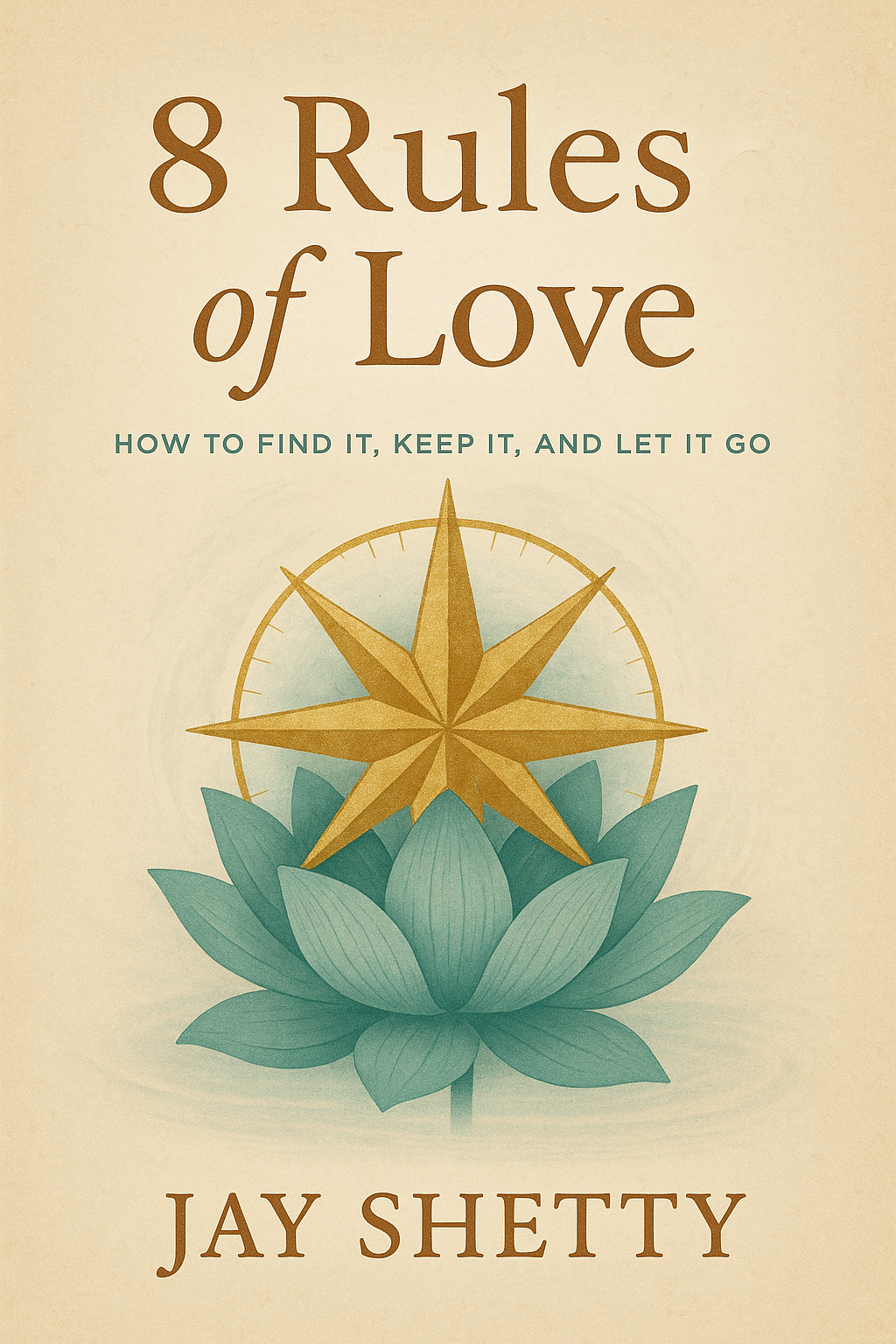
8 Rules of Love: How to Find It, Keep It, and Let It Go
Chapter Summaries
What's Here for You
Are you ready to move beyond fleeting attractions and cultivate love that lasts? Jay Shetty's "8 Rules of Love" offers a transformative guide, drawing from ancient wisdom and modern life to redefine your understanding and practice of love. This book promises to equip you with the tools to not only find profound connection but to nurture it, navigate its challenges, and even emerge stronger from its endings. You'll discover that true love isn't about grand gestures, but a consistent, mindful practice. Shetty challenges the fear of solitude, revealing it as the bedrock of healthy relationships, and urges you to understand the powerful law of karma and how your past impressions shape your present love life. Prepare to define love on your own terms, moving beyond vague feelings to clear intentions. You'll learn to see your partner not just as a companion, but as a 'guru' – a catalyst for growth – and to prioritize your own purpose ('dharma') as the essential foundation for giving and receiving love. Conflict, often feared, is reframed as an opportunity for deeper connection and consciousness. And when relationships end, you'll find a path to healing and resilience, understanding that breakups are not about breaking you, but about profound transformation. Ultimately, Shetty reveals love as an infinite capacity within you, ready to be cultivated and shared again and again. This book offers an intellectual journey grounded in ancient philosophy and a deeply emotional exploration of the human heart, fostering a tone of wisdom, compassion, and empowering self-discovery.
Introduction
Jay Shetty, drawing from ancient Vedic wisdom and his own experiences as a Hindu monk, introduces the profound concept of love not as a fleeting attraction, but as a daily practice requiring consistent care and attention, much like nurturing a flower. He contrasts the common tendency to 'pluck' beauty and passion, which inevitably withers, with the deeper, more rewarding act of watering and tending, which allows love to truly bloom and reveal its intricate details over time. Shetty acknowledges the myriad ways love is perceived across cultures and media—from the Greeks' seven types to modern songs that describe love as a rollercoaster or a hangover—but argues these often fall short of teaching us how to actively practice it. He posits that the pursuit of love and being loved is a fundamental human drive, yet many experience disappointment, mistaking lust for love, or finding their hopes wilting. The author reveals his intention to guide readers beyond the passive search for a 'soul mate' or the perfect relationship, urging them instead to intentionally build love, navigate its inherent imperfections, and foster a love that expands and evolves daily. This journey is framed through the lens of the four Vedic ashrams, or schools of learning, which map out stages of life and, consequently, stages of love: preparing for love through self-love and healing (Brahmacharya), practicing love by extending it to others with understanding and cooperation (Grhastha), protecting love through conflict resolution and forgiveness (Vanaprastha), and finally, striving for the perfection of boundless, universal love (Sannyasa). Shetty shares a personal anecdote of a grand, yet misguided, proposal to his now-wife Radhi, highlighting how societal narratives of romantic gestures often overshadow genuine individual needs and preferences, serving as a gentle reminder that true love is about understanding the person in front of you, not conforming to fairytale ideals. This book, he explains, offers eight cumulative, counterintuitive rules—two for preparation, three for practice, two for protection, and one for perfection—designed to cultivate a mindset for love in any relationship stage, emphasizing that love is not about achieving a perfect state but about learning to navigate the intrinsic imperfections of life, ourselves, and our partners.
Let Yourself Be Alone
Jay Shetty, in 'Let Yourself Be Alone,' guides us through the profound wisdom that embracing solitude is not the enemy of love, but its very foundation. We are often conditioned to fear being alone, equating it with loneliness and failure, a sentiment that drives us into unsatisfying relationships or keeps us tethered to those that no longer serve us. Shetty illustrates this with the story of Leo, who moved across the country to avoid loneliness, only to find himself more isolated than before, demonstrating how the fear of being single can lead to desperate decisions. The author distinguishes between loneliness—a painful state born of insecurity—and solitude—a glorious state of self-contentment and awareness. He posits that this comfortable state of being with oneself is crucial for developing the compassion, empathy, and patience needed to love another. Drawing parallels to the disciplined silence of monastic life, Shetty encourages a 'Solo Audit' to understand our current relationship with time alone, moving beyond mindless distractions to active engagement with ourselves through reading, walking, or pursuing hobbies. This initial assessment is followed by deliberately introducing new solo activities, like dining alone or attending an event solo, to confront discomfort and observe our reactions. The journey from loneliness to solitude, Shetty explains, unfolds in three stages: presence, discomfort, and confidence. Presence involves attuning to our feelings and choices to understand our core values, which then steer our decisions and offer a clear sense of self. Discomfort is the inevitable phase when challenging our solitude habits, pushing us to explore new skills, travel alone, or take on new work, thereby learning our independence and resilience. Finally, confidence emerges from this self-knowledge and self-reliance, allowing us to engage in relationships without seeking external validation or hinging our self-worth on another's approval. He uses the analogy of a warrior, Arjuna, and the god Krishna from the Bhagavad Gita to illustrate how our senses can be easily carried away by superficial attractions, and how solitude provides the crucial space to create a pause between attraction and reaction, fostering self-control and patience. Ultimately, Shetty argues that becoming a 'whole person' through productive solitude—knowing our own personality, values, and goals—is the prerequisite for a truly connected and loving relationship, enabling us to offer love without neediness or fear, and to recognize that we are embarking on a journey with a partner, not making them our entire journey.
Don’t Ignore Your Karma
Jay Shetty, in his exploration of love, urges us to look beyond the simplistic notion of 'bad relationship karma,' revealing karma as a profound law of cause and effect, where our current decisions, born from ingrained impressions called 'samskaras,' shape our future experiences. He illustrates this through the cycle: impressions absorbed from childhood and environment influence our adult choices, leading to consequences that, if undesirable, prompt us to revisit and edit those initial impressions, thus breaking the cycle. Shetty emphasizes that our earliest experiences, particularly with parents, media, and first loves, deeply imprint our expectations of what love should be, often unconsciously leading us to repeat or repair past patterns, much like the client who sought attentiveness but found obsession due to a reactive impression. He guides us to unearth these samskaras, perhaps through a 'Younger Self Meditation,' to understand their origins and free ourselves from their often unexamined influence. The chapter delves into how parental 'gifts and gaps'—the love received and the love missed—create patterns, and how media, from romantic comedies to advertising, crafts unrealistic ideals of love that can set us up for disappointment. Shetty also dissects the allure of certain relationship archetypes—the Rebel, the Chase, the Project, the Fboy/Fgirl, the Opulent One—as manifestations of our samskaras, urging conscious choice over unconscious attraction, akin to choosing a steady flame over a fleeting spark. He posits that we attract what we *use* to impress, highlighting the danger of presenting a curated persona rather than our authentic selves, which leads to relationships built on illusion, not genuine connection. Ultimately, Shetty empowers readers to move from being a 'Fixer' or 'Dependent' to a 'Supporter,' by taking ownership of their needs, filling their own emotional gaps, and choosing partners based on core qualities rather than superficial opulences, transforming inherited anxieties into conscious choices and fostering a love that is practiced, grown, and truly their own.
Define Love Before You Think It, Feel It, or Say It
Jay Shetty, in his chapter 'Define Love Before You Think It, Feel It, or Say It,' guides us through the often-confusing landscape of expressing and understanding love, revealing that the simple phrase 'I love you' carries a vast spectrum of meanings, leading to miscommunication and dashed expectations. He illustrates this with anecdotes, like the man who said 'I love you' and then ghosted, or the woman whose partner's 'I love you' was akin to loving his mother, highlighting the critical need to define love before declaring it. Shetty introduces a framework, inspired by the Bhakti tradition, to understand love not as a singular event, but as a journey through four distinct phases: Attraction, Dreams, Struggle and Growth, and Trust. In the Attraction phase, we experience the initial spark, a euphoric rush driven by brain chemicals, akin to seeing a promising chair online, but it's crucial not to mistake this potent chemistry for the entirety of love, as it's based on appearance rather than deep connection. This is why Shetty emphasizes the 'Three-Date Rule,' suggesting specific conversations to explore personality, values, and goals, moving beyond superficiality to genuine connection through reciprocal, escalating self-disclosure. As we move into the Dreams phase, attraction can cloud our judgment with unrealistic expectations, a phenomenon amplified by technology's illusion of endless choices, leading to 'relationshopping' and a search for perfection that overlooks a partner's inevitable imperfections and challenges. Shetty advocates for grounding these dreams in reality through rhythms and routines, establishing healthy boundaries and open communication about pace and expectations, rather than assuming mind-reading or succumbing to pressure. The inevitable arrival of the Struggle and Growth phase confronts us with differences and disappointments; Shetty posits that love isn't about avoiding trouble, but valuing your partner enough to confront difficult areas, learn from mistakes, and grow together, likening relationships to a masterfully designed annoyance that pushes us toward individual and shared evolution. Finally, the Trust phase, built painstakingly through consistent actions, thoughts, and words, allows for deep physical, mental, and emotional safety, where love is no longer a fleeting feeling but a resilient bond forged through shared challenges and unwavering support, culminating in a relationship where dreams, once fantasies, become shared realities built on mutual commitment and understanding. Shetty concludes that love is a cycle we navigate repeatedly, deepening our faith and finding renewed attraction, but true love requires committing to this journey, facing its challenges, and growing together, transforming dreams into tangible, shared futures.
Your Partner Is Your Guru
Jay Shetty, in the chapter 'Your Partner Is Your Guru,' invites us to reimagine our romantic relationships not merely as partnerships, but as profound opportunities for mutual growth, viewing each other as both teacher and student. He begins by contrasting the passive pursuit of wisdom with an active, shared journey, recalling a Zen story where a young man chose a guru who invited him to simply watch the sunset together, a metaphor for a relationship that embraces presence and shared experience over rigid instruction. Shetty posits that our partners, much like ancient gurus who listened to and sought feedback from their students, serve as mirrors reflecting our blind spots, helping us navigate life's 'turbulent ocean' with compassion and friendship, though unlike traditional gurus, this dynamic is one of equals – each partner is both guru and student. He explains that our inherent egocentric bias limits our self-perception, and it is through our partner's unique lens that we gain a more accurate and expansive view of ourselves, fostering transparency and encouraging self-work without judgment. This learning occurs in three ways: learning *with* a partner through shared experiences, learning *from* them through their expertise, and most profoundly, learning *through* them by observing their behavior and our reactions, transforming even annoyance into an educational moment. The core tension here is moving beyond transactional or ownership-based relationships toward a model of continuous growth, akin to the Grhastha ashram, where actions are guided by compassion, wisdom without ego, and love without expectation. Shetty provides a practical assessment to gauge a partner's capacity for growth, emphasizing qualities like self-awareness, emotional understanding, curiosity about the other, self-entertainment, problem-solving flexibility, support for others' growth, and the ability to inspire. He then delves into the qualities of a 'guru' partner, drawing from Vedic traditions, highlighting the importance of serving without ego, leading by example, supporting the partner's goals without imposing one's own, guiding without criticism, and fostering learning in their preferred style, much like a supportive friend rather than a demanding master. Conversely, he outlines the qualities of an ideal 'student' partner: openness, curiosity, humility, and a willingness to learn and translate feedback constructively, akin to the 'beginner's mind' or 'shoshin'. The narrative culminates in the profound insight that while partners intertwain their 'karmas' or life activities, their souls or identities must remain distinct, urging readers to maintain individuality, pursue personal interests, and spend time in solitude, thereby fueling the relationship with a richer, more self-actualized self. Ultimately, Shetty resolves the tension by framing the partner-guru dynamic not as a path to perfection or subservience, but as a continuous, reciprocal journey of growth, where the greatest gift is not achieving a static ideal, but the shared act of evolving together, and crucially, recognizing that abuse, in any form, is antithetical to this sacred learning process and must be a dealbreaker.
Purpose Comes First
Jay Shetty, in 'Purpose Comes First,' unveils a profound truth for navigating love and life: our purpose, our 'dharma,' must precede all else. He illustrates this with a client's wife who wisely prioritized herself, not out of selfishness, but to be her best for her family. This concept of dharma, the intersection of passion, expertise, and service, is not merely a career but a defining aspect of self that fuels our very existence. Shetty reveals that the ancient Vedas place dharma first among life's pursuits—purpose, work, pleasure, and liberation—because it guides how we allocate our time, money, and energy, imbuing them with meaning. Research echoes this, showing that a strong sense of purpose, or eudaimonia, offers greater resilience and stability than fleeting hedonistic pleasures; it can even insulate our self-esteem from the fickle tide of social media likes. The author uses the analogy of two acrobats, one advising mutual self-reliance for safety, to underscore that true partnership involves each individual tending to their own purpose first, then coming together from a place of wholeness. This means acknowledging that in any relationship, there are three vital connections: your partnership, your relationship with your purpose, and your partner's relationship with their purpose. Shetty guides us through the 'Pyramid of Purpose'—Learn, Experiment, Thrive, Struggle, Win—a framework for discovering and living our dharma, emphasizing that learning, driven by curiosity and often aided by mentors, is the crucial first step. He stresses the importance of finding time for this pursuit, even if it means reallocating 'time confetti' and engaging partners in this process to ensure mutual understanding and support. Experimentation, he explains, is about trying things out without pressure, embracing mistakes as learning opportunities, and inviting partners to join in or at least understand the journey. Thriving involves building consistency and steady progress, while struggle, though inevitable, is a powerful catalyst for growth when approached with awareness and shared with a partner. Winning, the ultimate recognition, is shown to be a byproduct, a rare moment built upon consistent effort across all preceding stages, not the sole aim. Crucially, Shetty advises on how to prioritize one's own dharma within a relationship, and then how to support a partner in theirs, advocating for creating space, offering encouragement, and celebrating their journey without imposing one's own expectations. He details strategies for navigating the complexities when two purposes collide, such as pursuing them after hours, prioritizing one temporarily with mutual agreement, taking turns, or, ideally, going all-in on both, always emphasizing open communication, shared commitment, and making the time spent together meaningful. Ultimately, the chapter resolves the tension between individual purpose and relational harmony by asserting that tending to our own dharma is not a withdrawal from love, but the most profound way to prepare ourselves to give our best selves to our partners and to the world.
Win or Lose Together
Jay Shetty, in his chapter 'Win or Lose Together,' invites us to reframe conflict not as a sign of a failing relationship, but as an essential precursor to deeper consciousness and connection. He illustrates this with a vivid scene of a couple arguing over a phone, highlighting how the avoidance of conflict, often mistaken for harmony, leads to a superficial existence where true understanding remains elusive. Drawing parallels from the Bhagavad Gita, Shetty reveals that even in the face of impending war, the divine Krishna guides Arjuna not to avoid the battle, but to learn how to fight productively, emphasizing that conflict, when approached with the right intention, is a necessary crucible for growth. The core dilemma presented is that couples often fight *each other* when they should be fighting *the problem*, a distinction that shifts the energy from ego-driven power struggles to a collaborative pursuit of understanding. Shetty introduces the concept of three argument energies: pointless (ignorance), power (passion), and productive (goodness), urging readers to aim for the latter by purifying the ego and adopting a team-oriented mindset. He suggests that by approaching disagreements as a united front, partners can 'swim through' challenges side-by-side, transforming individual losses into shared victories. This is further illuminated by the layered approach to diagnosing conflict—moving from social triggers to interpersonal dynamics and finally to the root inner conflicts, much like peeling back the layers of an onion to reveal its core. Understanding one's own and one's partner's 'fight style'—whether venting, hiding, or exploding—is presented as a crucial step in navigating these emotional landscapes, allowing for empathy and adjusted communication. The chapter provides a framework for transforming arguments into opportunities for growth through five steps: Place and Time, Expression, Anger Management, Commitment, and Evolution, all aimed at fostering genuine apologies and lasting change rather than superficial promises. Ultimately, Shetty posits that the true measure of a relationship's strength lies not in the absence of conflict, but in the ability to navigate it together, turning potential ruptures into opportunities for deeper intimacy and shared evolution, reminding us that 'every time the problem loses, you both win.'
You Don’t Break in a Breakup
Jay Shetty, in 'You Don't Break in a Breakup,' guides us through the often-painful landscape of relationship endings, revealing that love's disintegration is rarely sudden, but rather a slow accumulation of unaddressed 'scratches' that can deepen into 'cracks' and eventually, 'ruptures.' He illustrates this with the metaphor of a wall, where minor flaws, if ignored, can compromise the entire structure, emphasizing that while everyday issues can be touched up, fundamental problems like abuse, infidelity, inertia, or disinterest demand significant repair or separation. Shetty powerfully asserts that abuse, in any form—physical, emotional, financial, digital—is a non-negotiable dealbreaker, underscoring that safety is paramount and professional help is crucial for those in such situations. He then delves into the profound challenge of infidelity, noting that while recovery is possible, it requires immense commitment, honest communication, and forgiveness from both partners, cautioning against rebound relationships that merely carry old baggage into new connections. The author also explores the gradual erosion of love through disinterest and the atrophy of intimacy, advocating for active nurturing of connection through shared experiences, education, and service, rather than passive entertainment. Shetty offers a framework for navigating these challenges, presenting the choice to 'elevate' a relationship through understanding and acceptance, or to 'separate,' stressing that stagnation is never the answer. Should separation be the path, he guides us through 'perfecting your breakup,' advising honesty, clarity, and a clean break to allow for genuine healing, distinguishing between the mind's desperate cravings and the intelligence's capacity for growth. Ultimately, Shetty reminds us that during heartbreak, it is our expectations and the relationship's structure that break, not our unbreakable soul, urging us to find closure within ourselves, learn from the experience, and expand our capacity for love beyond romantic connections, recognizing that true healing comes from within and the lessons learned pave the way for future bonds.
Love Again and Again
Jay Shetty, in "Love Again and Again," invites us to reimagine love not as a finite resource to be found or kept, but as an infinite capacity to be cultivated and shared. He begins by posing a thought experiment: giving a hundred dollars to one person versus a dollar each to a hundred. While both have merit, the latter, he explains, expands our capacity for love, a principle that shifts as we progress through life's stages. The author reveals a profound misconception: that love's primary form is romantic or confined to a small circle of family and friends. Instead, he posits that romantic partnerships serve as practice, a stepping stone toward a grander, more life-changing form of love available to all, every day. This expansive love, exemplified by the Sannyasa stage of life, is characterized by looking beyond the self to serve others, finding love even in moments of frustration, and treating every person with the dignity their humanity deserves. This echoes the concept of self-realization, where the self extends beyond the ego to encompass the world, making service to others inherently service to oneself. Science, through the study of prosocial behavior, supports this, highlighting our deep-seated need for connection. Shetty illustrates this expanding radius of love: from loving one's children to loving the community, the school, the environment, and ultimately, the divine, recognizing our interconnectedness, much like Kabir Das's poetic assertion, 'The river that flows in you also flows in me.' This expansive giving, as Anne Frank noted, does not impoverish us, but rather solves a need greater than romantic love—the need to be of service, which science labels the 'helper's high.' The Vedas teach that love is not something to be found, but an inherent quality within us, obscured by ego and impurities, which we can access by removing these layers. The chapter then navigates how to actively give love, first to those closest, through understanding, belief, acceptance, and appreciation, and then by extending a 'radius of respect' even to difficult or toxic individuals, recognizing their hurtful behavior as a misdirected plea for love. This involves self-reflection to understand our own triggers and maintaining our values without accepting abuse. Shetty emphasizes that creating a loving environment, whether in our hearts or homes, is for our own well-being. For challenging relationships, a 'radius of respect' might mean limiting contact to protect ourselves while still wishing them well, or even helping them find other sources of love within their community. He introduces the concept of time management for love, drawing on Dunbar's number, suggesting a structured approach to nurturing relationships across different circles of closeness. The workplace, too, becomes a space for love, expressed through guidance, support, collaboration, and appreciation, even in professional settings where vulnerability might be inappropriate, reminding us that while some environments may feel like a river with crocodiles, we must hold onto our loving hearts. Extending this outward, proactive engagement in our communities and simple acts of kindness towards strangers—like a smile—can transform lives, releasing feel-good neurochemicals and fostering connection. Shetty concludes by urging us to actively plant seeds of love, to give rather than seek, to ask how we can love everyone in a room, thereby experiencing the profound joy and inexhaustible depths of love throughout our lives.
Conclusion
Jay Shetty's '8 Rules of Love' offers a profound reorientation of how we understand and practice love, moving beyond fleeting infatuation to embrace it as a deliberate, lifelong cultivation. The core takeaway is that love, in all its forms, is not a passive discovery but an active, daily endeavor. This requires us to first cultivate a robust inner world, understanding that self-love and personal healing are not prerequisites but the very bedrock upon which healthy external relationships are built. Shetty powerfully argues that solitude, often feared, is in fact the fertile ground for self-knowledge, patience, and self-compassion, enabling us to enter relationships as whole individuals rather than seeking completion. The book meticulously unpacks how our past, shaped by 'samskaras' and idealized cultural narratives, unconsciously dictates our relationship patterns, urging us to confront these ingrained impressions to break negative cycles. Emotionally, Shetty guides us through the inherent vulnerability and discomfort that accompany genuine growth. He normalizes the struggle, presenting conflict not as a sign of failure, but as an essential catalyst for deeper consciousness and connection. The emotional liberation comes from understanding that breakups, while painful, are not annihilations of the self, but the dissolution of relational constructs, offering an opportunity for profound learning and internal closure. The book fosters a sense of hope by illustrating that love is an infinite capacity, an ever-expanding force that can be continuously nurtured and shared. Practically, Shetty provides a roadmap for intentional relationship building. He emphasizes the necessity of defining love explicitly, understanding its progressive phases, and committing to navigating imperfections with partners who act as 'gurus' for mutual growth. The wisdom extends to prioritizing our individual 'dharma' or purpose, recognizing that a fulfilled self is a stronger partner. He advocates for a shift from transactional dynamics to a focus on shared learning and mutual support, transforming arguments into collaborative problem-solving. Ultimately, '8 Rules of Love' empowers us to become architects of our own loving experiences, fostering resilience, authenticity, and an ever-expanding capacity to give and receive love, not just in romance, but in service to a more connected humanity.
Key Takeaways
Shifting the focus from 'winning' an argument to defeating the problem together purifies the ego and fosters mutual growth.
Diagnosing conflict involves identifying its layers, from social triggers to interpersonal issues and underlying inner insecurities.
Love is a daily effort requiring consistent care and attention, akin to nurturing a flower, rather than a fleeting attraction that fades.
The pursuit of love is often guided by idealized cultural narratives that obscure the practical skills needed for its cultivation and maintenance.
True love is built intentionally through navigating imperfections, not passively found in a perfect person or relationship.
The four Vedic ashrams provide a framework for understanding love as a progressive journey, moving from self-preparation to universal practice.
Self-love and personal healing are foundational prerequisites for extending love and commitment to others.
Understanding and respecting individual preferences and needs, rather than conforming to societal romantic ideals, is crucial for authentic connection.
Love is a process of continuous growth and evolution, emphasizing the navigation of challenges and imperfections over achieving a static state of perfection.
The fear of loneliness compels individuals into suboptimal relationships, highlighting the central tension between seeking external validation and developing internal contentment.
Solitude, when approached with awareness and intention, is the fertile ground for cultivating self-knowledge, patience, and self-compassion, essential prerequisites for healthy love.
The journey from loneliness to confidence in solitude involves actively confronting discomfort and engaging in self-discovery through presence and deliberate solo experiences.
Developing self-awareness of one's values and goals is crucial for entering relationships as a whole person, rather than seeking completion from a partner.
Solitude provides the necessary space to differentiate between immediate sensory attraction and long-term nourishment, fostering self-control and discerning decision-making.
Becoming a self-regulated individual, capable of comforting and supporting oneself, is key to avoiding codependency and building reciprocal, healthy connections.
Karma is not punishment or reward, but the natural consequence of choices made with or without understanding, serving as a teacher to refine our decision-making.
Our ingrained impressions (samskaras) from childhood, media, and early relationships unconsciously shape our adult relationship choices, often leading to repeating past patterns.
Unearthing and understanding the origins of our samskaras, through introspection and practices like the 'Younger Self Meditation,' is crucial for breaking negative cycles and making conscious choices.
Parental 'gifts and gaps' and idealized media portrayals of love create deep-seated expectations that can lead us to seek partners who fill voids or replicate past dynamics, rather than fostering genuine connection.
Attracting partners based on superficial 'opulences' (wealth, beauty, status) or a curated persona, rather than core qualities and authentic self, leads to unsustainable relationships and emotional disconnect.
Transforming from relationship roles of 'Fixer' or 'Dependent' to 'Supporter' involves taking ownership of one's own needs, filling personal emotional gaps, and choosing partners based on mutual growth and respect.
The phrase 'I love you' is deeply ambiguous and requires explicit definition between partners to prevent miscommunication and false expectations.
Love progresses through distinct phases—Attraction, Dreams, Struggle and Growth, and Trust—each demanding different levels of understanding and effort.
Authentic connection goes beyond initial attraction; it's built through reciprocal, escalating self-disclosure and exploring personality, values, and goals.
Unrealistic expectations, often fueled by external pressures, must be replaced with grounded realities established through consistent rhythms, routines, and open communication.
Challenges and disagreements are inevitable and are opportunities for growth, revealing a partner's true value and the potential for a resilient, evolving bond.
Trust is not immediate but a gradual accumulation of consistent, trustworthy actions across physical, mental, and emotional domains, requiring self-trust as its foundation.
Sustainable love involves a commitment to navigating the cyclical nature of relationships, actively building shared dreams and facing difficulties together rather than avoiding them.
Romantic partners can act as 'gurus,' reflecting our blind spots and facilitating self-awareness through their unique perspective, transforming the relationship into a dynamic space for mutual learning and growth.
Effective partnership requires a shift from transactional dynamics to a focus on shared growth, where partners actively learn *with*, *from*, and *through* each other by embracing transparency, curiosity, and empathetic observation.
Cultivating a 'guru' mindset within a relationship involves leading by example, offering guidance without criticism or ego, supporting the partner's individual goals, and respecting their unique learning style and pace.
Developing 'student' qualities, such as openness, humility, curiosity, and effective communication, is crucial for receiving wisdom from a partner and fostering a reciprocal learning environment that honors both individuals.
While partners intertwine their life paths and activities ('karmas'), maintaining individual identity, pursuing personal interests, and seeking solitude are essential for sustained personal growth and a more vibrant, offering relationship.
Prioritizing one's own 'dharma' (purpose, passion, expertise, service) is essential for bringing the best version of oneself to relationships.
A strong sense of purpose provides psychological resilience, insulating self-esteem from external validation and enhancing overall well-being.
The journey of purpose unfolds through distinct stages—Learn, Experiment, Thrive, Struggle, Win—requiring consistent effort and learning from challenges.
Supporting a partner's pursuit of their purpose involves creating space, offering encouragement, and celebrating their growth without imposing personal expectations.
Navigating the complexities of two partners pursuing their purposes requires deliberate communication, mutual agreement on time allocation, and making shared time meaningful.
True partnership involves mutual self-reliance, where each individual tends to their own dharma first, creating a foundation of stability to share with their partner.
Conflict is not the end of love, but the beginning of consciousness and deeper understanding in relationships.
Avoiding conflict leads to superficiality; productive arguments, approached as a team, build resilience and connection.
Understanding and respecting individual 'fight styles' is crucial for effective communication and preventing arguments from escalating.
Transforming conflict requires a conscious commitment to 'PEACE': Place and Time, Expression, Anger Management, Commitment, and Evolution.
Relationship breakdowns are rarely sudden events but rather the cumulative effect of unaddressed minor issues that escalate into structural cracks.
Abuse in any form is a critical dealbreaker that requires prioritizing safety and seeking professional help for escape.
Infidelity, while deeply damaging to trust, can be overcome with profound commitment, radical honesty, and mutual forgiveness, though recovery is statistically rare.
Intimacy requires active nurturing through shared experiences, learning, and service, not passive consumption of entertainment, to maintain a vibrant connection.
The choice in a struggling relationship is between elevating it through understanding and acceptance, or separating, as stagnation is detrimental to growth.
Breakups are painful due to chemical and psychological responses akin to addiction withdrawal and physical pain, but it is the relationship's constructs, not one's soul, that break.
Finding closure is an internal process of creating a narrative of healing and learning from the relationship's end, rather than seeking it from the ex-partner.
Love is an infinite capacity to be cultivated and shared, not a finite resource to be found or kept.
Romantic love serves as practice for a more expansive, selfless love that benefits all of humanity.
True self-realization involves extending one's sense of self to encompass interconnectedness with others and the world.
Giving love, through prosocial behavior, fulfills a fundamental human need and generates profound personal well-being (the 'helper's high').
Love is an inherent quality within us, accessible by shedding layers of ego and negativity, rather than something to be sought externally.
Love can be extended through a 'radius of respect' to difficult individuals, balancing self-protection with compassion and understanding.
Consciously structuring time and effort across different relationship circles is essential for nurturing love effectively.
Action Plan
Reflect on the difference between liking and loving by observing how you care for things or people you value.
Identify one cultural narrative about love that may be influencing your expectations and question its validity for your own life.
Begin practicing self-care and self-compassion as the first step toward preparing to love others.
Examine past relationships to identify recurring patterns or lessons you might have missed.
Consider your own 'ashram' or stage of life and what lessons about love you need to focus on now.
Practice understanding and appreciating the unique personality, values, and goals of someone you care about.
Look for opportunities to intentionally build and nurture love in your daily interactions, rather than waiting for it to happen.
Acknowledge and embrace the imperfections in yourself and others as an integral part of the love-building process.
Dedicate one week to tracking all time spent alone, noting activities and your comfort level, focusing on mindful engagement rather than passive distraction.
Commit to trying one new activity alone each week for a month, such as seeing a movie solo or dining alone, and reflect on your experience and any intrusive thoughts.
Complete the 'Get to Know Your Values' exercise by examining your choices across different life areas to identify your core principles.
Engage in one of the 'Make Use of Your Time Alone' activities: commit to a new skill, plan a solo trip, or take on a new type of work, reflecting on what you learn about yourself.
Assess your life through the 'Identify Your Biggest Growth Area' questionnaire across five domains (Self, Financial, Mental/Emotional, Health, Relationships) to pinpoint where you most want to grow.
Develop a growth plan for your identified area of improvement using the 'Three Cs of Transformation': Coaching, Consistency, and Community.
Practice self-regulation by actively seeking to comfort, calm, or energize yourself before turning to others for emotional support.
Engage in a 'Younger Self Meditation' to identify and understand childhood impressions influencing your current relationship patterns.
Reflect on your parental 'gifts and gaps' by writing down your best and worst childhood memories and how your parents handled challenges.
Identify media (songs, movies) that shaped your early ideas of love and assess whether those ideals are realistic for your current relationships.
Examine your past relationships to pinpoint recurring patterns, such as attraction to 'Rebels' or engaging in 'The Chase,' and understand the underlying samskaras.
Differentiate between 'Fixer,' 'Dependent,' and 'Supporter' roles in relationships and consciously strive to embody the 'Supporter' dynamic.
List what you genuinely love about yourself, focusing on qualities rather than external 'opulences,' and identify what qualities your partners have appreciated in you.
Practice giving yourself what you wish to receive in relationships by daily identifying one act that makes you feel appreciated, special, or respected.
Before declaring love, engage in conversations to explicitly define what 'I love you' means to both you and your partner.
Utilize the 'Three-Date Rule' framework to explore a potential partner's personality, values, and goals through targeted questions.
Establish rhythms and routines with your partner to create space for genuine connection and observe their response to healthy boundaries.
Communicate openly about your pace and expectations in the relationship, rather than assuming your partner understands your needs implicitly.
When disagreements arise, view them as opportunities for growth and confront difficult areas together, rather than avoiding them or ending the relationship.
Actively build trust by being trustworthy in your thoughts, words, and actions, and by recognizing and appreciating your partner's consistent efforts.
Schedule a monthly relationship check-in to identify highlights, challenges, and collaboratively set a goal to work towards together.
Assess your partner's capacity for growth by asking: Do they like learning about themselves? Do they understand their own emotions? Are they curious about you? Can they entertain themselves? Are they open to new problem-solving ways? Do they support others' growth? Do they inspire you? (Always, Sometimes, Never).
Practice being a 'guru' by leading through service, example, supporting your partner's goals without imposing yours, offering guidance without criticism, and adapting to their learning style.
Develop 'student' qualities by approaching your partner with openness and curiosity, practicing humility, and learning to translate feedback constructively.
Help your partner clarify their goals by asking: What's really important to you right now? What do you need to get there? Is there anything I can do to help you?
Identify your partner's preferred learning style (Auditory, Visual, Thinking, Kinesthetic) and present new ideas or information in a way that resonates with them.
Communicate feedback using a 'love sandwich' approach, offering positive reinforcement before and after constructive criticism, or frame suggestions as collaborative explorations rather than direct commands.
Express gratitude by acknowledging your partner's 'guru' skills and contributions, thanking them for their presence, willingness to help, and specific positive actions.
Maintain your individuality by spending time in solitude, pursuing personal interests, and nurturing friendships outside the relationship, ensuring you continue to grow both within and beyond the partnership.
Identify your passions by asking questions like: What would you do if paid for it? What did you love as a child? What hidden talents do you possess?
Explore your strengths by recognizing roles you play (organizer, energizer, empathizer, analyzer) and how they intersect with your interests.
Commit time to learning about your purpose by taking classes, reading books, listening to podcasts, or seeking out mentors in your area of interest.
Experiment with your purpose by trying out new activities, offering services for free, or taking on small projects to see what resonates and what doesn't.
Engage your partner in discussions about your purpose to ensure mutual understanding and support, potentially reallocating 'time confetti' to make space for learning.
Regularly check in with your partner (e.g., annually) to discuss your individual and shared goals, adjusting commitments as needed.
When supporting your partner's purpose, create opportunities for them to practice, offer your presence, and celebrate their efforts, big or small.
Reframe your next disagreement not as a battle against your partner, but as a team effort to solve a shared problem.
Identify your own and your partner's typical 'fight style' (venting, hiding, exploding) and discuss how to accommodate each other.
When a conflict arises, consciously pause and choose a specific, calm time and place to discuss the issue, rather than addressing it impulsively.
Practice using 'we' statements and 'I feel' statements to express your needs and emotions without blaming your partner.
After resolving a conflict, practice a genuine apology that includes acceptance of responsibility, articulation of understanding, and a commitment to changed behavior.
When facing complex issues, resist the urge for quick fixes and commit to revisiting the topic for deeper understanding and evolving solutions.
Identify and address 'scratches' in your relationship before they become 'cracks' by having open conversations about minor recurring issues.
If experiencing any form of abuse, prioritize your safety by seeking professional help and creating a plan to leave.
If infidelity has occurred, engage in honest dialogue, answer questions truthfully, and practice forgiveness to begin rebuilding trust.
Actively nurture intimacy by planning shared experiences, pursuing new learning opportunities together, or engaging in service activities.
When facing an 'intolerable' issue, move through stages of understanding and acceptance by exploring its roots and communicating with empathy.
Upon ending a relationship, set a deadline, communicate honestly and compassionately face-to-face, and then make a clean break with minimal contact.
Create your own closure by writing down the pain caused by the relationship and identifying the lessons learned, reframing the breakup as a step toward future growth.
Practice extending love outwards by consciously seeking opportunities to offer a kind word, a smile, or a helping hand to strangers and acquaintances.
Reflect on your relationships and categorize them into circles of closeness to consciously allocate your time and energy more deliberately.
Identify one difficult person in your life and practice extending them love from a 'radius of respect,' focusing on understanding their pain without accepting abuse.
Actively look for ways to be of service to your community or a cause you care about, focusing on the act of giving rather than the outcome.
When interacting with colleagues, make an effort to show appreciation and understanding beyond professional tasks, even with a brief, specific compliment.
Challenge the notion that love must be reciprocated; practice giving love freely, as an expression of your own inner capacity.
When entering a room, ask yourself, 'How can I love everyone here today?' and focus on giving that love.