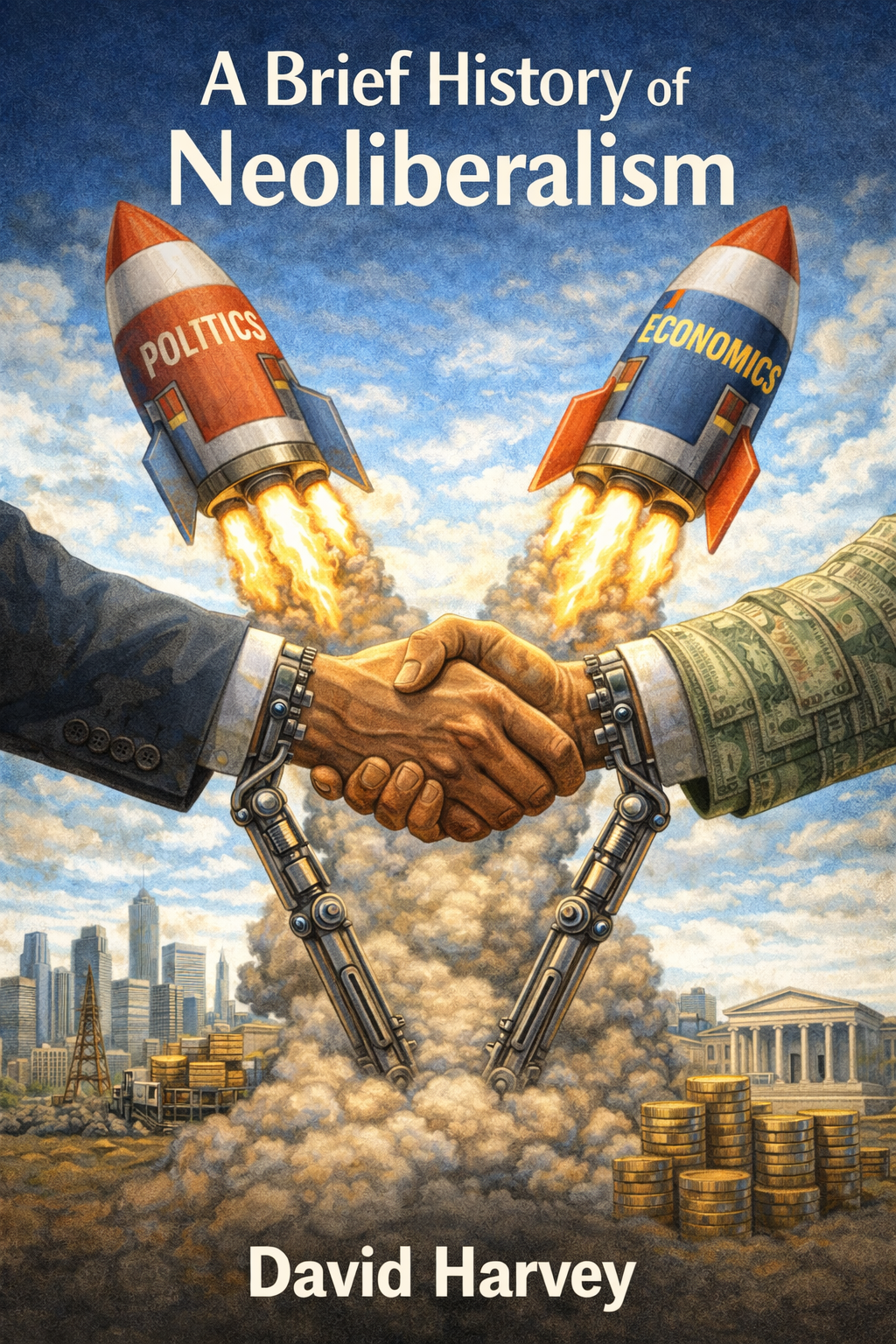
A Brief History of Neoliberalism
Chapter Summaries
What's Here for You
Prepare to have your understanding of the modern world fundamentally reshaped. David Harvey's 'A Brief History of Neoliberalism' isn't just a historical account; it's an intellectual excavation of the ideology that has profoundly influenced our economic and political landscapes. This book promises to demystify the concept of neoliberalism, revealing how seemingly universal ideals like 'freedom' and 'dignity' have been strategically employed to re-engineer global capitalism and consolidate power for economic elites. You'll gain a critical lens through which to view the world, understanding that neoliberalism wasn't a natural evolution but a carefully constructed framework, often implemented with swift, and sometimes brutal, force. Harvey meticulously dissects the role of the state under this paradigm, highlighting its often contradictory nature – theoretically minimalist yet actively involved in upholding specific economic structures. Furthermore, you'll discover that the spread of neoliberalism has been far from uniform, marked by uneven geographical developments and unique adaptations, such as 'Neoliberalism with Chinese Characteristics.' The book courageously places neoliberalism 'on trial,' exposing the paradoxes and tensions inherent in sustaining capitalism today, particularly in the post-2001 global economy. Ultimately, you will be empowered to reconsider the very meaning of freedom, contrasting visions of freedom from want with the prevailing emphasis on market freedom. This journey will equip you with the intellectual tools to critically analyze contemporary power structures and envision alternative futures, fostering a tone of informed skepticism and intellectual empowerment.
Freedom’s Just Another Word…
David Harvey, in 'A Brief History of Neoliberalism,' invites us to peel back the layers of a dominant ideology, revealing how the potent ideals of freedom and dignity, while inherently compelling, were strategically deployed to reshape global capitalism and restore economic elite power. He explains that for any thought system to become dominant, it must embed itself in our common sense, appealing to our deepest values and desires. Neoliberalism masterfully achieved this by framing state intervention and collective judgment as threats to individual liberty, a narrative that resonated from the dissident movements of Eastern Europe to the students of Tiananmen Square and the post-9/11 rhetoric of President Bush, who declared freedom the Almighty’s gift and America’s obligation to spread it. Yet, Harvey probes, what *kind* of freedom is truly being offered? He contrasts this rhetoric with the concrete policies enacted in Iraq under Paul Bremer—full privatization, foreign ownership, profit repatriation, and a regressive flat tax—revealing a state apparatus designed not for broad human flourishing, but for profitable capital accumulation, a 'neoliberal corral' for the horse of freedom. This pattern, Harvey demonstrates, first emerged in Chile after the 1973 coup, where the 'Chicago Boys' implemented radical free-market policies under the guise of economic revival, dismantling social movements and dismantling the very fabric of collective well-being. This experiment, though ultimately unstable, served as a crucial model for the neoliberal turns in Britain under Thatcher and the US under Reagan, highlighting a chilling repetition where brutal experiments in the periphery become blueprints for the center. Harvey then traces the breakdown of the post-WWII 'embedded liberalism'—a system that balanced market dynamics with state intervention, social welfare, and a class compromise—which collapsed under the weight of stagflation and fiscal crises in the 1970s. While the left proposed deepening state control, the ensuing debate polarized, ultimately allowing the interests of corporate and business power to surge forward. The neoliberal turn, he argues, was not an inevitable outcome but a response to a palpable threat to economic elites whose power and income share had diminished during the postwar boom. The chapter meticulously details how neoliberalism, far from merely revitalizing capital accumulation, became a project to restore and create economic elite power, evidenced by soaring income and wealth concentration, a dramatic widening of the CEO-to-worker pay gap, and the extraction of surpluses from the global South. This shift toward financialization, where stock values and speculative gains eclipsed production, fundamentally altered the meaning of class, fusing ownership and management and prioritizing the needs of Wall Street over Main Street. Harvey concludes by revisiting Karl Polanyi's distinction between 'good' freedoms—conscience, speech, association—and 'bad' freedoms—exploitation, inordinate gain, profiting from calamity. He posits that neoliberalism, in its pursuit of the latter, often employs authoritarian means, twisting principles to serve elite interests, leaving the promise of freedom as a 'mere pittance' for the many while securing unprecedented power and profit for the few, a stark contrast to the broader, more just freedoms Polanyi envisioned.
The Construction of Consent
David Harvey, in 'The Construction of Consent,' unveils the intricate mechanisms by which neoliberalism, far from being a natural evolution, was strategically engineered into the dominant ideology of our time. While early implementations, as seen in 1970s Chile and Argentina, were brutally swift, enforced by military coups and the suppression of social movements, the later 'revolution' spearheaded by Thatcher and Reagan in democratic societies required a more subtle, yet equally potent, strategy: the construction of political consent. Harvey explains that this consent wasn't built on critical engagement but on a carefully cultivated 'common sense,' often rooted in tradition, nationalism, and fear, which could obscure underlying class interests. He illustrates how powerful institutions—corporations, media, universities, and think tanks—became conduits for neoliberal ideas, a 'long march' envisioned by Hayek, transforming public opinion by framing neoliberalism as the sole guarantor of freedom. This ideological groundwork, often disguised as a celebration of individual liberties, allowed for the restoration of elite economic power, effectively splitting potential progressive coalitions by prioritizing individual freedom over social justice, a tension evident in the 1968 movements. The narrative then pivots to concrete examples, such as the confidential memo from Lewis Powell to the U.S. Chamber of Commerce in 1971, which galvanized business into organized action to reshape public discourse and institutional thought. This led to the formation of powerful lobbying groups like the Business Roundtable and the proliferation of corporate-funded think tanks, all working to promote neoliberal policies. The chapter draws a stark parallel between the financial coup that led to the New York City fiscal crisis and the military coup in Chile, demonstrating how financial institutions could impose austerity, curb union power, and redistribute wealth upwards, all under the guise of fiscal discipline. This 'New York scenario' became a blueprint, later amplified nationally under Reagan, characterized by deregulation, tax cuts for the wealthy, and the systematic weakening of labor through actions like the PATCO strike and the encouragement of deindustrialization. In Britain, the path to consent was different, lacking the potent Christian Right of the US but leveraging existing class structures and a dominant financial sector in the City of London. Thatcher's rise was fueled by a severe economic crisis and public frustration with powerful unions, culminating in the 'Winter of Discontent.' Her strategy involved monetarism to curb inflation and unemployment, a direct confrontation with the miners' union, and extensive privatization, including the sale of public housing which fostered a culture of homeownership and individual responsibility. Harvey underscores the genius of Reagan and Thatcher not just in implementing neoliberal policies but in making them mainstream, creating a legacy that subsequent leaders like Clinton and Blair found difficult to dismantle, thus entrenching the restoration of class power as a seemingly inescapable reality. The core dilemma lies in how deeply embedded neoliberalism became, often by exploiting the inherent tension between individual freedom and social justice, and by persuading populations to vote against their material interests through appeals to cultural and nationalist sentiments, a process that fundamentally reshaped class power and societal priorities on both sides of the Atlantic.
The Neoliberal State
David Harvey, in his exploration of 'The Neoliberal State,' guides us through the intricate and often contradictory landscape of state power under neoliberalism. Theoretically, the neoliberal state is envisioned as a minimalist entity, a staunch guardian of private property rights, the rule of law, and unfettered market forces, all designed to champion individual freedoms and foster innovation and wealth through competition and privatization. Yet, as Harvey reveals, the practice of neoliberalization has diverled significantly from this clean blueprint, creating a state that is far from simple or stable. He illustrates how the pursuit of a 'good business climate' often leads states to prioritize the integrity of financial systems and the interests of capital over the well-being of labor or the environment, a stark divergence from the theoretical ideal. This tension is palpable when we consider the state's role: while theory dictates a hands-off approach, practice demands active intervention to create favorable conditions for capital, sometimes even resorting to coercive measures to suppress opposition, a far cry from the promised liberation. Harvey points out the inherent contradictions, such as the need for state intervention in areas like natural monopolies or market failures, and the paradoxical reliance on state power to enforce market rules, all while ostensibly championing deregulation. The neoliberal state, in its practical application, often finds itself compelled to bail out financial institutions, a move that directly contradicts the principle of individual accountability it preaches, demonstrating a deep chasm between its espoused ideals and its operational realities. Furthermore, the chapter unveils how the neoliberal state, suspicious of democratic majority rule, leans towards governance by elites and experts, and how the very pursuit of market freedoms can lead to social incoherence and a resurgence of nationalism or authoritarianism as a response to the erosion of social solidarity. The neoconservative answer, as examined by Harvey, attempts to address this instability by emphasizing order and a specific brand of morality, often through militarization and appeals to national identity, further complicating the relationship between state, nation, and individual freedom. Ultimately, Harvey presents the neoliberal state not as a fixed entity, but as a dynamic, often unstable, and deeply contradictory political form, perpetually grappling with the gap between its theoretical aspirations and its practical outcomes, a journey from the promise of liberation to the reality of restored class power and inherent instability.
Uneven Geographical Developments
David Harvey, in his exploration of 'Uneven Geographical Developments,' reveals how the seemingly monolithic spread of neoliberalism across the globe has been anything but uniform. It's a story not of a smooth, imposed blueprint, but of turbulent currents, where states and regions adopted its tenets piecemeal – a bit of labor market flexibility here, financial deregulation there, privatization elsewhere – often in response to crises, only to sometimes backtrack when the social costs became too apparent. This unevenness, Harvey explains, became a primary engine of neoliberalization itself, as successful territories exerted pressure on others to follow suit, creating a dynamic of leapfrogging innovations and ephemeral competitive advantages that fueled global capitalism's volatility. While the UK and US led the charge, their own transitions were fraught with complexities, and their economic performances in the 1980s were hardly stellar, marked by low growth and rising inequality, a stark contrast to the economic powerhouses of Japan, West Germany, and the East Asian tigers, whose success often occurred *without* wholesale neoliberal reforms. These alternative models, emphasizing state investment and strong social protections, presented a compelling case for emulation, yet the relentless march of financialization, the increasing mobility of capital facilitated by falling transport costs and trade liberalization, and the ideological dominance of neoliberal orthodoxy, particularly through institutions like the IMF and World Bank, exerted immense pressure for convergence. The narrative then delves into specific case studies – Mexico, Argentina, South Korea – illustrating how this pressure manifested, often leading to financial crises, social upheaval, and a concentration of wealth, even as proponents blamed state intervention rather than the consequences of rapid deregulation and speculative financial flows. In Argentina, for instance, a desperate attempt to maintain a dollar peg led to a devastating collapse, while in South Korea, a developmental state's success was ultimately challenged by the internal pressures of its own powerful chaebols and external demands for financial liberalization, culminating in a crisis that benefited foreign capital. Even in Sweden, a bastion of social democracy, the push for neoliberalism, driven by business interests and a shift in economic ideology, led to 'circumscribed neoliberalization,' a less extreme but still significant erosion of its welfare state. Harvey concludes that the story of neoliberalization is not merely one of external imposition, but a complex interplay of internal class forces, geopolitical considerations, and the strategic actions of elites, often masked by a benevolent rhetoric of freedom and choice, yet consistently resulting in increased social inequality and the restoration of naked class power, particularly in the global financial centers.
Neoliberalism ‘with Chinese Characteristics’
In December 1978, China, under Deng Xiaoping, embarked on a transformative journey, a strategic pivot away from Maoist isolation towards economic reform. Faced with political uncertainty and stagnation, this move, though perhaps initially a pragmatic response, coincided with the global ascendancy of neoliberalism. What unfolded was a unique synthesis: a market economy infused with neoliberal elements, yet tightly interwoven with authoritarian centralized control. The author, David Harvey, meticulously charts this course, revealing how China, unlike the 'shock therapy' imposed elsewhere, navigated its own path, prioritizing gradual reform and experimentation, notably in regions like Guangdong. This strategy, encapsulated by the slogan 'to get rich is glorious,' prioritized unleashing individual and local initiative to spur productivity and economic growth, accepting the inevitable rise of inequality as a necessary byproduct of progress towards the ideal of 'xiaokang.' Crucially, China's integration into the world market was facilitated by parallel shifts in the advanced capitalist world, opening doors that would have been closed under previous global economic regimes. Harvey highlights the internal transformations, emphasizing that market reforms alone were insufficient without parallel shifts in class relations and institutional arrangements, a process that proved fitful and fraught with tension. The chapter posits that China's avoidance of immediate privatization, a hallmark of the Washington Consensus, allowed it to avert the economic disasters that befell other nations, instead constructing a state-manipulated market economy that delivered decades of spectacular growth and rising living standards for many. However, this success came at a cost: environmental degradation, widening social inequality, and the unsettling reconstitution of capitalist class power. The narrative delves into the complex political landscape, masked by internal party struggles, where economic development was pursued not as an end in itself, but as a means to enhance state power and manage dissent. A key strategic move was the reliance on foreign direct investment, keeping capitalist class power offshore and under state control, while carefully limiting the influence of international finance capital. The author points to the delicate balancing act, acknowledging compromises with the business diaspora and the demands of international trade rules, even as political pressures for liberalization emerged, culminating in the tragic events of 1989. Deng's subsequent crackdown underscored that economic neoliberalization would not be accompanied by political freedoms, forcing a further wave of economic reforms. The chapter illustrates the evolution from a state-dominated economy, where state-owned enterprises (SOEs) provided security and welfare, to one increasingly shaped by market forces, township and village enterprises (TVEs), and foreign capital. This transition, particularly the dissolution of agricultural communes and the rise of TVEs, fueled initial dynamism, yet also led to stark urban-rural income disparities and the creation of a vast, vulnerable migrant labor force. The restructuring of SOEs, their conversion into shareholding companies, and the increasing role of foreign direct investment fundamentally reshaped the economic landscape, often to the detriment of the 'iron rice bowl' security previously offered. Harvey notes the mixed results of foreign investment, its initial focus on export zones, and its eventual penetration of the vast internal market. The chapter concludes by examining the profound social consequences: the dramatic increase in income inequality, the proletarianization of the workforce, the reconstitution of class power through mechanisms like asset stripping and speculative real estate development, and the rise of a powerful business elite intertwined with the party. The immense labor surpluses, coupled with the state's reliance on debt-financed infrastructure projects, reveal a departure from pure neoliberalism towards a Keynesian approach, albeit one fraught with risks and dependent on managing capital flows and exchange rates. Ultimately, David Harvey argues that China's path has undeniably led towards neoliberalization and the reconstruction of class power, 'with Chinese characteristics,' a trajectory that, while achieving remarkable economic growth, has also sown the seeds of significant social division and potential future instability, hinting at a convergence with certain aspects of neoconservative ideology.
Neoliberalism on Trial
The author, David Harvey, delves into the paradox of the post-2001 global economy, where the very engines of growth—the United States and China—have operated more like Keynesian states than neoliberal ones, a contradiction that hints at a deeper tension: the conflict between sustaining capitalism and restoring ruling class power. Harvey posits that the neoliberal project, far from being a mere theoretical misstep, has been a deliberate strategy to reconstitute class power, often at the expense of genuine economic growth or societal well-being. He reveals that the actual record of neoliberalization is dismal, marked by stagnation and decline in many regions, with notable exceptions like China and India whose growth is attributed more to specific developmental states than pure neoliberal doctrine. The true, and perhaps most sinister, achievement of neoliberalism, Harvey argues, lies in its success as a mechanism for "accumulation by dispossession," a process where wealth is redistributed rather than generated. This occurs through the privatization of public assets, the financialization of economies leading to speculative bubbles and crises, the calculated management of these crises to benefit the powerful, and state-driven redistributions via tax codes and austerity measures. It's a system where, as Harvey illustrates with the stark contrast between Sweden and the UK, "circumscribed neoliberalization" can yield far better results than its unfettered form, yet the narrative of success persists, fueled by the spectacular, yet often superficial, growth in "global cities" and information technology, which diverts attention from the broader failures. The commodification of everything, from land and labor to culture and nature, becomes the hallmark of this era, eroding social protections and leaving individuals increasingly isolated and vulnerable, like disposable workers navigating a world of short-term contracts and precarious existence. This dispossession, he observes, has also spurred new forms of social solidarity, often manifesting in religious or tribal movements, as people seek anchors in a world where traditional institutions have withered. Even environmental degradation accelerates under this short-term contractual logic, turning vital resources into commodities to be extracted rapidly. While an oppositional culture has emerged, often framed in terms of rights, Harvey cautions that this focus can inadvertently reinforce the neoliberal frame by prioritizing individual legal battles over systemic democratic change, likening NGOs to "Trojan horses" and highlighting how rights discourse can be co-opted for imperialistic ends. Ultimately, he concludes, the neoliberal regime of rights, which elevates private property and profit rates above all else, may be the most insidious aspect, locking societies into a perpetual cycle of accumulation with devastating social and ecological consequences, yet it is this very regime that must be challenged if genuine alternatives are to emerge.
Freedom’s Prospect
In the landscape of political thought, the author David Harvey invites us to confront a profound divergence in the very meaning of freedom, a concept often wielded as a political banner. He contrasts President Roosevelt's vision of freedom from want—a freedom secured by the state's active role in eradicating poverty and ensuring basic security—with the narrower, neoliberal conception championed by figures like President Bush, which equates freedom primarily with deregulation and the unfettered expansion of market liberties. This reduction, as Karl Polanyi observed, offers a full measure of liberty to the already secure, while leaving the less fortunate with mere pittance. The chapter unfolds as a critique of this impoverished public discourse, highlighting how easily the term 'freedom' is co-opted, often without critical examination. Harvey points to thinkers like Fareed Zakaria and even Amartya Sen, whose work, though nuanced, can inadvertently bolster the neoliberal framework by linking social and political rights to market success. The narrative then pivots, revealing a growing undercurrent of dissent and a search for alternative visions. From environmental movements and anarchist critiques to local economic systems and flourishing religious sects, diverse groups are pushing back against the market ethic. Harvey underscores that the neoliberal project, driven by 'accumulation by dispossession,' has not only left vast populations vulnerable but has also constricted the space for genuine human flourishing even for those within the market system, forcing them into a relentless pursuit of consumption and spectacle. This systemic pressure, he argues, is generating a crisis within the neoliberal order itself, evidenced by staggering global imbalances and the increasing reliance on deficit financing by major economies. The author paints a stark picture of potential futures: a hyperinflationary scenario that could erase debt but devastate internal economies, or a prolonged deflation akin to Japan's stagnation, potentially shifting global hegemony. He warns that the current US administration's apparent indifference to these imbalances, coupled with a rising tide of nationalism, could lead to catastrophic choices, prioritizing elite class power over broad societal well-being. Yet, amidst this tension, Harvey identifies a burgeoning opposition, a fragmented yet determined constellation of movements challenging neoliberalism's core tenets. He calls for a renewed focus on class struggle, not as a nostalgic return to old paradigms, but as an unashamed recognition of how elite power is maintained and restored. The chapter concludes with a powerful call to action: to build alliances, reclaim democratic control over the state, and articulate a nobler vision of freedom—one that champions social equality, economic justice, and genuine political participation, moving beyond the narrow confines of market logic and authoritarian tendencies. The prospect is not one of simple reform, but of a fundamental reimagining of governance and freedom itself, a journey from the precipice of crisis towards a more equitable and democratic future.
Conclusion
David Harvey's 'A Brief History of Neoliberalism' meticulously dismantles the prevailing narrative of neoliberalism, revealing it not as an inevitable economic evolution, but as a historically constructed ideology designed to restore and concentrate elite class power. The core takeaway is that the potent ideals of freedom and dignity, while universally appealing, were strategically co-opted and redefined to serve the interests of capital accumulation, often at the expense of genuine individual liberty and social justice. Harvey demonstrates how the neoliberal state, far from being a minimalist enforcer of free markets, actively intervenes to create a favorable business climate, protect financial interests, and suppress dissent, often employing coercive measures and masking its agenda through the manipulation of 'common sense' and cultural values. The emotional lesson lies in recognizing the profound human cost of this agenda: the exacerbation of inequality, the dispossession of communities, and the creation of a vulnerable, 'disposable' workforce. The practical wisdom offered is a call to critically examine the dominant definitions of freedom, to understand the historical construction of consent, and to challenge the antidemocratic nature of neoliberalism and its associated ideologies. Harvey highlights that true progress often emerges not from strict adherence to neoliberal tenets but from deviations and the pursuit of alternative visions of freedom, such as freedom from want and insecurity. The book ultimately argues that the inherent contradictions within neoliberalism, particularly the tension between market freedoms and social cohesion, are leading to instability and crises, necessitating the formation of broad alliances and deepened democratic practices to forge a more equitable future. The integration of state and business elites, the commodification of life, and the strategic exploitation of crises are not accidental outcomes but deliberate mechanisms of 'accumulation by dispossession.' Recognizing and naming the class struggle disguised by neoliberal rhetoric is therefore essential for dismantling this system and building viable alternatives that prioritize collective well-being and genuine liberty for all.
Key Takeaways
The strategic capture of institutions like corporations, media, and universities was crucial for disseminating neoliberal ideology and shaping public opinion as the exclusive path to freedom.
Neoliberalism strategically leverages universally appealing ideals like freedom and dignity to mask a core agenda of facilitating profitable capital accumulation, thereby reshaping the state apparatus to serve corporate interests.
The concept of 'freedom' under neoliberalism is often a selective application, prioritizing market freedoms for capital and corporations while potentially curtailing freedoms for labor and collective action.
The rise of neoliberalism was significantly driven by a perceived threat to economic elites during the 1970s crisis, leading to policies designed to restore their power and wealth concentration, rather than solely to revitalize overall economic growth.
Neoliberalization has fundamentally altered class structures, often fusing ownership and management, prioritizing financial markets over production, and leading to a significant increase in wealth and income inequality globally.
The historical trajectory of neoliberalism reveals a pattern of experimental implementation in peripheral nations, later adopted as models for the core capitalist countries, suggesting a top-down imposition of ideology.
While neoliberalism claims to champion individual freedom, its practical application can lead to authoritarian tendencies and the concentration of corporate power, echoing Karl Polanyi's warning about the 'bad' freedoms derived from unchecked market economies.
Neoliberalism's ascendance was actively constructed through the manipulation of 'common sense' and cultural values, rather than purely rational economic debate, to mask the restoration of elite class power.
The inherent tension between individual freedom and social justice was exploited by neoliberalism to fragment potential progressive coalitions and isolate movements focused on collective well-being.
Financial crises and austerity measures, exemplified by the New York City fiscal crisis, served as powerful tools to impose neoliberal policies, discipline labor, and redistribute wealth upwards under the guise of fiscal necessity.
The success of neoliberalism relied on mobilizing specific social and political bases, such as the Christian Right in the US and a culture of homeownership in the UK, to vote against material interests by appealing to cultural and nationalist sentiments.
Reagan and Thatcher's political genius lay in transforming fringe ideological positions into mainstream political discourse, creating a lasting legacy and institutional constraints that subsequent leaders struggled to overcome.
The neoliberal project fundamentally shifted the role of government from serving the general welfare to creating a 'good business climate,' privileging financial institutions and corporate interests over citizen well-being.
The neoliberal state, while theoretically championing minimal intervention and free markets, in practice often becomes actively interventionist to create favorable business climates, leading to a contradiction between its ideological tenets and its operational necessities.
Neoliberal states exhibit a systematic bias towards protecting the financial system and capital interests over labor rights and environmental sustainability, a practical divergence from the theoretical promise of universal welfare through free markets.
The neoliberal suspicion of democracy leads to a preference for elite governance and expert rule, creating a paradox where the state must be both non-interventionist in markets and highly interventionist in political and social spheres to maintain control.
The practical implementation of neoliberalism often requires the state to act coercively to suppress opposition and enforce market rules, contradicting the ideal of individual liberty it purports to uphold.
The inherent instability of the neoliberal state, arising from contradictions like the tension between market freedoms and social cohesion, can lead to the rise of authoritarianism and nationalism as attempts to impose order and legitimacy.
The neoconservative response to neoliberal instability prioritizes order and morality, often through militarization and appeals to national identity, further entrenching elite power while masking the system's contradictions.
Neoliberalization progresses not as a uniform imposition but through uneven, partial adoption driven by local crises and competitive pressures, creating a dynamic of global economic volatility.
The economic successes of countries like Japan and West Germany in the 1980s, achieved without wholesale neoliberal reforms, challenge the narrative that neoliberalism is the sole path to prosperity.
Financialization and the increasing mobility of capital, amplified by institutional pressures from bodies like the IMF and World Bank, are key drivers of neoliberal adoption, often exacerbating social inequality and concentrating wealth.
The success or failure of neoliberal reforms is deeply contingent on internal class forces, particularly the strength of organized labor and the cohesive power of business elites, rather than solely on external policy prescriptions.
The rhetoric of neoliberalism, emphasizing freedom and choice, often serves as a mask for the restoration or reconstitution of class power, particularly for financial and corporate elites.
Financial crises, rather than being purely accidental, can be engineered or exploited to facilitate capital accumulation and dispossession, benefiting specific financial actors.
China's embrace of market reforms, while achieving significant economic growth, has led to a complex interplay of neoliberal economic principles and authoritarian political control, creating a unique hybrid system.
The 'shock therapy' avoidance strategy, differentiating China from other transitioning economies, allowed for state-guided market evolution and sustained growth, but at the cost of increasing social inequality and environmental degradation.
Economic reform in China was driven less by an ideological commitment to pure capitalism and more by a strategic imperative to strengthen state power, manage internal dissent, and enhance national prestige.
The rise of capitalist class power in China has been facilitated by the privatization of state assets, the flexibility of the labor market, and the appropriation of common resources, often benefiting a new elite through opaque means.
Despite the adoption of neoliberal economic tools, China's state retains significant control over capital flows and engages in large-scale, debt-financed infrastructure projects, revealing a deviation from strict neoliberal orthodoxy towards a Keynesian model.
The immense labor surpluses generated by China's economic transformation have created a vulnerable workforce, fueling social unrest and posing a significant challenge to the Communist Party's long-term stability and legitimacy.
The integration of China's party and business elites, mirroring trends seen in other nations, alongside the party's willingness to use state power to quell dissent, signals a complex and potentially volatile future trajectory.
Neoliberalism's core success lies not in fostering broad economic growth, but in its effectiveness as a mechanism for "accumulation by dispossession," redistributing wealth upwards through privatization, financialization, and crisis management.
The global economic engines of the US and China, despite operating under neoliberalism's guise, have largely employed Keynesian-style interventions, revealing a fundamental tension between sustaining capitalism and restoring ruling class power.
The commodification of nearly all aspects of life, from labor and land to culture and nature, under neoliberalism erodes social protections and creates a vulnerable, "disposable" workforce, necessitating new forms of social solidarity.
While oppositional movements often frame their struggles in terms of individual rights, this focus can inadvertently reinforce the neoliberal agenda by prioritizing legal recourse over systemic democratic reform.
The neoliberal regime of rights, which prioritizes private property and profit over social well-being and ecological sustainability, is a central pillar of its power and must be fundamentally challenged to create viable alternatives.
Genuine progress and societal well-being are often achieved through "circumscribed neoliberalization" or by deviating from its core tenets, as seen in countries like Sweden, contradicting the narrative of its universal success.
The dominant neoliberal definition of freedom, narrowly focused on free enterprise, fundamentally disenfranchises those outside or at the margins of the market, contrasting sharply with earlier visions of freedom as security and social justice.
Contemporary public discourse often fails to critically examine competing concepts of freedom, allowing neoliberal rhetoric to dominate and obscure the unequal distribution of liberty it creates.
Neoliberalism's core mechanism of 'accumulation by dispossession' generates widespread poverty, despair, and social unrest, while simultaneously limiting the emancipatory potential for those integrated into the market.
The internal contradictions of neoliberalism are increasingly leading to global economic imbalances and crises, suggesting its unsustainability as a guiding economic and political framework.
The rise of oppositional movements, diverse in their approaches, signals a widespread desire for alternatives to neoliberalism and its associated authoritarian tendencies.
Recognizing and naming class struggle is essential for challenging the restoration and maintenance of elite class power, which is often disguised by neoliberal rhetoric.
Achieving a more just and equitable future requires building broad alliances, deepening democratic practices, and actively challenging the antidemocratic nature of both neoliberalism and neoconservatism.
Action Plan
Critically examine the language of 'freedom' and 'dignity' used in public discourse, questioning whose interests it truly serves.
Investigate the specific policies enacted in your own country or region, considering their impact on capital accumulation versus broader social well-being.
Research the historical precedents of economic policies, looking for patterns of implementation and their consequences on different social classes.
Seek out diverse perspectives on economic systems, moving beyond dominant neoliberal narratives to understand alternative models of societal organization.
Analyze how market freedoms are balanced against social welfare and collective rights in current policy debates.
Reflect on the distinction between 'good' freedoms that enhance collective life and 'bad' freedoms that enable exploitation.
Consider how financialization impacts everyday life and economic stability, and evaluate its long-term consequences.
Critically examine the 'common sense' narratives presented in media and public discourse, questioning their underlying assumptions and beneficiaries.
Actively seek out diverse perspectives and engage in critical analysis of how concepts like 'freedom' are framed and utilized in political rhetoric.
Investigate the funding and influence of think tanks and corporate-backed institutions on public policy and academic thought.
Support and participate in movements that prioritize social justice and collective well-being alongside individual liberties.
Analyze local and national fiscal policies for their impact on wealth distribution and public services, questioning austerity measures that disproportionately affect vulnerable populations.
Recognize and challenge appeals to cultural nationalism or traditional values when they are used to obscure economic inequalities or class interests.
Educate yourself on the historical development of neoliberalism to better understand its current manifestations and potential alternatives.
Critically examine the theoretical underpinnings versus the practical applications of economic policies in your own context.
Analyze how state actions in your country prioritize business interests, financial stability, or individual/collective well-being.
Investigate the role of elite governance and expert decision-making versus democratic processes in key policy areas.
Evaluate the extent to which individual responsibility is emphasized over systemic factors in addressing social and economic issues.
Observe instances where market logic is applied to non-market domains and consider the potential consequences for social solidarity.
Consider the influence of nationalism and morality in contemporary political and economic discourse.
Seek out diverse perspectives on the role of the state in ensuring a balance between market efficiency and social equity.
Analyze the specific ways neoliberal policies have been implemented in your own region or country, noting any partial adoptions or reversals.
Investigate alternative economic models that have succeeded without strict adherence to neoliberal orthodoxy, such as those found in East Asia or certain European nations.
Critically examine the role of financial institutions and speculative capital in economic crises and development, questioning official narratives.
Consider the influence of class interests and power dynamics when evaluating economic policies and their stated goals.
Seek out diverse perspectives on economic development that challenge the dominant neoliberal discourse.
Observe how 'good business climate' rhetoric might obscure underlying power shifts and potential social costs.
Analyze the specific economic reforms implemented in China and contrast them with 'shock therapy' approaches in other nations to understand their varied outcomes.
Evaluate the tension between state control and market liberalization in China's development model and consider its long-term implications for political stability.
Examine the social consequences of rapid economic growth, such as rising inequality and labor exploitation, and consider their impact on different segments of the population.
Investigate the role of foreign direct investment and global trade in shaping China's economic trajectory and its relationship with the international community.
Consider how the concept of 'class' has been redefined and reconstituted within China's evolving socio-economic landscape.
Reflect on the balance between economic progress and the preservation of social welfare and environmental sustainability in development strategies.
Assess the strategies employed by the Chinese state to manage labor surpluses and social unrest, and consider their effectiveness and potential future challenges.
Critically examine the "success" narratives surrounding market-based reforms and seek data that reflects broader societal well-being beyond aggregate growth rates.
Investigate the mechanisms of "accumulation by dispossession" in your own community or nation, identifying privatized assets and eroded social protections.
Question the framing of individual rights as the sole or primary means of social and political change, exploring how collective action and democratic structures can be strengthened.
Become more aware of how financialization and speculative practices impact the real economy and everyday lives, looking beyond abstract market indicators.
Support and engage with movements that advocate for universal rights and social protections beyond the narrow scope of property and profit, recognizing the interconnectedness of social and ecological issues.
Seek out and amplify voices from marginalized communities disproportionately affected by dispossession and commodification.
Critically examine personal and public definitions of 'freedom,' comparing them against historical and alternative conceptions.
Seek out and engage with diverse oppositional movements and ideas that challenge the dominant market ethic.
Educate yourself on the concept of 'accumulation by dispossession' and identify its manifestations in your local context.
Articulate and advocate for policies that prioritize social justice, security, and freedom from want.
Support initiatives that aim to deepen democratic control over political and economic institutions.
Engage in discussions about class dynamics and power structures, unashamedly naming class struggle when observed.
Explore and support alternative economic models and community-based initiatives that foster greater equity and self-determination.