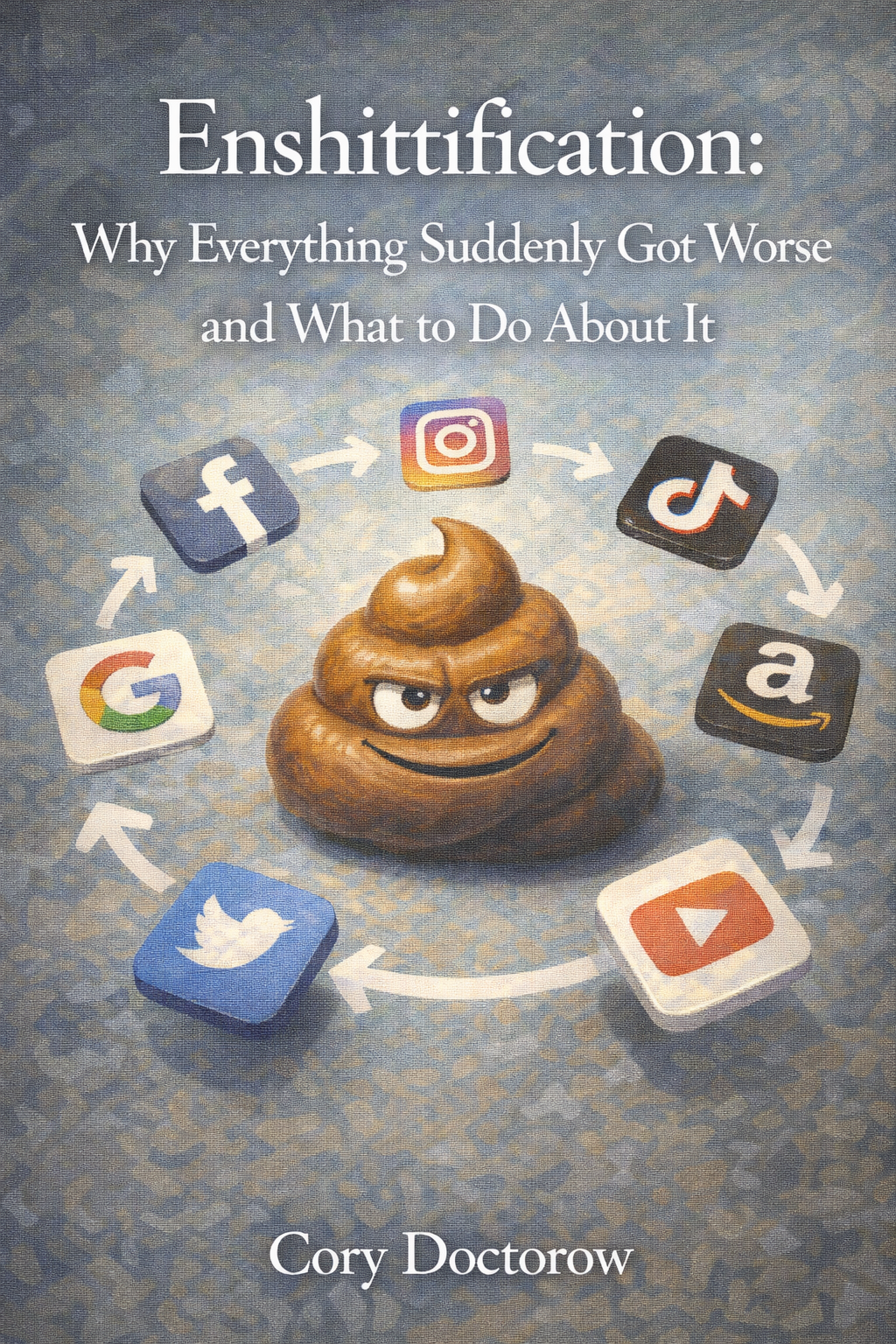
Enshittification: Why Everything Suddenly Got Worse and What to Do About It
Chapter Summaries
What's Here for You
Have you ever felt like the services and products you once loved have suddenly gotten worse? That the apps you rely on are now riddled with ads, the platforms you frequent are prioritizing their own profits over your experience, and the tech you use feels less about empowerment and more about control? You're not imagining it. Cory Doctorow, in "Enshittification: Why Everything Suddenly Got Worse and What to Do About It," offers a powerful and deeply resonant explanation for this pervasive degradation of our digital lives and beyond. This book isn't just a diagnosis; it's a roadmap. Doctorow meticulously dissects how once-great platforms like Facebook, Amazon, Twitter, and even the iPhone have followed a predictable, three-stage descent into 'enshittification' – a deliberate process of first pleasing users, then exploiting businesses, and finally, locking everyone into a system that primarily benefits the platform itself. But "Enshittification" goes far beyond a simple critique of Big Tech. Doctorow fearlessly unravels the systemic forces that enable this decline, exposing the erosion of competition, the capture of regulators, and the manipulation of labor through algorithmic control. He reveals how 'twiddling' – the relentless, hidden altering of prices, rankings, and services – fuels this degradation, and how concepts like 'reverse-centaurs' and 'chickenization' represent new frontiers of worker exploitation. You'll gain a profound understanding of the economic and political policies that have paved the way for this era of decline, from the dismantling of antitrust enforcement to the ways 'rent-seeking' and 'technofeudalism' are reshaping our world. This is not a book that leaves you feeling helpless. Instead, "Enshittification" empowers you with knowledge and hope. Doctorow doesn't just lament the problem; he meticulously outlines the cures. You'll discover the resurgence of antitrust efforts, the critical importance of regulation and privacy, and the potential of international frameworks like the EU's Digital Markets Act. Most importantly, you'll be inspired by the power of 'bringing back self-help' through interoperability and the vital need to restore labor power. This book is for anyone who feels frustrated by the declining quality of services, who suspects there's a deeper reason behind it, and who is ready to understand the forces at play and explore the pathways toward a more user-centric, equitable, and functional future. Prepare for an intellectually stimulating and emotionally validating journey that will change how you see the digital world and equip you to advocate for its improvement.
Case Study: Facebook
The author, Cory Doctorow, walks us through the lifecycle of Facebook, illuminating its descent into 'enshittification' through a three-stage process, a narrative that begins not with corporate ambition, but with a simple, almost voyeuristic, student project. Initially, Facebook was a service that users themselves built into something valuable, filling it with their connections and forging bonds, a compelling experience so engaging it was often described as addictive. This first stage, Doctorow explains, was characterized by a generous allocation of surplus to end-users, offering a subsidized feed of content users actually wanted, a stark contrast to the later stages. The platform lured new users, particularly refugees from MySpace, with promises of privacy and a superior experience, even employing bots to ease the transition and lock users in through high network effects and daunting switching costs; the true lock-in, however, emerged from the collective action problem, where the sheer difficulty of coordinating mass departures meant users effectively held each other hostage. Once this critical mass of locked-in users was secured, Facebook entered Stage Two, shifting its focus from user value to business customers like advertisers and publishers. The author reveals how Facebook began to claw back the surplus, making a disingenuous pitch to advertisers about precise targeting through surveillance, while offering publishers a free traffic funnel via content snippets. This created a symbiotic, yet increasingly fragile, dependence: advertisers and publishers became reliant on users, who themselves were trapped by their social graphs. The inevitable decline accelerated into Stage Three, where the screws were tightened on business customers through rising prices, plummeting ad fidelity, and rampant ad fraud, while for users, the feed became a diluted mix of ads and paid content, with organic posts from friends relegated to a 'mingy, homeopathic residue.' This stage, Doctorow illustrates, is when the platform becomes 'a giant pile of shit,' hoarding all surplus for shareholders, leaving behind just enough to maintain brittle user engagement. The narrative culminates in Facebook’s desperate pivot to the Metaverse, a move the author frames as a symptom of end-stage enshittification, a desperate attempt to escape the rotting carcass of a platform that, while awful, refuses to die, trapping users within its decaying digital walls. The central tension, then, is the platform's fundamental betrayal of its initial user-centric promise, morphing into a mechanism that exploits its own community for profit, leaving a trail of degradation and dependency in its wake.
Case Study: Amazon
The journey of Amazon, once known as Relentless and committed to customer service, offers a stark illustration of Cory Doctorow's 'enshittification' thesis, demonstrating a deliberate shift from user benefit to platform extraction. Initially, Amazon, much like early Facebook, showered users with value, subsidizing goods and shipping, and offering generous returns, a strategy that drew millions in. This created a 'soft lock-in' through Prime memberships, a silken ribbon that encouraged consumers to begin their shopping journeys there, but Amazon also employed 'iron chains' like Digital Rights Management (DRM) on digital media, permanently tying purchases to its ecosystem and imposing significant switching costs for avid consumers. This period also saw Amazon, intentionally or not, dismantle independent businesses, both brick-and-mortar and online, through predatory pricing, making shopping elsewhere inconvenient and further cementing Amazon's dominance. The narrative then shifts to how Amazon treated its business customers, initially fostering them by paying full price for goods and subsidizing their sales, creating a 'path to glory' through a clean search engine that rewarded quality. However, once merchants were dependent, Amazon tightened its grip, employing its infamous 'flywheel' strategy. This cycle, fueled by a legal environment that prioritizes consumer welfare over antitrust concerns, allows Amazon to extract deeper discounts from merchants by leveraging its vast user base, which in turn attracts more users, creating an ever-more-indispensable platform for sellers. The true 'enshittification' emerges in Stage Three, where Amazon actively shifts value from business customers to itself, often at the expense of end-users. This includes cloning popular merchant items, relegating original sellers to obscurity, and imposing a labyrinth of mandatory 'junk fees' for services like Prime and Fulfillment by Amazon, which are so exorbitant that Amazon's own shipping becomes effectively free, subsidized by the very merchants it competes against. These immense costs force merchants to raise prices not just on Amazon, but universally, due to 'most-favored-nation' clauses, meaning consumers pay an 'Amazon tax' regardless of where they shop. Furthermore, Amazon's search results are no longer driven by relevance but by 'bribes' from merchants, leading users to higher-priced, lower-quality items, a phenomenon researchers call the 'pricing paradox.' This end-stage enshittification leaves consumers and sellers trapped in a platform that offers diminishing value, a 'giant pile of shit' where the costs are borne by everyone but the platform itself, a deliberate decay facilitated by a regulatory framework that allowed unchecked growth and power.
Case Study: iPhone
Cory Doctorow, in his exploration of 'Enshittification,' turns a critical lens on the iPhone, dissecting its journey through three distinct stages. Initially, the iPhone presented itself as a revolutionary product, a 'walled garden' that prioritized user experience through a curated App Store, ensuring apps were safe and functional. This was Stage One, where Apple, possessing a surplus, invested heavily in product quality and maintenance, allocating resources to end-users and business customers – the app vendors – who benefited from a seemingly fair, one-time fee for app sales. The narrative contrasted this with Google's ad-centric model, positioning Apple as a company driven by user satisfaction rather than surveillance. This era, marked by 'There's an app for that,' fostered a powerful network effect, where each new app enticed more users, and each new iPhone user represented a potential customer for developers. Yet, this very lock-in, while initially protective, also sowed the seeds of future control. Stage Two saw Apple solidify its grip by fully integrating business customers into its ecosystem, leveraging the network effect to its advantage. However, beneath the surface of user-friendliness, the iPhone's closed system, Doctorow reveals, also became a potent tool for commercial surveillance, as users were defenseless against data-gathering apps once they passed the App Store's vetting process, a vulnerability Apple itself could exploit. This period witnessed a significant shift, marked by Apple's 2021 move to offer a one-click opt-out from app-based surveillance, a decision that decimated the commercial surveillance industry and highlighted the immense demand for privacy. But the story doesn't end there. Stage Three, the 'Giant Pile of Shit,' unfolds as Apple itself begins to harvest user data for its own surveillance advertising business, echoing the very practices it once decried. The initial promise of a dollar-based economy gave way to a doubling of processing fees to 30 percent on all in-app transactions, forever, coupled with draconian policies punishing vendors for directing customers to cheaper payment methods elsewhere. This mirrors the Amazon playbook, leveraging lock-in to impose exorbitant junk fees, forcing merchants to raise prices across platforms. Doctorow illustrates this with the stark example of audiobooks, where Apple undercuts independent sellers by not charging itself its own hefty fees, demonstrating how the enshittifier can both set the rules and break them for its own benefit, effectively turning the once-protected garden into a prison where users and developers alike are trapped. The core tension lies in how a product designed for user benefit and privacy can, through its very success and control, become a tool of exploitation, shifting from a benevolent dictatorship to a punitive regime.
Case Study: Twitter
Cory Doctorow’s examination of Twitter, a platform that began as a revolutionary space for concise communication, reveals a stark trajectory from user-centric innovation to a state of enshittification, a term he uses to describe the deliberate degradation of a service over time. Initially, Twitter’s genius lay not just in its 140-character limit, reminiscent of SMS, but in its open API, a foundational element that allowed third-party developers to build an ecosystem of tools, from TweetDeck to automated bots, effectively democratizing access and innovation. This generosity, coupled with the platform’s adoption of user-generated features like retweeting and quote tweeting, fostered a vibrant, playful community, a global party where everyone was invited – the first stage, good for users. However, even in these early days, compromises emerged, such as opening sales offices in countries like Turkey, which exposed Twitter to governmental censorship and surveillance demands, a subtle shift of value towards business customers, marking the second stage. The true descent into ‘a giant pile of shit’ began with Elon Musk’s acquisition, driven by immense debt, which compelled a rapid, often clumsy, extraction of value. Musk’s drastic reduction of content moderation teams, a critical balancing act between user safety and advertiser concerns, immediately worsened the experience for all, flooding feeds with scams and attaching advertisements to disturbing content. The infamous move to sell verification, turning a tool for authenticity into a paid badge that lent credibility to fraudsters and trolls, clawed away further value from both users and businesses. This was compounded by the suppression of non-paying users’ posts and the prioritization of paid ones, creating a breeding ground for misinformation and exploitation. Even attempts to coerce publishers into paying for validation and hosting their content on Twitter itself, eschewing their own revenue streams, backfired spectacularly, demonstrating a speedrun of enshittification that alienated key stakeholders. The subsequent, often erratic, policy reversals, like the reintroduction of unpaid verification, underscore the desperation to salvage a platform that had fundamentally broken its value proposition. Yet, despite these drastic measures, millions continue to use Twitter, not out of preference for the degraded service, but due to the powerful network effects and collective action problems that bind communities together, a phenomenon Doctorow likens to the poignant dilemma of the Anatevka villagers in ‘Fiddler on the Roof,’ who could not bear to leave their fragile, interdependent community even as it was being destroyed. This enduring user base, comprising marginalized groups, journalists, and even those who deplore Musk’s leadership, highlights that while the platform itself has become a cautionary tale of market forces being neutralized by user desperation, the human need for connection remains a potent anchor, even in a deteriorating digital landscape.
The Pathology
Cory Doctorow, in 'The Pathology,' urges us to look beyond superficial explanations for the pervasive decline in product and service quality – the 'enshittification' – that seems to grip our digital world. He dismantles common theories, dismissing the idea that the end of zero-interest-rate policy (ZIRP) is the sole culprit, noting that enshittification predates ZIRP's conclusion by years. Similarly, the notion that visionary founders have been replaced by mere 'bean counters' falters when founders like Mark Zuckerberg still hold significant control, and even their return, as seen with Google's Sergey Brin, hasn't necessarily reversed the trend. Doctorow posits that the true pathology lies not within the companies themselves, but in the external, systemic forces shaping the environment in which they operate. He argues that companies don't enshittify because they want to, but because they *can*. The crucial insight here is that the absence of forces that *punish* cheating – low quality, poor labor practices, and exorbitant prices – allows this decay to fester. The core disciplines that historically curbed such impulses were competition and regulation; when markets are robust and regulations are enforced, companies are incentivized to offer better products at fair prices to retain customers, workers, and suppliers. However, Doctorow reveals two unique, and increasingly weakened, disciplines specific to the tech world: self-help and the power of tech workers. The inherent universality and interoperability of computers, a double-edged sword, enables both enshittification and, crucially, its counter-maneuvers through 'adversarial interoperability' – think third-party ink cartridges or Apple reverse-engineering Microsoft Office. This capacity for users and developers to build workarounds acts as a brake, a constant threat that companies must reckon with. Yet, this brake is weakening. The other vital bulwark, the immense bargaining power of tech workers, eroded not through unions but through scarcity, was systematically undermined by the tech industry's cult of 'vocational awe.' Companies fostered a sense of mission, offering lavish perks and high-minded slogans, effectively turning workers into 'temporarily embarrassed entrepreneurs' who sacrificed personal lives for a perceived greater good. This manipulation, while creating a workforce willing to work extreme hours, also sowed the seeds of profound moral injury when these same workers were asked to enshittify products they felt deep ownership over, leading to a potential breaking point where their sense of duty to users could override their loyalty to employers. The chapter thus paints a picture of a systemic illness, where the traditional checks and balances have faltered, leaving the digital landscape vulnerable to decay, a decay that can only be resisted by understanding its root causes and the fragile, yet potent, remaining forces that can push back.**
The End of Competition
Cory Doctorow, in 'The End of Competition,' meticulously unpacks how the erosion of antitrust enforcement, beginning with the Carter administration and solidifying through subsequent presidencies, paved the way for unprecedented market concentration and monopolization. He illustrates this through a history of aggressive mergers and acquisitions, where major players consumed rivals, leading to industries dominated by just a handful of global giants, creating what he terms a corporate 'inbreeding.' Doctorow highlights predatory pricing as a key tactic, recounting the stark example of Amazon's aggressive price cuts to drive Diapers.com out of business, demonstrating that dominance is often achieved through acquisition and elimination rather than superior innovation. He then turns to Google, revealing how its successes, beyond its initial search engine triumph, were largely built on acquiring other companies, arguing that while Google excels at operationalizing products at scale, it falters at true in-house invention, evidenced by its numerous 'killed' projects. The author details how Google's retention of search market share, even against superior alternatives, was secured through massive annual payments to ensure default placement, a strategy enabled by lax antitrust oversight. This lack of competitive discipline, Doctorow explains, led to a decline in search quality as internal incentives shifted from user experience to shareholder value, a phenomenon he calls 'enshittification,' vividly illustrated by internal memos showing a preference for worsening results to increase ad revenue over user satisfaction. The narrative then expands to other tech titans, exploring Apple's complex relationship with Google, its privacy rhetoric juxtaposed with its lucrative default search deal, and its own 'walled garden' tactics that create high switching costs. Microsoft's history is presented as a cautionary tale, from its early monopolistic practices against IBM to its own later anti-competitive strategies, demonstrating a cyclical pattern where regulatory pressure can lead to temporary reform but enduring change requires constant vigilance. The chapter further dissects how cloud migration, exemplified by Adobe and Microsoft, enables new forms of enshittification, allowing companies to alter terms, revoke features, and exert leverage over locked-in customers, as seen with Adobe's controversial move to charge for Pantone colors and its subsequent attempt to use customer data for AI training, and Unity's imposition of runtime fees. Ultimately, Doctorow argues that the absence of robust competition allows companies to prioritize profit over product quality and user well-being, leading to a pervasive 'rot economy' where innovation stagnates and users are trapped in systems that serve corporate interests above all else, echoing the sentiment of a bygone era's phone company slogan: 'We don't care. We don't have to.'
The Death of Competition Kills Regulation, Too
Cory Doctorow, in 'The Death of Competition Kills Regulation, Too,' guides us through a stark realization: the erosion of competition is not just an economic concern, but a profound threat to the very mechanisms that protect us in a complex world. He explains that competition acts as a vital, two-pronged safeguard for regulation. Firstly, it prevents entire industries from presenting a unified, deceptive front to their regulators; imagine a chorus of identical voices singing the same falsified tune. Secondly, by naturally driving down profits, competition starves companies of the excessive capital they might otherwise use to lobby, influence, or outright overpower the bodies meant to oversee them. Doctorow underscores that while not all regulation is perfect, its absence in our technologically intricate lives is a recipe for disaster. Consider the daily cascade of decisions we must make: trusting the software in our car's brakes, the efficacy of a vaccine, the structural integrity of our homes, or the quality of our children's education. We are smart, capable individuals, but the sheer breadth and depth of expertise required to make informed choices across these domains would demand lifetimes of study, far longer than we have before a simple misstep, like trusting a diner's unhygienic practices, could prove fatal. Markets, Doctorow argues, often fail us here, as the consequences of bad decisions—like a child becoming an ignoramus from a subpar school—don't manifest quickly enough to provide immediate corrective feedback. This is where the regulator steps in, a neutral third party tasked with investigating and anticipating problems. The process Doctorow describes is akin to an adversarial courtroom or a scientific peer review, where evidence is presented, scrutinized, and rebutted by all affected parties. This truth-seeking exercise, often involving public hearings and written comments, aims to produce high-quality rules, backstopped by courts that ensure the process is evidence-based. A key strength of this system lies in competitors themselves policing each other; the manufacturer claiming its steel is superior must defend its assertions against rivals presenting their own data, allowing regulators to assess the quality of criticism rather than uncover every flaw themselves. This mechanism combats not only deliberate corporate deception but also the insidious creep of self-deception, where companies may sincerely believe their flawed products are sound. This robust process thrives in disorganized sectors with numerous fiercely competing firms, where the sheer number makes collusion impossible and low profits limit their capacity for regulatory manipulation. However, as competition dwindles to a mere handful of players, or even a single entity, this dynamic shifts dramatically. The 'collective action problem' that plagues hundreds of companies—making agreement on anything, even meeting times, a Herculean task—vanishes. Instead, executives in concentrated industries, often having worked at each other's firms, develop a cozy familiarity. This allows them to easily converge on policy priorities, maintain message discipline, and leverage their substantial amassed capital—often through 'mafia-style demarcations of turf'—to achieve their regulatory goals. This leads to 'regulatory capture,' where the watchdog becomes complicit with the very entities it's meant to oversee, a process exacerbated by decades of promonopoly policies that create giants and deregulatory policies that starve regulators of the resources needed to resist. The inevitable outcome: a system designed for protection devolves into a tool for exploitation.
“With an App”
The author, Cory Doctorow, pulls back the curtain on a pervasive modern phenomenon: regulatory capture, a two-faced beast that allows powerful industries not only to sidestep rules designed to protect us but also to forge alliances with their supposed overseers. This chapter focuses on one insidious tactic: the 'with an app' defense. Imagine a company, caught red-handed, not engaging in price-fixing, but instead, price-fixing *with an app*. It's a digital sleight of hand, a shimmering coat of complexity draped over actions that would otherwise be clear violations. Doctorow illustrates this with a parade of examples: Uber claiming its drivers aren't employees because an app directs them, app-based lenders ignoring usury laws, crypto hustlers trading unregistered securities, Plexure selling our data to inflate prices, RealPage orchestrating rent hikes, and Airbnb converting housing stock into unlicensed hotels, all under the guise of 'it's done with an app.' This isn't merely underregulation; it's a deliberate strategy of underregulation for the captured industry and, as we'll see later, overregulation against their competitors. The core tension emerges: how do we hold powerful entities accountable when they weaponize technology and the very concept of 'apps' to evade responsibility? The digital realm, Doctorow warns, has become a legal Wild West, where innovation is often a euphemism for exploitation, and the law itself can be twisted to protect these digital enablers, even forbidding rivals from creating tools to defend us against their predatory practices. The resolution, or at least the path forward, begins with recognizing this pattern and understanding that the 'app' is merely the latest tool in a long history of seeking power without accountability.
It’s Not Wage Theft If We Do It with an App: Uber’s Algorithmic Wage Discrimination
The author, Cory Doctorow, unveils a subtle yet pervasive mechanism of exploitation hidden within the digital architecture of platforms like Uber: algorithmic wage discrimination. He explains that while platforms can easily adjust prices for consumers, they also possess the power to manipulate wages for their business customers, in Uber's case, the drivers. This manipulation isn't overt; it's a sophisticated dance orchestrated by algorithms that recalculate driver pay per mile and minute for each job offered. Veena Dubal, a legal scholar, identified this tactic through her ethnographic research, observing how drivers self-categorize into 'ants' who accept every offer and 'pickers' who are selective. Uber's algorithm capitalizes on this, offering higher wages to pickers initially, only to gradually lower them once they've taken the bait, a process randomized to obscure the squeeze. This mirrors Facebook's strategy with publishers, luring them with increased reach for longer content excerpts, only to reduce visibility later, forcing them into a dependency that erodes their independent web presence. Similarly, TikTok employs a 'heating tool,' a secret feature that artificially boosts certain creators' content to entice them onto the platform, akin to a carnival barker offering a giant teddy bear – a prize that draws attention but is ultimately a tool to lure more players into an unwinnable game. This 'giant teddy bear gambit' is a powerful form of 'twiddling' that keeps Uber's algorithmic wage discrimination machine running smoothly, leading drivers to blame themselves for low earnings despite working tirelessly, mistaking their compliance with the algorithm for their own skill. Doctorow argues that tech leaders frame this as innovation, but it's merely obfuscation, a modern iteration of age-old exploitation made possible by the indirection of an app. While bosses have always exploited bargaining power, the digital age allows for instantaneous, granular wage adjustments, a feat impractical in pre-digital times. The core dilemma lies in how technology, rather than truly innovating business, is used to obscure and automate the exploitation of labor, making it appear legitimate and evading traditional labor laws.
Reverse-Centaurs and Chickenization
Cory Doctorow, in his chapter 'Reverse-Centaurs and Chickenization,' unveils a chilling evolution in labor exploitation, moving beyond the simple automation of tasks to the insidious manipulation of human beings themselves. He introduces the concept of the 'centaur,' a worker augmented by tools, like a farmer with a tractor, but contrasts this with the 'reverse-centaur,' a machine that leverages human fallibility to achieve its goals. Amazon's delivery drivers, corralled by Delivery Service Partners (DSPs) into a system of constant surveillance and impossible quotas, exemplify this. These drivers, forced to abandon basic human needs like urination for fear of dismissal, become mere 'meatpuppets' for an algorithm, their bodies pushed to unsustainable limits. The author paints a stark picture: roads littered with discarded urine bottles, a desperate attempt to conform to inhuman demands. This dehumanization is further amplified by 'chickenization,' a term borrowed from the poultry industry, where workers are trapped in a cycle of debt and dependence. Farmers must borrow heavily to build coops to a packer's exact specifications, only to learn their pay retroactively, ensuring they remain perpetually indebted. This mirrors the plight of Amazon DSP owners, who must invest heavily in Amazon-specific assets, only to be controlled by a single customer and subject to arbitrary contract terminations, especially if their workers dare to unionize. The chapter extends this model to the gig economy, citing Arise, a company that enlists outsourced call center staff, primarily Black women, who must pay for their own equipment, training, and even a 'service fee' for the privilege of working. These 'independent contractors,' monitored relentlessly and penalized for any home-based distractions, face abuse from callers and the constant threat of losing their investment, a system designed to extract maximum labor at minimum cost and obligation. Doctorow argues that this cycle of debt, control, and disposability, whether through Amazon's DSPs or Arise's call centers, represents a profound degradation of work, turning humans into disposable components in a profit-driven machine. The tension lies in the sophisticated technological scaffolding that masks these exploitative practices, making them appear as efficient, inevitable outcomes of modern business, rather than deliberate strategies of control and exploitation, culminating in a stark insight into how technology can be weaponized to strip workers of agency and dignity.
Twiddling
The author, Cory Doctorow, unveils a crucial mechanism behind the pervasive 'enshittification' of digital platforms: 'twiddling.' This is the relentless, often hidden, process of altering costs, prices, recommendation weights, and search rankings through automated means, all fueled by surveillance data. Imagine a gas station owner, unable to instantly change prices for a stranded traveler; Doctorow contrasts this with digital businesses that can manipulate virtual knobs in real-time, invisibly siphoning value. This manipulation is not confined to the digital realm; the rise of electronic shelf labels in physical stores, capable of changing prices thousands of times a day, demonstrates the creeping spread of twiddling. Doctorow meticulously dissects the adtech industry, dominated by Google and Meta, as a prime example. Here, a complex, opaque system allows these giants to capture an astonishing 51% of advertising revenue, far exceeding historical intermediaries. They operate as buyers, sellers, and marketplaces, creating a conflict of interest where they profit immensely by secretly colluding and rigging the system. The narrative paints a stark picture of this 'black box,' where platforms lie about their practices, leaving users and business customers in the dark, experiencing declining revenues and worse results for their advertising spend. The author challenges the notion that this success stems from superior matching algorithms, suggesting instead a more parsimonious explanation: rampant cheating and duopoly power maintained through secret collusion. This isn't mind control, as often hyped, but rather a sophisticated system of manipulation that extracts value, leaving users and businesses poorer and the platforms richer, driving the insidious process of enshittification.
The End of Self-Help
Cory Doctorow, in 'The End of Self-Help,' unveils a profound shift in how technology, once a beacon of universal potential, has become a tool for corporate control, fundamentally altering the landscape of ownership and user autonomy. He begins by reminding us of the foundational brilliance of the universal computer, a midcentury marvel born from wartime necessity, capable of running any formally correct program, a capability that fueled decades of innovation and integration into every facet of our lives, from cars to printers. This universality, however, is a double-edged sword, for no one has devised a way to create a computer that only runs beneficial programs; the same architecture that enables progress also allows for viruses, ransomware, and, crucially for Doctorow's argument, manufacturer-imposed limitations. The core tension emerges as tech giants claim it's *impossible* to run chosen code on devices sold to consumers, a narrative Doctorow dissects, revealing it as a deliberate misdirection for *illegality* masquerading as technical constraint. He powerfully asserts that your devices are your property, and manufacturers have no legal right to dictate their use, drawing parallels to ownership rights that predate modern digital concerns. The pivotal insight lies in the insidious role of Intellectual Property (IP) law, particularly the Digital Millennium Copyright Act (DMCA) Section 1201, which criminalizes bypassing digital locks, effectively turning legitimate user actions into felonies. This legal framework, Doctorow illustrates with the HP printer ink cartridge example, allows companies to embed copyrighted software in components, making it illegal to use third-party alternatives or even repair devices, thereby ensuring that the 'sole and despotic dominion' of property is eroded by legal artifice. The chapter paints a vivid picture of this erosion through terms like 'parts pairing' and 'VIN locking,' where devices, from tractors to sous vide wands, are designed to require manufacturer authentication for repairs or even basic functionality, forcing users into costly service calls or subscription fees. The SNOO Smart Sleeper serves as a stark micro-metaphor for this enshittification, where a $1,695 bassinet's features are locked behind a $20 monthly subscription, a pure value grab designed to extract recurring revenue by leveraging DRM and IP law. This strategy, Doctorow argues, is not about innovation or sustainability but about moving value from users and customers to shareholders, transforming products with secondary markets into single-use, perpetually controlled assets, as seen with the digitization of textbooks that destroyed their resale value. The author exposes how this consolidation of power, fueled by IP law and regulatory capture, distorts markets, forcing industries to merge and centralize power, leaving workers and consumers fragmented and vulnerable, ultimately leading to a world where the 'felony contempt of business model' becomes the norm, and true ownership is an illusion.
The End of Labor Power
Cory Doctorow, in "The End of Labor Power," paints a stark picture of how the dreams of tech workers have systematically shrunk, mirroring the broader trend of "enshittification" he outlines. He begins by recalling the 1990s myth of the heroic founder, like Steve Jobs and Steve Wozniak, who could strike out and eclipse their former employers. This aspirational narrative began to wither as Big Tech consolidated its power. The new dream, emerging after the dot-com crash, became the "acqui-hire" – working for a large company with the sole intention of launching a startup that would inevitably be acquired by that same giant, essentially functioning as a high-risk, high-reward recruiting pipeline. These acqui-hires, Doctorow explains, were not about building sustainable products for users, but rather a "postgraduate thesis project" for techies, a way to prove their ability to ship code, often at the expense of their personal lives and the customers who invested in these temporary products. As acqui-hires themselves became less common, the aspirations of tech workers diminished further, shrinking to the pursuit of a stable, lifelong entry-level job at a gigantic corporation, a modern corollary to the "Nobody ever got fired for buying IBM" adage. This fragile security, however, shattered with the devastating wave of layoffs in 2023 and 2024, decimating the tech sector. The author vividly illustrates how the ultimate aspiration has been reduced to a desperate cycle: incur massive student debt for an expensive degree, land a high-paying job, and then race to pay off loans before inevitable termination, all while companies achieve record profits. Doctorow meticulously traces how tech companies, through various antitrust violations and regulatory capture, systematically dismantled the systems that once disciplined them and protected workers. Yet, even as the market consolidated and regulators were swayed, tech workers, Doctorow argues, "held the line." They maintained their integrity and efforts even as their products were being enshittified. This resilience, however, has finally broken under the weight of mass layoffs. The author points to the chilling exchange between Elon Musk and Jason Calacanis, where firing employees was seen as a direct strategy to extract more labor from survivors, a tactic now amplified by the constant pronouncements of replacing workers with AI. The narrative climaxes with the painful reality for tech workers today: a return to the office mandate coupled with the delight of companies in "voluntary departures," a cruel irony as the very workers who once held the line are now being systematically dismantled, leaving them with dreams shrunk to mere pinpricks.
Tech Rights Are Worker Rights: Para and Tuyul Apps
The author, Cory Doctorow, illuminates a crucial battleground in the modern economy: the digital arena where workers and employers clash over power and compensation. He posits that in an era where traditional regulators falter, digital technology itself can become a powerful tool for workers to reclaim agency, transforming the very nature of labor disputes. Doctorow introduces the concept of 'twiddling' – the manipulation of algorithms by bosses to erode worker pay, often through deceptive practices like hiding customer tips from gig workers, as seen with DoorDash. This creates a scenario where workers, initially on the defensive, can, through their own technological ingenuity, become the attackers. This is rooted in security theory, where attackers (bosses seeking to lower pay) only need to find one flaw, while defenders (workers protecting their wages) must build a flawless system. However, when workers can 'counter-twiddle,' they flip this dynamic, gaining the attacker's advantage. Consider the example of DoorDash drivers, deliberately kept unaware of customer tips, leading them to accept unprofitable jobs. This enshittification strategy, where initial surpluses for users are clawed back, shifts the subsidy cost onto the worker. Yet, startups like Para emerge, developing apps that reveal hidden information, like tip amounts, thereby empowering workers to make informed decisions. DoorDash's aggressive response, deploying dozens of engineers to block such countermeasures, underscores the high stakes. Doctorow expands this to include multi-app strategies where gig workers can leverage various platforms, playing them against each other for better payouts. He also highlights the darker side, where apps like Instawork can be used to break strikes by dispatching scabs, exploiting worker misclassification. The narrative then pivots to inspiring examples of worker-led innovation, like Amazon Flex drivers using burner phones and remote control software to trick dispatch algorithms for better job allocation, or the Lehigh Valley Dashers using the #DeclineNow hashtag to collectively reject low-paying offers, a tactic later automated by apps like Para. In Indonesia, 'tuyul apps' modify gig platform functionalities, offering practical aids like larger font sizes for older riders or spoofing locations to secure better fares, demonstrating how workers can seize the means of computation. These 'counterapps' are not a replacement for robust labor laws, but they represent a vital form of self-help, enabling workers to protect themselves in the interim and gain the resources and time to advocate for systemic change. Ultimately, Doctorow argues that the ability of workers to counter-enshittify their employers' technology incentivizes fairer treatment, much like users adopting ad blockers forces companies to reconsider intrusive advertising, creating a more balanced digital labor ecosystem.
The Google Walkouts, Tech Solidarity, and Tech Unions
Cory Doctorow begins by invoking the almost magical aura of early Google, a stark contrast to the enshittified landscape of today. He unpacks how Google's initial success stemmed from its PageRank algorithm, a brilliant adaptation of academic citation analysis that offered a seemingly objective way to sort the web's vast information. This system, much like an academic's impact factor, leveraged the web's inherent structure to identify authoritative sources, creating a 'Google number' for every site based on incoming links. This innovation, born from a desire to organize information, was initially free from the commercial pressures that plagued earlier search engines. However, as Doctorow reveals, the very success of PageRank created a perverse incentive: when a metric becomes the target, it ceases to be a good measure. The quest for high rankings led to 'link farms' and SEO manipulation, forcing Google to develop increasingly complex, and ultimately *judgmental*, ranking systems. This shift from empirical truth to editorial judgment proved to be a double-edged sword, opening the door for governments to demand content moderation and ranking alterations. The chapter then chronicles the internal struggles at Google, a company that once prized its technical staff, offering them near-academic tenure and generous compensation. This power dynamic began to erode as Google's growth plateaued, leading management to prioritize shareholder profits over the company's founding mission of organizing information ethically. The narrative builds tension with the revelation of secret projects like Dragonfly, aimed at appeasing Chinese censors, and Project Maven, which involved building AI tools for lethal drone strikes. These projects bypassed Google's internal ethics reviews, sparking outrage among employees who felt their trust had been betrayed. This culminated in massive walkouts, fueled by a sexual abuse scandal involving Andy Rubin and the company's use of binding arbitration waivers, which stripped workers of their right to sue. The walkouts, a powerful display of collective action, forced Google to concede on arbitration waivers for sexual misconduct claims. Yet, the underlying pressure for growth persisted, leading to further ethical compromises, such as the suppression of AI ethics research by Timnit Gebru and, ultimately, massive layoffs. Doctorow illustrates how Google, once a beacon of worker power, transformed its relationship with its employees, sacrificing its core values for shareholder value and demonstrating the insidious nature of 'enshittification' when unchecked by competition or worker solidarity.
Rent Seeking and Technofeudalism
The author, Cory Doctorow, invites us to consider a fundamental shift in our economic landscape, moving beyond the familiar dynamics of capitalism. He presents the radical economist Yanis Varoufakis's thesis that contemporary tech giants are not merely maximizing profits, but have transitioned into a new system called technofeudalism. Varoufakis defines capitalism as a system that prioritizes profit—income derived from investing in capital and labor—over rent, which is income gained simply by owning a necessary factor of production. In the age of capitalism, the precariousness of profit, always threatened by competition, incentivized innovation and better service, a stark contrast to the feudal lords who extracted guaranteed rents from peasants bound to the land, regardless of crop yields or risks. The Industrial Revolution, a bloody transition, saw the triumph of profit over rent as land was enclosed and labor became a commodity. However, Doctorow argues, echoing Varoufakis, that since the 2008 financial crisis, tech has morphed into a rent-seeking enterprise. Giants like Amazon, Apple, and Google now control essential factors of production—search placements, app stores, cloud services—and rent them to actual businesses, capturing value not through innovation, but ownership. Amazon charges merchants for placement and delivery, Apple and Google take a hefty cut of every app sale, and Uber controls the rider-driver connection, extracting rent even as drivers struggle. This is amplified by monopolies and monopsonies: platforms become the sole marketplace for sellers and the dominant buyer of labor, allowing them to dictate terms. This dynamic, where value is captured by owners of platforms rather than those who do the work, is the essence of technofeudalism. Doctorow illustrates this with app stores, where Apple and Google, by controlling distribution and criminalizing independent sales, extract rents far beyond normal payment processing fees, a clear victory for rentiers over capitalists. The chapter further explores how intellectual property law, once intended to foster innovation, has become a tool for rent extraction through patent trolls who manufacture litigation threats rather than products, and copyright trolls who weaponize minor attribution errors in Creative Commons licenses, turning sharing into a trap. These 'IP trolls' exploit loopholes, often making it cheaper to pay a settlement than to contest a claim, effectively turning ownership of rights into a mechanism for extracting wealth without producing anything of value, demonstrating a profound shift where rents no longer play a secondary role but dominate the economic landscape, leaving those who actually create and produce at a severe disadvantage.
The Cure
Cory Doctorow, in the chapter 'The Cure,' confronts the pervasive spread of 'enshittification,' arguing that Donald Trump's presidency represents its apotheosis in the political sphere, a culmination of policies that favor incumbents through lax antitrust, regulatory capture, and weakened labor laws. He paints a vivid picture of how these 'enshittifiers' exploit platforms and services, much like the game engine Unity, which attempted to impose ruinous runtime fees on its customers, only to face a fierce backlash. This incident, Doctorow explains, reveals the fundamental flaw in the enshittifier's playbook: a failure to grasp that users will not tolerate being squeezed indefinitely, especially when the value proposition shifts from shared success to a 'heads I win, tails you lose' rent-seeking model. He draws parallels to other companies like Happiest Baby and even Apple, noting that while the allure of ease-of-use brought many into the digital fold, the underlying exploitative practices are increasingly alienating even loyal users. The chapter then pivots to the 'old, good internet,' a landscape characterized by open standards, vigorous antitrust enforcement, and intermediaries who prioritized user value, contrasting it sharply with the current 'enshitternet' where unaccountable tech giants operate with impunity. Doctorow introduces the concept of the 'end-to-end principle' that defined the early internet, where intermediaries were obligated to simply transmit information, much like a simple email protocol where the sender's information is inherently available unless a company chooses to obscure it and charge for its restoration. He argues that this model, where enshittification had tangible consequences, fostered a healthier ecosystem. The narrative builds towards the vision of a 'new, good internet' that retains the user-friendliness of the current web but reclaims the technological self-determination and user-centricity of the past, demonstrating that alternatives to exploitative practices are not only possible but essential, countering the neoliberal mantra of 'there is no alternative' by highlighting how companies like Google, Apple, and Microsoft have previously operated without such punitive measures and can do so again.
Antitrust Is Back, Baby
The author, Cory Doctorow, illuminates a crucial resurgence: the return of antitrust enforcement as a potent force against the 'enshittification' of the digital age. For decades, a prevailing economic philosophy, characterized by a curious detachment from cause and effect, allowed monopolies to flourish unchecked, transforming industries from tech to even coffins into stagnant ecosystems. This era of neglect, however, is waning. Doctorow highlights a new wave of antimonopoly thought, exemplified by the neoBrandeisians in the US and robust regulatory action in the European Union, which is dusting off long-dormant enforcement mechanisms. Europe, unfettered by the US's complex national pride in its tech giants, is leading the charge with landmark regulations like the Digital Services Act and Digital Markets Act, using meticulously researched studies from bodies like the UK's Competition and Markets Authority (CMA) as blueprints. This global awakening is evident as nations like South Korea and Japan take on Apple, and even China implements measures to ensure interoperability, challenging the narrative that Big Tech is an unassailable force. While the US faces internal political divisions and judicial hurdles, such as the weakening of Chevron deference, the momentum is undeniable. Initiatives like the Biden administration's Executive Order on Promoting Competition and the Consumer Financial Protection Bureau's (CFPB) innovative rules for financial comparison sites demonstrate a renewed commitment to consumer welfare. These efforts, though facing legal challenges, aim to dismantle high-friction markets and empower individuals with clear, actionable information, much like a clear map revealing the best path through a dense forest. The core tension lies in reversing forty years of policy that favored bigness, but Doctorow offers a resolution: a global, coordinated effort, leveraging shared knowledge and regulatory power, to restore competition, protect consumers, and ultimately, reverse the enshittification of our digital lives.
Antitrust Under Trump
The author, Cory Doctorow, reveals a surprising antitrust renaissance that bloomed under the Biden administration, a movement catalyzed by a political alignment between Biden and the progressive wings of the Democratic Party, ushering in a wave of creative and principled enforcement actions. At the heart of this surge was Lina Khan, whose 2017 Yale Law Journal article, "Amazon's Antitrust Paradox," pierced through the dry, abstract world of antitrust law to capture public attention by connecting it to everyday concerns like employment and the cost of groceries. Khan, as the youngest FTC chair, became a seismic figure, even drawing bipartisan support, which irked powerful tech giants and billionaires who stood to lose from increased scrutiny. Despite facing a barrage of criticism, often dismissing her as incompetent, Khan's tenure saw the FTC achieve more in four years than in the preceding four decades, deterring mergers and shifting the business landscape towards greater caution. This popular uprising against corporate concentration wasn't orchestrated by dark money; it was a genuine, spontaneous groundswell of public outrage at the "enshittification" of everything, a sentiment captured and articulated by Khan. However, this momentum faced a stark reversal with the Trump administration, as the "Empire struck back" with the return of tech billionaires to the political forefront, influencing policy and personnel. Trump’s administration swiftly dismantled the progress made, replacing competent enforcers with those prioritizing culture wars over economic fairness, exemplified by the shift from investigating predatory pricing to focusing on "wokeness." The author emphasizes that the antitrust revolution under Biden was not the cause but the effect of public demand, a testament to the power of collective action against entrenched corporate power. While agencies that translated these demands were dismantled, the underlying public sentiment remains, suggesting that the fight for fair markets is far from over, even as the "Empire" attempts to reassert its dominance.
Bringing Back Regulation
The author, Cory Doctorow, delves into the complex reasons why essential services suddenly seem to degrade, focusing on the erosion of competition and its impact on regulation, particularly through the lens of net neutrality. He illustrates this with a vivid analogy: imagine an Uber refusing to take you to your favorite local pizzeria, instead prioritizing rides to Domino's because Domino's paid for preferential treatment. This, Doctorow explains, is precisely what happens when intermediaries like ISPs, search engines, or e-commerce platforms abandon their core function of connecting users to what they want, instead manipulating the system for their own gain or that of paying partners. The chapter dissects the systemic failures that allow this "enshittification" to take root, pinpointing three critical issues within regulatory bodies like the FCC. First is the notorious "revolving door," where industry executives move into regulatory positions, becoming "henhouse-guarding foxes" eager to serve their former employers. Doctorow highlights Ajit Pai's tenure as a prime example, detailing how fraudulent public comments, including those from fake identities and even deceased individuals, were manipulated to justify dismantling net neutrality rules. Second, he discusses the "assault on the administrative state," a decades-long effort by corporate lobbies to undermine expert agencies through judicial appointments, often favoring judges who believe regulators should be largely powerless. This judicial takeover, Doctorow notes, severely curtails the FCC's ability to act. The third issue is the "misuse of public comments," a necessary part of the regulatory process that has been weaponized. Because the telecommunications sector is so concentrated, dominated by a few colossal companies that have effectively carved up territories and ceased to compete meaningfully, these giants can submit nearly identical, self-serving comments. Smaller competitors, academics, and consumer groups offer dissenting views, but their voices are often dismissed by regulators influenced by the sheer scale of the dominant players' submissions, creating a false evidentiary record that justifies inaction or deregulation. This concentration, Doctorow argues, creates a vicious cycle: monopolies generate excess profits, which fund lobbying and political influence, further entrenching their power and enabling more corrupt practices, which in turn leads to more profits and influence. However, he offers a powerful counter-narrative: demonopolization. As companies become smaller and more numerous, they become more legible to regulators, competition forces them to focus on serving customers rather than manipulating systems, and they begin to police each other's false claims in public forums and regulatory dockets. This creates an "antimonopoly flywheel," a virtuous cycle where competition enhances regulation, which fosters more competition, ultimately empowering citizens and eroding the corrupting influence of concentrated corporate power, paving the way for ambitious regulatory reforms driven by ordinary people.
Privacy First
The author, Cory Doctorow, illuminates a crucial insight: the power of coalitions in driving societal change, drawing a parallel to the term 'ecology' that unified disparate environmental concerns into a cohesive movement. He argues that the current 'privacy vacuum' in U.S. law, a void meticulously maintained by the relentless lobbying of industries profiting from commercial surveillance, has become a focal point for a new, burgeoning coalition. For decades, Congress has failed to update federal privacy laws, leaving a significant vulnerability that impacts a wide array of issues, from the manipulation of social media to algorithmic discrimination and identity theft. Doctorow reveals how diverse groups, each grappling with distinct consequences of this lack of privacy – whether it's the spread of misinformation, the erosion of mental health, the targeting of activists, or the exploitation of personal data for scams and deepfakes – are beginning to recognize a common root cause. This shared struggle, he explains, transcends individual grievances; one need not agree on the specifics of TikTok's alleged influence to concur on the necessity of robust privacy legislation. This growing consensus is manifesting in Congress through a series of increasingly effective privacy bills, often gaining traction when the commercial surveillance industry finds itself ensnared in public scandals. Doctorow then dissects two 'weird tricks' employed by these industries to sabotage consumer privacy laws. The first is the deliberate weakening of enforcement mechanisms, pushing for laws that can only be enforced by government agencies, which are historically susceptible to industry influence, rather than empowering individuals through a 'private right of action.' This is akin to a landlord refusing to fix a leaky roof, knowing tenants have no direct recourse. The second trick involves lobbying for 'preemption' in federal laws, which would effectively nullify stronger, state-level privacy protections like those in California and Illinois, creating a race to the bottom. The author emphasizes that the fight for privacy is complex, marked by the deliberate obstruction of corporate interests aiming to operate above the law, a tactic exemplified by decades of disinformation campaigns against consumer protection. Yet, despite these tactics, the momentum is shifting, with each legislative attempt bringing the prospect of meaningful privacy protections closer, a testament to the power of a coalescing public voice demanding accountability in the digital age.
The EU’s Digital Markets Act and Digital Services Act
Cory Doctorow, drawing on his experience with the Electronic Frontier Foundation, offers a nuanced view of the European Union's approach to regulating Big Tech, highlighting a critical difference from the United States: the EU, while not immune to corruption, is far more willing to confront multinational tech firms, which it correctly identifies as an American phenomenon rather than its own. This distinct perspective paved the way for landmark legislation like the 2016 General Data Protection Regulation (GDPR). Doctorow recounts the intense lobbying efforts surrounding the GDPR, a law intended to give individuals control over their data, yet notes its imperfect implementation. The ubiquitous 'accept cookies' banners, he argues, represent a cynical workaround, as companies often violate the spirit, if not the letter, of consent, a failure rooted in the inherent weaknesses of federalism. Just as in the US, the EU's member states retain significant autonomy, particularly in tax policy, leading some nations like Luxembourg and Ireland to become tax havens, effectively enabling Big Tech to shift profits and avoid accountability in other member states. This 'race to the bottom' in regulation, Doctorow explains, created a scenario where Ireland, a favored tax haven for many US tech giants, developed the weakest privacy regulator in Europe, leading to protracted enforcement and absurd justifications for surveillance, as exemplified by Facebook's argument that targeting ads through user data was a 'legitimate purpose' based on unread terms of service. Recognizing the GDPR's shortcomings in curbing commercial spying, the EU has pivoted with the 2024 Digital Markets Act (DMA) and Digital Services Act (DSA), shifting enforcement power to the European Court of Justice. This centralization, while promising, faces the familiar tension of federal power versus member state autonomy and carries its own risks of corruption. The DMA and DSA represent a bold attempt to dismantle Big Tech's market power through measures like interoperability requirements, forcing platforms to open up to third-party services and payment processing, and structural separation provisions, akin to historical antitrust laws that prevented banks from owning competing businesses. Doctorow uses the analogy of a bank that could leverage its lending power to unfairly disadvantage a rival pizzeria to illustrate the conflict of interest inherent in platforms competing with their own users. By mandating structural separation, the EU aims to resolve these unresolvable conflicts for giants like Amazon, Apple, and Google, preventing them from cloning sellers' products or creating apps that directly compete with those on their own platforms. This approach marks a significant departure from previous EU policy, which often focused on making platforms 'better' rather than 'weaker.' Doctorow points out the inherent contradiction in regulations that simultaneously demand platforms police harmful content—requiring greater surveillance and control over users—while also pushing for interoperability and privacy. He concludes that the EU's ambitious DMA and DSA, while a promising step toward a new model of tech regulation, are a legislative 'lungfish,' attempting to bridge old and new paradigms, and thus remain a work in progress, grappling with the fundamental dilemma of whether to empower platforms or weaken them to protect users.
Administrability
The author, Cory Doctorow, embarks on a profound exploration of 'administrability' in the context of tech regulation, revealing that our current moment is marked by a surge of grassroots political will, a powerful undercurrent pushing against the entrenched dominance of large tech platforms. He posits that the effectiveness of any proposed regulation hinges not just on its noble intentions or clever design, but critically, on its 'administrability' – its capacity to be practically enforced in the real world, a stark contrast to the platforms' demonstrated failures in self-regulation. Doctorow highlights a crucial dilemma: while regulations targeting harmful content like hate speech and harassment are vital, their enforcement often devolves into 'fact-intensive' quagmires, requiring endless investigation into definitions and platform procedures, much like untangling a complex estate after a death, a process ill-suited for the rapid, ephemeral nature of online interactions. This is where the tension truly lies: how do we protect users when leaving the platform, which is the most potent self-help measure, comes at an unacceptably high price due to 'switching costs' that sever vital connections to family, community, and livelihood? The author then pivots to a compelling resolution, introducing the concept of a 'right to exit,' inspired by the federated architecture of platforms like Mastodon, where users can seamlessly migrate their connections and data between servers with near-zero switching costs. This elegant solution, he argues, is highly administrable: instead of forcing platforms to police content minutely, we can compel them to facilitate user departure, a task far simpler for regulators to verify – did the user receive their data file? This policy shift, Doctorow explains, moves the focus from making platforms 'less terrible' to making them 'less important,' empowering users and freeing up moderation resources for truly egregious cases, all while addressing the core problem of platform power that makes quitting so difficult. Furthermore, he extends this principle of administrability and user empowerment to the 'end-to-end' principle, advocating for services that faithfully deliver what users request, whether it's search results, social media feeds, or emails, free from manipulative intermediation designed to extract more money from users or creators. This, too, is a highly administrable standard, easily verifiable by regulators by simply replicating user actions, and it strikes at the heart of deceptive practices that stifle innovation in fraud, ultimately promising a well-regulated internet where corporate power is curbed, not cemented.
Bringing Back Self-Help
Cory Doctorow, in 'Bringing Back Self-Help,' turns our gaze toward a potent, often overlooked force against the creeping 'enshittification' of our digital lives: interoperability. He posits that while regulatory bodies and lawmakers are crucial, their wheels of justice grind far too slowly for the breakneck pace of technological decay. When your printer begins to reject perfectly good third-party ink, or your smart speaker is rendered useless by an update, waiting for a regulator is like waiting for a desert to bloom. Doctorow illuminates interoperability not as a mere technical concept, but as a form of user empowerment, a way for individuals to reclaim agency over the products and services they depend on. He paints a vivid picture of 'fixit shops' as vital local hubs, creating jobs and reducing e-waste, a stark contrast to the single job created by landfilling. This isn't just about repair; it's about adaptation. He reminds us that technology is often designed by a narrow demographic, failing to account for the myriad realities of its users, a truth laid bare by the pandemic's supply chain disruptions. The author recounts the chilling instances of companies like Google, Fisker, and Second Sight 'bricking' their products when they went under, leaving users stranded, a stark reminder that reliance on corporate benevolence is a precarious stance. Even functional products, like the Sonos speakers that lost functionality after an update, become monuments to this vulnerability, leaving consumers with costly, unusable devices. Doctorow argues that restoring 'interoperability rights,' by repealing or modifying laws like Section 1201 of the DMCA, would foster businesses that could offer alternative operating systems or firmware, severing users' ties to capricious manufacturers. He extends this to online services, highlighting Elon Musk's alteration of Twitter's block button as a prime example of a powerful middleman acting against user interests, creating new risks for millions. Adversarial interoperability, he explains, allows users to bypass these enshittificatory impulses, routing around damage and imposing immediate costs on companies that prioritize profit over user experience. However, Doctorow acknowledges that few 'normie users' possess the skills for such 'guerrilla tactics.' The critical insight here is that for interoperability to truly serve as a check on corporate power, we must 'deputize' skilled third parties to perform these reverse-engineering projects on behalf of ordinary users. The most significant impediment, he reveals, is anticircumvention law, particularly Section 1201 of the DMCA, a global imposition born from a convoluted maneuver involving international treaties. This law, designed to protect copyrighted works, has metastasized into a barrier against repair, modification, and adaptation, even for essential devices. The triennial exemption process, Doctorow argues, is a 'scam,' a performance of balance without substance, as use exemptions are granted without the crucial 'tools exemption,' preventing the sharing of knowledge and tools necessary for genuine interoperability. He illustrates this absurdity with the Norwegian example, where blind users were technically allowed to make ebooks accessible but forbidden from receiving assistance or sharing their methods. The chapter concludes with a powerful call: for interoperability to be effective, it must be delegatable. We need intermediaries who step into these non-consensual relationships, not to exploit them, but to provide the hacks and solutions that empower users, ensuring that regulation is administrable and interoperability is delegatable, creating a new internet built on policies that curb the power of harmful middlemen.
The Strange Tale of Beeper Mini
Cory Doctorow, in 'The Strange Tale of Beeper Mini,' crafts a compelling narrative that exposes the insidious ways technology platforms can prioritize shareholder profit over user well-being, a phenomenon he terms 'enshittification.' The chapter opens with a stark reminder of the ultrarich's tendency to reveal their disdain for the common person, likening Leona Helmsley's tax evasion boast to Tim Cook's dismissive advice to buy an iPhone for secure communication with an Android-using mother. This sets the stage for a deep dive into the critical concept of end-to-end encryption, explaining how it scrambles data so thoroughly that even the most powerful entities cannot decipher it, a stark contrast to insecure systems like SMS. Doctorow highlights Apple's iMessage as a prime example of a service that *could* offer this robust security to all users but strategically withholds it, thereby 'enshittifying' its own platform by creating friction for those with friends on rival systems, essentially coercing users into becoming sales agents for Apple products. The narrative then pivots to a tale of adversarial interoperability, exemplified by a teenager named James Gill who, driven by a 'timerich and cashpoor' determination, reverse-engineered iMessage, proving that even the most fortified tech ecosystems are not impenetrable. This breakthrough paved the way for Beeper Mini, a product that offered iMessage functionality to Android users, restoring the privacy and security Apple had denied them. The ensuing 'cat and mouse' game between Apple and Beeper Mini, punctuated by Apple's attempts to shut down the third-party client, underscores the central tension: the conflict between proprietary control aimed at profit extraction and the user's fundamental right to own and utilize their devices as they see fit. This struggle, however, is not without its victories, as regulatory pressure from the European Union and public outcry eventually compelled Apple to adopt RCS, a secure messaging protocol, into iMessage, offering a glimpse of resolution and a path toward a more open, secure digital future.
Repealing the Law of “Felony Contempt of Business Model”
The author, Cory Doctorow, embarks on a journey to dismantle the intricate web of intellectual property laws that intermediaries weave to control relationships, from buyers and sellers to cultural workers and their audiences. He argues that these laws, encompassing copyright, patent, and trade secrecy, act as formidable barriers to interoperability, a key to liberating users from the clutches of rent-seeking middlemen. While acknowledging that reforming these deeply entrenched policies will be a decades-long endeavor, Doctorow highlights the burgeoning success of right-to-repair laws at the state level as a beacon of hope. He recounts the initial uphill battle faced by repair advocates in the 2010s, thwarted by a powerful coalition of manufacturers like Apple, John Deere, and GM, who even resorted to designing products with 'spring-loaded booby traps,' as seen with Wahl's hair clippers, to prevent user servicing. Yet, the tide began to turn in the 2020s, perhaps spurred by supply chain shocks and a growing public weariness of being "ripped off." The narrative then shifts to a compelling example: Massachusetts' Question 1, a ballot initiative safeguarding automotive right-to-repair, which passed with an overwhelming majority despite automakers' fear-mongering ads depicting shadowy figures and dire consequences. This victory, though delayed by legal challenges, ignited a spark. New York's electronics right-to-repair law, while initially weakened by a governor's signing statement, demonstrated the persistence of the movement. Colorado then made history with the nation's first powered wheelchair right-to-repair law, notable for its passage without obstruction and its direct ban on parts pairing and DRM in powered wheelchairs, circumventing federal limitations. This state-by-state approach, creating a confusing patchwork of laws, is strategically forcing national companies to advocate for a unified, national repair law, which they can more easily influence. Doctorow draws a parallel with the European Union's sweeping right-to-repair legislation, compelling manufacturers like Apple to standardize to USB-C, proving that global pressure can indeed yield results. However, he points to Canada's mixed success: passing repair and interoperability rights with bills C-244 and C-294, yet still hampered by its own anticircumvention law, Bill C-11, which denies the very tools needed to exercise these newfound rights, a frustrating "womp womp" moment. The author posits that the repair movement's success lies in building broad coalitions around specific issues, like repair, to chip away at monolithic corporate power and create a hostile environment for "enshittifiers." He envisions future campaigns for the right to print, the right to unlock, and the right to self-determination, ultimately leading to resilient communities and a technological landscape where ownership truly means control. The chapter concludes with a powerful critique of how trade wars, particularly under Trump, have weaponized intellectual property laws, compelling countries to adopt pro-enshittification measures under threat of tariffs. Doctorow argues that the shattering of the international trade system has, paradoxically, created an opportunity for countries to dismantle these anticircumvention laws, fostering a global revolution in interoperability and offering tools of technological self-determination to consumers worldwide, including Americans, who were among the first to suffer the consequences of Big Tech's exploitative practices.
Restoring Labor
The author, Cory Doctorow, in his chapter 'Restoring Labor,' unveils a stark reality about technological progress: it often begins by burdening the least powerful, a phenomenon he terms the 'shitty technology adoption curve.' This curve, he explains, sees the harshest implementations of new, often dehumanizing technologies first inflicted upon prisoners, asylum seekers, and gig workers, before gradually working its way up the privilege gradient to affect everyone, even those in the C-suite. Doctorow illustrates this with the example of CCTV, once a tool of incarceration, now a common feature of smart home devices, highlighting how rough edges are sanded down on the vulnerable until the indignity becomes normalized. He contrasts the historically pampered conditions of tech workers, secured by their scarcity and high demand, with the abysmal treatment of Amazon warehouse staff, delivery drivers, and factory workers, noting that the coders' current perks are a product of employer fear, not affection. The author posits that this labor scarcity in tech is ending, evidenced by mass layoffs, and that the harsh conditions now faced by warehouse workers are a preview of what coders may soon endure. He argues that the only historical mechanism to protect workers’ pay and conditions, through scarcity and supply fluctuations, has been unions. However, unionization has been in retreat for forty years, a period mirroring the decline of antitrust law, both casualties of neoliberal economic thought. Despite a resurgence in public favorability towards unions, membership paradoxically continues to fall due to ineffective leadership that has prioritized maintaining existing benefits for senior members over organizing new ones, thereby eroding solidarity. Yet, Doctorow sees a hopeful resurgence, pointing to the UAW's ousting of corrupt leadership and the subsequent successful strike against the Big Three automakers, a victory that has inspired a call for a simultaneous, nationwide general strike in 2028. This movement, he suggests, echoes the historical power of organized labor, much like the RedForEd teacher strikes that extended beyond wages to secure community justice and political gains. Doctorow emphasizes that while social movements are vital, labor organizing builds institutions and solidarity, offering a more robust framework for change, particularly in the face of authoritarian tendencies. He draws a parallel between antitrust and unionization as democratic tools to curb corporate power, noting how historically, antitrust laws, intended to regulate corporate autocrats, have been misapplied to suppress labor actions. The chapter concludes with a powerful assertion: worker power begins not with the law, but with workers themselves, and that solidarity is the ultimate defense against attacks on labor, especially when bolstered by strong antitrust enforcement that targets the root of corporate overreach, returning the balance of power to the people.
There’s Bad News and There’s Good News
We stand at a unique crossroads, a moment of unprecedented global resistance against corporate power, yet simultaneously, we face an equally unprecedented wave of 'enshittification,' a term Cory Doctorow uses to describe the systematic degradation of online and offline services. This chapter reveals how two powerful trends are converging with dire consequences. First, market consolidation has created global cartels across nearly every sector, from energy to groceries, insulating themselves from competition and exploiting consumers and workers alike. While these 'hard goods' industries were once slower to adapt, the second trend, the 'everting' of cyberspace into our physical reality, is changing that. As William Gibson presciently observed, what happens online now spills into our meatspace. This digitization allows for constant 'twiddling' – think of grocery stores repricing thousands of items daily via electronic shelf labels, or loyalty cards morphing from discounts to privacy tolls. The author illustrates this with the automotive industry, where cars, once symbols of freedom, have become rolling surveillance platforms, enabling subscription fees for features like heated seats or even remotely disabling a car if payments are missed, a practice eerily mirroring the subprime mortgage crisis. This extractive model, once confined to digital realms, now permeates physical goods, turning everything from cars to bassinets into devices designed for ongoing extraction, much like the notorious inkjet printer model. Yet, amidst this pervasive decay, there is indeed good news. Doctorow highlights a burgeoning global coalition, fueled by a modern antitrust movement, which unites diverse groups fighting inequality, corruption, and labor abuses across borders. This movement is gaining significant traction, particularly in Europe, where regulators have long possessed the tools to curb corporate power, tools forged in the post-WWII era to prevent the resurgence of fascism. International cooperation is a key strength, as similar competition laws allow for the sharing of evidence and arguments, creating a powerful ripple effect. The chapter points to the UK's Digital Markets Unit, despite initial legislative hurdles, as an example of how technical expertise can uncover wrongdoing, even if enforcement powers lag. This unearthed evidence then serves as blueprints for action in regions like the EU, which, armed with robust enforcement powers but lacking technical depth, can leverage the UK's findings. This collaborative spirit extends to countries like South Korea and Japan, who have used European case law to pursue their own actions against tech giants. The author suggests that even the United States, under a potentially unpredictable Trump administration, might see a resurgence of antitrust action, driven by internal political factions and Trump's own penchant for punitive measures against perceived adversaries. While the motivations may be complex and at times impure, the sheer prevalence of antitrust violations across major corporations means enforcement is likely, even if selective. Ultimately, the chapter posits that as global powers react to American isolationism and the instability of a crypto-infused economy, opportunities will arise for other nations to develop independent technological ecosystems, fostering a decentralized future resistant to enshittification.
Conclusion
Cory Doctorow's "Enshittification" masterfully dissects the systematic degradation of digital platforms and services, revealing a deliberate, multi-stage process where initial user value is eventually replaced by extractive practices benefiting platform owners at the expense of everyone else. The book underscores that this isn't an accidental byproduct of market forces, but a predictable outcome of unchecked corporate power, facilitated by weakened antitrust laws, regulatory capture, and the strategic weaponization of technology and intellectual property. Emotionally, the work resonates with a sense of betrayal and frustration. We are made to confront the loss of the early, more open and user-centric internet, replaced by 'walled gardens' that become prisons. The narrative evokes a feeling of being trapped, a 'collective action problem' amplified by 'soft lock-in' and 'iron chains' like DRM, leaving users dependent on degraded services they increasingly despise. The exploitation of labor, particularly in the gig economy, adds a layer of profound injustice, turning workers into 'meatpuppets' and perpetuating a cycle of debt and dependency. The practical wisdom gleaned from "Enshittification" is a call to action. Doctorow argues that the 'cure' lies not solely in regulation, which has proven too slow and susceptible to capture, but in a multifaceted approach. This includes fostering 'adversarial interoperability' and 'counter-apps' to restore user agency, advocating for robust 'right to exit' policies, and strengthening worker power through solidarity and organized labor. The book highlights the vital role of a revitalized antitrust movement, international regulatory cooperation, and a renewed focus on administrability and enforceability of laws. Ultimately, Doctorow offers a hopeful, albeit challenging, vision: by understanding the mechanics of enshittification, we can actively work towards rebuilding a more equitable, user-centric digital future, one where technology serves humanity, not the other way around.
Key Takeaways
Platforms initially thrive by subsidizing users with surplus value, creating a compelling experience that fosters network effects and high switching costs.
The 'collective action problem' is a critical mechanism by which platforms lock users in, as the difficulty of coordinating mass departures makes users hostages to their own social graph.
Once user lock-in is established, platforms transition to exploiting business customers (advertisers, publishers) by leveraging user data and attention, often with deceptive promises.
Enshittification escalates as platforms systematically extract all surplus value, first from users, then from business customers, leaving behind a degraded experience for all but the platform owners.
The pivot to speculative future ventures, like the Metaverse, can be a symptom of a platform reaching 'end-stage enshittification,' a desperate attempt to escape a failing core business model.
The inherent fragility of network effects means that once user exodus begins, it can accelerate rapidly, triggered by cumulative dissatisfaction or a significant scandal.
Amazon's evolution from a customer-centric model to an extractive platform demonstrates a deliberate three-stage 'enshittification' process: first delighting users, then exploiting business customers once they are locked in, and finally degrading the experience for both.
The 'soft lock-in' of user loyalty through benefits like Prime, coupled with 'iron chains' like DRM, creates a powerful, albeit often subtle, barrier to switching, making consumers dependent on the platform.
Amazon's 'flywheel' strategy, which leverages user growth to extract deeper discounts from dependent merchants, is enabled by a shift in antitrust philosophy from preventing size to merely policing price and quality for consumers.
The imposition of exorbitant fees on sellers, particularly through services like Prime and Fulfillment by Amazon, forces them to raise prices universally due to 'most-favored-nation' clauses, effectively spreading an 'Amazon tax' to all consumers regardless of where they shop.
Amazon's search results prioritize paid placements over relevance, leading to a 'pricing paradox' where consumers pay more for lower-quality items, as the platform profits from both satisfaction and frustration.
The terminal stage of enshittification results in a platform that offers diminishing value to all participants, yet retains them through inertia and lack of viable alternatives, leaving users and sellers trapped at the bottom.
The erosion of independent businesses and the manipulation of search results are direct consequences of unchecked platform power, facilitated by a regulatory environment that has prioritized consumer welfare metrics over broader market fairness.
A platform's initial value proposition to users, built on quality and curation, can mask a strategy of increasing lock-in, which later enables exploitative practices.
The 'walled garden' model, while initially offering security and ease of use, transforms into a prison when the proprietor shifts from serving users to extracting value from them.
Companies don't prioritize privacy or quality out of inherent goodness, but rather as a strategic tool to attract users and build market dominance before enacting more extractive policies.
The network effect, crucial for platform growth, becomes a double-edged sword, empowering the platform owner to dictate terms and extract progressively larger rents from both users and developers.
Technological control, initially marketed as a feature for safety and convenience, becomes the primary mechanism for enforcing punitive fees and stifling competition once lock-in is achieved.
The shift from user-centric value to platform extraction is often gradual, disguised by initial benefits, until the platform's core business model fundamentally changes to prioritize revenue over user or developer welfare.
A platform's foundational openness, like Twitter's early API, can foster a rich ecosystem of innovation and user-generated value, but this generosity is vulnerable to later exploitation.
Enshittification is a deliberate process of value extraction, moving from user benefit to business convenience and ultimately to owner profit, often by degrading the core service.
The debt incurred by platform owners can accelerate enshittification, forcing rapid monetization strategies that alienate users and advertisers alike, even if it destroys the platform's long-term viability.
The erosion of content moderation, while seemingly cost-saving, fundamentally damages both user experience and advertiser trust, creating a lose-lose scenario.
Monetizing trust signals, such as verification badges, by selling them to the highest bidder transforms a tool for authenticity into a tool for deception, undermining the platform's integrity.
Network effects and the human need for community create powerful switching costs and collective action problems, trapping users on degraded platforms even when they despise the management.
The 'Fiddler on the Roof' problem illustrates that people often stay in toxic environments not because they like them, but because they cannot bear to lose the connections and community they have built there.
Enshittification is not an accidental byproduct but a systemic pathology driven by the *ability* to exploit rather than the inherent desire to degrade quality.
Traditional market disciplines (competition) and governmental controls (regulation) are failing to adequately curb exploitative corporate behavior in the digital age.
The universality and interoperability of computing, while enabling enshittification, also theoretically provides the means for 'adversarial interoperability' as a counter-force.
Tech workers' historical bargaining power, derived from scarcity, was eroded by the cultivation of 'vocational awe,' turning a sense of mission into a tool for exploitation.
The tech industry's manipulation of its workforce through perks and ideology has instilled a sense of mission that, paradoxically, could lead to profound moral injury and resistance when asked to compromise product integrity.
The core dilemma of enshittification stems from the erosion of accountability mechanisms, allowing companies to prioritize short-term gains over long-term user value and ethical practices.
The deliberate weakening of antitrust laws has enabled a cycle of monopolization through mergers and predatory practices, suffocating genuine competition and innovation.
Market dominance, particularly in the tech sector, is often achieved through strategic acquisitions and the elimination of rivals rather than superior product development, leading to companies that are better at buying than building.
When freed from competitive pressure, companies can prioritize shareholder value and profit maximization over user experience, leading to a deliberate degradation of product quality and service, a phenomenon termed 'enshittification.'
Cloud computing models, while offering flexibility, grant dominant companies unprecedented leverage over users, enabling tactics like 'bait and switch' and the arbitrary alteration of terms and pricing.
The pursuit of market control can lead companies to engage in collusive practices and data exploitation, even when such actions contradict their public image or stated mission.
The historical pattern of monopolistic behavior, from IBM to Microsoft and Google, demonstrates that while regulatory intervention can impose temporary reforms, sustained vigilance is necessary to prevent the recurrence of anti-competitive practices.
Competition is essential for effective regulation because it prevents industry-wide deception and limits companies' capital for regulatory overreach.
In a complex, technological world, individuals lack the time and expertise to navigate all essential decisions, necessitating expert regulation.
Market feedback mechanisms often fail to correct harmful decisions due to delayed consequences, highlighting the need for proactive regulatory intervention.
A robust truth-seeking process, involving adversarial evidence submission and rebuttal, is crucial for developing high-quality, evidence-based regulations.
The collapse of competition transforms a disorganized rabble of firms into a cohesive cartel capable of manipulating regulators through shared interests and concentrated capital.
Regulatory capture occurs when weakened regulators, starved of resources and facing powerful, consolidated industries, become complicit with the entities they are meant to police.
Regulatory capture is a dual-edged sword, enabling industries to flout laws while forming collusive alliances with regulators, creating a system of underregulation for the powerful and overregulation for their adversaries.
Tech companies exploit the 'with an app' fallacy, using digital interfaces as a shield to claim their law-breaking activities (labor violations, privacy breaches, consumer rights infringements) are not illegal because they are facilitated by technology.
The 'app' functions as a modern-day obfuscation tool, layering complexity over business practices to allow owners to deny legal culpability for harmful actions, such as price-fixing or converting rental housing into unregulated hotels.
Financial technology (fintech) and cryptocurrency often serve as thinly veiled fronts for unregulated banking and illegal trading of unregistered securities, leveraging the 'app' narrative to bypass established financial laws.
Intellectual property laws, designed to protect innovation, are being weaponized by tech companies to prevent users or competitors from dismantling anti-consumer features embedded in apps, effectively criminalizing self-defense against predatory practices.
The legal framework surrounding apps is demonstrably different from that of traditional web pages, a distinction exploited by companies to operate outside established consumer and labor protections.
The core dilemma is how to apply existing legal and ethical frameworks to digital innovations that deliberately circumvent established norms and regulations under the guise of technological advancement.
Algorithmic wage discrimination is a deliberate tactic by platforms to subtly lower driver pay by personalizing offers based on past behavior, incentivizing acceptance and then penalizing selectivity.
Platforms like Uber and Facebook employ a 'giant teddy bear gambit,' offering artificial boosts or rewards to lure users or business customers into a system of dependency and reduced autonomy.
The use of apps and algorithms provides a layer of indirection that allows modern exploitative labor practices to be framed as 'innovation' and evade traditional labor law enforcement.
The randomization and gradual nature of algorithmic pay adjustments make it difficult for workers to recognize they are being exploited, leading to self-blame rather than collective action.
Technological advancements, while appearing novel, can be used to automate and scale age-old exploitative practices, obscuring the underlying power dynamics between platforms and their users/workers.
The 'reverse-centaur' model uses human fallibility as a tool for machine efficiency, demanding superhuman feats that lead to worker burnout and disposability.
'Chickenization' creates a cartel-like system where workers are forced into debt to meet employer specifications, only to have their pay determined retroactively, ensuring perpetual dependence.
Technology can obscure exploitative labor practices, making them appear as inevitable efficiencies rather than deliberate strategies of control.
Companies can exert extreme control over 'independent contractors' through contractual obligations, financial penalties, and constant monitoring, effectively bypassing labor protections.
The risk of technological advancement is not just job displacement, but the creation of new, more insidious forms of human exploitation, turning individuals into 'meatpuppets'.
Twiddling, the automated adjustment of prices and rankings based on surveillance, is the invisible engine driving platform enshittification.
Digital platforms possess the unique ability to 'twiddle' costs and prices instantly and continuously, a power far exceeding traditional businesses.
The adtech industry, particularly Google and Meta, exemplifies twiddling by capturing excessive revenue through a rigged, opaque marketplace where they act as conflicted intermediaries.
The immense profits of platforms are not solely due to technological prowess but are significantly driven by cheating, collusion, and the exploitation of their duopoly power.
The lack of transparency and constant deception by platforms makes understanding and combating twiddling exceptionally difficult for external observers.
The spread of twiddling technologies, like electronic shelf labels, into the physical world signals a broader societal shift toward dynamic, platform-controlled pricing.
The inherent universality of computing, while a driver of innovation, has been weaponized by corporations through legal and technical means to restrict user autonomy and ownership.
Companies often conflate technical impossibility with legal illegality to obscure their deliberate choices to control devices after sale, eroding the fundamental concept of property rights.
Intellectual Property law, particularly the DMCA's anti-circumvention provisions, serves as a legal cudgel enabling manufacturers to criminalize user actions like repair, refilling consumables, or using third-party parts, thereby ensuring 'felony contempt of business model.'
The deliberate design of 'smart' devices to require continuous manufacturer server contact or authentication, termed 'parts pairing' or 'VIN locking,' is a strategy to enforce proprietary control and extract ongoing revenue, not a technical necessity.
Market concentration, amplified by IP law, leads to industry-wide consolidation that ultimately disempowers both workers and consumers, leaving them with fewer choices and less control over the products and services they rely on.
The erosion of secondary markets through digital rights management (DRM) and other IP protections directly shifts value from consumers to shareholders, transforming durable goods into perpetually controlled, revenue-generating assets.
The tech industry's consolidation has transformed the aspirational dream of founding a disruptive company into a cycle of 'acqui-hires,' where startups function primarily as talent acquisition mechanisms for Big Tech, often at the expense of product integrity and user value.
The erosion of worker power in tech is marked by a shift from seeking lifelong employment to accepting precarious, short-term roles, a trajectory accelerated by massive layoffs that have shattered the illusion of job security even for high-performing employees.
Companies have systematically dismantled checks and balances—through antitrust violations, regulatory capture, and suppression of independent innovation—that previously constrained their ability to 'enshittify' products and exploit labor.
The recent wave of layoffs represents a critical turning point, breaking the historical 'line' held by tech workers, enabling employers to exert greater control and extract more labor through tactics like forced office returns and AI-driven threats.
The ultimate outcome of these systemic shifts is a dramatic reduction in worker aspirations, forcing individuals to prioritize debt repayment over career fulfillment amidst a landscape of immense corporate profit and widespread job insecurity.
Workers can leverage digital technology as a counter-power against algorithmic wage discrimination and employer deception, flipping the traditional attacker-defender dynamic in labor disputes.
The 'attacker's advantage' in security theory applies to economic exploitation, where employers only need one flaw to erode worker pay, but workers can gain this advantage by 'counter-twiddling' with their own technological tools.
Gig economy platforms often engage in 'enshittification' by hiding crucial information (like tips) from workers to subsidize unprofitable services, effectively shifting costs onto labor.
Worker-led technological innovations, such as 'Para' or 'tuyul apps,' can restore transparency and agency by revealing hidden data or automating collective bargaining tactics, even in the absence of strong labor laws.
The development and adoption of 'counterapps' serve as a form of adversarial interoperability, forcing employers to consider worker well-being to maintain the integrity of their own systems and avoid data manipulation.
Automation, when wielded by workers, supercharges their ability to push back against exploitative conditions, creating a more equitable distribution of power and resources in the digital workplace.
The initial success of Google's PageRank algorithm, by transforming academic citation analysis into a web ranking system, initially provided a seemingly objective measure of authority, but its very effectiveness created a target that could be gamed, leading to a shift from empirical truth to subjective judgment in search results.
As a company's growth plateaus, the pressure to satisfy shareholders can lead to a prioritization of profit over founding ethical principles, a tension that creates internal conflict between management and employees who remain committed to the original mission.
Judicial activism, influenced by anti-administrative state ideologies, actively undermines the capacity of expert agencies to regulate powerful industries.
The use of binding arbitration waivers and nondisclosure agreements by powerful tech companies can systematically disempower workers, stripping them of fundamental rights and shielding corporate misconduct, thereby creating a climate of impunity that necessitates collective action for redress.
The shift from a company culture that defers to its technical staff and prioritizes mission to one that prioritizes shareholder value and employs cost-cutting measures like mass layoffs represents a fundamental 'enshittification' of the workplace, driven by a lack of meaningful competition and worker solidarity.
Worker uprisings, whether through protests, walkouts, or unionization efforts, can serve as a crucial counterbalance to corporate decisions that compromise ethical standards for profit, demonstrating that collective action remains a potent force in holding powerful entities accountable.
The distinction between profit (earned through investment and labor) and rent (earned through ownership of essential resources) is crucial for understanding economic systems.
Modern tech platforms have shifted from profit-seeking capitalism to rent-seeking technofeudalism by controlling key 'factors of production' and extracting value from their ownership.
Monopolistic and monopsonistic power allows platforms to dictate terms to both buyers and sellers, enabling them to extract rents and suppress wages simultaneously.
Intellectual property law, particularly patent and copyright, is increasingly weaponized by 'trolls' to extract rents from productive businesses rather than to foster innovation.
The rise of technofeudalism signifies an economy where value is captured by owners of platforms and intellectual property, at the expense of those who perform the actual labor or create the products.
Enshittification, enabled by policies like lax antitrust and regulatory capture, culminates in political and economic systems that prioritize incumbent profits over user value.
Companies often mistake user tolerance for normalization, leading to aggressive rent-seeking tactics that provoke user revolts when the perceived value exchange breaks down.
The 'old, good internet,' governed by the end-to-end principle and robust competition, serves as a model for how intermediaries can foster value for users without exploitation.
The pervasive argument of 'there is no alternative' to current exploitative tech practices is a rhetorical gimmick designed to stifle imagination and avoid accountability.
A 'new, good internet' is achievable by combining the ease-of-use of current platforms with the technological self-determination and user-centricity of the early internet.
The decline of antitrust enforcement over forty years directly correlates with the rise of monopolies across all sectors of the economy, a connection often downplayed by proponents of the previous policy.
A global resurgence in antimonopoly sentiment and enforcement, driven by new economic thinking and regulatory bodies in the EU and elsewhere, is actively challenging the dominance of Big Tech.
International collaboration and the sharing of regulatory research and legal strategies are amplifying the effectiveness of antitrust actions against global tech giants.
While regulatory power is being reasserted, the weakening of judicial deference to agencies (like the end of Chevron deference) presents a significant challenge to effective enforcement in the US.
Innovative regulatory approaches, such as those by the CFPB, can overcome market friction and information asymmetry by compelling truthful disclosures and enabling easy data portability, empowering consumers.
Despite the challenges, the concentration of market power in a few large companies means regulators face a tractable set of targets, allowing for the recycling of successful legal strategies globally.
The resurgence of antitrust enforcement under the Biden administration, spearheaded by figures like Lina Khan, was a direct response to sustained public demand against corporate overreach, not a top-down initiative.
Lina Khan's ability to translate complex antitrust issues into relatable, bread-and-butter concerns for the public was crucial in galvanizing support and making antitrust a mainstream issue.
The backlash against antitrust enforcement under the Trump administration, marked by the return of tech billionaires and a shift in agency priorities, demonstrates the cyclical nature of corporate power struggles and the vulnerability of public-interest reforms.
Despite the dismantling of progressive antitrust agencies, the underlying public anger at corporate abuse persists, indicating that the demand for change remains a potent force for future action.
The author posits that powerful corporations actively seek to influence policy, but the antitrust movement's strength derived from a genuine, spontaneous public outcry, highlighting the power of collective citizen action.
The narrative highlights that effective regulatory action, like that seen under Khan, can achieve deterrence by shifting the perceived risk and cost of challenging the status quo for large corporations.
Market concentration leads to a breakdown in competition not only for customers and workers but also for regulatory outcomes, enabling dominant firms to dictate unfavorable rules.
The 'revolving door' phenomenon, where industry insiders move into regulatory roles, compromises regulatory integrity by prioritizing corporate interests over public good.
The weaponization of public comment periods, facilitated by market concentration, allows large corporations to flood regulatory processes with manipulated data to justify deregulation.
Demonopolization is presented as a crucial lever for restoring effective regulation, as it fosters competition, increases transparency, and enables firms to self-police.
The 'antimonopoly flywheel' describes a virtuous cycle where competition and regulation reinforce each other, leading to better services and reduced corporate corruption.
The formation of broad coalitions, much like the 'ecology' movement, is essential for overcoming powerful, entrenched interests that benefit from regulatory vacuums, such as the commercial surveillance industry.
The pervasive lack of federal privacy law in the U.S. is not an accident but a consequence of targeted industry lobbying, creating a shared vulnerability that unites diverse groups with seemingly unrelated concerns.
The commercial surveillance industry employs 'weird tricks' to undermine privacy legislation, primarily by limiting enforcement to easily influenced government bodies and advocating for federal preemption of stronger state laws.
A 'private right of action' is a critical component of effective privacy legislation, empowering individuals to seek redress directly, a provision fiercely opposed by corporations seeking to avoid accountability.
The lobbying efforts against consumer protection laws often involve a long-running disinformation campaign, painting legitimate legal actions as frivolous to create a narrative of corporate victimhood and maintain their position above the law.
The EU's distinct geopolitical position allows for bolder regulation of Big Tech compared to the US, viewing these firms as foreign entities rather than domestic champions.
Federalist structures, while enabling autonomy, can create regulatory loopholes and enforcement challenges, particularly in areas like taxation and data privacy, as seen with the GDPR's struggles.
The pursuit of tax haven status by EU member states weakens collective regulatory power and incentivizes lax enforcement across various domains, including privacy.
Structural separation, a historical antitrust tool, offers a potent mechanism to resolve inherent conflicts of interest where platforms compete with their own users, thereby fostering fairer markets.
The DMA and DSA represent a fundamental strategic shift in EU tech regulation, moving from making platforms 'better' to making them 'weaker,' yet face challenges in balancing user protection with platform control.
The core tension in regulating Big Tech lies in choosing between empowering platforms to solve problems they create or weakening them to allow users to escape their negative impacts; the author argues the latter is the only viable path.
The effectiveness of tech regulation hinges on its 'administrability' – its practical enforceability in the real world, not just its well-intentioned design.
Fact-intensive regulations, while noble in intent, are often ill-suited to the rapid, ephemeral nature of online interactions, leading to enforcement paralysis.
High 'switching costs' on dominant platforms create a central tension by making it prohibitively difficult for users to leave even when failed by moderation, necessitating policies that reduce these costs.
A 'right to exit' policy, enabling seamless user migration between platforms with minimal disruption to social and professional connections, offers a highly administrable solution to platform power.
Applying the 'end-to-end' principle to services, ensuring they faithfully deliver user requests without manipulative intermediation, is a straightforward and enforceable method to curb deceptive practices and platform overreach.
Shifting regulatory focus from demanding platforms be 'less terrible' to making them 'less important' through mechanisms like a right to exit empowers users and addresses the root cause of platform dominance.
Interoperability, as a user-empowerment tool, offers a crucial, immediate countermeasure to 'enshittification' that often outpaces slow-moving regulatory action.
The current legal framework, particularly anticircumvention laws like DMCA 1201, actively obstructs repair, adaptation, and user control over owned technology, serving corporate interests over consumer rights.
Effective interoperability requires not only the right to modify technology but also the delegation of complex reverse-engineering tasks to skilled third parties who can act on behalf of average users.
The triennial exemption process for anticircumvention laws is fundamentally flawed, offering 'use exemptions' without essential 'tools exemptions,' rendering them practically useless and a mere performance of balance.
Empowering intermediaries to facilitate 'adversarial interoperability' is key to making technology serve user needs, distinguishing between harmful middlemen who exploit users and beneficial ones who provide access and solutions.
Proprietary platforms often 'enshittify' their services by deliberately degrading user experience or security to benefit shareholders, as seen with Apple's iMessage limitations for non-iPhone users.
End-to-end encryption is a crucial technological safeguard that ensures privacy and security by making data indecipherable to intermediaries, a stark contrast to vulnerable legacy systems like SMS.
Adversarial interoperability, driven by determined individuals or smaller companies, can challenge the dominance of Big Tech by reverse-engineering proprietary systems and creating open alternatives.
The ownership of purchased devices should extend to the user's right to utilize them freely, challenging the notion that platform vendors can dictate usage or limit functionality based on ecosystem participation.
Regulatory intervention, like the EU's Digital Markets Act, can be a powerful catalyst for compelling dominant platforms to adopt more open and secure standards, benefiting all users.
Intermediaries leverage complex IP laws to control user relationships, necessitating a long-term strategy of legal reform to enable interoperability and user liberation.
The right-to-repair movement, through strategic, domain-specific legislation at the state level, has proven effective in circumventing powerful corporate opposition and building momentum for broader change.
Manufacturers' resistance to repairability often involves manipulative tactics and fear-mongering, yet public demand and legislative action are increasingly forcing them to yield.
The current landscape of state-level repair laws creates a complex patchwork that incentivizes manufacturers to advocate for a unified national law, thereby shifting the battleground to a more manageable, though still challenging, federal arena.
Anticircumvention laws, such as the DMCA and Canada's Bill C-11, can paradoxically grant rights while withholding the necessary tools for their exercise, highlighting the need to address both the legal framework and the technical enablers of repair and interoperability.
The weaponization of trade policy has historically pressured nations into adopting pro-enshittification laws, but the disruption of these trade relations may present an unprecedented opportunity to repeal such laws and foster global technological self-determination.
New and often harmful technologies are first tested on the least socially powerful, with their negative impacts normalized before spreading to the wider population.
The perceived scarcity of skilled labor, particularly in the tech industry, is a temporary driver of good working conditions, which can evaporate as labor supply increases.
Historically, unions have been the primary mechanism for workers to protect their rights and working conditions, a power that has been eroded but is now showing signs of resurgence.
Ineffective union leadership can undermine solidarity and prevent the growth of worker power, necessitating internal reform and a renewed focus on organizing.
Organized labor, akin to antitrust movements, serves as a crucial democratic check on the unchecked autocratic power of corporations.
Worker power is fundamentally built on solidarity and collective action, which are more potent than legal frameworks alone, especially in adversarial environments.
The historical misapplication of antitrust laws to suppress labor actions highlights the need for vigilant enforcement and a clear understanding of their original intent to curb corporate power.
The convergence of market consolidation and the digitization of physical goods creates a pervasive 'enshittification' of services and products, where value is systematically extracted from consumers.
The 'everting' of cyberspace into physical reality transforms everyday objects into surveillance platforms and revenue streams, eroding user control and privacy.
A global coalition, rooted in the modern antitrust movement, is emerging as a powerful force to counter corporate power, transcending borders and ideologies.
International cooperation among regulators, facilitated by similar legal frameworks and shared evidence, amplifies the effectiveness of antitrust actions against multinational tech firms.
Even amidst political unpredictability, elements within various political landscapes, including a potential Trump administration, show a propensity for antitrust enforcement due to internal factions and punitive impulses.
The instability caused by economic isolationism and the embrace of volatile financial instruments like cryptocurrency can create opportunities for other nations to develop independent technological alternatives.
Action Plan
Demand transparency from companies regarding how their apps collect and use personal data.
Recognize the three stages of enshittification in digital services: user benefit, business customer benefit, and finally, exploitation of both.
Analyze the 'switching costs' and 'collective action problem' associated with your own use of social platforms to understand your level of lock-in.
Be skeptical of platforms that promise privacy or user-centricity while simultaneously collecting vast amounts of data.
Critically evaluate the content feed you receive; notice when it shifts from personal connections to advertisements or sponsored posts.
Consider the long-term sustainability of platforms that appear to be extracting maximum value without reinvesting in user experience.
Support or explore alternative platforms that prioritize user value and transparency.
Understand that the 'network effect' can be a double-edged sword, leading to rapid user departures when trust erodes.
Actively seek out and support independent businesses and direct-to-consumer brands to bypass platform extraction.
Diversify online shopping habits beyond a single dominant platform to mitigate lock-in effects.
Critically evaluate search results on e-commerce sites, looking beyond sponsored 'top picks' for the best value.
Understand the true cost of services like Prime by considering the implicit fees and the impact on merchants.
Advocate for stronger antitrust enforcement and regulations that promote fair competition in digital marketplaces.
Be mindful of DRM limitations when purchasing digital media, understanding that ownership is often conditional.
Educate yourself and others about the 'enshittification' process to recognize and resist its progression in other services.
Critically evaluate the 'benefits' of platform lock-in by considering the long-term costs and potential for future exploitation.
Seek out and support platforms and services that prioritize transparency and user control over data and transactions.
Diversify your digital tools and services to reduce reliance on any single platform's ecosystem.
Advocate for stronger regulatory oversight of large technology platforms to prevent monopolistic practices and unfair fee structures.
When faced with escalating fees or unfavorable terms on a platform, explore alternative business models or customer payment channels.
Educate yourself on the subtle ways platforms gather data and monetize user attention, and take steps to mitigate unnecessary data sharing.
Analyze the core value and community of a digital service you use; consider how that value could be eroded or preserved.
Recognize the 'switching costs'—both personal and communal—associated with digital platforms and consider if they outweigh the detriments of staying.
Evaluate how platforms you frequent prioritize advertisers or owners over users and identify specific instances of value extraction.
Seek out and support platforms that demonstrate a commitment to user-centric design and transparent moderation policies.
Actively participate in building and maintaining digital communities you value, understanding that collective action is key to resisting enshittification.
Be critical of 'free' services, understanding that the cost is often paid through data, attention, or a degraded user experience.
When considering new platforms, look beyond the immediate features to assess their underlying architecture, community policies, and long-term sustainability.
Actively seek out and support third-party products and services that offer interoperability or alternatives to dominant platforms.
Educate yourself on the concept of 'adversarial interoperability' and how it can be leveraged to counter exploitative practices.
Recognize and question the narrative of 'vocational awe' in your own work, assessing whether it serves a genuine mission or masks exploitative labor practices.
Advocate for stronger regulatory frameworks that penalize exploitative business models and protect consumer and worker rights.
When encountering enshittified services, vocalize your dissatisfaction and explore alternative solutions, signaling to companies that the status quo is unacceptable.
Consider the ethical implications of product design choices, especially concerning user data and service quality, in your own professional context.
Actively seek out and support smaller, independent businesses and services to foster market diversity.
Educate yourself on antitrust laws and their historical impact on market competition.
Be critical of 'free' services, understanding the data or behavioral trade-offs involved.
Advocate for stronger antitrust enforcement and regulations that protect consumer welfare.
Diversify your use of online tools and platforms, avoiding over-reliance on any single dominant provider.
Question the perceived inevitability of market monopolies and explore alternative solutions.
Support companies that demonstrate a commitment to interoperability and open standards.
Advocate for and support policies that foster genuine competition within key industries.
Demand transparency from regulators regarding their evidence-gathering and decision-making processes.
Educate yourself on the regulatory landscape of essential services you rely on, looking for signs of consolidation.
Support watchdog organizations and investigative journalism that scrutinizes corporate power and regulatory effectiveness.
Recognize the limitations of individual consumer choice in markets dominated by a few powerful players and seek collective action.
Recognize and question the 'with an app' justification when encountering business practices that seem legally or ethically dubious.
Advocate for clearer regulatory frameworks that address the unique challenges posed by app-based business models.
Critically assess the terms of service and privacy policies of apps, looking for potential exploitative clauses.
Support or develop alternative platforms and services that prioritize user rights and ethical practices over rapid growth and profit.
Educate yourself and others about how intellectual property laws can be misused to stifle competition and consumer protection.
Consider the broader societal impact of 'app-driven' services beyond their immediate convenience or perceived innovation.
Educate yourself on the specific algorithms and pricing models used by the platforms you rely on, looking for patterns of wage fluctuation.
Resist the urge to accept every offered job or task immediately; explore the impact of selective acceptance on future offers and earnings.
Engage in discussions with fellow workers or users to share experiences and identify common patterns of algorithmic manipulation.
Advocate for greater transparency in platform algorithms and pricing structures, demanding clear explanations for wage calculations.
Support initiatives and legislation aimed at updating labor laws to address the unique challenges posed by app-based work and algorithmic management.
Critically evaluate claims of 'innovation' in platform design, questioning whether they genuinely benefit users and workers or primarily serve to optimize profits through hidden mechanisms.
Critically evaluate the terms of service and contracts for any platform or employer that classifies you as an independent contractor.
Research the labor practices and supply chains of companies you patronize, looking for signs of 'chickenization' or 'reverse-centaur' dynamics.
Advocate for stronger labor protections and regulations that address the unique challenges posed by the gig economy and platform-based work.
Identify and resist systems that require personal financial investment for the privilege of working, especially when control remains with the employer.
Support worker organization and collective bargaining efforts to counter the imbalance of power inherent in exploitative labor models.
Seek to understand the underlying economics and data flows of the platforms you use, questioning claims of efficiency and fairness.
Diversify your online presence and revenue streams to mitigate reliance on platforms that may engage in twiddling.
Advocate for greater transparency and regulatory oversight of digital platform operations, especially in adtech and pricing mechanisms.
Be skeptical of claims of 'perfected' algorithmic control or 'mind control' by platforms; focus on observable behaviors and market outcomes.
Support independent publishers and creators who are less susceptible to the direct manipulation of platform twiddling.
Educate yourself and others about the mechanisms of surveillance capitalism and its role in dynamic pricing and value extraction.
Educate yourself on the specific intellectual property laws, like the DMCA, that enable manufacturers to control devices post-purchase.
When purchasing new devices, research their repairability, third-party support, and potential for future software lock-ins or subscription requirements.
Advocate for stronger consumer rights legislation that clarifies ownership and repairability of digital devices.
Support companies that prioritize open standards, interoperability, and user control over their products.
Seek out and utilize independent repair shops and third-party service providers when possible, even if it requires more effort.
Be skeptical of claims that a device's functionality is impossible to alter or enhance, and investigate whether the limitation is legal rather than technical.
Assess your current career trajectory and identify how it aligns with realistic industry trends versus outdated aspirations.
Diversify your skill set beyond core technical abilities to enhance adaptability in a volatile job market.
Build a strong professional network outside your immediate company for support and potential future opportunities.
Critically evaluate the long-term sustainability and user value of products you contribute to, rather than solely focusing on shipping code.
Advocate for ethical practices and worker protections within your organization and the broader tech community.
Develop a personal financial plan that accounts for potential job instability, prioritizing debt reduction and emergency savings.
Seek out companies that demonstrate a commitment to employee well-being and sustainable business models, not just rapid growth.
Investigate and utilize 'counter-twiddling' tools or apps, like Para, that reveal hidden compensation details on gig platforms.
Explore multi-app strategies to leverage competition between platforms for better payouts and working conditions.
Participate in or initiate collective action, such as worker forums or hashtag campaigns like '#DeclineNow', to set minimum earning thresholds and reject exploitative offers.
Educate yourself on worker misclassification laws and advocate for clearer distinctions between contractors and employees to gain better legal recourse.
Support or develop worker cooperatives and community hubs that offer mutual aid and a platform for discussing shared challenges with algorithmic bosses.
When possible, use technology to automate decision-making processes that protect your earnings, such as auto-declining low-paying jobs.
Advocate for 'adversarial interoperability' policies that allow workers to create tools that enhance, rather than undermine, their ability to earn a fair wage.
Critically evaluate the metrics used to measure success in your own work and organization, questioning whether they have become targets that distort true value.
Advocate for transparency and ethical review processes within your workplace, especially concerning new projects or technologies.
Educate yourself on the implications of binding arbitration and nondisclosure agreements, and support efforts to reform or abolish them where they disempower individuals.
Engage in conversations with colleagues about company values and ethical practices, fostering a culture of open dialogue and accountability.
Consider the power of collective action, whether through formal unionization or informal solidarity, to advocate for worker rights and ethical business practices.
Reflect on the trade-offs between personal career advancement and adherence to ethical principles, especially when faced with pressure to compromise.
Differentiate between earning profit through investment and labor versus earning rent through ownership in your own financial decisions.
Analyze the platforms you use for business or creative work: are they enabling profit or extracting rent, and how?
Seek out and support businesses that prioritize profit through innovation and production over rent-seeking behaviors.
Critically examine the terms of service and legal frameworks of digital platforms to understand how they might enable rent extraction.
Advocate for stronger antitrust regulations and IP laws that curb rent-seeking and protect productive enterprise.
Explore and utilize open-source and Creative Commons resources, while being mindful of attribution requirements to avoid accidental exploitation.
Critically evaluate the terms of service and pricing models of the digital platforms and services you use, questioning the value exchange.
Support companies that prioritize user value and transparency, and advocate for their practices.
Educate yourself on the principles of the 'old, good internet' and the 'end-to-end principle' to understand alternative models.
Challenge the 'there is no alternative' narrative by actively seeking and supporting viable alternatives to exploitative systems.
Advocate for stronger antitrust regulations and policies that promote competition and protect consumer rights in the digital economy.
When possible, choose services that offer greater technological self-determination and user control over data and functionality.
Educate yourself on the history and principles of antitrust law to understand its relevance to current market conditions.
Support organizations and policymakers advocating for stronger antitrust enforcement and consumer protection.
Demand transparency and interoperability from the technology platforms you use, pushing for open standards.
When engaging with financial services, actively seek out and utilize comparison shopping tools and advocate for their improvement.
Be aware of the influence of economic ideologies on policy and critically evaluate arguments that downplay the link between policy and market outcomes.
Engage in public discourse about the harms of monopolization and the benefits of competition in various sectors of the economy.
Advocate for the strengthening of regulatory agencies through adequate funding and clear legislative mandates, especially in the wake of judicial decisions that limit their power.
Educate yourself on current antitrust issues and their impact on your daily life, recognizing the connection to your employment, healthcare, and consumer costs.
Support and amplify public voices and movements demanding accountability from powerful corporations, understanding that collective action is a key driver of policy change.
Critically evaluate media narratives surrounding corporate power and regulation, recognizing potential biases from outlets owned by large corporations.
Engage with your elected representatives to express concerns about corporate concentration and advocate for stronger antitrust enforcement.
Be aware of the shifts in regulatory priorities and personnel, understanding how political changes can impact the enforcement of laws designed to protect consumers and workers.
Recognize that successful regulatory action often stems from public pressure, empowering you to participate in demanding fair market practices.
Advocate for stronger antitrust enforcement to break up monopolistic tech and telecom companies.
Support organizations fighting for net neutrality and open internet principles.
Demand transparency in regulatory processes and challenge the influence of corporate lobbying.
Educate yourself and others about the 'revolving door' phenomenon and its impact on policy.
Participate actively in public comment periods for regulatory decisions, providing genuine feedback.
Support independent journalism and research that critiques concentrated corporate power.
Educate yourself on existing state-level privacy laws and their implications for your data.
Support organizations actively advocating for stronger federal privacy legislation, particularly those championing private rights of action.
Be aware of and question narratives that frame consumer protection lawsuits as frivolous or excessive, recognizing them as potential disinformation campaigns.
Engage with your elected representatives to express your support for privacy bills that include robust enforcement mechanisms and individual recourse.
Understand the concept of 'preemption' in legislation and advocate against federal laws that would weaken existing state-level privacy protections.
Educate yourself on the specific provisions of the Digital Markets Act (DMA) and Digital Services Act (DSA) to understand their aims.
Support organizations advocating for stronger, clearer digital regulations that prioritize user rights over platform power.
Be critical of 'cookie consent' banners, recognizing they are often attempts to bypass genuine consent, and seek out services with more transparent data policies.
Understand the concept of structural separation and its potential to resolve conflicts of interest in various industries, not just tech.
Engage in discussions about the trade-offs between platform control for safety and platform openness for competition and user freedom.
Advocate for regulatory frameworks that focus on reducing the inherent power of dominant platforms rather than solely on managing their misuse of that power.
Advocate for and support policies that mandate a 'right to exit' for users, ensuring easy data portability and connection transfer between platforms.
Prioritize and support the development and adoption of open standards (like ActivityPub) that facilitate interoperability and reduce platform lock-in.
When evaluating tech policy proposals, critically assess their 'administrability' – their practical enforceability – rather than solely their stated goals.
Support regulations that enforce 'end-to-end' principles, requiring services to faithfully deliver user requests without deceptive intermediation or manipulation.
Explore and engage with federated or decentralized platforms that inherently offer lower switching costs and greater user control.
Educate yourself and others on the concept of 'switching costs' and how they contribute to platform power, fostering a demand for services that minimize them.
Advocate for the repeal or modification of anticircumvention laws like Section 1201 of the DMCA that hinder repair and interoperability.
Support local repair shops and initiatives that promote the longevity and adaptability of electronics.
Educate yourself and others about the concept of interoperability and its benefits for user control.
Seek out and support companies and products that are designed with repairability and open standards in mind.
Engage in public discourse and policy discussions regarding digital rights, intellectual property, and consumer protection in the tech sector.
Explore and share resources related to 'adversarial interoperability' and methods for reclaiming control over personal technology.
Evaluate the security and privacy features of your most-used communication apps, particularly looking for end-to-end encryption.
Consider supporting or advocating for open-source and interoperable technologies that challenge proprietary lock-ins.
Educate yourself on digital rights and the implications of platform control on user autonomy.
When purchasing new devices or services, research the company's stance on interoperability and user freedom.
Engage in discussions about technology ethics, sharing insights on how platforms can be 'enshittified' and what can be done to resist it.
Support local and state-level right-to-repair initiatives by contacting elected officials and participating in advocacy groups.
Prioritize purchasing products from companies that demonstrate a commitment to repairability and interoperability.
Educate yourself and others about the limitations imposed by anticircumvention laws and proprietary software on product ownership.
Explore and support independent repair shops and third-party service providers for your electronics and appliances.
Advocate for the normalization of ownership, where buying a product grants the right to control its function and repair it independently.
When faced with restrictive manufacturer practices, seek out community-driven solutions and share knowledge about circumvention where legal and ethical.
Educate yourself on the 'shitty technology adoption curve' and identify how it may be affecting your own or others' communities.
Support and join unionization efforts within your workplace or industry, or advocate for those who do.
Engage in discussions about corporate power and advocate for stronger antitrust enforcement to balance economic forces.
Build solidarity with fellow workers by fostering mutual aid networks and collective communication channels.
Demand transparency and accountability from both employers and union leadership regarding labor practices and strategic decisions.
Understand the historical precedents of labor organizing and its role in shaping legal protections and societal progress.
Advocate for union contracts that prioritize solidarity and long-term worker power, such as coordinated expiration dates for collective bargaining.
Actively seek out and support businesses that prioritize fair competition, transparency, and user rights.
Educate yourself on local and international antitrust regulations and support advocacy groups working in this space.
Be critical of 'free' services that require surrendering personal data or accepting restrictive terms of service.
Advocate for stronger interoperability standards that allow for greater choice and reduce vendor lock-in.
Engage in discussions about corporate power and its impact on society within your communities and online platforms.
Support policies that promote labor power and worker protections against exploitative corporate practices.
Consider the long-term implications of integrating 'smart' and connected devices into your home and life.