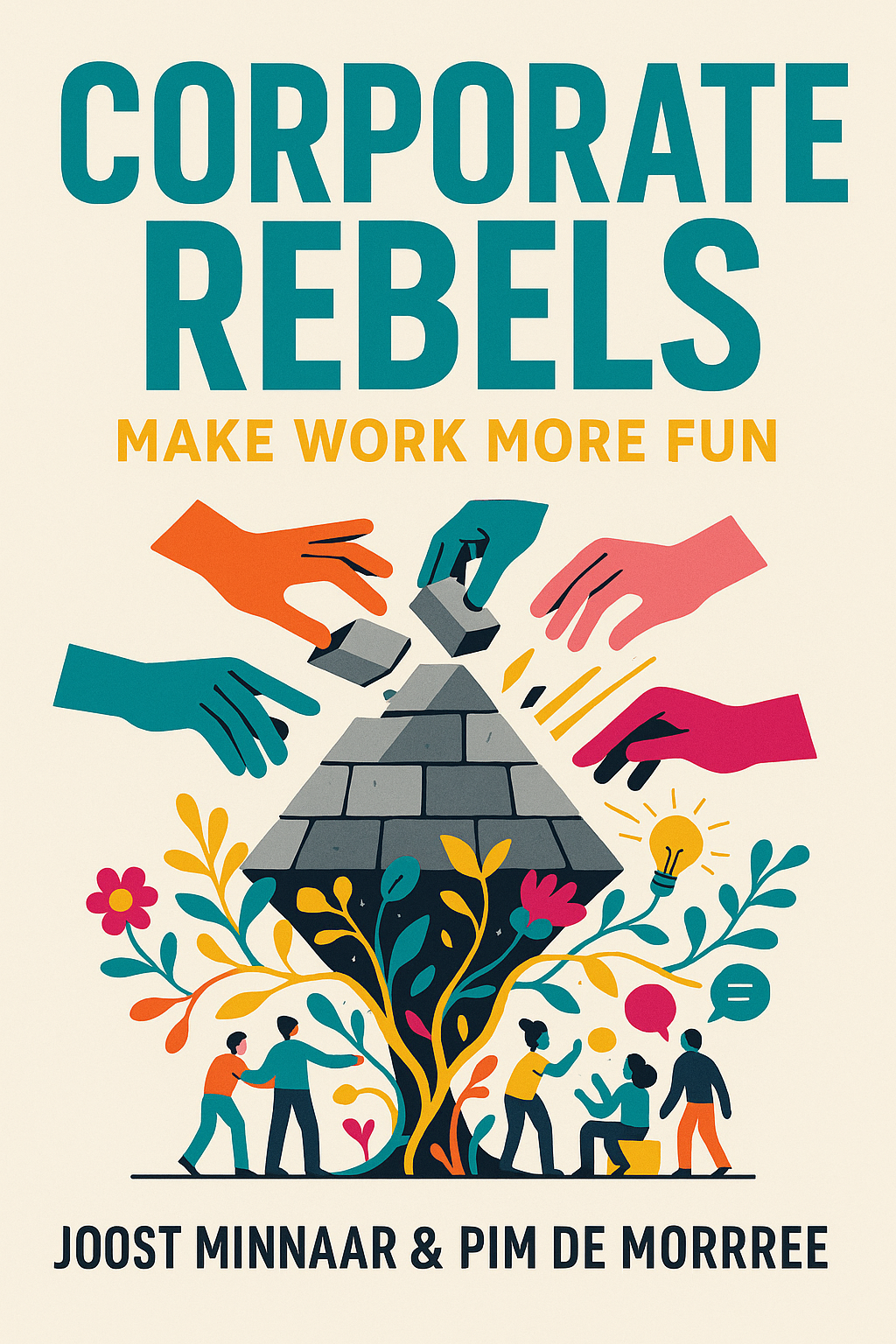
Corporate Rebels: Make Work More Fun
Chapter Summaries
What's Here for You
Are you tired of the rigid, soul-crushing structures of traditional corporate life? Do you dream of a workplace where purpose trumps profit, where innovation thrives on trust, and where leadership empowers rather than dictates? If so, "Corporate Rebels: Make Work More Fun" is your essential guide to a more fulfilling and effective professional existence. Authors Joost Minnaar and Pim de Morree invite you on an inspiring journey to discover how leading organizations are shattering outdated norms and building vibrant, human-centric workplaces. Through compelling real-world examples – from Patagonia's commitment to values and Haier's network of teams to the radical transparency of Semco and the freedom-driven model of Buurtzorg – this book reveals a powerful truth: work *can* be more fun, more engaging, and more impactful. You'll learn how to shift from hierarchical pyramids to agile networks, from directive commands to supportive leadership, and from rigid plans to adaptive experimentation. Discover the secrets behind fostering freedom and trust, distributing authority, and embracing talent and mastery over sterile job descriptions. "Corporate Rebels" is more than just a collection of case studies; it's an intellectual and emotional awakening. It offers a hopeful yet practical roadmap for leaders and employees alike, demonstrating that a radical reimagining of how we work is not only possible but also profoundly rewarding. Prepare to be challenged, inspired, and equipped with the insights to transform your own work environment and unlock a new era of purpose, creativity, and genuine enjoyment in your professional life. This book is for anyone who believes that work should be a source of fulfillment, not just a means to an end.
From Profit to Purpose & Values
The authors, Joost Minnaar and Pim de Morree, invite us into the world of 'Corporate Rebels,' a journey that probes the very soul of modern work, challenging the age-old maxim that profit is king. They begin by immersing us in the unique ethos of Patagonia, where a morning surf session with 'Chipper Bro,' an 11-time World Frisbee Freestyle champion, serves as a prelude to understanding a company deeply rooted in its founder Yvon Chouinard's philosophy: 'Let My People Go Surfing.' This experiential introduction underscores a central tension: the painful mismatch many feel between their work and a personal desire for meaningful contribution. Research, they note, reveals that a significant percentage of employees doubt their work's usefulness, with studies showing 37 percent of workers feeling their job lacks societal contribution. This disconnect, the authors argue, stems from an overemphasis on profit as the sole measure of success, leading to short-term thinking and demotivated employees. They present a compelling insight: employee motivation is demonstrably higher—between 17 to 33 percent—when profit is not the primary concern, a finding supported by decades of research and echoed by thought leaders like Daniel Pink. Yet, many organizations falter in translating this understanding into action, often resorting to superficial 'purpose hype' without genuine employee involvement, a strategy the authors liken to 'lipstick on a pig.' The narrative then shifts to the tangible reality of Patagonia's headquarters, a space that feels less like a corporate behemoth and more like a rambling mountain cabin, where campervans and drying wetsuits are common sights. Here, a diverse array of employees—from social media experts to childcare providers—share a common passion for outdoor life and a deep belief in the company's mission: 'Build the best products, cause no unnecessary harm, use business to inspire and implement solutions to the environmental crisis.' This mission isn't just a slogan; it's the company's anchor, driving meticulous care in every task, from product design to the pioneering on-site childcare service, which significantly boosts employee retention, particularly for mothers. The authors highlight another critical insight: embracing a higher purpose, like Patagonia's commitment to environmental responsibility, can lead to bold, albeit sometimes costly, decisions—such as switching to organic cotton, which tripled costs but solidified the company's values and created a new industry standard. This dedication to 'doing what's right' transforms Patagonia from a mere brand into a societal advisor, influencing consumer choices and advocating for change, as seen in their 'Vote Our Planet' campaign and substantial donations to environmental causes. The narrative then broadens to include other 'progressives' like Tonys Chocolonely, Zappos, and Beetroot, companies that have embraced higher purposes beyond profit margins, demonstrating that ethical outcomes and employee empathy foster a profound sense of belonging and purpose. The resolution emerges through a clear framework: companies must establish a bold, authentic purpose (Level 1), ensure this message permeates every level (Level 2), prioritize hiring for cultural fit over skills alone (Level 3), meticulously measure and share their impact (Level 4), and crucially, back their purpose with tangible actions, putting their money where their mouth is (Level 5). This journey from profit-centricity to purpose-driven existence, exemplified by pioneers like Patagonia and Hollands Kroon Council, reveals that true success lies not merely in financial gain, but in building organizations that inspire, empower, and contribute meaningfully to the world, transforming work into a calling rather than just a job.
From Hierarchical Pyramid to Network of Teams
The journey into the heart of Haier, a titan of Chinese industry, begins not with an invitation, but with the persistent pursuit of its enigmatic CEO, Zhang Ruimin. What unfolds is a profound exploration of organizational metamorphosis, moving from the rigid, suffocating grip of the hierarchical pyramid to the fluid, adaptive landscape of a network of teams. Gary Hamel's stark observations on the escalating cost of bureaucracy – a staggering $3 trillion annually in the US alone – paint a grim picture of traditional structures, where communication fractures across fiefdoms and client satisfaction takes a backseat to internal battles. This is the very ailment Zhang Ruimin, through a series of five major transformations over four decades, has relentlessly battled. His initial act of smashing faulty refrigerators, a visceral rejection of mediocrity, ignited the first spark of change, leading to a pyramid structure that initially brought quality and respect. Yet, as Haier grew, this very structure became a bottleneck, prompting a shift to a matrix model in the 90s, fostering innovation through employee rewards and recognition. The dawn of the millennium, however, brought new challenges with the rise of the internet and increased customer demand for customization. Haier responded by embracing satellite organizations and, crucially, by dismantling the pyramid altogether. This led to the creation of 2,000 self-organizing Zi Zhu Jing Ying Tis (ZZJYTs), later evolving into 4,000 autonomous microenterprises, each functioning like a small startup. This radical decentralization, epitomized by the RenDanHeYi model, empowers every employee to be their own CEO, fostering entrepreneurship and shared ownership. The story of Lu Kailin and his gaming computer venture, Thunderobot, exemplifies this transformation, skyrocketing from an internal idea to a multi-million dollar success. Similarly, Svenska Handelsbanken, under Jan Wallander, underwent a parallel transformation, dismantling a centralized, decision-paralyzing head office in favor of empowered local branches, proving that radical decentralization is a powerful antidote to bureaucratic inertia, creating a resilient, adaptable organization akin to a thriving rainforest where individual initiative fuels collective growth. The core tension lies in escaping the suffocating bureaucracy that plagues large organizations, a problem addressed by embracing radical decentralization and fostering an environment where autonomy and trust allow teams to function as entrepreneurial mini-companies, a model echoed by pioneers like Buurtzorg and Handelsbanken, illustrating that the future belongs to networks of agile, self-organizing teams.
From Directive to Supportive Leadership
In the quest to understand whether leadership can truly be more about support than command, authors Joost Minnaar and Pim de Morree embark on a journey that challenges the foundations of traditional management. Their investigation, sparked by experiences with ineffective leadership where decisions flowed solely from the top and employee opinions were often disregarded, leads them to pioneers like Ari Weinzweig of Zingerman's and Darren Childs of UKTV. At Zingerman's, they witness Weinzweig, influenced by anarchistic ideals of equality and initiative, embodying supportive leadership by personally attending to customers and deeply engaging new employees in the company’s history and values, emphasizing that leaders need their people far more than people need their leaders—a stark contrast to the statistic that 50% of employees quit due to their manager. This philosophy isn't just theoretical; it’s a living practice where every employee is seen as capable of greatness, and leadership is about enabling others, not dictating terms. This principle is further illustrated at UKTV, where Darren Childs dismantled a rigid hierarchy, transforming a sterile corporate environment into an open, collaborative space. By removing managers' private offices and introducing weekly town hall meetings where even sensitive questions could be anonymously submitted and openly answered, UKTV fostered transparency and trust, demonstrating that tearing down hierarchy by design cultivates a more engaged and creative workforce. The authors then distill these observations into actionable principles, highlighting the need to beware of the HiPPO (Highest Paid Person's Opinion), dismantle the 'ivory towers' of privilege, and revolutionize evaluation systems by shifting them from top-down directives to bottom-up feedback from team members. They also address the Peter Principle—promoting individuals to their level of incompetence—by advocating for multiple promotion tracks and, in the most radical examples, even exploring the election of leaders. Ultimately, the chapter reveals that supportive leadership, characterized by authenticity, modesty, and a genuine commitment to empowering employees, isn't just a softer approach; it’s a strategic imperative that leads to greater happiness, involvement, creativity, and tangible business success, a transformation where leaders are chosen for their ability to serve, not solely for their authority.
From Plan & Predict to Experiment & Adapt
In the realm of corporate transformation, a stark tension arises between the allure of predictability and the imperative of adaptation. The narrative unfolds with the discovery of K2K Emocionando, a team led by Pablo Aretxabala, who champion a radical approach to business called Nuevo Estilo de Relaciones, or NER. This philosophy, born from Koldo Saratxaga's revitalization of the Irizar Cooperative in the early 1990s, challenges deeply ingrained organizational norms. Irizar, once on the brink of technical bankruptcy, was resurrected through a management style that jettisoned hierarchical structures, control mechanisms, and power struggles, replacing them with self-managed teams, absolute transparency, trust, freedom, and responsibility. Koldo Saratxaga, a figure of wisdom and amiability, realized that the old paradigms of detailed annual planning, akin to a bygone era of Henry Ford's assembly line, were utterly inadequate for today's volatile world. He observed how this 'managing by numbers' often led to irrational decisions, like employees ordering unnecessary items to exhaust budgets, a ritualistic misery costing billions annually. Instead, Koldo fostered an environment where experimentation was not just allowed but encouraged, creating a flexible, adaptive, and engaging workplace. This involved dismantling the hierarchical pyramid, forming multidisciplinary, self-managed teams that functioned like miniature companies, and transforming physical spaces to promote interaction. Autonomy was paramount; teams set their own objectives and schedules, control mechanisms like time clocks were removed, and trust replaced rigid oversight. Transparency became a cornerstone, with financial information and performance data openly shared, fostering fairness and aligning goals. The success was staggering: Irizar experienced 14 consecutive years of 24 percent annual growth, with revenue soaring from 24 million to 310 million. This pioneering spirit, however, was not confined to Irizar. The chapter then draws parallels with Spotify, a Swedish music streaming giant, which also thrives on experimentation, embracing a motto: 'We aim to make mistakes faster than anyone else.' Spotify's structure of squads, tribes, and guilds, while sounding complex, mirrors the network-of-teams model, prioritizing innovation over predictability. Both K2K's Basque companies and Spotify demonstrate that in a world of constant change, adaptability is the ultimate currency, achieved not through rigid plans but through a culture of ruthless experimentation, failing fast, and continuous improvement. The core insight is that true organizational resilience emerges from empowering individuals, fostering transparency, and embracing the inherent chaos of change as an opportunity for growth, rather than a threat to be controlled.
From Rules & Control to Freedom & Trust
The narrative unfolds with a journey to the Belgian Ministry of Social Security, seeking out Frank van Massenhove, a figure rumored to lead a remarkably unconventional government body. What the authors find is a stark contrast to the imposing, corporate facade of the Finance Tower; a light, colorful, and modern space, much like the man himself, with his sparkling eyes and famously silly shoes. Van Massenhove’s candid opening, admitting he secured his position by initially deceiving interviewers about his command-and-control intentions, immediately sets the stage for a radical departure from traditional leadership. He confesses his true aim from day one was to build an organization founded on freedom, trust, and responsibility, believing more in his employees than in himself. This vision was a stark counterpoint to the neglected, dusty, and demotivated organization he inherited, characterized by outdated infrastructure and a stifling hierarchy. To attract fresh talent, he consulted his own children, learning that the younger generation craves flexibility, autonomy, and a rejection of prehistoric status symbols and hierarchy, valuing trust and the ability to evaluate their superiors. A tour of the ministry reveals an environment with no fixed workstations, but a variety of flexible spaces, emphasizing the quote, 'Freedom is that you can be, not that you have to be.' The presence of a child on a regular workday underscores the profound trust and flexibility in place, where roughly only 20% of civil servants are typically present on any given day, a testament to the power of earned trust. The authors reflect on the pervasive, yet often ineffective, reliance on control systems driven by fear and distrust, citing personal experiences with excessive reporting and convoluted expense reimbursement processes. They draw a parallel to Netflix's singular policy: 'Act in Netflix’s best interest,' highlighting how trust fosters autonomy and eliminates bureaucratic layers. An anecdote from Jean-François Zobrist about an absurdly complex glove-replacement process illustrates the inefficiency and cost of treating employees like children, noting that rules designed for a problematic 3% stifle the 97%. This pervasive lack of trust, leading to a loss of autonomy, is linked to rising burnout rates, a growing problem identified by TNO. Van Massenhove's transformation focused on making civil servants happy and creating an efficient government by involving employees directly in redesigning their work, asking them how they would build the department from scratch with customer satisfaction and results in mind. This three-year transformation, largely driven by the civil servants themselves, shifted the obsession from time spent to results delivered, replacing the 'perverse game' of staying late with a focus on output and a network-of-teams structure where senior management sits at the same table as everyone else. The result: productivity rose significantly, illness-related absences and burnout plummeted, and the ministry became an attractive employer, receiving vastly more applications than before. The chapter then expands to other pioneers, like the Dutch law firm BvdV, which embraces a four-day work week and self-setting salaries, inspired by Ricardo Semler's philosophy that freedom and trust lead to better performance. Similarly, Kath Blackham of VERSA in Melbourne experimented successfully with a four-day week, leading to doubled profits and increased staff retention. The core message resonates: organizations must dare to experiment, moving beyond the 'one-size-fits-all' approach to discover what works best, replacing outdated control mechanisms with common sense, transparency, and a focus on results and peer review, ultimately demonstrating that a culture built on freedom and trust yields remarkable rewards.
From Centralised to Distributed Authority
The narrative unfolds with the stark reality faced by David Marquet, a commander unexpectedly tasked with leading the USS Santa Fe, a nuclear submarine notorious for its abysmal performance and low morale. Thrust into this challenging position with little knowledge of the vessel, Marquet initially grappled with the traditional military approach of issuing directives, a method that proved ineffective with a crew conditioned to passive obedience. He observed firsthand how centralized decision-making, where authority rests with a select few, stifles initiative and common sense, creating a culture of 'zombies' awaiting orders, as evidenced by a simple pump installation delay stemming from a misplaced part order. This mirrors the broader organizational dilemma where hierarchical structures, designed for a bygone era, lead to inertia, poor decisions, and widespread frustration, much like playing a modern game on an ancient device. Marquet's radical shift began with 'managing by walking around,' actively questioning his crew about their roles, frustrations, and ideas, transforming his leadership from giving orders to eliciting solutions. This fundamental change, encapsulated by his mantra 'Don't move information to authority, move authority to information,' empowered the crew, turning them into creative, proactive problem-solvers. The immediate impact was astonishing: a critical inspection, previously dreaded, was passed with flying colors, propelling the Santa Fe from the fleet's bottom to its midpoint, a testament to the power of distributed authority. The ripple effect was profound, revitalizing morale and dramatically increasing reenlistment rates, demonstrating that when people are given control, they become more engaged, intelligent, and entrepreneurial. This liberation from the 'command-and-control' culture is further illustrated by the HaufeUmantis company, where democratic ideals led to employees democratically electing their CEO and board members, showcasing the profound trust and capability inherent in a distributed leadership model. The chapter posits that for organizations to thrive in today's dynamic world, they must move beyond outdated centralized systems and embrace distributed decision-making, whether through simple 'map decision-making' exercises, shifting the organizational language to encourage initiative, pushing authority down, implementing 'preapproval' with clear boundaries, or adopting the 'advice process' where individuals make decisions after seeking counsel, ultimately fostering ownership, pride, and superior performance.
From Secrecy to Radical Transparency
The journey into the heart of corporate transformation begins with a quest to meet Ricardo Semler, the visionary behind Semco, a company that has long been a beacon of progressive work culture. The authors recount their pilgrimage to Semco's factory in Itatiba, Brazil, a place where the air itself seems to hum with a different kind of energy, free from the rigid walls and hierarchical structures of traditional businesses. Initially, Semler’s own story reveals a path not of immediate enlightenment, but of trial and error. Upon taking over his father's company, his first instinct was a drastic, almost brutal, professionalization that led to the dismissal of key managers, inadvertently creating a vacuum of institutional knowledge. This initial misstep, a stark reminder that progress is rarely a straight line, taught him a vital lesson: control and bureaucracy, even when disguised as sensible procedures, can stifle the very spirit they aim to harness. It was the arrival of HR Director Clovis Bojikian, a pragmatic force to Semler’s visionary drive, that truly catalyzed the shift. Together, they began dismantling the old paradigms, not with a grand, pre-defined plan, but through a series of experiments born from the everyday concerns of their employees. The simple issue of how feijoada, a Brazilian bean stew, was prepared in the canteen became a microcosm of a larger transformation. When employees complained, instead of imposing a solution, HR asked them to devise one, thus igniting ownership and engagement. This principle, that empowering individuals to solve their own problems breeds commitment, became a cornerstone. Small changes, like eliminating time clocks and personal parking spaces, chipped away at status symbols and transferred power, fostering a palpable rise in trust. The core tension here is the inherent conflict between the perceived need for control in business and the human desire for autonomy and meaning. The authors illustrate how Semler and Bojikian, recognizing the limitations of the hierarchical pyramid, embraced a network-of-teams structure, inspired by models like Kyocera’s ‘Amoeba’ management. This radical decentralization meant that smaller, independent units, or ‘amoebas,’ operated with significant autonomy, fostering a sense of shared purpose and understanding. The most profound shift, however, was the move towards radical transparency. Semler articulates a clear conviction: 'Nobody can expect anyone to be fully involved if they do not have access to all the information.' This openness extended to all aspects of the business, including weekly meetings where financials, product development, and even hiring and firing were discussed openly, dismantling the ‘iceberg of ignorance’ where employees are left to guess and assume the worst. The chapter then pivots to Smarkets, a modern tech company that embodies these principles. Here, the authors explore how self-managing teams, radical transparency, and even self-set salaries are not just ideals, but implemented realities. The narrative highlights that superficial perks like bean bags and free food are mere distractions; true progressives address the fundamental issues of leadership, hierarchy, and trust. At Smarkets, the courage to make salaries public, after initial skepticism, dissolved feelings of unfairness and gossip, creating a culture of equity. The process of self-determined salaries, supported by business cases, peer review, and transparent communication, underscores the profound impact of trust. The overarching insight is that when information is shared freely, trust flourishes, leading to better decision-making, increased motivation, and a more joyful, engaged workforce. The chapter concludes by reinforcing that transparency, from open communication to open-book management and salary transparency, is not a path to chaos, but a vital ingredient for a truly humane and effective workplace, a testament to the idea that daring to be open is often the safest bet for collective success.
From Job Descriptions to Talent & Mastery
The authors, Joost Minnaar and Pim de Morree, delve into the revolutionary world of Buurtzorg, a Dutch home care organization that stands as a beacon of radical, yet remarkably effective, workplace design. They introduce us to Jos de Blok, the visionary founder, a man whose philosophy is steeped in simplicity and a profound distrust of management jargon, protocols, and the very notion of traditional management itself. De Blok's journey from frontline nurse to a director who felt his innovative ideas for self-managing teams were constantly stifled, led to his departure and the eventual birth of Buurtzorg in 2006. This organization, now a behemoth in Dutch home care, operates without a management structure, instead empowering over a thousand self-managing teams of nurses who are entirely autonomous in planning their work and hiring colleagues. The core tension here is the stark contrast between traditional organizations that burden employees with rigid job descriptions, hierarchical ladders, and a focus on fixing weaknesses, versus Buurtzorg's radical embrace of 'Talent & Mastery.' This principle encourages employees to discover and leverage their innate strengths, fostering continuous development rather than dwelling on perceived deficits. The authors highlight the staggering statistic that only a third of employees use their main talents daily, and an even smaller percentage perform tasks aligned with their interests, a clear indicator of wasted potential. Buurtzorg exemplifies a resolution to this dilemma by dismantling artificial hierarchies, minimizing meetings, and treating every employee's idea as valuable. Their model, replicated in the Mexican software company Nearsoft, demonstrates that true progress lies in enabling individuals to deploy their talents freely, echoing the democratic and shared-ownership principles found in historical pirate crews, as analyzed by co-founder Matt Perez. Nearsoftians, for instance, define their long-term goals collectively, and their 'boss' is often a shared vision rather than a person. The chapter then distills these pioneering practices into actionable steps, starting with identifying talents, moving to 'job crafting' where employees reshape their roles around their passions, encouraging unlimited, self-directed training, facilitating self-selected mentorship, and establishing internal project marketplaces. It’s a compelling narrative, suggesting that by shifting the focus from fixed roles to fluid talents, organizations can unlock unprecedented levels of engagement, productivity, and ultimately, a more human-centered approach to work, where simplicity reigns and people are empowered to do what they do best.
Seeing is believing
In the vast landscape of progressive workplaces, Joost Minnaar and Pim de Morree discovered that transformation isn't a monolithic blueprint, but a deeply personal journey. Their extensive explorations, spanning over a hundred organizations from family businesses to government departments, revealed a powerful truth: no single model fits all. Instead, it's a 'one size fits one' situation, where pioneers carve their own unique paths, often freeing themselves from the rigid shackles of command-and-control. Even the most seemingly dull environments can be reignited, proving that hitting the reset button is always possible, though not without its twists and turns. The authors caution against the traps of preconceived notions or rigid, linear plans, emphasizing that true change is a continuous process of improvement and experimentation. For those feeling powerless, especially when not in the CEO's seat, the message is clear: quitting isn't the only recourse. Progressive ways of working can bloom from the ground up. Consider the story of Harm Jans, an employee at the Dutch online retailer bol.com. Jans, leading a team of 30, faced the common dilemma of limited influence without senior authority. His initial attempts to convince top management of radical change met with resistance, a common hurdle when a company, comfortable in its success, fears embracing the unknown. Yet, Jans didn't falter. He understood that significant change at bol.com, a company built on autonomy, couldn't be dictated from above. His breakthrough came when he shifted his strategy: he empowered his own team to experiment. By modifying meeting structures, redistributing roles and accountabilities, and altering decision-making processes, they began to test new ways of working. Crucially, they measured progress by asking a simple question: 'On a scale of 0 to 10, how likely are you to recommend this new way of working?' This focus on internal satisfaction became their compass, guiding their adaptations. What started as a small experiment began to ripple outwards. Other teams, witnessing the growing enthusiasm and tangible results, clamored to join. Jans and his colleagues became coaches, helping new teams adopt these evolving methods. This organic growth, driven by shared excitement and validated by consistent improvement, became a powerful movement. The pioneers amplified their message through videos, blog posts, and presentations, transforming internal communication into a catalyst for widespread adoption. What began as a simple experiment in meetings and decision-making evolved into a fundamental re-evaluation of the company's structure, fostering entrepreneurship and ownership. The authors distill this wisdom into three core principles: First, 'Don't force change, inspire it.' Instead of top-down mandates that often breed resistance, find the rebels, share your vision, and empower them. Second, embrace 'Continuous Experimentation.' Abandon rigid, pre-designed plans for agile iterations, learning from both successes and failures. Finally, 'Create a Movement.' Make your vision visible, communicate relentlessly, and foster enthusiasm that spreads organically, turning individual successes into collective momentum. The journey of Harm Jans and bol.com is a testament to the inspiring power of rebellion, proving that profound workplace change can originate from anywhere, fueled by vision, invitation, and action.
Conclusion
“Corporate Rebels” by Joost Minnaar and Pim de Morree serves as a compelling manifesto for reimagining the very essence of work, moving beyond the narrow confines of profit-driven capitalism towards a more human-centered, purpose-led, and adaptable organizational paradigm. The core takeaway is a profound shift in perspective: true success is not measured solely by financial returns, but by the cultivation of genuine employee motivation, engagement, and a palpable sense of higher purpose. The book dismantles the myth that profit must be the primary driver, revealing that when organizations prioritize values, collective well-being, and a meaningful mission, financial success often becomes a natural byproduct. Emotionally, the journey through “Corporate Rebels” is one of liberation and inspiration. It offers a powerful antidote to the pervasive feelings of demotivation, burnout, and alienation that plague many modern workplaces. The stories of companies like Patagonia, Haier, and the Belgian Ministry of Social Security illustrate that a culture built on trust, freedom, and empowerment can foster profound job satisfaction and a sense of belonging. The emotional lesson is clear: work can and should be a source of fulfillment, not just a means to an end. Practically, the book provides a rich toolkit for transformation. It advocates for radical decentralization, the dismantling of rigid hierarchies in favor of agile networks of teams, and the embrace of supportive leadership over directive command. The emphasis on radical transparency, whether in financials or decision-making, is presented not as a risky experiment, but as a fundamental building block for trust and accountability. The authors champion a move from rigid 'plan and predict' models to dynamic 'experiment and adapt' frameworks, recognizing that adaptability, not brute force, is the key to navigating an unpredictable future. The practical wisdom lies in the courage to question established norms, to empower front-line employees, to foster psychological safety for experimentation, and to treat individuals as responsible adults capable of self-management. Ultimately, “Corporate Rebels” is a call to action, urging leaders and employees alike to shed the shackles of outdated industrial-era management and build workplaces that are not only more productive and innovative but also fundamentally more humane and fulfilling.
Key Takeaways
The overemphasis on profit as the sole measure of success leads to short-term thinking and demotivated employees; true motivation increases significantly when profit is not the primary concern.
Superficial 'purpose' initiatives, without genuine employee involvement and authentic commitment, fail to inspire and can even be more demotivating than no purpose at all.
A company's higher purpose acts as a moral compass, guiding decisions and fostering a sense of direction, particularly during challenging times, leading to greater employee engagement and retention.
Prioritizing hiring for cultural fit and shared values, rather than solely for skills, creates a more cohesive, motivated, and mission-aligned workforce.
Authenticity and credibility are built when companies demonstrably align their actions with their stated purpose, even if it involves significant financial sacrifice or challenging established practices.
Transforming work from a mere job into a calling requires a clear, shared purpose that resonates deeply with employees, fostering a sense of belonging and collective contribution to something larger than profit.
Bureaucracy imposes a significant financial and operational cost on organizations, hindering efficiency and innovation by creating layers of management and internal conflict.
Organizational structures must evolve dynamically with growth and external market changes to avoid becoming bottlenecks that stifle progress and employee engagement.
Radical decentralization, empowering autonomous teams or microenterprises with significant decision-making authority, fosters entrepreneurship, motivation, and a more adaptive organizational response.
Transforming a company requires a series of deliberate, often bold, structural shifts, moving from rigid hierarchies to more flexible, networked models that trust and leverage employee talent.
The 'network of teams' or 'ecosystem of minicompanies' model, where employees function as entrepreneurs with ownership and autonomy, offers a powerful solution to combatting organizational inertia and driving sustained success.
Measuring performance through objective, transparent metrics across autonomous units creates healthy competition and drives continuous improvement without the need for excessive centralized control.
Crisis can act as a catalyst for profound organizational transformation, forcing a re-evaluation of established structures and a courageous embrace of new, more agile models.
Traditional directive leadership, marked by the 'Highest Paid Person's Opinion' (HiPPO) and detached management, leads to employee disengagement and significant financial costs, necessitating a shift towards a supportive model.
Supportive leadership, inspired by philosophies valuing equality and initiative, thrives when leaders actively empower employees, fostering an environment where individuals feel valued and capable of contributing meaningfully.
Dismantling physical and hierarchical 'ivory towers' through open workspaces and transparent communication channels is crucial for breaking down command-and-control structures and building trust.
Transforming performance evaluations from top-down assessments to bottom-up feedback from team members provides more accurate insights and drives managerial improvement.
Organizations must address the 'Peter Principle' by creating alternative growth paths beyond management and ensuring leadership roles are filled by individuals competent in leading, not just excelling in individual tasks.
True supportive leadership requires leaders to be accessible, transparent, and genuinely invested in their teams' well-being and development, fostering a culture where feedback is encouraged and adversity is shared for collective learning.
Organizations must transition from rigid, plan-and-predict models to dynamic, experiment-and-adapt frameworks to thrive in an unpredictable world.
True organizational transformation, as exemplified by Irizar and K2K, hinges on dismantling hierarchical structures and control mechanisms in favor of self-management, transparency, and radical trust.
Annual budgeting cycles and detailed long-term planning often lead to wasted resources and irrational decision-making, whereas embracing flexibility and short-term, adaptive goal-setting fosters efficiency.
A culture of psychological safety, where experimentation is encouraged and failure is viewed as a learning opportunity rather than a punishable offense, is crucial for innovation and resilience.
Empowering employees through shared decision-making, transparent financial information, and autonomy over their work cultivates higher engagement, productivity, and improved financial outcomes.
Adaptability, not strength or intelligence, is the key to survival and success in the modern business landscape, driven by the capacity for rapid learning and response to change.
Inspiring change by finding and supporting internal rebels is more effective than enforcing mandates, which often leads to resistance and sabotage.
Radical trust in employees, rather than rigid control, unlocks higher productivity and well-being, as demonstrated by the Belgian Ministry of Social Security's transformation from a demotivated bureaucracy to a high-performing organization.
Treating employees like responsible adults, empowering them with autonomy over where, when, and how they work, leads to greater engagement and innovation, moving beyond outdated industrial-era management paradigms.
Rules designed for a small percentage of rule-breakers often stifle the autonomy, creativity, and motivation of the vast majority, highlighting the inefficiency of control mechanisms rooted in fear and distrust.
Organizational transformation is most effective when driven by the employees themselves, involving them in redesigning their work processes and culture to align with shared goals and individual needs.
Shifting the focus from time spent (hours clocked) to results delivered is crucial for genuine productivity, fostering a sense of ownership and purpose that transcends arbitrary working hours.
Experimentation with flexible work models, such as the four-day work week, can lead to significant improvements in employee happiness, stress reduction, motivation, and business performance, but requires a willingness to adapt and find unique solutions.
True leadership involves having the courage to initially operate in rebellion against conventional expectations, as Frank van Massenhove did, to build a foundation of freedom and trust before revealing the transformed reality.
Centralized decision-making, rooted in hierarchical structures, inherently stifles employee initiative, common sense, and proactive problem-solving, leading to organizational inertia and poor outcomes.
Shifting from a directive leadership style to one that empowers individuals by distributing decision-making authority can unlock latent potential, significantly boosting morale, engagement, and overall performance.
The 'advice process,' where individuals make decisions after seeking counsel from those affected and experienced, fosters a sense of ownership and accountability, leading to more robust and informed choices without succumbing to slow consensus.
Transforming organizational culture requires not just structural changes but also a linguistic shift, moving from passive directives to questions that prompt initiative and ownership.
Empowering front-line employees, who possess intimate knowledge of operational realities, is crucial for effective decision-making in rapidly changing environments.
Necessity, rather than comfort, often serves as the catalyst for radical leadership shifts, compelling leaders to abandon ineffective traditional models.
Distributed authority, when coupled with clear guidelines and responsibility, cultivates a sense of pride and entrepreneurship among employees, leading to sustained organizational success.
The initial pursuit of control through professionalization can inadvertently undermine an organization by severing ties with institutional knowledge and fostering distrust.
Empowering employees to solve their own problems, even seemingly minor ones like canteen food, cultivates ownership, engagement, and a sense of collective responsibility.
Dismantling hierarchical structures and adopting a network-of-teams model, where smaller units operate with autonomy, fosters deeper involvement and a more natural flow of work.
Radical transparency, extending to all business information from financials to strategic decisions, is crucial for building trust, preventing destructive speculation, and enabling informed participation.
Superficial perks in progressive workplaces are a facade; true transformation lies in addressing core issues of leadership, hierarchy, and fostering genuine freedom and trust.
Openly sharing salary information, while initially daunting, can dismantle perceptions of unfairness, reduce gender pay gaps, and ultimately foster a culture of equity and acceptance.
The continuous process of experimentation and adaptation, rather than adherence to rigid models, is key to evolving a workplace that remains responsive and effective.
Traditional organizational structures with rigid job descriptions and hierarchical management stifle individual talent and motivation, leading to wasted potential and decreased employee engagement.
Empowering self-managing teams and focusing on 'Talent & Mastery' allows individuals to leverage their innate strengths, leading to increased job satisfaction, productivity, and organizational success.
Simplicity, a radical reduction in bureaucracy, and a trust in professionals to manage their own work are foundational principles for creating highly effective and human-centered organizations.
Job crafting, where employees actively reshape their roles to align with their passions and talents, is a powerful tool for increasing engagement and reducing burnout, benefiting both the individual and the organization.
Organizations can foster a culture of continuous growth and innovation by allowing employees unlimited, self-directed training and enabling them to choose their own mentors and development paths.
True organizational transformation is a 'one size fits one' journey, requiring personalized paths rather than rigid, top-down plans.
Change initiatives can and should be driven from the base of an organization, not solely dictated by senior leadership, by empowering employees to experiment.
Measuring the impact of change through employee satisfaction and willingness to recommend creates organic buy-in and fosters a self-sustaining movement.
Continuous experimentation, coupled with reflection and adaptation, is a more agile and effective approach to change than extensive, pre-designed programs.
Creating a visible movement through effective communication and sharing successes (and even setbacks) is crucial for widespread adoption and sustained momentum.
Action Plan
Identify one area in your current work where rules or control mechanisms seem to stifle more than they protect, and brainstorm how to replace them with trust-based autonomy.
Reflect on your personal definition of meaningful work and identify the core values that guide your professional aspirations.
Evaluate your current organization's purpose: Is it authentic, clearly communicated, and genuinely integrated into daily operations, or is it merely a superficial statement?
Consider how hiring practices could be adjusted to prioritize cultural fit and alignment with core values alongside essential skills.
Identify one tangible action your organization could take to demonstrate its commitment to its stated purpose, even if it involves a short-term cost.
Seek opportunities to share the organization's purpose and impact with colleagues, customers, and stakeholders to foster transparency and collective understanding.
Explore how to measure and communicate the non-financial impact of your work and your organization's contributions to a greater good.
Identify and quantify the hidden costs of bureaucracy within your own organization, such as wasted meeting time and interdepartmental friction.
Evaluate your current organizational structure: does it support or hinder agility and employee initiative?
Explore opportunities to decentralize decision-making power to smaller teams or individuals closest to the customer or product.
Foster an environment of trust and autonomy, empowering teams to take ownership of their work and problem-solving.
Consider implementing performance metrics that reward initiative, customer satisfaction, and entrepreneurial spirit within teams.
Initiate conversations about radical structural change, using examples like Haier and Handelsbanken to illustrate the potential benefits of a network of teams model.
Encourage employees to think and act like entrepreneurs by providing resources, support, and a clear path for innovative ideas to be developed and implemented.
Actively practice listening to team members' opinions and ideas, prioritizing content over seniority.
Assess and remove physical symbols of hierarchy, such as private executive offices, to foster a more inclusive environment.
Implement a system for team members to provide regular, honest feedback on their direct manager's performance.
Explore creating dual career ladders that allow individuals to advance based on expertise without necessarily moving into management roles.
Initiate transparent communication channels, like anonymous Q&A sessions or suggestion boxes, to encourage open dialogue about sensitive issues.
Encourage team members to take initiative and ownership of tasks, providing support rather than directives.
When making decisions, consciously consider all relevant expertise, not just the opinion of the highest-ranking person present.
Initiate small-scale experiments within your team or department, focusing on improving a specific process or trying a new approach.
Challenge the necessity of rigid annual budgeting cycles by exploring shorter-term, more dynamic forecasting and resource allocation.
Create a 'safe-to-try' environment by openly discussing potential failures as learning opportunities, rather than reasons for punishment.
Encourage transparency by sharing relevant performance data and financial information with your team, fostering a sense of shared ownership.
Delegate decision-making authority to teams or individuals closest to the work, empowering them to adapt and innovate.
Allocate dedicated time, even a small percentage, for individuals or teams to explore new ideas or pursue self-initiated projects.
Engage your team in a discussion about their ideal working conditions, asking them to describe their 'destination' and how they might best contribute to reaching it.
Experiment with focusing on results rather than hours for a specific task or project, encouraging your team to manage their own time to achieve agreed-upon outcomes.
Challenge the assumption that employees need constant oversight by delegating a decision or responsibility that typically requires managerial approval.
Encourage employees to personalize their workspace or contribute to designing shared spaces, offering a tangible first step in granting autonomy.
Initiate a conversation about 'what bothers people, what drives them, and what changes would make them happy' within your team or organization.
Explore the feasibility of a pilot program for flexible working hours or a condensed work week within your team, focusing on measurable results.
Practice giving constructive feedback to colleagues based on shared goals and outcomes, rather than solely on adherence to process or managerial directives.
Identify and map out all current decision-making processes within your team or organization to understand who makes what decisions.
Begin asking questions like 'What do you propose?' instead of providing direct answers when employees seek approval.
Implement the 'advice process' by encouraging team members to seek counsel from those affected by their decisions before making a final choice.
Clearly define boundaries for decision-making (e.g., budget limits, quality standards) and communicate them to empower employees with 'preapproval'.
Actively question existing practices that keep command-and-control structures in place and seek to delegate those responsibilities.
Encourage open dialogue about team frustrations and ideas by adopting a 'managing by walking around' approach.
Translate passive language in communications to active phrases that imply initiative and ownership.
Initiate a small-scale experiment where employees are empowered to solve a recurring minor operational issue, taking full ownership of the solution.
Identify and eliminate one status symbol or unnecessary procedure that creates a sense of hierarchy or control within your team or organization.
Begin sharing one category of previously guarded business information (e.g., team performance metrics, project progress) with your team, explaining the rationale.
Encourage and facilitate peer-to-peer feedback sessions, providing training on constructive communication techniques.
Explore opportunities to decentralize decision-making by delegating specific responsibilities to small, autonomous teams.
If considering salary transparency, first establish clear, objective criteria for compensation and prepare for potential employee discussions about fairness.
Schedule regular 'open forum' or 'town hall' style meetings where employees can ask questions anonymously or openly about any aspect of the business.
Identify and list all the tasks your team or you currently perform.
Explore opportunities for 'job crafting' by identifying tasks that align with your interests and talents and seeking to incorporate them more into your role.
Advocate for or initiate discussions within your organization about focusing on employee talents and strengths rather than solely on job descriptions.
If in a leadership position, consider simplifying processes, reducing unnecessary protocols, and empowering teams to make more decisions.
Take ownership of your professional development by proactively identifying training needs and seeking opportunities to learn and grow in areas that leverage your talents.
Seek out or offer mentorship opportunities, focusing on mutual learning and development rather than formal hierarchies.
Identify a specific area within your sphere of influence where a small change could improve your work experience.
Initiate a small-scale experiment with your immediate team, focusing on a specific process or meeting structure.
Regularly solicit feedback from your team on the new approach, perhaps using a simple satisfaction scale.
Share the results and learnings from your experiment (both successes and failures) with colleagues.
Seek out and connect with other 'rebels' or like-minded individuals within your organization who are also interested in progressive ways of working.
Develop simple, clear communication materials (like a short video or blog post) to explain your experiment and its outcomes.
Instead of demanding change, focus on inspiring colleagues by demonstrating the benefits of your experimental approach.