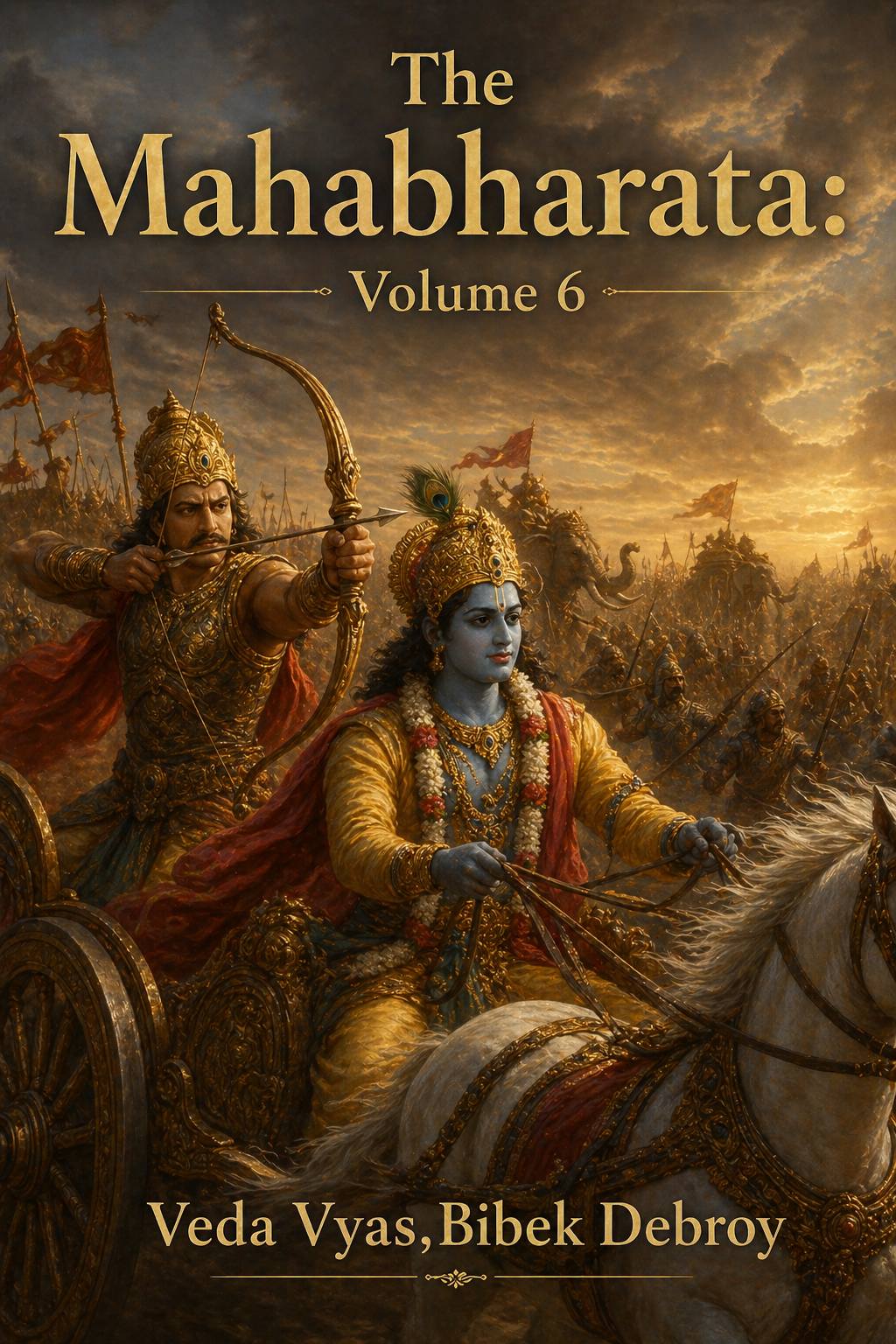
The Mahabharata: Volume 6
Chapter Summaries
What's Here for You
Prepare to be swept into the heart of the Mahabharata's most intense battles in Volume 6, a saga of sacrifice, vengeance, and dharma. Through the eyes of Veda Vyas and Bibek Debroy, you'll witness the fall of heroes like Abhimanyu and Jayadratha, the strategic genius and ultimate demise of Drona, and the unleashing of devastating divine weapons. Experience the emotional turmoil of Dhritarashtra as he grapples with loss and seeks answers in the face of unimaginable destruction. This volume promises a gripping exploration of morality, duty, and the profound consequences of war, leaving you contemplating the timeless questions at the core of this epic tale.
Abhimanyu-Vadha Parva
In the Mahabharata's “Abhimanyu-Vadha Parva,” Veda Vyas and Bibek Debroy recount the tragic thirteenth day of battle, a day etched in sacrifice and valor. Drona, the master strategist, unveils the impenetrable chakra vyuha, a vortex of war, and young Abhimanyu, son of Arjuna, alone knows its secrets. As the Pandavas surge forward, Jayadratha, shielded by Shiva's boon, halts their advance, leaving Abhimanyu isolated. The narrative crescendos as Abhimanyu, a solitary spark against overwhelming darkness, decimates enemy ranks—slaying princes and warriors, becoming a whirlwind of destruction. Yet, this triumph is fleeting. The chapter explores the cruel paradox of dharma, where youthful courage confronts seasoned brutality, culminating in Abhimanyu’s fall at the hands of Duhshasana's son. Sanjaya recounts the events to a devastated Dhritarashtra, painting a tableau of grief and righteous fury. Duryodhana's taunts against Drona reveal a deep-seated anxiety, a fear that even the most formidable strategies crumble before Arjuna's might. Drona, stung by the accusations, vows retribution, setting the stage for further carnage. Yudhishthira, burdened by responsibility, sends Abhimanyu into the fray, knowing the peril, showcasing leadership's agonizing choices. The chapter explores the idea that true courage isn't merely about physical prowess, but about acting in accordance with one’s duty, even when facing insurmountable odds, as Abhimanyu exemplifies. Arjuna's return ignites a firestorm of grief and vengeance, culminating in a fierce oath to avenge his son's death, a promise that will shape the coming days of battle. Krishna, ever the voice of wisdom, offers solace, reminding Arjuna that death in battle is the kshatriya's dharma, a path to worlds of merit, yet the sting of loss lingers, a shadow over the battlefield.
Pratijna Parva
In the Pratijna Parva of the Mahabharata, Veda Vyas and Bibek Debroy present a night of high tension and solemn vows. Sanjaya recounts how Arjuna's pledge to kill Jayadratha throws the Kaurava army into disarray, like a stone dropped into a still pond. Jayadratha, gripped by fear, seeks assurance from Drona, who attempts to bolster his confidence while acknowledging Arjuna's superior yogic strength. Duryodhana, ever pragmatic, assures Jayadratha of protection, setting the stage for a desperate defense. Krishna, ever the strategist, gently chides Arjuna for his rash vow, highlighting the immense challenge ahead and the potential ridicule if he fails—a burden now shared. He reminds Arjuna that vows, like arrows, once released, cannot be called back. Duryodhana orchestrates a complex defensive formation, a labyrinth of warriors designed to shield Jayadratha, while Arjuna, unwavering, reaffirms his resolve, fueled by grief and righteous anger. Krishna then guides Arjuna towards obtaining the Pashupata weapon from Shiva, a divine intervention necessary to overcome the seemingly insurmountable odds. Arjuna, through intense devotion, ascends to Shiva, receives the celestial weapon and the assurance of success, returning to the battlefield transformed, ready to face the dawn and fulfill his oath. This episode underscores the importance of strategic thinking under pressure, the weight of vows, and the necessity of divine grace when confronting seemingly impossible challenges.
Jayadratha-Vadha Parva
Part 1: In the sixth volume of *The Mahabharata*, Veda Vyas and Bibek Debroy recount the *Jayadratha-Vadha Parva*, a section named for the death of Jayadratha. Dhritarashtra, blind and grief-stricken after the death of Abhimanyu, seeks answers from Sanjaya, his narrator. He laments the loss of joy in his sons' abodes, the vanished sounds of music and praise, a stark contrast to the lamentations he now hears. Dhritarashtra grapples with the consequences of Duryodhana's choices, his refusal of peace, and the disastrous game of dice. Sanjaya reminds him that destiny is unyielding, and his past failures to restrain his sons have led to this calamity, like a flood after the embankment is useless. Drona, supreme among warriors, arranges the Kourava army in a complex vyuha, a battle formation designed to protect Jayadratha at all costs, creating a lotus and needle formation, nearly impossible to penetrate. Arjuna, driven by his vow, faces seemingly insurmountable odds, a churning ocean of enemies. He confronts Drona, seeking passage but finding only fierce resistance. A whirlwind of combat ensues, where Arjuna's skill is tested against Drona's strategic brilliance and the relentless attacks of Kourava warriors. The chapter crescendos with Arjuna's relentless pursuit of Jayadratha, overcoming formidable obstacles and slaying key warriors, even as Duryodhana, armored by Drona, stands defiant. Sanjaya vividly portrays the battlefield, a river of blood, choked with fallen warriors and shattered chariots, a testament to the carnage of war. The tension builds as Arjuna, with Krishna as his charioteer, navigates this deadly landscape, his determination unwavering, fueled by vengeance and a thirst for justice, against the backdrop of Drona’s strategic formations and the Kouravas' desperate defense. The chapter ends with Arjuna freeing his exhausted horses and creating a pavilion out of arrows, a testament to his determination and skill, setting the stage for the final confrontation.
Ghatotkacha-Vadha Parva
In the Ghatotkacha-Vadha Parva, Veda Vyas and Bibek Debroy plunge us into the fourteenth night of the Mahabharata war, a landscape illuminated by both blazing lamps and the fierce glow of battle. As Dhritarashtra seeks answers from Sanjaya about the night’s tumultuous events following Jayadratha's fall, the narrative tension escalates, revealing a battlefield where dharma and adharma blur. Arjuna, torn between duty and compassion, wounds his preceptor Kripa, sparking a lament over the shame of striking a brahmana. Krishna, a master strategist, maneuvers Satyaki against Karna, foreshadowing the inevitable clash of titans. Bhima, fueled by Karna's taunts, vows vengeance, setting a collision course amid the chaos. Drona, driven by Duryodhana’s goading, unleashes destruction upon the Pandava forces, highlighting the cost of pride and misplaced loyalty. As the night deepens, Ghatotkacha, the rakshasa prince, rises as a formidable force, his মায়া weaving illusions and terror. But even his might is tested when Karna, compelled by duty and circumstance, unleashes the Vasava spear, a weapon meant for Arjuna, against Ghatotkacha. In that moment, Ghatotkacha sacrifices himself, his death a strategic blow against Karna's ultimate target: Arjuna. As he falls, the narrative underscores a profound truth: even in the darkest hours, selfless sacrifice can alter the course of destiny. He dies a hero while still being a villian. The author shows how one's destiny can be changed by the circumstances, in one instance Satyaki is on the ground but saved by Krishna's chariot. The chapter is a visceral exploration of duty, sacrifice, and the complex morality of war, painting a vivid tableau of heroes and demons locked in a dance of destruction under the watchful eyes of gods and men.
Drona-Vadha Parva
In the *Drona-Vadha Parva*, Veda Vyas and Bibek Debroy plunge us into the heart of the Mahabharata's fifteenth day, a maelstrom of carnage defined by Drona's relentless devastation and ultimate downfall. The day dawns with Drona's fury unabated, as he decimates Drupada's lineage and key warriors, casting a pall of despair over the Pandava army; the narrative tension ratchets up with Ghatotkacha’s heroic sacrifice, a move orchestrated by Krishna to deplete Karna's divine spear—a weapon of singular destruction. Krishna, ever the strategist, dances with delight at this loss, a joy Arjuna finds unsettling amidst the grief; Krishna then unveils the brutal calculus of dharma, explaining how past actions, veiled in yoga, have paved their path, revealing that sometimes, the righteous path demands morally grey choices. Dhritarashtra laments the wasted spear, blind to his own culpability, while Sanjaya recounts failed strategies and the constant shadow of Krishna's protection, highlighting that true strength lies not just in arms, but in foresight. As night descends, Arjuna calls for a ceasefire, a moment of shared respite under the moon’s gaze, but Duryodhana, fueled by intolerance, spurs Drona onward, setting the stage for the chapter's grim climax. The day breaks anew, and Drona, confronted by the impossible choice of killing or being killed, continues his slaughter, a warrior trapped in a vortex of duty and destruction. Bhima’s deception—the false claim of Ashvatthama’s death—becomes the catalyst, a cruel twist that shatters Drona’s resolve, and as Drona relinquishes his weapons, Dhrishtadyumna strikes, defying honor in the name of destiny. The world witnesses Drona's ascent, a soul released from earthly torment, even as Dhrishtadyumna’s act is met with revulsion; the chapter closes with the Kourava army in disarray, their leader fallen, their spirit broken, leaving Ashvatthama to grapple with the devastating news, a poignant reminder that even in victory, the scars of war endure, etched in loss and moral compromise.
Narayana Astra Moksha Parva
In the *Narayana Astra Moksha Parva* of *The Mahabharata, Volume 6*, Veda Vyas and Bibek Debroy plunge us into the aftermath of Drona’s death, narrated by Sanjaya to Dhritarashtra. Ashvatthama, enraged by his father's unrighteous killing, invokes the devastating narayana astra—a weapon that Krishna knows can only be countered by complete surrender. The instructor notes that this divine weapon underscores the insight that true strength sometimes lies not in resistance, but in humility and strategic yielding. Ashvatthama's grief-fueled rage becomes a storm of destruction, a stark reminder that uncontrolled emotions can unleash forces beyond our ability to manage, leading to the insight that emotional regulation is paramount in leadership and conflict. The weapon unleashed is like a tempest, indiscriminately felling warriors, countered only when Krishna commands the Pandavas to disarm, demonstrating that wisdom dictates knowing when to lay down arms, both literally and metaphorically. As the narrative unfolds, Ashvatthama’s divine weapons are met with divine counters by Krishna and Arjuna, illustrating the principle that even the most formidable powers meet their match in the face of higher purpose and strategy. The chapter highlights the praise of Shiva, emphasizing that devotion and reverence can provide solace and strength amidst chaos, offering the insight that spiritual grounding is crucial for resilience. The episode closes with Ashvatthama's weapons proving futile against Krishna and Arjuna, a testament to the idea that righteousness and dharma ultimately triumph over vengeance and uncontrolled power. Vyasa later explains that Narayana, through immense austerities and devotion to Rudra, gained boons that made him invincible, emphasizing the insight that true power comes from inner strength and spiritual alignment. The chapter concludes with Drona Parva ending, and serves as a potent reminder that the path to victory often requires navigating moral complexities and making difficult choices, underscoring the final insight that ethical considerations are integral to any pursuit of power or justice.
Conclusion
Volume 6 of the Mahabharata, as recounted by Vyasa and Debroy, culminates in a crescendo of devastation, loss, and morally ambiguous choices. It underscores that even the most skilled warriors and meticulously crafted strategies are vulnerable to unforeseen circumstances and individual failings. The tragic death of Abhimanyu sets in motion a chain of vengeance, highlighting how grief and the desire for retribution, while powerful motivators, must be tempered by wisdom and dharma. Arjuna's vow and the subsequent events leading to Jayadratha's demise demonstrate the weight of pledges and the lengths to which individuals will go to uphold them. The fall of Drona, despite his strategic brilliance, illustrates that even the most formidable powers meet their match in the face of higher purpose and cleverly executed strategy. Ashwatthama's unleashing of the Narayanastra emphasizes the dangers of uncontrolled emotions and the devastating consequences of unrighteous anger. Throughout these parvas, the narrative consistently reveals that true strength lies not solely in physical prowess but in unwavering commitment to dharma, strategic yielding, and spiritual alignment. The volume serves as a potent reminder that while skill and strategy are essential, adaptability, unwavering resolve, and devotion are crucial for navigating the complexities of life and war. Ultimately, the Mahabharata reminds us that destiny's course is shaped by past actions, and that true victory demands not only strategic brilliance but also moral integrity and a deep understanding of dharma.
Key Takeaways
True strength lies in strategic yielding and humility.
Embrace courage in the face of duty, even when success seems impossible.
Recognize that leadership demands agonizing choices, balancing individual safety with collective goals.
Understand that true strength lies not only in physical prowess but in unwavering commitment to dharma.
Acknowledge that even the most skilled strategies can be undone by unforeseen circumstances or individual failings.
Accept that grief and the desire for vengeance can be powerful motivators, but must be tempered by wisdom and dharma.
Find solace in the understanding that death in battle, when fought with honor, is a path to merit and a fulfillment of duty.
Acknowledge the weight of vows: Understand that pledges, once made, carry significant consequences and require unwavering commitment.
Assess challenges realistically: Recognize the magnitude of obstacles and potential ridicule before committing to a course of action.
Seek strategic counsel: Consult with trusted advisors to navigate complex situations and develop effective plans.
Embrace divine assistance: Be open to receiving help from unexpected sources, including spiritual guidance, to overcome seemingly insurmountable odds.
Maintain unwavering resolve: Cultivate inner strength and determination to persevere in the face of adversity and fulfill commitments.
Recognize the power of devotion: Tap into spiritual practices and faith to gain strength, clarity, and divine favor in challenging times.
Destiny's course is immutable; past actions shape present consequences, underscoring the importance of foresight and restraint.
Unjust wars erode all joy and fill even the victor's home with lamentation.
True leadership demands upholding dharma, even when it requires confronting one's own kin.
Strategic brilliance can create formidable defenses, but unwavering determination finds a way through.
Vengeance, when fueled by justice, can drive one to overcome seemingly insurmountable obstacles.
Even the mightiest warriors need moments of respite and care, highlighting the human element in conflict.
Skill and strategy are essential, but true victory requires adaptability and unwavering resolve.
Duty and compassion often collide, forcing difficult choices with lasting consequences.
Strategic sacrifice can alter the course of events, even in the face of overwhelming odds.
Pride and misplaced loyalty can lead to devastating destruction.
Even amidst chaos and destruction, moments of selfless actions can change the course of destiny.
Destiny can be changed by the circumstances.
True victory sometimes demands morally ambiguous choices, forcing leaders to weigh immediate gains against long-term ethical costs.
Strategic foresight and adaptability are as crucial as brute strength in warfare, emphasizing the importance of planning beyond immediate battles.
The burden of leadership often requires sacrificing personal peace for the perceived greater good, highlighting the emotional toll of command.
Unwavering adherence to duty can lead to unintended devastation, urging a constant re-evaluation of one's actions and their broader impact.
The illusion of control in war reveals destiny's unpredictable hand, showcasing how even meticulous plans can be overturned by unforeseen events.
Grief and moral compromise are inevitable companions in conflict, underscoring the long-lasting scars of war on both victors and vanquished.
Uncontrolled emotions can unleash forces beyond our ability to manage; emotional regulation is paramount.
Wisdom dictates knowing when to disarm, both literally and metaphorically.
Even the most formidable powers meet their match in the face of higher purpose and strategy.
Spiritual grounding is crucial for resilience amidst chaos.
Righteousness and dharma ultimately triumph over vengeance and uncontrolled power.
True power comes from inner strength and spiritual alignment through devotion.
Action Plan
Reflect on a time when you faced a difficult duty and how you balanced personal risk with collective responsibility.
Consider how you can cultivate courage in the face of overwhelming odds in your own life.
Examine your own motivations for seeking vengeance and whether they align with your personal values.
Practice acceptance of loss as a natural part of life and find healthy ways to cope with grief.
Identify a situation where you can act with greater honor and integrity, even when it is difficult.
Evaluate your own understanding of dharma and how it guides your decisions and actions.
Seek wisdom from trusted sources when grappling with ethical dilemmas or moral ambiguities.
Before making a significant vow or commitment, thoroughly assess the potential challenges and consequences.
When facing seemingly insurmountable obstacles, seek guidance from trusted advisors and spiritual sources.
Cultivate inner resolve and unwavering determination to persevere in the face of adversity.
Explore personal spiritual practices and faith to gain strength, clarity, and divine favor.
Reflect on past experiences of success and failure to inform current strategic decisions.
Acknowledge and honor the weight of personal vows, striving to fulfill them with integrity and commitment.
When burdened by grief or anger, channel that energy into constructive action and strategic planning.
Reflect on past actions and identify patterns that have led to current circumstances.
Consider the long-term consequences of decisions, especially those driven by anger or greed.
Identify personal values and commit to upholding them, even in difficult situations.
Develop strategies for overcoming obstacles and pursuing goals with unwavering determination.
Practice empathy and compassion towards those affected by conflict.
Cultivate adaptability and resilience in the face of adversity.
Seek guidance from wise mentors and advisors when facing moral dilemmas.
Reflect on a time when you had to choose between duty and compassion, and consider the long-term impact of your decision.
Identify a situation where a small sacrifice on your part could significantly benefit others.
Examine your own loyalties and consider whether they align with your values and ethical principles.
Consider how external forces and circumstances can influence your own destiny, and identify strategies for adapting to change.
Identify someone or something that has caused you to act outside of your own code of ethics. Consider how you can change the pattern of being influenced by them.
Reflect on a time when you had to make a morally ambiguous decision and journal about the immediate and long-term consequences.
Identify a situation where strategic foresight could have averted a negative outcome and analyze the missed opportunities.
Consider the emotional toll of leadership in your own life and develop coping mechanisms for managing stress and moral compromise.
Evaluate your personal values and how they guide your decisions in challenging situations, questioning if any blind spots exist.
Research historical examples of leaders who faced similar ethical dilemmas and analyze their actions and outcomes.
Practice empathy and seek to understand the perspectives of those who may disagree with your moral choices.
Develop a personal code of ethics to guide your actions in morally complex situations, providing a framework for decision-making.
Practice humility and strategic yielding in conflicts.
Develop emotional regulation techniques to manage anger and grief.
Cultivate spiritual grounding through devotion and reverence.
Prioritize ethical considerations in decision-making, especially when pursuing power.
Seek wisdom from mentors or spiritual guides when facing moral dilemmas.
Reflect on the consequences of uncontrolled emotions and vengeful actions.
Embrace the idea that true strength lies in inner alignment and righteousness.