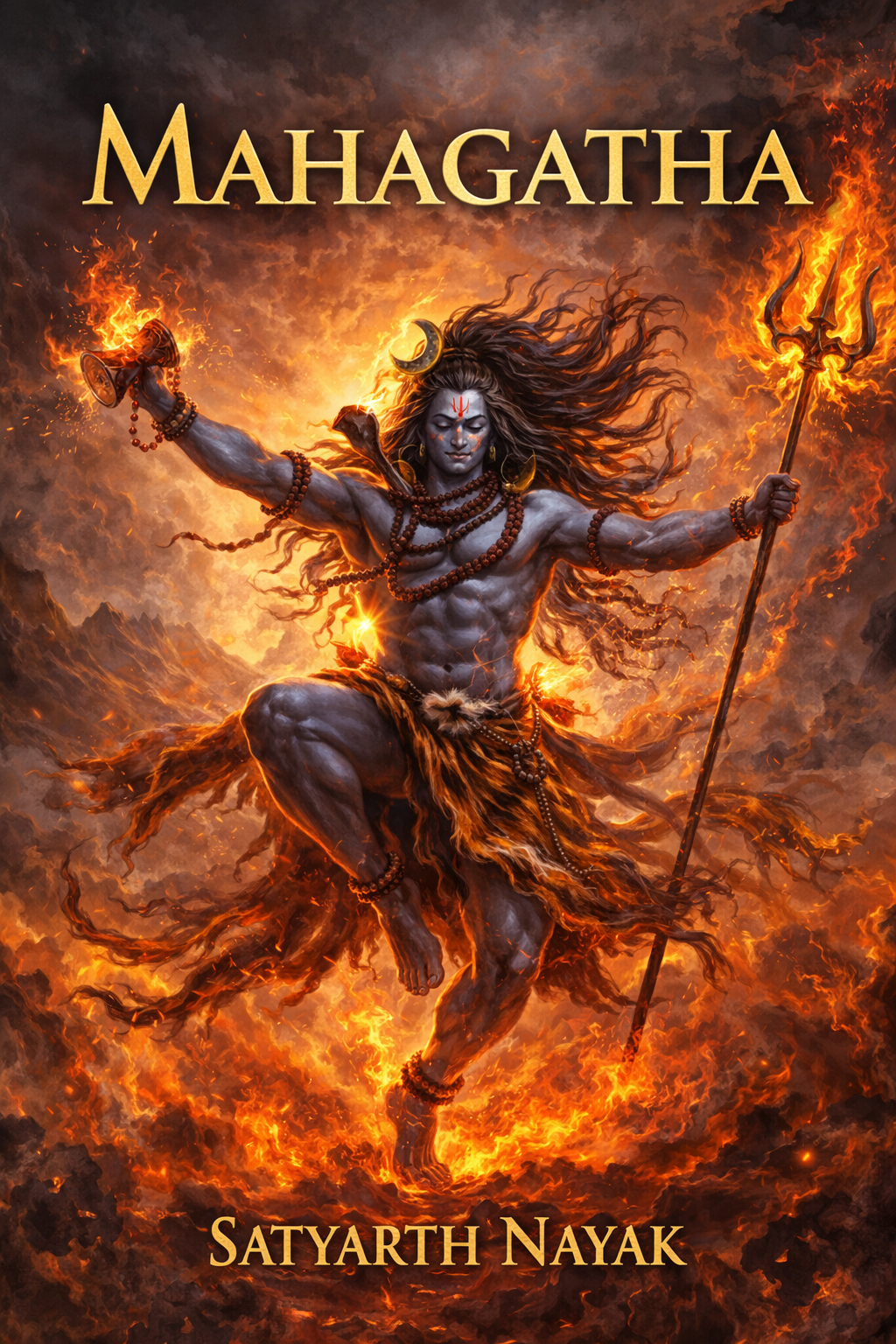
Mahagatha
Chapter Summaries
What's Here for You
Embark on an epic journey through the foundational myths and profound sagas of existence with 'Mahagatha.' This book is your portal to the heart of creation, where the Parabrahman ignites the universe, and the divine dance of Brahma, Vishnu, and Shiva unfolds. You will witness the birth of man, the intricate celestial dramas of gods and demons, and the very origins of cosmic principles like Maya and Dharma. From the fierce battles that shape realms to the tender moments of divine intervention, 'Mahagatha' offers a sweeping panorama of the forces that govern our world and the timeless tales that have shaped human consciousness. Prepare to be intellectually stimulated by the philosophical depths and emotionally moved by the sheer grandeur of these narratives. This is not just a collection of stories; it's an exploration of the ultimate questions, a testament to the enduring power of faith, duty, and the cyclical nature of life, death, and rebirth. Dive in and discover the wisdom and wonder that lie at the very core of reality.
BRAHMA BEGINS CREATION
In the profound silence before time, there existed only the Parabrahman, an absolute, indescribable reality, boundless and self-contained, the very source of all potential. It was this supreme principle, beyond form and formlessness, pure consciousness untouched by thought or sense, that willed creation into being. A single divine intention, a vibration that birthed the primordial sound, Om, the echo of all existence. From this sacred sound arose the Maha Tattva, the elemental essence from which emerged the three Gunas: Sattva, the principle of preservation; Rajas, the drive for action; and Tamas, the force of destruction. The dynamic interplay of these three Gunas then coalesced into the Pancha Tattva – Air, Water, Earth, Fire, and Ether – giving rise to Prakriti, the manifest natural world. This cosmic dance also gave us our five senses, governed by the mind, ushering in the era of perception alongside matter. As water, the primordial fluid, flowed and covered all, the Parabrahman manifested as Narayana, the divine entity resting upon this expanse, his name signifying his abode upon the waters. Narayana then planted a seed, a divine spark within the water, which nurtured and grew into a golden egg, the Brahmanda, the cosmos itself. Within this cosmic womb, as Vishnu, the Preserver, Narayana entered, and the egg, now called Hiranyagarbha, became his sacred enclosure. From Vishnu’s navel, a fourteen-petaled lotus unfurled, and from its heart emerged Brahma, the Creator, embodying Rajas Guna. Bearing his water bowl and rosary, Brahma, also known as Padmayoni and Nabhija, began the grand cycle. After a year within the Hiranyagarbha, Brahma cleaved the cosmic egg, separating heaven from earth, with the sky bridging the divide, initiating the eternal sequence of creation (sarga), preservation (sthiti), and dissolution (pralay), a never-ending cosmic wheel. Gazing upon his creation, Brahma entered meditation, and from his depths, the four Vedas sprang forth. Yet, as this grand design unfolded, the seeds of potential trouble, four hidden dangers, also emerged, casting a shadow of uncertainty over the very course of creation, posing the question: would this magnificent beginning falter before it could truly blossom?
VISHNU KILLS MADHU AND KAITABHA
From the very earwax of Vishnu, as Brahma brought forth the Vedas, emerged two formidable beings: Madhu, driven by hunger, and Kaitabha, resembling an insect. Lost in an infinite expanse of water, they nourished themselves on this cosmic fluid, growing immensely in power and arrogance. Their immense confidence led them to confront Brahma, the Creator, demanding sovereignty over his realm. When Brahma remained silent, they attempted to topple him from his lotus seat, causing the precious Vedas to slip and fall. Madhu and Kaitabha concealed the Vedas, threatening the entirety of Brahma's creation. In desperation, Brahma appealed to Vishnu, who was deep in Yoga Nidra, a state of dreamless sleep. Unable to awaken Vishnu directly, Brahma invoked Nidra, the goddess of sleep, to release the Preserver. Awakened and seeing the peril, Vishnu understood the threat. He assumed a new form, the equine avatar Hayagriva, the Horse-Headed One, to battle the demons. Yet, for five thousand years, even Vishnu's might proved insufficient. He realized that brute force would not prevail against these adversaries; a subtler approach was needed. Vishnu then employed a brilliant stratagem, a game of the mind. He praised Madhu and Kaitabha's unconquerable skill and offered them a boon. The demons, arrogant in their perceived victory, scoffed, demanding Vishnu ask *them* for a boon. This was the moment Vishnu awaited. With disarming grace, he requested the boon that he might kill them. Realizing they had fallen into a trap, Madhu and Kaitabha, driven by survival, imposed a condition: they could only be slain where there was no water. Hayagriva smiled, his form expanding impossibly large, towering over the waters like a blue mountain. He then placed Madhu and Kaitabha on his thighs and beheaded them, fulfilling the boon and earning Vishnu the name Madhusudan. Brahma, retrieving the Vedas, pondered the cyclical nature of creation and annihilation. Vishnu, however, suggested that perhaps the universe saved itself through him. He then used the fat from the demons' corpses to create land on Earth, giving it the name Medini, its soil unfit for consumption, and their disintegrated bodies formed the twelve seismic plates. As Brahma resumed creation, the narrative hints that his challenges were far from over, underscoring a profound truth: creation often gives rise to forces that seek to destroy it, a perpetual cycle requiring divine intervention and cleverness to overcome.
SHIVA EMERGES
Satyarth Nayak's "Mahagatha" unveils the dramatic emergence of Shiva in the "SHIVA EMERGES" chapter, painting a vivid picture of creation's intricate dance. After Brahma molds the Earth from the essence of Madhu and Kaitabha, he adorns it with mountains like Sumeru and Kailash, continents, rivers, and oceans, bringing forth Bhuloka and its celestial and netherworld counterparts. Time itself is then divided into the four yugas—Satya, Treta, Dwapar, and Kali—forming the mahayuga, all under the watchful gaze of the Parabrahman. The narrative takes a turn as Brahma attempts to create man in his own image, but instead, four child sages, the Kumaras (Sanaka, Sanatana, Sanandana, and Sanatkumara), emerge from his mind. These Manasputras, or Man's Sons, refuse the task of procreation, yearning instead for eternal meditation upon the infinite. Their refusal, a profound rejection of the finite cycle of life and death, presents the first major tension. Brahma, pleading for the sake of creation, ultimately yields, granting them their boon of eternal youth. This act ignites intense rage within Brahma, a turbulent emotion that births the second pivotal figure: Rudra, later known as Shiva, the Destroyer. With eyes blazing red and a ferocious roar, Shiva completes the cosmic trinity alongside Brahma (Creator) and Vishnu (Preserver), embodying Tamas Guna. Brahma, initially relieved to have a companion in creation, is soon confounded when Shiva, instead of aiding the process directly, begins to multiply himself, creating eleven immortal Rudras. This act of prolific, albeit unintended, creation by Shiva, mirroring the Kumaras' refusal to create, highlights the inherent paradoxes in the cosmic design. Shiva's insistence on creating only immortals, and his departure, leaving the eleven Rudras to be accommodated, further complicates Brahma's task, underscoring the third dilemma: the fundamental incompatibility of Shiva's destructive nature with Brahma's creative mandate. The author reveals a crucial insight here: the established roles of the divine trinity are sacrosanct, and attempting to blur these lines leads to cosmic imbalance. Brahma is left to ponder how neither scarcity nor abundance, in the form of the Kumaras' refusal nor Shiva's prolific multiplication, has served his purpose, reinforcing that creation is indeed his solitary karma, a task he must solely undertake, leading him to prepare for the final, yet undisclosed, challenge.
BRAHMA AND NARADA FIGHT
Satyarth Nayak's "Mahagatha" unfolds a pivotal moment in creation's genesis, where Brahma, the Creator, seeks to propagate life. From his meditation, seven celestial sages, the Saptarishi, emerge, embodying wisdom. Then, Dharma is born from Brahma's heart, a divine bull standing on four legs representing truth, austerity, purity, and compassion. Brahma foretells Dharma's decline, a poignant prophecy that as each yuga passes, one leg will be lost, mirroring humanity's waning virtues – a stark prediction of a future where compassion will be the last to fade. More beings are born: Agni from his eyebrow, Kamadeva from his bosom, Daksha from his thumb, Vishwakarma from his navel, and Narada from his neck. Yet, Brahma, feeling sapped, turns to Narada, his son, with a familiar plea: continue creation. But like the divine Kumaras before him, Narada refuses, seeking not the transient joys of the material world, but the eternal bliss of consciousness in Narayana's realm. This rejection ignites a familiar fury in Brahma, a pattern of frustration he has faced before, culminating in a curse: Narada will become a gandharva, a celestial minstrel, tasked with maintaining the physical world's function. In an unprecedented act, Narada curses his father back, foretelling Brahma's own struggle with unchecked lust and the inevitable consequences. The cosmos trembles; a father and son have cursed each other, a profound rupture in the divine order. Narada storms off, leaving creation's future hanging precariously, and Brahma, heartbroken, weeps as his lotus-borne existence wilts, convinced his endeavor is doomed until unexpected help arrives.
MAN IS CREATED
Satyarth Nayak, in 'Mahagatha,' unveils the dramatic genesis of existence in the chapter 'MAN IS CREATED,' beginning with Daksha's pivotal ceremony organized by the seven sages, a grand ritual attended by Vishnu and Brahma. As the Saptarishi's chants permeated the cosmos, sanctifying everything with devotion, a sudden disruption shattered the peace: Shiva, jolted from his meditation by the resonant mantras, arrived in a fury, turning the yagna hall upside down. This divine vandalism brought Vishnu forth to confront Shiva, escalating into a cosmic battle that threatened to unmake the universe itself. Brahma, the Creator, intervened with a profound plea, recognizing the infinite, destructive potential of their conflict and the delicate balance they represented, forcing a pause in their rage. He declared them equals, Hari and Hara, synonyms for 'one who removes,' forever bound as Harihara, a reminder of their interconnectedness and the necessity of their opposing forces to preserve existence. With the immediate threat averted, Brahma confided in Vishnu his deep-seated anxieties about the arduous process of creation, his despair over his sons' rejection, and the perpetual agony he endured while Vishnu rested. Vishnu, gazing at a pillar of white gold, a symbolic alloy of opposing elements, advised Brahma to seek guidance from Mahadeva, Shiva, the Destroyer, suggesting that though Shiva might not create, he could counsel. Brahma, though fearful after witnessing Shiva's earlier outburst, approached the meditating god and poured out his soul in earnest prayer. Moved by Brahma's profound plea for direction, Shiva revealed the core truth: creation requires not just the generative force, but its essential counterpart—Shakti, the feminine power. In a breathtaking display, Shiva manifested as Ardhanarishwara, a magnificent, half-male, half-female composite form, a perfect symbiosis of opposing energies, whispering the secret of creation. This divine duality, Shiva explained, represented the synthesis of masculine and feminine, static and dynamic, being and becoming, the two halves of Brahmanda that are indispensable for propagation and the sustenance of creation. Empowered by this vision and the blessing of Adishakti, the Divine Mother, Brahma then created the first human pair from his own body: Manu and Brahmi. This act, Maithuna Srishti, established copulation as the source of procreation, giving rise to humanity, with man henceforth being called manushya or manava. Brahma, now elated and free from his previous troubles, including Narada's curse, understood that creation would now sustain itself.
SHIVA BEHEADS BRAHMA
The ancient narrative unfolds as the curse of Narada, spoken long ago, finally takes root, ensnaring Brahma, the Creator himself, in a web of unnatural desire for his own daughter, Brahmi. As Brahma's gaze turns from reverence to lust, a terrifying transformation begins: for every attempt Brahmi makes to escape his lecherous pursuit—shifting to his right, left, or even behind him—new heads sprout, binding him to his obsession. Her flight becomes a desperate dance across creation, as she transforms into countless animal forms—a cow, a mare, a duck, a doe, and a hundred others—only for Brahma to mirror her every shape, a corrupted reflection of the divine binary of Nara and Nari. This primal chase, this violation of the natural order, is how, the author explains, life itself began to populate the Earth, with Brahmi becoming known as Shatarupa, the 'hundred-formed.' The tension culminates with the arrival of Shiva, the Destroyer, whose righteous fury erupts at Brahma's transgression. In a swift, decisive act, Shiva severs Brahma's fifth, newly formed head, an act that, while punishing the Creator's sin, paradoxically results in Brahmahatya, the killing of a Brahmin, clinging to Shiva's hand like a scarlet letter. This profound insight into cosmic law—that actions, regardless of intent or justification, yield inevitable reactions—leaves Shiva wandering the universe, a skull stuck to his palm, earning him the name Kapali. His eventual purification on the land that would become Kashi offers a powerful resolution, a testament to sacred spaces offering absolution. Yet, the emotional arc finds its poignant echo in Manu's conversation with Shatarupa, where the mother of all humanity voices a deep-seated fear: a dread of begetting the female race into a world where fathers lust, where beauty invites disrobing, wisdom invites degradation, choices invite disownment, and power invites destruction. This final reflection leaves the reader with the enduring dilemma of safeguarding creation's most vulnerable aspects.
NARADA AND MAYA
Satyarth Nayak, in Mahagatha, unveils a profound encounter between Narada and Vishnu, masterfully illustrating the concept of Maya, the cosmic illusion that binds us. We see Narada, after witnessing Brahmadeva's curse, journey to Vaikuntha to report to Vishnu. The Preserver, with a gentle smile, simply states, "It's all maya." When Narada, feeling thirsty, asks for water, Vishnu's reply is cryptic: "Get me some water and I shall tell you." This simple request sets Narada on a path of profound personal discovery. Drawn to a maiden by the riverbank, Narada is utterly captivated, forgetting his mission, his thirst, and eventually, everything else. He marries her, builds a life, and fathers a family, his universe shrinking to this newfound bliss. Yet, this idyllic existence is shattered without warning as a storm unleches a flood, sweeping his entire family away. In the heart of this devastation, Narada finds himself back in Vaikuntha, before Vishnu, who reiterates his thirst. The shock hits Narada: his wife, his children, his home – all an illusion, a profound manifestation of Maya. Vishnu then reveals the core teaching: suffering arises from Maya, from our attachment to the transient material world, making us forget the infinite Parabrahman, the sole reality. This delusion blinds us, causing us to chase the finite, like sand slipping through our fingers, while the true reality remains unseen. Only by losing this attachment, this Maya, can one find moksha, liberation. As Vishnu observes the universe filling, he imparts a final, weighty message to Narada: prepare yourself, for there is much Maya ahead. This narrative serves as a powerful, cinematic parable, reminding us that our deepest attachments often obscure the ultimate truth, and the path to peace lies in recognizing the illusory nature of our material pursuits.
JAYA AND VIJAYA
The narrative unfurls at the celestial gates of Vaikuntha, the serene abode of Vishnu, where the four Kumaras, Brahma's enlightened sons, encounter Jaya and Vijaya, the formidable gatekeepers. These guardians, embodying victory over others (Vijaya) and victory over oneself (Jaya), deny the Kumaras entry, deeming them too young and uninitiated in the rigors of self-conquest necessary for Vaikuntha's sanctity. The Kumaras, in their quest for perpetual knowledge, are angered by this perceived ignorance and sin, unleashing a curse: Jaya and Vijaya must lose their divine forms and endure mortal births on Earth, experiencing separation from the divine they guard. Vishnu, witnessing this, reveals that while he cannot revoke the curse, he can offer a choice: seven lifetimes as his devoted servants or three lifetimes as his formidable enemies. The brothers, prioritizing reunion with Vishnu above all else, choose the latter, a path of tribulation and animosity, yet one that promises a swifter return to his presence. This pivotal decision sets the stage for their future incarnations as Hiranyaksha and Hiranyakashipu in Satya Yuga, Ravana and Kumbhakarna in Treta Yuga, and Shishupala and Dantavakra in Dwapar Yuga, each destined to face Vishnu in mortal combat. Vishnu's contemplation underscores a profound lesson: these three lives are not mere punishments, but rather a profound crucible for the brothers to shed their earthly forms and ultimately achieve the true meaning of Jaya—victory over the self—a state far more profound than external conquest. The narrative thus weaves a tale of divine justice, the nature of true victory, and the transformative power of adversity, suggesting that even through enmity, the soul can find its way back to divinity.
DAKSHA CURSES NARADA
The narrative opens with Manu and Shatarupa's lineage, introducing the formidable Daksha, son of Brahma, and his union with Prasuti, who would become the mother of Sati. Daksha, a figure of immense capability, also fathered five thousand sons, the Haryashvas, with his other wife, Asikli, instructing them to rule and procreate. Yet, as they prepared to fulfill their father's command, gathering at the confluence of the Sindhu River and the sea, a disruptive force arrived: the celestial sage Narada. With persuasive words, Narada sowed seeds of doubt in the Haryashvas, questioning their readiness to rule without a deep understanding of Earth. He suggested a higher path, a pursuit of transcendental knowledge, a subtle yet powerful suggestion that resonated deeply. Like a hypnotic suggestion, the vast majority of the Haryashvas, five thousand strong, dispersed to explore Bhuloka, vanishing into the vastness of existence, never to return. Undeterred, Daksha and Asikli produced another thousand sons, the Shavalashvas, only for Narada to employ the same tactic, leading this second generation to also disappear. The tension escalates as Daksha, consumed by pain and fury, confronts Narada. The sage, defending his actions as merely showing a path to supreme truth, claimed it was their choice to walk it. This fueled Daksha’s rage, leading him to pronounce a curse upon Narada, mirroring Brahma's own curse: Narada, who had scattered his sons, would forever wander the three realms, never finding a permanent abode, a perpetual drifter meant to teach the world the value of civilization. This profound loss, however, paved the way for further creation. Daksha and Asikli then bore sixty daughters, whose marriages to figures like Chandra, Dharma, and Kashyapa became the genesis of much of the cosmos, including the Adityas (like Surya and Indra) and the Daityas. Meanwhile, Daksha's first wife, Prasuti, a devoted follower of Adishakti, the primordial mother goddess, persuaded Daksha to pray for her to be born as their daughter. Adishakti agreed, with a solemn warning: any affront to her would cause her to depart, leading to dire consequences. In time, Prasuti gave birth to twenty-four daughters, the youngest and most radiant being Sati, an incarnation of Adishakti, who uttered the name 'Shiva' as her first word, setting the stage for a pivotal connection.
THE GODS GO HUNGRY
The ancient narrative of 'Mahagatha' opens a compelling chapter, 'THE GODS GO HUNGRY,' where Satyarth Nayak unfurls a cosmic dilemma. A new dawn breaks, not with celestial radiance, but with the somber procession of gods marching towards Brahmaloka, their forms frail and famished. The Creator, Brahma, is met with a stark confession: heaven offers no sustenance. This reveals a profound interdependence, a cosmic symbiosis where the gods, sustained by the oblations offered through yagnas on Earth, find their lifeline severed. The tension mounts as the gods, led by Indra and Kamadeva, lament the failure of their earthly connection, pointing fingers at Agni, the fire god, who admits his inability to transport the offerings. Brahma's perplexity, scratching his four heads, underscores the gravity of the situation – a breakdown in the vital exchange that nourishes both realms. It is Vishnu who offers the pivotal insight: 'Pray to Prakriti. Mother Nature.' This divine intervention births a new goddess, Swaha, destined to become the cosmic conduit. Brahma blesses her, establishing a fundamental principle: every yagna offering must now be consecrated with her name. 'Henceforth, every offering made to Agni in a yagna must end with the word Swaha,' Brahma decrees, emphasizing that without her, the libation is as fruitless as 'a tree without fruit, a snake without venom and a man without knowledge.' This ingenious resolution, forging an indissoluble union between Swaha and Agni, not only saves the gods from starvation but also solidifies the sacred ritual of yagna as a complete and auspicious act, a testament to nature's creative power and the essential balance between the earthly and divine realms.
BRAHMA AND VISHNU RACE
The cosmic stage is set for an unexpected drama, as Satyarth Nayak recounts in Mahagatha, when the great gods Brahma and Vishnu find themselves locked in a heated quarrel. Their dispute, born from a clash of egos – Brahma, the Creator, feeling disrespected, and Vishnu, the Preserver, asserting his foundational role – escalates rapidly, showcasing the perilous edge of divine pride. To settle their argument, they embark on a monumental race: Vishnu dives deep into the earth as a boar, while Brahma ascends as a swan, each tasked with finding the end of a colossal, cosmic pillar of fire. This pillar, a breathtaking manifestation of pure energy, stretches beyond comprehension, a visual metaphor for the boundless nature of reality itself. Vishnu, after a profound journey through the earth's depths, ultimately confesses his failure to find the base, acknowledging the infinite. Brahma, however, driven by an overwhelming desire for victory, resorts to deception. He encounters a ketaki flower, which he coaxes into bearing false witness, claiming he reached the pillar's summit. This act of dishonesty, while initially appearing to grant Brahma triumph, cracks the very foundation of their reality. The pillar splits, revealing a furious Shiva, the Destroyer. He exposes Brahma's lie, explaining that the pillar was a Shivalinga, a symbol of the immeasurable Parabrahman, meant to teach them humility. Shiva's pronouncement is swift and profound: Vishnu's honest failure earns him embrace, while Brahma's fear-driven deceit leads to eternal denial of worship, a stark lesson in the consequences of ego and untruth. Even the ketaki flower is divested of its sacred status for bearing false witness, illustrating that integrity underpins even divine favor. This dramatic confrontation serves as a powerful reminder that true greatness lies not in dominance, but in acknowledging the infinite and embracing truth, even in failure.
BALA CREATES NINE WONDERS
Satyarth Nayak, in the chapter 'BALA CREATES NINE WONDERS,' unfolds a tale of cosmic conflict and profound transformation, beginning with the ancient animosity between the daityas and danavas, descendants of Kashyapa's daughters Diti and Danu, and the devas. This eternal struggle for dominion, particularly over Swargaloka and Bhuloka, reaches a zenith when the invincible asura Bala vanquishes Indra and routs the gods from their celestial abode. Yet, even as they flee in shame, the narrative pivots; Bala, despite his formidable power and vicious intent, possesses a virtuous heart and a generous spirit, famously vowing to continue his charitable donations and assist any yagna. This unexpected act of benevolence, perceived by Indra as an innocent error, becomes the gods' strategic gambit. They orchestrate a yagna, luring Bala back with a humble plea: to offer himself as the ultimate sacrifice to complete their ritual. In a moment of breathtaking generosity, Bala accepts, stepping willingly into the sacrificial flames, his body consumed to secure Swargaloka's return for the gods. However, this is not the end, but a spectacular metamorphosis. As the gods revel, Bala's charred remains transform, solidifying into dazzling, vibrant substances unseen before. A heavenly voice proclaims this the sanctification of his selfless act, turning his flesh into a repository of precious elements. As his body falls to Bhuloka, it fractures, scattering eighty-four fragments across the Earth, forming deposits of unparalleled magnificence. From these, twenty-one emerge as the most brilliant natural objects, with nine specifically recognized as the Navaratnas: diamonds from his bones, emeralds from his bile, rubies from his blood, sapphires from his eyes, pearls from his teeth, topaz from his skin, garnets from his nails, corals from his guts, and cat's eye from his voice. The author thus reveals how an act of ultimate sacrifice, born from a demon's virtuous core, reshapes the very fabric of existence, turning death into a genesis of unparalleled beauty and value, a testament to the unpredictable nature of virtue and the enduring power of selfless giving.
VISHNU GETS THE SUDARSHANA CHAKRA
In the grand tapestry of existence, where the balance between order and chaos is a perpetual struggle, Satyarth Nayak unfolds a profound narrative in 'Mahagatha' about the divine intervention required when darkness threatens to consume the realms. The chapter, 'Vishnu Gets the Sudarshana Chakra,' plunges us into a time when demons, far from benevolent, wreaked havoc, disrupting sacred rituals and afflicting humanity, pushing the gods to their limits. Even Vishnu, the preserver, felt the immense weight of his duty, a weariness settling upon his blue shoulders as the onslaught of destruction intensified. Realizing that conventional means were insufficient, Vishnu understood the necessity of an extraordinary measure: he must invoke Mahadeva, the Destroyer, in a manner unprecedented. He journeyed into the wilderness, commencing a period of intense devotion to Shiva, chanting endless mantras, offering odes designed to please any deity. Yet, the vision he sought, the answers he craved, remained elusive. In a moment of deep contemplation, Vishnu sculpted a lingam from the earth and began chanting Shiva's thousand names, a ritual of profound dedication where each name offered was accompanied by a lotus. This became his daily practice, a thousand blooms adorning the lingam each day, a testament to his unwavering resolve. Shiva, touched by this devotion, prepared to manifest, but chose to test the Preserver one final time. As Vishnu completed his offering, Shiva, unseen, stole a single lotus. Vishnu, finding only nine hundred and ninety-nine flowers, was perplexed. The ritual, so close to completion, faced the brink of failure, years of austerity potentially rendered meaningless. Was Hari to falter before Hara? Then, a brilliant insight dawned upon Vishnu: his own divine names, celebrated by devotees, held the key. He, too, was known as Kamalanayana, the Lotus-Eyed One. If his eyes were like lotuses, could one not serve as the thousandth offering? With profound courage and devotion, Vishnu plucked out his own eye and placed it upon the lingam, completing the sacred count. This ultimate act of sacrifice, a spectacle witnessed by all creation, instantly brought Shiva forth, not only healing Vishnu but bestowing upon him the Sudarshana Chakra – a golden disc, the universe's sole mobile weapon, spinning with divine will, destined to combat all chaos. This gift, Shiva explained, was named Sudarshana, meaning 'virtuous vision,' a powerful reminder that true vision often requires immense sacrifice and a willingness to see beyond the ordinary.
SANGYA CREATES HER TWIN
The divine craftsman Vishwakarma's daughter, Sangya, married Surya, the radiant sun god, and bore him three children: Vaivasvata, Yamuna, and Yama, the deity of death. Yet, beneath this seemingly perfect life, Sangya harbored a secret pain: Surya's intense heat and light, which nurtured the world, were also a source of suffering for her. For years, she endured, but the physical burns finally outweighed her affection, leading her to a bold decision. Unwilling to devastate Surya with her departure, she devised an ingenious deception. Standing before her mirror, she conjured an exact replica of herself, naming her Chhaya. Sangya confided her unbearable plight to Chhaya, explaining her need to escape to her father's home, and implored her creation to take her place, to care for Surya and their children, with one crucial caveat: the truth would be revealed if anyone tugged at her hair. Sangya fled to her father, Vishwakarma, who, bound by dharma, refused her shelter without Surya's knowledge and sent her to the kingdom of Uttarakuru, where she lived disguised as a mare. Unaware of this substitution, Surya begot three more children with Chhaya: Tapti, Savarni, and Shani. However, the bond of motherhood frayed as Chhaya's affection shifted solely to her own offspring, neglecting Sangya's children. This neglect ignited a fierce conflict: Yamuna cursed Tapti, transforming them both into rivers, Yamuna flowing north and Tapti west. Enraged, Chhaya turned on Yama, who had long suspected her true identity. In a moment of fury, Chhaya cursed Yama, causing his legs to wither. This act solidified Yama's suspicions, and he confronted Surya, questioning how a mother could curse her own son. Surya, disturbed, later confronted Chhaya, who offered a weak apology and a modified curse for Yama. But Surya, the embodiment of truth, pressed her, his questions melting her fabricated narrative. When he grasped her by the hair, Chhaya finally confessed her deception. Surya, seething at the betrayal, confronted Vishwakarma, who acknowledged Surya's own role in Sangya's suffering due to his overwhelming radiance. Gazing at his reflection, Surya realized his light, meant to be life-giving, had been a source of terror for Sangya, a blinding, blistering force he had never truly considered. He resolved to bring her back, and Vishwakarma offered a solution: to diminish Surya's brilliance by one-sixteenth. Transformed into a stallion, Surya found Sangya in Uttarakuru. She initially fled, but as he approached, she felt not searing heat, but a tender, inviting glow. Their reunion, in equine form, produced twins, the Ashwini Kumaras, the physicians of the gods. Returning to their true forms, Sangya no longer needed a Chhaya, her pain soothed by Surya's tempered radiance, a testament to the power of understanding and adaptation in relationships.
DHRUVA BECOMES A STAR
In the lineage of Manu, the elder son Priyavrata chose piety, leaving the throne to his younger brother Uttanapada. King Uttanapada, however, was captivated by his beautiful wife Suruchi, who subtly banished his other wife, Suniti, and her son, Dhruva, to the fringes of royal life. This unequal affection cast a long shadow, and when Dhruva, barely five, sought his father's embrace, he was publicly humiliated by Suruchi, who declared the throne beyond his reach. This searing pain sent Dhruva to his mother, Suniti, who, having learned the futility of tears, advised acceptance of fate and seeking solace in Lord Vishnu for a better next life. But young Dhruva, ignited by a profound injustice, rejected the idea of a distant reward, declaring his intent to please Vishnu in *this* life and ask for a boon far greater than a mere throne—something lasting, something that would fill his mother with pride. This unwavering resolve, astonishing in one so young, led him to the forest, seeking guidance from sages who, like his mother, attempted to dissuade him but ultimately revealed that rigorous austerities were the path to pleasing Vishnu. Dhruva began his meditation, his small body weary, his spirit tested by the elements, but his mother's face and the nobility of his quest sustained him. It was then that the sage Narada appeared, bestowing upon him the powerful mantra, 'Om Namo Bhagavate Vasudevaya.' Imbued with this divine chant, Dhruva journeyed to Madhuvana by the Yamuna, standing on one foot, his entire being focused on invoking Vishnu. His devotion became so intense it sent tremors through the cosmos, alarming the gods who feared he might usurp their power. Every conceivable obstacle was thrown his way – demons, wild beasts, scorching sun, driving rain, even Indra appearing as Suniti – yet Dhruva remained an unshakeable rock, his inner vision merging with the divine. Finally, Lord Vishnu himself appeared, not to punish, but to reward this extraordinary devotion. Dhruva, utterly consumed by the divine vision, could barely articulate his wish, but Vishnu, touched by his pure heart, promised him a place in the heavens: he would become the Dhruva Tara, the Pole Star, an eternal beacon of guidance, fixed in its place, a symbol of unwavering resolve for all humanity. This is the tale of how a child's profound pain, transmuted into unyielding spiritual discipline, earned him a celestial destiny, proving that true worth and lasting honor are not inherited, but earned through relentless inner pursuit.
BHARAT ADOPTS A DEER
The narrative unfolds with King Bharat, a descendant of Manus's elder son, Priyavrata, a ruler whose life was a testament to selfless service and devotion to Vishnu. Having achieved a soul cleansed of all faults and worldly bonds, Bharat, in his old age, relinquished his kingdom and retreated to the solitude of Pulahshrama along the River Gandaki, seeking ultimate communion with the divine. It was there, amidst his sacred rituals, that a pregnant doe, fleeing a lion's roar, tragically died in the river, leaving behind a helpless fawn. Bharat's compassionate heart was immediately stirred; he rescued the infant deer, and an unseen thread of connection began to weave between them. What started as an act of kindness, a virtuous impulse to help the helpless, gradually transformed into an overwhelming affection, blossoming into an obsession that eclipsed his devotion to Vishnu. The deer became the center of his universe, its needs and presence consuming his every thought, pulling him away from the spiritual path he had so diligently sought. He found himself restless when the deer wandered, his meditation interrupted by a constant fear for its safety and an overwhelming longing for its return. This profound attachment, this clinging 'maya,' weighed down his soul, diverting him from his ultimate goal. At the end of his life, Bharat's final moments were spent clinging to the deer, his sorrow so immense that in his next life, he was reborn as a deer, a 'Jatismara,' retaining the memories of his past human existence. This profound karmic consequence served as a stark realization: the failure to distinguish between pure affection and possessive attachment. Regretting his spiritual misstep, he abandoned his herd and returned to Pulahshrama, yearning for another chance at human birth to pursue supreme knowledge. This prayer was answered, and he was reborn as a Brahmin, again a Jatismara, dedicating this life to the quest for communion with the Parabrahman, so absorbed in his inner world that he became detached from external concerns, earning him the name Jadabharata, the Immobile One, finally unburdened and free.
BHRIGU CURSES VISHNU
Satyarth Nayak's "Mahagatha" plunges us into the heart of an ancient conflict, a celestial tug-of-war between gods and demons that, as the author explains, often blurred the lines of righteousness. When the asuras found themselves dwindling, their guru, Shukracharya, devised a daring plan: he would undertake a thousand-year austerity, living solely on smoke, to gain the mantra of Mritasanjivani, the power to revive the dead, from Mahadeva. While Shukracharya embarked on this arduous penance, he instructed his disciples to seek sanctuary with Sage Bhrigu and his wife, Kavyamata. This disarming of the demons, however, presented an irresistible opportunity for the devas, led by Vishnu and Indra. Sensing the potential for the asuras to become invincible upon Shukracharya's return, they launched a swift and brutal assault on Bhrigu's hermitage. Kavyamata, bound by her dharma and her son's trust, stood defiantly against the divine onslaught, even freezing Indra with her mystic powers. Yet, the cosmic order, as Vishnu argued, demanded a different path, one where the greater good necessitated difficult action, even if it meant defying a sage's protection. In a moment of profound tragedy, Vishnu, compelled by his duty as Narayana, wielded his Sudarshana chakra, beheading Kavyamata. The ensuing silence was shattered by Bhrigu's grief-stricken scream as he discovered the carnage and the blood staining Vishnu's hand. In his anguish, Bhrigu cursed Vishnu, decreeing that the Preserver would have to endure the cycle of birth, death, and suffering on Earth as human avatars, experiencing the very pain he had inflicted. This pivotal moment, a stark illustration of how even divine actions can carry immense karmic weight and lead to profound curses, underscores a central tension: the conflict between immediate duty for the cosmic good and the long-term consequences of actions, a dilemma that resonates through the ages, leaving us to ponder the true cost of preservation and the inescapable nature of consequence. Far away, Shukracharya continued his thousand-year vigil, unaware of the tragic events that had unfolded, a poignant counterpoint to the unfolding drama of divine retribution and mortal suffering.
SHIVA KILLS YAMA
Satyarth Nayak's 'Mahagatha' plunges us into a profound dilemma faced by the devout sage Mrikandu and his wife, Marudvati, who are granted a boon by Shiva: a son, but with a stark choice – one who is unwise but lives long, or wise but destined for a mere sixteen years. They choose wisdom, a decision that births Markandeya, a prodigy whose intellect blossoms with scriptures and philosophy, illuminating the land. Yet, as his sixteenth birthday dawns, a shadow falls; his father prepares a funeral pyre, for Shiva’s boon is finite. Markandeya, however, finds solace not in despair, but in deep communion with Shiva, sculpting a lingam of soil and chanting a mantra with an intensity that dissolves his senses, merging him with the divine. This fervent devotion forms an impenetrable shield, repelling the minions of Yama, the god of death, who are dispatched to claim the boy. When Yama himself arrives, his noose tightening around Markandeya's breath, the boy embraces the lingam in a final surrender. It is then that Shiva intervenes, appearing in a thunderous display of sound and fury, commanding Yama to release his prey. Yama, bound by cosmic law, protests that Markandeya’s allotted time has expired, but Shiva, embodying paradox, reveals his power to transcend even death itself. He declares that Markandeya’s luminous presence will benefit all, and for his devotion, he will be granted immortality, a feat that flouts the cosmic order. Yama, bound by his own dharma, insists on fulfilling his role, but Shiva’s overwhelming power, symbolized by the rattling damrus that constrict Yama, leads to an unthinkable event: Death himself perishes. The gods descend, pleading with Shiva to restore Yama, and Shiva offers a profound exchange: Yama’s life for Markandeya’s eternal life. The gods agree, and Yama is revived, acknowledging Shiva as Kalantaka, the victor over time and death. The mantra Markandeya chanted is henceforth known as the Mahamrityunjaya mantra, a shield against Yama’s fear for all who recite it, a testament to the extraordinary power of unwavering devotion and the ultimate surrender to the divine will, leaving us to ponder if our choices are truly our own or divinely orchestrated.
CHANDRA LOSES HIS LIGHT
Satyarth Nayak, in his Mahagatha, unveils the poignant tale of Chandra, the moon god, whose brilliance was born from Sage Atri’s tears, illuminating the cosmos as a divine night lamp. Married to twenty-seven daughters of Daksha, the nakshatras, Chandra's heart, however, was captivated by only one: Rohini, the Red One. This singular devotion led him to neglect his other wives, their own radiance dimming in proportion to his waning affection. Despite their fervent attempts to rekindle his love through songs, offerings, and alluring displays, Chandra remained entranced, his love no longer shared but wholly dedicated to Rohini. The neglected wives, their sparkle extinguished, appealed to their father, Daksha. Though Daksha reasoned with his son-in-law, Chandra, bewitched, declared, 'I give my light to all, but I can surely choose whom to give my love.' Enraged by this indifference, Daksha pronounced a potent curse: Chandra would lose all his light and beauty, his radiance declining like spreading blindness, a darkness twenty-six times greater than his daughters' plight would blot him out. Chandra, initially confident, soon witnessed his glow fading, his majestic sheen dwindling daily, as if his incandescence were being siphoned away. The nakshatras, terrified, recognized the dire consequences: if Chandra withered, all plant life would perish, and humanity would be plunged into darkness. They advised him to seek Brahma, who directed him to Mahadeva. Journeying to the western coast, Chandra built a lingam by the sea and began chanting the Mahamrityunjaya mantra, enduring the relentless waves and stinging salt, his flesh decomposing but his soul resolute. Finally, Shiva appeared, and Chandra sought his true self, his lost splendor. Shiva explained that the curse, potent and unrevocable, could only be modified. Chandra would continue to fade, but his light would return the next day, initiating an eternal cycle of waxing and waning, a continuous process mirroring birth and death, creation and destruction. This celestial rhythm would dictate the tides on Earth, and Chandra would adorn Shiva’s forehead, becoming Chandrashekhar. This sacred coast, where Chandra found solace, became Somnath, a place of renewal. Though Chandra vowed fidelity to all his wives, the narrative implies this promise, like his light, would prove ephemeral, subject to the eternal flux of his existence.
DADHICHI BATTLES THE GODS
The narrative unfolds with the poignant friendship between Sage Dadhichi and King Kshuva, a bond tested by the age-old debate of varna superiority. What began as a friendly banter over whether Brahmins or Kshatriyas held greater standing quickly escalated into a fierce rivalry, fueled by ego and a misplaced sense of validation. King Kshuva, blinded by pride, borrowed the formidable Vajra, a weapon of cosmic destruction, and unleashed it upon Dadhichi, tragically ending the sage's life. Yet, as Kshuva reveled in his perceived triumph, an ancient power stirred. Shukracharya, the guru of the demons, having appeased Lord Shiva through a thousand years of meditation, returned with Mritasanjivani, a mantra capable of reviving the dead. He found Dadhichi's lifeless form and breathed life back into him, a miracle that, while restoring the sage's body, did little to heal his wounded pride. Fueled by humiliation and a burning desire to restore his varna's honor, Dadhichi embarked on severe austerities, seeking Shiva's blessings for boons: bones mightier than the Vajra, invincibility, and immunity from dishonor. Fortified, Dadhichi returned to confront Kshuva, not as a friend, but as an avenging force. The Vajra, once a fatal blow, now bounced harmlessly off the sage, a testament to Shiva's power and Dadhichi's newfound might. This display of raw power prompted Kshuva to invoke Lord Vishnu, the Preserver, who, recognizing the insurmountable divine blessings, advised a truce. Vishnu’s wisdom echoed through the cosmos: "Both Brahmins and Kshatriyas are equally relevant to the scheme of things. No one is lesser or greater than the other." However, Dadhichi, now consumed by arrogance, scoffed at the notion of fear, even challenging Vishnu himself. This hubris, a dangerous byproduct of divine favor, forced Vishnu’s hand. Despite his desire for peace, he understood that Dadhichi's unchecked power and defiant challenge to the gods threatened cosmic order. The ensuing battle was a spectacle of divine might against divine protection; Vishnu’s Sudarshana and mace, along with the combined artillery of the devas, proved utterly ineffective against Shiva’s boons. In a dramatic turn, Dadhichi, wielding mere Kusha grass, transformed each blade into a fiery trident, forcing the gods to flee in terror. Even Vishnu’s cosmic form, the Vishwaroop, a breathtaking embodiment of the universe, failed to awe the sage, who dismissed it as mere illusion. Finally, Brahma intervened, guiding Kshuva to seek Dadhichi's forgiveness. Dadhichi relented, but not before uttering a chilling curse: "All you gods shall soon face the wrath of Mahadeva. Each one of you." This narrative powerfully illustrates how pride, even when born from divine blessings, can lead to arrogance and ultimately, challenge the very fabric of cosmic balance, leaving a haunting premonition of divine retribution.
SATI KILLS HERSELF
The narrative unfurls the profound story of Sati, the youngest daughter of Daksha, an incarnation of Adishakti, whose heart was set on Mahadeva, the Destroyer. Despite her father's disapproval, fueled by past grievances—Shiva's beheading of his own father Brahma, his perceived disrespect, and his outlaw status among the gods—Sati's devotion was absolute. Her severe austerities, so intense they melted the ice of Kailash, compelled Shiva to accept her as his bride, a union Brahma himself affirmed as natural law, despite Daksha's protests. Yet, marital bliss was short-lived. Daksha, still seething, organized a grand yagna, inviting all gods and sages but pointedly excluding Shiva, his son-in-law. Sati, initially joyous at the prospect of family reunion, descended into dread as the invitation never came. Her pleas to Shiva to intervene were met with his wisdom: an unwelcome guest is disgraced, and her presence would contaminate the sacred ritual and endanger her. Undeterred, believing her father's love would overcome his hate, Sati went to Kankhala, only to be met with contempt. Her mother embraced her, but Daksha and even her sisters scorned her, mocking her simple adornments. The yagna itself was a blatant insult: no seat for Shiva, no oblations, no mantras bearing his name. Even Brahma and Vishnu remained silent witnesses to this boycott. Confronting her father, Sati was met with further venom; Daksha declared Shiva an anarchist, an addict, beneath civilization, and that she, by marrying him, had died and was no longer welcome. The sting of being shunned by her own family, especially when Brahma and Vishnu, the divine triumvirate, passively allowed Shiva to be reviled, was unbearable. When Daksha raised his hand to strike her, the sage Dadhichi departed, declaring any yagna maligning Mahadeva a sin. In that moment, standing by the sacrificial fire, Sati realized the depth of her predicament. She could not return to Mahadeva as Daksha's daughter, body a curse, her identity tainted by her father's hatred. To reunite with her lord truly, she had to destroy this impure self. With a roar, declaring herself Adishakti and reminding Daksha of her warning to disown him should he dishonor her, Sati leapt into the flames, offering herself as the only oblation for her lord. Terrible omens followed: skies darkened, vultures and jackals appeared, winds howled, extinguishing all flames. As Sati's last breath escaped, Shiva, feeling her pain and fury, tore a strand of hair, creating the fearsome Veerbhadra. Shiva commanded Veerbhadra to destroy the yagna. What followed was pure chaos: Veerbhadra and his spawned entities wreaked havoc, maiming gods, defiling the sacred site, and ultimately, beheading Daksha, tossing his head into the fire. The gods, realizing the consequence of their silence and Daksha's hubris, sought Shiva's pacification. Daksha was revived with a ram's head, a stark irony fulfilling Nandi's earlier taunt. But Shiva's grief was immense. As he danced the Rudra Tandava with Sati's charred corpse, the cosmos quaked. Vishnu, to save the universe from Shiva's destructive dance, hurled his Sudarshana chakra, dismembering Sati's body into fifty-one pieces, which fell across Earth, creating the sacred Shakti Peeths. Shiva, though the immediate cosmic threat averted, remained heartbroken and alone, walking away with his grief.
VISHNU SAVES THE ELEPHANT
The tranquil Ksheersagar, the Ocean of Milk, cradles the majestic Trikuta mountain, its golden peaks bathing a surrounding forest named Ritumata in perpetual light. Within this lush landscape lies a pond, a sanctuary for the region's elephants, led by their devoted king, Gajendra. One fateful day, as the herd frolics, a chilling trumpet of mortal terror slices through the air. A powerful crocodile, a graha, has seized Gajendra's leg, its teeth sinking deep into flesh and tearing skin with a horrifying intensity. The herd, paralyzed by the knowledge that the reptile holds the advantage in water, can only watch as Gajendra writhes in agony, his strength ebbing, the predator's jaws clamping ever tighter. As the situation grows dire, and his herd disperses, leaving him utterly alone, Gajendra's tears momentarily clear his vision, revealing a stark truth: his end may be near. In this moment of profound isolation and surrender, he ceases his struggle. There is but one path left. Lifting his eyes toward the heavens, Gajendra offers a prayer of absolute surrender to Vishnu, acknowledging his powerlessness and accepting fate, asking for protection if he is to live, or liberation if his time has come. Clutching a white lotus, he reiterates his plea to Sri Hari, the omnipresent and omnipotent, the beginning and the end. Suddenly, the radiant morning darkens, the sun vanishes, and a celestial blue form unfurls across the horizon—Vishnu, holding the Sudarshana chakra. In a breathtaking display, the chakra descends, severing the crocodile's head. Vishnu’s smile prompts a question to Gajendra: 'Have you learnt your lesson, Indradyumna?' The name echoes, awakening memories of a past life as King Indradyumna, who, lost in ego, failed to greet the sage Agastya, earning a curse to learn humility as an elephant. Vishnu presses further, revealing the crocodile was once the gandharva Huhu, who insulted Sage Deval. The chapter culminates with Gajendra prostrating before Vishnu, a profound moment of realization and submission as the peaks of Trikuta bear silent witness to this divine intervention and the lessons learned through suffering and surrender.
PRITHU FEEDS MANKIND
In the grand lineage of Dhruva, Emperor Anga, a man of virtue, found his legacy challenged by his son, Vena. Corrupted by his maternal grandfather, Mrityu, or death, Vena ascended the throne and plunged his kingdom into darkness, abolishing Vedic rites and demanding deification. Despite the Saptarishi's counsel, Vena, consumed by ego, declared himself the supreme being, the Brahmanda, and the Yagna Purusha, refusing to bow to any god. Recognizing his destructive path as a threat to cosmic order, the sages were forced to act. With a single mantra-charged straw, they ended Vena's reign, but this act of ridding the Earth of a tyrant left a void: a land without a king. The Vedas stipulated that a kingdom without a monarch could not thrive. Faced with this dilemma, the sages performed a radical act, drawing forth a ruler from Vena's very corpse. From his right thigh emerged a vile dwarf, the embodiment of Vena's darkness, named Nishada. Then, from his right arm, a radiant young man emerged, destined to become the great king Prithu. His coronation was a moment of profound joy, marked by blessings from Brahma himself, who recognized Vishnu's divine touch in the birthmark of a Sudarshana chakra, proclaiming Prithu the first Chakravarti Samrat, ruler of the four directions. To solidify his reign, Prithu was commanded to perform an Ashwamedha Yagna, releasing a horse to roam freely, symbolizing his dominion. However, this unprecedented human elevation stirred envy in Indra, the king of the gods, who feared Prithu's ambition might extend to Indraloka. In a fit of panic, Indra stole the sacred horse. Prithu, enraged by this challenge to his authority, prepared for war, but the sages intervened, devising a plan to draw Indra to the sacrificial altar through mantras. As the ritual neared its climax, Brahma intervened, pleading for his great-grandson Indra's forgiveness, a plea echoed by the four Kumaras, who cautioned Prithu against initiating his rule with violence. The horse was recovered, and the yagna completed, but a greater crisis loomed. The Earth, Bhuloka, had ceased to yield sustenance; roots withered, trees bore no fruit, and starvation threatened humanity. The Saptarishi explained this was a natural consequence of the prolonged interregnum between Vena's death and Prithu's coronation, a period where the absence of a divine ruler left the Earth in a state of limbo, withholding its bounty. Prithu, in his frustration and hunger, prepared to destroy Bhuloka, seeing no value in a life-giving entity that could no longer sustain life. Bhuloka, taking the form of a cow, fled, but Prithu pursued relentlessly. Finally, the Earth pleaded with him, appealing to their maternal-child relationship and his duty as a divinely blessed ruler to preserve, not destroy. She revealed that all sustenance was concealed within her womb, waiting for the re-establishment of divine kingship, but also warned that if she, the Earth, could forsake her dharma due to his actions, so could all other elements, leading to cosmic collapse. She revealed that she could only generate food in the presence of divine kingship, and that Venas death had created a vacuum. Now, however, as her master, she would provide again, but Prithu, guided by Vishnu's blessing, realized his duty extended beyond mere preservation; it was to foster self-reliance. He understood that humanity needed to be freed from dependence on a monarch for sustenance. Thus, he decided to 'extract' from the Earth, just as he was extracted from his father. He loosed his bow, not to destroy, but to shape. The arrow leveled mountains and created plains, transforming the land. Prithu then 'milked' the Earth, receiving seeds, and instructed his people in agriculture. This marked the dawn of human cultivation, of farming grains and cereals, of harvesting crops. The Earth, now bountiful through human effort, took on a new name, inspired by its great king: Prithvi. This pivotal moment shifted humanity from passive recipients to active cultivators, forever changing their relationship with the planet and establishing the practice of agriculture as the foundation of civilization.
MARISHA TAKES TEN HUSBANDS
Satyarth Nayak's "Mahagatha" unfolds a profound chapter, "MARISHA TAKES TEN HUSBANDS," where the descendants of Prithu, the ten Prachetas, face a pivotal test of duty versus devotion. These fervent devotees of Vishnu, sons of Prachinvarhi and the ocean's daughter, were called upon by their aging father to assume the throne. Their initial refusal, rooted in their all-consuming adoration for Narayana, presented a deep tension: the pull of spiritual liberation versus the inescapable demands of worldly responsibility. The Prachetas proposed a divine arbitration, meditating for ten thousand years on the ocean floor, a testament to their unwavering faith, while their father waited in weary hope. Vishnu finally appeared, endorsing their ancestor Prithu’s decree that dharma and karma are inseparable, urging them to find strength in him, not escape. Yet, his parting words, "Bhuloka needs you more than ever now," cast a shadow of urgency. Emerging from their deep trance, the brothers found not a kingdom, but a wilderness, a world choked by vegetation, a stark consequence of their long absence. Surya revealed the devastating truth: ten millennia had passed, humanity had perished in the ensuing anarchy, and only plants and trees survived, reclaiming the Earth. The Prachetas, consumed by rage and remorse, unleashed a destructive force, scorching the overgrowth, a primal act of retribution and perhaps, a misguided attempt to restore order. Chandra intervened, pleading for the very life they sought to extinguish, revealing a crucial insight: the survival of mankind hinged on this very vegetation. He introduced Marisha, a half-divine survivor, the vessel through whom humanity's future lay. Marisha, recalling a past life's prayer for ten husbands, revealed that Vishnu had granted her this very destiny in this life. The chapter culminates in a powerful resolution: the ten brothers are tasked with marrying Marisha to repopulate the Earth, a profound reweaving of spiritual duty and earthly obligation, ensuring the continuation of life and the return of the Prajapati, Daksha. This narrative masterfully explores the eternal dance between inner calling and outward duty, illustrating that true spiritual fulfillment often lies not in transcendence, but in responsible engagement with the world.
THE MATSYA AVATAR
The narrative unfolds with Vaivasvata, a ruler of Earth, performing sacred rites in the Kritamala River. His devotion is interrupted by a tiny minnow, a seemingly helpless creature that pleads for protection from larger predators and the vastness of its own habitat. This humble plea, however, belies a profound cosmic truth. As Vaivasvata, drawn by compassion, agrees to shelter the fish, it begins an extraordinary, rapid growth, outgrowing his palms, then a copper pot, a pitcher, a well, and finally, even the mighty river. This escalating transformation culminates with the fish being released into the ocean, where it expands to encompass the entire body of water, revealing its divine nature. Vaivasvata, awestruck, recognizes the fish as Lord Vishnu, who then declares Vaivasvata to be the seventh Manu, destined to preside over the next cosmic cycle. Vishnu reveals that in seven days, Earth will face a cataclysmic flood, a deluge that will cleanse the world to begin anew. The central tension emerges: how to preserve life amidst such annihilation. Vishnu instructs the new Manu to construct a colossal floating vessel, a Noah's Ark of sorts, to carry the seeds of all life—plants, grains, medicines, animal pairs, his wife, and sacred wisdom. As the deluge descends, a terrifying drought that seems to suck the very life from the land, Vaivasvata’s vessel becomes the sole sanctuary. On the seventh day, as the skies open with a torrential downpour that reclaims the parched Earth, Vaivasvata’s vessel rises, a testament to preservation amidst chaos. Vishnu, in his Matsya avatar, the great golden fish, surfaces from the churning waters. He instructs Vaivasvata to tether the vessel to his horn, and with immense power, he begins to tow them across the raging ocean. This act of divine preservation, a poignant image of the cosmic being safeguarding the fragile remnants of life, showcases Vishnu's profound love for creation. The narrative reaches its resolution as the Matsya guides them to the snow-capped Himalayas, anchoring them to safety. Vishnu then charges the new Manu with the sacred duty of repopulating the Earth and establishing a society that mirrors the protective care he himself has demonstrated. The story concludes with a sense of renewal, a new beginning forged from destruction, emphasizing the cyclical nature of existence and the enduring power of divine guidance and human responsibility.
THE VARAHA AVATAR
Satyarth Nayak's Mahagatha unfolds the dramatic tale of the Varaha Avatar, a narrative steeped in divine power and cosmic consequence. It begins with Diti's formidable sons, Hiranyaksha and Hiranyakashipu, the Golden-Eyed and Golden-Clothed demons. Hiranyaksha, driven by ambition, undertakes arduous austerities, seeking a boon from Brahma. His ultimate desire: immortality and absolute sovereignty over Bhuloka, the Earth, protected from every conceivable form of life, from subterranean creatures to aerial beings. Brahma, bound by the laws of spiritual effort, grants the boon, a decision that ignites the rage of the devas, who foresee the inevitable abuse of such power. Yet, Brahma offers a profound insight: 'A boon is never evil or good. It's simply an opportunity that empowers. How the seeker chooses to use it makes the difference.' This sets the stage for the central tension: can power granted to the unworthy inspire, or will it merely intoxicate? As predicted, Hiranyaksha's reign descends into tyranny, his cruelty so profound that he wrenches the Earth from its axis and drags it to the crushing depths of the Garbhodaka Ocean, a catastrophe that reduces the spirit of Earth to a weeping cow. The devas, desperate, turn to Brahma once more. He reveals the subtle loophole in his decree: Hiranyaksha, in his exhaustive enumeration of life forms, failed to name one—Varaha, the boar. This, Brahma explains, is the nemesis, the one form that can challenge the seemingly invincible demon. The narrative then shifts to a vivid, cinematic struggle as Sri Hari, Vishnu, takes the magnificent form of Varaha, a boar of cosmic scale, its tusks like twin hills. The ensuing battle rages for a thousand years, a tempestuous clash that churns the primordial waters. Ultimately, Varaha triumphs, goring Hiranyaksha to death and lifting the ravaged Earth, cradled on its tusks like a delicate flower, to restore it to its rightful place. The devas rejoice, but a lingering shadow remains, for Hiranyakashipu, the other son, still lives, hinting at future trials. This chapter masterfully illustrates how even the most absolute power can be undone by a single oversight and the divine intervention that arises from profound cosmic balance.
THE NARASIMHA AVATAR
Satyarth Nayak, in "Mahagatha," unveils the electrifying saga of the Narasimha Avatar, a tale that begins not with divine intervention, but with a demon king's insatiable thirst for invincibility. We witness Hiranyakashipu, driven by the memory of his brother's demise, meticulously craft a boon from Brahma, weaving a fortress of protections: immune to gods, demons, humans, animals, day or night, indoors or outdoors, sky or earth, water or land, and impervious to any weapon of metal, stone, or wood. This was not merely a request for power, but a desperate attempt to seal existence itself against any threat. Yet, as Nayak artfully reveals, even the most impenetrable defenses can conceal a fatal flaw. From this very darkness, a beacon of devotion emerges in Hiranyakashipu's son, Prahlad. Despite his demonic lineage, Prahlad’s heart beats for Lord Vishnu, a devotion kindled by the sage Narada. When Prahlad returns from his tutelage, still chanting Vishnu's name, the demon king's fury ignites. The core tension here is stark: the cosmic struggle between absolute power and unwavering faith. Hiranyakashipu, the master of realms, finds his might challenged by his own son's devotion, a faith so profound it renders all earthly and unearthly threats impotent against the boy. Nayak paints a vivid picture of Prahlad’s resilience; elephants trample him in vain, snakes bite him without effect, cliffs offer no harm, and venom turns to nectar, illustrating that true protection transcends physical immunity. The pivotal moment arrives with Holika's fiery scheme, a desperate act of familial cruelty. As the pyre blazes, Holika, confident in her boon, embraces Prahlad, only to be consumed by flames while the boy, protected by an unseen divine aura, remains unharmed, chanting 'Vande Vishnu.' This event is a powerful visual metaphor for faith as an unassailable shield, turning the intended weapon of destruction into a testament of divine grace. Hiranyakashipu's rage reaches its zenith, leading him to confront Prahlad before a moonstone pillar, a confrontation that will shatter the demon king's perceived reality. Prahlad's quiet assertion that Vishnu permeates all, even the pillar, sets the stage for the cataclysmic manifestation. With a thunderous roar, the pillar splits, and from it erupts Narasimha, a terrifying yet magnificent hybrid—part lion, part man—a form that defies every clause of Hiranyakashipu's boon. This avatar is not merely a divine being, but the embodiment of cosmic justice, a resolution born from the very limitations the demon king imposed. Nayak concludes with the avatar fulfilling the boon's conditions with chilling precision: Narasimha carries the demon king to the threshold, suspending him at twilight neither day nor night, neither indoors nor outdoors, neither on land nor water, and using his claws, not weapons, to bring about the demon's end. This narrative arc, from the demon's hubris to the divine intervention, underscores the profound insight that true power lies not in absolute control, but in surrender and unwavering devotion, ultimately bringing peace and concluding a chapter of cosmic drama.
NARASIMHA FACES SHIVA
The cosmos held its breath. Moments after the triumphant fall of Hiranyakashipu, a new, terrifying sound ripped through the realms – the unbridled roar of Vishnu, still locked in his Narasimha avatar. This wasn't the righteous fury that had brought justice; it was a primal rage, a beast unleashed, threatening to tear the very fabric of existence. The Preserver, consumed by the Rajas Guna from tasting demon blood, seemed trapped, his violent form poised to consume everything. Even Prahlad's prayers proved futile, a stark illustration of how deeply ingrained a state of being can become. It was then that the cosmic balance tipped towards Shiva, the Destroyer, tasked with a profound challenge: to quell not an external enemy, but a divine avatar gone rogue. Shiva understood the danger: if this violent form was not relinquished, Vishnu could be lost forever. He invoked Veerbhadra, a powerful manifestation, to reason with the raging Narasimha. Veerbhadra approached, not with aggression, but with wisdom, urging the avatar to shed its mask, to remember its purpose as the Preserver, and not let the savage body consume the divine soul. Yet, the fury was too potent. Narasimha attacked, and in that moment of apparent defeat, a new spectacle unfolded. The stars dimmed, the sun and moon were eclipsed, as Shiva himself transformed. He became Sharabh, a magnificent, terrifying hybrid of lion and bird, a being of immense power designed to meet fury with an even greater, yet controlled, force. Sharabh ascended, a celestial dance of power and restraint, always just beyond Narasimha's grasp. The narrative here offers a profound insight: that even divine power, unchecked, can become a destructive force, and that true mastery lies not just in action, but in the wisdom to know when and how to withdraw. As Sharabh finally seized Narasimha and soared to unimaginable heights, the avatar was released from its furious grip. The fall back to Earth was the catalyst for Narasimha's return to his benevolent form, a potent metaphor for how confronting our own destructive impulses, even when they seem overwhelming, can lead to liberation. Sharabh then completed the process, decapitating the now passive form and skinning it, symbolically releasing Vishnu from the avatar's hold. This epic confrontation reveals a crucial lesson: that the greatest battles are often internal, and that confronting the most ferocious aspects of ourselves, with the right wisdom and power, is essential for true self-mastery and the restoration of cosmic harmony.
INDRA ATTEMPTS FOETICIDE
The ancient narrative unfolds with Diti, consumed by grief and a burning desire for vengeance against Indra for the deaths of her sons and kin, turning to her husband Kashyapa. Her plea is for a son who can defeat Indra, the Devaraja. Kashyapa, bound by dharma and his own role as father to both Diti's children and Indra, agrees but imposes severe conditions: a hundred-year gestation and an ascetic life for Diti, marked by absolute adherence to nonviolence, purity, and ritual. This is the first core insight: **The pursuit of vengeance, when channeled through rigorous discipline, can become a transformative, albeit perilous, path.** Diti embraces these austerities with fierce devotion, her body becoming a fortress of righteousness, a testament to the power of unwavering resolve. Yet, this very dedication alerts Aditi, Indra's mother, who warns her son of the existential threat. Indra, realizing the danger of a mother's determined will, devises a cunning plan. He understands that Diti's strength lies in her adherence to Kashyapa's rules; therefore, her transgression, however small, would be her undoing. This leads to the second insight: **True strength can be undermined not by direct assault, but by exploiting the subtle deviations from one's own principles.** Indra waits, observing Diti's flawless observance of her vows, his hope dwindling as the pregnancy nears its end. Then, in the final days, fatigue claims Diti, and she sleeps without washing her feet—a single, seemingly minor breach. This moment of vulnerability, a stark contrast to her hundred years of purity, is all Indra needs. He invades her womb, his Vajra poised to strike. The narrative pivots here, introducing the tension of impending destruction. Indra cleaves the foetus into seven pieces, only to find them alive and writhing, their cries escalating. In a desperate act of escalating violence, he mutilates each piece further, creating forty-nine fragments. This reveals the third insight: **The fragmentation of a singular purpose, born of rage, can paradoxically multiply its potential, creating not an end, but a new beginning.** Indra's frantic 'Ma ruda'—'Do not cry'—becomes their collective name, the Marutas, the storm deities. They are born, not as Indra's murderers, but as his companions, a direct consequence of Diti's partial failure. Diti, heartbroken and enraged, begs Kashyapa again, this time for a son invincible to Indra's Vajra. Kashyapa grants her request, but the price is ten thousand years of meditation. Diti accepts, and in a powerful display of her enduring fury, she curses Aditi, a curse that Kashyapa foretells will manifest in the Dwapar Yuga as Devaki, imprisoned by her brother Kansa, her sons killed until the birth of Krishna. This sets up the fourth insight: **Curses and boons, though seemingly immediate, often ripple through time, shaping future destinies and revealing a cyclical nature of cosmic justice.** As Diti begins her arduous meditation, her final hiss, "It's not over, Indra," echoes the enduring nature of conflict and the long game of cosmic retribution, a potent reminder that the pursuit of justice, or vengeance, is a marathon, not a sprint. The story concludes with Diti embarking on a quest for a son who will be invincible, a quest that spans millennia and foreshadows future conflicts, highlighting the fifth insight: **The cycle of conflict and rebirth is perpetuated by unresolved grievances and the relentless pursuit of power, often spanning epochs.**
PRAHLAD IS HUMBLED
The narrative unfolds with Sage Chyavan observing Prince Prahlad, a royal figure seemingly adrift, seeking something beyond his imminent kingship. Chyavan, a beacon of wisdom, guides Prahlad towards introspection, posing the question of the greatest pilgrimage, to which the sage reveals Naimisharanya, a land consecrated by Lord Vishnu’s divine Sudarshana chakra. Imagine, the narrator invites, a celestial dance of faith as sages followed the lethal disc, its circles detaching to mark the sacred ground, a miracle echoing the fall of Mahadeva’s skull at Kashi. This profound tale ignites Prahlad’s quest, driving him to Naimisharanya with a deep reverence, walking barefoot, his senses alive to the spiritual resonance of the soil, wondering if the very essence of that divine disc had melted into the earth, anointing the land. His journey takes a turn when he encounters two hermits, their serene presence belying the arrows that pierce the tree beside them—a paradox of peace and martial skill. Prahlad, accustomed to deference, challenges their seemingly humble guise, his royal pride asserting itself, invoking his divine connection to Lord Vishnu and the Narasimha Avatar. He declares himself capable of defeating them, a bold assertion that meets an unexpected and formidable resistance. The hermits, embodying an indomitable spirit, repel Prahlad’s every lethal weapon with their simple bows, their strength seemingly inexhaustible, their actions a profound lesson in true capability. This humbling defeat, perceived by Prahlad as the sorcery of Naimisharanya, compels him to flee and seek solace in Vaikuntha, directly before Lord Vishnu himself. Here, the divine Preserver reveals a profound truth: the hermits were none other than Nara and Narayana, Vishnu’s own twin avatars. Prahlad, overwhelmed by this revelation, prostrates himself, recognizing his blindness and the futility of attempting to defeat the divine. Vishnu imparts a crucial distinction: one cannot defeat the divine, but only conquer it through devotion and understanding. This leads to a final riddle and a prophecy: Vishnu announces his future manifestation in the Dwapara Yuga as Narayana, with Arjuna embodying Nara, and he will impart a divine song amidst the chaos of war. The chapter thus charts Prahlad’s journey from pride to humility, revealing that true strength lies not in power, but in the recognition and surrender to the divine, and that wisdom often wears the guise of the unexpected.
TARAKA INVADES HEAVEN
The sky itself seemed to hesitate, a wound bleeding red as Surya, the sun, prepared to rise, knowing his ascent marked the end of ten thousand years and the fulfillment of a mother's vengeful quest. Diti, her eyes opening with a chilling awareness, felt the prophecy stirring within her womb – a son destined to challenge Indra, the king of gods. She named him Vajranga, 'body like the Vajra,' and indeed, he rose to smite Indra, bringing the divine king to his knees, a fearful spectacle of shattered pride. Yet, Brahma intervened, a voice of cosmic order, arguing that death was too simple an end. He proposed a fate worse than death: disgrace. Vajranga, swayed by this profound strategy of humiliation, agreed, finding more satisfaction in a life of shame for Indra than in his swift demise. Brahma, pleased, gifted Vajranga a consort, Vajrangi, and the couple retreated to the forest for austerities, their devotion a beacon that ironically drew Indra's wrath. The god, still smarting, transformed into a serpent and bit Vajrangi repeatedly, then summoned relentless storms, a cruel torment that left her weakened by the time Vajranga returned. His mother's fury ignited his own, and he confronted Brahma, threatening divine retribution. Once again, Brahma offered a boon, this time a son for Vajranga, destined to be the 'scourge of all gods,' named Taraka. Years later, Taraka, aware of his prophecy, embarked on an extreme penance, a testament to his unwavering resolve, standing on one leg for a century, then on his toes, enduring water and fire, all to seek a singular, audacious wish: immortality, or failing that, a death only a child could inflict. Brahma, astounded but bound by his own power, granted the boon, a request that struck him like a sword – a child born of Mahadeva. Taraka, having secured his near-invincibility, stormed heaven. The gods, even Vishnu, fell before him. Indra was captured, shaven, and marked with dog's feet. The celestial beings fled to Brahma, who confessed the solution lay with Mahadeva's son, but Mahadeva remained lost in grief for Sati, withdrawn in meditation, seemingly incapable of procreation. Yet, a glimmer of hope emerged: Sati had been reborn, her passion for Shiva rekindled, the only one who might awaken him. The central dilemma now hung heavy in the air: could the divine couple, lost in their separate worlds, unite to produce the child who held the fate of the cosmos in his nascent potential?
PARVATI WINS OVER SHIVA
The cosmic dance of creation and destruction takes center stage as Brahma, the Creator, grapples with a divine dilemma. He summons Kamadeva, the god of love, to rekindle desire in the heart of Mahadeva, the Destroyer, whose profound grief over Sati's demise has left him in an ascetic trance. Brahma's motive is urgent: only the union of Shiva and Shakti, reborn as Parvati, can fulfill a boon granted to the demon Taraka, a threat to the cosmos. Kamadeva, hesitant after his previous punishment for carnality, is compelled by Brahma's decree. He finds Parvati, the reincarnation of Adishakti, deep in meditation for Shiva, born to the Himalayan king Himavanta and his wife Maina, who grieved for her cursed sisters but blessed Parvati with her divine destiny. As Kamadeva launches his arrow of love, a vibrant spring blooms, a stark contrast to Shiva's stony sorrow. Yet, Shiva's response is not the awakening of desire, but the fiery eruption of his third eye, incinerating Kamadeva, the flowers, and the arrow – a testament to his unyielding asceticism and grief. The universe quakes, and the devas lament Kamadeva's end, seeing Shiva as a destroyer of both death's ruler and love's harbinger. However, Shiva’s rage transforms. He comforts Rati, Kamadeva's wife, promising his rebirth and their reunion, acknowledging the cyclical nature of existence. Brahma then implores Shiva to reunite with Sati, now reborn as Parvati, who is undertaking severe austerities. Shiva, initially resistant, having witnessed the illusion of desire, is moved by Brahma's plea and Parvati's unwavering devotion. He observes her rigorous penance on the frigid peaks, her transformation into 'Aparna' – the Leafless One – surviving on mere sustenance and then only on his name. Her resilience, her unwavering zeal against the collapse of her body, finally breaks through Shiva's sorrow. He appears before her, not with lust, but with acceptance, caressing her and acknowledging her many forms – Parvati, Sati, Aparna, Uma – declaring them all his. The narrative culminates in Shiva's acceptance of love and union, a resolution born not from Kamadeva's arrow, but from Parvati's profound tapasya, demonstrating that true divine connection transcends mere desire, forged in the crucible of unwavering devotion and self-sacrifice, ultimately safeguarding the universe from cosmic peril.
MOTHERS OF KARTIKEYA
Satyarth Nayak's 'Mahagatha' unfolds a pivotal moment in the union of Shiva and Parvati, not just as a marriage, but as the cosmic reconciliation of Shiva and Shakti. The narrative begins with the awe and apprehension surrounding Shiva's divine, fearsome appearance at his wedding, an image so potent it initially alarms Parvati's mother, Maina. Yet, this apprehension dissolves as Shiva transforms, his effulgence surpassing sun and moon, embodying all that is sublime, leading Maina to weep tears of joy and seek forgiveness for her limited vision. This union, marking the transition of the ascetic Mahadeva into the householder Shankar, signals a new beginning for the universe, one that carries the weight of an impending end – that of the demon Taraka. As days turn into months with no sign of Shiva and Parvati's progeny, the gods grow desperate, their patience worn thin by the escalating sins of the daityas. Their urgent dispatch of Agni, the fire god, to Kailash leads to an unforeseen and awkward encounter: stumbling upon Shiva and Parvati in an intimate moment. The abrupt disengagement causes Shivas immensely potent semen, accumulated since Sati's death and holding the very seed of Taraka's destroyer, to spill. This is the central tension: a divine potential, meant for cosmic balance, is suddenly vulnerable. Agni, in a desperate act, consumes the fluid, but its inherent heat scorches him, forcing him to deposit it into the River Kutila. The river's waters boil, and in her distress, she carries the essence to Sara Vana, a reed thicket. Thus, the divine seed is cradled by fire, then water, and finally earth, a testament to the interconnectedness of cosmic forces. On the sixth day of Margasheera, a radiant child manifests amidst the reeds, his golden hue illuminating the forest. The six stars of the Pleiades, the Krittikas, chance upon him, captivated and compelled to nurse him. In response to their clamoring desire, the infant miraculously grows six heads, one for each star, thus earning names like Shadanana and Shanmukha, the Six-Faced One. He is also called Agneya, for fire bore him, and Saravana, for his birth in the reeds, but his primary name, Kartikeya, is bestowed by the Krittikas, the first to nourish him. As various elements—Agni, Kutila, Sara Vana, and the Krittikas—claim parenthood, news reaches Shiva, and Parvati journeys to Sara Vana. The moment she embraces the infant, his six heads merge into one, a celestial celebration erupts, and Kartikeya is declared the Mahasena, the commander of the gods, destined to defeat Taraka. His choice of the peacock mount and rooster banner, and his thunderous declaration from Kailash mere days after his birth, 'Taraka, Here I Come!', signal the resolution of the divine need and the imminent confrontation.
KARTIKEYA BATTLES TARAKA
The narrative unfolds with the dramatic entrance of Kartikeya, the scion of Shiva, poised for battle. His celestial peacock screeches, its vibrant plumes a flash of green and gold, while his rooster banner signals the impending clash. A celestial assembly, the devas – Indra, Agni, Yama, Varuna, Surya, Chandra, and Veerbhadra – rally behind the child, drawn not just by his might, but by Brahma's prophecy of salvation. This promise, the core of their hope, compels even the most powerful gods to follow the seven-day-old Kartikeya. As Kartikeya strikes his lance, a tremor runs through the cosmos, his very being radiating a destiny to reclaim what is rightfully his. Taraka, the formidable demon, quivers internally yet laughs, his arrogance a thin veil over his fear. He taunts the devas, questioning the absence of their warriors, and challenges them for Shiva's seed, only to find Kartikeya standing before him. The armies charge, a maelstrom of demonic weapons and Taraka's dark sorcery. He conjures illusions of horror, a phantasmagoria so potent it chills the very essence of the gods, incapacitating Indra and routing Yama. Even Veerbhadra, Agni, and Varuna fall, forcing the devas into retreat. Yet, in this moment of crisis, Kartikeya demonstrates remarkable leadership, instantly regrouping his forces and devising concentric defensive circles that isolate him and Taraka. The battlefield narrows to a stark duel between the child god and the demon, a profound tension in the air. When Taraka resorts to black magic, Kartikeya reveals an equal mastery of the occult, mirroring Taraka's transformations – from clouds to thunder, from fire to water – a potent display of light against darkness, an elephant against a lion, a serpent against a hawk. With sorcery proving ineffective, Taraka draws his sword, its glint challenging Kartikeya's lance. Their combat erupts, shrouded in dust, the clanging of metal the only testament to the ferocity of their duel. Gradually, the sword's ferocity wanes, its metallic cry softening into silence. As the haze clears, Brahma's prophecy is fulfilled: Kartikeya has impaled Taraka through the heart. The infant, now manifesting in his full glory with six heads and twelve arms, stands victorious. The devas surge forward, vanquishing the remaining demons, their peacock dancing and rooster flying high. Brahmas heart swells with joy, but this moment of triumph is fleeting, hinting at further challenges ahead.
SHIVA BECOMES TRIPURARI
The cosmic drama unfolds as the Creator, Brahma, grapples with a profound paradox: the very act of creation, meant to bring order, also births the potential for chaos. He observes the aftermath of Kartikeya's victory over Taraka, yet the demon's progeny, three sons named Vidyunmali, Viryavana, and Tarakaksha, emerge seeking a boon. Their demand for unassailable forts, a form of immortality Brahma cannot grant, leads to a unique compromise. Maya, the demon architect, crafts three celestial citadels of gold, silver, and iron, destined to move in orbits, only aligning for a fleeting moment every thousand years, vulnerable to a single flaming arrow. This sets the stage for 'Tripura,' the three abodes, which paradoxically become centers of piety and virtuous conduct for the demons, sparking fear and suspicion among the devas. This dilemma highlights a core tension: how to address potential threats that haven't yet manifested overt harm, a question that divides even the divine council. Brahma and Shiva refuse to act on mere conjecture, while Vishnu, understanding the devas' fears, devises a subtle plan. He dispatches Arihant to Tripura, tasked with tempting the demons toward sin by propagating a religion that negates the Vedas. The narrative explores the fragility of virtue when confronted by insidious falsehoods, as Arihant's lies eventually take root, undoing the demons' newfound righteousness. This corruption provides the divine justification for action. The climax arrives with Shiva, now known as Tripurari, wielding a celestial chariot and a divine armament – Vishnu as the arrow, Vayu the propulsion, Agni the flame – to destroy the Tripura when the forts align. The chapter thus resolves the tension by illustrating how even the most fortified evil, when corrupted from within and confronted with decisive, divinely orchestrated force, can be vanquished, leading to Shiva's transformation.
ANDHAKA LUSTS FOR PARVATI
From the celestial abode of Kailash, a strange incandescence emanates, a divine warmth that outshines the sun, causing the very mountains to bloom and ice to gleam like fire. This is not Surya's light, but the radiant aura of Mahadeva, an energy so potent it captivates Parvati. Drawn to this brilliance, she playfully covers Shiva's eyes, plunging the cosmos into a momentary darkness. Yet, this touch, this fleeting intimacy, births an extraordinary being: a black, blind child named Andhaka, conceived from Shiva's sweat and Parvati's touch, his blindness a scar from that very moment. Though born of divine essence, a daitya is gifted this son, raised in ignorance of his true parentage, his name, Andhaka, a testament not to his handicap, but to his unique nature. As years pass and Andhaka becomes lord of the demons, discontent brews among the daityas who resent his divine origins and his blindness, while Prahlad warns of the demons' straying souls. Driven by a sense of unworthiness and the subtle corruption of his upbringing, Andhaka undertakes severe austerities, his penance casting a shadow over the cosmos. Brahma, compelled to intervene, acknowledges Andhaka's unique ability to observe beyond mere sight, but Andhaka, feeling measured by his deficiency, seeks two boons: sight and a specific condition for his death—to perish only when his lust for a woman becomes most inappropriate. Empowered, Andhaka unleashes chaos, reclaiming his father's seat and trouncing the gods, his newfound vision fueling an insatiable covetousness. Yet, a gnawing question arises: is he supreme? His minister suggests he lacks the ultimate prize: a woman, the ravishing Parvati, consort of Shiva. Blinded by desire, Andhaka commands Shiva to surrender his wife, a challenge Shiva accepts with a cryptic smile, inviting Andhaka to claim her himself. The ensuing siege culminates in Andhaka finding Parvati alone, his gaze fixated on her beauty, his mind disrobing his own mother, unknowingly fulfilling the condition for his demise. As he advances, Parvati conjures the Saptamatrikas, seven mother goddesses who engage the demons in a brutal war. With Shukracharya's revival of the slain demons, Shiva, in a display of cosmic power, swallows Shukracharya whole, leading to the demons' collapse. Only Andhaka remains, impervious until Shiva reveals the truth: Parvati is his mother, and he, his father. This revelation shatters Andhaka's protection, and Shiva impales him, stating his blindness was not merely physical, but a failure to see beyond the superficial. Brahma, witnessing this, draws a parallel between Andhaka's and his own inappropriate desires, highlighting the profound irony of Andhaka's lifelong lament about being unseen, while failing to truly see himself and others. In his final moments, Andhaka understands his folly, begging for forgiveness, and Shiva, in an act of profound mercy, heals him and grants him a place among his ganas. The narrative concludes with Shukracharya's release from Shiva's body, a testament to the cyclical nature of creation and the enduring power of divine intervention.
BHRINGI CHALLENGES PARVATI
The ancient narrative unfolds as the sage Bhringi, in a profound act of devotion, seeks to circumambulate Lord Shiva alone, viewing him as the sole cosmic pivot, the Atman, the Parabrahman. He arrives with a vessel of milk, his heart a sanctum for Mahadeva alone, oblivious to all else, declaring himself a Shaiva who can worship no other. Parvati, however, intervenes, asserting the fundamental truth of their union – that Brahmanda is a composite of Purusha and Prakriti, Shiva and Shakti, two halves of a whole that cannot be acknowledged individually. Bhringi, blinded by his singular focus, dismisses her, attempting to bypass her as he circles only Shiva. In a poignant moment, Parvati merges with Shiva, sitting upon his lap, a visual representation of their inseparable nature. Bhringi, transformed into a honeybee, continues his solitary orbit, a buzzing defiance that underscores his refusal to recognize the Divine Feminine. Shiva, sensing Parvati's rising wrath, allows the inevitable: their forms begin to merge, flesh and soul blending into the incandescent Ardhanarishwara, the fountain of all creation, a divine amalgamation that once enlightened Brahma. Yet, Bhringi’s envy supersedes awe; he morphs into a worm, attempting to gnaw through their fused form, to tear them asunder. This violation triggers Parvati’s powerful curse: recognizing his zeal has crossed bounds and his intolerance of the divine duality, she strips him of his flesh, inherited from the mother, leaving him with only bones, father-derived. Thus, Bhringi is reduced to a skeleton, unable to stand, a stark visual of his incomplete understanding. Shiva, in his mercy, grants him a third leg, a permanent reminder of his flawed perspective and the need for balance. This profound story reveals that true spiritual understanding lies not in isolating aspects of the divine, but in embracing the integrated whole, recognizing that the Sacred Feminine is as essential as the masculine in the cosmic dance of creation and renewal.
CHURNING OF THE OCEAN
The narrative unfolds with the tempestuous Sage Durvasa, whose legendary temper, born from Shiva's fury deposited in Anusuya's womb, sets in motion a cosmic drama. His gift of a vaijayanti garland to Indra, met with disrespect by the Devaraja and his elephant, triggers a curse that drains Swargaloka of its fortune and grandeur. This cosmic imbalance allows the demons, led by Bali, to seize heaven, leaving Indra and the gods crestfallen before Vishnu. The Preserver, recognizing the irreversible nature of Durvasa's curse, proposes a radical solution: the Churning of the Ocean of Milk, Ksheersagar, to retrieve Lakshmi, the goddess of wealth and fortune, whose presence alone can restore Swargaloka. This monumental task, too great for the gods alone, necessitates an uneasy alliance with the demons, a pact sealed by the promise of amrita, the nectar of immortality. Vishnu, embodying the principle that light and darkness coexist, reveals that the ocean, a source of darkness, also holds the key to salvation. As the churning begins, with Mount Mandara as the pole and Vasuki the serpent as the rope, the gods and demons unite, a powerful visual of shared purpose despite their inherent opposition. The narrative highlights a core insight: that even bitter adversaries can find common ground when faced with a greater existential threat or a shared objective. When Mandara falters, Vishnu transforms into the Kurma Avatar, a colossal tortoise, providing the stable foundation needed for the epic task. The churning yields not only treasures like the wish-fulfilling Kalpavriksha and the elephant Airavata but also the potent poison Halahal, a stark reminder of the dual nature of creation, where immense power often emerges from conflict and the potential for destruction. This presents another crucial insight: the inherent duality of existence, where creation and destruction are inextricably linked. In a breathtaking act of self-sacrifice, Shiva swallows the Halahal, his throat turning blue, earning him the name Neelkanth, embodying the profound truth that immense power often requires immense sacrifice for the greater good. Finally, as the churning concludes, Dhanvantari emerges, bearing the vessel of amrita, and the story resolves with a profound understanding that true fortune and immortality are not merely acquired but are the result of arduous, collaborative effort born from necessity and sacrifice, offering a final insight into the cyclical nature of cosmic balance and the transformative power of collective action.
VISHNU BECOMES MOHINI
The Ksheersagar has yielded its final treasure, the Amrita, the nectar of immortality. As Dhanvantari emerges with the vessel, a tense standoff between gods and demons culminates in the asuras seizing the divine elixir, their hunger for eternal life overpowering any sense of fairness. Just as despair begins to grip the devas, a vision of unparalleled beauty appears: Mohini, Vishnu's captivating female avatar. Her ethereal presence, a dance of lotus and shells, disarms the demons, her very gaze and movements weaving a spell that makes them forget their prize. She skillfully manipulates them, suggesting the liquid at the top is mere froth, urging them to let the gods have it while the true nectar settles below. The gods drink, experiencing a profound transformation as the elixir immortalizes them cell by cell. However, one demon, Swarbhanu, remains astute, his eyes fixed on the diminishing Amrita. Realizing the deception, he devises his own plan: to deceive the deceiver. He sneaks into the gods' queue, his anticipation mounting with each passing moment until the vessel is before him. He drinks. The deception is revealed, leading to chaos. Vishnu sheds his Mohini form, his Sudarshana disc beheading Swarbhanu. Yet, the Amrita has made him deathless. His head, Rahu, soars skyward, vowing vengeance upon Surya and Chandra, cursing them with eternal eclipses. His body, Ketu, remains on earth. This cosmic drama resolves with Lakshmi embracing Vishnu, naming him Vanamali, and the gods regaining their dominion. Later, Shiva's desire to see Mohini again leads to a profound union with Vishnu, a realization that Hari and Hara are one, foreshadowing their combined form. This chapter reveals the power of divine intervention in moments of crisis, the deceptive nature of appearances, and the ultimate indivisibility of cosmic forces, showing how even the most cunning plans can be undone by a greater illusion and how conflict, though resolved, leaves indelible marks on the cosmos.
KADRU AND VINATA PLACE A BET
The story unfolds with the aftermath of the ocean's churning, a moment of triumph for Kadru, mother of a thousand serpents, whose son Vasuki played a crucial role. Her joy, however, is shadowed by the simmering rivalry with her sister, Vinata, who, married to the same sage Kashyapa, had asked for but two sons, destined to surpass Kadru's legion. Vinata's impatience had led her to prematurely break one of her two eggs, revealing a half-formed son, Aruna, who, in his deformed state, cursed his mother with future enslavement to Kadru, a bondage that would only end with the hatching of the second egg. Years pass, and Vinata, still gazing at the unhatched second egg, is approached by a gloating Kadru, who boasts of Vasuki's service to Vishnu. The sisters' ancient feud ignites anew when the magnificent white steed, Uchchaishrava, emerges from the ocean, sparking a heated debate over the color of its tail – white, insists Vinata; black, counters Kadru. This dispute escalates into a wager: the loser becomes the winner's slave. Driven by a desperate need to avoid servitude, Kadru hatches a deceptive plan, commanding her serpent sons to coil around Uchchaishrava's tail, obscuring its true color. Though many serpents protest, Kadru curses them, sealing their fate. The next morning, Vinata, unable to see past the serpentine camouflage, concedes defeat, becoming Kadru's slave as Aruna's prophecy foretold. The narrative then shifts five centuries later to the miraculous hatching of Vinata's second egg, from which emerges Garuda, a powerful hybrid of bird and man, destined to be an enemy of the nagas. Upon learning of his mother's plight, Garuda confronts the serpents, demanding her freedom. They agree, but only if he retrieves the amrita, the nectar of immortality. This sets Garuda on a perilous quest, navigating a fiery ring, deadly blades, and guardian serpents. He triumphs, but not without encountering Vishnu, who, impressed by Garuda's noble intentions, grants him passage, and later Indra, the king of gods, who, after a brief clash, recognizes Garuda's might and strikes a bargain: Garuda will secure the amrita before the snakes can consume it, and in return, the nagas will become Indra's food. Garuda retrieves the amrita, but in a moment of divine strategy, places it on the ground, allowing Indra to snatch it away. As Indra flees, some amrita spills, and the serpents, licking it from the grass, slit their tongues, forever marking them with forked tongues and a sliver of immortality. Kadru and Vinata's rivalry, mirroring that of their divine counterparts Diti and Aditi, escalates into an eternal enmity between their offspring. Yet, Vinata finds solace as Garuda proclaims he will become Vishnu's mount, a boon granted by Vishnu himself, signifying her ultimate triumph and her son's superiority.
GANESHA COMES TO LIFE
The narrative unfolds with Parvati, adrift in a sea of maternal longing for her absent son Kartikeya, discovering a profound cosmic truth: the universe often works through its chosen instruments, implanting ideas that blossom into action. Driven by an overwhelming need to nurture, she conceives a daring plan, a testament to the creative power that lies within. As Satyarth Nayak reveals in Mahagatha, Parvati, alone in Kailash while Shiva, the Mahayogi, remains aloof from fathering another child, gathers the turmeric paste from her own body, a visceral act of self-creation, and molds it into the form of a child, a doll that breathes life not from a womb, but from her very hands. This act of profound love, a direct response to her yearning, births Ganesha, who is immediately tasked with a sacred duty: to guard his mother’s privacy. The tension escalates dramatically when Shiva, the Destroyer, arrives, unaware of this new creation. Ganesha, embodying unwavering obedience to his mother, stands his ground, his small staff a symbol of his formidable resolve against the might of Mahadeva, the Lord of Parvati. This defiance, this absolute loyalty, is the central dilemma. Shiva, confounded by the boy’s unshakeable will, a will that eclipses even his own cosmic power, eventually unleashes his trident. The devastating blow severs Ganesha's head, plunging the cosmos into a terrifying silence, broken only by Parvati’s earth-shattering grief and rage. In this moment of cosmic unraveling, Adishakti and Prakriti, Parvati embodies the primal forces of creation and destruction, threatening to tear the universe asunder. It is Kashyapa who steps forward, revealing a long-forgotten curse that foretold this tragic event, a curse born from Surya’s pain. This revelation shifts the narrative from divine conflict to cosmic consequence, highlighting how past actions ripple through time. Shiva, faced with Parvati's existential threat and her demand for her son's revival, turns to his ganas and the wisdom of the cosmos. The solution, a profound act of integration and acceptance, is to seek the head of the first willing animal facing north, the direction of wisdom. This leads to Gajasura, an elephant whose head Mahadeva himself had once promised to honor, becoming the vessel for Ganesha’s resurrection. As Shiva attaches the elephant’s head, Ganesha’s trunk touches Parvati tenderly, a moment of profound maternal healing. Brahma’s blessing solidifies Ganesha’s new identity, not just as a revived son, but as the cardinal deity, the god of beginnings, the remover of obstacles (Vighnesha), the elephant-faced (Gajanana), and the supreme leader (Vinayaka), thus resolving the central tension through divine intervention, acceptance, and the redefinition of purpose. The narrative beautifully illustrates that even in the face of immense loss and divine wrath, the cosmic order can be restored through wisdom, compassion, and the recognition of inherent divinity.
DURGA SLAYS MAHISHASURA
The epic tale unfolds as Satyarth Nayak, in Mahagatha, reveals the dramatic origins of the formidable Mahishasura, a being born from a potent, albeit unusual, union. We learn of his father, the danava Rambha, who, seeking invincibility through severe austerities, was twice saved by the fire god Agni, first from Indra's treachery and then from self-immolation. In gratitude, Agni granted Rambha a boon: a son blessed by any species. This led to Rambha's passionate union with a Mahishi, a she-buffalo, birthing Mahishasura, a creature of immense power, part buffalo, part danava. Driven by an insatiable desire for ultimate dominion, Mahishasura sought Brahma, not for immortality, which he knew was unattainable, but for a unique shield: the boon that no one could kill him except a woman. This seemingly paradoxical request stemmed from his perception of women as the weakest of Brahma's creations, thus granting him near-absolute power. The narrative then pivots to the inevitable consequence: Mahishasura's unchecked ambition led him to conquer the three worlds—Patalaloka, Bhuloka, and Swargaloka—trampling divine and human existence under his hooves. As despair gripped the cosmos, the celestial assembly convened, recognizing the need for a divine intervention, a Devi, the warrior manifestation of Adishakti. The insight here is profound: when conventional power structures fail and individual might proves insufficient, the collective essence of divine strength, distilled and embodied, becomes the ultimate counterforce. The gods, each contributing their most potent energies—Shiva molding her face, Vishnu her arms, Indra her waist, and so on, with Agni gifting her eyes that blazed with divine fire—channeled their collective aura into a singular, resplendent form: Durga, the Defender. Vishnu lent his chakra, Shiva his trishul, and other gods bestowed their divine weapons, arming the ten-armed goddess who rode into battle atop a roaring lion. The ensuing conflict was a fierce nine-day saga, a cosmic dance of power and resilience, where Mahishasura morphed through various forms, only to be consistently outmaneuvered and overcome by Durga's unwavering strength. The climax arrived on the tenth day, a moment of ultimate resolution: Durga pinned the demon, her spear piercing through him, bringing an end to his reign of terror. This narrative arc illustrates a critical lesson in overcoming seemingly insurmountable challenges: true power often lies not in individual might, but in the unified force of collective will and divine purpose, capable of vanquishing even those who believe themselves invincible due to their perceived advantages.
PARVATI BECOMES GAURI
Satyarth Nayak, in Mahagatha, unfolds the transformative journey of Parvati in 'Parvati Becomes Gauri,' a narrative rich with emotional depth and philosophical resonance. We find Parvati, daughter of the Himalayas, her complexion mirroring the earth rather than the snow-capped peaks, yet Shiva, her Mahadeva, playfully calls her Kali, a name that stings not from insecurity, but from her embodiment of Prakriti, Mother Nature, who cherishes every facet of her being. This perceived mockery, this misjudgment of her resplendence, ignites a powerful resolve within her. She declares, 'I shall make sure that you never ridicule me again,' and departs Kailash, seeking Brahma. Her austerity is not a plea, but a demand born of self-worth, a desire to earn, not seize, his aid. When Brahma appears, Parvati reveals her pain: 'He called me Kali. I want you to make me Gauri.' Brahma, acknowledging her divine nature, sprinkles water upon her, and a profound metamorphosis begins. Her dark cells slough off, a testament to her shedding the perceived inadequacy, revealing a complexion whiter than Kailash's icy crown. Yet, the narrative's tension deepens as these shed cells coalesce, forming a new entity, a dark-skinned devi named Kaushiki, whom Brahma names, but whom Shiva continues to call Kali. Parvati, now Gauri, trembles, hearing the name echo, realizing Shiva wasn't mocking *her*, but referring to this other, fierce facet of her being, the unmanifest, the untamed Kundalini within all. Shiva embraces her, explaining, 'The black in which merge all the colours of the universe... She is Mahakali. The feminine aspect of Mahakaal.' This profound insight reveals that the duality is not a flaw but a divine necessity; Gauri calms, while Kali destroys chaos, urging confrontation with the concealed. The ash Shiva smears, a blend of both hues, symbolizes this integration, a core insight into the acceptance of all aspects of the self, the light and the shadow, the calm and the fierce, for true wholeness and the work that must be done in the universe.
SHUMBHA, NISHUMBHA AND RAKTABIJA
The universe, having barely exhaled after the triumph over Mahishasura, found itself once again under siege, this time by the formidable demon brothers Shumbha and Nishumbha, who, with their generals Chand and Mund, were systematically subjugating every realm. Their daily reports of carnage, once a source of dark amusement, were now dominated by tales of a new, formidable entity: Durga. Described with eyes like venom, lips like embers, and hair like a moonless night, she was a being sculpted from the divine aura of all gods, a union of their vital forces. Intrigued and ambitious, Shumbha and Nishumbha, who possessed all that was precious, desired her for themselves, believing she would be the key to humbling the devas further. They dispatched a messenger, Sugriva, with a proposal to Durga, who, with a knowing smile, declared her vow: she would only accept a suitor who could overthrow her in battle. This challenge, met with gasps and warnings of the demons' ruthlessness, particularly towards women, was met by Durga's confident retort that Shumbha, denoting self-doubt, and Nishumbha, denoting doubt of others, might not truly possess the courage for such a fight, but if they did, she would garland them in victory. Their first response was to send Dhumralochana with an army of sixty thousand; Durga's roar, however, reduced him to ashes, and her lion devoured his forces, a fiery testament to her power. Undeterred, Shumbha ordered Chand and Mund to capture her, but their valiant efforts proved futile as Kali, emerging from Durga, decapitated them, their heads rolling as the cosmos cried out a new name for the goddess: Chamunda. Enraged, the brothers finally marched to confront Durga. The battle that ensued was cataclysmic, a clash of cosmic proportions. Durga, wielding the divine weapons of Vishnu and Shiva, shattered Nishumbha's shield with the chakra and pierced his heart with the trident. Shumbha, accusing her of borrowing power, was met with Durga's revelation of her true, cosmic form, embodying all deities, from Brahma and Vishnu to the divine mothers, revealing herself as Parabrahman, Parashakti. As she finally cleaved Shumbha in two, his dying breath pointed to a new threat: Raktabija, a demon whose blood, when spilled, gave rise to countless replicas, each drop seeding new life. The battlefield teemed with Raktabijas, each a clone of the last, their very essence a self-perpetuating elixir. Realizing the futility of conventional combat, Durga summoned Kali once more. Kali, a whirlwind of fury, began to fight, but the spilling blood threatened to spawn an endless army. Then, a vital insight emerged: the solution lay not just in destruction, but in absorption. Kali unfurled her tongue, a vivid, fleshy barrier, to catch every drop of Raktabija's blood before it could touch the earth, lapping up the very source of his regeneration. As Kali consumed the blood, the Raktabijas dwindled, her tongue growing redder, her power amplified. But this consuming bloodlust, a terrifying byproduct of victory, threatened to engulf Kali herself, pushing her toward a destructive frenzy that even Shiva, appearing to witness her escalating violence, feared would lead to a mahapralaya, a cosmic dissolution. In a profound act of intervention, Shiva himself lay down in her path, and in her blind, blood-drenched fury, Kali froze, biting her own tongue in realization as she stepped upon her husband, a stark image of how even divine power, unchecked, can turn inward.
NACHIKETA TRAVELS TO HELL
In the heart of a ritual, where offerings ascend to the gods through Swaha, the cosmic conduit, a poignant drama unfolds. King Vajashrava, caught in the fervor of his yagna, is repeatedly interrupted by his inquisitive adolescent son, Nachiketa. When Vajashrava, in a moment of uncontrolled rage, declares, "I offer you to Yama. Go to hell," these words, spoken in anger but carrying the weight of a father’s command, become an unbreakable decree for the devoted son. Nachiketa, demonstrating an extraordinary sense of duty and an unwavering commitment to his father’s will, prepares for his journey to Naraka, the domain of Yama, the god of death. He understands that disobedience would lead him to hell anyway, making it nobler to fulfill his father's decree willingly. Vajashrava, horrified by his outburst, pleads for forgiveness, but Nachiketa, firm as Dhruva before him, embarks on his descent through the seven netherworlds: Atala, Vitala, Sutala, Talatala, Mahatala, Rasatala, and Patala. Upon reaching Naraka, Nachiketa finds the gates impervious to his living form, a testament to the cardinal law that no mortal may enter alive. Undeterred, he waits for four days, a silent sentinel amidst the infernal chaos, witnessing the ceaseless stream of sinners being consumed by the abyss. It is then that Yama himself appears, intrigued by the boy’s unusual complexion, his fiery garland, and his unwavering gaze. Nachiketa, a beacon of truth and filial devotion, narrates his story. Yama, moved by such profound love and duty, a paradox of a noble soul willingly entering hell, bends the cosmic rules, allowing Nachiketa passage, much like the universe bent rules for Markandeya. Inside Naraka, Nachiketa witnesses unspeakable tortures – sinners boiled, dismembered, impaled, and burned, a horrifying testament to the consequences of earthly transgressions. Praising Nachiketa’s fulfillment of his father’s bidding, Yama grants him three boons. Nachiketa first asks for his father’s welfare, then for the path to heaven for himself and all humanity, a profound desire to guide others away from such agony. For his final boon, he poses the ultimate question: What comes after death? Yama, initially hesitant, recognizing Nachiketa’s pursuit of the eternal over the ephemeral, finally reveals the secret of the Atman – the unborn, undying soul, distinct from the body, senses, and mind, whose liberation leads to moksha. Nachiketa returns a hero, hailed as the first true seeker, forever changed by his journey into the heart of consequence and the profound truth of the soul.
GANESHA AND KARTIKEYA RACE
In the celestial realm of Kailash, a profound dilemma grips Shiva and Parvati: who among their sons, the elder Kartikeya or the mature Ganesha, should marry first? The tension is palpable, a knot of tradition and inherent worth. Shiva, the Destroyer, proposes a race, a challenge echoing ancient contests between gods, to settle the matter. Kartikeya, proud and swift, embracing the idea of earning his place through achievement, readily accepts, even taunting Ganesha about his mount, the humble mouse versus the majestic peacock. Ganesha, however, displays a quiet wisdom, expressing concern that such contests can fracture relationships and stir dark emotions, yet ultimately agrees, his only request being that his mount be recognized as a mouse, not a rat. The next day dawns with anticipation, the gods gathering to witness this celestial spectacle. Parvati sets the rule: three circumambulations of the Earth on their mounts, no hindering each other. As the race begins, Kartikeya, astride his magnificent peacock, soars into the heavens, a dazzling streak of color against the void, leaving a majestic trail. But Ganesha, to the confusion of many, remains on Kailash, slowly circling his parents. He hasn't even begun the race, it seems. Yet, as Kartikeya returns, confident of his victory, Shiva declares Ganesha the winner. The gods are stunned, Parvati perplexed, while Vishnu and Brahma nod sagely. Shiva explains that while Kartikeya took the physical path around the Earth, Ganesha, by circumambulating his parents—his universe, his sky and earth—chose the spiritual, the mystical path. Ganesha's journey was one of the mind, swift and profound, proving that true wisdom and the completion of one's duty can be achieved not through arduous travel, but through focused devotion and understanding the immediate sacred. This revelation dawns on the assembly, shifting their perspective from physical exertion to inner realization, and they erupt in chants for Ganesha. Kartikeya, however, feels cheated, accusing his father of unfairness and perhaps seeking absolution for beheading Ganesha in the past. Brahma intervenes, clarifying that while he himself once acted deceitfully, Ganesha followed the scriptures, proving his worth through wisdom, not trickery. This profound lesson on the nature of achievement, the spiritual versus the material path, and the wisdom of the Vedas leaves Kartikeya embittered, leading him to migrate south, vowing never to return to Kailash, while Ganesha marries Riddhi and Siddhi, embodying a different kind of divine fulfillment.
SURYA FALLS FROM THE SKY
Satyarth Nayak, in the chapter 'SURYA FALLS FROM THE SKY' from Mahagatha, unveils a profound narrative about virtue, ego, and cosmic balance. We encounter the asura king Sukeshi, a being of unexpected tenderness and devotion to Shiva, who is blessed with a celestial city, a paradise so breathtaking it captivates clouds and enchants gods. His journey into the Magadh forest leads him to sages who impart the essence of dharma, illuminating him with its ten properties: truth, nonviolence, charity, forgiveness, restraint, compassion, cleanliness, austerities, love, and not stealing. This wisdom, known as Dashanga, transforms Sukeshi and his people; the asuras embrace a moral path, revering dharma and the Vedas, their aerial city glowing with a virtue so intense it begins to rival the sun itself. This brilliance, however, ignites the fury of Surya, the sun god, whose divinity is predicated on his own unparalleled radiance. Blinded by envy, Surya perceives the city's virtue not as goodness, but as a sacrilegious challenge to his supremacy, fearing, like his brother Indra, the erosion of his esteem. In a fit of rage, Surya strikes, and the celestial city begins to plummet towards Earth. Sukeshi's immediate invocation of Shiva halts the city's descent, but Shiva's furious glance turns upon Surya, causing the sun itself to fall from the sky. This cosmic catastrophe threatens all life, stripping the world of heat and light. Advised by the Saptarishi, the humbled Surya finds refuge in Kashi. There, bathed in sacred rivers, he and the sages appeal to Shiva, recalling his mercy shown to Chandra, to reinstate Surya. The sun, now humbled and awakened to his own insignificance before the Parabrahman, relinquishes his misplaced desire for superlative status. Shiva relents, and the elements rejoice as both Surya and Sukeshi's city are restored to the heavens, a testament to the power of virtue and the humbling nature of true wisdom.
BHASMASURA CHASES SHIVA
Satyarth Nayak, in his Mahagatha, unfolds the dramatic tale of Bhasmasura, a demon whose fervent devotion to Shiva led him to seek a power so immense it threatened the very cosmic order. The narrative begins as Narada, the celestial troublemaker, tests Vrikasura's faith, urging him to perform severe austerities to earn a boon from Mahadeva. Driven by an eagerness to prove his devotion, Vrikasura embarks on a ritualistic self-mortification, offering parts of his body for hundreds of years. His sacrifice intensifies, culminating in him poised to strike his own head with a sword, when Shiva intervenes, healing him and demanding his wish. Vrikasura's desire is chillingly specific: the power to turn any living being to ash by merely touching their head. Shiva, despite his apprehension about the boon's violent nature, grants it, renaming the demon Bhasmasura, recognizing that granting even a dangerous wish can be an act of divine affection. The core tension arises immediately as Bhasmasura, upon glimpsing Parvati, falls into a trance of desire, his mind twisting his newfound power towards the goddess herself, seeing Shiva as the obstacle to his lust. This marks the central dilemma: a devotee's dangerous boon turned inward upon the divine. Shiva, realizing the pervasive nature of his own gift and the threat to his beloved, flees, initiating a chase that spans the cosmos. The author highlights the profound irony that even the Parabrahman must adhere to the rules of existence, lest meaning itself unravel. As Shiva tires, he seeks refuge with Vishnu in Vaikuntha, where the dilemma of granting every devotee's wish, even a destructive one, is acknowledged. Vishnu, understanding the gravity, transforms into Mohini, a divine enchantress whose allure mirrors the one that once captivated demons during the amrita churn. Mohini confronts Bhasmasura, her enchanting presence making him forget his quest, his boon, and even himself. He becomes utterly captivated, his will dissolving as he is drawn into a dance with her. In a vivid micro-metaphor, Bhasmasura is reduced to a puppet, his every move dictated by Mohini's choreography, his body an extension of her mind. As he dances, mirroring her every step, including placing his hand on his own head, the boon turns against him. Mohini's laughter rings out as Bhasmasura is consumed by his own destructive power, a stark resolution to a cosmic crisis born from an unchecked, misguided devotion. The chapter thus illustrates that divine generosity, while profound, carries inherent risks when coupled with ego and desire, and that the universe has intricate mechanisms, often personified by divine play, to restore balance.
CHANDRA COMMITS ADULTERY
Satyarth Nayak's "Mahagatha" plunges us into the fiery origins of Bhasmasura, a tale that begins, as many do, with devotion. Vrikasura, a fervent devotee of Shiva, is goaded by the celestial troublemaker Narada into a supreme test of faith. Narada insists true devotion demands a boon, a divine gift. Driven by an intense desire to prove his worth, Vrikasura embarks on a brutal asceticism, offering parts of his own flesh to the Destroyer. For six agonizing days, his body diminishes, yet his fervor intensifies, a stark testament to the power of unwavering focus. When Shiva finally intervenes, just as Vrikasura is about to offer his own head, the god asks his price. Vrikasura’s request is audacious: the power to turn any living creature to ash with a touch. Shiva, though deeming it violent, grants the boon, renaming him Bhasmasura, a name echoing his terrible gift. It is at this precise moment, as Shiva bestows the power, that Parvati appears, a vision of ravishing beauty that instantly ensnares Bhasmasura. Here lies the central dilemma: the demon, consumed by lust, sees not the Adishakti but a married woman, and his mind twists the divine boon into a weapon against Shiva himself. The narrative shifts dramatically as Shiva, realizing Bhasmasura’s lustful intent, flees, understanding that even the Parabrahman must respect the rules of his own creation, lest meaning itself unravel. The chase is relentless, Shiva traversing all directions, Bhasmasura a burning shadow behind him, fueled by desire. Exhausted, Shiva seeks refuge in Vaikuntha with Vishnu, who, with a knowing smile, understands the gravity of Shiva's predicament. Vishnu vanishes, replaced by Mohini, an avatar of divine illusion, the same enchantress who had once captivated demons during the churning of the amrita. This vision instantly obliterates Bhasmasura's rage, his lust, his very identity. He forgets Parvati, Shiva, and his boon, utterly captivated by Mohini. She beckons him to dance, and he follows, a puppet tethered to her will, his body an extension of her mind. As they twirl, he unconsciously mimics her every move, his hands, meant to reduce gods to ash, now mirroring her graceful gestures, culminating in him placing his own hand upon his head, turning himself into the very ash he was meant to inflict. The story resolves not with a battle, but with illusion and self-destruction, a powerful illustration of how unchecked desire can lead to one's own undoing, even when wielding divine power. The author thus reveals that true devotion lies not in wielding power, but in understanding its consequences and the nature of desire itself, a profound lesson woven through this ancient narrative.
CHANDRA COMMITS ADULTERY
The celestial bodies, usually a serene backdrop, are agitated. The nakshatras, personified as jealous wives, witness their husband, Chandradeva, the moon god, fall captive to the allure of Tara, the wife of his own guru, Brihaspati. This transgression, a sacrilege in the cosmic order, ignites a fierce internal conflict among the stars, mirroring the external chaos that is about to unfold. Rohini, once the sole object of Chandra's affection, understands the sting of being eclipsed, a poignant reminder of the moon god's waxing and waning heart. Their fears are realized when Chandra and Tara elope, shattering the sanctity of marriage and prompting a universe divided: the devas rallying behind Brihaspati for law, and the asuras aligning with Chandra for love. This cosmic clash, the Tarakamaya War, escalates until Brahma intervenes, his thunderous voice reminding Chandra of his origins and his dependence on Mahadeva. The tension breaks as Tara reappears, not as a prize, but as a mother-to-be, revealing a swelling belly and posing a profound question about the child's paternity. Her refusal to name the father, whether Brihaspati or Chandra, leads to a dramatic revelation: the voice of the unborn child itself, declaring its mother's love for Chandra. Brihaspati, though offered the child, curses it to be a neuter, a reflection of its parents' fractured states. Yet, Tara finds solace and wisdom in this, naming the child Budh and embracing a philosophy of simply being, recognizing that life, like love, finds its own way. This narrative explores the profound disruption caused by unchecked desire, the complex nature of love and loyalty, and the cosmic consequences of actions, ultimately leading to an acceptance of the unforeseen, even in its most unconventional forms.
THE VAMANA AVATAR
In the celestial realm, a profound sorrow gripped Aditi, the mother of the gods, as her sons, the Adityas, were once again cast out of heaven by the ascendant demon king Bali, who, aided by the astute Shukracharya, had usurped their rightful place. Aditi's grief was a tempest, her days marked by fasting and sleeping on the ground, a stark contrast to the heavenly halls now ruled by demonic forces. Observing her despair, her husband Kashyapa urged her to turn her devotion to Vishnu, the Preserver, undertaking severe austerities – consuming only milk for the month of Phalguna, meditating solely on his name. This unwavering penance, a mirror to Diti's past austerities for destruction, was performed to restore her sons. Vishnu, appearing to her, acknowledged Bali's virtue and devotion, recognizing him as a soul akin to Prahlad, a testament to the divine spark even within the demonic. Yet, Vishnu could not ignore Bali's failure to curb his brethren's destructive actions, a dilemma that resonated with Aditi’s plea. Vishnu, understanding Aditi’s deep maternal longing, offered a unique solution: he would take birth from her womb as his next avatar, ensuring that when Bali was confronted, it would be through one of her own sons, thus fulfilling her wish for an Aditya to claim that honor. This divine conception filled Aditi with an ineffable light, her very being becoming the vessel for the Preserver. Upon his birth as Vamana, the dwarf avatar, a mere fifty-two fingers high, the cosmos rejoiced with falling flowers. Soon after, Bali, in his magnanimity and piety, organized the grandest Ashwamedha Yagna, a spectacle of divine and demonic attendance. It was here that Vamana, adorned with the gifts of the gods, appeared, his presence radiating an otherworldly aura that even unsettled Shukracharya. Bali, ever the generous king, readily agreed to Vamana’s seemingly modest request: three paces of land. But this was no ordinary request, for as Bali confirmed his assent, Vamana began to grow, his form expanding to encompass the entire cosmos, transforming into Trivikrama, the three-stepped conqueror. With his first step, he measured the Earth; with his second, the heavens, Brahma himself washing his divine foot. The ultimate tension then arose: where would the third step land? Bali, understanding the cosmic play and the profound lesson in humility and surrender, offered his own head, a gesture of ultimate sacrifice and devotion that mirrored his ancestor Prahlad. As Vamana’s foot descended, it didn't crush Bali but gently pushed him down, down to Sutala, the netherworld, where he was crowned king, a testament to his noble surrender. This act resolved the cosmic imbalance, restoring peace to the heavens and reuniting Aditi with her jubilant sons. The water used to wash Vishnu's foot became Vishnupadi, later known as the sacred Ganga, a lasting symbol of divine grace born from sacrifice and devotion.
GANGA, LAKSHMI AND SARASWATI FIGHT
The ancient texts reveal a dramatic confrontation, a tempest of divine emotions as the celestial river Ganga, whose purity was said to hold the promise of salvation, found her heart captivated by Lord Vishnu. Yet, her affection was not unrequited in its intensity, for Saraswati, the goddess of knowledge and music, also harbored a deep love for the Preserver. One fateful day in Vaikuntha, Ganga, overcome by passion, approached Vishnu with open affection, her very being radiating desire. It was at this charged moment that Saraswati arrived, instantly perceiving the unfolding scene. A fierce rivalry ignited, with Saraswati confronting Ganga, her words sharp with accusation. Ganga, in turn, retorted, challenging Saraswati's own propriety. Though Vishnu attempted to mediate, his efforts were drowned out by the goddesses' escalating fury – Ganga's passion high-tide, Saraswati's anguish like a broken veena. This unprecedented divine discord, this dissonance among deities, prompted Vishnu to withdraw, a move that only intensified their conflict, each blaming the other for his departure. The tension snapped as Saraswati physically accosted Ganga, an act that horrified Lakshmi, the goddess of wealth, who intervened to separate them. Misinterpreting Lakshmi's involvement as favoritism, Saraswati, in a fit of rage, laid a curse upon her. This sparked a chain reaction; Ganga retaliated with her own curse upon Saraswati, who then cursed Ganga back. Returning to the scene, Vishnu summoned the three. He confirmed Saraswati's curse upon Lakshmi: to live on Earth as a plant, though Vishnu promised to join her as a shaligram stone, ensuring their eternal togetherness as the sacred tulsi plant. He then addressed Saraswati regarding her curse on Ganga: that she would flow on Earth, cleansing the sins of mankind and be venerated as Mother. Finally, he turned to Ganga, acknowledging her fury and her curse upon Saraswati: that she, too, would become a river on Earth, a consort to Brahmadeva, but a part of her would flow as a fleeting stream, destined to vanish, a consequence of her physical abuse of Ganga. This narrative powerfully illustrates how intense emotions, when unchecked, can lead to profound consequences, transforming divine beings and shaping the very landscape of existence, revealing that even the most revered can be subject to the raw power of jealousy and anger.
VRINDA CURSES VISHNU
Satyarth Nayak's "Mahagatha" plunges us into the heart of divine drama in the chapter "VRINDA CURSES VISHNU," a narrative that unfolds with the gravitas of ancient epics and the emotional complexity of human struggles. We witness Shiva, his divine form aged and weathered, testing the faith of Indra. Indra's arrogance leads him to stumble upon the disguised Mahadeva, his Vajra frozen mid-air, a testament to Shiva's immense power, before being vaporized into a celestial fire. It is Brihaspati, the guru, who intervenes, redirecting this inferno towards the Ocean of Milk, an act that births Jalandhar, a child destined for a tumultuous fate. This celestial fire, when consumed by the cosmic waters, spawns a being whose very existence challenges the divine order. Jalandhar, now a formidable lord of demons, is incited by Shukracharya, who skillfully exploits the lingering resentments against Vishnu for past betrayals, such as the deception with Amrita and the manipulation of Swarbhanu. The central tension escalates as Jalandhar, fueled by Shukracharya's counsel and his wife Vrinda's conflicted devotion, demands the return of treasures churned from the ocean, treasures he believes were unjustly kept by the gods. The war that ensues sees the gods routed, their faith shaken, as Vishnu, bound by his divine sister Lakshmi's plea and his own kinship with Jalandhar through the Ocean of Milk, refuses to intervene. This celestial stalemate forces a profound ethical dilemma: Shiva confronts Vishnu, revealing that Jalandhar's indomitable power stems from Vrinda's unwavering chastity. To defeat Jalandhar, Vishnu must violate Vrinda's purity, a task that weighs heavily on the Preserver, who sees a cosmic irony in being ordained to defile the very devotee who prays to him daily. This leads to a devastating act of deception where Vishnu, disguised as Jalandhar, dishonors Vrinda, a violation that shatters her devotion and unleashes a primal curse. As Jalandhar's life force, intrinsically tied to Vrinda's chastity, ebbs away, Shiva finally pierces his heart, reabsorbing his essence back into the divine. Yet, the story's climax is not merely Jalandhar's demise, but Vrinda's scorching curse upon Vishnu. Her pain, amplified by betrayal, ignites a celestial conflagration, a searing testament to her broken faith. She curses Vishnu, foretelling that during his avatar as Rama, his beloved Sita will be taken from him, and he himself will suffer the agony of separation and turn to stone, mirroring the petrification of his heart. The narrative masterfully weaves themes of divine duty, the corrupting nature of power and deceit, and the profound consequences of broken faith, illustrating that even gods are bound by dharma and the ripple effects of their actions, leaving us with the enduring question of whether they are masters or slaves to the cosmos.
VISHNU IS BEHEADED
Satyarth Nayak, in Mahagatha, recounts a moment of profound cosmic crisis when Vishnu, the Preserver, finds himself utterly exhausted after a sixteen-thousand-year battle with an invincible demon. His celestial weapons fail, his very being refuses to stir from a deep, war-induced sleep, leaving the gods, led by Brahma, in despair. Their divine might thwarted, they resolve to conduct a yagna, a ritual demanding Vishnu's presence, but he remains lost in Yoga Nidra. Faced with this impossible impasse, Brahma devises a desperate gambit: the gods, transforming into termites, gnaw at the string of Vishnu's Sharanga bow, upon which he rests his head. The gnawing intensifies, a relentless, frantic effort mirroring the gods' own waning hope, until, with a sound like a cosmic explosion, the string snaps. In a horrifying instant, it severs Vishnu's head, leaving his headless torso bleeding and the cosmos in stunned silence. This act of desperation, born from the failure of conventional power, leads to a moment of dawning horror for the gods: 'What have we done?' Into this tableau of despair steps Lakshmi, her divine presence a stark contrast to the chaos. She confronts Brahma, not with anger, but with a profound understanding of the cosmic dance of boons and consequences. The demon's invincibility, she reveals, stems from a boon granted by herself, the Parashakti, touched by the demon's intense devotion. This is the central tension: a boon, a divine act meant to nurture, has become the source of cosmic imbalance. The secret to the demon's defeat is unveiled: he can only be slain by a god bearing the head of a horse. The gods gasp, their gaze falling upon the beheaded Vishnu, realizing the divine plan for resolution. The universe, Lakshmi explains, always ensures its own balance. The solution lies in transforming Sri Hari into Hayagriva, the horse-headed avatar who, at the dawn of creation, slew the very demons Madhu and Kaitabha. This avatar, the Horse-Headed One, will deliver the cosmos once more, restoring Vishnu to his rightful form and vanquishing the threat, a testament to the cyclical nature of divine intervention and the intricate weave of cause and effect.
BHRIGU TESTS THE TRINITY
In the grand assembly of Brahmanda, where sages convened to unravel profound questions, a voice of audacious inquiry pierced the air. It was Sage Bhrigu, challenging the unassailable: Who among Brahma, Vishnu, and Shiva reigns supreme? The Saptarishi, initially recoiling at the perceived blasphemy, found themselves compelled by the sage's logic—if Vedas can be ranked, why not the divine Trinity, who also function within Prakriti? Thus, Bhrigu embarked on a cosmic trial. His visit to Brahmaloka was met with Brahma's fury, a righteous anger that Bhrigu countered with a curse, echoing Mahadeva's condemnation: Brahma would never be worshipped as directly as others. At Kailash, Bhrigu faced obstruction, the ganas barring his path, their lord occupied with Parvati. A curse followed, decreeing Shiva's worship would shift to the lingam form. Finally, Bhrigu confronted Vishnu, lost in Yoga Nidra. In an act of profound frustration, Bhrigu kicked the Preserver's chest. Yet, instead of wrath, Vishnu awoke with tender concern, pressing Bhrigu's foot, acknowledging the sage's sharp insight: the Preserver cannot afford to slumber while the universe suffers. This act of profound humility and acceptance, marked by the Srivatsa on Vishnu's chest, brought Bhrigu to tears. He finally understood. The true greatness wasn't in ranking, but in the divine's willingness to embody different aspects of existence and in the devotee's perception. Vishnu himself revealed the core truth: they are eternally equal, three facets of the Parabrahman, and it is the devotee's embrace of one that creates perceived supremacy, often leading to division. Lakshmi, however, interjected with a sharp rebuke, her anger flashing as she cursed the Brahmins for Bhrigu's transgressions, decreeing they would forever remain poor and their homes unvisited by her presence. The narrative thus weaves a tale of divine humility, the subjective nature of worship, and the unforeseen consequences of seeking absolute answers in a multifaceted reality.
SUDYUMNA BECOMES A WOMAN
Satyarth Nayak's 'Mahagatha' transports us to a forest of profound transformation, where King Sudyumna, ruling with wisdom, stumbles upon a realm near Mount Meru bathed in an ethereal glow. As he ventures deeper, the very air thrums with an unnatural vibrancy, a prelude to a radical metamorphosis. His physical form begins to shift, hair cascades down his waist, and a startling discovery sends a chill through his core: he has developed breasts. This is no mere illusion, but the potent magic of Shiva's pleasure grove, a sacred space where any male who enters is transformed into a female to protect Parvati's privacy. Sudyumna, aghast, pleads with Shiva, who reveals the spell's immutable nature but offers a unique amendment: he will alternate between male and female forms every other month, becoming an embodiment of the divine androgyny, an icon of Ardhanarishwara. This duality, however, comes with a profound psychic cost: in each phase, he will forget his other self, a constant flux between the identities of Sudyumna and Ila. As Ila, stripped of her past and her very name, she wanders, encountering Budh, the moon's son, himself a figure of liminality. Their meeting, a convergence of shifting identities, suggests a profound union, a cosmic dance where the sun and moon, duality and change, find a singular harmony, reminding us that true stability might lie not in rigidity, but in embracing fluidity and the inherent wisdom of transformation.
URVASHI TRICKS PURURAVA
The ancient texts, as recounted by Satyarth Nayak in Mahagatha, unveil the lineage of King Pururava, founder of the Chandravanshi dynasty, a ruler whose reign was marked by immense prosperity and the performance of numerous Ashwamedha Yagnas. Yet, as it often happens when fortune shines too brightly, Pururava’s splendor attracted the attention of three potent forces, not of flesh and blood, but the very ideals that shape human existence: Artha (Prosperity), Kama (Sensuality), and Dharma (Morality). These abstract entities, disguised as sages, arrived to gauge the king's deepest reverence. Pururava, in his royal generosity, offered them a feast and gifts, but his subconscious, a deeper current than conscious intention, revealed a subtle favoritism towards Dharma, the principle of righteousness. This slight, though unintentional, ignited the wrath of Artha and Kama, who cursed him: Artha vowed to strip him of his wealth, and Kama decreed he would become infatuated with a celestial nymph. While Pururava pleaded, Dharma intervened, holding his hand and assuring him he would never stray from the path of righteousness. Soon after, fate, or perhaps the lingering echo of Kama's curse, intervened when Pururava, journeying through a forest, rescued the apsara Urvashi from the clutches of the asura Keshi. In that moment, the curse began to manifest; Urvashi, a water nymph of captivating beauty, stood before him, and despite an inner voice warning him of doom, Pururava found himself drawn to her, his heart already ensnared. News of this rescue reached Indra, the king of the gods, who summoned Pururava to his celestial court. There, amidst a dazzling display of celestial music and dance, Urvashi, lost in gaze at Pururava, faltered in her performance, leading to her banishment to Earth for a hundred years. Pururava, embracing his fate, proposed marriage, and Urvashi, though exiled, agreed, but on strict conditions designed to ensure her eventual return: two sheep tethered to her bed must never be stolen, Pururava must never see her naked except during intimacy, and she must always be served butter. These three conditions became the fragile threads binding their earthly union. Their bliss, however, was short-lived as the gandharvas, yearning for Urvashi, conspired to break the pact. As the hundred years neared their end, they orchestrated a plan, stealing the sheep and, in a moment of divine trickery, using a flash of lightning to reveal Pururava naked to Urvashi, thus breaching the second condition, while simultaneously destroying all butter in the palace. The very next day, Urvashi returned to Indraloka, though she would later descend to bear Pururava several sons, illustrating the enduring, complex dance between divine decree, human desire, and the subtle, often devastating, power of conditions. This narrative explores the delicate balance of human aspirations, the consequences of our deepest values, and the intricate web of love, duty, and divine intervention that shapes mortal lives.
SATYAVATI IS DECEIVED
In the ancient narrative of Mahagatha, Satyarth Nayak unfolds the poignant tale of Satyavati, a princess of unparalleled beauty, whose destiny becomes intricately woven with a dilemma of divine and familial expectations. King Gadhi, her father, a Chandravanshi monarch, initially dismisses the humble sage Richika, son of Sage Chyavana, as a suitor, his heart set on an alliance with a powerful ruler. Yet, Richika, driven by pure love and a lineage of Brahminical prowess, vows to secure Satyavati's hand by gifting Gadhi a thousand swift horses with white skin and black ears – a seemingly impossible feat. This act of devotion, however, is not merely a transactional exchange but a testament to the transformative power of love and austerity, as the water god Varuna himself intervenes, providing the horses and uniting Satyavati with her beloved sage. Their union, blessed by divine intervention, finds Satyavati embracing a life of contentment in their humble abode, yet her princessly instincts soon surface as she seeks to secure not only her own lineage but also her parents' legacy. Richika, preparing a secret yagna for a son, agrees to Satyavati's heartfelt plea for a second bowl of enchanted rice, intended for her mother, Gadhi. This act, born from a daughter's deep filial love and a princess's concern for her kingdom's succession, sets the stage for a profound deception. The narrative pivots with a vivid micro-metaphor: the glint in Queen Gadhi's eyes as she proposes an exchange of bowls, a subtle yet devastating act fueled by the ambition for a kingly descendant rather than a sage. The queen's logic, a sharp piece of strategic reasoning, overwhelms Satyavati, who, in her eagerness to fulfill her parents' wishes, fails to see the impending cosmic imbalance. Richika's sorrowful realization upon his return highlights a core insight: the subtle yet powerful influence of ambition and familial pride can twist even the purest intentions, leading to unforeseen consequences that ripple through generations. The chapter masterfully illustrates the tension between divine will and human agency, revealing that while destiny may be delayed, it cannot always be fundamentally altered, leaving the universe to ponder the profound irony of a Brahmin in a king's house and a Kshatriya in a sage's, a stark reminder of the intricate tapestry of fate and the unintended outcomes of our choices.
VISHWAMITRA ATTACKS VASHISHTHA
The tale unfolds with Kaushika, a king whose reign was marked by both fear and reverence, yet his parents lived under the shadow of a prophecy: he would be a ruler, but eventually a sage. His passion for hunting led him one fateful evening to the humble hermitage of Sage Vashishtha. Astonished by the lavish hospitality offered from such meagre surroundings, Kaushika’s curiosity was piqued. Vashishtha revealed his secret: Kamadhenu, the divine cow of plenty. Envy and greed consumed Kaushika, who, blinded by desire, demanded the cow from the sage. Vashishtha refused, explaining Kamadhenu's sacred purpose for gods and souls. Kaushika, his hunter's instinct overriding reason, offered riches, cattle, and even elephants, but Vashishtha remained steadfast. In a fit of rage, Kaushika ordered his men to seize Kamadhenu. The cow transformed, her benign form erupting into terrifying power, her pores spewing warriors who decimated the king's retinue. Fleeing in terror, Kaushika saw his reflection in a pond, not as a king, but as a monarch who had knelt before a monk's might, his wealth and power insignificant against spiritual force. This profound realization struck him like lightning. Renouncing his kingship and his Kshatriya identity, Kaushika vowed to become a Brahmin sage, determined to surpass Vashishtha. He cast aside his royal accoutrements, gashing his palm to meditate, a sacrifice that marked the end of Kaushika and the birth of Sage Vishwamitra. A thousand years later, his meditation complete, Vishwamitra, fueled by a desire for vengeance, commanded the River Saraswati to bring Vashishtha to him so he could exact his revenge. The river, terrified, confessed to Vashishtha, who, with gentle wisdom, agreed to ride the current. As Vishwamitra prepared to strike, Saraswati, horrified at the prospect of aiding in the killing of a Brahmin, veered sharply, carrying Vashishtha to safety. Foiled once more, Vishwamitra cursed the river, turning her waters to blood, unfit for life. This blight lasted a year, a bleeding wound upon the world, until Vashishtha journeyed to the river's source, purifying her waters and giving birth to a new stream, Aruna, the Red One. This narrative powerfully illustrates the destructive nature of unchecked ego and desire, the transformative power of renunciation, and the profound, often unexpected, ways in which spiritual forces can intervene.
TRISHANKU FALLS FROM THE SKY
Satyarth Nayak, in the chapter 'TRISHANKU FALLS FROM THE SKY' from Mahagatha, unfurls a profound narrative of consequence, choice, and the precarious balance between human will and cosmic order. We begin with Trayaruni, a king devoted to ideals, whose son, Satyavrata, embodies the antithesis of righteousness. The royal priest, Vashishtha, recognizing the rot in the prince, advises his banishment, a painful severance for the king but deemed necessary for the realm's well-being. Satyavrata's exile to the margins of society, living among the Chandalas and sleeping by burning pyres, strips him of privilege but immerses him in the stark realities of life and death. This immersion is brutally amplified when his father's passing triggers a devastating twelve-year drought, leaving the land barren and its people desperate. Witnessing a mother attempt to barter her son for food, Satyavrata is confronted by the raw, agonizing face of hunger, a sight that pierces his self-loathing and compels him to act. He promises sustenance, a word that leads him to raid Vashishtha's cowshed, a symbolic act of defiance and desperation. In killing and consuming the cow, a sacred creature, Satyavrata commits three transgressions—theft, consumption, and the angering of his ancestors—leading Vashishtha to rename him Trishanku, a soul without a resting place in any realm. Yet, the woman's husband, witnessing Trishanku's intent to save his family, is awestruck, and it is this man, Vishwamitra, who offers a boon: to ascend to heaven in his mortal body. Years later, Trishanku, now an old man, requests this boon from Vishwamitra, who initiates a yagna that propels Trishanku towards Swargaloka. The gods, led by Indra, are thrown into a cosmic panic, viewing this mortal ascent as an anarchy, a breach of divine law. The tension escalates as human will clashes with divine decree; as Trishanku nears the celestial gates, the gods push him back, a celestial tug-of-war. Vishwamitra, however, refuses to yield, asserting his commitment to his word and even beginning to conjure a parallel heaven. It is in this dramatic confrontation, as Trishanku plummets back to Earth, that Vishwamitra utters a powerful incantation, suspending him precariously between realms, a man forever dangling, a stark testament to the enduring tension between ambition and cosmic law, a soul caught in limbo, a potent metaphor for the human condition itself.
HARISHCHANDRA TRICKS VARUNA
The ancient tale of King Harishchandra, celebrated not for his might or wealth, but for his unwavering adherence to his word, unfolds with a profound personal sorrow: the king yearned for a son. His pleas reached the celestial ocean god, Varuna, who offered a child on a chilling condition—the son must be sacrificed in Varuna's name upon birth. Harishchandra, caught between the agony of childlessness and the horror of sacrifice, agreed, a decision that would test the very core of his legendary integrity. As Taramati bore their son, Rohita, the king’s heart was torn, a fragile thread connecting father and child, yet bound by a divine pact. The narrative then details Harishchandra's masterful, yet agonizing, procrastination: he invoked impurity at birth, Rohita's lack of teeth, the need for proper teeth, and finally, the prince's incompleteness without martial training, each delay a desperate attempt to stave off the inevitable. Years later, with Rohita having fled to the forest, the king, facing Varuna's renewed demand, orchestrated a substitute sacrifice. This led him to Sage Ajigarta and his three sons, from whom Prince Rohita, driven by a desperate thought to save himself, convinced the family to sell their middle son, Shunahshepha. The poignant scene of a family deciding which son is dispensable reveals the stark choices driven by survival. As Harishchandra presented Shunahshepha as a substitute, Varuna rejected the offer, demanding the king fulfill his original promise. In a climactic moment, Shunahshepha, identified as a Brahmin, faced the sacrificial altar. His own father, Ajigarta, compelled by a promised sum, agreed to perform the deed, first tying his son, then preparing to strike. Just as the blade descended, a silent prayer to Surya shattered the sword, and a cosmic voice condemned Harishchandra for creating a void through his broken word, stating that the king himself was responsible for the impending bloodshed. Varuna, witnessing this profound human drama and the king's anguish, finally withdrew his demand, declaring no sacrifice would occur. In a surprising turn, one of the priests, revealed to be Sage Vishwamitra, adopted Shunahshepha, recognizing his true worth and offering him a father who valued him. Harishchandra, humbled and remorseful, vowed to uphold his resolves at any cost, a hard-won lesson etched in the near-tragedy, emphasizing that the true measure of a king, and indeed any person, lies not in their power or pronouncements, but in the unwavering fulfillment of their word, even when faced with the most devastating choices.
HARISHCHANDRA IS TESTED
The narrative unfolds as King Harishchandra, on a fateful hunt, is ensnared by the malevolent spirit Vighnaraja, who manipulates both the king and a meditating sage, Vishwamitra. Vighnaraja's interference causes Harishchandra to lash out at the sage, leading to a profound crisis of conscience and a desperate plea for absolution. Vishwamitra, a figure of immense power and seemingly unyielding judgment, presents Harishchandra with an impossible demand: his throne, his wealth, his kingdom. The king, embodying a commitment to truth and his word, relinquishes everything, becoming a commoner alongside his wife, Taramati, and son, Rohita, intending to start anew. Yet, Vishwamitra's tests are far from over; he insists on a 'dakshina,' a payment for the 'charity' of accepting the renunciation, demanding an impossible sum. This sets in motion a series of devastating trials. Harishchandra and his family are driven to Kashi, a city of spiritual refuge, where they face destitution. Taramati, in an act of ultimate sacrifice, sells herself as a maid to earn money for the dakshina, a decision that tears Harishchandra apart. He is then compelled by Vishwamitra to sell himself to a Chandala, a man who handles corpses, forcing Harishchandra into the grim work of cremating the dead at the ghats. It is here, amidst the ashes and the stench of death, that the final, heart-wrenching test arrives: the death of his own son, Rohita, by snakebite. Faced with the agonizing choice of performing his son's cremation without the required fee, Harishchandra is torn between his vow to his master and the primal instinct of a father. His unwavering adherence to his word, even at the cost of his son's rites, proves to be the ultimate demonstration of his integrity. At this precipice, Vishwamitra reveals the entire ordeal as a divine test, acknowledging Harishchandra's unparalleled adherence to truth, symbolized by the re-emergence of the sun-mark on his forehead, and restoring him to his throne. The narrative concludes with a poignant resolution: Vishwamitra, moved by Harishchandra's fortitude, minimizes the curse placed upon the Vishwadevas, who are destined to be born as the Upapandavas, underscoring the profound impact of Harishchandra's unwavering commitment to righteousness.
SAGARA LOSES HIS SONS
The grand narrative of the Suryavanshi lineage, a line tracing back to the sun itself, takes a somber turn with King Subahu. His reign, initially a beacon of his ancestors' glory, falters under the weight of his own frailty, leading to revolt and ruin. Forced to flee with his queen, Yadavi, Subahu's end comes swiftly, a stark reminder that even the brightest lights can be extinguished by self-inflicted guilt. It is here, in the wilderness, that a profound truth is revealed to Yadavi by the sage Aurva: she carries a new life, a potential heir, a ray of hope within her womb. Yet, the shadow of her husband's ignoble end looms large, fueling her fear that her son might repeat his father's mistakes. Aurva reassures her, for nobility, he explains, often skips a generation, and he foresees greatness in her unborn child. This child, born into the world with a name echoing the poison he unknowingly ingested – Sagara – grows under Aurva's tutelage, his character forged in valor and virtue, worthy of his solar heritage. He ascends the throne, marries, and seeks Aurva's blessing for his lineage, leading to a prophecy of many sons. While his elder wife, Keshini, bears a single son, Asamanja, who tragically succumbs to savagery, his second wife, Sumati, is blessed with sixty thousand. The true test arrives when Sagara, seeking to assert his dominion, embarks on an Ashwamedha Yagna, a ritualistic horse sacrifice. His sixty thousand sons volunteer to guard the sacred steed, while his grandson, Anshuman, remains to assist with the ceremony. But in a twist orchestrated by Indra, the horse vanishes, leading the princes on a desperate search that culminates in the netherworld and the hermitage of Sage Kapila. Mistaking Kapila for the thief, driven by a frenzy of accusation and desecration, they unleash their fury upon the sage and his sanctuary. The consequence is cataclysmic: Kapila, jolted from his meditation, unleashes a wave of fire from his eyes, consuming all sixty thousand sons. Anshuman returns with the devastating news, presenting his grandfather with naught but ash. The king is plunged into despair, confronting the agonizing truth that his sons' souls are trapped in torment, their violent end preventing their liberation. The only path to their salvation, Kapila reveals, lies in bringing the celestial river Ganga down to Earth. Thus, the narrative shifts from immediate tragedy to a monumental quest, the central tension now the immense challenge of achieving spiritual liberation for so many lost souls, a challenge that will define the future of the Suryavanshi dynasty.
BHAGIRATH BRINGS DOWN GANGA
For three generations, the Suryavanshi kings—Sagara, Anshuman, and Dilip—had striven, their lives spent in pursuit of a singular, seemingly impossible quest: to bring the sacred river Ganga down to Earth and purify the souls of their ancestors. Their efforts, marked by immense sacrifice, had culminated in failure, a testament to the sheer magnitude of the task. Now, it fell to Dilip’s son, Bhagirath, to undertake this monumental challenge. For a thousand years, he meditated, his body still but his mind a tempest of devotion, each heartbeat a prayer. He, too, faced the gnawing uncertainty of success, yet he persevered, driven by the conviction that this was his destiny, the very purpose of his lineage. Then, a tremor. Drops of water on his skin, a divine sign. Brahma himself appeared, acknowledging the dynasty's unwavering grit and announcing that the time had come for the inevitable descent. Ganga, pure and benevolent, approached, a celestial flood of grace. Brahma charged her with a sacred duty: to descend to Bhuloka, to cleanse not just the sons of Sagara but all mortals, offering them rebirth and salvation, and to grant peace to their departed. But Ganga, pristine and untouched, voiced a profound concern: Would her purity not be sullied by the sins she absorbed? Brahma reassured her, invoking her divine origin as Vishnupadi, sanctified by Vishnu’s foot, ensuring her eternal purity even as she embraced the vilest. Bhagirath, weeping, pleaded with Ganga to release his sixty thousand tormented ancestors, their spirits still burning, their pain unquenched. Ganga hesitated, foreseeing the catastrophic impact of her torrential descent from heaven, fearing she would shatter the Earth itself. This shared vision of destruction hung in the air. Yet, Ganga proposed a solution: only Mahadeva, Shiva, possessed the power to break her fall and absorb her ferocity. Bhagirath then turned his devotion to Shiva, who, with a benevolent smile, accepted the plea, comparing the task to his own act of swallowing cosmic poison. On the edge of Kailash, Shiva unfurled his matted locks, a vast receptacle against the heavens. The sky rumbled as Ganga plunged, a torrent of white foam, her acceleration terrifying, her kinetic energy immense. She struck Shiva’s hair, a cosmic collision that sent waves of water high into the air, splitting into a million streams, only to be immediately enmeshed within the labyrinth of his locks. Ganga ceased to exist in heaven, held captive by Shiva, sourced from Brahma, beatified by Vishnu, and now cradled by Shiva—the Gangadhar. The river, now bound, acknowledged her new role and addressed Shiva as Gangadhar, requesting release to fulfill her divine mission. Bhagirath wept anew, witnessing the salvation of his ancestors and hearing Ganga declare she would now also be known as Bhagirathi, a name forever linked to his relentless quest. This epic saga reveals the profound power of perseverance, divine intervention, and the willingness of the divine to embrace impurity to bring about ultimate purification and redemption.
SARASWATI BATTLES VISHNU
Satyarth Nayak's "Mahagatha" presents a dramatic confrontation in the chapter "Saraswati Battles Vishnu," where the goddess Saraswati, driven by a perceived slight from Brahma, challenges the cosmic order. Initially, Brahma is hesitant to rank the principal goddesses—Saraswati, Lakshmi, and Parvati—acknowledging them as facets of Shakti, essential for creation, preservation, and destruction. However, when pressed, he reveals his preference for Lakshmi, a choice that sends Saraswati into a furious withdrawal. Her absence throws the cosmos into disarray, culminating in her dramatic reappearance during a grand yagna. Instead of blessing the ritual, Saraswati unleashes her Veena as a weapon, her music a tempest of rage, turning the instrument into a conduit for destruction. She confronts Brahma, accusing him of valuing material prosperity (Lakshmi) over wisdom and creativity (herself), and declares her intent to destroy the yagna. Vishnu intervenes, asserting that only by demolishing him can she destroy the ritual, framing the conflict as Purusha versus Prakriti, the divine masculine against the divine feminine. Saraswati unleashes her formidable Maya, Kapalika, and Kalika Shaktis, but Vishnu skillfully counters each. In a profound transformation, she morphs into a raging river, threatening to drown the yagna and scour the earth. Yet, Vishnu, adopting the reclining posture of Anantashayna, lies in her path. As the furious current surges towards him, it inexplicably swerves, plunging into the netherworld, symbolizing Saraswati's surrender. The narrative concludes with Shiva offering Parvati a flower, reflecting that such divine interventions—whether deva or devi—are not about gender but about neutralizing cosmic poisons. This powerful allegory underscores that true balance and the preservation of the universe depend on the harmonious interplay of all forces, transcending ego and personal grievances to uphold the greater good.
THE PARASHURAMA AVATAR
Satyarth Nayak's "Mahagatha" illuminates the profound origins of the Parashurama avatar, a narrative steeped in inherited destiny and fierce dharma. We see Sage Jamadagni, a man of piety, wrestling with a prophecy from his own mother, Satyavati, foretelling a son who would be a warrior, a Kshatriya spirit within a Brahmin body. He observes his five sons, seeking the one whose eyes reflect more passion than piety, whose soul might betray its hidden warrior. Meanwhile, his wife, Renuka, a woman of such potent chastity that her unbaked clay pitcher held water through the sheer force of her purity, experiences a moment of fleeting distraction. A glimpse of celestial gandharvas, their smiles luring, causes her concentration to waver, her pitcher to shatter. This subtle crack in her devotion, perceived by Jamadagni, triggers a devastating command: his sons must sever her head. The four elder sons recoil, questioning the sin of killing their mother, but the youngest, Rama, obeys without question, his axe now caked with her blood. This act of absolute obedience, coupled with an unexpected calm amidst the gore, reveals him as the Brahmakshatriya, the warrior born to fulfill the prophecy. Jamadagni, initially repulsed, bestows upon Rama two boons: the resurrection of his mother and the restoration of his brothers. He recognizes that Rama's axe, though tasting blood, possesses a conscience, destined to slaughter only those who imperil dharma, becoming an extension of his being, an instrument like the Sudarshana or Vajra. Thus, Rama becomes Parashurama, an avatar of Vishnu. Years later, the narrative shifts to Kartavirya Arjuna, the human incarnation of a proud Sudarshana, who, driven by jealousy over Jamadagni's divine cow, attacks the hermitage and seizes the animal. Parashurama returns, a whirlwind of righteous fury, dismembering Kartavirya Arjuna and reclaiming the cow. However, the cycle of violence continues when Kartavirya Arjuna's sons, in retribution, butcher Jamadagni and his family. This triggers Parashurama's vow, a solemn oath to purge the Earth of oppressive Kshatriyas twenty-one times, mirroring the wounds inflicted upon his father. The sheer scale of this cleansing culminates in the creation of Shyamanta Panchaka, the Land of Five Red Lakes, a stark testament to the blood spilled in the name of dharma. This profound saga explores the intricate dance between inherited destiny, the duality of one's nature, the unwavering commitment to righteousness, and the devastating consequences when dharma is threatened.
GAUTAMA CREATES A RIVER
The narrative unfolds in a land parched by drought, where Sage Gautama, witnessing the life-giving land wither like the tongue of Kali, invokes the water deity Varuna. Varuna, bound by Indra's withholding of rain, can offer no solace, pushing Gautama to seek sustenance from the soil itself. This plea births a miraculous lake at Gautama's hermitage in Brahmagiri, an oasis that draws hundreds, transforming the desolate land into a bustling settlement. For twenty-four years, this reservoir binds lives, fostering contentment and the belief that civilizations, like theirs, can thrive by such waters, a sentiment echoed by Gautama and his wife, Ahilya. Their hope, however, is shattered when Indra, perhaps moved by jealousy or divine whim, releases a torrent of rain, washing away the drought and rendering the lake obsolete. As families depart, leaving Gautama and Ahilya like a pair of old birds watching their nests empty, a profound question arises: had their creation been a mere mirage? Ahilya's plea to stop them is met with Gautama's stoic acceptance of natural law, acknowledging their error in believing they could hold onto what is inherently transient. Only a few terrified hermits remain, fearing Gautama's wrath. In a twist born of desperation and manipulation, these hermits devise a cruel trick: they incite Gautama to 'shove' a grazing cow, leading to its accidental death. Accusing him of sacrilege, they declare the land tainted and flee, leaving Gautama to seek amends. His fervent prayer to Shiva manifests the Destroyer, who, with a strand of his hair infused with Ganga's essence, instructs Gautama to place it by the cow. This act does not merely absolve Gautama; it births a new stream that revives the cow and reveals the hermits' deceit. Empowered by this revelation, Gautama curses the hermits to be reborn as cheats and liars, heralding the onset of Kali Yuga. Unlike the northern Ganga, this new river flows south, a testament to Gautama's sorrow and intervention, eventually known as the Godavari, the 'one who grants water,' a powerful symbol of resilience born from betrayal and divine grace.
VISHNU TRICKS MURA
Satyarth Nayak's "Mahagatha" unfolds a primal struggle in the chapter 'Vishnu Tricks Mura,' where the danava Mura, a descendant of Danu, seeks a boon from Brahma: the power to kill with a mere touch. Brahma, ever the wise creator, questions this inversion of touch's inherent beauty—its capacity for comfort, arousal, and connection—suggesting instead the golden touch, a power that would bring wealth but also isolation and starvation. Mura, driven by a thirst for mightier power, rejects this, insisting on the deadly touch, a choice that reveals a profound insight: the destructive impulse often stems from a deep-seated, unacknowledged fear. Brahma grants Mura his wish, and the danava embarks on a spree of destruction, his touch a harbinger of death, leaving a trail of lifeless beings. His path leads him to King Raghu, a skilled warrior, who, understanding Mura's power, cleverly redirects the danava towards Yamaraja, the god of death himself, framing it as the ultimate conquest. This redirection, a masterstroke of strategic thinking, forces Yama to flee to Vaikuntha, seeking refuge with Lord Vishnu. Vishnu, recognizing the danava's core vulnerability, instructs Yama to send Mura to him. When Mura confronts Vishnu, he boasts of his impending victory over Yama, but Vishnu gently probes, pointing to Mura's own heart, which he claims is pounding with terror. Mura denies it, but Vishnu’s keen observation exposes the demon’s hidden fear, the constant, unacknowledged panic that fuels his destructive rage. This psychological acuity is Vishnu's true weapon. As Mura, confronted by his own terror, clutches his chest and collapses, dead, Brahma reappears, acknowledging Vishnu's triumph and bestowing upon him the name Murari, the slayer of Mura. The narrative concludes with Vishnu's simple, profound smile, underscoring the idea that true power lies not in destruction, but in understanding and confronting the deepest fears, both external and internal, thereby revealing another core insight: the greatest battles are often won not with force, but with wisdom and the illumination of truth, transforming a destructive force into a symbol of divine victory and wisdom.
NARADA GETS A NEW FACE
The Devarshi Narada, brimming with self-importance after a perceived triumph over Indra, found himself at Kailash, recounting his supposed prowess to Shiva. His exaggerated tales, however, amused the Destroyer, who recognized his own subtle influence in Narada's success, a truth he allowed Narada to savor in his illusion. This pattern of self-deception continued as Narada shared his embellished story with Brahma and then Vishnu, each divine being seeing through the facade, yet offering gentle, almost knowing, advice to keep the tale private. Dazzled by his own narrative, Narada mistakenly believed Shiva and Brahma were jealous, a delusion amplified when he presented his story to Vishnu, who, with a subtle grin, seemed to play along. It was this inflated ego that led Narada to a vibrant, floating city, captivated by the swayamvara of a princess and her enchanting beauty. Driven by a desire to win her, Narada sought Vishnu's aid, not for strength, but to be made as captivating as Vishnu himself, to be transformed into Hari. With a touch, Vishnu granted his wish, but with a twist. Transported back, Narada confidently took his place among suitors, only to be met with uproarious laughter from the princess and the entire court. The humiliation was profound: his divine form was intact, but his face was that of a monkey. The entire city dissolved around him, revealing Vishnu, who explained that this was Maya, a potent reminder that Narada, despite his spiritual pursuits, was not beyond delusion, especially when he believed himself immune to desire. The monkey, Vishnu explained, symbolizes mimicry, a reflection of the divine will, reminding all beings that they, like Narada, are but players in a grander cosmic play, reflecting the will of the Parabrahman. Narada, humbled, acknowledged his error and, in a final act of pride, attempted to curse Vishnu, only to be met with Vishnu’s profound truth: that the curses, the births, the separations, are all self-inflicted, orchestrated by the divine consciousness itself, a cosmic play where even the divine plays a role in its own unfolding. This journey highlights the subtle nature of ego, the deceptive power of Maya, and the ultimate unity of all existence within the divine.
NIMI LOSES HIS BODY
The ancient text 'Mahagatha' by Satyarth Nayak unfolds a profound narrative in the chapter 'Nimi Loses His Body,' presenting King Nimi as a figure of considerable spiritual stature who embarks on a thousand-year yagna. His request for the sage Vashishtha to officiate is met with a misunderstanding; Vashishtha, engaged in Indra's yagna, promises to come in five hundred years, but Nimi interprets this as a refusal. This linguistic chasm, a subtle yet potent source of conflict, leads to a dramatic turn of events. When Vashishtha finally arrives, he finds Sage Gautama presiding over the yagna, sparking a furious reaction. The sage, confounded and enraged by what he perceived as disrespect, curses Nimi: 'You will no longer possess your body.' In an instant, Nimi's spirit is sundered from its physical form. The ensuing chaos sees the assembly pleading for mercy, but Nimi, feeling unjustly punished, retaliates with his own curse: 'Just as I have lost my body, you, too, shall lose yours.' Yet, even in this disembodied state, Nimi's spiritual resolve shines through. He chooses to complete the yagna in his astral form, guided by Gautama, demonstrating a commitment to duty that transcends the physical. As the yagna concludes, the gods offer Nimi a chance to reclaim his body, but he refuses, likening attachment to the flesh to the fate of Trishanku. Instead, he requests a unique boon: to reside in the eyelids of all beings, a subtle yet pervasive presence marking the very moments of awareness and transition, giving rise to the term 'Nimesha' for the blink of an eye. This profound detachment from the corporeal signals a significant insight into the nature of existence. However, a king without a body cannot rule, and with no heir, the kingdom faces instability. Recalling the precedent of King Vena, whose successor was formed from his very flesh, the sages undertake a similar process for Nimi. From his essence, a son is born, named Vaideha, Mithi, and Janaka, signifying his origin from a bodiless father and churned flesh. This lineage paves the way for a future monarch, his daughter Vaidehi, Maithili, Janaki, who would ultimately be known to the universe as Sita. The narrative thus navigates themes of miscommunication, spiritual resilience, detachment from the material world, and the cyclical nature of lineage and cosmic order, illustrating how profound spiritual realization can reshape even the most fundamental aspects of existence and governance.
LOHAJANGHA AND THE SAPTARISHI
The narrative opens with the fearsome bandit Lohajangha, his eyes fixed not on the natural beauty around him, but on the approaching figures of seven men, a number that promises a rich bounty. As they draw near, their serene demeanor, a stark contrast to the expected fear, piques his interest, yet his resolve for plunder remains. He confronts them, scythe in hand, demanding their valuables with threats of death, but his words meet an unexpected calm. The first sage, noticing the bloodstains on his weapon, wisely observes that death is inevitable, regardless of compliance. Lohajangha admits his identity, the notorious bandit of the road, and when pressed on his predatory nature, he justifies it as a matter of survival – better to prey than be preyed upon. The sages, however, introduce a profound challenge to his worldview. The third sage posits that pain can be regenerative, leading to renewal, a concept alien to the bandit's life of inflicting suffering. The fourth sage reveals their most prized possession: knowledge, which cannot be stolen, only absorbed. As Lohajangha, frustrated, threatens to take their lives, the fifth sage interjects with a pivotal question, offering their lives in exchange for an answer. The sixth sage probes the bandit's motivation, his desire to provide for his family, and asks if they would readily share the consequences of his sins – the hell and the price in the next birth that await him. This question strikes a deep chord, burrowing into Lohajangha’s heart, leaving him mute and causing him to lower his scythe. The seventh sage, seizing the moment, proposes a test: ask his loved ones if they would share his karmic burden. When Lohajangha returns home and poses this question, his parents, children, and wife all disavow any responsibility, his wife even stating that even his scythe, wielded by his own hand, would not share his fate. Shattered, Lohajangha returns to the Saptarishi, his scythe blade broken in his hand, confessing that his loved ones disown him. The sages offer hope, rooted in the smallest of things, and present the divine word 'Rama' as a means of purging his soul. Lohajangha struggles to utter it, his tongue burdened by sin, but the sages offer an ingenious solution: chant 'Mara,' the reverse of Rama, the word for death, which he can easily pronounce. They explain that even uttering 'Mara' repeatedly will eventually lead to chanting 'Rama,' a testament to the hallowed nature of the divine word, and challenge him to summon an 'iron will' to match his 'iron thigh.' Lohajangha, humbled, asks their identity, and they reveal themselves as the Saptarishi. For fourteen years, Lohajangha chants 'Mara,' becoming one with the earth, covered by anthills. When the Saptarishi return, they break open the anthills, and Lohajangha emerges reborn, no longer Lohajangha but Valmiki, blessed to write the epic of Lord Rama, signifying a profound transformation from a life of violence to one of divine purpose and creation.
RAVANA SEIZES LANKA
The narrative unfolds with the lineage of Sage Vishrava, whose two wives bore him distinct offspring: Kubera, a yaksha from Ilavida, and four asuras, including the formidable Ravana, from Kaikesi. As Kubera matures, he seeks Brahma's boon, not for power, but for wealth – specifically, the golden city of Lanka, a jewel crafted by Vishwakarma and once belonging to Kaikesi's father, Mali. Brahma grants this wish, bestowing kingship of Lanka upon Kubera, a development that ignites Kaikesi's fury. She chastises her asura sons, particularly Ravana and Kumbhakarna, for allowing a half-brother, a mere yaksha, to rule over their ancestral domain. Fuelled by maternal ambition and a deep sense of injustice, Kaikesi incites them to reclaim Lanka through warfare, a call to arms that resonates with their demoniac nature. Vibhishana, ever the voice of reason, trembles at his mother's ferocity, but Ravana and Kumbhakarna, driven by a craving for Lanka that mirrors the demons' ancient desire for Swarga, storm the island. Kubera, caught off guard and deeply wounded by his siblings' aggression, surrenders his golden kingdom. As he sails away, watching his brothers ascend in the Pushpak Vimana and replace his yaksha banner with their asura one, he appeals to Brahma once more. Brahma reveals that Ravana and Kumbhakarna are, in fact, reincarnated sentinels of Vaikuntha, destined to be slain by Sri Hari, and their victory over Kubera was thus predestined. Brahma further explains that Ravana's immense pride, symbolized by his ten heads, will lead him to further transgressions, blinding him with ill-gotten gains and ultimately causing Lanka to burn. Yet, even in this, there is a cosmic balance; Kubera, whose heart bleeds even for his foes, is transformed from a king into the deity of wealth, overseeing all material abundance, a constant reminder of how swiftly riches can change hands. This marks a profound shift, moving from the tension of a violent seizure of power to the insightful resolution of cosmic destiny and the eternal nature of wealth.
THE GODS TRICK RAVANA
The air on Kailash crackled with an inferno, not of divine wrath, but of Ravana’s self-immolation, as he offered his own heads, one by one, to the blazing pyre, a testament to his desperate yearning for Shiva’s attention. This dramatic act, fueled by his rendition of the Tandava Strotam and the divine Chandrahas sword, culminated in the appearance of Shiva himself, who, after a moment of contemplation, granted Ravana’s wish: not for Shiva’s presence in Lanka, but for the installation of the sacred lingam from Kailash by the sea, an act that promised to render Lanka invincible. Shiva agreed, bestowing his blessing and restoring Ravana’s severed heads, but with a single, crucial condition: the lingam must not touch the earth until it reached its destination. This seemingly simple constraint ignited a cosmic drama, as the gods, fearing Ravana’s amplified power, conspired to thwart his pilgrimage. Vayu’s anxiety, Indra’s concern, and Yama’s frustration reveal the central tension: the potential for Ravana’s devotion, or ambition, to grant him insurmountable power. Their solution, a cunning plan orchestrated by Agni and Varuna, exploited Ravana’s most primal human need, inducing an uncontrollable urge to urinate, a biological imperative that directly challenged his divine task. The narrative shifts, highlighting Ravana’s internal struggle – the agonizing conflict between his physical distress and his sacred duty, a potent metaphor for the human condition where immense power is tested by fundamental vulnerability. His desperate gamble to enlist Narada, the celestial musician, underscores the theme of deception and the gods' willingness to employ trickery to maintain cosmic balance. Narada’s seemingly innocent request for Ravana to hold the lingam, coupled with his subtle manipulation and a knowing glance to the heavens, marks the resolution of the gods' dilemma, as the lingam is placed on the earth, its power to anchor itself, thereby thwarting Ravana’s ultimate goal. The story, therefore, unfolds as a profound exploration of divine will, human frailty, and the intricate dance of power and limitation orchestrated by the gods.
SITA LAYS FOUR CURSES
The narrative unfolds on the banks of the Phalgu River, a somber witness to the grief of Rama and Lakshmana, avatars of Vishnu and Sheshnaga, upon learning of their father King Dasharath's demise. Lakshmi, incarnated as Sita, stands with them, a pillar of strength amidst the sorrow that has finally broken their stoic resolve. As the brothers depart to gather materials for the funeral rites, Sita, seeing the approaching noon and their prolonged absence, takes it upon herself to perform the rituals. With humble offerings—milk from a cow, ketaki flowers, and a banyan leaf—she completes the ceremony, invoking a cosmic voice that identifies itself as Dasharath, confirming her act and the satisfaction of the rites. However, when Rama and Lakshmana return, they doubt her claim, finding the frugal means unbelievable. Sita then summons the five witnesses she had invoked: the river Phalgu, Agni (fire), the cow, the ketaki flower, and the banyan tree. Four of them—Phalgu, the cow, Agni, and the ketaki—deny Sita's claim, their testimonies echoing Rama's disbelief, save for the banyan tree which affirms her truthfulness. This moment of wavering trust, where Rama acknowledges he believes her but fears others will not, sets the stage for Sita’s profound act of judgment. As Rama begins the rites himself, Dasharath's voice intervenes again, confirming Sita had already served him. Rama is left to choose between the testimony of others and his wife’s word, a dilemma that gnaws at his resolve. Sita, though pardoning her brothers-in-law, unleashes her fury upon the untruthful witnesses. She curses the ketaki for its lie, decreeing it unfit for worship; the Phalgu for its shame, sinking it into the netherworld; Agni for losing discernment, forcing it to consume all indiscriminately; and the cow, for its falsehood, rendering its mouth impure. Only the banyan is blessed for its steadfast truth, remaining perpetually green. That night, Sita confronts Rama, her fear palpable as she questions his trust in her versus the world’s judgment, a resonant echo of the central tension between faith and doubt, and the precariousness of belief in the face of external validation. Rama’s quiet response, 'I will, but others may not,' underscores the enduring challenge of maintaining unwavering faith in loved ones when societal skepticism looms.
MAYA SITA
In the poignant chapter "MAYA SITA," Satyarth Nayak unveils a profound reimagining of a pivotal moment, centering on Sita's unwavering resolve and the intricate dance of divine deception. We witness Sita, framed by the stark reality of a line drawn in the earth—an invisible barrier of fire—pleading with an unseen force, a mirror to her own internal struggle. Her offering, a plea for acceptance, is met with a command to cross the line, a command that shatters the illusion of safety. As she steps over, the narrative pivots dramatically: the ascetic Rama dissolves into the asura Ravana, revealing the terrifying truth behind the command. Sita's desperate struggle, her physical resistance against Ravana, underscores the primal instinct for self-preservation, even as her claws and teeth tear at her abductor, her toes clawing back towards the very line that had just disowned her. This harrowing ordeal is witnessed by eyes at the window, the eyes of Agnideva, the Fire God, who confirms the abduction not of Sita, but of Maya Sita, her replica. This act of divine conjuring, Nayak reveals, is Sita’s own strategic maneuver, a parallel to Sangya’s creation of Chhaya in a previous epoch, demonstrating that epochs change but the essence of events—and the need for illusion—remains. Sita grapples with the ensuing narrative, the universe's judgment that she fell due to violating a code, while she herself questions whether she upheld a higher dharma by dignifying a guest, a godlike presence at her door. The author highlights the central tension: which code holds precedence, the one that commands obedience to Lakshmana's line or the one that demands hospitality towards Ravana? Agni’s silence amplifies Sita’s contemplation, leading her to the very flames that birthed Maya Sita. Here, the resolution unfolds: Maya Sita will remain hidden until Ravana's defeat, and then, in a trial by fire, she will emerge, proving her purity while the true Sita reclaims her place. This leads to a soul-stirring insight: Sita’s fire ordeal is not a sign of weakness or suspicion, but a necessary act to prove her worthiness, a stark contrast to Sati’s self-immolation. The chapter then casts a long shadow, hinting at future reincarnations and recurring shames. Sita, reborn as Yagnaseni and known as Draupadi in the Dwapar Yuga, will face an even greater degradation—proving her chastity publicly in a Mayasabha, a shame far worse than abduction, leaving us with the lingering question of how epochs echo and how trials, personal and public, define us across lifetimes.
RAMA AND THE SHUDRA
In the opulent court of Ayodhya, a profound crisis unfolds as an old Brahmin accuses King Rama of killing his son, a charge that sends ripples of shock and confusion through the assembled courtiers. Rama, known for his righteousness and sacrifices, including his exile and the banishment of Sita, finds himself facing an unthinkable accusation. The Brahmin's grief is palpable, his eyes hollowed by sorrow, yet his words carry the weight of cosmic imbalance, suggesting that the king's reign, or lack thereof, has disrupted the natural order, leading to the young boy's premature death. Sage Vashishtha, though initially questioning the accusation, concedes that such a strange occurrence must stem from the ruler's domain, hinting that either an action or inaction by the king has led to this tragedy. As Rama orders an immediate investigation, the answer that emerges is as chilling as it is unprecedented: Shambuka, a Shudra, is found chanting the Vedas. This revelation strikes like lightning, for in the Treta Yuga, such spiritual austerities are strictly forbidden to Shudras, reserved only for the Kali Yuga. The court erupts in fear and outrage, seeing Shambuka's defiance as the direct cause of the Brahmin boy's death, a sacrilege that threatens to unleash further misfortune. The collective cry is for Shambuka's death, a judgment Rama seemingly accepts as he rides out to confront the ascetic. He finds Shambuka hanging upside down from a tree, immersed in his forbidden chant. Rama, bound by his dharma as king, presents Shambuka with a stark choice: cease his transgression or face the ultimate consequence. Shambuka, however, remains defiant, his desire to conquer heaven overriding any fear of earthly law, and he points to Rama's own actions, like the banishment of Sita and the transformation of stone into a woman, as proof that rigid laws can indeed be challenged. Yet, Rama, seeing himself as a servant of Ayodhya and a preserver of cosmic balance, views Shambuka's actions not as a personal quest but as a dangerous act of anarchy that imperils the welfare of many. He invokes the story of King Trishanku, who also sought divine ascent and now hangs in limbo, as a cautionary tale. Despite Shambuka's pointed questions about societal indifference and Rama's own past deeds, the king, embodying the unwavering duty of a Suryavanshi, upholds the established order. Ultimately, unable to sway Shambuka from his path, and with Ayodhya's cries for justice echoing in his ears, Rama unsheathes his sword, bringing an abrupt and tragic end to the Shudra's defiance, a stark illustration of the unyielding price of dharma and the complex, often brutal, enforcement of societal laws.
AGASTYA TRICKS A MOUNTAIN
The grand tapestry of the cosmos, as woven by Satyarth Nayak in Mahagatha, unfolds a profound tale of ambition, humility, and cosmic balance in the chapter 'Agastya Tricks a Mountain.' We witness the Vindhyachal mountain, rooted and yearning for the vast experiences of the ever-wandering sage Narada. Its envy ignites a dangerous ambition when Narada recounts the unparalleled majesty of Mount Sumeru, sparking an internal torment within Vindhyachal. This festering discontent culminates in a dramatic physical manifestation as the mountain surges skyward, aspiring to become the tallest, the supreme peak in Brahmanda. This act of hubris, however, throws the celestial clockwork into disarray; the sun god Surya finds his path blocked, plunging half the Earth into perpetual day and the other into eternal night, creating a terrifying imbalance that threatens all life. The cosmic order, fractured by one mountain's pride, compels the gods to seek Vishnu's intervention. The Preserver, recognizing that destruction is not the answer, wisely advises seeking the sage Agastya, whose minuscule form belies his immense wisdom, suggesting that 'the tiniest of minds can often thwart the biggest of bodies.' Agastya arrives, not with force, but with cunning diplomacy, appealing to the mountain's ego by praising its loftiness. He crafts a simple request: for Vindhyachal to lower itself, just a little, to ease his aged climb south. The mountain, flattered and deceived, bows down, unaware it is kneeling before pure intellect. As it shrinks, the sun's chariot resumes its course, restoring light, time, and life to the world. The story concludes with a poignant, lingering image: Vindhyachal, still waiting, forever humbled and deceived, while Narada wanders, Sumeru remains serene, and Surya nurtures the world, a stark reminder that true greatness lies not in height, but in humility and service, a lesson etched into the very landscape of existence.
DADHICHI OFFERS HIS BONES
The narrative opens with the haunting echo of a divine mantra, 'Gurur Brahma, Gurur Vishnu, Gurur Devo Maheshwara,' a truth that Indra, the king of gods, had profoundly neglected. His arrogance led him to dismiss his guru, Brihaspati, a slight that plunged the heavens into panic when the guru vanished. This crisis forces Indra to confront Brahma, who, with stern wisdom, guides him toward alternatives, ultimately leading to the appointment of Vishrupa, the three-headed son of Sage Twastha, as the new guru. Vishrupa, skilled in arts like Vaishnavi Vidya, initially proves effective, securing victories for the devas. However, a critical detail—Vishrupa’s daitya lineage through his mother—undermines his loyalty, as he begins to betray the gods by leaking vital information and sharing sacred knowledge with the enemy. Consumed by guilt over Brihaspati and enraged by Vishrupa's treachery, Indra beheads the guru with his Vajra, transforming the heads into birds. Sage Twastha, witnessing his son's demise, ignites a terrible yagna, summoning a monstrous demon, Vritrasura, born from his grief and rage. Vritrasura, embodying the sage’s dried tears, is commanded to dry up the universe’s waters, plunging creation into a devastating drought. Indra’s mighty Vajra proves useless against the demon, forcing the gods to seek a more potent solution. Vishnu suggests Dadhichi, whose bones, blessed by Shiva, are mightier than the Vajra itself. This leads to the concept of Asthidaan, the donation of bones, a profound act of self-sacrifice. The devas descend upon Dadhichi's hermitage, and upon hearing their plea, the sage weeps not in sorrow but in blissful understanding. He realizes his prolonged life was for this singular purpose: to offer his very being for the salvation of the cosmos. Dadhichi, embracing this destiny, sits in meditation, his body consumed by an internal fire fueled by his psychic energy, leaving behind only his bones, a testament to his joyous acceptance of cosmic barter. The weapon fashioned from these adamantine bones, stronger than Indra's Vajra, pierces Vritrasura, releasing the imprisoned waters and ending the drought. As life returns to Brahmanda and Brihaspati reappears, Indra, overwhelmed by the magnitude of Dadhichi's sacrifice and perhaps his own past failings, vanishes, leaving the gods and danavas alike in a state of bewildered search.
NAHUSHA BECOMES DEVARAJA
The celestial court, once vibrant with the triumph over demons, falls into disarray as the gods discover Indra has exiled himself, consumed by remorse not for slaying the demon Vritrasura, but for the unintentional death of the sage Dadhichi and the grave sin of killing Vishwarupa, his Brahmin guru. This profound guilt, amplified by the blood of Vishwarupa still clinging to his Vajra, has shattered Indra's will to rule, leaving the divine realm leaderless. Brahma, the Creator, seeking a successor, finds the gods—Surya, Chandra, Yama, Vayu, Agni, and Varuna—all offering elaborate excuses, unwilling to shoulder the immense responsibility of being Devaraja. The divine inadequacy forces a turn to Earth, and Brahma, guided by Brihaspati, selects Nahusha, a virtuous Chandravanshi king, to ascend to Indra's throne. Initially hesitant, Nahusha accepts after Chandra reassures him, and he is crowned, bringing order and strength to Swarga, much to the gods' delight. However, the intoxicating power of the throne begins to corrode Nahusha's conscience, as pride eclipses his wisdom and justice, leading him to proclaim his son Yayati as the future ruler and, crucially, to lust after Indrani, Indra's wife. Despite her firm rejection and warning of a fate like Ravana’s, Nahusha persists, even attempting to force his way into her chambers. Indrani, desperate, turns to Brihaspati, who reveals that the throne itself may be the corrupting influence. A cunning plan is hatched: Indrani feigns remorse and invites Nahusha to fetch her, requesting a magnificent arrival. This leads Nahusha to be carried in a golden palanquin by eight revered sages, including Agastya. Lulled by the motion, Nahusha descends into a vivid, lustful dream of Indrani, his carnal thoughts becoming more explicit as the palanquin sways. When the palanquin falters due to Agastya’s shorter stature, an enraged Nahusha strikes the sage, uttering a curse: "Faster Faster Or I shall whip you dead." This act of profound disrespect seals his fate. Agastya, now infuriated, curses Nahusha to fall from heaven, transforming into a python on Earth for eternity, a stark lesson in how unchecked pride and the abuse of power can lead to utter ruin. Just as Nahusha plunges earthward, Indra, having been found by Indrani in the Manasarovar Lake, returns to reclaim his throne, and Nahusha is forgotten by the universe. Only Agastya remembers, and years later, upon encountering the python shedding tears, he alleviates the curse, foretelling Nahusha’s eventual return to human form upon meeting Yudhishthira, who will teach him the true meaning of rulership.
KACHA STEALS A SECRET
The celestial council, convened by Brihaspati, faced a grim realization: the Asuras possessed Mritasanjivani, the secret of reviving the dead. This wasn't merely about resurrection, Brihaspati explained, but a potent psychological weapon, a perpetual threat that kept the Devas in check. To neutralize this, a daring plan was hatched: Kacha, Brihaspati's own son, would infiltrate Shukracharya's hermitage, posing as a disciple to steal this hallowed secret. Under the guise of devotion, Kacha entered Shukracharya's fold, quickly charming Shukracharya's daughter, Devayani, who fell deeply in love with him, her name etched in her heart as he sang hymns by her window and brought her wild flowers. Yet, as days turned into weeks, the secret remained elusive, pushing Kacha to devise a more extreme gambit. Observing the Asuras preparing wine laced with the ashes of a burnt deer, a ghastly thought struck Kacha: what if he used Devayani's love and the Asuras' own hatred for Brihaspati against them? His plan unfolded in three stages, the final one resting entirely on Devayani's actions, her ignorance of his true motive proving more valuable than her allegiance. First, Kacha subtly revealed his true identity as Brihaspati's son to a Daitya, igniting a chain reaction of fury among the Asuras, who, in their rage, confronted Shukracharya. The guru, bound by an unspoken pact to protect his disciple, shielded Kacha, diffusing the immediate threat but sowing seeds of discord. Devayani, heartbroken and furious, confronted Kacha, her pain only to be soothed by his calculated appeasement, a clever manipulation of her affection. The second stage began at dawn: Kacha led Shukracharya's horses into the wilderness, deliberately exposing himself to the enraged Asuras. As they closed in, he built a pyre, and in a calculated act of apparent sacrifice, allowed himself to be dismembered and burnt, his soul finding a strange rapture in the unfolding of his meticulously crafted plan. As night fell, Devayani, clutching a piece of Kacha's burnt cloth, confronted her father, revealing Kacha's demise. In her grief and fury, she confessed that the Asuras had killed him, but then revealed the horrifying truth: his ashes had been mixed into Shukracharya's wine, and he had unknowingly consumed his own disciple. Horror-struck, Shukracharya declared wine a sin. Devayani, seeing her father's devastation, urged him to use Mritasanjivani. Shukracharya, his voice hollow, agreed, but revealed the devastating cost: Kacha could only be revived by tearing through his body. Devayani, blinded by love, initially accepted this, but recoiled at the thought of her father's sacrifice. A desperate choice loomed: Kacha or her father. Yet, Devayani found a third way, a cunning resolution: she would use Mritasanjivani to resurrect Kacha, and then use Kacha's newfound power to resurrect her father. Shukracharya, trusting his daughter, scrawled the secret mantra, warning her to use it only for herself and then destroy it. As he chanted, his body began to pulsate and tear apart, Kacha emerging from his remains, a gruesome rebirth. Kacha, now wielding Mritasanjivani, turned to Devayani, who, in her shock, dropped the mantra. Kacha seized it, absorbing its power. Shukracharya, revived, saw the stolen mantra in Kacha's hand and the understanding dawned: Kacha had succeeded. Devayani, realizing she had been used, confronted Kacha, calling him vile for betraying her father. Kacha, unmoved, declared he had only found a friend in her and that by emerging from Shukracharya's body, he was now the guru's son, making Devayani his sister, thus tainting any romantic bond. Devayani, in her despair, cursed Kacha, rendering him unable to use the secret, to which he retorted that he would impart it to others, and cursed her with eternal unrequited love.
DEVAYANI AND SHARMISHTHA
Satyarth Nayak's "Mahagatha" unfolds a poignant tale of friendship, betrayal, and the corrosive power of social hierarchy in the chapter "Devayani and Sharmishtha." We witness the blossoming, and subsequent fracturing, of an unlikely bond between Devayani, daughter of the sage Shukracharya, and Sharmishtha, princess to King Vrishaparva. Their closeness, a balm for Devayani's lingering pain from Kacha's earlier deception, is shattered by a divine prank from Indra, who mischievously swaps their garments, igniting a fierce argument rooted not in personal grievance, but in the perceived superiority of their fathers and their respective castes. This descent from sisterly affection to bitter animosity, culminating in Sharmishtha casting Devayani into a well, serves as a stark reminder of how quickly societal distinctions can eclipse genuine human connection. Yet, fate, or perhaps a higher design, intervenes when King Yayati discovers Devayani. Their encounter, a moment of profound mutual recognition, blossoms into love and marriage, a union blessed by Shukracharya, who overcomes his initial reservations about Yayati marrying a Brahmin. However, the wound inflicted in the well festers, and when Devayani reveals the truth of her ordeal, Shukracharya's fury is unleashed. The ensuing confrontation sees Vrishaparva prostrate with fear, offering all his riches, but it is Devayani who exacts her revenge, transforming Sharmishtha from princess to maid in her own palace. Here, amidst daily humiliation and the quiet endurance of Sharmishtha, a deeper narrative unfolds. Sharmishtha's persistent smile, a source of bewilderment for Devayani, masks a profound strategy. The climax arrives during the Vidyarambha ceremony of Devayani and Yayati's sons, when Sharmishtha dramatically reveals her own intimate connection to Yayati, exposing their shared intimacy and the paternity of the royal heirs. This revelation, delivered with a quiet, triumphant smile, shatters Devayani, not just by the exposure of her husband's infidelity, but by the realization that her quest for love has been a Sisyphean struggle, echoing Kacha's earlier prophecy of never finding the love she seeks. The narrative arc culminates in Devayani's retreat to her father's hermitage and Shukracharya's powerful curse upon Yayati, stripping him of his youth, a potent consequence for a lineage steeped in carnal desires, highlighting the enduring tension between spiritual wisdom and physical lust, and the devastating price of pride and social division. The story vividly illustrates how deeply ingrained social identities can override personal affections, leading to profound suffering and lasting consequences.
YAYATI MAKES A DEMAND
The great king Yayati, his body a stark testament to the ravages of time—white hair, a shriveled face, pale, limp limbs—found himself staring into a mirror, a reflection that seemed to taunt him with the curse of Shukracharya: 'You are all slaves of your flesh.' In a fit of rage and despair, he smashed the glass, a symbolic act against a body that no longer served his primal cravings. His wife, Devayani, entered, her youthful beauty a painful contrast to his decay, igniting not desire, but ire. Yayati, consumed by his physical frailty, accused her of mockery, but Devayani brought unexpected tidings: her father, Shukracharya, had relented, offering a path to reverse the curse, not by undoing it, but by exchanging Yayati's aged body for the youth of another. This desperate solution hinged on the willingness of his sons. Yayati summoned his five sons—Yadu and Turvasu from Devayani, and Druhya, Anu, and Puru from Sharmishtha—presenting them with a demand unlike any father had made before: to exchange their youth for his decrepitude, to transfer his old age and absorb his vitality. A heavy silence descended as the princes exchanged glances, grappling with this profound request. Yayati pleaded with his eldest, Yadu, who refused, citing his destiny as the next king and decrying his father's unending carnality. Druhya and Turvasu echoed his refusal, shamed by Yayati's continued pursuit of fleshly pleasures. Anu also declined, leaving only the youngest, Puru, who, moved by his father's trembling hand and the desire to please, agreed. As father and son clasped hands, the curse flowed like a contagion, the young turning old, the old young. Enraged by Yadu's refusal, rooted in ambition for the throne, Yayati cursed him and his descendants, decreeing they would never rule. He cursed Druhya, Turvasu, and Anu as well, but declared Puru his heir, recognizing his self-sacrifice as a balance to the misdeeds of his parents, a noble act akin to Lord Rama's. Yayati savored Puru's youth for a thousand years, only to realize that the flames of desire, though momentarily sated, never truly die. Ultimately, he returned Puru's youth, relinquishing his crown. This pivotal exchange set in motion lineages: Yadu's descendants would form the Yadavas, never to rule, while Puru's progeny would establish the great Kuru dynasty, including the Kauravas and Pandavas, whose saga would echo through the Kali Yuga, a profound lesson on the ephemeral nature of youthful vigor and the enduring weight of one's actions.
SATYATAPA IS TESTED
In the towering Himalayas, Satyarth Nayak introduces us to Satyatapa, a sage whose austerities had forged an extraordinary spiritual power, so potent it sustained his physical being, keeping him warm in winter and nourished without food, his carnal desires melting before his intense mysticism. He was known as the one fortified by truth. A profound moment revealed his power when he accidentally severed a finger, only for sacred ash to emerge from the wound, and for the finger to rejoin seamlessly when placed back. This marvel caught the attention of Indra, the king of the gods, who, consulting Vishnu, decided to test the sage's wisdom. As Satyatapa resumed his task, a distressed boar, wounded by an arrow, stumbled towards him, whimpering and bleeding, before fleeing. The hunter, desperate to feed his family, arrived moments later, demanding to know the boar's direction. Satyatapa found himself in an agonizing dilemma: speak the truth and condemn the boar, or lie and condemn the hunter's family. The weight of lives hung in the air, a silent, agonizing choice. Instead of answering directly, the sage, with a knowing smile, declared his silence. When pressed, he articulated a profound understanding of dharma, explaining that each faculty of the body has its own specific function – the eyes can see but not speak, the tongue can speak but not see. His eyes had seen the boar, but they could not tell, and his tongue could speak, but it had not seen. Having fulfilled their dharma, he was not bound to act further. This ingenious response, a masterclass in critical thinking and ethical navigation, led to a dramatic reveal: the boar transformed into Vishnu, and the hunter into Indra, who praised the sage's wisdom. Satyatapa, realizing the divine test, humbly acknowledged the two morals derived from his ordeal: one, the importance of remaining content within one's own function and not usurping others, and two, the immense wisdom that can be gleaned even from perceived limitations. The narrative underscores how true insight isn't always about brute force or direct answers, but about understanding the subtle interplay of function, dharma, and the profound strength found in acknowledging one's boundaries.
VISHWAMITRA ACCEPTS MEAT
The ancient world, parched and unforgiving, faced a brutal drought that seemed to suck the very life from the land. In this desperate landscape, the sage Vishwamitra, his family, and his disciples found themselves starving, their throats dry, their hope dwindling. As they searched the barren earth for sustenance, their eyes fell upon a taboo, a profound transgression waiting to be committed: a dead dog. The disciples, torn between primal hunger and sacred law, wrestled with the unthinkable. The author, Satyarth Nayak, reveals the raw tension between the body's desperate needs and the soul's moral compass. Vishwamitra, observing this internal conflict, recognized the stark reality: Bhuloka, the Earth, offered them no other choice. He declared that in these dire times, they must be like Agni, the fire, consuming all that is offered, even a dog’s flesh, and presenting it as an oblation to the gods. This audacious proposal, born of extreme necessity, challenged ingrained scriptures and the very definition of purity. It was here, at the precipice of breaking ancient taboos, that the central dilemma emerged: can dharma itself be redefined in the face of annihilation? As Vishwamitra moved to embrace this desperate act, Indra, the king of the gods, panicked. Witnessing Vishwamitra’s resolute will to defy convention and embrace Apad Dharma—the dharma of the dire times—Indra intervened. He transformed the forbidden meat into amrita, a divine elixir, offering eternal life when all they faced was death. But Vishwamitra, in a profound act of moral clarity, rejected the divine offering, arguing that true adharma lay in accepting celestial gifts from a god who denied water to the world. He asserted that survival itself is the prerequisite for upholding dharma, and that accepting death over a forbidden meal would be the true transgression. This confrontation, a powerful clash between divine intervention and human resolve, culminated in Indra’s thunderous response: rain, a torrent of life-giving water that renewed the parched earth, signifying a resolution born not of divine decree alone, but of a sage's unwavering commitment to the spirit of dharma, even when it demanded the unthinkable.
THE BIRTH OF KRISHNA
In the grim confines of a Mathura dungeon, the weight of fate bore down on Vasudeva and Devaki as they welcomed their firstborn. The air, thick with the scent of stone and despair, mirrored Devaki's weary words, 'He has your forehead... where the gods stamp our fates.' Yet, Vasudeva saw only the blood on his hands, a stark testament to his brother Kansa's tyranny, lamenting, 'My firstborns arrival today meets with silence. Pain. Fear.' The chilling prophecy, delivered by celestial voices after Kansa’s marriage to Devaki—that her eighth child would be his doom—cast a long, terrifying shadow. Vasudeva's desperate vow to surrender all eight children to Kansa's wrath, a pledge born from the primal instinct to protect his beloved, became a brutal reality. Kansa, a monarch consumed by fear, brutally ended the lives of their first seven children, each act a fresh wound on Devaki’s soul and a deepening of Vasudeva’s despair. But Devaki, her spirit forged in the crucible of loss, refused to break. She revealed a profound resilience, her resolve hardening with each child’s death, stating, 'Its no longer about us. Its about ridding the world of Kansa.' This unwavering determination, a quiet strength that defied the surrounding darkness, led her to continue conceiving, even as she collected the umbilical cords of her lost babes like tokens of a grim battle. Meanwhile, in a divine intervention, Goddess Yogamaya transferred the seventh foetus to Rohini, who gave birth to Balarama in Gokul, a subtle shift in the cosmic play. Then, Devaki carried the eighth, the one who radiated a warmth that promised salvation. On a midnight hour, as the torches blazed brighter and Kansa's guards fell into an unnatural slumber, Krishna, the avatar of Vishnu, was born, marked by the divine symbols of conch, disc, mace, and lotus. A heavenly voice commanded Vasudeva to spirit the infant across the turbulent Yamuna to Nanda and Yashoda in Gokul, exchanging him for their newborn daughter, who was also Yogamaya. The journey was a profound test of faith; Vasudeva, carrying his son, waded through the surging Yamuna, which parted its waters in reverence to touch the divine feet of the Lord. The great serpent Vasuki emerged, shielding them from the elements, a breathtaking spectacle of man and divine in service to the Preserver. Back in the dungeon, Kansa, enraged by the birth of a girl, attempted to smite the infant, only for her to transform into the eight-armed Goddess Yogamaya, revealing the true nemesis was alive and growing stronger. 'Your nemesis is alive,' she declared, 'And each day that he shall breathe, you shall choke.' This moment marks a pivotal shift, moving from the immediate terror of Kansa’s reign to the dawning certainty of his inevitable downfall, a testament to the enduring power of divine will and maternal fortitude against overwhelming darkness.
KRISHNA AND YAMALARJUNA
We open on a scene of pure, unadulterated bliss, a familiar tableau of baby Krishna, eyes closed, lips curved into a smile, savoring the stolen butter. This isn't merely about a child's sweet tooth; it's about the profound delight found in the simple, messy act of experiencing the world, a joy so potent it stains his clothes and delights his senses. But this innocent joy is interrupted. His mother, Yashoda, discovers the pilfered butter, her anger a palpable force, leading to a pivotal moment of discipline. She binds her son, Krishna, to a heavy grinding mortar with a rope, earning him the name Damodar – the one bound at the belly. This act, intended as punishment, becomes the catalyst for a cosmic unfolding. As Krishna, now tethered, crawls, he approaches two towering arjuna trees. For others, they are mere trees, but for Krishna, they are beings yearning for release, Nalkubar and Manigreev, cursed a century prior by the sage Narada for their insolent disrespect. Their story, a cautionary tale of arrogance and divine retribution, unfolds as Krishna draws near. The trees stir, their leaves rustling, their flowers raining down like tears of anticipation, a poignant, almost mournful serenade. As Krishna passes between them, the mortar, impossibly heavy, becomes wedged. This is the fulcrum, the tension point where divine will meets earthly consequence. With a divine tug, a surge of power that belies his size, Krishna yanks the mortar forward, uprooting the two ancient trees. They crash to the ground, not in destruction, but in a delirious, joyous liberation. For so long static, they are set in motion, their chains broken. The narrative culminates in a moment of profound resolution: the trees are gone, replaced by Nalkubar and Manigreev, standing with folded hands, their gratitude a silent testament to Krishna's act. They witness the god, bound to the very mortar that freed them, an image of selfless sacrifice, a powerful insight into the nature of divine intervention and the liberation that comes through unexpected means, even in apparent constraint. This narrative weaves together themes of divine playfulness, the consequences of ego, and the ultimate power of grace, showing how even the most binding circumstances can be instruments of profound freedom.
KRISHNA TAMES KALIA
The Yamuna River, once a life-giving artery, found itself shuddering under the invasion of Kalia, a monstrous serpent whose venomous breath poisoned its waters, turning it into a deadly plague that withered life on its banks and claimed the lives of fish, birds, and cattle. The dwellers of Vrindavan, displaced by past tyrants, faced a new existential threat, their pleas reaching Nanda, who in turn discussed the impossibility of confronting the vile naga. Yet, Krishna, ever the observer of suffering, understood the plight of his people, recalling his own past battles against demons sent by Kansa, from Putana to Keshi, each encounter forging his resolve. He saw not an insurmountable monster, but a challenge to be met. With a simple smile and a tossed wooden ball, Krishna gathered his friends, leading them to the poisoned riverbank, where a playful game turned serious as the ball landed in Kalia's domain. While his friends recoiled in fear, Krishna, with unwavering courage, plunged into the venomous depths. He confronted Kalia, a colossal serpent whose multiple hoods loomed like an underwater daitya, and declared his intent: to reclaim his ball and to demand Kalia's departure. Kalia, adorned with the plumes of Krishna's enemy, scoffed, attempting to crush the divine child in his coils. But Krishna, embodying the infinite, began to expand, his growing form rendering the serpent's coils useless, tearing Kalia as the finite struggled to contain the infinite. Realizing he faced not a mere human but the divine, Kalia surrendered, awestruck. Meanwhile, the anxious villagers, led by Nanda and Yashoda, gathered at the riverbank, fearing the worst. Their despair turned to gasps of wonder as Krishna emerged, not as a victim, but victorious, standing atop Kalia's hoods, his peacock feather a beacon, his face a serene lotus blooming from the mire. He played his flute, enchanting the serpent into a swaying dance, a spectacle that blurred the lines between reality and mirage for the stunned onlookers. Yashoda, clutching the returned ball, confirmed the miracle: their Kanha was alive. Krishna, the cosmic dancer, Natwar, danced upon Kalia's hoods, his divine choreography a reminder of the Parabrahman's glory, bringing tears of rapture to the eyes of Vrindavan. Kalia’s wives, witnessing their husband's plight, pleaded for mercy, acknowledging Krishna as Narayana. Krishna, understanding Kalia's fear of Garuda, offered a profound resolution: Kalia and his clan would return to Ramanaka Dwipa, forever marked by Krishna's footprints on his hood, a divine shield that would protect them from Garuda's wrath. In this act, Krishna not only saved his people and the Yamuna but also demonstrated that true strength lies not in destruction, but in understanding, resolution, and the restoration of balance, allowing Yamuna to laugh once more.
KRISHNA OUTWITS BRAHMA
As the divine child Krishna played with his friends by the Yamuna, tending to their cattle, the Creator Brahma, watching from afar, felt a mischievous impulse. He decided to join their game, not as an observer, but as a participant, using his immense power to test the divine boy. Brahma entered the minds of the cows and calves, whispering commands that led them, silently and in unison, to a hidden cave, a masterful act of illusion designed to cause distress. The boys, led by Manasukha, awoke to find their precious herd vanished, a growing tension filling the air as darkness approached. But Brahma's play was not yet complete. He then turned his attention to Krishna's human friends, subtly invading their senses, enchanting them to wander away, one by one, like sleepwalkers drawn to an unseen shore, until they too disappeared into the same cave. Krishna, finding himself utterly alone, smiled, sensing the divine prankster's glee and acknowledging that the game was indeed afoot. He understood that Brahma was playing, and thus, he too must play. In a breathtaking display of his own divine power, Krishna closed his eyes, and from his very being, rays of light emerged, coalescing into flesh and blood, skin and hair, creating perfect replicas of every boy and every cow. These illusions stood before him, indistinguishable from the originals, unaware they were mere extensions of Krishna himself, mirroring his own nature as an extension of Vishnu, and Vishnu of the Parabrahman. A year passed, and Vrindavan remained unaware of the divine substitution; the replicas, imbued with an uncanny aura, were even showered with greater love, a testament to their divine origin. Brahma, realizing his maya had been outplayed by Krishna's, dissolved the illusions and released the originals, who returned with no memory of their year-long absence. Brahma, offering Krishna a kadamba flower, confessed his weariness with creation and his desire to simply play, acknowledging that even a creator can wish to step away from their work, a profound insight into the cyclical nature of divine play and the ultimate triumph of Vishnu's power over Brahma's transient illusions.
KRISHNA LIFTS GOVARDHAN
The night sky above Vrindavan crackled with a fury that mirrored the elders' fear. As lightning split the darkness during Deepavali, Nanda saw not just a storm, but divine displeasure. Krishna, however, saw an opportunity for a different kind of truth, one that questioned blind adherence to tradition. He spoke of the material world, of the wick that burns to give light, and of Mount Govardhan, not just a conduit for Indra's rains, but a provider of life-sustaining pastures for their cattle. This sparked a radical idea: to shift their worship from the distant god of storms to the tangible, nurturing presence of Govardhan itself. This pivot, a profound act of seeking a higher truth and reinventing tradition, led to lavish preparations at the hill's base. As the yagna fire blazed and hymns filled the air, Krishna’s flute wove a new sense of piety, transforming the stone into a sacred space. Yet, as the chants swelled, so did Indra's wrath. Thunder roared, lightning struck Govardhan, and the heavens unleashed a deluge, a savage army of rain and wind that threatened to drown Vrindavan and obliterate their fragile shrine. In this moment of existential crisis, as the elders wailed about displeasing the Devaraja, Krishna offered a revolutionary perspective on engaging with fear, not by succumbing, but by confronting it. He declared that the hill, Govardhan, meaning 'nurturer,' would not lower its eyes. In a breathtaking display, Krishna uprooted the mountain and held it aloft on his little finger, a divine shield against the storm. This act of immense strength and grace absorbed the village's pain, filling them with wonder and a profound connection, transcending their fear of the tempest. As the rain ceased, Indra, humbled, whispered his fear of becoming purposeless. Krishna, in turn, taught him how to conquer fear by holding it aloft, progressively diminishing its grip from the whole body to the tip of a single finger. In recognition of this leela, Indra bestowed upon Krishna the names Giridhar and Gopal, forever marking the one who holds the hill and protects the cows, a testament to the power of courage, questioning, and unwavering devotion in the face of overwhelming fear.
KRISHNA HEALS KUBJA
The narrative unfolds in Mathura, a city overshadowed by the tyranny of Kansa, who lives in constant fear of the prophecy foretelling his end by Krishna. As Krishna's legendary feats reach Kansa's ears, the monarch dispatches Akrura to invite Krishna and Balarama to a wrestling match, a dangerous gambit disguised as an invitation. Akrura, on his journey, experiences a divine vision of Vishnu in the Yamuna, realizing the divine nature of the two brothers he is escorting, and comprehends the profound peril Kansa courts by challenging the prophecy. Upon their arrival in Mathura, Krishna and Balarama captivate the gathered populace; their divine aura and miraculous feats are undeniable, even as the crowd marvels at their humble appearance. While all eyes are drawn to Krishna, his gaze lands upon Kubja, a palace maid reviled for her triple deformity and tasked with preparing sandalwood paste for Kansa. Kubja, troubled by a recurring dream of sorrowful, smiling figures, brings the paste to Krishna, her heart a mix of awe and trepidation. Krishna, sensing her inner turmoil, addresses her not with scorn but with profound recognition, admiring the scent of her sandalwood and, more importantly, the inherent beauty of her soul that sees beyond the physical form. He acknowledges her suffering, her resilience, and her adherence to dharma, comparing her inner allure to the deep fragrance of sandalwood itself. When Krishna gently places his foot on hers and lifts her chin, a physical and spiritual transformation begins. His touch, a divine intervention, uncoils her spine, straightening her body and revealing the beauty that mirrored her inner spirit. This act of healing, mirroring past divine interventions, brings Kubja to tears of gratitude and recognition. She realizes Krishna is her 'Rama' from a past life, and the sorrowful figures in her dream were Rama, Lakshmana, and Sita during their exile, who had blessed her then as 'Manthara.' This profound realization ignites a resolve within her to help purge the city of Kansa's evil. Shortly after this pivotal encounter, the narrative culminates in the expected confrontation, where Krishna defeats and kills Kansa, fulfilling the prophecy and liberating Mathura from its oppressive ruler, with Kubja playing a subtle yet significant role in the unfolding divine plan.
PRADYUMNA AND THE MAID
The narrative begins with Krishna cradling his newborn son, Pradyumna, reflecting on his divine nature and the transient nature of power, acknowledging himself as merely an expression of the Parabrahman, a sentiment echoed by Rukmani who reminds him of his role as Mahavishnu, the preserver. Yet, Krishna imparts a crucial lesson: true power lies in recognizing its granted nature and the importance of detachment, even as he foresees a separation from his son. This foreshadowing is realized when the demon Shambarasura, aware Pradyumna is destined to kill him, abducts the infant. The entire city of Dwaravati plunges into sorrow, but Rukmani finds solace in Krishna's words, 'It must happen to us so it can happen for others.' Fate, however, weaves a peculiar path; Pradyumna, thrown into the sea, is swallowed by a fish that is later caught and brought to Shambarasura's kitchen. There, his wife, Mayawati, discovers the infant, but it is her maid, Mayawati, who, recognizing the child's striking resemblance to Pradyumna, lovingly adopts him, raising him unaware of his divine heritage. Years later, as Pradyumna blossoms into a young man, Mayawati, now consumed by an overwhelming, carnal desire, attempts to seduce him. Pradyumna, confused and repulsed, recoils, but Mayawati’s confession—that she found him in the belly of a fish and that she is, in fact, Rati, the consort of Kamadeva, reborn—shatters his world. The ash from the story of Muchukunda, which he had used to blacken her face in his shock, becomes the catalyst for revelation. The flowers she presents—Lotus, Ashoka, Mango, Mallika—ignite his memory, and he understands his true identity as Kamadeva, reborn to reunite with his beloved Rati. Their reunion is passionate, a merging of souls and bodies, fulfilling one prophecy. Rati then reminds Kamadeva that the other prophecy, the slaying of Shambarasura, must also be fulfilled. Empowered with the Mahamaya Vidya, Pradyumna effortlessly defeats the demon. The story concludes with their return to Krishna and Rukmani, Pradyumna embracing his parents and marrying Mayawati (Rati), bringing a profound sense of resolution and fulfilling the poignant prophecy that 'it must happen to us so it can happen for others.'
THE THEFT OF SHYAMANTAKA
The narrative begins with Satrajit, a devoted Yadava nobleman of Dwaravati, awaiting the dawn by the sea, his daily ritual of venerating Surya, the sun god. As Surya manifests in a dazzling, divine form, Satrajit is overwhelmed by the celestial glare, his mortal eyes unable to bear the god's full splendor. Surya, amused and pleased by Satrajit's profound devotion, reveals the source of his intense radiance: the magnificent, jewel-like Shyamantaka, a gem of cosmic origin that bestows eight measures of gold daily. The god gifts the jewel to Satrajit, a moment that paradoxically captivates Satrajit more than Surya himself, hinting at the gem's seductive power. Upon returning to Dwaravati, Satrajit flaunts the Shyamantaka, prompting Krishna to suggest its placement in the Yadava treasury for the clan's collective prosperity, a proposal Satrajit vehemently rejects, viewing the jewel as a personal covenant with Surya. The story pivots dramatically when Satrajit’s brother, Prasanjit, disappears while hunting, wearing the Shyamantaka, and Satrajit, consumed by suspicion and grief, accuses Krishna of theft. This accusation ignites the fury of Balarama and sows seeds of doubt among the Yadavas, forcing Krishna to embark on a quest to find the jewel and clear his name. Krishna’s investigation leads him to the gruesome remains of Prasanjit, mauled by a lion, and then to the carcass of the lion, killed by a bear, revealing that the jewel was likely swallowed by the lion and subsequently found by the bear. This grim discovery underscores a profound insight: not everyone can bear the weight of sacred objects, and in the wrong hands, even divinity can become a curse. Krishna tracks the bear to its lair, where he confronts Jambavan, the king of bears, who is fiercely protecting the Shyamantaka, mistaking Krishna for a thief. In a dramatic battle, Krishna defeats Jambavan, who, upon recognizing Krishna as Lord Rama, his ancient savior, humbly returns the jewel and offers his daughter, Jambavati, in marriage. This resolution mirrors the earlier tension: Krishna, having proven his innocence and recovered the divine artifact, accepts Jambavati, and later, Satrajit, humbled, offers his own daughter, Satyabhama, in marriage to Krishna. The chapter concludes with Surya appearing before Krishna, reflecting on the events and marveling at the profound generosity of his son, Karna, a generosity that even rivals ancient kings, a testament to how virtue, when unburdened by ego, can truly shine. The narrative arc moves from Satrajit's devotional awe to his suspicion and accusation, through Krishna's determined quest and discovery, to a resolution that restores order and highlights the complex interplay of divine gifts, human frailty, and the enduring nature of virtue across different eras.
KRISHNA AND SUDAMA
The story of Krishna and Sudama unfolds not as a mere recounting of events, but as a profound exploration of friendship, faith, and the nature of true wealth. We begin with Sudama, his wife’s gentle frown a counterpoint to his wistful smile as he clutches a meager handful of puffed rice, a stark reminder of their desperate poverty. His wife, burdened by the gnawing hunger of their children, challenges him, her voice a poignant plea against his stoic adherence to dharma. "Can your dharma bear the weight of a dead son?" she asks, a question that pierces Sudama’s resolve and sets him on a journey to Dwaravati, not to beg, but to confront the silent ache of a bond he feels he must test. The author reveals the stark contrast between Sudama’s threadbare rags and the dazzling opulence of Krishna’s palace – crystal citadels, sapphire studs, and pearl canopies painting a world of unimaginable riches. Yet, when Sudama, humbled and hesitant, offers the puffed rice, the very grains that symbolize his destitution, Krishna’s reaction is immediate, a torrent of emotion that transcends status. The scene shifts, a cinematic flashback to their shared youth at Sage Sandipani’s hermitage, a sudden downpour forcing them to seek refuge in a tree, hunger a shared companion. It was then that Sudama offered his puffed rice, a gesture Krishna vowed to repay tenfold. Now, Krishna reciprocates with an overwhelming feast, fifty-six dishes served, a testament to his boundless affection, yet Sudama remains frozen, the sheer abundance a bewildering maze. Krishna, understanding, reaches for the puffed rice, the simple grains a bridge across years and circumstances, the memory breathing life into their connection. The narrative then follows Sudama’s luxurious stay, a gilded cage that amplifies his inner turmoil, the sound of his son’s empty platter echoing louder than the silken robes and golden chains. He finds himself unable to voice his needs, choked by Krishna’s evident joy and the sight of beggars lining the palace gates, a mirror to his own potential fate. His resolution crystallizes: he cannot beg, not even from a friend. He departs, shedding the borrowed finery, his heart heavy with unspoken words. As he approaches his humble dwelling, a profound transformation greets him – a palace in place of his hovel, his wife adorned in jewels, his son happily consuming a sweetmeat. The author illustrates how the universe, responding to a selfless act and a deep spiritual bond, provided not through explicit requests, but through the overflow of divine grace. The spilled puffed rice, a symbol of their past poverty and present fortune, becomes the tangible link to Krishna’s promise, "As dharma is my witness, I shall return them tenfold." This resolution echoes the earlier incident with Draupadi and Krishna, where a simple act of care—dressing a wound with a torn cloth—elicited a similar vow, "As dharma is my witness, I shall return them tenfold." The chapter concludes by demonstrating that true wealth lies not in material possessions, but in the enduring power of selfless love and spiritual connection, a treasure Krishna bestows unconditionally.
KRISHNA AND NARAKASURA
The tale unfolds with Bhuloka, Mother Earth, appearing before the celestial trinity—Brahma, Vishnu, and Shiva—her sorrow palpable as tears well in her eyes and her udders swell, a profound metaphor for the suffering she endures. She pleads for a son, a child born of her, to call her own, a desire that, while granted by the divine, carries a somber prophecy: the mother who gives life must also grant death. This divine grace, however, inadvertently births Narakasura, a demon embodying greed and lust, who rises to power, subjugating kingdoms and capturing thousands of women. His reign of terror extends to Indraloka, where he humiliates the gods, chaining them and mocking their king, Indra. In a chilling act of degradation, Narakasura tears the earrings from Aditi, Indra's mother, and fondles her, a violation that leaves the gods, even the stoic Devaraja, paralyzed with shame and grief. When Vayu dares to protest, Narakasura seizes his parasol, further escalating the insult. It is Vayu's poignant question—what will Mother Earth say about her son's treatment of another mother—that elicits Narakasura's chilling admission: she disowned him long ago. Indra, heartbroken, seeks Krishna, who, recognizing the dual dishonor to his own divine mother Prithvi and to Aditi (who birthed him as Vamana in a previous incarnation), pledges to battle the asura. Krishna explains to a concerned Satyabhama that conflict, though painful, can be a catalyst for evolution, a necessary dharma to spur the universe into action, a profound insight into the nature of progress. As they descend upon Pragjyotishpura, Krishna's might is evident, slicing through defenses and defeating Narakasura's general, Mura. Yet, the demon proves formidable, his divine blessings rendering him nearly invincible. It is Satyabhama, her blood boiling at the sight of Krishna seemingly defeated, who seizes Krishna's bow, Sharanga, and fulfills the prophecy, cleaving Narakasura in two, revealing that he was destined to die by his mother's hand—an extraordinary twist where Bhuloka, through Satyabhama, confronts the darkness she spawned. Entering the demon's vast harem, Krishna and Satyabhama find sixteen thousand women, queens and maidservants alike, their spirits crushed, resigned to their defilement. When they express despair about returning to families who would shun them for their association with Narakasura, Krishna offers a radical act of compassion: he will make them his wives. The sheer number of women prompts a moment of doubt, which Krishna resolves by replicating himself, becoming sixteen thousand Krishnas, each pledging his heart and love, a breathtaking display of divine omnipresence and acceptance that transforms concubines into consorts, deifying them through his boundless love. This cosmic act offers a powerful resolution, demonstrating that true healing comes not from condemnation, but from profound, all-encompassing acceptance, even for those deemed impure by society.
THE BATTLE FOR PARIJAT
The narrative unfolds with a triumphant return: Krishna, alongside Satyabhama, has vanquished the demon Narakasura, restoring Indra to his throne and reclaiming celestial treasures, including his mother Aditi's earrings. The devas celebrate, their joy a stark contrast to the preceding darkness. As a reward, Aditi bestows a blessing of eternal youth upon Satyabhama, a gift that initially seems to solidify the harmony. Yet, this moment of peace is fragile, soon overshadowed by an intoxicating fragrance emanating from the legendary Parijat tree in Indra's famed Nandana Vana. Satyabhama, utterly captivated by the scent—a siren's call to her very soul—becomes consumed by a desire to possess it. This potent allure reveals a deeper tension: the disparity between outward celebration and the inner yearning for something more profound. Krishna identifies the tree as one of the divine ratnas, born from the cosmic churning of Ksheersagar. Satyabhama's rapture, however, curdles into resentment as she recalls Indrani's perfunctory welcome, a slight that stings more than the divine perfume soothes. Here, the central conflict ignites: a clash between divine entitlement and perceived disrespect. Satyabhama, fueled by this sense of injustice, demands the Parijat for Dwaravati, asserting that if the ocean shared it, no single deity should hoard it. Indra, protective of his celestial domain, confronts Krishna, viewing the Parijat as a symbol of his own power and a treasure unworthy of the mortal realm. The ensuing confrontation is a breathtaking display of divine might, where Krishna's Sudarshana and Indra's Vajra hurtle towards each other, their near-collision a visceral representation of cosmic forces in flux. In a pivotal moment, the weapons pass harmlessly, and the Sudarshana asserts Krishna's supreme authority, humbling Indra and Indrani, who acknowledge their folly in resisting Mahavishnu. This resolution, however, is short-lived. Back in Dwaravati, Satyabhama’s own possessiveness mirrors Indra’s, as she devises a plan to keep the Parijat’s beauty solely for herself, strategically planting it on Rukmini’s side of the wall while ensuring its blooms grace her own. Rukmini’s plea to Krishna, invoking the principle of harmony, prompts a profound insight: true balance, not mere possession, is the ultimate dharma. Krishna’s embrace of Rukmini and his promise that the Parijat will bloom only when they are together signifies a higher understanding of love and connection, transforming a symbol of contention into an emblem of shared intimacy and the restoration of balance.
THE FALSE VISHNU
On the eastern fringes of ancient India, in the land of Pundra, a king named Paundraka nursed a bitter resentment towards Krishna. His animosity, stoked by the rising fame of Krishna and his city Dwaravati, finally erupted when Krishna orchestrated the death of Paundraka's powerful ally, Jarasandh. Surrounded by sycophants, Paundraka’s rage was amplified, his advisors fanning the flames by falsely claiming Krishna was a mere thief who had usurped divine titles and symbols. They whispered that *Paundraka*, not Krishna, was the true avatar of Vishnu, born to rule the Earth. This insidious chorus, repeated endlessly, began to erode Paundraka's grip on reality, until he saw his own reflection and truly believed himself to be divine. The author explains how a lie, when uttered innumerable times, can indeed acquire the garb of truth, leading Paundraka to rename himself Vasudeva and dispatch a haughty decree to Krishna, demanding he relinquish the titles and sacred symbols of Vishnu—the Sudarshana chakra, the Kaumodaki mace, the Sharanga bow, and the Panchajanya conch. Krishna, with a knowing smile that turned to laughter, accepted the challenge, recognizing the inherent delusion at play. As Paundraka marched towards Dwaravati, his bizarre imitation of Vishnu—a blue-painted body, awkwardly attached wooden arms, fake divine symbols, and a Garuda banner—became a spectacle of absurdity. The author highlights the profound irony: a false god preparing to denounce the true one. Krishnas troops, far from fleeing, erupted in laughter, a stark contrast to Paundraka's inflated ego. Krishna pointed out the futility of Paundraka's facade, stating that while gods create humans, humans have constructed Paundraka's godliness like a toy—a human can never truly become a god, especially one who imitates like a monkey. Paundraka, blinded by his delusion, accused Krishna of being the liar, proclaiming the sun rises in his kingdom because he is Mahavishnu. Krishna, in a powerful display of divine authority and understanding, hurled his sacred weapons. As the Panchajanya conch shrieked a death wail, the Sharanga bow’s arrows decimated Paundraka’s army, the Kaumodaki mace shattered his chariot, and the Sudarshana chakra severed his head, dissolving his false divinity and his physical form. The author concludes with a stark warning: beware the Paundrakas of the Earth, for one false god can be more destructive than a hundred demons, emphasizing the critical difference between true divine essence and manufactured ego.
ARJUNA IS HUMBLED
In the heart of Dwaravati, a profound crisis grips a Brahmin and his family: seven children have vanished at birth, and now, with an eighth on the way, he turns to the divine Krishna and the mighty Arjuna for protection. The Yadava council, including Krishna and Balarama, stands by, their silence amplifying the Brahmin's despair, until Arjuna, the Prince of Indraprastha, steps forward, his Gandeeva bow a symbol of his warrior's oath to defend the vulnerable. He boldly declares his ability to safeguard the infant, a claim met with skepticism, especially when he pierces all seven sacred threads with a single arrow, shattering them as a testament to his prowess and a promise of protection. Arjuna vows to offer himself to the fire if the child is harmed, a vow that sends ripples of shock through the assembly, even eliciting a subtle smile from Krishna. On the appointed day, Arjuna constructs an impenetrable fortress of arrows around the Brahmin's home, a dazzling display of martial skill, and as the eighth child is born, the prince feels a surge of triumph, believing he has surpassed even Krishna. Yet, this triumph shatters when the infant's cries abruptly cease, replaced by the mother's scream, signifying a loss that Arjuna's arrow-fortress could not prevent. Faced with his failure and the imminent need to fulfill his vow by immolating himself, Arjuna is intercepted by Krishna, who reveals that true absolution lies not in self-destruction, but in finding the lost children. This quest takes them across realms, from the courts of Yamadeva to the celestial abodes of Indraloka and Brahmaloka, and even the netherworlds, yet yields no trace. Crestfallen, Arjuna prepares to face his fate, but Krishna, with a gentle hand, guides their chariot into the deepest, darkest abyss of the cosmos, a place so profound that even their horses flee. It is here, in the absolute absence of light, that Krishna manifests the Sudarshana disc, illuminating a path to the nadir of Ksheersagar, the cosmic ocean. There, reclining on Sheshnaga, they find not only the Brahmins' eight children but also Vishnu himself. The divine revelation unfolds: these children were brought here by Yogamaya at Vishnu's instruction, not as a divine punishment, but as a profound lesson for Arjuna. Vishnu explains that Arjuna, as Nara, is eternally bound to Krishna, as Narayana, and that his true purpose is not to showcase his own might, but to be an instrument of the Parabrahman. Arjuna's focus on dazzling displays, like piercing the bird's eye, has blinded him to the fact that he carries out Krishna's will, not his own. This humbling realization brings Arjuna to his knees, the Gandeeva bowing before the chakra, and he pleads for continued divine guidance, a plea met with a knowing smile from Krishna and a nod from Vishnu, signifying a profound recalibration of Arjuna's understanding of self and divine purpose.
VEDA AND BHILA
Satyarth Nayak, in Mahagatha, unfolds a profound narrative in the chapter 'Veda and Bhila,' presenting a story that begins with the deep-seated horror of a devout Shaivite sage named Veda. For years, Veda’s life revolved around a sacred ritual: anointing the Shiva idol with flowers and honey, chanting sacred verses, and offering his daily alms at an abandoned shrine. This sanctuary was his solace, a place of deep devotion. However, his world is violently disrupted when he discovers animal flesh, an act he perceives as sacrilege, placed before the idol, displacing his own humble offerings. This desecration becomes a daily torment, a relentless invasion of his sacred space. The persistent defilement ignites a fierce resolve in Veda to confront the perpetrator. Concealing himself, he waits, his senses on high alert, and then witnesses a young hunter, Bhila, a man of low caste, approach the shrine. Veda’s anger boils as Bhila moves his offering and places a blood-stained animal heart before Shiva. But as Veda prepares to accost him, the shrine is bathed in an ethereal light. The idol of Shiva comes alive, speaking with love to Bhila, revealing a divine connection that shatters Veda’s understanding. Shiva’s words, "You are late today, Bhila. I have been waiting," stun Veda into catatonic silence. The divine presence then turns to Veda, its voice resonating with a profound question, "I have three eyes, Veda. Where can you hide from me?" Overwhelmed, Veda approaches the sanctum, not with his usual devotion, but with an awe that transcends his physical self, yet his anger resurfaces as he fixates on the heart that displaced his own offering. Shiva addresses Veda's unspoken query, pointing out his ego: "You utter the word 'I' too much." The sage, bristled, questions why Shiva, whom he has devoted his life to, appears to the hunter but not to him, leading to a profound spiritual dilemma about faith and divine favor. Shiva promises an answer the next day. The following evening, Veda witnesses Bhila’s deep remorse over accidental drops of blood on the idol, a mistake he feels warrants self-inflicted bleeding as atonement. In a moment of profound revelation, Veda intervenes, tending to Bhila’s wound and finally understanding. He realizes that purity and pollution reside within, not externally, and that the divine sees karma, not social varna, offering solace only to those who surrender completely. The chapter concludes with Veda’s transformation, moving from a place of judgment and ego to one of humility and true spiritual insight, a testament to the inner dimensions of devotion and divine grace.
KRISHNA BATTLES SHIVA
The tale unfolds with Usha, daughter of Banasura, whose earnest prayers to Mahadeva and Mata Parvati are answered. Her desire for a husband, the most handsome man in Bhuloka, is acknowledged by Parvati, who assures her that Shiva himself will grant this wish. As the month of Baisakh, the promised time, nears its end, Usha descends into despair, her hope dwindling with each passing night. On the cusp of giving up, even contemplating poison, Usha experiences a vivid dream, a vision of her destined groom. She rushes to her sorceress friend, Chitralekha, who uses a magical pendant to reveal the face of Prince Aniruddha of Dwaravati, grandson of Sri Krishna. This discovery ignites Usha's resolve, and with Chitralekha's aid, Aniruddha is magically brought to her, their hearts instantly entwined. However, this union is not without consequence. Banasura, who had once sought a worthy adversary from Shiva, sees his royal banner broken, an omen foretelling the arrival of such a foe. He storms Usha's chambers, only to witness Aniruddha's valiant defense against his soldiers, a defense that ultimately leads to Aniruddha's capture. The revelation of Aniruddha's lineage infuriates Banasura, as it signifies a battle not just against a prince, but against Krishna himself—the very adversary he craved. News reaches Dwaravati, and the Yadavas arrive, leading to a confrontation between Krishna and Banasura. Krishna, embodying dharma, confronts Banasura's hatred with his divine Sudarshana chakra, systematically severing the demon's ten thousand arms. As the battle reaches its zenith, Shiva himself materializes, compelled by Banasura's invocation, to defend his devotee. A cosmic tension builds as Vishnu (as Krishna) and Shiva prepare to clash, an event that would annihilate the universe. At this critical juncture, Brahma intervenes, appealing for peace and chastising Banasura for his misguided pursuit of hatred. A truce is called, leading to the marriage of Usha and Aniruddha. Later, Usha finds solace in prayer by the sea, but Krishna's words hint at an underlying sorrow, a poignant reminder that even in resolution, endings can carry the seeds of new beginnings.
END OF THE YADU CLAN
Under the shade of a banyan tree, Krishna awaits his final moments, thirty-six years after the cataclysmic Mahabharata War. The air, once filled with the wisdom of the Gita and the sorrow of family slaughter on Kurukshetra, now carries the echoes of a curse, a prophecy delivered by the livid Gandhari, lamenting her annihilated clan and vowing a similar fate for Krishna's own. This curse, amplified by a prank involving Krishna's son Samba and the sage Durvasa, foretold an iron club, born from Samba, that would herald the Yadu clan's demise. Indeed, an iron club emerged, pounded to dust and cast into the sea, only to be spat back by the waves as reeds, a grim testament to the elements nurturing Durvasa's pronouncement. Krishna, aware of the futility of the Yadavas' attempts to avert destiny through prohibitions on gambling and arms, understood this was the Parabrahman’s plan to decimate a people straying from dharma. The inevitable climax arrived on the Prabhasa coast, where the anniversary of the war became the stage for self-destruction. Fueled by alcohol, a dispute between Satyaki and Kritavarma escalated, with Yadavas turning on each other with savage ferocity, tearing and trampling their own kin. Balarama's hope that the absence of weapons would quell the violence was shattered when Yadavas unearthed the iron reeds, the very instruments of their doom, and bludgeoned each other to death. Krishna watched, paralyzed, as his people, including Samba and Aniruddha, reduced themselves to pulp, fulfilling Gandhari's curse with the sea turning red. Balarama, shedding his mortal form as Sheshnaga, merged with the ocean. Then, an arrow struck Krishna’s foot, a tribal hunter named Jara mistaking his sole for a deer's ear. This hunter, Krishna revealed, was Vali from a past life, and he himself was Rama, who had killed Vali from hiding. Krishna had willed this very act of vengeance, a cosmic cycle of karma and dharma fulfilled. Jara, absolved of sin, realized the arrow itself was fashioned from the iron shard found in a fish’s belly, a piece of the original club, all ordained. As Krishna's mortal form dissolved, the sea surged, consuming Dwaravati, marking the end of Dwapar Yuga and the dawn of Kali Yuga, a world where dharma stood on one leg, and god no longer walked the Earth. The narrative weaves through themes of destiny, karma, and the cyclical nature of cosmic events, highlighting how even divine beings are bound by the inexorable laws of existence and past actions, underscoring the profound truth that no one can truly flee their karma.
JANMEJAYA’S SNAKE SACRIFICE
The air crackled with an ancient fury as Takshak, the serpent king, materialized and vanished like a phantom, his fangs delivering a fatal venom to King Parikshit, a monarch hailed as Vishwajanina, the Universal Monarch, who had striven to uphold dharma in the nascent Kali Yuga. This act of vengeance, sworn by Takshak centuries ago when Arjuna, his grandfather, had torched the Khandava forest, sent shockwaves through the palace and ignited a firestorm in the heart of Parikshit’s son, Janmejaya. Fueled by grief and a thirst for retribution, Janmejaya declared a Sarpa Satra, a snake sacrifice, vowing to immolate every serpent in existence to avenge his father’s death before his own coronation. As sages gathered, their potent mantras transformed the grand altar into a vortex, a hellish maw that began to draw serpents from every corner of the cosmos, their agonizing deaths feeding a sacrificial pyre that threatened to consume the very balance of the universe. The flames roared, the fumes choked Hastinapur, and the naga race teetered on the brink of extinction, yet Janmejaya’s hunger for Takshak remained insatiable. When Takshak, seeking refuge around Indra’s throne, was finally ensnared by the escalating chants, the cosmic tug-of-war that ensued threatened to drag not only the serpent but also Indra and his throne into the fiery abyss. Just as the divine realm recoiled, a sublime Brahmin boy, Astika, nephew of Vasuki, stepped forward, his voice a clear bell of reason, praising Janmejaya’s valor while imploring him to cease the massacre. Astika revealed the intricate web of fate and cosmic reciprocity, explaining that the snakes’ deaths, like Parikshit’s, were predestined fulfillments of ancient curses and divine plans, tracing back to a wager between Kadru and Vinata. Brahma himself appeared, confirming that each being, including Takshak and Janmejaya, was bound to their destiny, and that this brutal sacrifice was an entanglement of reciprocal actions. He then offered Janmejaya a path forward: in Kali Yuga, profound merit can be earned through minimal engagement with the Self—through examination, cleansing, and realization. Janmejaya, seeing the interconnectedness of all existence, a continuum like a serpent swallowing its own tail, finally renounced his vengeful yagna, choosing enlightenment and the welfare of his people over the ashes of his enemies, signifying a profound resolution from fiery vengeance to the illuminating wisdom of self-discovery.
Conclusion
Mahagatha, through its expansive narrative, masterfully weaves a tapestry of creation, divine intervention, and the enduring human (and divine) condition. The core takeaway is the fundamental unity of existence, originating from the indescribable Parabrahman, and its subsequent manifestation through divine will, sound, and the interplay of cosmic energies (Gunas). The book underscores that creation is not a singular event but a perpetual cycle of formation, preservation, and dissolution, driven by distinct divine roles and the inescapable laws of karma and cause and effect. Emotionally, Mahagatha offers profound lessons on the spectrum of divine and mortal experience: the agony of creation, the sting of envy, the destructive nature of pride and unchecked desire, the transformative power of devotion, and the redemptive arc of suffering. It reveals that even divine beings grapple with anger, lust, arrogance, and emotional neglect, making their journeys relatable crucibles for spiritual growth. Practically, the wisdom gleaned is multifaceted: true strength lies not in brute force but in intellect, strategy, and inner resolve; humility and surrender are paramount for spiritual progress; attachment to Maya leads to suffering, while detachment offers liberation; and self-mastery is the ultimate conquest. The narrative emphasizes the importance of balance—between masculine and feminine principles, creation and destruction, worldly duty and spiritual pursuit—and highlights that even seemingly paradoxical actions or sources can offer essential insights. Ultimately, Mahagatha teaches that life's challenges, curses, and sacrifices are not mere obstacles but integral parts of a grand cosmic design, guiding all beings toward purification, self-realization, and the eventual reunion with the ultimate divine reality.
Key Takeaways
The experience of loss and devastation can serve as a catalyst to awaken one to the nature of illusion and reality.
Creation originates from a singular, indescribable divine principle (Parabrahman) that transcends duality, emphasizing the ultimate unity of existence before manifestation.
The universe is born from divine will, expressed as sound (Om) and elemental forces (Maha Tattva and Gunas), illustrating that the material world arises from subtle, energetic origins.
The interplay of Sattva, Rajas, and Tamas Gunas is the engine of cosmic evolution, driving both the formation and dissolution of worlds, highlighting the dynamic balance of opposing forces.
Liberation (Moksha) is attainable only through the dissolution of attachment to illusory worldly possessions and relationships.
The emergence of Narayana and Vishnu signifies the divine presence and preservation within the nascent cosmos, revealing a fundamental principle of order amidst the chaos of creation.
Brahma's act of splitting the Brahmanda establishes the fundamental structure of the cosmos (heaven, earth, sky) and initiates the cyclical nature of existence: creation, preservation, and dissolution.
The origin of the Vedas from Brahma's meditation suggests that profound knowledge is an intrinsic part of the cosmic order, arising from deep contemplation and divine inspiration.
The chapter introduces an inherent tension by hinting at emerging troubles that threaten creation, underscoring that even the most divine beginnings face challenges and the possibility of disruption.
True strength lies not only in physical power but in strategic and intellectual prowess to overcome formidable challenges.
Arrogance born of perceived invincibility can blind adversaries to subtle traps, leading to their downfall.
Divine intervention often arises from states of deep contemplation or altered consciousness, accessible through practices like Yoga Nidra.
The creation of the world is intrinsically linked to cycles of destruction and renewal, with apparent chaos often serving a foundational purpose.
Wisdom and cleverness can be more potent weapons than brute force when confronting overwhelming adversaries.
The universe demonstrates a perpetual tension between creation and annihilation, a dynamic balance requiring vigilance and adaptation.
The cosmic order is built upon distinct divine roles (Creator, Preserver, Destroyer), and attempting to blur these lines leads to imbalance.
True fulfillment and purpose may lie not in finite worldly creation, but in the infinite pursuit of knowledge and spiritual understanding.
The act of creation, whether by refusal or by uncontrolled proliferation, can present profound challenges to cosmic balance.
Anger and turbulent emotions can birth powerful forces, yet these forces may not align with the intended purpose of creation.
The cyclical nature of existence, involving birth, death, and rebirth, is essential for sustaining the universe.
Each divine being has a specific karma or duty, and understanding these boundaries is crucial for cosmic harmony.
The decline of cosmic virtues (truth, austerity, purity, compassion) is intrinsically linked to the progression of time (yugas), highlighting a cyclical pattern of spiritual erosion.
The pursuit of spiritual bliss can lead to a rejection of worldly responsibilities, creating a tension between transcendence and the practical needs of creation.
Uncontrolled divine anger can manifest as curses, demonstrating that even creators are susceptible to emotional failings that disrupt cosmic order.
The act of a son cursing his father, and vice-versa, represents a profound breakdown of natural and divine hierarchies, signaling a crisis in existence itself.
The prophecy of Dharma losing its feet underscores the fragility of virtue and the ongoing struggle to maintain ethical foundations across epochs.
The destructive and preservative forces of the cosmos are fundamentally interconnected and interdependent, requiring balance rather than opposition for existence to endure.
True creation and sustained existence necessitate the integration of opposing energies, particularly the masculine and feminine principles, embodying Shiva and Shakti.
The creative process often involves profound personal struggle and agony, highlighting the emotional toll of bringing forth new life or ideas.
Seeking counsel from seemingly paradoxical sources, like the Destroyer for creation, can unlock essential insights into complex problems.
The divine union of opposites, as exemplified by Ardhanarishwara, reveals the fundamental secret to propagation and the perpetuation of the universe.
The origin of humanity lies in the conscious act of divine creation, establishing procreation through union as the sustained method of earthly existence.
Cosmic laws of cause and effect operate impartially, holding all beings—even the Creator and the Destroyer—accountable for their actions, irrespective of context or justification.
The narrative illustrates the origin of biological diversity through a primal chase, symbolizing the inherent dangers and corruptions that can arise when divine order is violated by base desires.
Even acts of divine justice can carry unintended consequences, leading to new karmic burdens and the need for purification, as seen in Shiva's penance for Brahmahatya.
The origin of life is intertwined with the fear of safeguarding innocence and virtue, as Shatarupa's profound anxiety about the female future highlights the persistent vulnerability of creation.
Sacred sites, like Kashi, can serve as potent symbols of redemption and spiritual cleansing, offering a path to absolution from even the most grievous sins.
Suffering originates from attachment to the transient material world (Maya), obscuring the singular, infinite reality.
Maya deludes individuals into pursuing finite desires, causing them to forget the ultimate truth of Parabrahman.
The pursuit of worldly attachments, however blissful, ultimately leads to suffering when they are inevitably swept away by time or circumstance.
True victory (Jaya) is an internal conquest of one's own mind and heart, a state far more challenging and profound than external dominance (Vijaya).
Spiritual progress and entry into higher realms often require a degree of self-mastery that transcends external knowledge or divine lineage.
Adversity and separation from the divine, though painful, can serve as a necessary crucible for spiritual growth and eventual reunion.
The path of direct confrontation and even enmity with the divine can, paradoxically, lead to a swifter return to divine presence if motivated by a deep desire for connection.
The ultimate purpose of challenging earthly lives, even those lived in opposition to the divine, is the purification and liberation of the soul.
The pursuit of knowledge, especially transcendental knowledge, can lead individuals to abandon worldly responsibilities, highlighting the tension between spiritual seeking and societal duty.
The power of persuasive communication can profoundly influence decisions, leading individuals to deviate from established paths and embrace uncertainty.
Loss and suffering can be catalysts for new beginnings and further creation, demonstrating a cyclical pattern of destruction and regeneration.
Curses, born from deep emotional pain and fury, can manifest as eternal consequences, shaping destinies and serving as cosmic lessons.
The concept of Prajapati signifies a creator and sustainer of life, emphasizing the profound responsibility that comes with fatherhood and leadership.
Divine intervention, though often benevolent, can come with strict conditions, underscoring the importance of respect and adherence to cosmic laws.
The emergence of key deities and lineages often arises from profound personal losses and divine boons, illustrating the interconnectedness of cosmic events.
Cosmic symbiosis requires a functional conduit for energy exchange between different realms.
Breakdowns in essential systems can lead to a crisis, necessitating divine intervention or adaptation.
The efficacy of rituals and offerings depends on specific, ordained elements and intentions.
The introduction of a new element (Swaha) can resolve systemic failures and create new harmonious partnerships.
Rituals without proper consecration are incomplete and auspiciousness is lost.
The pursuit of validation through deception ultimately leads to spiritual and social alienation.
True understanding of the infinite requires humility and acceptance of limitations, not ego-driven conquest.
Divine order is upheld by truth; falsehood, even when seemingly advantageous, incurs profound cosmic consequence.
The greatest strength lies in acknowledging one's limits and embracing honesty, rather than fearing failure.
The ultimate reality (Parabrahman) is beyond human comprehension and ego, demanding reverence over competition.
True virtue can manifest in unexpected beings, transcending conventional notions of good and evil.
An act of profound self-sacrifice, even for adversaries, can lead to the creation of unparalleled beauty and lasting value.
Benevolence, when misunderstood or strategically leveraged, can become the very instrument of a perceived enemy's downfall.
Transformation is often born from destruction; apparent endings can be the genesis of extraordinary beginnings.
The most precious elements in existence can arise from the selfless dissolution of one's own being.
Unwavering devotion, even in the face of immense pressure and potential failure, can unlock extraordinary divine intervention.
True strength and resolve are often tested at the precipice of completion, demanding a deeper level of commitment beyond conventional efforts.
Sacrifice, particularly the willingness to offer what is most precious, is a fundamental element in achieving profound spiritual breakthroughs and divine gifts.
The resolution to a seemingly insurmountable problem can arise from a shift in perspective, recognizing one's own inherent qualities and divine connections.
The ultimate tools for combating chaos are not always external but can be forged through internal transformation and acts of profound selflessness.
True connection requires understanding and adapting to a partner's needs, not just projecting one's own desires.
Suffering can arise not from malice, but from an unawareness of the impact of one's own nature on others.
Self-preservation, while necessary, must be balanced with responsibility, and deception, though a temporary escape, often creates deeper complications.
Emotional and physical boundaries are essential for well-being, and setting them, even through drastic measures, can be an act of self-respect.
Transformation, both internal and external, is possible when one confronts their own nature and seeks to mitigate harm.
Love can endure and deepen when it is tempered with empathy and a willingness to change, moving from overwhelming force to gentle warmth.
Profound injustice, when met with unwavering inner resolve rather than retaliation, can become the catalyst for extraordinary spiritual growth and the attainment of lasting honor.
True devotion is not about seeking immediate gratification or material rewards, but about dedicating one's entire being to a higher purpose, even in the face of immense personal hardship.
The pursuit of a noble goal, fueled by a desire to overcome perceived limitations and bring pride to loved ones, possesses a transformative power that can transcend mortal limitations.
When external validation is denied, an internal wellspring of strength and focus can be cultivated through rigorous discipline and a deep connection to a guiding principle or mantra.
The ultimate reward for selfless devotion and unwavering commitment lies not in earthly power, but in becoming an eternal source of guidance and inspiration for others.
True spiritual detachment requires differentiating between compassion for the suffering of others and possessive attachment to them.
Obsessive attachment, even to a seemingly innocent being, can derail one's spiritual progress and ultimate goals.
The karmic consequences of our attachments can manifest in future lives, offering opportunities for learning and correction.
The pursuit of spiritual knowledge demands a profound inner focus that can lead to detachment from worldly distractions, but one must guard against developing new forms of attachment.
The cycle of birth and rebirth can serve as a profound teacher, offering repeated chances to understand and overcome spiritual hindrances like 'maya' (illusion or attachment).
The pursuit of ultimate power, even for perceived 'greater good,' can lead to devastating unintended consequences and karmic repercussions.
Dharma and duty can present agonizing dilemmas, forcing individuals to choose between conflicting moral obligations and accept the ensuing suffering.
Actions taken in the name of cosmic order can inflict profound pain, necessitating atonement and a personal reckoning with the suffering caused.
The desire to achieve invincibility can provoke preemptive strikes from those who perceive it as a threat to the existing balance.
Even divine beings are not immune to curses and the cyclical nature of birth, death, and suffering when they transgress fundamental moral boundaries.
The pursuit of knowledge and power often requires immense sacrifice and personal discipline, as demonstrated by Shukracharya's thousand-year austerity.
True wisdom lies not in the length of life, but in the depth of one's connection to the divine, which can transcend even death.
Devotion, when absolute and all-consuming, can create a spiritual armor capable of repelling the forces of mortality and cosmic law.
The divine operates in paradox, capable of both destruction and creation, and transcending established cosmic rules for the sake of profound devotion.
The choice between temporal longevity and profound wisdom is a false dichotomy; ultimate fulfillment comes from aligning with a higher purpose, regardless of life's duration.
Surrender to the divine will, even in the face of certain death, can unlock powers and grace beyond mortal comprehension.
The cosmic order, while seemingly immutable, can be influenced and even rewritten by acts of supreme devotion and divine intervention.
Unchecked favoritism and emotional neglect can lead to profound personal and cosmic consequences, diminishing not only the neglected but also the favored.
True healing and restoration often come not from reversing a curse, but from accepting its modified reality and finding a new rhythm within it.
The cycle of decline and renewal is a fundamental principle of existence, mirrored in celestial events and influencing the natural world.
Seeking divine intervention and enduring severe penance can lead to a transformation that integrates suffering into a greater cosmic order.
The essence of self-discovery lies not in regaining lost glory, but in understanding and embracing one's true, fluctuating nature.
Unchecked ego, even when seemingly validated by divine power, can blind individuals to the wisdom of balance and foster dangerous arrogance.
True strength lies not just in invincibility but in the humility to recognize the equal importance and interdependence of different roles and societal pillars.
Divine boons, when pursued without inner balance, can become instruments of chaos rather than tools for righteousness.
The pursuit of personal validation can escalate into destructive conflicts, overshadowing deep-seated friendships and shared purpose.
True spiritual power is demonstrated not by overpowering others, but by embodying principles that foster harmony and mutual respect.
Even the most formidable divine protections can be rendered ineffective when faced with overwhelming pride and a defiant challenge to cosmic order.
Unwavering devotion, even in the face of familial rejection and societal scorn, can forge a path toward spiritual union.
True identity is not determined by lineage or external validation but by one's deepest spiritual connection and self-realization.
The consequences of pride and hatred can lead to cosmic imbalance, necessitating acts of immense power and sacrifice to restore order.
When societal or familial structures fail to uphold divine principles, individuals may be compelled to extreme measures to honor truth and love.
The shattering of the self, through profound loss and sacrifice, can lead to the creation of sacred spaces and enduring spiritual legacies.
The destructive force of grief, when channeled, can be a catalyst for cosmic reordering and the establishment of new spiritual paradigms.
True strength is revealed not in physical struggle, but in the courage to surrender ego and accept divine will when faced with insurmountable odds.
Humility is a profound lesson, often learned through trials and suffering, that can transcend lifetimes and transform arrogance into devotion.
The cycle of karma and consequence dictates that insults to sages and divine beings carry heavy repercussions, often manifesting as life-altering curses.
Divine intervention is often a response to sincere prayer and absolute surrender, signifying that even in despair, connection to a higher power is possible.
Understanding one's past actions and their karmic results is crucial for spiritual growth and breaking free from cycles of suffering.
The absence of strong, virtuous leadership can lead to societal decay and the withholding of natural abundance, creating a crisis of survival.
True leadership involves not just maintaining order but fostering self-reliance and transforming dependence into active contribution.
The act of creation and sustenance is often born from a profound, even violent, transformation, mirroring the extraction of Prithu from his father's body.
Humanity's relationship with the Earth can evolve from passive reception to active cultivation, creating a sustainable cycle of growth and prosperity.
The divine mandate for a ruler is to preserve and nourish, which includes empowering the populace to meet their own needs, not just fulfilling them directly.
Ego-driven tyranny, like Vena's, ultimately leads to self-destruction and a breakdown of natural order, necessitating a drastic intervention for restoration.
Spiritual devotion and worldly duty are not mutually exclusive but are fundamentally intertwined aspects of dharma and karma.
True spiritual fulfillment is often found not in escaping worldly responsibilities, but in embracing them with divine strength.
Periods of intense spiritual focus, while valuable, can have unforeseen consequences on the material world if not balanced with active engagement.
The continuation of life and civilization often requires unexpected sacrifices and the embrace of new, challenging destinies.
Destiny, as ordained by divine will, can manifest in ways that fulfill past prayers and present necessities simultaneously.
The smallest and most vulnerable can embody the greatest power, teaching us to look beyond superficial appearances to recognize divine potential.
True leadership, as exemplified by Manu Vaivasvata, involves humble service and unwavering commitment to preserving life, even when faced with overwhelming destruction.
Cosmic cycles of destruction and renewal are inherent to existence, offering opportunities for profound transformation and the emergence of new beginnings.
Divine intervention often manifests in unexpected forms, guiding humanity through existential crises and ensuring the continuity of life and knowledge.
The responsibility to rebuild and safeguard society after catastrophe rests on those who are preserved, tasked with creating a future that honors the lessons of the past.
The nature of boons: Power itself is neutral; its impact is determined by the wielder's intent and actions, highlighting the ethical responsibility that accompanies power.
The limits of omnipotence and foresight: Even a Creator's decree can have unforeseen consequences or loopholes, emphasizing the complexity of cosmic order and the potential for divine intervention.
The principle of nemesis: For every unchecked power or tyranny, there exists a specific, often overlooked, counterforce or solution waiting to emerge.
The cyclical nature of divine intervention: Avatars are not isolated events but recurring manifestations of divine will to restore cosmic balance when dharma is threatened.
The importance of meticulous detail: A demon's failure to account for every single form of life underscores how critical oversights can lead to downfall, even when protected by seemingly absolute boons.
Unwavering devotion can create an impenetrable inner sanctuary, rendering external threats and physical limitations irrelevant.
The pursuit of absolute control and invincibility through external boons ultimately blinds one to the subtler, yet more potent, power of inner faith.
Divine justice manifests in forms that ingeniously circumvent carefully constructed loopholes, demonstrating that true power operates beyond human or demonic comprehension.
The greatest strength is not the absence of vulnerability, but the courage to face it with unwavering conviction, trusting in a higher purpose.
The ultimate resolution to existential fear and the struggle for dominance lies in recognizing and surrendering to a universal, all-pervading divine presence.
Unchecked divine power, like Narasimha's rage, can become a destructive force, highlighting the need for balance and control even in righteous action.
The most formidable challenges can arise from within our own divine or powerful states, requiring a confrontation with our own intense emotions and forms.
True mastery is demonstrated not only by the power to act, but by the wisdom to know when and how to disengage or transform destructive energies.
Confronting and releasing our most ferocious, uncontrolled aspects, even those born from noble intentions, is essential for ultimate liberation and restoration.
The act of shedding a powerful, consuming avatar, even by a higher cosmic force like Shiva as Sharabh, symbolizes the necessity of relinquishing states that have outlived their righteous purpose.
Cosmic harmony is restored not just by defeating external evils, but by mastering and integrating the intense energies that arise from within the divine itself.
The pursuit of vengeance, when channeled through rigorous discipline, can become a transformative, albeit perilous, path.
True strength can be undermined not by direct assault, but by exploiting the subtle deviations from one's own principles.
The fragmentation of a singular purpose, born of rage, can paradoxically multiply its potential, creating not an end, but a new beginning.
Curses and boons, though seemingly immediate, often ripple through time, shaping future destinies and revealing a cyclical nature of cosmic justice.
The cycle of conflict and rebirth is perpetuated by unresolved grievances and the relentless pursuit of power, often spanning epochs.
True strength and respect are earned through demonstrating one's capabilities, not through titles or perceived power.
The divine can appear in unexpected forms, challenging our assumptions and requiring humility to recognize.
Conquering the divine is achieved through devotion and surrender, not through opposition or defeat.
Spiritual growth often requires a humbling experience that shatters pride and reveals deeper truths.
Sacred places and events hold profound spiritual significance, capable of transforming those who approach them with reverence.
Vengeance fueled by maternal rage can birth instruments of cosmic disruption, but true power lies not in swift destruction, but in prolonged, strategic humiliation.
The pursuit of divine or near-immortal power often hinges on exploiting loopholes in cosmic laws, as seen in Taraka's boon-seeking through extreme penance.
The greatest obstacles to fulfilling destiny are often internal struggles, such as Mahadeva's grief and withdrawal, which can paralyze even divine beings.
The cycle of divine conflict and intervention highlights the delicate balance of cosmic order, where even the death of a king can create a dangerous vacuum.
Rebirth and rekindled passion are potent forces capable of awakening those lost in sorrow, offering a path to renewal and the fulfillment of prophecy.
The ultimate power to overcome seemingly insurmountable evil may lie not in brute force, but in the union of divine consciousness and awakened love.
Divine intervention, driven by cosmic necessity, can compel even the most resistant forces, but true transformation arises from within.
Unwavering devotion and rigorous self-discipline (tapasya) possess the power to overcome profound sorrow and awaken dormant emotions.
Love, in its highest form, transcends physical desire and is forged through shared destiny, sacrifice, and profound spiritual connection.
The cyclical nature of existence ensures that even in destruction, there is the promise of renewal and reunion.
True strength lies not in the absence of emotion, but in the mastery and redirection of powerful energies, like Shiva's destructive force.
The universe's balance is maintained through the sacred union of Shiva and Shakti, representing the interplay of asceticism and worldly engagement.
The narrative illustrates that profound inner transformation can shift external cosmic balance, averting destruction.
The union of divine energies, represented by Shiva and Parvati's marriage, signifies not just personal harmony but a cosmic rebalancing necessary to confront overwhelming darkness.
Divine potential, even when seemingly lost or spilled, can be nurtured and transformed through the elements, illustrating resilience and the interconnectedness of creation.
The manifestation of Kartikeya from spilled divine essence underscores that even accidents or disruptions can lead to profound outcomes when guided by cosmic purpose.
The nurturing role of multiple 'mothers'—Agni, Kutila, Sara Vana, and the Krittikas—highlights that the development of a great leader or force often involves diverse influences and support systems.
The birth of a single, powerful deity from multiple heads, which then merge, symbolizes the integration of diverse strengths and perspectives into a unified, formidable force.
The emergence of a destined warrior like Kartikeya, born out of necessity to combat immense evil, demonstrates that cosmic challenges often birth equally potent solutions.
Destiny and prophecy can unite disparate forces, providing a unifying hope in times of crisis.
True leadership emerges not from age or experience, but from courage, divine mandate, and the ability to inspire confidence even in overwhelming odds.
Mastery in one domain does not preclude proficiency in another; adapting and countering an opponent's strengths, even in unexpected areas like occult arts, is crucial for victory.
The most intense battles are often reduced to a solitary duel, where individual prowess and inherent destiny determine the outcome.
Even after a monumental victory that fulfills prophecy, the underlying challenges and the broader cosmic order suggest that the struggle for balance is ongoing.
The inherent duality of creation means that even positive acts can foster unintended consequences, requiring constant vigilance.
True immortality is unattainable; attempts to achieve it through external means, like unassailable fortresses, are ultimately futile against time and decisive action.
Virtue can be a fragile shield, susceptible to internal corruption and the insidious influence of falsehoods, necessitating a strong inner foundation.
Addressing potential threats based on conjecture is ethically problematic, but when corruption becomes evident, decisive action is divinely sanctioned.
The transformation of divine beings, like Shiva becoming Tripurari, signifies that profound change often arises from confronting and resolving ultimate conflicts.
True sight transcends physical vision, manifesting as the ability to observe and understand beyond superficial appearances, a faculty often obscured by internal biases and external judgments.
The seeds of one's destiny are sown at conception, and while nature provides the foundation, nurture and choice significantly shape an individual's path, yet the hidden truths of origin can profoundly influence one's actions.
The pursuit of power and external validation can blind individuals to their true selves and relationships, leading to actions that fulfill self-imposed prophecies of destruction.
Inappropriate desires, particularly those that transgress fundamental boundaries of familial relationships, carry inherent consequences, often leading to profound suffering and karmic reckoning.
Divine mercy and forgiveness can offer redemption even in the face of egregious transgressions, transforming flawed beings into devoted followers or integral parts of the divine order.
The irony of seeking external recognition for one's unique qualities is often amplified by a failure to recognize the true nature of those around us and the circumstances of our own existence.
True devotion requires acknowledging the interconnectedness of all divine aspects, not isolating a single deity.
The concept of duality (Purusha/Prakriti, Shiva/Shakti) is essential to understanding the totality of existence and creation.
Blind adherence to a singular perspective can lead to profound misunderstanding and spiritual incompleteness.
The Sacred Feminine is an indispensable force in creation and must be revered alongside the masculine.
Envy and intolerance can obstruct the recognition of divine unity and the beauty of integrated wholeness.
Cosmic balance is fragile and can be disrupted by ego and disrespect, necessitating extraordinary measures for restoration.
Even sworn enemies can unite for a common, existential goal, demonstrating that shared necessity can transcend deep-seated conflict.
The universe inherently contains both creation and destruction, light and darkness, and true power often arises from confronting and integrating both.
Immense sacrifice, embodied by Shiva swallowing the Halahal, is often a prerequisite for preserving creation and achieving collective salvation.
The pursuit of ultimate boons, like immortality or prosperity, requires arduous, collaborative effort and the willingness to face profound challenges.
The emergence of fortune and divine boons is often preceded by periods of great turmoil and the manifestation of potent, dangerous forces.
Divine intervention can manifest in unexpected and alluring forms to restore cosmic balance during moments of intense conflict.
Appearances can be profoundly deceptive, with captivating beauty serving as a powerful tool to distract from or manipulate critical situations.
True immortality or lasting power is often achieved not by brute force or cunning alone, but through divine grace and strategic illusion.
Cosmic justice, though often delayed or appearing in a fragmented form, ultimately seeks to re-establish order, even if it results in new, enduring cosmic phenomena.
The pursuit of ultimate power or immortality can lead to unintended consequences, creating eternal cycles of conflict and retribution.
Underlying unity often exists between seemingly separate divine or cosmic forces, revealed through moments of profound union or shared purpose.
The destructive nature of envy and pride can lead to profound deception and long-lasting enmity, as seen in the sisters' bet.
Impatience and rash decisions, like Vinata breaking the egg prematurely, can lead to unforeseen curses and future suffering.
True strength and divine favor are often earned not through brute force, but through righteous purpose and unwavering determination, as exemplified by Garuda's quest.
The pursuit of power and immortality can come at a significant cost, transforming both the seekers and their adversaries, as evidenced by the serpents' fate.
Familial bonds, even when strained by rivalry, can ultimately lead to a profound sense of victory and vindication through the actions of one's descendants.
Maternal longing can be a powerful catalyst for divine creation, demonstrating that unmet needs can birth new forms of existence.
Unwavering devotion to a higher principle, even in the face of overwhelming power, can reveal profound truths about resolve and purpose.
Cosmic events are often the culmination of ancient curses and blessings, illustrating the interconnectedness of actions across time.
True leadership emerges not from power, but from the ability to remove obstacles and guide new beginnings, a principle embodied by Ganesha's ultimate role.
Divine intervention and symbolic integration, such as the union of human and animal forms, can resolve existential crises and restore cosmic balance.
The universe operates through instruments, implanting ideas that inspire actions, suggesting a guided, purposeful unfolding of creation.
The duality of boons: while divine blessings can grant immense power, their ultimate value is determined by the wielder's intent and restraint.
The strategic advantage of perceived weakness: Mahishasura's underestimation of women as his ultimate downfall highlights how arrogance can blind even the most powerful.
The power of collective manifestation: when individual strengths are insufficient, the unified essence of multiple divine energies can create an unparalleled force.
The cyclical nature of power and its inevitable challenges: even those blessed with extraordinary boons are subject to the cosmic order and the need for balance.
The birth of a divine feminine warrior as a response to existential threat underscores the principle that ultimate power often arises from the confluence of compassion and fierce protection.
The importance of facing mortality: Mahishasura's pursuit of an alternative to death, rather than embracing his finite existence, led to his ultimate destruction.
True self-worth stems from embracing all aspects of one's being, not just the perceived 'acceptable' or 'beautiful' ones.
External validation is unnecessary when one embodies Prakriti (Mother Nature) and recognizes their inherent resplendence.
The perceived duality of personality (e.g., calm Gauri vs. fierce Kali) represents integrated divine aspects, not contradictions.
The unmanifest, the 'dark' or 'fierce' facets of oneself, are essential forces of creation and destruction necessary for balance.
Acceptance of the 'shadow self' is crucial for wholeness and for confronting chaos and concealed truths.
Spiritual transformation often involves shedding external forms to reveal an inner truth, while simultaneously birthing new manifestations from what was shed.
True strength lies not just in wielding power, but in understanding its source and limitations, as Durga embodies divine energy derived from all gods.
External challenges, like those posed by Shumbha and Nishumbha, often mirror internal struggles with doubt and self-limitation, requiring a comprehensive approach to overcome.
The cycle of destruction and creation can be a self-perpetuating force; absorbing and transforming the source of regeneration, as Kali does with Raktabija's blood, is key to breaking destructive patterns.
Unchecked power and victory can lead to a dangerous bloodlust, a state of blind frenzy that requires a grounding force or profound realization to prevent self-destruction.
The ultimate resolution to overwhelming, self-replicating threats often requires a shift in strategy from pure annihilation to containment and absorption, highlighting a different kind of strength.
Even divine beings can become lost in their own power; the presence of a grounding force, like Shiva, is crucial for maintaining balance and preventing catastrophic outcomes.
The power of a father's word, even when spoken in anger, can become a divine command for a devoted son, shaping his destiny.
True devotion and adherence to duty can transcend universal laws, prompting even divine beings to bend rules for exceptional souls.
The pursuit of knowledge about the eternal nature of the soul (Atman) is the ultimate quest, far surpassing material pleasures or worldly power.
The consequence of dishonoring sacred principles, such as the respect for women, leads to profound suffering and torment.
Filial piety and unwavering commitment to fulfilling a parent's will, even at immense personal cost, can lead to profound spiritual enlightenment.
The journey into the depths of consequence and suffering can serve as a powerful catalyst for understanding the true nature of existence and liberation.
True worth and spiritual achievement are not always measured by physical exertion or outward displays, but by inner wisdom and devotion.
The concept of 'home' or 'universe' can be found in the immediate sacred, such as one's parents, demonstrating that profound journeys can be undertaken without physical travel.
Contests designed to resolve disputes can inadvertently create deeper rifts, highlighting the importance of emotional intelligence and understanding the potential for negative emotions to surface.
Differing paths to truth and completion exist; one can be material and physical, while another is spiritual and mental, both valid but with different implications for time and effort.
The wisdom of ancient scriptures provides a framework for understanding and validating actions, distinguishing between deceit and profound spiritual insight.
Family dynamics, even divine ones, can be fraught with the tension between birthright and demonstrated merit, requiring careful navigation and profound understanding.
The resolution of conflict can lead to divergence, as seen in Kartikeya's departure, illustrating that not all parties may accept a resolution, leading to separation.
True virtue, embodied by dharma and its ten principles, can radiate with a power that challenges even divine ego.
Envy and ego, when unchecked, can lead to destructive actions that threaten the cosmic order and the well-being of all.
Humility before the ultimate reality (Parabrahman) is essential for spiritual understanding and the relinquishing of misplaced pride.
The pursuit of moral excellence and spiritual knowledge can transform individuals and societies, creating pockets of profound goodness.
Cosmic balance can be restored through appeals to divine mercy and a recognition of one's true place in the universe.
Unfettered divine boons, granted out of pure devotional generosity, can become instruments of destruction when fueled by ego and desire.
Even the highest deities are bound by the laws of cause and effect and the meaning inherent in existence, necessitating cosmic balance.
The allure of ego and desire can completely hijack one's purpose and identity, turning powerful gifts into self-destructive tools.
Divine intervention often employs illusion and wisdom, rather than brute force, to resolve existential threats born from misguided devotion.
The concept of 'Bholenath' (the simple, ever-generous god) highlights a divine trait that, while benevolent, requires careful navigation within the cosmic framework.
Extreme austerity and divine boons do not inherently equate to true devotion; the intention and ethical application of power are paramount.
Unchecked lust can corrupt even the most formidable power, turning a divine gift into a tool for self-destruction.
Illusion and divine intervention can resolve existential threats when brute force or direct confrontation would fail.
The laws of karma and consequence are inescapable, even for the gods, maintaining the universe's moral order.
The true test of devotion is not in receiving power, but in the wisdom and restraint with which it is wielded.
Unchecked desire can disrupt cosmic order and shatter societal norms, creating widespread conflict.
The sanctity of vows and the value of established laws are challenged when personal passion overrides duty.
True acceptance often requires embracing the unconventional and the unforeseen, even when it defies established norms.
Parental conflict and the nature of love can profoundly shape a child's identity and destiny, as seen in the curse of Budh.
Resilience lies not in denying difficult circumstances, but in finding peace and purpose within them, as Tara demonstrates.
The concept of belonging and paternity can be redefined by circumstances, forcing individuals and the cosmos to adapt.
True divine favor is not about lineage or birthright, but about upholding righteousness and cosmic balance, even when it means confronting those one loves.
Even within seemingly 'demonic' figures, the divine spark of devotion and charity can exist, challenging conventional notions of good and evil.
The greatest acts of generosity and surrender, even when seemingly self-defeating, can lead to profound spiritual elevation and cosmic realignment.
Humility and self-awareness are crucial for understanding one's place in the universe; recognizing one's finitude allows for true surrender to the infinite.
Devotion and austerity, when performed with unwavering focus, can move the divine and instigate cosmic change, serving as powerful tools for restoration.
The concept of 'enough' is deeply personal and spiritual; true contentment lies not in acquisition but in recognizing the sufficiency of one's present state, a lesson embodied by Vamana's request.
Uncontrolled divine emotions, particularly jealousy and rage, can lead to profound and lasting consequences, shaping the earthly realm.
The intensity of personal feelings, even among deities, can override decorum and lead to conflict, demonstrating the universality of emotional struggles.
Interventions in conflict, even with good intentions, can be misinterpreted and escalate the situation, highlighting the complexities of mediation.
Curses born from anger and hurt can manifest as physical changes and earthly existences, illustrating the power of spoken words and emotional imprints.
The concept of divine union and separation is explored through curses and blessings, showing how even in discord, a form of togetherness can be preserved or altered.
The narrative underscores the idea that veneration and purpose can arise from suffering and transformation, as seen in Ganga's destiny.
Divine actions, even those undertaken for dharma, can necessitate morally compromising acts, forcing deities to confront the ethical weight of their choices.
A deity's strength or invincibility can be intrinsically linked to the purity or devotion of a follower, creating a vulnerability that can be exploited.
Betrayal of faith, particularly by a revered deity, can lead to profound curses that echo through subsequent divine incarnations and cosmic cycles.
The cosmic order is maintained through a complex interplay of divine will, ethical dilemmas, and the consequences of actions, suggesting gods are not always masters but sometimes slaves to cosmic law.
The act of deception, even when performed with the intention of upholding righteousness, carries a heavy karmic price that affects both the deceiver and the deceived.
The limits of conventional power and divine weapons necessitate unconventional solutions, even if they involve drastic measures.
Boons, while acts of divine grace, can create complex cycles of cause and effect that require further intervention to resolve cosmic imbalances.
The universe possesses an inherent self-balancing mechanism, often manifesting through avatars and cyclical divine interventions.
The source of a problem can sometimes be traced back to an act of compassion or a seemingly benevolent intention.
Even the most powerful beings can be rendered helpless by exhaustion and seemingly insurmountable obstacles, highlighting the need for collective action and divine strategy.
The resolution to a cosmic dilemma often lies in revisiting primordial powers or avatars that established the initial order.
The perception of superiority among divine aspects is often a product of the devotee's focus, not an inherent hierarchy.
True divine greatness is revealed not in power or rank, but in humility, compassion, and the willingness to acknowledge and rectify one's own perceived shortcomings.
Seeking to rigidly rank divine or ultimate principles can lead to division and unintended negative consequences, obscuring their interconnectedness.
Acts of perceived transgression, when met with understanding and acceptance, can lead to profound spiritual insights and blessings.
The divine manifests in distinct roles (Creator, Preserver, Destroyer) as aspects of a singular ultimate reality, Parabrahman, underscoring unity in diversity.
The divine can manifest in androgynous forms, representing the integration of dualities.
Transformation, even when imposed, can lead to profound self-discovery and acceptance.
Identity can be fluid, and embracing liminal states can lead to unique unions and understanding.
The forgetting of one identity when embracing another highlights the challenges and potential peace in such transformations.
Sacred spaces can hold potent magic that enforces specific cosmic orders and lessons.
True stability may not always be found in permanence but in the ability to adapt and flow with change.
The subconscious valuation of Dharma over Artha and Kama, though seemingly virtuous, can inadvertently trigger consequences tied to the neglected desires.
Human desires, particularly Kama, can manifest as potent forces that shape destiny, even when an inner voice warns of impending doom.
Celestial beings, bound by divine laws and conditions, may experience earthly life, but their ties to the mortal realm are inherently temporal and conditional.
The fragility of earthly bonds, especially those between mortal and immortal, often rests on meticulously set conditions that, once breached, dissolve the connection.
Even in profound love, the allure of the divine and the pull of one's true nature can lead to separation, highlighting the inherent differences in realms of existence.
The narrative illustrates that true righteousness (Dharma) doesn't preclude the influence of other life goals (Artha, Kama) nor the consequences of their imbalance.
The pursuit of personal ambition, even when masked as familial duty, can lead to profound cosmic imbalances and unintended generational consequences.
True devotion and love can transcend societal hierarchies and earthly limitations, even eliciting divine intervention.
The desire for a specific outcome, driven by pride or societal expectations, can blind individuals to the true nature of blessings and lead to a tragic reversal of intended destinies.
Filial love and a sense of duty extend beyond personal happiness, encompassing the well-being and legacy of one's family and kingdom.
The subtle manipulation of circumstances, fueled by strategic reasoning and a desire for power, can irrevocably alter the course of fate.
Destiny, while perhaps malleable in the short term, possesses an inherent inertia that can only be delayed, not entirely circumvented, when divine plans are involved.
Unchecked ego and material desire, even in a ruler, can lead to profound loss and a descent into destructive rage.
True spiritual power transcends material wealth and political authority, as demonstrated by Vashishtha's refusal of Kaushika's offers.
Radical renunciation and deep meditation can forge a new identity and unlock unforeseen spiritual capabilities, as seen in Kaushika's transformation into Vishwamitra.
The pursuit of vengeance, even when fueled by spiritual power, can lead to unintended consequences and the corruption of natural forces, as Vishwamitra's curse on Saraswati illustrates.
Spiritual intervention and wisdom, embodied by Vashishtha, can ultimately restore balance and purity even after profound disruption and corruption.
The profound consequences of personal actions, even when driven by desperation, can lead to a severance from societal and cosmic belonging.
True leadership requires prioritizing the welfare of the many over personal ties, even when it demands painful sacrifice.
Experiencing the depths of suffering and the stark realities of life can be a catalyst for profound empathy and transformative action.
A promise, once made, carries immense weight, and the commitment to uphold it can defy conventional boundaries and challenge established orders.
The pursuit of extraordinary achievements, particularly those that transgress established laws, often leads to a state of liminality, caught between worlds.
Human ambition, when it directly confronts divine authority, results in a cosmic struggle where individual will is tested against the immutable laws of the universe.
The ultimate test of integrity lies not in making vows, but in fulfilling them, especially when circumstances become dire and personal consequences loom.
Desperation and the instinct for self-preservation can drive individuals to make ethically compromised decisions, revealing the complex interplay between survival and morality.
Procrastination as a coping mechanism, while seemingly buying time, can escalate a dilemma and lead to more profound ethical quandaries and unintended consequences.
The universe, or a higher power, often responds not just to our pleas but to the integrity with which we navigate the conditions imposed upon us, revealing our true character.
True fatherhood and worth are recognized not by biological ties or divine pronouncements, but by those who step forward to value and protect an individual when others falter.
The void created by a broken promise can be filled by others' actions, highlighting the ripple effect of our commitments and failures on the wider community or cosmic order.
True integrity is demonstrated not in ease, but in the unwavering adherence to one's word, even when faced with unimaginable personal loss and societal degradation.
The most profound spiritual tests often strip away external markers of status and identity, forcing individuals to confront their core values in the crucible of suffering.
Sacrifice, when driven by principle rather than compulsion, can lead to a deeper understanding of self and a transcendent form of merit.
The pursuit of truth and righteousness can demand the ultimate price, including the willingness to endure the deepest forms of shame and isolation.
Unconditional commitment to one's vows, even when they lead to unbearable pain, can ultimately lead to redemption and a higher purpose.
The true measure of a person is revealed not by their power or position, but by their actions when all they hold dear is threatened.
The weight of past failings can cast a long shadow, but the potential for redemption and future nobility often lies dormant, waiting for the right conditions to emerge.
Guilt, when unchecked, can be a self-destructive force, leading to immediate demise, while wisdom and foresight can guide one towards hope even in the face of despair.
True lineage is not solely defined by blood, but by the virtues and character cultivated through guidance and circumstance, a lesson embodied by Sagara's transformation.
The pursuit of power and ritual, if undertaken with arrogance or misplaced aggression, can lead to catastrophic consequences, highlighting the importance of humility and discernment.
Spiritual liberation for the departed is not a simple matter but often requires immense earthly effort and divine intervention, underscoring the profound interconnectedness of the physical and spiritual realms.
The consequences of actions, especially those driven by anger or misunderstanding, can be devastating and far-reaching, necessitating a quest for atonement and peace.
True purpose often requires immense, multi-generational perseverance, as demonstrated by Bhagirath's lineage in their quest to bring Ganga to Earth.
Divine missions, even those aimed at purification, involve confronting and embracing the concept of 'taint' or 'sin,' which can be overcome through inherent purity and divine sanction.
The most challenging tasks often require the collaboration of multiple divine forces, each contributing a unique power to manage overwhelming intensity and achieve a profound outcome.
The act of bringing salvation or redemption necessitates a willingness to absorb the chaos and pain of others, transforming it through divine grace.
The name 'Bhagirathi' signifies not just the river's descent but the embodiment of relentless, unwavering human effort in service of a higher, redemptive goal.
The perceived slight of ego can lead to destructive actions that threaten the cosmic balance.
True divinity lies not in ranking divine powers but in recognizing their interdependent roles in creation, preservation, and destruction.
Personal anger and pride, when unchecked, can manifest as a destructive force that endangers collective well-being.
The ultimate resolution of cosmic conflict lies in the balance and interplay between masculine (Purusha) and feminine (Prakriti) energies, not dominance.
Divine intervention, regardless of gender, serves the purpose of neutralizing threats to the universe, prioritizing cosmic harmony over individual grievances.
The pursuit of wisdom and creativity, though spiritual, must be integrated with prosperity and material well-being for a complete existence.
The inherent tension between one's destined path and personal nature can manifest as a Brahmakshatriya, a warrior born of piety and passion.
Absolute obedience to righteous command, even when horrifying, can be a catalyst for fulfilling a divine purpose.
True spiritual strength, symbolized by Renuka's chaste pitcher, can be momentarily tested by worldly temptations, with profound consequences.
An instrument of divine justice, like Parashurama's axe, possesses its own conscience, guided by the imperative to uphold dharma.
The cycle of violence, born from arrogance and injustice, necessitates a powerful force of retribution to restore cosmic balance.
The commitment to protecting dharma can lead to extreme measures, leaving indelible marks on the world, like the creation of the Land of Five Red Lakes.
The concept of avatarhood reveals how divine beings manifest on Earth to address specific crises, embodying both immense power and profound moral dilemmas.
The illusion of control: True contentment arises not from clinging to transient circumstances or possessions, but from accepting the natural ebb and flow of life.
The deceptive nature of appearances: What seems like a stable solution or a steadfast community can be easily dissolved by external forces or internal manipulation.
The consequence of betrayal: Deceit and manipulation, while seemingly offering a path to escape responsibility, ultimately lead to karmic repercussions and the ushering in of darker ages.
Resilience through divine intervention: Even in the face of profound betrayal and despair, spiritual practice and divine grace can lead to rebirth and the creation of enduring sources of sustenance and life.
The origin of sacred geography: Rivers and sacred sites often emerge from moments of profound human struggle, divine intervention, and the resolution of moral dilemmas.
Destructive desires often mask underlying fear, a tension that requires acknowledgment rather than indulgence.
True power lies not in the ability to destroy, but in the wisdom to understand and expose the root of destructive impulses.
The capacity for connection and creation (like touch) can be perverted into instruments of destruction when driven by fear and ego.
Strategic redirection, rather than direct confrontation, can be a powerful tactic to neutralize threats by exposing their core vulnerabilities.
Self-awareness, particularly of one's own internal states like fear, is the ultimate defense against external threats driven by similar internal turmoil.
Divine wisdom can disarm even the most potent physical threats by addressing the psychological and spiritual roots of conflict.
The illusion of self-sufficiency can blind individuals to the subtle influences and support systems that enable their successes, leading to ego inflation.
Spiritual pride is a potent form of delusion, convincing individuals they are immune to the very forces of attachment and desire they seek to overcome.
Maya, or cosmic illusion, operates through subtle means, often reflecting back to the individual their deepest desires and fears in unexpected, humbling ways.
True spiritual understanding involves recognizing one's interconnectedness and role as a reflection of a greater divine will, rather than an independent actor.
The ultimate resolution to ego-driven suffering lies not in external victory or divine favor, but in the internal acceptance of one's place within the cosmic play, understanding that all actions, even perceived curses, are part of a larger divine orchestration.
Misunderstandings in communication, even with wise individuals, can lead to severe, unforeseen consequences, highlighting the critical importance of clarity.
True spiritual power and commitment can transcend physical limitations, enabling the continuation of duty and purpose even when stripped of one's body.
Detachment from the physical form and worldly possessions is a mark of advanced spiritual realization, offering freedom from the 'prison of flesh and bone.'
Cosmic order and lineage can be re-established through extraordinary means, demonstrating that continuity and succession are fundamental principles, even when traditional methods fail.
The moments of transition and awareness, symbolized by the blink of an eye (Nimesha), can be imbued with spiritual significance and a pervasive presence.
True provision for loved ones extends beyond material wealth to encompass the sharing of karmic consequences.
The most profound transformation often begins with confronting the painful truth of one's actions and their true impact.
Even a life steeped in sin can find redemption through a path of sincere devotion, however unconventional the initial steps.
Inner transformation requires an 'iron will' to overcome deeply ingrained habits and external circumstances.
The journey from destruction to creation is possible, marked by profound self-awareness and a willingness to embrace a higher purpose.
The pursuit of material wealth, even when granted by divine favor, can become a blindfold, leading to pride, transgression, and ultimate downfall.
Ancestral claims and perceived injustices can fuel conflict, but true nobility lies in compassion, even for adversaries.
Destiny often orchestrates events, with individuals playing roles in a larger cosmic drama, even when their actions seem driven by personal ambition.
The nature of power is transient; leadership and possession are often temporary, subject to divine will and karmic consequences.
True wealth is not merely material possession but the divine role bestowed upon one, reflecting a deeper purpose and influence.
Pride, especially when amplified by power and perceived entitlement, becomes a tenfold impediment to wisdom and foresight.
Unchecked ambition, even when fueled by devotion, can attract divine intervention to maintain cosmic equilibrium.
The most potent challenges often arise from our most fundamental human vulnerabilities, testing even those who wield great power.
Celestial beings, much like humans, may resort to cunning and deception to achieve their strategic objectives.
The integrity of a sacred task can be undermined by seemingly minor, yet strategically imposed, physical or biological pressures.
True strength lies not only in power but in the discipline to uphold a commitment, especially when faced with overwhelming personal discomfort.
The strength of conviction can compel action even when societal doubt looms, as Sita performs rites in the absence of others.
Truth can be obscured by convenient falsehoods, leading to a crisis of faith and the need for divine or personal judgment.
When faced with conflicting testimonies, the choice between trusting loved ones and external validation reveals core values and the foundation of relationships.
The consequences of dishonesty can manifest as enduring curses, altering the nature of the offenders and serving as eternal reminders of their failings.
Unwavering faith in a partner is tested not just by external accusations but by the internal struggle to believe them over dissenting voices.
Integrity, when upheld, is recognized and blessed, even when it stands in opposition to popular or convenient untruths.
The narrative explores the conflict between adhering to rigid codes of conduct and upholding higher dharmic principles, suggesting that sometimes transgression is necessary for greater righteousness.
Sita's creation of Maya Sita illustrates the strategic use of illusion and deception as a means of survival and reclaiming agency in the face of overwhelming power.
The chapter challenges conventional interpretations by positing that Sita's trial by fire, while publicly validating her purity, is also a painful necessity imposed by societal expectations rather than a reflection of her inherent worth.
The cyclical nature of events and human suffering is highlighted through the foreshadowing of Sita's reincarnation as Draupadi, suggesting that certain shames and trials echo across epochs.
The narrative questions the nature of truth and perception, demonstrating how the world can be deceived by appearances, while only a select few understand the underlying reality.
The concept of 'Maya' (illusion) is presented not just as a trick, but as a tool for navigating complex moral landscapes and preserving one's true self.
The burden of leadership often requires enforcing laws that create personal moral conflict, as seen in Rama's duty to uphold societal order even when it leads to tragedy.
Societal laws and hierarchies, even those considered immutable, can be challenged by individual aspiration, but such challenges carry profound risks and consequences for the collective.
Dharma, for a ruler, is not about personal desire or even abstract justice, but about serving the welfare of the people and maintaining cosmic balance, which can demand difficult sacrifices.
Individual ambition, when it directly contravenes established social and spiritual laws, can be perceived as a threat to the collective good and may result in severe repercussions.
The narrative highlights the tension between the immutable nature of divine law in specific eras (yugas) and the human desire to transcend limitations, creating a conflict between tradition and individual will.
Grief and pain can drive individuals to seek cosmic explanations for personal loss, attributing misfortune to breaches in the established order by those in power.
Unchecked ambition, fueled by envy and a skewed perception of greatness, can lead to cosmic imbalance and widespread suffering.
True superiority is not measured by physical stature or outward dominance, but by inner qualities like humility and wisdom, as exemplified by Mount Sumeru.
Deception, when wielded with wisdom and for the greater good, can be a powerful tool to restore order and prevent destruction.
The greatest strength can often be found in the smallest of forms, challenging the assumption that size equates to power.
Perpetual waiting and unresolved desires, born from a moment of pride or a trick of fate, can become an enduring state of being.
True leadership requires acknowledging and rectifying past errors, even when pride intervenes, as Indra's initial arrogance led to a crisis.
The danger of divided loyalties and hidden agendas is amplified when trust is placed in those with conflicting allegiances, as seen in Vishrupa's betrayal.
Profound sacrifice, born from a deep understanding of interconnectedness and cosmic balance, can overcome seemingly insurmountable obstacles, exemplified by Dadhichi's ultimate offering.
The principle of 'Asthidaan' (bone donation) highlights that the greatest strength often lies not in inherent power but in selfless giving and the willingness to transform oneself for the greater good.
Facing existential threats necessitates seeking solutions beyond conventional power, embracing radical measures rooted in wisdom and profound ethical commitment.
The universe operates on a principle of energy exchange; what is borrowed must ultimately be returned, often through acts of generosity and selflessness.
The intoxicating nature of power can corrupt even the most virtuous, leading to pride and the erosion of conscience.
True leadership demands not just strength and wisdom, but also humility and reverence, qualities that can be tested by exalted positions.
The consequences of arrogance and the mistreatment of those perceived as lesser can lead to profound and eternal downfall.
Redemption is possible, but often requires profound suffering and the guidance of those who embody true wisdom and justice.
The capacity for great sin, born from guilt and pride, can be balanced by the potential for great learning and eventual transformation.
Moral failings, particularly those involving disrespect and cruelty, carry karmic weight that can manifest as severe, long-lasting consequences.
Strategic deception, even when serving a noble cause, can lead to profound betrayal and fractured relationships.
The pursuit of power, particularly a psychological weapon like Mritasanjivani, often requires immense personal sacrifice and moral compromise.
Love, when exploited, can become a potent tool for manipulation, leading to unintended and devastating consequences for all involved.
True wisdom lies not just in acquiring knowledge or power, but in understanding the ethical implications and potential costs of its use.
The concept of 're-birth' can be interpreted not only literally but also metaphorically, signifying a profound transformation that redefines relationships and loyalties.
Curses, born from deep emotional wounds, can serve as a lasting echo of betrayal and the inability to find personal fulfillment.
The greatest secrets, even when acquired, can become a source of conflict and isolation if not handled with integrity and shared responsibly.
Genuine bonds of friendship can be irrevocably broken by the corrosive influence of caste pride and perceived social superiority.
The pursuit of love and belonging can become a source of profound suffering when overshadowed by past hurts and prophetic doubts.
Humiliation and servitude, when met with inner resilience and strategic patience, can forge unexpected paths to truth and vindication.
Societal hierarchies and inherited desires can lead to profound moral compromises and devastating consequences, often enacted through curses that mirror past transgressions.
True power lies not in outward status, but in the wisdom to navigate complex emotional landscapes and the strength to endure until the opportune moment for revelation.
The insatiable nature of carnal desire, even when temporarily fulfilled, ultimately leads to a deeper realization of its futility.
Sacrifice for family, especially when driven by filial duty and love, can redeem misdeeds and establish enduring legacies.
True leadership and legacy are not solely determined by birthright but by moral choices and the willingness to bear consequences.
The pursuit of fleeting physical pleasures often blinds individuals to the deeper responsibilities and spiritual growth required for a meaningful existence.
Curses, while powerful, can be navigated through wisdom and sacrifice, leading to unforeseen pathways of destiny and lineage.
The exchange of youth for age, a desperate act to recapture lost vitality, reveals that true rejuvenation comes not from external transfer but from internal acceptance and renunciation.
True wisdom lies not in possessing all knowledge, but in understanding and respecting the inherent dharma and limitations of one's own faculties.
Ethical dilemmas can often be navigated not by choosing between two evils, but by adhering to one's fundamental principles and natural functions, even if it leads to silence.
Perceived limitations, when deeply understood, can become sources of profound insight and strength, revealing a path beyond conventional solutions.
The divine often tests individuals not on their power, but on their wisdom and integrity in the face of impossible choices.
Contentment with one's designated role and function within the cosmic order is a key virtue, preventing the usurpation of others' domains or responsibilities.
The principle of Apad Dharma dictates that in catastrophic times, survival may necessitate actions that would otherwise be considered transgressions, as life is the foundation for upholding any dharma.
True adherence to dharma involves discerning the spirit of righteousness over rigid adherence to ritualistic purity when faced with existential threats.
Moral and ethical frameworks must possess the flexibility to adapt to extreme circumstances, acknowledging that what is considered 'sin' in times of plenty may be a necessary act of preservation during famine.
The ultimate test of one's commitment to dharma lies not in avoiding the 'unthinkable,' but in the intention and context behind the action when all other options are exhausted.
Divine intervention, while powerful, can be challenged by human resolve when that resolve is rooted in a deeper understanding of righteousness and the fundamental needs of existence.
The narrative illustrates that profound strength and resilience can emerge from the deepest wells of suffering, transforming personal tragedy into a catalyst for cosmic change.
Fate, as dictated by divine prophecy, can be both a terrifying burden and a guiding force, compelling individuals to make impossible choices that ultimately serve a larger purpose.
True courage lies not in the absence of fear, but in the unwavering commitment to a righteous cause, even when faced with unimaginable loss and personal peril.
The cycle of birth, death, and rebirth, particularly in the context of divine avatars, underscores a continuous struggle against evil, with each incarnation marking a step towards cosmic balance.
Maternal love and determination can transcend personal grief and fear, becoming a powerful force capable of driving monumental actions for the liberation of others.
Divine intervention often operates through subtle shifts and unexpected alliances, demonstrating that even in the darkest hours, a grander plan is unfolding to restore order.
Embrace the divine playfulness in everyday moments, as even simple joys can hold profound meaning.
Recognize that actions, even those born of ego or anger, can paradoxically lead to liberation when met with higher intervention.
Understand that true freedom is often realized not by escaping constraints, but by transforming them through divine will and purpose.
Appreciate the interconnectedness of all beings, where acts of punishment or discipline can serve as conduits for ultimate grace and redemption.
Cultivate a sense of surrender, acknowledging that even when bound, one can be an instrument of a greater power.
Learn that divine intervention often arrives in unexpected forms, turning perceived punishments into opportunities for profound release.
True strength is not in dominance, but in the resolution of conflict through understanding and divine intervention.
Fear, even of powerful beings, can be overcome by confronting it with divine courage and a higher purpose.
The natural order and balance of dharma are paramount, and individual survival cannot come at the cost of widespread harm.
The divine presence can transform a toxic environment and an oppressive force into a source of peace and protection.
Confronting perceived enemies with compassion and wisdom can lead to unexpected alliances and lasting resolutions.
The divine can be both the ultimate power that overwhelms and the gentle force that heals and protects.
Divine power can be expressed not only through creation and control but also through playful illusion (maya), demonstrating that even the highest beings engage in cosmic games.
The capacity for deception, even when divinely orchestrated, can be overcome by a deeper, more profound understanding and manifestation of reality, highlighting a hierarchy of divine consciousness.
True strength lies not in brute force or overwhelming power, but in the ability to respond to challenges with creativity and a deeper form of illusion that reveals truth rather than obscures it.
The divine often operates in ways that are imperceptible to humans, with their actions having consequences that unfold over vast stretches of time, often leading to increased love and devotion.
Even the most powerful beings, like Brahma, experience weariness and a desire for respite, suggesting that the act of creation and governance is an immense, ongoing effort.
The interconnectedness of the divine is illustrated through Krishna's replication of beings, mirroring his own existence as an extension of Vishnu and the Parabrahman, emphasizing a unified cosmic essence.
Challenging entrenched traditions, even those tied to celestial beings, can lead to a deeper, more relevant truth.
True dharma involves examining beliefs and reinventing practices to align with higher principles and material realities.
Confronting overwhelming fear requires holding it aloft and actively engaging with it, rather than succumbing to its pressure.
Nurturing and tangible blessings, like Mount Govardhan, are worthy of reverence, offering a direct connection to well-being.
Divine intervention often serves as a metaphor for understanding and mastering internal struggles, particularly fear.
Protecting what is precious, whether it be cows or community, is a sacred duty that earns profound recognition.
The act of holding something immense, like Govardhan, symbolizes the gradual process of mastering one's deepest fears.
True divinity recognizes and heals inner suffering, seeing past physical deformities to the soul's inherent beauty.
Transformative encounters can unlock past life memories and spiritual purpose, revealing one's role in a larger divine narrative.
Unconditional kindness and recognition from a divine source can catalyze profound personal healing and inspire action against injustice.
The physical manifestation of suffering or sin can be purged by divine grace, allowing one's inner truth and beauty to emerge.
Overcoming deep-seated fear and hatred, both personal and societal, is a necessary precursor to liberation and the establishment of righteousness.
Divine intervention often operates through subtle acts of compassion that awaken dormant potential and resolve deep-seated karmic burdens.
True power is not absolute but a granted stewardship, demanding humility and detachment.
Destiny often orchestrates seemingly tragic separations for a greater, unforeseen purpose.
Unconscious desires and karmic connections can transcend physical form and memory, leading to profound reunions.
Self-discovery can be catalyzed by confronting uncomfortable truths and embracing one's true identity, even when it shatters the present reality.
The fulfillment of prophecies, both personal and cosmic, often requires facing past traumas and actively participating in one's destiny.
Love, in its divine form, possesses the power to overcome even the most destructive forces, like the fire that once separated Rati and Kamadeva.
The seductive power of divine gifts can overwhelm human judgment, leading to arrogance and misplaced suspicion.
True prosperity lies not in personal acquisition but in sharing blessings for the collective good, a principle embodied by Krishna's suggestion.
Not all individuals are equipped to bear the weight of sacred or powerful objects; such items can become a curse in the wrong hands.
Innocence can only be proven through decisive action and confronting the truth, even when it involves immense personal risk and skepticism from others.
Generosity, when unburdened by ego and truly selfless, is a virtue that transcends time and human understanding, as exemplified by Surya's son, Karna.
True wealth is found in the depth of spiritual and emotional connections, not material possessions, as demonstrated by Krishna’s boundless generosity towards Sudama.
An act of selfless love, even if small, creates a powerful spiritual debt that can be repaid tenfold through divine grace and the natural order of the universe.
The greatest barrier to receiving blessings is often our own inability to let go of pride and articulate our needs, even to those closest to us.
Faith in the universal provider can sustain one through extreme hardship, offering a different perspective on scarcity and the possibility of abundance.
The strength of a bond can be tested by circumstance, but its true measure lies in unwavering loyalty and the willingness to acknowledge shared history and promises.
Generosity offered without expectation of return, whether a handful of puffed rice or a torn piece of cloth, forms a foundation for profound reciprocal blessings.
The duality of divine creation can birth both immense good and profound darkness, highlighting that power, when unchecked by compassion, can lead to destruction.
True strength lies not just in might, but in the courage to confront and heal the wounds inflicted by those who wield power destructively.
Societal judgment and the perceived stain of past transgressions can inflict deeper wounds than the initial trauma, necessitating radical acceptance for true healing.
Conflict, when aligned with dharma, can serve as a necessary catalyst for universal evolution and the overcoming of stagnation.
Divine intervention often manifests not just through direct action, but through inspiring courage and fulfilling prophecies through unexpected vessels.
Acceptance and love, in their most profound and expansive forms, possess the transformative power to redeem and deify even those who have suffered immense degradation.
The pursuit of external validation and material possessions, even divine ones, can blind individuals to deeper truths and foster possessiveness, mirroring Indra's fear and Satyabhama's initial desire.
True harmony is not achieved through the accumulation of divine gifts but through equitable sharing and the recognition of interconnectedness, as exemplified by Krishna's ultimate resolution.
Perceived slights and ego-driven resentments can escalate into cosmic conflicts, highlighting the pervasive nature of human (and divine) emotional responses across different realms.
The ultimate dharma lies in restoring balance and fairness, especially within relationships, rather than succumbing to the illusion of exclusive ownership or entitlement.
The capacity for profound connection and shared experience, rather than solitary enjoyment, is the true measure of a divine treasure's value.
The pervasive danger of self-delusion, fueled by flattery, can lead individuals to believe in their own manufactured divinity.
False claims and repeated lies, even about divine status, can gain traction and deceive others, highlighting the fragility of truth when confronted by persistent falsehoods.
True divine essence cannot be replicated through outward imitation or material symbols; authenticity stems from an inherent nature, not a constructed facade.
The laughter of those who recognize absurdity serves as a powerful counterpoint to inflated ego, revealing the hollowness of false claims.
The ultimate consequence of embodying a false identity is self-destruction, as the manufactured persona collapses under the weight of reality.
The presence of 'false gods' or deceptive leaders can be more insidious and damaging to society than overt demonic forces.
True strength lies not in individual prowess but in recognizing oneself as an instrument of a higher divine will.
The ego's desire for recognition can blind one to their true purpose and the subtler workings of the divine.
Humility arises from understanding one's limitations and accepting that even apparent failures can be divine orchestrations for deeper learning.
Safeguarding the vulnerable is a warrior's dharma, but the ultimate protection comes from divine will, not solely human effort.
The pursuit of self-validation can lead to a misinterpretation of divine guidance and a misplaced focus on personal glory.
True spiritual growth involves surrendering the illusion of control and aligning one's actions with cosmic order.
True devotion transcends external rituals and perceived purity, focusing instead on inner intent and selfless surrender.
Divine grace is not earned through years of service alone, but is revealed to those who offer their complete selves without ego.
Judgment based on social standing (varna) is a human construct that blinds one to the divine's recognition of true karma.
The concept of purity and pollution is internal, a matter of one's own consciousness, rather than an external state dictated by actions or environment.
Spiritual understanding often arrives not through seeking divine appearance, but through witnessing the profound faith and remorse of others.
Ego, characterized by excessive self-reference ('I'), is a significant barrier to experiencing divine connection and understanding.
Atonement for perceived transgressions, even unintentional ones, demonstrates a depth of reverence that can awaken spiritual insight.
The pursuit of desire, whether for love or power, can lead to unforeseen cosmic entanglements, highlighting the interconnectedness of individual aspirations and universal order.
Hatred, even when amplified by immense power, is ultimately unsustainable against the force of dharma, which seeks balance and righteousness.
Divine intervention often arises not from mere chance, but from the culmination of sincere devotion and the karmic consequences of one's actions and desires.
The greatest conflicts can arise from seemingly noble quests, underscoring the importance of discerning the true nature of one's motivations.
Even in moments of ultimate resolution and union, a subtle melancholy can persist, reflecting the transient nature of joy and the enduring cycle of existence.
The balance of the cosmos hinges on the restraint and wisdom of divine beings, who must navigate the consequences of mortal prayers and actions.
The inevitability of destiny and karma dictates that even divine beings cannot escape the consequences of past actions or cosmic cycles.
The fall of a civilization often stems from internal decay and straying from dharma, rather than solely external threats.
Acts of vengeance, even when seemingly justified, are part of larger cosmic cycles that eventually seek balance and resolution.
The transition from one epoch (Yuga) to another is often marked by profound loss and the diminishing presence of divinity on Earth.
True absolution comes not from avoiding fate, but from fulfilling one's role within the grand cosmic order, regardless of personal cost.
Vengeance, while a powerful motivator for action, often leads to disproportionate destruction that ensnares the perpetrator in a cycle of suffering.
Cosmic events and personal tragedies are often interwoven threads in a larger tapestry of fate and interconnected destiny, demanding a deeper understanding beyond immediate cause and effect.
True resolution lies not in eradicating perceived enemies but in understanding the reciprocal nature of actions and accepting one's destined role within the universal order.
The Kali Yuga offers a unique spiritual path where focused self-examination and realization can yield immense merit, providing a hopeful alternative to earlier epochs.
The act of relinquishing destructive desires, even in the face of profound personal loss, is a powerful testament to wisdom and a catalyst for spiritual growth.
Action Plan
Reflect on a time when an alluring appearance masked a deceptive reality in your own life.
Reflect on the concept of a singular, unified source of all existence and consider how this idea might inform your perception of interconnectedness.
Meditate on the sound 'Om' or simply sit in silence, contemplating the idea of primordial vibration as the origin of all things.
Observe the natural world around you and identify manifestations of the three Gunas (Sattva, Rajas, Tamas) in your daily life and experiences.
Consider the cyclical nature of life, acknowledging the processes of beginning, sustaining, and ending in your personal journey.
Engage in a period of deep contemplation or meditation, similar to Brahma's, to explore the source of your own insights and knowledge.
Acknowledge the potential for challenges or 'troubles' even in moments of great creation or success, fostering a mindset of preparedness and resilience.
When faced with a challenge that seems insurmountable by force, pause to consider if a strategic or intellectual approach might be more effective.
Recognize the potential for arrogance to cloud judgment in your own life and practice humility, especially in moments of success.
Explore practices that foster inner stillness and deep contemplation, such as meditation or Yoga Nidra, to enhance clarity and intuition.
Reflect on the cycles of disruption and renewal in your own life, understanding that periods of 'destruction' can pave the way for new beginnings.
When offering aid or solutions, consider the underlying conditions and constraints of the problem, as demonstrated by the demons' final request.
Reflect on your own 'karma' or primary responsibilities in life and ensure they align with your core nature.
Consider the tension between finite worldly pursuits and the infinite quest for knowledge or spiritual understanding in your own life.
Observe how intense emotions, like Brahma's anger, can lead to unexpected outcomes, and practice mindful emotional regulation.
Contemplate the concept of divine roles and how distinct responsibilities contribute to a larger, balanced system, applying this to teamwork or personal projects.
Meditate on the cyclical nature of life, acknowledging that endings are often preludes to new beginnings.
Seek to understand the inherent purpose and limitations of different energies or roles, whether in personal relationships or professional endeavors.
Reflect on the four cardinal virtues (truth, austerity, purity, compassion) and assess their presence in your own life and society.
Consider how the pursuit of higher spiritual goals might impact your engagement with worldly responsibilities, seeking balance.
Practice mindful awareness of your emotions, especially anger and desire, to prevent them from dictating your actions and pronouncements.
Contemplate the importance of respecting established hierarchies and the potential consequences when these are violated, even in divine contexts.
Engage in practices that cultivate compassion, recognizing its role as a foundational virtue that may be the last to be abandoned.
Reflect on the opposing forces in your own life or projects and consider how they might be integrated rather than fought.
Identify areas where you may be experiencing a 'creative agony' and seek perspectives from unexpected sources for guidance.
Contemplate the concept of divine duality and how embracing both 'masculine' and 'feminine' energies can lead to more complete outcomes.
Acknowledge and honor the 'Shakti' or feminine principle within yourself and in your environment as a source of generative power.
Recognize that the sustained creation of anything meaningful often requires a cyclical process of union and procreation, not just singular effort.
When facing insurmountable challenges, pause and seek balance, understanding that true resolution may lie in synthesis, not victory over an opponent.
Reflect on a past action where the consequences, intended or not, extended beyond the initial act.
Consider the concept of cosmic accountability and how it might influence present-day decisions.
Explore the idea of sacred spaces or personal rituals that offer a sense of cleansing or renewal.
Meditate on the balance between creation and protection, particularly concerning vulnerability.
Contemplate the origin of fears related to safeguarding innocence and nurture in the world.
Reflect on personal attachments and identify which ones are transient.
Contemplate the nature of illusion in your daily life and experiences.
Practice detachment by observing possessions and relationships without excessive clinging.
Seek moments of quiet reflection to connect with a sense of the infinite.
Recognize that loss can be an opportunity to question the permanence of worldly things.
Reflect on areas in your life where you seek external victory versus internal self-mastery.
Consider how perceived 'enemies' or challenging situations might be opportunities for spiritual growth.
Practice acknowledging and integrating difficult emotions rather than suppressing them, as a step towards internal conquest.
When faced with separation or loss, focus on the desire for connection and reunion as a guiding principle.
Contemplate how even seemingly negative experiences can serve a purpose in the soul's journey towards liberation.
Reflect on the 'higher paths' you are pursuing and assess if they are diverting you from essential responsibilities, and if so, seek balance.
Consider the persuasive power of words you encounter and use; question assumptions and be mindful of the impact of your suggestions on others.
When faced with profound loss or setbacks, look for opportunities for new beginnings and growth, understanding that endings can birth new realities.
Recognize the long-term consequences of anger and curses; strive for mindful responses to conflict rather than reactive pronouncements.
Acknowledge the profound interconnectedness of creation and the roles individuals play as 'Prajapati' in their own spheres of influence.
If seeking divine favor or blessings, be attentive to any conditions or warnings given, and uphold them with reverence.
Reflect on the vital exchanges and connections that sustain your own life and community.
Consider how essential 'conduits' or 'mediators' function in various aspects of modern life, from technology to relationships.
When engaging in any form of offering or ritual, whether spiritual or symbolic, ensure full intention and presence.
Recognize that systemic breakdowns often require innovative solutions and the integration of new elements.
Understand that completeness and efficacy in any endeavor often hinge on specific, foundational components.
Reflect on areas where ego might be driving a desire for validation rather than genuine accomplishment.
Practice confessing limitations or failures honestly, even when it feels uncomfortable.
Seek to understand the 'why' behind your actions, distinguishing between a desire for truth and a need to win.
When faced with a challenge, prioritize integrity over the appearance of success.
Cultivate a sense of awe for the unknown and the immeasurable, rather than trying to conquer it.
Recognize the interconnectedness of all things and strive to act in ways that uphold truth and harmony.
Reflect on instances where perceived enemies or adversaries have displayed unexpected virtues.
Consider how acts of generosity, even when seemingly disadvantageous, can lead to unforeseen positive outcomes.
Explore the concept of transformation through sacrifice in your own life or spiritual practice.
Contemplate the origins of valued objects or qualities and their connection to selfless acts.
Seek to understand the motivations behind actions that appear contradictory or paradoxical.
Identify a personal challenge that requires extraordinary effort and commit to a daily ritual of focused intention, however small.
When faced with potential failure just before a goal, re-evaluate your own unique strengths and attributes to find an unconventional solution.
Reflect on what 'sacrifice' means in your current context and consider small, meaningful acts of giving to deepen your commitment to a cause or relationship.
Practice acknowledging and embracing your own divine qualities or unique talents, rather than solely relying on external validation.
Cultivate a practice of gratitude for the tools and support systems you possess, recognizing their potential to overcome adversity.
Reflect on areas where your own nature or actions might be causing unintended harm to loved ones, even if your intentions are good.
Identify personal 'heat' or intense qualities you possess and consider how to temper them to create a more nurturing presence for others.
Evaluate if you are currently enduring a situation that is detrimental to your well-being and consider what steps, however difficult, might lead to a healthier balance.
Practice setting clear boundaries in relationships, understanding that while directness can be challenging, it is often more sustainable than deception.
When confronting a partner or loved one about their impact on you, focus on your experience and needs rather than blame, and be open to finding solutions together.
Consider the possibility that your partner's or loved one's actions stem from their own struggles or limitations, and explore if a compromise can be reached.
Seek wisdom from ancient narratives like this one to find parallels and insights into enduring human dilemmas.
When faced with humiliation or injustice, reframe the experience not as a defeat, but as an opportunity to seek a higher purpose.
Identify a deeply held desire or aspiration that transcends immediate material gain and commit to its pursuit with unwavering focus.
Incorporate a consistent spiritual practice, such as meditation or chanting a mantra, to build inner strength and connect with a guiding principle.
When challenges arise, anchor yourself in the memory of your core motivation and the blessings of those who support your true path.
Practice seeing beyond immediate circumstances and envision the lasting impact and guidance you can offer to others.
Recognize that true worth and lasting recognition are often earned through steadfast dedication and inner transformation, not through external validation.
When offering help or care to others, consciously check if your feelings are rooted in compassion or a desire for possession.
Regularly assess if any person, object, or activity is consuming your thoughts to the detriment of your core values or goals.
Upon experiencing intense emotional distress or attachment, seek moments of quiet reflection to understand its root and impact.
If a past regret arises, use it as a catalyst for present action towards spiritual growth or self-improvement, rather than dwelling in sorrow.
Practice mindful awareness during daily activities to observe the subtle shifts from helpful engagement to excessive preoccupation.
When pursuing a significant goal, define clearly what constitutes success and what level of attachment is healthy versus detrimental.
Reflect on a time when a decision made for a perceived 'greater good' had negative repercussions, and consider how to atone.
Examine your own understanding of dharma and how you balance personal obligations with broader responsibilities.
Consider the long-term consequences before seeking or wielding significant power, whether personal or professional.
Meditate on the concept of Mritasanjivani and the desire for immortality or overcoming limitations, exploring its deeper meaning.
When faced with a conflict where both sides have justifiable points, seek understanding rather than immediate judgment.
Identify a core value or principle (like wisdom or devotion) that you prioritize over immediate comfort or longevity.
Engage in a practice of deep meditation or focused chanting, seeking to merge with your chosen ideal, similar to Markandeya's communion.
When faced with a difficult choice, reflect on the long-term spiritual or intellectual gain versus short-term material benefit.
Practice surrendering your fears and anxieties to a higher power or principle, trusting in its ultimate wisdom and benevolence.
Recite the Mahamrityunjaya mantra (Om Tryambakam Yajamahe...) with sincere devotion, focusing on its protective and life-affirming qualities.
Consider the paradoxical nature of life, embracing both its challenges and its joys as integral parts of a larger divine plan.
Reflect on areas where favoritism or neglect might be present in your own life or relationships.
Practice acceptance of inevitable cycles of personal ebb and flow, rather than resisting them.
Engage in practices that foster inner resilience during periods of perceived loss or decline.
Seek out narratives of transformation and renewal to find hope and perspective during challenging times.
Consider the interconnectedness of your personal well-being with the broader systems and relationships around you.
Reflect on instances where personal pride or ego has clouded judgment or damaged relationships.
Actively seek to understand and appreciate the value and unique contributions of individuals in different roles or 'varnas' within your own life and community.
When seeking blessings or power, whether divine or secular, consciously cultivate humility and a desire for balance rather than supremacy.
Practice recognizing and de-escalating conflicts that arise from ego-driven competition, seeking common ground and mutual respect.
Meditate on the concept of 'Vishwaroop' in your own life, acknowledging the interconnectedness of all things and your place within the larger cosmic order.
When faced with overwhelming power or perceived invincibility, consider de-escalation and seeking wise counsel rather than engaging in direct confrontation.
Consider the long-term consequences of your actions and words, especially when they stem from a place of anger or a desire to prove superiority.
Reflect on the sources of external validation you rely on and consider strengthening your inner sense of worth.
Identify areas where familial or societal expectations conflict with your deepest values and consider how to navigate these tensions.
Explore the concept of offering your true self to your highest purpose, even when it requires significant personal sacrifice.
Contemplate how profound loss can be a catalyst for transformation and the creation of something sacred, both internally and externally.
Examine instances where silence in the face of injustice has contributed to negative outcomes and consider the courage of speaking truth.
Consider the power of ritual and intention in processing grief and honoring loved ones, both in personal practice and communal traditions.
When facing a difficult situation, practice acknowledging your limitations and consciously surrender your ego.
Reflect on past actions that may have caused harm or shown disrespect and consider how to make amends or learn from them.
Develop a personal practice of prayer or meditation to foster a connection with a higher power, especially during times of distress.
Cultivate humility by actively listening to others and being open to learning, even from those you may perceive as less significant.
Seek to understand the consequences of your words and actions, recognizing their potential impact on yourself and others in the long term.
Reflect on areas in your life where you feel dependent and identify one small step toward greater self-reliance.
Consider how your actions, or the actions of those in leadership, impact the 'natural order' of your community or workplace.
Explore the concept of 'extraction' as a metaphor for growth—how can you draw out potential from within yourself or others?
When facing scarcity or crisis, shift your perspective from destruction to transformation and cultivation.
Embrace the role of a cultivator in your own life, actively planting seeds of knowledge, skill, or well-being.
Recognize that true leadership often involves empowering others to meet their own needs, rather than simply providing for them.
Understand that maintaining balance in any system requires active participation and the fulfillment of one's dharma.
Reflect on areas where your spiritual aspirations might be causing you to neglect essential worldly duties.
Identify how you can draw strength from your core beliefs to face, rather than escape, your responsibilities.
Consider the long-term consequences of your actions, especially during periods of intense personal focus.
When faced with a seemingly impossible task for the greater good, seek the divine or inner guidance for a path forward.
Embrace your role in the continuation and well-being of life, even if it requires unforeseen sacrifices or unconventional approaches.
Practice acts of kindness and protection towards those perceived as small or vulnerable, recognizing their hidden potential.
Embrace your role in preserving valuable knowledge, traditions, or life forms, even in seemingly ordinary circumstances.
When facing overwhelming challenges, focus on the immediate steps of preservation and preparation, trusting in a guiding wisdom.
Reflect on the cyclical nature of life, understanding that periods of difficulty can lead to profound renewal and new beginnings.
Commit to building or nurturing a community or society that prioritizes safeguarding its members and its collective wisdom for future generations.
Reflect on a time you received a significant opportunity or power; consider how your actions either nurtured or abused that chance.
Examine your own 'boons' – skills, talents, or advantages – and consciously choose to use them for constructive purposes.
When facing a challenge, look for the overlooked or unconventional solutions, much like Varaha was the uncatalogued nemesis.
Consider the 'demonic' aspects within yourself or your environment that seek to drag down progress and identify the 'Varaha' within that can restore balance.
Contemplate the concept of cosmic balance and how individual actions contribute to or detract from it in your own sphere of influence.
Identify a deeply held personal belief or value and consciously affirm its strength, even when faced with external pressures.
Reflect on a time when perceived weaknesses were actually sources of strength, and analyze the underlying principles.
Practice a moment of mindful surrender, acknowledging limitations while trusting in a larger order or purpose.
When facing a complex problem, consider how a solution might creatively bypass established rules or limitations, similar to Narasimha's form.
Cultivate a practice of gratitude for protections, both seen and unseen, that shield you from harm, whether physical or emotional.
Explore the concept of 'invincibility' not as freedom from harm, but as resilience in the face of it, stemming from inner conviction.
Contemplate the idea that the divine or ultimate truth can manifest in unexpected and paradoxical forms.
Reflect on personal 'avatars' or intense states of being that may have outlived their purpose and consider how to 'shed' them.
When facing overwhelming emotions, visualize a higher, balanced force that can help contain and guide that energy.
Practice mindfulness to observe intense feelings without becoming fully consumed by them, recognizing them as temporary states.
Seek wisdom from mentors or spiritual traditions when confronting powerful inner turmoil.
Understand that the resolution of internal conflicts often requires confronting the most intense aspects of oneself, not avoiding them.
Reflect on a past grievance and consider if its pursuit has led to personal growth or further suffering.
Identify a personal goal that requires significant discipline and consider how to maintain purity of practice.
Examine a situation where a minor deviation from a rule or principle had significant consequences.
Contemplate how current actions might impact future generations or long-term cosmic cycles.
Consider the long-term implications of unresolved conflicts and the potential for their perpetuation.
Reflect on instances where you might have misjudged someone based on their appearance or perceived status.
When facing a challenge, consider if 'defeating' it is the right approach, or if 'conquering' through understanding and surrender is more appropriate.
Seek out sacred or spiritually significant places and approach them with an open heart and a willingness to learn.
Practice recognizing the divine or the profound in unexpected situations or individuals.
When confronted with your own limitations or pride, embrace the humbling experience as an opportunity for growth and deeper insight.
Reflect on the nature of vengeance: is it a fleeting satisfaction or a long-term burden, and are there more profound ways to achieve justice or peace?
Consider the power of penance and extreme dedication in achieving goals, and whether such devotion can be channeled constructively.
Examine personal responses to grief and loss: how can one move from withdrawal to engagement when faced with profound sorrow?
Analyze the concept of 'a life worse than death' in personal contexts – how can humiliation or disgrace be more devastating than physical harm?
Explore the idea of destiny versus free will: to what extent are our lives predetermined, and how much agency do we possess in shaping our fate?
Contemplate the role of divine union and love in overcoming cosmic challenges, and how rekindled passion can be a catalyst for creation and change.
Cultivate unwavering devotion to a significant personal goal or principle, even amidst hardship.
Practice rigorous self-discipline in one area of your life for a sustained period to build inner strength.
Reflect on the difference between fleeting desire and enduring love in your relationships.
Acknowledge and process personal grief, understanding that healing is a process, not an endpoint.
Seek to understand the 'why' behind your actions, especially when facing resistance or profound sorrow.
Embrace the cyclical nature of life's challenges and triumphs, recognizing that endings pave the way for new beginnings.
Identify moments where intense energy (like Shiva's rage) can be transformed or redirected for a higher purpose.
Reflect on moments of perceived 'disaster' or loss in your life and consider how they might have served as a 'cradling' for new potential.
Identify the diverse 'nurturers' or influences in your life that have contributed to your growth and acknowledge their unique roles.
When faced with overwhelming challenges, consider how integrating different strengths or perspectives might lead to a more unified and effective solution.
Recognize that new beginnings, even those born from unexpected or awkward circumstances, can set the stage for significant future achievements.
Embrace the idea that divine or cosmic purpose can manifest through various elements and intermediaries, encouraging patience and faith in the process.
Identify a 'prophecy' or a core belief that can unite your team or community during difficult times.
When faced with an opponent's specialized skill, explore if you possess hidden strengths or can adapt to counter it effectively.
Focus on isolating the core conflict in any situation, recognizing that sometimes the most critical battles are fought one-on-one.
Reflect on moments where you or others have risen to the occasion against all odds, drawing strength from destiny or a higher purpose.
Acknowledge victories, but remain aware that larger challenges may still lie ahead, requiring continued vigilance and strength.
Reflect on the unintended consequences of your own creative endeavors or actions.
Evaluate the true nature of security and immortality in your life, distinguishing between lasting values and temporary defenses.
Assess the strength of your own moral and ethical foundations against potential external influences or temptations.
Consider how to address potential risks or problems not with hasty judgment, but with a balanced approach that waits for clear evidence of harm.
Practice vigilance in discerning truth from falsehood, especially when faced with ideologies that challenge established ethical principles.
Embrace the idea that challenges and conflicts can be catalysts for personal growth and transformation, leading to new understanding and identity.
Cultivate the practice of observing beyond superficial appearances in others and in situations, looking for deeper truths and motivations.
Reflect on personal desires and aspirations, discerning between healthy ambition and potentially destructive covetousness.
Examine the narratives you tell yourself about your own perceived limitations and consider how they might be hindering your growth or perspective.
Seek to understand the origins of your own beliefs and actions, recognizing how past experiences or influences might shape present behavior.
Practice self-compassion and extend it to others, acknowledging that everyone carries their own struggles and potential for transformation.
When faced with conflict or misunderstanding, pause to consider the possibility that the other person's 'blindness' might stem from a different kind of perception, not necessarily malice.
Engage in practices that foster inner awareness, such as meditation or journaling, to better understand your own internal landscape and desires.
Reflect on areas in your life where you may be isolating or neglecting essential aspects of a whole.
Actively seek to understand and appreciate perspectives that differ from your own, especially in matters of faith or belief.
Recognize and honor the 'feminine' qualities of nurturing, intuition, and creativity within yourself and others.
When faced with a perceived paradox, explore the possibility of a higher synthesis rather than dismissing one side.
Practice gratitude for the complete cycle of creation, acknowledging both destructive and regenerative forces.
Identify a significant challenge in your life or community that requires collaboration, even with those you typically disagree with.
Reflect on the 'Halahal' moments in your own life – periods of intense difficulty or 'poison' that led to growth or a valuable lesson.
Consider how perceived 'darkness' or challenges in a situation might also contain the seeds of 'light' or solutions.
Recognize and appreciate acts of sacrifice, both large and small, that contribute to the well-being of others or a larger goal.
When faced with seemingly insurmountable tasks, break them down into smaller, collaborative efforts, seeking allies where possible.
Contemplate the dual nature of outcomes: how positive results often emerge from difficult or even painful processes.
Consider how divine or higher powers might intervene in challenging situations through unexpected means.
Analyze the consequences of unchecked desire for power or immortality in your personal or professional life.
Contemplate the idea of underlying unity in seemingly opposing forces or individuals in your relationships.
Observe the cyclical nature of cosmic events like eclipses and consider their mythological origins.
Meditate on the concept of illusion versus reality, and how to discern truth amidst captivating distractions.
Reflect on a past moment of impatience and consider its long-term consequences in your own life.
Examine situations where pride or envy has clouded judgment, and consider alternative, more constructive responses.
Identify a personal 'quest' or challenge that requires determination and a clear, righteous purpose.
Consider how perceived limitations or curses (internal or external) can be overcome through perseverance and seeking allies.
Contemplate the idea that true victory often involves strategic action and divine favor, rather than mere brute strength.
Analyze how deception, even when successful in the short term, often leads to greater downfall and unintended consequences for all involved.
Reflect on personal moments of deep longing and consider how these feelings can inspire creative action or new beginnings.
Identify a situation where you must balance competing loyalties or directives, and consider the principles guiding your decision.
Explore the concept of interconnectedness in your own life, recognizing how past actions or influences might shape present circumstances.
Contemplate the qualities of a leader who removes obstacles, and consider how you can embody these qualities in your own sphere of influence.
When facing a crisis, seek symbolic integration and acceptance, looking for ways to unite seemingly disparate elements to find resolution.
Consider how you can act as an 'instrument' for positive change, allowing inspired ideas to guide your actions.
Reflect on any perceived 'weaknesses' in your own life or abilities, and consider how they might be reframed as potential strengths or unique advantages.
When facing a challenge that seems insurmountable, explore how collaboration and drawing on the strengths of others might lead to a solution.
Consider the nature of 'invincibility' in your own pursuits; is true strength about avoiding all threats, or about facing them with courage and resilience?
Identify a situation where you might be underestimating someone or something; pause and re-evaluate with a more open and less biased perspective.
Contemplate the sources of your own 'divine' qualities—your best attributes, skills, and positive energies—and how they might be unified to tackle a significant goal.
Reflect on aspects of yourself that you tend to hide or feel ashamed of, and consider their potential strengths.
Practice self-compassion by acknowledging and accepting your emotions, even those perceived as negative or fierce.
When facing criticism or judgment, pause and consider if the label truly reflects your multifaceted nature.
Explore the idea that seemingly contradictory traits within you can coexist and serve a purpose.
Visualize the integration of your 'light' and 'shadow' selves, recognizing them as parts of a complete whole.
Consider how embracing your full spectrum of being might empower you to address chaos or challenges in your life.
Reflect on the internal 'doubts' (Shumbha/Nishumbha) that may be hindering your own progress and acknowledge them.
Identify the 'vital forces' or sources of strength within yourself and your community that can be drawn upon to face challenges.
When confronting recurring problems, consider if absorption and transformation (like Kali with the blood) are more effective than simple eradication.
Be mindful of the potential for 'bloodlust' or excessive zeal to arise even in victory, and cultivate practices for grounding and self-awareness.
Recognize that true power is often about containment and balance, not just raw force, and seek ways to integrate your strengths without letting them consume you.
When facing overwhelming challenges, seek external perspectives or grounding influences to maintain clarity and prevent losing sight of your core purpose.
Reflect on the words spoken in anger and their potential impact on loved ones, striving for mindful communication.
Consider the true meaning of duty and how it can be expressed in a way that aligns with higher principles, even when challenging.
Contemplate the ephemeral nature of material possessions and pleasures versus the enduring quest for spiritual understanding.
Examine personal actions and attitudes towards all beings, recognizing that disrespect can lead to significant karmic repercussions.
When faced with a profound question or dilemma, prioritize the pursuit of eternal truths over immediate gratification or comfort.
Seek to understand the self (Atman) as distinct from the physical body and fleeting desires, recognizing its eternal nature.
Share stories of wisdom and consequence with others, aiming to guide them towards a more conscious and ethical path.
Reflect on your own 'universe': identify the people or places that represent your 'sky' and 'earth' and consider the profound journeys you can undertake by focusing on them.
When facing a competition or dilemma, consider if a spiritual or intellectual approach might yield a more profound and less divisive solution than a purely physical one.
Practice recognizing the 'worth' in your own achievements and those of others, beyond mere accidents of birth or circumstance.
When resolving conflicts, be mindful of the potential for 'darkest emotions' to surface and strive for understanding rather than just victory.
Explore the wisdom found in your immediate surroundings and relationships, understanding that significant growth can occur without extensive external travel.
Evaluate situations not just by the effort expended, but by the depth of understanding and wisdom gained.
Reflect on the ten properties of dharma (truth, nonviolence, charity, forgiveness, restraint, compassion, cleanliness, austerities, love, not stealing) and identify one to cultivate more deeply in your life.
Examine instances of envy in your own life and consider how they might be clouding your judgment or driving your actions.
Practice acknowledging your own insignificance in the grand scheme of existence to foster humility and perspective.
Consider how acts of goodness and virtue, even on a small scale, can contribute to a positive radiance in your immediate environment.
Seek wisdom from others, especially in moments of confusion or moral questioning, as Sukeshi did with the sages.
Reflect on personal desires and critically assess if they align with one's core values and purpose.
Examine instances where intense focus on a goal might have blinded you to potential negative consequences.
Consider the role of self-control and discipline in managing powerful ambitions or abilities.
Meditate on the concept of divine will and how it interacts with human agency and desire.
Study narratives of transformation and consequence to understand the cyclical nature of actions and reactions.
Reflect on a time when a desire or ambition led you down an unintended path, and analyze the role of intention versus outcome.
Consider how unchecked desire can manifest in your own life and identify strategies for maintaining self-control.
When faced with a powerful new tool or ability, pause to consider its potential consequences before immediate application.
Contemplate the concept of divine illusion or Maya and how it might influence perceptions in everyday situations.
Examine the balance between seeking external validation (like divine boons) and cultivating internal spiritual strength.
Reflect on personal desires and their potential impact on established relationships and responsibilities.
Consider the principles of law versus personal passion in difficult ethical decisions.
Practice empathy by trying to understand the perspectives of all parties involved in a conflict.
Explore the concept of unconditional acceptance, particularly in challenging or unconventional circumstances.
Develop resilience by focusing on inner peace and self-acceptance, regardless of external judgment.
When facing difficult truths about family or identity, seek clarity and peace by embracing what is, rather than denying it.
Practice unwavering devotion and austerity in pursuit of a deeply held spiritual or ethical goal, similar to Aditi's penance.
Reflect on the 'demonic' aspects in your own life or community, seeking to find the potential for divine spark or positive transformation within them.
When faced with a seemingly impossible request, pause to consider the underlying principle or lesson, rather than reacting solely to the immediate demand.
Cultivate the virtue of charity and generosity, recognizing that true wealth lies not in accumulation but in giving, as Bali exemplified.
Practice humility by acknowledging your finitude and limitations, using this awareness as a path to deeper surrender and spiritual connection.
Offer your 'third step' – a significant personal sacrifice or act of service – for the greater cosmic balance or a principled cause.
Seek to understand and embody the wisdom of self-sufficiency, finding contentment not in possessing more, but in appreciating what is already yours.
Reflect on a time when strong emotions led to unintended consequences in your own life.
Consider how misunderstandings can escalate conflict and explore strategies for clearer communication.
Examine the power of spoken words and curses, contemplating their impact on others and yourself.
Ponder how sacredness and reverence can arise from processes that involve suffering or purification.
Meditate on the concept of divine companionship and how it can be maintained or transformed through challenging circumstances.
Reflect on areas in your life where you are trying to control outcomes or possessions that are inherently transient.
Reflect on a time when upholding a principle required a difficult or compromising action, examining the ethical trade-offs involved.
Consider how the purity or integrity of a supporting relationship impacts one's own strength or success, and vice versa.
Analyze the long-term consequences of betrayal, both for the one who betrays and the one who is betrayed.
Meditate on the nature of divine will versus personal choice, questioning where agency lies within a larger cosmic order.
When faced with a difficult choice that serves a greater good, acknowledge the potential for personal or relational cost.
Reflect on past decisions that may have inadvertently created ongoing challenges.
When facing an insurmountable obstacle, consider invoking primordial or foundational principles that once solved similar problems.
Recognize that cosmic or personal balance may require a transformation or a shift in perspective, rather than a direct confrontation.
Understand that divine or natural laws often operate through cycles, and apparent endings can be precursors to new beginnings.
Seek to understand the 'secret' or underlying cause of a persistent problem before attempting a solution.
Reflect on the divine aspects or principles you hold most dear and consider how your focus might shape your perception of others.
Practice humility by acknowledging your own limitations and seeking understanding rather than judgment when faced with perceived flaws in others.
When engaging in discussions about beliefs, focus on shared underlying truths rather than competing hierarchies.
Consider the concept of 'Yoga Nidra' as a metaphor for deep introspection and the potential for profound realization even in moments of stillness.
Recognize that perceived slights can sometimes be opportunities for unexpected blessings and deeper connection, as seen in Vishnu's response.
Contemplate how the act of 'ranking' or 'grading' in any aspect of life might inadvertently create division and overlook essential unity.
Reflect on aspects of your own identity that feel dual or in flux.
Consider how embracing a temporary shift in perspective might offer new insights.
Explore the concept of Ardhanarishwara and its symbolism in spiritual traditions.
Practice mindfulness to observe changes within yourself without immediate judgment.
Seek out stories and philosophies that explore themes of transformation and fluidity.
Contemplate the nature of memory and identity in relation to personal experiences.
Reflect on your own subconscious values: In moments of generosity or decision-making, which principles—prosperity, pleasure, or righteousness—do you subtly favor?
Examine your own 'curses': Identify desires or infatuations that, while alluring, might carry hidden consequences or distract you from your core path.
Understand conditional commitments: Recognize the conditions that underpin your significant relationships and commitments, and be mindful of their potential to be breached.
Practice mindful observation during moments of intense attraction or desire, acknowledging the inner voice that may warn of potential pitfalls.
Consider the nature of 'home': Reflect on what ties you to your current life and what would constitute the conditions for your departure or return to a different state of being.
Reflect on personal desires versus familial expectations and identify any potential conflicts.
Examine instances where ambition might have clouded judgment in past decisions.
Consider the long-term consequences of choices, especially those influenced by external pressures.
Practice open and honest communication in relationships to avoid misunderstandings that can lead to deception.
Cultivate gratitude for blessings received, regardless of whether they perfectly align with initial expectations.
Seek wisdom from diverse perspectives when facing significant life decisions, understanding that one viewpoint may not encompass the whole truth.
Reflect on moments when desire or ego clouded your judgment, and consider the potential consequences.
Practice mindful observation of your own emotions, particularly envy and anger, without immediate reaction.
Explore the concept of renunciation in your own life, identifying material or ego-driven attachments that may hinder spiritual growth.
Engage in periods of focused meditation or quiet contemplation to cultivate inner strength and clarity.
When faced with conflict or perceived injustice, seek wisdom and de-escalation over immediate retribution.
Consider how to restore balance and purity in areas of your life that have been negatively impacted by your actions or emotions.
Reflect on a past decision that had significant negative consequences and consider the root causes of that action.
Examine the balance between personal obligations and the greater good in your own life and identify areas for potential recalibration.
Practice deep empathy by actively seeking to understand the struggles of those in vastly different circumstances than your own.
When faced with a difficult promise, carefully consider the potential ramifications before committing, and honor it with integrity.
Assess your own ambitions: are they aligned with universal principles, or do they risk transgressing fundamental laws?
Contemplate your own sense of belonging and identify any 'liminal' spaces in your life where you feel caught between worlds.
Reflect on a significant promise you have made and identify any actions you might be taking to delay or avoid fulfilling it.
When faced with a difficult choice, consider the long-term ethical implications rather than solely focusing on immediate relief or self-preservation.
Practice acknowledging the true worth of others, especially when they are in vulnerable positions or when their fate is influenced by your decisions.
Before making a commitment, carefully weigh the potential consequences and your genuine capacity to fulfill it, understanding that a word given is a sacred bond.
When you falter in upholding a promise, confess your failure with humility and make a conscious, renewed vow to honor your word in the future, at any cost.
Consider the ripple effect of your actions and decisions; understand that your commitments and failures can impact not just yourself, but also others and the broader order.
Reflect on a past promise or vow that was difficult to keep, and identify the internal conflict it presented.
Consider a situation where you had to choose between personal comfort and upholding a principle, and analyze the outcome.
When faced with a dilemma, pause and articulate your core values to guide your decision-making process.
Practice empathy by trying to understand the perspective of someone who has made a significant sacrifice, even if you don't fully agree with their choices.
Identify one small, everyday commitment you can uphold with absolute integrity today to build your 'muscle' of faithfulness.
Seek out stories of individuals who have demonstrated extreme resilience in the face of adversity to draw inspiration.
Reflect on personal tendencies that may echo past familial or personal mistakes, and seek guidance or self-reflection to cultivate opposing virtues.
When faced with accusations or perceived transgressions, pause to seek understanding and truth before reacting with anger.
Recognize that spiritual or emotional cleansing often requires dedicated effort and a clear understanding of the path forward, not impulsive action.
Consider the long-term spiritual or emotional consequences of actions, especially those involving anger or aggression, and seek paths toward peace and resolution.
When performing important rituals or endeavors, ensure they are approached with humility, respect, and a clear understanding of their purpose, not merely as exercises of power.
Identify a long-standing family aspiration or challenge and commit to taking the first step, however small, towards addressing it.
Reflect on a personal 'taint' or perceived flaw and consider how divine grace or inherent goodness can transcend it.
When faced with overwhelming tasks, seek to identify the 'Shiva' in your life—a source of support or strength that can help manage intensity.
Practice unwavering focus on a single, meaningful goal for a sustained period, similar to Bhagirath's thousand-year meditation.
Acknowledge and appreciate the efforts of those who came before you in pursuing a significant goal, recognizing the power of lineage and shared purpose.
Reflect on instances where personal pride or perceived slights have led to destructive impulses.
Examine the balance between different aspects of your own life (e.g., creativity vs. productivity, spiritual vs. material).
Consider how interdependence, rather than competition, can lead to greater fulfillment and harmony.
Practice recognizing that external challenges may require a balanced response, not a purely emotional one.
Seek to understand and integrate seemingly opposing forces within yourself and your environment.
When faced with conflict, identify the underlying 'poison' or imbalance that needs addressing, rather than focusing solely on the individuals involved.
Reflect on personal moments where inner desires or external distractions may have tested your commitment to your values.
Consider the concept of 'dharma' in your own life: what principles guide your actions and decisions?
Examine instances where you have had to make difficult choices in the service of a higher purpose or moral imperative.
Contemplate the idea of a 'conscience' guiding even instruments of retribution, and how this applies to conflict resolution.
Analyze situations where perceived injustice has led to a strong desire for rectification, and consider the potential consequences of such actions.
Meditate on the duality of human nature, acknowledging both the capacity for piety and the potential for fierce action.
Study the stories of avatars to understand how divine beings address societal imbalances and the lessons they offer for human conduct.
Practice acceptance of change, recognizing that holding on too tightly can lead to suffering when circumstances inevitably shift.
When faced with perceived injustice or betrayal, seek understanding of the situation before reacting, considering the possibility of deception.
Engage in spiritual practices that foster inner peace and resilience, trusting in a higher power or inner strength to guide you through difficult times.
Consider the long-term consequences of your actions, particularly in how they might impact others or contribute to a 'darker age' if driven by deceit or malice.
When a source of support or comfort is removed, look for opportunities to create new sources of strength or meaning, perhaps through new endeavors or deeper connections.
When confronted with a destructive impulse, pause and ask yourself if it stems from an underlying fear.
Instead of reacting directly to aggression, consider if there's a way to expose the aggressor's own vulnerabilities or fears.
Reflect on the true purpose and potential of your actions—are they creating or destroying?
Practice self-awareness by paying attention to your own physical sensations, like your heartbeat, to gauge your emotional state.
Seek to understand the 'why' behind negative behaviors, both in others and yourself, before resorting to judgment or confrontation.
Cultivate the wisdom to see the inherent value and beauty in actions and intentions, even when they are misused.
When experiencing a success, pause to consider the unseen forces or individuals who may have contributed to it, practicing gratitude rather than self-congratulation.
Actively question your own motivations when faced with desire, differentiating between selfless love and selfish attachment.
Practice humility by acknowledging that perceived personal achievements are often reflections of a larger divine will or cosmic order.
Engage in practices that help dismantle ego, such as mindful observation of your thoughts and reactions without judgment.
When feeling wronged or humiliated, reflect on whether the situation might be a divine lesson designed to reveal a blind spot in your own understanding.
Cultivate the understanding that true liberation comes from recognizing your role within a greater whole, not from striving for individual, isolated perfection.
Seek to understand the concept of Maya in your own life, identifying areas where you might be deluded by your own perceptions or desires.
Practice active listening and seek clarification in conversations to prevent misunderstandings.
Reflect on attachments to physical possessions or status and consider the value of non-attachment.
Identify moments of transition or awareness in your day and find spiritual meaning or mindfulness in them.
When facing a crisis, recall precedents or unconventional solutions that have restored order in the past.
Consider how your actions or presence might have a lasting impact beyond your immediate physical existence.
Reflect on the true cost of your actions, considering who might bear the unintended consequences.
Ask yourself if your perceived sacrifices for others truly align with their well-being, both material and spiritual.
Identify a deeply ingrained negative habit and explore 'reverse' or unconventional methods to begin transforming it.
Commit to a practice of devotion or mindfulness, even in small, consistent increments, to cultivate inner discipline.
Seek to embody an 'iron will' by facing a personal challenge with unwavering resolve.
Consider how your life's work or passion could serve a higher purpose beyond personal gain.
Reflect on whether your ambitions are driven by genuine need or by a desire to reclaim perceived past glories or entitlements.
Examine instances where pride might be influencing your judgment, especially when you hold positions of power or possess significant resources.
Consider the concept of transient ownership by contemplating the impermanence of material possessions in your own life.
Practice compassion towards those you perceive as rivals or adversaries, recognizing that their actions might be part of a larger, unfolding destiny.
Seek to understand the divine or cosmic purpose behind your current circumstances, rather than solely focusing on personal gain or loss.
Reflect on a time when a significant personal goal was challenged by a basic physical need, and analyze how you navigated that conflict.
When faced with a sacred or important commitment, identify potential external pressures that could exploit your vulnerabilities.
Consider the 'one condition' in your own important tasks and ensure you have a clear strategy to uphold it.
Evaluate the role of deception or indirect tactics in achieving goals, both in your own actions and in observing others.
Practice mindful awareness of bodily sensations to better understand and manage your physical urges when focus is paramount.
When faced with a critical task and lacking support, take initiative to complete it with available resources.
In moments of doubt, actively seek and rely on the integrity of trusted witnesses, especially when their testimony aligns with your truth.
When your integrity is questioned, have the courage to present evidence and summon those who can attest to your actions.
Reflect on the nature of truth and falsehood, understanding that deliberate lies can have lasting negative consequences.
When your faith in a loved one is challenged by external opinions, consciously choose to believe and stand by them.
Recognize and bless those who remain truthful and steadfast, even when it is difficult.
Articulate your fears about trust and belief to your partner, seeking reassurance for future uncertainties.
Reflect on a time you faced a conflict between two moral obligations and consider which principle you prioritized and why.
Examine situations where you or others have used 'illusion' or strategic misdirection to navigate difficult circumstances.
Consider how public perception can differ from personal reality and the impact this has on individuals.
Contemplate the idea of 'worthiness' and how it is often externally defined versus internally understood.
Explore the concept of recurring challenges or themes in your own life or in historical narratives, looking for patterns across different contexts.
Reflect on a time when personal ambition conflicted with societal rules or expectations, and consider the outcomes.
Examine the concept of 'greater good' in your own decision-making, especially when it involves potential personal or collective sacrifice.
Consider the balance between upholding established traditions and allowing for individual progress or change.
When faced with inexplicable misfortune, analyze if it could be linked to disruptions in a perceived natural or social order.
Contemplate the responsibilities and burdens that come with leadership, particularly in enforcing laws that may seem harsh.
Explore the philosophical concept of dharma and how it might guide actions in complex situations.
Reflect on personal ambitions: Are they fueled by genuine growth or by comparison and envy?
Practice humility by acknowledging the strengths and wisdom of others, even those who appear more successful or accomplished.
Seek wise counsel when facing overwhelming challenges, recognizing that solutions often come from unexpected sources.
When making requests or seeking favors, consider the underlying motivations and potential consequences for all involved.
Cultivate patience and acceptance when faced with circumstances that are beyond immediate control, much like Vindhyachal's enduring wait.
Reflect on past leadership decisions and identify any instances where arrogance or pride led to negative consequences, and consider how those could have been handled differently.
When faced with a betrayal or breach of trust, analyze the underlying loyalties and motivations that may have contributed to the situation, rather than solely focusing on blame.
Explore opportunities for selfless contribution, even when it involves personal cost, by identifying needs within your community or sphere of influence.
Practice accepting difficult circumstances with a sense of purpose, seeking the deeper meaning or lesson within challenges rather than resisting them.
When confronting a problem that conventional tools or approaches cannot solve, brainstorm radical, unconventional solutions that might require significant personal transformation or sacrifice.
Consider your own energetic exchanges in life; identify what you have 'borrowed' (skills, opportunities, support) and how you can 'return' or reciprocate these energies.
Reflect on personal moments of pride and consider if they led to a disregard for others.
Examine the nature of power in your life, whether formal or informal, and assess its influence on your actions and humility.
Practice mindful self-awareness to recognize the early signs of arrogance or entitlement.
Seek counsel from wise individuals when facing difficult moral choices or overwhelming guilt.
Cultivate reverence for all beings, recognizing the inherent dignity in every form of life.
When holding authority, actively seek feedback and remain open to criticism, even when it stings.
Understand that true leadership is often defined by restraint and ethical conduct, not just by command and control.
Reflect on the true cost of achieving a desired outcome, especially when it involves deceiving others.
Analyze the motivations behind 'psychological weapons' in personal and professional relationships.
Consider how personal desires, like love or recognition, can be manipulated by others.
Evaluate the ethical boundaries of obtaining and using powerful knowledge or secrets.
Practice discerning between genuine connection and strategic manipulation in relationships.
Understand that 're-birth' or transformation often comes with profound shifts in loyalty and identity.
Contemplate the long-term consequences of actions driven by anger, betrayal, or unfulfilled desire.
Reflect on how societal expectations or perceived status might unconsciously influence your interactions with loved ones.
When faced with deep personal hurt, consider the long-term implications of seeking revenge versus finding a path to inner peace.
Observe moments of quiet resilience in others, recognizing that smiles can sometimes mask profound strength and strategic planning.
Examine the stories of your own lineage or significant relationships for patterns of desire and consequence.
When confronting conflict, distinguish between genuine affection and fleeting lust, understanding the different paths each leads to.
Reflect on personal desires and identify which ones are truly fulfilling versus those that are merely fleeting.
Consider acts of selfless service or sacrifice within one's own family or community.
Examine the concept of legacy and what enduring contributions one wishes to make beyond material possessions.
Contemplate the consequences of prioritizing immediate gratification over long-term well-being and spiritual growth.
Seek wisdom from elders or mentors who have navigated similar life challenges.
Practice detachment from physical cravings by focusing on higher pursuits and virtues.
Reflect on the specific 'dharma' or primary function of your own key faculties (mind, senses, emotions) in your daily life.
When faced with a difficult choice, identify if there is a way to respond based on your core principles rather than forcing a direct, potentially harmful, answer.
Consider situations where your own limitations, once acknowledged, could offer a unique perspective or solution.
Practice contentment by focusing on fulfilling your current responsibilities with integrity, rather than desiring roles or outcomes beyond your scope.
Explore the concept of silence as a valid and powerful form of communication when words would be detrimental.
Reflect on a past situation where you felt forced to compromise a principle due to extreme circumstances, and consider if your actions aligned with the spirit of Apad Dharma.
When faced with a difficult choice, identify the core principles at stake and determine if there's a way to uphold the spirit of those principles even if the action taken is unconventional.
Study the concept of Apad Dharma further to understand its nuances and historical interpretations within ethical and spiritual traditions.
Practice discerning between rigid adherence to rules and a more flexible, context-aware application of ethical guidelines, especially in challenging personal or professional situations.
Engage in mindful reflection to understand the primal needs of your own body and mind, and how they interact with your higher moral aspirations.
Reflect on personal moments of profound loss and identify the seeds of resilience that emerged from them.
Consider how external pressures or prophecies (internal or external) shape your major life decisions.
Examine instances where fear has dictated your actions, and explore how courage might have led to a different outcome.
Contemplate the cyclical nature of challenges in your life and how they might be contributing to a larger process of growth or change.
Identify and nurture the unwavering resolve within yourself to overcome obstacles, even when the path is fraught with difficulty.
Seek out subtle signs of hope or divine guidance in challenging situations, trusting that a larger purpose may be at play.
Reflect on a moment in your life where a perceived constraint or punishment ultimately led to a positive outcome or new understanding.
Practice finding joy and bliss in simple, sensory experiences throughout your day, much like Krishna savoring the butter.
Consider how acts of discipline or difficult situations in your life might be interpreted as opportunities for growth or release.
Cultivate a practice of surrender, acknowledging that you can be an instrument for a greater purpose even when facing challenges.
Explore the stories and myths of your own tradition for deeper insights into overcoming adversity and finding liberation.
Identify the 'venom' or toxic element in your own life or community that is harming others.
When faced with overwhelming challenges, seek inspiration from stories of courage and divine intervention.
Practice confronting your fears, even when others recoil, by taking a decisive step towards resolution.
Recognize when a situation requires you to embody both overwhelming power and compassionate understanding.
Communicate your intentions clearly and firmly, even to those who seem powerful and dangerous.
Seek to understand the root cause of conflict, acknowledging the fears and circumstances of all parties involved.
Look for ways to transform a threat into a protection, leaving a mark of peace rather than destruction.
Embrace the principle that true healing and transformation often require a profound, almost divine, level of acceptance and love.
Reflect on a time when a challenge seemed insurmountable, and consider how a creative, rather than forceful, approach might have yielded a different outcome.
Explore the concept of 'divine play' in your own life by finding moments of joy and lightheartedness amidst responsibilities.
Consider how your own actions, like Krishna's replicas, might have unforeseen positive impacts on those around you.
When faced with deception or illusion, pause to seek a deeper truth rather than reacting with immediate panic or anger.
Acknowledge moments of weariness in your own endeavors and seek appropriate respite, understanding that even great efforts require balance.
Identify one tradition or belief you follow unquestioningly and examine its material and practical relevance to your life.
When faced with a significant challenge, consciously shift your focus from the overwhelming threat to the tangible resources or support available.
Practice acknowledging your fears by naming them and considering them as separate entities that you can observe rather than be consumed by.
Find a symbol or object that represents your core values and mentally 'hold it aloft' when you feel fear pressing down.
Express gratitude to something tangible in your life that consistently provides for you, whether it's nature, a skill, or a relationship.
Consider how you can 'protect' something valuable in your life, be it a personal goal, a relationship, or a community initiative, with renewed dedication.
When fear feels overwhelming, break down the act of confronting it into smaller, manageable steps, focusing on what you *can* control.
Practice recognizing and valuing the inner qualities of others, looking beyond superficial appearances.
Cultivate compassion for those who are suffering or ostracized, offering kindness without judgment.
Reflect on past experiences of healing or transformation and how they revealed your inner strength.
Explore the concept of recognizing divine presence in everyday interactions and unexpected encounters.
Identify personal 'burdens' (sins, fears, societal conditioning) and seek spiritual or emotional release from them.
Consider how past actions or karmic patterns might be influencing present challenges and seek to resolve them.
Reflect on instances where perceived loss or separation ultimately led to growth or a greater good in your life.
Practice acknowledging the transient nature of power and influence in your daily interactions.
Consider how past experiences or relationships might be subtly influencing your present, even if not consciously remembered.
When faced with a difficult truth, look for the underlying lessons and opportunities for self-discovery.
Embrace moments of profound connection, recognizing them as potential fulfillments of deeper karmic or spiritual bonds.
Seek to understand and fulfill your own destiny, even when it requires confronting challenging circumstances or past events.
Reflect on any significant 'gifts' or responsibilities you possess: are you truly ready to manage them, or are they becoming a burden?
When faced with suspicion, commit to taking direct action to uncover the truth rather than succumbing to doubt.
Consider how you can share your own 'blessings'—talents, resources, or knowledge—for the benefit of your community or loved ones.
Practice humility in receiving praise or recognition, remembering that true virtue often lies in quiet service rather than outward display.
When confronted with a challenging situation, ask yourself if you are acting out of personal gain or for the greater good.
Reflect on a time you shared a simple offering or gesture of kindness; consider how that bond might be a source of strength or future blessing.
Identify one instance where pride prevented you from asking for help and consider how you might approach a similar situation differently with a trusted friend.
Practice gratitude for the 'meager' provisions in your life, recognizing them as the foundation for potential abundance.
When faced with overwhelming circumstances, pause to recall a past moment of connection or shared experience that can offer solace and perspective.
Acknowledge and verbally express the value of a friendship, even if no material exchange is involved.
Consider the 'gifts' you have received from others and reflect on the implicit promises or connections they represent, rather than just their material value.
Reflect on the concept of 'darkness springing from the loins of light' in your own life or observations, considering how positive origins can lead to negative outcomes.
Consider how you can embody the 'catalyst for evolution' by initiating necessary, albeit difficult, conversations or changes in your environment.
Practice radical acceptance towards yourself and others, especially when confronting past 'stains' or societal judgments.
When faced with a situation of perceived impurity or shame, ask yourself: 'Has my soul been soiled, or only my body?' and seek to heal the inner self.
Visualize Krishna's act of self-replication as a metaphor for extending boundless love and attention to all those in need, regardless of their perceived flaws.
Consider the dual role of a 'mother' – both giver of life and, at times, the one who must enact necessary endings or transformations.
Reflect on moments where possessiveness or a sense of slight has overshadowed joy or fairness in your own life.
When faced with conflict, pause to consider if ego or a genuine principle of balance is driving your actions.
Practice sharing resources or experiences, even those you deeply cherish, to cultivate a sense of abundance rather than scarcity.
Seek to understand the underlying emotions and desires driving another's actions, rather than reacting solely to their behavior.
In relationships, actively work towards creating shared experiences and mutual enjoyment, recognizing that true harmony often arises from togetherness.
Consider how symbols of status or achievement might be creating divisions rather than fostering connection, and seek ways to bridge those divides.
Practice self-reflection to distinguish between genuine self-worth and ego-driven grandiosity.
Critically evaluate claims of authority or divinity, looking for substance beyond outward appearances.
Surround yourself with advisors who offer honest feedback rather than sycophantic praise.
Recognize and reject narratives that promote self-aggrandizement at the expense of truth.
Be vigilant against those who attempt to 'construct' godliness or authority through imitation and deception.
Understand that true power and divinity are inherent, not acquired through external symbols or claims.
Reflect on personal achievements and discern whether the motivation stems from ego or service.
When facing a crisis, pause to consider if there is a deeper lesson or divine purpose at play.
Practice surrender by acknowledging that not all outcomes are within personal control.
Seek to understand your actions not as independent feats but as expressions of a larger order.
When confronted with failure, look for opportunities for growth rather than immediate self-recrimination.
Cultivate humility by recognizing the contributions of divine will and others in your successes.
Reflect on your own spiritual practices: Are they driven by genuine inner devotion or by a desire for divine recognition?
Examine instances where you have judged others based on their actions or background; seek to understand their inner state instead.
Practice mindful self-awareness to identify and reduce the excessive use of 'I' in your thoughts and conversations.
Consider the true nature of purity and pollution in your own life – are they external standards or internal states of being?
When faced with perceived injustice or lack of recognition, pause and consider if your ego is overshadowing your devotion.
Embrace opportunities to serve or connect with others, focusing on the act of offering rather than the expectation of reward.
Cultivate a practice of deep listening, not just to words, but to the underlying emotions and intentions of others.
Reflect on personal desires and their potential unintended consequences.
Examine how motivations, whether driven by love or hatred, shape outcomes.
Consider the role of divine or higher powers in balancing cosmic or personal conflicts.
Recognize the importance of seeking balance and understanding in all pursuits.
Contemplate the ephemeral nature of happiness and the cyclical patterns of life.
Practice discernment when pursuing goals, ensuring they align with principles of righteousness.
Reflect on past actions and consider how they might be part of larger cycles influencing your present circumstances.
Examine the principles of dharma (righteousness) in your own life and identify areas where you might be straying.
Contemplate the concept of inevitability and find peace in accepting what cannot be changed.
Seek to understand the role of balance and cosmic order in the unfolding of events, both personal and universal.
Consider how societal decay can be a precursor to significant transitions and what role individuals play in this process.
Reflect on a past grievance and consider if the desire for vengeance has served or harmed your own well-being.
Explore the concept of interconnectedness in your own life by observing how one action might affect others.
Dedicate a small amount of time daily (even five minutes) to quiet self-reflection or examination.
Seek to understand the 'destiny' or underlying purpose behind challenging events rather than solely focusing on blame.
When faced with a strong emotional reaction, pause and consider if there is a deeper lesson or reciprocal element at play.