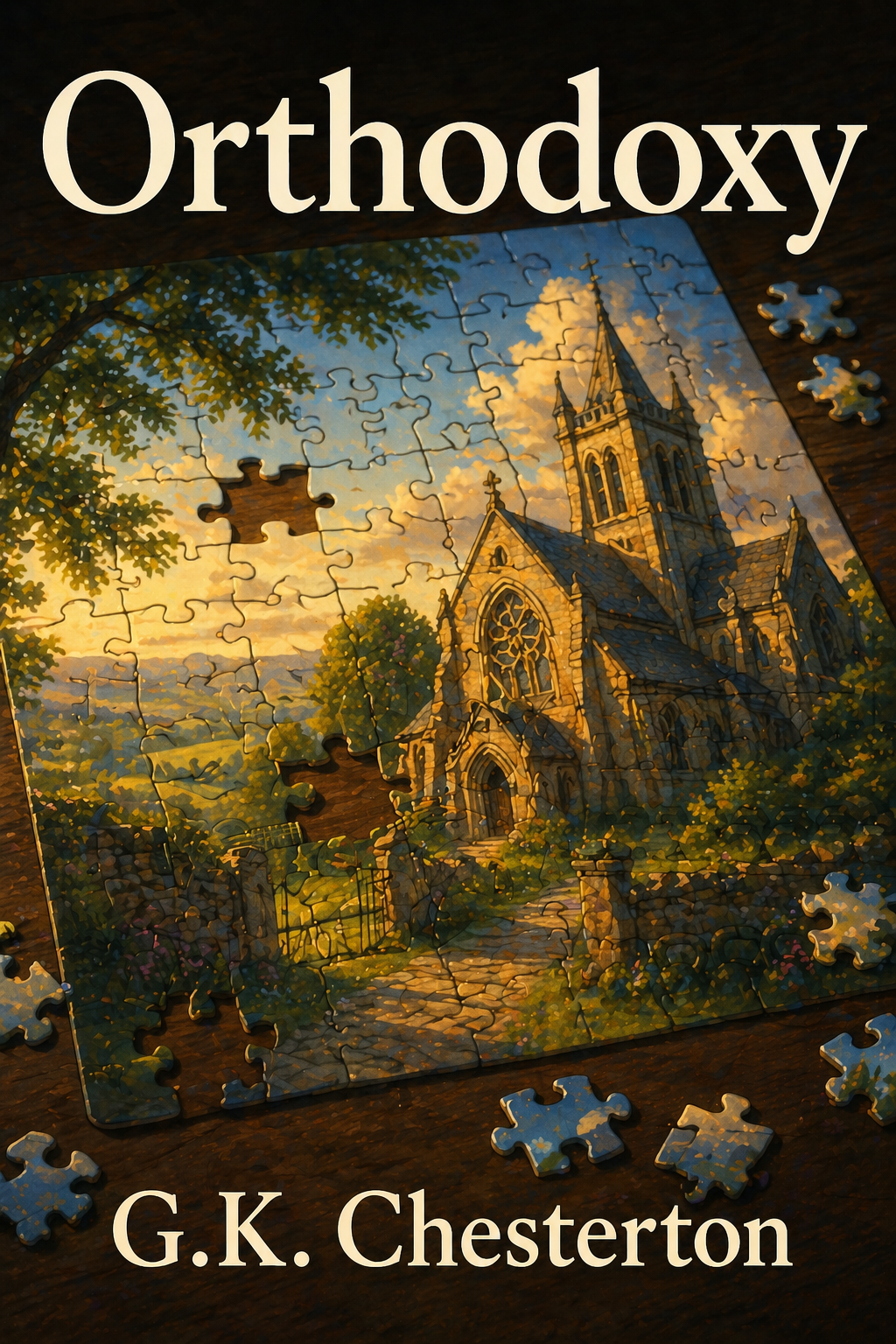
Orthodoxy
Chapter Summaries
What's Here for You
Prepare to embark on an intellectual adventure with G.K. Chesterton's *Orthodoxy*, a witty and profound exploration of faith, reason, and the delightfully strange nature of reality. If you've ever felt that modern life, with all its progress, has somehow lost its way, this book is your compass. Chesterton, with characteristic charm and paradoxical brilliance, doesn't offer simple answers, but a journey – a quest to rediscover the wonder and sanity hidden within traditional beliefs. You'll gain a fresh perspective on everything from fairy tales to the 'suicide of thought,' emerging with a renewed appreciation for the world's inherent magic and the surprising logic of Christianity. Expect to be challenged, amused, and ultimately, inspired to see the world not as it *is*, but as it *could be*, brimming with both eternal truths and revolutionary possibilities. Prepare for a thought-provoking, and at times, delightfully absurd, journey into the heart of orthodoxy.
INTRODUCTION IN DEFENCE OF EVERYTHING ELSE
In the opening of "Orthodoxy," G.K. Chesterton responds to critics, particularly Mr. G.S. Street, who challenged him to articulate his own cosmic theory after critiquing others in "Heretics." Chesterton frames his book as an answer to this challenge, a personal, pictorial, and somewhat vague statement of the philosophy that shaped him, a philosophy he attributes not to himself but to God and humanity. He employs a vivid metaphor: an English yachtsman who mistakenly rediscovers England, illustrating the central problem he wishes to explore—how to be simultaneously astonished by and at home in the world. He acknowledges the desirability of a life that blends the familiar and the unfamiliar, a concept he equates with the Christian idea of romance, evoking both mystery and the ancient significance of Rome. Chesterton confesses his own journey mirrors this rediscovery; he, too, sought to be ahead of his time, only to find himself far behind, backed by the traditions of Christendom. He admits to attempting originality and inventing a heresy, only to realize it was, in fact, orthodoxy, a journey marked by a sense of farce at his own expense, a pursuit of the obvious. Chesterton clarifies that his essays will focus on the Apostles Creed as a foundation for energy and ethics, setting aside the question of its source, positioning this work as a slovenly autobiography rather than an ecclesiastical treatise, ready to address further challenges from Mr. Street in future books. Ultimately, Chesterton invites readers to join him in finding the extraordinary within the ordinary, embracing both wonder and welcome in their perception of the world, acknowledging that his journey to orthodoxy was a process of discovering truths already present, a testament to the enduring wisdom of Christian tradition.
THE MANIAC
In this chapter of *Orthodoxy*, G.K. Chesterton embarks on an exploration of sanity, madness, and the perils of unbridled reason. He begins with a pointed anecdote about a publisher who praises self-belief as a key to success, a sentiment Chesterton sharply rebukes, suggesting that the truly self-assured reside in lunatic asylums, drawing a parallel to the modern world's overestimation of self-confidence. He argues that while modern society readily dismisses sin, it still acknowledges the existence of madness, using the imagery of Hanwell as a symbol of intellectual collapse. Chesterton posits that imagination and mysticism, not reason, are bulwarks against insanity, for imagination embraces the infinite, while reason seeks to confine it, like a poet who soars effortlessly versus a logician whose head splits from the strain. He critiques the modern tendency to exalt reason above all else, warning that unchecked logic, devoid of common sense and affection, leads to a contracted, airless existence. The madman, he observes, is not one who has lost his reason, but one who has lost everything *except* his reason, trapped in a narrow, perfect circle of thought. Chesterton extends this critique to materialism and extreme skepticism, portraying them as systems of thought that, while logically complete, ultimately diminish humanity by denying essential aspects of the human experience, such as free will, hope, and the capacity for wonder. He illustrates how materialism, in its deterministic view, can paradoxically lead to cruelty, while extreme egoism traps individuals in the nightmare of their own minds. To illustrate, Chesterton paints a sensory scene: imagine stars as mere dots in the blackness of one's brain, a mother's face a sketch from one's own insane pencil. Ultimately, Chesterton champions mysticism and the acceptance of paradox as vital for maintaining sanity. He suggests that the ordinary man's ability to hold seemingly contradictory truths—fate and free will, the earthly and the heavenly—is the key to his resilience. Mysticism, like the sun, is the light by which we see everything else, a splendid confusion that illuminates the world, contrasting sharply with the sterile, reflected light of detached intellectualism.
THE SUICIDE OF THOUGHT
In this chapter of *Orthodoxy*, G.K. Chesterton explores the modern world's paradoxical state, arguing that its virtues, untethered from each other, have run wild, causing more harm than good; he uses the phrase 'heart in the right place' to illustrate normal proportion, a balance notably absent in contemporary society, where virtues operate in isolation, leading to unintended consequences. Chesterton points to Mr. Blatchford's misplaced charity and the acrid realist's embrace of physical truth at the expense of moral truth as examples of this fractured virtue, highlighting humility as a virtue now misplaced, settling on conviction rather than ambition, creating a society too modest to believe in fundamental truths. The author paints a vivid scene of the modern skeptic, so humble they doubt their ability to learn, a stark contrast to the old humility that spurred effort, not paralysis. Chesterton asserts that the modern world is at war with reason itself, with sages unable to even grasp the riddle of religion, and he warns of the peril of the human intellect destroying itself, a threat religious authority once guarded against. He likens this threat to burglary, suggesting that just as physical security is necessary, so too is intellectual security. He argues that reason is itself a matter of faith, a belief that our thoughts relate to reality, and that skepticism, taken to its extreme, questions the validity of all thought, leading to intellectual helplessness. Chesterton then dissects various modern philosophies, including materialism, evolution, and pragmatism, revealing their self-destructive tendencies, for example, evolution destroys not religion, but rationalism. He critiques the worship of will, championed by figures like Nietzsche and Shaw, as ultimately paralyzing, for Chesterton, will is defined by its limitations, its choices, its particularity. He vividly describes the will-worshippers, scaling staggering mountains, yet ending up in Tibet, side-by-side with Tolstoy in the land of nothing and Nirvana. Chesterton contrasts these failed philosophies with the figure of Joan of Arc, who embodied both the compassion of Tolstoy and the courage of Nietzsche, a practical person of action, not a mere speculator. Finally, Chesterton suggests that Joan and her faith hold a secret of moral unity lost to the modern world, a unity rooted in a balanced approach to both love and hate, meekness and magnificence, a holistic vision that transcends the fragmented perspectives of modern thought.
THE ETHICS OF ELFLAND
In "THE ETHICS OF ELFLAND," G.K. Chesterton embarks on a whimsical yet profound exploration of how fairy tales shape our understanding of the world, arguing against the disenchanted modern view. He begins by dismantling the common notion that idealism fades with age, asserting the opposite: his faith in ideals remains steadfast, while his belief in practical politics has waned. Chesterton then lays bare his democratic and traditionalist leanings, seeing tradition as democracy extended through time, giving voice to ancestors. His core philosophy, he reveals, was forged in the nursery, from the fairy tales that are fundamentally reasonable. For Chesterton, fairyland is the sunny country of common sense, where the imagination reigns supreme. The central tension arises when Chesterton contrasts this fairy-tale perspective with the scientific worldview, which he finds strangely irrational in its insistence on laws of nature. He illustrates this with the image of Newton and the apple, arguing that while science sees cause and effect as inevitable, fairyland recognizes the arbitrariness of events. Chesterton advocates for a return to wonder, to seeing the world as enchanted, where a tree bears fruit not by law but by magic. This sense of wonder leads to gratitude, an appreciation for existence as a gift, legs to jump, eyes to see. The emotional arc crescendos with the Doctrine of Conditional Joy, the idea that happiness in fairy tales hinges on obeying incomprehensible conditions, a concept Chesterton extends to life itself. He criticizes the modern obsession with expansion, finding it soulless and confined compared to the cozy, jewel-like smallness of the fairy-tale world. Chesterton concludes by summarizing his core beliefs: the world is a mystery needing explanation, purpose implies a person, beauty exists even with flaws, gratitude requires humility, and all good is a remnant of a primordial ruin, rescued like Crusoe's goods from a shipwreck. This chapter serves as a defense of childhood wonder, a call to recognize the magic in the mundane, and a reminder that true reason lies not in cold logic, but in the boundless imagination of fairyland.
THE FLAG OF THE WORLD
In this chapter of *Orthodoxy*, G.K. Chesterton dismantles the conventional notions of optimism and pessimism, suggesting they are inadequate for navigating the complexities of life. He observes how easily these terms devolve into self-serving justifications, where the optimist praises everything but the pessimist, and vice versa. Chesterton proposes a more profound approach: a primary loyalty to the world akin to patriotism, a devotion that transcends mere approval or disapproval. He illustrates this with the whimsical example of Pimlico, arguing that only through a transcendental love, devoid of earthly reason, can even the most uninspiring places be transformed. Like cities growing from sacred stones, love precedes and enables greatness. Chesterton then critiques the "candid friend," the anti-patriot whose pessimism masks a hidden desire to hurt, contrasting this with genuine concern. He equates rational optimism with stagnation, while irrational optimism fuels reform, drawing a parallel to patriotism: those who love a place without reason are best equipped to improve it. He notes the paradox of women who defend their loved ones fiercely, yet are also their keenest critics. Chesterton advocates for a "cosmic oath of allegiance" before any act of reform, emphasizing the need to both hate and love the world intensely, seeing it as both a fortress and a cottage. This tension between love and hate, acceptance and change, is crucial. Chesterton then confronts the rise of suicidal thought, viewing suicide as the ultimate rejection of life's oath. He contrasts the suicide with the martyr, one who cares so little for the world that they wish to end it all, the other, who cares so deeply for something beyond themselves that they are willing to sacrifice everything. Chesterton suggests that Christianity, with its paradoxical stance on martyrdom and suicide, offers a unique perspective: a fierce love for the world combined with a recognition of its flaws. This duality, the ability to be both optimistic and pessimistic, is the key to engaging with the world meaningfully. He concludes by suggesting that Christianity's central tenet—God's separation from the cosmos—allows for both joy and indignation, enabling one to fight the world's forces without abandoning existence itself. The world, he suggests, is like a play, planned perfectly but left to imperfect actors, requiring both our loyalty and our transformative action. Chesterton’s journey is a revelation, as childhood fancies find resonance in Christian doctrine, reversing the reason for optimism: not that we fit into the world, but that we do not, allowing us to embrace our unique, even monstrous, potential.
THE PARADOXES OF CHRISTIANITY
In this chapter of *Orthodoxy*, G.K. Chesterton navigates the treacherous waters between reason and reality, suggesting that the world's subtle deviations from perfect logic are not flaws, but rather, invitations to a deeper truth. He uses the analogy of a lunar mathematician analyzing the human body, expecting perfect symmetry, only to be confounded by the heart's singular placement, illustrating how life lures logicians into traps of near-reasonableness. Chesterton posits that Christianity, uniquely, anticipates these 'illogical truths,' embracing complexities that simpler philosophies overlook. He argues that the modern world's intricate problems paradoxically reinforce the truth of Christian doctrine, much like snowflakes forming the maze at Hampton Court—too complex to be mere coincidence. The author recalls his own journey from paganism to agnosticism, catalyzed by the very arguments of rationalists like Huxley and Spencer, who inadvertently revealed Christianity's extraordinary nature through their contradictory criticisms. He paints a vivid picture: Christianity, attacked for both inhuman gloom and naive optimism, for excessive militancy and pacifism, for being both too exclusive and too universal, begins to take on an odd, compelling shape. Chesterton proposes a radical idea: perhaps Christianity isn't flawed, but rather, it is the standard against which the world appears skewed. He suggests that the church's emphasis on seemingly contradictory virtues—extreme humility and towering pride, unyielding justice and boundless forgiveness—aren't weaknesses, but strengths, reflecting a profound understanding of human nature's inherent tensions. Chesterton envisions Christianity as a daring experiment in irregular equilibrium, like a gothic cathedral where every column, though unique, is essential. He concludes by celebrating orthodoxy not as a safe haven, but as a thrilling adventure—a chariot racing through the ages, dodging heresies while upholding a wild, reeling truth. In essence, Chesterton invites us to see Christianity not as a rigid dogma, but as a dynamic, paradoxical force that embraces life's inherent contradictions and offers a path to genuine sanity.
THE ETERNAL REVOLUTION
In "THE ETERNAL REVOLUTION," G.K. Chesterton, acting as our insightful guide, tackles the paradox of progress, revealing that genuine improvement requires both satisfaction with the present and discontent with its imperfections. He cautions against the modern tendency to chase ever-shifting ideals, a fool's errand akin to painting a world blue, only to change the color each day, leaving behind a chaotic mess of abandoned visions. Chesterton critiques Nietzsche's reliance on physical metaphors, exposing a timidity in defining a concrete vision for humanity. He urges us to fix our vision, to define what we wish to reform, lest we drift aimlessly, swayed by every passing philosophy. The author paints a vivid scene: humanity as an artist, given the colors of a palette but needing a fixed subject to paint, lest the canvas remain forever a meaningless swirl. He then introduces the idea that progress isn't merely an automatic unrolling but a determined shaping, a reform guided by a clear image in our minds. Chesterton argues that a fixed ideal is crucial for any revolution, for swift action requires old, established ideas, not fleeting novelties. He posits that a permanent ideal is as necessary to the innovator as to the conservative; it is necessary whether one wishes the king’s orders to be promptly executed, or the king to be promptly executed. The narrative reaches an emotional crescendo as Chesterton unveils the Christian perspective: the ideal is fixed, Edenic, a restoration rather than a mere alteration, and that only Christianity truly questions the trustworthiness of the well-nurtured, challenging the modern world's reliance on the rich. He explains that true progress isn't inevitable but requires vigilance, a constant revolution against the corrupting influence of power, and that only the Christian doctrine of original sin adequately accounts for humanity's tendency to backslide. Chesterton concludes that a perfect Utopia demands the liberty to bind oneself, to take vows seriously, emphasizing the Christian marriage as the epitome of a real and irrevocable commitment, the heart of all romantic writing. Thus, the chapter resolves with a call for a fixed, composite ideal, a vision of progress rooted in Christian principles, offering a path to genuine and lasting reform.
THE ROMANCE OF ORTHODOXY
In this chapter of *Orthodoxy*, G.K. Chesterton challenges the modern notion that liberalizing religion automatically leads to a more liberated world. He begins by dismantling the illusion of progress, suggesting that modern society's bustle is a mask for laziness, where long words and complex phrases serve as a labor-saving device for thought. Chesterton then dives into the heart of the matter: the common assumption that disbelief in miracles is inherently more liberal. He argues the opposite—that miracles, representing the triumph of mind over matter, align more closely with the spirit of freedom. He uses the metaphor of the modern person doubting the Resurrection due to a strict materialism, akin to being chained by a godless fate. Chesterton pivots to pantheism and the popular notion that all religions are essentially the same, especially Buddhism and Christianity. He sharply rebukes this idea, pointing out the fundamental differences in their teachings and artistic representations, contrasting the inward gaze of the Buddhist saint with the outward wonder of the Christian saint. He illuminates that Christianity, unlike pantheism, cherishes the separation of souls, fostering love and individuality. He argues that the Western energy to dethrone tyrants stems from the theological assertion of individual identity. Chesterton extends his critique to the Trinity, suggesting that the complex God of the Athanasian Creed, with its internal council of mercy and justice, is more liberating than the solitary god of monotheism. Finally, he addresses the concept of damnation, asserting that emphasizing the possibility of ruin, rather than universal salvation, fuels action and progress. He concludes with the divinity of Christ, arguing that a God who experienced doubt and revolt is a source of courage for all insurgents. The chapter crescendos with the striking image of revolutionaries choosing a creed, finding only Christianity's God who has been in revolt, offering a dark mirror to their own isolation. According to Chesterton, the modern person often undermines their own values in their zeal to dismantle traditional faith, sacrificing political courage and common sense in the process, leaving the essence of orthodoxy untouched but the world around it in disarray.
AUTHORITY AND THE ADVENTURER
In "AUTHORITY AND THE ADVENTURER," G.K. Chesterton grapples with a central paradox: why embrace seemingly restrictive Christian doctrines when one could simply extract the 'good parts'? He positions himself as a rationalist, appreciating intellectual justification for his intuitions, and recounts his journey toward spiritual certainty. Chesterton argues that the evidence for Christianity isn't in isolated demonstrations but in a vast accumulation of unanimous facts, much like the secularist's miscellaneous objections. He dismantles common anti-Christian arguments—that humans are merely beasts, religion originates in fear, and priests blight society—revealing their untruth. Instead, he sees humanity's divergence from other creatures as a towering eccentricity needing explanation. He observes that Christianity, far from belonging to the Dark Ages, was a bridge across them, preserving pagan joy within its walls; Catholic doctrine and discipline may be walls; but they are the walls of a playground. The author then pivots to miracles, asserting that believers accept them due to evidence, while disbelievers reject them based on a prior doctrine, and challenges the notion that spiritual means good, cautioning against a mere spirituality that can lead one from ape to devil. Chesterton envisions the world of spirits as a landscape to be navigated, seeking what is good and comforting. The Christian Church, for him, is a living teacher, offering constant revelation and guidance, much like a parent in childhood. He embraces Christendom as a mother, finding the world once more a garden full of symbolic shapes, each with a hidden meaning. Ultimately, Chesterton accepts Christianity because it has proven itself a truth-telling thing, convincing even where it is unattractive. It is the only philosophy that dares to assert what seems untrue, yet reveals itself as truth, like a father's wisdom in the garden. He concludes that Christianity uniquely positions joy as gigantic and sadness as small, fulfilling humanity's ancestral instinct to be right-side up, and suggests that the universe's silence is not heartless but a reverent stillness, allowing us to perceive tragedy as a merciful comedy, while the laughter of the heavens remains too loud for our ears.
Conclusion
Chesterton's 'Orthodoxy' is a compelling invitation to rediscover the wonder inherent in existence. It argues that true freedom and progress aren't found in rejecting tradition, but in embracing the paradoxes and mysteries that underpin reality. The book champions a balanced worldview, one that acknowledges both the beauty and the brokenness of the world. It cautions against the dangers of unchecked reason and the illusion of self-sufficiency, advocating instead for humility, gratitude, and a willingness to embrace limitations. Ultimately, 'Orthodoxy' suggests that a robust faith, grounded in tradition and tempered by paradox, provides the most solid foundation for navigating the complexities of life and fostering genuine human flourishing. It is an argument for embracing the seemingly restrictive doctrines of Christianity not as chains, but as pathways to deeper truths and a more meaningful existence, urging readers to seek rational justification for their intuitions and to challenge prevailing narratives in pursuit of a more complete understanding of the world. The emotional lesson is one of hope, finding joy amidst suffering, and recognizing the sacredness in the ordinary. The practical wisdom lies in the call to action: to engage with the world with both love and a critical eye, striving for improvement while remaining grounded in a fixed ideal.
Key Takeaways
To truly appreciate the world, one must balance a sense of wonder with a feeling of belonging, finding the extraordinary within the ordinary.
Personal philosophies are often rediscoveries of existing truths rather than wholly original creations, humbling the individual and connecting them to a broader tradition.
The essence of romance lies in the harmonious blend of familiarity and novelty, mirroring the Christian worldview's capacity to make the world both astonishing and comforting.
Genuine intellectual exploration involves a willingness to be self-deprecating and to recognize one's own limitations in the pursuit of truth.
A robust philosophy or faith should provide both ethical guidance and a source of vital energy, grounding action in a coherent worldview.
The pursuit of originality can paradoxically lead to the rediscovery of orthodoxy, highlighting the enduring relevance of foundational beliefs.
Unquestioning self-belief, often celebrated in modern society, can be a dangerous form of delusion, akin to madness, blinding individuals to their own flaws and limitations.
While modern society readily dismisses sin, it still acknowledges the existence of madness, using the imagery of Hanwell as a symbol of intellectual collapse.
Imagination and mysticism, not reason alone, are essential for maintaining mental balance, as they allow for the acceptance of the infinite and the paradoxical nature of reality.
Unchecked logic, devoid of common sense and affection, can lead to a contracted and dehumanizing existence, trapping individuals in narrow circles of thought.
Materialism and extreme skepticism, while seemingly offering complete explanations of the world, often diminish humanity by denying essential aspects of the human experience, such as free will and hope.
The acceptance of paradox and the ability to hold seemingly contradictory truths are vital for maintaining sanity and a balanced perspective on life.
True understanding comes not from eliminating mystery, but from embracing it, allowing for a broader and more nuanced comprehension of the world.
Isolated virtues, while seemingly positive, can become destructive forces if not balanced by other virtues and a sense of proportion.
Humility, when misplaced onto one's convictions rather than one's self, leads to intellectual paralysis and an inability to assert truth.
Reason is fundamentally an act of faith, and unchecked skepticism can erode the very foundation of thought.
Philosophies that deny objective truth or the existence of stable categories ultimately undermine the possibility of thought itself.
The worship of will, devoid of any guiding principle or standard, negates the very essence of will, which is choice and limitation.
True action requires embracing limitations and making definite choices, rather than rebelling against all constraints.
A balanced integration of seemingly opposing virtues, like compassion and courage, is essential for moral unity and effective action.
Ideals are not lost with age but rather, faith in practical systems erodes, revealing a deeper commitment to fundamental values.
Tradition embodies democracy across time, valuing the collective wisdom of ancestors over isolated expertise.
Fairy tales offer a fundamentally reasonable perspective on the world, emphasizing wonder and the arbitrariness of events.
Scientific materialism, with its insistence on natural laws, often overlooks the inherent mystery and magic of existence.
True happiness stems from gratitude for the gift of existence, accepting its limitations and conditions with humility.
The modern obsession with expansion and largeness lacks the cozy, jewel-like intimacy and sacredness of a finite, cherished world.
All good is a remnant saved from a primordial ruin, urging humans to store and hold it sacred.
True engagement with the world requires a primary loyalty, akin to patriotism, that transcends mere approval or disapproval.
Genuine improvement stems from an irrational love for something, rather than a calculated or reasoned affection.
The ability to simultaneously love and hate the world is essential for meaningful change and prevents complacent acceptance.
Suicide represents the ultimate rejection of life and contrasts sharply with martyrdom, which affirms a connection to something beyond oneself.
Christianity uniquely combines optimism about the universe with pessimism about the world, providing a framework for both acceptance and reform.
God's separation from the cosmos, a key Christian tenet, allows for both joy and indignation, enabling one to fight the world's forces without abandoning existence itself.
Embrace life's subtle deviations from perfect logic as pathways to deeper truths, rather than dismissing them as flaws.
Seek philosophies that account for the unexpected and irregular aspects of reality, not just the simple truths.
Recognize that complex problems can paradoxically strengthen the validity of certain beliefs or doctrines.
Evaluate belief systems not just by their internal consistency, but by how well they address contradictory criticisms.
Understand that virtues often exist in tension, requiring a balance of seemingly opposite emotions or actions.
View orthodoxy not as a rigid set of rules, but as a dynamic process of maintaining equilibrium amidst life's complexities.
True progress demands a fixed ideal, not a constantly shifting vision, to guide meaningful reform.
Genuine reform requires both satisfaction with the present and discontent with its imperfections, a balance often lacking in modern approaches.
Metaphors can obscure rather than clarify thought if they lack a grounding in concrete ideas and values.
A permanent ideal is essential for both innovation and conservatism, providing a stable foundation for action and judgment.
Christianity offers a unique critique of power, questioning the trustworthiness of the rich and well-nurtured, a challenge to modern society's assumptions.
Progress isn't automatic but requires constant vigilance and a willingness to challenge established institutions, recognizing humanity's tendency to backslide.
A meaningful Utopia must include the liberty to bind oneself to commitments, emphasizing the importance of real and irrevocable obligations.
Challenge the assumption that disbelief in miracles is inherently more liberal, recognizing that miracles symbolize the triumph of mind over matter and align with the spirit of freedom.
Question the notion that all religions are essentially the same, appreciating the distinct teachings and values that shape diverse spiritual paths.
Embrace the Christian concept of individual souls as essential for love and ethical action, resisting the dissolving of identity in pantheistic worldviews.
Recognize the value of the Trinity as a model for internal complexity and balance, contrasting it with the potential for tyranny in a solitary, absolute power.
Acknowledge the importance of the possibility of failure or ruin as a motivator for action and progress, rather than assuming a guaranteed positive outcome.
Consider the revolutionary implications of a divine figure who experienced doubt and revolt, finding strength and courage in the face of adversity.
Be wary of undermining one's own values in the pursuit of dismantling traditional beliefs, ensuring that the pursuit of progress does not sacrifice essential principles.
Embrace seemingly restrictive doctrines for the profound truths they reveal, rather than merely extracting convenient elements.
Seek rational justification for intuitions, recognizing that spiritual certainty often arises from accumulating diverse, unanimous facts.
Challenge prevailing narratives and dismantle common misconceptions to uncover deeper truths about humanity, religion, and society.
Recognize that Christianity, far from being a relic of the past, acted as a bridge through dark times, preserving joy and civilization.
Approach the spiritual realm with discernment, seeking genuine goodness and comfort rather than being misled by mere spirituality.
View religious institutions as living teachers, offering continuous guidance and revelation, like a trusted parent.
Understand that true joy is not a fleeting emotion but a fundamental orientation that dwarfs sadness, enabling a balanced worldview.
Action Plan
Reflect on a time when you thought you were being original, but later realized you were echoing existing traditions; consider what you learned from that experience.
Identify an area of your life where you can cultivate a greater sense of wonder and curiosity, while still maintaining a feeling of security and belonging.
Explore the core tenets of the Apostles Creed and consider how they might provide a foundation for your own ethical framework and sense of purpose.
Challenge yourself to find the extraordinary in the ordinary aspects of your daily routine, seeking out moments of surprise and delight.
Consider how your personal philosophy balances the familiar and the unfamiliar, and identify ways to integrate more of both into your life.
Engage in creative activities that stimulate imagination, such as writing poetry, painting, or playing music.
Practice mindfulness or meditation to cultivate a sense of presence and acceptance of the unknown.
Challenge rigid or overly logical thought patterns by considering alternative perspectives and possibilities.
Embrace paradox and ambiguity, recognizing that not all truths can be neatly categorized or explained.
Cultivate a sense of wonder and awe by spending time in nature or exploring art and culture.
Connect with others who hold different beliefs and perspectives, seeking to understand their viewpoints without judgment.
Reflect on personal experiences where intuition or emotion played a significant role, acknowledging the value of non-rational ways of knowing.
Limit exposure to purely materialistic or deterministic viewpoints, seeking out sources that promote hope, meaning, and free will.
Identify areas in your life where virtues may be operating in isolation and seek ways to balance them with other values.
Cultivate a healthy skepticism towards yourself while maintaining conviction in fundamental truths.
Examine the underlying assumptions of your own thought processes and challenge any beliefs that undermine reason or objective reality.
When faced with a decision, consider not only what you want but also what you are willing to give up or limit in order to achieve it.
Seek to integrate seemingly opposing virtues, such as compassion and courage, into a coherent moral framework.
Look for practical ways to translate your beliefs into concrete actions, following the example of figures like Joan of Arc.
Embrace limitations as a necessary component of creativity and meaningful action.
Revisit a favorite fairy tale and reflect on the ethical lessons it conveys.
Identify one area in your life where you can cultivate a greater sense of wonder and enchantment.
Challenge a materialistic assumption by considering the possibility of magic or mystery.
Practice gratitude by acknowledging the gift of existence and appreciating its limitations.
Embrace tradition by connecting with the wisdom of ancestors and collective human experience.
Seek to find the extraordinary in the ordinary, recognizing the miracle in everyday events.
Examine personal beliefs in light of the Doctrine of Conditional Joy, accepting the incomprehensible conditions of happiness.
Address the world with diminutives to show fondness.
Identify a place or thing you feel drawn to and cultivate a deeper, more intentional love for it, regardless of its flaws.
Reflect on your own tendencies toward optimism or pessimism and consider how these perspectives might be limiting your engagement with the world.
Embrace the tension between loving and hating aspects of the world, recognizing that both are necessary for meaningful change.
Consider what it means to take an "oath of allegiance" to life, and how this commitment can inform your actions and choices.
Identify a cause or issue you care deeply about and commit to working towards its reform with both passion and a critical eye.
Explore the Christian perspective on the relationship between God and the cosmos, and how this understanding can inform your own worldview.
Practice gratitude for the good in the world while simultaneously acknowledging and addressing its challenges.
When confronted with seemingly contradictory criticisms of a belief system, consider whether these contradictions reveal a deeper, more complex truth.
Identify areas in your own life where you seek balance between seemingly opposite virtues, such as humility and pride, or justice and mercy.
Challenge yourself to embrace complexity and paradox, rather than seeking simple, easily digestible answers.
Reflect on how your own journey of faith or doubt has been shaped by unexpected or contradictory influences.
Seek out perspectives that challenge your assumptions and force you to grapple with uncomfortable truths.
Consider how the intricate problems of the modern world might reinforce, rather than undermine, certain fundamental beliefs.
Practice holding seemingly opposing ideas in tension, recognizing that true wisdom often lies in embracing paradox.
Define your personal vision for a better world, grounding it in fixed values rather than fleeting trends.
Identify areas in your life and society where you feel both satisfaction and discontent, seeking a balanced approach to reform.
Critically examine the metaphors and language you use, ensuring they clarify rather than obscure your thinking.
Challenge the assumption that the rich and powerful are inherently trustworthy, holding all individuals accountable to ethical standards.
Actively engage in the process of reform, recognizing that progress requires constant vigilance and a willingness to challenge established norms.
Seek out opportunities to bind yourself to meaningful commitments, embracing the responsibility and adventure that come with real obligations.
Reflect on the Christian perspective on original sin, acknowledging humanity's tendency to backslide and the need for constant self-reflection.
Examine your own assumptions about what constitutes 'liberal' or 'progressive' thought, questioning whether they truly lead to greater freedom and justice.
Reflect on your beliefs about miracles and the supernatural, considering whether disbelief is based on evidence or simply a pre-existing bias.
Explore the differences between various religious and philosophical traditions, avoiding the oversimplification that they all teach the same essential truths.
Cultivate a sense of wonder and curiosity about the world, recognizing the value of individual identity and the potential for meaningful connection with others.
Embrace the complexity of theological concepts like the Trinity, appreciating the balance and harmony they represent.
Acknowledge the possibility of failure and ruin in your own life and in society, using this awareness as a motivation for action and progress.
Find inspiration in the idea of a God who experienced doubt and revolt, drawing strength from the example of resilience and courage in the face of adversity.
Be mindful of the potential to undermine your own values in the pursuit of dismantling traditional beliefs, ensuring that your actions align with your deepest principles.
Critically examine your own objections to traditional beliefs, seeking deeper truths beyond surface-level criticisms.
Actively seek out diverse perspectives and experiences to accumulate a broader understanding of complex issues.
Engage with religious teachings as a student, seeking continuous learning and revelation rather than static knowledge.
Cultivate a sense of wonder and curiosity, approaching the world with the eyes of a child discovering hidden meanings.
Prioritize joy as a fundamental orientation, recognizing its power to dwarf sadness and provide a balanced worldview.
Challenge the prevailing narrative and embrace the seemingly unattractive aspects of faith, trusting that they may reveal profound truths.
Seek out mentors and teachers who can guide you on your spiritual journey, providing wisdom and support.
Reflect on how seemingly restrictive rules and doctrines can provide freedom and structure within a larger framework.