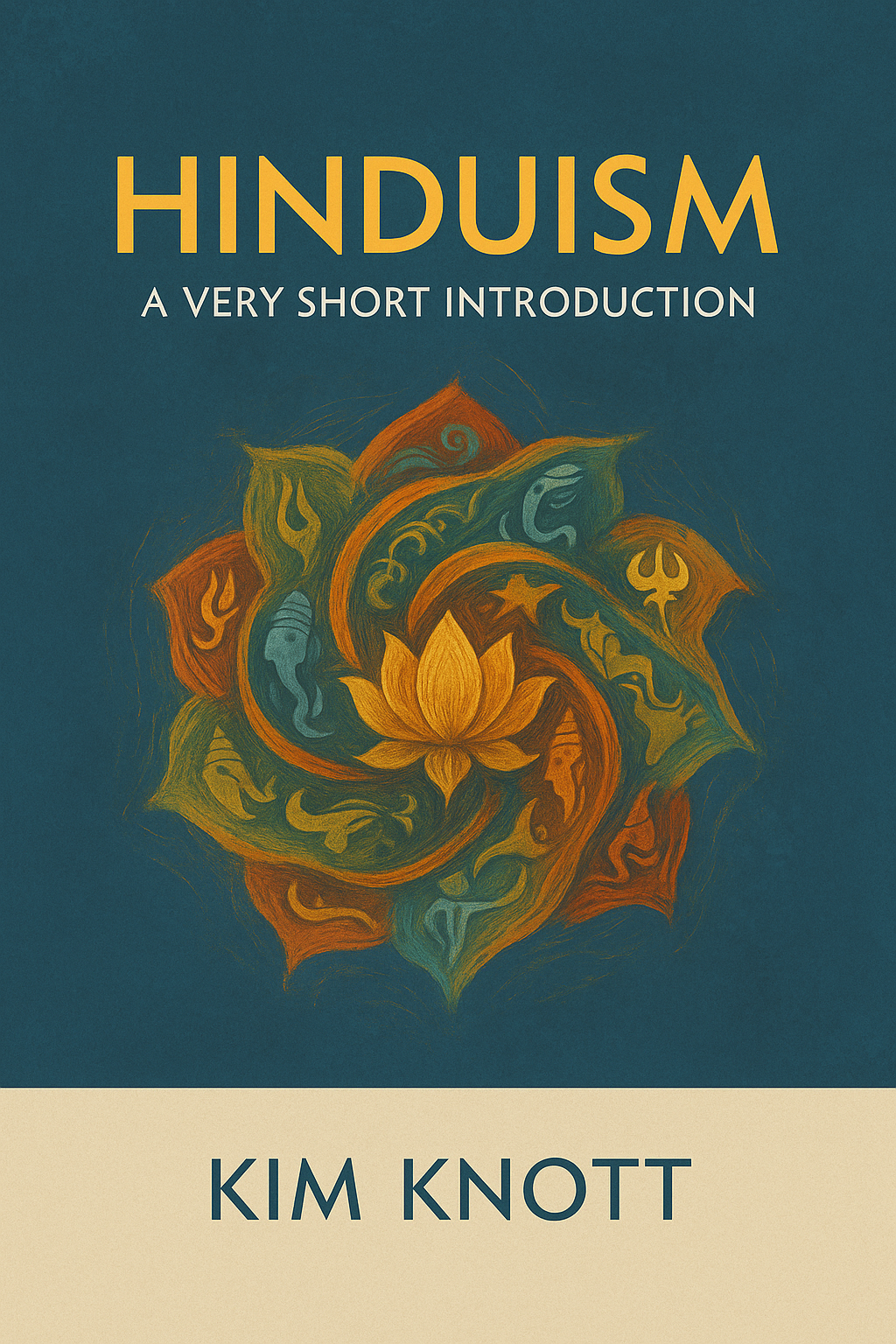
Hinduism: A Very Short Introduction
Chapter Summaries
What's Here for You
Embark on a captivating journey into the heart of Hinduism with Kim Knott's "A Very Short Introduction." This isn't just a book; it's your personal invitation to unravel the complexities and embrace the profound beauty of one of the world's oldest living traditions. Have you ever wondered if Hinduism is truly a singular religion, or how its ancient wisdom continues to resonate in our modern world? Knott guides you through these fundamental questions, illuminating the diverse perspectives – from the analytical scholar to the devoted practitioner – and revealing how knowledge in Hinduism is not just learned, but lived and transmitted through stories, gurus, and ancient texts. You'll delve into the profound exploration of the self, a quest that bridges millennia and finds new expression through global technologies. Prepare to be enthralled by the enduring power of divine heroes and epic tales like the Ramayana, and to ponder the mysterious divine presence that can manifest in the most unexpected ways. This book fearlessly confronts how Hinduism has been shaped by colonialism and modernity, and tackles the challenging realities of social structures, particularly the experiences of women and Dalits, within its religious and political spheres. Discover the fascinating paradox of an ethnic religion that has transcended its geographical boundaries, spreading across the globe. Ultimately, Knott invites you to appreciate the multifaceted nature of "Hindu Dharma," "Hinduism," and "Hinduisms," urging you to see beyond simple definitions and embrace the rich tapestry of perspectives. You will gain not only a deeper intellectual understanding but also an enriched appreciation for the spiritual, cultural, and social dimensions of this vibrant tradition, fostering a tone of intellectual curiosity and respectful exploration.
The Scholar and the Devotee
The author, Kim Knott, invites us into the library of understanding Hinduism, posing a fundamental question: is it truly a religion like others, and how do we approach its study? She illuminates the crucial methodological dilemma of differing perspectives – that of the scholar, seeking objective analysis, and the devotee, experiencing faith from within. Knott explains that while scholarly books might be found in sociology, art, languages, or anthropology, the 'Religion' section is where most Westerners begin, yet this categorization itself is a point of inquiry. She reveals that scholarly accounts, whether by insiders or outsiders, are inevitably shaped by the author's background, challenging the long-held notion of purely objective historical accounts, much like early Western scholars, or 'orientalists,' whose work was influenced by colonial interests. A vivid scene emerges of archaeologists unearthing the ancient Indus Valley civilization, a discovery that complicates narratives of Aryan migration and the origins of Hindu traditions, leaving scholars and devotees alike to grapple with interpretations of unearthed seals depicting horned figures and fertility goddesses. The chapter delves into the tension between the devotional view of Hinduism as *sanatana dharma*, an eternal tradition beyond human history, and the scholarly quest to date and dissect its origins, particularly concerning the Veda. Knott highlights how even within these camps, diversity thrives; some scholars strive for empathetic understanding, while others remain rooted in their own cultural lenses, and similarly, Hindu perspectives range from critical distance to unwavering faith. She emphasizes that understanding scripture, for instance, differs vastly between the devotional embrace of revelation and the scholarly pursuit of critical reasoning, a divide that also extends to the interpretation of Hindu practices, which some scholars once dismissed as mere superstition. Ultimately, Knott offers her own perspective as an outsider, a white British Quaker, aiming to present a critical yet inclusive view, acknowledging that every account, including her own, is a tapestry woven from a unique viewpoint, and that the richness of Hinduism lies not in a single definition but in its profound unity and diversity, a truth that resonates whether one approaches it with analytical rigor or heartfelt devotion.
Revelation and the Transmission of Knowledge
The author, Kim Knott, invites us into the heart of Hindu tradition, where knowledge is not merely read but lived and passed down, often through the resonant voice of a storyteller or the deep wisdom of a guru. Imagine a Pandit, sitting cross-legged on a cool clay floor, his mind a vast repository of epic verses, not just reciting, but breathing life into the Ramayana and Mahabharata, his public recitations a testament to the authority of the ancient Vedas. This ancient practice, embodied by figures like the Pandit and the Shankaraacharyas, underscores a profound concept: sampradaya, the oral tradition, a lineage of teaching and learning that sustains theological and ritualistic knowledge across generations. Central to this transmission is the distinction between Shruti – that which is revealed, the divine truths captured in the Vedas and Upanishads – and Smriti – that which is remembered, texts like the Epics and Puranas, which elaborate on revealed truths through human composition. The Vedas themselves, though few may read them intimately, form the bedrock of Hindu thought, their authority unquestioned, acting as a reference point for the creation, maintenance, and transformation of traditions, as scholar Brian K. Smith suggests. Brahmins, historically linked to the mouth of the cosmic Purusha, are the custodians of this revealed knowledge, meticulously passing down Vedic hymns and performing rituals, like the sacred thread ceremony or rites of passage, to sustain the world and maintain dharma – truth, law, and duty. Yet, the transmission of spiritual knowledge also flows through gurus, individuals whose authority often stems not from formal training or caste, but from profound spiritual experience and charismatic ability, much like the enigmatic Anandamayi Ma. These gurus, irrespective of their background, become conduits, helping others navigate the ocean of existence, samsara, towards liberation, moksha. The narrative tension arises from understanding how this sacred knowledge, from the revealed Shruti to the remembered Smriti, and from the ritualistic duties of the Brahmin to the experiential wisdom of the guru, is preserved and transmitted, ensuring continuity amidst diverse practices and societal structures, ultimately revealing that Hinduism is defined by its dynamic engagement with this ancient, living tradition.
Understanding the Self
The quest to understand the self, a journey as ancient as time yet as modern as the internet, unfolds through the lens of Hinduism, revealing a profound and multifaceted understanding. Twentieth-century gurus, bridging tradition and technology, have extended their reach globally, using print, transport, and digital platforms to guide disciples. Movements like ISKCON and the Swaminarayan Hindu Mission, with leaders like the American-born Sivaya Subramuniyaswami, demonstrate this evolution, disseminating teachings through publications like 'Hinduism Today.' At its core, the teaching is that we are not our physical bodies, fleeting emotions, or even our minds; we are divine souls, immortal beings on a journey of evolving oneness with the divine, a truth echoed by the ancient Vedic rishis who proclaimed, 'God is the Life of our life.' This ancient wisdom finds a powerful echo in the Upanishads, most notably in the profound declaration, 'Tat tvam asi' – 'That thou art.' Imagine a father, Uddalaka Aruni, instructing his son Shvetaketu, not through abstract pronouncements, but through tangible analogies: the dissolving salt in water, imperceptible yet everywhere present, revealing the subtle, pervasive essence that constitutes reality and the self. This fundamental insight, that the individual self (atman) is identical with the universal consciousness (Brahman), forms the bedrock of Vedanta. However, as the narrative artfully illustrates, this non-dualistic perspective, championed by Shankara, is not the only path. Centuries later, Ramanuja and Madhva offered distinct interpretations, emphasizing the importance of a qualified non-duality and a clear duality, respectively. Ramanuja saw the ultimate reality as the personal Lord, Ishvara, with the self and the world as distinct yet intimately related instruments, like the body to the soul, highlighting the crucial role of divine grace. Madhva, pushing further, asserted a complete separation between God and the self, emphasizing complete dependence on the divine for liberation. These differing philosophical currents, from Shankara's advaita to Ramanuja's vishishtadvaita and Madhva's dvaita, continue to shape modern Hindu movements, demonstrating the rich tapestry of thought surrounding the self. Beyond philosophical discourse, the practical implications of karma and yoga offer pathways to navigate this understanding. The ancient dilemma of suffering and rebirth, fueled by action (karma), finds a transformative resolution in the Bhagavadgita. Krishna, guiding Arjuna, introduces karma yoga – the discipline of action performed without attachment to its fruits, transforming everyday tasks into spiritual practice. This path, along with jnana yoga (knowledge) and bhakti yoga (devotion), offers multiple routes to liberation, acknowledging that seekers find the way best suited to their temperament. This revolutionary idea, that liberation is not a singular, arduous path but a journey with many approaches, even extending an invitation to the marginalized, reshaped the understanding of action and rebirth from a cycle of suffering to a discipline for personal transformation. Modern thinkers like Mahatma Gandhi and Arvind Sharma have further adapted these concepts, advocating for karma yoga as a tool for self-rule and social change, reframing karma not as fatalistic destiny tied to caste, but as the immediate consequences of our present choices, empowering individuals to shape their future through free will and present action, thereby dissolving the rigidities of caste and fostering a society focused on immediate improvement. Thus, the understanding of the self in Hinduism is not a static declaration but a dynamic, evolving exploration, inviting each individual to discover their own divine essence within the grand cosmic play.
Divine Heroes: The Epic Tradition
The author explains that the enduring power of Hindu epics, particularly the Ramayana, lies not just in their narrative but in their profound cultural and spiritual resonance, a phenomenon vividly illustrated by the 1987 television adaptation of the Ramayana. This epic, watched by an estimated 80 million Indians every Sunday, transcended mere entertainment, becoming a near-divine spectacle that inspired devotion and even temporary national unity, with actors becoming identified with their divine roles and viewers seeking their blessings. While celebrated for its reach, this specific adaptation faced criticism for its sentimentality and its promotion of a singular version of the story, highlighting a central tension: the Ramayana exists in thousands of variations, each offering different perspectives on characters like Rama, Sita, and Ravana, and reflecting a broader diversity within Hinduism itself. The narrative then delves into the core story of Rama, emphasizing the concept of dharma—duty, order, and righteousness—as the guiding principle. Rama's unwavering adherence to his father's promise, Sita's devotion and trials, and Hanuman's loyalty all exemplify dharma, illustrating how individual actions contribute to the social and cosmic order. This adherence, however, leads to complex moral dilemmas, such as Rama's banishment of Sita, which the author interprets not as personal cruelty but as a king's prioritization of social order and the quieting of public doubt over personal conviction. The chapter also explores Sita's character, moving beyond the simple image of a dutiful wife to reveal her strength, self-possession, and agency, qualities that resonate deeply with women who find in her story lessons applicable to modern life, a stark contrast to the more superhuman goddesses like Durga or Kali, who are sought for their divine powers. These divine female figures, particularly the great Devi, embody fierce protection, creative power, and a break from traditional subservience, offering a different model of female strength. Ultimately, the author connects these epic narratives to modern India, showing how figures like Rama and concepts like Mother India (Bharata Mata) have been invoked in nationalist movements, sometimes leading to conflict, as seen in the destruction of the mosque in Ayodhya, demonstrating how deeply ingrained these stories are in the collective imagination and national identity, even when factual history is disputed, emphasizing that popular imagination thrives on powerful stories and the emotions they evoke.
The Divine Presence
The author, Kim Knott, invites us to explore the profound concept of the divine presence within Hinduism, a topic that often sparks wonder and debate, as vividly illustrated by the 1995 Ganesha milk miracle. This extraordinary event, where countless images of the elephant-headed deity seemingly drank milk, rekindled the age-old dialogue between science and faith, yet for many Hindus, the surprise was not the miracle itself, but its global scale, as divine manifestations are considered a commonplace thread in the fabric of Indian religious life. Knott clarifies the crucial distinction between statues and icons, or *murtis*. While temple sculptures possess artistic merit and depict sacred stories, it is the *murti*, consecrated through intricate ritual processes, that is prepared to be inhabited by the divine. Brahmins infuse these icons with *prana*, or living breath, establishing a sacred space where God is manifest, to be cared for as an honored guest, fostering an intimate, reciprocal relationship through *darshana*, the act of seeing and being seen by the deity. European observers, encountering *darshana* centuries ago, often misinterpreted it as mere idol worship, a perspective rooted in their own theological frameworks, which apprehended God through the word rather than the image, and struggled with the apparent multiplicity of deities. However, as Knott reveals, this overlooks the sophisticated theological understanding that the divine, though transcendent, is also immanent and accessible in various forms. Vaishnava theologians, for instance, teach that the Lord manifests in five forms: the supreme transcendental form, emanations (*avataras*), the individual heart, the inner controller of the universe, and crucially, the divine presence within the consecrated icon. This accessibility is further exemplified by the beloved deity Ganesha, son of Shiva and Parvati, known for removing obstacles and attending to devotees' requests. His story—created by Parvati, accidentally decapitated by Shiva, and revived with an elephant's head—underscores his compassionate nature. The divine presence, Knott explains, is not confined to ritually consecrated *murtis*; it can manifest in images in homes, pictures of gurus, and even natural formations like Shiva's *linga*, which can be worshipped even when unconsecrated. This leads to a deeper understanding of the Hindu worldview: the divine may appear or give a sign at any time, to encourage, reward, warn, or even punish devotees. This is mirrored in the concept of the many and the One, where the multitude of deities are understood as expressions of a singular, ultimate reality, Brahman. A seeker asking a sage how many gods exist receives a series of diminishing numbers, culminating in 'One,' illustrating that while many forms are recognized, they ultimately point to a unified divine. Many Hindus choose a personal deity, an *ishtadeva*, often influenced by family tradition or a profound personal experience, yet they also acknowledge and offer worship to others. This duality is evident in the worship of Vishnu and Shiva, who, while considered supreme by their followers (Vaishnavas and Shaivas respectively), are also understood as immanent within each person. Vishnu asserts his influence through *avataras* like Rama and Krishna, while Shiva often manifests through the *linga*. The divine presence also extends to spirits and human exemplars. Female spirits near villages, marked by offerings, and self-realized souls, or *mahatmas* like Gandhi, reveal its pervasive nature. Possession, where a deity speaks through a devotee, as seen in *teyyam* dancers in Kerala or during Durga Puja in Bengal, is another profound manifestation of the divine. Responses to this presence are diverse, ranging from home shrines with daily offerings of food, incense, and light, to communal religious life centered around temples and festivals like the Kumbh Mela. The intricate architecture of temples, like Madurai's Minakshi temple, serves as a testament to devotion, housing deities like Minakshi and Sundareshvara, who are ritually attended to as honored guests. Even movements like ISKCON, founded by A. C. Bhaktivedanta Swami, embody this principle, encouraging devotees to see all actions as opportunities for divine service, from chanting mantras to everyday labor, spreading the name and form of Krishna globally. Ultimately, Knott presents Hinduism not as simple polytheism, but as a dynamic tradition where the divine is both transcendent and immanent, perceived in myriad forms that ultimately converge into the One, accessible through devotion, ritual, and a profound recognition of its presence in the world.
Hinduism, Colonialism, and Modernity
The author explains how Hinduism, a faith with roots stretching back millennia, has been profoundly shaped by centuries of foreign rule, a narrative that truly ignites with the arrival of Europeans. Consider the words of Kabir, the fifteenth-century bhakti poet, a weaver who saw beyond the outward rituals of both Islam and Hinduism, declaring, 'Rama and Rahim both lie within my heart, and there alone is where to seek them.' This sentiment, a powerful call for inner devotion over external form, echoes through the diverse mystical traditions of India, a testament to a faith that often developed in the shadow of conquerors, from the Delhi Sultanate and Mughal Empire to the British Raj. The European encounter, beginning with traders like Vasco da Gama seeking spices and Christians, soon evolved into a desire to understand and, at times, reshape India in its own image. Scholars like Charles Wilkins and William Jones, working for the East India Company, began translating sacred texts like the Bhagavad Gita and Manusmriti, presenting Hinduism in a more accessible, even admirable, light to Western audiences, a stark contrast to earlier condemnations of popular religion. This period marked a crucial insight: external observation and translation could begin to frame Hinduism not just as an object of suspicion, but as a tradition with profound philosophical depth, a perspective that Warren Hastings himself recognized, hoping such writings would 'survive when the British dominion in India shall have long ceased to exist.' Yet, beneath this scholarly veneer, a missionary zeal persisted, exemplified by Abb Dubois, a Jesuit who meticulously documented Hindu customs not to commend, but to expose perceived 'wickedness and incongruities of polytheism and idolatry' to highlight the 'beauties and perfections of Christianity.' This tension between scholarly appreciation and missionary imperative fueled a dynamic period of reform and reinterpretation within Hinduism itself. Figures like Ram Mohan Roy, a polyglot and social reformer, challenged orthodox practices like sati and idolatry, advocating for reasoned, ethical monotheism, drawing inspiration from both Islamic and Christian thought, and crucially, utilizing modern tools like print and newspapers to disseminate his ideas, a truly modern Indian responding to a changing world. This period reveals a core dynamic: the 'pizza effect,' where ideas travel, transform, and return, influencing their origin. Vivekananda, for instance, presented a monistic vision of Vedanta to the West, which in turn shaped Western perceptions and later influenced a generation of Indians, demonstrating how ideas fermented abroad could then re-enter India, sparking pride and a sense of heritage, particularly among those like Annie Besant who defended Hinduism against missionary criticism. Even Mohandas K. Gandhi, shaped by his legal studies in London and his engagement with texts like the Bhagavad Gita and the Sermon on the Mount, forged his philosophy of satyagraha, a commitment to truth and nonviolent action, from this cross-cultural dialogue. This chapter, therefore, illuminates how the encounter with colonialism and modernity didn't just impose external pressures, but catalyzed an internal re-evaluation and resurgence within Hinduism, as reformers and thinkers grappled with tradition, reform, and the very definition of their faith in a rapidly globalizing world. The ongoing debate around sati, from its condemnation by the British to its controversial resurgence in 1987, serves as a poignant, enduring symbol of this complex interplay between tradition, reform, and societal change.
Challenges to Hinduism: Women and Dalits
The author, Kim Knott, guides us through a complex landscape where the lines between social, political, and religious spheres in India are not merely blurred but fundamentally intertwined, particularly when examining the experiences of women and Dalits. We begin by confronting the apparent paradox of women like Indira Gandhi and Dalits like K. R. Narayanan holding high office, prompting a deeper inquiry: does this signify true equality, or merely a superficial shift? Knott reveals that the deeply ingrained religious ideas and ritual customs, such as those found in texts like the Manusmriti, have historically relegated both women and those outside the varna system, referred to as chandalas, to positions of impurity and marginalization. The Manusmriti, for instance, describes chandalas as 'dog-cookers,' barred from property ownership and forced to live outside villages, their touch deemed polluting, especially to Brahmins. Similarly, women, particularly those of twice-born classes, were prescribed a life of dependence, their virtue tied to bearing sons, and denied direct access to scriptures or spiritual advancement, their very nature deemed weak and fickle. Yet, the narrative shifts, highlighting the transformative power of the Bhakti movement, where poets like Antal, Akkamahadevi, Mirabai, Kabir, and Ravidas found spiritual expression and a direct connection with the divine, irrespective of gender or caste, singing in their mother tongues. The twentieth century saw a more organized awakening, with figures like Pandita Ramabai championing women's education and rights, and later, the broader women's movement gaining momentum through grassroots activism against dowry, domestic violence, and for workers' rights, finding inspiration in Hindu goddesses and mythology. This struggle for equality, however, faces persistent challenges, as seen in the pervasive issue of dowry, where daughters, traditionally viewed as a financial drain, can become victims of dowry-related violence and murder, a practice that continues despite legal prohibitions. The author introduces the deeply unsettling reality of sex-determination tests, where the strong societal preference for sons leads to the abortion of nearly all female fetuses, posing profound questions about human rights within the Hindu framework. Parallel to these struggles are the enduring injustices faced by Dalits, formerly known as untouchables or Harijans, who, despite constitutional equality and protective laws, continue to suffer violence, discrimination, and denial of basic rights. Dr. B. R. Ambedkar emerges as a pivotal figure, advocating for legal reform and, crucially, for the 'material and spiritual conversion' of Dalits, famously leading half a million followers to embrace Buddhism, a religion that offered a path to cessation of suffering and a new identity free from the stigma of Hinduism. As a distinct Dalit identity solidified by the 1970s, fueled by literature and protest, it challenged the dominant brahminical ideology, seeking an alternative history and a more just future. The chapter concludes by acknowledging that while the appointment of a woman or Dalit to the highest religious office like Shankaraacharya remains unlikely in the near future, the core issues of spiritual and material equality are undeniably on the agenda, forcing a confrontation with traditional Hindu teachings on purity, pollution, and the inherent duties prescribed for different social groups, setting the stage for a radical transformation of Hindu dharma itself.
Crossing the Black Waters: Hinduism beyond India
The author, Kim Knott, invites us to explore a fascinating paradox within Hinduism: its enduring identity as an ethnic religion, deeply tied to the land of Bharat and its people, yet simultaneously a tradition that has, against its own historical injunctions, spread across the globe. For centuries, Hinduism was largely defined by birth within the Indian caste system, bound by the sacred geography of Bharat, a land ritually purified and protected by the 'black waters' – the forbidding oceans. This perceived ethnic boundary lent support to the idea that Hinduism was not a universalizing faith like Buddhism, Christianity, or Islam, which actively sought converts. Yet, as Knott reveals, this narrative begins to unravel when we consider the journeys of Hindus beyond India's shores. From the early Brahmins who traveled to Southeast Asia to consecrate kingdoms, extending the ritual boundaries of Bharat, to the merchant Chettyars establishing trade networks, and later migrants seeking opportunity in East Africa and beyond, Hindus have consistently navigated and redefined their relationship with the 'black waters.' A compelling illustration of this tension is the story of Madho Singh, the Maharaja of Jaipur, who, invited to Edward VII's coronation, faced the profound dilemma of defiling his sacred person and, by extension, his land and people, by crossing the ocean. His ingenious solution—chartering a ritually purified ship stocked with sacred earth and Ganges water—underscores the deep-seated concern with maintaining purity and connection to the sacred land, even amidst foreign shores. This adaptability is further evident in the experiences of indentured laborers transported to places like Trinidad and Fiji, and later professionals migrating to North America and Australasia. These communities, though often facing discrimination, have established vibrant religious and social institutions, from converted premises to magnificent purpose-built temples like London's Shri Swaminarayan Mandir. This diaspora, Knott explains, is not merely a passive transplantation but an active reinterpretation of tradition. While many maintain caste endogamy, the very act of establishing sacred spaces and performing rituals outside India challenges traditional boundaries. The rise of lay-led organizations and the emphasis on devotional practices, inspired by traditions like Bhakti, demonstrate a willingness to embrace the spirit over the strict letter of brahminical injunctions. The author highlights how these global Hindu communities, connected by kin, caste, and increasingly by digital networks, are fostering a dynamic, multifaceted Hinduism. They grapple with the tension between articulating a unified Hindu identity for public recognition and celebrating the inherent diversity and openness within the tradition. Ultimately, Knott presents Hinduism not as a static, geographically confined faith, but as a resilient, evolving tradition, capable of profound adaptation and reinvention in the hands of its global adherents, who are often inspired more by the spirit than the letter of their ancestral practices.
Hindu Dharma, Hinduism, and Hinduisms
The author, Kim Knott, invites us to consider the multifaceted nature of Hinduism, beginning with a simple yet profound observation: what we see, and therefore understand, is often a matter of perspective, much like observing a cow in a bustling city versus a sacred symbol. This sets the stage for understanding that Hinduism, too, is perceived differently by outsiders and insiders, and even within its vast expanse, there is no single, monolithic viewpoint. Knott skillfully unpacks the Western construct of 'religion' and its limitations when applied to Hinduism, a tradition that lacks a single founder or creed, and instead encompasses a complex tapestry of beliefs, rituals, ethics, and the intricate socioreligious system of caste. The term 'Hindu' itself, originally a geographical descriptor, evolved over time, influenced by Orientalist scholarship and nationalist movements, to signify a religious identity, though its meaning remains fluid and contested. The author proposes that 'Hinduisms,' in the plural, might be a more accurate representation, acknowledging the myriad traditions, philosophies, deities, and practices that coexist, often in tension, much like a diverse family where members share resemblances but also hold differing opinions and engage in spirited debates. This internal dynamism, Knott argues, is deeply intertwined with power structures, where individuals and groups continually assert their beliefs and interests, mirroring the struggles within a family to be heard. The chapter culminates by returning to the symbol of the cow, whose significance has also been a site of negotiation, transforming from a Vedic sacrificial offering to a potent symbol of Hindu identity, national pride, and even global ecological awareness. This journey with the cow mirrors the evolution of Hinduism itself, a tradition that, while rooted in ancient practices, is continuously reinterpreted and reshaped by modern contexts, reform movements, and global influences, defying easy definition and inviting ongoing dialogue about its identity and future, especially in the face of Hindu nationalism and the growing global presence of Hindu communities.
Conclusion
Kim Knott's "Hinduism: A Very Short Introduction" masterfully navigates the intricate tapestry of Hindu traditions, revealing that understanding this vast spiritual landscape is an ongoing journey of perspective. The core takeaway is the inherent tension between objective scholarly analysis and subjective devotional experience, a dichotomy that underscores the impossibility of a singular, definitive "Hinduism." Instead, the book illuminates the existence of "Hinduisms" – a dynamic constellation of diverse beliefs, practices, and interpretations shaped by history, culture, and individual lived experiences. Emotionally, the work resonates with the profound human quest for meaning, highlighting the solace found in devotional practices, the resilience of individuals facing systemic oppression (as seen with women and Dalits), and the enduring power of epic narratives to foster collective identity and moral guidance. The concept of *dharma*, far from being a rigid set of rules, emerges as a fluid principle of duty and ethical responsibility, offering practical wisdom for navigating life's complexities. The book emphasizes that true understanding lies not in seeking a monolithic truth, but in appreciating the multifaceted nature of the divine, the self, and the very concept of what it means to be Hindu. From the transformative power of the guru-disciple relationship to the adaptive spirit of the diaspora, Knott demonstrates that Hinduism is a living tradition, constantly evolving and reinterpreting its ancient wisdom for contemporary challenges, reminding us that all knowledge, like faith, is ultimately a matter of perspective and deeply personal engagement.
Key Takeaways
The study of Hinduism is inherently complex due to the fundamental divergence between scholarly, objective analysis and devotional, experiential understanding, necessitating an awareness of the author's perspective.
Historical and textual interpretations of Hinduism are often shaped by the author's cultural, religious, and political background, challenging the ideal of pure objectivity, as seen in early Orientalist scholarship.
The concept of Hinduism as a unified, eternal tradition (*sanatana dharma*) is contrasted with the scholarly approach of tracing historical origins, creating a tension between faith-based belief and evidence-based inquiry.
Archaeological discoveries, such as those from the Indus Valley civilization, introduce new data that can both support and challenge existing scholarly and devotional narratives about the formation of Hinduism.
Interpretations of Hindu scriptures and practices vary significantly, with devotional traditions emphasizing revelation and living tradition, while scholarly approaches prioritize critical reasoning and textual analysis.
The author's own position as an outsider, a white British Quaker, highlights the value of diverse perspectives in understanding Hinduism, acknowledging that all accounts are subjective and influenced by heritage.
Hindu knowledge is primarily transmitted through oral tradition (sampradaya) and lineage, emphasizing continuity over written records.
The distinction between Shruti (revealed truth, e.g., Vedas) and Smriti (remembered tradition, e.g., Epics) defines the hierarchy and nature of sacred Hindu texts.
Brahmins, as ritual specialists, are crucial custodians of Vedic knowledge and perform societal duties (dharma) to maintain cosmic and social order.
Guru authority is often rooted in personal spiritual experience and charisma rather than solely on caste or formal education, enabling them to guide disciples towards liberation.
Hindu traditions are defined by their dynamic use of the Vedas as a foundational reference point for religious creation, maintenance, and transformation.
The concept of the self in Hinduism is not singular but multifaceted, encompassing diverse philosophical interpretations from non-dualism to qualified dualism and dualism, each offering a unique perspective on the relationship between the individual soul and the ultimate reality.
Ancient wisdom, exemplified by 'Tat tvam asi,' posits the identity of the individual self (atman) with the universal consciousness (Brahman), a core tenet of Vedanta that challenges conventional notions of separation.
The practical disciplines of karma yoga and other yogas provide actionable pathways for liberation, transforming the understanding of action and rebirth from a cycle of suffering into a process of personal growth and spiritual realization.
Karma, when understood through the lens of free will and present action rather than fatalistic destiny, empowers individuals to shape their future and transcend societal limitations like caste, fostering a focus on immediate ethical responsibility.
Modern Hindu movements and thinkers adapt ancient teachings to contemporary contexts, demonstrating the enduring relevance and evolving nature of Hindu philosophy in addressing both personal and societal challenges.
The guru-disciple relationship, modernized through technology, continues to be a vital conduit for transmitting profound spiritual insights, making ancient wisdom accessible across geographical and cultural boundaries.
The widespread cultural impact of epic narratives like the Ramayana demonstrates their power to foster collective identity and devotion beyond mere storytelling.
The multitude of versions of the Ramayana underscores the inherent diversity within Hinduism, challenging monolithic interpretations.
Dharma, as exemplified by Rama's adherence to duty and order, serves as a foundational principle for navigating personal choices and societal responsibilities, even when they lead to difficult outcomes.
Sita's character offers a complex portrayal of feminine strength and resilience, resonating with women by highlighting agency and self-possession amidst trials, distinct from the superhuman power of goddesses.
The concept of the divine feminine, embodied by the Devi and her various forms, represents potent forces of protection, creation, and independence that challenge traditional gender roles.
Epic narratives and religious figures can be powerfully co-opted for nationalist purposes, shaping collective imagination and potentially leading to social conflict when conflated with historical claims.
The enduring appeal of epic traditions lies in their ability to evoke powerful emotions and resonate with lived experiences, transcending time and offering profound insights into human roles and relationships.
The distinction between a mere statue and a consecrated icon (*murti*) is fundamental to understanding Hindu worship, as only the latter is ritually prepared to house the divine presence, transforming it into a locus of reciprocal relationship.
The perceived multiplicity of deities in Hinduism is reconciled through sophisticated theological frameworks that view these diverse forms as expressions of a singular, ultimate reality, Brahman, thus bridging the apparent tension between the many and the One.
The divine presence in Hinduism is not confined to consecrated icons but can manifest spontaneously in various forms and places, including natural objects, images in homes, and even through human possession, demonstrating its pervasive and accessible nature.
The concept of *darshana* is a reciprocal act of seeing and being seen by the deity, central to the devotional practice that fosters an intimate relationship between the devotee and the divine, moving beyond mere observation to active engagement.
Hindu responses to the divine presence are multifaceted, encompassing personal devotion through home shrines and communal practices like temple worship and festivals, reflecting a deep integration of the sacred into daily life and significant life events.
Foreign rule, from the Mughals to the British, paradoxically spurred internal reform and reinterpretation within Hinduism by creating a context for critical self-reflection and engagement with external ideas.
The European 'discovery' of Hinduism involved a dualistic approach: scholarly admiration for philosophical texts and a missionary impulse to critique and convert, shaping both Western and Indian perceptions.
Modernization within Hinduism, exemplified by figures like Ram Mohan Roy and Vivekananda, often involved a synthesis of indigenous traditions with elements of Western thought and organizational structures, leading to the creation of new movements like the Brahmo Samaj and Vedanta Societies.
The 'pizza effect' – the process of ideas being exported, transformed abroad, and then reimported to influence their homeland – significantly shaped modern Hinduism, notably through figures like Gandhi who engaged with Western interpretations of Hindu texts.
The debate and reform surrounding practices like sati highlight the ongoing tension between deeply held traditional beliefs and the influence of external ethical frameworks and internal calls for social justice, particularly concerning women's rights.
The development of Neo-Hinduism demonstrates a conscious effort to reclaim and redefine Hinduism in response to colonialism, emphasizing ancient wisdom and ethical principles to foster pride and national identity.
The perceived separation between social-political affairs and religious traditions in India is an artificial construct, as religious ideas and ritual customs deeply underpin and maintain caste and gender inequalities.
Despite legal and constitutional advancements, the deeply entrenched patriarchal norms and the concept of purity/pollution within traditional Hindu texts like the Manusmriti continue to systematically marginalize women and Dalits, limiting their spiritual and social access.
The Bhakti movement and subsequent reformist and activist movements, from Pandita Ramabai's educational campaigns to the grassroots struggles against dowry and violence, demonstrate a persistent human drive for self-expression, dignity, and equality that transcends prescribed social hierarchies.
Dr. B. R. Ambedkar's radical approach, advocating for legal reform and spiritual conversion to Buddhism, highlights a critical response to systemic religious oppression, offering a framework for Dalits to reclaim agency and forge a new identity based on equality and liberation.
Religious protest and identity formation among women and Dalits take diverse forms, ranging from seeking external religious or secular alternatives to reclaiming and subverting existing Hindu symbols and traditions to challenge dominant ideologies and create more just futures.
The ongoing challenges faced by women and Dalits in achieving spiritual and material equality necessitate a radical re-evaluation and potential transformation of core Hindu teachings on purity, pollution, and the prescribed duties of various social groups.
The historical perception of Hinduism as an ethnic religion tied to India is challenged by the global diaspora's active reinterpretation and practice of faith beyond its geographical and traditional boundaries.
The concept of 'black waters' (kala pani) represents a significant ritual and psychological barrier for traditional Hindus, necessitating ingenious adaptations and spiritual justifications for journeys and settlement abroad.
Hindu migration, driven by diverse motives from religious consecration to economic opportunity, has led to the establishment of new sacred spaces and the adaptation of rituals, demonstrating the religion's resilience and flexibility.
The diaspora experience highlights a tension between maintaining traditional caste-based practices and adapting to new social contexts, often prioritizing devotional spirit over strict adherence to brahminical rules.
Modern Hindu communities outside India are actively engaged in preserving and transmitting their faith to younger generations, facing the unique challenge of nurturing religious identity in environments where Hinduism is a minority tradition.
The global spread of Hindu spirituality, including the adoption of practices by non-Hindus, raises ongoing debates about the definition, boundaries, and authenticity of Hindu identity in a diverse world.
The perception of Hinduism is inherently subjective, varying significantly between external observers and internal practitioners, and even among Hindus themselves, challenging the notion of a singular, universally agreed-upon definition.
The Western category of 'religion' is an inadequate framework for understanding Hinduism, which integrates seamlessly with life's secular aspects and lacks defining Christian characteristics like a single founder or creed, suggesting 'Hindu dharma' or 'way of life' offers a more fitting indigenous perspective.
The term 'Hindu' evolved from a geographical identifier to a complex religious and ethnic label, shaped by historical interactions and scholarly interpretations, highlighting the constructed nature of religious identities.
Recognizing 'Hinduisms' in the plural is essential to grasp the tradition's internal diversity, encompassing numerous schools, deities, practices, and even challenges to orthodoxies, all existing in a dynamic, sometimes tense, familial relationship.
The evolution of symbols like the cow, from ancient reverence to a modern emblem of national and religious identity, mirrors Hinduism's own journey of reinterpretation and negotiation in response to historical and social forces.
Power dynamics are intrinsic to Hinduism, evident in ongoing debates and struggles among individuals and groups to assert their beliefs, interests, and viewpoints, much like within a family.
Hinduism is not a static entity but a constantly evolving tradition, embracing both continuity with its ancient roots and radical transformation driven by modern interpretations, social reforms, and global engagement.
Action Plan
When encountering any explanation of Hinduism, actively consider the author's background and potential biases.
Explore secondary sources that offer contrasting scholarly and devotional interpretations of Hindu concepts or history.
Recognize that debates about origins and practices are ongoing, with new evidence constantly shaping understanding.
Be mindful of the tension between faith-based beliefs and evidence-based historical inquiry when learning about religious traditions.
Seek out diverse voices and perspectives when studying any complex subject, not just Hinduism.
Reflect on your own preconceptions and viewpoints when engaging with new information about religion or culture.
Explore the concept of sampradaya by seeking out traditional storytellers or oral history projects in your own culture.
Differentiate between 'revealed' and 'remembered' knowledge in your own learning, noting where authority is derived.
Reflect on the role of tradition and continuity in your personal or professional life.
Consider how spiritual or intellectual authority is established and transmitted in your community.
Engage with foundational texts of a tradition, understanding their role as a reference point for subsequent thought.
Seek out diverse perspectives on knowledge transmission, recognizing the value of both formal and experiential learning.
Reflect on the nature of your own 'self' by distinguishing between physical sensations, emotions, thoughts, and a deeper, unchanging essence.
Consider the implications of 'Tat tvam asi' in your daily life: how might recognizing an underlying unity with all things change your interactions?
Explore the concept of karma yoga by performing a daily task with full attention, detaching from the desire for specific outcomes.
When faced with challenges, consciously choose to focus on your present actions and their immediate consequences rather than dwelling on past events or future anxieties.
Research the philosophical differences between Shankara, Ramanuja, and Madhva to deepen your understanding of Vedanta's diverse interpretations.
Practice mindful observation of your thoughts and emotions without judgment, recognizing them as transient experiences rather than your core identity.
Engage with spiritual texts or teachings that resonate with you, seeking to understand the 'why' behind their guidance rather than just the 'what'.
Explore different versions of the Ramayana or other epic tales to appreciate narrative diversity.
Reflect on your own understanding of 'dharma' and how it guides your personal duties and societal roles.
Consider how characters like Sita display strength and agency, and identify similar qualities in your own life or in others.
Examine how cultural narratives and figures are used to shape national identity and public opinion.
Engage with stories that challenge conventional roles and offer new perspectives on heroism and divinity.
Contemplate the balance between individual desires and the needs of social order in decision-making.
Reflect on the distinction between a representation and an inhabited presence in your own life, considering where you invest sacredness.
Explore the concept of 'seeing and being seen' (*darshana*) by considering how you engage with symbols or individuals you hold in high esteem.
Consider the idea of the 'many as expressions of the One' in your own life, seeking unity within apparent diversity.
Practice acknowledging the divine presence not just in grand gestures or consecrated spaces, but in the everyday moments and ordinary objects around you.
Engage in an act of service or devotion, however small, recognizing it as an opportunity for connection with something larger than yourself.
If you have a personal deity or chosen one, explore the reciprocal relationship: how do you serve them, and how might they be present for you?
Observe how different traditions reconcile seemingly contradictory ideas, like the coexistence of multiple forms with a singular ultimate reality.
Reflect on how external influences have shaped your own beliefs or practices, identifying moments of transformation or synthesis.
Explore the concept of the 'pizza effect' in other cultural or intellectual domains to understand how ideas evolve through exchange.
Research the lives and works of key figures mentioned, such as Kabir, Ram Mohan Roy, and Vivekananda, to deepen your understanding of their contributions.
Consider how modern communication tools, like those used by Ram Mohan Roy, continue to influence the spread of religious and philosophical ideas today.
Engage critically with historical accounts of religious practices, considering the perspectives of both observers and participants, particularly when examining controversial traditions like sati.
Seek out diverse interpretations of religious texts and traditions, recognizing that understanding can be enriched by multiple viewpoints, both internal and external.
Reflect on how religious or cultural traditions in your own society might uphold or challenge social inequalities.
Seek out and engage with literature or art produced by marginalized communities to understand their perspectives.
Support organizations working towards gender equality and the eradication of caste-based discrimination.
Educate yourself on the historical context of discriminatory practices to better challenge them in the present.
Consider how the concept of 'purity' and 'pollution' can be re-examined in various social and spiritual contexts.
Champion the cause of legal and social reforms that aim to dismantle deeply ingrained systems of oppression.
Reflect on a personal 'black water' – a boundary, rule, or fear that has historically limited your experiences or growth, and consider how you might adapt or reinterpret it.
Explore the history of a cultural or religious tradition you belong to and identify instances where it has spread beyond its original homeland, noting the adaptations made.
Consider the role of 'sacred spaces' in your own life and how you might create or maintain them, even in unfamiliar or challenging environments.
Examine the balance in your life between adhering to established traditions and embracing the spirit or underlying principles of those traditions.
Seek out stories or information about diasporic communities to understand how cultural and religious identities are maintained and transformed across generations.
Engage with diverse perspectives on religious or cultural identity, recognizing that there can be multiple valid ways of practicing and understanding a tradition.
Approach the study of Hinduism with an awareness of diverse perspectives, acknowledging that understanding is shaped by one's own standpoint.
Challenge the assumption that Hinduism fits neatly into the Western category of 'religion,' exploring it as a comprehensive 'way of life' or 'dharma' instead.
Recognize the historical and social forces that have shaped the term 'Hindu' and its religious connotations, understanding identity as a fluid construct.
Embrace the idea of 'Hinduisms,' appreciating the tradition's vast internal diversity and the coexistence of multiple beliefs and practices.
Observe how symbols, like the cow, evolve in meaning and significance, reflecting broader cultural and religious transformations.
Consider the role of power dynamics in shaping religious discourse and practice, both historically and in contemporary debates.
Engage with Hinduism as a living tradition, open to its capacity for both continuity and significant change.