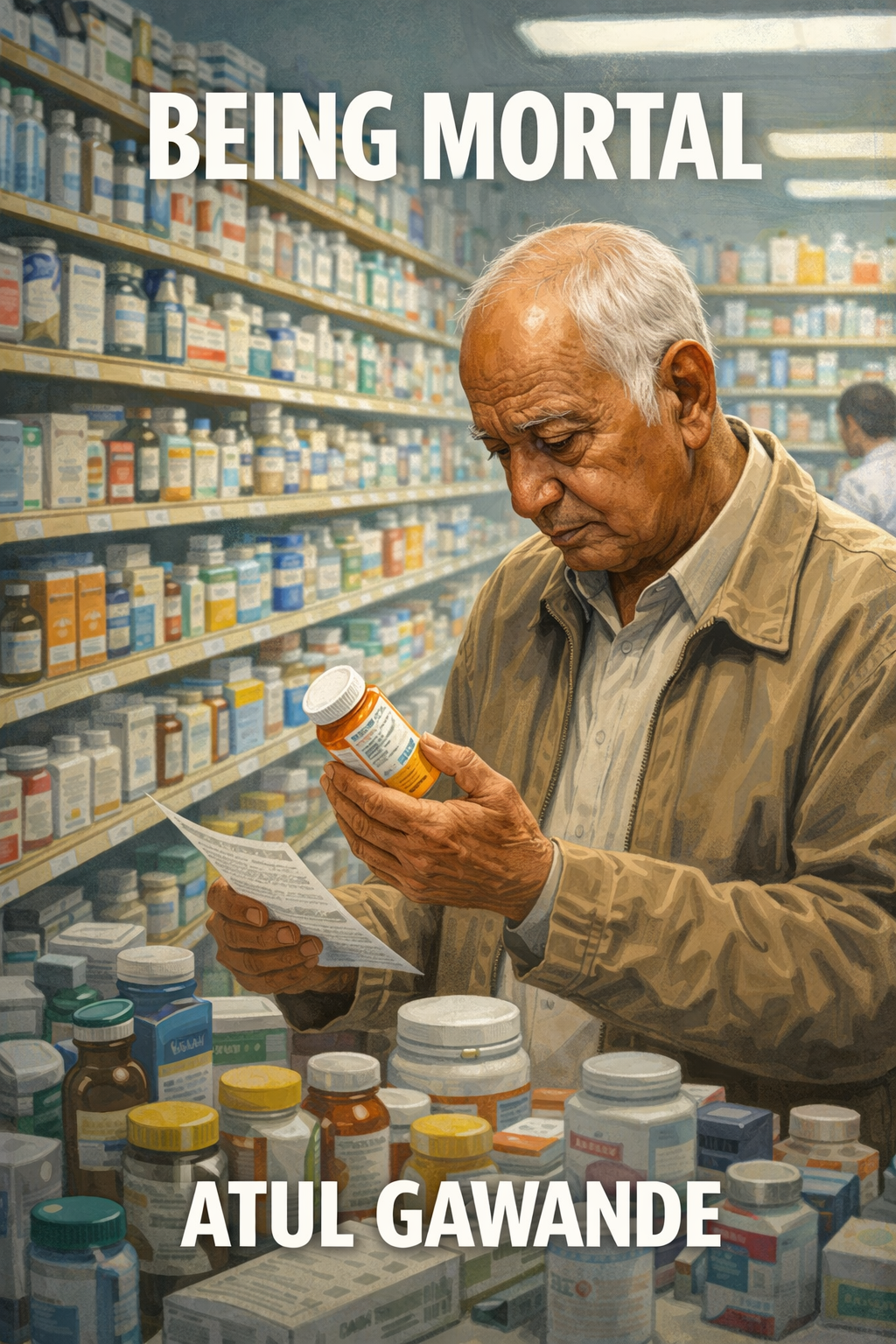
Being Mortal: Medicine and What Matters In The End
Chapter Summaries
What's Here for You
Prepare for a deeply moving and intellectually stimulating journey into the heart of aging and mortality with Atul Gawande's 'Being Mortal.' This book isn't just about death; it's about life – how we live it, how we prolong it, and how we can redefine its meaning in our final years. Gawande masterfully blends personal anecdotes, compelling case studies, and insightful philosophical reflections to expose the shortcomings of modern medicine's approach to end-of-life care. You'll confront uncomfortable truths about our societal denial of aging, the medical system's tendency to prioritize longevity over quality of life, and the crucial importance of having honest, courageous conversations about our wishes for the end. Through stories of individuals navigating the complexities of aging, dependence, and terminal illness, you'll gain a profound understanding of the challenges and opportunities that arise when confronting our own mortality. Discover innovative approaches to assisted living that prioritize well-being and purpose, and learn how to navigate the often-conflicting priorities of medical intervention and personal autonomy. 'Being Mortal' promises not only to inform, but to empower you to make more conscious choices about how you and your loved ones will face the inevitable. Prepare to be challenged, enlightened, and ultimately, inspired to live more fully, knowing that the most meaningful moments often lie in embracing the reality of our finite existence.
The Independent Self
In 'Being Mortal,' Atul Gawande reflects on the evolving landscape of aging, contrasting traditional multigenerational care with modern Western independence, framing it through personal anecdotes. He begins with his exposure to aging through Kathleen's grandmother, Alice Hobson, a fiercely independent woman who maintained her autonomy despite her advancing years, showcasing a life starkly different from the author's ancestral experiences. Gawande juxtaposes Alice's self-reliance with his paternal grandfather, Sitaram Gawande, in rural India, where elders were revered and cared for within the family, highlighting a cultural chasm in approaches to aging. Sitaram, despite physical limitations, retained authority and respect, a stark contrast to the often-isolated elderly in Western societies. The author explains the shift from multigenerational care to independent living, noting how increased longevity, economic development, and evolving family structures have reshaped our perception of old age. He illuminates the tension between the desire for independence and the inevitable challenges of aging, painting a picture of the elderly navigating a world that increasingly values autonomy. Gawande points out that the rise of retirement communities and the concept of 'intimacy at a distance' reflect a societal preference for independence, where both the elderly and their children often choose separation as a form of freedom, but this freedom often obscures the looming reality of declining health. Gawande presents a poignant moment when Alice's independence begins to wane, marked by confusion and falls, revealing the limitations of a system that reveres self-sufficiency but struggles to address the complexities of aging and the inevitable loss of independence, leaving families and individuals grappling with the question of what to do when independence is no longer sustainable, a question hanging heavy like an unresolved chord.
Things Fall Apart
In "Being Mortal," Atul Gawande reflects on how medicine has reshaped our experience of aging and death, revealing a central tension: while medical advancements extend life, they often do so by prolonging decline, a reality our culture struggles to accept. Gawande illustrates how, historically, death struck swiftly, but now, chronic illnesses create a drawn-out descent, a hilly road of temporary recoveries and inevitable setbacks, highlighting that modern medicine stretches the journey, even when it cannot alter the destination. He notes how teeth soften, bones harden, and bodies calcify, a poignant reminder that aging is the story of our parts gradually wearing down, like a complex machine with failing backups. The author explains that while the classical view attributes aging to random wear and tear, newer perspectives suggest a genetically programmed process, yet he argues that our extended lifespans are less natural, more a product of unnatural interventions, with genetics playing a surprisingly small role in longevity. Gawande shares the story of Jean Gavrilles, an eighty-five-year-old patient, to demonstrate the expertise of geriatric care, emphasizing that the focus shifts from curing diseases to supporting quality of life and maintaining function, and that her story underscores how geriatricians address the real threats to well-being, such as falls, rather than solely focusing on life-threatening ailments. He contrasts this proactive approach with the neglect Alice experienced, whose falls and car accident were missed as warning signs, illustrating the consequences of not recognizing and adapting to the creeping vine of decline. Gawande points out that geriatric care, though effective in reducing disability and depression, faces economic challenges and societal neglect, as medical innovation often overshadows the importance of managing old age with compassion and expertise. He recounts Felix Silverstone's story, a geriatrician facing his own aging, to show the importance of purpose and connection in navigating decline, and how Silverstone's care for his blind wife became a source of self-worth, emphasizing the need to be honest about one's limitations. Gawande concludes with a call for a shift in priorities, advocating for geriatric training for all primary care doctors, and paints a vivid picture of Silverstone driving at night, his words underscoring that while decline is inevitable, medical care can influence the steepness and the preservation of what matters most.
Dependence
In this poignant chapter of *Being Mortal*, Atul Gawande explores the complex realities of aging and dependence through the stories of Felix and Bella, and Alice Hobson, revealing our societal unpreparedness for the final stages of life. Gawande introduces Felix and Bella, an elderly couple navigating the challenges of aging with grace and mutual devotion; their bond, deepened by decades of shared experience, is tested when Bella's sudden deafness isolates her, forcing a move to a nursing home floor, which illustrates how sensory loss can cruelly sever connections, plunging individuals into confusion and agitation. The author highlights a core tension: the dread of losing one's way of life far outweighs the fear of death itself, a sentiment echoed by many elderly individuals facing a continuous series of losses. Despite professional care, Felix finds the nursing home exasperating, as staff often overlook Bella's personal preferences, which underscores the dehumanizing potential of institutional care that prioritizes procedure over personhood; Felix’s decision to bring Bella home, even with the added burden, emphasizes the profound importance of familiar surroundings and control in maintaining dignity. Gawande then shifts to the story of Alice Hobson, whose move to Longwood House, a seemingly ideal senior living complex, strips her of independence and purpose, revealing that a comfortable facility is a mere facsimile of home, unable to replicate the sense of belonging and control essential to well-being. Gawande contrasts Alice's experience with historical context, recalling the grim realities of poorhouses and the terror they instilled, to highlight the advancements in elderly care, yet he argues that modern nursing homes, while safer, often fail to address the deeper human needs for autonomy and connection. The chapter exposes the unintended consequences of medicalizing old age, as nursing homes evolved from hospitals' need to clear beds, not from a genuine desire to improve the lives of the dependent; this historical perspective reveals that the systems we devise often prioritize societal goals over the individual's need for a life worth living. Alice's eventual confinement to the skilled nursing unit, stripped of privacy and control, mirrors Erving Goffman's description of total institutions, where life is rigidly scheduled and individuality suppressed, like a prison sentence for being old. Gawande encapsulates a universal struggle: the battle for control and self-expression within the confines of institutional life, where even small acts of resistance, like eating a cookie, become acts of rebellion, finally, Jim’s understanding of Alice's whispered desire to die underscores the ultimate need for agency and compassion in the face of mortality, urging us to confront our societal neglect of the elderly's fundamental needs for meaning and autonomy.
4 • Assistance
In this chapter of "Being Mortal," Atul Gawande explores the complex challenges of aging and the limitations of modern medicine in providing meaningful assistance to the elderly, focusing on the story of Lou Sanders and the evolution of assisted living. Gawande sets the stage by highlighting a societal paradox: despite widespread dissatisfaction with nursing homes, there's a lack of imagination for better alternatives. Lou Sanders's story exemplifies this tension, as his increasing frailty forces his daughter, Shelley, to confront difficult choices. Initially, Shelley welcomes Lou into her home, but the demands of caregiving soon become overwhelming, a situation mirrored by Keren Brown Wilson's experiences with her mother, Jessie, whose stroke led to a frustrating series of nursing home stays. Wilson, Gawande explains, sought to revolutionize elder care with the concept of assisted living, prioritizing autonomy and a sense of home, envisioning a place where the frail elderly could maintain control over their lives, reminiscent of Jessie's desire for a simple apartment with her favorite things. Yet, as Gawande reveals, the assisted living model often falls short of its promise, devolving into a watered-down version of nursing homes, driven by concerns for safety and profit rather than genuine assistance with living, underscored by Shelley’s struggle to find a facility that truly caters to Lou’s needs. Gawande then pivots to the work of Laura Carstensen, whose research suggests that as people age, their priorities shift from achievement to appreciating everyday pleasures and relationships, a shift that is less about age and more about perspective, a perspective often lost in the medicalized approach to elder care. The chapter culminates with Lou's placement in an assisted living facility, a decision driven by Shelley’s concern for his safety, but one that ultimately diminishes his quality of life, a stark illustration of how the desire for safety can eclipse the need for meaning and connection, as Gawande poignantly illustrates, the system often prioritizes the anxieties of the caregivers over the lived experiences of the elderly themselves, trapping them in a cycle of institutionalization where their desires are secondary to their perceived needs.
A Better Life
In "A Better Life," Atul Gawande chronicles Dr. Bill Thomas's radical experiment at Chase Memorial Nursing Home, a place initially marked by despair. Thomas, a physician more at home on his farm than in sterile hallways, recognized the 'Three Plagues' of nursing home existence: boredom, loneliness, and helplessness. The author illustrates how Thomas, leveraging his salesmanship and willingness to face rejection, convinced the nursing home to embrace an unconventional solution: injecting life itself into the institution by introducing plants, animals, and children. Gawande emphasizes that this wasn't merely about adding amenities; it was a philosophical rebellion against the institutionalization that strips elders of their autonomy and purpose. The initial chaos of one hundred parakeets loose in the beauty salon becomes a vivid metaphor for the disruption of established routines. The author underscores the insight that residents, once considered beyond engagement, began to thrive when given opportunities to care for other living beings, highlighting the fundamental human need for a reason to live. Gawande draws a parallel to Josiah Royce's philosophy of loyalty, explaining that humans crave dedication to something beyond themselves to find meaning, a cause that transcends mere existence. The narrative tension resolves as Gawande contrasts this life-affirming approach with the narrow medical focus that often neglects the sustenance of the soul, an imbalance modern society has created. He introduces figures like Keren Wilson and Jacquie Carson, who, like Thomas, sought to redefine dependent living, either by dismantling the nursing home model or by creating havens within it. The author highlights that the Leonard Florence Center, embodies these principles. Gawande concludes with Lou Sanders's story, a man who found renewed purpose and connection in his final years, revealing that even in debility and dependence, autonomy—the freedom to shape one's own story—remains possible and essential. The terror of aging, Gawande suggests, lies not just in loss, but in the isolation that strips away one's ability to make choices and sustain connections, a terror that can be overcome with imagination and a commitment to a life of worth.
Letting Go
In "Letting Go," Atul Gawande grapples with the central dilemma of modern medicine: when to fight for life and when to accept death. He introduces Sara Thomas Monopoli, a young woman diagnosed with terminal lung cancer shortly after giving birth, whose story becomes a poignant example of the medical system's inclination towards aggressive treatment, even when a cure is impossible. Gawande highlights the financial burden of end-of-life care, noting that a significant portion of healthcare spending goes towards futile efforts in the last months of life, creating a 'warehouse for the dying'. He contrasts this with the past, where death was a more precipitous event, and society had established rituals for ars moriendi, the art of dying. Now, technology sustains organs far beyond awareness, obscuring the very definition of dying. Gawande then introduces Sarah Creed, a hospice nurse, whose work illustrates an alternative approach: prioritizing quality of life over mere prolongation. Creed's hospice care focuses on pain management, mental awareness, and family connection, rather than aggressive interventions. The author reveals the transformative power of simple conversations, citing studies that show terminally ill patients who discuss their end-of-life preferences often experience less suffering and their families are less likely to face depression. Gawande underscores the importance of recognizing that people with serious illnesses have priorities beyond simply prolonging their lives, such as avoiding suffering and strengthening relationships. He then describes how a system in La Crosse, Wisconsin, dramatically reduced end-of-life hospital costs through routine discussions about patient wishes, demonstrating that discussion, not just directives, is what matters most. Gawande concludes by advocating for a shift in medicine's focus, from fighting death at all costs to helping individuals achieve what is most important to them in their final days, emphasizing the need for doctors to be willing to have hard discussions, to guide patients toward a peaceful and meaningful end, and to surrender territory when it can't be won.
Hard Conversations
In "Being Mortal," Atul Gawande guides us through the complex terrain of end-of-life care, highlighting the global shift in attitudes toward death as societies evolve economically and medically. Gawande contrasts the impersonal, often futile, high-tech interventions with the deeply human need for autonomy and dignity. He introduces us to his father's journey with a spinal cord tumor, a narrative thread that allows Gawande to confront his own professional habits and biases. The author explains how medical training often defaults to paternalistic or informative models, sidelining the interpretive approach where a doctor acts as a counselor, helping patients define their priorities. Gawande vividly recalls a neurosurgeon, Dr. Benzel, who embodied this shared decision-making, earning the trust of Gawande's father by addressing his fears, not just his tumor. This illuminates a core insight: true care involves understanding what matters most to the patient. Gawande then recounts the case of Jewel Douglass, a woman battling metastatic ovarian cancer, emphasizing the physician's role in conveying not just facts but also empathy. He introduces the "I am worried" technique, a simple yet profound way to signal solidarity and concern. The chapter explores the concept of "ODTAA syndrome"—One Damn Thing After Another—capturing the relentless crises that often mark the end of life. Gawande also shares how his father, facing paralysis, redefined his identity through community service, underscoring the importance of maintaining control over one's life narrative even when physical control diminishes. Gawande presents the concept of preference shift as death approaches, the knowledge of finitude sharpens focus, altering desires, and priorities. This shift underscores the gift of understanding the limits of one’s time. Ultimately, the author reflects on the limitations of aggressive treatments that ignore the patient's quality of life, which he observed firsthand as his father underwent radiation. The author then pivots to the importance of hospice care, illustrating how even in a small Appalachian town, innovative solutions like Athens Village are emerging to support aging individuals. A hospice nurse's visit becomes a masterclass in compassionate care, prioritizing comfort and dignity over mere survival. The story culminates with Gawande’s father walking, against all odds, at his son's graduation, symbolizing the power of patient-centered care that honors life's true values until the very end, with the hard conversations serving as guideposts on the path toward a more humane conclusion.
Courage
In this chapter of "Being Mortal," Atul Gawande grapples with the multifaceted nature of courage, drawing upon Plato's dialogue, the Laches, where Socrates and Athenian generals debate its true meaning. The chapter unfolds with the case of Jewel Douglass, a patient facing recurrent ovarian cancer, illustrating the agonizing choices patients and doctors confront when weighing quality versus quantity of life. Gawande reflects on how medical professionals often revert to presenting facts and figures, sidestepping the deeper exploration of a patient's fears, goals, and acceptable trade-offs. He underscores the first kind of courage required in aging and sickness: confronting the reality of mortality. Gawande then illuminates Daniel Kahneman's Peak-End rule, revealing how our remembering selves judge experiences not by their duration but by their most intense moment and their ending, creating a tension between the experiencing and remembering self. This tension becomes palpable as Jewel Douglass struggles to decide whether to undergo risky surgery, fearing both suffering and a diminished quality of life; her body a stage for this internal debate. Gawande shifts the focus to the importance of narrative in our lives, asserting that people seek meaning not merely in the accumulation of pleasurable moments but in the overarching story of their existence. He shares the story of Peg Bachelder, a piano teacher who, with the help of hospice, found purpose and joy in her final weeks by continuing to teach, embodying the dying role and its profound impact on both the dying and those left behind. Finally, Gawande recounts his father's end-of-life experience, illustrating the struggle to balance pain management with maintaining awareness and the challenge of honoring a patient's wishes in the face of conflicting emotions and medical interventions. He reveals that the most cruel failure in treating the sick and aged is neglecting their priorities beyond safety and longevity. Gawande concludes by advocating for assisted living over assisted death, emphasizing the importance of shaping one's story to the very end and recognizing that courage lies in acknowledging the limits while striving to act within them, ensuring that the last chapters of life hold meaning and autonomy.
Conclusion
'Being Mortal' synthesizes the challenges of aging in modern society, highlighting the tension between our desire for independence and the inevitability of decline. Gawande underscores how medical advancements, while extending life, often prolong suffering, prompting a critical examination of our healthcare priorities. The emotional lesson is profound: true care involves honoring individual autonomy, fostering connection, and providing purpose, even in the face of mortality. Practically, this translates to advocating for geriatric training, prioritizing palliative care, and engaging in open conversations about end-of-life wishes. The book serves as a powerful call to action, urging us to reimagine elder care and embrace a holistic approach that values quality of life over mere survival, ensuring a more dignified and meaningful journey for all.
Key Takeaways
Acknowledging mortality and preparing for death can lead to a more peaceful and meaningful end-of-life experience.
Effective end-of-life care requires understanding and honoring the patient's values and priorities, not just treating their disease.
Societal structures have shifted from multigenerational care to prioritizing individual independence, influencing how we experience old age and approach end-of-life care.
Increased longevity and economic development have empowered both the elderly and their children to choose independent living, altering traditional family roles and expectations.
Cultural values emphasizing autonomy often overshadow the inevitable challenges of aging, creating a tension between the desire for independence and the need for support.
The modern reverence for independence can leave individuals and families unprepared for the realities of declining health and the eventual loss of self-sufficiency.
Traditional multigenerational systems provided inherent support and respect for elders, integrating them into family life and decision-making processes.
As societies modernize, the role of elders as exclusive holders of knowledge diminishes, impacting their status and influence within families and communities.
Recognize that modern medicine extends life but often prolongs decline, requiring a shift in focus towards quality of life.
Acknowledge that aging is a gradual wearing down of complex systems, and early interventions can significantly improve outcomes.
Prioritize geriatric care that focuses on maintaining function and independence, not just treating diseases.
Address the social and economic challenges hindering geriatric care to ensure adequate support for the aging population.
Find purpose and maintain social connections to navigate the challenges of aging with dignity and resilience.
Be honest about one's limitations and make necessary adaptations to maintain independence and quality of life.
Advocate for geriatric training for all primary care doctors to improve care for the elderly.
Acknowledge that the fear of losing one's way of life often outweighs the fear of death itself, and proactively plan for maintaining independence and quality of life in old age.
Recognize that sensory loss can profoundly impact an individual's ability to connect and communicate, and prioritize strategies to maintain sensory engagement.
Understand that institutional care, while providing physical safety, can inadvertently dehumanize individuals by prioritizing procedures over personal preferences and autonomy.
Advocate for environments that prioritize individual control and familiar surroundings, recognizing their profound impact on maintaining dignity and well-being.
Challenge the medicalization of old age by shifting the focus from merely prolonging life to ensuring a life worth living, prioritizing autonomy, connection, and purpose.
Promote compassionate end-of-life care that respects individual agency and allows for the acceptance of mortality on one's own terms.
Societal imagination regarding elder care is limited, often accepting inadequate nursing homes due to a lack of envisioning better alternatives.
Family caregiving, while often preferred, can become unsustainable due to dual-income pressures and the increasing demands of caring for frail elders.
The assisted living concept, intended as a radical alternative, has often been diluted, prioritizing safety and profit over autonomy and quality of life.
As individuals age, their priorities shift from achievement and growth to everyday pleasures and close relationships, a perspective often overlooked in elder care.
Perspective, rather than age, significantly influences life priorities, with a heightened awareness of mortality leading to a focus on the present and meaningful connections.
The desire for safety in elder care can inadvertently overshadow the individual's need for autonomy, connection, and a sense of purpose.
Effective elder care requires understanding and assisting individuals in maintaining the connections and joys that matter most to them, rather than merely providing custodial or medical services.
Recognize and actively combat the 'Three Plagues'—boredom, loneliness, and helplessness—in environments for the elderly to foster a sense of purpose.
Provide opportunities for individuals, regardless of their physical or cognitive state, to care for other living beings, nurturing their inherent need for purpose and connection.
Challenge institutionalized routines and prioritize residents' autonomy and well-being over mere efficiency and safety.
Embrace a philosophy of loyalty and transcendence, encouraging individuals to find meaning through dedication to causes beyond themselves.
Advocate for a holistic approach to elder care that addresses both physical health and the sustenance of the soul, promoting a life of worth and connection.
Understand that true autonomy lies in the freedom to shape one's own life story, even in the face of debility and dependence, by empowering individuals to make choices and sustain relationships.
Actively seek out and support innovative models of elder care that prioritize community, flexibility, and personal agency over rigid institutional structures.
Aggressive medical intervention at the end of life can often decrease quality of life without significantly extending it.
Open and honest conversations about end-of-life wishes can significantly improve the dying experience for patients and their families.
Hospice care prioritizes quality of life and can lead to extended survival compared to aggressive treatment in some cases.
Modern medicine often prolongs biological life without addressing the emotional and spiritual needs of the dying.
The medical system should shift from solely fighting death to helping patients achieve their values and priorities in their final days.
Advanced care planning and palliative care can reduce unnecessary medical interventions and improve patient satisfaction.
The 'interpretive' doctor-patient relationship, where the physician acts as a counselor, is crucial for shared decision-making and patient autonomy.
Openly expressing concern and empathy, such as saying 'I am worried,' can build trust and facilitate difficult conversations about mortality.
The final phase of life often involves a series of escalating crises ('One Damn Thing After Another'), requiring a shift in focus from cure to care.
Maintaining a sense of purpose and control, even in decline, is essential for quality of life.
Hospice care and community support systems can empower individuals to live fully and die with dignity in their own homes.
The knowledge of one's finitude can sharpen focus and alter desires, making it important to address the patient's current needs and happiness.
True courage in aging and illness lies in acknowledging mortality and acting according to one's values, not just prolonging life.
Medical professionals should prioritize understanding a patient's fears, goals, and trade-offs to provide truly patient-centered care.
The 'Peak-End rule' demonstrates that our memories prioritize the most intense moments and the ending, influencing how we perceive overall experiences of suffering or pleasure.
People seek meaning in the narrative arc of their lives, not just the accumulation of positive moments, highlighting the importance of a good ending.
The 'dying role'—sharing memories, settling relationships, and establishing legacies—is crucial for both the dying and their loved ones.
Balancing pain management with maintaining awareness is a difficult but essential aspect of end-of-life care, requiring constant adjustment and communication.
The ultimate goal is not just a good death, but a good life to the very end, emphasizing the need for comprehensive palliative care.
Action Plan
Reflect on your personal values regarding independence and interdependence as you age.
Initiate conversations with your family about your preferences for care and support in later life.
Research available resources and support systems for the elderly in your community.
Consider how you can balance your desire for independence with the potential need for assistance in the future.
Explore ways to maintain social connections and engagement as you age.
Evaluate your living situation and make adjustments to promote safety and accessibility.
Advocate for policies and programs that support the well-being of the elderly.
Examine your own biases and assumptions about aging and the capabilities of older adults.
Assess your or your loved one's risk of falling and take steps to improve balance and reduce hazards.
Simplify medication regimens and consult with a geriatrician to minimize side effects and interactions.
Prioritize social connections and activities to combat isolation and maintain mental well-being.
Monitor nutrition and weight to maintain muscle strength and overall health.
Advocate for geriatric training in medical schools and primary care settings.
Seek regular check-ups with a geriatrician to address age-related health concerns proactively.
Create a plan for long-term care and end-of-life wishes, involving family and healthcare providers.
Identify a sense of purpose and engage in activities that provide meaning and fulfillment.
Initiate conversations with elderly loved ones about their fears, preferences, and priorities for maintaining independence and quality of life as they age.
Actively seek out and implement strategies to support sensory engagement for elderly individuals experiencing sensory loss, such as providing assistive devices, creating stimulating environments, and facilitating social interaction.
Advocate for person-centered care approaches in institutional settings, emphasizing individual preferences, autonomy, and meaningful activities.
Create a 'living will' or advance directive that specifies end-of-life care preferences, including the acceptance of mortality and the avoidance of unwanted medical interventions.
Explore alternative housing and care models that prioritize autonomy and community, such as co-housing communities or home-based care options.
Actively engage in community initiatives that support elderly individuals, such as volunteering at senior centers or providing companionship to isolated seniors.
Initiate open and honest conversations with aging loved ones about their priorities, fears, and desires regarding their future care.
Research and explore a variety of elder care options beyond traditional nursing homes, focusing on facilities that prioritize autonomy and quality of life.
Advocate for person-centered care approaches that respect individual preferences and needs, even when they conflict with safety concerns.
Engage in community initiatives that support and empower elderly individuals to maintain social connections and meaningful activities.
Educate yourself and others about the limitations of the current elder care system and advocate for policy changes that prioritize autonomy and well-being.
Reflect on your own attitudes and biases regarding aging and dependency, and challenge assumptions that may compromise the autonomy of elderly individuals.
Actively listen to and validate the emotional experiences of aging loved ones, providing companionship and support without imposing your own expectations.
Create opportunities for intergenerational connections, fostering empathy and understanding between younger and older generations.
Support organizations and initiatives that are working to transform the culture of elder care, promoting dignity, respect, and autonomy.
Assess the level of social connection with the elderly in your life and identify 1-2 new ways to engage them in social activities or community events.
Identify one small change you can make in your own life or the life of someone you care for to combat boredom, loneliness, or helplessness.
Advocate for more person-centered care in your local nursing home or assisted living facility.
Seek out opportunities to connect with and learn from elders in your community.
Reflect on your own values and priorities, and identify a cause or purpose that gives your life meaning.
Take steps to ensure that your wishes for end-of-life care are known and respected.
Support organizations that are working to reform elder care systems and promote autonomy and well-being for all.
Consider how you can create a more supportive and inclusive community for people of all ages and abilities.
If working in healthcare, challenge institutional routines and prioritize resident's autonomy and well-being over mere efficiency and safety.
Reflect on your own values and priorities regarding end-of-life care.
Discuss your wishes with your family and healthcare providers.
Create an advance care plan or living will to document your preferences.
Consider palliative care or hospice services if you or a loved one is facing a serious illness.
Ask your doctor about the potential benefits and burdens of different treatment options.
Advocate for open and honest communication with your medical team.
Support policies and practices that promote patient-centered end-of-life care.
Normalize conversations about death and dying in your community.
Seek guidance from palliative care specialists in navigating complex medical decisions.
Prepare a comfort pack at home with essential medication.
Initiate conversations with loved ones about their values, fears, and priorities regarding end-of-life care.
When facing medical decisions, seek out doctors who prioritize shared decision-making and are willing to discuss quality of life.
Practice expressing empathy and concern to patients or loved ones by using phrases like 'I am worried'.
Explore hospice care and community support options early in the process of dealing with a serious illness.
Focus on living for the best possible day today, rather than sacrificing current well-being for uncertain future gains.
Advocate for patient-centered care that respects individual autonomy and dignity.
Reflect on your own fears and beliefs about death and dying to better understand your preferences for end-of-life care.
Engage in community initiatives that support aging individuals and provide resources for those facing serious illnesses.
Document your wishes for end-of-life care in advance directives and share them with your family and healthcare providers.
Reflect on your own fears, goals, and values regarding end-of-life care and discuss them with loved ones.
When faced with medical decisions, actively seek to understand the potential trade-offs between quantity and quality of life.
Practice active listening and empathy when communicating with individuals facing serious illnesses or end-of-life decisions.
Identify and prioritize what truly matters to you in life, focusing on creating meaningful experiences and relationships.
Advocate for patient-centered care that respects individual autonomy and values.
Consider how you can support and honor the 'dying role' for those nearing the end of their lives.
Explore palliative care and hospice options to ensure comprehensive support and comfort during serious illness.
Examine your own biases and assumptions about aging, illness, and death to provide more compassionate care.