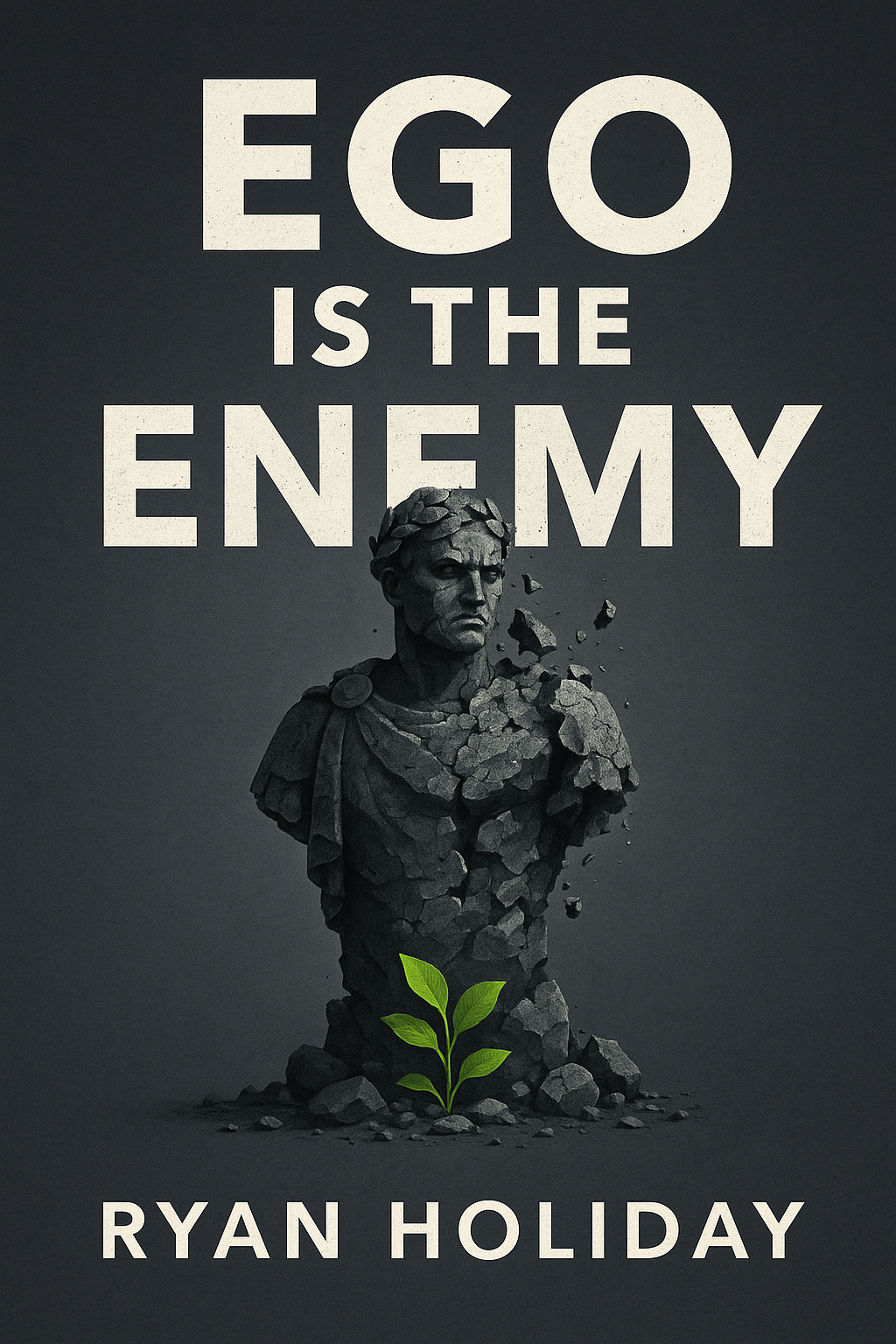
Ego Is the Enemy
Chapter Summaries
What's Here for You
Are you ready to unlock your true potential and achieve lasting success, not by chasing fleeting validation, but by conquering your most formidable opponent? Ryan Holiday's "Ego Is the Enemy" is your guide to understanding and dismantling the silent saboteur that lurks within us all. This book promises to equip you with the wisdom and strategies to move beyond the destructive impulses of ego, transforming ambition from a source of pride into a powerful engine for growth. You will gain a profound understanding of how to cultivate humility, embrace continuous learning, and harness the power of self-discipline. Prepare to shed the illusions of early success, resist the siren call of external praise, and discover the quiet strength in diligent work and unwavering focus. This journey will challenge your modern assumptions about passion and success, offering a counterintuitive yet deeply effective path forward. The intellectual tone is sharp, insightful, and grounded in historical and philosophical wisdom, while the emotional tone is one of empowerment, encouragement, and sober self-reflection. By the end, you'll feel equipped to navigate the complexities of achievement with clarity, resilience, and a profound sense of purpose, ensuring that your greatest victories are not derailed by the very ego that helped you achieve them.
TALK, TALK, TALK
The author, Ryan Holiday, unveils a potent adversary lurking within our ambitions: the seductive allure of 'talk.' He illustrates this with the cautionary tale of Upton Sinclair, whose 1934 gubernatorial campaign was so consumed by the pre-written narrative of his success – detailed in his book, 'I, Governor of California' – that the actual pursuit of the office lost its urgency, culminating in a decisive defeat. This phenomenon, Holiday explains, is a universal temptation, amplified by our modern digital landscape. Platforms like Facebook, Twitter, and even the comment section of an article beckon us to fill empty spaces with pronouncements of future plans, aspirations, or curated positive self-portraits, often masking underlying fear or struggle. This external validation seeking, a whisper from our ego, can paralyze progress. Emily Gould, a writer, found herself trapped in this cycle, spending two years of a lucrative book deal lost in the digital ether of blogging and social media, mistaking the performance of work for the work itself. The core insight here is that talk, especially when it precedes action, depletes the very energy needed to overcome the 'Resistance' – that internal hurdle to creative expression and meaningful endeavor. Silence, contrary to popular belief, is not weakness but a profound strength, particularly in the nascent stages of any significant journey. As Soren Kierkegaard cautioned, verbalizing nascent thoughts can weaken the will to act. Bo Jackson, the legendary athlete, embodies this principle, sharing his ambitious goals with only his girlfriend, preserving his strategic flexibility and psychological focus. The author reveals that talk depletes our resources, with research suggesting that visualizing or verbalizing goals can lead the mind to confuse them with actual progress. This is especially costly when facing difficult tasks with uncertain outcomes, as talk offers an escape from accountability and saps the energy required to wrestle with the 'void' – the inherent uncertainty and discomfort that great work often demands. The greatest art and achievements, Holiday posits, arise not from banishing this void, but from confronting it. Ultimately, the chapter urges us to recognize that the impulse to seek recognition before we have truly acted is a drain on our vital life force, and that true progress is forged in the quiet, often arduous, work behind the scenes, where effort is concentrated and impact is earned, not merely spoken.
TO BE OR TO DO?
Ryan Holiday, in "Ego Is the Enemy," draws us into the quiet, powerful orbit of John Boyd, a military strategist whose influence belies his obscurity. Boyd, a fighter pilot known as "Forty-Second Boyd" for his unparalleled combat speed, became a legendary instructor and thinker, his theories quietly reshaping modern warfare. He never sought the spotlight, foregoing books and public accolades, a deliberate choice to focus on substance over status. Holiday presents Boyd's pivotal lesson, delivered to a young, impressionable officer at a career crossroads: the stark choice between "to be somebody" and "to do something." To be somebody, Boyd explained, meant compromising principles, turning on friends, and chasing the external markers of success – promotions, good assignments, club membership. It's the path of ego, where appearances of power and prestige overshadow genuine contribution. In contrast, to do something meant pursuing a higher purpose, serving one's country, one's Air Force, and oneself through uncompromised, meaningful work. This path might forgo promotions and favor, but it offered truth, integrity, and the potential for real impact. This fundamental tension, Holiday argues, is life's constant "roll call." We are often tempted by the glittering prizes of recognition, title, and personal ease, which can corrupt our initial noble intentions, turning duty, honor, and country into pride, power, and greed, a descent Boyd illustrated by crossing out the former and writing in the latter. The author emphasizes that our purpose is the compass; if our purpose is self-aggrandizement, the path of compromise is clear. But if our purpose is larger than ourselves—to accomplish, to prove, to serve—then distractions fade, and the true work becomes paramount. This is not about who we want to *be*, but what we want to *accomplish*. Boyd himself lived this, a "ghetto colonel" who died with uncashed checks, refusing bribes, and repeatedly held back from promotion, a silent testament to his commitment to doing over being. The narrative urges us to examine our own motivations, to ask if our pursuits are driven by genuine purpose or the ego's insatiable hunger for validation, reminding us that the choices we make about our time and our work shape us profoundly.
BECOME A STUDENT
The narrative begins with a stark contrast: one guitarist's dream job shattered, another's realized. In the early 1980s, Metallica unceremoniously ousted Dave Mustaine, handing him a bus ticket home, while Kirk Hammett of Exodus stepped into the vacant lead guitarist role. Though thrust into what seemed like a lifelong ambition, Hammett soon faced a humbling realization: despite his talent and new position, he wasn't as skilled as he aspired to be. This led him to Joe Satriani, a guitarist renowned for his ability to teach even prodigies. Satriani's approach was rigorous, demanding weekly lessons and mastery of the material, with a clear consequence for failure. Hammett, however, embraced this challenge, committing two years to Satriani's tutelage, not just to refine his technique but to understand the fundamentals, learning to 'do more with fewer notes.' This journey illustrates a core principle: the power of embracing the student mindset, where ego is checked, and ambition is placed in the hands of a trusted mentor, imposing a necessary 'ego ceiling' that prevents complacency. The pretense of knowledge, the author explains, is a dangerous vice that halts growth; only through studious self-assessment can mastery be achieved. This idea echoes in Frank Shamrock's 'plus, minus, equal' training system for fighters, emphasizing the need for mentors, mentees, and peers to gain continuous, multi-angled feedback and purge ego, fear, and laziness. From musicians and fighters to scientists, philosophers, writers, and politicians, the constant pursuit of learning, internalizing fundamentals, and staying connected to the evolving landscape of their domains is paramount to achieving and maintaining greatness. The temptation, upon achieving a certain level of success, is to believe 'I've made it,' a dangerous illusion that can lead to obscurity. A true student, conversely, remains like a sponge, self-critical, self-motivated, and always seeking improvement, understanding that true growth requires humility and a willingness to confront one's shortcomings. The author posits that ego actively avoids harsh feedback, preferring its own inflated self-assessment, thereby blocking the 'incubation' period necessary for deep learning and development. In an age where resources for education are abundant, the excuse for not learning is gone, yet ego often drives away potential teachers or makes us resistant to their guidance. It is this humility, this relentless drive to learn, that keeps individuals grounded and open to the feedback that fuels genuine mastery, reminding us that it is impossible to learn that which one believes one already knows.
DON’T BE PASSIONATE
The author, Ryan Holiday, embarks on a counterintuitive journey, challenging the modern obsession with passion as the ultimate driver of success. He observes a cultural landscape saturated with calls to 'find your passion,' from Burning Man to TED talks, yet reveals that this unbridled enthusiasm, this 'vivida vis animi,' can often be the very anchor dragging us down. Consider Eleanor Roosevelt, a figure of immense influence, who, far from being driven by passionate fervor, operated with purpose and direction, her actions guided by reason rather than raw emotion. Contrast this with figures like George W. Bush, Dick Cheney, and Donald Rumsfeld, whose passion for the Iraq War, or Christopher McCandless's fervent heading into the wild, or the climbers of the tragic 1996 Everest climb, illustrate how intense, unexamined zeal can blind individuals to critical objections and real dangers, leading to spectacular failures like the Segway's overhyped launch. Holiday posits that passion, in its most common interpretation – an unquenchable desire to achieve a vague, ambitious goal – is often a poor substitute for discipline, mastery, and perseverance, masking deeper weaknesses. He draws a parallel to John Wooden, the legendary basketball coach, who described his approach as 'dispassionate,' emphasizing control and execution over emotional spectacle. The core insight is that while passion might feel like a powerful engine, it can easily become the 'drunkenness of passion,' leading to overinvestment, premature action, and a failure to grasp the complexities of a task. Instead of this breathless, impetuous energy, Holiday advocates for purpose, which he defines as passion with boundaries, and realism, which requires detachment and perspective. He illustrates this through the deliberate, methodical approach of seasoned professionals who ask questions, plan for contingencies, and build success incrementally, locking in gains and learning from feedback. This iterative process, though less glamorous than grand manifestos or impulsive leaps, is the path to sustained accomplishment. The author urges us to be humbled by the magnitude of our goals, determined to see them through with deliberation and consideration, leaving the unbridled zeal to the amateurs, and instead focusing on what one *must* do, not merely what one *cares* about, ultimately leading to greater, more effective achievements.
FOLLOW THE CANVAS STRATEGY
The author, Ryan Holiday, unfolds a profound strategy for navigating early career stages, drawing inspiration from ancient Rome and echoing through modern ambition. He introduces the concept of the 'anteambulo,' a path-clearer who served patrons, a role exemplified by the epigrammist Martial, who, despite his bitterness over perceived indignities, possessed a unique vantage point due to his outsider status. Holiday posits that this ancient model, far from being a mark of servitude, offers a powerful framework for growth, a lesson often lost on those blinded by ego and entitlement, much like modern interns suing employers or graduates refusing entry-level positions. The core insight is that true progress often comes not from demanding recognition, but from providing support, much like finding 'canvases for other people to paint on.' This strategy, Holiday explains, recalibrates our perception of service, shifting it from subservience to strategic enablement, allowing us to learn, adapt, and build influence from the inside. Benjamin Franklin, with his anonymous 'Silence Dogood' letters, and Bill Belichick, who mastered the unglamorous task of film analysis, serve as modern testaments to this approach, demonstrating how embracing grunt work and giving others credit can yield immense long-term rewards. The tension lies in overcoming the ego's insistence on immediate validation, the feeling of being demeaned by serving others, which, if unchecked, obstructs vision and progress. The resolution is found in understanding that 'the person who clears the path ultimately controls its direction,' a principle that reduces ego, fosters learning, and builds a foundation of trust and reciprocal relationships, much like earning interest on a principal of deferred gratification. This 'canvas strategy' is not about sycophancy but about actively creating opportunities for others, thereby creating a path for oneself, a timeless and infinitely scalable power play.
RESTRAIN YOURSELF
The author reveals a profound truth: the greatest achievements often spring not from explosive talent, but from quiet self-control. Consider the young Jackie Robinson, a man whose fiery spirit and quick temper, evident in youthful run-ins with the law and a contentious military discharge, seemed antithetical to the monumental task ahead of him. Yet, it was precisely this raw potential, tempered by an extraordinary capacity for restraint, that Branch Rickey sought. Rickey understood that integrating Major League Baseball demanded more than skill; it required a resilience that could absorb the inevitable barrage of prejudice and provocation without shattering. Jackie Robinson's journey became a testament to this principle. He faced a coordinated campaign of hatred – pitches aimed at his body, spikes at his Achilles, venomous taunts from opponents like Ben Chapman. The author paints a vivid picture: Robinson, wanting to retaliate with visceral force, instead held fast to his pact, choosing not to fight back, not to let his ego dictate his reaction. This wasn't about condoning injustice; it was about understanding that some goals are so significant they require enduring even the most demeaning treatment. As Ryan Holiday explains, this required Robinson to put aside not just his ego, but in some ways, his basic human right to respond to indignity. He endured the slights, the insults, even posing for a photo with his tormentor to advance a larger purpose. This underscores a core insight: the path to significant goals often involves tolerating a certain amount of nonsense, a deliberate choice to absorb rather than react. The author extends this to all endeavors, noting that success in any new field, regardless of talent, connections, or past achievements, will be met with indifference or sabotage. Here, ego is the enemy, a dangerous indulgence that blinds us to the strategic necessity of enduring hardship. The impulse to correct, to lash out when not recognized, is powerful, but the true path forward lies in quiet persistence. The text emphasizes that this restraint is a difficult skill, a tightrope walked by those who understand that the up-and-coming must endure the abuses of the entrenched. Robinson's story culminates in his eventual assertion of boundaries, but only after establishing himself, proving his worth, and carving out his space. He learned early that his unique position tolerated only restraint and had no forgiveness for ego, a lesson as relevant today as it was then. The narrative arc moves from the raw, untamed energy of youth to the disciplined mastery required for groundbreaking achievement, illustrating that while passion is vital, it is restraint that ultimately preserves the vision and allows it to flourish.
GET OUT OF YOUR OWN HEAD
The author, Ryan Holiday, illuminates a pervasive human tendency: getting trapped within the confines of one's own thoughts, a state where imagination supplants reality and paralyzes action. He draws parallels with fictional characters like Holden Caulfield, Arturo Bandini, and Binx Bolling, who, lost in their internal worlds, struggled to engage with the tangible world. This isn't merely a literary phenomenon; Holiday points to historical figures like Civil War General George McClellan, whose grand visions of himself and his army, coupled with an inflated sense of his own genius, led to inaction and costly missed opportunities, a stark contrast to the initiative-taking Lee and Stonewall Jackson. McClellan’s ego, the author explains, wasn't confidence but a delusion that prevented him from seeing objective reality or the need to act, ultimately costing thousands of lives. This internal narrative, whether self-aggrandizing or self-loathing as described by Anne Lamott, can consume anyone, particularly the ambitious, especially in a culture that encourages personal branding. The author reveals that this self-absorption, akin to the adolescent 'imaginary audience,' convinces us that we are constantly being watched, leading us to prefer the internal performance to actual engagement. Successful individuals, like General George Marshall, actively resist this internal theater, recognizing that dwelling on how one might be perceived can corrupt judgment and stifle necessary action. The core insight is that our imagination, while a powerful asset, becomes a dangerous prison when it runs unchecked. To live clearly and presently, we must learn to curb these flights of fancy, to pull ourselves out of the abstract and engage with the uncomfortable, tangible reality around us, recognizing that there is simply work to be done and lessons to be learned, rather than an audience to perform for.
THE DANGER OF EARLY PRIDE
The author, Ryan Holiday, warns us in "The Danger of Early Pride" that the intoxicating feeling of early success can be a perilous trap, blinding us to our own limitations and hindering our growth. He paints a vivid picture of a young Benjamin Franklin, returning to Boston at eighteen, so puffed up with self-satisfaction from his modest achievements in Philadelphia that he flaunts his new suit and coins, even to his older brother, desperately seeking validation. This hubris culminates in a humbling encounter with the respected Cotton Mather, who advises Franklin, "Stoop, young man, stoop—as you go through this world—and you'll miss many hard thumps," a lesson Franklin would carry throughout his life. Holiday explains that pride is fundamentally a lie, convincing us we are better than we are, better than we were made to be, leading us away from humility and connection. This sentiment echoes through history, from Cyril Connolly's observation that "whom the gods wish to destroy, they first call promising," to the ancient Greek poet Theognis, who wrote that the first gift bestowed upon one destined for annihilation is pride. This early pride, or "beginners conceit," as Holiday terms it, dulls our most vital tools for success: our ability to learn, adapt, remain flexible, and build relationships. It takes a minor accomplishment, like striking out on one's own or publishing a single piece, and magnifies it into a defining characteristic, creating a dangerous wedge between our perception and reality. John D. Rockefeller, a young man already experiencing early success, understood this peril, engaging in nightly self-reflection, reminding himself, "go steady," and harboring "a horror of the danger of arrogance." He knew that a little temporary success could spoil judgment and warp perspective, creating a "myopic, onanistic obsession." This is why Genghis Khan, preparing his successors, warned that pride would be harder to subdue than a wild lion, likening it to an animal standing atop a mountain, higher than the mountain itself. The true danger, Holiday emphasizes, isn't necessarily external negativity, but the insidious validation and gratification that come from promise, making us too comfortable, too pleased with ourselves. The author urges us to be on guard against this "wild self-confidence and self-obsession," to "kill it early—or it will kill what we aspire to." The antidote, he suggests, is genuine self-knowledge, which leads to humility. When pride surfaces, we must ask ourselves, "What am I missing right now that a more humble person might see?" or "What am I avoiding, or running from, with my bluster, franticness, and embellishments?" It is far better to confront these questions with low stakes than to face their consequences later, for even private thoughts of superiority are a dangerous form of pride. Ultimately, as Holiday concludes, this isn't about deferring pride until it's "earned," but about recognizing that "there’s nothing in it for you" to boast; the true path lies in continuous striving, acknowledging how far we still have to go.
WORK, WORK, WORK
The author, Ryan Holiday, delves into a profound truth often obscured by the allure of grand ideas: that intentions, no matter how brilliant, are merely whispers in the wind unless they are forged into reality through relentless work. He illustrates this with the poignant example of Edgar Degas, a master painter whose potential for poetry remained unrealized because he mistook inspiration for the craft itself. As Stéphane Mallarm famously told Degas, it is not with ideas, but with words, and more importantly, with work, that verse is made. This distinction, Holiday explains, separates the professional from the dilettante – the acceptance that an idea is merely the seed, and the hard, often unglamorous, labor is the soil, water, and sunlight required for growth. Henry Ford’s observation that you can't build a reputation on what you're going to do, and Nina Holton’s assertion that a germ of an idea doesn't make a sculpture that stands, underscore this fundamental principle. The author challenges the reader to confront the sheer, unceasing volume of this necessary work, not as a temporary hurdle before a big break, but as an ongoing commitment, a perpetual effort without an end zone. This realization, while perhaps less glamorous than the fantasy of instant genius, offers a more attainable path, grounded in patience, humility, and sheer fortitude. The ego, Holiday argues, recoils from this truth, preferring the immediate gratification of aspiration and planning over the deferred rewards of diligent effort. He contrasts this with figures like Bill Clinton, who meticulously built a network over years, or Charles Darwin, who toiled in obscurity for decades to perfect his theory of evolution, driven by the quiet understanding that the work simply wasn't done. The core dilemma presented is whether we embrace this solitary struggle, finding joy in the process itself – the practice, the craft, the making – or chase fleeting attention and validation through endless ideation and chatter. Holiday invokes the Latin expression *Materiam superabat opus* – the workmanship surpassed the material – reminding us that while we may not control our starting point, we absolutely control what we make of it. Bill Bradley’s self-admonition, that when you are not practicing, someone somewhere is, serves as a stark reminder of the constant competition and the inevitability of being tested. The seductive myth of 'faking it till you make it' is exposed as a dangerous illusion, a gamble that crumbles under scrutiny, unlike the foundational trust required for professions like medicine or quarterbacking. Instead, the author advocates for delaying gratification, for passing the marshmallow test, and for making investments in oneself through diligent practice and improvement, rather than in the ego. Work, then, is the solitary hours at the track in bad weather, the pushing through painful first drafts, the ignoring of external plaudits. It is the understanding that quality is not inherent but is painstakingly built, often against resistance, leaving behind the undeniable marks of effort, like the chips on the floor of a craftsman's workshop.
FOR EVERYTHING THAT COMES NEXT, EGO IS THE ENEMY . . .
The author, Ryan Holiday, posits that for all that lies ahead, ego is the ultimate adversary, a truth that echoes through history and resonates even today. We all desire success, to matter, to achieve wealth and recognition, but a deep-seated fear often paralyzes us: the fear that humility will lead to subjugation and irrelevance. Consider the historical figure Sherman, who, midway through his career, likely felt precisely this way, questioning his path as he hadn't yet achieved outward signs of success. This internal conflict, this fear of not measuring up, can lead to a Faustian bargain, twisting clean ambition into a desperate addiction. While ego might offer temporary solace, masquerading as audaciousness or confidence, it's merely deferring the costs. It’s like Ira Glass’s “Taste-Talent Gap” in creative work; our taste might be killer, but our initial output is often a disappointment. Ego tempts us to bluster, to cover up shortcomings with sheer force of personality. However, the path to true growth lies in honestly facing our limitations, allowing humility to guide us, and then dedicating ourselves to bridging that gap with diligent work and positive habits. In our modern era, this temptation is amplified, much like Lance Armstrong's pursuit of glory or Barry Bonds's flirtation with performance enhancement. The ego whispers that everyone else is taking shortcuts, that winning at all costs is the only way. But Holiday argues that true ambition lies in facing life with quiet confidence, resisting the allure of crutches, and committing to being the best version of oneself for the long game, prioritizing doing over being. This was Sherman’s choice, a quiet crucible that forged a leader prepared for history’s demands, ambitious yet patient, innovative without being brash. We too have this chance to play a different game, to be audacious in our aims, for what comes next will surely test us, and ego, that wicked sister of success, will be waiting.
ALWAYS STAY A STUDENT
The author, Ryan Holiday, challenges our perception of history's great figures, moving beyond simplistic narratives to reveal a deeper truth. Consider Genghis Khan, often cast as a mere barbarian conqueror. Holiday argues this view is profoundly wrong. Far from being a brute, Khan was a master strategist, a perpetual student whose empire's expansion was fueled by an insatiable appetite for learning. His stunning victories stemmed from his ability to absorb the best technologies, practices, and innovations from every culture his empire touched. This pragmatic cycle of learning, adaptation, and revision, driven by a disciplined will, made him the greatest conqueror the world has ever known, precisely because he was more open to learning than any other. From adopting the decimal system from Turkic tribes to mastering siege warfare with Chinese engineers, Khan's success was built on appropriation. He learned the crucial art of winning hearts and minds from the Jurched, employing scholars and thinkers from conquered lands to manage his vast territories. This habit of absorbing talent and ideas persisted, leading to the remarkable religious freedoms and cultural convergence within the Mongol Empire, spreading innovations like lemons to China and noodles to the West, and fusing technologies like gunpowder and metalwork to create the cannon. Holiday then pivots this historical lens to our own lives, asserting that as we succeed and advance, we inevitably encounter new situations and problems that demand new learning. The newly promoted soldier must learn politics, the founder must learn to delegate, the writer must learn to edit. Each victory, much like Khan's, expands our knowledge but also reveals the ever-widening shore of our ignorance. This is where the subtle, insidious threat of ego emerges; the pressure to pretend we know more than we do, to believe we've 'graduated.' This conceit, this ' Scientia infla,' knowledge puffing us up, halts growth. Wynton Marsalis offers a crucial antidote: humility engenders learning by beating back arrogance, leaving us open. The simple test of a humble person, Marsalis suggests, is that they consistently observe, listen, and improve, never assuming they know the way. Holiday implores us to embrace this lifelong student mindset, to actively seek discomfort by placing ourselves in situations where we are the least knowledgeable. The amateur becomes defensive when challenged, but the professional finds joy in learning, in being shown up, engaging in education as an endless process. Businesses, like individuals, often fail not from lack of resources, but from a lost ability to learn. As Peter Drucker wisely notes, it's not enough to simply want to learn; we must understand *how* we learn and establish processes for continuous education, lest we doom ourselves to self-imposed ignorance. The author concludes with a stark warning: the moment ego tells us we've arrived, learning grinds to a halt, like a ship deliberately steering towards the siren song of its own perceived mastery, leading to a wreck.
DON’T TELL YOURSELF A STORY
The author reveals that myths are born not in the living, but in the retelling, a trap even brilliant minds like Bill Walsh, the architect of the 49ers' rapid ascent, narrowly avoided. Faced with a team in disarray, Walsh could have easily spun a narrative of a grand, pre-ordained plan, a sexy story of genius. Yet, he consistently demurred, admitting no set timetable for Super Bowl victory, for the simple reason that such ambitions would have been delusional given the team's abysmal state—a stark contrast to the triumphant image later painted. Instead of focusing on the distant win, Walsh implemented a rigorous 'Standard of Performance,' a meticulous focus on the 'What should be done. When. How.' This meant instilling discipline in seemingly trivial details, from how players held a football to the neatness of the locker room, believing that if the players took care of the details, the score would inevitably take care of itself. This approach, grounded in humility and a focus on execution rather than a grand vision, was the true engine of transformation, a truth too mundane for headlines that preferred the 'Genius' narrative. This tendency to craft compelling stories about our past, to say 'I knew it all along,' is a dangerous human impulse, leading to arrogance and turning life into a caricature. The author warns that these narratives, while comforting, can derail future success. The 49ers themselves stumbled after their first Super Bowl, falling prey to the dangerous confidence that accompanies such self-mythologizing, losing 12 of 22 games by prematurely crediting themselves with powers they hadn't yet mastered and slackening the very standards that fueled their rise. It was only by returning to the Standard of Performance, shedding the stories, that they reclaimed their winning ways, securing three more Super Bowls. The stakes, the author emphasizes, are highest at the top, where ego is most damaging; the ability to listen and improve becomes paramount. This echoes the wisdom of Bernard Baruch and Jeff Bezos, who caution against the illusion of perfect foresight and the temptation to retroactively impose clarity on messy beginnings. Instead of reverse-engineering success from others' stories or pretending our own path was perfectly planned, we must remember the reality of the struggle. As investor Paul Graham advises, truly big things are often built from deceptively small beginnings, urging us to keep our identity small and focus on the work itself, not a glorious, ego-driven vision. Napoleon's 'To Destiny' ring, a symbol of his grand narrative, ultimately led to exile and defeat, illustrating the perilous nature of believing in a pre-ordained, grand destiny. The author concludes that labels like 'genius' or 'filmmaker' can be equally dangerous, divorcing us from the reality of the hard work, creativity, persistence, and luck that actually led to success. The public failures of projects like Google Glass and Google Plus serve as cautionary tales. Instead of embracing a false crown and living a fabricated story, we must remain focused on excellent execution, for that is the only thing that will sustain our achievements.
WHAT’S IMPORTANT TO YOU?
Ryan Holiday, in 'What's Important to You?', unveils a profound truth: the relentless pursuit of external validation, fueled by ego, often leads us astray from our own authentic desires and potential. He illustrates this through the stark contrast between Ulysses S. Grant and William Tecumseh Sherman. While Sherman, content with his achievements, wisely declined political ambitions and found peace in retirement, Grant, a brilliant general, succumbed to the ego's siren call, seeking the presidency and later financial success, only to preside over a corrupt administration and face bankruptcy. This divergence, the author explains, highlights a critical human tendency: once we achieve success, especially early or abundantly, we lose our bearings, constantly comparing ourselves to others and feeling inadequate, a cycle that drains our brief time on earth. The core tension lies in this ego-driven envy and the inability to say 'no' to distractions, leading us to waste precious energy on things we don't truly want, for people we don't truly respect. Holiday urges us to heed Seneca's concept of 'euthymia'—the sense of our own path, staying on it without distraction. This requires introspection: understanding what truly matters to us, not what others deem valuable, and having the courage to forsake the rest. The author emphasizes that competitiveness is vital, but knowing *who* you're competing with and *why* is paramount; otherwise, ego dictates that value is derived solely from being better than everyone else. This misguided pursuit, like Captain Ahab chasing Moby Dick, leads to squandered potential and a lack of true contentment. The resolution lies in recognizing that strategies are often mutually exclusive—you cannot be an opera singer and a teen pop idol simultaneously. By defining our true priorities, whether money, family, influence, or building a lasting organization, and understanding the tradeoffs involved, we can begin to say 'no' to the 'stupid races' that don't matter, developing the quiet confidence that comes from fidelity to our own purpose. The illusion that having what someone else has will bring happiness is a costly one, often only dispelled by getting burned. Ultimately, independence is found not in coveting what others possess, but in letting them covet what we have, by staying true to ourselves.
ENTITLEMENT, CONTROL, AND PARANOIA
The author, Ryan Holiday, warns that the intoxicating spell of success, particularly when coupled with power, can lead to dangerous delusions: entitlement, control, and paranoia, echoing the folly of Xerxes, who, after his bridges were destroyed, lashed the river and beheaded his engineers. This chapter illuminates how the very traits that propel us to success—raw power, force of will, persistence, and courage in the face of odds—can, when unchecked, morph into destructive ego. Holiday illustrates this with the tale of Ty Warner, creator of Beanie Babies, whose hubris led to catastrophic failure. The author posits that the earnest drives fueling ambition can curdle into entitlement, the instinct to take charge can become an addiction to control, and the need to prove doubters wrong can breed paranoia. These are not abstract concepts; they manifest in tangible ways, leading to strained relationships, the exhaustion of those around us, and a warped perception of reality, as seen in the historical figures Arthur Lee and Richard Nixon, whose paranoia and loss of grip ultimately isolated them. Benjamin Franklin, in a letter he never sent, cautioned Arthur Lee against such a temper, recognizing it as a precursor to insanity, a sentiment echoed by the author's observation of Nixon's erratic behavior on the Oval Office tapes. Even General Winfield Scott pitied Jefferson Davis for his belligerent pestering, recognizing it as the flailing of an 'enraged imbecile.' The core dilemma is that unchecked ego becomes its own worst enemy, hurting not only ourselves and our loved ones but also our customers and clients, as Napoleon's disdain for the French people demonstrated. Holiday defines entitlement as the assumption of 'This is mine. I've earned it,' which devalues others and leads to exhausting tirades. Control, conversely, demands 'It all must be done my way,' leading to paralyzing perfectionism and pointless battles. Paranoia, the most insidious of the three, whispers, 'I can't trust anyone. I'm in this totally by myself,' fostering a self-defeating cycle where efforts to protect oneself only create the persecution one fears. The author implores us to recognize these patterns, to regularly remind ourselves of our limits, and to get our perceptions under control before we become prisoners of our own delusions, a far cry from the freedom we envisioned in our success.
MANAGING YOURSELF
The author reveals that possessing great qualities is only half the battle; the true challenge lies in their management. Dwight D. Eisenhower, upon becoming president, famously rejected sealed, confidential envelopes, understanding that his role was to lead and delegate, not to be bogged down by every detail. This wasn't a sign of ego, but a profound recognition of the need for an organized, functioning executive branch, much like the disciplined military units he commanded. He knew the difference between urgent and important, prioritizing the big picture while trusting his staff with the execution. This contrasts sharply with the cautionary tale of John DeLorean, whose car company imploded not for lack of vision, but for a fundamental failure in management. DeLorean, convinced GM's order stifled his creativity, deliberately flouted conventional wisdom, creating a dysfunctional, politically charged organization rife with mismanagement. He was a genius, as many noted, but rarely enough. His ego, the narrative suggests, allowed a culture of chaos to flourish, where accountability dissolved and projects faltered. DeLorean's inability to manage himself, to delegate effectively, and to embrace discipline and strategic planning ultimately led to the spectacular failure of his company and his dream. The core insight here is that as individuals ascend in their careers, the habits that brought them success—idiosyncrasies, brute force effort—become liabilities. The transition from doer to leader requires a reevaluation of identity, a humility to accept others' expertise, and a focus on the big picture. It's about accepting the often less glamorous, but crucial, task of setting priorities and enforcing them, much like Eisenhower’s disciplined approach. The author posits that micromanagers and charismatic visionaries who neglect execution often fail because they cannot manage themselves, leading to a detachment from reality. Ultimately, the chapter argues that the responsibility of leadership, whether in a company or one's own life, demands self-management, clarity, and purpose, lest the industry, or indeed life itself, consumes you.
BEWARE THE DISEASE OF ME
Ryan Holiday, in 'Beware the Disease of Me,' invites us to consider a profound paradox of success: how the very victories we strive for can breed a subtle, corrosive ego. He contrasts the grand narratives of World War II with the often-unseen human frailties – the backstabbing, the ambition, the self-preservation – that simmered beneath the surface of even the noblest causes. Amidst this historical backdrop, the author highlights General George Marshall as a remarkable exception, a man seemingly untouched by the 'Disease of Me.' Pat Riley's observation of winning teams provides a lens: the innocent climb of early collaboration can fracture under the weight of recognition, leading to the 'Disease of Me' where individual importance eclipses collective goals. This insidious affliction, as Holiday explains, manifests as arrogance, entitlement, and a focus on personal gain over the mission. Marshall, however, navigated this treacherous terrain with an almost unnatural grace. His balanced relationship with rank, his active discouragement of personal advancement, and his willingness to forgo honors for the greater good or to protect mentors like General Pershing reveal a core principle: true confidence waits and focuses on the task, unburdened by external validation, a stark contrast to ego’s insatiable need for applause. This is powerfully illustrated when Marshall, despite being offered command of the D-Day invasion, deferred the decision entirely to President Roosevelt, understanding that the best man for the job, not personal glory, was paramount. This magnanimity, this ability to see past personal slights and to prioritize the mission above all else, is presented not as weakness, but as a superior strategy and a mark of profound character. The author posits that while managing one's image might seem crucial early in a career, true accomplishment lies in focusing on the work itself, letting the results speak for themselves. The essential lesson is that the allure of personal gain, titles, and accolades, while natural, must be tempered by humility and selflessness. Ultimately, Holiday argues, playing for the name on the front of the jersey – the team, the cause – ensures that the name on the back will be remembered for the right reasons, demonstrating that integrity and selflessness are not hindrances but powerful engines of lasting impact.
MEDITATE ON THE IMMENSITY
Ryan Holiday, in 'Meditate on the Immensity,' invites us to step back from the clamor of our own importance and reconnect with the vastness of the universe and history, a practice he argues is essential for overcoming ego. He begins by recounting the profound experience of explorer John Muir in Alaska, who, surrounded by the intricate dance of nature, felt an overwhelming sense of 'sympatheia'—a Stoic concept of cosmic connectedness, akin to what Pierre Hadot called the 'oceanic feeling.' This feeling, a realization of our infinitesimal place within an immense cosmos, is precisely what ego obscures. When we are consumed by busyness, success, and the demands of being important, we detach from this larger reality, leading to feelings of emptiness, exhaustion, and a loss of our initial drive. Holiday suggests a powerful antidote: actively seeking out places of historical significance, like ancient battlefields or geological wonders. Standing in such locations, he explains, allows us to witness the continuity of human experience and the enduring presence of nature, reminding us that countless generations have walked this earth before us. This perspective dissolves the illusion of our unique centrality, revealing our place within a grand tradition, a lineage stretching back through time. As Neil deGrasse Tyson notes, we can simultaneously recognize our smallness and our connection to the universe. This is why great leaders and thinkers throughout history have sought solitude in nature; it silences the noise of the ego, allowing us to hear our own inner voice and find crucial perspective. Creativity, the author posits, thrives not on self-importance but on receptiveness, on widening our view to see what lies beyond ourselves. He vividly illustrates our disconnect from the past by highlighting how recent Cleopatra's life was to the construction of the pyramids, or how England still paid debts from the 18th century in the 21st. These are not relics of a monochrome past; they were vibrant lives, just like ours, experiencing the same joys and sorrows. Muhammad Ali's quip, 'It's hard to be humble when you're as great as I am,' underscores the constant battle against this egoic tendency, a battle best fought in moments of quiet contemplation, like walking along a dark, roaring beach, or in a sensory deprivation tank. Ultimately, Holiday urges us to actively seek this 'cosmic sympathy,' to embrace William Blake's vision of seeing 'a World in a Grain of Sand,' and to let the feeling of our smallness within the infinite carry us, reminding us that we are part of something far grander than our individual lives, and that this realization is the true path to freedom and fulfillment.
MAINTAIN YOUR SOBRIETY
The author, Ryan Holiday, invites us to consider the profound power of sobriety – not as abstinence from substances, but as a state of clear-headedness, a deliberate counterweight to the intoxicating effects of ego, power, and success. He contrasts the common perception of leadership, often tied to fiery speeches and forceful personalities, with the quiet, unassuming strength of figures like Angela Merkel. Merkel, a three-term leader and a force for peace, embodies this 'sobriety' through her plainness, modesty, and careful consideration, echoing the wisdom of Aesop's tortoise who wins through steady persistence rather than reckless speed. This deliberate pace, a stark departure from the modern impulse to rush towards success, allows for thoughtful decision-making, as seen when Merkel waited on the diving board, refusing to be guided by fear or haste. Holiday argues that this sustained clarity is the true engine of lasting impact, a lesson also embodied by Marcus Aurelius, who fought against the 'stain of absolute power' to remain true to philosophical principles. The narrative paints a vivid picture: Vladimir Putin attempts to intimidate Merkel with his dog, a classic ego-driven power play, but she remains unflinched, her composure turning the moment back on him. This is the essence of sobriety: maintaining equilibrium amidst stressors, prioritizing principle over pride, and resisting the urge to escalate tension for ego's sake. It's about being firm yet patient, willing to compromise on tactics but not on core values. The author emphasizes that this isn't about lacking charisma, but about recognizing that charisma alone cannot solve complex problems; it's rational analysis and a focus on results, free from vanity or self-aggrandizement, that truly moves nations forward. Like Bill Belichick, who was 'in the steak business' and had 'contempt for sizzle,' leaders like Merkel understand that substance trumps showmanship. In today's information-saturated, rapidly changing world, this clear head is not just beneficial, it's essential. Sobriety, therefore, involves eliminating the unnecessary and destructive: shedding the obsession with image, the contempt for others, the need for special treatment, and the tendency to preen or lord one's position. It's a vital defense against the corrupting and fragmenting nature of power and ego, a 'hangover cure' for the mind that must remain sharp. The author concludes by highlighting that true sobriety is often found in quiet lives, with individuals who shun the spotlight and live modestly, their lack of artifice and focus on their work a testament to their enduring strength, proving that 'it requires a strong constitution to withstand repeated attacks of prosperity.'
FOR WHAT OFTEN COMES NEXT, EGO IS THE ENEMY . . .
The author Ryan Holiday guides us to a profound realization: the summit of achievement is not a place of rest, but a new battlefield where the greatest adversary is often ourselves. He posits that the ego, once satisfied with ambition, becomes a formidable foe when faced with success, making it even harder to manage than the climb itself. Drawing from Aristotle, Holiday introduces the concept of the 'golden mean'—the difficult-to-find midpoint between extremes—as the crucial element for navigating the delicate balance between relentless ambition and paralyzing complacency. This isn't about abandoning our drive, but about applying it with precision; as Holiday notes, it's easy to step on the gas or take your foot off, but the true mastery lies in applying the right pressure, at the right time, in the right way. He cites the cautionary tales of Alexander the Great and Napoleon, both brilliant conquerors whose unchecked egos ultimately led them to ignominious ends, their grand ambitions fading like smoke, leaving behind a trail of destruction and little lasting fulfillment. Even Howard Hughes, a figure often mythologized, is presented not as a triumphant maverick, but as a man deeply unhappy, his perceived 'awesome life' a stark contrast to his dying words expressing a wish to escape his own existence. Holiday warns that prosperity itself is no guarantee of happiness, and the world, governed by natural laws of regression, conspires against sustained success. The media turns on those it once lauded, rumors spread like wildfire, and the crowd naturally roots against the victor. Instead of succumbing to delusion or taking our achievements for granted, the author urges us to prepare for the inevitable shifts of fate—adversity, difficulty, and failure. These reversals are not anomalies but integral parts of life's cycle, and like success, they too can be managed, not by denying them, but by cultivating resilience, humility, and a clear sense of purpose, connecting us to something larger than our own ego.
ALIVE TIME OR DEAD TIME?
Ryan Holiday, in the chapter 'Alive Time or Dead Time?', explores a profound dichotomy that defines our response to adversity and constraint. He begins by recounting the early life of Malcolm X, then known as Detroit Red, a criminal whose escalating life of crime led him to a ten-year prison sentence. This incarceration, however, presented a stark choice, a concept Robert Greene would later distill into 'Alive Time or Dead Time.' This isn't merely about passive waiting versus active engagement; it's about how we seize moments of failure, injustice, or enforced idleness. For Malcolm X, prison became a crucible for transformation, not a tomb for his spirit. He chose 'alive time,' devouring books from the prison library, teaching himself to read by meticulously copying a dictionary, and immersing himself in history, philosophy, and religion. His prison became his university, a place where he found an unexpected freedom through intellectual exploration, transcending the physical confines. This powerful narrative echoes throughout history: Francis Scott Key penning the anthem during wartime captivity, Viktor Frankl refining his psychology amidst the horrors of concentration camps, Ian Fleming creating 'Chitty Chitty Bang Bang' on bed rest, and Walt Disney deciding his artistic path after an injury. The core tension, Holiday argues, lies in our reaction to the seemingly terrible, the uncontrollable. The instinct might be to rail against fate, to feel wronged and demand things differently—a shortsighted response that ignores the potential for growth. 'Dead time,' he explains, is not just about idleness; it can be the prolonged pursuit of the very behaviors that led to our downfall, or simply a passive reinvestment in destructive patterns. Instead, Holiday urges us to reframe these periods, even those of our own making, as opportunities. He asks, 'This moment is not your life. But it is a moment in your life. How will you use it?' The author posits that when ego-driven resistance fades, replaced by a conscious decision to utilize adversity, we can convert 'dead time' into 'alive time.' This transformation hinges on accepting the present situation, however undesirable, and 'casting down your bucket where you are,' as Booker T. Washington advised, making the most of immediate surroundings and internal resources, rather than succumbing to bitterness or escapism.
THE EFFORT IS ENOUGH
Ryan Holiday, in 'The Effort Is Enough,' invites us to consider the profound, often overlooked power of focusing solely on the work itself, divorced from the clamor for external validation. He masterfully uses the forgotten Byzantine general Belisarius as a lens through which to examine this principle. Belisarius, a man of unparalleled military genius who saved Western civilization on multiple occasions, received not glory, but suspicion, betrayal, and ultimately, humiliation from the emperor he served. Despite being stripped of his honors, wealth, and even, legendarily, his sight, Belisarius himself is never recorded as complaining, nor was he ever tempted by the power he could have seized. His historian, Procopius, corrupted by the emperor Justinian, even tarnished his reputation posthumously. This stark contrast between Belisarius's monumental achievements and his dismal reception highlights a core tension: the disconnect between effort and reward. Holiday argues that when our ego demands appreciation, we become vulnerable to the world's indifference, its fickle judgments, and the arbitrary nature of recognition. He suggests that the true measure of success lies not in the applause or the accolades, but in the quiet satisfaction of doing the right thing, of fulfilling one's duty with integrity. This is the essence of finding contentment in the effort itself. Consider the inventor whose groundbreaking work is dismissed by contemporaries, or the activist whose cause is only recognized generations later; their plight underscores the arbitrary nature of external validation. The author posits that clinging to outcomes—whether positive or negative—is a path to resentment, especially when we have minimal control over them. Instead, embracing the idea that 'doing the right thing was enough,' as Belisarius seemingly did, provides a bulwark against disappointment. This mindset shifts the definition of success from external markers to internal peace, a direct result of self-satisfaction from knowing one has given their utmost. The story of John Kennedy Toole's 'A Confederacy of Dunces,' rejected by numerous publishers only to win a Pulitzer Prize after his death, serves as a poignant reminder of how arbitrary external success can be; the book's quality remained unchanged, only the world's perception shifted. Ultimately, Holiday guides us towards a resolution: to tie our well-being to our own actions, not to the opinions or reactions of others, finding sanity and self-respect in the diligent execution of our work, recognizing that recognition and reward are merely pleasant extras, and rejection is a reflection on the observer, not the observed. The effort, when done with the right intention and integrity, is indeed enough.
FIGHT CLUB MOMENTS
The author Ryan Holiday, in his chapter 'Fight Club Moments,' illuminates a profound truth: sometimes, the ego is so deeply entrenched that only a brutal, shattering experience can break through its defenses and force genuine change. He begins by citing a litany of historical figures—J. K. Rowling, Charlie Parker, Lyndon B. Johnson—who, like the protagonist in *Fight Club*, experienced a 'going down,' a katabasis, a descent into what feels like the underworld. These moments, whether self-inflicted like Jack blowing up his own apartment or externally imposed, serve as a harsh but necessary catalyst. The core insight here is that we often surround ourselves with illusions and destructive behaviors, hardening into a state from which we cannot escape on our own; **humility, the author argues, is often achieved only through enduring humiliations.** This chapter reveals that these 'Fight Club moments'—a devastating critique, a lost love, a financial crisis—are almost always initiated by an outside force, often exposing truths we already knew but were too afraid to admit. The narrative tension builds as we see how ego, the very thing that often causes the crash, then actively blocks progress, exemplified by the 2008 financial crisis where many refused to learn. Yet, from this ruin, opportunity for profound growth emerges. As Hemingway observed, 'The world breaks every one and afterward many are strong at the broken places.' The chapter stresses that **denial is the ego's refuge, a dangerous force when threatened**, leading to escalation and toxic responses, as seen in the tragic trajectory of Lance Armstrong. The resolution lies in facing these moments, not turning away from the spotlight of exposure, but instead, weighing the criticism and reflecting on what is true. **Change, Holiday asserts, begins by hearing the words of others, even when painful, and critically assessing them.** Ultimately, the chapter offers a powerful, albeit stark, perspective: only by standing at the edge of the hole we've dug, can we truly appreciate the bloody claw marks of our ascent and the strength forged in being brought to our knees, much like Vince Lombardi's football teams, before they can rise again.
DRAW THE LINE
Ryan Holiday, in the chapter 'Draw the Line,' implores us to confront the destructive power of ego, a force that transforms minor mistakes into catastrophic downfalls. Consider the cautionary tale of John DeLorean, whose ambition curdled into narcissism and mismanagement, leading him not to acceptance, but to a desperate, illegal drug deal to save his failing company. This, Holiday argues, is the ego's insidious whisper: 'Why is this happening to me? How do I save this and prove to everyone I’m as great as they think?' It’s the primal fear of weakness that compels us to dig deeper into the hole, rather than stop. We see this pattern echoed in Steve Jobs' initial firing from Apple; his unmanageable ego was clear. Yet, Jobs' eventual response, though born of pain, was a profound act of self-correction. He didn't succumb to the ego’s demand for immediate vindication. Instead, he retreated, learned, and rebuilt, channeling his energy into new ventures like NeXT and Pixar, ultimately resolving the flaws that had led to his downfall. This highlights a crucial insight: genuine strength lies not in avoiding failure, but in the ability to learn from it and rebuild with integrity. The author contrasts this with figures like Dov Charney, founder of American Apparel, who, facing significant losses and scandals, chose a path of defiant escalation rather than stepping aside, leading to bankruptcy. The narrative then broadens, referencing the disgraced statesman Alcibiades, who repeatedly defected, each move driven by ego and ambition, ultimately leading to ruin. Alexander Hamilton’s prescient advice to 'have the courage to make a full stop' serves as a poignant reminder that sometimes the bravest act is not to fight harder, but to recognize when to disengage. The central dilemma the chapter explores is how to respond to failure. Ego insists on doubling down, on breaking rules, on chasing improbable solutions, clinging to the delusion of being an unstoppable force. Wisdom, however, understands that positions—aspiring, succeeding, or failing—are temporary. When success slips away, the ego grips and claws, shattering what remains. The wise response, Holiday teaches, is to step back, return to first principles, and work your way back up. He offers a powerful reframe: 'He who will do anything to avoid failure will almost certainly do something worthy of a failure.' The true failure, then, is not falling, but abandoning your principles, and killing what you love out of an inability to bear loss. If your reputation can't withstand a few blows, it was never truly robust. The chapter’s core message is a call to action: distinguish between a temporary setback and an existential crisis, and when the walls feel like they’re closing in, have the courage to draw the line, to stop digging, and to preserve your character, for that is the only thing ego cannot truly ruin unless you let it.
MAINTAIN YOUR OWN SCORECARD
The author, Ryan Holiday, reveals a profound truth in this chapter: true progress isn't measured by external accolades or societal benchmarks, but by an internal standard of excellence that transcends ego. Consider the New England Patriots' draft of Tom Brady, a player overlooked by many, who became a legend. While the outcome was a staggering return on investment, the team's leadership, like Scott Pioli, didn't bask in the glory; instead, they fixated on the intelligence failure that nearly cost them this gem. This isn't perfectionism, but a commitment to a higher standard, a refusal to let ego cloud judgment. Coach John Wooden and Bo Jackson embodied this, never solely relying on the scoreboard or a single great play. Their measure of success was internal, a relentless pursuit of doing things perfectly, even when external results suggested otherwise. This internal scorecard, as Warren Buffett distinguishes it from the external one, becomes the true metric of our potential. It means we don't get overly swayed by luck or temporary wins, nor crushed by defeats, because our focus remains on becoming the best possible version of ourselves. Adam Smith’s concept of the ‘impartial spectator’ offers a framework for this self-evaluation, urging us to view our actions through the eyes of an objective observer, both before and after we act, thereby sidestepping the ego's tendency to rationalize or seek validation. This rigorous self-examination, this conscious effort to move beyond what we can 'get away with' to what we 'should do,' is not always comfortable; it can feel like self-inflicted torture, a constant push toward improvement. But it is precisely this subsuming of ego and the relentless pursuit of higher standards, not out of greed but out of discipline, that leads to genuine, lasting growth and resilience, allowing us to move further than where we are right now.
ALWAYS LOVE
The author, Ryan Holiday, illuminates the corrosive nature of ego-driven animosity through the lens of Orson Welles's battle with William Randolph Hearst over the film Citizen Kane. When Hearst, enraged by what he perceived as an insult, launched an all-consuming, multi-decade campaign to destroy the film and Welles, he inadvertently amplified its notoriety, a phenomenon now known as the Streisand Effect. This demonstrates a core insight: attempting to obliterate something out of hate or ego often guarantees its preservation and wider dissemination. Hearst, a man of immense power and wealth, became so consumed by this vendetta that it ultimately consumed him, turning his formidable drive into a crippling weakness, a pattern also seen in the downfall of Richard Nixon, whose own self-image as a perpetual fighter against a hostile world became his undoing. Holiday posits that a more potent response to perceived attacks or slights is not anger, but love, or at the very least, the ability to let go and laugh. Frederick Douglass, when subjected to racial indignity, famously declared, 'They cannot degrade Frederick Douglass. The soul that is within me no man can degrade,' shifting the focus from his own hurt to the degradation of those inflicting the harm. This mirrors another crucial insight: great leaders often respond to enemies with pity and empathy rather than hate, recognizing that hate is a debilitating cancer that erodes one's own life. The chapter argues that while hate defers blame and offers a distraction, it ultimately arrests personal development and tarnishes legacies. It offers Martin Luther King Jr.'s perspective that hate is a burden and love is freedom, a transformational force that liberates the individual from the corrosive grip of anger. Thus, the central dilemma is presented: how does one navigate the inevitable slights and attacks of life without succumbing to an ego-fueled rage that ultimately harms oneself more than anyone else? The resolution lies in a conscious choice to disarm the ego, to cultivate a spirit of forgiveness and understanding, and to recognize that the true punishment for negative traits like dishonesty or selfishness often lies within the perpetrator themselves. Orson Welles, despite the immense pressure and obstruction, ultimately lived a fulfilling life, his genius eventually recognized, and his legacy unmarred by bitterness, a testament to the power of letting go. In contrast, the story of Dave Mustaine, consumed by rage over his ousting from Metallica, serves as a stark reminder of how prolonged hatred can lead to addiction and arrested development, even amidst external success. The author concludes that love, in its egoless, open, and peaceful form, is the path to true productivity and lasting fulfillment, a stark contrast to the self-destructive nature of hate, which, as the saying goes, will get you every time.
FOR EVERYTHING THAT COMES NEXT, EGO IS THE ENEMY . . .
The author, Ryan Holiday, illuminates a timeless truth: ego is the persistent adversary standing between us and our potential, particularly in the face of life's inevitable ascents and descents. He draws parallels from history, referencing Winston Churchill's solitary stand against rising fascism and Katharine Graham's courageous leadership of her family's newspaper empire, and later her son Donald's struggle to navigate industry decline. These figures, facing immense pressure and isolation, teach us that difficulty is not an anomaly but a fundamental part of the human journey. As Benjamin Franklin wisely noted, one must expect to taste the dregs when drinking to the bottom of the cup. Yet, it is precisely in these dregs, in failure, that profound learning occurs, often more so than in success. This is the core tension: wisdom or ignorance, and ego acts as the swing vote. The author posits an endless loop: aspiration fuels success and adversity, success breeds new ambitions and its own challenges, and adversity, in turn, sparks aspiration and further success. We all navigate this continuum. When we falter, it stings, and our primal instinct is to shield ourselves from further pain, to avoid ego's corrosive influence. But ego, if left unchecked, transforms temporary setbacks into permanent defeats. The key lies in learning from mistakes, in transforming moments of failure into opportunities for self-awareness. Great individuals, Holiday explains, didn't avoid hardship; they found benefit within it, often realizing their own fallibility and learning that things wouldn't always go their way. This self-awareness became their pathway through adversity, enabling them to rise again. Therefore, the guiding principle is simple, though rarely easy: do not aspire out of ego, achieve success without ego, and push through failure with strength, not ego. It’s the mantra for surviving and thriving, a reminder that our greatest growth often sprouts from the unlikeliest soil of struggle.
Conclusion
Ryan Holiday's 'Ego Is the Enemy' serves as a profound and timely manual for navigating the treacherous landscape of ambition and achievement. Across its chapters, a singular, powerful message emerges: the ego, in its myriad forms – the craving for validation, the need to be seen, the fear of not being enough – is the most formidable obstacle to genuine growth and lasting success. The book masterfully dismantles the modern glorification of 'passion' and 'talk,' revealing them as often superficial substitutes for the deep, sustained, and often unglamorous work required for mastery. Holiday implores us to embrace a 'student mindset,' to remain perpetually curious, humble, and open to feedback, recognizing that true learning is a lifelong, iterative process, not a destination. Emotionally, the book offers a powerful antidote to the anxiety and burnout fueled by external comparison and the relentless pursuit of 'more.' It guides us towards finding contentment not in what we *are* or *appear to be*, but in what we *do* and the purpose we serve. The practical wisdom is abundant: cultivate silence and focus, prioritize substance over image, learn from every experience – especially adversity – and understand that true influence is built by enabling others. Holiday encourages us to develop restraint, to manage our impulses, and to distinguish between urgent and important, recognizing that the 'Disease of Me' is a potent threat that amplifies with success. Ultimately, 'Ego Is the Enemy' is a call to sober clarity, urging us to ground ourselves in reality, to embrace the immensity of the universe and our place within it, and to forge a path defined by integrity, diligent effort, and a commitment to something larger than ourselves. It's a reminder that our greatest victories are often won not in the spotlight, but in the quiet, disciplined pursuit of excellence, where the true measure of our character is kept on our own scorecard.
Key Takeaways
Delay asserting personal rights and boundaries until a solid foundation of achievement and credibility is established, using the initial phase to learn and build.
The temptation to talk about our plans and aspirations before taking action can preemptively deplete the energy and will required for actual execution, leading to a loss of interest in the real-world pursuit.
Modern digital platforms amplify the ego's desire for external validation, encouraging performative positivity and the substitution of online chatter for substantive work.
Silence, particularly in the early stages of a project or journey, is a source of strength and strategic flexibility, allowing for focused effort and preventing premature dissipation of motivation.
Verbalizing goals or visualizing progress can lead the mind to mistakenly equate discussion and imagination with actual accomplishment, thus hindering genuine advancement.
Meaningful work and creative breakthroughs often emerge from confronting and wrestling with the inherent uncertainty and discomfort of the 'void,' rather than trying to fill it with premature talk or distractions.
True achievement is built through concentrated, quiet effort rather than seeking attention or validation before the work is done; the energy spent on talk is diverted from the essential task.
The critical choice between seeking external validation ('to be somebody') and pursuing internal purpose ('to do something') defines one's life trajectory and impact.
Ego thrives on appearances and external markers of success, often leading individuals to compromise principles for promotions and recognition.
True accomplishment stems from a commitment to a purpose larger than oneself, which clarifies priorities and makes external distractions less appealing.
The systems and structures within organizations can corrupt noble intentions, requiring constant vigilance to ensure actions align with core values.
Our choices about how we spend our time and what we work on actively shape who we become, making the nature of our work a profound ethical consideration.
Embracing the 'student mindset' by seeking instruction from those more skilled imposes a crucial 'ego ceiling,' preventing complacency and fostering continuous growth.
The pretense of knowledge is a dangerous barrier to mastery; true learning requires diligent self-assessment and the humility to acknowledge what one doesn't know.
Constant, multi-angled feedback from mentors, peers, and even critique is essential for purging ego, fear, and laziness, leading to a more accurate self-appraisal.
True mastery requires a long period of 'incubation' and wrestling with concepts, a process facilitated by humility and the understanding that one is never truly 'done' learning.
Ego actively avoids critical feedback, preferring its own inflated reality, which blocks improvement and leads to stagnation, while humility opens the door to necessary criticism and growth.
In the modern era, abundant resources for learning eliminate excuses for ignorance, making the choice to remain a student a conscious, ego-driven decision or a path to lasting success.
Unbridled passion, while often celebrated, can lead to impulsivity, flawed judgment, and spectacular failure by masking a lack of discipline, preparation, and realism.
True accomplishment stems not from fervent emotion, but from a combination of clear purpose, which is passion with boundaries, and strategic realism, which involves detachment and perspective.
Effective individuals prioritize deliberate, methodical action, contingency planning, and iterative learning over grand, impulsive gestures fueled by raw enthusiasm.
Passion often represents form over function; true progress requires a focus on function, function, function, built through consistent effort and attention to detail.
Humility in the face of a task's magnitude, coupled with a determined resolve to see it through, is a more potent driver of success than naive, overconfident zeal.
Embrace the 'anteambulo' or 'canvas strategy' by actively clearing paths and providing support for those ahead of you, rather than focusing solely on personal recognition.
Recognize that early career stages often involve an 'ego recalibration,' where humility and a willingness to perform less glamorous tasks are crucial for learning and growth.
True influence and long-term success are built by enabling the success of others, which, in turn, creates opportunities and controls direction, rather than by seeking immediate credit.
Overcoming the ego's resistance to perceived indignities of service is essential for absorbing knowledge and building strategic relationships that will yield future dividends.
The willingness to do what others deem 'grunt work' or to give away credit can lead to mastery of crucial skills and invaluable experience that pave the way for future leadership.
Recognize that achieving significant goals often necessitates enduring unfair treatment and provocation, requiring a deliberate choice to restrain ego-driven reactions.
Understand that when entering new fields or pursuing ambitious projects, expect indifference and sabotage, and resist the impulse to lash out, as ego will hinder progress.
Cultivate restraint as a critical skill, viewing it not as weakness but as a strategic tool to absorb the inevitable abuses from established systems or individuals.
Separate personal dignity from external treatment; when others treat you poorly, it reflects more on them than on you, allowing you to focus on your larger objectives.
Develop the capacity to tolerate 'little fuck yous,' one-sided compromises, and unwarranted anger directed at you, processing them internally rather than reacting outwardly.
The danger of living in an internal world of thoughts and fantasies, which disconnects one from reality and paralyzes the ability to act.
Ego, often mistaken for confidence, can manifest as a self-delusional narrative that prevents objective assessment and necessary action, leading to significant failures.
The 'imaginary audience' phenomenon, prevalent in adolescence but persisting into adulthood, creates a self-imposed performance that distracts from genuine engagement with the world.
Ambition and creativity, while valuable, can amplify the risk of becoming lost in internal narratives if not consciously managed.
True success requires actively curbing self-absorbed thoughts and projections to remain grounded in tangible reality and focused on the work at hand.
Living clearly and presently demands courage to confront uncomfortable realities rather than retreating into the solace of abstract thought or internal performance.
Early pride, fueled by minor accomplishments, is a dangerous delusion that dulls essential learning and adaptive capacities, creating a false sense of mastery.
The ancient wisdom across cultures consistently warns against premature celebration, identifying pride as a precursor to downfall, especially for those deemed "promising."
Pride distorts our perception of reality, transforming small successes into inflated self-importance and isolating us from constructive feedback.
Humility, born from genuine self-knowledge, is the most effective defense against the ego's deceptive allure, enabling us to see what we are missing.
The greatest threat to progress is not external criticism but internal complacency and the gratification derived from early, unearned confidence.
Actively questioning our own blind spots and motivations when pride arises is crucial for maintaining a realistic perspective and charting a true course.
The distinction between aspiration and achievement lies solely in dedicated, unglamorous work, not in the brilliance of an idea alone.
Mastery and success are not achieved through reaching a specific goal or number of hours, but through a continuous, unending commitment to diligent effort.
The ego craves immediate recognition and validation for ideas and plans, actively resisting the deferred gratification inherent in the long, arduous process of actual work.
True professionals and artists are defined by their commitment to the craft and the production of tangible results, rather than by their experiences or internal states.
Embracing the solitary struggle and finding fulfillment in the process of working, practicing, and improving is more sustainable and rewarding than chasing external validation.
The quality of one's output is not predetermined by innate talent or circumstances, but is actively constructed through persistent, often difficult, workmanship.
Ego's deceptive short-term adaptability masks long-term detrimental costs, masquerading as confidence when facing the 'Taste-Talent Gap'.
The fear that humility leads to irrelevance can drive individuals to compromise integrity, creating a 'Faustian bargain' between ambition and addiction.
True ambition is demonstrated not by chasing external validation or shortcuts, but by proceeding with quiet confidence and a commitment to long-term growth, prioritizing genuine effort over ego-driven shortcuts.
Facing shortcomings with honesty and humility is crucial for personal development, allowing for targeted improvement to bridge the gap between one's aspirations and current abilities.
Resisting the temptation to take shortcuts, even when others do, is a mark of a leader committed to authenticity and the 'long game', fostering resilience and preparedness for future challenges.
True mastery is not a destination but a continuous process of learning and adaptation, driven by humility, not ego.
Success breeds new challenges and ignorance; recognizing this expands our capacity for growth rather than fostering complacency.
Actively seeking out uncomfortable learning environments and embracing criticism is essential for professional and personal development.
Ego's greatest danger lies in its ability to convince us we know enough, thereby halting the very learning necessary for continued success.
The ability to absorb and integrate the best practices and innovations from diverse sources is a hallmark of historical and contemporary success.
Humility is the foundation of learning, enabling us to observe, listen, and improve without the blinders of arrogance.
The danger of narrative: Crafting stories about past successes to claim foresight leads to arrogance and can derail future performance by replacing genuine effort with self-congratulation.
The power of the Standard of Performance: Focusing on meticulous execution of fundamental tasks and details, rather than a grand vision or outcome, is the true engine of transformation and sustained success.
Humility in ambition: True leaders acknowledge the unpredictable nature of success, focusing on controllable processes rather than predetermined timetables, understanding that speed of achievement is often a fortuitous break.
The high cost of ego at the top: Success amplifies the need for humility, as the margins for error shrink and the ability to receive feedback and adapt becomes critical.
Building from small bets: Significant achievements often arise from starting with deceptively small, manageable actions and iteratively scaling ambitions, rather than pursuing grand, ego-driven visions from the outset.
The risk of labels and identity: Attaching grand labels like 'genius' can detach individuals from the foundational work, creativity, and persistence that led to their success, making future achievement seem inevitable rather than earned.
Ego-driven envy and the need to constantly compare ourselves to others distract us from our authentic path and lead to wasted potential and unhappiness.
True contentment arises not from accumulating more or surpassing others, but from understanding and staying true to one's own deeply held priorities and purpose.
The ability to say 'no' to external pressures, distractions, and opportunities that do not align with our core values is essential for focus and achieving what truly matters.
Success, especially when achieved early or in abundance, can be a dangerous disorientation, making it crucial to re-evaluate priorities and resist the urge to chase external validation.
Recognizing and accepting that life requires tradeoffs and that specific strategies are often mutually exclusive is key to avoiding ego-driven overreach and making conscious choices.
The same qualities that drive success, like force of will and persistence, can become liabilities when they morph into entitlement, control, or paranoia.
Entitlement arises from the belief that one has earned a privileged status, leading to a disregard for others' time and contributions.
The demand for control, often stemming from ambition, can devolve into paralyzing perfectionism and the unnecessary exertion of authority.
Paranoia, fueled by a lack of trust and a sense of isolation, creates a self-fulfilling prophecy of persecution and undermines one's own efforts.
Success can cast a spell, distorting our perception of power and leading us to overestimate our capabilities and underestimate the limits of our influence.
Recognizing the seductive nature of entitlement, control, and paranoia is the first step in preventing them from becoming destructive forces that alienate others and distort reality.
Effective leadership demands diligent self-management and organizational structure, not just personal brilliance.
The skills that lead to early success may hinder advancement if not adapted to increased responsibility.
Distinguishing between urgent and important tasks is crucial for focusing on strategic priorities.
Delegation and trust in competent individuals are vital for scaling impact and preventing burnout.
Ego can foster a culture of chaos and unaccountability, leading to systemic failure.
Transitioning to leadership requires humility, a shift from doing to directing, and a focus on the big picture.
The 'Disease of Me' is the insidious byproduct of success, where ego inflates individual importance and fractures collective purpose.
True confidence is characterized by patience and focus on the task at hand, independent of external validation, unlike ego's demand for recognition.
Prioritizing the mission and the team over personal glory or advancement is not a weakness but a strategic and ethical imperative.
Magnanimity and graciousness, even in the face of past slights, serve the greater good and demonstrate profound character.
Focusing on the substance of one's work and contribution, rather than managing personal image, leads to more impactful and lasting achievements.
Selflessness and integrity, when balanced with ambition, are powerful drivers of success and legacy, rather than impediments.
Ego thrives on self-importance and distraction, obscuring our connection to the larger universe and history, which leads to feelings of emptiness and burnout.
Seeking perspective by meditating on the immensity of time and space, through experiences like visiting historical sites or observing nature, counteracts ego and fosters a sense of belonging.
Recognizing our place within a continuous stream of human experience and natural processes reveals our smallness, which paradoxically liberates us and enhances our receptivity to creativity and meaning.
Our perceived uniqueness is an illusion; understanding historical and cosmic scales demonstrates our fundamental similarity to those who came before and our interconnectedness with the universe.
Actively cultivating 'cosmic sympathy'—a feeling of awe and connection to something larger than oneself—is a deliberate practice to overcome ego and reconcile with life's realities.
Sustained success and true leadership are built not on ego-driven ambition or flashy displays, but on a deliberate, sober clarity of mind and purpose.
The impulse to rush towards achievement is often counterproductive; patient, steady progress and careful consideration are more sustainable and effective strategies for long-term impact.
Maintaining emotional equilibrium and objective analysis, especially under pressure or provocation, allows one to resist ego-driven reactions and make more principled decisions.
True strength lies in resisting the intoxicating effects of power and success, which can fragment judgment and close off options, by remaining grounded in core principles and objective reality.
The most effective leaders and individuals focus on the 'steak' – the substance and results – rather than the 'sizzle' – the image and superficial accolades, as this focus is crucial for navigating complexity and driving progress.
Cultivating sobriety involves actively eliminating ego-driven distractions such as obsession with image, contempt for others, and the need for special treatment, thereby preserving mental clarity and effectiveness.
Success amplifies the ego, making self-management more critical than during the pursuit of ambition.
The 'golden mean' is the essential principle for balancing ambition and complacency, requiring nuanced application rather than extreme effort.
Unchecked ego leads to self-destruction, causing even great figures like Alexander and Napoleon to lose sight of fulfillment and meet tragic ends.
External forces and natural cycles inevitably challenge success, making preparation for adversity as vital as the pursuit of achievement.
True fulfillment comes from maintaining humility, purpose, and connection, rather than from ego-driven pursuits of fame or power.
Recognizing that reversals and regressions are natural parts of life allows for proactive management and resilience.
The cost of renown includes increased scrutiny and a tendency for the public to favor underdogs, necessitating a grounded perspective.
Adversity and involuntary downtime present a fundamental choice between passive resignation ('dead time') and active self-improvement ('alive time').
True freedom can be found not in external circumstances, but in the internal choice to learn, grow, and engage intellectually, even within confinement.
Historical figures and ordinary individuals have transformed severe hardships into catalysts for greatness by consciously choosing to utilize their enforced periods of inactivity for development.
The instinct to resist or lament unfavorable circumstances is often shortsighted; embracing these moments as opportunities for introspection and necessary work is crucial for progress.
Periods of 'dead time,' whether self-inflicted or due to external forces, can be revitalized by shifting focus from ego-driven resistance or distraction to deliberate, purpose-driven action.
Maximizing 'alive time' requires accepting the present reality ('cast down your bucket where you are') and actively leveraging available resources and internal capacity, rather than wishing for different circumstances.
The pursuit of external validation, driven by ego, makes individuals susceptible to disappointment when their efforts are met with indifference or negativity, despite the quality of the work.
True fulfillment and resilience stem from internal satisfaction derived from the integrity and effort invested in one's work, rather than from external rewards or recognition.
Belisarius's life exemplifies that focusing on duty and performing actions well, irrespective of the outcome or appreciation, is a path to inner peace and a shield against external injustices.
Tying one's sense of well-being to external factors like praise or success is a form of 'ambition' that can lead to unhappiness, whereas grounding it in one's own actions promotes 'sanity'.
The value and quality of one's work are inherent and do not change based on external reception; therefore, letting subjective external judgments dictate self-worth is a precarious stance.
Ego often necessitates catastrophic 'Fight Club moments' to force self-awareness and break through denial.
Humility is not passively learned but actively forged through enduring painful, ego-shattering experiences.
External forces, while painful, often serve as the necessary mirrors reflecting our own hidden truths and fears.
Denial is the ego's primary defense mechanism, and threatened egotism can lead to dangerous escalation and destructive behavior.
True progress and transformation are only possible after confronting and accepting the harsh realities exposed by these moments of ruin.
The strength and resilience gained from overcoming a 'bottom' experience are profound and liberating.
Recognize that ego fuels the desire to double down on failures, leading to deeper ruin, whereas wisdom understands that setbacks are temporary and require a return to core principles.
The most courageous response to adversity is not to fight harder in the wrong direction, but to have the wisdom and fortitude to make a full stop and disengage from a losing battle.
True strength is revealed not in the absence of failure, but in the capacity to learn from mistakes, rebuild with integrity, and preserve one's character above all else.
When faced with the feeling of being betrayed or losing one's life's work, resist the ego's call to react from fear and defensiveness; instead, seek rational reflection.
The ultimate failure is not experiencing a setback, but abandoning one's principles and values in a desperate attempt to avoid the sting of embarrassment or loss.
True success is measured by adherence to a personal, internal standard of excellence, not by external validation or objective achievements.
Ego hinders growth by focusing on past successes and external praise, preventing self-awareness of potential failures or areas for improvement.
Great individuals hold themselves to a standard that exceeds societal definitions of success, prioritizing personal bests over public recognition.
Adopting the perspective of an 'impartial spectator' allows for objective self-evaluation, mitigating ego's tendency to rationalize or seek validation.
A commitment to higher, self-imposed standards is a discipline that fosters resilience and continuous improvement, rather than a pursuit driven by greed.
Measuring oneself against one's own potential and standards, rather than luck or external wins, leads to a more robust and enduring sense of accomplishment and strength.
Resisting the ego's urge for immediate gratification and validation is crucial for long-term development and ethical conduct.
Ego-driven attempts to destroy or suppress something often backfire, amplifying its reach and impact (the Streisand Effect).
Allowing anger and hate to consume you transforms powerful drives into crippling weaknesses that damage oneself more than the target.
True strength lies not in retaliating against perceived enemies, but in responding with empathy, pity, or at least the ability to let go.
Hate is a self-destructive 'cancer' that erodes one's own life and potential, while love is a liberating and transformational force.
Focusing on past grievances and seeking revenge arrests personal development and prevents one from moving forward productively.
Recognizing that the negative traits of others often contain their own inherent punishment liberates one from the need for personal retribution.
Ego transforms temporary setbacks into permanent failures by preventing learning from mistakes.
Adversity and failure are essential catalysts for wisdom and personal growth, often more so than success.
Self-awareness, cultivated through facing and learning from difficulties, is the critical pathway to overcoming challenges and achieving resilience.
The aspiration and achievement cycle involves aspiration leading to success and adversity, success creating new challenges and ambitions, and adversity sparking renewed aspiration.
The core principle is to navigate life's journey—aspiration, success, and failure—without allowing ego to dictate actions or outcomes.
Action Plan
Focus on rebuilding your character and integrity after a failure, rather than solely on immediate vindication.
Identify the areas in your life where talk is replacing action and consciously choose to prioritize doing over discussing.
Schedule dedicated 'deep work' periods free from digital distractions, focusing solely on the task at hand.
Practice the art of strategic silence by refraining from sharing your goals or plans until you have made significant progress.
When feeling overwhelmed, resist the urge to talk about the problem and instead break it down into smaller, actionable steps.
Confront the discomfort of uncertainty and the 'void' by sitting with it, rather than seeking immediate external validation or distraction.
Cultivate a 'thrifty tongue,' speaking only when necessary and ensuring your words are backed by substance.
Observe your own digital habits and reduce time spent on platforms that encourage performative pronouncements over productive work.
Reflect on your current career path and identify whether you are primarily pursuing 'to be somebody' or 'to do something'.
Examine the external markers of success you are currently chasing (e.g., title, salary, recognition) and assess their alignment with your core purpose.
Consciously evaluate opportunities and decisions based on whether they serve your larger purpose, rather than immediate personal gain or ego gratification.
Identify potential compromises you might be making and determine if they align with your values or if they are ego-driven concessions.
Define your purpose clearly, articulating what you aim to accomplish rather than who you aim to be.
Practice saying 'no' to opportunities that offer personal advancement but distract from your core mission.
Identify a mentor or expert in your field whose skills exceed yours and commit to regular learning from them.
Actively seek out constructive criticism on your work or performance, even when you feel confident.
Dedicate time each week to practicing fundamentals and theoretical aspects of your craft, not just performance.
Practice self-reflection by honestly assessing your strengths and weaknesses, particularly in areas where you feel most competent.
When receiving feedback, focus on understanding the message rather than defending your position or ego.
Embrace periods of deliberate practice and 'incubation' where you wrestle with complex ideas without immediate pressure for results.
Make a conscious effort to consume resources (books, courses, articles) that challenge your existing knowledge and introduce new perspectives.
When considering a new endeavor, consciously assess your level of passion versus your level of preparedness and realistic planning.
Practice separating your emotional excitement from the objective requirements of a task, focusing on 'what needs to be done' rather than 'how much I want to do it.'
Develop a habit of asking 'what could go wrong?' and planning for contingencies before fully committing resources to an idea.
Break down large goals into smaller, manageable steps, completing each before moving to the next and seeking feedback along the way.
Cultivate realism by seeking out dissenting opinions and potential objections, rather than dismissing them as negativity.
Frame your motivations around purpose and contribution ('I must do X for Y reason') rather than personal desire ('I am passionate about X').
Identify one person in a position of influence above you and proactively identify a task you can do to make their work easier or more effective.
Practice attributing a recent success or good idea to a colleague or superior, focusing on the benefit to them.
Seek out a task that others avoid or consider 'grunt work' and strive to excel at it, viewing it as a learning opportunity.
Consciously defer personal credit for a contribution, focusing instead on the collective achievement or the benefit to others.
Before entering a meeting or interaction, consider how you can help others present their best ideas or achieve their goals.
Reflect on a time you felt resentful about a task or role and reframe it through the lens of the 'canvas strategy' to find a learning or strategic advantage.
Before reacting to provocation, pause and ask yourself if your immediate emotional response serves your larger, long-term goals.
When facing unfair criticism or slights, consciously choose to absorb the feedback internally rather than engaging in an outward defense or attack.
Identify the 'nonsense' you are willing to tolerate on your path to a significant goal and mentally prepare yourself to endure it without losing composure.
Practice a 'pact of restraint' in situations where you are tempted to retaliate, remembering the greater objective you are working towards.
When you feel personally attacked or unrecognized, redirect your energy into working harder and improving your craft, rather than seeking immediate validation.
Develop a personal mantra or technique, like Bas Rutten's 'rustig,' to help you remain calm and centered when faced with frustrating circumstances.
Acknowledge that setbacks and poor treatment are often part of the process for newcomers, and use them as opportunities to learn and grow stronger.
Consciously identify when your thoughts are becoming an internal performance rather than a tool for understanding.
Practice grounding yourself in the present moment by focusing on tangible sensations and immediate surroundings.
Challenge your internal narratives, especially those that are either overly self-congratulatory or excessively self-critical.
Seek objective feedback from trusted sources to counter your own potentially biased internal assessments.
When faced with a decision, prioritize action and engagement over prolonged, abstract deliberation.
Actively resist the urge to 'perform' for an imagined audience, whether in social interactions or professional endeavors.
Embrace discomfort as a sign that you are engaging with reality, rather than retreating into the comfort of your own head.
When experiencing success, consciously practice humility by acknowledging the contributions of others and the role of luck.
Engage in regular self-reflection, perhaps through journaling, to critically assess your progress and identify potential areas of ego inflation.
Actively seek out constructive criticism, even when it feels uncomfortable, viewing it as a vital tool for growth rather than a personal attack.
When you feel pride, pause and ask yourself, "What am I not seeing?" or "What blind spot does this pride mask?"
Focus on the process and continuous learning rather than solely on the outcome or labels associated with achievement.
Remind yourself of how far you still have to go and how much more there is to learn, especially after achieving a milestone.
Commit to dedicating consistent, focused time to your work each day, regardless of how inspired you feel.
Shift your focus from the outcome or external validation to the process and the act of creation itself.
Practice delayed gratification by prioritizing the hard, unglamorous tasks necessary for long-term progress over immediate comforts or recognition.
View challenges and setbacks not as failures, but as opportunities to refine your craft and deepen your understanding.
Actively resist the ego's desire for praise and recognition by staying grounded in the task at hand.
Measure your progress not by the applause of others, but by the tangible evidence of your labor and the 'chips' you leave behind.
Remind yourself that your ambition will be earned not by dreaming, but by diligently doing, day after day.
Acknowledge and accept the 'Taste-Talent Gap' in your own work or skill development, understanding it as a normal part of growth.
Resist the urge to cover up weaknesses with bravado; instead, honestly assess your limitations.
Commit to putting in the necessary time and effort to bridge the gap between your current abilities and your aspirations.
Practice humility by recognizing that external validation is less important than genuine progress and self-improvement.
Choose authentic effort and long-term development over quick fixes or shortcuts, even when faced with perceived competitive pressures.
Cultivate quiet confidence by focusing on your own process and progress, rather than comparing yourself to others who may be taking unethical paths.
Identify a subject outside your expertise and deliberately read a book or take a course on it.
Seek out environments where you are likely to be the least knowledgeable person and actively listen and observe.
When faced with criticism, pause and deliberately look for the kernel of truth to learn from, rather than becoming defensive.
Schedule regular 'learning audits' to assess what new skills or knowledge you have acquired and what gaps remain.
Actively solicit feedback from colleagues, mentors, or even subordinates, framing it as an opportunity for growth.
Practice the 'Socratic method' on yourself, questioning your own assumptions and beliefs regularly.
Find a mentor or peer who is demonstrably skilled in an area you wish to improve and ask them to teach you.
Identify and document the core 'Standard of Performance' for your current projects or role, focusing on fundamental tasks and details.
When reflecting on past successes, consciously acknowledge the role of luck and effort alongside planning, resisting the urge to claim total foresight.
Break down large ambitions into smaller, actionable steps, focusing on mastering each incremental stage before scaling.
Actively seek and listen to constructive feedback, especially after experiencing success, to counteract potential ego inflation.
Challenge any grand labels or self-identities that have emerged from recent achievements, and re-center focus on the underlying work and principles.
Practice mindful execution by dedicating full attention to the task at hand, minimizing distractions and the impulse to narrate your progress prematurely.
Dedicate time for quiet reflection to identify what truly matters to you, independent of external validation or comparison.
Consciously practice saying 'no' to opportunities, obligations, or distractions that do not align with your core priorities.
Analyze your current commitments and assess whether they serve your authentic goals or are driven by ego or comparison.
Define the specific tradeoffs inherent in your chosen path and accept them, rather than trying to have it all.
When faced with the success of others, pause and reaffirm your own unique path and purpose, rather than letting it trigger envy or inadequacy.
Evaluate your financial goals and ensure they are based on a clear understanding of need, not an ego-driven default of 'more'.
Actively reflect on the specific qualities that led to your successes and consider how they might be manifesting as entitlement, control, or paranoia.
Practice deliberately devaluing your own time and contributions in interactions to counter entitlement and foster empathy.
Identify areas where you exert control unnecessarily and consciously choose to delegate or allow for alternative methods.
When feelings of distrust or suspicion arise, pause and examine whether they stem from objective reality or an internal fear-driven narrative.
Seek out feedback from trusted colleagues or friends, particularly when you feel overly certain or resistant to differing opinions.
Regularly remind yourself of the limits of your influence and power, acknowledging what is within and outside of your control.
Consciously practice valuing the time and perspectives of others, even in minor interactions, to counteract the effects of ego.
Identify the critical tasks that require your direct attention and delegate the rest.
Practice differentiating between tasks that are urgent and those that are truly important for long-term goals.
Actively seek opportunities to trust others with responsibility, even if it feels less efficient initially.
Reflect on how your personal habits might be hindering the effectiveness of your team or organization.
Develop a clear set of priorities for yourself and any organization you lead.
Cultivate humility by acknowledging areas where others possess greater expertise or capacity.
Actively identify and resist the urge to prioritize personal recognition over team or mission objectives.
Practice deferring decisions and opportunities when a colleague or team member is a better fit, even if it means personal sacrifice.
Cultivate a mindset where confidence is derived from competence and contribution, not external praise or status.
When faced with past slights or frustrations, seek to understand the bigger picture and act with magnanimity rather than retribution.
Consciously shift focus from managing your image to deepening your skills and impact in your core work.
Reflect on whether your current actions are serving the 'name on the front of the jersey' (the team, the cause) or the 'name on the back' (personal glory).
Visit a place of historical significance or natural wonder and consciously reflect on the passage of time and the scale of existence.
Engage in activities that foster a sense of awe, such as stargazing, spending time in vast natural landscapes, or contemplating ancient art and architecture.
Practice mindfulness or meditation specifically focused on dissolving the boundaries of the self and connecting with the external world.
Seek out stories and historical accounts that highlight the continuity of human experience across generations.
When feeling overwhelmed by personal importance, intentionally recall the vastness of the universe and the sheer number of lives that have preceded yours.
Engage in a practice that reminds you of your physical smallness in relation to powerful natural forces, like walking by a large ocean during a storm.
When faced with a significant decision, intentionally pause to analyze the situation objectively, resisting the urge for immediate, ego-driven action.
Practice maintaining composure during stressful interactions or provocations, focusing on the underlying principle rather than reacting defensively.
Consciously identify and eliminate ego-driven behaviors, such as excessive concern with personal image or seeking special treatment.
Embrace a 'steak, not sizzle' mentality by prioritizing tangible results and substantive work over superficial displays or accolades.
Cultivate a steady, patient approach to your goals, understanding that long-term success is often built through consistent, deliberate effort rather than rapid acceleration.
Regularly reflect on your motivations, asking if your actions are driven by genuine purpose or the intoxicating influence of ego, power, or position.
Actively seek to identify and apply Aristotle's 'golden mean' in your current endeavors, finding the balance between extremes.
Reflect on the cautionary tales of Alexander and Napoleon, considering how ego might be influencing your own ambitions and decisions.
Prepare proactively for potential setbacks by developing contingency plans and strengthening your personal resilience.
Cultivate humility by focusing on your purpose and connecting with the larger world, rather than solely on personal achievement.
Guard against complacency by continuing to learn and adapt, even after reaching significant milestones.
Practice self-awareness to recognize when ego is becoming a detrimental influence on your judgment and actions.
Embrace the cyclical nature of life, understanding that both success and failure are temporary states that require thoughtful management.
Identify a current period of 'dead time' in your life, whether it's waiting, recovery, or a setback.
Consciously decide to engage in 'alive time' by choosing one specific learning or productive activity to pursue during this period.
Commit to a reading or study goal, even if it's just a few pages or minutes a day, similar to Malcolm X's dedication to books.
Reflect on the ego-driven reactions you might have to your current situation and actively choose to reframe it as an opportunity.
Practice accepting your present circumstances without immediate resistance, focusing instead on what can be done with what you have.
Identify one small, neglected task or problem that feels overwhelming and break it down into manageable steps to address during your 'dead time.'
Seek out historical or personal examples of individuals who turned adversity into advantage and draw inspiration from their approach.
Identify one task or project where you can focus purely on the quality of execution, deliberately setting aside thoughts of how it will be received.
Practice redefining success for a specific endeavor by focusing on the personal effort and integrity you bring to it, rather than the outcome.
When faced with a setback or lack of recognition, consciously remind yourself of the value of your effort and intentions, independent of external validation.
Journal about a time you felt unappreciated despite significant effort, and reflect on what internal satisfaction you *did* gain from the process itself.
Consciously shift your internal dialogue from 'What will others think?' to 'Am I doing this to the best of my ability and with integrity?'
When faced with criticism or a setback, pause and consider if it exposes a truth you've been avoiding.
Identify one area where your ego might be preventing you from seeing reality clearly.
Practice active listening when receiving feedback, even if it is difficult to hear.
Reflect on past 'rock bottom' moments and identify the lessons learned, however painful.
Instead of escalating when confronted, try to understand the perspective of the person delivering the difficult news.
View moments of demolition not as an end, but as an opportunity to rebuild with greater strength and awareness.
When facing a significant setback, pause and ask: 'Is this the person I want to be?' before taking further action.
Identify instances where ego might be driving a defensive or escalating response to criticism or failure.
Practice the art of the 'full stop' by recognizing when continuing a course of action is likely to worsen the situation.
When success begins to slip, resist the urge to grip harder; instead, work your way back to foundational principles and best practices.
Confront the fear of embarrassment by accepting that reputation can absorb blows and that true worth lies in character, not invincibility.
Identify and define your personal, internal standards of excellence for key areas of your life.
Regularly practice self-reflection, consciously evaluating your actions through the lens of an 'impartial spectator'.
When experiencing success, deliberately seek out the potential failures or areas for improvement, rather than dwelling on the achievement.
Challenge your own rationalizations for less-than-ideal behavior by asking yourself what the 'should' is, independent of consequences.
Set one specific, challenging goal for the upcoming week that pushes beyond your current comfort zone.
When faced with a setback, focus on the lessons learned and the opportunity for improvement, rather than external blame or self-pity.
Actively seek feedback from trusted sources, not for praise, but for genuine insights into your blind spots.
When faced with criticism or opposition, pause and consider if an ego-driven reaction is serving you.
Practice shifting your perspective to see the underlying humanity or struggles of those who offend you.
Consciously choose to 'let go' of minor slights, visualizing the resentment as a weight being shed.
Identify one person or situation that currently evokes anger and actively seek to replace that feeling with empathy or indifference.
When recounting a past grievance, try to reframe the narrative from one of victimhood to one of lessons learned or resilience.
Recognize that others' negative traits often lead to their own downfall, freeing you from the need for personal vengeance.
When possible, respond to a provocation with a calm, egoless demeanor, similar to Orson Welles's interaction with Hearst.
When facing failure, consciously pause and ask: 'What can I learn from this experience?'
Actively seek feedback after successes and failures to gain objective insights.
When experiencing ambition, examine its root: is it driven by genuine purpose or ego's desire for validation?
Practice humility by acknowledging your fallibility and the contributions of others.
Reframe challenges not as obstacles to be avoided, but as opportunities for growth and self-discovery.