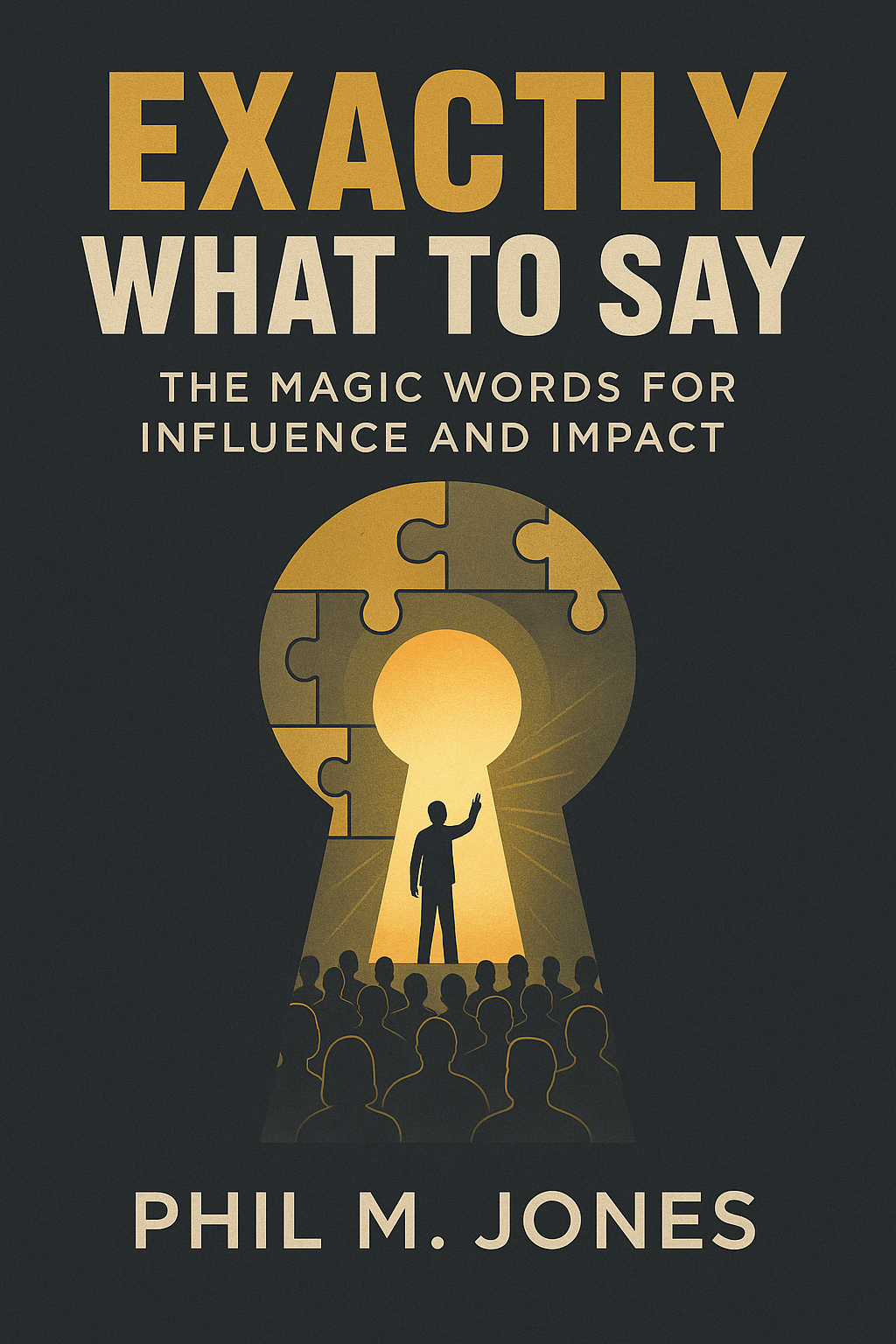
Exactly What to Say: The Magic Words for Influence and Impact
Chapter Summaries
What's Here for You
Are you tired of conversations that stall, objections that derail your progress, or the fear of rejection that keeps your best ideas locked away? In 'Exactly What to Say: The Magic Words for Influence and Impact,' Phil M. Jones unlocks the profound power of language to transform your interactions, both personally and professionally. This isn't about manipulation; it's about clarity, connection, and guiding conversations with integrity. Imagine effortlessly bypassing the common barriers that prevent people from saying 'yes.' Jones reveals how to tap into a universal human desire for open-mindedness, navigate conversations with those who believe they know it all, and understand the true 'motive' behind action. You'll discover how to help others visualize success ('Just Imagine'), overcome the dreaded 'no time' excuse ('When Would Be a Good Time?'), and gracefully handle follow-ups without awkwardness ('I’m Guessing You Haven’t Got Around To'). This book is your guide to making simple yet powerful 'swaps' in your phrasing, presenting options that feel empowering ('You Have Three Options'), and understanding the psychology behind decision-making ('Two Types of People'). You’ll learn to build instant rapport ('I Bet You’re a Bit Like Me'), defuse nervousness ('Don’t Worry'), and overcome indecision with a simple phrase ('Most People'). Beyond these techniques, you'll gain the tools to navigate negativity ('The Good News'), ensure crucial next steps are taken ('What Happens Next'), and skillfully address objections ('What Makes You Say That?'). You'll learn the art of guiding conversations towards a 'maybe' before aiming for a 'yes' ('Before You Make Your Mind Up'), turn conditions into commitments ('If I Can, Will You?'), and subtly influence decisions about quantity ('Enough'). With insights inspired by legendary detectives ('Just One More Thing') and a deep understanding of human nature, you'll master the art of asking for and receiving help ('A Favor') and cutting through conversational roadblocks ('Just Out of Curiosity'). This book offers a practical, empowering, and intellectually stimulating journey. You will gain the confidence to speak with impact, the skill to influence outcomes ethically, and the emotional intelligence to connect more deeply with others. Prepare to unlock a new level of effectiveness in every conversation you have.
I’m Not Sure If It’s for You, But
The author, Phil M. Jones, confronts a common barrier to sharing ideas: the paralyzing fear of rejection. He introduces a deceptively simple yet powerful linguistic tool designed to circumvent this fear entirely. Imagine standing at the precipice of an introduction, the weight of potential dismissal heavy on your shoulders. Jones reveals a set of 'Magic Words' that act as a shield, allowing you to present your concept, product, or service with remarkable freedom from apprehension. These words, 'I’m not sure if it’s for you, but…,' are more than just a polite opening; they are a masterclass in psychological influence. The brilliance lies in how they disarm the listener’s defenses. By preemptively suggesting the offering might *not* be suitable, Jones explains, you signal 'there's no pressure here.' This seemingly counterintuitive approach sparks curiosity, like a subtle tug on a thread that makes the listener wonder what lies beneath the surface, hooking them with an intrigue born of possibility. The phrase also activates an internal driver, prompting a decision-making process that feels entirely uncoerced and self-directed. The true power, however, is unleashed by the humble conjunction 'but.' In most contexts, 'but' acts as a formidable negator, erasing all that came before it. Yet, in this specific construction, 'I’m not sure if it’s for you, but…,' the 'but' serves to amplify what follows. The listener’s internal monologue shifts from potential dismissal to a quiet, compelling whisper: 'You might want to look at this.' It transforms a potential 'no' into an invitation to explore. Jones illustrates this with relatable examples: seeking referrals by saying, 'I’m not sure if it’s for you, but would you happen to know someone who is interested in [the result of your product/service]?' or extending an invitation by noting, 'I’m not sure if it’s for you, but we have plans on Saturday, and you’re welcome to join us.' Even in a sales context, 'I’m not sure if it’s for you, but this option is available for this month only, and I would hate for you to miss out.' This rejection-free framework cultivates a simple dichotomy of outcomes: either the listener leans in, personally intrigued and seeking more information, or, in the absolute worst case, they offer to consider it. It’s a strategy that transforms the landscape of influence, turning potential rejection into an opportunity for genuine engagement.
Open-Minded
Phil M. Jones, in his chapter 'Open-Minded,' unveils a subtle yet powerful linguistic key to influence, tapping into a near-universal human desire. He observes that when surveyed, the vast majority of people readily identify as open-minded, a perception born from the stark contrast with being labeled closed-minded. This inherent inclination, this almost automatic self-identification, becomes the bedrock of a persuasive strategy. Jones explains that by framing a new idea or proposal with the simple, yet potent, question, 'How openminded are you...?', you bypass initial resistance and invite consideration, shifting the odds dramatically from a tentative fifty-fifty to a commanding ninety-ten. Imagine standing at a crossroads, presented with a path; the question isn't 'Will you walk?', but 'How openminded are you to exploring this path?' This subtle reframing doesn't force a decision, but rather, it gently steers the conversation toward acceptance, making the desired outcome feel like a natural extension of their own positive self-image. The author illustrates this with practical examples: 'Would you be openminded about trying this as an alternative?' or 'How openminded are you about increasing your monthly income?' Each phrase acts like a soft invitation, a velvet rope rather than a locked door, making it exceedingly difficult for the other person to outright reject the possibility without contradicting their own perceived openness. The tension arises from the listener's internal desire to uphold their self-image of being openminded, and the resolution is found in their willingness to at least explore, if not embrace, the proposed idea, transforming a potential negotiation into a collaborative exploration.
What Do You Know?
The author, Phil M. Jones, unveils a subtle yet powerful technique for navigating conversations that threaten to devolve into intractable debates, particularly when faced with someone convinced of their own superior knowledge. Jones explains that the key to influence isn't winning an argument, but rather shifting the other person's stance from one of absolute certainty to one of thoughtful doubt. This isn't about direct confrontation, which often entrenches people further in their beliefs, leaving both parties frustrated, like ships passing in the night, unable to connect. Instead, the magic lies in questioning the very foundation of their certainty: the knowledge upon which their opinion rests. Imagine a solid wall of conviction; Jones offers a way to gently probe for cracks, not to demolish it, but to invite inspection. By prefacing a challenge with the disarmingly simple phrase, "What do you know about...", we invite the other person to reveal the basis of their argument. This soft inquiry, as Jones describes it, acts as a quiet threat to their knowledge base, prompting them to share their references. Often, this act of articulation reveals the insufficiency of their evidence, allowing them to recognize their strong opinions might be unfounded, without losing face. This strategic questioning, applied through examples like inquiring "What do you know about us, our business, and the way we do things differently?" or "What do you know about how things really work here?", can transform a potential conflict into an opportunity for receptiveness and understanding. The ultimate aim is not to prove oneself right, but to foster an environment where both parties can emerge with their dignity intact, moving towards a shared understanding rather than a divisive victory. It’s about ensuring that in the grand theater of conversation, everyone wins, or at least, no one is left feeling defeated and unheard.
How Would You Feel If?
The author, Phil M. Jones, unpacks the elusive concept of motivation, revealing it not as a mystical force, but as a fundamental human drive rooted in simple words: 'motive' and 'action.' He explains that motivation, at its core, is a 'reason to move.' This insight forms the bedrock for understanding influence and persuasion; if the reason is compelling enough, people can indeed be moved to do almost anything. Jones posits that this powerful 'reason' stems from one of two primal forces: the desire to avoid a potential loss or the drive to acquire a potential gain. He emphasizes a crucial, often overlooked truth: people are wired to work far harder to avert a loss than to achieve a gain, a disparity that magnifies with the greater the perceived contrast between their current undesirable state and their hoped-for future. Yet, the journey to influencing action doesn't stop with understanding the 'why'; it extends to the 'how' decisions are made. Jones clarifies that while logic plays a role, decisions are invariably initiated by emotion. Something must 'feel right' before it can 'make sense.' This leads to the chapter's titular and transformative tool: the phrase 'How would you feel if...?' By posing this question, Jones enables listeners to time-travel into a future scenario, experiencing firsthand the emotions—both positive and negative—that such a future might evoke. This imaginative leap creates a vivid, tangible vision, a 'conditional future-facing scenario,' that provides the necessary emotional impetus and a concrete reason to act, either moving towards a desired outcome or away from a dreaded one. The greater the emotional contrast painted, the more potent the call to action becomes.
Just Imagine
The author, Phil M. Jones, reveals a profound truth about human decision-making: every choice is first conceived in the mind, a hypothetical rehearsal before reality. He explains that if we cannot visualize ourselves doing something, the likelihood of it happening plummets. This is where the power of imagination becomes a potent tool for influence. Jones likens the phrase 'Just imagine' to a key that unlocks the subconscious, opening an 'image viewer' that compels us to picture the scenario being painted. Much like the nostalgic 'Once upon a time...' that invited children into story worlds, 'Just imagine' can captivate adult minds, effortlessly placing vivid pictures in their consciousness. These mental images, Jones emphasizes, are the bedrock upon which decisions are built. He connects this to the concepts of 'away' and 'toward' motivation, suggesting that finishing these imagined scenarios with either a positive future state or the avoidance of a negative outcome can powerfully drive action. Consider the visceral impact of painting a picture: 'Just imagine the smiles on your kids faces when you tell them you've booked a trip to Disneyland.' Suddenly, the listener isn't just hearing words; they are seeing, feeling, and experiencing the joy. This act of allowing others to build the case in their own minds, powered by their own creative faculties, is far more potent than any direct description, letting them 'do the hard work' of belief. The author argues that by enabling individuals to 'see the picture of that very thing happening,' their belief in achieving it soars, creating a more vivid and compelling reality than mere explanation could ever achieve, ultimately driving the desired impact and decisions.
When Would Be a Good Time?
The author, Phil M. Jones, unveils a subtle yet powerful linguistic key to unlocking influence, a simple phrase that bypasses one of the most formidable barriers to advancing an idea: the ubiquitous claim of 'no time.' Imagine standing at the threshold of someone's busy schedule, their mind already a whirlwind of to-dos, and you need them to pause, to truly consider what you offer. The immediate instinct for many is to recoil when faced with the dreaded 'I don't have time.' But Jones reveals that by prefacing your request with 'When would be a good time to…,' you subtly shift the conversational landscape. This isn't just a question; it's an invitation to an assumption. It plants a seed that a 'good time' *will* exist, transforming the possibility of 'no' into a mere logistical puzzle of 'when.' This elegant framing prompts the other person to subconsciously accept that your proposal deserves consideration, making it far less likely they'll shut the door before it's even opened. It’s like offering a hungry person a perfectly ripe piece of fruit; the question isn't *if* they'll take it, but *when* they'll find a moment to savor it. Jones emphasizes that once a response is given, the onus is on you to secure a specific time, maintaining control and momentum. Furthermore, when you follow up, resist the urge to ask for an immediate review or opinion, which can invite negativity. Instead, pivot to a question like, 'So, what do you like about it?' This simple reframing guides them to highlight the positives, building on the initial momentum and paving a smoother path toward acceptance and action.
I’m Guessing You Haven’t Got Around To
The author, Phil M. Jones, invites us into a common human dilemma: the fear of following up, especially when we suspect the other person hasn't completed their part of the bargain. It’s that moment after sending details or hearing about a consultation, when the next step requires reaching out, and a knot of apprehension forms in our stomach. We anticipate the excuses – the forgotten tasks, the delayed decisions. But Jones offers a masterful linguistic pivot, a way to disarm this tension before it even solidifies. Instead of asking, 'How did that go?' or 'Did you get that done?', he proposes a phrase that elegantly sidesteps the predictable defenses: 'I’m guessing you haven’t got around to...'. This isn't about accusation; it's about psychological framing. By voicing the very excuse you anticipate, you pull the rug out from under it, preventing the other person from hiding behind it. Imagine calling someone who needed to consult their partner; asking, 'I’m guessing you haven’t got around to speaking to your partner yet?' transforms the interaction. Suddenly, they can’t fall back on that familiar stall. They are left with two paths: either a quiet pride in having actually completed the task, or a gentle embarrassment prompting a renewed commitment. It’s a subtle art, this re-routing of conversational traffic. The author illustrates with further examples: 'I’m guessing you haven’t got around to looking over the documents yet,' or 'I’m guessing you haven’t got around to setting a date yet.' This strategy, by pushing for the negative scenario, compels the individual to rise to the positive or, at the very least, to offer a concrete plan for resolution. It leverages the inherent human desire to be seen as reliable, making it incredibly difficult to dismiss a direct, yet gently probing, inquiry. This approach, as Jones explains, creates a scenario that completely disarms them, opening the door for genuine progress rather than a frustrating cycle of evasion. When met with 'No, you’re right, we’re still thinking about it,' the negotiation can begin. If they respond with, 'No, we have, and we’ve made a decision,' you can then confidently ask, 'Great, when are we ready to get started?' It’s about using words that anticipate their potential fallback, forcing a more honest and productive engagement, and remembering that most people are people of their word and feel a pang when called out, even gently.
Simple Swaps
The author, Phil M. Jones, unveils a potent linguistic strategy in 'Simple Swaps,' demonstrating how minuscule alterations in phrasing can profoundly shift conversational outcomes. He posits that the subtle art of transforming open-ended questions into closed ones can yield predictable, desired responses, a principle he first observed in the realm of sales. Many presenters falter by asking, 'Do you have any questions?' This query, Jones explains, inadvertently plants a seed of doubt, suggesting that the listener *should* have questions, potentially making them feel inadequate if they don't. This often leads to the dreaded deferral: 'I need to think about it.' The tension here is the loss of control, the moment the conversation slips from the presenter's grasp. The resolution, however, is elegantly simple: swap 'Do you have any questions?' for 'What questions do you have for me?' This seemingly minor shift places the ball squarely back in the presenter's court, guiding the conversation towards a decision. It’s akin to a skilled sailor adjusting the rudder; the same wind now propels them with purpose. This technique works by assuming a decision has been made, making it easier for the listener to either confirm they have no lingering doubts or to voice specific needs, moving the interaction decisively forward. Jones then elevates this concept with a second, equally powerful swap. When seeking specific information, like a contact number, the common approach of 'Can I have your phone number?' invites a permission-based resistance. It’s a direct request that can feel intrusive, like knocking on a door that might remain shut. The breakthrough lies in rephrasing this to 'What's the best number to contact you at?' This subtle pivot bypasses the need for explicit permission and instead frames the request as a collaborative effort to find the most convenient way to connect. The result is an effortless flow of information, as if a locked gate has been smoothly unlatched. Both examples underscore a fundamental truth: the architecture of our language dictates the architecture of our results, turning potential conversational dead ends into clear pathways toward influence and impact.
You Have Three Options
In the intricate dance of influence and decision-making, Phil M. Jones unveils a subtle yet powerful linguistic tool in his chapter, 'You Have Three Options.' The core tension here, as Jones explains, is our innate human aversion to feeling manipulated, coupled with a deep-seated desire to believe we are the architects of our own choices. When faced with indecision, people often feel adrift, and this is precisely where a carefully crafted narrative can offer clarity and direction. Jones reveals that by framing a situation with the phrase, 'As I see it, you have three options,' we can gently guide someone through their decision-making process, appearing impartial all the while. This technique doesn't force a choice; rather, it structures the landscape of possibilities. The author emphasizes the psychological resonance of the number three, making it an easily digestible and memorable structure for the listener. By strategically placing your preferred outcome as the third option, you imbue it with a sense of finality and logical progression, much like the final crescendo in a symphony building anticipation. Consider the scenario of recruiting someone hesitant to join your venture: you might begin by painting a vivid picture of their current dissatisfaction – long hours, family time lost, inadequate pay – a relatable struggle that sets the stage. Then, present the options: first, the arduous path of seeking another similar job, a process fraught with uncertainty and often leading to a comparable, uninspiring outcome; second, the passive, perhaps even disheartening, choice of doing nothing and accepting the status quo; and third, the inviting possibility of exploring this new opportunity, perhaps alongside their current commitments. The tension between these choices is palpable, but the resolution is artfully engineered. By concluding with a question like, 'What’s going to be easier for you?', the author elegantly removes the less appealing options, such as the laborious job hunt or the stultifying inertia of inaction. This leaves the path you've presented as the clear, low-resistance choice, the one that feels most accessible and least daunting. It’s a masterful way to transform a complex decision into an effortless selection, allowing the individual to feel empowered by a choice that, in reality, has been thoughtfully curated.
Two Types of People
The author, Phil M. Jones, posits that a core responsibility for entrepreneurs, sales professionals, and business owners is to act as catalysts for decision-making, a role he terms a 'professional mind-maker-upper.' While many excel at generating interest, the true challenge, the crucial moment that drives results, lies in guiding individuals to a final decision. This is where the magic truly happens. Jones reveals that decisions become significantly easier when presented as polarizing choices, much like choosing between red or white wine, or a beach versus a ski vacation. The author's key insight is the power of the 'Magic Words,' specifically the phrase, 'There are two types of people in this world...' This simple statement, he explains, instantly engages the listener's internal dialogue, prompting them to immediately identify which category they belong to, creating an almost involuntary anticipation for the options to follow. The instructor's role then becomes presenting two distinct choices, strategically framing one as the clear, easy option. For instance, one might contrast those who leave their financial success to employers with those who build their own futures, or those who resist change with those who embrace it to create a better tomorrow. The pattern is clear: the options are deliberately stacked. Jones encourages readers to reflect on their own actions, suggesting that there are two types of people: those who read such advice and do nothing, and those who put it into practice for immediate results. This framing, he implies, is not just about selling a product or service, but about empowering individuals to take ownership and make definitive choices that shape their own destinies.
I Bet You’re a Bit Like Me
In the chapter 'I Bet You’re a Bit Like Me,' Phil M. Jones unveils a deceptively simple yet potent linguistic tool designed to foster agreement and navigate conversations with remarkable ease, particularly with strangers. The author explains that by prefacing a statement with the phrase, 'I bet you’re a bit like me,' one can gently steer a listener toward shared understanding, tapping into the natural human inclination to find common ground. This technique, Jones reveals, acts as a master key, unlocking doors to agreement by leveraging the path of least resistance in dialogue. Imagine the initial apprehension in a crucial conversation, a silent tension hanging in the air, only to dissolve as this simple phrase creates an immediate, almost imperceptible bridge. The core insight here is that people are more receptive to ideas that mirror their own perceived values and behaviors. By framing a desired outcome or belief as something relatable – such as enjoying hard work for future dividends, preferring productive evenings over mindless television, or acknowledging the reality of being a busy, juggling individual – the speaker invites the listener into a shared perspective. When the listener nods in agreement, they are not just acknowledging the statement; they are, in essence, providing evidence that subtly binds them to the subsequent proposition, making it significantly harder to raise objections later. This strategy is a powerful way to preemptively disarm common excuses, like a lack of time, by establishing a foundational agreement on shared principles. The author emphasizes that this is not about manipulation, but about understanding human psychology and using language to build rapport and gather authentic buy-in, transforming potential conflict into collaborative understanding. It’s a quiet revolution in communication, proving that the right words, delivered with sincerity, can indeed be magic.
If... Then
The author, Phil M. Jones, guides us to understand how deeply ingrained our communication patterns are, shaped by the very words we absorbed in childhood. He reveals that from our earliest years, we were programmed by the conditional statements of adults – 'If you don't eat your dinner, then you won't get dessert.' These 'if... then' structures, repeated endlessly, formed habits and belief systems that now underpin our decision-making, often without our conscious awareness. These weren't just idle threats; they were linguistic blueprints that taught us to expect a certain outcome based on a preceding condition. Jones illustrates how this powerful psychological mechanism, once used to shape our behavior as children, can now be intentionally harnessed for influence. By framing proposals with this 'if... then' sandwich, we can create a compelling sense of guaranteed outcomes. Imagine presenting a new product: 'If you decide to give this a try, then I promise you won't be disappointed.' Or offering your skills: 'If you give me a chance in the role, then I am confident you will thank me later.' This technique, he explains, positions outcomes as almost inevitable, making them incredibly difficult to disbelieve. It’s like planting a seed of certainty; you provide the condition, and the listener's mind readily accepts the promised fruit. The chapter concludes by showing how this simple, yet profound, linguistic tool can be used to instill confidence and drive acceptance, demonstrating its potent impact on persuasion and belief.
Don’t Worry
In the tapestry of human interaction, Phil M. Jones unveils a simple yet profound truth: the immense power contained within just two words. He explains how, when faced with someone gripped by nervousness, apprehension, or outright fear, a calmly delivered 'Don't worry' can act as an immediate balm. Imagine the palpable tension in the air, a storm cloud of uncertainty gathering over someone’s brow; with these words, the author suggests, that storm can dissipate, leaving behind a sense of calm control. This isn't just about placating nerves; it's about offering a lifeline, a quiet assurance that you have the situation under control and can guide them through the unknown. Jones illustrates this with examples, showing how acknowledging their present state—'You're bound to be nervous right now' or 'I know you don't know what to do right now'—and then offering support, 'but that's what I'm here for,' transforms potential panic into progress. He even uses his own experience, assuring readers that mastering new communication skills, like the ones he teaches, takes time, and that 'Don't worry if you're wondering how you're going to make all these new word choices stick.' The core insight here is that in moments of high stress, a confident, empathetic declaration of reassurance can fundamentally alter the emotional landscape, easing anxiety and fostering trust, much like a cool hand on a fevered brow. It’s a testament to how carefully chosen words can dismantle fear and build bridges of confidence, one conversation at a time.
Most People
The author, Phil M. Jones, unveils a potent, yet deceptively simple, linguistic tool that has driven significant negotiating success: the phrase 'most people.' He posits that indecision is the primary impediment to progress, and this phrase acts as a catalyst, swiftly moving individuals out of procrastination. Jones illuminates two fundamental human tendencies that give this phrase its power. First, people derive confidence from the actions of others, especially when those actions have proven successful. Imagine a cliff edge, children hesitant to jump into the water below; the moment one brave soul takes the plunge, lands safely with a smile, the dam breaks, and others eagerly follow. This illustrates our innate inclination to trust in the safety of numbers. Second, while direct instructions can feel intrusive, people often need guidance. Jones recognized that stating 'What I think you should do is...' can sound arrogant, but framing it as 'what most people do' circumvents this. When we tell someone what most people would do in a given situation, their subconscious mind aligns, thinking, 'Aha, I am one of most people, so perhaps this is the right course of action for me too.' This subtle redirection leverages social proof and a desire for validation, transforming potential objections into momentum. The applications are vast: 'What most people do is complete the forms with me here today,' or 'What most people do is place a small order to get started.' By tapping into this collective wisdom and the comfort of conformity, Jones demonstrates how even minor adjustments in language can profoundly enhance influence and impact, leading to immediate positive effects in daily conversations and negotiations.
The Good News
The author, Phil M. Jones, unveils a powerful strategy for navigating negativity, both internal and external, through the simple yet profound technique of 'labeling.' Imagine a storm cloud of doubt or resistance gathering in a conversation; Jones offers a way to disperse it with minimal effort. He explains that by prefacing a point with the phrase, 'The good news is...,' you attach a positive label that the other person finds almost impossible to shed. This subtle linguistic maneuver doesn't just reframe the immediate situation; it fundamentally shifts the direction of the dialogue, steering it away from blame and self-pity toward a more constructive, forward-looking path. For instance, when someone questions their abilities, you can counter with, 'The good news is that we have dozens of people who were in exactly the same situation when they first started, and they have gone on to be successful and are here to support you, too.' This isn't about denying reality; it's about choosing which aspect of reality to highlight, like a skilled photographer choosing the best light to capture a subject. Similarly, when faced with resistance to change, the author suggests, 'The good news is you already know that what you are doing now is not working, so what is the harm in trying this?' This approach compels individuals to face forward with optimism, effectively zapping negative energy. Jones extends this principle with another potent phrase: 'That's great.' When someone offers an excuse, expecting you to argue, responding with 'That's great' disarms them. By adding, 'you've just found out another way that doesn't work,' you transform their perceived obstacle into a learning opportunity, prompting a fundamental shift in their thinking. While some might find this approach unconventional, Jones suggests that those who can't adapt to this positivity might not be the people you want in your life anyway. Ultimately, by consistently employing 'The good news is...' and 'That's great,' you begin to tip the scales of thought, encouraging introspection and guiding individuals toward better outcomes and behaviors, proving that even the most stubborn negativity can be transformed into fertile ground for growth.
What Happens Next
In the intricate dance of business, a common pitfall emerges after the meticulous groundwork of building rapport and presenting a compelling solution. The author, Phil M. Jones, observes a critical juncture where conversations, after enthusiastic nods and smiles, often stall, leaving the crucial decision hanging in the air. This inertia, he explains, stems from a pervasive fear of appearing pushy, a hesitation that paralyhes progress and, ultimately, leads to a loss for all parties involved. It is in these moments, when the imparting of knowledge concludes, that a leader must emerge, gently guiding the conversation toward its natural conclusion. The magic words, Jones reveals, are a simple yet powerful phrase: 'What happens next is…' This phrase acts as a bridge, connecting the information shared with the necessary action, creating a clear path forward. Instead of asking what the prospect *wants* to do, the instructor guides the listener to *declare* what happens next, painting a vivid picture of the immediate future. For instance, 'What happens next is that we are going to take a few moments, complete some of your personal details and get things set up for you to receive everything in the quickest possible time.' This sets a concrete scene, followed by a simple, almost effortless question that requires a low-commitment answer, such as 'In terms of registering your details, what is the best address for you?' The ease of this response signals a commitment to moving forward. The core insight here is that by framing the next steps definitively and asking an easily answerable question, one transforms a potential stalemate into a decisive close. A concise, constructive 'what happens next' conversation is the key to unlocking more agreements in the initial encounter, making every moment with a prospect count. The easier the question, the more readily the decision follows, much like a river finding its course once the dam is gently opened.
What Makes You Say That?
In the intricate dance of human interaction, the author, Phil M. Jones, illuminates a universal challenge: navigating objections. We encounter them daily, personal and professional, often leading to a tense standoff or, for an easy life, a surrender of our own aspirations. These moments, where another’s indecision or resistance surfaces, represent a critical shift in conversational power. An objection, Jones reveals, is rarely just a simple refusal; it’s often a veiled alternative to a direct 'no,' or a tactic to delay commitment. The true pivot, however, lies in recognizing that the moment an objection is voiced, the other person seizes the reins. To regain control, to steer the dialogue back towards your objective, the author proposes a profound yet simple reframe: treat every objection not as a roadblock, but as an invitation to inquire. The core tension arises when we instinctively prepare a counterargument, a defensive posture that often escalates conflict. Instead, Jones guides us to a more effective strategy, one that disarms by disarming ourselves of the need to prove the other person wrong. The true magic, the 'one set of Magic Words,' emerges from this principle. It’s the simple, yet powerful, question: 'What makes you say that?' This inquiry acts like a key, unlocking the reasoning behind the objection, transforming a potential confrontation into an opportunity for understanding. Imagine an objection like a closed door; instead of trying to force it open, this question gently asks the person on the other side to explain why it’s shut. By asking them to elaborate, we compel them to articulate their underlying concerns, their true motivations, or their genuine hesitations. This act of explanation obliges them to take responsibility for their statement, filling in the gaps that were previously left to our assumptions. This shift doesn't just prevent prejudgments or arguments; it allows us to see the situation through their eyes, fostering empathy and paving the way for a more informed, collaborative resolution. It’s about understanding the 'why' before charting the 'what next.'
Before You Make Your Mind Up
Phil M. Jones, in his chapter 'Before You Make Your Mind Up,' illuminates a profound truth about influence: directly converting a 'no' to a 'yes' is a Herculean task. The real art, he reveals, lies in first navigating the delicate space of 'maybe.' When faced with resistance, when the other person's inclination is to reject an idea, Jones offers a powerful linguistic tool – a set of 'Magic Words' to gently steer the conversation back. He suggests prefacing your next move with, 'Before you make your mind up...' This simple phrase acts as a subtle pause, a moment of reflection that can halt the momentum of a firm rejection. Imagine a ship veering off course, its sails catching an unfavorable wind; these words are the skilled hand on the tiller, turning it back towards a more navigable path. For instance, instead of accepting a nascent 'no,' one might say, 'Look, before you make your mind up, let's make sure we've looked at all the facts.' Or, 'Before you make your mind up, why don't we just run through the details one more time so you can know what it is that you are saying no to?' This reframing doesn't dismiss their initial reaction but invites a deeper consideration, a more informed stance. It’s like offering a clearer lens through which to view the proposition. Another tactic Jones advocates is, 'Before you make your mind up, wouldn't it make sense to speak to a few more people about the difference this could make for you and your family?' This approach shifts the focus from a personal, perhaps immediate, objection to the broader, long-term implications and the wisdom of collective input. These carefully chosen words don't force agreement; rather, they create an opening, a bridge from a closed-off 'no' to a more receptive 'maybe.' This subtle shift in vantage point is crucial, as it allows for the introduction of alternative information, bolstering your idea and gently increasing your influence over their ultimate decision, transforming a potential dead end into a continuing dialogue.
If I Can, Will You?
The author, Phil M. Jones, confronts a common human dynamic: the art of the excuse. We've all been there, whether in the bustling arena of sales or the intimate circle of personal relationships, where a prospect or a friend presents an external condition—a car in the shop, a rival's lower price—as an insurmountable barrier, effectively stepping out of the decision-making process and placing responsibility elsewhere, beyond their control. Jones reveals a potent counter-strategy, a linguistic key to unlock these impasses. It’s the simple, yet profound, question structure: 'If I can..., then will you...'. Imagine trying to rally a friend for a Friday night outing; they demur, citing car trouble and late-night bus limitations. The 'If I can...' approach disarms this by offering a solution: 'If I can pick you up and drop you off at home, then will you be able to be ready for seven pm?' Suddenly, the external barrier dissolves, and the focus shifts back to their willingness. Similarly, when a price objection arises, the author suggests, 'If I can match that price for you, then would you be happy to place the order with me today?' This isn't about blindly agreeing to demands; it's about isolating the stated condition and gaining control of the next move. You haven't yet conceded anything, but you've opened a door to either further honest dialogue or, more hopefully, a clear path to agreement. By presenting your best option once the condition is met, you dramatically increase the likelihood of achieving your desired outcome. This technique, Jones explains, empowers you to dismantle arguments by addressing the root cause of resistance, transforming a standstill into a dynamic exchange.
Enough
The author, Phil M. Jones, unveils a subtle yet powerful linguistic tool in the chapter 'Enough,' focusing on how carefully chosen words can gently guide decisions toward greater quantity or commitment. He explains that in situations demanding a choice about quantity or level of service, the right question can make it significantly easier for others to opt for more. Consider the familiar scene at the grocery store, where indecision over the number of apples to buy is common. Jones illustrates that by framing a question like, 'Would eight apples be enough for you?', the customer is nudged towards a 'yes' and the decision is made with surprising ease. This principle extends beyond retail, aiming to foster repeat business by ensuring customers have sufficient product to form a habit, much like how a 'three-for-two' offer can transform a trial into a preferred brand. He offers a compelling example of a company selling a drinking gel, where the decision often lies between two or three bottles. Instead of a lengthy explanation of benefits, the simple, direct query, 'Would three bottles be enough for you?', leverages the power of 'enough' to simplify the choice and encourage the larger purchase. The core insight here is that when we actively participate in the decision-making process, we gain the ability to influence outcomes, and consumers often welcome being led toward what is perceived as the 'right' choice. Jones posits that offering a choice between two numbers often results in a 50/50 split, but by posing a direct question involving only the larger option and the word 'enough,' the odds swing dramatically in favor of the greater quantity. This strategy, when integrated into everyday business conversations, can lead to significant improvements, imagine if every transaction simply included one more unit. It’s a quiet revolution in influence, turning the path of least resistance into a pathway to greater value for both the customer and the business.
Just One More Thing
Phil M. Jones, in his chapter 'Just One More Thing,' unveils a subtle yet powerful negotiation tactic, drawing inspiration from the iconic television detective Columbo. The author explains that while sales training often emphasizes the 'upsell'—encouraging customers to buy more at the point of sale—a less discussed, yet equally potent, strategy is the 'downsell.' This involves setting a secondary, lesser objective to pursue if the primary goal remains unmet. Imagine entering a negotiation aiming for a substantial long-term contract; if that proves elusive, a downsell might be securing a modest trial order. Or, if the ambition was to forge a business partnership, the downsell could be to simply have them experience your products as a customer. The genius of this approach, as illustrated by Columbo's signature sign-off, is its ability to reopen a door that appears to be closing. Columbo, after meticulously questioning his suspects and seemingly concluding his investigation, would turn back just as they began to relax, his guard down, and utter those fateful words: 'Oh, just one more thing.' This moment, when expectations have shifted from confrontation to closure, becomes the perfect opportunity to ask the crucial question, the one that unlocks the final piece of the puzzle. Jones translates this into everyday interactions: you’ve presented your ideas, the potential client is intrigued but hesitant, and the meeting is drawing to a close. Instead of leaving empty-handed, you can recreate the Columbo moment. As you gather your belongings and head for the exit, pause, turn back, and with a gentle, 'Just one more thing,' introduce a simplified, low-commitment option. This could be an invitation to sample a product, place a small initial order, attend a relevant event, or even be introduced to a key contact. The essence is to keep the conversation alive, to pivot from potential rejection to a smaller, more accessible commitment, ensuring you don't walk away with nothing but instead plant a seed for future engagement.
A Favor
Success, as Phil M. Jones explains in 'Exactly What to Say,' is rarely a solitary pursuit; it thrives on the willingness of others to lend a hand. He posits that by mastering certain phrases, we can unlock this essential human inclination to help. Imagine a simple question, 'Could you do me a small favor?' Jones reveals this as a potent key, often eliciting an immediate, almost unconscious agreement, even before the nature of the request is known. This powerful psychological trigger sets the stage for influence, demonstrating that the 'how' of asking is often more critical than the 'what.' The author then pivots to a common business challenge: acquiring new customers through referrals. He identifies three key barriers: laziness, poor timing, and a lack of knowing how to ask. While the first is dismissed as a trait of those not invested in growth (like the reader of this book), the latter two are explored in depth. The crucial insight for timing, Jones explains, is to ask when the other person is happy, particularly when they express gratitude. The simple phrase 'Thank you,' he notes, often stems from a feeling of indebtedness, a perfect moment to transition to a request. This is where the narrative tension peaks: how to capitalize on this fleeting feeling. The solution lies in a sequence of carefully chosen words. After the initial 'Could you do me a small favor, could you?' comes the gentle challenge of 'You wouldn't happen to know...' followed by the specific, disarming qualifier, 'just one person...' who, 'just like you,' would benefit from the service. The key is to then pause, allowing the other person to think, a moment of quiet anticipation before the next gentle prompt: 'Don't worry, I'm not looking for their details right now, but who was it that you were thinking of?' This de-escalates pressure and guides them toward a specific name. The final step involves securing permission for a follow-up, asking, 'Couldn't you do me a further favor, could you?' to introduce them to someone like Steve. The magic, Jones concludes, is in the deliberate slowing down of the process to ultimately speed up the outcome, yielding conversations with pre-qualified, expectant leads, a far greater prize than a mere name and number. It’s a testament to the profound impact of precise language, turning a potential request into a welcomed invitation.
Just Out of Curiosity
Phil M. Jones, in his exploration of influence and impact, confronts a common, yet deeply frustrating, conversational roadblock: the seemingly innocuous phrase, 'I just need some time to think about it.' He observes that while no one should be rushed into decisions, this statement often serves as a polite deferral, a way to push a decision into the nebulous future without true analysis. Imagine the scenario: you've invested time, listened intently to challenges, and crafted thoughtful recommendations, only to be met with this vague response, leaving the conversation stalled and unproductive. This, Jones argues, isn't fair to the effort invested. The author felt an almost primal urge to ask, 'What exactly do you need to think about?' but recognized the social minefield such directness presented. The common default—a passive 'It's okay, no pressure'—often means walking away from potential progress. This frustration, however, spurred a quest for a method to elicit genuine answers without appearing rude. The breakthrough came with a simple yet powerful linguistic tool: prefacing a direct question with 'Just out of curiosity.' This phrase acts as a gentle bridge, transforming potentially intrusive inquiries into soft, permissible requests for understanding. By providing a reason and gaining implicit permission to ask, control of the conversation subtly shifts, not to dominate, but to foster transparency. Consider the examples: 'Just out of curiosity, what is it specifically you need some time to think about?' or 'Just out of curiosity, what needs to happen for you to make a decision about this?' The critical element following such a question is silence. This isn't an empty void, but a space for genuine reflection, a pause that feels like an eternity yet is essential for clarity. Jones explains that this pause compels the other person to move beyond vague deferrals. Often, within about twelve seconds, a real, honest answer emerges, providing the transparency needed to move forward. In rarer cases, the silence extends, pushing the individual to confront the lack of a substantive reason for delay. They might then realize, 'You know what, you're right. There isn't anything to think about.' It is this brave act of asking the question they themselves weren't ready to voice that empowers them to make a decision that is truly right. This approach, Jones concludes, elevates one from simply participating in conversations to becoming a 'professional mindmaker-upper,' capable of facilitating genuine progress and clarity.
Conclusion
Phil M. Jones's 'Exactly What to Say' masterfully demystifies the art of influence, revealing that impactful communication hinges not on grand pronouncements, but on the strategic deployment of carefully chosen words. The core takeaway is that by understanding and leveraging fundamental human psychology – our innate desire for control, our aversion to rejection, our drive to maintain a positive self-image, and our emotional decision-making processes – we can navigate conversations with unprecedented effectiveness. The book offers a profound emotional lesson: fear, particularly the fear of rejection, is a primary obstacle, but it can be systematically dismantled by framing inquiries in ways that grant the listener agency and reduce pressure. Phrases like 'I'm not sure if it's for you, but...' and 'How openminded are you...' don't just bypass defensiveness; they activate curiosity and appeal to our desire to be perceived as reasonable and intelligent. Emotionally, the book teaches us to move beyond direct confrontation, which entrenches opposition, and instead to gently probe underlying assumptions ('What do you know about...?') and tap into future feelings ('How would you feel if...?'). This fosters empathy and understanding rather than adversarial debate. The practical wisdom is abundant and actionable. Jones provides a lexicon of 'magic words' that serve as mental triggers, like 'Just imagine' to ignite visualization, or 'Don't worry' to instantly alleviate anxiety. He illustrates how framing choices ('You have three options') simplifies decision-making, how referencing social proof ('Most people...') leverages our need for validation, and how anticipating objections ('I'm guessing you haven't got around to...') smooths the path to commitment. Ultimately, 'Exactly What to Say' empowers readers by transforming potentially awkward or confrontational interactions into guided conversations that lead to clarity, agreement, and action. It underscores that true influence isn't about manipulation, but about facilitating better decisions by understanding and speaking to the core motivations and perceptions of others, thereby fostering genuine connection and achieving desired outcomes with grace and efficiency.
Key Takeaways
Leveraging an individual's own imagination allows them to build belief and drive their own decisions.
Harnessing the 'if... then' pattern allows for the strategic positioning of guaranteed outcomes to increase influence.
Repetitive verbal patterns from youth solidify into subconscious decision-making frameworks.
Framing proposals with 'if... then' creates a powerful expectation of a positive result.
The phrase 'Don't worry,' delivered confidently and calmly, can instantly alleviate anxiety and tension in others.
Acknowledging a person's current nervousness or uncertainty before offering reassurance is more effective.
Reassurance in moments of stress helps individuals feel more in control and open to guidance.
Fear of rejection is a primary obstacle to sharing ideas; a rejection-free opening can dismantle this barrier.
Framing an offering as potentially unsuitable ('I'm not sure if it's for you') paradoxically increases intrigue and reduces listener pressure.
The word 'but' in this specific context ('I'm not sure if it's for you, but...') negates the initial uncertainty and highlights the subsequent information as valuable.
By allowing the listener to feel in control of the decision-making process, you foster an unpressured internal drive to engage.
This 'rejection-free' approach leads to either genuine interest and further inquiry or thoughtful consideration, minimizing negative outcomes.
The effectiveness of this technique stems from its ability to bypass defensive mechanisms and activate curiosity.
The widespread perception of being openminded creates a powerful leverage point for influence.
Framing proposals with 'How openminded are you...?' shifts conversational odds in your favor by appealing to self-perception.
This linguistic approach bypasses immediate resistance by focusing on willingness to consider rather than immediate agreement.
The core tension lies in an individual's desire to maintain their positive self-image as openminded.
The resolution is achieved by making the proposed idea seem like a natural extension of their perceived openness, fostering exploration.
The phrase 'How openminded are you about at least trying it?' offers a low-barrier entry point for new ideas.
Influence in conversations is achieved by moving others from certainty to doubt, not by winning arguments.
Directly challenging opinions entrenches people; questioning the knowledge behind opinions is more effective.
The preface 'What do you know about...' gently probes the knowledge base of an opinion without direct confrontation.
Revealing the insufficient evidence behind an opinion allows the speaker to save face while becoming more receptive.
The goal is mutual understanding and receptiveness, not individual victory in a debate.
Challenging assumptions with confidence avoids arguments that leave all parties feeling like losers.
Motivation is fundamentally a 'reason to move,' driven by either avoiding loss or gaining something desirable.
The drive to avoid a potential loss is a significantly stronger motivator than the pursuit of a potential gain.
Decisions are primarily made for emotive reasons first, meaning something must 'feel right' before it can 'make sense' logically.
The phrase 'How would you feel if...?' allows individuals to emotionally experience a future scenario, creating a powerful reason to act.
Creating contrast between a current undesirable state and a desired future state amplifies the motivation to change.
Framing future possibilities allows people to mentally time-travel, triggering emotions that drive action towards or away from specific outcomes.
All decisions are first made hypothetically in the mind, requiring visualization before they can become reality.
The phrase 'Just imagine' acts as a mental trigger, compelling the subconscious to create vivid mental imagery.
Placing compelling mental pictures in someone's mind is a more effective influence strategy than direct description.
The power of 'Just imagine' can be amplified by framing scenarios around 'toward' (positive outcomes) or 'away' (avoiding negative outcomes) motivation.
The phrase 'When would be a good time to…' preempts the 'no time' objection by framing the conversation around scheduling, not refusal.
By prompting the assumption that a good time will exist, this question shifts the focus from possibility of rejection to the logistics of acceptance.
Securing a specific time and date after posing the question is crucial for maintaining conversational control and ensuring follow-through.
When following up, asking 'So, what do you like about it?' instead of 'What did you think?' encourages positive feedback and builds momentum.
The core tension lies in overcoming resistance to new ideas; the resolution is found in reframing the initial inquiry to invite commitment rather than rejection.
Fear of follow-up can be overcome by preemptively addressing anticipated excuses.
Phrasing a question as 'I’m guessing you haven’t got around to...' disarms conversational defenses by voicing the expected excuse.
This technique compels individuals to either confirm they've acted or commit to a specific plan of action, leveraging their desire to be seen as reliable.
By prompting a response to a presumed negative, you guide the conversation toward a positive outcome or a clear resolution.
The strategy works because it anticipates and neutralizes common avoidance tactics, creating a direct path for progress.
This method encourages honesty and commitment by making it harder for individuals to rely on pre-prepared excuses.
Transforming open-ended questions into closed ones shifts conversational control from the respondent to the questioner, guaranteeing a more decisive outcome.
Asking 'Do you have any questions?' can create subconscious pressure to find or feign questions, leading to deferral, whereas 'What questions do you have for me?' assumes a decision and prompts clarification or confirmation.
Phrasing requests as permissions ('Can I have...') invites resistance, while framing them as logistical inquiries ('What's the best way to...') elicits effortless cooperation.
The subtle art of 'simple swaps' in language can transform potentially awkward or unproductive conversations into efficient pathways toward desired results.
By assuming a positive outcome or a collaborative intent, you can guide conversations toward resolution and information exchange with greater ease.
People resist feeling manipulated and prefer to believe they make their own decisions, creating a tension that can be resolved through guided choice presentation.
The phrase 'As I see it, you have three options' provides a structured framework for decision-making, reducing cognitive load and making choices feel more manageable.
Presenting choices in a sequence of three leverages a natural cognitive preference, with the final option implicitly carrying the most weight and perceived value.
By strategically ordering options, with the desired outcome last, you can subtly highlight its benefits and position it as the path of least resistance.
Concluding with a question about ease or simplicity, such as 'What's going to be easier for you?', effectively steers individuals towards the presented, favorable option by eliminating less desirable alternatives.
The primary role of sales professionals is to be decision catalysts, helping customers make up their minds.
Polarizing choices simplify decision-making, making it easier for individuals to commit.
The phrase 'There are two types of people in this world...' immediately engages self-identification and prompts a decision.
Effective influence involves presenting two options, with one clearly positioned as the desirable or easier choice.
The ultimate tension lies between passive consumption of information and active implementation for tangible results.
Leverage the phrase 'I bet you’re a bit like me' to establish common ground and foster immediate agreement by appealing to shared perceived values.
Utilize relatable statements prefaced with this phrase to preemptively address potential objections, such as lack of time, by securing early buy-in on underlying principles.
Recognize that people are more likely to agree with propositions that align with their self-perception, making relatable framing a powerful persuasive tool.
Understand that verbal agreement, even to a general statement, creates a psychological commitment that makes future disagreement more difficult.
Employ this technique early in conversations, especially with strangers, to navigate the path of least resistance and build rapport effortlessly.
Gather 'evidence' of agreement through nods and affirmation, which strengthens your position for subsequent recommendations.
Childhood conditional statements ('if... then') create deeply embedded belief systems that influence adult decision-making.
The 'if... then' linguistic structure establishes a perceived causal link that makes outcomes highly believable.
Empathy, combined with a calm demeanor, transforms high-stress situations into opportunities for connection and problem-solving.
Mastering new skills, including impactful language, is a process that requires patience and consistent practice.
Indecision is the primary barrier to progress, and simple linguistic cues can overcome it.
People are influenced by the successful decisions of others, seeking validation and safety in numbers.
Direct commands can be perceived as rude, but framing actions as what 'most people do' leverages social proof without offense.
The subconscious mind seeks to align with the perceived norms of the 'majority,' making 'most people' a powerful persuasive phrase.
Subtly guiding behavior by referencing the actions of 'most people' can lead to immediate positive shifts in influence.
Leveraging the phrase 'most people' taps into a fundamental human desire for belonging and validated decision-making.
Transforming negativity into positivity is achievable by proactively labeling situations with optimistic reframes.
The phrase 'The good news is...' acts as a linguistic anchor, compelling listeners to accept a positive perspective and shift conversational momentum.
Acknowledging excuses with 'That's great' and reinterpreting them as discoveries of what doesn't work can redirect resistance into productive self-inquiry.
Proactive positive labeling can prevent conversations from devolving into cycles of blame and self-pity.
Shifting focus from problems to potential solutions, even when acknowledging current failures, fosters forward-thinking and encourages action.
The strategic use of specific phrases can alter an individual's cognitive framing, leading to changed perspectives and behaviors.
The fear of appearing pushy can lead to inaction and missed opportunities, paralyzing crucial decision-making processes.
The responsibility to lead the conversation to a close rests with the presenter after sharing information.
The phrase 'What happens next is...' is a powerful tool to transition from presentation to commitment by clearly defining the subsequent steps.
Framing the next action as a statement of fact, rather than a question soliciting a decision, guides prospects forward.
Asking a simple, low-effort question that is easy to answer facilitates a rapid response and a positive outcome, signaling commitment.
Concise and constructive 'what happens next' conversations are essential for closing more deals in the first meeting.
Objections are not endpoints but shifts in conversational control, signaling an opportunity to understand rather than confront.
The instinct to counter an objection with an argument is counterproductive; true influence lies in inquiry.
Framing objections as questions allows the questioner to regain control and guide the conversation toward resolution.
The phrase 'What makes you say that?' empowers the respondent to articulate their reasoning, fostering transparency and responsibility.
Understanding the 'why' behind an objection, through genuine curiosity, enables more effective problem-solving and decision-making.
Shifting power dynamics in a conversation by asking questions, rather than making statements, is key to successful negotiation.
Directly converting a 'no' to a 'yes' is extremely difficult; the initial goal should be to shift resistance towards a 'maybe.'
The phrase 'Before you make your mind up...' serves as a critical pause, preventing immediate rejection and reopening the conversation.
Inviting a review of facts or details before a final decision encourages a more informed and less emotional response.
Suggesting consultation with others or consideration of broader implications can reframe the decision-making process away from immediate objections.
Shifting the other person's perspective by creating a pause allows for the introduction of new information and increased influence.
The primary tension is overcoming immediate rejection; the resolution is creating an opportunity for continued dialogue and consideration.
Recognize when external conditions are used as excuses to abdicate responsibility and halt progress.
Reframe objections by isolating the stated barrier and shifting the focus back to the individual's willingness.
Employ the 'If I can..., then will you...' question structure to proactively remove obstacles and regain control of the interaction.
Use conditional offers to test the sincerity of objections and create an opportunity for a clear agreement.
Empower yourself to drive conversations forward by offering solutions to perceived external limitations.
Framing questions with the word 'enough' simplifies decision-making for the customer, often leading them to choose a larger quantity than they might have initially considered.
Consumers are receptive to being guided towards what is perceived as the 'right' decision, making guidance a valuable skill in influence.
Directly asking about sufficiency with the larger option ('Would X be enough?') bypasses comparative decision-making and leads to a higher probability of acceptance.
Ensuring customers purchase sufficient quantities can foster habit formation and lead to repeat business and brand loyalty.
The word 'enough' acts as a powerful psychological trigger, making the larger quantity seem reasonable and sufficient, thus reducing resistance.
The 'downsell' is a critical, often overlooked, negotiation strategy that secures a lesser objective when a primary one fails, preventing a complete loss.
Employing the 'Just one more thing' technique, inspired by Columbo, revitalizes closing conversations by re-engaging prospects when their guard is down.
A downsell transforms a potential 'no' into a smaller, manageable 'yes,' creating an entry point for future engagement and building momentum.
This tactic leverages the psychological shift occurring as a conversation concludes, making individuals more receptive to a reduced request.
By offering a simpler, lower-risk alternative, you can effectively bring someone into your world or secure a valuable next step, even if the initial grander vision isn't realized.
The power of the 'Just one more thing' lies in its ability to keep possibilities open and avoid leaving a situation with zero progress.
The phrase 'Could you do me a small favor?' is a powerful psychological trigger that elicits agreement before the request is even known, demonstrating the primacy of framing in influence.
The optimal time to ask for help or referrals is immediately following expressions of gratitude, as 'Thank you' often signifies a feeling of indebtedness, creating a receptive moment for a request.
When seeking referrals, framing the ask with phrases like 'just one person' and 'someone who, just like you...' makes the request feel reasonable, specific, and complimentary, increasing the likelihood of a positive response.
De-escalating pressure by stating 'Don't worry, I'm not looking for their details right now, but...' allows individuals to recall a name without feeling immediate obligation, making the subsequent request for an introduction smoother.
Slowing down the referral process by securing permission for indirect introductions and follow-ups paradoxically accelerates the outcome, leading to more qualified and receptive leads.
Mastering the art of asking involves not just knowing what you want, but understanding the psychological cues and linguistic frameworks that make others want to help you achieve your goals.
The phrase 'I need time to think' is often a polite deferral, not a genuine request for analysis, hindering decision-making and progress.
Direct, probing questions can be perceived as rude, but prefacing them with 'Just out of curiosity' transforms them into acceptable requests for clarity.
Granting permission to ask a direct question through phrases like 'Just out of curiosity' shifts conversational control constructively, fostering transparency.
Strategic silence following a direct question is crucial, providing the necessary space for the other person to offer a genuine, unvarnished answer.
Asking brave, direct questions that others may not be ready to ask themselves empowers them to confront obstacles and make better decisions.
Becoming a 'professional mindmaker-upper' involves mastering the art of eliciting honest responses to facilitate clarity and decision-making.
Action Plan
In high-stress scenarios, consciously project a relaxed posture to convey control.
Prepare a simple, low-commitment offer or request to use as your downsell.
Practice delivering the phrase 'Don't worry' with a calm and confident tone.
When someone expresses anxiety, acknowledge their feelings before offering reassurance.
Use 'Don't worry' to signal that you are prepared to help navigate a difficult situation.
Practice opening conversations with potential clients or contacts using the phrase, 'I’m not sure if it’s for you, but…' followed by your core message or question.
Identify specific situations where you typically feel fear of rejection and plan to use this phrase as an alternative opening.
Experiment with different ways to complete the sentence after 'but…' to best suit the context, focusing on the benefit or opportunity.
Observe how listeners respond to this opening and note any shifts in their engagement or curiosity.
Reframe your own mindset to see the 'but' not as a negator, but as a bridge to the truly important part of your message.
When introducing a new idea, begin your pitch with the question, 'How openminded are you about...?'
Follow the initial question with a specific scenario or proposal that you want the other person to consider.
Use variations like 'Would you be openminded about trying this?' or 'How openminded are you about seeing if we could...?'
Be mindful of the other person's self-perception and leverage their desire to be seen as openminded.
Practice this phrasing in low-stakes conversations to build confidence and observe its effects.
When faced with strong, unyielding opinions, refrain from direct argument.
Instead of challenging the opinion itself, inquire about the knowledge basis for it using phrases like 'What do you know about...'.
Use specific examples relevant to the context, such as 'What do you know about our process?' or 'What do you know about the recent changes?'
Listen actively to the explanation provided, identifying the source and sufficiency of their knowledge.
Use the insights gained to gently contrast your perspective, focusing on broader understanding rather than winning.
Practice this technique in low-stakes conversations to build confidence and skill.
Identify the core motivations of the person you wish to influence, focusing on their desire to avoid loss or achieve gain.
When attempting to persuade, emphasize the potential negative consequences of inaction or the risks of loss.
Use the phrase 'How would you feel if...' to help individuals vividly imagine a future scenario.
When presenting an idea, focus first on making it feel emotionally right for the other person.
Create stark contrast between the individual's current situation and the desired future state to enhance motivation.
Practice framing potential outcomes in terms of both potential gains and potential losses to gauge impact.
Ask yourself: 'How would I feel if I experienced the outcome I am trying to achieve or avoid?' to build empathy and understanding.
Begin conversations or pitches by using the phrase 'Just imagine' to prompt mental visualization.
When using 'Just imagine,' paint vivid sensory details to make the imagined scenario more real.
Tailor the 'Just imagine' scenarios to resonate with the specific desires or motivations of the listener (e.g., family, success, new possessions).
Connect the imagined positive future to the action you are proposing.
Allow the listener to fully engage with the imagined scenario before pressing for a decision, letting their mind build the case.
Practice finishing 'Just imagine' statements with either the positive outcomes (toward motivation) or the negative consequences of inaction (away motivation) relevant to the situation.
When introducing a new idea or proposal, always begin with the phrase 'When would be a good time to…'.
Immediately after receiving a positive response to 'When would be a good time to…?', propose a specific date and time for the next step.
Upon following up on a proposal, ask 'So, what do you like about it?' to elicit positive feedback.
Practice using this phrasing in low-stakes situations to build confidence and familiarity.
When following up, begin by saying, 'I’m guessing you haven’t got around to [the specific task/action] yet.'
Use this phrase to preemptively address the most likely excuse you anticipate.
When the other person confirms they haven't completed the task, immediately ask for a new, specific commitment or timeline.
If they say they have completed it, follow up with a question about the next steps or readiness to proceed.
Practice this phrasing in low-stakes situations to build comfort and observe its effect.
Analyze common excuses you receive in your interactions and prepare the corresponding 'I'm guessing...' opening.
When concluding a presentation or discussion, replace 'Do you have any questions?' with 'What questions do you have for me?'
When requesting information, such as contact details, rephrase 'Can I have X?' to 'What's the best X to reach you at?'
Practice identifying situations where a subtle word swap can shift a question from permission-based to outcome-oriented.
Consciously adopt the mindset of assuming a positive outcome when asking questions in professional or personal interactions.
Observe conversations around you to identify instances where similar 'simple swaps' are being used effectively or could be implemented.
When faced with someone needing help with a decision, start by stating, 'As I see it, you have three options.'
Identify and articulate three distinct choices for the individual, ensuring one aligns with your desired outcome.
Order the options strategically, placing your preferred choice last to build its perceived value.
Frame the options by highlighting the potential downsides of the less desirable choices and the benefits of your preferred option.
Conclude the choice presentation with a question that emphasizes ease or simplicity, such as 'What’s going to be easier for you?'
Practice this technique in low-stakes situations to build confidence and observe its effects.
Identify opportunities to act as a 'decision catalyst' for your clients or colleagues.
Practice framing choices in a polarizing manner (e.g., 'Would you prefer X or Y?').
Utilize the 'two types of people' phrasing to prompt self-identification and engagement.
Consciously design your presented options so one is the clear, easy, or desirable choice.
Reflect on whether you are a 'doer' or a 'reader' of new strategies and commit to implementing one learned concept this week.
Identify a common value or behavior relevant to your objective that most people share (e.g., desire for success, aversion to wasted time).
In an early conversation, preface a statement about this shared value with 'I bet you’re a bit like me...' and state the relatable concept.
Observe the listener's reaction, looking for nods or verbal affirmations of agreement.
Use the established agreement as a foundation to introduce your objective or proposal, framing it as a logical next step.
Practice this technique in low-stakes conversations first to build confidence and refine your delivery.
Be mindful of maintaining eye contact and a sincere tone when using this phrase to enhance its effectiveness.
Identify common 'if... then' statements you heard frequently as a child and reflect on their impact.
Practice constructing 'if... then' statements to frame desired outcomes in low-stakes conversations.
Experiment with using 'If you decide to try this, then I believe you'll be impressed with the results' in professional contexts.
Analyze your own persuasive language to see where 'if... then' structures can be naturally integrated.
Observe how others use conditional language to influence decisions and consider the effectiveness.
Reassure others by sharing your own past experiences of similar feelings and successful outcomes.
Identify situations where indecision is hindering progress.
Practice framing desired actions as what 'most people' do in similar circumstances.
Observe how the phrase 'most people' influences your own decision-making.
Use 'most people' to gently guide others towards a beneficial action, rather than issuing a direct command.
Experiment with variations of the 'most people' phrase to see its impact on different audiences.
Reflect on the underlying psychological principles of social proof and conformity to deepen understanding.
When faced with negativity or resistance, proactively use the phrase 'The good news is...' to reframe the situation positively.
When someone expresses doubt about their ability, use 'The good news is...' to highlight available support and past successes of others in similar situations.
If someone is resistant to change, use 'The good news is...' to point out their awareness that the current method isn't working, framing the change as a logical next step.
When someone offers an excuse or reason for not acting, respond with 'That's great' to acknowledge their input without validating it as a barrier.
Follow up 'That's great' with a reframe, such as 'you've just found out another way that doesn't work,' to turn their excuse into a discovery.
Consciously practice these phrases in everyday conversations to build the habit of positive reframing and constructive redirection.
Observe how others react to these phrases and adjust your approach based on the observed shifts in their attitude and engagement.
After presenting your solution, immediately use the phrase 'What happens next is...' to define the subsequent steps.
Clearly articulate the specific actions that will occur immediately following the presentation.
Formulate a simple, low-effort question that requires an easy-to-provide answer to move the process forward.
Practice stating the next steps as a definitive action rather than asking for permission or a decision.
Focus on making the final question about logistical details rather than the core decision itself.
Review recent stalled conversations and identify where a 'what happens next' statement could have been applied.
When an objection is raised, resist the urge to immediately counter with a statement or argument.
Reframe the objection in your mind as an opportunity to ask a clarifying question.
Use the phrase 'What makes you say that?' to encourage the other person to elaborate on their concern.
Actively listen to the explanation provided, focusing on understanding their perspective.
Use the insights gained from their explanation to guide your next response or proposed solution.
Practice this approach in low-stakes situations to build confidence in its effectiveness.
When faced with an initial rejection or hesitation, pause and use the phrase 'Before you make your mind up...' to halt the immediate 'no'.
Follow the 'Before you make your mind up...' phrase by inviting a review of facts or details to ensure all information is considered.
If appropriate, suggest consulting with others or considering long-term implications to broaden the decision-making perspective.
Actively listen to the other person's initial objections, but use the 'maybe' strategy to create space for your counterpoints.
Practice using these 'Magic Words' in low-stakes conversations to build confidence and refine your approach.
Identify when a prospect or friend uses an external factor as a reason to avoid commitment.
Formulate a conditional offer that directly addresses the stated external barrier.
Ask the 'If I can..., then will you...' question to test the validity of the objection.
Listen carefully to the response to gauge sincerity and willingness to proceed.
If agreement is reached on the condition, present your best offer to secure the desired outcome.
Practice this technique in low-stakes personal interactions to build confidence.
Identify opportunities in your interactions where a customer might be deliberating over quantity.
Practice framing questions around sufficiency, such as 'Would X units be enough for you?' instead of offering a choice between two numbers.
Use the word 'enough' in conjunction with the larger, preferred option to simplify the decision for the customer.
Analyze your sales data to see if implementing this questioning technique correlates with an increase in average units per transaction.
Observe how others use similar language to guide decisions and adapt successful strategies to your own context.
Identify your primary objective and a viable 'downsell' objective before any negotiation.
Practice the 'Just one more thing' pause and turn-back technique in low-stakes conversations.
When a primary objective seems unlikely, use the phrase 'Just one more thing' to reopen the conversation.
Introduce your downsell offer or request immediately after using the key phrase, while the prospect's guard is down.
Analyze conversations where you left with nothing and identify opportunities where a downsell could have been applied.
Practice asking for small, low-stakes favors to build comfort with the phrasing.
Actively listen for expressions of gratitude ('Thank you') from clients or colleagues as cues to potentially ask for a referral or assistance.
When asking for referrals, use the specific phrasing 'You wouldn't happen to know just one person who, just like you, would benefit from...' and then pause.
If someone hesitates when asked for a name, use the de-escalating phrase: 'Don't worry, I'm not looking for their details right now, but who was it that you were thinking of?'
When requesting an introduction, ask for permission to have a follow-up conversation about how the introduction went, e.g., 'Would it be okay if I gave you a call next week to find out how the chat with Steve went?'
Identify happy customers who have recently expressed satisfaction and consider them prime candidates for referral requests.
Reflect on past interactions where someone expressed gratitude and analyze if a referral ask could have been appropriately timed.
When faced with the 'need time to think' objection, resist the urge to accept it passively.
Practice prefacing direct questions with the phrase 'Just out of curiosity' to soften their impact.
Use specific 'Just out of curiosity' questions like, 'What is it specifically you need some time to think about?' or 'What needs to happen for you to make a decision?'
After asking a direct question, consciously embrace and utilize strategic silence to encourage a genuine response.
Commit to remaining quiet, even when the silence feels uncomfortable, allowing the other person space to articulate their thoughts.
Observe the reactions and responses that emerge from using this technique to understand underlying decision-making barriers.
View asking these direct, curiosity-framed questions as a skill to develop, aiming to become a 'professional mindmaker-upper'.