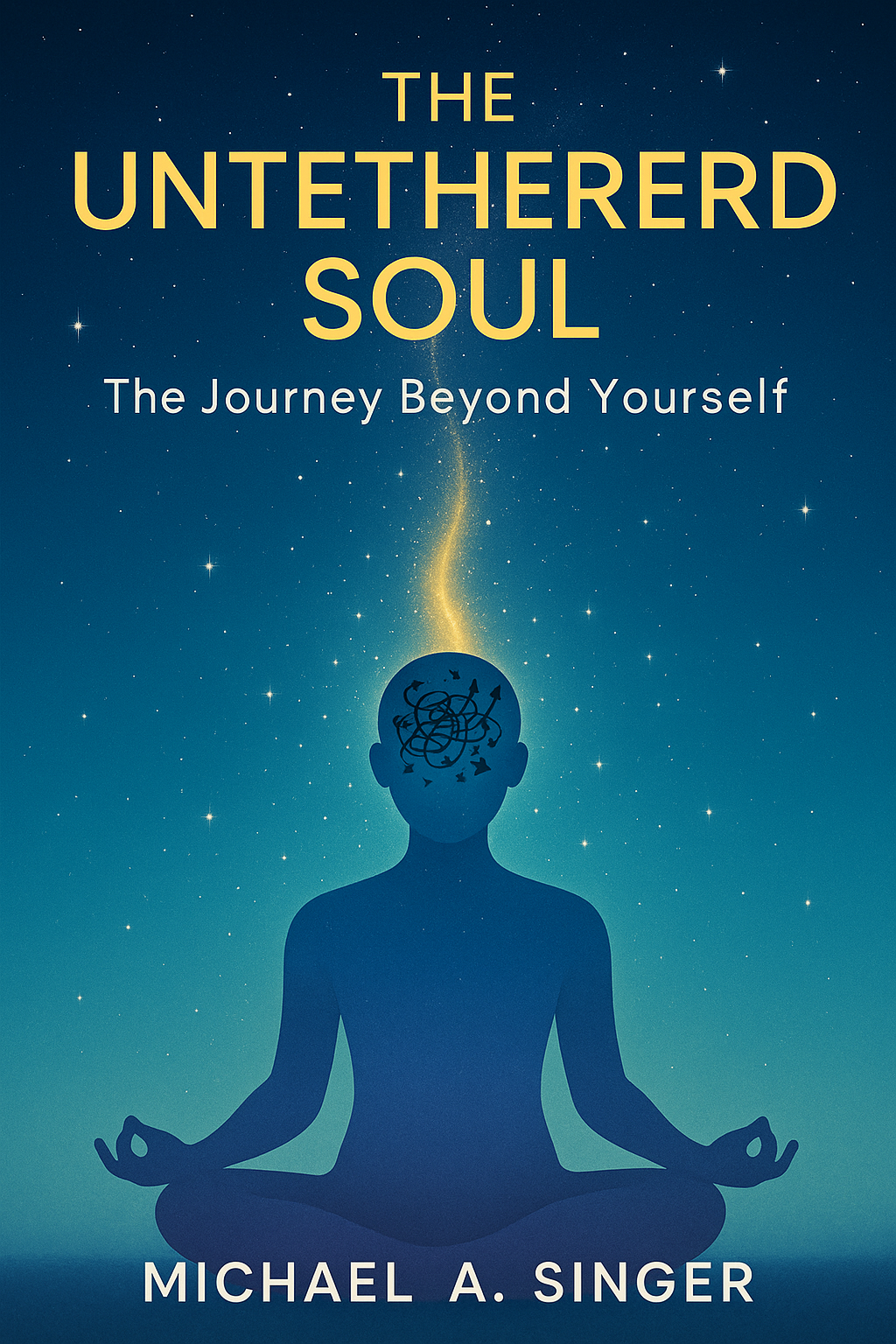
The Untethered Soul: The Journey Beyond Yourself
Chapter Summaries
What's Here for You
Are you tired of the incessant chatter in your mind, the 'inner roommate' that dictates your moods and reactions? Michael A. Singer's 'The Untethered Soul' offers a profound invitation to step beyond the limitations of your perceived self and discover a boundless inner freedom. This journey is not about changing your external circumstances, but about transforming your inner landscape. You'll learn to recognize the voice in your head not as your true identity, but as a mechanism to be observed. By exploring concepts like the 'lucid self' and 'infinite energy,' you'll begin to tap into an untapped wellspring of power within. Singer guides you through transcending the natural tendency to close off, to protect yourself from vulnerability, revealing that true growth lies in embracing, not avoiding, your inner disturbances. This book will equip you with the tools to let go of the fears and attachments that create suffering, understanding that pain itself can be the price of freedom. You will discover how to quiet the barrage of thoughts and emotions, cultivating a witness consciousness that allows you to see beyond the 'false solidity' of your psyche. Prepare to embark on a path of unconditional happiness, not through struggle, but through the spiritual path of nonresistance, finding the secret of the middle way. Ultimately, 'The Untethered Soul' promises a direct, internal experience of the Divine, seeing the world through 'the loving eyes of God.' This is a journey of deep intellectual exploration and profound emotional liberation, promising a life lived with greater peace, clarity, and authentic joy.
the voice inside your head
Michael A. Singer, in 'The Untethered Soul,' invites us to turn our attention inward, not to the content of our thoughts, but to the ceaseless chatter of the voice inside our heads. He reveals a startling truth: this inner monologue, which we often mistake for ourselves, is merely a mechanism, a vocalizing process that never truly rests. Imagine standing by a river, watching the water flow ceaselessly; the voice in your head is much like that river, constantly moving, churning, and shaping the landscape of your perception. Singer explains that this voice takes both sides of any argument, shifts its stance to maintain its own momentum, and often speaks about things already perceived or experienced, like narrating a scene you're already witnessing. This constant narration, he posits, isn't about understanding the world, but about creating a comfortable, controllable internal representation—a mental model that buffers us from the raw, unfiltered experience of reality. The tension arises because we become so identified with this voice, mistaking its pronouncements for our true selves, leading to unnecessary worry, distraction, and neurosis. The resolution lies in a profound shift in perspective: recognizing that you are not the voice, but the silent awareness that hears it. This awareness, this inner observer, is the true self, a constant presence that remains even when the voice falls silent. By stepping back and objectively observing this internal dialogue, without judgment or attachment, we can begin to untether ourselves from its incessant demands. Singer suggests that this voice, though often a source of distress, can become the very launchpad for spiritual awakening when we understand its nature and our relationship to it, leading us to realize that the world unfolds largely independent of our mental commentary, and that true growth comes from transcending the need for constant mental protection.
your inner roommate
Michael A. Singer, in 'The Untethered Soul,' invites us on a journey to discover that true inner peace isn't found by changing our external circumstances, but by understanding and transcending the incessant internal monologue that defines our 'inner roommate.' He explains that our growth is intrinsically linked to recognizing that the 'I' constantly chattering within, with its perpetual cycle of likes, dislikes, and problems, will never find lasting contentment. The core dilemma, Singer reveals, is our tendency to believe that external changes will resolve our inner turmoil. When a problem arises, the instinctive question is 'What should I do about it?' leading us to believe the issue lies solely outside ourselves. However, the wise path, he suggests, is to ask, 'What part of me is being disturbed by this?' This shifts the focus inward, prompting us to identify the disturbed aspect of ourselves. The crucial insight here is that the very act of observing this inner disturbance, of becoming aware of the internal chatter, reveals a deeper, separate consciousness – 'The Witness.' This Witness, the author explains, is not the problem; it is the one who sees the problem. This objective awareness is the essence of a spiritually minded approach, contrasting with a worldly one that seeks solutions in external manipulation. Singer paints a vivid picture of this inner roommate as a relentless, often neurotic companion, capable of ruining even the most joyous moments with its anxieties and judgments. Imagine, he urges, externalizing this voice, giving it a body, and spending a day with it. You'd likely be appalled by its constant conflicts, its erratic judgments, and its tendency to create melodrama out of thin air. This realization, this seeing of the roommate for what it is – a source of constant internal conflict – is the catalyst for spiritual growth. The author stresses that we don't need to silence this voice, but rather to stop identifying with it, to recognize that we are the Witness observing its performance. The resolution lies in this detachment, in reclaiming our inner domain not as the voice, but as the awareness that perceives it. By consciously choosing to 'take the seat of witness consciousness,' we can begin to free ourselves from the habitual mind's grip, understanding that our will is ultimately stronger than the incessant chatter, allowing us to reclaim our lives from this internal companion. This is the path to true inner freedom, a vacation from the relentless internal drama.
who are you?
In the quiet pursuit of inner freedom, the great teacher Ramana Maharshi offered a profound, yet deceptively simple, question: 'Who am I?' He posited this single inquiry as more potent than any scripture, mantra, or pilgrimage. Michael A. Singer, in 'The Untethered Soul,' invites us into this very exploration, challenging our conventional identities. Imagine, he suggests, being asked 'Who are you?' in a conversation. We might offer a name, 'Sally Smith,' but that's merely a collection of letters, a label assigned by others. We might then identify with a role, like 'Frank Smith's wife,' yet this, too, is transient, dependent on external relationships and circumstances, not an intrinsic truth. We might recount our life story – birth, schooling, relationships, experiences – but Singer presses further, asking who it was that *had* these experiences. Was it the same 'you' who was four feet six inches tall as Dorothy in the fifth grade, and is now five feet six inches? This persistent 'you,' the one who witnesses the changing physical form, the one who looks in the mirror across decades, reveals a continuity of being that transcends the physical. Consider the act of dreaming: who is it that watches the inner cinema? It is the same conscious observer who sees the world and notices the passage of time. This fundamental 'me,' the subject, is distinct from the objects it perceives, whether they are external sights or internal emotions. As we observe a dog playing, our attention can be instantly captured by the fear of a sudden hiss, demonstrating how inner states can eclipse outer reality, yet the 'you' experiencing both remains. Even when thoughts cease in deep meditation, a quiet awareness persists, proving that existence isn't tethered to the act of thinking. The mind can be a noisy torrent or a peaceful stillness, but it is 'you' who notices, 'you' who hears these thoughts. The author guides us to a pivotal realization: we are not the external world, nor are we our emotions or thoughts; these are simply objects that come and go before our awareness. The true self is the conscious witness, the seat of awareness itself. Through an experiment of instantaneously perceiving a room's details without thought, we glimpse the effortless power of consciousness. When the piano and the people in the room cease to exist, we remain; but if awareness itself were to cease, then 'you' would cease to be. Thus, the answer to 'Who am I?' becomes 'I am the one who sees,' the conscious receiver of all experience, living from the center of awareness, the true home behind the fleeting forms, feelings, and thoughts.
the lucid self
Michael A. Singer, in 'The Untethered Soul,' invites us to explore the profound concept of the 'lucid self,' drawing a parallel to lucid dreaming where awareness transcends immersion. Just as a dreamer can recognize they are dreaming and consciously choose to fly, we too can cultivate an awareness of our own awareness in waking life. Singer explains that consciousness possesses an innate ability to focus, a skill we intuitively grasp without formal instruction, allowing us to direct our attention. This fundamental aspect of consciousness, often overlooked in our daily discourse, is the very essence of our being. The core tension arises when this focused consciousness becomes so absorbed in the 'objects' of our experience—thoughts, emotions, or sensory input—that we lose sight of the 'subject,' the aware self. Imagine being so captivated by a movie, with synchronized sights, sounds, and even imagined tastes and smells, that you forget you are merely sitting in a theater. This is analogous to how our consciousness gets lost in the internal 'show' of our minds and emotions, becoming 'object-conscious' rather than 'self-conscious.' The resolution lies in consciously turning the light of awareness back upon itself. This is the practice of true meditation: not just concentrating on an object, but contemplating the very nature of consciousness itself. By shifting our focus from the transient objects of experience to the enduring awareness that perceives them, we reclaim our centered self. This is not about changing who we are, but about remembering who we have always been—the silent witness, the expansive consciousness that underlies all experience. As Singer reveals, the journey beyond the self is not about annihilation, but about recognizing the infinite nature of our true being, moving from the finite focus on fleeting experiences to the infinite awareness of the Self, ultimately realizing we are not the human being we thought we were, but the consciousness watching one.
infinite energy
Michael A. Singer, in his chapter 'Infinite Energy,' invites us to explore a profound truth often overlooked in our fast-paced Western world: the immense, untapped power of our inner energy. He posits that every thought, every emotion, every single internal process expends energy, much like physical actions. We rarely consider this internal economy, leading to states of depletion that even food and rest cannot mend. Singer illustrates this with a poignant example: the drastic shift in energy following a devastating breakup, only to be instantly revitalized by a call from the very person who caused the despair. This dramatic surge, he explains, doesn't come from external sources but from an internal wellspring, a spiritual energy that is always available, waiting to be accessed. The core dilemma, as Singer reveals, is not a lack of energy, but our tendency to block it. This blockage, he explains, occurs when we close our hearts and minds, retreating into restrictive internal spaces. This act of closing, often a protective habit formed by past experiences, severs our connection to this infinite source, plunging us into lethargy or disturbance. The yogis and ancient traditions, he notes, understood these energy centers, or chakras, and the vital importance of keeping them open. The resolution lies in a simple yet powerful commitment: to stay open. Singer argues that the only thing preventing us from experiencing constant love, enthusiasm, and boundless energy is our own choice to close. He encourages us to recognize that closing is a habit, one that can be unlearned through conscious effort and a willingness to experience life's ups and downs without shutting down. By choosing openness, no matter the external circumstances, we allow this infinite energy to flow, not only replenishing ourselves but also becoming a source of light and healing for others. The journey beyond yourself, Singer suggests, is a journey into this unlimited inner power, accessible to all who dare to remain receptive.
the secrets of the spiritual heart
Michael A. Singer, in 'The Untethered Soul,' invites us to explore a profound yet often misunderstood aspect of our being: the spiritual heart. He reveals it not as a mere biological pump, but as a phenomenal instrument, an energy center capable of generating vibrations and harmonies far beyond any earthly instrument. This heart, Singer explains, is the orchestrator of our lives, its opening and closing dictating our capacity for love, our experience of anger, and our encounters with emptiness. We are not the heart itself, he clarifies, but the experiencer of its subtle energy shifts. The core dilemma arises when this energy center becomes blocked by stored, unfinished patterns from our past. When sensory input – the energetic impressions of the world – creates disturbance, we resist, causing these patterns to get stuck, much like a light blue Mustang that triggers a cascade of unresolved emotions from years ago. This resistance transforms fleeting experiences into 'Samskaras,' indelible impressions that encrust the heart's valve, restricting the free flow of life’s energy. These stored energies, whether negative or positive (from clinging to joyful moments), create internal cycles that drain our vitality and dictate our reactions. The chapter offers a path beyond this limitation: the practice of allowing experiences to pass through us, rather than resisting or clinging. By consciously choosing to release stored energies as they arise, even if it brings temporary discomfort, we can purify the heart. Imagine this process as a natural cleansing, like the body purging foreign matter. The ultimate resolution is a permanently open heart, a state of unending inspiration, love, and presence, where life flows through us, transforming us with each passing moment. This journey requires courage, a willingness to confront the pain of released Samskaras, and a steadfast commitment to remaining centered, allowing the heart to sing its full, magnificent range.
transcending the tendency to close
Michael A. Singer, in 'The Untethered Soul,' guides us through the profound journey of transcending our innate tendency to close off, to protect our vulnerable inner selves. He reveals that just as science shows the universe arises from an underlying energy field, so too does our inner world, manifesting as thoughts, emotions, and drives. The primal survival instinct, once focused on physical threats, has evolved in our modern, safe societies to defend our psychological self-concept. When faced with perceived threats—a raised voice, an uncomfortable topic—we don't flee into the woods like a deer; instead, we withdraw, closing down our energy centers, erecting a protective shield around our ego. This constant guarding, Singer explains, doesn't resolve underlying insecurities; it merely locks them away, preventing growth and true freedom. Imagine being trapped in a darkened room, wanting sunlight but unable to open the blinds because you fear what might come in. This self-imposed imprisonment leads to a stagnant life, where joy is scarce and days are merely survived. The path to genuine spiritual growth, Singer proposes, lies in embracing the opposite: unification. It's about becoming so aware that there's no longer a scared part to defend, only a unified self witnessing the dance of the psyche. This requires allowing every fragmented piece of ourselves to surface and be exposed to awareness, even if it brings temporary discomfort. The central tension, then, is the choice between the exhausting work of protection and the liberating surrender of letting go. Singer urges us to recognize this tendency to close, especially around our soft spots, and to consciously decide not to engage with the protective impulse. Instead, we can choose to observe the part of us that seeks defense and simply let it be. The reward for this non-protection, this willingness to allow disturbances to simply pass through, is liberation. We become free to walk through life without the constant burden of self-defense, experiencing what comes next with open awareness. This is not about suppressing emotions or thoughts, but about recognizing that they are mere objects of consciousness, like clouds passing in the sky. When you feel the energy shift—a tightening, a defensive posture—that's the cue for growth, not for defense. It's the moment to practice ‘letting go,’ falling back behind the energy rather than being pulled into its storm. This requires conscious effort, a decision to disengage from the compelling pull of disturbed energies. Singer likens it to watching a car drive by and then simply letting the thought of wanting it pass, rather than spiraling into a narrative about salary and job changes. This is being centered: the consciousness remains steady, observing the ebb and flow of thoughts and emotions without being swept away. Each time the energy pulls, we can choose to relax and release, understanding that our center of consciousness is inherently stronger. The practice begins with small things—a borrowed pencil, a honking car—learning to release the pull for the sake of freedom. Singer emphasizes that this is a game, a choice between being bothered and being free. By consistently choosing to let go, even when the mind dramatizes potential threats, we dismantle the habit of the lower self. The ultimate outcome is a profound state of peace, where even significant losses can be weathered without emotional scarring, living from a place of pure consciousness that is eternally free.
let go now or fall
Michael A. Singer, in his chapter 'let go now or fall' from 'The Untethered Soul,' unveils a profound truth about the human condition: our lifelong journey of self-exploration is inextricably linked to how we navigate life's inevitable changes. He explains that fear is not an external enemy, but an internal 'thing,' an object in the universe we are capable of experiencing and releasing, or clinging to. When we attempt to shield ourselves from fear by creating a predictable, controllable world, life itself becomes the adversary, a constant struggle against an 'it' that threatens our carefully constructed safety. This resistance to change, born from an inner discomfort with ourselves, distorts our perception, making the world appear frightening. The author reveals a core insight: the natural unfolding of life is inherently okay, but our fear-driven definitions of desirable and undesirable events dictate otherwise, leading us to believe we must control our environment to be okay. As we spiritually grow, we realize that protecting ourselves from inner issues actually breeds more problems, transforming life into a heavy, constant fight against perceived disturbances. Singer offers a powerful alternative: to stop fighting life, to accept that it is not under our control, and to face the fear that fuels the fight. He posits that fear stems from blockages in our energy flow, weakening the heart and making us susceptible to negativity. The path to spiritual evolution, then, lies in removing these blockages, not in protecting them. A crucial, albeit difficult, law emerges: when your inner 'stuff' is triggered, let go immediately, because it will only become harder later. This requires recognizing that you, the observer, are distinct from the disturbed feelings and thoughts that arise. Staying in this seat of centered awareness, the 'witness,' is the only place from which true release is possible. When we fail to let go, our consciousness is pulled into the disturbance like a magnet, causing us to lose our clear perspective and descend into a cycle of reactive behavior. This 'fall' can lead to drastic actions, externalizing our inner turmoil and creating negative cycles that further entrench us. The author paints a vivid picture: imagine a rock thrown into water, creating ripples within us; life's changes are those ripples, pushing us to release what's blocked. When these blockages are hit, instead of resisting, we must open our hearts and permit the purification process. By choosing to let go in the moment of disturbance, we allow that blocked energy to be purified and flow upward, strengthening us and leading to an 'ascent.' The secret to this ascent, Singer explains, is to continuously look upward, relax the heart, and remain in the seat of Self, allowing inner darkness to purify itself without engagement. He emphasizes that even if we fall, the path is to get up, let go immediately without rationalization, and use the experience to strengthen our resolve. Ultimately, Singer presents a stark choice: let go now, or fall, recognizing that that which holds us down can become the very fuel for our upward journey, transforming struggle into strength.
removing your inner thorn
Michael A. Singer, in 'The Untethered Soul,' guides us through a profound exploration of personal growth, revealing that true transformation lies not in avoiding our inner disturbances, but in embracing them as catalysts for change. He paints a vivid picture: imagine a persistent thorn lodged in your arm, a constant source of pain whenever it’s touched. Our natural instinct, he explains, is to build a fortress around this thorn, meticulously clearing paths and designing elaborate contraptions to prevent any further contact. This protective strategy, however, becomes a lifetime’s work, a complex web of adjustments that, while minimizing immediate pain, ultimately dictates every aspect of our lives—where we go, whom we’re close to, even how we sleep. The author emphasizes that this is not a solution, but a sophisticated form of avoidance, where the problem, no matter how well-managed, continues to run our lives from the shadows. He draws a powerful parallel to our inner lives, where 'thorns' of loneliness, rejection, or insecurity cause deep disturbances. Just as with the physical thorn, we can either build a life around these sensitivities, constantly managing our environment and interactions to avoid discomfort, or we can choose a more radical path: removal. This removal isn't about suppression, but about recognizing that we are not the pain itself, but the consciousness that observes it. The core insight is that true freedom comes from allowing these inner disturbances to pass through us, like watching a storm from a safe, inner vantage point, rather than becoming the storm itself. By ceasing to play with our inner thorns—that is, by not constantly touching them through avoidance or overreaction—we allow the blocked energy to release naturally. The author invites us to become explorers of our inner landscape, to witness the feelings of loneliness, fear, or need without absorption, recognizing them as temporary experiences of the human condition, not the totality of our being. This shift in perspective, from identifying with the disturbance to observing it from the seat of awareness, allows a powerful inner energy, a 'Shakti' or Spirit, to emerge, sustaining us and ultimately freeing us to live authentically, unburdened by the constant need to protect our deepest sensitivities. This journey beyond the self is the essence of a spiritual life, where we learn to be present with all of life’s experiences, finding strength not in avoiding pain, but in the unwavering awareness that witnesses it.
stealing freedom for your soul
Michael A. Singer, in 'The Untethered Soul,' invites us to a profound realization: the prerequisite to true freedom is the conscious decision to cease suffering. He argues that our lives are burdened by an incessant inner weight – the fear of inadequacy, failure, judgment, and pain. This weight is so pervasive, like a fish unaware of the water it swims in, that we often don't recognize the constant state of suffering, or our efforts to avoid it. Singer posits that our mental and emotional lives are in a perpetual state of dis-ease, analogous to a body with chronic ailments; we only notice it when it intensifies, but the underlying fragility is constant. The core dilemma, he explains, stems from assigning our minds an impossible task: to orchestrate the external world to ensure our constant comfort, approval, and happiness. This relentless striving, this internal monologue of 'I, me, and mine,' is the very engine of our psychological suffering. It's like expecting your body to perform superhuman feats daily, leading to breakdown. The signs of this psychic breakdown are the familiar companions of fear, anxiety, and neurotic thought. The author challenges the common approach of seeking external solutions – a promotion, a relationship, wealth – to mend this internal void, revealing these as mere attempts to cover a deeper problem: a lack of inner wholeness. True success, he contends, is akin to physical health; it's a state where your psyche functions seamlessly, requiring no constant management or defense, allowing you to live fully, not use life as a tool for self-repair. The path to liberation, Singer reveals, lies not in fighting the mind, but in disengaging from its impossible directives. It's a practice of gently withdrawing your attention, like stopping an addiction one simply ceases the behavior. By choosing not to participate in the mind's dramas – the anxieties, the what-ifs – and instead, quietly observing it from a place of awareness, we begin to untether ourselves. This involves setting up 'trigger points' in daily life, moments to remind ourselves to step back, to relax, and to release the grip of the mind. It’s about recognizing that you are not the thinking mind, but the consciousness that witnesses it. As you consistently practice this disengagement, you learn to fall behind the mind, becoming the quiet observer. The moment the mind starts its frantic calculations, you simply relax and release, letting go at the heart level before the mind even engages. This, Singer concludes, is how we steal freedom for our souls, transforming the very energies that once held us captive into the keys to our liberation.
pain, the price of freedom
Michael A. Singer, in 'The Untethered Soul,' reveals a profound truth: the gateway to genuine spiritual growth and transformation is not found in comfort, but in a courageous peace with pain. He explains that expansion inherently demands change, and change, by its very nature, challenges our deepest needs for safety, comfort, and control, often manifesting as discomfort or outright pain. This inner disturbance, while unpleasant, is a crucial signal. Singer urges us to sit with these feelings, to explore their origins, and to discover the deep, often hidden, layer of pain residing at the core of our being. He posits that our entire personality—our beliefs, thoughts, actions, and ways of being—is meticulously constructed as a shield, a lifelong strategy to avoid this fundamental discomfort. This avoidance, however, creates a perpetual cycle; anything done to sidestep this core pain inadvertently becomes a tether, linking us back to its potential sting. Consider the fear of rejection: we meticulously curate our social interactions, our attire, even our cars, all to avoid a perceived slight. Yet, this very effort amplifies our sensitivity, turning a casual remark about our car into a painful experience because the underlying motive was pain avoidance. Singer paints a vivid picture of this layered defense, likening it to building walls around a hidden wound. He suggests a radical shift in perspective: instead of recoiling from inner pain, we must learn to see it as a temporary shift in energy, a natural, passing phenomenon. Like looking up at a sky dusted with billions of stars, our personal disturbances shrink in cosmic perspective. The key lies in embracing openness, not contraction; in relaxing into the tightness and pain, allowing it to pass through us like wind. Each time we resist, we dam the stream, storing pain and creating psychological noise. But each time we consciously choose to relax, to remain open, and to let the energy flow, a piece of that stored pain dissolves forever. This willingness to face and release the pain is the price of freedom, the very work that unlocks the vast ocean of love, joy, and peace that lies beyond. True spiritual growth, Singer concludes, is found in consciously choosing to pay this price, transforming us from slaves to fear into vibrant beings experiencing life with unburdened hearts.
taking down the walls
Michael A. Singer, in 'The Untethered Soul,' guides us through the quietening that occurs as we deepen our inner seat, revealing that the constant barrage of thoughts, emotions, and sensory input has merely overwhelmed our true awareness. As we cultivate witness consciousness, we begin to grasp that our awareness is independent of what it observes, suggesting a path to freedom from the psyche's magical hold—a state often misunderstood as enlightenment. Singer argues that our limited, personal experiences and conceptual frameworks obscure this possibility, leading us to dismiss it or relegate it to the mystical few. The chapter introduces a powerful allegory: imagine building a dream house in a sunlit field, a fortress of concrete and shutters, designed for self-sufficiency and isolation. Over time, the comfort and predictability of this self-made sanctuary become paramount, causing us to seal ourselves off from the outside world, much like locking down shutters that blend into the walls. This house, Singer explains, is our mind, constructed from thoughts, emotions, past experiences, beliefs, and opinions—a mental structure that blocks out the natural, radiant light of existence. When our carefully curated internal world is challenged, we become defensive, reinforcing these walls of thought and emotion, mistaking them for our true selves. The dilemma is clear: we are trapped in a self-imposed darkness, illuminated only by the flickering, artificial light of our own making, while an infinite, effortless light surrounds us. The resolution lies not in striving for enlightenment, but in recognizing these walls for what they are—blockages—and allowing the natural flow of life to dismantle them. By ceasing to defend our fortress of thoughts, we can witness the crumbling of these barriers and allow our consciousness to expand into the brilliant, omnipresent light that has always been there, a release that is the true journey beyond ourselves.
far, far beyond
Michael A. Singer, in 'The Untethered Soul,' guides us on a profound journey far beyond the confines of our perceived self, revealing that the very essence of spirituality lies in the continuous act of moving past our current state. He posits that limitations and boundaries are not inherent to existence but are mental constructs, artificial barriers we erect to feel a semblance of control over an infinite universe. Our analytical minds, in an attempt to grasp the boundless, break reality into discrete thoughts, forming mental models that become our perceived truth; we then struggle to force the world to conform, labeling anything that deviates as wrong or unfair. This internal struggle, Singer explains, arises from an inability to accommodate the infinite within our finite mental frameworks. The path to transcending these self-imposed limits requires a willingness to risk not believing in our models, to observe what happens when they falter – like when a foundational relationship crumbles or a cherished plan unravels. These seismic shifts, though initially disorienting, offer a crucial glimpse into the very reasons we construct these mental cages. He illustrates this with the simple act of not smoking or not dressing up; by choosing not to engage in habitual behaviors that maintain comfort, we confront the underlying urges and causes, peeling back layers of conditioning. The author likens our comfort zone to a tiger's cage, a place of perceived safety that ultimately restricts the expanse of our consciousness. Most people, he observes, cling to this cage, fearing the unknown beyond, mistaking confinement for protection. Spirituality, then, is not about decorating the cage, but about the courageous commitment to go beyond its bars. This involves recognizing the edges of our psyche – the insecurity, jealousy, or fear that signal we've hit a boundary – and, crucially, choosing not to pull back. It's about learning to relax and lean into that discomfort, much like a brave dog testing the invisible fence, understanding that the 'shock' is merely discomfort, not true harm. The journey beyond is an infinite one, a commitment to constantly meet these edges, to relax through them, and ultimately, to fall through into the infinite expanse that lies on the other side, transforming the boundaries of our fear into pathways to freedom.
letting go of false solidity
Michael A. Singer, in 'The Untethered Soul,' invites us to explore the intricate, often tumultuous landscape within our own psyche, a place he reveals is less a solid structure and more a dynamic interplay of fleeting thoughts, emotions, and energy. He explains that our deep-seated tendency to cling to these transient inner states, mistaking them for stability, is the root of much of our suffering. We construct an identity, a 'self-concept,' by grabbing onto passing mental objects, much like building an island of apparent solidity in a vast, empty inner space. This constructed self, a persona designed for security and predictability, becomes the very thing we defend, leading to a perpetual struggle against the natural flow of life. Singer guides us toward a profound realization: the true Self is not the edifice we build, but the silent, unchanging awareness that observes it all. He proposes that the path to freedom lies not in reinforcing this false solidity, but in daring to let it crumble, facing the fear that drives our clinging. Imagine, he suggests, a mind like a vast, empty inner space, with thoughts drifting like clouds; clinging is what causes these clouds to gather and form perceived mountains. By consciously relaxing our grip, by witnessing the unfolding of our inner world without trying to control it, we can move beyond the turmoil. This journey requires a willingness to embrace psychological disturbance, to ask 'Who am I that notices this?' rather than 'What do I do about this?' Ultimately, Singer reveals that true peace is found not in building defenses, but in stepping out of the fortress of our own making, allowing the natural flow of existence to reveal an ocean of inner peace and light, a state of transcendent awareness where we are no longer identified with the transient phenomena of the mind and emotions, but with the boundless expanse of pure consciousness.
the path of unconditional happiness
Michael A. Singer, in 'The Untethered Soul,' proposes that the highest spiritual path is life itself, a journey that transforms into liberation when approached with a simple, yet profound, underlying decision: do you want to be happy, or do you not? He argues that most people complicate this fundamental choice by attaching conditions, believing happiness is outside their control when external circumstances shift, like a partner leaving or a career faltering. Singer invites us to imagine being lost and starving, where the only thought is 'food,' devoid of preference. Similarly, he suggests that the choice for happiness should be absolute, a 'yes' that transcends 'ifs, ands, or buts,' regardless of life’s inevitable challenges—a lost flight, a dented car, or personal loss. This unconditional commitment, he explains, is the very essence of the highest spiritual path, acting as a catalyst for growth. When faced with adversity, the choice to break this vow of happiness is examined; Singer posits that events themselves do not dictate our state, but rather our internal decision to be happy regardless of them. The true purpose of life, he asserts, is to enjoy and learn from experiences, not to suffer, and this enjoyment is entirely within our control, even embracing the moments of death. To embrace this path is to transcend the part of ourselves that creates melodrama, that seeks reasons *not* to be happy, thus awakening to higher aspects of being. The narrative paints a picture of reality: a planet adrift in an infinite, empty space, making the choice to be happy and enjoy the experience the only rational course. Singer emphasizes that this journey is not about external practices but about an internal vow, a commitment to remain open, like a heart that stays open even when faced with profound loss, rather than closing off and shutting down energy. He likens the closed heart to a lack of energy, while an open heart allows for a flow of uplifting energy, a state akin to Satchitananda, or eternal conscious bliss, the very nature of God. The chapter concludes by suggesting that this unwavering commitment to unconditional happiness ultimately leads to a state beyond words—ecstasy, bliss, liberation—where the veils of the human mind fall away, revealing the eternal and infinite.
the spiritual path of nonresistance
Michael A. Singer, in 'The Untethered Soul,' invites us to view spiritual growth not as a struggle, but as the highest path of learning to live life without stress, problems, or melodrama. The core tension, he explains, arises not from life's events themselves, but from our inherent resistance to them. This resistance, fueled by our 'willpower'—the very force that moves our limbs and directs our thoughts—is often asserted against what has already happened or what might happen in the future. When we resist, imagine attempting to stop ripples in a still lake by throwing more stones; the energy has nowhere to go, gets stuck within our psyche, blocking the heart's flow and leading to exhaustion, burnout, or emotional shutdown. This inner turmoil stems from past impressions—childhood memories, past heartbreaks like a breakup associated with azaleas—that we allow to dictate our present reactions. Singer reveals that the spiritual path, therefore, is the practice of nonresistance, the willingness to let life's events flow through us. It's about accepting reality, not as a personal problem, but as an event unfolding on this planet, free from the distortions of fear and desire. By consciously choosing to stop resisting, we can transform stressful situations into stepping stones for growth, much like learning to relax through a fear of dogs can open us to a broader relationship with the world. This deep inner release is the journey beyond ourselves, leading to clarity, an awakening of inner energy, profound love, and a state where nothing can disturb us, allowing our true capabilities to emerge unhindered.
contemplating death
Michael A. Singer, in 'The Untethered Soul,' unveils a profound paradox: death, the ultimate end, is life's most potent teacher. It doesn't merely inform us that we are not our bodies; it *shows* us, stripping away our attachments in an instant, revealing the transient nature of wealth, status, and even life itself, making us all equal in its final embrace. The author implores us not to wait for this ultimate lesson, but to embrace the mere *possibility* of death at any moment as a catalyst for living fully, urging us to consider: if our last breath could be this one, how would we truly live? This perspective challenges our jealousies and possessiveness, revealing that true love desires the happiness of the beloved, even beyond our own presence. Singer paints a vivid scene: imagine an angel announcing your imminent departure tonight. How would you interact with loved ones? The petty grievances would vanish, replaced by an outpouring of love, a profound appreciation for each fleeting moment. This, he suggests, is the consciousness we *can* cultivate daily. He prompts us to examine our priorities, asking what we would do with a final week, and then to confront the stark reality of how we *are* spending our time. The Angel of Death, he muses, would find it poignant if we claimed we needed just one more week, having been gifted fifty-two *this past year alone* without true appreciation. The author emphasizes that death's lesson isn't reserved for the aged; it can strike any of us, at any time, with a single, unreturned breath. He contrasts this with the awakened soul, for whom death's arrival would bring no change, no regrets, because they already live in alignment with their deepest being, free from compromise. A yogi's awareness of a sword suspended by a spiderweb mirrors our own precarious existence, a constant reminder that any moment—a car ride, a meal—could be our last. This isn't morbid; it's an invitation to infuse every moment with meaning, much like those facing their final week describe it as the most significant of their lives. Singer reveals that the true tension lies not in *what* we do, but *how much of ourselves* is present. He asks us to consider the profound appreciation a hospital patient has for a single walk outside, a feeling we often miss, too preoccupied with the future to savor the present. This fear, this constant striving for 'next,' keeps us from truly living. He urges us to release this fearful part of ourselves, to be bold and open, to live as if death were our constant companion, not as a threat, but as the ultimate liberator that makes life precious through its scarcity. This scarcity, he explains, transforms a simple rock into a gem, and death imbues life with its value. By embracing death's temporal nature, we realize life isn't something to 'get,' but something to *experience* fully, moment by moment. When we live each experience with depth, as if it were our last, we find fulfillment, not by accumulating experiences, but by fully inhabiting the ones we have, transforming our relationship with life and rendering death's eventual claim on us less a loss and more a natural conclusion to a life lived with profound appreciation.
the secret of the middle way
Michael A. Singer, in 'The Untethered Soul,' guides us through the profound simplicity of the Tao, the ancient Chinese concept of 'The Way.' He reveals that this fundamental principle of life, the balance of yin and yang, light and dark, doing and not-doing, is not some mystical enigma but a tangible, ever-present truth accessible through mindful observation. Singer illustrates this through relatable extremes: the perils of constant eating versus starving, the suffocating closeness versus stark isolation in relationships, and the scorching heat versus absolute zero in temperature. Each extreme, he explains, represents a pendulum swing, a deviation from the natural equilibrium that expends tremendous energy and leads to inevitable collapse. The Tao, conversely, resides in the quiet center, the point of balance where forces harmonize without forceful push or pull. This middle way, Singer emphasizes, is not static but a dynamic equilibrium, much like the delicate tension required to perfectly sail a boat, where the wind, sail, and rudder work in concert. By refusing to feed the extremes—by not indulging in excessive reactions or clinging to fixed preferences—we allow our energy to naturally return to the center. This reclamation of energy, previously wasted in oscillating between opposites, grants us unprecedented efficiency and clarity. The instructor explains that when we cease the frantic side-to-side motion of the pendulum, we discover a reservoir of power, enabling us to accomplish tasks with remarkable speed and ease, freed from the burden of constant adjustment. This is the essence of effortless action, where life unfolds through us rather than being forced by us. The key lies in 'leaving it alone,' allowing the pendulum to naturally swing back to its resting point, much like the calm eye of a hurricane amidst the swirling chaos. As we learn to feel for the edges without stepping over them, we navigate life not by mapping every pitfall, but by trusting the center to guide us. This journey beyond the self, beyond the extremes, leads to a state of profound presence, where events are experienced as they are, in the moment, allowing for a more capable and peaceful engagement with the unfolding tapestry of existence.
the loving eyes of god
Michael A. Singer, in 'The Untethered Soul,' invites us on a profound journey beyond the confines of the personal self, proposing that true knowledge of the Divine isn't found in doctrines or cultural constructs, but in a direct, internal experience. He reveals that deep within us lies a connection to the Divine, a part of our being that transcends the psyche and the body. By consciously choosing to identify with this deeper self, a natural transformation unfolds, allowing us to witness our own movement toward Spirit, much like observing the effects of rain or fire. This isn't abstract philosophy; it's a lived reality. Singer illustrates how releasing lower vibrations—the tension, anxiety, anger, and resentment that grip the personal self—allows our Spirit to naturally drift upward, creating an experience of spaciousness and distance from those fleeting emotions. This upward drift, he explains, is as undeniable as breathing or the beating of a heart; it's a direct experience of becoming less tethered to the earthly self and more open to a profound sense of inner expansiveness. As we associate less with the physical and psychological, we begin to identify with the flow of pure energy, experiencing a backdrop of unconditional love, openness, and appreciation—the very essence of Spirit. The path to this state, Singer emphasizes, is not by reaching for Spirit, but by willingly letting go of the personal self, the very thing that prevents us from touching the Divine. As we release these lower aspects, we soar, experiencing a continuous progression of increasing love and lightness, mirroring the states described by saints and sages throughout history. The ultimate knowing of God, Singer posits, comes not from external teachings but from this internal merging, where the individual drop of consciousness becomes one with the Universal Ocean of Being, echoing the profound statements of spiritual masters across traditions: 'I and my Father are one.' He paints a vivid picture of this transformation: imagine feeling boundless love for all creation, seeing every person as a unique, beautiful flower, and transcending judgment for appreciation and honor. This shift in perception, this seeing with the 'eyes of God,' is the most potent way to know the Divine. When we can look at another with pure, unconditional love—a love that sees past imperfections and embraces the totality of being—we are glimpsing the Divine looking through us. This is not a love we can manufacture; it is transcendental, divine, selfless love, the very nature of Spirit. The chapter resolves by urging us to release the concept of a judgmental God, a notion that breeds guilt and fear, and instead embrace the reality of a loving God, a God who is pure love and in a state of eternal, conscious bliss and ecstasy, seeing only beauty in all of creation. Just as the sun shines equally on all, regardless of whether they turn towards it, God's love is ever-present, an unconditional refuge waiting for us to simply turn and receive.
Conclusion
Michael A. Singer's 'The Untethered Soul' offers a profound and transformative journey beyond the confines of the self, illuminating the path to inner freedom and lasting peace. At its core, the book dismantles the illusion that we are our incessant internal dialogue, the 'inner roommate' whose ceaseless chatter creates a distorted perception of reality and perpetual discontent. Singer masterfully guides us to recognize our true identity not as the thoughts and emotions that arise and pass, but as the silent, unchanging awareness – 'The Witness' – that observes them. This fundamental insight is the key to detaching from the mental noise and reclaiming our lives. The emotional lessons are deeply liberating. We learn that true peace isn't achieved by altering external circumstances, but by shifting our focus inward to the part of ourselves that is disturbed. By embracing the courage to remain open, even in the face of discomfort and fear, we unlock access to an infinite reservoir of inner energy. The tendency to 'close down' in response to past hurts or perceived threats is revealed as the primary mechanism blocking this vital flow. Singer emphasizes that spiritual growth isn't about avoiding pain, but about allowing triggered energies and inner 'thorns' to pass through us without resistance. This act of 'letting go' is not a passive surrender, but an active choice to release the energetic pull of disturbing thoughts and emotions, thereby strengthening our centered awareness. Practically, the book provides a roadmap for integrating these insights into daily life. The wisdom lies in understanding that life's challenges are neutral; it is our internal resistance and past emotional imprints that create suffering. By practicing nonresistance and acceptance, we transform personal problems into neutral occurrences, allowing for clarity and presence. The awareness of death, far from being morbid, becomes a potent teacher, reminding us of life's preciousness and urging us to fully inhabit the present moment. Ultimately, 'The Untethered Soul' teaches that true fulfillment, unconditional happiness, and vibrant aliveness emerge when we consciously choose to step beyond our self-imposed mental walls and comfort zones, embracing the continuous act of moving beyond our perceived limitations. By recognizing ourselves as the boundless consciousness that witnesses all experiences, we discover the profound truth that liberation is not a distant goal, but an ever-present possibility, 'stolen' by the simple, conscious decision to cease suffering and live from the expansive space of awareness.
Key Takeaways
The incessant internal dialogue is a separate mechanism, not the true self, and its primary function is to maintain its own activity.
We mistake the voice in our head for ourselves, leading to identification with its content and a distorted perception of reality.
The mind narrates the external world to create a comfortable, controllable internal model, buffering us from direct experience and offering a false sense of control.
The true self is the silent awareness that observes the voice, distinct from the thoughts and narratives it produces.
Objective observation of the inner voice, without judgment or identification, is the key to detaching from its incessant chatter and finding inner peace.
The mental voice serves as a protective mechanism, but this reliance prevents us from truly living and engaging with life directly.
The constant internal monologue, referred to as the 'inner roommate,' is the source of perpetual discontent and the root of perceived external problems, not the external circumstances themselves.
True peace is achieved not by solving external issues, but by shifting focus inward to identify the part of oneself that is disturbed by a situation.
The ability to witness one's own inner disturbances – thoughts, emotions, judgments – reveals a separate consciousness, 'The Witness,' which is distinct from and unaffected by the inner turmoil.
Identifying with the inner roommate leads to a 'worldly' approach of seeking external solutions, whereas recognizing oneself as the Witness facilitates a 'spiritual' approach of inner detachment and freedom.
Externalizing the inner roommate's voice and behavior helps to objectively recognize its neurotic, conflict-generating nature, thereby undermining one's identification with it.
Spiritual growth is the process of disidentifying from the inner roommate and reclaiming one's life by consciously choosing to inhabit the role of the Witness, whose will is supreme over the habitual mind.
The core identity is not found in external labels (name, roles) or life experiences, but in the persistent conscious awareness that witnesses these phenomena.
The self is the subject experiencing the world, distinct from the objects (external reality, emotions, thoughts) that populate that experience.
Consciousness is the fundamental reality; it is the unchanging witness that remains even when thoughts, emotions, or external circumstances change or disappear.
True self-knowledge arises not from analyzing thoughts or experiences, but from turning awareness inward to the source of perception itself.
The 'I' that experiences is not dependent on thinking; awareness exists independently of mental activity, as evidenced by deep meditation.
The ultimate resolution to the 'Who am I?' dilemma is recognizing oneself as pure awareness, the unchanging center from which all experiences arise and pass.
The ability to be aware of being aware, akin to lucid dreaming, allows us to transcend immersion in life's experiences.
Consciousness inherently possesses the power to focus, a natural faculty we can consciously direct to observe our inner world.
We become lost when our consciousness, fixated on external stimuli or internal thoughts and emotions, forgets its role as the observer.
True meditation involves turning awareness inward, not to concentrate on an object, but to contemplate the nature of consciousness itself.
The practice of observing our own awareness is the path to recognizing our true, expansive nature as the Self, independent of transient experiences.
Spirituality is the awakening to our fundamental identity as the boundless consciousness, the silent witness to the human experience.
Our internal world expends energy through thoughts and emotions, leading to depletion if not managed.
An infinite source of inner energy is always available, distinct from physical energy, but is often blocked by our internal defenses.
Closing our hearts and minds, a habitual reaction to past experiences, is the primary mechanism that prevents this energy from flowing.
Staying open, rather than closing in response to life's challenges, is the key to accessing and sustaining boundless inner energy.
Consciously choosing openness, even when it feels unnatural or vulnerable, allows for a continuous flow of energy, love, and enthusiasm.
The ability to remain open, regardless of external circumstances, transforms life into an exciting experience and allows us to become a source of positive energy for others.
The spiritual heart is a powerful energy center that governs our emotional states and life's trajectory, acting as a valve that opens and closes to the flow of life.
Blockages in the heart, known as Samskaras, are created when we resist or cling to past energetic impressions, preventing them from passing through us.
Stored Samskaras, like deeply ingrained emotional imprints, can be triggered years later by seemingly unrelated events, causing us to relive past feelings and reactions.
The choice lies not in changing external circumstances, but in developing the inner capacity to allow triggered energies to pass through without resistance, leading to purification.
An open heart, achieved through conscious release of stored energies, allows for a continuous flow of inspiration, love, and presence, representing our natural state.
Both the aversion to painful experiences and the clinging to pleasant ones create blockages, highlighting that true freedom comes from embracing the full spectrum of life's experiences as they are.
The instinct to protect our psychological self-concept, rather than our physical body, drives us to 'close down' emotionally when faced with perceived threats, preventing genuine growth.
Constantly defending our ego and insecurities doesn't resolve them but rather locks them away, creating a stagnant inner life devoid of spontaneous joy and freedom.
True spiritual growth requires a shift from defending a fragmented self to embracing a unified awareness where all inner experiences are observed without identification.
The practice of 'letting go' involves consciously choosing to disengage from the pull of disturbing thoughts and emotions, recognizing them as transient objects of consciousness.
By consistently practicing detachment from the energetic pull of inner turmoil, even in small daily instances, we strengthen our center of consciousness and achieve liberation.
Freedom is not the absence of difficult emotions or events, but the ability to remain centered and at peace while experiencing them, by choosing release over suppression or closing.
Fear is an internal 'thing' that drives our need for control, making life appear threatening when we try to avoid it rather than release it.
The natural unfolding of life is not inherently problematic; our inner fears and blockages create the perception of disturbance and the need for external control.
Protecting ourselves from inner issues paradoxically creates more problems, leading to a constant struggle against life and a distortion of our reality.
The most effective way to navigate life's challenges is to stop fighting and accept its uncontrollable nature, thereby confronting the fear that fuels resistance.
When inner blockages are triggered, immediate release ('letting go') is crucial, as delaying this process makes it significantly more difficult to regain clarity and freedom.
True liberation comes from recognizing oneself as the detached observer ('the witness') of one's thoughts and emotions, enabling release from the seat of centered awareness.
Failing to let go causes consciousness to be pulled into the disturbance, leading to reactive behavior, a loss of self, and the creation of negative cycles that perpetuate suffering.
True personal transformation arises not from protecting oneself from inner disturbances, but from embracing them as opportunities for growth.
Attempting to avoid or manage inner 'thorns' (like loneliness or fear) leads to a life dictated by avoidance, where the problem, rather than the solution, runs everything.
The core of freedom lies in recognizing that you are the observer of your inner experiences, not the experiences themselves, allowing disturbances to pass through without absorption.
Inner thorns are blocked energies that can be released by allowing them to be felt and observed, rather than suppressed or avoided, which only irritates them further.
By shifting focus from the 'melodrama' of emotions to the steady seat of awareness, one can access a profound inner energy ('Shakti') that sustains and liberates.
Authentic living stems from engaging with the world and relationships out of genuine interest and love, rather than from a need to avoid inner pain or seek validation.
The fundamental step to freedom is a conscious decision to stop suffering, recognizing that constant fear, insecurity, and anxiety are burdens we don't need to carry.
Our minds are given an impossible task of controlling external circumstances for internal validation, leading to perpetual suffering and a feeling of psychic fragility.
External solutions like relationships, success, or possessions are attempts to mask an inner lack of wholeness and do not address the root cause of suffering.
True psychic well-being is achieved not by fixing the mind, but by disengaging from its constant demands and observing its activity from a state of pure awareness.
Liberation is 'stolen' by consciously withdrawing attention from the mind's neurotic dramas and practicing relaxation and release, becoming the observer rather than the participant.
Daily life can be transformed into a practice of freedom by using simple 'trigger points' to remind oneself to step back, observe the mind, and remain centered in awareness.
The avoidance of deep-seated inner pain, rather than the pain itself, is the primary driver of personality and a significant impediment to spiritual growth.
Behavior patterns and sensitivities are often elaborate defense mechanisms constructed to avoid a core layer of psychological pain, inadvertently linking individuals to the very discomfort they seek to escape.
Inner pain should be viewed not as a threat to be avoided, but as a temporary energy flow that can be released by consciously choosing openness and relaxation, rather than contraction and resistance.
The willingness to consciously face and allow inner pain to pass through, rather than resisting or suppressing it, is the essential 'price of freedom' that unlocks deeper peace, joy, and spiritual realization.
Spiritual growth is realized in the moment one consciously chooses to remain open and present with pain, allowing it to be purified and released, thereby dissolving stored psychological burdens.
True freedom and vibrant aliveness emerge when one is no longer afraid of inner pain, allowing the world's challenges to pass through without triggering stored emotional responses.
The inner quietude experienced through deeper self-awareness reveals that our consciousness has been overwhelmed by mental and emotional noise, not inherently limited.
True freedom, often mislabeled as enlightenment, is accessible by recognizing that our awareness is distinct from the thoughts and emotions it observes.
Our 'house' of self is a mental construct built from past experiences, beliefs, and emotions, acting as a self-imposed prison that blocks out natural awareness and joy.
Defending our mental walls—our ingrained thoughts and emotional patterns—prevents us from seeing what lies beyond them and perpetuates our confinement.
The darkness we experience is not an inherent void but a blockage of the infinite, natural light of existence, caused by the walls we build around ourselves.
Releasing the need to defend our mental fortress and allowing life's natural flow to challenge these walls is the key to dismantling them and achieving freedom.
Spiritual growth is defined by the continuous act of moving beyond one's current state and perceived limitations, not by maintaining comfort.
Our mental models and the boundaries they create are artificial constructs used to exert control over an infinite reality, leading to internal conflict when the world doesn't conform.
Transcending self-imposed limitations requires confronting and intentionally stepping beyond the discomfort and fear associated with challenging our mental models and comfort zones.
Habitual behaviors are often shields protecting us from underlying causes; by choosing not to engage in them, we can access deeper layers of understanding about our motivations.
The comfort zone, though perceived as safety, is a mental cage that restricts consciousness; true freedom lies in recognizing and willingly moving beyond its boundaries.
Spiritual progress is marked by the commitment to consistently relax into and move through psychological edges, rather than retreating from discomfort, transforming fear into a guide for freedom.
The internal psyche is a dynamic, ever-changing space filled with transient thoughts and emotions, not a solid, fixed entity.
Suffering arises from the mistaken tendency to cling to these fleeting mental and emotional states, mistaking them for stability and using them to construct a false sense of self.
True identity resides not in the constructed personality or 'self-concept,' but in the unchanging awareness that observes thoughts and emotions.
Releasing the need for false solidity and embracing psychological disturbance is the path to inner freedom and peace.
Spiritual living involves accepting life's unfolding moments without clinging to them or defining oneself through them, thereby dismantling the protective mental models.
The practice of asking 'Who am I that notices this?' rather than 'What do I do about this?' shifts identification from the disturbed mind to the undisturbed witness.
The fundamental choice for happiness is an underlying decision that, when made unconditionally, clarifies one's entire life path.
Conditional happiness, where joy is dependent on external circumstances, creates the illusion that happiness is out of one's control.
Spiritual growth is stimulated by challenges that test one's commitment to unconditional happiness.
Events are neutral; our internal decision to enjoy or suffer from them is the determining factor in our experience of life.
Maintaining an open heart, rather than closing it in response to difficulty, is the key to experiencing consistent inner joy and energy.
The practice of unconditional happiness involves releasing the mind's tendency to create drama and reasons for unhappiness, leading to transcendence.
Stress and tension are not caused by life's events, but by our internal resistance to them.
Willpower, our inherent force, is often misapplied to resist past events or future anxieties, leading to wasted energy and inner blockage.
Past emotional impressions create a lens through which we resist current events, preventing us from experiencing reality clearly.
The spiritual path involves consciously choosing nonresistance, allowing life's energies to flow through us rather than getting stuck.
Acceptance of reality transforms events from personal problems into neutral occurrences, freeing us to respond with clarity and presence.
Practicing nonresistance, even in small ways like relaxing through a fear, creates a ripple effect that opens us to greater peace and expanded capabilities.
Death serves as life's most profound teacher, revealing the impermanence of our attachments and the true equality of all beings, urging us to learn from its possibility now, rather than waiting for its inevitable arrival.
Embracing the unpredictability of death can liberate us from petty concerns and possessiveness, fostering deeper love and a desire for the well-being of loved ones, even beyond our own existence.
The awareness of our mortality can serve as a powerful catalyst to live life at our highest level, challenging us to dig deep within ourselves and stop wasting precious time and energy on trivial matters.
True fulfillment comes not from accumulating future experiences or possessions, but from fully inhabiting and appreciating the present moment, recognizing that life's meaning is found in the willingness to experience it.
Scarcity, embodied by death's temporal nature, is what imbues life with its preciousness and meaning; without it, we would squander every moment, assuming infinite time.
A wise person lives with the constant awareness of death, not in fear, but with gratitude for each moment, understanding that their experience is already whole and complete, making them ready for any outcome.
The Tao, or 'The Way,' represents the principle of balance and equilibrium found in the center between opposing extremes, offering a path to inner peace and efficiency.
Extremes in any aspect of life, whether physical, emotional, or relational, are unsustainable and lead to wasted energy and eventual collapse.
True spiritual understanding of the Tao is not found in complex doctrines but in recognizing the simple truth of balance through mindful observation of life's natural rhythms.
By consciously choosing not to engage with or feed extreme reactions and preferences, one allows their energy to naturally return to a balanced center, unlocking greater personal power.
Living in the Tao is characterized by effortless action and a state of dynamic equilibrium, where one moves with life's forces rather than struggling against them, leading to clarity and presence.
Navigating life by 'feeling for the edges' without crossing them allows one to remain centered and in harmony, akin to a skilled sailor adjusting to the wind.
True knowledge of God stems from direct inner experience and the transformation of one's own being, rather than from external doctrines or cultural beliefs.
Releasing lower vibrations like anger, fear, and resentment creates inner spaciousness, allowing one's Spirit to naturally 'drift upward' toward higher states of consciousness.
Identifying with the deeper spiritual self, rather than the personal psyche or body, leads to an experience of unconditional love, openness, and appreciation as the natural backdrop of existence.
The path to the Divine involves letting go of the personal self and its attachments, a process that reveals the inherent beauty and oneness of all creation.
Knowing God is achieved by experiencing the qualities of Divine love within oneself—unconditional compassion, non-judgment, and ecstatic appreciation for all beings and phenomena.
The concept of a judgmental God fosters guilt and fear, whereas the reality of a loving God provides unconditional refuge and is experienced as eternal, conscious bliss.
Action Plan
Consciously observe the voice inside your head without judgment or engagement.
Recognize when the inner voice is narrating an experience you are already directly perceiving.
Practice stepping back and viewing your thoughts as separate from your true self.
Notice when the inner voice argues with itself and realize the futility of this internal conflict.
When an internal energy builds up (like anger or desire), observe the voice's activity without acting on its impulses.
Differentiate between the experience of reality and your mind's commentary on it.
Remind yourself that you are the listener, the awareness, not the voice speaking.
When a problem arises, consciously ask yourself, 'What part of me is being disturbed by this?' instead of focusing on an external solution.
Dedicate time to simply observe your inner thoughts and emotions without judgment, noticing the constant chatter of your 'inner roommate.'
Practice externalizing your inner voice by imagining it as a separate person speaking aloud, and observe its behavior.
When you catch yourself identifying with negative or anxious thoughts, remind yourself that you are the Witness observing these thoughts, not the thoughts themselves.
Commit to spending time in solitude and silence, intentionally noticing the inner roommate's resistance and chatter.
Recognize that you do not have to act on or believe everything your inner voice says; begin to question its advice.
Make a conscious decision to prioritize inner freedom and actively practice detaching from the habitual mind's dramas.
When asked 'Who are you?', pause and consider your identity beyond your name, roles, or possessions.
Practice observing your thoughts and emotions as distinct from yourself, like clouds passing in the sky.
Engage in moments of quiet introspection, noticing the awareness that exists even when thoughts are absent.
Direct your attention inward to the 'seer' of your experiences, rather than focusing solely on the experiences themselves.
When faced with strong emotions or distracting thoughts, gently remind yourself that you are the awareness experiencing them, not the emotions or thoughts themselves.
Experiment with perceiving your surroundings instantaneously without the need to label or analyze each detail.
Practice noticing when your attention becomes absorbed by thoughts, emotions, or external stimuli.
Consciously redirect your focus back to the simple awareness of your own presence, perhaps by internally repeating a simple phrase like 'hello.'
Engage in moments of quiet contemplation, turning your awareness towards the act of observing itself, rather than the content of your thoughts.
Begin to question the nature of your own consciousness by asking, 'Who am I?' and observing the immediate experience of being aware.
When strong emotions or thoughts arise, acknowledge them as objects of awareness without becoming lost in them.
Practice observing life's events—both internal and external—as if watching a movie, maintaining the awareness that you are the viewer, not the character.
Notice when you feel depleted and identify if it's due to internal energy expenditure rather than physical fatigue.
Observe your habitual reactions of 'closing' your heart or mind in response to challenging situations or people.
Practice consciously choosing to stay open, even for brief moments, when faced with discomfort or negative emotions.
Commit to not closing your heart or mind over specific events, recognizing that closing cuts off your energy source.
Explore ways to relax and release tension when you feel the urge to close, opting instead to be present with the situation.
Make a conscious decision to remain open, understanding that this choice is a practice that can be cultivated over time.
When you feel a surge of joy or enthusiasm, reflect on what allowed that openness and consider how to foster it more consistently.
Observe your heart's responses when triggered by external events or thoughts.
When a past impression (Samskara) arises, acknowledge it without judgment and consciously choose not to resist or cling to it.
Practice allowing emotional energy to flow through you, understanding that discomfort is temporary and part of the release process.
Recognize that both negative and positive attachments can block the heart; strive to experience moments fully without holding on or pushing away.
When an old pattern is stimulated, breathe into the sensation and consciously decide to let it pass through rather than react from the past.
Commit to the process of purification by choosing to release stored energies, even when difficult, to achieve a permanently open heart.
Notice and acknowledge your tendency to 'close down' or create a protective shield when feeling uncomfortable or threatened.
Practice observing disturbing thoughts and emotions without identifying with them or trying to change them; let them pass like clouds.
When you feel an inner tightening or defensiveness, consciously choose to 'let go' by relaxing and releasing the energetic pull.
Start with small, everyday annoyances (like a car honking) and practice releasing your reaction to them, viewing it as a game of freedom.
Commit to observing the 'pull' of inner energies and making a conscious decision not to be drawn into them, even when it feels powerful.
Recognize that your consciousness is the watcher, distinct from the thoughts and emotions it observes, and rest in that awareness.
Willingly accept the 'price' of freedom by letting go of the need to protect your ego, even when the mind dramatizes potential consequences.
When you notice a feeling of fear or disturbance arise, acknowledge it as an 'object' within you.
Instead of trying to control external circumstances to avoid triggers, consciously decide to stop fighting life's changes.
Practice recognizing yourself as the detached observer ('the witness') of your thoughts and emotions when disturbances occur.
When a situation triggers your inner 'stuff,' commit to letting go immediately without rationalizing or analyzing.
If you react and lose your seat of awareness, acknowledge the fall, get up, and immediately recommit to letting go.
View life's challenges that stimulate your inner issues not as problems, but as opportunities for purification and release.
Continuously practice opening your heart and allowing blocked energy to pass through, rather than holding onto it.
Identify an inner 'thorn' – a recurring sensitivity or disturbance you tend to avoid.
Instead of trying to prevent situations that might trigger this thorn, consciously choose to allow the feeling to arise.
Practice observing the sensation and thoughts associated with the disturbance without judgment, noting 'I notice I am feeling X'.
Recognize that you are the awareness witnessing the feeling, not the feeling itself.
Gently redirect your attention back to your center of consciousness when you find yourself absorbed in the emotional drama.
Engage in activities or relationships because you genuinely desire to, not because you are trying to avoid a specific inner discomfort.
Commit to regularly sitting with your awareness, allowing difficult energies to pass through without resistance.
Consciously decide that you no longer wish to suffer and commit to releasing the burdens of fear and insecurity.
Observe your mind's constant stream of thoughts without judgment, recognizing them as activity rather than reality.
When your mind presents an external 'solution' to an inner problem, consciously refrain from pursuing it.
Practice withdrawing your attention from neurotic thought patterns, akin to disengaging from an addiction.
Establish daily 'trigger points' (e.g., getting in the car, picking up the phone) to remind yourself to pause, observe your inner state, and release the mind's grip.
Gently relax your body and heart when you notice inner turmoil, allowing yourself to 'fall back' into the awareness behind the thoughts.
Focus on the heart's subtle energetic shifts as an earlier indicator of internal states, learning to let go at this level before the mind engages.
Identify a specific situation that triggers inner pain or disturbance.
Instead of immediately reacting or withdrawing, consciously choose to relax your body and heart.
Gently turn your attention towards the sensation of tightness or pain without judgment.
Allow the feeling to be present, observing it as a temporary energy flow rather than a catastrophe.
Practice breathing into the sensation, inviting it to pass through you rather than holding onto it.
When faced with external criticism or rejection, notice if your reaction stems from a desire to avoid inner pain.
Consciously choose to remain open and receptive, even when uncomfortable, to allow the energy to release.
Recognize that stored pain is a barrier to joy and love, and commit to releasing it through conscious presence.
Practice observing your thoughts and emotions without judgment, recognizing them as transient phenomena rather than your core identity.
Identify specific beliefs or past experiences that you cling to and consider them as potential 'walls' of your inner house.
When faced with challenging emotions or situations, consciously choose not to defend your usual reactions or thought patterns.
Gently 'walk toward' your emotional barriers by exploring uncomfortable feelings or situations, rather than immediately pulling away.
Shift your focus from trying to create internal light (happiness, comfort) to recognizing the 'walls' that block the natural light of awareness.
Allow everyday life's challenges and experiences to naturally dismantle your mental defenses instead of reinforcing them.
Identify a situation that typically causes you discomfort or insecurity and consciously choose to stay with that feeling for a short period without reacting.
Examine a habitual behavior you engage in for comfort (e.g., checking social media, overeating) and choose to refrain from it for a set duration to observe the underlying urges.
When your mental model of how things 'should be' is challenged, pause before reacting and ask yourself if you are trying to force reality into your limited framework.
Practice relaxing into the feeling of insecurity or fear when you approach a perceived boundary, rather than pulling back.
Commit to the daily practice of 'going beyond' by choosing one small action that pushes your comfort zone, no matter how minor.
Recognize that discomfort is a signal of your edges, not a threat, and view these moments as opportunities to expand your consciousness.
Observe your thoughts and emotions without judgment, recognizing them as transient phenomena passing through your awareness.
Practice identifying with your awareness rather than the content of your thoughts or feelings, by asking 'Who am I that notices this?'
Consciously choose to let go of the need to control or hold onto specific thoughts, emotions, or past experiences.
When faced with psychological disturbance or fear, resist the urge to defend or rationalize, and instead, simply observe the sensation.
Intentionally relax your mental grip on self-concepts and beliefs, allowing them to dissolve without immediate replacement.
Engage in mindful observation of internal and external events, allowing them to unfold without trying to impose your conceptual model upon them.
When you notice yourself clinging, acknowledge the tendency and gently redirect your focus back to pure awareness.
Make a clear, unconditional decision to be happy for the rest of your life, without attaching any 'ifs, ands, or buts'.
When faced with a challenging event, consciously ask yourself if you are willing to let go of your happiness over it.
Practice noticing when your heart begins to feel closed and consciously choose to relax and open it instead.
When your mind offers reasons not to be happy, acknowledge them without getting involved, and reaffirm your commitment to joy.
During daily life, reframe perceived difficulties as simply events to be experienced and learned from, rather than reasons for unhappiness.
Remind yourself that enjoying life is the most rational choice, given the transient nature of existence.
When you feel yourself closing off, question what benefit you believe you are gaining from that reaction and choose to let it go.
Observe your internal reactions when faced with an event you dislike, noting any impulse to resist.
Practice consciously relaxing your body and mind when you notice resistance arising.
When confronted with a past impression that triggers resistance, acknowledge it as an old imprint, not current reality.
Begin to view challenging events not as personal problems, but as neutral occurrences to be experienced.
Engage with relationships by seeking to understand others rather than trying to make them fit your expectations.
When faced with a fear, practice relaxing into the sensation rather than pushing it away.
Regularly contemplate the possibility of your own death, not with fear, but as a reminder to live fully in the present.
When facing a difficult situation or a strong emotion, pause and consider how it would matter if this were your last week of life.
Identify one daily activity you often rush through and consciously choose to engage with it more deeply and appreciatively.
Express genuine love and gratitude to your loved ones, as if each interaction might be your last.
Challenge your attachments to material possessions and social roles by imagining them being taken away suddenly.
Practice being fully present in conversations and interactions, savoring the experience rather than planning for what comes next.
Shift your focus from 'getting' experiences to truly 'experiencing' the moments life offers, embracing both joy and difficulty.
Observe your own reactions and identify instances where you swing to extremes (e.g., overeating, excessive worry, intense anger).
When you feel yourself being pulled towards an extreme, consciously pause and consciously choose not to feed that reaction.
Practice allowing thoughts and feelings to pass through your awareness without judgment or attachment, much like watching clouds drift by.
Engage in activities that require a delicate balance, such as sailing, playing a musical instrument, or mindful movement, to cultivate a sense of dynamic equilibrium.
When faced with a challenging situation, focus on finding the 'middle way' or the balanced response rather than reacting impulsively.
Recognize that true progress often comes not from forceful action, but from aligning with natural rhythms and allowing energy to flow freely.
Cultivate a practice of simply 'being present' in each moment, observing life unfold without needing to control or fix it.
Consciously choose to identify with your deeper spiritual self rather than your personal thoughts, emotions, or physical sensations.
Observe your own feelings of tension, anger, or anxiety without identifying with them, allowing them to drift away as you release your hold on them.
Practice letting go of judgments about yourself and others, shifting instead to appreciation and honoring of differences.
When experiencing strong emotions, notice the distance that arises as you return to your inner spiritual core.
Reflect on moments when you have felt unconditional love for another and recognize that this capacity is a glimpse of the Divine within you.
Turn your focus toward the Divine by choosing to look for love and beauty, much like turning your face towards the sun, regardless of past darkness or perceived shortcomings.
Begin to notice the unfolding of natural qualities like love, peace, and openness within yourself as you move further inward.