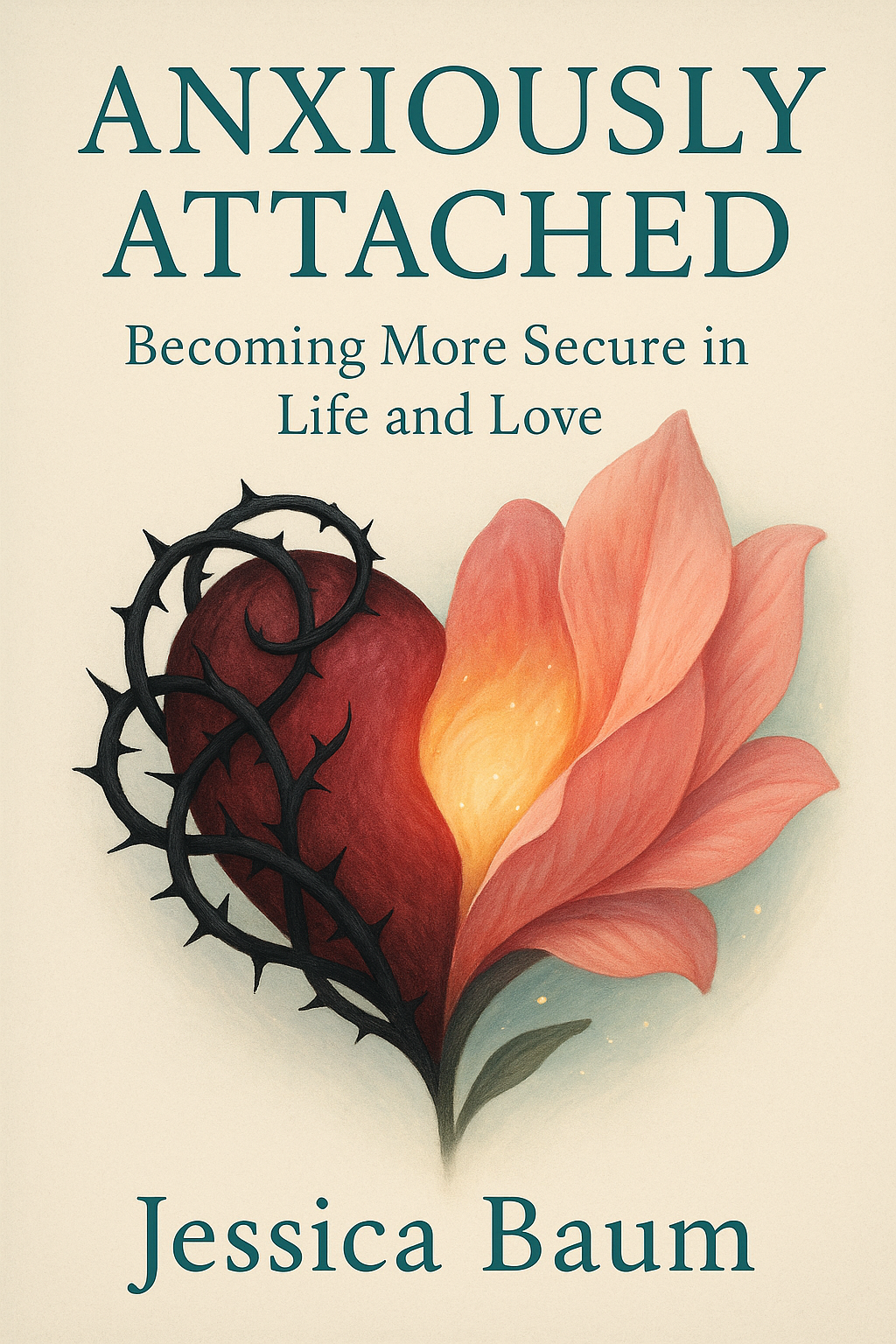
Anxiously Attached: Becoming More Secure in Life and Love
Chapter Summaries
What's Here for You
In 'Anxiously Attached,' Jessica Baum offers a compassionate and insightful guide to understanding and transforming your relationship patterns. This book promises a profound journey of self-discovery, revealing how your earliest bonds shape your adult connections and often lead to the familiar, yet painful, 'anxious-avoidant dance.' Baum unveils the powerful 'Little Me Pact' that governs your emotional landscape, showing how childhood experiences create silent agreements that impact your ability to love and be loved. You'll learn to listen to your inner world, recognizing that true security blossoms from within. The core promise is healing your inner child, transforming from a 'selfless' state of dependency to a 'self-full' one of inner abundance. Discover the beauty of flexible boundaries, not as barriers, but as gateways to mutual respect. Baum debunks the myth of perfect relationships, instead guiding you to nurture yourself and find the transformational power of love, even amidst past wounds. Ultimately, you'll gain the tools to cultivate self-fulfillment, attract supportive relationships, and embrace a new, more secure way of loving and being loved. The tone is one of gentle wisdom, deep empathy, and empowering clarity, inviting you to explore your vulnerabilities with courage and emerge with a richer, more secure sense of self and connection.
The Role of Relationships
The author, Jessica Baum, begins by reminding us that our deep-seated desire for connection is not merely a preference, but a fundamental human imperative, woven into our very biology from the moment of birth. We are, she explains, social creatures hardwired for intimacy, a truth often obscured by societal pressures towards hyperindependence or, conversely, by the desperate clinging born from a fear of abandonment. Baum introduces attachment theory, pioneered by John Bowlby, as a crucial lens through which to understand these relational patterns, detailing how early childhood experiences with caregivers shape our adult attachment styles: anxious, avoidant, and secure. The anxious attachment style, Baum notes, stems from inconsistent caregiving, leading to a persistent fear of abandonment and a tendency to hyperfocus on relationships, often suffocating partners and creating a cycle of seeking reassurance that paradoxically leads to the very rejection feared. Conversely, those with avoidant attachment learned early on to rely solely on themselves due to consistently unmet emotional needs, prizing independence above all else. Securely attached individuals, however, were nurtured with consistent warmth and care, fostering trust and comfort with interdependence. Baum emphasizes that we often embody multiple attachment patterns, activated by our current relationships, and understanding these dynamics is key to self-awareness. She illustrates this with a personal anecdote of her own anxious attachment clashing with her ex-husband's avoidant tendencies, describing the visceral panic and desperate attempts to reconnect that only pushed him further away, a painful cycle rooted in the primal need for safety. This is where the science of the autonomic nervous system, particularly Dr. Stephen Porges' polyvagal theory, offers profound insight; Baum explains that connection is a biological necessity, and our nervous system is constantly scanning for safety, activating different branches—ventral (connection), sympathetic (fight-or-flight), and dorsal (freeze)—based on perceived threats. For those with anxious attachment, a partner's withdrawal can trigger a sympathetic arousal, a hair-trigger response that, while seemingly irrational, makes perfect sense from the perspective of early abandonment fears. The author challenges the pervasive 'fairytale myth' of romance, where partners are expected to be the sole source of safety and love, arguing that true fulfillment arises from first developing intimacy with oneself. She posits that our adult relationships serve as mirrors, reflecting our whole selves and offering a space for acceptance and growth, rather than a solution to internal deficits. Baum recounts the story of her client Nina, who was drawn to emotionally unavailable partners due to suppressed aspects of her own personality, highlighting that attraction to certain partners often reveals unhealed inner wounds. Ultimately, Baum reveals that unhealthy relationships, while painful, are potent teachers, offering signposts for self-healing and spiritual transformation. She encourages readers to embrace their unique attachment needs, to seek supportive connections, and to understand that the journey to secure attachment is an ongoing process of self-discovery, where healing one's own wounds is the most powerful catalyst for transforming relationships and finding a deeper, universal love.
The Secret Language of the Little Me Pact
Jessica Baum, in 'Anxiously Attached,' unveils a profound truth: every intimate bond we forge is underpinned by an emotional pact, a silent agreement echoing the very first ones we made as vulnerable children. As we grow closer, we reveal our inner selves, and the ways we learned to love and be loved in childhood stir to life, whispering the age-old question: Will you still love me if? Baum illustrates that this dynamic of giving and receiving, fundamental to life itself, forms the bedrock of our romantic relationships. Our capacity for mutual exchange, support, and unconditional love is deeply shaped by our earliest experiences and the attachment styles they forge. Secure attachment blossoms when caregivers are attuned and responsive, instilling a deep-seated knowing that we are lovable, a feeling grounded in bodily warmth and balanced nervous systems. However, when caregivers are preoccupied or wounded, their unpredictability can leave a child hypervigilant, suppressing authentic expressions to maintain connection, leading to a constant state of sympathetic arousal and a deep-seated fear of abandonment. This legacy, tucked away in our subconscious, activates with intimacy, bringing forth everything we never learned about connection. Baum introduces the concept of 'Little Me,' the younger part of us holding these stored experiences, feelings, and stories as memories. These embodied memories, both of core wounds and support, powerfully influence our adult behaviors, particularly in relationships, explaining why we may repeatedly make similar mistakes in love, mistaking familiar pain for love. Consider the poignant story of Ben and Hunter: Ben, whose mother praised accomplishments but neglected emotional expression, learned to prioritize doing well and minimize his feelings, developing an avoidant tendency. Hunter, whose mother was inconsistently available due to her own anxiety, became hypervigilant and learned to put her own needs second to earn affection, fostering an anxious attachment. Their friendship, a 'Little Me Pact,' mirrored these patterns: Ben offered independence, Hunter offered constant attention, but eventually, their core wounds created strain and misunderstanding, leading to rupture. These childhood adaptations, born from unmet needs for safety, attention, reflection, and love, become the lens through which we view the world, calcifying into core wounds that dictate our relational patterns. For instance, Carrie, showered with attention for her beauty but dismissed emotionally, developed a core wound of shame and a belief that her worth resided solely in her appearance, leading her to attract partners who focused on her looks but offered no deeper connection, or to panic when partners desired more. Baum emphasizes that healing begins not with finding someone to fix us, but by acknowledging and sitting with our wounded Little Me, guiding us to listen to that inner child and provide the care they never received. This is the work of becoming 'selffull,' which requires identifying our core wounds—the unmet needs from childhood—and understanding how they manifest in our adult relationships through patterns of attraction, communication gaps, and repeated emotional experiences. By charting these patterns, as demonstrated with Carrie's wound of 'I will always get left,' we can recognize how our bodies signal distress—sadness, heart pain, belly tightness—and how we adapt, often by stifling emotions or seeking external validation. The chapter further explores the energetic dance of relationships, positing that our thoughts and feelings, with their electromagnetic charge, magnetically attract situations that align with their energetic imprint, explaining why we repeatedly enter 'Little Me Pacts' that recreate familiar pain. When energy is blocked by unexamined core wounds, it builds, leading to outbursts or emotional issues, and a desperate search for external 'balm' in new relationships, often resulting in codependency where one partner's needs are neglected to appease the other's fear of abandonment or rejection. Baum illustrates this with Susan and Dan, where Susan's fear of abandonment led her to stifle her needs, culminating in an explosive fight. Conversely, a selffull state allows for free-flowing energy, enabling us to meet our own needs and bring vibrant energy into relationships, fostering mutual growth rather than codependency or the perpetuation of painful, unconscious pacts rooted in childhood wounds.
The Anxious-Avoidant Dance and More
Jessica Baum, in "Anxiously Attached," unveils the intricate and often painful dynamic known as the anxious-avoidant dance, a pattern deeply rooted in our earliest experiences of coregulation. She explains that secure attachments are forged in infancy through the attuned responsiveness of a caregiver, a delicate dance of facial expressions, cries, and vocal tones that signals safety and connection. When this foundational dance is disrupted, as it is for those with anxious or avoidant attachment styles, adult relationships become a struggle to truly see and be with each other, leading to either explosive conflict or quiet misery. This chapter illuminates how individuals with these differing blueprints, developed as survival strategies, are often drawn to partners who mirror their childhood experiences, confusing familiarity with what feels right, even as it destabilizes them further. The anxious individual, driven by a primal fear of abandonment, employs 'activating strategies'—reaching out, seeking constant reassurance, and escalating behaviors—like an octopus extending its tentacles in a desperate bid for connection. Conversely, the avoidant individual, whose early needs for emotional attunement were unmet, retreats, employing 'deactivating strategies' such as withdrawal and emotional distance, akin to a turtle pulling its head into its shell for safety. Baum uses the compelling case of Lauren and Peter to illustrate this painful interplay: Lauren's anxious pursuit of connection triggers Peter's avoidant retreat, each reinforcing the other's deepest fears and wounds. This dance, Baum reveals, is not about blame but about understanding the survival mechanisms at play, born from a felt lack of safety. She introduces the concept of 'earned secure attachment,' emphasizing that while early wounds may still leave scar tissue, healing involves recognizing these patterns and choosing different responses. The narrative pivots towards hope, suggesting that through self-compassion and nurturing an 'Inner Nurturer,' individuals can soften their protective behaviors and build inner security. Baum also cautions against the allure of narcissistic partners, who exploit this need for adoration through intermittent reinforcement, leading to a state of 'love addiction' for the anxiously attached. This addiction, fueled by potent neurochemicals in early romance, can trap individuals in a cycle of self-loss, where the pursuit of fleeting connection becomes a form of self-harm. Ultimately, the chapter guides readers toward recognizing that while intense attraction might feel like love, true connection requires safety, trust, and mutual vulnerability, urging a courageous return to the body and self-attunement as the foundation for lasting healing and more secure relationships.
Listen to Your Heart
Jessica Baum, in her chapter 'Listen to Your Heart,' invites us into the profound and often uncharted territory of our inner world, emphasizing that the journey toward becoming 'selffull' requires a foundation of safety, love, and support. She explains that for those with an anxious attachment style, this inner work means cultivating a compassionate self-relationship, guided by the presence of trusted others—therapists, friends, or even the author herself—who form a vital safety net. At the core of this exploration are three integral parts of the self: the wounded 'Little Me,' the vigilant 'Inner Protectors,' and the warm 'Inner Nurturers.' Baum guides us to understand that the 'Little Me,' carrying unmet needs and past pain, will only reveal itself when it feels safe, much like a child who needs acceptance, not criticism. Our 'Inner Protectors,' often a chorus of warning voices or hypervigilant feelings, emerge from a deep-seated fear of further harm, stemming from past hurts and unmet expectations; Baum suggests that gratitude for their protective intent is the first step toward healing, recognizing they stand guard for the vulnerable 'Little Me.' Simultaneously, she introduces the concept of 'Inner Nurturers,' the internalized presence of those who have offered us attention, understanding, and steady care, often felt as a warmth in the chest, a testament to the heart's own intelligence. This heart-brain, a complex network of neurotransmitters and ganglia, communicates vital intuitive guidance, with research indicating it sends significantly more messages to the head-brain than vice versa, shaping our feelings and actions in ways we often don't consciously perceive. Therefore, learning to listen to the heart's messages—balancing logical thought with intuitive knowing—becomes paramount for healing core wounds and achieving emotional wholeness. Baum introduces practical tools like the 'Heart Scan Meditation' and daily 'Heart Awareness' exercises, encouraging us to notice physical sensations, breath quality, and posture to tune into our heart's intelligence, which communicates through the body's language. This practice helps soften the logical mind, revealing an interconnected wisdom and allowing access to the calm, wholesome, and secure self that lies beyond past pain. By befriending our Inner Protectors, acknowledging their protective role, and understanding the pain they shield, we create space for them to soften and eventually shift from guarding against past threats to offering present-moment guidance. This process is deeply intertwined with connecting to our community of Inner Nurturers, internalized figures of love and support who offer coregulation and strengthen our sense of identity. The journey involves acknowledging the fear and vulnerability that arises, pausing when overwhelmed to reground in the present, and leaning on our support systems. Ultimately, Baum emphasizes that by actively engaging these inner allies—Nurturers and Protectors—we rebuild our internal world, preparing a safe haven for the 'Little Me' to heal and find joy, wonder, and intuition, paving the way for true love and connection.
Healing Little Me from the Inside Out
Jessica Baum guides us on a profound journey inward, revealing how the relationship we cultivate with our "Little Me"—the wounded child within—is the bedrock for all our adult connections, especially our intimate ones. The core wounds sustained in childhood, Baum explains, don't just disappear; they instinctively shape the relationships we seek, as the part of us that learned a painful way to love never received the necessary nurturing to mature. Fortunately, we possess Inner Nurturers, wise internal figures capable of soothing our upset Little Me, creating a safe harbor for our deepest feelings, much like an attentive parent offering unconditional support and firm boundaries. Inviting these Inner Nurturers to lead is essential for becoming selffull, a process that can be amplified with professional support, ultimately building an internal healing community that liberates us from external dependence. This internal reparenting allows for coregulation, transforming the search for love from a desperate quest for completion into a joyful process of growth. The first crucial step is cultivating awareness of how we relate to our Little Me, moving beyond societal norms that often encourage emotional bypassing, a learned behavior from caregivers who themselves may not have known how to sit with difficult emotions. Baum emphasizes that true healing lies in bravely holding space for our wounded parts, acknowledging that all feelings, no matter how messy, are vital messengers of our emotional needs. Leaning into these feelings, particularly the discomfort of pain and vulnerability, is where the most profound healing occurs, as trapped old pain colors our entire experience of the world. She likens this to "leaning into your feelings," understanding that all emotions are simply communication, not good or bad, and that validating them from our Inner Nurturers provides the permission to feel and to need. This internal validation is a vital step toward meeting our emotional needs, creating an "Inner Safe Place" where these wounded parts can be heard and tended to. The chapter then introduces a powerful exercise to visualize this Safe Place, inviting Little Me and Inner Nurturers to connect, fostering internal empathy and building trust, even if it takes time for Little Me to feel safe enough to share. The narrative shifts to the concept of "real self-love," which is not mere indulgence but the courageous act of showing up for all parts of ourselves, especially the difficult ones like anger, sadness, and shame. These emotions, often repressed, can manifest as grief and eventually depression if ignored, but by inviting Little Me into the Safe Place to express them, we allow for validation and healing. Baum introduces the powerful practice of "saying what you feel," labeling emotions to create observer space and connect the logical brain to the emotional one, thus "naming it to tame it." This process is crucial for managing the Autonomic Nervous System (ANS) responses that can trigger primal fight-or-flight or freeze reactions rooted in childhood trauma. The chapter offers a "Sanctuary for a Frightened ANS" exercise, focusing on breathwork to signal safety to the brain, creating respite for the nervous system. Ultimately, the work of healing Little Me involves "adopting" these disowned parts, offering them the unconditional love, acceptance, and reparative experiences they missed in childhood. Through a journaling exercise with childhood photos, individuals can connect with these wounded aspects, identify unmet needs, and offer the validation that transforms implicit memories and eases the grip of Inner Protectors. The story of Stacy and her dog Gigi illustrates how external validation, while helpful, is secondary to developing internal resources; when her partner's attempts to soothe her were invalidating, Stacy found solace and healing through her Inner Nurturer, her grandmother, which in turn allowed her to grieve not only Gigi but also past hurts. This process of feeling and being met with what was needed—whether comfort, safety, or acceptance—restores balance, releasing stagnant pain and fostering the capacity to give and receive love. By strengthening internal resources and adopting disowned parts, we cultivate a deep sense of inherent worth, understanding that we are perfectly imperfect and worthy of love exactly as we are, a foundation for lasting, secure relationships and a truly selffull life.
From Selfless to Self-Full
Jessica Baum, in "From Selfless to Self-Full," invites us to explore the profound shift from an anxious, externally-dependent state to one of inner abundance and security. She explains that the tendency toward selflessness, often rooted in early life experiences of unmet needs and perceived disapproval, leads to a deep-seated belief that our worth must be earned through constant giving and self-neglect. This pattern, woven tightly with anxious attachment, stems from an "inner abandonment" where our own needs were internalized as unimportant, creating a "rescue fantasy"—a deeply ingrained cultural narrative of a perfect savior who will finally see and meet our unmet desires. Baum distinguishes this damaging selflessness from a healthy "self-fullness," where one possesses robust inner resources to meet their own needs and offer support to others from a place of abundance, not depletion. She contrasts the selfless state, characterized by hyper-vigilance to others' emotions and a loss of self, with the "selfish" state, born from the same fear but manifesting as an intense focus on one's own needs, often with rigid boundaries. The ultimate aim, Baum reveals, is the "self-full" state, where individuals possess a stable sense of self-worth, can meet their own needs or ask for them to be met, and engage in relationships with interdependence and trust, drawing on a community of "Inner Nurturers." This journey involves confronting the "rescue fantasy" and "idealizing" new partners as saviors, a pattern that often leads to love hunger and enmeshment, particularly when encountering avoidant tendencies. The chapter offers a "Selffull Meditation" as a practical guide, encouraging readers to listen to their bodies, connect with their "Inner Nurturers," and cultivate a sense of inherent worth and support, ultimately transforming the anxious attachment system into a secure one by providing the essential emotional nourishment that was missing in childhood. This process, Baum emphasizes, is not about achieving an effortless, perfect state, but about the courageous, often messy work of turning inward, embracing all parts of oneself, and building a foundation of self-compassion and inner resilience, transforming the exhausting chase for external validation into a profound, unshakable connection with oneself.
The Beauty of Boundaries
Jessica Baum, in 'The Beauty of Boundaries,' illuminates a vital aspect of healing: the cultivation of healthy boundaries, not as rigid walls or open doors, but as flexible gateways that foster mutual respect and acknowledge the validity of each person's needs. For those with an anxious attachment, this is often a new landscape, born from childhood experiences where sensitivity to others' needs overshadowed their own, a pattern often stemming from caregivers who themselves needed care. Baum emphasizes that establishing these boundaries is not about shutting down love or issuing ultimatums, but about deepening self-fulfillment to reduce the fear of loss, thereby enabling a balance between personal needs and those of a partner. The core truth is that a distinct 'me' is the prerequisite for a healthy 'we,' and this 'me' flourishes in relationships with others who have their own robust 'me.' This chapter delves into the development of both inner and outer boundaries, explaining that inner boundaries are forged when our emotions are accurately reflected and validated in early childhood, creating a foundation of self-trust. Conversely, when emotions are disavowed or caregivers are emotionally unavailable, a pattern emerges where individuals may give themselves away to maintain connection, leading to a profound lack of healthy boundaries. Baum introduces the concept of coregulation, where flexible boundaries enhance relational safety, and highlights how the internalization of caregivers shapes our adult relational patterns, with secure early dependence fostering healthy interdependence. The narrative then pivots to address the often-misunderstood emotion of anger, revealing it as a crucial messenger signaling unmet needs or crossed boundaries, rooted in pain and fear, particularly the primal fear of abandonment. Baum guides readers to understand anger not as aggression, but as a vital signal for connection and self-advocacy, urging a move from suppressing emotions to integrating them. The story of Sasha exemplifies this, showcasing how a client learned to harness her anger to set boundaries with her mother, transforming her relationships by prioritizing her own needs and finding freedom in expressing her truth. This journey from fear to self-fulfillment is also framed as a transition from independence to interdependence, where a secure sense of self allows for deeper, more resilient connection, contrasting with codependency. The chapter offers a practical framework for establishing boundaries, beginning with 'pressing pause' on immediate responses, dialoguing with one's inner world, discerning a 'sovereign yes' or 'no,' and then clearly communicating it, all while tending to the 'Little Me' parts that fear rejection. Baum uses the metaphor of a well-maintained home with a gate to illustrate the ideal of flexible boundaries, allowing for discernment and controlled connection, rather than the chaotic enmeshment or isolating walls that often characterize anxious attachment. Finally, the chapter underscores the importance of knowing one's nonnegotiables—fundamental values and deal-breakers—and, when necessary, the ultimate boundary of letting go, as exemplified by Rebecca's courageous decision to leave a relationship that no longer aligned with her core desires, thereby creating space for truly fulfilling attachments. The overarching message is one of empowerment: by becoming 'self-full,' individuals can navigate relationships with both support and freedom, ultimately fostering deeper intimacy and lasting connection.
A New Way to Love and Be Loved
The author, Jessica Baum, reveals that perfect relationships are a myth, for no human is perfect; instead, our connections often become the very spaces where our deepest childhood wounds are awakened. Yet, through the practice of self-nurturing, by cultivating inner voices that echo past support, we can mend these core wounds and rewire our brains for security. Baum emphasizes that this internal shift soothes the autonomic nervous system, slowing reactions and allowing for greater capacity to connect with our own needs while balancing those of a partner, fostering empathy and transforming intimate connections into arenas for healing and growth rather than mere anxiety soothers. This ongoing work means our current and future relationships become practice grounds for relating differently, ultimately leading to a profound impact on how we show up and the partners we attract, naturally aligning us with those who value us, and lessening the unconscious draw to unavailable individuals. Baum cautions that as one partner thrives, it might disrupt the other, particularly if they've adapted to pain through avoidance, yet this greater availability for intimacy can sometimes inspire healing in a partner, or, if wounds run too deep, signal an end. Conflict, she explains, is inevitable and, when approached as an opportunity for growth, can deepen awareness and strengthen connections, especially when we pause to communicate needs constructively rather than reacting with anger. As healing deepens, we become more attuned to our own tender spots and those of our partners, taking ownership of our pain rather than projecting it outwards. The narrative then delves into the post-honeymoon phase, a critical period where the initial dopamine rush fades, revealing partners in their entirety and often activating old childhood dances of anxiety and avoidance, which can feel like a power struggle. Baum highlights that this challenging phase is normal and a vital part of defining boundaries, yet it holds the potential for deeper connection if compatibility exists and partners are willing to communicate and compromise, moving beyond the illusion of a perfect lover to build something lasting. She stresses that escaping to find a new honeymoon phase means forfeting exponential personal growth, particularly for the anxiously attached who may spiral into old patterns when ruptures occur, feeling betrayed by the perceived loss of attunement. However, by turning to supportive people and revisiting inner work, we can see that partners often step on 'land mines' within us unknowingly, and that repair, much like in the well-attached mother-infant dyad, is paramount, teaching our nervous system that distress can be met and needs can eventually be fulfilled. This stability is built on mutual respect, transparency, vulnerability, humility, and the capacity to listen deeply, fostering empathy for differing needs and histories, and shifting the dynamic from 'Me versus You' to 'Team Us.' Baum acknowledges the deeply ingrained protective mechanisms—avoidance, anger, blame—that guard our wounded inner child, noting they yield to safety and healing over time, though progress is rarely linear, involving much back-and-forth. She explains that these ingrained patterns, formed in infancy and recorded in our autonomic nervous system, dictate automatic responses to perceived threats, often leading us to construct narratives of blame that prevent us from receiving what we truly need. The key, she proposes, lies in slowing down, staying connected to both partners' experiences, and accessing the broader perspective that calm affords, gradually building the neural pathways for this through practices like inner nurturing and contextualizing partner behaviors. Visualizing a partner's core wounds can transform accusatory tones into empathy, recognizing that behind defensiveness often lies a child's pain, thus allowing for gentle words that foster safety and deeper connection. Baum then explores the 'octopus' (anxious) and 'turtle' (avoidant) patterns of response during heightened distress, where the anxious partner reaches out frantically and the avoidant partner shuts down, both driven by deep-seated fears. She posits that these moments of meltdown, far from being endings, are the greatest growth opportunities, containing all the elements—scared inner children, a desire to connect, re-trainable brains, and the potential for transformation—needed to stretch our 'love muscles' and build a sanctuary. Through exercises like 'Team Building for Team Us,' where partners practice mirroring and validation, they learn to see each other's truths, not as right or wrong, but as different perspectives, fostering resonance and empathy. The ultimate goal is to see each other as whole beings, embracing imperfections, and cultivating 'Team Us' by focusing on appreciation, practicing non-blaming communication with 'I' statements, and validating each other's experiences, thereby healing old wounds of not being seen or heard and transforming the relationship into a source of interdependence. The chapter concludes with a meditation, 'Bring Your Partner into Your Heart Space,' guiding individuals to visualize their partner with gratitude and acceptance, recognizing their whole selves—both strengths and vulnerabilities—to foster a sustainable, deeply intimate connection built on mutual acceptance and the understanding that perfection is not the goal, but rather a shared journey of healing and growth, where conflict becomes an opportunity for ever-deepening intimacy.
The Mysterious Transformational Power of Love
As we draw near the close of this profound journey, Jessica Baum illuminates the deep, inherent capacity within each of us to heal our attachment patterns, cultivate self-fulfillment, and attract supportive relationships, emphasizing that our reactions stem from factors often beyond our control, fostering compassion for ourselves and others. Baum reveals that while our attachment styles are embedded in our bodies, transformation is not only possible but actively underway as we practice tending to our inner selves and inviting emotionally present people into our lives, building a felt sense of safety and trust—the very foundation of the inner security we all crave. She introduces the concept of the 'cosmic partner,' a cohealer in a relationship built on interdependency, a spiritual and human agreement where both individuals learn and grow together, understanding that ruptures, rather than being failures, are crucial opportunities for deepening intimacy. This profound connection, Baum suggests, often emerges most readily when we release the frantic search for 'the one,' focus on quality friendships, and trust the universe, allowing supportive relationships to naturally draw us closer. The author highlights that the constant seeking for completion can keep the anxious system activated, mirroring childhood conditions, whereas engaging with safe people allows our systems to relax and recognize the support already present. She reassures that desiring romantic partnership is natural and that building a secure life with others prepares us for such a connection, framing current relationship conflicts as opportunities for conscious understanding and deeper connection. Drawing on both spiritual intuition and relational neuroscience, Baum posits that we are primed for healing and security in the presence of warm connections, which build our 'community of Inner Nurturers.' She illustrates this with her own journey, where repeated experiences of rupture and repair in her current marriage transformed her fear of conflict into a safe space for expressing needs and truth, moving from a narrative of relationships being dangerous to one of having a dancing partner for growth. The essence of this transformation lies in developing intimacy with oneself—'intomesee'—which then allows for a deeper joining with another vulnerable soul, creating a safe harbor for each other's wounded parts, a process that took her years to trust, not in her partner, but in the unfolding of healthy connection. Baum cautions against idealizing a perfect relationship, asserting that thriving partnerships are those that challenge us and require growth, reminding us that we are shifting from a feeling of lack to one of inherent connection, realizing everyone is navigating their own journey. She invites us to see our supportive relationships as a constellation, interconnected and shining bright, guided by an inner wisdom and a trust in the universe, which can manifest as synchronicity—those delightful moments when events conspire to show us we are on the right path. This shift from seeking to being love transforms the search into a flowing river of vitality, an invitation for others to join us as we understand love as an abundant energy. Noelle's story exemplifies this, moving from depression and day-drinking after a difficult breakup to embracing trust in the universe and community, realizing her sadness stemmed from the loss of a dream, not her ex. By healing her inner world and reconnecting with her supportive friendships, she grieved her old fantasies and discovered that true happiness came from within, eventually leading to a fulfilling, interdependent relationship. Baum emphasizes that we are far more than our relationship status, and becoming self-full means inviting love in through all nurturing relationships, dropping the pressure to achieve societal milestones by a certain age, and understanding that there is no single template for life or love. She expands this transformational power to include nature, explaining the healing benefits of forest bathing and connecting with the natural world, reminding us that we are cosmically designed for interdependence and that nature itself is a constant source of support, a powerful reminder that we are part of something larger. Baum concludes by affirming that while anxious attachment may always bring a heightened sensitivity to anxiety, it also gifts us with sensitivity, empathy, and an openness to change, making us ideal partners for healing and interdependency, moving beyond the Western ideal of rugged independence to embrace the biological imperative of connection. Ultimately, she encourages us to view this journey as a spiritual unfolding, trusting the love within ourselves and recognizing our inherent worthiness for nurturing and supportive relationships, allowing healing to dissolve layers of pain and open us to a new way of loving and being loved.
Conclusion
Anxiously Attached: Becoming More Secure in Life and Love, by Jessica Baum, offers a profound and compassionate guide to understanding and transforming insecure attachment patterns, particularly anxious attachment. The book masterfully synthesizes attachment theory and polyvagal theory, revealing how our earliest relational experiences create deeply ingrained "Little Me Pacts" and core wounds that unconsciously shape our adult relationships. Baum highlights the autonomic nervous system's role in our fight-or-flight responses to perceived relational threats, explaining how anxious individuals often operate from primal survival instincts rather than conscious choice. A central theme is the dismantling of the societal "fairytale myth" of romance, which places the burden of safety and happiness on a partner, and the vital importance of cultivating "self-intimacy" and "self-fullness." The book argues that rather than seeking external validation or relying on partners for emotional regulation, the path to healing lies in internal reparenting and self-compassion. Emotionally, the book validates the deep pain and fear associated with anxious attachment, acknowledging the hypervigilance and fear of abandonment that often drive these patterns. It offers a gentle invitation to confront and embrace the "Little Me," the wounded younger self, recognizing that these unhealed wounds act as magnets, attracting familiar but painful relational dynamics. The journey described is one of immense courage, requiring individuals to acknowledge their "Inner Protectors" and "Inner Nurturers," and to consciously choose vulnerability and self-acceptance over familiar but destructive patterns. The emotional lesson is one of profound self-compassion, recognizing that our protective mechanisms, though flawed, are rooted in a desire to shield past pain. Practically, Baum provides a roadmap for rewiring the nervous system and fostering "earned secure attachment." This involves developing new experiences of safety and soothing through techniques like breathwork, sensory awareness, and tuning into the heart's intelligence. The concept of "Inner Nurturers"—internalized figures of love and support—is presented as a powerful tool for building inner security and coregulation, allowing individuals to meet their own emotional needs. The book emphasizes the importance of healthy boundaries, not as rigid walls but as flexible gateways, and the courageous act of identifying nonnegotiables and practicing the "press pause" strategy when navigating requests. Ultimately, Baum guides readers to understand that relationship ruptures are not failures but opportunities for growth and repair, and that true intimacy is built on a foundation of safety, trust, and interdependence. By shifting from "selfless" tendencies to "self-fullness," and by embracing all parts of oneself, readers are empowered to attract supportive relationships and live a life of authentic connection and abundance.
Key Takeaways
Our innate biological drive for connection shapes our relational patterns, with attachment theory explaining how early caregiver interactions form adult attachment styles (anxious, avoidant, secure), influencing our capacity for intimacy and trust.
Anxious attachment, characterized by a fear of abandonment and hypervigilance in relationships, often stems from inconsistent early caregiving, leading to behaviors that paradoxically push partners away and perpetuate a cycle of seeking external validation.
The autonomic nervous system, as described by polyvagal theory, dictates our responses to perceived threats in relationships, with anxious individuals often entering fight-or-flight states when feeling disconnected, driven by primal survival instincts rather than conscious choice.
The societal 'fairytale myth' of romance, which places the burden of safety and happiness on a partner, obscures the essential truth that self-intimacy and self-acceptance are the foundational prerequisites for healthy, interdependent adult relationships.
Attraction to certain relational dynamics, particularly those that trigger anxiety, often serves as an unconscious invitation to address and heal core wounds rooted in childhood experiences, making relationships powerful catalysts for personal growth.
Transforming insecure attachment patterns involves rewiring the nervous system through new experiences of safety and soothing, fostering self-compassion, and developing the ability to consciously respond rather than react to relational challenges.
Intimate relationships are built upon unconscious 'Little Me Pacts' that echo early childhood emotional agreements, shaping adult relational patterns.
Core wounds stemming from unmet childhood emotional needs create deeply ingrained patterns and beliefs that unconsciously attract similar painful relationship dynamics.
Recognizing and validating the 'Little Me'—the wounded younger self—is essential for healing and breaking the cycle of repeated relationship mistakes.
The energy of unhealed core wounds acts as a magnet, attracting situations and partners that confirm these ingrained beliefs, often leading to codependency or repeated abandonment.
Becoming 'selffull' involves acknowledging one's own core wounds and needs, and actively working to meet them, rather than relying on a partner for emotional regulation and nourishment.
Understanding the 'energetic imprint' of our thoughts and feelings, particularly those tied to core wounds, is crucial for transforming destructive relational patterns.
The anxious-avoidant dynamic in relationships stems from a learned inability to coregulate, originating in childhood caregiver interactions, leading to a cyclical pattern of pursuit and withdrawal in adult partnerships.
Individuals often unconsciously seek out relationship patterns that confirm their subconscious beliefs about love, mistaking familiar but unhealthy dynamics for what feels right.
Anxiously attached individuals employ 'activating strategies' driven by fear of abandonment, while avoidantly attached individuals use 'deactivating strategies' to protect themselves from overwhelming emotional pain, creating a destructive cycle.
Healing from attachment wounds involves developing 'earned secure attachment' through conscious effort, self-compassion, and nurturing an 'Inner Nurturer' to build inner security, rather than relying on external validation.
Intense romantic attraction, particularly in relationships with narcissistic or highly avoidant partners, can be a neurochemical high akin to addiction, masking underlying wounds rather than fulfilling genuine needs for secure connection.
True intimacy and lasting connection are built on a foundation of safety and trust, which allows for autonomy and growth, a stark contrast to the chaotic intensity often mistaken for love.
Becoming 'selffull' requires cultivating an internal environment of safety and support, acknowledging that the 'Little Me' will only reveal its unmet needs when feeling accepted, not criticized.
Inner Protectors, though often critical, are motivated by a genuine desire to shield the 'Little Me' from past pain and fear, and befriending them is key to accessing the vulnerability they guard.
The heart possesses its own intelligence, a vital source of intuitive guidance that communicates through sensations and emotions, and learning to listen to it balances our logical understanding with deeper knowing.
Healing core wounds involves acknowledging their present pain and allowing oneself to feel it fully, making space for reparative experiences through the warmth of care, whether internal or external.
Cultivating a community of Inner Nurturers—internalized figures of love and support—provides essential coregulation and strengthens our sense of identity, enabling us to navigate difficult emotions.
The practice of tuning into the heart through sensory awareness, breath, and posture can help regulate the nervous system and foster a sense of connection and wholeness.
By acknowledging and integrating both Inner Protectors and Inner Nurturers, we build new neural pathways, creating a balanced inner world where the wounded 'Little Me' can finally feel safe and begin to heal.
The core wounds of our "Little Me" instinctively shape our adult relationships, necessitating internal reparenting through Inner Nurturers to foster secure connections.
Emotional bypassing, a learned societal and familial response, hinders healing by preventing us from holding space for all feelings; embracing them as vital messengers is key.
True self-love involves courageously confronting and accepting all aspects of oneself, including difficult emotions, rather than seeking external validation for worth.
Managing the Autonomic Nervous System's primal responses to perceived threats requires conscious techniques like breathwork to create internal safety and allow for emotional processing.
Adopting disowned parts of ourselves, especially those wounded by unmet childhood needs, through validation and reparative experiences, transforms implicit trauma memories and reduces the reliance on protective mechanisms.
Developing a robust internal community of "Inner Nurturers" provides a secure base, enabling us to meet our own emotional needs and navigate life's challenges with greater resilience and self-compassion.
The pervasive tendency toward selflessness in anxious attachment stems from early life experiences where expressing personal needs led to perceived disapproval, creating a belief that love must be earned through self-neglect.
The 'rescue fantasy,' a deeply ingrained cultural narrative, fuels anxious attachment by projecting the unmet need for consistent, unconditional love onto potential partners, leading to idealization and disappointment.
Moving from selflessness to 'self-fullness' involves cultivating internal resources and a stable sense of self-worth, enabling one to meet their own needs and offer support to others from a place of abundance, not depletion.
The 'selfish' state, while seemingly opposite to selflessness, arises from the same core fear of abandonment and unmet needs, manifesting as an overemphasis on personal demands and a resistance to vulnerability.
The 'Selffull Meditation' and connecting with 'Inner Nurturers' offer a tangible pathway to heal childhood wounds by providing the consistent, loving attention that was absent, thereby rewiring attachment expectations towards security.
Embracing all parts of oneself, including painful emotions and past traumas, is essential for developing self-compassion and resilience, transforming the belief in external validation into an unshakable inner foundation.
Healthy boundaries are not rigid walls but flexible gateways that grow from mutual respect, acknowledging that each person's needs matter, a crucial shift for those with anxious attachment patterns.
The ability to establish clear inner boundaries, rooted in having one's emotions validated in childhood, is the foundation for setting effective outer boundaries in adult relationships.
Anger, often misunderstood, serves as a vital messenger signaling pain, fear, and crossed boundaries, and its healthy expression is essential for self-advocacy and relational integrity.
Interdependence, characterized by a secure sense of self, allows for deeper connection than independence or codependency, fostering resilience and mutual growth within relationships.
Navigating requests requires a 'press pause' strategy, inner dialogue with one's 'Little Me,' and clear communication of a 'sovereign yes' or 'no' to maintain self-respect and relational honesty.
Identifying nonnegotiables is paramount for self-preservation and the pursuit of fulfilling relationships, with the courage to let go being the ultimate boundary when core needs are unmet.
The process of grieving and letting go, supported by inner and outer resources, is a necessary step in healing and opening oneself to healthier, more secure future connections.
Embrace relationship ruptures as opportunities for growth by practicing repair through active listening and validation, transforming conflict into connection.
Cultivate inner security by developing a strong relationship with your 'Inner Nurturers' to heal childhood wounds, which rewires neural circuits for greater safety in adult relationships.
Shift from 'Me versus You' to 'Team Us' by understanding that both partners' perspectives are valid, fostering empathy and collaborative problem-solving rather than adversarial arguments.
Recognize and compassionately observe your own and your partner's protective patterns (e.g., anger, withdrawal) as signals of underlying fear and old wounds, rather than personal attacks.
Move beyond the 'honeymoon phase' illusion by actively choosing vulnerability, compromise, and honest communication to build deep, sustainable intimacy based on whole-person acceptance.
Develop the capacity to hold your own center during distress by accessing inner support and practicing self-nurturing, enabling you to respond to relationship challenges with calm curiosity rather than reactivity.
Healing anxious attachment involves cultivating self-fulfillment and trusting the universe, which naturally draws supportive relationships rather than frantic searching.
Relationship ruptures are not failures but essential opportunities for deepening intimacy and growth, especially when approached with conscious awareness and repair.
Interdependency, not independence, is the natural human state; embracing connection with oneself, others, and nature fosters security and well-being.
Societal timelines for relationships and life milestones create pressure; embracing an individual path with compassion and self-acceptance is key to freedom.
The transformational power of love extends beyond human connection to include the natural world, offering a profound source of regulation and support.
Anxious attachment, while bringing sensitivity to anxiety, also offers gifts of empathy, openness to change, and a capacity for deep connection, making one an ideal partner for healing.
True love is an abundant energy that flows from within and is reflected in all supportive relationships, transforming the search into an experience of being love.
Action Plan
Reflect on your earliest relationship experiences with caregivers to identify potential origins of your current attachment patterns.
Observe your immediate physical and emotional reactions when a partner withdraws or seems distant, noting them as signals from your nervous system.
Challenge the 'fairytale myth' by identifying instances where you've outsourced your sense of safety or happiness to a partner.
Practice self-compassion by acknowledging that your relational patterns, while perhaps painful, were adaptive responses to past circumstances.
Identify supportive individuals in your life (friends, therapist) who can offer nonjudgmental external support during your inner work.
Begin to practice setting small, healthy boundaries in current relationships, starting with clearly communicating your own needs.
Engage in activities that foster self-intimacy and self-acceptance, such as journaling, mindfulness, or pursuing personal interests independently.
Identify the recurring patterns and common characteristics of past romantic partners to uncover potential 'Little Me Pacts'.
Reflect on early childhood experiences to pinpoint unmet emotional needs that may have led to core wounds.
Acknowledge and validate the feelings and experiences of your 'Little Me,' offering yourself the compassion and attention you may not have received as a child.
Chart your core wounds, the beliefs they generated, and how they continue to manifest in current relationships.
Practice sitting with and listening to your wounded 'Little Me' rather than immediately seeking external validation or solutions.
Begin to consciously tend to your own unmet needs, fostering 'selffullness' and reducing reliance on partners for emotional nourishment.
Notice the energetic 'charge' of your thoughts and feelings, and how it might be attracting specific relational dynamics.
Identify and name your own 'activating strategies' (e.g., constant texting, seeking reassurance) when you feel fear of abandonment, understanding they are survival responses.
Recognize the 'deactivating strategies' (e.g., withdrawal, busyness) in a partner, understanding they often stem from a fear of overwhelming emotional pain, not a lack of care.
Practice self-compassion by acknowledging that these patterns are rooted in early survival needs, not personal failings.
Begin cultivating 'earned secure attachment' by nurturing your 'Inner Nurturer' and focusing on building inner security independent of a partner's actions.
Gently begin reconnecting with your body and its sensations as a way to process emotions and develop embodied awareness, rather than disassociating.
Observe the neurochemical 'high' of early romance and differentiate it from the sustainable safety and trust required for genuine, lasting connection.
When faced with intense attraction to unavailable partners, pause and assess whether the 'chemistry' is a sign of deep connection or an activation of old wounds.
Explore the possibility of couples therapy if both partners are willing to work on their core wounds and learn to coregulate together.
Practice placing your hand on your chest and asking yourself, 'How am I feeling right now?' allowing your heart to answer without analysis.
Experiment with extending your breaths, breathing in for a count of five and out for seven, imagining the breath filling your belly, to observe changes in your emotional state.
Perform the 'Heart Scan Meditation,' focusing on sensory experiences in your heart center and observing any emotions, images, or memories that arise without judgment.
Identify and acknowledge your 'Inner Protectors' by listening for 'should' and 'shouldn't' messages, thanking them for their protective intent and recognizing the pain they shield.
Consciously recall and visualize individuals or places that represent 'Inner Nurturers,' allowing their warmth, compassion, and acceptance to flow into you.
When an 'Inner Protector' voice arises, acknowledge it and then gently turn to your 'Inner Nurturer' for reassurance and support, creating dialogue between these inner parts.
If feeling overwhelmed during inner work, pause, ground yourself in the present by focusing on your immediate environment, breath, and physical sensations, and seek external support if needed.
Set an intention for your inner work, such as 'I am learning safe new ways to experience my inner world,' to focus your energy and commitment.
Identify and invite your Inner Nurturers to sit with your wounded Little Me parts, offering them validation and a safe space to express their feelings.
Practice emotional awareness by noticing and naming your feelings throughout the day, using phrases like "I feel fearful" or "I feel let down."
Engage in the "Inner Safe Place" visualization exercise to create a sanctuary where your Inner Nurturers can tend to your Little Me.
Use deep breathing techniques, such as extending exhales, to calm your Autonomic Nervous System (ANS) when feeling activated or frightened.
Gather childhood photos and journal about the feelings, memories, and unmet needs that arise, then offer your Little Me the validation and acceptance they needed.
Commit to "leaning into" uncomfortable feelings rather than bypassing them, recognizing them as essential messengers of your emotional needs.
Regularly check in with your Little Me parts, offering them reassurance of your presence and love: "You are not alone" and "You are enough."
Identify and journal about early life experiences where expressing needs felt unsafe or led to disapproval.
Practice the "Selffull Meditation" regularly to connect with Inner Nurturers and cultivate self-compassion.
Gently scan your body for areas of tension and offer them breath and attention, listening for their stories.
When you notice the impulse to idealize a new partner, pause and acknowledge the underlying 'rescue fantasy' at play.
Begin to practice small acts of self-care that honor your own needs, even when it feels uncomfortable or unfamiliar.
Engage with a trusted friend or therapist to explore your 'Little Me' parts and receive validation for your experiences.
Set an intention to practice "I am supported" daily, reinforcing inner and outer resources.
Practice pressing pause before responding to requests, using phrases like 'I need to get back to you.'
Engage in inner dialogue with your 'Little Me' parts to discern your true needs and wants before agreeing to something.
Identify and acknowledge your bodily sensations (e.g., softening belly, expanding heart) when trying on 'yes' or 'no' responses to gauge your authentic feelings.
Communicate your boundaries clearly and calmly with your partner or others, without excessive explanation or apology.
Identify your relationship nonnegotiables by creating lists of 'No Way,' 'Maybe,' and 'Yes' categories for various aspects of a partnership.
When a hard boundary is crossed and a relationship is no longer serving your core needs, practice the ultimate boundary of letting go, seeking support to grieve the loss.
Visualize your energy system as a home with a gate, practicing discernment about who and what you allow into your personal space.
Practice self-nurturing by consciously connecting with your 'Inner Nurturers' when anxiety arises, recalling supportive voices from your past.
When conflict emerges, intentionally pause before reacting, and use 'I' statements to express your feelings and needs without blame (e.g., 'I feel afraid when...').
Engage in active listening with your partner: repeat back what you hear them say to ensure understanding and then validate their experience ('It makes sense you felt that way because...').
Before a conflict escalates, practice identifying your own protective patterns (e.g., wanting to lash out, withdraw) and acknowledge them as signals of underlying fear or old wounds.
Schedule dedicated time for open, non-blaming conversations with your partner about your individual patterns of reacting to pain and fear.
Utilize the 'Bring Your Partner into Your Heart Space' meditation to cultivate gratitude and acceptance for your partner as a whole person, imperfections included.
When a rupture occurs, consciously shift your focus from 'Me versus You' to 'Team Us,' reminding yourself you are on the same team working towards mutual understanding.
Practice tending to your 'Little Me' by acknowledging and comforting its feelings, especially when anxious attachment patterns are activated.
Focus on cultivating quality friendships and supportive relationships, trusting that this widens your capacity to attract a fulfilling romantic partner.
Engage in moments of mindful connection with nature—forest bathing, walking barefoot on grass, or simply observing the natural world—to calm your nervous system.
Reframe relationship ruptures not as failures, but as opportunities to practice conscious communication, repair, and deepen understanding with your partner or loved ones.
Identify and nurture your 'Inner Nurturer community,' leaning on past positive connections and present supportive people to build a sense of belonging.
Challenge societal timelines for life and relationships; embrace your individual path and focus on your own wants and needs as they arise.
Practice self-compassion by accepting your current attachment patterns while actively engaging in healing work and forming secure connections.
When feeling anxious, intentionally shift focus from seeking external validation to recognizing the love and support already present within and around you.