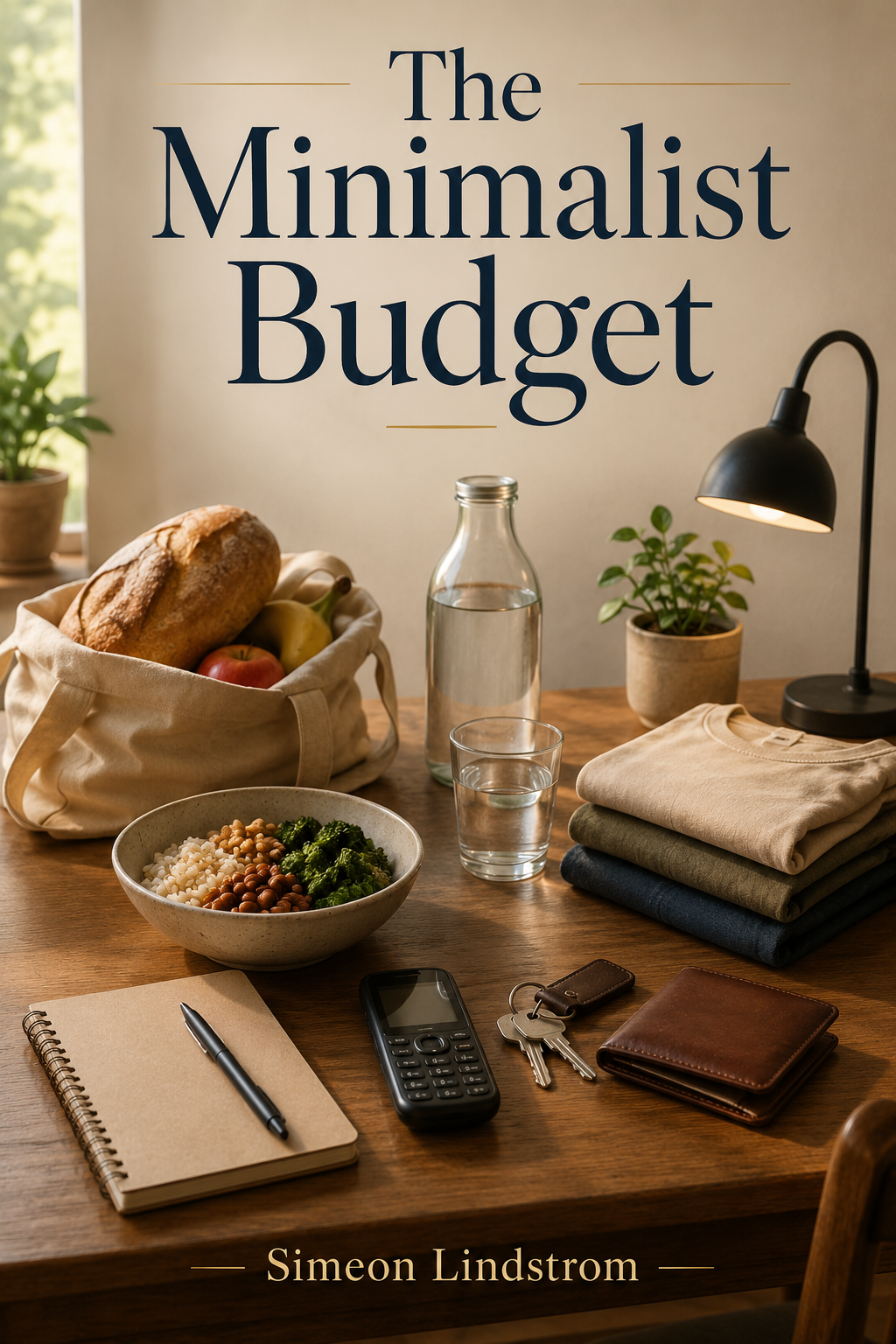
The Minimalist Budget
Chapter Summaries
What's Here for You
Ready to break free from the endless cycle of spending and regret? 'The Minimalist Budget' isn't just another budgeting guide; it's a pathway to reclaiming your time, aligning your finances with your deepest values, and ultimately, living a more fulfilling life. Simeon Lindstrom gently guides you through a transformative process, revealing how to make mindful purchasing decisions, cut unnecessary expenses without feeling deprived, and set achievable goals that stick. Prepare to challenge conventional wisdom, confront societal pressures surrounding wealth, and navigate the complexities of money within relationships. This book offers practical tools and a compassionate perspective, empowering you to create a personalized budget that prioritizes well-being and unlocks true financial freedom. Get ready to embark on a journey of self-discovery, where less becomes more, and your budget becomes a reflection of your most authentic self.
THE PURCHASE
Simeon Lindstrom illuminates the pivotal moment of purchase, a crossroads where mindful intention clashes with the pervasive power of advertising. He observes how easily individuals succumb to impulse, often regretting purchases upon later reflection, a testament to the 'mindlessness' cultivated by the shopping experience. To counter this, Lindstrom advocates for establishing firm principles before entering the retail environment, creating a filter against persuasive marketing. He emphasizes the importance of emotional awareness, cautioning against shopping when tired, sad, or bored, as advertising preys on vulnerabilities, whispering that a new acquisition will solve deeper problems. Lindstrom urges a proactive approach to gathering information, becoming a 'modern-day hunter-gatherer' seeking the best options rather than settling for the readily available. He champions the power of planning, advising shoppers to visualize their needs and resist spontaneous decisions that cloud clarity. The author highlights the deceptive allure of in-store displays, urging buyers to envision items in their everyday context, grounding their expectations. Lindstrom stresses the importance of assessing quality and longevity, encouraging consumers to look beyond immediate gratification and consider the long-term value and maintenance of their purchases. He simplifies decision-making by not sweating the small stuff, like generic potatoes, so one can focus on more specific needs, and challenges the notion of thriftiness by advocating for valuing one's time; pre-cut vegetables might cost more, but the time saved could be more valuable. Lindstrom encourages relative thinking, framing purchases in terms of opportunity costs, like hours worked or other forgone goods, to gain perspective. Finally, he implores readers to resist the urge to compare themselves to others, recognizing that much of consumerism is driven by social pressure and insecurity and to reject the negativity inherent in advertising's message that one's life is inadequate without their product.
MAKING YOUR BUDGET, PART ONE: FINDING THE CORE
Simeon Lindstrom invites us to rethink budgeting, positioning it not merely as a financial exercise, but as a mindful alignment of our resources with our values, suggesting that a truly minimalist budget begins not with money, but with time, the most finite and precious resource. Lindstrom draws inspiration from Oscar Wilde, who believed in spending one's last penny on a lily, underscoring the importance of nourishing the soul alongside basic needs. The author emphasizes that while money is often the primary focus, time and value are routinely overlooked, time being unlike money, which can be earned or borrowed, time marches on, irretrievable and finite. Lindstrom urges us to start by auditing our 24 hours, blocking out time for essentials like sleep, meals, and exercise, but also for unwinding and relaxation, acknowledging that no time is truly 'dead'. It's a stark realization that much of our time is frittered away on things we don't ultimately value, a misalignment that leads to a sense of being constantly busy yet unfulfilled. He introduces the concept of opportunity cost, revealing how seemingly innocuous time-wasters displace activities that truly enrich our lives, urging us to deliberately question whether our time is spent in the best way. Then, Lindstrom shifts focus to value, noting that money is merely a symbol, a stand-in for something more fundamental: our perception of worth, illustrating how the market value of an item may not align with its actual value in our lived experience. Like a merchant weighing spices, we must discern what truly adds to our well-being, our sense of purpose, for time passed well is the very essence of value. Ultimately, Lindstrom advocates for building our lives around our passions and values, rather than treating them as afterthoughts, because a budget that ignores our emotional and spiritual needs is destined to leave us empty, like a finely crafted ship without a destination.
MAKING YOUR BUDGET, PART TWO: CUTTING
In this chapter of *The Minimalist Budget*, Simeon Lindstrom guides us through the crucial act of cutting unnecessary expenses, framing it not as deprivation, but as a pathway to aligning our spending with our deepest values. Lindstrom emphasizes that a minimalist budget isn't about eliminating everything, but rather removing what doesn't serve us, what feels unnecessary to our sense of self. He urges us to first identify the non-negotiable aspects of our lives—those passions and values that bring us joy—and vow to protect them, creating a boundary beyond which cuts should not venture. Lindstrom then introduces a practical exercise: meticulously tracking every expenditure over a month, converting these figures into percentages to reveal their true relative impact. He encourages readers to assign a 'value percentage' to each item, reflecting how much it genuinely enhances their life, challenging the notion that frugality necessitates sacrificing what truly matters. If superhero figurines bring immense joy, Lindstrom suggests, then allocating a significant portion of one's income to them is not frivolous but rather an investment in happiness, a stark contrast to societal pressures that might deem such spending wasteful. He invites us to consider the time associated with each expenditure, prompting reflection on whether the time invested aligns with the value received. Imagine a cluttered attic, each item representing a financial or time commitment; Lindstrom encourages us to declutter, making space for what truly matters. The author reveals that this process often exposes a disconnect between our ideal lifestyle and the one we're actually living, highlighting how we may be inadvertently spending time and money on things we don't truly value, or worse, things that actively detract from our well-being. Ultimately, Lindstrom reframes 'cutting' as 'spring cleaning,' an act of creating efficiency, making way for the people, experiences, and things that genuinely enrich our lives. By focusing on eliminating expenditures that don't align with our values or that consume excessive time, we can free up resources to nurture our passions and cultivate a more fulfilling existence. It is a transformative act of self-discovery, aligning our financial choices with our authentic selves.
HOW TO MAKE “SMART” GOALS
In 'The Minimalist Budget,' Simeon Lindstrom addresses a common pitfall: setting goals destined to fail. He observes that many individuals, accustomed to their routines, struggle to enact meaningful change, like phasing out habits or altering daily rituals. Lindstrom introduces the SMART framework as a solution, a beacon to guide individuals toward achievable objectives. He cautions against vague aspirations such as 'eating better' or 'wasting less money,' which lack direction. A SMART goal, Lindstrom elaborates, is Specific—clearly defined to avoid ambiguity. It is Measurable, offering tangible metrics to track progress; envision it as a detailed map, not a blurry snapshot. Attainable, grounded in reality to prevent discouragement, much like setting sail with enough provisions for the journey. Realistic, aligning with one's capabilities to foster genuine growth, not a mirage of success. And Time-Based, anchored to a deadline that combats procrastination, a ticking clock reminding us of our commitment. Lindstrom illustrates the power of specificity by contrasting a 'not so smart goal' of 'being more efficient' with a SMART alternative: 'spending 10 less on groceries by next month.' Similarly, vague intentions to 'spend quality time with children' transform into dedicated, scheduled moments—'every Tuesday, spending at least one hour playing football.' The core idea is that a well-defined goal is a lighthouse, cutting through the fog of good intentions and guiding us toward measurable, achievable progress.
THE NITTY GRITTY
In 'The Nitty Gritty,' Simeon Lindstrom acts as a guide, urging us to align our spending with our values, acknowledging that time and money are finite resources; it's about cutting away the unessential to reveal what truly matters. Lindstrom emphasizes that personalized solutions are key, as one size doesn't fit all; if spending in a certain area brings fulfillment, then saving there is unnecessary. The author breaks down practical ways to save time and money across various aspects of life, starting with food. The chapter highlights that convenience often clashes with health when time is scarce, but healthy eating can be prioritized when money is tight, suggesting cooking in bulk and opting for cheaper, unprocessed foods. For those short on both time and money, Lindstrom advocates for simple, quick-to-prepare meals. Moving onto clothing, Lindstrom recognizes the emotional connection many have with clothes, understanding that for some, elaborate dressing brings joy, and the minimalist approach isn't about deprivation but about focusing on what serves one's highest good. Health, often taken for granted until compromised, is next. Lindstrom challenges the consumerist idea of health as merely aspirational, urging readers to focus on core needs and trim away unnecessary extras. The chapter presents a paradox: a demanding life leaves little time for health, yet better health buys more time; it's about finding the least effort for the most benefit. Lindstrom then discusses home and cleaning, framing the home as either a peaceful sanctuary or a demanding cage, advocating for solutions that save time and money while enhancing quality of life. Finally, the chapter addresses children, cautioning against the trap of equating material possessions with good parenting, urging parents to focus on imparting values, skills, and lasting memories. Lindstrom frames budgeting as a reorientation to basic principles, often separate from material wealth, closing with debt and finances, recognizing debt's psychological toll, and advocating for professional help when debt spirals out of control, and emphasizes saving, even small amounts, to cultivate a mindset of diligence. Like a sculptor chipping away at stone to reveal the masterpiece within, Lindstrom encourages readers to mindfully carve out a life aligned with their deepest values, where spending reflects intention, not impulse.
THE CHALLENGE - PUTTING EVERYTHING INTO PRACTICE
In this chapter of *The Minimalist Budget*, Simeon Lindstrom challenges the conventional wisdom of budgeting, suggesting it often focuses too narrowly on finances while neglecting overall well-being. Lindstrom introduces the concept of minimalist budgeting, which seeks to optimize happiness with the least expenditure of time, money, and energy. He critiques budgeting "gurus" who overemphasize a single variable at the expense of others, leading to a miserly mindset or wasted time. Through three case studies, Lindstrom illustrates how a broader perspective can lead to more fulfilling lives. First, there's Amanda, a mother overwhelmed by the demands of raising three children and maintaining a large home, her life felt like a whirlwind, constantly depleting her. Amanda's story reveals that true change comes not from mere expense-cutting, but from re-evaluating core values; she downsized her home, redefined her work, and embraced homeschooling, finding renewed purpose in a simpler, more connected life, ultimately realizing the white picket fence wasn't her dream. Then there's Kim, who curbed her stress-induced shopping habit by channeling her creative energy into sewing and knitting, transforming a financial drain into a fulfilling hobby and social outlet. Lindstrom underscores that rerouting resources can enrich life, potentially even leading to new income streams. Finally, Jeff, struggling with unemployment and living at home, transformed his excess time into opportunities by volunteering and coaching, boosting his self-esteem and expanding his network. Lindstrom highlights how Jeff's proactive engagement led to a job offer and a path toward independence. The chapter encourages readers to consider what truly matters to them, suggesting that mindful consideration of values can make budgeting feel less like a constraint and more like a pathway to a richer, more meaningful existence. It’s about finding that sweet spot where financial resources align with genuine happiness, even if it means challenging societal norms and expectations.
A NOTE ON “POVERTY”
Simeon Lindstrom navigates the sensitive intersection of minimalism and poverty, acknowledging how deeply our culture equates self-worth with net worth, a truth many budget resources tiptoe around. He observes how society often glorifies voluntary frugality while stigmatizing frugality born of necessity, such as relying on government assistance. Lindstrom underscores that minimalism, at its heart, is about identifying essentials, which vary greatly from person to person, irrespective of their financial status. A wealthy individual can embrace minimalist living, just as someone struggling financially might still be caught in a materialistic cycle. Sometimes, financial hardship—job loss or unexpected expenses—forces a reconsideration of lifestyle, turning what feels like a failure within the capitalist system into an opportunity to redefine values. Lindstrom cautions that the ability to mindfully choose a minimalist lifestyle is, in itself, a privilege, a form of wealth often inaccessible to those trapped in cyclical poverty, too exhausted to even contemplate their values. He recognizes that while minimalism is not synonymous with poverty, its principles can offer a framework for navigating limitations, emphasizing the importance of subjective value. Despite the universal applicability of minimalist principles, Lindstrom acknowledges that individual experiences vary widely, and what one person considers a significant expense might be negligible to another. Minimalism, he asserts, demands honesty, a raw confrontation with reality, even when resources are stretched thin and choices are limited; it’s about controlling the subjective value assigned to money and possessions, learning to find contentment and richness in life regardless of debt or financial constraints. Lindstrom suggests that if financial issues frequently strike a nerve, exploring one’s attitudes toward money becomes crucial, warning against the trap of asceticism or self-punishment, which are just as binding as overt materialism. Ultimately, minimalism is about mindfulness—understanding how material things interact with our happiness and our world, a path accessible to all, regardless of background or financial standing, each walking it with different values and goals, yet united by the same core principles.
A NOTE ON MARRIAGE AND MONEY
In "The Minimalist Budget," Simeon Lindstrom addresses a critical intersection: marriage and money, where financial stress often casts a long shadow, becoming a primary cause of marital discord. Lindstrom paints a vivid picture: couples entangled in the thicket of 'who pays for what,' sometimes to the point of separation, highlighting that the complexity only deepens with shared lives and children. He underscores the importance of clearly defining each partner's contributions and rights to their shared wealth, urging couples to conduct regular financial check-ups, assessing what each person brings to, and takes from, the table. Lindstrom points out a common pitfall: men inadvertently creating damaging financial situations with their wives, and wives unintentionally undermining their own financial futures by solely embracing the homemaker role without considering personal savings and retirement. Therefore, he champions the need for a comprehensive accounting system within the partnership, one that recognizes not just monetary income, but also the value of time and contributions, such as childcare and household management. The author advocates for open dialogue, urging partners to tally income from all sources, even the more abstract ones, like time and value, to ensure that these align with both partners' values and principles. Ultimately, Lindstrom frames financial discussions not as battles, but as opportunities to build a stronger, more equitable foundation for the marriage, one where each partner feels valued and secure, turning potential conflict into a source of mutual understanding and respect.
THE FIRST STEPS TO YOUR OWN MINIMALIST BUDGET
Simeon Lindstrom invites the reader to embark on a journey toward minimalist budgeting, emphasizing that the initial week is crucial for establishing a core foundation rooted in time, money, and personal values. He advises a candid assessment of one's schedule, urging individuals to visually map out their time allocation to reveal potentially overlooked patterns, perhaps a stark neon reminder of where the hours vanish. Lindstrom stresses the importance of aligning financial expenditures with deeply held values and passions, a process akin to sifting through the noise to find the signal. The core tension arises from the common misalignment between spending habits and actual values, a discrepancy that often leads to dissatisfaction. To address this, Lindstrom recommends identifying the "stickiest area"—the category where spending least reflects personal value—and setting SMART goals: Specific, Measurable, Attainable, Realistic, and Time-based. He suggests starting with small, manageable changes, like reducing grocery spending by 10%, gradually increasing the challenge over time, and mapping out the time frames for your goals. Over the following month, mindful observation and adjustments are key; budgeting should not be a form of self-punishment but a conscious realignment. Lindstrom cautions against drastic, simultaneous changes, likening it to a house of cards easily collapsing under pressure. Ultimately, the goal is to cultivate a budget that mirrors one's true essence, a financial plan that serves a meaningful purpose. Saving money, Lindstrom suggests, is straightforward in theory—earn more, spend less—but its successful implementation hinges on understanding the intricate relationship between money, personal history, psychology, and values. The revamped budget should therefore aim to harmonize spending habits with the individual's authentic life and aspirations, because saving without purpose lacks true value; it’s about making informed choices that resonate with what truly matters, not just accumulating wealth in a vacuum. The journey, he concludes, is about aligning financial habits with a life of purpose, ensuring that money serves as a tool to enhance meaningful experiences rather than becoming an end in itself.
Conclusion
Lindstrom's 'The Minimalist Budget' transcends simple financial advice, advocating for a life consciously aligned with core values. It's a call to reclaim agency over our time and money, resisting the allure of mindless consumption. The book emphasizes the importance of understanding our emotional triggers for spending, setting SMART goals, and prioritizing experiences and personal growth over material possessions. Crucially, it acknowledges the privilege inherent in choosing minimalism, urging sensitivity towards those facing financial hardship. Ultimately, the minimalist budget is a tool for cultivating mindfulness, fostering stronger relationships, and achieving a deeper sense of purpose by intentionally allocating resources to what truly matters.
Key Takeaways
Mindful consumption requires pre-set principles to resist impulsive buying driven by advertising.
Emotional state significantly impacts purchasing decisions; avoid shopping when vulnerable.
Thorough research of options ensures better choices and prevents settling for the default.
Pre-shopping planning and visualization clarify needs and reduce susceptibility to marketing tactics.
Assessing the quality and longevity of items promotes long-term value over short-term gratification.
Time is a valuable resource; consider the time cost of cheaper options versus convenience.
Comparing prices to other goods or hours worked provides perspective on the true cost of purchases.
Resisting social comparison and external validation reduces unnecessary consumerism.
A minimalist budget should prioritize time and value alongside money, recognizing time as a finite resource and value as a personal assessment of worth.
Misalignment between spending habits and personal values leads to a sense of being busy yet unfulfilled, highlighting the importance of conscious time budgeting.
The concept of opportunity cost reveals how time spent on trivial activities displaces opportunities for more meaningful experiences.
Monetary value is not absolute; the true value of an item or activity lies in its impact on one's well-being and sense of purpose.
Integrating passions and values into one's budget is essential for emotional and spiritual fulfillment, preventing a sense of emptiness.
Time is the most absolute and precious of your resources, and it should be used to enrich the remaining time you have.
Identify and protect the non-negotiable aspects of your life—your passions and values—before making any cuts to your budget.
Track all expenditures, converting them into percentages to understand their true impact and relative importance in your life.
Assign a 'value percentage' to each item, reflecting how much it genuinely enhances your life, to guide spending decisions.
Consider the time associated with each expenditure to ensure that time investment aligns with the value received.
Recognize and address any disconnect between your ideal lifestyle and your actual spending habits.
Reframing 'cutting' as 'spring cleaning' allows you to create efficiency and make way for the things that genuinely enrich your life.
Eliminating expenditures that don't align with your values or that consume excessive time frees up resources to nurture your passions.
Vague goals are easily abandoned; specificity provides clarity and direction.
Measurable goals allow for tracking progress and maintaining motivation.
Attainable goals, rooted in reality, prevent discouragement and foster belief in one's ability to succeed.
Realistic goals align with one's capabilities, promoting genuine growth rather than setting up for failure.
Time-based goals combat procrastination by establishing deadlines, creating a sense of urgency and accountability.
Transforming broad intentions into SMART goals enhances the likelihood of achieving desired outcomes.
Prioritize spending in areas that genuinely enhance fulfillment and happiness, and cut back ruthlessly on everything else.
When short on time, convert that time into money by strategically spending on convenience; when short on money, invest time in cost-saving activities like cooking from scratch.
Approach clothing with mindful intention, focusing on quality staples and personal expression rather than succumbing to fleeting trends.
Invest in health as a non-negotiable priority, even with limited time and money, by focusing on simple, effective habits like walking and home workouts.
Reframe parenting by prioritizing experiences, values, and skills over material possessions, fostering deeper connections and resourcefulness in children.
Tackle debt aggressively and cultivate a savings mindset, no matter how small, to regain control of finances and build a foundation for future security.
Minimalist budgeting prioritizes overall well-being and happiness, not just financial savings, ensuring no single life variable suffers.
Re-evaluating core values, rather than simply cutting expenses, can lead to more profound and sustainable life changes.
Redirecting spending from unproductive habits to creative or social pursuits can enhance quality of life and potentially generate income.
Transforming excess time into productive activities, such as volunteering or skill-building, can boost self-esteem and create new opportunities.
True budgeting success comes from a conscious consideration of what is truly important, rather than merely following generic financial advice.
Recognize that society often values voluntary frugality more than frugality born out of necessity, highlighting a bias against those in poverty.
Understand that minimalism is about identifying individual essentials, which vary regardless of one's financial status.
Acknowledge that choosing a minimalist lifestyle is a privilege, a form of wealth often unavailable to those in cyclical poverty.
Focus on controlling the subjective value assigned to money and possessions to find contentment regardless of financial constraints.
Explore one's attitudes toward money, avoiding the trap of asceticism or self-punishment, which are as binding as overt materialism.
Embrace minimalism as a path to mindfulness, understanding how material things interact with happiness and the world.
Financial stress is a leading cause of marital failure; addressing it proactively is essential for a healthy partnership.
Couples must establish clear understandings of each partner's financial contributions and rights to shared wealth to avoid conflict.
Regular financial check-ups are crucial for assessing each partner's input and output, ensuring transparency and fairness.
It's important to recognize and value non-monetary contributions, such as childcare and household management, in financial decision-making.
Partners should openly discuss and align their financial values and principles to foster mutual understanding and prevent resentment.
Establish a core foundation for your budget by aligning your spending with your deeply held values and passions.
Identify the area where your spending least reflects your personal values to pinpoint the 'stickiest area' for improvement.
Set SMART goals (Specific, Measurable, Attainable, Realistic, Time-based) to ensure achievable and sustainable progress in your budget.
Budgeting should be a mindful realignment of your finances, not a form of self-punishment or deprivation.
Small, gradual changes are more effective than drastic, simultaneous changes in establishing new financial habits.
A budget's true value lies in its ability to fulfill a meaningful purpose, aligning your financial habits with your life's aspirations.
Action Plan
Before entering a store or browsing online, write down exactly what you need and why.
Identify your emotional triggers for shopping and avoid shopping when experiencing those emotions.
Research alternative options before settling for the first available product.
When in a store, imagine using the item in your daily life to assess its true value.
Examine the quality and construction of items to ensure long-term durability.
Calculate the time required for cheaper alternatives (e.g., food preparation) and weigh it against the cost savings.
Translate the price of an item into hours worked to gain a clearer perspective on its value.
Reflect on whether a purchase is driven by personal need or social pressure.
Unsubscribe from marketing emails and unfollow social media accounts that promote unnecessary consumerism.
Conduct a time audit: track your daily activities for a week to identify where your time is actually spent.
Identify your core values: list the things that truly matter to you and bring you joy and fulfillment.
Align your budget with your values: allocate time and money to activities that support your core values.
Eliminate time-wasting activities: identify and reduce activities that don't contribute to your well-being or goals.
Assess the value of purchases: before buying something, consider its true impact on your life and happiness.
Schedule time for passions: dedicate specific time each week to pursue your interests and hobbies.
Reflect on your spending: regularly review your budget and spending habits to ensure they align with your values and goals.
Prioritize experiences: invest in experiences that create lasting memories and enrich your life.
Identify your non-negotiable passions and values, and vow to protect them in your budget.
Track all your expenditures for a month, categorizing and calculating the percentage of your total spending.
Assign a 'value percentage' to each expenditure, reflecting how much it enhances your life.
Evaluate the time associated with each expenditure to ensure it aligns with the value received.
Identify discrepancies between your ideal lifestyle and your current spending habits.
Eliminate expenditures that don't align with your values or that consume excessive time.
Reallocate the freed-up resources to nurture your passions and cultivate a more fulfilling life.
Regularly review your budget to ensure it continues to reflect your evolving values and priorities.
Identify a vague goal you currently have and rewrite it using the SMART framework.
For each goal, define specific actions, measurable metrics, and realistic timelines.
Break down large goals into smaller, more manageable steps to maintain momentum.
Regularly review your SMART goals and adjust them as needed based on progress and changing circumstances.
Set reminders for deadlines to maintain accountability and prevent procrastination.
Track your progress visually using a chart or spreadsheet to stay motivated.
Share your SMART goals with a friend or family member for added support and accountability.
Identify your core values and assess how your current spending aligns with them.
Create a capsule wardrobe of versatile, high-quality pieces that can be mixed and matched.
Incorporate free or low-cost exercise options like walking, running, or online workout videos into your routine.
Plan simple, home-cooked meals using inexpensive, nutritious ingredients like legumes, eggs, and seasonal vegetables.
Involve children in household chores and teach them age-appropriate saving and investing skills.
Automate savings and overpay on debt whenever possible to accelerate progress.
Track spending meticulously to identify areas where you can cut back and reallocate resources.
Conduct a comprehensive review of your spending, not just in terms of money, but also time and energy.
Identify one area of your life where you feel your spending is misaligned with your values.
Explore alternative ways to fulfill the needs or desires that drive your unproductive spending.
Consider downsizing your living space or possessions to reduce stress and increase free time.
Volunteer your time or skills to a cause you care about to boost your self-esteem and expand your network.
Negotiate a more flexible work arrangement to prioritize your well-being and personal life.
Reflect on what truly brings you joy and fulfillment, and make intentional choices to prioritize those activities.
Challenge societal norms and expectations that may be driving your spending habits.
Seek out a community of like-minded individuals who support your values and goals.
Reflect on how your self-worth is tied to your financial status and identify ways to decouple them.
Identify your personal essentials, distinguishing between needs and wants, regardless of your income.
Acknowledge and address any biases you may hold towards others based on their financial situation.
Assess your attitudes towards money and explore any underlying emotional connections you may have.
Practice mindfulness in your spending habits, being intentional about each purchase and its impact on your happiness.
Challenge societal norms around wealth and success, redefining your own measures of fulfillment.
Focus on controlling the subjective value you assign to possessions, appreciating them for their utility and meaning rather than their monetary worth.
Seek opportunities to practice gratitude and contentment, regardless of your financial circumstances.
Schedule a regular 'money date' with your partner to discuss finances openly and honestly.
Create a shared budget that reflects both partners' income, expenses, and financial goals.
Identify and quantify all contributions to the household, both monetary and non-monetary.
Discuss and align on financial values and principles, such as saving, spending, and investing.
Develop a plan for personal savings and retirement, regardless of employment status.
Seek professional financial advice to create a tailored financial plan for your relationship.
Assess your schedule and track how you spend your time to identify areas for potential realignment.
Determine your core values and passions to guide your budgeting decisions.
Identify the 'stickiest area' in your budget where spending least reflects your personal values.
Set SMART goals for improving your spending habits in the identified 'stickiest area'.
Start with small, manageable changes and gradually increase the challenge over time.
Regularly review and adjust your budget to ensure it continues to align with your evolving values and goals.
Avoid making too many changes at once to increase the likelihood of sticking to your new financial habits.
Ensure your spending choices align with your personal values, even if they differ from societal expectations.