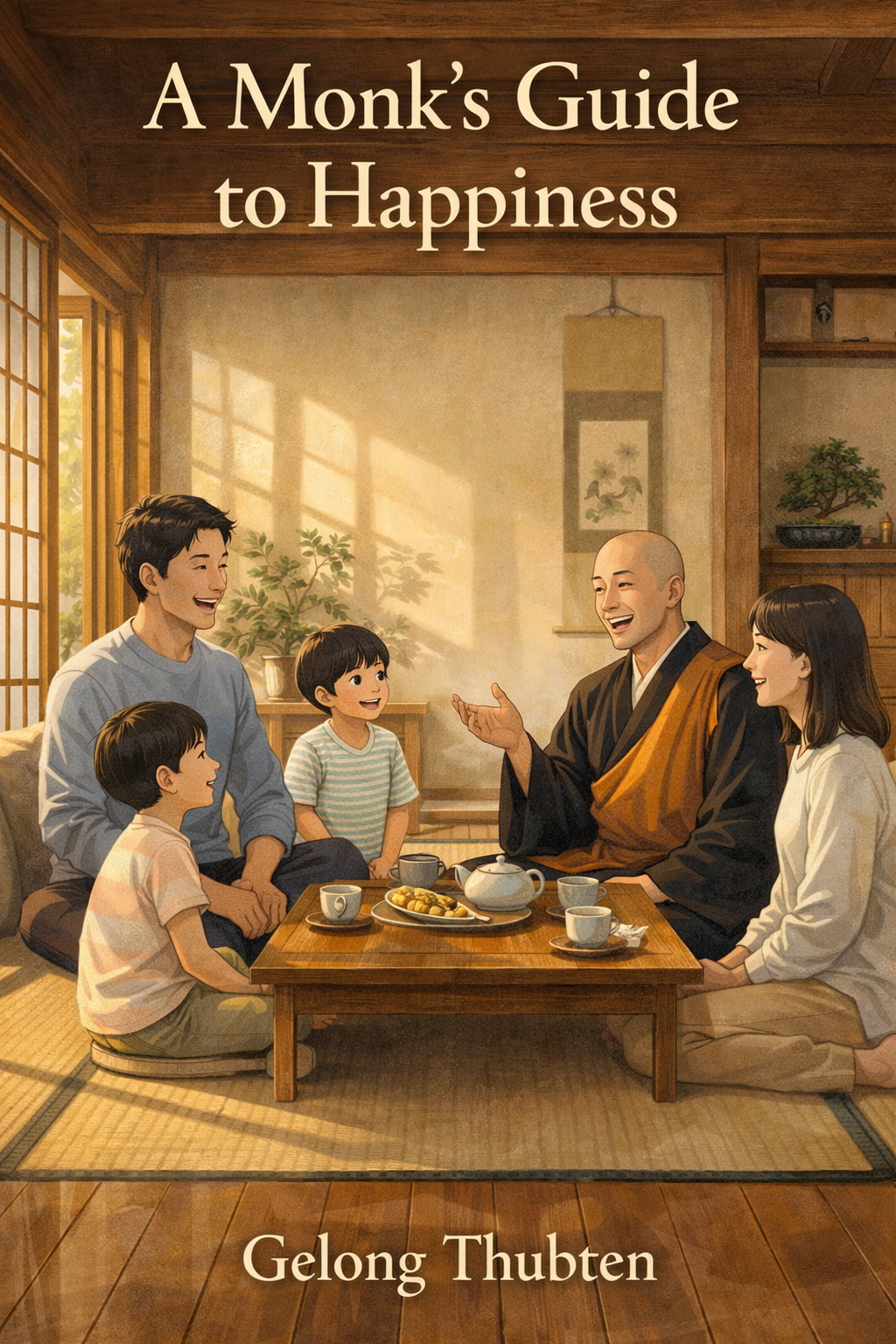
A Monk's Guide to Happiness
Chapter Summaries
What's Here for You
Are you feeling overwhelmed by the relentless pace of modern life, caught in a cycle of stress, addiction, and burnout? Do you suspect that true happiness isn't a fleeting emotion, but a fundamental state of being, a core part of our human wiring? "A Monk's Guide to Happiness" offers a profound and practical roadmap to rediscover this innate joy. Drawing from his own dramatic transformation from a life teetering on the edge of collapse in New York to the profound stillness of a four-year meditation retreat, Gelong Thubten reveals that happiness is not a destination, but a skill that can be cultivated. This book challenges the notion that we must eradicate our thoughts to find peace, instead offering a revolutionary approach to working with our minds – understanding that true mastery lies not in silencing the whirlwind of 60,000 daily thoughts, but in learning to navigate them with wisdom and grace. You'll learn how to build positive habits, transforming meditation from an occasional escape into a powerful, gym-like training for your inner life. Discover the transformative power of compassion, the liberating force of forgiveness, and the surprising truth that happiness is not a solitary pursuit, but a deeply interconnected endeavor. Prepare to embark on an intellectual and emotional journey that will equip you with the tools to find lasting revitalization, inner stillness, and a profound sense of well-being, even amidst the chaos of the twenty-first century. This is more than a book; it's an invitation to reconnect with your true, happy nature.
What Is Happiness?
Gelong Thubten emerged from a profound four-year meditation retreat, a stark contrast to the hyper-connected, lightning-fast world he re-entered. Cut off from technology and external news, his immersion in intensive meditation pushed him to confront his own mind, a journey he describes as 'open-heart surgery with no anesthetic.' This intense, often painful, experience paradoxically illuminated the nature of happiness, revealing it not as an external acquisition but as an internal skill. Returning to a London buzzing with smartphones and a constant barrage of information, Thubten observed a society seemingly hypnotized by screens, addicted to instant gratification and fleeting 'hits' of dopamine, a cycle he likens to an endless hunger. He noted the shift towards hyper-stimulating, fast-paced media, a reflection of our own distracted, constantly stimulated lives, where simple presence feels 'boring.' This chase for external validation and sensory overload, he argues, leaves individuals perpetually dissatisfied, never truly arriving at fulfillment. The core dilemma presented is our societal pursuit of happiness through external means—possessions, achievements, fleeting pleasures—which Thubten posits is a form of enslavement. He contrasts this with true, enduring happiness, which he defines as a state of freedom, completeness, and peace, achieved not by altering circumstances but by mastering our inner world. This internal mastery, he explains, is cultivated through mental training, specifically meditation and mindfulness. These practices offer a way to access an inner wellspring of nourishment, providing resilience and centeredness amidst life's inevitable challenges. Thubten dispels common myths about meditation, emphasizing it's not about silencing the mind but about changing our relationship with our thoughts and emotions, making it a vital tool for survival and connection in our pressurized modern world, a pathway to unconditional compassion and freedom found within.
Hardwired to Be Happy
The author, Gelong Thubten, begins by revealing a profound truth from Buddhist philosophy: we are, at our core, hardwired for happiness. This isn't a hopeful aspiration, but our fundamental nature, meaning that suffering feels like an unwelcome intrusion, a deviation from our true state. The very act of picking up this book suggests a deep-seated intuition that a reservoir of happiness lies within, waiting to be accessed. He then delves into the concept of freedom, noting that while we champion societal freedoms, our minds often remain enslaved by uncontrollable thoughts and emotions. We become adrift in moods, memories, and worries, feeling like passengers in our own lives. Yet, Thubten offers encouragement, highlighting that these mental states are ever-changing and, crucially, habitual. This is where the scientific concept of neuroplasticity offers a powerful lens: our minds can be retrained, forging new neural pathways to cultivate positive habits and diminish negative ones. Thubten shares his personal transformation, illustrating how meditation dissolved deep-seated self-hatred, demonstrating the potential for radical change. He introduces the idea of the 'observer' within us – a part of the mind that witnesses our emotions without being consumed by them. Like a vast sky that contains countless clouds, our awareness is boundless, far greater than the transient storms of our thoughts and feelings. Meditation, he explains, is not about eradicating these clouds, but about learning to recognize the immense space of the sky itself, connecting with our true essence. The Tibetan word 'gom,' meaning 'to become familiar with,' perfectly captures this practice of befriending our awareness. Thubten uses vivid metaphors, likening thoughts and emotions to insubstantial clouds seen from an airplane or waves on the ocean. We suffer when we mistake these transient phenomena for solid reality, reacting with fear. Instead, by resting in the awareness of the ocean, we can cease being tossed about by the waves. Ultimately, our essence is freedom, and freedom is happiness. Neuroscience, too, supports this, with figures like Candace Pert suggesting we are 'hardwired for bliss.' Even the brain's tendency to signal danger can be seen as a mechanism to return us to our natural, positive state, much like the release of oxytocin in early bonding. Any negative emotion, paradoxically, can be proof of our boundless capacity for happiness, signaling a yearning for what is already within. The key insight is that this deep, inherent wholeness and happiness are not external quests but an internal discovery, obscured by our tendency to grasp at fleeting experiences and external gratifications.
Stress in the Twenty-first Century
The author, Gelong Thubten, opens a window into his own tumultuous past, a stark contrast to his present life as a monk, recounting a period of intense addiction, burnout, and fear that led him to the brink of physical and mental collapse. He recalls a life in New York, surrounded by friends and the trappings of success, yet utterly consumed by a self-destructive ambition and a mind that ran too fast, always searching for an elusive happiness. This internal turmoil manifested physically, culminating in a serious heart condition and a profound burnout diagnosed by doctors. It was during this time of deep vulnerability, gifted books on meditation and a suggestion to visit a Tibetan Buddhist monastery, that a radical shift began. Even the journey to this new path was fraught with anxiety, marked by a terrifying panic attack in a video store, a vivid illustration of the nameless fears that gripped him. This personal narrative serves as the foundation for exploring the pervasive issue of stress in the 21st century, which Thubten identifies as fundamentally rooted in a concept he calls 'grasping.' Grasping, he explains, is our innate tendency to cling to pleasant experiences and push away unpleasant ones, a cycle that leaves us perpetually chasing fleeting satisfiers and fleeing inevitable discomfort. This constant striving, this internal battle with our thoughts and emotions, is what creates stress. He elaborates on four key ways this grasping manifests: not getting what we want, getting what we don't want, protecting what we have, and losing what we love. These are not external forces, but rather the internal states of mind that arise from our disconnection from our true inner potential for happiness. The chapter then delves into the physiological impact of this modern-day stress, explaining how our ancient fight-or-flight response, designed for immediate physical threats, is now perpetually triggered by mental stressors like emails and social comparisons, leading to a toxic overproduction of cortisol. This chronic activation, unlike that of a gazelle fleeing a lion, is not burned off through physical exertion, leaving us depleted and reliant on external stimulants like caffeine and sugar, creating a vicious cycle of exhaustion. Thubten critiques the modern culture of busyness as a badge of honor, a societal construct that prioritizes external achievement over inner well-being, leading to widespread depression and a loss of self-worth. He highlights how the digital age, with its constant barrage of curated lives and truncated communication, exacerbates this by fostering comparison, envy, and a distorted sense of reality. The author posits that this relentless pursuit of external validation and happiness is ultimately futile, a frantic attempt to fill an inner void. Yet, amidst this grim diagnosis of modern living, a thread of hope emerges: meditation. Thubten reveals that meditation, far from dulling ambition, actually cultivates a resilient equanimity, a bedrock of inner peace that allows for genuine joy and energy. He assures us that happiness is not an external acquisition but an internal state, a skill that can be cultivated, a profound realization that offers a path to freedom from the exhausting grip of stress and a return to our true, unburdened nature.
Meditation and Mindfulness
The human mind, a whirlwind of 60,000 to 80,000 thoughts daily, often spins with repetitive and negative patterns. Yet, as Gelong Thubten explains, the futile attempt to eradicate these thoughts only amplifies their presence, much like a dog chasing a thrown stick. True mastery, he reveals, lies in becoming like the lion, observing the thrower rather than the stick itself. Meditation, in its essence, is not about achieving mental silence—a common misconception that leads to stress and feelings of failure—but about transforming our relationship with our thoughts. It's a two-part system: meditation is the dedicated time for mental training, while mindfulness is the practice of bringing our awareness back from distraction and integrating this awareness into daily life. Thubten cautions against the desire to 'switch off,' likening it to a coma, and instead advocates for a profound shift: ending the war with our thoughts to find inner peace. This is achieved not by blanking the mind, but by finding space within the thoughts, learning to observe them without becoming entrapped. Imagine standing beside a busy road, the mind, with thoughts as passing cars; the practice is to simply watch them go by, perhaps recognizing a taxi and choosing not to get in. The core insight is that our reaction to thoughts, not the thoughts themselves, dictates our happiness. By using anchors like the breath, we train our awareness to return, developing resilience against negativity. This practice builds mental strength, akin to lifting weights for the body. Furthermore, meditation teaches us to befriend our emotional life, which often runs the show, by becoming more emotionally intelligent and less driven by feelings. Negative emotions, stemming from craving, anger, and confusion, are not to be eliminated but understood. Craving, or grasping, creates a sense of lack; anger and aversion push away; confusion obscures reality. Meditation helps us untangle these habits, allowing us to feel emotions without being controlled by them. The process unfolds in three phases: full focus, noticing the mind has wandered, and gently returning to the focus. Each phase, especially the 'noticing' of distraction, is a success, a moment of re-engagement. This understanding revolutionizes practice, transforming it from a battle into a gentle return, where wandering thoughts become aids, not enemies. Ultimately, this journey reveals a fundamental goodness within, offering true freedom and happiness.
Getting Started
The author, Gelong Thubten, recounts his own tumultuous entry into monastic life, a journey catalyzed by overwhelming stress and excess, leading him at twenty-one to Kagyu Samye Ling Monastery in Scotland. He discovered not the expected pious figures, but individuals with wild pasts seeking deeper meaning, guided by a revolutionary Tibetan Abbot. Thubten’s initial attempts at meditation were fraught, a two-hour session feeling like an eternity of staring at carpet patterns, yet this struggle was the beginning of a profound transformation. He learned that monastic vows, like celibacy and abstaining from intoxicants, though seemingly restrictive, offered a surprising liberation. A pivotal moment arrived when his perception of his teacher, Choje Akong Tulku Rinpoche, shifted from seeing him as grumpy to recognizing his vast, sky-like mind, fostering complete trust and a desire to learn. This led Thubten into a nine-month solitary retreat, a period of intense fasting, silence, and meditation focused on compassion, which solidified his decision to dedicate his life to becoming a monk. The core of beginning this path, as Thubten explains, lies in engaging the senses as an anchor to presence, a practice likened to training a restless monkey consciousness to focus on one of five windows—our senses—instead of flitting about. He emphasizes that starting meditation is simply about beginning, right now, without hesitation, finding a quiet space, and adopting a stable posture, whether cross-legged or seated in a chair, with a straight back to promote awareness. Crucially, Thubten advocates for meditating with eyes open, gazing softly into space, as a way to cultivate clarity and presence, rather than retreating into darkness or associating meditation with 'switching off.' This openness, he suggests, is a fearless acceptance of what is, a fundamental aspect of being present. He debunks the need for external aids like music, asserting that the capacity for peace resides within, and while guided meditations can be helpful initially, true practice involves eventually going solo. Starting with ten minutes, twice a day, is a sustainable habit, with morning being an ideal time to balance cortisol levels and set a tone of calm for the day. The chapter then offers practical exercises, beginning with connecting to the body through the tangible sense of touch—feeling the chair, clothing, feet, and breath—and progressing to the 'mindful body' scan, a neutral observation moving through the body to foster a new, liberated relationship with it, where tensions can unravel simply by being present without judgment. Ultimately, Thubten’s narrative is a testament to how embracing the present moment, through mindful engagement with our senses and body, can lead to profound peace and a meaningful life, transforming the internal chaos into a source of strength and service.
Building the Habit
The author, Gelong Thubten, invites us to understand meditation not as an occasional escape, but as a profound journey, a path for building positive habits much like one would train at the gym to build muscle. He explains that our lives are fundamentally shaped by habits, both old and new, and that even our moments of upset stem from ingrained tendencies, which we then perpetuate. By recognizing this, we gain the power to actively change these habits and steer our lives with greater intention, a process amplified by the brain's neuroplasticity, where repetition truly creates lasting effects. Thubten emphasizes that consistently connecting with our awareness through meditation strengthens our innate capacities for resilience, peace, and happiness. The true power, however, lies not just in dedicated meditation sessions, but in weaving these moments of mindfulness into the fabric of our everyday lives. He illustrates this with a personal anecdote from a crowded London train, transforming a moment of misery into one of profound well-being simply by focusing on the physical sensations of his surroundings, a practice he calls 'mindful moments.' These 'micro-moments' act as a continuous thread, preventing us from straying too far from our practice and allowing mindfulness to become our default state, a radical transformation that requires consistent, gentle effort rather than dramatic shifts. To cultivate this, Thubten suggests a step-by-step approach: first, choose two or three mundane daily actions—like brushing teeth or washing hands—and use them as triggers for mindfulness for thirty days, focusing on the raw physical experience and gently returning your attention whenever the mind wanders. After this initial period, expand this practice to all activities, dropping into mindful awareness for a few seconds at a time, using sensory anchors like the feeling of the ground beneath your feet or the contact of your body with a chair. Crucially, he advises against stopping activities or slowing down to be mindful, as this separates it from real life and creates an artificial image; instead, mindfulness should be integrated seamlessly, like a quiet hum beneath the surface of daily action. He cautions against prolonging these moments to the point of oppression, advocating instead for short, frequent doses that make mindfulness a place you *want* to return to. This consistent practice, even when feeling unhappy or fatigued, builds the resilience needed to navigate stressful situations, as our habitual reactions are bypassed by a trained, mindful response. Thubten frames 'waiting'—whether in traffic, on hold, or for a webpage to load—as a golden opportunity for this mental training, a chance to release tension and cultivate calmness, thereby reprogramming our stress responses. He encourages us to see these moments not as lost time, but as gifts, transforming our relationship with time and work-life balance. Mindful eating is presented as another accessible pathway, where savouring each bite and chewing properly not only aids digestion but also fosters a deeper appreciation for our food and its origins. Ultimately, the core message is that happiness is a skill, cultivated moment by moment, and that by practicing consistently, especially during difficult times and mundane activities, we learn to fall in love with reality, building pathways of joy and finding freedom from reactivity.
Going Deeper
Gelong Thubten, after taking lifelong monastic vows, found himself under the wing of his teacher, Akong Rinpoche, a man whose incredible mind and living example of compassion would shape his life for two decades. This profound mentorship, spent on the road and in Rinpoche's office, became the most enriching experience, leaving Thubten inspired to carry on the work even after Rinpoche's tragic passing. Encouraged by his teacher, Thubten began to teach meditation not just in traditional Buddhist centers, but also in more challenging environments—hospitals, schools, refugee charities, drug rehabilitation centers, and even prisons. It was in these latter spaces, facing inmates grappling with intense anger, self-harm, and deep-seated issues, that Thubten discovered the transformative power of meditation, realizing that even the jarring clang of prison doors could become a mindfulness trigger, a gateway to peace. He learned that the true aim of meditation isn't merely to escape discomfort or chase fleeting feelings of wellbeing, a trap he himself fell into, becoming a 'junkie' for spiritual highs, only to find himself feeling depressed. This 'wellbeing trap,' as Thubten calls it, arises when we chase happiness or try to eliminate stress, paradoxically creating more of both. The core insight here is that the relentless pursuit of happiness, the 'feel-good factor,' can become an endless cycle, a hamster wheel that leads to disappointment. Instead, Thubten reveals that deeper benefits emerge when we shift our focus from seeking a 'hit' to relaxing into the present moment, letting go of expectation and fear. This shift unlocks creativity, enabling us to move beyond the fragmented, multitasking mindset that plagues modern life and embrace 'fully tasking'—doing one thing with mindful precision. The author underscores that true presence is a skill, often lost in our hyper-connected world where minds are elsewhere, even when bodies are present. He illustrates this with the image of people at a geyser, phones held high, capturing a moment instead of living it. He posits that by consistently returning our awareness to the present, particularly through breath meditation, we begin to 'thin down the mental glue' that binds us to our thoughts and emotions, thus disempowering their hold. This practice enhances mental focus, sharpening our edge rather than dulling it, and crucially, helps us decode our addictions. Thubten explains that addiction, at its root, is a craving to fill an inner emptiness, a 'hole in the soul,' and that chasing external objects only deepens this void. The true resolution lies not in eradicating the craving, but in observing it with mindful awareness, recognizing that the feeling of completion we seek is already present within us, accessible through 'mindfullness'—filling the mind with peace and joy. Ultimately, as we go deeper, facing what might seem like darkness under the floorboards, Thubten guides us to understand the mind not by its content, but by its context, revealing that our problems are often illusory, lacking solidity, and that the 'master key' to freedom lies in transforming how our minds function in the present, rather than endlessly digging through the past. The chapter concludes by offering practical exercises, like breath meditation and counting breaths, to cultivate this profound presence and inner transformation.
Happiness Is a Group Effort
Gelong Thubten, in 'Happiness Is a Group Effort,' invites us to shift our perspective from the solitary pursuit of happiness to a profound understanding of our interconnectedness. He explains that our very existence, from the air we breathe to the sustenance we consume, is a testament to this interdependence, a concept deeply rooted in Buddhist philosophy. This fundamental truth, however, often gets lost in our modern, individualistic culture, which celebrates self-empowerment and self-actualization, leading to a pervasive sense of loneliness. Thubten posits that this relentless focus on the self, driven by desire and aversion, creates an endless cycle of dissatisfaction, a trap amplified by the self-help industry's emphasis on 'becoming the best you.' He challenges the very notion of a separate, independent self, revealing through contemplation that our identity is woven from the threads of every connection we've ever made, much like a famous person is defined by their audience. The author then pivots to the transformative power of gratitude, a feeling often suppressed by a culture that conditions us to focus on what we lack. He paints a picture of how acknowledging our dependence on others, and their dependence on us, can cultivate a positive outlook and a sense of responsibility, much like a family unit. This gratitude, he argues, is a natural human capacity, evident in the uninhibited connection seen in children, a capacity that can be rekindled even in adulthood. Thubten contrasts these 'natural resources' of connection with the 'unnatural resources' of modern life—material possessions, competition, and the superficial connections fostered by social media—which ultimately leave us feeling isolated. He draws a stark parallel between our unchecked desires and the environmental crisis, urging a shift towards contentment and mindful resourcefulness. The narrative then delves into the science of connection, highlighting oxytocin, the 'cuddle chemical,' released through early mother-infant bonding, which forms the basis of our resilience and capacity for calm. He laments how modern living, with its isolated boxes and transactional relationships, severs these natural bonds, often leading to the transmission of stress across generations. The chapter concludes with a hopeful vision for integrating mindfulness into education, suggesting that teaching meditation to children could be a powerful antidote to societal ills, fostering a future built on kindness and compassion. Thubten emphasizes that genuine happiness is not a finite resource to be won, but a boundless wellspring found within, accessible through the recognition of our shared humanity and the practice of contentment, ultimately urging us to embrace our innate capacity for connection and kindness, the true foundation for enduring happiness.
Compassion
Gelong Thubten, in his chapter 'Compassion,' recounts a profound turning point during a four-year meditation retreat on the Isle of Arran. Initially, he found himself in a state of severe depression and anxiety, a stark contrast to his senior monk status, feeling as if he were falling through dark space. This harrowing experience, however, became the crucible for a life-changing discovery: happiness is like a switch in the mind, accessible through the compassionate acceptance of one's own pain. He explains that empathy, while a natural human connection to others' suffering, can be debilitating, often leading to emotional contagion and a shared sense of distress, like two people drowning because the rescuer cannot swim. This empathic response is limited by emotional reactivity, hidden expectations—where kindness becomes a form of barter—preference for certain individuals, and the overwhelming frustration of helplessness. True compassion, Thubten reveals, transcends these limitations. It is a dynamic, trainable quality characterized by a deep intention to help, selfless and unconditional love. Research indicates that compassion activates the brain's intention and motor cortex, preparing for action rather than succumbing to distress. This shift from merely feeling *with* someone to actively wishing them well and helping them is the core of developing sustainable happiness. He offers a powerful framework for cultivating this, moving from viewing everyone as equal, to prioritizing others' needs, and ultimately to altruism—willingly taking on the burden of others' suffering, much like a mother cares for her child. Thubten emphasizes that this isn't about martyrdom but about a deep commitment, a training of the heart, rooted in the understanding of our profound interdependence. He guides us to set compassionate intentions before meditation, transforming it from a self-centered pursuit into a powerful engine for benefiting all beings. The practice involves recognizing our own mental habits and extending that understanding to others, acknowledging their pain and confusion rather than judging them. Ultimately, compassion is presented not just as a way to help others, but as the fastest path to our own authentic, limitless happiness, a win-win situation that cultivates a spacious, resilient mind and spreads peace outward, like ripples on water.
Forgiveness
The author, Gelong Thubten, opens this chapter by confronting a profound obstacle to happiness: resentment. He illustrates this with Jean-Paul Sartre's famous line, "Hell is other people," drawing from his own experience acting in Sartre's play "No Exit," where characters mentally torment each other. Thubten argues that this cycle of anger and revenge is the true hell, a fiery pit that consumes us, undermining even our physical health. He likens holding onto resentment to clutching a hot coal, a burden that burns us from within. The core dilemma is our strong mental attachment, the "mental glue" that binds us to these habits, hindering our ability to let go and find freedom. Through the practice of meditation, however, we can begin to loosen this grip, with each gentle return of attention to our anchor, like the breath, strengthening our capacity for release. While compassion is vital, Thubten emphasizes that it is truly tested when directed towards our "enemies" or those who irritate us, revealing that our compassion is only stable and complete when it extends to them. To break free from resentment, Thubten proposes a series of intelligent steps: first, recognize that the true enemy isn't the person, but our own reaction—our anger and pain. This insight shifts our focus inward, opening the door to change. Second, embrace radical gratitude, viewing hurtful situations not as attacks, but as opportunities to train in compassion and forgiveness, much like lifting weights to build muscle. Our "enemies," in this light, become our greatest teachers, pushing us to grow where comfort zones fail. Third, cultivate a deeper understanding of the aggressor's internal suffering and confusion, recognizing that their actions often stem from their own misery and lack of self-control, akin to a child gripped by a fever. This perspective, he suggests, is incredibly liberating, as it dissolves the burden of rage. Thubten then addresses the internal conflict we have with our own thoughts and emotions, explaining that true forgiveness, particularly self-forgiveness, arises from unconditional acceptance, not from trying to suppress or condemn our inner experiences. He shares his own journey with a harsh internal monologue, showing how offering compassion to his own suffering transformed his self-perception and made self-forgiveness attainable. The chapter concludes by extending forgiveness to life's challenges, advocating for mindful acceptance of difficult experiences, transforming resistance into freedom and joy, and reminding us that even in the darkest tunnels, "everything is beautiful" if we choose to see it that way. Ultimately, Thubten offers practical meditation exercises to cultivate resilience, forgive others, and embrace life's inherent flow.
Energizing Your Practice
Gelong Thubten, finding solace and a different kind of energy amidst the wild beauty of Kagyu Samye Ling Monastery in Scotland, contrasts it with the pulsating frenzy of New York. He learned that true revitalization comes not from constant activity, but from cultivating inner stillness. Even as his life became a whirlwind of teaching and managing meditation centers, often from a suitcase, he discovered that regular meditation was as essential as eating, a source of profound energy. The central tension explored is the struggle to maintain a consistent meditation practice amidst life's demands, a struggle that can lead to guilt and a downward spiral of negativity. Thubten reveals that this loss of energy for practice stems from three primary obstacles: lack of confidence, procrastination, and being too busy. He posits that a lack of confidence, the belief that we don't have what it takes, can be overcome by recognizing our immense human potential – our capacity for learning, achievement, and mental transformation, noting that deep down, we are hardwired for happiness. Procrastination, the perpetual 'tomorrow,' is addressed by deeply reflecting on impermanence, understanding that time is finite, a realization that can imbue our practice with a greater sense of urgency and appreciation. The pervasive modern ailment of being 'too busy' is countered by questioning our attitudes towards happiness and recognizing that true, lasting peace comes from deep mental training, not fleeting sensory hits. To reignite motivation, Thubten encourages asking profound questions: Why do we do what we do? What do we truly want to achieve? Is it working? He guides us to see that happiness and suffering are not external forces, but rather the mind's perception, a 'mental experience of reality.' This insight shifts the focus inward, making the mind the ultimate source of our well-being. Crucially, he advocates for cultivating joyful enthusiasm rather than a sense of duty, likening the latter to 'miserably dragging a bag of rocks up a hill.' Sustainable diligence, he explains, comes from 'diligere'—to take delight in—connecting with our essence of pure happiness. Our attitude also plays a vital role; approaching meditation not as a daunting mountain but as a series of manageable steps, perhaps just five or ten minutes a day, or even micro-moments of awareness, can slip the practice 'under the radar' and make it feel natural. He cautions against trying to silence the mind, which creates resistance, instead framing meditation as a method for giving the mind 'total freedom.' Even feelings of sleepiness or agitation during practice are temporary states, like clouds passing across the vast, open sky of our awareness, and persisting through them transforms the body's association with stillness from sleep to awareness. Ultimately, Thubten presents compassion as a powerful energizer, dedicating practice for the benefit of others lending it a deeper meaning and value. Through contemplative exercises, like reflecting on human potential, impermanence, actions and results, and the mind's role in happiness, we are skillfully guided back to the cushion, realizing meditation is not an option, but a necessity for enduring happiness.
Conclusion
Gelong Thubten's "A Monk's Guide to Happiness" offers a profound reorientation, challenging the pervasive modern notion that happiness is a prize to be won through external achievements or sensory gratification. Instead, the book masterfully illustrates that true, sustainable happiness is an internal skill, an innate capacity deeply ingrained within us, which we can cultivate through dedicated mental training, primarily through meditation and mindfulness. The core takeaway is that our inherent nature is one of peace and completeness; suffering and dissatisfaction are not our default state but rather aberrations caused by our learned habits of 'grasping' – clinging to the pleasant and pushing away the unpleasant. This incessant cycle, amplified by the relentless pace and digital saturation of 21st-century life, triggers chronic stress by keeping our ancient fight-or-flight mechanisms in overdrive without physical release. Emotionally, the book guides us through the often-uncomfortable terrain of our own minds. It teaches that the struggle isn't with our thoughts and emotions themselves, but with our relationship to them. We are invited to become an 'observer,' a spacious awareness distinct from the transient mental content. This shift in perspective, facilitated by practices like noticing thoughts without entanglement and gently returning our attention, fosters resilience and inner freedom from the tyranny of our own minds. The journey may begin with perceived difficulty or resistance, particularly for those with turbulent pasts, but this very struggle becomes the fertile ground for profound transformation, revealing our innate capacity for well-being and joy. Practically, Thubten provides a roadmap for integrating this wisdom into daily life. Meditation is presented not as an escape or a quest for specific 'feel-good' states, but as a habit-building discipline akin to physical training. The emphasis is on consistency, patience, and self-compassion, recognizing that each 'return' to focus after distraction is a success. Engaging the senses, practicing mindful eating, and utilizing moments of 'waiting' are practical gateways to present-moment awareness. Furthermore, the book expands the concept of happiness beyond the individual, highlighting our fundamental interconnectedness. Cultivating compassion and forgiveness – for ourselves and others – emerges not just as ethical imperatives but as essential pathways to genuine contentment and freedom from self-inflicted suffering. By shifting our focus from external validation to internal peace and from ego-centered desire to a mind dedicated to the benefit of others, we unlock the deepest, most sustainable form of happiness, recognizing that our inherent essence is freedom itself.
Key Takeaways
True happiness is an internal skill cultivated through mental training, not an external reward to be acquired.
Our modern addiction to instant gratification and sensory stimulation, driven by dopamine surges, perpetuates dissatisfaction and an endless cycle of craving.
Happiness is fundamentally a state of inner freedom, characterized by completeness and peace, achieved by mastering our thoughts and emotions rather than manipulating external circumstances.
Meditation and mindfulness are not about emptying the mind but about transforming our relationship with thoughts and emotions, offering resilience and inner stability.
In a world saturated with information and speed, cultivating an internal sense of presence and connection is becoming a matter of survival, not a luxury.
Our true nature is happiness, and suffering is an aberration, suggesting an innate potential for well-being.
While external freedoms are pursued, internal freedom from the tyranny of uncontrollable thoughts and emotions is paramount.
Neuroplasticity demonstrates that mental states are habits that can be consciously reshaped through practices like meditation.
We possess an 'observer' self, a spacious awareness that is distinct from and larger than our transient thoughts and emotions.
Meditation is not about eliminating negative thoughts but about recognizing our boundless awareness as the fundamental reality.
Our inherent essence is freedom, which, when recognized, is synonymous with complete happiness.
The capacity for deep happiness is biologically ingrained, and negative emotions signal a deviation from this natural state, prompting a return.
Stress in the 21st century is primarily a result of 'grasping,' our innate tendency to cling to pleasant experiences and push away unpleasant ones, leading to a perpetual and exhausting cycle of desire and avoidance.
The four primary drivers of stress are externalized states of mind: not getting what we want, getting what we don't want, protecting what we have, and losing what we love, all stemming from a disconnection with our inner potential for happiness.
Modern life's constant mental stressors trigger our ancient fight-or-flight response, leading to chronic cortisol overproduction and physical depletion, as this stress is not resolved through actual physical exertion.
The cultural emphasis on 'busyness' and external achievements as markers of success distracts from inner well-being, fostering a society that validates itself through superficial accomplishments rather than intrinsic worth.
The digital age, with its curated online lives and constant comparison, exacerbates stress by fueling envy, distorted perceptions, and a diminished sense of self-worth.
True happiness and freedom from stress are not found in external acquisition but are cultivated internally through practices like meditation, which fosters equanimity and a resilient inner state.
Meditation offers a profound solution by helping individuals master their thoughts and emotions, reducing cortisol levels and allowing for a more joyful, energetic, and authentic engagement with life.
Meditation's true aim is not to eliminate thoughts but to change our relationship with them, fostering inner peace by observing them without entanglement.
Mindfulness is the active practice of returning awareness to the present moment, a skill honed through noticing distraction and gently redirecting attention.
Negative emotions stem from core habits of craving, anger, and confusion, and meditation helps cultivate emotional intelligence by understanding and managing these reactions rather than suppressing them.
The practice of meditation involves three crucial phases: focused attention, noticing the mind has wandered, and returning to focus, with each 'return' representing a success, not a failure.
By treating thoughts and emotions as passing phenomena, like cars on a road, rather than engaging with them, we build resilience and reduce suffering.
Cultivating awareness allows us to access a fundamental goodness within, leading to true freedom and happiness independent of external circumstances.
The initial resistance and perceived difficulty in meditation practice, especially for those with turbulent pasts, can be the very ground from which profound transformation arises.
Monastic vows, often seen as restrictive, can paradoxically lead to liberation by providing structure and freedom from distracting external pursuits.
Building trust in a teacher or practice often emerges not from immediate liking, but from witnessing their authentic, grounded presence and selfless dedication.
Engaging the senses is a practical gateway to present-moment awareness, anchoring the mind like training a restless monkey to focus on a single window.
Meditating with eyes open fosters mental clarity and fearless acceptance of reality, rather than seeking escape or associating peace with darkness.
True meditation involves relaxing into the present moment without judgment or the need to 'feel' something specific, moving beyond a 'hunt' for validation.
Developing a non-judgmental awareness of the body can unravel internal tensions, transforming it from a source of discomfort into a vehicle for mental training.
Mindfulness is best cultivated as a consistent habit woven into daily life, not an occasional escape, through the repetition of dedicated sessions and 'mindful moments' integrated into mundane activities.
Neuroplasticity underscores that repeated mental training, like meditation, fundamentally rewires the brain, strengthening positive habits such as resilience and peace.
Integrating short, frequent moments of mindfulness into everyday actions, rather than relying solely on formal meditation sessions, is crucial for transforming one's default state and experiencing lasting peace.
Stressful situations are best managed not by seeking emergency techniques, but by building a foundational habit of mindfulness, which creates inherent resilience and calm in the face of pressure.
Moments of 'waiting' or perceived downtime are valuable opportunities for mindfulness training, allowing us to reprogram stress reactions and cultivate a more relaxed relationship with time.
Practicing mindfulness consistently, even when feeling unhappy, fatigued, or unwell, is essential for developing true resilience and learning to accept and work with all present-moment experiences.
Mindful eating transforms a basic necessity into a practice of awareness, improving digestion, fostering gratitude, and revealing emotional eating patterns.
The pursuit of happiness can become a 'wellbeing trap,' where the very act of seeking or trying to eliminate stress paradoxically creates more of it, turning meditation into a 'hamster wheel' of endless striving.
Deeper benefits of meditation, such as enhanced creativity and mental focus, emerge not from chasing fleeting 'feel-good' sensations, but from learning to relax into the present moment, releasing expectations and fears.
True presence is a skill that must be cultivated, especially in our digitally saturated world, by intentionally returning our awareness to the present, transforming external distractions into mindfulness triggers.
Addiction stems from an attempt to fill an inner void; observing craving with mindful awareness, rather than chasing its object, can dismantle the addiction by revealing the inherent completeness within.
Mental transformation in meditation focuses on the context of the mind—how it relates to its content—rather than solely on excavating past experiences, thereby disempowering the hold of psychological material.
The modern celebration of the individual self, driven by desire and aversion, leads to isolation and dissatisfaction, obscuring the fundamental truth of our interconnectedness.
True happiness is not found in self-optimization or material acquisition, but in recognizing and honoring our interdependence with others and the world.
Cultivating gratitude for our connections, both given and received, is a powerful antidote to selfishness and a pathway to genuine contentment.
Our innate capacity for connection and kindness, rooted in neurochemistry and evident in childhood, can be suppressed by stress and modern societal structures, but can be rekindled through mindful practices.
Mindful living and meditation offer a path to sustainable happiness by shifting focus from external validation to internal contentment and by fostering compassion for oneself and others.
Integrating mindfulness into education is crucial for building a more connected, compassionate, and less violent future society.
Empathy, while a natural starting point for connection, can be emotionally debilitating and unsustainable due to its reactive, preferential, and expectation-laden nature.
Compassion is a trainable, dynamic quality that moves beyond shared suffering to a deep intention and commitment to help others, fostering resilience and prosocial behavior.
Accepting one's own pain with compassion is the gateway to accessing inner happiness and developing the foundation for effectively helping others.
Cultivating compassion involves shifting from an ego-centered perspective to recognizing our interdependence and valuing the well-being of others as much as, or more than, our own.
Compassion training is a proactive process that requires setting clear intentions, practicing non-judgmental acceptance of one's own mind, and extending this kindness universally.
True, lasting happiness is an interdependent reality, found not in grasping for personal satisfaction but in a mind dedicated to the benefit of others.
Resentment is a self-inflicted wound, a 'hot coal' we hold onto, that poisons our happiness and health, and true freedom comes from learning to let go of this burden.
The primary obstacle to forgiveness is our attachment to negative mental habits, which meditation practice can help to loosen by training our ability to gently redirect attention.
Our "enemies" and those who irritate us are not the true antagonists; our own anger and pain are, and recognizing this internal battleground is the first step toward liberation.
Viewing hurtful situations and people as opportunities for training in compassion and forgiveness, rather than as personal attacks, transforms challenges into catalysts for growth and resilience.
Understanding that hurtful actions often stem from the aggressor's own internal suffering and lack of self-control, much like being overwhelmed by a fever, fosters empathy and dissolves rage.
Self-forgiveness is cultivated through radical acceptance of our mistakes and shortcomings, reframing them as opportunities for growth rather than reasons for self-loathing.
Accepting life's challenges with mindful presence, without resistance or judgment, allows us to transform difficult experiences into sources of profound freedom and even joy.
The persistent struggle with meditation practice, often fueled by guilt and a sense of failure, can be overcome by addressing core obstacles: lack of confidence, procrastination, and busyness.
Recognizing our inherent human capacity for learning, achievement, and mental transformation is key to building confidence and overcoming the belief that meditation is too difficult.
Contemplating impermanence and the finite nature of time can transform procrastination into diligent, present-moment practice.
True happiness and freedom are not found in external circumstances but are a result of training the mind, as our perception of reality is the primary determinant of our experience.
Sustainable diligence in practice arises from joyful enthusiasm and a sense of 'taking delight in' the process, rather than from duty or obligation.
Approaching meditation with patience, focusing on small, manageable steps, and embracing micro-moments of awareness makes the practice more accessible and sustainable.
Viewing meditation not as an attempt to silence the mind but as a path to granting it freedom, and practicing compassionately for oneself and others, deepens its meaning and energizes commitment.
Action Plan
Dedicate a short period each day to simply sit with your thoughts and feelings without judgment, observing them like clouds passing in the sky.
When you feel the urge for instant gratification (e.g., reaching for your phone, a snack), pause for a moment and notice the craving without immediately acting on it.
Practice mindful observation of simple, everyday activities, such as eating a meal or walking, focusing on the sensory experience.
Challenge the belief that external achievements or possessions are the sole sources of happiness; instead, reflect on moments of inner peace and contentment.
Explore short guided meditations to begin changing your relationship with your thoughts and emotions.
When faced with a difficult situation, consciously try to embrace things as they are, rather than immediately resisting or trying to change them.
Cultivate the practice of observing your thoughts and emotions without immediate judgment or identification.
Engage in regular meditation to 'become familiar with' your own awareness, as suggested by the term 'gom'.
Use the metaphor of the sky and clouds to reframe challenging thoughts and emotions as transient phenomena.
Practice recognizing that your mind's awareness is vaster than any single thought or feeling, like the ocean is vaster than its waves.
Gently redirect your focus towards your inherent capacity for happiness when you notice yourself grasping at external circumstances.
Explore the concept of neuroplasticity by consciously choosing to foster positive mental habits through intentional practice.
Remind yourself that your natural state is one of contentment, and negative emotions are signals to return to that state.
Identify personal instances of 'grasping'—moments of clinging to pleasant experiences or pushing away unpleasant ones—and observe the resulting stress.
Recognize and name the four primary drivers of your stress (not getting, getting, protecting, losing) to understand their internal origin.
Become aware of how often your body's fight-or-flight response is triggered by non-life-threatening stressors, such as emails or social media notifications.
Challenge the cultural narrative that equates busyness with success and instead prioritize moments of 'being' and inner reflection.
Consciously limit exposure to social media and curated online content that fuels comparison and envy, focusing instead on authentic self-perception.
Begin a short, consistent meditation practice, even just a few minutes daily, to observe thoughts and emotions without immediate reaction.
Seek to cultivate inner happiness by recognizing that it is an internal state, not an external acquisition, and explore what brings genuine contentment from within.
Dedicate a short period each day to sit quietly and practice observing your thoughts without judgment, noticing their patterns.
Use your breath as an anchor during meditation, gently returning your focus to it each time you realize your mind has wandered.
Practice 'moments of awareness' throughout your day by consciously connecting with your surroundings and sensory experiences.
Reframe the experience of distraction during meditation not as a failure, but as a successful moment of noticing and returning.
Engage with difficult emotions by observing them without trying to suppress or escape them, recognizing they are temporary mental states.
When negative emotions arise, identify if they stem from craving, anger, or confusion, and use this understanding to respond more skillfully.
Begin with simple meditation supports like focusing on the body or breath, gradually moving to more subtle forms of awareness.
Begin meditating for 10 minutes, once or twice a day, focusing on the sensation of your breath or the feeling of your body against a chair or the floor.
Practice meditation in a quiet space with a wall behind you for a sense of security.
Sit with a straight back, whether on a chair or the floor, to promote alertness.
Experiment with meditating with your eyes softly open, gazing into space, to cultivate awareness.
Engage in a body scan, slowly moving your attention through different parts of your body without judgment, noticing sensations or their absence.
When your mind wanders during meditation, gently redirect your attention back to your chosen focus (breath, body sensation) without self-criticism.
Set a consistent time for meditation each day, ideally in the morning, to establish a discipline and balance your internal state.
Approach meditation by simply 'being' with the experience rather than 'trying' to achieve a specific feeling or outcome.
Choose two or three mundane daily actions (e.g., brushing teeth, washing hands, drinking water) and commit to practicing mindfulness during these activities for thirty days.
Expand mindfulness practice by intentionally dropping into mindful awareness for a few seconds at a time during any activity, using sensory anchors like touch or sight.
Utilize moments of waiting (e.g., in traffic, on hold, for a webpage to load) as opportunities to practice releasing tension and cultivating calm, rather than succumbing to impatience.
Integrate mindful eating by focusing on the sensations, tastes, and textures of your food during at least a few meals each day, chewing thoroughly.
Begin and end each day with a brief moment of mindfulness, focusing on bodily sensations or breath before getting up and before falling asleep.
Practice mindfulness during challenging or unpleasant moments, such as physical discomfort or fatigue, by gently resting in the raw experience without judgment.
Engage in short, regular meditation sessions (e.g., 10-15 minutes daily) rather than attempting long, arduous practices, especially when starting out.
Use sound as an anchor for meditation, neutrally observing all sounds without labeling or judgment, even in noisy environments.
Practice returning your focus to your breath whenever your mind wanders, using the sensation of air entering and exiting your nose or mouth as a precise anchor.
When experiencing a craving or addictive urge, pause and observe the physical sensation of wanting without judgment, rather than immediately acting on it.
Intentionally dedicate short periods to 'fully tasking'—focusing entirely on one activity with mindful precision, free from multitasking.
Reframe the goal of meditation from seeking a 'high' or immediate relief to embracing the present moment with relaxed expectation.
When faced with difficult thoughts or emotions, practice observing them as transient phenomena, like clouds passing in the sky, rather than solid realities.
Begin a regular meditation practice, such as the seven-step breathing meditation, dedicating 10-15 minutes daily to cultivate present moment awareness.
Engage in a meditation practice focusing on natural objects to build mindful connection with the external world.
Practice gratitude by bringing to mind three things for which you are thankful, exploring the reasons and feeling appreciation.
Actively cultivate joy for the achievements and happiness of others, extending this feeling beyond loved ones.
Consciously shift focus from external validation and material acquisition to internal contentment and resourcefulness.
When interacting with others, especially family, practice mindful responses rather than automatic reactions to stress or emotion.
Lead by example in practicing meditation and using compassionate language within your family to foster a positive connection.
Reflect on your daily interactions and identify areas where you can be more present and less distracted by technology.
Before meditating, set a compassionate intention, dedicating the practice not only to your own well-being but also to the happiness of all beings.
Practice accepting your own thoughts and emotions without judgment, recognizing them as transient mental events rather than personal failings.
Engage in analytical meditation by contemplating the effects of selfishness versus compassion on your inner state, relationships, and the environment.
Utilize visualization meditation to radiate feelings of love, kindness, and freedom from a glowing ball of light in your chest outwards to others, starting with loved ones and extending to all beings.
When encountering difficult people or situations, consciously try to acknowledge the underlying pain or confusion that might be driving their behavior, rather than immediately judging them.
Actively cultivate a sense of interdependence, recognizing how countless individuals contribute to your daily life and practicing gratitude for their efforts.
When interacting with others, prioritize kindness and understanding, knowing that each compassionate act has a ripple effect that can spread happiness.
When experiencing resentment, recognize that your anger and pain are the true enemies, not the person involved, and focus on managing your internal reaction.
Practice radical gratitude by reframing hurtful situations as opportunities to train your compassion and forgiveness skills.
Cultivate understanding by contemplating the potential internal suffering and confusion of the person who caused you harm, imagining yourself in their situation.
Engage in self-forgiveness by calmly acknowledging your mistakes without falling into guilt, appreciating them as opportunities for growth.
When facing discomfort or tension, practice mindful acceptance by focusing on the physical sensation with loving awareness, bathing it in compassion.
Dedicate your meditation practice to the happiness and freedom of all beings, wishing for mutual forgiveness and liberation from resentment.
Identify your primary obstacle to practice—lack of confidence, procrastination, or busyness—and explore the suggested remedies for it.
Engage in a brief contemplation on your human potential and capacity for mental transformation to build self-confidence.
Dedicate a few minutes to reflecting on impermanence to gain a fresh perspective on time and urgency.
Ask yourself the core questions: 'Why do I do all the things I do?', 'What do I really want to achieve?', 'Is it working?' to clarify your motivations.
Start with short, manageable meditation sessions, even just five or ten minutes daily, and gradually increase the duration.
Practice 'micro-moments' of awareness throughout the day, dropping into mindful observation without pressure.
Frame your meditation practice as an opportunity for joyful exploration rather than a duty or obligation.
When feeling sleepy or agitated during meditation, gently return to your focus without judgment, remembering your mind is like the vast sky.
Consider dedicating your meditation practice to the benefit of others to deepen its meaning and boost motivation.