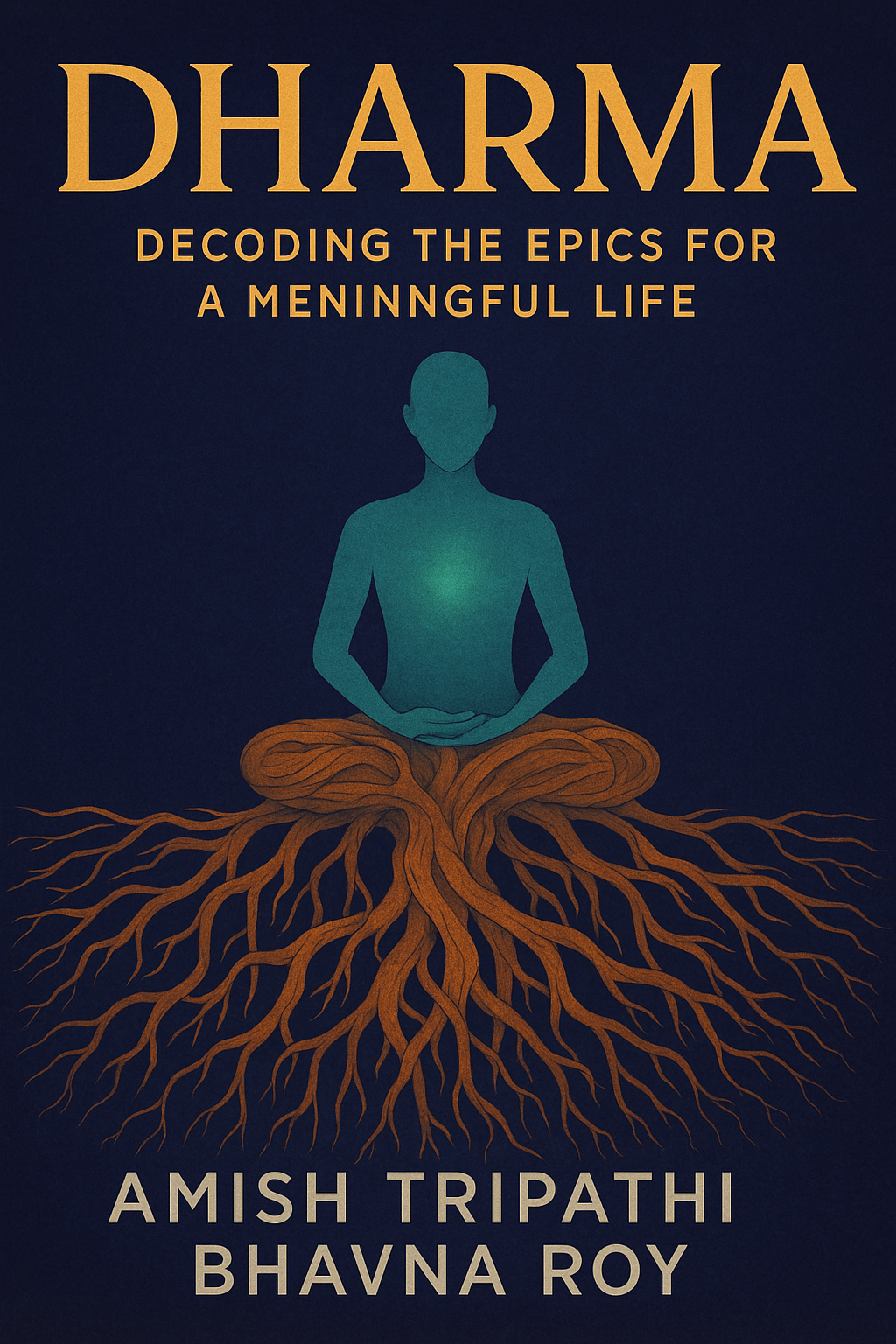
Dharma: Decoding the Epics for a Meaningful Life
Chapter Summaries
What's Here for You
Embark on a transformative journey with "Dharma: Decoding the Epics for a Meaningful Life." This isn't just a book; it's your personal guide to navigating the complexities of existence, drawing timeless wisdom from the heart of Indian epics. Have you ever wondered about the true nature of karma, or how your actions ripple through the universe? Are you grappling with the distinction between your duty and your personal calling (Swadharma)? This book invites you to explore these profound questions through the eyes of relatable characters like Nachiket, who finds himself on a quest for deeper meaning amidst the everyday hustle. You'll delve into the multi-faceted nature of figures often painted as villains, like Duryodhana, understanding the 'burden of envy' and the contradictions that make us human. Discover the delicate balance of desire and self-denial, and the quiet power of listening to your heart. Learn why humility isn't weakness but a potent force against wounded pride. Unravel the slippery slope of loyalty, questioning its true meaning through epic heroes. Confront the destructive price of anger and victimhood, and find solace in the profound simplicity of living in the present moment. Through engaging dialogues and insightful narratives, Amish Tripathi and Bhavna Roy offer a fresh perspective, blending ancient philosophy with modern relevance. Prepare to gain not just intellectual understanding, but a renewed sense of purpose, emotional clarity, and a roadmap for living a more conscious, fulfilling, and meaningful life. The tone is one of insightful exploration, empathetic understanding, and empowering revelation, making the profound accessible and the ancient relevant to your modern world.
WHAT IS KARMA ANYWAY?
In the bustling streets of Pune, a young sous-chef named Nachiket, rushing against time, offers a fleeting thought of 'good karma' as he narrowly avoids a traffic accident. This simple act of reflection, however, soon deepens into a profound exploration of karma and its intricate relationship with dharma, sparked by a conversation with his insightful father-in-law, Dharma Raj. The chapter masterfully unpacks the concept of karma, moving beyond the simplistic 'good begets good, bad begets bad' to reveal its complexity, illustrated through the contrasting examples of Nobel laureate Liu Xiaobo and the Chinese Communist Party, and later, the whistleblower Dr. Li Wenliang and the devastating coronavirus pandemic. Dharma Raj, a retired police officer with a reputation for wisdom, guides Nachiket through these challenging ideas, posing questions that challenge conventional understanding. He introduces the ancient Greek myth of Icarus, a story not just of youthful exuberance and fatal hubris, but a parable about balance, cautioning against both complacence and overreach—a central tension in understanding our actions. The narrative then pivots to the essence of dharma itself, defined not as a moral code, but as that which holds and sustains, the ideal expression or best state of any living thing, from a diamond achieving its perfect molecular order to a lion fulfilling its predatory role. This concept of dharma as a natural order, a cosmic law, is further illuminated by the poignant story of a lioness sacrificing herself for her cubs, a tale shared by Vedavati with the formidable Raavan, representing dharma’s subtle yet powerful influence even on those consumed by arrogance. The chapter emphasizes that attaining this state of dharma involves finding one's purpose and rhythm within the universe, a state mirrored in the effortless action of 'wei wu wei'—doing without doing—as described in Lao Tzu's Taoism, a state exemplified by artists and athletes at the peak of their performance. However, Dharma Raj offers a crucial distinction: naturalness, in its unexamined, instinctive form, can be limiting, unlike the conscious pursuit of one's dharma. The chapter concludes with a playful, yet pointed, exchange between Nachiket and his in-laws, highlighting how emotional patterns and habits, whether indulgent or critical, can hinder the attainment of one's true purpose, leaving the listener with a renewed perspective on the continuous, often challenging, journey toward understanding and living one's dharma.
SWADHARMA VS DHARMA
The narrative unfolds as a deep dive into the concept of Dharma, contrasting it with Swadharma, through a rich dialogue between Nachiket, Lopamudra, and Dharma Raj, echoing the intricate interconnectedness of the universe, much like the Indra's Net, where every element reflects all others. Dharma Raj introduces the idea of a 'higher naturalness' achieved by very few, like Lord Ram and Gautam Buddha, contrasting it with the often rigid, ego-driven habits that define most people, likening them to animals reacting to simple stimuli like a bone. The discussion pivots to karma as a tool for self-discovery, a path one must walk alone to confront and master their inner drama, a journey likened to Icarus's flight, where flying too low or too high can lead astray. The complexity of distinguishing good from bad, or right from wrong, is explored through the lens of the Mahabharata, specifically the characters of Gandhari and Bhishma, whose 'great sacrifices' are re-examined not as pure altruism, but as potentially self-indulgent or even adharmic actions stemming from ego and a misunderstanding of true duty. Lopamudra challenges the conventional view, suggesting Gandhari's blindfolding was a 'blind sacrifice,' and Bhishma's vow, while seemingly selfless, was a 'self-fulfilled sacrifice' that failed to challenge his father's base instincts and ultimately led him to fight against his own beliefs. The narrative then draws parallels with Sati and Parvateshwar from Amish Tripathi's Shiva trilogy, highlighting how their adherence to laws or vows, without inner integrity or balance, could lead them astray, underscoring that true sacrifice is mindful and serves the greater good, not merely personal vows or ego gratification. The chapter emphasizes that genuine sacrifice is about doing one's rightful duty, empowering rather than debilitating, and that self-indulgence, often masked as swadharma, is misaligned with dharma, the law of life which always moves towards balance. Kunti emerges as an exemplar of stoic forbearance, her sacrifices being neither grand nor self-pitying, but a quiet, responsible fulfillment of duty that strengthened her children, illustrating that true sacrifice involves setting aside one's own ego and desires for the greater good, a lesson further illuminated by Ram's acceptance of consequences for his actions, demonstrating responsible duty over blind obedience. Ultimately, the chapter suggests that understanding rightful duty and true sacrifice is not taught but experienced, bringing joy and satisfaction, and that one must have the strength to sacrifice the voice of the ego, rather than one's own enlightened self-interest or dharma.
THE BURDEN OF ENVY
The authors Amish Tripathi and Bhavna Roy, through the dialogue between Nachiket and Dharma Raj, delve into the complex character of Duryodhana, revealing a figure far from one-dimensional. Born under ill omens, Duryodhana is presented not just as a villain but as a bundle of contradictions: generous and protective, yet consumed by envy. We see his loyalty in elevating Karna and his familial bonds, yet this is shadowed by a profound sense of being wronged. His desire for the throne stems from a perceived birthright, and his personal rejections, like Subhadra choosing Arjuna, fuel a corrosive spiral of anger, resentment, and ultimately, envy. Dharma Raj explains that this envy, a powerful corrosive force, often cloaks itself in justifications of unfairness and desert, a pattern mirrored in the tragic figure of Manthara. Scarred by illness and disfigurement, Manthara’s life of suffering was amplified by the brutal loss of her daughter, Roshni, and the perceived injustice of the legal system. The narrative then shifts to the internal struggle, urging readers to recognize these archetypes—Duryodhana, Bhima, Manthara, Hanuman—within themselves. The immense strength of Bhima, born of Vayu, is shown to be a double-edged sword, prone to arrogance and exploitation, as seen when the Kauravas poison him. His encounter with Hanuman, his elder brother and the son of the same wind god, serves as a potent lesson in humility and the necessity of harnessing raw strength. Hanuman, in contrast, embodies controlled power and compassion, exemplified in his selfless and respectful defeat of a tiger to protect Sita and Radhika, demonstrating that true strength lies not in dominance but in self-control and empathy. This highlights a core insight: unfettered strength attracts envy and resentment, but one’s response determines character. Contentment, Dharma Raj posits, is key to mitigating envy, stemming from understanding the ephemeral nature of pleasure and the endless cycle of wanting. The chapter illustrates this through everyday examples, suggesting that satisfaction arises not from acquisition, but from equanimity—the ability to be active and fulfilled without being driven by unending desire. Lopamudra emphasizes that true contentment doesn't lead to passivity but to dynamic action rooted in self-acceptance. The narrative concludes by framing these epic characters not as mere historical figures, but as potent metaphors for our own inner dramas, urging us to look beyond the surface narratives to the deeper wisdom they offer about our virtues, vices, strengths, and weaknesses, thereby aiding in the profound journey of self-discovery.
LISTEN TO YOUR HEART
In the quiet intimacy of a family discussion, the authors Amish Tripathi and Bhavna Roy, through their characters, delve into the complex spectrum of human desire and self-denial, weaving a narrative that echoes the profound wisdom of the epics. They explore the extremes of celibacy, embodied by Bhishma's 'pointless sacrifice,' which, they argue, stemmed from a 'selfish embrace of selflessness' and 'celibate arrogance,' ultimately causing conflict rather than peace. This stands in stark contrast to Parvateshwar, whose vow of celibacy, born from a deep sense of honor and family tradition, was eventually overcome not by denial, but by the heartfelt pursuit of Anandmayi. The narrative then shifts to Arjuna, who embraces his sensuality with exemplary women like Ulupi, Chitrangada, and Subhadra, finding joy and fathering accomplished sons such as Iravan, Babhruvahana, and Abhimanyu. The tragic tale of Abhimanyu, trapped in the 'Chakravyuh'—a labyrinth of fate he knew how to enter but not escape—serves as a poignant reminder of the consequences of incomplete wisdom, even in the face of valor. The authors propose that mindful sensuality, distinct from 'mindless lust,' is key, evidenced by Arjuna's steadfast refusal of Urvashi's advances despite her threats. This leads to a core insight: true strength lies not in denial, but in acknowledging and managing one's desires with intention. They contrast Bhishma's self-righteous abstinence with Arjuna's acceptance of his desires, and highlight how Amba-Shikhandi’s denied love became a toxic force, literally leading to Bhishma's demise. The extreme opposite of Bhishma's arrogance is Dushasana's lustful obedience, a stark representation of how external commands can be used as a convenient excuse for inexcusable actions, a point underscored by the helplessness plea often used by molesters. The chapter posits that lust is never conquered by celibacy; rather, it is love, in its purest form, that overwhelms and destroys it, as demonstrated by Bhima's fierce protection of Draupadi against Kichaka and his thirst for revenge against Dushasana. The authors suggest that Tantra Shastra, often misunderstood, explores this very path—that spiritual union is rarely achieved through denial, but through embracing and transcending desire, leading ultimately to the soul's union with the Absolute. The chapter concludes with the simple yet profound advice, 'Listen to your heart,' a guiding principle that enabled Parvateshwar to break his vow for the sake of justice and love, and a powerful call to recognize that the true journey is about rising above our animal nature to experience the beauty of human connection and spiritual fulfillment.
THE CASE FOR HUMILITY
The authors, Amish Tripathi and Bhavna Roy, in "Dharma: Decoding the Epics for a Meaningful Life," explore the profound concept of humility through the lens of Indian epics, presenting it not as mere passivity, but as a powerful antidote to the corrosiveness of injured pride. The narrative unfolds through a dinner conversation, where the characters Nachiket and Gargi, along with Gargi's father Dharma Raj and mother Lopamudra, dissect the nature of pride. They begin by contrasting honorable pride, exemplified by Parvateshwar, with magnificent pride, seen in Lady Sati, and then delve into injured pride, personified by Guru Dronacharya. Drona’s story illustrates how a request for help, when perceived as a demand fueled by entitlement, can shatter self-esteem, leading to a deep sense of humiliation and wounded pride. This is contrasted with the grace of a beggar offered to Shiva, who, despite his poverty, embodies a magnificent pride rooted in self-peace and generosity, demonstrating that true dignity lies not in possessions but in one's inner state. The chapter then pivots to Yudhishtra, initially presented as a passive figure whose humility is questioned as weakness. However, the narrative reveals a transformation, portraying Yudhishtra Part One as someone whose words of dharma are not yet matched by actions, revealing a gap between his expressed values and his actual conduct, particularly evident in his gambling addiction and the subsequent humiliation of Draupadi. This disconnect is framed through the lens of an unstable psyche, where thoughts and emotions require constant supervision to prevent a rift between the physical and divine selves. The crucial insight emerges: true humility, as seen in Yudhishtra Part Two, is not about avoiding action but about using hardship and self-examination to bridge the gap between who we want to be and who we are. This transformation is powered by action, where righteousness is put to work, and words are backed by deeds, exemplified by Yudhishtra offering himself in place of Bhima and his pivotal, truthful-yet-deceptive statement that led to Drona’s demise, all undertaken for the greater good. The discussion then expands to the nature of pride itself, distinguishing between honorable pride, magnificent pride, and the insidious potential of warrior pride. Parvateshwar’s journey from an abrasive, merit-based pride to devotion to Shiva illustrates how respect earned through action and adherence to principles like karma over birth can evolve into magnificent pride. Lady Sati’s arc further refines this, showing how initial arrogance and self-righteousness can transform into magnificent pride when one acknowledges their own flaws and shifts focus from self-validation to making others proud. The chapter concludes by emphasizing that true humility is the crucible where pride is refined, leading to magnificence when pride in oneself is replaced by the pride others take in you, a profound shift that transforms even the fiercest warrior into a devoted follower.
LOYALTY IS A SLIPPERY SLOPE
The narrative unfolds as a wise instructor navigates the complex terrain of loyalty, a concept often lauded but, as explored through the epic characters of Karna and Kumbhakarna, fraught with peril. It begins with a spirited debate: is Karna, the warrior ostracized and then elevated by Duryodhana, merely magnificent in his unwavering allegiance, or is his loyalty a destructive force? The instructor posits that our admiration for Karna stems from identifying with his fractured qualities, a potent reminder that loyalty, when unquestioning, can become a dangerous slope, a concept echoed in the refusal of Maharishi Valmiki's family to share his bad karma, a stark lesson that consequences are borne alone. This leads to an examination of Kumbhakarna, whose loyalty to his brother Raavan is born of deep love, a stark contrast to loyalty rooted in fear. Kumbhakarna, a gentle soul, is torn between his brother’s descent into adharma and his familial bond, embodying a loyalty that, while beautiful in its devotion, becomes a heavy burden. His attempts to mirror Vedavati’s guidance, urging Raavan towards redemption, highlight the internal battle between love and righteousness. The narrative then pivots to disloyalty, personified by Brahaspati, the scientist whose loyalty to knowledge and Meluha leads him to betray Shiva’s trust by faking his own death, a move driven by a complex mix of ego and a desire to protect his friend, demonstrating that even noble intentions can mask multiple, less apparent motives. Parvateshwar’s dilemma, caught between his loyalty to Lord Shiva and his duty to Meluha, further illustrates the agonizing choices loyalty demands, ultimately finding solace in his own swadharma, even if it meant opposing his God. Anandmayi, his wife, offers a counterpoint, her heart’s unwavering devotion to her husband ultimately trumping her loyalty to Shiva, revealing that in moments of crisis, our deepest, hidden selves emerge, either to our shame or pride. The chapter concludes by distinguishing between Karna's unexamined loyalty and Kumbhakarna's conscious struggle, emphasizing that true loyalty allows for critique and growth, a 'heart thing' that, unlike pure intellect, acknowledges the complexities of dharma and the human condition, urging us to find our own fit while avoiding blind, absolute allegiance.
THE PRICE OF ANGER
The authors Amish Tripathi and Bhavna Roy, through the lens of Dharma, explore the profound cost of anger and victimhood, illustrating how these emotions can consume us. We witness Nachiket and Gargi engaging with Dharma Raj, who posits that while one might feel entitled to pain, this injured victimhood becomes a self-inflicted wound, a debris collection that harms physically and emotionally, a stark contrast to Lord Ganesh, who, despite also being abandoned, did not abandon dharma. Lady Kali, abandoned and filled with rage, becomes a stark counterpoint; her existence, hidden from her mother Sati, led to a consuming anger, a desire for confrontation and vengeance, seeing Meluha and its people as vile and her father as a repulsive goat, even resenting her sister Sati’s good fortune. The narrative weaves in the wisdom that while suppressing feelings is disastrous, so too is complete identification with them; one must learn to be aware of emotions, channeling their flow with wisdom and awareness to become the master rather than the controlled. Ganesh, on the other hand, seeks to protect and restore, his response to being victimized a magnificent flip, not handing out blame or seeking vengeance, understanding that the universe will deliver justice. Anger, it is revealed, invariably extracts a terrible price, blinding us to reality and leading to wrong decision-making, regret, and guilt, much like a rabid dog that does not let go. The chapter highlights the difference between anger and rage: rage simmers and consumes, while controlled anger, like Ganesh’s, can be bled out through tears, a natural tool for relief and release, not a sign of weakness but of courage and strength, a key distinction from Kali’s destructive fury. Ultimately, the narrative posits that victimhood can be replaced by the ability to question intelligently, separating external reality from personal narratives, and by a disciple-like commitment to dharma, a commitment that includes the courage to question even God, as Arjuna did, seeking answers, not to sound smart, but to find clarity and resolve. Gratitude, the chapter concludes, is the ultimate destroyer of injured victimhood, reminding us that while we may feel cheated by life, we have also received unmerited good, a half-empty, half-full glass from which we choose what to internalize, allowing gratitude, like Arjuna aided by Krishna's divine wisdom, to annihilate the victimhood that anchors us in self-pity, helping us to push the wheel of consciousness forward.
THE PRESENT IS WHAT MATTERS
In the quiet dawn, as Gargi and her father, Dharma Raj, share chai and conversation, a profound exploration of breath and its connection to our inner lives unfolds. Gargi, a yoga instructor, guides her family through the principles of Pranayama, revealing how this ancient practice of breath control, rooted in the concept of Prana or life force, aligns remarkably with modern scientific understandings of energy and vibration. This journey begins with a simple yet powerful invitation: to notice. As Lopamudra and Nachiket settle onto their mats, Gargi explains that self-regulation and self-observation are intrinsically linked to breath regulation and observation. The way we breathe, she elucidates, mirrors our emotional state—a subtle emphasis on inhaling during fear or anger, and a shift to exhaling when expressing ourselves. By simply observing these patterns, we can begin to understand our psychological reality, learning to check, redirect, and even silence the mental chatter that often overwhelms us. This mindful observation, Gargi suggests, is the first step toward engaging with our own inner Kurukshetra, the battlefield where we confront our inner demons, our Kauravas. The practice deepens as they focus on the physical sensations of breath: the coolness of the inhale, the warmth of the exhale, the gentle rise and fall of the chest and belly, and the subtle pauses, known as kumbhaka, between breaths. These moments of focused attention, free from the compulsion to control, become windows into the space between thoughts, a tranquil realm where the mind can find stillness. Dharma Raj reflects on the innate ability to breathe, lamenting that we often neglect its optimal practice, a neglected art in a world that optimizes everything from eating to walking. He highlights how fearful breathing, characterized by chest movement, often develops in infancy, contrasting it with the ideal yogic breath that engages both the belly and the chest. This connection between breath and emotion is a key insight: a fearful or chest-dominant breath may signal underlying anxieties that we often ignore, even the fear of confronting our own fears. The chapter emphasizes that while fear is a natural instinct, a constant state of fear can become a learned, detrimental spiral. The invitation to take "baby steps" in self-awareness, to notice our breath’s rhythm during stress or conflict, becomes a gentle nudge towards reclaiming our presence. Nachiket’s realization that three deep breaths, three times a day, can anchor us in the present moment resonates deeply. For as Dharma Raj wisely points out, breathing is the only element truly anchored in the present; it cannot be stored for the future or recalled from the past. Focusing on the breath, therefore, is an act of grounding ourselves in the here and now. Gargi then breaks down Pranayama into its distinct elements—Puraka (inhalation), Antarkumbhaka (breath retention), Rechaka (exhalation), and Bahya Kumbhaka (post-exhalation pause)—explaining how slowing the breath soothes the nervous system and can lead to moments of thoughtlessness, balancing the brain's hemispheres. The session culminates with the Nadi Shodhana, or alternate nostril breathing, a practice designed to balance our biochemistry and correct subtle imbalances in breath flow, leaving the family with a sense of calm and renewed connection as Nachiket and Gargi prepare to depart, carrying the promise of present-moment awareness into their day.
Conclusion
Amish Tripathi and Bhavna Roy's 'Dharma: Decoding the Epics for a Meaningful Life' offers a profound and transformative journey, urging us to move beyond superficial interpretations of ancient wisdom to embrace its living essence. The book masterfully dismantles simplistic notions of good and bad, revealing karma not as a rigid punishment system, but as a complex interplay of intent, context, and consequence. This nuanced understanding liberates us from judgment, fostering a deeper appreciation for the interconnectedness of all actions and their ripple effects. At its heart, the exploration of Dharma transcends mere duty; it is presented as the inherent purpose and ideal expression of our being. The pursuit of this Dharma is depicted as an effortless flow, a 'wei wu wei,' achievable through conscious awareness and diligent self-examination, distinguishing true naturalness from mere instinct or habit. This journey requires confronting our inner 'drama' – the unexamined emotional patterns and ego-driven reactions that act as formidable barriers to realizing our authentic selves. The epics, rather than being historical accounts, become vibrant archetypes within us, illustrating the constant battle between our higher aspirations and our baser instincts. The emotional lessons are stark and deeply resonant. Envy is exposed as a corrosive force, masquerading as entitlement, while anger and victimhood are shown to be self-inflicted wounds. The book champions humility not as weakness, but as an active, self-aware strength that counteracts injured pride and allows for genuine magnificence to be earned. True strength, it argues, is a blend of humility, self-control, and compassion, a stark contrast to raw, unbridled force. Contentment emerges as the potent antidote to envy, cultivated by understanding the transient nature of pleasure and embracing equanimity. Practically, 'Dharma' provides a roadmap for navigating the complexities of desire and loyalty. It challenges rigid adherence to vows or personal codes when they conflict with the greater good, advocating for authentic Swadharma that aligns with cosmic Dharma. Genuine sacrifice is redefined as mindful duty, empowering oneself and others, rather than ego-driven self-indulgence. The exploration of desire and celibacy suggests that mindful engagement, rather than outright denial, is often the path to transcendence, with pure love holding the power to overcome even the most entrenched societal expectations. Similarly, loyalty is presented as a 'slippery slope,' demanding the courage to offer critique and hold individuals accountable, rather than blind obedience. The book powerfully asserts that excuses of helplessness or obedience are never justifiable for morally reprehensible acts, underscoring the imperative of personal responsibility. Finally, the practical wisdom extends to the tangible practice of Pranayama, offering a direct pathway to self-observation and emotional regulation. By consciously connecting with our breath, we can gain mastery over our inner states, access the present moment, and cultivate the mental clarity and inner peace necessary to embody our Dharma. Ultimately, 'Dharma' is an invitation to a life of conscious living, where understanding our interconnectedness, embracing our true nature, and acting with wisdom and compassion lead to profound fulfillment and a meaningful existence.
Key Takeaways
Unquestioning loyalty, even when stemming from deep affection or obligation, can become a dangerous adherence to adharma, blinding individuals to moral degeneration.
Karma transcends simple retribution; its evaluation depends on context, intent, and outcome, challenging the notion of absolute good or bad actions.
Dharma is not merely a set of rules, but the inherent nature of a being or thing, representing its ideal expression, purpose, and sustaining principle.
The pursuit of dharma involves finding one's unique rhythm and purpose within the universe, akin to effortless action ('wei wu wei') rather than forced effort.
True naturalness, conducive to dharma, requires conscious awareness and examination, distinguishing it from unthinking, instinctive behavior or limiting habits.
Understanding karma and dharma necessitates moving beyond judgment to a deeper comprehension of interconnectedness and the 'way' things are meant to be.
Personal growth is hindered by unexamined emotional patterns and habits, which act as barriers to realizing one's inherent dharma.
True Dharma is a cosmic symphony of interconnectedness, while ego-driven habits bind individuals to reactive, animalistic responses.
Karma is a tool for self-discovery, requiring one to confront and master their inner drama to move closer to Dharma, avoiding the extremes of 'flying too low' or 'flying too high'.
Apparent acts of 'great sacrifice,' like Gandhari's or Bhishma's, can be rooted in ego, self-indulgence, or a misunderstanding of duty, leading to adharmic outcomes rather than true selfless action.
Authentic Swadharma is aligned with Dharma and honor; when vows or personal morality conflict with the greater good, true Dharma requires prioritizing the latter, not blindly adhering to rigid personal codes.
Genuine sacrifice involves mindfully fulfilling one's rightful duty, empowering oneself and others, rather than self-indulgent mollycoddling or ego-driven adherence to vows.
Understanding rightful duty and sacrifice is an experiential journey that brings joy and satisfaction, requiring the strength to sacrifice the ego's voice and embrace responsibility over subservience.
Envy is a corrosive force that often disguises itself with justifications of unfairness and entitlement, leading to a spiral of negative emotions and character decay.
True strength requires not just power, but humility, self-control, and compassion, as exemplified by Hanuman's controlled might versus Bhima's raw, often exploited, force.
Contentment is the antidote to envy and resentment, found not in the endless pursuit of having, but in understanding the transient nature of pleasure and cultivating equanimity.
Epic characters serve as archetypes within us, offering profound lessons on virtues, vices, and the journey of self-discovery when viewed as ideas rather than literal people.
The capacity for inner transformation—harnessing negative traits like envy and resentment—is present within us, but requires conscious effort and diligent practice to cultivate positive qualities.
Celibacy, when driven by moral arrogance or a desire for self-aggrandizement, becomes a form of 'celibate arrogance' and can be more destructive than embracing one's desires mindfully.
True strength and the conquering of lust arise not from denial, but from love, which can overwhelm and destroy base desires, as seen in Bhima's actions to protect Draupadi.
External actions, whether vows of celibacy or acts of obedience, are less significant than the underlying intentions and the courage to face one's true inner motivations.
The path to spiritual growth and fulfillment often lies in acknowledging, managing, and transcending desires, rather than rigidly denying them, as suggested by philosophical and spiritual traditions.
Love, when pure and recognized as a shared pain and desire for justice, has the power to overcome even the most deeply entrenched vows and societal expectations.
Excuses of helplessness or obedience, as seen in Dushasana's actions, are never justifiable for morally reprehensible acts, highlighting the importance of personal responsibility.
The journey towards the soul uniting with the Absolute involves embracing life's experiences, including sensuality, not through denial or entrapment, but through mindful engagement and love.
Injured pride, stemming from public humiliation or perceived slights, can be a corrosive force, but humility acts as its essential antidote.
True humility is not passive weakness but an active choice rooted in self-awareness and the willingness to align actions with expressed values.
The gap between one's perceived self and actual self, often hidden even from oneself, requires introspection and hardship to narrow, transforming words into deeds.
Magnificent pride is earned through consistent action, merit, and unwavering adherence to principles, rather than birth or status.
Pride transforms into magnificence when an individual acknowledges their own arrogance and shifts focus from self-validation to earning the pride of others.
Humility is the catalyst for this transformation, allowing pride to become a positive force that drives noble action and earns genuine respect.
True loyalty requires the courage to offer critique and hold individuals accountable, rather than blindly following, as demonstrated by Kumbhakarna's attempts to mirror truth to Raavan.
Actions driven by complex motives, such as Brahaspati's disloyalty, reveal that even noble intentions can be intertwined with ego and self-preservation.
In moments of crisis, one's deepest, often hidden, self emerges, revealing whether loyalty is rooted in conviction or external obligation, impacting one's sense of pride or shame.
The tension between head (intellect, duty) and heart (love, conviction) defines the struggle of loyalty, with the heart often revealing a truer path when tested.
Finding one's personal dharma means discerning when to uphold loyalty and when to pivot, recognizing that excess in any form, including loyalty, should be avoided.
Injured victimhood, even if one feels entitled to pain, becomes a self-inflicted wound that harms physically and emotionally.
Emotions must be respected and acknowledged but not completely identified with; awareness and channeling them with wisdom are key to mastery.
Rage is a consuming force that blinds and leads to destructive decisions, whereas controlled anger, expressed appropriately, can lead to resolution and healing.
Gratitude is the antidote to victimhood, transforming the perception of life's challenges from unmerited hardship to a balance of received good.
The courage to question and seek answers, coupled with a commitment to dharma and wisdom, allows one to overcome personal narratives of injury and move towards resolution.
True strength lies not in the absence of tears, but in their appropriate use as a natural tool for release and healing, a sign of courage rather than weakness.
The practice of Pranayama, or breath control, offers a tangible method for self-observation and self-regulation, directly influencing our thoughts and emotions by aligning our breath patterns with our inner states.
Consciously observing the subtle nuances of our breathing—the ratio of inhalation to exhalation, and the engagement of the belly versus the chest—can reveal underlying emotional patterns, particularly fear and difficulty in self-expression.
The present moment is a sanctuary accessible through focused attention on the breath, as breathing is the only life process that exists solely in the 'now' and cannot be manipulated from the past or future.
Ideal yogic breathing, engaging both the belly and chest, contrasts with 'fearful breathing' that relies primarily on the chest, suggesting that a shift in breath can help address ingrained emotional responses.
Achieving moments of thoughtlessness, where breathing and heart rates naturally slow, is a key aim of Pranayama, leading to a soothed nervous system and balanced brain hemispheres.
The practice of observing the breath, without judgment or forceful control, allows thoughts to naturally arise and dissipate, creating space for mental clarity and inner peace.
Action Plan
Reflect on a recent action and consider its intent, outcome, and potential karmic implications beyond immediate consequences.
Identify an object or living thing and contemplate its 'ideal expression' or dharma.
Explore moments in your life where you experienced 'doing without doing' (wei wu wei) and analyze the conditions that allowed it.
Examine one of your habitual emotional responses and consider whether it serves your dharma or hinders it.
Practice pausing before reacting to challenging situations, allowing for understanding before judgment.
Consider how external factors or societal pressures might influence the perception of one's karma and dharma.
Reflect on personal 'sacrifices' and discern if they stem from ego, obligation, or genuine duty aligned with Dharma.
Examine personal vows and commitments to ensure they serve the greater good and are not merely self-indulgent or rigid adherence to personal morality.
Identify instances where one might be 'mollycoddling' others instead of encouraging their growth through responsible expectations.
Practice distinguishing between subservience and respectful duty, asserting oneself when faced with adharma or injustice.
Seek joy and satisfaction in fulfilling rightful duties, rather than seeking external validation or comfort.
Confront the voice of the ego, recognizing when it dictates actions that deviate from one's enlightened self-interest or Dharma.
Embrace personal responsibility for actions and their consequences, as exemplified by Lord Ram's acceptance of his punishment.
When experiencing envy, pause to identify the underlying justifications and explore if they are truly rooted in fairness or in a sense of entitlement.
Reflect on personal instances where strength was misused or led to negative consequences, and consider how self-control and compassion could have been applied.
Practice recognizing the transient nature of pleasure by observing the cycle of wanting, acquiring, and then wanting something new, to cultivate detachment.
Engage with characters from epics or other stories not just as narratives, but as metaphors for internal states and potential for growth.
Consciously practice appreciating the qualities and achievements of others without comparison or resentment.
Strive for equanimity by cultivating the ability to be satisfied with what one has while still remaining dynamic and purposeful.
Examine the underlying intentions behind your own vows or commitments, questioning if they stem from genuine principle or a desire for moral superiority.
Reflect on instances where love, rather than denial, helped you overcome a challenging desire or impulse.
Consider how you might use 'listening to your heart' as a guiding principle for difficult decisions, balancing logic with genuine feeling.
Identify and reject excuses of helplessness or blind obedience when faced with morally questionable requests or situations.
Explore the concept of mindful sensuality by observing your own reactions and desires without immediate judgment, seeking understanding before action.
Recognize that true spiritual growth may involve embracing life's experiences, including relationships and intimacy, rather than solely through abstinence.
Identify instances where pride has led to negative outcomes and reflect on how humility could have offered a different path.
Practice aligning your actions with your stated values, ensuring your deeds reflect your beliefs.
Engage in self-reflection to understand the gap between your self-perception and your actual behavior.
Seek opportunities to earn respect through consistent merit and honorable conduct, rather than relying on status or entitlement.
Consciously shift focus from seeking self-validation to performing actions that make others proud of you.
Acknowledge your own arrogance or overconfidence when it arises, using it as a catalyst for genuine humility.
Practice offering unqualified apologies and accepting responsibility when you have erred, as a demonstration of true humility.
Regularly examine your loyalties: Ask yourself if your allegiance supports or hinders the greater good and your own dharma.
Practice offering constructive critique: Find ways to express concerns to those you are loyal to, mirroring Kumbhakarna's approach.
Reflect on your motivations: Before acting on loyalty, consider all underlying reasons, acknowledging both noble and ego-driven impulses.
Identify your core values: Understand what principles are non-negotiable for you, guiding your choices when loyalty conflicts with dharma.
Embrace the 'heart over mind' balance: Allow your emotional intelligence and empathy to inform your decisions, especially in complex relational situations.
Seek balance in all things: Recognize that even positive qualities like loyalty can become detrimental in excess; strive for moderation.
Identify instances where you feel entitled to pain or anger and recognize them as potential sources of self-harm.
Practice observing your emotions without complete identification, using them as tools rather than allowing them to control you.
When experiencing anger, distinguish between healthy expression and destructive rage, seeking release rather than suppression.
Actively cultivate gratitude by acknowledging the good things you have received, even amidst difficulties.
Engage in intelligent questioning about your personal narratives of victimhood to separate external reality from internal stories.
Commit to a personal dharma or set of guiding principles, even when it requires questioning difficult truths.
When faced with a perceived injustice, choose to push the 'wheel of consciousness' forward rather than succumbing to self-pity.
Dedicate a few minutes each day to simply observe your breath without trying to change it.
Pay attention to how your breathing shifts during moments of strong emotion (e.g., anger, excitement, fear) and note the physical sensations.
Practice noticing the difference between inhaling cool air and exhaling warm air.
Experiment with consciously lengthening your exhalation slightly and observe any changes in your emotional state.
Try to engage your belly more than your chest when taking slow, deep breaths.
Incorporate three conscious, deep breaths into your routine three times a day, focusing on returning to the present moment.
Explore the basic elements of Pranayama: Puraka (inhalation), Antarkumbhaka (retention), Rechaka (exhalation), and Bahya Kumbhaka (pause).