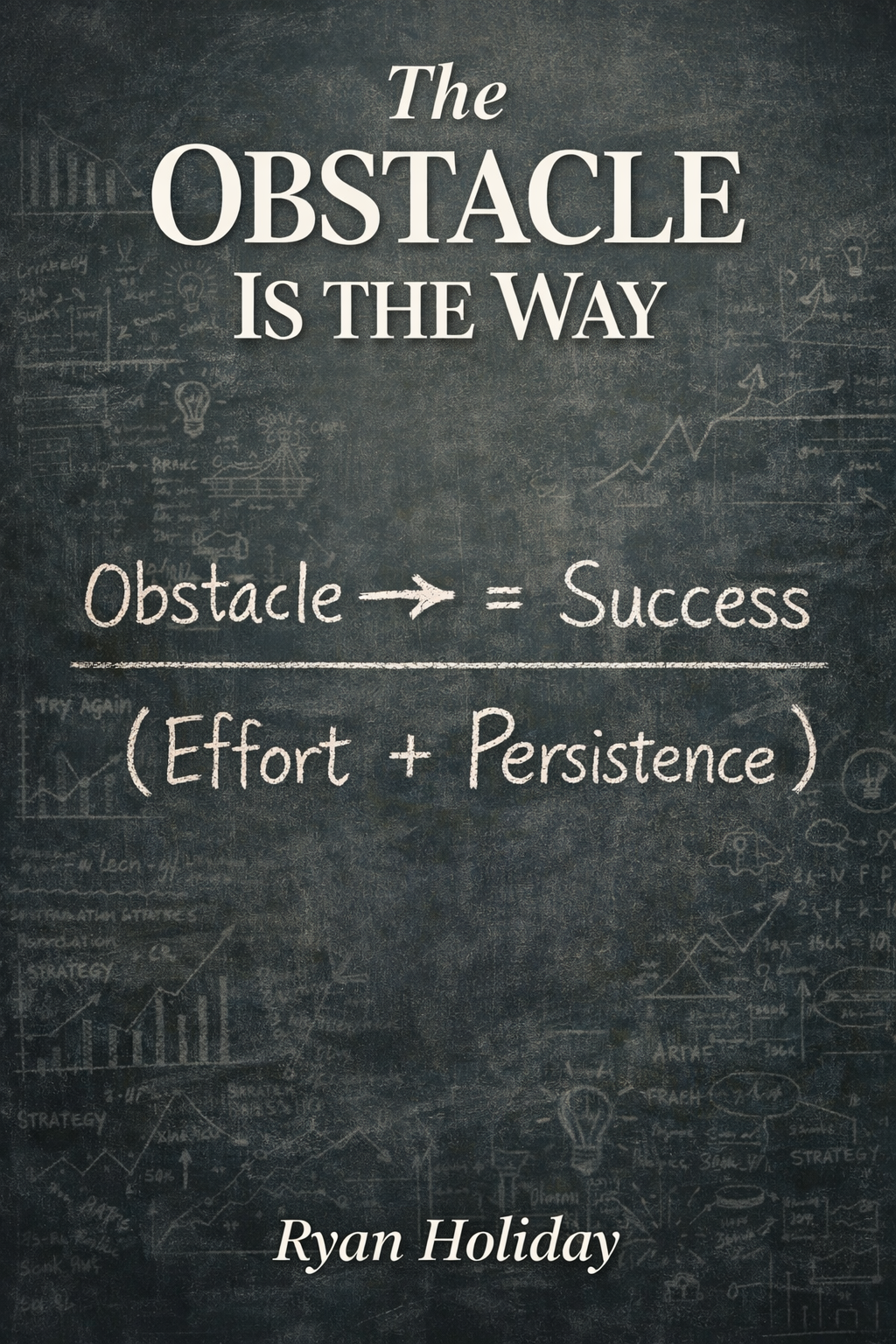
The Obstacle Is the Way
Chapter Summaries
What's Here for You
Are you ready to transform the challenges that stand between you and your goals into the very fuel that propels you forward? "The Obstacle Is the Way" by Ryan Holiday offers a profound and empowering framework, rooted in ancient Stoic wisdom, to help you navigate life's inevitable hurdles with resilience, clarity, and unwavering resolve. This isn't just another self-help book; it's a practical guide to reframing your entire approach to adversity. You'll discover how to master your perception, understanding that how you *choose* to see a situation is far more powerful than the situation itself. Learn to harness the discipline of right action, moving beyond mere activity to strategic, courageous, and persistent efforts that dismantle obstacles piece by piece. Most importantly, you'll tap into the immense power of your inner will – the unshakeable core of your being that remains untouched by external circumstances and serves as your ultimate source of strength when all else seems lost. Through compelling stories of historical figures like John D. Rockefeller, Abraham Lincoln, and Marcus Aurelius, you'll gain actionable insights and a renewed sense of agency. Prepare to embrace a mindset where setbacks are not roadblocks, but opportunities for growth. The intellectual tone is one of profound insight and practical application, while the emotional tone is one of empowerment, resilience, and ultimately, triumphant overcoming. This book promises to equip you with the mental fortitude to face any challenge head-on, not just to survive it, but to thrive because of it. The obstacle, as the title suggests, truly becomes the way.
PERCEPTION
Ryan Holiday, in 'The Obstacle Is the Way,' reveals that our perception is not merely how we see the world, but our decision about what events will mean, a lens that can be our greatest strength or profound weakness. He illustrates this through the early life of John D. Rockefeller, who, during the Panic of 1857, didn't succumb to fear like others but instead saw an opportunity to learn, developing a sangfroid—an unflappable coolness under pressure—that would define his legendary career, teaching us that the market, like life, is unpredictable and often vicious, and only a rational, disciplined mind can profit from it. This discipline of perception, Holiday argues, is learned, not innate, forged in the school of adversity, enabling one to resist impulse in favor of cold, hard common sense, a lesson echoed in Warren Buffett's adage to be fearful when others are greedy and greedy when others are fearful. The narrative then shifts to Rubin Hurricane Carter, wrongly imprisoned, who, despite the loss of physical freedom, refused to surrender his internal freedom—his attitude, beliefs, and choices—demonstrating that while external circumstances can be controlled by others, our reactions and perceptions remain our own, a powerful testament to Marcus Aurelius's idea that we choose not to be harmed, and therefore are not harmed. This control over our internal world is paramount, as Holiday explains using the example of Ulysses S. Grant, who displayed remarkable nerve control and composure amidst explosions and chaos, a trait he cultivated through practice and a clear focus on his objective, reminding us that in the face of life’s pressures, grace and poise, a cool head, are more valuable than talent alone. The chapter deepens this by exploring how to control our emotions, drawing parallels to astronauts trained not to panic, where emotional regulation is the difference between life and death, urging us to replace emotional freakouts with logic and a calm assessment, asking ourselves if getting upset provides more options, and realizing that if it doesn't change the situation, it’s an unhelpful, even destructive, emotion. Furthermore, Holiday introduces the practice of objectivity, urging us to separate the factual 'this happened' from the subjective 'and it is bad,' much like Miyamoto Musashi’s observing eye that sees only what is there, free from exaggerations and prejudice, employing exercises like 'Contemptuous Expressions' to strip away ornamentation and see things as they truly are, realizing that we are complicit in the creation of our obstacles through our judgments. The power of altering perspective is highlighted through Pericles, who, during a solar eclipse, used a simple analogy to calm his panicked sailors, showing that fear is often irrational and can be defeated by reframing the situation, understanding that while we cannot change the obstacle itself, we can change how it appears and how we approach it, transforming perceived disasters into opportunities for growth. Finally, Holiday emphasizes that true genius and accomplishment lie in acting on our perceptions, as exemplified by Steve Jobs, who, through his 'reality distortion field,' pushed boundaries and inspired teams to achieve the seemingly impossible, reminding us that our perceptions heavily influence what we believe is possible, and that boldness comes from calculating risks and acting decisively, echoing Epictetus's wisdom: our primary job is to divide things into what we can control – our choices, judgments, and perspectives – and what we cannot, focusing our energy on the former to navigate life’s challenges, ultimately finding opportunity not in avoiding adversity, but in embracing it, transforming every setback into a chance to learn, grow, and act.
Action
Ryan Holiday, in his exploration of action within 'The Obstacle Is the Way,' reveals that while action is commonplace, right action is a discipline, a directed force aimed at dismantling obstacles step by step. He emphasizes that true action requires courage, creative application, and persistence, not brute force or mere thought, citing the profound example of Demosthenes, who overcame a speech impediment and theft by his guardians not with excuses, but with relentless, self-imposed training, literally burying himself in study and practicing with pebbles in his mouth, ultimately becoming Athens' greatest orator and conscience. This narrative underscores a core insight: our response to adversity defines us, much like an instinctual flinch protects us from falling, we must act decisively rather than dally or evade, for as Holiday argues, it is not what happens to us but what we do with it that matters, turning 'shit into sugar' through gusto and creativity, a principle echoed by Amelia Earhart's audacious 'yes' to a risky transatlantic flight offer, which propelled her to global renown not by waiting for perfect conditions, but by gaining momentum and pressing forward. He urges us to seize the initiative, to swing the bat, to stop jogging when we should be sprinting, illustrating this with Erwin Rommel’s relentless forward momentum on the North African front, contrasting it with the cautious British, reminding us that 'always think with your stick forward' is the mantra to avoid crashing. The chapter then pivots to persistence, asserting that 'the best way out is always through,' as demonstrated by Ulysses S. Grant's arduous, year-long campaign to capture Vicksburg, where exhausting conventional options led him to bold, unconventional strategies like running his boats past enemy batteries, a tenacity mirrored by Thomas Edison’s six thousand filament tests, proving that genius is often persistence in disguise; the essential lesson here is that innovation and victory often arise from the slow, repeated pressure of trying every angle until one works, a refusal to be deterred by doubt or discouragement, embodying the spirit to 'strive, to seek, to find, and not to yield.' Iteration, the next crucial element, is presented through the lens of Silicon Valley startups and their Minimum Viable Products (MVPs), where 'failure is a feature,' teaching us to embrace feedback, learn from mistakes cheaply and quickly, and view ourselves as 'startups of one,' continually refining our approach rather than fearing the sting of error, recognizing that 'action and failure are two sides of the same coin' and that each setback is an opportunity to ask 'what went wrong here?' and 'what can be improved?' This leads to the concept of 'The Process,' championed by Coach Nick Saban, which advocates focusing on the task at hand—'what you needed to do in this drill, on this play, in this moment'—rather than the ultimate prize, creating order and manageability by breaking down daunting challenges into discrete steps, much like Henry Clay advised a young James Espy on learning the alphabet, one letter at a time. Holiday then delves into 'Doing Your Job, Doing It Right,' highlighting figures like Andrew Johnson and James Garfield who found pride and success by mastering their current roles, however humble, underscoring that 'how you do anything is how you can do everything,' and that vanity falls away when action and duty become priorities. Pragmatism, or 'What's Right Is What Works,' is illustrated by Samuel Zemurray's cunning acquisition of land by buying it from both claimants, bypassing legalities with ingenious solutions like temporary pontoon bridges, reminding us to focus on results over perfect methods, to be flexible and adapt, asking 'how are you going to solve this problem?' rather than adhering rigidly to rules, a spirit embodied by Richard Wright forging a note to access books. He further explores the 'Flank Attack,' using George Washington's wily, evasive tactics against the British, emphasizing that decisive victories often come not from direct confrontation but from unexpected angles, 'never attack where it is obvious,' and the power of indirect approaches, akin to Phil Jackson's triangle offense, using leverage and avoiding direct confrontation where the enemy is strongest. Finally, the chapter champions 'Using Obstacles Against Themselves,' drawing parallels with Gandhi's nonviolent civil disobedience, where 'nonaction can be action,' absorbing the opponent's power, and the Russians using winter against Napoleon and the Nazis, urging us to find ways for adversity to defeat itself, like Alexander the Great tiring his horse Bucephalus, or to recognize when restraint and patience are the wisest actions, understanding that 'sometimes, staying put, going sideways, or moving backward is actually the best way to advance,' and that 'every positive has its negative,' and by pushing through, we can transform negatives into positives. Ultimately, Holiday concludes with 'Prepare for None of It to Work,' reminding us that while we can manage perceptions and direct actions, we cannot control the world, and sometimes, despite our best efforts, obstacles remain insurmountable, presenting an opportunity to practice virtues like acceptance and humility, embracing the idea that 'problems are a chance for us to do our best' and accepting the outcome with grace, ready for what comes next.
Will
The author Ryan Holiday, in the chapter 'Will' from 'The Obstacle Is the Way,' unveils the profound power of our inner resolve, a force that remains untouched by external circumstances and serves as our ultimate recourse when agency dissolves. He illustrates this through the life of Abraham Lincoln, a man who battled crippling depression yet led a nation through civil war, demonstrating that true strength lies not in brute force but in quiet humility, resilience, and flexibility. Lincoln’s personal suffering, far from being a weakness, forged the profound empathy and patient endurance required to navigate the nation’s trial, teaching us that our own hardships can become a unique preparation for greater purpose. This internal fortitude, this 'Will,' is the discipline of the heart and soul, the one thing we control completely, allowing us to endure, contextualize, and derive meaning from obstacles that cannot simply be overcome. Holiday then turns to Theodore Roosevelt, who, despite a childhood ravaged by asthma, relentlessly built himself into a formidable figure, underscoring the principle that our physical and mental strength are not fixed but forged through deliberate practice, much like the ancient Stoics who cultivated an 'Inner Citadel'—a mental fortress against adversity. This preparation, this 'anticipation thinking negatively,' or *premeditatio malorum*, is a crucial practice, a mental rehearsal of potential failures to build resilience and manage expectations, preparing us for the inevitable disruptions life throws our way. The chapter then explores the 'Art of Acquiescence,' recognizing that true strength lies not in fighting against what we cannot change, but in accepting and channeling our energy effectively, much like Thomas Jefferson, who, unable to be a public orator, became a master writer. This acceptance, this *amor fati*—the love of everything that happens—is not passive resignation but an active embrace of fate, transforming what we *must* do into what we *get* to do, finding joy and opportunity even in disaster, as Thomas Edison famously did when his factory burned down. Ultimately, Holiday emphasizes perseverance, the long game of 'Sitzfleisch' or staying power, championed by figures like Odysseus and Magellan, which is more than mere persistence; it is an indomitable will that keeps us moving forward, round after round, until the end. Finally, the chapter urges meditation on mortality, not as a morbid exercise but as an invigorating reminder that our limited time imbues life with purpose and urgency, helping us prioritize what truly matters and face every obstacle, no matter how daunting, with clarity and gratitude, preparing us to start the cycle anew, for as Virgil noted, 'Behind mountains are more mountains,' and each challenge overcome only reveals the next, refining us into our best selves.
FINAL THOUGHTS The Obstacle Becomes the Way
Ryan Holiday's "The Obstacle Is the Way" culminates in a profound reflection, drawing from the life of Marcus Aurelius, who faced a stark betrayal when his trusted general, Avidius Cassius, rebelled. Instead of succumbing to anger, Marcus, embodying the Stoic principle of controlling perception, chose a path of measured response. He kept the news secret, delaying his reaction, hoping Cassius might reconsider. When that didn't happen, he prepared to march, but with an extraordinary intention: to capture Cassius alive and forgive him. This internal discipline, a core tenet of Stoicism, allowed Marcus to transform personal affront into a broader opportunity for demonstrating justice and clemency. The author explains that this internal control is the first step in turning obstacles into advantages. Even though fate intervened when an assassin killed Cassius before Marcus could enact his plan, the obstacle of betrayal still became the way. It presented Marcus with an even greater chance to practice forgiveness, not just on an individual, but on a systemic scale. He refused to execute any of Cassius's co-conspirators or prosecute supporting senators, famously imploring the senate to keep his reign unstained by the blood of any senator. This illustrates a crucial insight: adversity, like fire, can consume challenges and rise higher, using the very material that threatens to overwhelm it. Holiday emphasizes that while we may not face military rebellions, the principle remains universally applicable. Every day presents smaller, yet significant, obstacles—pointed remarks, traffic jams, professional setbacks, personal hurts. The author guides us to see these not as dead ends, but as opportunities to practice resilience and virtue. This is the essence of the Stoic approach: to perceive things clearly, act correctly, and endure what cannot be changed. It's about transforming fear into prudence, pain into transformation, and mistakes into initiation. This philosophical framework, accessible to all, unlocks latent powers within us—the power to manage our perceptions, direct our actions, and strengthen our will. It’s not about avoiding difficulties, but about leaning into them, much like Margaret Thatcher earning her moniker, the "Iron Lady," through years of steadfastness. Vires acquirit eundo, the Latin phrase suggests, "We gather strength as we go." Ultimately, the chapter reveals that what once blocked the path now becomes the path itself. By mastering perception, action, and will, we can flip any obstacle, becoming stronger, more resilient individuals, prepared for life's inevitable trials, and finding that what impedes us actually advances us. The obstacle, in its truest sense, becomes the way forward.
Conclusion
Ryan Holiday's "The Obstacle Is the Way" offers a profound and actionable framework for navigating life's inevitable challenges, not as impediments, but as the very path to progress. The core takeaway is a radical shift in perspective: our perception of an event, not the event itself, dictates its impact. By cultivating objective observation, akin to a disciplined 'observing eye,' we learn to separate objective reality from our subjective judgments, thereby gaining clarity and preventing emotional overreactions. This leads to the crucial emotional and nerve control, presented not as innate traits but as learned skills honed through conscious practice, allowing us to remain calm and rational amidst chaos. The book consistently reinforces the power of reframing, transforming perceived disasters into opportunities for growth and development. A fundamental principle is the Stoic distinction between what is within our control – our thoughts, judgments, and actions – and what is not, enabling us to allocate our energy effectively and make sound decisions. True action, as explored in the book, is not mere busyness but a courageous, persistent, and directed force. It requires embracing calculated risks and understanding that our response to adversity, rather than the adversity itself, defines our journey. This involves persistence and iteration, viewing failures as vital feedback loops for learning and innovation, much like a startup refining its product. The emphasis on 'The Process' encourages focusing on the immediate task, breaking down overwhelming challenges into manageable steps to maintain momentum. Mastering one's current role with pride and excellence is also highlighted as a builder of character and capability, embodying the principle that 'how you do anything is how you can do everything.' "The Obstacle Is the Way" champions a pragmatic and flexible approach, prioritizing results over rigid adherence to methods and encouraging indirect strategies or 'flank attacks' when direct confrontation is unwise. A key strategic insight is learning to use obstacles against themselves, employing non-action or restraint, and transforming perceived weaknesses into advantages. The book prepares us for the possibility of failure, advocating for our best effort without attachment to outcome, and using insurmountable challenges as opportunities to practice virtues like humility and acceptance. The ultimate emotional lesson is one of resilience and inner strength, cultivated through acceptance of what we cannot change and channeling energy into what we can. Personal adversity, when reframed, becomes preparation and a source of empathy. Proactive mental preparation, such as rehearsing potential failures (*premeditatio malorum*), builds resilience. The 'Art of Acquiescence' and *amor fati* – the love of fate – are presented as powerful tools for transforming constraints and necessary actions into opportunities. Perseverance is underscored as the sustained application of will and endurance, essential for navigating life's continuous flow of obstacles. Meditating on mortality provides perspective and urgency, clarifying priorities and fostering a more purposeful and grateful existence. Ultimately, the book teaches that strength and resilience are cultivated through consistent practice and facing challenges head-on, gathering momentum over time. The fundamental Stoic disciplines of clear perception, correct action, and enduring acceptance provide the comprehensive toolkit to not only navigate but to actively benefit from any obstacle, for the obstacle, in truth, becomes the way.
Key Takeaways
Adversity can be harnessed as fuel for growth, much like fire consumes obstacles to rise higher.
Our perception of events, not the events themselves, determines their impact, allowing us to choose between seeing obstacles as insurmountable problems or opportunities for growth.
Cultivating objective observation, akin to Miyamoto Musashi's 'observing eye,' involves separating factual events from subjective judgments to gain clarity and avoid unnecessary emotional reactions.
Emotional control and nerve control are learned skills, developed through practice and conscious effort, enabling us to remain calm and rational amidst chaos, much like astronauts or historical figures.
The ability to alter our perspective, reframing challenges not as disasters but as chances for development, is a powerful tool for navigating adversity and unlocking potential.
Distinguishing between what is within our control (our thoughts, judgments, actions) and what is not (external circumstances, others' actions) is fundamental to effective decision-making and energy allocation.
True action stems from a clear, objective perception of reality, embracing calculated risks rather than succumbing to fear or conventional limitations, thereby turning obstacles into advantages.
Embrace action not as mere activity, but as a deliberate, courageous, and persistent force directed towards overcoming obstacles, recognizing that our response to adversity, not the adversity itself, defines our path.
Cultivate persistence and iteration by viewing failures not as endpoints but as crucial educational feedback loops, essential for innovation and learning, akin to a startup constantly refining its product.
Follow 'The Process' by focusing on the immediate task at hand rather than the distant prize, breaking down overwhelming challenges into manageable steps to maintain order and momentum.
Master your current role and perform your duties with pride and excellence, understanding that 'how you do anything is how you can do everything,' and that dedication to the task, however small, builds character and capability.
Adopt a pragmatic, flexible approach, prioritizing results over rigid adherence to rules or methods, and be willing to adapt tactics to fit the situation, asking 'what works?' rather than 'what is the perfect way?'
Employ indirect strategies and flank attacks, avoiding direct confrontation where enemies are strongest, and instead seek leverage, unexpected angles, and the line of least expectation to achieve victory.
Learn to use obstacles against themselves by employing non-action, restraint, or by allowing the obstacle's inherent energy to work for you, transforming perceived weaknesses into strategic advantages.
Prepare for the possibility of failure by giving your best effort without attachment to outcome, accepting that some obstacles may be insurmountable and using such challenges as opportunities to practice virtues like humility and acceptance.
True inner strength, or 'Will,' is cultivated through acceptance and resilience, not by resisting uncontrollable external events.
Personal adversity, when reframed, can serve as essential preparation and a source of empathy for facing larger challenges.
Proactive mental preparation, such as rehearsing potential failures (*premeditatio malorum*), builds resilience and better equips us to handle life's inevitable disruptions.
The 'Art of Acquiescence' involves accepting what cannot be changed and channeling energy into what can, transforming constraints into opportunities for growth.
Embracing *amor fati*, the love of fate, means actively finding value and cheerfulness in all circumstances, turning necessary actions into opportunities.
Perseverance is the sustained, long-term application of will and endurance, crucial for navigating life's continuous series of obstacles, not just single challenges.
Meditating on mortality provides perspective and urgency, clarifying priorities and empowering us to live more purposefully and gratefully.
Control your perceptions to prevent external events from dictating your emotional and mental state.
Transforming negative experiences into opportunities for practicing virtue, such as forgiveness and resilience, is a powerful strategy for personal advancement.
The core Stoic disciplines of clear perception, correct action, and enduring acceptance provide the tools to navigate and benefit from any obstacle.
Strength and resilience are not innate but are cultivated through consistent practice and facing challenges head-on, gathering momentum over time.
The fundamental lesson is to see obstacles not as impediments, but as the very path forward, advancing action rather than impeding it.
Action Plan
When faced with a challenging event, consciously pause and ask: 'What is the objective reality of this situation, and what is my subjective judgment about it?'
Practice observing your emotional reactions to stressors and ask: 'Does this emotion provide me with more options, or is it hindering my ability to act?'
Identify one external circumstance you cannot control and one internal choice you can make regarding it. Focus your energy on the choice.
When encountering a setback, actively seek out the potential lesson or opportunity it presents, even if it's small.
Before reacting to a perceived problem, take a moment to 'hold on a moment, let me see who you are and what you represent'—test the impression before accepting it.
Reframe a current challenge by asking: 'If this were happening to a friend, what advice would I give them?' and apply that objective perspective to your own situation.
Consciously acknowledge a moment of potential panic or overwhelm and tell yourself, 'I am not going to die from this,' and then focus on the immediate, actionable task.
Identify one significant obstacle in your life and brainstorm at least three distinct actions you can take to address it, focusing on courage and persistence.
Choose a task you've been procrastinating on and commit to working on it for a set period (e.g., 30 minutes) without distraction, focusing only on the immediate steps.
Reflect on a recent failure or setback; ask yourself 'What can I learn from this?' and identify one specific adjustment you can make for future attempts.
Take on a small, mundane task today with the intention of doing it exceptionally well, focusing on craftsmanship and pride in execution, regardless of its perceived importance.
When faced with a problem, identify the most direct or 'expected' solution, then brainstorm at least two indirect or 'flank attack' approaches.
Analyze a current challenge and consider how its inherent characteristics or the actions of others could be used to your advantage, rather than fought against.
Practice 'channeling your energy' by consciously redirecting frustration or negative emotions into focused, productive action rather than outward expression.
Set a clear goal, but then consciously focus your daily efforts on the smaller, immediate 'process' steps required to reach it, rather than solely on the end result.
When a plan doesn't work out as expected, consciously choose to accept the outcome gracefully and immediately pivot to the next step or alternative, rather than dwelling on the setback.
Practice *premeditatio malorum* by envisioning potential failures in a current project or goal and planning responses.
Identify one aspect of your life you tend to resist or fight against, and consciously practice accepting it without judgment.
Reframe a recent setback by asking: 'What lesson can I learn from this, and how can it make me stronger or more empathetic?'
In moments of frustration, consciously choose to adopt a cheerful or grateful attitude, even if it feels unnatural at first.
When facing a difficult task or challenge, remind yourself of the long-term goal and focus on consistent, daily effort rather than immediate victory.
Dedicate a few minutes each day to reflecting on your own mortality, not with fear, but with gratitude for the present moment.
Consider how you can contribute to a cause or community larger than yourself, focusing on 'Unity over Self' in your actions.
When faced with a setback, pause and consciously control your initial perception of the event.
Identify how a current challenge can be used as an opportunity to practice patience, forgiveness, or another virtue.
Practice clear perception by observing situations objectively, without emotional judgment.
Direct your actions with energy and persistence, focusing on what is within your control.
Develop your will by enduring difficulties and compensating for disadvantages.
Mentally rehearse how you would apply Stoic principles to potential future obstacles.
Seek to understand and accept the world as it is, rather than wishing it were different.