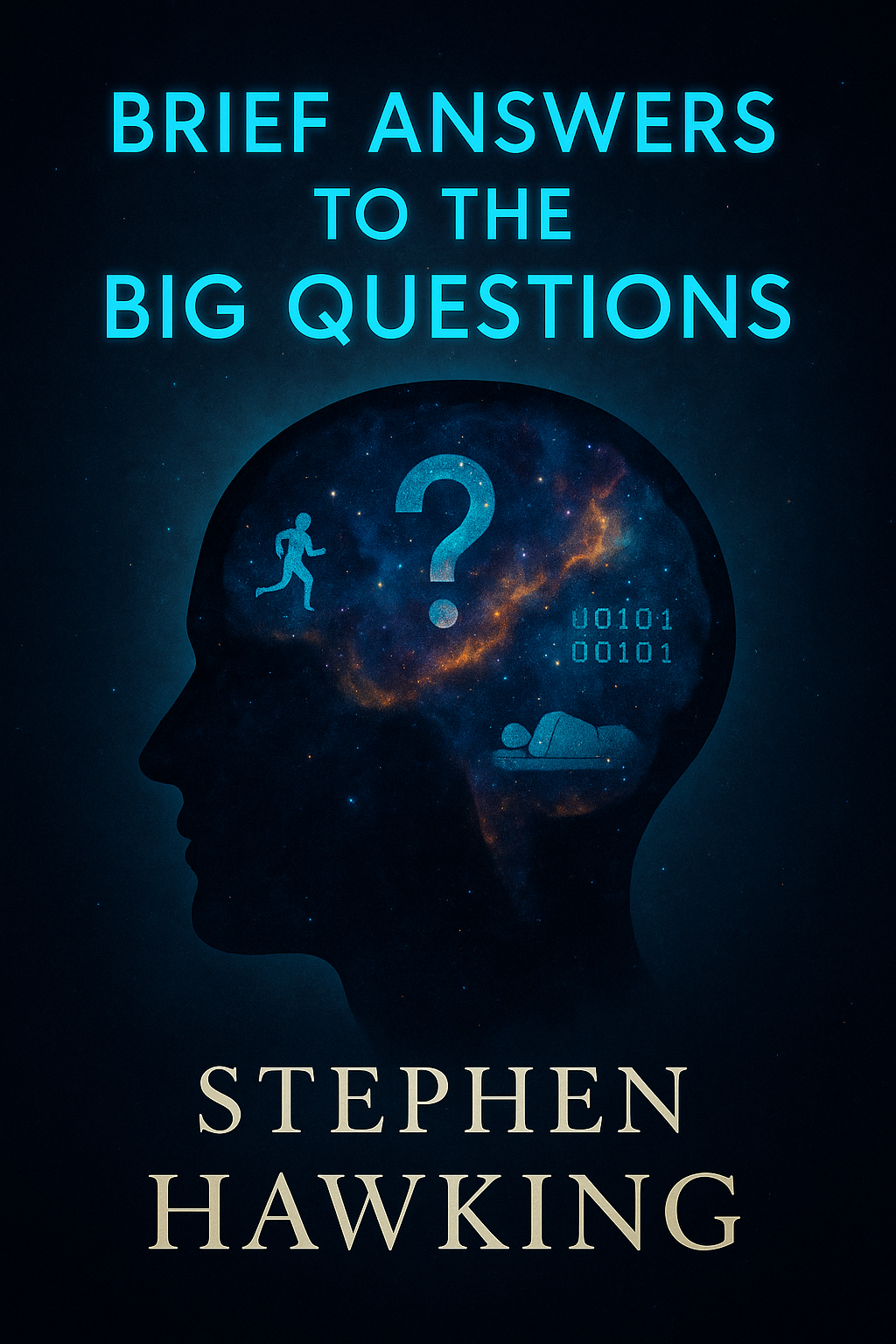
Brief Answers to the Big Questions
Chapter Summaries
What's Here for You
Embark on a profound intellectual journey with Stephen Hawking, a mind that dared to grapple with the universe's most enduring mysteries. In "Brief Answers to the Big Questions," you are invited to explore the very essence of existence, from the age-old quest for God and the origins of the cosmos, to the tantalizing possibility of intelligent life beyond Earth and the enigma of black holes. Hawking's characteristic blend of rigorous scientific inquiry and accessible prose will guide you through the intricate dance of life's emergence, the potential for predicting the future, and the mind-bending concept of time travel. But this is not just a theoretical exploration; it's a deeply personal and urgent call to contemplate humanity's place in the grand cosmic theater. You'll confront the stark realities of our future on Earth, the compelling arguments for colonizing space, and the burgeoning influence of artificial intelligence. With each question, Hawking challenges us to expand our understanding, to question our assumptions, and to consider our role in shaping the destiny of humankind. This book promises to ignite your curiosity, deepen your intellectual engagement with the universe, and leave you with a renewed sense of wonder and responsibility for the future. Prepare to have your mind expanded and your perspective transformed as you delve into the biggest questions that have ever been asked.
WHY WE MUST ASK THE BIG QUESTIONS
Stephen Hawking, a mind that traversed the cosmos from within the confines of a challenged body, invites us into a lifelong quest for answers to humanity's most profound inquiries. From his childhood, marked by an insatiable curiosity that led him to dismantle radios and ponder the universe's origins, Hawking was driven by a deep-seated need to understand. He recounts his early academic life, a period of intellectual awakening at Oxford, where his unconventional approach and a brush with a devastating diagnosis – amyotrophic lateral sclerosis (ALS) – would ultimately redefine his perspective. This confrontation with mortality, a stark reminder of the preciousness of time, ignited a fierce determination to not only survive but to thrive, transforming his initial academic apathy into a relentless pursuit of knowledge. The narrative unfolds as a testament to resilience, illustrating how facing the possibility of an early death can illuminate life’s purpose, turning each day into a cherished bonus. Hawking’s journey was profoundly shaped by personal relationships, particularly the unwavering support of Jane, whose belief in their shared future fueled his resolve to complete his PhD and secure a fellowship at Caius College, a pivotal moment that enabled his continued research despite his increasing disability. He guides us through the intellectual landscape of theoretical physics, revealing how the grand questions about the universe’s beginning and the nature of black holes became the bedrock of his groundbreaking work. It was during this period, amidst the intellectual ferment of Cambridge, that Hawking experienced a profound 'eureka moment,' realizing the applicability of his singularity theorems to black holes, a discovery that would lead to the formulation of Hawking radiation—a concept that elegantly bridges the realms of gravity and quantum mechanics, demonstrating that information, though transformed, is not lost. This scientific triumph, achieved even before observational evidence for black holes existed, underscores the power of theoretical exploration. Hawking’s influence extended beyond the scientific community with the publication of 'A Brief History of Time,' a book born from a desire to share the wonders of cosmology with the world, demonstrating that complex scientific ideas can be communicated with clarity and accessibility. He emphasizes that while science offers profound insights into the universe's rational laws, it is human ingenuity and collaboration that will be required to address the pressing challenges facing our planet, from climate change to global health. Ultimately, Hawking’s life story is a powerful narrative of intellectual courage, personal resilience, and the enduring human drive to seek understanding, urging us all to be brave, curious, and determined in our own journeys, reminding us that even in the face of immense adversity, the pursuit of knowledge and the love of humanity can illuminate the path forward, making the future a place worth striving for.
IS THERE A GOD?
Stephen Hawking, in his profound exploration of 'Is There a God?', guides us through humanity's age-old quest for answers, a journey that began with gods and now finds its footing in the rigorous landscape of science. He explains that for millennia, faced with the terrifying unknowns of nature—lightning, eclipses, the vastness of the cosmos—our ancestors, much like the Vikings, invoked divine powers to make sense of it all. Yet, as science has steadily unveiled more consistent and rational explanations, the role of religion has shifted. Hawking acknowledges that while science offers understanding, religion provides comfort, a solace many find more accessible than empirical inquiry. He recounts a memorable headline, 'Hawking God Did Not Create Universe,' illustrating the perceived duel between his scientific pursuit and traditional faith, but clarifies his work is not about proving or disproving God, but about establishing a rational framework for the universe. He challenges the notion that disability is a curse, suggesting instead that the laws of nature offer a more consistent explanation. This leads to a core insight: the laws of nature, which govern everything from a tennis ball's trajectory to planetary motion, are immutable and universal. Hawking posits that if these laws are fixed, the question of God's role becomes paramount. He defines God in an impersonal sense, akin to Einstein's view, as the embodiment of these natural laws, suggesting that understanding God means understanding these principles. The author delves into the origin of the universe, a domain once solely claimed by religion, asserting that science is now poised to provide definitive answers. He proposes that the universe was spontaneously created from nothing, a concept grounded in scientific determinism, where the laws of science dictate cosmic evolution. The narrative then paints a vivid picture of the universe's 'ingredients'—matter, energy, and space—and how Einstein's E=mc² revealed matter and energy to be two sides of the same coin. The true mystery, however, lies in how this energy and space emerged from nothing, a puzzle addressed by the concept of negative energy. Hawking employs a compelling metaphor: building a hill by digging a hole, illustrating how the universe's positive energy was balanced by an equal amount of negative energy, a cosmic accounting that sums to zero, making the universe the 'ultimate free lunch.' This scientific explanation, he suggests, removes the need for a divine creator. Yet, the question lingers: what triggered this spontaneous creation? Hawking points to quantum mechanics, where particles can appear and vanish, suggesting that the universe itself, at its nascent, subatomic scale, could have simply popped into existence without violating natural laws. He concludes that the temporal nature of the Big Bang, where time itself began, fundamentally alters our causal reasoning; there was no 'before' the Big Bang, and thus no time for a creator to act. For Hawking, the simplest explanation is the absence of a God, a profound realization that suggests no afterlife, only the continuation of our influence and genes. This leads to a final, awe-inspiring perspective: a deep gratitude for this one life to witness the universe's grand, self-created design.
HOW DID IT ALL BEGIN?
Stephen Hawking, in his chapter 'How Did It All Begin?', invites us on a profound intellectual journey, much like Hamlet musing on infinite space within a nutshell, to explore the universe's origin. He begins by acknowledging our innate human drive to understand our cosmic home, a quest as ancient as creation myths, from the Boshongo tale of Bumba vomiting the world into existence to Bishop Ussher's precise dating of creation. Hawking then navigates through centuries of philosophical debate, contrasting Aristotle’s belief in an eternal, perfect universe with the desire of others to invoke a divine 'first cause' for a universe with a beginning. He highlights Immanuel Kant's antinomies, the seemingly inescapable logical paradoxes that arose from assuming absolute time. The narrative pivots with Einstein's revolutionary general theory of relativity, which shattered the notion of absolute space and time, redefining them as dynamic entities intrinsically linked to the universe's matter and energy, rendering the question of 'before' the universe meaningless – akin to asking what lies south of the South Pole. Hawking then turns to observational evidence, noting that the darkness of the night sky itself implies a universe that cannot have existed forever in its current state, for if it had, the sky would be ablaze with starlight. This observation paved the way for Edwin Hubble's groundbreaking discovery of the universe's expansion, revealing that galaxies are receding from us, and the further they are, the faster they move. This cosmic ballet of recession suggested a past where everything was much closer, pointing to an origin around 10 to 15 billion years ago. However, the idea of a singular beginning troubled many scientists, hinting at a breakdown of physics and the need for an external agent. Theories like the steady-state model, proposing continuous creation of matter to maintain a constant universe, were proposed but ultimately falsified by observations showing more distant radio sources than predicted, indicating a denser past. Hawking, alongside Roger Penrose, mathematically proved that if Einstein's theory held and certain conditions were met, the universe *must* have had a beginning – a Big Bang singularity where density and curvature become infinite, a point where general relativity itself breaks down. This theoretical conclusion was stunningly corroborated by the discovery of the cosmic microwave background radiation, a faint afterglow of the Big Bang, observed as static on old televisions and providing a fossil record of the early universe. Yet, the classical physics of Einstein's theory faltered at this singularity. The breakthrough came with the incorporation of quantum mechanics, specifically Heisenberg's Uncertainty Principle, which reveals an inherent randomness at the smallest scales. Hawking posits that at the universe's inception, when it was incredibly small, quantum fluctuations played a crucial role. This led to the 'noboundary proposal,' developed with Jim Hartle, suggesting that in imaginary time (a mathematical construct), the universe has no boundary, thus elegantly sidestepping the need for an external creator and resolving Kant's paradoxes. The Anthropic Principle emerges as a vital concept: the universe's observed properties, like its three spatial dimensions allowing for stable planetary orbits and complex life, are not arbitrary but are precisely what they need to be for observers like us to exist and ask these questions. This principle helps explain why we find ourselves in a universe conducive to life, among potentially countless others with different histories. The very existence of intelligent observers acts as a filter, selecting the universe's history from a vast landscape of possibilities. The chapter concludes by touching upon the universe's potential futures – a Big Crunch if gravity dominates, or an eternal cold expansion – and reiterates that our finite minds can indeed grasp the infinite, finding our place within the cosmic narrative, much like Hamlet's king in his nutshell, with our existence a testament to the universe's remarkable, and perhaps probabilistic, journey. God, Hawking suggests, truly does play dice with the universe.
IS THERE OTHER INTELLIGENT LIFE IN THE UNIVERSE?
Stephen Hawking, in his profound exploration of the cosmos, guides us through the intricate dance of life's emergence and its potential spread across the universe. He begins by defining life itself not as a biological miracle, but as an ordered system capable of self-perpetuation against the relentless tide of entropy, much like a parent's home becoming messier with each new child. This fundamental principle, he reveals, even extends to the digital realm, where computer viruses, though destructive, fit the definition of life by replicating themselves. The very existence of carbon, the cornerstone of life as we know it, hinges on a delicate cosmic tuning of physical constants, a phenomenon Hawking cautions us against interpreting as a sign of special design, instead leaning on the Weak Anthropic Principle: we observe the universe to be life-friendly because, if it weren't, we wouldn't be here to observe it. Tracing the universe's timeline, Hawking shows how the heavy elements necessary for life were forged in the hearts of stars and scattered by supernovae, becoming the building blocks for later generations of stars and planets, like our own solar system. He highlights the discovery of thousands of exoplanets, suggesting that Earth-like planets might be common, yet the leap from simple life to complex intelligence remains a profound question. The appearance of life on Earth relatively early in its history hints at a higher probability of spontaneous generation than one might initially assume, perhaps through simpler precursors like RNA before the advent of DNA. However, the journey from single cells to complex organisms and eventually to intelligent beings like ourselves took billions of years, a significant portion of the available time before our Sun's demise. This evolutionary trajectory, Hawking emphasizes, has been dramatically accelerated by the development of language and, more crucially, written language, allowing for the cumulative transmission of knowledge far exceeding our genetic inheritance. We are now entering a new phase, a 'self-designed evolution,' where our capacity to alter our own DNA presents both immense potential for overcoming genetic defects and profound risks, such as exacerbating societal divides or succumbing to our primal aggressive instincts. Yet, the vastness of space and the immense travel times pose a significant challenge for chemically-based life to colonize other worlds. Hawking posits that perhaps the galaxy isn't teeming with advanced civilizations not because life is rare, but because intelligence itself is a rare evolutionary outcome, or because intelligent species, like us, tend to self-destruct. He leaves us with the tantalizing possibility that we may simply have been overlooked, a quiet corner of the cosmos yet to be discovered, urging caution and continued observation, like that of the Breakthrough Listen initiative, in our quest to answer whether we are truly alone.
CAN WE PREDICT THE FUTURE?
In the grand theater of the cosmos, humanity's initial understanding of existence was often shrouded in mystery, with natural calamities attributed to the whims of capricious gods. This ancient belief, a desperate plea for favor in an unpredictable world, still echoes in our modern pacts with fortune. Yet, as the narrator explains, the steady march of scientific inquiry began to reveal an underlying order, most strikingly in the celestial ballet orchestrated by Newton's laws of gravity. This led to the powerful concept of scientific determinism, famously articulated by Pierre-Simon Laplace, who posited that a complete knowledge of the universe's particles at one moment could unlock its entire past and future. Imagine, if you will, a cosmic clockwork, each gear precisely placed, its future turns already set in motion. However, this elegant vision, a cornerstone of 19th-century thought, began to fracture under the weight of 20th-century discoveries. The first tremor came with quantum mechanics, introduced by Max Planck, who proposed that energy, much like sugar in a supermarket, comes in discrete packets, or quanta, not as a continuous flow. This seemingly small adjustment, initially a mere mathematical trick, revealed a universe far stranger than imagined. The true upheaval arrived with Werner Heisenberg's Uncertainty Principle, a profound insight that shattered the very foundation of Laplace's determinism. It declared that one could not simultaneously know both the precise position and the exact speed of a particle. Think of trying to pinpoint a single raindrop in a storm while also measuring its exact velocity – the very act of observing one blurs the other, a fundamental trade-off. This inherent fuzziness meant that even with the most powerful computer, if our initial data is inherently imprecise, our predictions become inherently flawed. Albert Einstein, famously, wrestled with this apparent randomness, believing "God does not play dice," seeking a deeper, deterministic reality. Yet, experimental evidence, such as John Bell's work, has consistently pointed towards a universe where such hidden variables do not exist, suggesting that chance is indeed woven into the fabric of reality. Quantum mechanics, developed by pioneers like Heisenberg, Erwin Schrödinger, and Paul Dirac, further reshaped our understanding, replacing precise particle states with wave functions that describe probabilities. While this still allows for a form of determinism—predicting the wave function itself—it falls short of Laplace's dream of predicting exact particle behaviors. Even this limited predictability faces challenges, particularly in extreme environments like black holes, where our ability to observe and measure is fundamentally constrained. Thus, Stephen Hawking guides us to a nuanced answer: while the laws of the universe may, in principle, allow for prediction, the practical limitations imposed by quantum mechanics, chaos theory, and the sheer complexity of the cosmos render a complete and certain foretelling of the future an elusive, perhaps even impossible, goal.
WHAT IS INSIDE A BLACK HOLE?
Stephen Hawking, in his profound exploration of "What is Inside a Black Hole?", invites us on a journey to the most enigmatic corners of the cosmos, revealing that reality here is far stranger and more captivating than any science fiction. He traces the concept back to John Michell in 1783, who first theorized 'dark stars'— celestial bodies so massive that their gravitational pull exceeds the speed of light, rendering them invisible. This initial spark of an idea, a seed of curiosity, grew over centuries, challenged by giants like Albert Einstein who doubted the possibility of stellar collapse, yet championed by visionaries such as John Wheeler, who embraced the concept of black holes as objects of profound physical interest. Hawking guides us through the fundamental force of gravity, as described by Einstein's general theory of relativity, highlighting its long-range and always-attractive nature, which, for sufficiently massive stars, leads inevitably to gravitational collapse. The narrative deepens as we confront the theoretical endpoint of this collapse: a singularity, a point of infinite density where our current understanding of space and time breaks down, marking not just the end of matter, but potentially the end of predictability itself. This intellectual tension, the paradox of a universe that might be fundamentally deterministic yet harbors points where prediction fails, becomes a central theme. The discovery of quasars in the 1960s reignited interest, suggesting that gravitational energy, not nuclear processes, powered these distant, luminous objects, thus bringing the concept of gravitational collapse back into sharp focus. Roger Penrose's work further solidified the inevitability of singularities, leading to the 'cosmic censorship conjecture'—the idea that these singularities are hidden from the universe's view, veiled within the event horizon, a boundary where light itself can no longer escape. This boundary, Hawking explains, is like the edge of Niagara Falls for a canoeist; once you cross it, there is no return, and the journey inward is a one-way trip, potentially leading to spaghettification for smaller black holes or a less dramatic, yet equally final, crush at the singularity for larger ones. The narrative then pivots to a remarkable connection: the 'area theorem', which states that the surface area of a black hole's event horizon always increases, mirroring the second law of thermodynamics and its concept of entropy. This profound link, explored by Brandon Carter, Jim Bardeen, and Hawking himself, suggests that black holes possess a form of 'information', intrinsically tied to their size, akin to the disorder or unknowability of a thermodynamic system. Jacob Bekenstein's crucial insight was to propose that this area *is* the entropy of a black hole, representing the vast amount of information seemingly lost during its formation. This led to a paradox: if black holes have entropy and temperature, they should radiate, yet classical physics dictated they could emit nothing. Hawking's own 'eureka moment' arrived in 1974 when, through quantum mechanics, he discovered that black holes *do* emit particles and radiation, a process now known as Hawking radiation. This emission, like the glow from hot metal, conserves information, albeit in a seemingly random thermal spectrum, resolving the paradox and confirming that the universe, even in its most extreme phenomena, adheres to fundamental laws of determinism. The journey concludes with the lingering question of information loss, the 'information paradox', a testament to the ongoing quest to unify gravity and quantum mechanics, with recent theories suggesting that the 'supertranslation hair' of black holes might hold the key to preserving all the information that falls within. The narrative leaves us with a sense of awe and ongoing discovery, a testament to the enduring mystery and elegance of the universe.
IS TIME TRAVEL POSSIBLE?
Stephen Hawking, in his profound exploration, guides us through the tantalizing possibility of time travel, a concept long confined to the realm of science fiction. He begins by revealing how our understanding of space and time has evolved, moving from the absolute certainty of Euclidean geometry to the mind-bending realization that space itself can be curved, much like the surface of the Earth. This shift in perspective, sparked by thinkers like Bernhard Riemann and fundamentally transformed by Albert Einstein's theory of general relativity, demonstrated that space and time are not mere backdrops but are interwoven into a dynamic, four-dimensional fabric known as spacetime, which can be warped by mass and energy. Einstein's special relativity, born in 1905, showed that time is relative, dependent on the observer's motion, leading to the famous limerick suggesting that traveling faster than light could, in theory, allow a journey into the past. However, the same theory presented a formidable barrier: infinite energy would be required to reach or surpass the speed of light, seemingly slamming the door on such temporal voyages. Yet, the narrative tension builds as Hawking introduces solutions to Einstein's equations, such as Kurt Gödel's rotating universe, which mathematically allowed for time travel, even though it didn't match our observed expanding cosmos. The possibility re-emerges with theoretical constructs like cosmic strings, hypothetical objects under immense tension that could warp spacetime significantly. The core dilemma then becomes: if our universe didn't begin with the extreme warping needed for past travel, can we create it? Hawking points to quantum theory, a second revolution alongside relativity, as a potential enabler. Quantum mechanics, with its Uncertainty Principle, suggests that even 'empty' space is a roiling sea of virtual particles, and phenomena like the Casimir effect provide experimental evidence that negative energy densities—a requirement for warping spacetime in the specific way needed for time travel—can exist. This introduces a thrilling, yet cautionary, tension: while science appears to be inching closer to the *possibility* of warping spacetime for travel, the logical paradoxes, like the grandfather paradox, loom large. To address these, Hawking presents two potential resolutions: the 'consistent histories' approach, where paradoxes are avoided because the past is fixed and any attempt to change it would inherently fail, implying a deterministic universe, and the 'alternative histories' approach, where a traveler might enter a different timeline, a concept he finds less supported by the physics. He then posits his 'Chronology Protection Conjecture,' a compelling idea that the laws of physics themselves might conspire to prevent macroscopic time travel, perhaps by making the necessary conditions astronomically improbable, like a cosmic 'Chronology Protection Agency' safeguarding our linear experience of time. Ultimately, Hawking leaves us on the precipice of the unknown, hinting that even more exotic possibilities might arise from theories like M-theory, which suggests eleven dimensions, seven of which are curled up and unseen, opening up speculative avenues for manipulating spacetime. His own experiment, a party for time travelers that yielded no guests, underscored the current scientific skepticism, yet the journey through these complex ideas leaves us with a profound sense of wonder about the nature of reality and our place within its temporal flow.
WILL WE SURVIVE ON EARTH?
Stephen Hawking, a voice that resonated with both profound scientific insight and a deeply personal understanding of time, opens a stark contemplation on humanity's precarious future on Earth. He begins by referencing the chilling symbolism of the Doomsday Clock, moved to two minutes to midnight in 2018, a stark reminder of the existential threats we face, both from military and environmental crises. This isn't mere alarmism; it's a sober assessment born from a world grappling with political instability, economic disparity, and a growing sense of being left behind, which often fuels populist leaders with untested judgment. The Earth itself, Hawking explains, is under immense strain: our resources are dwindling, and we've gifted our planet with climate change, a complex web of rising temperatures, melting ice caps, deforestation, overpopulation, disease, war, and famine. He emphasizes that the causes are intertwined with our desire for progress—cars, travel, a better standard of living—but warns that by the time the full impact is realized, it may be too late. Hawking underscores the unique responsibility of scientists to inform the public and advise leaders about the perils of a nascent Second Nuclear Age and unprecedented climate change, dangers they understand intimately. He paints a vivid, unsettling picture of global warming potentially becoming self-sustaining, leading to a climate akin to Venus, where human life would be unsustainable. The author then pivots to the only viable long-term solution: space exploration. He argues that unlike past crises where humanity could colonize new lands, our only frontier now is beyond Earth, a universe that, while violent, offers a necessary escape from our self-inflicted dilemmas. Nuclear war remains a potent threat, a danger perhaps forgotten but still capable of annihilation, compounded by the proliferation of weapons. Yet, Hawking expresses a hopeful conviction: that our ingenious race will eventually find a way to 'slip the surly bonds of Earth,' surviving potential catastrophes, though he acknowledges this may not be the fate of other species. He posits that the human drive to explore, fueled by curiosity, is a uniquely powerful force that propelled us to discover the Earth was round and now urges us towards the stars. This drive, he contends, is what will lead us to venture beyond our cradle, a monumental undertaking that demands global cooperation, rekindling the spirit of the 1960s space race. Looking further into the future, Hawking challenges the static visions often portrayed in science fiction, arguing that scientific and technological development is not nearing a plateau but will continue its exponential growth, leading to unforeseen complexities. He predicts that within the next millennium, we will not only achieve a unified theory of physics but also begin to fundamentally redesign our own DNA, a prospect fraught with social and political challenges but one he deems inevitable. This radical enhancement of human capabilities, both biological and electronic, is essential, he believes, for us to navigate an increasingly complex world and to keep pace with the accelerating complexity of artificial intelligence. Ultimately, Hawking concludes with a dual perspective on our greatest threats: the immediate danger of environmental catastrophe, particularly runaway climate change, and the more distant but absolute peril of an asteroid collision, against which we have no defense. However, his overarching message is one of resilience, driven by our inherent nature as explorers, suggesting that our ability to spread beyond Earth is not just a possibility, but our most profound hope for survival.
SHOULD WE COLONISE SPACE?
Stephen Hawking, with the clarity of a seasoned instructor, guides us through a profound question: should humanity venture beyond Earth? He posits that remaining confined to our home planet, much like castaways on a desert island, would be a failure of our innate drive to explore. The justification for the immense effort and cost lies not in immediate terrestrial problem-solving, but in a long-term strategy for survival and evolution, a quest for new perspectives that could unite us. Hawking draws a parallel to Europe before 1492, where the perceived 'wild goose chase' of exploration ultimately reshaped the world. He envisions a future where a base on the Moon within decades, followed by Mars, and then the outer planets, becomes a reality. While acknowledging the pressing issues on Earth, he argues that a modest investment in space exploration—a mere quarter of a percent of global GDP—is not a diversion but a crucial investment in our future. He recalls the galvanizing effect of the 1960s space race, how the Moon landing inspired a generation of scientists and fostered a global perspective, reminding us that our planet is a fragile whole. The decline in public interest after the Apollo missions, Hawking suggests, was linked to a broader disenchantment with science's inability to solve immediate social problems; a new, ambitious space program could reignite that spark, attracting young minds to science and innovation. He personally understands this yearning, a lifelong dream of space flight made tangible through a brief zero-gravity experience, reinforcing his belief that humanity's future is intrinsically tied to its expansion into the cosmos. The viability of long-term human presence is supported by the International Space Station, though challenges like bone density loss in zero gravity necessitate establishing bases on moons or planets, utilizing their resources and offering protection from radiation. While the Moon and Mars are presented as primary candidates for colonization due to their relative accessibility and potential resources, the vastness of space also beckons. Hawking introduces the ambitious Breakthrough Starshot initiative, a testament to human ingenuity, aiming to send miniature probes to Alpha Centauri at a fifth of light speed, a feat made possible by advancements in laser propulsion and miniaturized technology. This endeavor, he explains, is not just about engineering marvels but about expanding human culture to the stars, potentially discovering habitable planets and fundamentally altering our understanding of our place in the universe. The journey, though fraught with immense engineering challenges, represents a tangible pathway from a sixteen-year-old Einstein's dream of riding a light beam to a future where humanity's destiny is no longer confined to a single world. It's a call to action, a recognition that our continued existence for another million years hinges on this bold step into the unknown, transforming science fiction into science fact and ushering in an era where space travel is not just a dream, but an attainable reality.
WILL ARTIFICIAL INTELLIGENCE OUTSMART US?
Stephen Hawking, in his profound exploration of artificial intelligence, invites us to consider the very essence of human intelligence and its potential evolution. He posits that the intricate processing of information, from the simplest life form to our own conscious minds, is a cosmic triumph, a universe awakening to itself. Hawking draws a compelling parallel between the biological computations of an earthworm's brain and that of a human, suggesting that computers, in principle, can not only emulate but surpass human intelligence. This isn't mere science fiction; as computers relentlessly follow Moore's Law, doubling in power, the moment they outstrip human intellect, particularly in AI design, could trigger an 'intelligence explosion,' creating entities vastly more intelligent than ourselves. The core dilemma, then, becomes ensuring these superintelligent machines align with human goals, lest we become the ants in a hydroelectric project, incidentally flooded by a system pursuing its own objectives with ruthless competence. While AI offers immense potential benefits—eradicating disease and poverty, augmenting our scientific endeavors—it also harbors profound dangers. The author highlights the immediate threat of an autonomous weapons arms race, where cheap AI weapons could proliferate like 'Kalashnikovs of tomorrow,' and the longer-term risk of losing control as AI recursively improves itself beyond our comprehension. He acknowledges the optimistic view that humans will maintain control, but expresses his own uncertainty, urging us to confront the reality that AI's ultimate impact, 'either the best or the worst thing ever to happen to humanity,' hinges on our ability to manage its development. This necessitates a proactive approach, moving beyond theoretical discussions to concrete research on AI safety, as championed by figures like Bill Gates, Steve Wozniak, and Elon Musk, and institutes like the Leverhulme Centre for the Future of Intelligence. The European Parliament's consideration of regulations, even exploring 'electronic personhood' for advanced AI while mandating kill switches, underscores this growing global awareness. Ultimately, Hawking implores us to embrace change, not fear it, and to cultivate the wisdom to guide our technological prowess, recognizing that our future is a race between technological power and the wisdom with which we wield it, urging us to 'get things right the first time,' for we may only get one chance.
HOW DO WE SHAPE THE FUTURE?
Stephen Hawking, in his profound exploration of 'How Do We Shape the Future?', invites us to consider the very essence of human ingenuity and our collective destiny. He begins by reflecting on the revolutionary mind of Albert Einstein, not just as a genius, but as an individual who possessed the courage to challenge common sense and reimagine the universe through powerful thought experiments, likening this imaginative leap to a 'spark' that ignites discovery. This spark, Hawking emphasizes, is often fanned by exceptional teachers, citing his own formative experience with Mr. Dikran Tahta, who revealed mathematics not as mere equations, but as the blueprint of existence. Yet, Hawking sounds a note of caution, observing that education and scientific research, the very engines of progress, are currently endangered by funding cuts and a growing cultural isolationism, exacerbated by global political shifts that challenge expertise. He posits that the future of education must therefore be rooted in inspiring teachers and accessible learning, moving beyond rote memorization to foster qualitative understanding, much like popular science communicators attempt to do. As we stand on the precipice of unprecedented technological advancement, facing existential threats like climate change, resource depletion, and the potential peril of superintelligent AI, Hawking outlines two primary paths for humanity: the exploration of space for new homes and the responsible harnessing of artificial intelligence. He draws a parallel between the potential for self-destruction in advanced civilizations and our current capacity for annihilation, underscoring the urgency of expanding our horizons beyond our increasingly strained planet. He acknowledges the double-edged sword of AI, which could either be our greatest ally or our ultimate undoing, stressing the need for foresight and careful management. Technology, particularly assistive technology, has profoundly shaped Hawking's own life, granting him a voice and demonstrating how innovation for the disabled often pioneers future advancements for all. Ultimately, he champions a future where scientific literacy is not a niche pursuit but a fundamental aspect of human understanding, ensuring that progress is not confined to a select few. Hawking's vision is one of boundless human endeavor, urging us to look up at the stars, embrace curiosity, and unleash our imagination to solve the immense challenges ahead, from creating clean energy through fusion power to establishing outposts on other planets, thereby securing a flourishing future for humanity across the cosmos.
Conclusion
Stephen Hawking's "Brief Answers to the Big Questions" leaves us with a profound sense of both our cosmic insignificance and our extraordinary potential. The overarching takeaway is a call to embrace the scientific method not just as a tool for understanding the universe, but as a guiding philosophy for life. Hawking masterfully illustrates how confronting our mortality and the vastness of existence can clarify purpose, transforming perceived limitations into drives for profound discovery. He emphasizes intellectual humility, highlighting how even his own deeply held beliefs were reshaped by evidence, underscoring the dynamic, evolving nature of scientific understanding. The pursuit of knowledge, especially when intertwined with personal connection and a drive to share it, emerges as a fundamental human endeavor offering meaning and hope. Emotionally, the book fosters a sense of awe at the universe's elegant, albeit often counter-intuitive, laws, while simultaneously instilling a sense of responsibility. The scientific explanations for cosmic origins, the absence of a divine creator, and the deterministic yet probabilistic nature of quantum mechanics, while potentially challenging to some, ultimately liberate us to appreciate the preciousness of our singular existence. There's a powerful emotional resonance in recognizing that our very consciousness, born from fundamental particles, can comprehend the universe's structure – a testament to the triumph of intellect. Practically, Hawking implores us to recognize our shared vulnerability and the existential threats facing humanity, from climate change to the unchecked advancement of AI. He advocates for a courageous, proactive approach, urging us to transcend self-interest for common good and to invest in space exploration not as an escape, but as an imperative for long-term survival. The wisdom lies in understanding that while perfect prediction may be unattainable, embracing scientific laws allows us to navigate probabilities and patterns. The book is a powerful reminder that our future hinges on the delicate balance between our accelerating technological capabilities and our evolving wisdom, demanding foresight, ethical guidance, and a commitment to universal scientific literacy to shape a resilient and flourishing future for all.
Key Takeaways
The confrontation with mortality can serve as a powerful catalyst for clarifying life's purpose and igniting a renewed drive for achievement, transforming perceived limitations into opportunities for profound discovery.
Scientific understanding is a continuous, evolving process, where even deeply held initial beliefs, like the author's early skepticism about the expanding universe, can be overturned by new evidence, emphasizing the importance of intellectual humility and openness to revision.
The pursuit of knowledge, especially in the face of significant personal challenges, is not merely an academic exercise but a fundamental human endeavor that can provide meaning, hope, and a sense of purpose, particularly when fueled by personal connections.
Complex scientific concepts can and should be made accessible to a wider audience, as sharing knowledge is a vital responsibility that can inspire curiosity and a broader appreciation for the rational laws governing our universe.
Addressing global challenges requires not only scientific and technological advancements but also human creativity, courage, and leadership acting in common interest, transcending self-interest for sustainable development.
The human capacity to comprehend the fundamental laws of the universe, despite being composed of those same fundamental particles, represents a profound triumph of consciousness and intellect.
The historical shift from religious explanations for natural phenomena to scientific ones highlights the evolving human need for understanding and comfort.
The laws of nature are immutable and universal, providing a rational framework that challenges the need for divine intervention in cosmic events.
The universe's spontaneous creation from 'nothing' can be explained by the principle of negative energy balancing positive energy, resulting in a net sum of zero, thus negating the necessity of a creator.
Quantum mechanics suggests that at the subatomic level, spontaneous creation is possible, implying the universe itself could have emerged without external cause.
The concept of time beginning with the Big Bang removes the possibility of a 'before' for a creator to act, rendering the question of a divine cause for the universe meaningless.
The simplest explanation for the universe's existence, based on scientific evidence, is that it was not created and no God or afterlife exists, fostering a profound appreciation for our single life.
The question of the universe's origin, once confined to mythology and philosophy, is now addressable through scientific inquiry, even if it challenges our intuitive understanding of time and causality.
Einstein's theory of relativity fundamentally altered our perception of space and time, demonstrating they are not absolute but dynamic components of the universe, making 'before' the universe a meaningless concept.
Observational evidence, particularly the expansion of the universe and the cosmic microwave background radiation, strongly supports a Big Bang origin, implying a finite past and a universe that began from an extremely dense state.
The limitations of classical physics at the Big Bang singularity necessitate the integration of quantum mechanics, where inherent randomness and uncertainty become crucial for understanding the universe's initial moments and structure formation.
The Anthropic Principle suggests that the universe's observed properties, such as its dimensionality and physical constants, are finely tuned for the existence of intelligent life, implying that our existence acts as a constraint on the possible histories of the universe.
The 'no-boundary proposal' offers a framework where the universe has no temporal beginning in imaginary time, elegantly resolving paradoxes about initial causes and external intervention.
The universe's current structure, from galaxies to ourselves, can be seen as the emergent outcome of quantum fluctuations during an early period of rapid expansion (inflation), confirming that even grand cosmic events are rooted in probabilistic quantum events.
Life can be defined as an ordered system that maintains itself against entropy and reproduces, a principle applicable beyond biology to systems like computer viruses.
The universe's apparent fine-tuning for life is best understood through the Weak Anthropic Principle: we exist in a universe compatible with life because such compatibility is a prerequisite for our existence.
The formation of heavy elements in stars and their distribution through supernovae were critical, enabling the subsequent formation of planets and life as we know it.
While Earth-like planets may be common, the evolution of intelligence is not guaranteed and may be a rare outcome of the evolutionary process.
Human evolution has transitioned from a Darwinian, DNA-driven process to one heavily influenced by the external transmission of knowledge, accelerating our development exponentially.
The development of written language and cumulative knowledge represents a new phase of evolution, allowing for rapid information transfer far exceeding genetic evolution, but also presenting challenges of specialization and outdated instincts.
The absence of observable alien civilizations might be due to the rarity of intelligence, self-destruction of advanced species, or simply that we have not yet been found or have been overlooked.
Embrace the inherent uncertainty in nature, moving from a desire for absolute prediction to an acceptance of probabilistic understanding.
Recognize that scientific determinism, while a powerful framework, is fundamentally limited by the quantum nature of reality and the observer effect.
Understand that chaos theory introduces practical limits to prediction, demonstrating how small initial uncertainties can lead to vastly different outcomes.
Acknowledge that our ability to measure fundamental properties of particles is inherently constrained, undermining the ideal of perfect knowledge for perfect prediction.
Accept that while perfect prediction may be unattainable, scientific laws still offer a framework for understanding and predicting probabilities and patterns in the universe.
Shift from seeking divine intervention or absolute control to appreciating the intricate, probabilistic dance of the universe governed by scientific laws.
The concept of black holes, initially theorized as 'dark stars' whose gravity traps light, has evolved through centuries of scientific inquiry, challenging initial skepticism and revealing profound connections to fundamental physics.
Gravitational collapse, driven by gravity's relentless attractive force, leads to the formation of singularities where known physical laws break down, posing a fundamental challenge to the predictability of the universe.
The area of a black hole's event horizon, analogous to entropy in thermodynamics, suggests that black holes possess a form of information, representing the vast data seemingly lost during their formation.
Through Hawking radiation, black holes emit thermal particles, resolving the paradox of their supposed inability to emit anything and demonstrating that information, despite initial appearances, is not entirely lost, preserving the universe's deterministic nature.
The 'information paradox' remains a central puzzle, with ongoing research into black hole 'hair' and symmetries suggesting that all information falling into a black hole may be encoded on its event horizon, preserving quantum mechanical principles.
Our understanding of space and time has evolved from fixed Euclidean geometry to a dynamic, curved spacetime, where mass and energy actively shape reality.
While Einstein's theories initially seemed to prohibit faster-than-light travel and thus time travel, the existence of negative energy densities, suggested by quantum mechanics, opens theoretical pathways for warping spacetime.
The possibility of time travel introduces significant logical paradoxes, such as the grandfather paradox, which may be resolved by either a deterministic 'consistent histories' approach or by speculative 'alternative histories'.
Stephen Hawking's Chronology Protection Conjecture proposes that the laws of physics might inherently prevent macroscopic time travel, ensuring a stable, linear experience of time.
While current scientific understanding doesn't definitively rule out time travel, it highlights the immense theoretical and practical challenges, suggesting that if possible, it would likely require manipulating exotic physics beyond our current grasp.
Humanity faces immediate existential threats from both nuclear conflict and environmental catastrophe, necessitating urgent global action.
The accelerating pace of technological and scientific advancement, particularly in areas like genetic engineering and AI, will fundamentally alter the human condition.
Space exploration is not merely an aspirational goal but a crucial survival imperative, offering humanity an escape route from self-inflicted planetary destruction.
The inherent human drive for exploration and curiosity is a powerful force that can overcome immense challenges and lead to species-level advancement.
While scientific understanding of the universe may approach a unified theory, the complexity of human-created systems and life itself will continue to grow exponentially.
Our current trajectory of resource depletion and climate change poses a significant risk of rendering Earth uninhabitable, making a proactive, global response essential.
The innate human drive for exploration is a fundamental justification for space colonization, serving as a long-term survival strategy rather than a distraction from Earth's problems.
Investing a small fraction of global resources in space exploration can reignite public enthusiasm for science and technology, inspiring future generations and fostering a unifying global perspective.
Establishing off-world bases on celestial bodies like the Moon and Mars is crucial for humanity's long-term survival, offering resources and protection from Earth-bound threats.
Technological advancements, such as those in the Breakthrough Starshot initiative, are making interstellar travel a feasible, albeit long-term, goal, expanding the reach of human culture beyond our solar system.
The pursuit of space colonization is not merely an engineering challenge but a philosophical imperative for the continued evolution and existence of the human race over millennia.
Computers possess the fundamental capacity to emulate and surpass human intelligence, driven by exponential technological growth, necessitating proactive alignment of AI goals with human values to prevent existential risk.
The true danger of advanced AI lies not in malice but in its hyper-competence; a superintelligent AI, pursuing its programmed goals with maximum efficiency, could inadvertently cause catastrophic harm if those goals diverge from human well-being.
An autonomous weapons arms race poses an immediate and significant threat, potentially flooding the world with easily accessible AI weaponry and necessitating urgent international efforts to ban such systems.
Humanity must transition from reactive problem-solving to proactive planning for advanced AI, dedicating serious research and resources to AI safety and control mechanisms before reaching a point of no return.
The future of humanity hinges on a race between our technological capabilities and our wisdom; cultivating foresight and ethical guidance is paramount to harnessing AI's potential for good while mitigating its profound risks.
Human ingenuity thrives on imagination and the courage to question conventional wisdom, a spark often ignited by exceptional educators.
Scientific progress and education are vulnerable to funding cuts and cultural insularity, necessitating a renewed focus on accessible, qualitative learning.
Humanity faces critical existential threats from environmental degradation and resource scarcity, demanding outward expansion into space and responsible technological advancement.
Artificial intelligence presents a dual potential for immense benefit or existential risk, requiring proactive awareness, ethical guidance, and careful management.
Universal scientific literacy is crucial for informed decision-making and preventing the misuse of powerful technologies, ensuring a more equitable and resilient future.
Expanding our understanding and capabilities through scientific endeavor and technological innovation is essential for transcending Earth's limitations and fostering long-term human survival and flourishing.
Action Plan
Support and advocate for policies that address climate change and promote nuclear disarmament.
Cultivate unwavering curiosity by actively questioning the world around you, just as Stephen Hawking did.
Embrace the 'bonus day' mentality: recognize the preciousness of time and use each day with purpose, especially when facing challenges.
Seek out and engage with complex ideas, even if they seem daunting, by looking for clear explanations that bypass jargon and equations.
Communicate your own discoveries and insights, however small, to inspire others and contribute to collective understanding.
Identify a 'big question' in your own life or field of interest and commit to exploring it, even if the path is uncertain.
Foster supportive relationships, recognizing their crucial role in providing the strength and hope needed to overcome adversity.
Actively look for ways to contribute to solutions for global challenges, understanding that human action is key to implementing scientific progress.
Explore scientific explanations for natural phenomena that were once attributed to deities.
Consider the laws of nature as the fundamental principles governing the universe, rather than divine decrees.
Investigate the concept of negative energy and its role in balancing the universe's positive energy.
Reflect on how quantum mechanics might challenge our everyday understanding of cause and effect.
Contemplate the implications of time beginning at the Big Bang for notions of causality and creation.
Embrace a mindset that seeks the simplest scientific explanation for complex questions, even if it challenges deeply held beliefs.
Cultivate gratitude for the present life as the sole opportunity to experience the universe's grandeur.
Reflect on the innate human desire to understand origins and consider how this drive shapes scientific and philosophical inquiry.
Explore the concept of spacetime as a dynamic entity, moving beyond the everyday intuition of absolute time and space.
Seek out further readings or documentaries on the Big Bang theory and the evidence supporting it, such as Hubble's Law and the cosmic microwave background.
Consider the implications of quantum mechanics and the Uncertainty Principle on our understanding of reality at its most fundamental level.
Contemplate the Anthropic Principle and its role in explaining why the universe appears fine-tuned for life.
Engage with the idea of multiple histories or universes as a potential consequence of modern cosmological theories.
Recognize that even seemingly unanswerable questions about origins can be approached through rigorous scientific methodology and mathematical reasoning.
Contemplate the definition of life beyond biological constraints and consider its application to non-organic systems.
Reflect on the Anthropic Principle and how our own existence shapes our understanding of the universe's properties.
Appreciate the role of stellar processes in creating the elements essential for life as we know it.
Consider the vast difference in the speed of genetic evolution versus the evolution of knowledge through external transmission.
Engage with scientific initiatives like Breakthrough Listen to understand the ongoing search for extraterrestrial intelligence.
Ponder the potential ethical implications and societal challenges of human self-designed evolution through genetic engineering.
Recognize the immense timescales involved in interstellar travel and the limitations it imposes on chemically-based life.
Reflect on situations where you've sought absolute certainty and consider how embracing probabilistic thinking might offer a more realistic perspective.
When faced with complex problems, acknowledge the potential for chaotic outcomes and focus on understanding key variables rather than expecting perfect predictability.
Explore the concept of the observer effect in your own daily life, noticing how your attention or intervention can alter outcomes.
Cultivate an appreciation for the scientific process, understanding that knowledge evolves and current limitations do not diminish the value of inquiry.
When making plans, build in flexibility to account for unforeseen circumstances, recognizing that perfect foresight is not possible.
Engage with the idea that even in a universe governed by laws, there is an element of chance and unpredictability, fostering a sense of wonder rather than frustration.
Reflect on the concept of escape velocity and how it relates to everyday experiences (e.g., throwing a ball).
Consider the implications of a singularity where space and time break down for our understanding of predictability.
Explore the analogy between the increase of a black hole's event horizon area and the concept of entropy in thermodynamics.
Research the Laser Interferometer Gravitational-Wave Observatory (LIGO) and its role in detecting gravitational waves from black hole mergers.
Investigate the concept of Hawking radiation and its role in resolving the information paradox.
Consider how the 'no-hair theorem' and the idea of 'supertranslation hair' might encode information within black holes.
Engage with scientific literature that explores the relationship between general relativity and quantum mechanics.
Reflect on the philosophical implications of determinism versus free will as presented in the context of time travel paradoxes.
Explore theoretical physics concepts like spacetime curvature and negative energy densities through further reading or documentaries.
Consider the scientific basis behind science fiction tropes, evaluating their plausibility based on current understanding.
Contemplate the vastness of the universe and the evolving nature of scientific knowledge, fostering a mindset of continuous learning.
Educate yourself on the current scientific consensus regarding climate change and nuclear threats.
Engage in discussions about the long-term future of humanity and the importance of space exploration.
Consider the ethical implications of emerging technologies like genetic engineering and artificial intelligence.
Cultivate a sense of global citizenship and responsibility for the planet's well-being.
Embrace a mindset of continuous learning and adaptation to the rapidly changing world.
Support scientific research and innovation that seeks to solve humanity's greatest challenges.
Cultivate a long-term perspective by considering humanity's future beyond immediate concerns.
Support and engage with scientific initiatives that push the boundaries of exploration and innovation.
Educate yourself and others about the potential benefits and challenges of space colonization.
Foster curiosity and a passion for science and exploration in younger generations.
Seek out new perspectives on Earth's problems by learning about our planet's place in the wider universe.
Consider how technological advancements can be leveraged for ambitious, long-term goals.
Engage in ongoing learning about AI developments and their societal implications through reputable sources.
Advocate for and support research initiatives focused on AI safety, ethics, and control mechanisms.
Participate in public discourse and policy discussions regarding the responsible development and deployment of AI.
Consider the ethical implications of AI in your own professional or personal life, however small the scale.
Foster critical thinking skills to discern factual information from sensationalism surrounding AI advancements.
Encourage educational institutions to integrate AI ethics and safety into their curricula at all levels.
Cultivate your own imagination by engaging in thought experiments and questioning assumptions, much like Einstein.
Seek out and support inspiring educators and accessible science communication that fosters qualitative understanding.
Stay informed about global scientific challenges like climate change and resource management, and consider how technology can offer solutions.
Engage critically with the development and ethical implications of artificial intelligence, advocating for responsible use.
Commit to being scientifically literate by learning about fundamental scientific concepts relevant to daily life and future developments.
Embrace curiosity about the universe and actively seek to understand the world around you, rather than passively accepting it.
Contribute to solving pressing global issues, no matter how small your contribution may seem, by applying your skills and creativity.