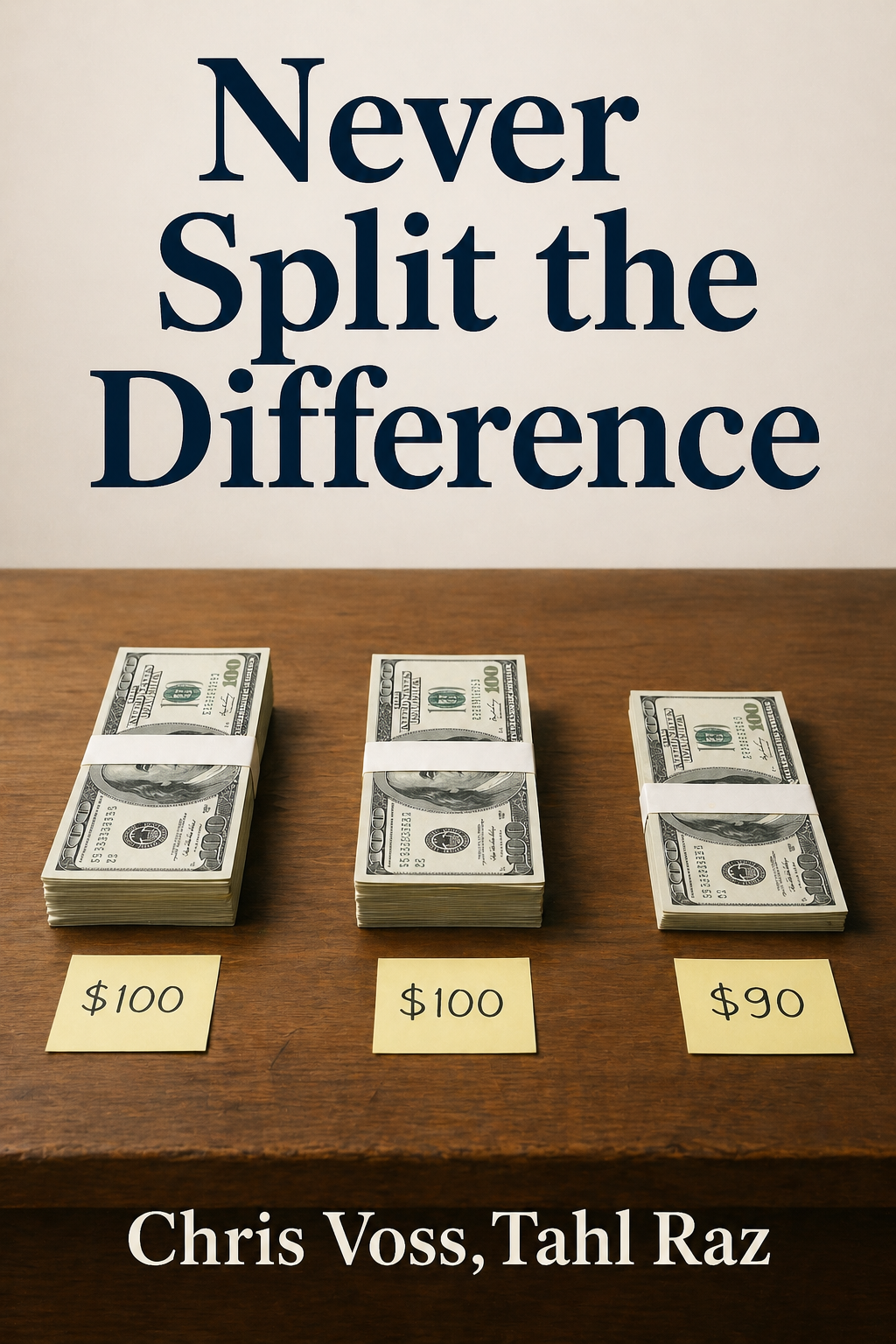
Never Split the Difference
Chapter Summaries
What's Here for You
Tired of negotiation tactics that feel like arm-wrestling? "Never Split the Difference" offers a revolutionary approach, forged in the high-stakes world of FBI hostage negotiation. Chris Voss, a seasoned crisis negotiator, shares the secrets to unlocking win-win outcomes in any situation, from everyday interactions to critical business deals. Prepare to ditch outdated strategies and embrace a proven system built on emotional intelligence and psychological insight. You'll learn how to use tactical empathy to understand your counterpart's perspective, master the art of strategic questioning, and create the illusion of control to guide negotiations toward your desired outcome. This book isn't just about getting what you want; it's about building trust, fostering collaboration, and achieving results that leave everyone feeling heard and valued. Get ready to transform your negotiation skills and gain the confidence to navigate any conversation with poise and effectiveness. Expect a blend of gripping real-life stories, practical techniques, and a healthy dose of counterintuitive wisdom that will challenge your assumptions and empower you to become a master negotiator. Prepare to be both intellectually stimulated and emotionally engaged as you unlock the power of "Never Split the Difference."
THE NEW RULES
In this chapter of *Never Split the Difference*, Chris Voss recounts his intimidating encounter with Harvard Law School negotiation professors, setting the stage for a deep dive into the art and science of negotiation. Voss, a seasoned FBI hostage negotiator, found himself in a mock hostage situation orchestrated by Robert Mnookin and Gabriella Blum, masters of conflict resolution. The initial tension was palpable, a street cop facing the academic elite. Voss quickly realized the traditional negotiation tactics of logic and rationality, championed by institutions like Harvard, often fall flat in real-world scenarios, especially when emotions run high. Voss introduces the power of calibrated questions, open-ended queries that shift the conversational frame and grant the illusion of control to the counterpart. His simple question, "How am I supposed to do that?", disarmed Mnookin and Blum, revealing the limitations of their intellectual approach. He further illustrates this point by recounting his experience at Harvard Law School’s Winter Negotiation Course, where his experiential knowledge trumped the cutting-edge techniques of brilliant students. Voss emphasizes that negotiation is not about intellectual power but about understanding human psychology, the irrationality and emotional drivers that underpin every interaction. Like Roger Federer stepping into a 1920s tennis match, Voss wielded emotional intelligence as his titanium racket. He contrasts the rational problem-solving approach, popularized by *Getting to Yes*, with the FBI's shift towards emotional intelligence, particularly after the Ruby Ridge and Waco disasters exposed the ineffectiveness of purely rational tactics. The chapter culminates in the assertion that life itself is a negotiation, a constant interplay of wants and needs, from high-stakes deals to everyday interactions. Voss frames negotiation as communication with results, highlighting its vital role in information gathering and behavior influencing. He lays the groundwork for the book's core concept: tactical empathy, listening as a martial art to gain access to another person's mind, turning potential conflict into meaningful collaboration. Ultimately, Voss invites the reader to embrace negotiation as a transformative tool, a means to achieve personal and professional goals while fostering stronger relationships. The book promises a journey from active listening and tactical empathy to the discovery of Black Swans, those rare pieces of information that can change everything.
BE A MIRROR
In "Never Split the Difference," Chris Voss recounts a tense bank robbery in Brooklyn, a crucible where negotiation skills were tested under fire, revealing a world far removed from cookie-cutter solutions. Voss emphasizes that great negotiators thrive on uncovering surprises, discarding assumptions like old maps in uncharted territory. He introduces the concept of active listening, a potent antidote to the 'schizophrenia' of negotiation, where internal voices drown out the counterpart's true message. Voss advocates making the other person the sole focus, creating a safe space for them to reveal their needs, not just their wants. The chapter then pivots to the power of slowing down, using time as a strategic tool to build rapport and de-escalate tension, a lesson learned when a food negotiation unexpectedly stalls. Voss introduces the 'Late-Night, FM DJ Voice'—a deep, soft, and reassuring tone that flips emotional switches, turning distrust into trust, nervousness into calm. He contrasts this with the positive-playful voice, ideal for most situations, and warns against the assertive voice, which often triggers resistance. Mirroring, or isopraxism, emerges as a deceptively simple yet profoundly effective technique, a Jedi mind trick where repeating the last three words of someone's statement fosters connection and encourages elaboration. As Voss reflects on the chaotic standoff, he underscores the importance of remaining adaptable, willing to change course based on new evidence. The chapter culminates with practical advice on confronting without confrontation, using the late-night FM DJ voice, mirroring, and strategic silence. Ultimately, Voss reframes negotiation not as a battle of wills, but as a process of discovery, a dance of empathy and understanding. He leaves the reader with a powerful reminder: being right isn't the key; having the right mindset is, and highlights Oprah Winfrey as a master negotiator in plain sight, a case study of a practitioner persuading people to share their deepest secrets.
DON’T FEEL THEIR PAIN, LABEL IT
In “Never Split the Difference,” Chris Voss unveils the power of tactical empathy, illustrating how labeling emotions can transform negotiations. Voss recounts a tense standoff in Harlem, where he, as the primary negotiator, faced armed fugitives, emphasizing that traditional negotiation tactics often ignore the crucial role of emotions. He stresses that emotions aren't obstacles but tools. Voss equates the negotiator's role to that of a therapist, understanding and reflecting the other party's feelings to influence behavior. He introduces tactical empathy as recognizing and vocalizing the other's perspective, going beyond sympathy to understand the mindset behind the feelings. Voss highlights the physical basis of empathy, explaining how neural resonance aligns our brains with others, improving communication. He then introduces labeling as a technique to validate emotions by naming them, diffusing tension and reinforcing positive aspects. Voss cautions against using “I” statements, advocating for neutral observations like “It seems like…” to encourage responsiveness, turning a tense moment into a shared understanding. He illustrates how labeling negative emotions diffuses them, while labeling positive ones reinforces them, citing an example of resolving a dispute with an FBI official in Canada by directly acknowledging the negative dynamic. Voss shares a story of a fund-raiser who uncovered a donor's deeper motivations by labeling her hesitation and passion. He introduces the concept of an accusation audit, listing potential criticisms to disarm the counterpart, exemplified by a student who recovered a million-dollar contract by addressing ABC Corp's potential grievances. Voss narrates Ryan's experience at an airport, showcasing how labels and mirrors can secure a seat on a sold-out flight, highlighting the importance of empathy in building rapport. Ultimately, Voss urges readers to view these techniques as extensions of natural human interactions, fostering genuine connections and understanding, because in the intricate dance of negotiation, empathy isn't just a step; it’s the music that guides the way, helping to clear the barriers, address the fears, and acknowledge the inherent human desire to be understood.
BEWARE “YES”—MASTER “NO”
In "Never Split the Difference," Chris Voss illuminates the counterintuitive power of "No" in negotiation, challenging our ingrained aversion to it. He begins by dissecting the telemarketer's relentless pursuit of "Yes," a tactic that often triggers resistance and distrust. Voss, drawing from his experience in the FBI's Crisis Negotiation Team, recalls his initial desire to join the team and Amy Bonderow's repeated rejections, which ultimately opened the door to his career. He highlights Lieutenant Martin's habit of initially saying "No" as a protective mechanism, allowing for more thoughtful consideration later. Voss underscores that "No" is not necessarily rejection but often a temporary decision to maintain the status quo, a safe harbor in the face of change. He references Jim Camp's concept of granting the other party the "right to veto" to foster a more collaborative environment. Voss introduces the three types of "Yes": counterfeit, confirmation, and commitment, cautioning against the dangers of the counterfeit "Yes," which provides a false sense of agreement. He recounts his experience at HelpLine, where he learned that true persuasion involves guiding the other party to discover solutions themselves, rather than imposing them. Voss vividly recalls Jim Snyder's critique of his call with Daryl, the cabbie, illustrating that Daryls positive response was merely a way to end the conversation, not a genuine commitment. The author emphasizes that effective negotiation requires understanding and addressing the other party's primal needs for safety, security, and control, needs that cannot be met through logic or feigned niceness. Instead, Voss suggests embracing "No" as a means of creating a safe space for open communication. He shares Marti Evelsizer's strategic use of a "No"-oriented question to retain her position, demonstrating its power in shifting control. Voss then deconstructs the common dread of "No," reframing it as an opportunity for clarity and progress, not the end of discussion, like a movie from the 80s that we still identify with, but recognize that we've moved on from. Finally, Voss presents Ben Ottenhoff's successful implementation of a "No"-oriented fundraising script, which significantly improved donation rates by empowering potential donors. He also offers practical advice for eliciting "No" and dealing with those who avoid it, stressing the importance of walking away when necessary. Voss concludes with a one-sentence email technique for re-engaging unresponsive contacts, encapsulating the essence of "No"-oriented communication. He urges readers to view these strategies as an "anti-niceness ruse," prioritizing authenticity and genuine understanding over superficial politeness.
TRIGGER THE TWO WORDS THAT IMMEDIATELY TRANSFORM ANY NEGOTIATION
In "Never Split the Difference," Chris Voss, along with Tahl Raz, illuminates the pivotal role of 'That's right' in transforming negotiations, drawing from Voss's extensive experience in crisis negotiation with the FBI. The chapter opens with the tense backdrop of Jeffrey Schilling's kidnapping by Abu Sayyaf, setting the stage for a masterclass in negotiation strategy. Voss explains how the Behavioral Change Stairway Model (BCSM), rooted in Carl Rogers' concept of unconditional positive regard, guides negotiators from active listening to behavioral change. He contrasts this with the often superficial agreement of 'yes,' arguing that true breakthroughs occur when the other party genuinely feels understood. Voss recounts the Schilling case, highlighting his role in guiding negotiations with Abu Sabaya, a notorious rebel leader. The challenge was Sabaya's unwavering demand for 'war damages,' a sum of $10 million, effectively stalling any progress. A key turning point arrived not in direct talks with Sabaya, but in Voss's negotiation with Benjie, a Filipino military officer initially resistant to building rapport with the enemy. By acknowledging Benjie's rage towards Sabaya—'You hate Sabaya, don't you?'—Voss unlocked Benjie's potential as a negotiator. This illustrates a core insight: before convincing others, acknowledge their perspective to elicit a 'That's right' response. Voss then details how Benjie, armed with active listening techniques, summarized Sabaya's grievances so effectively that Sabaya uttered the transformative words, 'That's right,' dissolving his financial demands. Voss underscores that 'That's right' signals a stealth victory, a moment of realization where the adversary feels heard and understood. He contrasts this with 'You're right,' which often serves as a dismissive tactic. Voss shares an anecdote about his son, Brandon, a football player, to illustrate this difference, revealing how Brandon only changed his behavior once he genuinely agreed with the need to adapt his playing style. The chapter culminates with examples of how 'That's right' facilitated a pharmaceutical sale and a career advancement, emphasizing its universal applicability. Voss concludes with a powerful image: 'Sleeping in the same bed and dreaming different dreams,' a metaphor for partnerships lacking genuine communication. The key, he asserts, is to strive for understanding, not just agreement, and to use summaries—combining labeling with paraphrasing—to trigger that crucial 'That's right' moment, which opens the door to real change and breakthrough.
BEND THEIR REALITY
In "Never Split the Difference," Chris Voss unveils the subtle art of bending reality in negotiations, drawing from his experiences as the FBI's lead international kidnapping negotiator in Haiti. He begins with a stark scene: Port-au-Prince, a city gripped by a kidnapping epidemic, a landscape where traditional negotiation tactics crumble. Voss challenges the conventional wisdom of compromise, portraying it not as a sacred virtue but as a path to mediocrity, a pair of mismatched shoes no one wants to wear. Instead, he advocates for understanding the irrational, emotional undercurrents that drive decision-making, a realm where fairness is a loaded term, a potential F-bomb. He illustrates how deadlines, often perceived as constraints, can be manipulated to one's advantage, transforming time from an enemy into an ally. Voss introduces the Ultimatum Game, a microcosm of human irrationality, revealing that perceived unfairness can outweigh rational self-interest, even to the point of self-sabotage. This leads to a crucial insight: successful negotiation isn't about logic; it's about emotional intelligence, recognizing that people are more driven by the fear of loss than the allure of gain. Voss then introduces prospect theory, offering practical tactics to anchor emotions, establish ranges, and pivot to nonmonetary terms, turning potential losses into opportunities. He emphasizes the power of odd numbers and surprise gifts to disrupt expectations and foster reciprocity. Voss concludes with a detailed guide on negotiating a better salary, blending persistence, empathy, and a focus on mutual success, painting a vivid picture of how to transform a negotiation from a tug-of-war into a collaborative dance. Voss reminds us that the best negotiators recognize the human psyche for what it is: emotional, irrational, and predictably patterned, and that using that knowledge is not manipulation, but simply rational.
CREATE THE ILLUSION OF CONTROL
In "Never Split the Difference," Chris Voss recounts the harrowing Dos Palmas hostage crisis, a crucible that reshaped the FBI's negotiation strategies. The initial failure underscored a critical flaw: treating negotiation as a combative wrestling match. Voss reveals the pivotal shift toward coaxing, not overcoming, emphasizing that true control lies in granting the counterpart an illusion of command. He introduces the concept of calibrated, open-ended questions as the key to removing aggression and inviting collaboration. Voss vividly illustrates this with the disastrous Burnham-Sobero case in the Philippines, highlighting how a tit-for-tat mentality and fear of reciprocity paralyzed effective communication. He then contrasts this with an unlikely success: a drug dealer who, without formal training, elicited crucial information by simply asking, "Hey, dog, how do I know she's all right?" This "holy shit" moment underscores the power of suspending unbelief, a concept borrowed from psychologist Kevin Dutton. Voss argues that calibrated questions, starting with "what" or "how," disarm defensiveness and channel the other party's energy toward solving the problem—your problem. He cautions against "why" questions, which often trigger accusatory responses. The author emphasizes that the goal isn't to force agreement but to guide the counterpart toward your solution, making them believe it was their idea all along. He shares a personal anecdote about using a calibrated question with his boss to secure approval for a Harvard program, demonstrating its effectiveness in real-world scenarios. However, Voss cautions that emotional regulation is paramount; even the best strategy fails without self-control. He recounts a story of a marketing strategist who lost a payment dispute due to her anger overriding a well-crafted script. Voss concludes with practical advice: bite your tongue, disarm verbal assaults with calibrated questions, and recognize that people often react defensively from a perceived lack of control. Ultimately, negotiation is listener's judo, using the counterpart's energy to achieve your objectives.
GUARANTEE EXECUTION
In "Never Split the Difference," Chris Voss underscores that a negotiator's role extends beyond securing an agreement; it's about ensuring the agreement is executed flawlessly. Voss paints a scene: negotiators orchestrating a prison siege surrender, a plan nearly derailed by a single, uninformed SWAT officer, highlighting how easily deals can collapse without complete buy-in. The negotiator, Voss suggests, is a decision architect, skillfully shaping verbal and nonverbal cues to achieve both consent and implementation. He emphasizes that 'Yes is nothing without How,' a mantra for driving deals to fruition. Voss illustrates this with the story of Jos, kidnapped in Ecuador, where calibrated 'How' questions, like Julie's persistent inquiries about her husband's well-being, bought crucial time, leading to Jos's escape. These questions, Voss explains, are a graceful way to say 'No,' compelling the counterpart to solve problems and consider implementation, turning potential adversaries into collaborators. Voss cautions against superficial agreement, noting that a simple 'You're right' or a noncommittal 'I'll try' are red flags, urging negotiators to delve deeper until the counterpart articulates the terms of success in their own words, fostering a sense of ownership. Voss then broadens the scope, pointing out that negotiations rarely occur in a vacuum; unseen influencers, or 'Level II' players, can make or break a deal, like the division head who scuttled a training agreement despite CEO approval. Voss advocates for identifying and addressing these hidden motivations through calibrated questions, ensuring everyone is on board. Finally, Voss delves into identifying deception and handling aggression, introducing the 7-38-55 rule, where body language and tone outweigh the literal words, serving as vital assessment tools. He introduces the 'Rule of Three,' securing agreement on the same point three times to expose falsehoods, and the 'Pinocchio Effect,' where liars often use more words and third-person pronouns to distance themselves from the untruth. Voss even shares his 'Chris discount' anecdote, showing how using one's own name can humanize the negotiation and foster empathy. Voss ultimately urges negotiators to visualize the playing field beneath the words, manipulating subtle signals to craft robust agreements and guarantee their execution, always remembering that a well-defined 'How' is the bedrock of any successful negotiation.
BARGAIN HARD
In "Never Split the Difference," Chris Voss delves into the often-anxiety-inducing realm of bargaining, transforming it from a necessary evil into a strategic advantage. He begins with a personal anecdote, his pursuit of a Salsa Red Pearl Toyota 4Runner, illustrating how initial rapport and strategic pauses can dramatically shift a negotiation's outcome. Voss emphasizes that effective bargaining isn't about intuition or math; it's about recognizing and leveraging the psychological currents beneath the surface. He introduces three negotiator types: the methodical Analyst, the relationship-focused Accommodator, and the assertive individual, each with distinct approaches to time, silence, and reciprocity. Voss cautions against the 'I am normal paradox,' urging negotiators to understand their counterpart's style rather than projecting their own. He warns that skilled negotiators often begin with extreme anchors, 'punching' the other side in the mouth, and emphasizes the importance of deflecting these aggressive moves with calibrated questions rather than immediate concessions. Voss advocates for strategic assertion, using controlled anger, threats without anger, or even strategic umbrage to reset unproductive dynamics. He also recommends using "I" messages to set boundaries without escalating conflict, always maintaining a willingness to walk away from a bad deal. Voss introduces the Ackerman model, a structured offer-counteroffer system involving setting a target price, beginning with an offer at 65% of that price, and then incrementally increasing offers to 85%, 95%, and finally 100%, always with empathy and precise, non-round numbers. He illustrates this with a detailed example of a student negotiating a rent cut after receiving notice of an increase, showcasing the power of preparation, research, and calibrated questions. Voss envisions bargaining as a flattened S-curve, where progress requires occasional pauses, escalations, or de-escalations to bring the relationship back to rapport. Ultimately, Voss stresses that the person across the table is not the enemy; the unsolved issue is, and maintaining a collaborative approach, even in the face of conflict, is fundamental to reaching a successful resolution. Voss paints a vivid picture: imagine the negotiation table as a chessboard, each piece representing a psychological tactic, each move carefully considered, not to crush the opponent, but to navigate towards a mutually beneficial outcome. He urges the reader to embrace conflict as a catalyst for truth, creativity, and ultimately, resolution.
FIND THE BLACK SWAN
Chris Voss, alongside Tahl Raz, opens the chapter with the chilling account of William Griffin's hostage crisis, a stark example of how preconceived notions can blind us to unforeseen realities. The narrative pivots to Nassim Nicholas Taleb's Black Swan theory, emphasizing that these are not mere low-probability events, but events entirely outside our realm of expectation, reshaping the landscape like the unexpected discovery of black swans themselves. Voss underscores that in negotiation, we navigate known knowns, known unknowns, and, most critically, unknown unknowns—the Black Swans. The Rochester crisis, Voss argues, was tragically mishandled because the FBI, shackled by conventional wisdom, failed to recognize the telltale signs that Griffin's motives transcended typical hostage demands; they missed the Black Swans. Voss then shifts to actionable strategies, asserting that every negotiation holds at least three Black Swans, urging a change in mindset from a linear game to a multi-dimensional, emotionally attuned exploration. He emphasizes active interrogation, intuitive listening, and keen observation of nonverbal cues. The power of Black Swans lies in their ability to amplify leverage, which Voss breaks down into three types: positive (the ability to grant desires), negative (the capacity to inflict loss), and normative (the appeal to the counterpart's values). He illustrates normative leverage with the story of Dwight Watson, the tobacco farmer, where understanding Watson's religious worldview became the key to de-escalation. Voss stresses the importance of uncovering a counterpart's 'religion'—their core beliefs and values—to build rapport and influence, highlighting the 'similarity principle,' where shared identities foster trust. Furthermore, he advises tapping into a counterpart's hopes and dreams, offering a vision that aligns with their aspirations. Voss underscores that when faced with seemingly irrational behavior, labeling someone as 'crazy' is a dead end; instead, one must investigate potential informational gaps, constraints, or hidden interests. He advocates for face-to-face interactions to observe unguarded moments, those fleeting cracks in the facade that reveal invaluable insights. The chapter culminates with a call to embrace conflict as a pathway to creative solutions, urging negotiators to overcome their fear of confrontation and engage in honest, empathetic dialogue. Voss champions a negotiation style driven by information and empathy, aimed not at domination but at uncovering mutual value. In essence, the chapter is a masterclass in perceptive awareness, urging readers to shed their assumptions, embrace the unknown, and transform conflict into a collaborative art.
Conclusion
Never Split the Difference is more than a guide to negotiation; it's a masterclass in emotional intelligence and human connection. The core takeaway is that successful negotiation hinges not on logic or power plays, but on understanding and acknowledging the other party's emotions. Tactical empathy, active listening, and calibrated questions are not mere techniques, but tools for building rapport and trust. Voss emphasizes the importance of challenging assumptions, embracing 'No,' and seeking 'That's right' to achieve genuine breakthroughs. The book's practical wisdom lies in its actionable strategies, like labeling emotions, performing accusation audits, and bending reality through framing. Ultimately, it teaches that life is a negotiation, and mastering these skills enhances both personal and professional relationships, fostering collaboration and understanding in every interaction.
Key Takeaways
Traditional negotiation tactics rooted in logic often fail when emotions are high; prioritize understanding the other party's emotional state.
Calibrated questions shift the negotiation's focus, empowering the counterpart while subtly guiding them towards solutions.
Experiential knowledge and emotional intelligence can surpass intellectual prowess in real-world negotiation scenarios.
Life is a continuous negotiation; mastering negotiation skills enhances all aspects of personal and professional life.
Tactical empathy, listening with intent, is a powerful tool to build rapport, de-escalate tensions, and influence outcomes.
Embrace negotiation as a tool for collaboration, transforming potential conflict into meaningful and productive interactions.
Challenge your assumptions by viewing them as hypotheses to be tested, not unwavering truths.
Prioritize active listening to quiet internal voices and fully understand your counterpart's perspective.
Use time strategically to slow down negotiations, fostering rapport and de-escalating tension.
Employ the 'Late-Night, FM DJ Voice' to build trust and create an aura of authority without triggering defensiveness.
Master mirroring by repeating the last three words of your counterpart's statements to foster connection and encourage elaboration.
Adapt your approach based on new evidence, remaining flexible and open to changing course during negotiations.
Focus on cultivating the right mindset, recognizing that understanding and empathy are more crucial than being 'right'.
Tactical empathy involves recognizing and vocalizing the other party's perspective to increase influence, going beyond simple sympathy to understand their mindset.
Labeling emotions diffuses negativity and reinforces positive aspects, creating a shortcut to intimacy by acknowledging how the other person feels.
Using neutral language, such as 'It seems like...', encourages responsiveness and avoids defensiveness, fostering a more collaborative environment.
Addressing negative emotions directly, without judgment, allows for a quicker establishment of trust and a more efficient working relationship.
Performing an accusation audit—listing potential criticisms—disarms the counterpart and prepares you to address negative dynamics proactively.
Empathy enhances communication by activating neural resonance, allowing you to anticipate the other person's thoughts and feelings.
Effective negotiation involves prioritizing understanding and connection over immediate gains, viewing empathy as a means to foster healthier human interactions.
Embrace "No" as a tool to initiate genuine negotiation, fostering safety and control for the other party.
Differentiate between counterfeit, confirmation, and commitment "Yes" to avoid false agreements and wasted effort.
Guide others to discover solutions themselves, recognizing their need to feel responsible for the outcome.
Address the primal needs for safety, security, and control to build trust and facilitate open communication.
Reframe "No" as an opportunity for clarity and progress, not as a rejection or failure.
Use "No"-oriented questions to elicit engagement, define boundaries, and uncover hidden agendas.
Prioritize authenticity over superficial niceness to build trust and achieve meaningful outcomes.
Achieve genuine breakthroughs in negotiations by prioritizing understanding over mere agreement, recognizing that 'That's right' signifies a deeper connection than a simple 'yes'.
Employ active listening techniques, particularly summarizing and labeling, to reflect the other party's viewpoint, fostering trust and paving the way for behavioral change.
Recognize that eliciting 'That's right' requires acknowledging the other party's emotions and perspective, even if you disagree with their position.
Understand that 'You're right' often serves as a dismissive tactic, whereas 'That's right' indicates genuine agreement and a shift in perspective.
Use summaries, combining rearticulation of meaning with acknowledgment of underlying emotions, as a powerful tool to trigger a 'That's right' response.
Cultivate unconditional positive regard to create an environment conducive to changing thoughts and behaviors, recognizing the innate human urge toward socially constructive behavior.
Challenge the notion of compromise; instead, aim to understand underlying needs and create solutions that avoid splitting the difference, which often leads to unsatisfactory outcomes for all parties involved.
Recognize that deadlines are often self-imposed and can be manipulated to your advantage by understanding the other party's pressures and using time as a tool to influence their decisions.
Understand that fairness is a subjective and emotionally charged concept; use it cautiously and be prepared to address accusations of unfairness directly by seeking to understand the other party's perspective.
Acknowledge and address the other party's fears and anxieties early in the negotiation to anchor their emotions and create a foundation of empathy.
When negotiating, be aware of prospect theory and loss aversion, framing your offers in a way that highlights what the other party stands to lose if the deal falls through.
Pivot to nonmonetary terms to create value and flexibility in negotiations, identifying what is valuable to the other party but costs you little.
Use odd numbers and surprise gifts to create a sense of thoughtfulness and reciprocity, disrupting expectations and fostering a more generous atmosphere.
Shift from combative negotiation to collaborative coaxing by prioritizing understanding and empathy to create a more receptive environment.
Employ calibrated, open-ended questions (starting with 'what' or 'how') to remove aggression and invite the other party to participate in problem-solving.
Recognize and suspend 'unbelief' by guiding counterparts toward your solution while giving them the illusion of control.
Avoid accusatory 'why' questions, which trigger defensiveness, and instead focus on neutral inquiries that encourage explanation.
Prioritize emotional regulation and self-control, as anger and reactive behavior can negate even the best negotiation strategies.
Understand that negotiation is 'listener's judo,' using the counterpart's energy and information to achieve your goals.
Influence the entire team behind your counterpart, not just the individual, to ensure a robust and reliable agreement.
True negotiation success lies not just in reaching an agreement, but in meticulously planning and ensuring its successful implementation.
Calibrated 'How' questions are powerful tools for gently guiding negotiations, uncovering potential roadblocks, and compelling counterparts to consider your perspective.
Superficial agreement, signaled by phrases like 'You're right' or 'I'll try,' should be met with deeper probing to ensure genuine buy-in and commitment.
Successful negotiators must identify and address the motivations of unseen influencers ('Level II' players) who can impact the deal's outcome.
Nonverbal cues, especially tone of voice and body language, are critical indicators of truthfulness and conviction, often outweighing the literal words spoken.
Employing the 'Rule of Three' by securing agreement on key points multiple times can expose falsehoods and solidify commitment.
Humanizing the negotiation process through humor, empathy, and personal connection can break down barriers and foster collaboration.
Mastering bargaining requires understanding the psychological dynamics at play, not just surface-level offers and counteroffers.
Effective negotiators adapt their style to match their counterpart's, recognizing that individuals fall into distinct categories like Analyst, Accommodator, or Assertive.
Extreme anchors are common bargaining tactics, and skilled negotiators must learn to deflect them with questions rather than immediate concessions.
Strategic assertion, including controlled anger and well-placed boundaries, can reset unproductive negotiation dynamics.
The Ackerman model provides a structured approach to offer-counteroffer bargaining, incorporating psychological tactics like reciprocity and loss aversion.
Maintaining a collaborative relationship, even during tense bargaining sessions, is crucial for reaching a successful resolution.
Conflict can be a catalyst for truth, creativity, and resolution in negotiations, and should not be avoided.
Uncover Black Swans by shifting from a linear negotiation style to an emotionally intelligent exploration of hidden information and unspoken needs.
Recognize that every negotiation contains at least three Black Swans, and prioritize discovering these unknown unknowns to gain significant leverage.
Master the three types of leverage—positive, negative, and normative—to effectively influence your counterpart's perceptions and decisions.
Understand your counterpart's core beliefs and values ('religion') to build rapport, create shared identity, and unlock normative leverage.
Reframe seemingly irrational behavior as a clue to uncover hidden constraints, unmet needs, or informational gaps, expanding your field of movement.
Prioritize face-to-face interactions and observation of unguarded moments to access invaluable verbal and nonverbal cues.
Embrace conflict as a catalyst for creative problem-solving, fostering honest dialogue and collaborative solutions rather than avoiding confrontation.
Action Plan
Practice asking calibrated questions (How? What?) in everyday conversations to guide the discussion.
Actively listen to others, focusing on understanding their emotions and perspective.
Identify situations where emotional intelligence can be applied instead of purely rational arguments.
Reframe your mindset to view every interaction as a potential negotiation.
Develop tactical empathy by labeling the other person's perspective to build trust.
Prepare for negotiations by anticipating the other party's needs and concerns.
Strive for 'That's right' instead of 'Yes' to ensure true understanding and agreement.
Practice patience and silence to encourage the other party to reveal more information.
Actively question your assumptions before entering a negotiation, identifying them as hypotheses to be tested.
Practice active listening by focusing solely on your counterpart's words and emotions, minimizing internal distractions.
Consciously slow down your speech and body language during tense conversations to create a sense of calm.
Experiment with the 'Late-Night, FM DJ Voice' in low-stakes situations to master its calming effect.
Incorporate mirroring into your daily conversations by repeating the last few words of what others say.
Seek feedback on your communication style to identify and minimize assertive or aggressive tendencies.
Reflect on past negotiations to identify moments where a change in mindset could have improved the outcome.
Practice labeling emotions in everyday conversations by starting sentences with 'It seems like...' or 'It sounds like...'.
Actively listen and observe body language to detect underlying emotions in others.
Before a negotiation, conduct an accusation audit by listing all the potential negative things the other party might say.
When someone expresses a negative emotion, acknowledge it directly and without judgment.
Mirror the other person's words to encourage them to elaborate and feel heard.
Incorporate tactical empathy into your communication by understanding the other person's perspective and vocalizing that understanding.
Pause after labeling or mirroring to allow the other person to process and respond.
Focus on clearing barriers to agreement by addressing the other person's fears and concerns upfront.
Use labels to reinforce positive perceptions and dynamics during interactions.
When faced with a potential negotiation, start by inviting the other party to say "No" to your ideas.
Actively listen for and identify the different types of "Yes" (counterfeit, confirmation, commitment) to gauge true agreement.
Ask open-ended questions that encourage the other party to discover solutions themselves.
Frame your proposals in ways that address the other party's need for safety, security, and control.
Practice reframing "No" as a temporary pause or request for more information, rather than a rejection.
Intentionally use "No"-oriented questions to elicit engagement and uncover hidden concerns.
If someone is ignoring you, send a concise email asking, "Have you given up on this project?"
Prioritize authenticity and genuine understanding over superficial politeness in your interactions.
Actively practice summarizing the other person's viewpoint in your own words during conversations to ensure mutual understanding.
Use labeling to identify and acknowledge the emotions underlying the other person's statements, demonstrating empathy.
Strive to elicit a 'That's right' response by reflecting back the other person's perspective before attempting to persuade them.
Avoid using 'You're right' as a dismissive tactic; instead, seek genuine agreement and understanding.
When faced with resistance, pause and reframe your approach to focus on understanding the other person's needs and motivations.
Incorporate active listening techniques into your daily interactions to build stronger relationships and resolve conflicts more effectively.
Identify your own irrational blind spots and emotional triggers in negotiations to avoid making impulsive decisions.
When faced with a negotiation, resist the urge to compromise and instead explore creative solutions that address the underlying needs of both parties.
Analyze the deadlines involved in a negotiation to determine their true impact and identify opportunities to use them to your advantage.
Be mindful of the emotional impact of the word 'fair' and use it strategically to build trust and rapport, rather than as a weapon.
Before making an offer, anchor the other party's emotions by acknowledging their fears and anxieties to prepare them for potential losses.
When discussing numbers, use odd numbers to create a sense of thoughtfulness and calculation, rather than round numbers that feel like placeholders.
Identify nonmonetary terms that are valuable to the other party but cost you little, and use them to sweeten the deal and create a sense of reciprocity.
When negotiating a salary, focus on defining success metrics and establishing a plan for future raises to demonstrate your commitment and create a sense of partnership with your boss.
Practice framing requests as calibrated questions, starting with 'what' or 'how,' to encourage collaborative problem-solving.
Actively listen to understand the other party's perspective before presenting your own, suspending 'unbelief' to create a more receptive environment.
Identify situations where you typically react defensively and prepare a calibrated question to use instead.
Before entering a negotiation, outline your ideal outcome and craft questions designed to guide the conversation in that direction.
When faced with an emotional outburst, pause, take a breath, and respond with a calibrated question to de-escalate the situation.
Seek to influence the team or stakeholders behind your counterpart to ensure a more stable and reliable agreement.
Reflect on past negotiations, identifying missed opportunities where calibrated questions could have been used more effectively.
Role-play negotiation scenarios with a friend or colleague to practice using calibrated questions under pressure.
When negotiating, always follow up a 'Yes' with calibrated 'How' questions to ensure a clear plan for implementation.
Actively listen for verbal and nonverbal cues that indicate hesitation or disagreement, and address them directly.
Identify and engage with key stakeholders beyond the immediate negotiating table to secure their support.
Employ the 'Rule of Three' by restating key agreements in different ways to confirm understanding and commitment.
Use your own name during negotiations to humanize yourself and build rapport with the other party.
Before finalizing any agreement, ask 'How will we know we're on track?' and 'How will we address things if we find we're off track?'
When faced with an aggressive counterpart, use calibrated 'What' and 'How' questions to deflect and gain control.
Practice active listening and mirroring techniques to build trust and encourage open communication.
Identify your own negotiation style (Analyst, Accommodator, or Assertive) to understand your strengths and weaknesses.
Before entering a negotiation, research your counterpart to determine their likely negotiation style and tailor your approach accordingly.
Prepare calibrated questions to deflect extreme anchors and gather information about your counterpart's priorities.
Practice setting boundaries using "I" messages to avoid escalating conflicts.
Develop an Ackerman plan with a target price and incremental offers (65%, 85%, 95%, 100%) to guide your bargaining strategy.
Always be prepared to walk away from a deal if it doesn't meet your bottom line.
Focus on the issue at hand, not the person across the table, to maintain a collaborative approach.
Actively seek out face-to-face interactions to observe unguarded moments and capture nonverbal cues.
Ask calibrated questions that probe for hidden constraints, unmet needs, or informational gaps.
Research and understand your counterpart's core beliefs and values to identify potential normative leverage.
Listen intently for subtle clues and inconsistencies in your counterpart's communication, comparing notes with team members to uncover missed information.
Reframe seemingly irrational behavior as a potential signal of underlying issues, rather than dismissing it outright.
Challenge your own assumptions and preconceived notions to remain flexible and adaptable during negotiations.
Embrace conflict as an opportunity for creative problem-solving, engaging in honest and empathetic dialogue to uncover mutual value.
Identify and articulate your own goals clearly, while also seeking to understand your counterpart's aspirations and motivations.