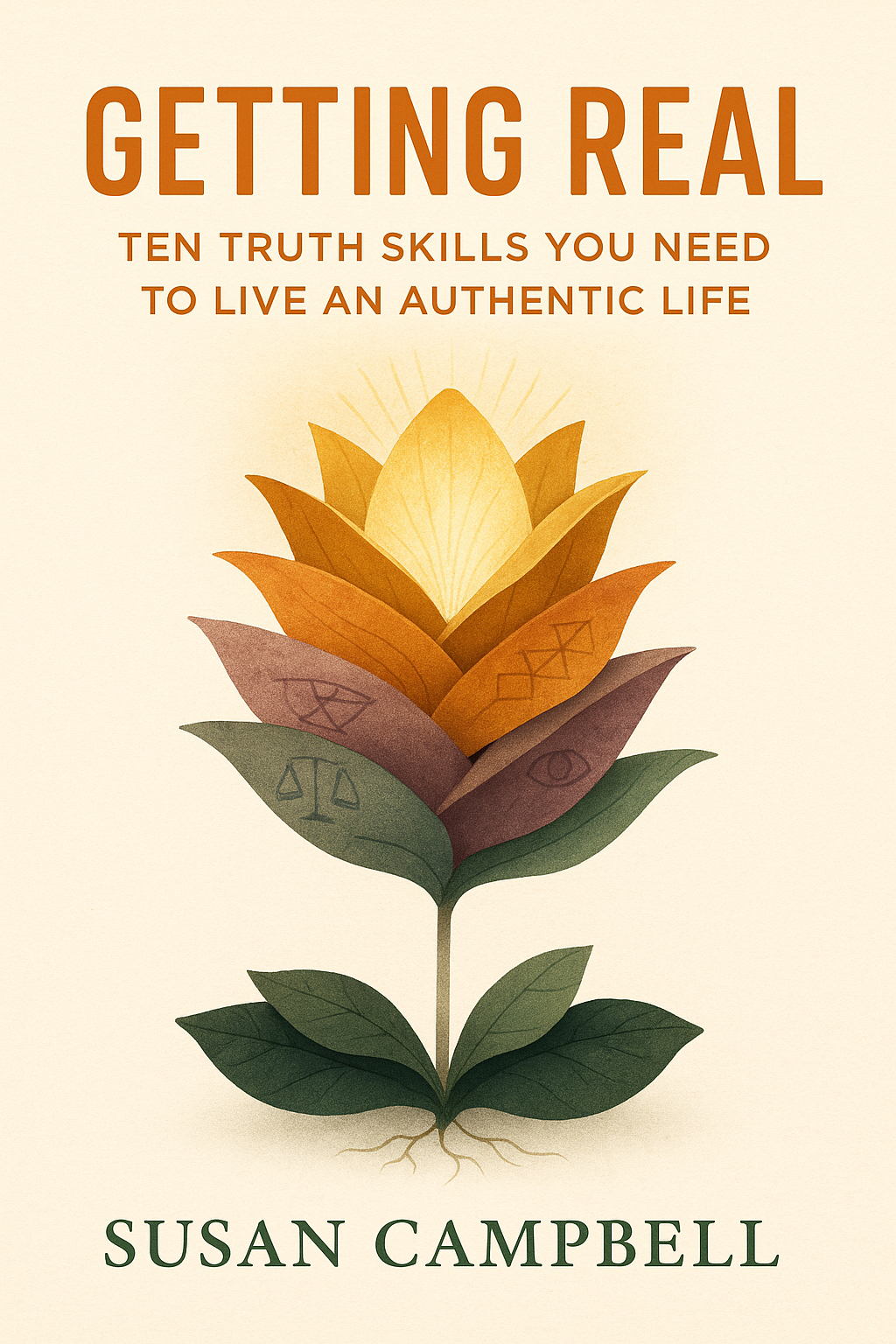
Getting Real: Ten Truth Skills You Need to Live an Authentic Life
Chapter Summaries
What's Here for You
Are you tired of feeling like you're performing, constantly managing how you appear to others? Do you long for a deeper sense of connection, both with yourself and the people around you? In "Getting Real," Susan Campbell offers a transformative journey to unlock the power of authentic living. This book is your guide to shedding the masks we wear – the need to be 'right,' the fear of conflict, the impulse to hide – and stepping into the liberating freedom of being truly yourself. Through relatable stories and practical 'truth skills,' you'll discover how to navigate the complexities of your inner world with courage and clarity. You will learn to embrace what you're truly experiencing, even when it's uncomfortable, and to express your wants and needs with confidence. Campbell guides you to understand the subtle dynamics of intention in communication, to welcome feedback as a gift for growth, and to reclaim the parts of yourself you've projected onto others. This isn't about achieving a flawless, static version of yourself. Instead, "Getting Real" celebrates the messy, beautiful reality of being human. You'll gain the skills to revise your statements when necessary, hold differing viewpoints without losing your own, and express the rich tapestry of your mixed emotions without shame. You'll even learn to find wisdom in the silence and the 'fertile void' of not knowing. The ultimate promise? A life imbued with greater serenity, genuine presence, and profound compassion – for yourself and for others. Prepare to move beyond pretense and discover the profound peace and connection that comes from finally, fully, getting real.
HOW TO STOP BEING RIGHT AND START BEING REAL
The author, Susan Campbell, invites us into a profound exploration of authenticity, revealing that the common impulse to 'be right' often serves as a shield, a way to manage our fear of appearing foolish, losing control, or facing conflict. Campbell begins by posing a series of relatable questions, uncovering the widespread tendency to lie, sugarcoat, and withhold our true feelings—not out of malice, but from a deep-seated need for safety and self-esteem rooted in perceived control over how others perceive us. This central tension between the desire for control and the messy reality of genuine connection is vividly illustrated through her own experience with a coaching client, Leo, who had neglected to review employee feedback. Campbell's initial impulse was to react with anger and disappointment, a desire to control the situation by ensuring Leo's preparedness. Yet, a moment of self-awareness, a quiet pause in the restroom, allowed her to shift from 'controlling' to 'relating.' By bravely stating her feelings—'Leo, I'm feeling angry and disappointed'—she broke through the pretense, releasing a fog of suppressed emotion and paving the way for genuine work and connection. This moment underscores a core insight: **true connection and accomplishment emerge not from predictable outcomes, but from the creative energy released when we discard the script and show up authentically in the moment.** Campbell's research further illuminates this, suggesting that a vast majority of our communication is geared toward controlling uncontrollable factors, a monumental waste of energy that leaves us unprepared for life's inevitable surprises. The narrative then shifts to her father’s story, a man who held onto his 'rightness' about his company’s impending failure, withholding his true insights from management, only to find himself unemployed and regretful, realizing that maintaining his self-respect by speaking his truth would have been more valuable than being 'right' in his silent frustration. This leads to another crucial insight: **the pursuit of control, while seemingly protective, paradoxically leaves us more vulnerable to unexpected change and less able to navigate complexity.** Campbell introduces the concept of 'relating' as the antidote to 'controlling' communication, defining it as speaking our truth—our thoughts, feelings, and observations—with the sole intention of sharing information and making emotional contact, rather than manipulating an outcome. This requires a willingness to enter a realm of uncertainty together, a space where vulnerability is not a weakness but a pathway to deeper connection. To cultivate this, she outlines ten 'truth skills,' a framework for conscious, deeply contacting communication. These skills, such as 'experiencing what is,' 'being transparent,' 'noticing your intent,' and 'welcoming feedback,' empower us to distinguish between our internal narratives and external reality, to reveal ourselves without agenda, and to remain open to how our actions affect others. A particularly powerful skill is 'asserting what you want and don't want,' a practice that affirms our right to our desires and boundaries, even if they aren't met, thereby keeping our energy flowing. Equally vital is 'taking back projections,' recognizing that what we criticize in others may be a reflection of our own disowned aspects, which can unlock blocked life energy. The ability to 'revise an earlier statement,' 'hold differences' by embracing a 'both/and' perspective, and 'share mixed emotions' without needing to be consistent, all contribute to a more flexible and resilient approach to interaction. Finally, Campbell emphasizes 'embracing the silence,' the spaciousness of not knowing, which allows for authentic responses to arise from a place of deep presence. The ultimate resolution is a profound shift in identity: **we learn that who we are is not defined by our thoughts or positions, but by our capacity to experience life as it unfolds, finding our well-being not in control, but in the courage to participate authentically.** This practice of 'getting real' transforms us from controllers of our lives into participants, revealing that our true aliveness is found at the edge of uncertainty, where we trust ourselves enough to speak our truth, regardless of the reception.
EXPERIENCING WHAT IS TO GET WHERE YOU NEED TO GO, BE WHERE YOU ARE
In the quiet moments after her son leaves, Mona finds herself adrift in a sea of complex emotions – sadness, jealousy, and a nagging sense of obligation. This familiar dance of feeling something and then immediately telling herself she *shouldn't* feel it is a pattern she’s ready to break. Susan Campbell, in "Getting Real," guides us through this very challenge, illustrating the profound power of 'experiencing what is.' Mona’s story becomes a potent reminder that suppressing our true feelings, like the sting of her son’s growing independence, often masks older, unresolved wounds. As she finally allows herself to feel the pain, a forgotten memory surfaces: the childhood trauma of losing her beloved dog, Woofer, and the harsh dismissal from her father, "Shut up, Mona. Stop being such a crybaby." This moment, twenty-five years prior, had taught her to stifle her grief, a lesson that now resurfaced, amplified by her present-day loss. Campbell reveals that true healing isn't about avoiding discomfort, but about bravely confronting it, recognizing that as long as we avoid what calls out to be experienced, a part of us remains lost. The core insight is that our pain often stems not from the current situation, but from the *way* we suppress our authentic experience of it. By distinguishing between 'what is' – the raw sensory data of our experience – and 'what we imagine' – our interpretations, beliefs, and judgments – we can begin to disentangle ourselves from the narratives that bind us. This distinction is crucial, whether it’s recognizing a driver laughing at you versus inferring they’re mocking you, or feeling anger when a partner pushes you away versus assuming they are rejecting you. Campbell emphasizes that our interpretations, often fueled by past hurts and ingrained beliefs, can be far more painful than the actual experience. These interpretations become 'buttons,' deeply ingrained beliefs gone mad, that trigger automatic reactions and keep us stuck in familiar, albeit painful, emotional territory. The journey of 'experiencing what is' is presented not as a grand, dramatic event, but as a vigilant practice of noticing when we try to avoid our feelings and then consciously choosing to stay present with them. It's about recognizing the internal critic, the endless comparisons, and the desire to theorize, and instead, gently turning our attention back to the simple reality of the moment. This practice is a hero's journey, a quest to reclaim our authentic selves by shedding the protective layers of our ego, which mistakenly believes it needs constant defense. Ultimately, Campbell suggests that by embracing what is, even when it’s painful, we connect to a deeper, more resilient part of ourselves, a presence that cannot be diminished. This allows for authentic contact, both with ourselves and with others, moving us from a reactive state to one of conscious observation, and paving the way for genuine healing and wholeness.
BEING TRANSPARENT FREEDOM’S JUST ANOTHER WORD FOR NOTHING LEFT TO HIDE
Susan Campbell, in her chapter 'Being Transparent: Freedom's Just Another Word for Nothing Left to Hide,' guides us through the profound liberation found in authentic self-expression, contrasting it with the subtle constraints of hiding. She opens with the relatable scenario of Jenny and Fred's anniversary dinner, where a well-intentioned but poorly phrased toast about 'skirmishes' and the 'Thirty Years War' inadvertently wounds Jenny, highlighting how misinterpretations, even unintentional ones, can create emotional distance. Jenny's brave choice to voice her hurt, articulating her physical sensations and emotional response, serves as a powerful example of Truth Skill 2: expressing what is felt. This act, though uncomfortable in a social setting, clears the air, demonstrating that transparency, when motivated by an intent to relate rather than control, fosters genuine connection. Campbell reveals that the core tension lies in the gap between our lived experience and how we believe we *should* be, a gap often filled with self-judgment and the energy tied up in false beliefs, frequently stemming from 'one-trial learning' in childhood. She illustrates this with Kevin, who, by confronting his financial anxieties and tracing them back to a childhood memory of a bill collector, moves from self-deception to a more honest self-description, ultimately leading to a more authentic connection. The author emphasizes that secrets, whether about past actions or current vulnerabilities, reinforce the belief 'If people really knew me, they wouldn't accept me.' Through exercises like the anonymous 'Secrets Exercise,' Campbell shows how sharing these hidden aspects, even in a controlled environment, can normalize them and provide profound healing, transforming shame into acceptance. She posits that our 'favorite fears'—whether of being ignored, abandoned, or overwhelmed—often dictate our behavior, but naming them specifically, as in the extensive fear-assessment list, allows us to confront their often insubstantial nature, revealing underlying desires. Campbell powerfully connects transparency to freedom, asserting that anything we hide limits our capacity for authentic response and choice. She introduces the 'In the interest of transparency...' preamble as a tool for navigating difficult disclosures, particularly anger or resentment, framing them not as attacks but as vital information for relational honesty. The chapter culminates in the exploration of 'unfinished business' and 'resentments and appreciations' clearing practices, suggesting that ritualizing honest communication, especially with loved ones, creates a safe container for vulnerability. Campbell recounts Smitty's powerful experience of sharing his deep resentment with his mother, which not only liberated him but also led to a reciprocal, healing disclosure from her, demonstrating how confronting taboo feelings like anger, sexual desire, or neediness, within supportive structures, can dismantle old beliefs and foster genuine intimacy and spiritual freedom. Ultimately, Campbell invites us to view hiding as a treatable condition, an energy block solvable by embracing our present reality, feeling our emotions, and sharing our truths, even imperfectly, to reclaim our inherent freedom and wholiveness.
NOTICING YOUR INTENT IS IT TO RELATE OR TO CONTROL?
The author, Susan Campbell, invites us to deeply examine our intentions in communication, unveiling a fundamental dichotomy: relating versus controlling. She illustrates this with Sara, a mother whose sharp reprimand to her daughter Heather about muddy floors stems not from a desire to connect, but from an impulse to control, to make Heather feel bad. This control-oriented approach, Campbell explains, often backfires, creating distance rather than understanding. Contrast this with Sara's alternative: expressing her anger directly and vulnerably, "I can feel the heat rising in my face... Im angry at you." This act of relating, of sharing her present experience, is not about forcing an outcome but about authentic self-expression. Campbell then introduces Jody, a supervisor paralyzed by fear of Freya's potential complaint, leading Jody to rewrite Freya's sloppy report rather than offer feedback. This avoidance, this need for safety, traps Jody in a cycle of resentment and powerlessness, demonstrating how controlling, driven by a need for comfort and to avoid discomfort, ultimately diminishes our freedom. The core insight here is that relating is motivated by a desire to know and be known, to be transparent and open, while controlling arises from the need for safety and comfort, employing a lifetime of strategies to avoid feeling awkward or unsafe. Campbell posits that we must learn to become comfortable with the discomfort of not knowing, to tolerate the uncertain 'in-between' if we are to truly connect and grow. She likens relating to dancing, a spacious exchange of truth and energy, vital in our rapidly changing world, whereas control is an attempt to maintain the illusion of knowing and managing outcomes, often rooted in childhood fears of abandonment or disapproval. Ultimately, the chapter guides us to recognize that basing our self-worth on control is an illusion; true resilience and connection emerge when we dare to be real, unique, and open to surprise, embracing the vulnerability of relating, much like Flo, who risked expressing her attraction to Ron and found a genuine connection, rather than playing it safe. Campbell urges us to move from the 'right, safe, and certain' game of control to the 'real, unique, and open to surprise' dance of relating, building trust and connection by sharing our authentic experience, even when it feels uncertain, for it is in this vulnerability that we discover our deepest self-trust and our truest connections.
WELCOMING FEEDBACK IT’S HOW WE LEARN
The author, Susan Campbell, guides us into the crucial realm of feedback, revealing it not as a critique, but as the very engine of authentic living and relational growth. She posits that true connection hinges on our willingness to be open to how we affect others, a willingness that requires a genuine curiosity about their realities, even when that truth might sting. Campbell illustrates this with a poignant childhood memory: her father, attempting to rearrange her beloved playhouse, inadvertently falls through a floorboard she had cleverly disguised. This incident, though resulting in laughter and minor scrapes, highlights a stark lesson: fear can obstruct honest communication, robbing us of our capacity for 'magic,' and when people fear telling us the truth, we risk a metaphorical tumble into the unknown, much like her father in the basement. The narrative then broadens to examine the atmosphere that either invites or repels feedback, using the example of Jane, a supervisor whose rigid management style, refusing any input on improving workflow, ultimately leads to operational chaos and a reprimand from her own superiors. This serves as a potent reminder: if feedback isn't flowing, it's a signal to examine our own listening skills and our tendency to blame the messenger. Campbell emphasizes that curiosity is innate, but often buried by past punitive experiences, leading us to believe 'no news is good news' and that hearing truth is unsafe. She introduces practical strategies for cultivating this openness, suggesting rituals like 'sharing withholds' or the 'when you, I felt' structure, designed to clear the air and foster trust. The core insight is that welcoming feedback isn't about accepting every impression as gospel, but about allowing it to land, to be processed, and to inform our growth, ultimately strengthening our ability to connect deeply and authentically with others.
ASSERTING WHAT YOU WANT AND DON’T WANT SUPPORTING YOUR FEELINGS WITH ACTION
The author, Susan Campbell, delves into the fifth truth skill: asserting what you want and don’t want, a crucial step for living an authentic life that builds upon the foundations of experiencing what is and being transparent. Many, like Karl who fantasizes about quitting when he feels unappreciated, or Carla who dreams of divorce when her husband spends freely while criticizing her grocery choices, struggle with direct expression, their lives becoming cluttered with 'if onlys' and unfulfilled desires. Campbell shares her own past difficulty with assertion, a pattern rooted in a fear of rejection and a subconscious belief that one must suppress their feelings to avoid discomforting others, a belief she recognized as 'false belief 2.' Her journey toward authenticity involved a profound dream where agonizing gut pain revealed the cost of abandoning her desires, a realization amplified by her Gestalt therapy training and a therapist’s insightful question: 'You treat yourself like you can't handle being told no.' This led Campbell to understand that her pain was blocked energy, a consequence of caretaking others by suppressing her own needs. She committed to expressing her desires, even if her husband couldn't meet them, stating her intention not to control him but to break free from her own 'play-it-safe' pattern. This was a difficult period, yet it marked the beginning of her 'getting real,' a journey of staying alive and connected to her feelings, even when met with resistance. The chapter emphasizes that the aim of assertion isn't merely to get what you want, but to speak your truth, see yourself more fully, feel yourself more deeply, and maintain your own flow of energy, often revealing that getting what you want isn't essential to your identity, but experiencing and expressing your feelings are. This is further illustrated through the story of Michael, who linked compliance with happiness and assertiveness with discontent, and Jane Ellen, whose childhood experience of getting a coat led to marital conflict, both learning to recognize how their past experiences created false beliefs that sabotaged their present desires. Even in dating, as with Steve's struggle to say 'no' to Molly's demands for expensive gifts, the core issue is often a deep-seated fear of not being liked or valued if one doesn't comply. The chapter offers practical tools like the 'Curious Child Exercise' and the 'YesNo Exercise' to practice setting boundaries and expressing anger or resentment as valuable information, vital for authentic connection and intimacy. It highlights that assertion, even when it 'bumps up against' another person's boundaries, can actually help them stretch and grow, and that painting a vivid picture when asking for what you want can add originality and beauty to the interaction. Ultimately, Campbell urges readers to notice their self-protective patterns, transform complaints into direct 'I' statements, and remember that they don't have to answer every question, reassuring them that discomfort with others' reactions is a temporary hurdle on the path to genuine self-expression and connection.
TAKING BACK PROJECTIONS DISCOVERING YOUR OTHER SIDE
The author, Susan Campbell, invites us into the intricate dance of projection, a fundamental human tendency where we cast our inner worlds onto the external stage. We meet Matthew, a computer technician locked in a silent battle with his boss, Ray, a conflict that Campbell reveals is not truly about Ray at all, but a potent echo of Matthew's own internal struggle with authority, a pattern forged in an achievement-oriented childhood where he felt perpetually compared and pressured. This is the core tension: our outer conflicts are often mirrors reflecting our inner landscapes. Campbell explains that we are all like 'walking, talking projectors,' seeing in others what originates within ourselves. When Matthew rebels against Ray's micromanagement, he's unconsciously rebelling against his own oppressive inner critic, a voice that sounds eerily like his father's, demanding 'shoulds' and fueling procrastination. This realization, that the struggle is with himself, is the crucial first step in 'taking back projections.' Campbell then introduces Sally, who harbors unconscious anger at men but expresses it through judgmental comments about other women. Her 'should' directed outward, 'You shouldn't put men down,' is a signal, a signpost pointing to her own unresolved feelings. The real work, Campbell emphasizes, is to own this judgment not as a pronouncement on another, but as a revelation about oneself: 'I notice I'm having some judgmental selftalk.' This shift from external accusation to internal ownership is transformative. We learn that projections are not simply errors in perception, but valuable opportunities for self-discovery, humbling us by revealing our own 'buttons.' Campbell guides us to distinguish between actual behavior and our interpretations, urging us to say, 'I see you looking at the floor as you talk, and I imagine you're feeling insecure,' rather than stating the interpretation as fact. This practice helps us live with the inherent anxiety of not knowing another's inner world, fostering authenticity. The 'If Only' exercise further illuminates this, showing how our unmet desires projected onto others – 'If only you would look at me when I talk, I'd feel connected' – reveal our own internal blocks to experiencing those feelings. Campbell suggests that instead of waiting for others to change, we can actively work on ourselves, perhaps by looking at them when we speak, taking responsibility for our own emotional states. When we receive projections, like Jim's anger about the car door, Campbell advises against automatic self-blame. Instead, we should examine if the projection triggers our own inner conflicts, recognizing that 'his anger is his. It's about him.' The resolution lies in embracing this humbling truth: we are all projectors, and our projections are not definitive truths about others, but intimate glimpses into our own untamed inner lives, waiting to be reclaimed and understood.
REVISING AN EARLIER STATEMENT IT’S OKAY TO GO OUT AND COME IN AGAIN
The author, Susan Campbell, invites us into a world where perfection is an illusion, and authenticity is found in the courage to revisit our words and actions. Consider Cheryl, on a first date, who, caught off guard, offers a lukewarm "nice man" when her heart whispers "wildly attracted." Her words land with a thud, deflating her date. This moment, Campbell suggests, isn't a dead end but an invitation. What if, instead of clinging to the image of being in control, Cheryl called him the next day, admitting, "I didn't speak the truth"? This is the essence of 'going out and coming in again' – a profound act of self-kindness and relational honesty. Campbell introduces the 'Monday Morning Quarterback Process,' a tool to revisit interactions that have gone awry, not with blame, but with curiosity. Imagine Fred, at his anniversary party, wishing he'd said more before being interrupted, or Jenny, wishing she hadn't jumped to the worst conclusion. By sharing these 'if I had it to do over' reflections, they not only gain clarity on their own patterns—Fred's tendency to go with the flow, Jenny's quickness to assume the negative—but also foster deeper connection. This isn't about admitting mistakes to appear flawless; it's about embracing our inherent imperfection. The narrative unfolds like peeling an onion, where each layer of honest disclosure reveals a deeper truth, often surprising us with emerging feelings, like Cheryl's potential admission of attraction. Fear, Campbell notes, is often just a signpost indicating we’re entering the fertile ground of self-discovery, the very space where self-trust is cultivated. When our actions have caused harm, the invitation extends to making amends, asking, 'Is there something I can do to make it up to you?' This act of repair, whether it's Timmy washing his dad’s truck or a manager admitting fault for costly damage, brings closure not just for the other person, but for ourselves, freeing us from the distraction of unfinished business. Sal, the manager who lied about damaging equipment, found forgiveness and a path forward not by maintaining his facade, but by authentically confessing his fear and responsibility. The steps are clear: signal your intent to revise, take responsibility without excuses, report your changed awareness using 'I' messages, and then, crucially, listen, leaving space for the other person's response. This practice, Campbell assures us, doesn't eliminate mistakes, but it shrinks the gap between missteps and moments of authentic repair, making each interaction lighter, more forgiving, and ultimately, more real.
HOLDING DIFFERENCES SEEING OTHER VIEWPOINTS WITHOUT LOSING YOUR OWN
Susan Campbell, in her chapter 'Holding Differences,' invites us to explore a profound truth skill: the ability to see the world from multiple perspectives simultaneously, without sacrificing our own. Drawing inspiration from the martial art of aikido, where centeredness means engaging the world as an opponent does, Campbell explains that true clarity and effective action arise from holding divergent views in tension, rather than collapsing into one or the other. She posits that we often face a false dichotomy: either dominate others or submit to them. However, she reveals a third, more expansive path – the skill of holding differences. This truth skill allows us to expand our consciousness, becoming spacious and nonreactive, thereby revealing a richer landscape of options. Campbell illustrates this with the timeless Sufi parable of the three blind men and the elephant; each man grasps a part of the truth – a wall, a tree, a rope – and mistakes it for the whole, a potent metaphor for humanity's tendency to cling to limited perspectives. The author suggests that our fear of difference, learned in childhood when uniqueness was often discouraged, leads us to believe that disagreement implies error or loss. Yet, she argues, harmony in diversity arises not from eliminating disagreement, but from embracing paradox and viewing conflict as an opportunity for deeper understanding. Campbell introduces practical tools like the Contact-Withdrawal Exercise and Active Listening, emphasizing that truly listening means hearing what challenges us, asserting our boundaries, and holding multiple perspectives without confusion. She shares compelling anecdotes, such as the workplace negotiation between Jake and Mory, where active listening facilitated a win-win solution by holding both Jake's desire for a raise and Mory's budget pressures. Even more profoundly, she recounts a Vipassana meditation experience where intense emotional pain, born from witnessing environmental pollution, transformed into a sense of oneness with both the polluter and the polluted, demonstrating how embracing paradox expands consciousness. In relationships, Campbell highlights the challenge of holding differing needs, as seen in the marital impasse between Paul and Paula concerning monogamy. She asserts that staying in the tension of such unresolved predicaments, rather than rushing to a premature resolution, can lead to profound personal transformation and a deeper understanding of what is truly real for each individual. Ultimately, Campbell guides us toward valuing honesty in disagreement, recognizing that control over another's thoughts is an illusion that only creates static. By learning to hold differences, we move from a painful battle against what is, to embracing the inherent oneness of existence, allowing our consciousness to expand and revealing the interconnectedness of all views.
SHARING MIXED EMOTIONS YOU’RE NOT CRAZY, YOU’RE COMPLEX
The author, Susan Campbell, guides us through the often-turbulent waters of expressing mixed emotions, revealing that what feels like confusion is actually complexity, a sign of emotional maturity rather than a flaw. She posits that we are not inherently flawed when we feel two seemingly opposing emotions at once, such as resentment and appreciation, or fear and desire. Campbell uses her own experience with a friend and former business partner, Bob, to illustrate this point; she feels resentment over unpaid money but also fears losing the friendship. Her recommendation, rooted in truth skill 9, is not to suppress one feeling for the other, nor to use fear manipulatively, but to express both. She demonstrates this by imagining the conversation: 'I have a resentment I want to express, and now I'm aware that I'm also feeling something like fear... I fear that if I tell him my resentment, he might cut off communication with me. I resent you for saying you'd pay me the $10,000 you owe me and then not paying it.' The key is to express the foreground feeling, then the background, allowing the other person's response to unfold without immediate judgment. This is further exemplified by Ken, who, living with his parents post-divorce, feels both gratitude for their support and irritation at his mother's constant questioning. He learns to express both, acknowledging his irritation while also valuing their help. Polly's exclamation, 'I feel too many things at once. I'd better just shut up before I make a complete fool of myself,' highlights a common struggle, to which Campbell reassures that confusion is simply multiple things vying for attention, and the way out is not to fight it but to allow one feeling to surface, then the next, like peeling layers of an onion. Lars, furious about his son Ted damaging a lawn mower, also feels appreciation for Ted's helpful intent. He learns to express both: 'I appreciate you for volunteering to do the lawn... And I also feel really angry and upset that the new mower now needs major repairs.' Campbell emphasizes using 'and' instead of 'but' to validate both feelings, stating, 'Using and instead of but sends the message that both parts of the sentence are true.' Ava, caring for her disabled husband Reese, experiences sorrow for his predicament, resentment for his demands, and love for him. She finds the courage to express this complex mixture, saying, 'I feel resentment toward you for asking me to stay home this morning. And yet always in the background is how much I love you.' The core principle emerges: acknowledging and expressing these layered truths, rather than suppressing them, leads to greater authenticity and deeper connection. Campbell advises that when our buttons are pushed, we can disclose all parts of our response—anger, fear, and the self-judgment about having those feelings—to improve our skill at sharing mixed emotions. Even when receiving surprising feedback, we can express our initial hurt and our desire to still receive constructive criticism. The narrative concludes by reiterating that it gets easier with practice, transforming these complex internal landscapes into opportunities for genuine connection and self-understanding, allowing one feeling to float to the foreground and be expressed, even if something else lurks in the background.
EMBRACING THE SILENCE OF NOT KNOWING ENTERING THE FERTILE VOID
The author, Susan Campbell, unveils a profound truth: authentic communication thrives not just on words, but on the potent spaces between them—the pregnant pauses, the quiet after a thought has landed, allowing it to sink in and for us to truly hear ourselves. This chapter introduces 'embracing silence,' the tenth truth skill, as a gateway to overcoming the anxiety of the unknown, the 'fertile void' from which creation springs. Campbell illustrates how the ego, fearing discomfort, often rushes to fill this void, much like her father prematurely answering an interviewee's question, or her teenage self scripting conversations to avoid awkward silences, both driven by a cultural belief that something is better than nothing, fast is better than slow. She reveals that this deep-seated cultural dysfunction—the belief that knowing is better than not knowing—stems from a misguided pursuit of emotional security through control, an illusion that prevents genuine connection. Through a self-assessment quiz, readers are invited to explore their own tendencies to fill silence, highlighting how our doing-oriented culture devalues stillness. The narrative pivots to the transformative power of silence in human interaction, emphasizing its role in fully experiencing feelings and fostering presence, as demonstrated by practices like the 'talking egg' and the Quaker tradition of speaking only when the spirit moves. Campbell shares the profound impact of Lee Glickstein's 'take your applause' advice, urging listeners to savor the moment of being received, a practice that alleviates stage fright and builds connection. The poignant story of Tanya, who discovered repressed childhood trauma through meditation—a practice of deep stillness—serves as a powerful testament to confronting inner pain. Her journey, from a nonstop talker to someone capable of deep listening and honest confrontation with her parents, underscores how embracing uncertainty, the very essence of human interaction, allows for vulnerability and authentic healing. Campbell posits that true connection is forged not by control, but by spaciousness—by asking rather than telling, by being open to disagreement and the unknown outcomes of our expressions. She encourages practices like word fasting, silent parties, and free association, not as an avoidance of communication, but as a means to interrupt habitual patterns and honor the silences from which deeper truths emerge. Ultimately, the chapter advocates for a courageous willingness to inhabit the mystery of not knowing, to tolerate emptiness, and to trust the silence, recognizing that true creativity and presence bloom in these unscripted moments of shared vulnerability.
SERENITY, PRESENCE, AND COMPASSION
Susan Campbell, in her chapter 'Serenity, Presence, and Compassion,' illuminates the profound rewards awaiting those who commit to the practice of 'Getting Real.' She posits that as we embrace authenticity, we begin to embody three essential qualities: serenity, presence, and compassion. Serenity, the deep inner peace that arises from accepting life's unpredictability, is achieved not by controlling outcomes, but by becoming the 'noticer' or 'witness' of our thoughts and experiences, akin to being the stream rather than the cork bobbing upon it. This witness consciousness, an inner spaciousness, anchors us in our essential being, rendering us unthreatened by external circumstances or fluctuating emotions, thus leading to unconditional happiness. Presence, described as an energetic aliveness and open attentiveness, is the gift of our free, available attention to the current moment. Campbell explains that we often miss these present moments, tethered to the past or rushing into the future, but by learning to notice our mind chatter and selftalk, we can always return to 'now.' True presence means relating to what is happening in the current situation, with the current person, in our current state, recognizing that our words and actions must align—a congruence fostered by self-awareness. Finally, compassion, the ability to be moved by suffering without drama or blame, grows as we become more honest about our own hidden, shameful aspects. Paradoxically, accepting these 'darker parts' through self-compassion transforms them. It is through transparency, Campbell reveals, that we become most lovable, finding within ourselves the willingness to forgive and love, both ourselves and others. The author suggests that by embracing what is—even our judgments and 'spiritually incorrect' thoughts—we disarm their sting, fostering connection and a greater sense of well-being. The payoff for 'Getting Real' is a life lived with an open heart and mind, where energy flows freely, relationships remain vibrant, and true freedom and intimacy become not aspirations, but lived realities.
Conclusion
Susan Campbell's 'Getting Real' offers a profound and actionable roadmap to living an authentic life, fundamentally challenging the pervasive human tendency to prioritize being 'right' over being 'real.' The core wisdom lies in recognizing that our ingrained need for control, a defense against vulnerability and uncertainty, paradoxically breeds more of the very discomfort we seek to avoid. Campbell expertly guides us through ten 'truth skills' that dismantle these control mechanisms, fostering genuine connection and self-awareness. Key takeaways revolve around the transformative power of authentic communication, or 'relating,' which prioritizes sharing one's truth with the intent to connect rather than manipulate. This involves cultivating skills like 'experiencing what is'—observing reality without the filter of interpretation or past trauma—and embracing transparency, even when it involves discomfort. The emotional lessons are deeply resonant: learning to hold differences without resorting to domination or submission, and expressing mixed emotions not as confusion but as a sign of complexity, liberates us from rigid, binary thinking. We are encouraged to shed the burden of 'imaginary dangers' and 'favorite fears,' recognizing them as projections of disowned parts of ourselves. Practical wisdom abounds in the emphasis on asserting our wants and needs, not to control others, but to affirm our self-worth and maintain our energetic flow. Similarly, welcoming feedback, even when difficult, is presented as a vital engine for relational growth. Campbell powerfully illustrates how taking back projections—seeing our own disowned traits in others—is crucial for self-awareness and freeing up blocked life energy. The concept of 'going out and coming in again'—the ability to revise earlier statements and actions—offers a path to self-kindness and deeper relational honesty, moving beyond the pressure of first-time perfection. Ultimately, 'Getting Real' teaches that true aliveness and freedom are not found in controlling life, but in courageously participating in it, embracing uncertainty, speaking our truth, and fostering serenity, presence, and compassion through radical honesty. By shifting from a 'right, safe, and certain' approach to a 'real, unique, and open to surprise' way of interacting, we unlock our potential for profound personal transformation and vital, less conflict-ridden connections.
Key Takeaways
The pervasive human tendency to 'be right' stems from a deep-seated need for control, which paradoxically makes us more vulnerable to life's uncertainties.
Authentic communication, or 'relating,' involves sharing our truth with the intent to connect, not to manipulate outcomes, thereby releasing creative energy and fostering deeper understanding.
Cultivating 'truth skills' like experiencing 'what is,' being transparent, and welcoming feedback allows us to distinguish between our internal narratives and external reality, leading to more honest interactions.
Asserting our wants and needs, even when uncertain of the outcome, affirms our self-worth and keeps our emotional energy flowing, rather than inhibiting it.
Recognizing and taking back projections—seeing our own disowned traits reflected in others—is crucial for self-awareness and freeing up blocked life energy.
Holding differences and sharing mixed emotions allows for greater complexity and resilience in relationships, moving beyond rigid 'either/or' thinking.
True aliveness and authentic selfhood are discovered not by controlling life, but by participating in it courageously, embracing uncertainty and speaking our truth.
Authentic emotional experience, rather than suppression, is the path to healing, as clinging to unresolved past feelings can overshadow present-day challenges.
Distinguishing between 'what is' (direct experience) and 'what we imagine' (interpretations and beliefs) is crucial for navigating reality and avoiding unnecessary suffering.
Suppressed emotions and past traumas act as 'buttons,' triggering automatic, often painful, reactions that prevent us from engaging authentically with the present.
The mind's tendency to interpret and predict danger, often rooted in past experiences, can create 'imaginary dangers' that distract from and distort our actual present experience.
Developing the skill of 'experiencing what is' requires conscious vigilance in noticing and allowing feelings without judgment, thereby loosening the ego's grip and fostering a deeper sense of self.
When we learn to experience and express our authentic feelings, even difficult ones, without the filter of interpretation, we create more profound and less conflict-ridden connections with others.
Authentic transparency, motivated by the intent to relate, dissolves emotional distance and fosters genuine connection, even when it involves expressing discomfort.
False beliefs, often formed through early 'one-trial learning,' create an internal gap between who we are and who we think we should be, leading to hiding and limiting our freedom.
Sharing deeply held secrets, even anonymously, can normalize them, transform shame into acceptance, and provide a profound sense of healing and reassurance.
Identifying and naming 'favorite fears' specifically allows us to confront their often insubstantial nature, revealing underlying desires and freeing us from their restrictive power.
Confronting 'unfinished business' and expressing taboo emotions like anger or resentment within supportive structures can dismantle old beliefs and lead to significant personal and relational healing.
Ritualizing honest communication, such as sharing resentments and appreciations, creates a safe container for vulnerability, enabling individuals to express withheld feelings and move towards forgiveness and wholeness.
The fundamental tension between relating (seeking to know and be known through authentic expression) and controlling (prioritizing comfort and safety by manipulating outcomes) dictates the quality of our connections and personal freedom.
Control-oriented communication, driven by a need to avoid discomfort or ensure a specific outcome, often backfires, leading to resentment, distance, and a diminished sense of self-worth.
Relating involves embracing vulnerability and the 'discomfort of not knowing,' sharing one's present experience directly and without agenda, fostering trust and deeper connection.
Childhood experiences and ingrained 'control patterns'—such as identifying with scripts, filtering perceptions through core beliefs, or having 'buttons pushed'—often unconsciously drive our need to control, limiting our authentic expression.
Developing self-trust and resilience requires practicing relating, which means accepting uncertainty and trusting our ability to handle unexpected outcomes, rather than relying on the illusion of control.
Shifting from a 'right, safe, and certain' approach to a 'real, unique, and open to surprise' way of interacting fosters genuine connection and allows us to participate more fully in life's dynamic processes.
Welcoming feedback is essential for relational growth, requiring genuine curiosity about others' realities, even when the truth is uncomfortable.
Fear of discomfort can lead to withholding honest feedback, resulting in missed opportunities for growth and potential negative consequences, akin to a hidden pitfall.
A lack of feedback, especially negative or constructive input, signals a potential unapproachability, urging self-reflection on listening habits and the tendency to blame the messenger.
Cultivating openness to feedback requires overcoming past experiences that may have taught us that hearing truth is unsafe, by rekindling innate curiosity.
Specific, structured feedback practices, like 'sharing withholds' or 'when you, I felt,' can clear the air, build trust, and facilitate authentic connection.
Receiving feedback is an invitation to be affected, not an obligation to change; it's about processing information and making conscious choices about growth.
Authentic assertion means expressing your wants and don't wants directly, regardless of the outcome, to maintain your own energy flow and prevent life from becoming 'clogged with unfinished business.'
Suppressing your desires to avoid disappointing others or causing discomfort is a 'false belief' that leads to internal pain and blocked energy, hindering genuine self-expression.
The core purpose of assertion is not to control others or guarantee satisfaction, but to foster self-awareness, deepen self-connection, and maintain your personal vitality.
Past painful experiences related to asking for what you want can create unconscious 'false beliefs' that sabotage present attempts at assertion, requiring conscious recognition and reframing.
Expressing strong emotions, including anger or resentment, is a vital form of authentic contact that can awaken others to your needs and foster deeper intimacy.
Transforming complaints into direct 'I' messages and painting vivid pictures of your desires makes assertions more effective and allows for greater imaginative expression.
Outer conflicts often serve as projections of unresolved inner struggles, making self-awareness the primary tool for conflict resolution.
Recognizing judgmental 'shoulds' directed at others is a powerful signal to explore one's own unacknowledged feelings or patterns.
Distinguishing between observable behavior and personal interpretations is crucial for authentic communication and owning one's projections.
Unmet needs and desired emotions, articulated through 'If Only' statements, reveal internal blocks that have been projected onto others.
Receiving projections involves acknowledging the other's experience while simultaneously examining one's own triggered reactions as opportunities for self-discovery.
Embrace 'going out and coming in again' as a fundamental truth skill, allowing you to revise earlier statements or actions, fostering self-kindness and deeper relational honesty.
Utilize the 'Monday Morning Quarterback Process' to revisit interactions with hindsight, sharing what you wish you had done or said differently, which illuminates personal patterns and strengthens connections.
Recognize that authentic living isn't about perfect honesty, but imperfect honesty—acknowledging that your understanding and feelings evolve, and it's okay to express this evolution.
Understand that fear often signals movement into unknown territory ripe for self-discovery and the building of self-trust, rather than an indicator to retreat.
When actions have caused harm, offer to make amends by asking how you can repair the situation, recognizing that closure benefits both parties and frees you from unfinished business.
When admitting a lie or mistake, authenticity and taking responsibility are paramount; people are often more forgiving of genuine confession than persistent denial.
Practice revising statements by signaling your intent, taking responsibility, reporting your changed awareness, and actively listening, thereby fostering openness and reducing the pressure for first-time perfection.
The core tension lies in the human tendency to see differences as threats, leading to either domination or submission, whereas the author proposes 'holding differences' as a third, expansive path that integrates multiple viewpoints.
Embracing paradox and viewing disagreement not as a problem but as an opportunity for deeper understanding is crucial for finding harmony in diversity.
Active listening, particularly the practice of repeating back what is heard, is a powerful tool for holding differences, allowing one to remain present with discomfort and gather more comprehensive input.
Differing contact-withdrawal rhythms in relationships are natural phenomena, and learning to honor one's own rhythm without threat is key to navigating relational differences.
Staying present within an unresolved predicament, allowing the tension of conflicting views to exist without rushing to a solution, can lead to profound personal transformation and expansion of consciousness.
Fear of difference, often rooted in early life experiences of conformity, can be overcome by recognizing that one's unique perspective does not inherently threaten another's.
Accepting the inevitability of differing perceptions and desires, and relinquishing the illusion of controlling others' thoughts, fosters more honest communication and allows for learning from diverse perspectives.
Recognize that experiencing multiple, seemingly contradictory emotions simultaneously is a sign of emotional complexity and maturity, not confusion or personal failing.
When expressing difficult emotions, articulate both the primary feeling (e.g., resentment) and any secondary feelings (e.g., fear, appreciation) using connective words like 'and' to validate their co-existence.
The pathway out of emotional confusion lies not in suppressing conflicting feelings, but in allowing one to surface and be expressed, followed by others, much like peeling layers of an onion.
Authentic communication involves expressing your present feelings and intentions without manipulative strategies aimed at future outcomes, fostering a sense of completion.
Sharing mixed emotions, even when difficult, can deepen relationships by fostering understanding and preventing the buildup of unexpressed sentiments.
Practice expressing the foreground feeling first, then allow subsequent emotions to emerge, creating space for genuine dialogue and resolution.
Self-assessment of beliefs about emotional consistency can reveal hidden barriers to experiencing and expressing the full spectrum of one's feelings.
Authentic communication requires embracing silence as a space for words to land, self-reflection, and the emergence of new ideas, rather than filling every moment with sound.
The fear of the unknown, symbolized by the 'void,' drives a cultural compulsion to fill silence with premature answers or excessive explanation, hindering genuine connection and self-awareness.
Cultivating comfort with uncertainty and not knowing is a crucial skill for authentic living, enabling deeper presence and more meaningful interpersonal contact.
Practices like meditation, word fasting, and mindful pauses can train the mind to tolerate silence, access deeper truths, and foster a more receptive state for receiving and expressing oneself.
True connection is built on spaciousness and openness, prioritizing asking questions and active listening over telling and controlling outcomes, thereby allowing for authentic expression from others.
Confronting repressed emotions and past traumas, often revealed through stillness and silence, is essential for personal healing and transforming relationships, even when it involves difficult conversations.
Serenity is achieved by shifting identity from the ego's need for control to that of a detached 'witness' consciousness, allowing for unconditional peace regardless of external circumstances.
Presence is cultivated by consciously directing our attention to the present moment, observing our mind chatter without judgment, and ensuring congruency between our words and actions.
Compassion, both for oneself and others, arises from radical honesty about our perceived flaws and hidden aspects, leading to transformation and deeper connection.
Authenticity, through embracing all aspects of experience—even the uncomfortable or 'negative'—dissolves the ego's defenses and fosters genuine well-being and resilience.
The practice of 'Getting Real' liberates energy, vitalizes relationships by preventing stagnation, and ultimately grants true freedom from conditioning and fear.
Action Plan
Practice noticing your immediate emotional reactions and physical sensations in interactions, distinguishing them from your mind's interpretations.
When you feel the urge to 'be right' or control a situation, pause and consider if you can instead express your genuine feelings or observations to relate.
Consciously choose to be transparent by sharing a thought, feeling, or sensing you might normally withhold, with the intention of connecting, not changing another person.
Practice asking for feedback after an interaction (e.g., 'How are you with what I just said?') to stay attuned to others' responses.
Identify one thing you want or don't want in a specific situation and practice asserting it clearly and calmly, without expecting a particular outcome.
When you find yourself judging another person, ask yourself if that trait might be a projection of something you disown within yourself.
Intentionally embrace moments of not knowing or uncertainty, allowing yourself to be present without needing to plan or predict the outcome.
When you feel an urge to suppress or talk yourself out of a feeling, pause and allow yourself to simply feel it without judgment.
Practice distinguishing between what you directly observe (see, hear, sense) and what you interpret or imagine about it.
Identify your 'buttons' – beliefs that trigger strong emotional reactions – and notice when they are pushed.
When communicating, focus on describing what you directly experienced ('I felt X when Y happened') rather than stating interpretations as facts.
Engage in the 'I notice... I imagine...' exercise with a partner to practice differentiating observation from interpretation.
Pay attention to your internal selftalk and notice the patterns of comparison, judgment, and self-criticism.
When faced with discomfort or pain, consciously choose to stay present with the sensation rather than trying to escape it.
Practice identifying and articulating physical sensations and emotions when you feel hurt or upset, similar to Jenny's response.
Engage in self-reflection to uncover 'false beliefs' that may be dictating your choices about transparency, especially in challenging situations.
Experiment with sharing a minor secret or vulnerability anonymously in a safe, controlled setting to gauge the emotional impact and potential for relief.
Identify one 'favorite fear' and list specific imagined negative outcomes, then assess the likelihood and impact of those outcomes.
Initiate a 'resentments and appreciations' practice with a trusted partner, focusing on specific 'I resent you for...' or 'I appreciate you for...' statements.
When sharing difficult truths, consider using a preamble like 'In the interest of transparency...' to signal benevolent intent and manage your own fears.
Actively notice moments when you are lying, pretending, or withholding, and use these as cues to return to experiencing and expressing what is real for you.
During an interaction, pause and ask yourself: 'Is my intent to relate or to control this situation or person?'
Practice expressing your feelings directly using 'I' statements, focusing on your experience without demanding a specific outcome (e.g., 'I feel disappointed because...').
Identify one of your ingrained 'control patterns' (e.g., a specific reaction to criticism) and observe when it arises.
Consciously choose to tolerate a moment of uncertainty or not knowing in a conversation, resisting the urge to immediately resolve or control the outcome.
When you feel a strong negative reaction, ask yourself if a childhood 'button' has been pushed and if your perception is being filtered by old beliefs.
Engage in a conversation where you intentionally share something vulnerable about your experience, without trying to predict or manage the other person's response.
Reflect on a recent situation where you chose control; consider what relating might have looked like and what the potential benefits could have been.
Actively solicit feedback from trusted individuals by asking specific questions about your behavior and its impact.
When receiving feedback, pause to notice physical sensations and emotions before formulating a response.
Practice the 'when you, I felt' communication structure to offer feedback that focuses on your experience rather than judgment.
Engage in regular 'clearing the air' rituals with important people in your life, such as sharing resentments and appreciations.
When given feedback, acknowledge the speaker for sharing their perspective, even if you don't immediately agree with the content.
If feedback is unclear, ask for specific examples rather than becoming defensive.
Commit to viewing feedback as an opportunity for learning and growth, rather than a personal attack.
Identify a situation where you tend to fantasize instead of assert; practice stating one clear want or don't want directly.
Recall a painful childhood memory of asking for something and being rejected or punished, and explore the 'false belief' it created.
When feeling resistance to expressing a desire, pause and acknowledge any fear of disapproval, then gently proceed with expressing your want.
Practice transforming a complaint into an 'I' message, stating what you desire directly (e.g., 'I want to sit by the fire and be quiet together' instead of 'Why don't we ever sit by the fire?').
Engage in the 'Curious Child Exercise' or 'YesNo Exercise' with a trusted friend to practice asserting personal boundaries.
When asked a question you don't want to answer, practice stating, 'I don't feel like talking about that right now,' and observe your own and the other person's reaction.
When asking for something, try painting a vivid picture with specific details of what you want and the vision it serves.
When you feel a strong negative reaction to someone's behavior, pause and ask yourself: 'What inner conflict or pattern might this be mirroring in me?'
Practice rephrasing judgments about others as personal observations, starting with phrases like 'I notice I'm having a judgment that...' or 'I'm having a thought that...'
When making a statement about another person's feelings or intentions, clearly distinguish between what you directly observed and what you are interpreting or imagining.
Use the 'If Only' exercise by completing the sentence 'If only you would [action], I'd feel [emotion]' and then explore what internal blocks prevent you from feeling that emotion independently.
When someone projects their feelings or blame onto you, notice if their words trigger any of your own unresolved issues, and acknowledge your own reaction without automatically accepting their blame.
If you find yourself becoming defensive when criticized, consider sharing your internal selftalk, such as 'I'm noticing my selftalk is that you shouldn't be blaming me,' to disidentify from the defensiveness.
Identify a past interaction where you wish you had communicated differently and practice articulating what you wish you had said or done.
Engage in the 'Monday Morning Quarterback Process' with a trusted friend or partner to revisit a past miscommunication.
When you realize you've said something that doesn't reflect your current feelings, practice calling the person to revise your earlier statement, starting with 'I' messages.
If you've harmed someone, consider asking them, 'Is there anything I can do to make it up to you?' and be prepared to act on their response.
When faced with a difficult truth, consciously choose to speak the truth you are aware of *now*, even if it might need revision later.
Practice admitting a mistake or a lie by taking direct responsibility, avoiding excuses, and clearly stating your changed awareness.
When revising an earlier statement, consciously listen to the other person's response and create space for them to share their perspective or wishes.
Practice active listening by repeating back to the speaker what they have said, especially when hearing something that challenges your viewpoint.
When faced with disagreement, consciously identify the three choices: attempt to persuade, submit, or practice holding differences.
Engage in the Contact-Withdrawal Exercise with a partner to become aware of and honor your differing needs for connection and space.
When experiencing intense emotions during a disagreement, try to stay present with the physical sensations and self-talk rather than immediately reacting or interpreting.
Intentionally seek out perspectives that differ from your own, approaching them with curiosity rather than judgment.
When in a conflict, consciously try to hold both your own perspective and the other person's perspective in your mind simultaneously, without needing to resolve them immediately.
Reflect on childhood experiences where expressing a unique viewpoint might have led to negative consequences, and consider how those patterns influence current reactions to differences.
Use the 'I resent you for...' sentence structure in a safe context to express grievances, followed by sharing bodily sensations and self-talk, as a way to articulate difficult feelings without attacking the other.
When experiencing conflicting emotions, pause to identify and name each distinct feeling without judgment.
Practice verbalizing both feelings in a difficult conversation, using 'and' to connect them, for example, 'I feel X, and I also feel Y.'
When expressing a difficult emotion, acknowledge any accompanying fear or hesitation about the other person's reaction, but do not use it as a manipulative tactic.
After expressing a primary feeling, stay present to allow secondary or underlying emotions to surface and communicate them as well.
Engage in a self-assessment quiz similar to the one provided to identify personal beliefs that might hinder the expression of mixed emotions.
When receiving feedback that evokes mixed feelings (e.g., hurt and a desire for growth), express both your immediate reaction and your intention to learn.
After sharing complex emotions, remain to listen to and process the other person's response, fostering a true dialogue.
Practice pausing for a few seconds before speaking to check in with yourself and the other person.
Intentionally allow silence after asking a question, resisting the urge to answer it yourself.
Engage in a 'word fast' with a trusted friend for a set period, communicating nonverbally.
In conversations, consciously shift from telling to asking, inquiring about the other's thoughts and feelings.
Dedicate time to daily meditation or stillness practices to build tolerance for inner silence.
When sharing something important, practice Lee Glickstein's 'take your applause' by pausing after speaking to receive the other's response.
Experiment with the 'talking egg' or 'talking stick' concept in group settings to create space for thoughtful contributions.
Practice identifying yourself as the 'noticer' of your thoughts and feelings, rather than being identified with them.
Consciously bring your attention back to the present moment whenever you notice your mind wandering to the past or future.
Share your 'selftalk,' especially judgments, with a trusted friend or in a journal to disarm their power and practice transparency.
Accept uncomfortable feelings or situations without trying to change them immediately, focusing instead on learning from them.
When relating to others, notice if your words and actions are congruent, and gently acknowledge any incongruities.
Practice extending compassion to yourself, especially when confronting difficult emotions or perceived flaws, by offering kindness rather than criticism.
Intentionally practice being open to surprises and unexpected outcomes in daily interactions.