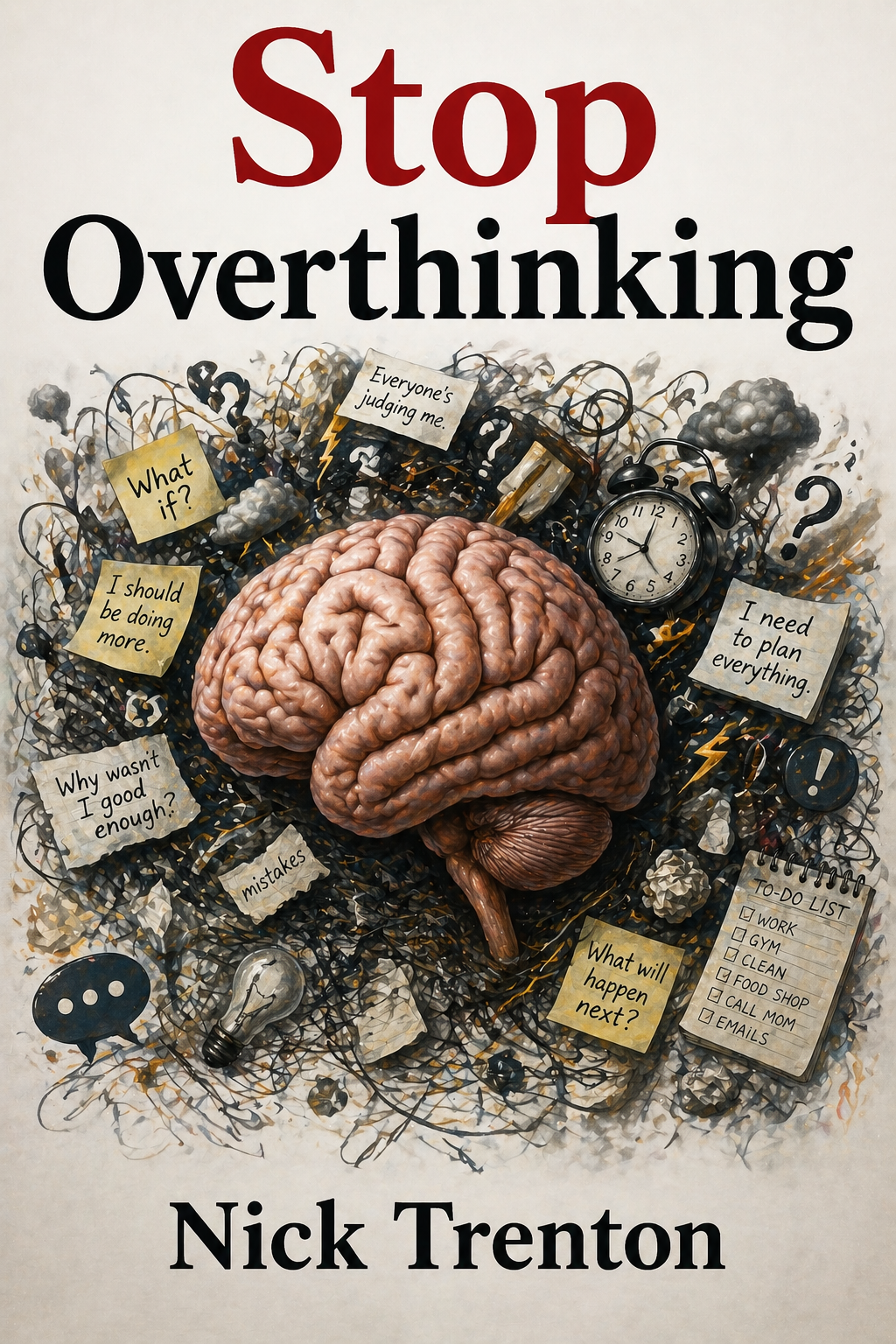
Stop Overthinking
Chapter Summaries
What's Here for You
Are you trapped in a relentless cycle of worry, replaying past events and anticipating future anxieties? "Stop Overthinking" offers a lifeline, guiding you from the labyrinth of your mind toward a calmer, more centered existence. Through relatable examples and practical techniques, you'll discover that overthinking isn't just about surface-level anxieties, but a deeper entanglement of thought patterns. This book provides a toolkit for dismantling stress, managing your time and inputs effectively, and cultivating instant moments of zen amidst the chaos. You'll learn to rewire negative thought patterns using principles of Cognitive Behavioral Therapy (CBT), fostering a more balanced perspective. Ultimately, "Stop Overthinking" empowers you to transform your relationship with anxiety, shifting from a state of overwhelm to one of mindful control. Prepare to embark on a journey of self-discovery, gaining the skills to navigate your inner world with greater ease and resilience. The tone is encouraging and practical, offering actionable steps towards a more peaceful and productive life, free from the tyranny of overthinking.
Overthinking Isn’t About Overthinking
In "Stop Overthinking," Nick Trenton invites us to consider James, a man caught in the labyrinth of his own mind, a mirror reflecting many of our internal struggles. The author illuminates that overthinking isn't merely about the surface-level worries, like James's health scare, but a deeper entanglement with anxiety itself. Trenton suggests that the causes of overthinking are seldom the focus of overthinking. It's a crucial distinction: the mole on James's back isn't the problem; it's the springboard for runaway thoughts. The narrative tension arises from our tendency to treat the symptoms—endless rumination—rather than the root cause: anxiety. Trenton underscores that while genetics might load the gun with a predisposition to anxiety, environmental factors pull the trigger. Life events, stressors, even the arrangement of one's living space contribute. The insight here is that anxiety is multifactorial, a blend of nature and nurture, interacting in complex ways. It's not just about what's happening, but how we perceive it. Trenton reveals that our cognitive style, our mental frames, act as the secret ingredient. Two people can face the same stressor, but their interpretation dictates their experience. Like a lens distorting reality, our mental models shape our perception of stress. The author emphasizes that overthinking has far-reaching consequences, impacting our physical health, mental well-being, and social connections. It's a physiological, psychological, and spiritual phenomenon, a storm raging within. Trenton offers a resolution: overthinking is not a natural state; it's a destructive behavior we can actively choose to stop. Stress is inevitable, but overthinking is optional, a path we can divert from with conscious effort and the right techniques, reclaiming control of our minds and lives.
The De-Stress Formula and Then Some
In "Stop Overthinking," Nick Trenton unveils a practical guide to dismantling the cycle of stress and anxiety, beginning with the foundational principle of self-awareness—a lens through which we observe our inner and outer worlds without judgment, like watching clouds drift by. Trenton introduces the "4 As of Stress Management": avoid, alter, accept, and adapt, presenting them as a versatile toolkit for navigating life's inevitable pressures. He illustrates how avoidance isn't escapism but a strategic retreat from unnecessary stressors, such as rearranging schedules to sidestep the chaos of Saturday morning grocery runs or setting boundaries with draining relationships. When avoidance isn't feasible, Trenton advocates for altering the situation by communicating needs assertively, suggesting that voicing discomfort with a colleague's interruptions can reshape interactions. Acceptance, he clarifies, isn't passive resignation but an active acknowledgment of one's emotions, offering the example of a breakup where validating feelings and practicing forgiveness become pathways to release resentment. Finally, adapting involves profound shifts in perspective, like a perfectionist recalibrating expectations to align with reality, fostering resilience. Trenton then introduces stress diaries as a method to pinpoint triggers and responses, transforming nebulous anxiety into actionable data. He also champions the 5-4-3-2-1 grounding technique, a sensory anchor that pulls us back to the present moment when panic threatens to spiral, reminding us that our bodies, unlike our minds, are always rooted in the now. Drawing from narrative therapy, Trenton encourages externalization, a powerful reframe that separates individuals from their problems; anxiety isn't an inherent trait but an experience one can observe and manage. By rewriting our internal narratives, Trenton suggests, we shift from feeling like victims of circumstance to becoming empowered authors of our own lives, capable of deconstructing overwhelming thoughts into manageable steps, turning chaos into a coherent story.
Manage Your Time and Inputs
In a world demanding constant attention, Nick Trenton unveils the subtle art of managing time and inputs, transforming the overwhelmed 'Susie' into a master of her own schedule. Trenton begins by dismantling the myth that relaxation techniques alone can solve stress, especially when poor time management is the true culprit; it’s like trying to extinguish a house fire with a water pistol while the gas line is still open. He advocates for a fundamental shift: prioritizing rest and enjoyment, not as afterthoughts, but as essential components of a well-structured life, suggesting that if there isn't enough time for both work and well-being, the work itself needs re-evaluation. Trenton introduces a framework for aligning time with values, urging listeners to log their hours, analyze their spending, and restructure their schedules to reflect what truly matters, emphasizing that time management isn't just about cramming more tasks into a day, but about architecting a life that mirrors one's deepest values. He also cautions against the pitfalls of individual time management styles, from the 'time martyr' who drowns in obligations to the 'perfectionist' paralyzed by unattainable standards, advocating for self-awareness as the first step to improvement. Trenton then presents Allen's Input Processing Technique, a method for streamlining responses to the constant barrage of information, advocating for immediate decisions to prevent inputs from accumulating into a mental backlog, freeing up attention and energy. Eisenhower's Urgent-Important matrix is introduced as a tool for firefighters, helping them distinguish between what truly matters and what merely distracts, providing a framework for prioritizing tasks and delegating or eliminating the rest. The chapter culminates in a discussion of SMART goals—Specific, Measurable, Attainable, Relevant, Time-bound—as a roadmap for turning values into tangible outcomes, and an exploration of the Kanban method for visualizing and continuously improving workflows, advocating for small, incremental changes over intimidating leaps. Trenton also champions time blocking as a strategy for carving out focused time for deep work, minimizing distractions, and reclaiming control over one's schedule, ultimately transforming the listener from a reactive juggler into a proactive architect of their own time and energy, making space for what truly matters.
How to Find Instant Zen
In "Stop Overthinking," Nick Trenton explores practical methods for mitigating anxiety in the moment, emphasizing that relaxation is a skill cultivated through consistent practice, much like any other beneficial habit. He reveals that relaxation isn't a passive occurrence but an active process that lowers heart rate, improves digestion, and moderates stress hormones. Trenton introduces three techniques—autogenic relaxation, progressive muscle relaxation, and visualization—all designed to shift focus from mental turmoil to present-moment body awareness. Autogenic training, originating from Johannes Schultz's work, teaches individuals to deliberately calm their central nervous system by using verbal cues to promote awareness of sensations like heaviness, warmth, and regulated heartbeat. Imagine a soothing wave of warmth spreading through your limbs as you repeat, 'I am completely calm,' six times. Trenton underscores that consistent dedication to autogenic training empowers individuals to control internal biological processes. He cautions, however, that those with specific health conditions should consult a doctor before attempting it. Transitioning to guided imagery and visualization, Trenton illustrates how mental images can align the mental and physical realms, steering the mind toward calming destinations. He paints a scene where one can conjure a relaxing environment internally, controlling their stress response by focusing on soothing sensations. Trenton suggests combining visualization with other relaxation techniques to enhance its effectiveness, stating that the body follows the mind's lead, unable to distinguish between reality and imagination. This technique can be like folding up a scene as though it were a painting, and putting it in your pocket to access later. Finally, Trenton delves into progressive muscle relaxation, explaining how tensing and then releasing muscles can relieve tension caused by the fight-or-flight response, benefiting digestive health and lowering blood pressure. He emphasizes that conscious control and awareness of our muscles can lead to deeper states of muscular relaxation when you begin with tensing first. Trenton concludes by reinforcing that mastering these techniques—autogenic training, visualization, and muscle relaxation—is about gaining control over conscious awareness, guiding it away from stressful rumination and toward the present moment and sensory input, ultimately leading to mental, emotional, and physical mastery.
Rewire Your Thought Patterns
In "Stop Overthinking," Nick Trenton illuminates the intricate dance between mind, body, and emotions, pinpointing the mind as the primary architect of our anxiety. Trenton introduces Cognitive Behavioral Therapy (CBT) as a powerful tool, revealing how it gently realigns our skewed perceptions, fostering helpful and adaptive thoughts that can liberate us from the shackles of everyday stress. He explains that our thoughts, not external realities, sculpt our world, birthing emotions that in turn mold our beliefs and behaviors; thus, altering our thoughts is akin to recalibrating our entire existence. Trenton then guides us through the labyrinth of cognitive distortions, those silent saboteurs of clear thinking, such as the all-or-nothing trap, the overgeneralization vortex, and the insidious negativity bias, urging us to unmask these illusions that cloud our judgment. He introduces the ABC model—Antecedent, Behavior, Consequence—as a practical framework to dissect our reactions, urging us to become detectives of our own minds, meticulously logging triggers and outcomes to expose the hidden architecture of our habits. Like a cartographer charting unknown lands, Trenton encourages readers to maintain a dysfunctional thought record, a detailed log of automatic thoughts, emotions, and alternative responses, enabling us to perform a 'postmortem' on our mental landscapes. He then champions cognitive restructuring, teaching us to challenge our internal narratives, acting as scientists scrutinizing our own thinking, seeking evidence rather than succumbing to runaway thoughts. Trenton further advocates for behavioral experiments, a bold step to test our most deeply held beliefs against the touchstone of reality, creating tangible experiences that can shatter long-held misconceptions. Finally, Trenton underscores the importance of self-talk, urging us to cultivate a kinder, more respectful inner voice through deliberate self-scripting, transforming our internal monologue into a source of strength and encouragement, like a personal mantra echoing through the chambers of our minds.
Newfound Attitudes and Emotional Regulation
In "Stop Overthinking," Nick Trenton guides us toward transforming our relationship with anxiety, not just through fleeting techniques, but through a fundamental shift in attitude. He paints a picture of two contrasting figures: one, drowning in the whirlpool of negative thoughts, the other, a beacon of calm, navigating life's storms with unwavering composure. The core difference, Trenton asserts, lies in attitude, a conscious choice to direct our awareness. He presents a manifesto of five key attitudes, the first being a focus on control: like pushing against an immovable boulder, dwelling on the uncontrollable drains our energy, while focusing on our sphere of influence empowers us to act. Trenton urges us to accept what we cannot change, channeling our efforts where they yield results, even if it's merely our own reaction. Next, he emphasizes action over abstraction; anxiety thrives in the realm of vague fears and hypothetical scenarios, but decisive action grounds us in reality, transforming us from passive observers to active participants. The author challenges us to see obstacles as opportunities for creative solutions, to ask, "If I can't do this, what can I do?" Trenton then directs our gaze to gratitude, urging us to focus on what we possess rather than what we lack; this "glass half full" perspective primes us to see solutions and opportunities, preventing us from overlooking the very things that can alleviate our distress. He underscores the importance of presence, noting that anxiety often dwells in the past or future, while true awareness resides in the present moment, the only place where our thoughts can truly serve us. Finally, Trenton advocates for prioritizing needs over wants, cutting through the noise of our desires to identify what is truly essential for our well-being; this simplification allows us to focus our energy and build resilience in the face of disappointment. Trenton concludes with a practical method: the opposite action technique. This involves first identifying and acknowledging the emotion without judgment, then deliberately cultivating the opposite emotion to steer thoughts and behaviors in a healthier direction. It's about allowing emotions to ride with us, but not letting them drive. He illustrates this with a tense encounter after a car accident, where choosing calm over anger can defuse the situation and bring a sense of peace. Ultimately, Trenton's message is one of empowerment: by consciously adopting these attitudes and actively regulating our emotions, we can break free from the cycle of overthinking and cultivate a life of resilience, focus, and inner peace.
Conclusion
Nick Trenton's 'Stop Overthinking' offers a comprehensive toolkit for dismantling the anxiety-fueled cycle of rumination. It underscores that overthinking is often a symptom, not the disease itself, stemming from a complex interplay of genetics, environment, and individual cognitive styles. The book's emotional lesson lies in recognizing that stress is inevitable, but *how* we respond is a choice. Practical wisdom is woven throughout, beginning with cultivating self-awareness—observing thoughts and emotions without judgment. The '4 As' (avoid, alter, accept, adapt) provide a flexible framework for proactive stress management. Time management isn't just about efficiency; it's about aligning actions with core values. Techniques like the 5-4-3-2-1 grounding exercise and externalizing problems offer immediate relief, while cognitive restructuring, rooted in CBT principles, addresses the underlying distorted thought patterns. Ultimately, 'Stop Overthinking' empowers readers to rewrite their internal narratives, cultivate resilience, and build a life grounded in conscious action rather than anxious reaction, shifting the focus from what we lack to gratitude for what we have.
Key Takeaways
Overthinking is often a symptom of underlying anxiety, not the root problem itself.
Anxiety arises from a complex interplay of genetic predispositions and environmental factors.
Our individual cognitive style and mental models significantly shape our experience of stress.
Overthinking has wide-ranging negative consequences, impacting physical, mental, and social well-being.
While stress is a fact of life, overthinking is a choice that can be actively resisted and changed.
Becoming aware of your thoughts and thinking about your thoughts can be a trigger for overthinking.
Cultivate self-awareness to observe inner and outer experiences without judgment, providing a foundation for managing stress.
Utilize the '4 As' (avoid, alter, accept, adapt) as a versatile framework for responding to stressors proactively.
Practice acceptance by validating your emotions and working towards forgiveness, freeing yourself from resentment and blame.
Adapt to stress by making lasting changes to your worldview and expectations, fostering resilience and a stronger sense of self.
Maintain a stress diary to pinpoint triggers and responses, enabling data-driven adjustments to manage stress levels effectively.
Employ the 5-4-3-2-1 grounding technique to anchor yourself in the present moment, interrupting the cycle of overthinking and panic.
Externalize problems by separating yourself from them, gaining perspective and empowering yourself to rewrite your internal narratives.
Prioritize rest and enjoyment as essential, not optional, elements of a balanced life, recognizing their impact on overall well-being and productivity.
Align your time with your core values by analyzing how you currently spend your hours and restructuring your schedule to reflect what truly matters to you.
Identify and address your individual time management style (e.g., 'time martyr,' 'perfectionist') to overcome specific roadblocks hindering your effectiveness.
Streamline your response to inputs (emails, calls, messages) by making immediate decisions to prevent mental clutter and free up attention.
Distinguish between urgent and important tasks using Eisenhower's matrix to prioritize effectively and delegate or eliminate distractions.
Set SMART goals (Specific, Measurable, Attainable, Relevant, Time-bound) to transform values into tangible outcomes and enhance focus.
Visualize and continuously improve your workflows using the Kanban method, focusing on small, incremental changes for sustained progress.
Relaxation is an active skill requiring consistent practice, not a passive state.
Autogenic training empowers individuals to control their central nervous system through verbal cues and sensory awareness.
Mental imagery can align the mental and physical realms, enabling control over the stress response.
Tensing and releasing muscles can relieve tension caused by the fight-or-flight response, promoting physical and mental relaxation.
Mastering relaxation techniques involves guiding conscious awareness away from rumination and toward the present moment.
Thoughts, not external events, primarily shape our emotions and behaviors, highlighting the power of cognitive restructuring to alter our perceptions and responses.
Cognitive distortions act as filters, skewing our perception of reality; identifying and challenging these distortions is crucial for clear, rational thinking.
The ABC model (Antecedent, Behavior, Consequence) provides a structured framework for understanding and modifying unwanted behaviors by identifying triggers and outcomes.
Maintaining a dysfunctional thought record enables a detailed analysis of automatic thoughts and emotions, paving the way for healthier, alternative responses.
Behavioral experiments offer a practical way to test core beliefs, using real-world experiences to challenge and reshape entrenched thought patterns.
Cultivating positive self-talk and scripting through conscious effort can transform our inner dialogue into a supportive and empowering force, enhancing self-esteem and resilience.
Focusing on what you can control, rather than what you can't, conserves energy and empowers action.
Taking decisive action, instead of dwelling on abstract fears, clarifies and grounds you in the present.
Cultivating gratitude for what you have, instead of fixating on what you lack, reveals hidden opportunities and solutions.
Directing your awareness to the present moment, rather than the past or future, maximizes your ability to act effectively.
Prioritizing needs over wants simplifies decision-making and builds resilience against disappointment.
Practicing the 'opposite action' technique allows you to consciously choose alternative emotions and behaviors, disrupting negative patterns.
Adopting a mindset characterized by flexibility, focus and resilience will help you overcome anxious overthinking and promote well-being.
Action Plan
Identify specific triggers that exacerbate your overthinking, such as insecurities or stressful situations.
Practice mindful awareness to recognize when you're engaging in overthinking patterns.
Challenge negative thought patterns by questioning their validity and exploring alternative perspectives.
Cultivate healthy daily habits, such as regular exercise, balanced nutrition, and sufficient sleep.
Create a calming and organized environment in your home and workspace to reduce stress.
Explore cognitive behavioral therapy (CBT) techniques to reframe your perspective and manage anxiety.
Strengthen your sense of control and empowerment by setting achievable goals and taking proactive steps.
Practice self-compassion and challenge negative self-talk.
Establish clear boundaries in relationships and commitments to reduce external stress.
Practice daily self-awareness by checking in with your bodily sensations, thoughts, and feelings without judgment.
Identify stressors in your environment and actively avoid those that are unnecessary or harmful.
Communicate your needs and feelings directly to others to alter stressful situations.
When faced with a difficult situation, validate your emotions and seek ways to forgive if wronged.
Challenge and adjust your expectations to align with reality, reducing stress caused by perfectionism.
Keep a stress diary for a week to track your stress levels, triggers, and responses, then analyze the data for patterns.
Use the 5-4-3-2-1 grounding technique during moments of anxiety or panic to anchor yourself in the present.
Practice externalization by separating yourself from your problems and reframing your internal narrative.
Identify your top three values and assess whether your current time allocation reflects these priorities.
Track your time for a week, logging every hour spent, to identify areas where you can better align your activities with your values.
Create a daily to-do list, ranking tasks as urgent, important, or not important, and focus on completing urgent and important tasks first.
Implement Allen's Input Processing Technique by making immediate decisions on incoming stimuli (emails, calls, etc.) to avoid mental clutter.
Use Eisenhower's Urgent-Important matrix to classify tasks and delegate or eliminate those that are not important or urgent.
Set a SMART goal (Specific, Measurable, Attainable, Relevant, Time-bound) related to a personal or professional objective.
Visualize your workflow using the Kanban method, breaking down tasks into manageable steps and continuously improving the process.
Block out specific times in your schedule for deep work, minimizing distractions and maximizing focus on high-priority tasks.
Schedule regular rest and leisure activities into your week to ensure adequate relaxation and prevent burnout.
Practice autogenic training daily, focusing on sensations like heaviness, warmth, and regulated heartbeat, using verbal cues.
Incorporate guided imagery into your routine, visualizing a calming place and engaging all senses to enhance relaxation.
Perform progressive muscle relaxation, tensing and releasing different muscle groups to relieve tension and improve body awareness.
Combine relaxation techniques with other practices like meditation, yoga, or journaling for synergistic effects.
Consult a healthcare professional before attempting autogenic training if you have underlying health conditions.
Create a personal library of calming mental images to access during moments of stress or anxiety.
Dedicate 15-20 minutes each day to practice one or more of these relaxation techniques.
Pay attention to where stress is accumulating in your body and adjust your relaxation techniques accordingly.
Identify your cognitive distortions by recognizing patterns of negative thinking such as all-or-nothing thinking, overgeneralization, or emotional reasoning.
Use the ABC model to dissect specific situations, noting the Antecedent (trigger), Behavior (reaction), and Consequence (outcome) to understand the drivers of your actions.
Keep a dysfunctional thought record to log automatic thoughts, associated emotions, and alternative, healthier responses to gain insight into recurring patterns.
Challenge your automatic thoughts by questioning the evidence supporting them and actively seeking alternative interpretations to promote more balanced thinking.
Conduct behavioral experiments to test core beliefs by formulating hypotheses and observing real-world outcomes to reshape entrenched thought patterns.
Develop a self-script with positive and encouraging language to counteract negative self-talk and reinforce a kinder, more compassionate inner voice.
Practice STOP: When you feel a negative emotion, STOP. Pause, and become alert. Write down as much as you can in your record, whichever style youve opted for. Identify the trigger or cue, or at least whatever came directly before the feeling, and note it down.
Identify one area in your life where you feel powerless and shift your focus to what aspects you *can* control.
When caught in a cycle of overthinking, choose a small, concrete action you can take immediately to ground yourself in reality.
Start a daily gratitude practice, listing three things you appreciate to cultivate a more positive perspective.
Practice mindfulness by focusing on your breath or senses to anchor yourself in the present moment.
Identify three essential needs in a specific area of your life (e.g., housing, relationships) and prioritize them over less important desires.
When experiencing a strong negative emotion, identify the opposite emotion and consciously try to cultivate it for a set period of time.
Create a CBT spreadsheet to identify unhealthy thoughts and think of better alternatives.