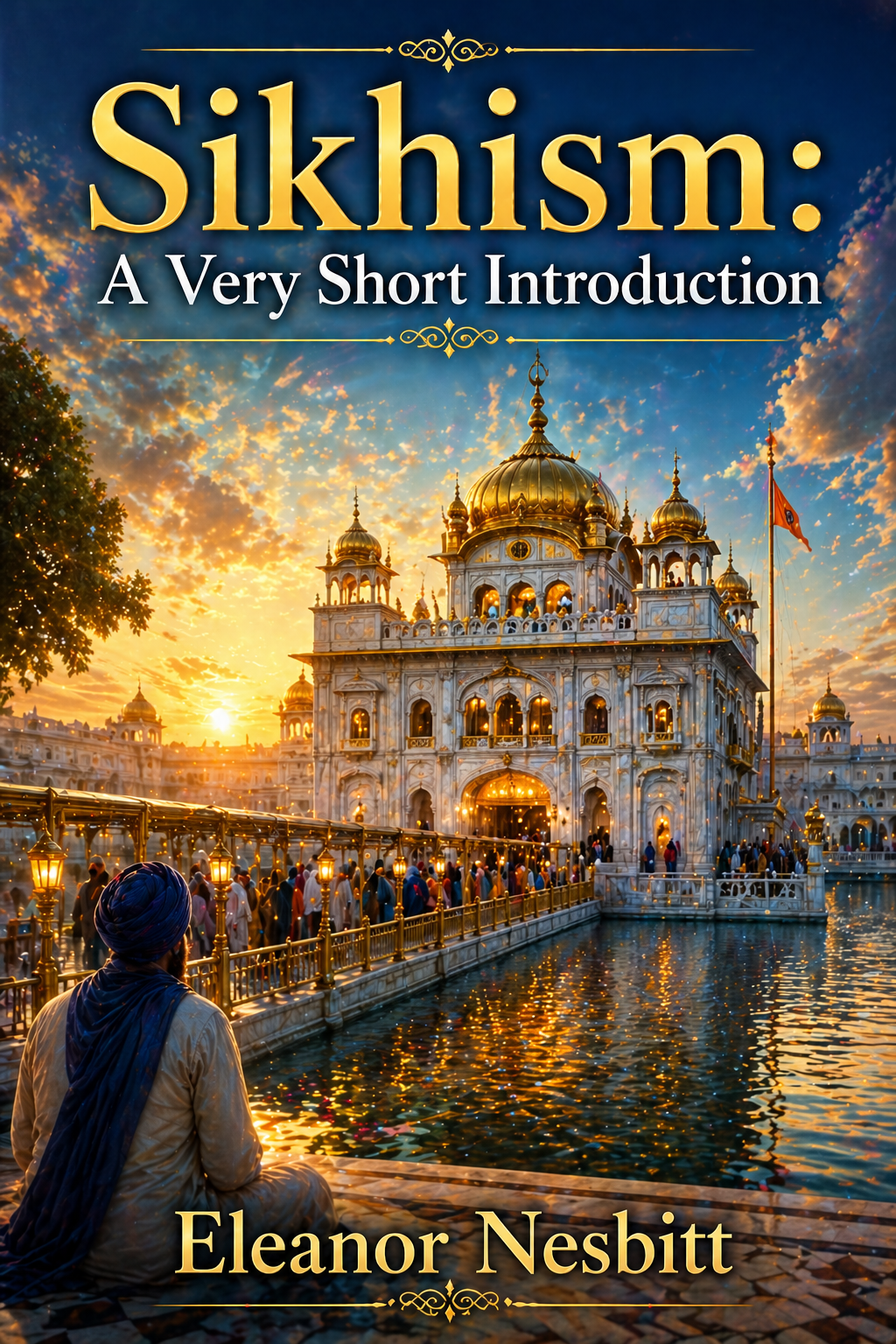
Sikhism: A Very Short Introduction
Chapter Summaries
What's Here for You
Embark on a journey to understand Sikhism beyond surface-level perceptions with Eleanor Nesbitt's insightful exploration. This book unveils Sikhism as a living, breathing tradition shaped by history, devotion, and diaspora. You'll gain a deeper appreciation for the significance of the Guru Granth Sahib, the symbolism of the turban and Khalsa, and the evolving identity of Sikhs in a globalized world. Delve into the nuances of Sikh attitudes toward caste, gender, and interfaith relations, and contemplate the challenges and opportunities facing Sikhism in the third millennium. Prepare for an intellectually stimulating and culturally enriching experience that dispels misconceptions and fosters a profound understanding of this vibrant faith.
Introduction
In this introductory chapter of 'Sikhism: A Very Short Introduction,' Eleanor Nesbitt sets the stage for understanding Sikhism not as a static entity, but as a vibrant, evolving tradition. The author begins by acknowledging common perceptions of Sikhism, often colored by media portrayals of swords and turbans, contrasting them with the reality of energetic hospitality and a profound spiritual discipline. Nesbitt emphasizes that Sikhism's story is one of a community forged through struggle, and the book will largely follow a chronological path to illuminate its development. The initial tension arises from the oversimplified image of Sikhism—Guru Nanak, the Guru Granth Sahib, gurdwaras—versus the messy, ongoing process of becoming a distinct religion, particularly in relation to Hinduism. Nesbitt cautions against viewing religion as an abstract concept, instead framing it as a fluid tradition, difficult to fully define, like trying to hold water in cupped hands. She highlights that the term 'Sikhism' itself, like 'Hinduism' and 'Buddhism,' is a Western construct, adopted but not entirely satisfactory. The author clarifies the meaning of 'Sikh'—a learner or disciple—and points to the diverse ways Sikhs define their faith, referencing the core beliefs: one immortal Being, the ten Gurus, the Guru Granth Sahib, and the baptism of the tenth Guru. This definition underscores a key tension: the interplay between a fixed set of principles and the lived experiences of a community. Statistics reveal the concentration of Sikhs in Punjab, India, and their diaspora across the globe, especially in the UK, Canada, and the USA. The role of the Guru is paramount, understood as the 'remover of darkness,' encompassing the ten human Gurus, the gurbani within the scriptures (Guru Granth Sahib), and God itself (Vahiguru). Nesbitt then poses a central question: does Sikhism constitute a separate faith? She presents five perspectives, ranging from Sikhism as a Hindu sampradaya to the assertion of Sikhs as a separate nation. The book adopts a sixth view: Sikhism has evolved into a separate religion with its own markers—scripture, calendar, rites, places of worship, and shared history—yet remains intertwined with its historical context, particularly Hinduism and Islam. She notes the etymological connection of 'Hindu' to the Indus River, emphasizing Hinduism's inclusive nature and acceptance of concepts like karma. The author explores the argument that Sikhism is a Hindu sampradaya, acknowledging shared names, families, teachings, concepts, and social conventions. However, she also notes Sikh writers' resistance to being absorbed into Hinduism, recalling the earlier absorption of Buddhism. The relationship is not a simple parent-daughter dynamic, as with Judaism and Christianity, due to differing numerical balances and textual relationships. Nesbitt dispels the notion of Sikhism as merely a blend of Hinduism and Islam, cautioning against oversimplification. Resonances between faiths do not necessarily imply direct influence. Finally, the author stresses the importance of Punjab as the spiritual homeland of Sikhs, even for those in the diaspora, and introduces 'panjabiat' as a blend of language, humour, and lifestyle. Ultimately, Nesbitt sets the stage for exploring the dynamic interplay between Sikh teachings and Punjabi cultural norms, acknowledging both convergence and divergence, and previews the book's structure, which will delve into the lives of the Gurus, the scriptures, the Khalsa, Sikh history, the diaspora, and contemporary issues.
Guru Nanak and his first successors
In this exploration of Guru Nanak and his early successors, Eleanor Nesbitt paints a vivid picture, starting with the symbolic devotional images revered by Sikhs, particularly those of Guru Nanak and Guru Gobind Singh, figures who loom large in the Sikh faith. Nesbitt draws a parallel between Guru Nanak and Martin Luther, noting their shared critique of religious formalism and their advocacy for vernacular teachings, while also cautioning against oversimplification, emphasizing the unique spiritual and cultural tapestry of 15th-century Punjab, a land of Hindu majority under Muslim rule, a crucible of diverse faiths including Sufis and the bhakti movement, setting the stage for Nanak's revolutionary message. The author navigates the challenge of understanding Guru Nanak, pointing out the absence of gospel-like scriptures and highlighting the role of janam-sakhis narratives filled with miracles and moral lessons, like the tale of Bhai Lalo and Malik Bhago, which underscores integrity over status. Nesbitt invites us to consider how these stories, though not literal history, reveal the values embedded by Guru Nanak in his hymns, poems that serve not as autobiography but as beacons of divine truth, urging self-transformation. She then outlines Guru Nanak’s life, from his birth in Nankana Sahib to his spiritual awakening after his experience in the river, to his travels with Mardana, to the founding of Kartarpur, where work and worship intertwined, to the selection of his successor before his death. Nesbitt then reveals a core teaching: Guru Nanak's declaration that "There is no Hindu, no Muslim," a radical call for transcending religious labels and embracing inner spirituality. The author unpacks the mul mantar, the essence of Sikh belief, emphasizing the singularity of oankar, and the importance of truthful action rooted in continuous meditation, a path away from ego and delusion, towards enlightenment. Nesbitt highlights Guru Nanak’s advocacy for equality and the importance of community, the sadhsangat, and the practice of nam dan ishnan meditate, give, bathe. She concludes by noting the roles of Guru Nanak’s successors, Nanak 2, 3, 4, and 5, their contributions to the Guru Granth Sahib, and their emphasis on langar, the communal meal, a tangible expression of equality, showing how spiritual movements evolve into institutions, all while holding firm to the message of Guru Nanak.
Guru Granth Sahib
In Eleanor Nesbitt's exploration of the Guru Granth Sahib, she sets the stage by illustrating its daily presence in Sikh life, a guiding voice accessed through technology and tradition alike. The central tension arises: is this scripture merely a book, or something more profound? Nesbitt illuminates the Sikh belief that the Guru Granth Sahib is the living embodiment of the Gurus, the final and eternal Guru. The author emphasizes that the scripture's message is a singular, powerful yearning for God, advocating for inner transformation over ritualistic adherence or caste distinctions; instead, it calls for constant meditation on the divine name amidst the chaos of life. The compilation of the Granth, Nesbitt explains, involved multiple Gurus, each contributing to its formation, from Guru Nanak's inspired hymns to Guru Arjan's authoritative volume, a textual lineage meticulously preserved. Like a river fed by many tributaries, the language of the Guru Granth Sahib is a rich tapestry, weaving together Persian, Sanskrit, and vernacular dialects, all rendered in the Gurmukhi script, a script believed to come directly from the mouth of the Guru. The author underscores that this linguistic diversity was intentionally inclusive, aiming to reach a broad audience rather than a select elite. Nesbitt reveals that the organization of the Guru Granth Sahib is deeply structured, arranged by musical mode and poetic form, reflecting the belief that music can alter states of mind, evoking serenity and joy. As Nesbitt continues, she notes that Guru Gobind Singh declared the Granth as the ultimate Guru, a belief that infuses every aspect of Sikh worship and daily life, from the reverence shown to the physical text to the communal singing of kirtan. This veneration, she suggests, is akin to the Christian belief in the Eucharist, where the bread and wine embody Christ's body and blood. Nesbitt gently nudges the reader to consider honoring the content of the scripture, not just its physical form, urging a deeper engagement with its teachings. The gurdwara itself exists solely to house the Guru Granth Sahib, its presence dictating rituals and behaviors, from the waving of the chaur to the ceremonial laying to rest at night. The author paints a vivid picture of the scripture's journey, transported with utmost care and reverence, its sanctity permeating every space it occupies. It's a reminder that true reverence lies not just in ritual, but in the transformative power of the word.
Turban, Khalsa, and codes of conduct
In Eleanor Nesbitt's exploration of Sikh identity, she unveils the profound symbolism embedded within the turban and the Khalsa tradition. The narrative begins by addressing the visible markers of Sikh identity, particularly the turban, dispelling misconceptions and revealing its cultural and religious significance. Nesbitt highlights that while turban colors often reflect personal preference or political leanings, they are also integral to Khalsa Sikh commitment, an insult to which is seen as an insult to the Panth. The Five Ks, outward signs of a Sikh, are explored: kesh (uncut hair), kangha (comb), kirpan (sword), kachh (cotton breeches), and kara (steel or iron bangle); these are not mere accessories, but emblems of disciplined holiness, sexual restraint, justice, and a connection to the divine. The author navigates the historical context of the Khalsa, born from Guru Gobind Singh's call for conspicuous loyalty in 1699, set against a backdrop of 17th-century confrontations. Nesbitt introduces the tradition of Vaisakhi, a pivotal event where Guru Gobind Singh established the Khalsa, demanding unwavering commitment symbolized by the willingness to sacrifice oneself. She unpacks the inauguration ceremony involving amrit, the water of immortality, and the adoption of the name Singh, marking a casteless body of brave warriors dedicated to protecting the defenceless; this transformation, Nesbitt argues, signifies a shift towards a community ready to challenge oppression. The chapter then turns to the evolution of Sikh militarization, recounting the martyrdom of Guru Arjan and Guru Tegh Bahadar, whose sacrifices ignited a spirit of resistance against Mughal rule; these acts of courage became cornerstones of Sikh identity, inspiring generations to defend their faith. Finally, Nesbitt examines the development of the rahit-namas, codes of discipline that shaped Sikh behavior, addressing contentious issues such as vegetarianism and social separation from Muslims; these codes, born from turbulent times, underscore the Khalsa's martial character and the ongoing negotiation of Sikh identity in the face of historical and ethical dilemmas, revealing a faith forged in the crucible of conflict and commitment.
The shaping of modern Sikhism
In this chapter, Eleanor Nesbitt charts the evolution of contemporary Sikhism through the lens of influential intellectuals, the Tat Khalsa, and political activists, the Akalis, revealing how their efforts reshaped Sikh identity in 19th- and 20th-century Punjab. Nesbitt sets the stage with Maharaja Ranjit Singh, whose inclusive reign, though celebrated, stood in contrast to the Tat Khalsa's later push for a sharply defined Sikhism distinct from Hinduism. The Golden Temple in Amritsar, a symbol of Sikh resilience, embodies this complex history, its architecture a blend of Mughal and Rajput styles, its sanctity a focal point for Sikh devotion, yet once a site of Hindu-influenced worship. Here, the central tension emerges: the struggle between an amorphous, syncretic Sanatan Sikhi and the reformist zeal for a purified Khalsa tradition. Nesbitt elucidates how movements like the Nirankaris and Namdharis, with their emphasis on formless worship and repetition of God's name respectively, sought renewal but differed from the Tat Khalsa in their acceptance of living Gurus. British rule, with its romanticized view of Sikhs as a martial race, further complicated matters, encouraging Khalsa traditions in the army while simultaneously opening doors to Christian missionary activity and the printing press, tools that amplified competing religious narratives. The emergence of the Singh Sabha movement, from which the Tat Khalsa arose, marked a turning point, driven by anxieties over syncretism and Christian incursion; the printing press became a double-edged sword, disseminating views swiftly but also intensifying the sense of distinct identity among religious groups, like ink solidifying into immutable borders. The Akali movement's struggles for control of Sikh holy places and the legal recognition of the Anand Karaj marriage rite underscore the determination to assert Sikh distinctiveness. Partition in 1947, a cataclysmic event marked by ethnic cleansing and loss, paradoxically led to a more geographically concentrated Sikh population, fueling the campaign for a Punjabi-speaking state. The chapter culminates with an exploration of diverse expressions of Sikh identity, from Bhagat Puran Singh's compassionate seva to the Akhand Kirtani Jatha's strict adherence to Khalsa discipline, revealing that even within a reformed Sikhism, a spectrum of beliefs and practices persists. Nesbitt underscores that the Sikh Rahit Maryada, published in 1950, became a cornerstone for standardizing Sikh practice, yet the debates over who is a 'proper Sikh' continue, reflecting the ongoing negotiation between tradition and modernity, unity and diversity, in the ever-evolving tapestry of Sikhism.
Sikhism outside India
In this exploration of the Sikh diaspora, Eleanor Nesbitt illuminates how a faith community adapts and thrives beyond its homeland. She sets the stage by noting the shift in the term 'diaspora' itself, now broadly applied to faith communities outside their historical origins, and emphasizes that the Sikh diaspora, though smaller than the Jewish one, holds significant influence due to its affluence, particularly in the UK and North America. Nesbitt reveals a central tension: the struggle to maintain Khalsa traditions amidst social and legal pressures in new environments. She paints a vivid picture of early Sikh migrants—farmers from the Jalandhar Doaba, driven by dwindling land holdings and the need to secure their families' izzat—seeking better fortunes in 1950s Britain, where labor was in demand. The narrative then broadens, showcasing the diverse phases of migration, from the 19th-century mobilization following the British annexation of Punjab to the establishment of Sikh communities in East Africa, spurred by the British administration's need for skilled construction workers. Nesbitt highlights the evolution of gurdwaras in the diaspora, transforming from simple gatherings in private homes to impressive, purpose-built structures that serve as community hubs. These spaces offer solace and cultural familiarity, but also reflect adaptations to Western norms, such as weekend marriages and the initial use of chairs during worship. The author underscores the challenges faced by turban-wearing Sikhs, navigating legal and social obstacles to preserve their Khalsa identity, and she notes the crucial role of religious education in UK schools in shaping public perception of Sikhism. Nesbitt doesn't shy away from the internal tensions either, highlighting how Punjabi politics and the Khalistan movement have influenced diaspora communities, sometimes dividing them along caste lines. She introduces the figure of the Sant, a charismatic leader who strengthens commitment to Sikhi and provides a transnational link between sangats, and she also acknowledges the unique phenomenon of the 3HO movement, which has attracted Western followers to a distinct form of Sikh practice. Ultimately, Nesbitt emphasizes the diaspora's economic contributions to Punjab, the emergence of new Sikh studies, and the ongoing debates surrounding identity, tradition, and modernity within the Panth, revealing a faith community constantly negotiating its place in a changing world, a vibrant tapestry woven with threads of tradition, adaptation, and unwavering devotion.
Attitudes to caste, gender, and other faiths
In this exploration of Sikhism, Eleanor Nesbitt navigates the complex interplay of faith, culture, and societal norms, revealing how Sikh teachings grapple with caste, gender, and interfaith relations. Nesbitt begins by framing the discussion with contrasting narratives: Bhai Vir Singh's idealized depiction of a Sikh woman in "Sundri" and Gurinder Chadha's contemporary film "Bend It Like Beckham," highlighting the evolving roles and expectations of women within the Sikh community. The central tension emerges: the resounding Sikh claim of equality within the Panth versus the persistent realities of social hierarchies. Nesbitt unpacks how, despite Guru Nanak's declaration of universal nobility and the feminine valorization in the concept of bani, historical and cultural forces have shaped gender dynamics. We see how scripture hails women, yet also uses them as images of distraction, creating a tension between reverence and caution. The author notes the evolution of rahit-namas, from those imposing different rules for men and women to the Sikh Rahit Maryada advocating equal obedience, yet the silence surrounding influential figures like Mata Sundri speaks volumes. Moving to caste, Nesbitt confronts the paradox of a faith denouncing caste distinctions while existing within a caste-based society, highlighting the persistence of caste endogamy and stereotypes, even in the diaspora. The narrative tension peaks with the juxtaposition of the Gurus' teachings on spiritual equality and the social reality of caste-based discrimination, a chasm bridged neither by denial nor simple condemnation. Finally, Nesbitt addresses interfaith relations, revealing how Sikh scripture promotes unity while historical conflicts have led to social segregation, illustrating the ongoing negotiation between inclusivity and distinct identity, a balance symbolized by Bhai Kahnaiya offering water to both sides of the battlefield. The author underscores that while the Sikh Rahit Maryada discourages interfaith marriage, respect for all faiths remains a cornerstone, a testament to Sikhism's enduring quest for truth beyond dogma.
Sikhism and the third millennium
In this chapter, Eleanor Nesbitt navigates the complex terrain of Sikhism in the 21st century, a landscape marked by globalization, resurgent religious identities, and the ever-present tension between tradition and modernity. The author begins by noting how, in the wake of events like 9/11, Sikhs were mistakenly targeted, highlighting a global tendency to conflate religious appearance with extremism, a stark reminder of how easily misunderstanding can lead to prejudice. Nesbitt then turns to the internal dynamics of the Panth, exploring the contentious Nanakshahi calendar debate, which serves as a microcosm of larger questions about authority, identity, and the delicate balance between preserving distinctiveness and engaging with broader Punjabi culture. The struggle to reconcile the Nanakshahi calendar with the Vikrami calendar underscores a core tension: how can a community maintain its unique identity while remaining connected to its cultural roots? The author masterfully portrays the Akal Takhat, the SGPC, and the Sant Samaj, revealing the intricate interplay of religious and political factions within Sikhism. Nesbitt observes that the Guru Granth Sahib, while revered as the ultimate authority, requires human interpretation, thus opening the door to varying perspectives and potential disputes. The author highlights the challenge of applying ancient wisdom to contemporary ethical dilemmas, noting the absence of a formal clergy and the difficulties faced by diaspora Sikhs in accessing relevant guidance. Nesbitt suggests that the increasing influence of overseas Sikh communities and the rise of internet forums are reshaping traditional authority structures, creating new spaces for dialogue and debate. In an era defined by rapid information exchange, the internet becomes both a source of connection and a potential echo chamber, amplifying diverse voices while also lending spurious authority to unreliable sources. She emphasizes that Sikhism's relationship to other faith communities, particularly Hinduism, remains a central theme of Sikh discourse, with debates over identity and distinctiveness continuing to shape the Panth's evolution. Nesbitt ultimately frames Sikhism as a vibrant, evolving tradition, full of internal diversity and open to continuous reinterpretation, and calls for a confident embrace of scholarly inquiry and interfaith dialogue, urging Sikhs to articulate their distinctiveness without defensiveness, recognizing that the essence of their faith—the union of the human soul with the divine—transcends any singular definition.
Conclusion
Nesbitt's 'Sikhism: A Very Short Introduction' reveals a faith both deeply rooted in history and dynamically evolving. Sikhism, while sharing a landscape with Hinduism and Islam, has forged a distinct identity, particularly through the Khalsa and the Guru Granth Sahib, considered a living Guru. The text transcends mere scripture, guiding daily life and inspiring devotion. The turban and Five Ks are potent symbols, reflecting commitment and community. However, Nesbitt doesn't shy from complexities. The diaspora presents challenges of maintaining identity amidst globalization, while internal tensions persist regarding caste, gender, and interpretations of scripture. The book underscores the importance of understanding Sikhism not as a monolithic entity but as a faith constantly negotiating tradition and modernity. Ultimately, the book emphasizes the Sikh call for equality, compassion, and seeking truth through experience, offering relevant wisdom for a global audience navigating diverse spiritual paths.
Key Takeaways
Sikhism is not a static, neatly packaged religion, but an evolving tradition shaped by historical struggles and ongoing identity formation.
The term 'Sikhism' is a Western construct that, while now widely used, simplifies the complex reality of the faith.
The concept of 'Guru' in Sikhism extends beyond the ten human Gurus to encompass the scriptures and God itself, emphasizing the interconnectedness of spiritual guidance.
While Sikhism shares historical and cultural contexts with Hinduism and Islam, it has evolved into a distinct religion with its own unique markers and self-definition.
Punjab serves as the spiritual homeland for Sikhs, and 'panjabiat' (Punjabiness) significantly influences Sikh identity and cultural expression.
True spirituality transcends religious labels, focusing on inner truth and ethical action.
Authentic living integrates meditation, honest work, and selfless sharing.
Ego and materialism create delusion, obscuring spiritual growth.
Community and shared practice strengthen spiritual devotion.
Spiritual leadership involves both divine inspiration and practical organization.
Equality and compassion are essential expressions of divine love.
The Guru Granth Sahib is revered as the living embodiment of the Gurus, not merely a text, guiding daily life and spiritual practice.
The scripture emphasizes inner transformation and meditation on the divine name over adherence to rituals or caste distinctions.
The Granth's compilation involved multiple Gurus, each contributing to its rich textual and spiritual heritage.
The linguistic diversity of the Guru Granth Sahib was intentionally inclusive, designed to reach a broad audience through vernacular languages.
The scripture's organization by musical mode reflects the belief in music's power to alter states of mind and evoke spiritual emotions.
Sikhs are encouraged to honor the content of the Guru Granth Sahib through mindful reading and application of its teachings, not just through physical veneration.
The presence of the Guru Granth Sahib transforms a space into a gurdwara, dictating rituals and behaviors that reflect deep reverence.
Visible symbols like the turban and the Five Ks are not merely outward signs but profound expressions of religious commitment, historical identity, and community solidarity within Sikhism.
The Khalsa represents a transformative shift towards a casteless, warrior-like community dedicated to upholding justice and protecting the defenceless, born from Guru Gobind Singh's call for unwavering loyalty.
Martyrdom and militarization are pivotal aspects of Sikh history, inspiring resistance against oppression and shaping the ideal of the 'sant sipahi'—the saint-soldier.
The rahit-namas, or codes of discipline, reflect the ongoing evolution of Sikh identity and ethical considerations, addressing issues such as diet and social separation within a historical context of conflict and resistance.
Sikh identity is not monolithic but has been shaped by competing movements and historical forces, including reformist groups, British rule, and political activism.
The drive for a distinct Sikh identity intensified in response to perceived threats of syncretism, Christian conversion, and the political landscape of British India.
Legal and political victories, such as the Anand Marriage Act and the Sikh Gurdwaras Act, were crucial in establishing Sikhs as a community distinct from Hindus.
Partition in 1947, despite its immense human cost, led to a greater concentration of Sikhs and fueled the demand for a Punjabi-speaking state, seeking to protect Sikh traditions.
Contemporary Sikhism encompasses a range of expressions, from strict adherence to Khalsa discipline to compassionate service, reflecting diverse interpretations of what it means to be a Sikh.
The Sikh diaspora's affluence amplifies its influence within the global Panth, demanding its inclusion in discussions about the faith's future.
Maintaining Khalsa identity in the diaspora requires constant negotiation between tradition and the social/legal constraints of new homelands.
Migration patterns reveal a complex interplay of economic necessity, social status, and religious identity, challenging simplistic notions of a unified Sikh experience.
Gurdwaras in the diaspora evolve into multifaceted community centers, adapting to local contexts while preserving core Sikh values and practices.
Political movements in Punjab significantly impact diaspora Sikh communities, creating both unity and division along ideological and caste lines.
Charismatic Sants play a vital role in sustaining religious commitment and providing transnational connections within the diaspora.
Sikh studies in the diaspora contribute new perspectives and critical analyses, sparking debates about tradition, identity, and the interpretation of scripture.
Recognize the tension between the Sikh ideal of equality and the lived realities of gender, caste, and interfaith relations within the community.
Understand how historical and cultural contexts shape the interpretation and implementation of religious principles.
Acknowledge the complex roles women have played in Sikh history, marked by both celebration and silence.
Confront the paradox of denouncing caste while navigating a caste-based society, and actively work to dismantle caste-based discrimination.
Embrace the Sikh emphasis on respect for all faiths, while also maintaining a distinct Sikh identity.
Promote inclusivity and break down barriers based on gender, caste, or religious identification in daily life.
Seek truth through personal experience rather than rigid adherence to dogma, fostering respect for diverse spiritual paths.
Globalization and heightened religious tensions have led to misidentification and prejudice against Sikhs, underscoring the need for greater interfaith understanding and awareness.
The Nanakshahi calendar controversy reveals a deep-seated tension within the Panth regarding authority, identity, and the balance between distinctiveness and cultural connection.
While the Guru Granth Sahib serves as the ultimate authority, its interpretation by fallible humans necessitates ongoing dialogue and can lead to varied understandings.
The absence of a formal clergy within Sikhism poses challenges for addressing contemporary ethical dilemmas, especially for diaspora Sikhs navigating unfamiliar social contexts.
The rise of internet forums and the increasing influence of overseas Sikh communities are reshaping traditional authority structures, fostering new spaces for debate and community-building.
Sikhism's relationship to other faith communities, particularly Hinduism, remains a central theme, with debates over identity and distinctiveness shaping the Panth's evolution.
Sikhism's enduring strength lies in its internal diversity, continuous reinterpretation, and its potential to offer spiritual guidance and ethical frameworks relevant to a global audience.
Action Plan
Support initiatives that promote religious literacy and understanding in your community.
Reflect on your own preconceptions about Sikhism and consider how they might be influenced by media portrayals.
Explore the diverse ways Sikhs define their faith and consider the interplay between core beliefs and lived experiences.
Research the historical and cultural context of Sikhism, particularly its relationship with Hinduism and Islam.
Consider the significance of Punjab as the spiritual homeland for Sikhs and how 'panjabiat' influences Sikh identity.
Engage in respectful dialogue with Sikhs to learn more about their faith and experiences firsthand.
Reflect on a time when you prioritized status or wealth over integrity, and identify one step you can take to align your actions with your values.
Commit to a daily practice of meditation or remembrance (nam simaran) to cultivate inner peace and awareness.
Identify one area of your life where ego or materialism influences your decisions, and practice detachment from those desires.
Seek out a community of like-minded individuals (sadhsangat) to support your spiritual journey.
Practice selfless service (seva) by volunteering your time or resources to help others.
Share a meal with people from diverse backgrounds to foster understanding and break down barriers.
Reflect on the mul mantar and consider how its qualities (truth, creator, without fear, without hate) can guide your daily actions.
Incorporate daily readings or listening to passages from the Guru Granth Sahib into your routine.
Reflect on the meaning of a selected passage and how it applies to your daily life.
Explore the musical modes (rags) associated with different sections of the scripture and their emotional effects.
Practice meditation on the divine name (nam simaran) as a means of inner transformation.
Visit a gurdwara to observe the rituals and reverence shown to the Guru Granth Sahib.
Engage in collective singing of shabads (kirtan) to experience the vibration of the Gurus utterance.
Seek to understand the inclusive and diverse linguistic influences within the Guru Granth Sahib.
Honor the teachings of the scripture by striving for inner purity and selfless service.
Reflect on the meaning and purpose behind outward symbols of identity, both personal and cultural.
Explore the history and significance of the Five Ks in Sikh tradition, considering their implications for personal conduct and community responsibility.
Consider how the concept of 'saint-soldier' can be applied to one's own life, balancing contemplation with proactive engagement in social justice.
Research the rahit-namas and their role in shaping Sikh ethics and practices, examining how these codes address contemporary ethical dilemmas.
Engage in respectful dialogue with members of the Sikh community to learn more about their traditions and beliefs.
Research the history of the Singh Sabha movement and its role in shaping modern Sikh identity.
Reflect on the ways in which external forces, such as political events and cultural trends, can influence religious identity.
Explore the diverse expressions of Sikh faith and practice, from strict adherence to Khalsa discipline to more inclusive approaches.
Consider the challenges of maintaining religious identity in a globalized world and the strategies that different communities employ.
Engage in respectful dialogue with individuals from different religious backgrounds to foster understanding and appreciation.
Examine the role of religious institutions and leaders in promoting social justice and community welfare.
Reflect on the importance of preserving cultural heritage and traditions in the face of modernization and change.
Visit a local gurdwara to experience the Sikh community and its practices firsthand.
Research the history of Sikh migration to your country or region.
Engage in respectful dialogue with Sikhs about their experiences and perspectives on maintaining their identity in the diaspora.
Reflect on how your own cultural or religious identity has been shaped by migration or globalization.
Explore the work of Sikh scholars and academics to gain a deeper understanding of Sikh history and theology.
Consider the challenges faced by religious minorities in your society and advocate for policies that protect their rights.
If Sikh, explore your family history and the reasons for their migration, connecting with your roots and the broader diaspora story.
Reflect on personal biases related to gender, caste, and religious affiliation.
Actively challenge discriminatory practices within your community.
Support initiatives that promote equality and inclusivity.
Engage in interfaith dialogue to foster understanding and respect.
Advocate for the rights and empowerment of marginalized groups.
Educate yourself and others about the complexities of Sikh teachings and practices.
Seek opportunities to learn from and collaborate with people of different backgrounds.
Engage in respectful dialogue with individuals from different religious backgrounds to foster greater understanding and challenge misconceptions.
Explore the historical context and diverse interpretations surrounding the Nanakshahi calendar debate to deepen your understanding of Sikh identity.
Reflect on how ancient wisdom can be applied to contemporary ethical dilemmas, considering the perspectives of both tradition and modernity.
Participate in online or in-person discussions within the Sikh community to contribute to ongoing conversations about faith and identity.
Critically evaluate the sources of information you encounter online, especially regarding religious topics, to ensure accuracy and avoid misinformation.
Support initiatives that promote interfaith cooperation and understanding in your local community.
Seek out opportunities to learn more about Sikhism and its rich cultural heritage through books, documentaries, and community events.