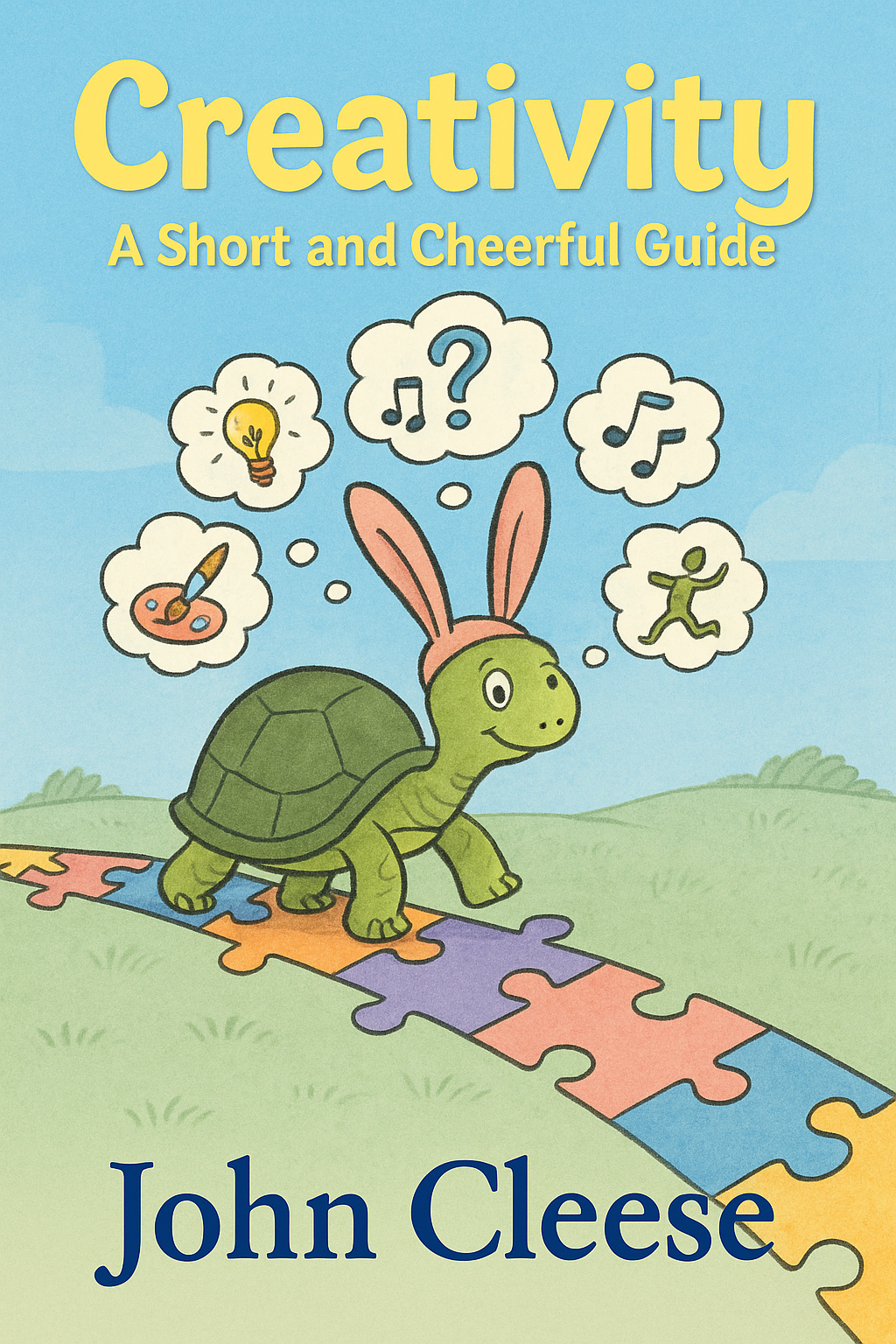
Creativity: A Short and Cheerful Guide
Chapter Summaries
What's Here for You
Embark on a delightful journey into the heart of creativity with the inimitable John Cleese, the legendary comedian and writer, as he unveils the secrets behind sparking your own innovative genius. This cheerful guide promises to demystify the creative process, revealing that it's not some mystical gift bestowed upon a select few, but a skill that can be cultivated and nurtured within anyone. Cleese shares his own serendipitous discovery of creativity, not through ambition, but through the collaborative spirit of Cambridge's Footlights, highlighting the power of diverse minds coming together. You'll gain a profound understanding of the two fundamental modes of thinking: the swift, analytical 'Hare Brain' and the slower, more contemplative 'Tortoise Mind.' This distinction is key to unlocking your creative potential, allowing you to harness both your quick wit and your deeper, more imaginative insights. Prepare for a treasure trove of practical advice, born from Cleese's own extensive writing career. He'll guide you with hints and suggestions, emphasizing the often-overlooked power of writing about what you know, transforming the seemingly mundane into the extraordinary. The tone throughout is one of warm, witty encouragement, infused with Cleese's signature humor and insightful observations. You'll leave feeling intellectually stimulated and emotionally uplifted, armed with the confidence and practical tools to embrace your own creative spark and apply it to any aspect of your life, whether it's professional endeavors, personal projects, or simply finding new ways to see the world. This is your invitation to a more creative, cheerful, and fulfilling existence.
The Creative Mindset
The author, John Cleese, recounts a surprising discovery of his own creativity during his Cambridge days, not through a desire for show business, but through joining the Footlights society, a group known for its camaraderie and diverse backgrounds. To become a member, one had to write something, and Cleese found that by penning original sketches, he could evoke laughter, a profound realization that sparked his creative journey. He soon observed a peculiar phenomenon: after wrestling with a creative problem in the evening, the solution would often appear with startling clarity upon waking, as if his mind continued its work overnight. This led him to understand that creativity wasn't solely about intense conscious effort, but also about allowing the unconscious mind to process and refine ideas. He further illustrates this with an anecdote where a lost sketch, rewritten from memory, turned out to be an improvement on the original collaboration, reinforcing the idea of an intelligent, self-improving unconscious. Cleese clarifies that this 'unconscious' is not the Freudian repository of repressed thoughts, but rather the vast, automatic processing system that handles everyday functions, from digestion to skilled motor tasks like shaving or driving. This intelligent unconscious, he explains, is essential for functioning, allowing us to perform complex actions without conscious strain. However, he cautions that this powerful system is not directly controllable; it communicates through feelings, images, and subtle nudges rather than direct verbal answers, much like the phenomenon of a forgotten word surfacing later. A fascinating experiment involving the recognition of Chinese characters demonstrated this beautifully: participants unconsciously recognized previously seen characters and, instead of recalling them consciously, simply developed a preference for them, revealing the unconscious's subtle influence. Thus, Cleese suggests that engaging with our creative potential requires not forceful interrogation, but rather a crafty, coaxing approach, understanding that the unconscious mind offers its insights in its own unique, non-verbal language, often after we've stepped away from the problem.
Hare Brain, Tortoise Mind
The author, John Cleese, guides us through a profound distinction in thinking, inspired by Guy Claxton's "Hare Brain, Tortoise Mind." Our formal education, he explains, often obsesses over the logical, analytical "Hare Brain"—the quick, purposeful mind adept at problem-solving and weighing pros and cons. Yet, this leaves us ill-equipped for the intricate, shadowy, and ill-defined problems where creativity and wisdom truly reside. This is the domain of the "Tortoise Mind," a slower, more playful, contemplative mode of thinking that, for all its apparent aimlessness, possesses its own potent intelligence. Cleese recounts Donald MacKinnon's research with architects, revealing that the most creative among them shared two key traits: they knew how to play, and they deferred decisions for as long as possible. Play, in this context, is not mere idleness but a childlike absorption in a puzzle for its own sake, a spontaneous exploration free from the anxiety of purpose or mistakes. Deferring decisions, conversely, is not indecisiveness but a tolerance for discomfort, an understanding that by waiting until the deadline, one allows space for new information and unexpected ideas to emerge. The greatest killer of creativity, Cleese warns, is interruption, both external and internal; the fear of making a mistake can paralyze us, yet in creative pursuits, there are no mistakes, only avenues to explore. To access the Tortoise Mind, one must create safe spaces with boundaries of time and space, allowing for uninterrupted "play." This may initially feel chaotic, filled with trivial thoughts, much like a chattering monkey, but by writing them down and gently guiding the mind, it can settle, allowing the unconscious to send its subtle messages—hints and nudges, often in the form of images and feelings, not clear-cut words, as Einstein himself noted. This process requires patience, as new, woolly ideas need time to clarify before the analytical Hare Brain can assess their viability. The journey is iterative, a back-and-forth between the Tortoise Mind's idea generation and the Hare Brain's critical evaluation, a dance that Cleese himself employed in writing "A Fish Called Wanda," ultimately leading to a more refined outcome. The crucial insight is that both modes of thinking are essential, but they must be kept separate, allowing each to perform its unique function.
Hints and Suggestions
The author, John Cleese, draws from his rich experience as a writer to offer a tapestry of advice, suggesting that the mental alchemy of creativity is remarkably consistent across diverse fields. He begins with the seemingly obvious, yet vital, principle: 'Write about what you know.' This isn't a limitation, but a launchpad, much like a gentle nudge rather than a command. You are most likely to spark innovation in territory you already understand and care about. When embarking on a creative endeavor, the initial idea might be a flicker, not a blaze. Cleese advocates for 'borrowing' inspiration from those you admire, not to slavishly copy, but to make the idea your own through engagement and play. This act of being influenced is the fertile ground where true originality can sprout, much like Shakespeare masterfully repurposed existing plots. The essence of creativity, he explains, lies in the 'imaginative leap.' This leap can be monumental, like Einstein's theories, or a subtle shift, like repositioning a rose in a bouquet. The key is movement, a departure from the status quo. He reveals a profound truth about the creative process: experience, while valuable, can sometimes dull our edge, leading to a phenomenon akin to the 'Law of Diminishing Returns.' This is why, as Picasso noted, his early drawings held a power his later, more technically proficient work sometimes lacked. The creative journey often comprises stages: initial originality as one learns, mature expression at the peak of mastery, and a subsequent tailing-off as familiarity sets in. Yet, some, like physicist Richard Feynman, master the art of perpetual freshness by nurturing their unconscious, often through playful pursuits like playing the drums or games, recognizing that 'playing keeps you fresh.' Setbacks are not failures, but integral parts of the process. Cleese shares his realization with Graham Chapman that 'blockages weren't an interruption in the process, they were part of it.' This perspective transforms fallow periods into necessary preparation for fertile ones, a concept echoed by Gregory Bateson's observation that 'you can't have a new idea 'til you've got rid of an old one.' He advises to 'get your panic in early,' acknowledging that fear is a natural response to a difficult challenge, but its energy can be harnessed to initiate action, even if it's just making notes that don't have to be good. By starting with simple questions about audience and message, you prime your unconscious, which continues its work even when you step away. Brevity, he reminds us, is the soul of wit and, crucially, of not boring your audience. Overconfidence, the belief that one 'knows what they're doing,' is a creativity killer, as it halts learning and entrenches established patterns. The best minds, Cleese suggests, don't just want to be right; they 'want to know if they're right,' a principle keenly felt in the unforgiving arena of comedy. Testing ideas involves critical evaluation after the playful stage, followed by iteration, or by moving to action and observing the results, whether it's trying on a dress or launching a product. He stresses the importance of 'killing your darlings,' the willingness to jettison cherished ideas that no longer serve the evolving work, a practice more natural to experienced creators. When seeking feedback, Cleese offers a sharp directive: ask specific questions about boredom, confusion, or lack of credibility, but 'ignore these completely' suggestions for solutions unless they come from fellow writers, as ultimately, 'you and only you must decide which criticisms and suggestions you accept.' The iterative process of seeking opinions, refining, and re-seeking is crucial, ensuring the work evolves effectively. Finally, he notes that 'your thoughts follow your mood,' emphasizing the importance of being in the right frame of mind, free from distraction, to foster creativity.
Conclusion
John Cleese's "Creativity: A Short and Cheerful Guide" offers a profound yet accessible framework for understanding and cultivating our innate creative potential. The core takeaway is that creativity is not a mystical gift bestowed upon a select few, but a natural outcome of engaging with the world in a particular way. Cleese masterfully illustrates that true creativity often blossoms not from direct, forceful pursuit, but from immersion in enjoyable activities, allowing the "intelligent unconscious" – the "Tortoise Mind" – to work its magic. This intuitive, patient processing system, often undervalued in our education systems which favor the analytical "Hare Brain," is crucial for tackling complex, ill-defined problems. The book emphasizes that the unconscious communicates indirectly through feelings, images, and intuitions, requiring patience and an acceptance of ambiguity rather than rigid logical analysis. This leads to a significant emotional lesson: to embrace playfulness and a childlike absorption, free from the paralyzing fear of error or the pressure of immediate results. The practical wisdom lies in understanding how to actively nurture this "Tortoise Mind." This involves creating protected mental and physical space, deferring decisions until the last possible moment to allow for emergent ideas, and recognizing that creative blocks are not failures but essential preparatory phases. Cleese advocates for a dynamic interplay between the intuitive "Tortoise Mind" for generation and the analytical "Hare Brain" for refinement, stressing the importance of "borrowing" and transforming influences rather than mere imitation. Ultimately, the guide teaches us to trust the iterative nature of creativity, to "kill our darlings" when necessary, and to confront challenges with a blend of early action and low initial expectations. By fostering a "beginner's mind" and patiently engaging with our inner world, we can unlock a reservoir of originality and transform our approach to problem-solving and life itself.
Key Takeaways
Creativity often emerges unexpectedly through engagement with enjoyable activities rather than direct pursuit.
The unconscious mind plays a crucial role in problem-solving and creative refinement, often working on issues when conscious effort ceases.
True creativity involves producing original work, even when influenced by external sources.
Complex skills and creative solutions can become more accessible when the conscious mind relaxes its grip.
The 'intelligent unconscious' is a vital processing system for everyday functioning and creative thought, operating independently of conscious awareness.
The unconscious communicates indirectly through feelings, images, and intuitions, requiring careful interpretation rather than direct questioning.
Engaging the unconscious for creative insight involves indirect methods and patience, rather than forceful concentration.
Formal education often prioritizes the analytical "Hare Brain" at the expense of the intuitive "Tortoise Mind," which is crucial for complex, ill-defined creative problems.
True creativity is fostered by a playful, exploratory mindset, akin to childlike absorption, free from the pressure of immediate results or the fear of error.
Deferring decisions until the last possible moment, while uncomfortable, allows for the emergence of new information and ideas, leading to more robust solutions.
Interruptions, both external and internal (especially the fear of mistakes), are the primary inhibitors of creative thought, necessitating the creation of protected mental and physical space.
Accessing the "Tortoise Mind" involves cultivating patience, tolerating ambiguity, and allowing the unconscious to communicate through images and feelings, rather than forcing premature logical analysis.
Creative problem-solving is an iterative process, requiring a dynamic interplay between the "Tortoise Mind" for idea generation and the "Hare Brain" for critical evaluation and refinement.
Creativity thrives most powerfully in areas you already know and care deeply about, serving as a foundation rather than a limitation.
Embrace inspiration by 'borrowing' from admired sources, transforming influences into your unique creations through playful engagement, not mere imitation.
The 'imaginative leap,' however small, is fundamental to creativity; recognize that progress can come from numerous small adjustments or a single significant breakthrough.
Periods of creative 'blockage' are not failures but essential preparatory phases; learn to trust and nurture your unconscious mind through play and persistence.
Confronting challenges with 'panic in early' can harness fear's energy for action, while setting low initial expectations prevents premature discouragement.
Combat creative stagnation by actively nurturing your unconscious and maintaining a state of 'beginner's mind,' even amidst deep expertise.
Be willing to 'kill your darlings' – jettison cherished ideas that no longer serve the evolving work to allow for necessary transformation and growth.
Action Plan
Engage in creative activities that you find enjoyable, even if they are not directly related to your primary goals.
When facing a difficult problem, work on it consciously for a period, then step away and allow your unconscious mind time to process.
Practice writing or creating regularly, focusing on developing your unique voice even when inspired by others.
Trust that your mind continues to work on problems even when you are not actively concentrating on them.
Pay attention to subtle feelings, intuitions, and 'hunches' as they may be messages from your unconscious.
When a creative solution seems obvious after a period of rest, acknowledge and appreciate the role of your unconscious processing.
Experiment with indirect approaches to problems, such as changing your environment or engaging in a different activity, to 'coax' insights from your unconscious.
Recognize that the most skilled activities often become effortless through practice, allowing the unconscious to take over.
Identify and protect dedicated 'play' time for unfocused, curious exploration of problems or ideas.
Consciously defer decisions until the absolute deadline, allowing space for new information and insights to emerge.
Create physical and temporal boundaries (e.g., a closed door, a set time) to minimize external interruptions during creative periods.
When internal distractions arise, immediately write them down on a separate note to acknowledge and then release them.
Embrace ambiguity and confusion as natural parts of the creative process, resisting the urge for premature clarity.
Practice mindfulness or quiet contemplation to calm the mind and become receptive to the subtle messages from your unconscious.
When a new idea surfaces, allow it to develop and clarify before subjecting it to critical analysis.
Engage in an iterative process, cycling between creative idea generation and logical evaluation to refine concepts.
Identify a creative project and consciously choose to work within an area you already know and care about.
Select an admired creator and intentionally 'borrow' an idea or technique, adapting it into your own unique approach.
Practice making small 'imaginative leaps' in your daily tasks, observing the subtle shifts they create.
When facing a creative block, resist the urge to stop; instead, engage in a playful activity to 'keep you fresh' and allow your unconscious to work.
For your next challenging task, deliberately 'get your panic in early' by acknowledging the fear and immediately starting with low-expectation notes.
Consciously identify a cherished idea within your current project that might be hindering its progress, and be prepared to 'kill it' if necessary.
Seek feedback on a draft, but focus your questions on identifying specific points of boredom, confusion, or lack of credibility, rather than asking for solutions.