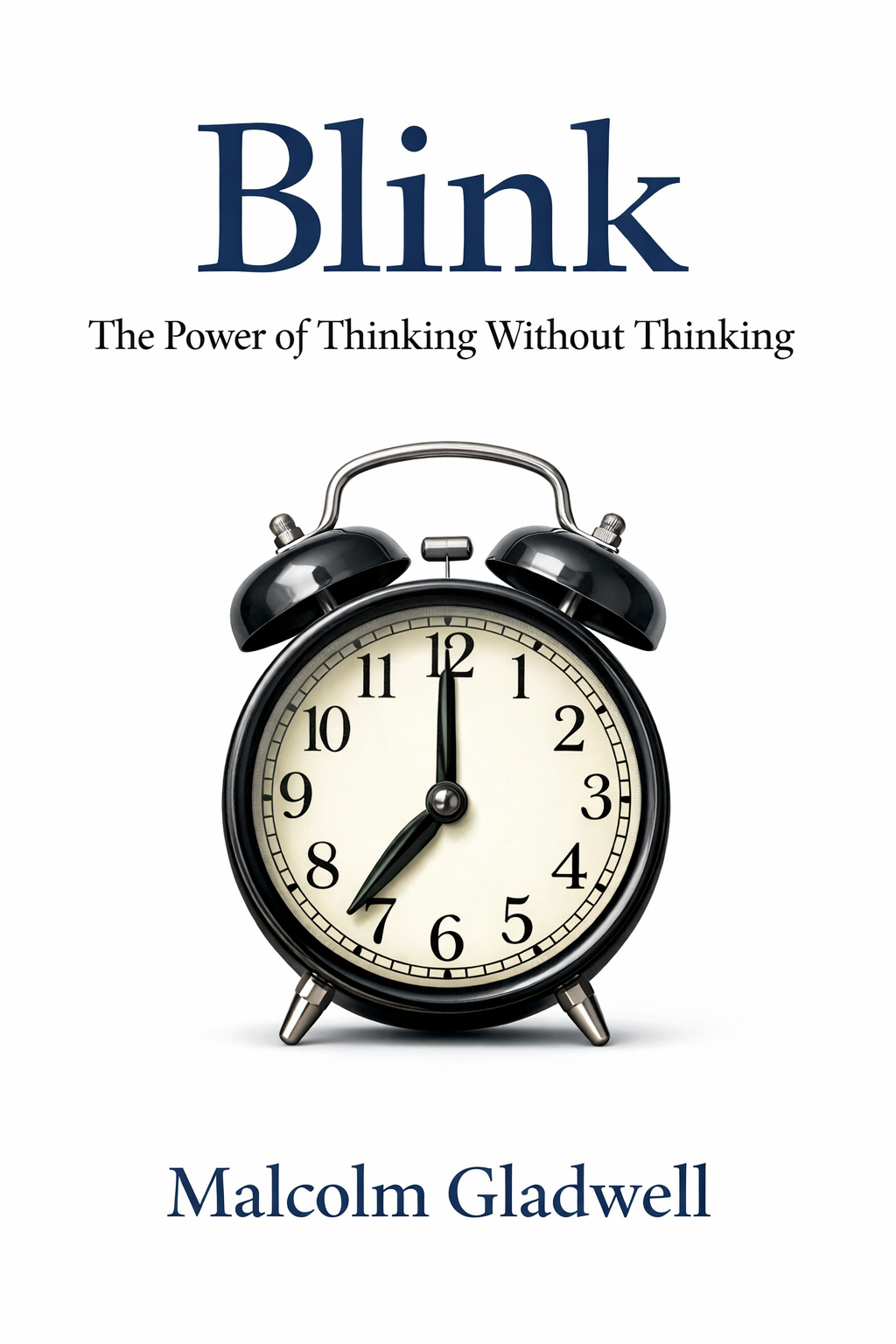
Blink: The Power of Thinking Without Thinking
Chapter Summaries
What's Here for You
Ever wonder how some people make brilliant decisions in an instant, while others stumble? Malcolm Gladwell's 'Blink' unlocks the astonishing power of 'thin slices' – those rapid, unconscious judgments that can reveal profound truths. Imagine understanding the dynamics of a relationship in minutes, predicting an athlete's performance before it happens, or recognizing the subtle cues that lead to both spectacular success and catastrophic error. This book dives deep into the secret life of snap decisions, revealing how our intuition, when honed, can be an incredible asset. You'll explore the fascinating science behind those split-second assessments, from the effectiveness of rapid cognition to the pitfalls of falling for appearances, like the Warren Harding Error. Discover how to harness spontaneity, like the legendary Paul Van Riper, and understand the delicate art of mind-reading and asking the right questions to truly understand what people want. Through captivating stories and rigorous research, 'Blink' will equip you to trust your instincts, navigate complex situations with newfound clarity, and make more effective decisions, both personally and professionally. Prepare to be intellectually stimulated and emotionally engaged as you learn to harness the power of thinking without thinking.
The Theory of Thin Slices: How a Little Bit of Knowledge Goes a Long Way
Malcolm Gladwell, in 'Blink,' unveils the astonishing power of 'thin slices' – those rapid, unconscious judgments that can unlock profound truths. He introduces us to John Gottman's 'love lab,' where observing couples for mere minutes, analyzing subtle emotional cues and physiological responses, can predict marital success with remarkable accuracy – a stark contrast to our intuitive belief that deep understanding requires exhaustive data. This ability, Gladwell explains, is 'thinslicing,' our unconscious mind's automated, accelerated version of meticulous analysis, capable of finding critical patterns in mere moments. Gottman’s research, initially focused on marriage, reveals that the 'fist,' a unique signature in communication akin to the distinct rhythm of a Morse code operator, surfaces even in the briefest interactions, revealing underlying relationship dynamics. He discovered that contempt, more than criticism, is a devastating predictor of marital failure, acting as a powerful signal of rejection that can even impact physical health. This principle extends beyond relationships; psychologist Samuel Gosling demonstrated that strangers, given just fifteen minutes to observe a college student’s dorm room, could predict personality traits like conscientiousness and openness better than close friends, proving that indirect evidence often bypasses the confusing noise of direct interaction. Similarly, in medicine, the likelihood of a doctor being sued for malpractice hinges not on their error rate, but on the quality of their interpersonal communication, with tone of voice and perceived respect being paramount – a finding Nalini Ambady confirmed by analyzing mere forty-second audio clips of doctor-patient conversations, stripped of words, and still predicting lawsuit risk. Gladwell concludes that thinslicing, or 'coup d'oeil,' the power of the glance, is not an exotic gift but a fundamental human capacity, allowing us to grasp the essence of situations and people with astonishing speed and accuracy, often more effectively than prolonged, deliberate analysis, reminding us that sometimes, the most profound insights arrive in the blink of an eye.
The Locked Door: The Secret Life of Snap Decisions
Malcolm Gladwell, in 'Blink,' invites us into the enigmatic world of our unconscious mind, revealing how rapid cognition, or 'thinking without thinking,' shapes our lives in profound ways. He introduces us to Vic Braden, a tennis coach who could predict double faults with uncanny accuracy, yet couldn't articulate how he knew, highlighting the first critical fact about snap judgments: they are lightning-fast and rely on the thinnest slices of experience, often operating beyond our conscious grasp. This leads to the central tension: while these judgments are powerful, their mysterious nature, hidden behind a 'locked door,' makes them difficult to trust, especially in a world that demands reasoned explanations. We see this in the Iowa gambling experiment where participants intuitively avoided losing decks before conscious awareness, and in art experts sensing fakes through a flurry of sensory impressions they couldn't easily explain. Gladwell then delves into the concept of 'priming,' demonstrating with experiments like John Bargh's scrambled-sentence tests that subtle cues can unconsciously alter our behavior—making us walk slower when primed with words related to old age, or influencing our patience in social situations based on word associations. This reveals a second crucial aspect: these unconscious influences are powerful yet invisible, making us unaware of what truly affects our actions, a phenomenon underscored by studies showing how racial stereotypes can halve test performance without conscious acknowledgment. The narrative then shifts to the 'storytelling problem,' where we invent plausible, but often incorrect, explanations for decisions driven by our unconscious, as seen with athletes like Ted Williams explaining their prowess with explanations that don't align with the physics of their actions. This inability to access and articulate the 'why' behind our snap judgments creates a dilemma: how do we reconcile our intuitive knowledge with our need for logical justification? The resolution lies in accepting this mystery. Gladwell suggests that rather than fighting the locked door, we should respect the power of our unconscious, acknowledging that sometimes 'it is possible to know without knowing why we know,' and that this hidden processing is essential for handling complex situations efficiently, freeing our conscious minds for other tasks, much like a mental valet. The chapter concludes by urging us to embrace this uncertainty, to accept our ignorance of the precise mechanisms driving our rapid decisions, and to trust that our unconscious mind, though hidden, is often our most effective guide.
The Warren Harding Error: Why We Fall For Tall, Dark, and Handsome Men
Malcolm Gladwell, in "Blink," unveils the potent, often deceptive nature of rapid cognition through the lens of the Warren Harding Error. He recounts the story of Warren Harding, a man whose striking handsomeness and resonant voice captivated Harry Daugherty, a political strategist, leading to an improbable presidential candidacy and presidency, despite Harding's profound lack of intelligence and policy substance. This narrative sets the stage for exploring how our instantaneous judgments, our 'blinks,' can be misled by superficial appearances, creating a powerful, almost gravitational pull that overrides deeper analysis. Gladwell illustrates this with the Implicit Association Test (IAT), revealing how unconscious biases, like associating 'career' more readily with 'male' than 'female,' or holding pro-white associations even among minorities, operate beneath our conscious awareness. These automatic associations, forged by environment and experience, profoundly influence our behavior, often in ways we don't recognize, leading to the 'dark side of rapid cognition' where prejudice and discrimination can flourish. He then pivots to the world of car sales, using Bob Golomb, a virtuoso salesman, as a counterpoint. Golomb's success stems not from judging customers by appearance, but from treating everyone with equal respect and attentiveness, deliberately fighting the 'Warren Harding Error.' This is starkly contrasted with Ian Ayres' study, which demonstrated how car salesmen, unconsciously or consciously, offered significantly higher prices to black men and women than to white men, effectively 'spotting the sucker' based on deeply ingrained biases. The chapter concludes with a call to action, emphasizing that while unconscious biases are not easily changed through willpower alone, they can be altered by consciously seeking out diverse experiences and environments that challenge and reshape our automatic associations, urging us to manage and control our first impressions rather than be controlled by them. The overarching tension lies in the power of our rapid, intuitive judgments versus the reality of our often flawed, biased subconscious, leading to the insight that acknowledging and actively managing these snap judgments is crucial for fairer, more rational decision-making.
Paul Van Riper’s Big Victory: Creating Structure for Spontaneity
Malcolm Gladwell, in his exploration of rapid cognition, delves into the extraordinary story of Paul Van Riper, a Marine Corps legend whose intuitive leadership famously clashed with the Pentagon's systematic approach to warfare during the Millennium Challenge 2002 war game. Van Riper, a man who embodied action and adaptability, was tasked with commanding the opposing 'Red Team' against the overwhelmingly resourced 'Blue Team.' The Blue Team, armed with vast data, complex matrices, and a belief in rational analysis, meticulously planned to dismantle their adversary. They operated under the assumption that overwhelming information and logical processing could lift the 'fog of war.' However, Van Riper, a student of war's inherent unpredictability, countered not with more data, but with a profound understanding of how true spontaneity is born from rigorous preparation and adherence to core principles. His Red Team, communicating via couriers and employing World War II tactics, launched a devastating surprise attack, sinking sixteen Blue Team ships and exposing the flaw in the Pentagon's overly analytical model. This pivotal moment underscores a central insight: true expertise and decisive action under pressure aren't about having more information, but about having the right structure and training that allows for rapid, intuitive decision-making. Gladwell draws a parallel to the world of improvisational comedy, where performers, far from being chaotic, rely on strict rules and extensive rehearsal to create seemingly spontaneous and brilliant performances. Similarly, the chapter highlights the perils of over-analysis, illustrating how excessive introspection and verbalization can actually impair insight, a phenomenon known as 'verbal overshadowing.' This is further exemplified by the Cook County Hospital's ER, where implementing the concise Goldman algorithm for chest pain diagnosis, rather than overwhelming doctors with data, dramatically improved accuracy and efficiency. The narrative arc moves from the tension of an analytical system versus intuitive genius in war, to the insight that structured practice and purposeful constraint enable effective spontaneity, ultimately resolving with the understanding that in complex, high-stakes environments, knowing less but understanding the essential patterns—the 'frugality' of good decision-making—is often the key to victory.
Kenna’s Dilemma: The Right-and Wrong-Way to Ask People What They Want
Malcolm Gladwell, in "Blink," explores the profound disconnect between our rapid, intuitive judgments and the often unreliable methods we use to solicit opinions, using the enigmatic rock musician Kenna as a central case study. Kenna, a gentle soul with a sound that defied easy categorization, captivated industry insiders – from A&R executives to U2’s manager – with his sheer talent and unique artistic vision. Record executives like Craig Kallman were 'blown away,' and legendary figures like Paul McGuinness declared he would 'change the world,' their instincts signaling a massive appeal. Yet, when Kenna’s music was subjected to traditional market research, the results were dismal, his songs scoring poorly and his potential radio airplay deemed limited. This stark contrast between expert intuition and consumer testing revealed a deeper truth: asking people what they want isn't as straightforward as it seems. The chapter then pivots to the infamous 'New Coke' saga, where blind taste tests, seemingly definitive, led to a catastrophic market failure because they ignored the powerful, unconscious associations consumers have with brands, packaging, and context – the very things that make them reach for a Coke, not just a fizzy, sweet drink. We learn that a sip test, divorced from the reality of consuming a whole beverage in one's own environment, can be profoundly misleading, a lesson echoed in the Aeron chair's initial rejection due to its unfamiliar, 'ugly' aesthetic, which was later embraced as its unique beauty. The core dilemma, Gladwell reveals, is that our snap judgments are powerful but can be easily misinterpreted or undermined by flawed methodologies. Experts, like the food tasters Gail Vance Civille and Judy Heylmun, can reliably interpret their own reactions because they possess a specialized vocabulary and years of experience, allowing them to dissect nuances that average consumers, or even market researchers, miss. Conversely, when asked to articulate their reasoning for liking or disliking something unfamiliar, people often invent plausible-sounding explanations that don't reflect their true, unconscious preferences, a phenomenon akin to making jam experts into 'jam idiots' by forcing introspection. Ultimately, the chapter argues that while our rapid cognition is invaluable, it must be understood within its proper context, and when dealing with genuinely novel or revolutionary products, like Kenna's music or the Aeron chair, market research's blunt instrument can easily confuse the 'different' with the 'bad,' leading to missed opportunities and a failure to recognize true innovation. The tension between Kenna’s undeniable talent and the market’s cold data highlights the critical need to interpret, not just collect, consumer reactions, especially when faced with the truly new.
Seven Seconds in the Bronx: The Delicate Art of Mind Reading
Malcolm Gladwell, in 'Blink,' delves into the profound and often perilous nature of rapid cognition, specifically our ability to 'read minds' in mere seconds, using the tragic Amadou Diallo shooting as a stark case study. The narrative begins by immersing us in the gritty reality of the South Bronx, introducing Amadou Diallo, a young man from Guinea, and the plainclothes officers of the Street Crime Unit who would ultimately end his life. Gladwell masterfully reconstructs the events of that fateful night, highlighting how the officers, particularly Sean Carroll, experienced a catastrophic failure in their 'mind-reading' abilities. Three critical mistakes are laid bare: mistaking Diallo’s innocent curiosity for suspicion, misinterpreting his stillness as brazenness rather than terror, and finally, seeing a dangerous threat where there was only profound fear. This failure, Gladwell posits, stems from a breakdown in our innate capacity for 'thinslicing,' the instantaneous, often unconscious, interpretation of subtle cues. He then pivots to explore the science behind this ability, introducing the groundbreaking work of Silvan Tomkins and Paul Ekman. Tomkins, a visionary psychologist, believed faces were a goldmine of emotional information, a notion Ekman rigorously tested, leading to the development of the Facial Action Coding System (FACS). This system breaks down facial expressions into forty-three distinct 'action units,' revealing that our faces are not merely passive displays but active participants in generating emotion, influencing our autonomic nervous system. The chapter then introduces the concept of 'mindblindness,' exemplified by individuals with autism, who struggle to interpret nonverbal cues, demonstrating what happens when this crucial human faculty fails. Through experiments like Ami Klin's study of Peter watching 'Who's Afraid of Virginia Woolf,' we see how the absence of mind-reading leads to a literal, object-focused interpretation of the world, missing the rich tapestry of human emotion. Conversely, Gladwell explores how extreme stress, akin to temporary autism, can hijack our cognitive functions, narrowing our vision and sound perception, turning us into beings who 'argue with our dog,' as David Grossman describes. This state, amplified by the lack of 'white space'—the temporal and spatial distance needed for assessment—can lead to fatal misjudgments, as seen in the Reagan assassination attempt and the officers' actions in the Diallo shooting. The critical lesson emerges: while rapid cognition is powerful, it is susceptible to biases and breakdowns, especially under duress or time constraints. Yet, Gladwell offers a path toward redemption: training and experience can enhance our mind-reading skills, allowing us to expand that critical sliver of time, as demonstrated by the veteran officer who, through practiced observation and a deliberate stretching of moments, avoided an unnecessary shooting. The chapter concludes by returning to Wheeler Avenue, where the officers, overwhelmed by stress and a lack of time, succumbed to a temporary 'autism,' their instinctive reactions overriding their capacity for nuanced understanding, leading to a tragedy born not necessarily of malice, but of a profound failure in the delicate art of reading another human being.
Conclusion
Malcolm Gladwell's 'Blink' masterfully illuminates the potent, often hidden, world of rapid cognition – the power of thinking without thinking. The book's core takeaway is that our unconscious mind, through a process Gladwell terms 'thin-slicing,' can arrive at remarkably accurate insights from minimal information, often surpassing the deliberate, analytical mind. This intuitive faculty, while powerful, is also prone to significant pitfalls, most notably the 'Warren Harding Error,' where superficial attributes can override genuine competence, and unconscious biases, deeply ingrained by culture and experience, can lead to unintentional discrimination. Gladwell emphasizes that these snap judgments, though swift and often mysterious – a 'locked door' to their precise reasoning – are not entirely beyond our influence. The emotional lessons lie in recognizing the fallibility of our first impressions and cultivating humility in our assessments of others. We learn to appreciate that genuine connection, as seen in relationship research, hinges on subtle cues like respect and warmth, not overt conflict. The practical wisdom gleaned from 'Blink' is multifaceted: we are encouraged to trust our intuition when it's honed by expertise, but also to be vigilant against its biases. The book advocates for a conscious effort to manage the experiences that shape our unconscious, seeking diverse environments and challenging our assumptions. It teaches us the importance of 'frugality' in decision-making, focusing on critical information rather than drowning in data, and understanding that over-analysis can lead to 'paralysis by analysis.' Ultimately, 'Blink' is a call to embrace the complexity of our minds, acknowledging both the brilliance of our rapid cognition and the imperative to guide it with awareness, experience, and a commitment to fairness, thereby transforming our fleeting judgments into more considered and equitable actions.
Key Takeaways
Our unconscious mind possesses a powerful ability called 'thinslicing' that can derive accurate insights from extremely limited exposure, often surpassing deliberate analysis.
The subtle, often unnoticed 'fist' or signature in communication patterns, particularly contempt in relationships, is a more potent predictor of long-term outcomes than overt conflict or criticism.
Indirect evidence, such as personal spaces or communication tone, can reveal deeper truths about personality and behavior than direct interaction, as it bypasses self-presentation and biases.
Interpersonal communication quality, specifically perceived respect and warmth, is a more significant factor in outcomes like medical malpractice lawsuits than technical skill or error rates.
Mastering 'thinslicing' involves recognizing and trusting the patterns and intuitive judgments our unconscious mind makes, even when they are derived from fleeting moments.
Snap judgments are incredibly rapid and rely on minimal information, often operating unconsciously, creating a 'locked door' to their exact reasoning.
Subtle environmental cues and word associations can unconsciously prime our behavior and attitudes without our awareness, demonstrating the pervasive influence of the unconscious mind.
We possess a 'storytelling problem,' tending to create rationalizations for decisions made by our unconscious, which may not reflect the true drivers of our actions.
Accepting the mysterious nature of our unconscious decisions, rather than demanding explicit explanations, is crucial for effective decision-making in complex situations.
Our unconscious mind acts as a vital 'mental valet,' efficiently managing minor decisions and environmental adjustments, allowing our conscious mind to focus on more significant tasks.
Superficial physical attributes, like those of Warren Harding, can create powerful, unwarranted positive first impressions that override assessments of actual competence and intelligence, leading to significant misjudgments in leadership selection.
Unconscious biases, measurable through tools like the Implicit Association Test (IAT), operate on a deep level, automatically linking concepts (e.g., race and goodness, gender and career) in ways that may be entirely incompatible with our stated conscious values.
These unconscious associations, shaped by cultural messages and personal experiences, subtly influence our behavior and interactions, often leading to unintentional discrimination and disadvantage for certain groups, even when conscious intent is to be fair.
Individuals like car salesman Bob Golomb demonstrate that deliberately challenging the 'Warren Harding Error' by treating all individuals with consistent respect and avoiding appearance-based judgments can lead to greater success and customer loyalty.
While conscious willpower may not easily alter ingrained unconscious biases, actively seeking out diverse experiences and environments that expose us to different cultures and people can fundamentally reshape these automatic associations over time.
Recognizing the pervasive influence of 'snap judgments' is the first step; actively managing and controlling the experiences that form these impressions is the essential resolution to mitigate their negative impact.
Effective spontaneity in high-stakes situations is not random but cultivated through rigorous training, adherence to core principles, and a defined structure.
Over-reliance on excessive data and systematic analysis can lead to a 'paralysis by analysis,' blinding decision-makers to intuitive insights and rapid cognition.
True expertise often involves recognizing and acting upon essential patterns with minimal, yet critical, information, a principle known as 'frugality' in decision-making.
The act of verbalizing or over-analyzing intuitive judgments can interfere with and impair accurate recognition and insight, a phenomenon termed 'verbal overshadowing.'
Creating an environment that allows for decisive, on-the-spot action, free from excessive introspection and bureaucratic process, is crucial for successful rapid cognition.
Simplifying complex problems by identifying core predictive elements, rather than accumulating vast amounts of data, leads to more accurate and efficient decision-making.
Traditional market research methods often fail to capture genuine consumer preference for novel or unconventional products because they rely on superficial questioning that can confuse unfamiliarity with dislike.
Expert intuition, grounded in specialized knowledge and a developed vocabulary for articulating sensory experiences, provides a more reliable, albeit less quantifiable, assessment of quality and appeal than broad consumer surveys.
Our unconscious associations with brands, packaging, and context play a far more significant role in product preference than pure taste or immediate sensory reaction, as demonstrated by the New Coke failure.
The inability to articulate the reasoning behind our snap judgments, especially for unfamiliar concepts, can lead us to misinterpret our own feelings, inventing plausible but inaccurate explanations that distort our true preferences.
Innovation is inherently vulnerable to market research because its success often depends on a gradual acclimatization to new aesthetics or ideas, which early, superficial consumer testing cannot predict.
The 'blind' testing of products strips away crucial contextual cues, leading to flawed data that mistakes a lack of familiarity for a lack of quality, thereby hindering the adoption of revolutionary ideas.
The human capacity for rapid cognition, or 'mind reading,' is a powerful but fallible tool susceptible to significant errors under stress or time pressure.
Facial expressions are not just passive signals of emotion but actively influence our physiological state, forming a feedback loop that shapes our feelings.
Extreme stress and time constraints can induce a temporary state of 'mindblindness,' akin to autism, where individuals lose the ability to accurately interpret social and emotional cues.
The absence of 'white space'—sufficient temporal and spatial distance—severely impairs our ability to process information and make sound judgments, leading to reliance on primitive, often biased, reactions.
While innate mind-reading abilities can fail, they can also be honed and improved through deliberate practice, training, and experience, allowing for more nuanced and accurate snap judgments.
Misinterpretations of subtle cues, amplified by fear and societal biases, can lead to catastrophic outcomes, underscoring the critical importance of understanding the mechanics of rapid cognition.
Action Plan
Practice observing subtle non-verbal cues and communication patterns in brief interactions.
Pay attention to your immediate, intuitive reactions to people and situations, and reflect on what might be driving them.
When assessing relationships or people, look for consistent patterns of behavior, especially indicators like contempt or defensiveness, rather than isolated incidents.
In professional settings, focus on the quality of communication and perceived respect, as these often predict outcomes more than technical proficiency.
Trust your 'hunch' when it arises from a thin slice of experience, but be prepared to analyze the underlying patterns that informed that hunch.
When forming judgments, consider the indirect evidence available, such as personal spaces or communication style, to gain a more objective perspective.
Practice observing your immediate reactions and gut feelings without immediately trying to rationalize them.
Experiment with subtle environmental changes or focus shifts to notice how they might influence your mood or behavior.
When explaining a decision, pause to consider if your explanation truly reflects the underlying reasons or is a constructed narrative.
Cultivate a willingness to say 'I don't know' when unsure of the precise cause of a feeling or decision, acknowledging the limits of conscious recall.
Trust your intuition in low-stakes situations and observe the outcomes, learning to build confidence in your unconscious processing.
Actively seek out and engage with diverse individuals and cultural experiences to challenge and broaden your automatic associations.
When making important decisions, such as hiring or evaluating performance, consciously pause and question initial impressions based on appearance.
Utilize tools like the Implicit Association Test (IAT) to gain self-awareness about potential unconscious biases.
Practice treating every individual you encounter with consistent respect and attentiveness, regardless of their appearance or perceived status.
When forming judgments, deliberately look for contradictory evidence and information that goes beyond superficial characteristics.
Educate yourself about common biases, such as the 'Warren Harding Error,' to better recognize them in yourself and others.
Before making a judgment, ask yourself: 'Am I seeing the person or the stereotype?'
Identify core principles and essential patterns in your field, focusing on what truly drives outcomes rather than accumulating all possible data.
Practice essential skills repeatedly until they become intuitive, creating a foundation for spontaneous action when needed.
Resist the urge to over-verbalize or over-analyze intuitive insights; trust your initial, well-trained instincts in high-pressure moments.
When facing complex problems, seek to simplify by identifying the most critical variables, rather than trying to account for every possibility.
Create clear, structured frameworks for decision-making that allow for rapid action, but avoid overly rigid processes that stifle adaptability.
Learn from 'failures' by analyzing the underlying strategic or structural issues, rather than blaming individual actions.
Embrace the 'rule of agreement' by accepting initial offers or suggestions in collaborative efforts, fostering a flow of ideas.
Recognize when detailed analysis is appropriate (planning phase) versus when rapid, intuitive action is required (execution phase).
Cultivate a specialized vocabulary or framework to better understand and articulate your own nuanced reactions to new experiences or products.
When evaluating something new, consciously consider the context and your existing associations, rather than relying solely on isolated sensory input.
Recognize that initial negative reactions to unfamiliar things may stem from a lack of understanding or exposure, not necessarily inherent flaws.
When seeking feedback on innovative ideas, prioritize insights from experienced individuals who possess deep knowledge in the relevant field.
Resist the urge to over-explain or rationalize your gut feelings about something new; instead, trust your initial, unadorned reaction.
Challenge conventional market research findings when they contradict strong expert intuition, especially for products that are genuinely novel.
Seek out experiences that push your boundaries and expose you to the 'different' to expand your capacity to appreciate innovation.
Consciously practice observing the subtle facial microexpressions and body language of others in everyday interactions.
When making important decisions, especially under pressure, intentionally create 'white space'—pause, slow down, and gather more information before acting.
Seek out opportunities to practice and refine your observational skills, whether through deliberate observation of people or through specific training exercises.
Recognize the impact of stress and time pressure on your own judgment and develop strategies to mitigate its effects, such as deep breathing or seeking a second opinion.
Actively challenge your initial assumptions and stereotypes about individuals, especially in unfamiliar or high-stakes situations.
Cultivate empathy by consciously trying to understand the potential emotional state and perspective of others, even when faced with ambiguity.
Review past miscommunications or conflicts to identify moments where 'mindreading' failed and consider how a different approach might have yielded a better outcome.