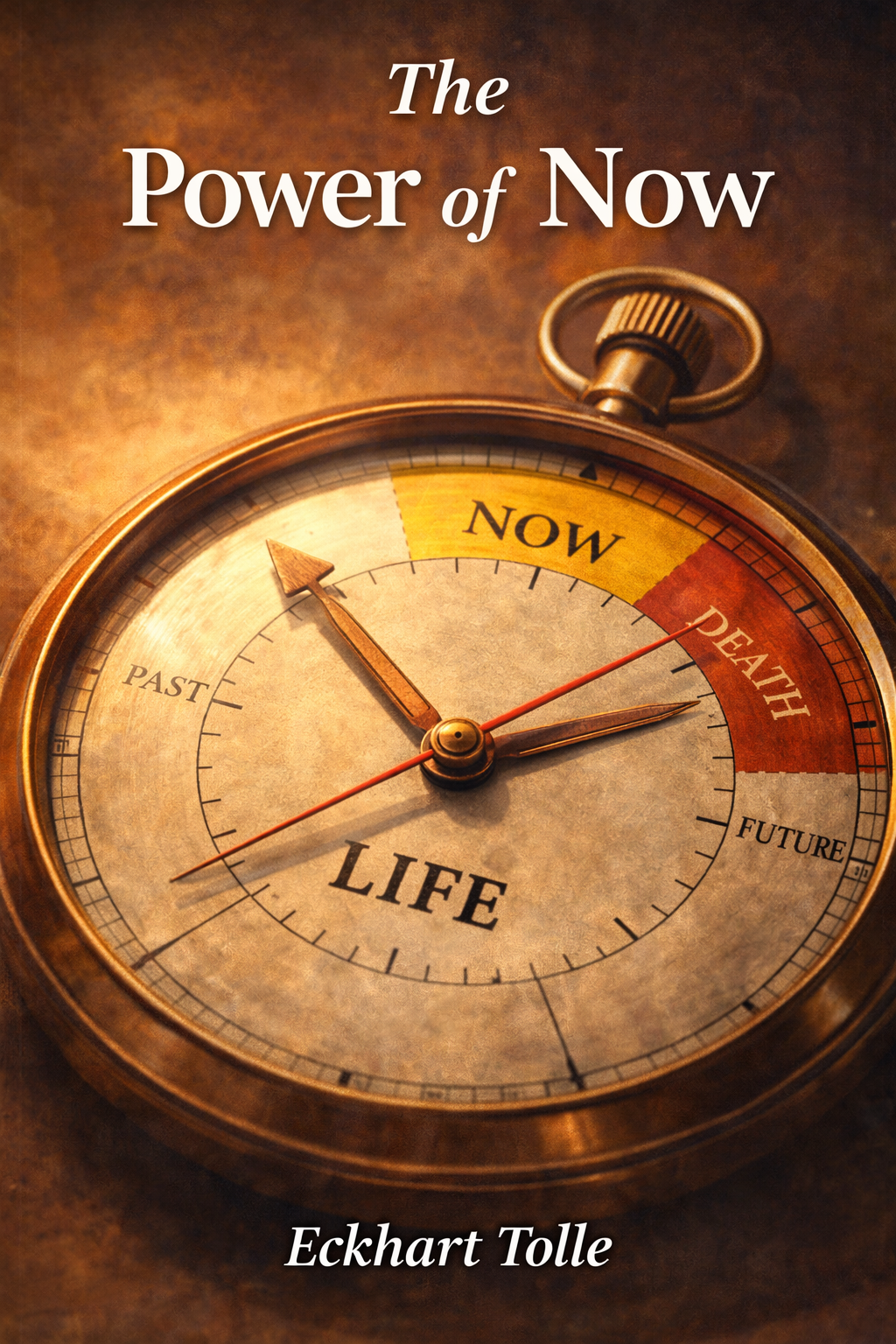
The Power of Now
Chapter Summaries
What's Here for You
Are you tired of the incessant chatter of your own mind, the constant stream of thoughts that often lead to anxiety, pain, and a feeling of being disconnected from your true self? Eckhart Tolle's "The Power of Now" offers a profound and transformative invitation to step out of this mental imprisonment and discover a state of deep inner peace and liberation. This book's central promise is radical: you are not your mind. You are the consciousness that observes it. Tolle guides you on a journey to understand that the suffering we experience is largely self-created, stemming from our resistance to the present moment and our deep identification with our thoughts and emotions. What will you gain? Prepare to gain a profound understanding of how your mind operates, its strategies for avoiding the present, and how this 'core delusion' creates unnecessary pain. You'll learn to distinguish between the thinking mind and the ever-present consciousness, cultivating the ability to observe your thoughts without being swept away by them. Tolle provides practical insights and exercises to help you move deeply into the Now, not as an abstract concept, but as a lived, felt experience. You'll discover the power of presence, learning to access it through the inner body and connect with the formless source of all existence. This journey will lead you to experience enlightened relationships, where true connection arises from presence rather than dependence. Ultimately, you will transcend the fleeting nature of happiness and unhappiness to discover an unshakeable inner peace that lies beyond them. You'll also explore the profound meaning of surrender, understanding it not as defeat, but as a deep wisdom of yielding to the present moment. The emotional and intellectual tone of this book is one of profound wisdom, gentle guidance, and unyielding clarity. Tolle's approach is both deeply spiritual and remarkably practical, offering a path to enlightenment that is accessible to everyone. It's an intellectual exploration that leads to a visceral, experiential transformation. The tone is encouraging, patient, and ultimately, deeply hopeful, empowering you to reclaim your life from the tyranny of the past and the anxiety of the future, and to truly live in the only moment that ever exists: the Now.
YOU ARE NOT YOUR MIND
Welcome, seekers of presence. Eckhart Tolle, in his profound chapter 'You Are Not Your Mind,' unveils the greatest obstacle to enlightenment: our own incessant thinking. He begins with a parable of a beggar sitting on a box of gold for thirty years, a metaphor for humanity's condition – rich in the inherent joy of Being, yet impoverished by seeking fulfillment outside ourselves, trapped by the illusion of separation. Tolle clarifies that enlightenment isn't a superhuman feat but a natural state of oneness with Being, the eternal, indestructible essence within us all, accessible not through the mind, but in the stillness of the present moment. The word 'God,' he notes, has become a closed concept, often a mental idol, whereas 'Being' remains an open concept, pointing to the immediate realization of 'I am.' The core dilemma, then, is our identification with the mind, leading to compulsive thinking that creates a false, mind-made self, a phantom ego driven by past and future, blocking true connection. This incessant mental noise, this 'disease' of the mind using us rather than us using it, is the source of suffering. Tolle guides us towards liberation by introducing the practice of 'watching the thinker' – observing the voice in our head without judgment, recognizing ourselves as the witnessing presence. This act of disidentification creates a gap in the mental stream, a moment of 'no-mind' where true alertness and peace arise, revealing a vaster intelligence beyond thought. He emphasizes that emotions, arising from the body's reaction to our thoughts, are also reflections of our mental state; when in conflict, the body's felt emotion often reveals a deeper truth than the surface thought. By learning to observe both thoughts and emotions without being consumed by them, we reclaim our presence. This isn't about abandoning the mind – it's a tool, but one that should serve us, not possess us. True creativity, insight, and peace emerge when the mind reconnects with the greater intelligence of Being. The journey, therefore, is to disengage from the mind's grip, to become present, and to realize that the treasure of Being, the source of true joy and peace, has been within us all along, obscured only by the clouds of compulsive thought.
CONSCIOUSNESS: THE WAY OUT OF PAIN
Eckhart Tolle, in 'The Power of Now,' invites us to confront the unnecessary pain that shadows our lives, revealing it as a self-created construct born from our unobserved mind's resistance to the present moment. The core tension, Tolle explains, lies in our deep identification with the mind, which perpetually seeks to escape the Now by dwelling in the past and future, thereby obscuring our true nature and accumulating a heavy burden of time and residual pain. He posits that this mind-created time is the breeding ground for suffering, a stark contrast to the timeless vitality of Being. The key insight is that the greater part of human pain is self-created, stemming from non-acceptance and unconscious resistance to what is, manifesting as judgment on the mental level and negativity on the emotional. To break free, Tolle offers a profound shift: make the Now your primary dwelling place, not just a brief visit, by deeply realizing that the present moment is all you ever truly possess. This requires a conscious surrender to what is, accepting the present, however unpleasant, as if you had chosen it, and then acting from that space of acceptance. He then introduces the concept of the painbody, an accumulated field of negative emotional energy from past hurts, which lies dormant or active, feeding on further pain by compelling us to unconsciously identify with it. This painbody, a 'dark shadow cast by the ego,' thrives on our identification and fear of facing our own inner pain, driving us to seek more suffering, to become victims or perpetrators, perpetuating a cycle of unhappiness. The resolution lies in becoming the conscious observer, the 'watcher' of the painbody, without judgment or analysis. By bringing the light of consciousness to these painful energies, not by fighting them, but by accepting and observing them, their power dissolves. This process, akin to ancient alchemy, transmutes suffering into consciousness, healing the split within and restoring wholeness. The author emphasizes that this disidentification from the painbody is not a passive acceptance but a powerful act of presence, severing the link between the pain and our thought processes, allowing true inner freedom and peace to emerge. He clarifies that psychological fear, distinct from instinctive self-protection, arises from this mind-identification, creating an 'anxiety gap' as the ego, inherently vulnerable, perceives constant threat. Ultimately, the ego's deep-seated sense of lack and incompleteness drives a compulsive search for external validation, a bottomless hole that can never be filled by possessions, success, or recognition, as these are merely external identifications, not the true self. The resolution, therefore, is to 'die before you die,' to relinquish these identifications and discover the true self, rooted in Being, accessible through the power of the present moment, thereby ending the cycle of pain and fear.
MOVING DEEPLY INTO THE NOW
Eckhart Tolle, in "Moving Deeply into the Now," guides us through the profound realization that our true self is not found within the ceaseless chatter of the mind, but in the timeless present moment. He explains that the mind, while a powerful tool, becomes the ego when we identify with it, creating a false self driven by fear and endless wanting, much like a branch severed from its vine. The core dysfunction, Tolle reveals, is this identification, and once understood, the complexities of the ego's endless manifestations cease to hold power. The key to disengaging from this mental entanglement lies in ending the delusion of time, for time and mind are inseparable; to be identified with the mind is to be trapped in a cycle of memory and anticipation, forever missing the precious Now. This eternal present is not merely a point in time, but the only reality, the sole access to the formless realm of Being, where true life unfolds. Past and future, Tolle asserts, are mere reflections of the Now, possessing no reality of their own, like the moon borrowing its light from the sun. He illustrates this with the vivid image of seeing a tree not as a flat, dead image, but as a vibrant, living essence, a glimpse of Being that transforms perception. While fleeting experiences can offer a taste of this timeless dimension, Tolle emphasizes the need for a permanent shift in consciousness, urging us to break the habit of denying the present moment and to practice observing our thoughts and emotions without judgment, becoming the silent watcher. This witnessing presence withdraws energy from the mind, transforming it into presence itself. The chapter then distinguishes between clock time, essential for practical life, and psychological time, the ego's addiction to past and future, which creates suffering and negativity. Tolle warns that this psychological time, when collectively manifested in ideologies or rigid belief systems, can lead to horrific outcomes, creating a present hell for a supposed future heaven. He proposes that all problems are ultimately illusions of the mind, surviving only in the absence of the Now. By narrowing our focus to this moment, we discover the life underneath our life situation, a life free from problems, where actions are imbued with quality and love, not driven by the ego's need for validation or the fear of failure. This shift from psychological time to presence is presented not just as a personal transformation, but as a crucial step in the evolution of consciousness, our only chance for survival, leading to the profound joy of simply being, complete and whole, in the eternal present.
MIND STRATEGIES FOR AVOIDING THE NOW
The author Eckhart Tolle guides us through the subtle yet pervasive ways the human mind evades the present moment, a phenomenon he identifies as the 'core delusion.' This isn't about denying the reality of paying bills or the inevitability of aging, but understanding that 'loss of Now is the problem,' a loss of our very Being. Tolle explains that true freedom from time isn't intellectual agreement but a lived realization, a state where every cell vibrates with the joy of existence. For most, this freedom isn't instantaneous; it's a gradual awakening, a back-and-forth between consciousness and the mind's habitual grip, much like learning to walk, where one stumbles and rises again, each return to presence a victory. He distinguishes between 'ordinary unconsciousness,' characterized by a low-level hum of discontent, often masked by distractions like work or food, and 'deep unconsciousness,' a more acute suffering triggered by threats to the ego or the pain-body. The key, Tolle reveals, lies not in avoiding challenges, but in using them as opportunities to deepen presence. He illustrates this with the analogy of a background noise – we only notice it when it stops, just as we might only recognize our habitual unease when we consciously observe our inner state. The Native American chief's observation of 'tense faces, staring eyes' in white people, always seeking something, echoes this ancient unease rooted in constant wanting and resistance to what is, a collective dysfunction fueling a dehumanized civilization. To dissolve this 'ordinary unconsciousness,' Tolle urges self-observation: asking 'Am I at ease at this moment?' or 'What's going on inside me?' This inward turn, feeling the body, noticing the mind's projections, is the first step. He offers a powerful insight: 'Unhappiness is polluting not only your own inner being and those around you but also the collective human psyche.' The path to freedom involves accepting what is, even resentment or anger, not to indulge in them, but to recognize their futility and 'drop' them, much like releasing a hot coal. True acceptance, he clarifies, transmutes these feelings, preventing the ego from using them as a shield. He provides concrete examples of ordinary unconsciousness: complaining about a situation, resisting one's here and now, or being so consumed by the future that the present becomes a mere means to an end. The remedy is always to 'be there totally,' whether by changing the situation, accepting it, or removing oneself, but always without negativity. Fear, he notes, can be faced by bringing presence to it, dissolving its link with thought. Surrender, not weakness, is the strength to accept the unchangeable. He challenges the notion of 'waiting' as a state of mind, a denial of the present, emphasizing that true prosperity is gratitude for the Now, not a future acquisition. He posits that the past cannot survive in presence; it thrives in our absence. The chapter culminates in the understanding of life's 'inner purpose'—the quality of consciousness in the present moment—as distinct from the 'outer purpose' of achieving future goals. This inner journey, he concludes, is the true path, where each step taken with total presence becomes an expression of perfection, a direct connection to Being.
THE STATE OF PRESENCE
Eckhart Tolle, in 'The Power of Now,' invites us to explore the profound state of presence, not as an intellectual concept, but as a direct experience. He reveals that presence cannot be grasped by the thinking mind; understanding it is found only in the act of *being* present. Tolle illustrates this with a simple experiment: observe the space before your next thought arises. In that stillness, he explains, you are free from the incessant mental noise, awake yet utterly still, much like a cat poised to pounce. This alertness is the key to anchoring yourself in the Now, preventing the mind's powerful momentum from sweeping you away like a wild river. To achieve this rootedness, Tolle emphasizes inhabiting your body fully, maintaining a connection to your inner energy field. He draws parallels to Jesus' parables of waiting—not a restless, future-focused anticipation, but an alert, total presence where one awaits a significant arrival. This is a state of being so fully in the Now that the personality, with its past and future, recedes, allowing your true Self to emerge. Tolle connects this to moments of experiencing beauty in nature, suggesting that such awe arises when the mind stills, allowing the inner, ineffable essence to shine through. This sacredness, he posits, is revealed only when we are present, and our presence is, in fact, one with this essence. He elaborates on presence as pure consciousness becoming aware of itself, a cosmic awakening. This evolution, viewed from the limited human perspective, appears as a journey from unconscious perfection through suffering to a conscious, deeper perfection, akin to the parable of the prodigal son. The act of watching your mind, of becoming the observer, withdraws consciousness from thought forms, strengthening the watcher and weakening the mental noise. This, Tolle suggests, is not merely a personal event but a cosmic one, foreshadowing the 'end of the world'—the liberation of consciousness from identification with form. He warns that remaining trapped in the egoic mind, a 'sinking ship,' leads to confusion and destruction, while the widespread use of substances to escape this mental torture only delays liberation. The path forward, he insists, is not backward to a pre-thinking state, but forward into higher consciousness. Tolle concludes by equating presence with Christ, the divine essence within, emphasizing that 'Christ' refers to this indwelling divinity whether recognized or not, while 'presence' signifies its awakened state. The 'second coming of Christ,' he clarifies, is not a physical return but a global transformation of consciousness from time to presence. He cautions against personalizing spiritual figures, stressing that true recognition of light comes from light within oneself, and that presence is one, shared and amplified in collective stillness.
THE INNER BODY
Eckhart Tolle, in 'The Power of Now,' invites us to explore a profound truth: that our deepest self, our very Being, is not found in the ceaseless chatter of the mind or the ephemeral nature of our physical form, but within the invisible, animating presence of the inner body. The central tension arises from our ingrained habit of identifying with our thoughts and external circumstances, a state Tolle calls the illusion of the self, which breeds fear and suffering. He explains that the visible body, subject to decay, is but a limited perception; the true access point to Being lies in feeling the body from within, as a subtle energy field that pervades every cell. This practice, of inhabiting the inner body, is not about escaping the physical but embracing it as a gateway to a realm of stillness, peace, and vibrant life, a reality beyond birth and death. Tolle emphasizes that words like 'sin' or 'unconsciousness' can serve as signposts, pointing to the collective insanity of egoic mind dominance, but we must look beyond the words themselves to the reality they signify. He cautions against spiritual practices that deny the body, asserting that true transformation occurs *through* the body, not away from it; the ancients, he suggests, lost this teaching, mistaking the outer form for the entirety of the self. By consciously shifting attention from compulsive thinking to the feeling of the inner body, even fleetingly at first, we reclaim consciousness trapped in mental constructs, strengthening our connection to our indestructible reality. This inward focus, like a tree deeply rooted, anchors us in the Now, making us resilient to life's storms. Tolle offers a path through potential discomfort, explaining that agitation or nausea during this practice might signal unacknowledged emotions that need simple, non-judgmental attention and acceptance, a process that naturally leads to forgiveness of grievances that feed the mind's false self. The inner body, he reveals, is our link to the Unmanifested, the Source of all consciousness, and inhabiting it can slow physical aging and bolster both our physical and psychic immune systems by raising our vibrational frequency. He offers practical guidance: when the mind is too active, focus on conscious breathing, visualizing light filling the body, or simply feel the energy within. For creative thought or true listening, he advises alternating between thinking and inner stillness, or 'thinking with the whole body,' and 'listening with the whole body,' thereby creating a space for genuine communion and connection, a resolution to the pervasive conflict born of mind-identification.
PORTALS INTO THE UNMANIFESTED
Eckhart Tolle, in 'The Power of Now,' guides us toward the Unmanifested, the formless source of all existence, through a series of 'portals' that offer conscious access to this profound reality. The journey begins with a practical meditation, urging us to deepen our awareness of the inner energy field of the body—the 'inner body'—not as a thought, but as a felt sense. By focusing intently on this energy, we reclaim consciousness from the mind, dissolving the perceived boundary between observer and observed, transcending the physical form itself. This deep dive into the body, Tolle explains, is a tracing of the 'chi' or life energy back to its vibrant, still source, the Unmanifested. Chi, he clarifies, is the movement, the bridge between the manifested world of form and the stillness of the Unmanifested, and reaching this point of absolute stillness is to go beyond the body and chi to the Source itself. He then expands this concept, revealing that conscious access to the Unmanifested is not limited to the inner body; the Now, the cessation of thinking, and surrender are also vital portals. The Now, in particular, is intrinsically linked to the Unmanifested, and by dissolving psychological time through intense present-moment awareness, we become conscious of this formless dimension. Similarly, creating a gap in the incessant stream of thought, even for a moment through a conscious breath or focused observation, allows the Unmanifested to shine through the opaque screen of mental activity. Surrender, the letting go of inner resistance, is crucial because resistance strengthens the ego's sense of separateness, binding us to the manifested world. When this form identity softens through surrender, the Unmanifested can shine through. Tolle then introduces silence and space as external manifestations of the Unmanifested, urging us to pay attention to the gaps between sounds or the empty space around us, rather than the objects themselves. He posits that by focusing on silence or space, we withdraw attention from mind-objects, simultaneously becoming aware of the 'space of no-mind,' pure consciousness. This contemplation of external emptiness mirrors inner stillness, the infinitely creative womb of all existence. The essence of the room, he suggests, is not the furniture but the space it occupies; similarly, the essence of our being is this inner space of consciousness. Even dreamless sleep, an involuntary portal, offers a glimpse of this merging with the Source, but conscious entry is what brings liberation. Ultimately, Tolle reveals that the Unmanifested is the divine purpose of the universe, and by consciously connecting with it, we overcome the world and realize that only the real is eternal, transforming our perception of life, death, and everything in between. Even the moment of physical death, he notes, presents a final, albeit brief, involuntary portal, a luminous light that, if approached with consciousness and without residual fear or attachment, offers a final opportunity for conscious immortality, a transcendence of the illusion of the false self.
ENLIGHTENED RELATIONSHIPS
The author, Eckhart Tolle, delves into the nature of relationships, positing that true fulfillment and salvation are not found in future events or external circumstances, but in the present moment. He asserts that the pursuit of happiness through pleasure or psychological gratification is a fleeting illusion, a projection onto an imaginary future, and that true salvation lies in embracing the 'Now' from wherever we are, recognizing that we are already whole. Tolle critiques romantic relationships as they commonly exist, describing them as often devolving into 'love-hate' cycles fueled by an addictive craving for wholeness that stems from a deep-seated sense of lack and incompleteness, both physical and psychological. This ego-driven attachment, he explains, is mistaken for love, creating a dependency that inevitably leads to pain when unmet needs resurface. The path to enlightened relationships, however, begins with intense presence, accepting what is without judgment, and disidentifying from the 'painbody' – the accumulated emotional residue of past suffering. By bringing consciousness to our inner state and accepting our partners as they are, we create space for true love, which arises from Being, not the mind. Tolle suggests that women, often more attuned to their bodies, may have a natural advantage in accessing this state, particularly in transmuting the collective female painbody, which can become an opportunity for awakening rather than a source of suffering. He reveals that the greatest challenge for men is often the thinking mind, while for women, it's the painbody, though this can vary. Ultimately, Tolle proposes that relationships can serve as a profound spiritual practice, a crucible in which unconsciousness is brought to light, offering salvation if we embrace the present moment with acceptance and presence. He concludes that true love, arising from the realization of oneness with all life, has no opposite and is not dependent on external validation, leading to a state of being where the need for a relationship with oneself dissolves, replaced by a direct experience of Being, transforming all other relationships into expressions of this fundamental love.
BEYOND HAPPINESS AND UNHAPPINESS THERE IS PEACE
Eckhart Tolle, in "The Power of Now," guides us beyond the ephemeral nature of happiness to discover an abiding inner peace. He begins by distinguishing happiness, which is conditional and dependent on external circumstances, from true inner peace, which remains unshaken regardless of life's fluctuations. Tolle posits that what we perceive as negative events—limitations, failures, or pain—can serve as profound teachers, stripping away false ego-driven goals and revealing a deeper sense of self, humility, and compassion. He reveals that from a higher perspective, conditions are neither positive nor negative; they simply are, and complete acceptance of this 'isness' dissolves the mind's tendency to create dualities of good and bad. This acceptance, he explains, is the essence of forgiveness, particularly the forgiveness of the present moment, which prevents the accumulation of resentment. Even in the face of profound sadness, such as the death of a loved one or the approach of one's own end, a deep serenity can be found beneath the tears by relinquishing resistance. Tolle introduces the concept of 'drama'—self-created turmoil arising from egoic patterns like resistance, control, and fear—and asserts that living in complete acceptance brings an end to this internal and external conflict. He likens the ego's grip to a storm on the surface of a deep lake; while the surface may be turbulent, the depths remain still and unaffected. The author then explores the cyclical nature of existence and the impermanence of all forms, emphasizing that clinging to fleeting conditions leads to suffering, while embracing the flow of life leads to a deeper connection with Being. He illustrates this with the example of animals, like ducks, who naturally release excess energy after conflict, avoiding the buildup of negativity. Tolle encourages us to view negativity not as failure but as a signal to 'wake up' and be present, suggesting practices like imagining becoming transparent to external disturbances to prevent them from lodging within. He concludes by highlighting that true peace is not found in seeking a different state but in accepting the present moment fully, a state of surrender that transmutes non-peace into peace itself. This profound shift allows for a deeper connection with others, not through the superficial forms of mind and body, but through the shared awareness of Being, enabling true compassion—a recognition of both shared mortality and shared eternal life—that heals and transforms from the level of cause.
THE MEANING OF SURRENDER
Eckhart Tolle, in 'The Power of Now,' delves into the profound concept of surrender, challenging the common misconception that it implies defeat or passivity. He explains that true surrender is not about passively accepting undesirable circumstances, but rather a 'simple but profound wisdom of yielding to rather than opposing the flow of life.' This yielding happens in the present moment, the only place where life's flow can be experienced. Resistance, Tolle reveals, is the mind's incessant labeling and emotional negativity, particularly pronounced when expectations clash with reality—this is the 'pain gap.' By accepting the 'isness' of the Now without judgment, we relinquish inner resistance, reconnecting with our Being and freeing ourselves from mind identification. This doesn't preclude taking action; in fact, 'surrendered action' arises from a higher, more effective energy than action fueled by anger or despair. Tolle illustrates this with a vivid image: life's situation is a thick fog, while conscious presence is a powerful flashlight, illuminating only the narrow, clear space of the Now. Resisting this fog hardens the ego, creating a sense of separateness and fear, and even constricting the physical body. Surrender, conversely, grants access to the timeless realm of our true Being, transforming our actions into a 'joyful celebration of life energy.' When faced with unpleasant situations, such as being stuck in mud, the practice is to accept the immediate 'isness' of the moment without labeling it, then take focused, 'positive action' on the single thing that can be done now, rather than getting lost in future projections. This conscious presence, this surrender to the Now, enhances the quality of our consciousness and, consequently, the quality of our actions and their results. Tolle emphasizes that this inner phenomenon has profound outer effects, particularly in relationships, where resistance to others' unconscious behavior can lead to becoming unconscious oneself. Yet, surrender doesn't mean allowing oneself to be used; it means saying a firm 'no' from a place of insight, free from negativity. Even in extreme situations like illness or disaster, surrender is the key. It's not about accepting the label of 'illness' but about accepting the immediate physical sensations—pain, discomfort—in the Now, using them as a catalyst for consciousness. This transforms 'base metal into gold,' suffering into enlightenment. The ultimate insight is that resistance is the mind's attempt to maintain a false identity, a counterfeit strength, while surrender, vulnerability, and presence reveal our true, invulnerable Being. The journey through suffering, often seen as a 'way of the cross,' is ultimately a forced surrender that can lead to profound peace and the realization of one's divine nature, a realization that becomes a conscious choice when one fully embraces the Now.
Conclusion
Eckhart Tolle's 'The Power of Now' offers a transformative blueprint for navigating the human condition, fundamentally asserting that our primary source of suffering stems from an unconscious identification with our thoughts and the relentless pull of psychological time—the past and the future. The core takeaway is that true peace, fulfillment, and liberation are not external achievements but an intrinsic return to our natural state of Being, accessible only through present-moment awareness. Tolle dismantles the illusion of the ego, a mind-created phantom sustained by compulsive thinking and temporal preoccupation, revealing it as the root of self-imposed pain and fear. The emotional lessons are profound: the realization that most suffering is self-created through resistance to 'what is,' and the understanding that emotions are somatic responses to mental patterns, often revealing deeper truths than intellectual thought. The book guides readers toward observing the 'thinker' and the 'painbody'—accumulated past emotional pain—without judgment. This non-reactive witnessing is presented not as an arduous task, but as the most direct path to disidentification from mental constructs and the activation of higher consciousness. The emotional liberation promised is not the eradication of negative feelings, but the transcendence of their power over us by meeting them with conscious presence, transforming pain into consciousness. Practically, Tolle provides actionable wisdom through the concept of 'presence.' This involves anchoring oneself in the Now, often by inhabiting the 'inner body'—an invisible energy field that serves as a direct portal to our true, indestructible Being. Shifting attention from the incessant mental chatter to the felt sense of the inner body stills the mind, dissolves psychological time, and reclaims consciousness. Furthermore, the book redefines surrender not as passive resignation, but as active yielding to the present moment, which frees us from inner conflict and allows for 'surrendered action'—effective and joyful engagement arising from stillness. Enlightened relationships, too, are reframed as opportunities for spiritual growth, founded on radical acceptance and presence rather than egoic attachment. Ultimately, 'The Power of Now' is an invitation to recognize that the timeless dimension of Being, the source of all life and consciousness, is not a distant goal but an ever-present reality, available the moment we cease our resistance and fully inhabit the eternal Now.
Key Takeaways
The primary obstacle to experiencing inner peace and true fulfillment is unconscious identification with compulsive thinking, creating an illusion of separation from our true nature and the world.
Enlightenment is not an extraordinary achievement but a return to our natural state of felt oneness with 'Being,' the indestructible, eternal life essence accessible through presence in the Now.
Observing the 'thinker' – the incessant stream of thoughts and emotions – without judgment is the foundational practice for disidentifying from the mind and activating a higher consciousness.
Emotions are the body's reaction to mental patterns; when mind and emotion seem to conflict, the felt emotion in the body often reflects a deeper truth about our state of mind.
True liberation comes not from eliminating thought, but from using the mind as a tool, free from its compulsive dominance, allowing creativity and intelligence to flow from a state of inner stillness.
Our sense of self, the 'ego,' is a mind-created phantom, sustained by constant thinking and past-future preoccupation, which prevents us from experiencing the reality of the present moment and our true being.
The majority of human suffering is self-created through unconscious resistance to the present moment, fueled by identification with the mind and its temporal projections.
True freedom from pain is achieved by consciously choosing to dwell in the present moment, accepting 'what is' as if it were chosen, and acting from that space of acceptance.
The 'painbody,' an accumulation of past emotional pain, seeks to survive by compelling unconscious identification, feeding on further suffering unless observed with conscious presence.
Observing the painbody without judgment or analysis, bringing conscious attention to its energy, transmutes suffering into consciousness, breaking its hold and restoring inner wholeness.
Psychological fear stems from the ego's perceived threat and its identification with the mind, creating an 'anxiety gap' that can only be resolved by connecting with the deeper self beyond the mind.
The ego's inherent sense of lack drives a compulsive pursuit of external gratifications and identifications, none of which can fill the inner void, highlighting the need to discover the true self beyond these constructs.
The ultimate resolution to pain and fear lies in 'dying before you die,' relinquishing all non-essential identifications to uncover the true, deathless self rooted in the power of the Now.
The fundamental dysfunction of human consciousness is identification with the mind, creating a false ego-self that thrives on psychological time (past and future), leading to suffering and a denial of the present moment.
True liberation and access to the timeless dimension of Being are found not by solving problems on the level of the mind, but by disidentifying from the mind and embracing the 'Now' as the only reality.
Psychological time, the compulsive dwelling on past and future, is the root of all negativity, anxiety, and suffering, whereas presence in the Now dissolves these states and restores life's vitality.
Problems are mind-created illusions that cannot survive in the present moment; shifting attention to the Now reveals that situations are either to be dealt with or accepted, not turned into sources of pain.
The practice of observing the mind without judgment cultivates presence, withdrawing energy from the egoic mind and transforming it into a powerful, still witnessing awareness.
Joy, ease, and lightness are indicators of presence; when these are absent, it signals a takeover by psychological time, and changing the 'how' of an action, rather than its 'what,' can restore this vital flow.
True fulfillment and a stable sense of self are derived from Being in the eternal present, free from the ego's compulsive need to 'become' something, leading to a state of inherent completeness and freedom from fear.
The 'loss of Now' is the fundamental human problem, a core delusion that transforms situations into personal suffering by disconnecting us from our Being.
True freedom from time is not intellectual understanding but a felt, lived realization of presence, achieved through repeated returns to the present moment.
Habitual unease, a low-level discontent, is 'ordinary unconsciousness' driven by egoic identification with thought and emotion, often masked by distractions.
Challenges serve as crucial tests; they either pull us into deeper unconsciousness or serve as potent catalysts for awakening and intensifying presence.
Complaining and resistance to 'what is' create inner conflict and psychic pollution, a state that can be dissolved by conscious acceptance and taking responsibility for one's inner space.
The past cannot survive in conscious presence; by bringing full awareness to thoughts, emotions, and reactions as they arise in the Now, we dissolve their hold.
Life's 'inner purpose'—the quality of consciousness in the present—is the ultimate fulfillment, distinct from the 'outer purpose' of achieving future goals, which cannot provide lasting satisfaction.
Presence is not an intellectual concept but a direct experience of stillness and alertness achieved by disengaging from the thinking mind.
Inhabiting your body fully and maintaining awareness of its inner energy field is crucial for anchoring oneself in the present moment and preventing mental distraction.
The experience of beauty and sacredness in the world arises when the mind is stilled, allowing an ineffable inner essence to be perceived, which is intrinsically linked to one's own presence.
True self is revealed when consciousness awakens to itself, moving beyond identification with form (ego) and the limitations of psychological time towards a state of pure, timeless consciousness.
Watching the mind strengthens pure consciousness (the watcher) and weakens mental formations, signifying a cosmic awakening of consciousness from its identification with form.
The 'second coming of Christ' is understood not as a physical event but as a global transformation of human consciousness from a time-bound, egoic state to one of awakened presence.
Recognizing divine presence, whether termed Christ or presence, requires an inner light to perceive the light in oneself and others, transcending exclusivity and form-based identity.
The illusion of identifying solely with the physical body and mind creates fear and suffering; true freedom comes from realizing your deeper Being.
The inner body, an invisible energy field, serves as the primary access point to the realm of Being, offering a direct connection to your indestructible reality.
Spiritual transformation is achieved through embracing and inhabiting the body, not by denying or escaping it, as true reality is found within.
Consciously shifting attention from compulsive thinking to the sensation of the inner body reclaims consciousness, stills the mind, and anchors you in the present moment.
Accepting and feeling unacknowledged emotions, coupled with forgiveness, is crucial for accessing the inner body and releasing the mind's grip.
Inhabiting the inner body strengthens both physical and psychic immune systems by raising your vibrational frequency, making you resilient to negativity.
True communication and connection arise not from mind-to-mind interaction but from being present in the inner body, creating a space for authentic communion.
Conscious awareness of the inner body's energy field is a direct portal to the Unmanifested, transcending physical form and reclaiming consciousness from the mind.
The Unmanifested, the still source of all, is distinct from 'chi' (life energy), which acts as a bridge between the formless and the manifested world.
The present moment (the Now), the cessation of thought, and surrender to what is are crucial portals that allow the Unmanifested to shine through the limitations of form identity.
External silence and space are manifestations of the Unmanifested, and by consciously attending to them, we access inner stillness and pure consciousness (no-mind).
Dreamless sleep offers an unconscious glimpse of the Unmanifested, but conscious entry through any portal is necessary for true liberation and realization.
The Unmanifested is the divine purpose of the universe, and conscious connection to it transforms our perception of life and death, revealing that only the real is eternal.
True salvation and fulfillment are found not in future achievements or external conditions, but in the immediate presence of 'Now,' accessible from any state of being.
Romantic relationships often become 'love-hate' cycles due to mistaking egoic attachment and addictive clinging for true love, driven by a deep-seated sense of incompleteness.
The 'painbody,' an accumulation of past emotional suffering, is a primary obstacle in relationships, but bringing conscious presence to it can transmute it into radiant consciousness.
Enlightened relationships are cultivated through radical acceptance of oneself and one's partner, without judgment or the need to change them, fostering a state of Being rather than egoic identification.
Women may have a unique opportunity to transmute the collective female painbody, transforming what has been a source of suffering into a powerful catalyst for awakening and consciousness.
Relationships serve as a profound spiritual practice when embraced with presence, transforming conflict into an opportunity for self-realization and the emergence of true love, which has no opposite.
True inner peace is not dependent on external conditions, unlike happiness, and can be accessed through complete acceptance of the present moment.
Apparent negative events serve as crucial teachers, stripping away egoic illusions and revealing deeper wisdom, humility, and compassion.
The ego's creation of 'drama' through resistance, control, and fear prevents true peace, and acceptance is the key to transcending this cycle.
Embracing the impermanence of all forms and relinquishing resistance to life's natural cycles leads to a state of grace and inner stillness.
Negativity is a signal to awaken to the present moment, and by becoming transparent to external disturbances, one can prevent their internal accumulation.
Genuine compassion arises from recognizing the shared mortality and the shared eternal life in all beings, leading to healing at the deepest level of cause.
Acceptance of one's current state, even non-peace, is the act of surrender that transmutes it into true peace.
True surrender is not passive resignation but actively yielding to the present moment without inner resistance, freeing oneself from the mind's incessant labeling and negativity.
Inner resistance, fueled by the mind's judgments and expectations, creates suffering; accepting the 'isness' of the Now dissolves this resistance and reconnects us with our essential Being.
Surrendered action, arising from conscious presence rather than reaction, is more effective and joyful than action driven by egoic energy like anger or despair.
By focusing intensely on the present moment, even amidst difficult life situations or illness, one can dissolve suffering and transmute negative experiences into wisdom and enlightenment.
Vulnerability, achieved through letting go of resistance and embracing the Now, is not weakness but the gateway to discovering one's true, invulnerable essence.
Conscious choice and true forgiveness become possible only when one disidentifies from the mind's conditioned patterns and accesses the power of present-moment awareness.
Action Plan
When negativity arises, view it not as a failure but as a signal to 'wake up' and become more present.
Practice 'watching the thinker' by observing your thoughts without judgment, noting them as they arise and pass.
Direct your attention intensely to the present moment, focusing on sensory details of everyday activities like walking or washing hands.
When experiencing an emotion, feel it in your body without analyzing or trying to change it, recognizing it as a reflection of your mental state.
Create intentional pauses throughout your day to focus on your breath and the feeling of your inner presence.
Ask yourself 'What is going on inside me at this moment?' and simply observe your inner landscape without analysis.
Gently disidentify from compulsive thinking by recognizing 'I am the witness of the thought,' creating a gap in the mental stream.
When experiencing unhappiness or negative emotions, pause and recognize if you are resisting the present moment; consciously choose to accept it.
Make the present moment your primary focus, consciously bringing your attention back to 'now' whenever your mind drifts to past regrets or future worries.
When a strong negative emotion arises, identify it as the painbody and consciously choose to observe its energy without judgment or analysis, rather than identifying with it.
Practice bringing conscious attention to your inner space, acting as the silent watcher of your thoughts and emotions, especially when the painbody seems active.
Recognize that psychological fear is often a product of the mind projecting future threats; ground yourself in the present moment where you can always cope.
Observe any compulsive need to be right or defensive in arguments, understanding it as the ego's fear of annihilation and choosing to disidentify from the mental position.
When feeling a sense of lack or incompleteness, resist the urge to seek external validation and instead turn your attention inward to the deeper self beyond ego identifications.
Consciously choose to act from a place of presence and acceptance rather than from a reaction to past hurts or future anxieties.
When you notice yourself caught in thoughts about the past or future, consciously withdraw your attention and bring it back to the present moment, noticing your breath or sensory input.
Practice observing your thoughts and emotions without judgment, recognizing them as mental events rather than your true identity.
When faced with a challenging situation, ask yourself if it is a problem that requires immediate action or something to be accepted as part of the present moment.
Intentionally focus on the 'how' of your actions rather than solely on the desired outcome, bringing full attention and presence to the task at hand.
Engage your senses fully in everyday activities, noticing the aliveness and 'isness' of things, even simple objects or sounds.
Make a conscious decision to create no more pain for yourself by not turning situations into problems.
When you find yourself reacting strongly to a situation, notice the reaction and the emotion, but try to remain as the observing presence behind it.
Consciously choose to step out of the time dimension whenever it is not needed for practical purposes, even for short durations, to deepen your connection with the Now.
Regularly ask yourself: 'Am I at ease at this moment?' or 'What's going on inside me?' and direct your attention inward to observe your thoughts and feelings without judgment.
When you notice yourself complaining or resisting a situation, consciously choose to either change the situation, remove yourself from it, or accept it totally.
Practice 'dying to the past' by not dwelling on past memories or future worries; bring your full attention to the present moment and your current experience.
When faced with fear, acknowledge it, but instead of letting it rise into your mind, bring your attention fully into the physical sensation of the fear in your body.
If you find yourself 'waiting' for something in the future, consciously snap out of it and bring your awareness back to the present moment, focusing on the fullness of Being now.
When engaged in an activity, whether work or relaxation, strive to be fully present in the doing, experiencing the energy of the moment rather than projecting into the future.
Upon realizing you have lost the Now, gently return your focus to the present moment, even if only for a few seconds, and gradually extend that duration.
Practice observing the space between your thoughts by asking yourself 'What is my next thought?' and waiting alertly.
Anchor yourself in the present by bringing your attention to the inner energy field of your body.
When experiencing beauty in nature or elsewhere, consciously still your mind and seek the underlying essence beyond names and labels.
Engage in the practice of watching your mind without judgment to strengthen your awareness as the observer.
Listen to the silence between sounds, even amidst noise, to cultivate inner stillness and presence.
Recognize that 'Christ' or divine presence is within you, not an external entity to be sought exclusively.
Reflect on the concept of 'psychological time' and practice disidentifying from past regrets and future anxieties by returning to the Now.
Practice feeling your inner body by directing attention to the subtle energy field within your hands, feet, and torso for a few minutes daily.
When overwhelmed by thoughts or emotions, consciously shift your attention to the sensation of your inner body to anchor yourself in the present.
Use moments of waiting, such as in traffic or queues, as opportunities to deepen your connection with your inner body.
When experiencing strong emotions, bring your full attention to the feeling without judgment and check for underlying grievances.
Practice forgiveness by relinquishing grievances, whether towards others, yourself, or circumstances, to release the mind's hold.
When the mind is too active, focus on conscious breathing, following the breath into and out of your body, to reconnect with your inner presence.
When needing a creative solution or idea, pause thinking by focusing on your inner energy field, then resume thinking from a place of stillness.
When listening to another person, feel the energy field of your inner body simultaneously to create a still space for genuine listening.
Dedicate 10-15 minutes to a meditation focused on feeling the inner energy field of your body, ensuring you are alert and relaxed.
Practice bringing your attention to the stillness within, even during everyday activities, especially in relationships or when interacting with nature.
Intentionally create brief moments of stillness by focusing on the silence between words during conversations or the silence in which sounds arise and disappear.
Observe the empty space around you, withdrawing attention from objects, to experience the inner space of no-mind and pure consciousness.
Practice surrender by consciously letting go of mental or emotional resistance to present circumstances, observing how it softens your form identity.
When engaged in daily life, consciously maintain a connection to the inner stillness, keeping the 'portal' to the Unmanifested open.
Recognize the present moment as a portal by focusing intensely on 'what is,' dissolving psychological time and becoming aware of pure presence.
From wherever you are in your current emotional state or relationship dynamic, consciously bring your attention fully into the present moment.
When you notice yourself judging your partner or yourself, pause, acknowledge the judgment without acting on it, and practice accepting the situation as it is.
Identify the 'painbody' in yourself – the emotional residue of past suffering – and instead of reacting to it, consciously bring your presence and attention to the sensations within your body.
Practice complete acceptance of your partner as they are, letting go of the need to judge them, change them, or fix them, even when their behavior triggers you.
When experiencing strong negative emotions in a relationship, recognize them as the painbody surfacing, and choose to be the conscious observer of these emotions rather than being taken over by them.
If you are a woman, consider using the time of your menstrual cycle as an opportunity to consciously observe and transmute any surfacing emotional pain or tension, bringing presence to it.
When your partner exhibits unconscious behavior, refrain from reacting with blame or criticism; instead, hold the 'knowing' of their behavior within a space of loving presence without judgment.
Practice complete acceptance of the present moment, acknowledging 'what is' without judgment or resistance.
Intentionally practice releasing resistance to external disturbances by imagining them passing through you without impact.
Observe apparent negative events as potential teachers, looking for the deeper lessons they may hold.
When experiencing emotional pain, focus on accepting the feeling rather than resisting it, allowing it to transmute.
Meditate on the impermanence of all forms, including your own physical body, to foster detachment from outcomes.
Cultivate compassion by recognizing the shared vulnerability and mortality of all beings, as well as their shared eternal essence.
When faced with an unpleasant situation, accept the 'isness' of the immediate moment without judgment or labeling.
Focus your attention on the single, specific action you can take *now* to improve the situation, rather than getting lost in future possibilities.
Practice observing your mind's judgments and emotional reactions without identifying with them, recognizing them as resistance.
If experiencing pain or suffering, turn your full attention to the physical sensations and emotions, allowing them to be present without resistance.
When saying 'no' to a person or situation, ensure it comes from a place of clear insight and inner nonresistance, not from reaction or negativity.
Use difficult life circumstances or illness as an opportunity to deepen present-moment awareness and practice surrender, transforming suffering into consciousness.