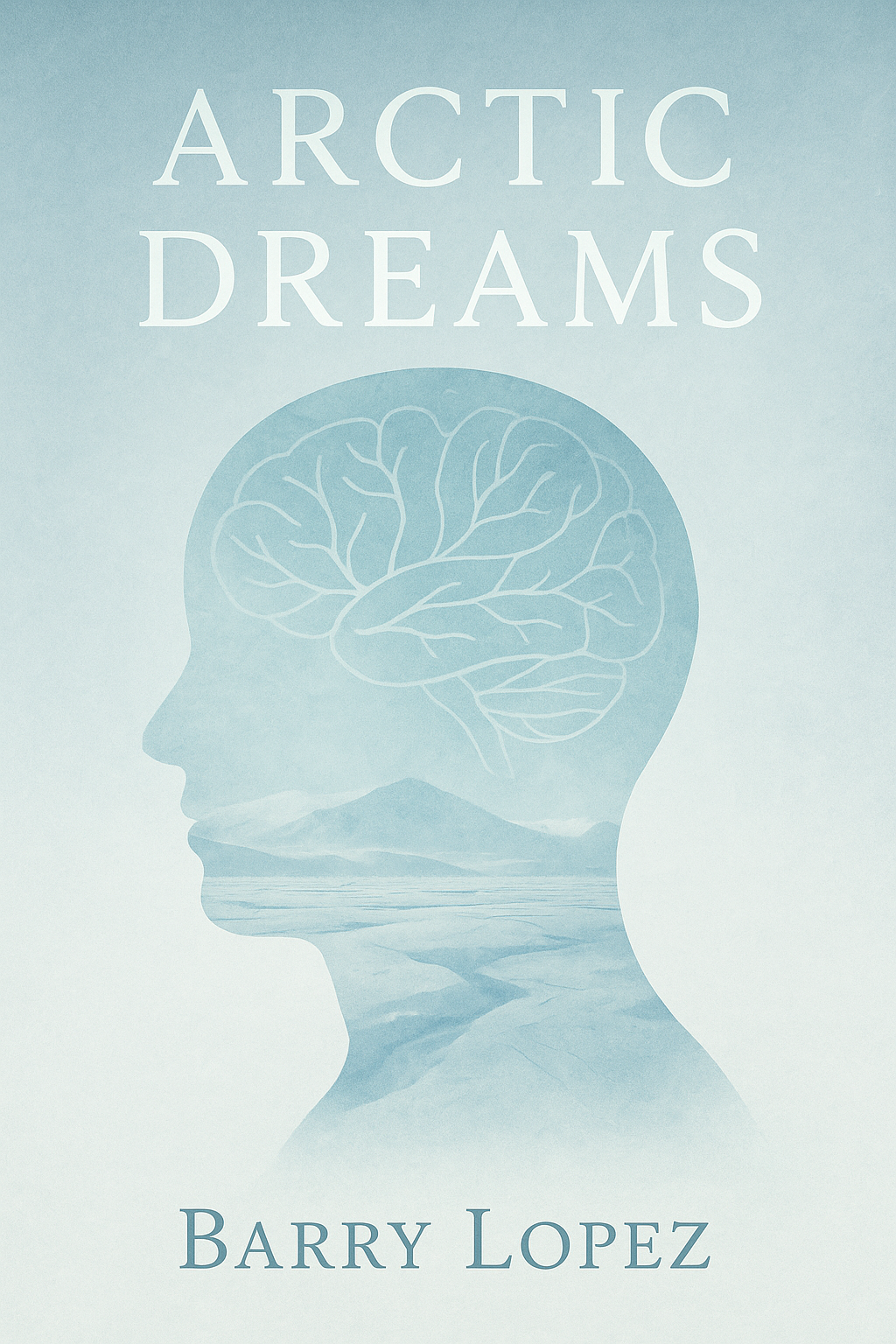
Arctic Dreams
Chapter Summaries
What's Here for You
Prepare to embark on an extraordinary journey into the heart of the Arctic, a land of stark beauty and profound mystery, with Barry Lopez's *Arctic Dreams*. This is not merely a travelogue; it is an invitation to a deeper understanding of a world often misunderstood, a realm perceived as either a distant paradise or a desolate wasteland. Lopez, with lyrical prose and an unblinking gaze, dismantles these myths, revealing the Arctic as a living, breathing entity, pulsing with ancient rhythms and teeming with life. You will find yourself transported to the vast, frozen expanse of Hazen Strait, guided by the unwavering light of Polaris, and witness the raw, untamed spirit of the muskox on Banks Island. You'll stand at the edge of the sea ice, experiencing the primal mix of awe and trepidation that accompanies encounters with the magnificent polar bear and the elusive narwhal. Lopez doesn't shy away from the perils; he immerses you in the chilling apprehension of navigating iceberg-laden waters and the harrowing reality of being trapped in pack ice, transforming these moments into profound meditations on human resilience, desire, and the very nature of wealth. More than just observing the landscape, you will learn to *feel* it, to move beyond superficial descriptions to an intuitive connection with the land, the ice, and the light. Through meticulously observed details and a deep respect for the natural world, Lopez unveils the intricate cycles of migration, the subtle yet vibrant ecosystems, and the profound stories etched into the very fabric of the Arctic. He challenges the romanticized narratives of exploration, urging us to see the Arctic not as a conquest, but as a place of profound encounter and humbling wisdom. *Arctic Dreams* offers you the chance to expand your horizons, to cultivate a deeper appreciation for the planet's wild places, and to discover a renewed sense of wonder and connection within yourself. It is an intellectual and emotional awakening, a testament to the enduring power of nature and the human spirit's capacity for deep engagement with the world around us.
Pond’s Bay, Baffin Island
Barry Lopez, in his chapter 'Pond's Bay, Baffin Island' from *Arctic Dreams*, transports us to the summer of 1823, a moment of remarkable bounty and profound encounter in the vast Arctic. The British whaler Cumbrian, after a less-than-stellar excursion, finds unexpected success in the West Water off Baffin Island, teeming with the Greenland right whale, a creature whose very being seemed designed for the whalers' pursuit – slow, buoyant, and rich in oil and bone. This success, however, was part of a fleeting golden age, a brief era of prosperity following the Napoleonic Wars, fueled by the insatiable demand for whale products to light homes and furnish factories. Lopez masterfully weaves the practicalities of this industry, the sheer tonnage of oil and whalebone, with the sensory experience of the Arctic itself. The men worked under a sun that never set, their days a heady mix of arduous labor and breathtaking landscapes – glaciers like marble cliffs, mist-laden icebergs, and the ghostly glide of belukha whales. They found exhilaration in the constant light and a deep satisfaction, yet beneath this triumph lay a complex tension. The immense beauty of the Arctic, a sublimity that filled their journals with awe, often felt at odds with the brutal efficiency of their work. They witnessed the 'carnage of wealth,' the grisly remains of hundreds of flenched whales, a testament to their profitable harvest. Simultaneously, Lopez introduces the Tununirmiut, the local Inuit, who engaged in a complex trade, offering furs and ivory for European goods. This encounter, however, was marked by a profound misunderstanding of value. The Europeans, focused on tangible wealth and profit, saw the Inuit's deep knowledge of the land as 'quaint' or 'dated,' failing to grasp their sophisticated understanding of survival and their own definition of richness—a life of good family, intimate knowledge of homeland, and a capacity for awe. This period of intense exploitation, which would soon unravel due to technological shifts, economic policies, and overfishing, also sowed the seeds of ecological and social devastation. The arrival of European diseases like diphtheria and smallpox decimated the Inuit population, a stark illustration of how the advance of Western culture, even when seemingly driven by economic opportunity, carried unforeseen and tragic consequences, a loss of vast knowledge and a cultural narrative deeply intertwined with the land. Lopez concludes by urging a deeper, more particularized understanding of the Arctic, not merely as a resource to be exploited, but as a complex ecosystem and a unique civilization with its own rhythms and values. He challenges us to consider what it truly means to grow rich, suggesting that true wealth might lie not in material gain but in a profound connection to the land, a capacity for awe, and a life lived in moral peace with the universe, a perspective gained by truly listening to the land itself, much like the seal observed in silent contemplation on the sea ice.
Arktikós
On the vast, frozen expanse of Hazen Strait, miles from shore under a six-day moon, Barry Lopez invites us into the Arctic, a realm often mythologized as either a distant paradise or a desolate wasteland. He begins by anchoring us to the celestial constant of Polaris, the North Star, a beacon that has guided humanity for millennia, and notes the ancient Greek conception of the region as 'Arktiks,' the land of the great bear, imagining Hyperborea as a place of gentle breezes and abundant life, a stark contrast to the more common perception of it as a land of frozen mountains and spiritual desolation, a figurative battleground for the forces of light and darkness. Lopez then meticulously unpacks the complex geography of the Arctic, not through simple lines on a map, but through the subtle shifts of its various 'poles' – Geographic, Magnetic, Geomagnetic, and the Pole of Inaccessibility – revealing a landscape in constant, almost imperceptible motion. The true narrative, however, unfolds as he guides us through the Arctic's unique celestial dance: the sun’s low, unmoving arc in winter, its 360-degree orbit in summer, and the profound, lingering twilight that blurs the very definition of day and night. This altered perception of time and light forces a confrontation with our ingrained, temperate-zone assumptions, much like the 'Novaya Zemlya images' that tricked 16th-century explorers into seeing a sun that had not yet risen, a reminder of the universe's peculiar hinges. As we journey southward from this extreme, Lopez illustrates the dramatic simplification of biological life – fewer species, lower productivity, and a stark shift in survival strategies, from complex tropical webs to fewer, more visible parts in a simplified, yet equally intricate, ecosystem. The soil itself transforms, becoming thinner, more acidic, and less fertile, a testament to the reduced solar energy and slower decomposition, where life clings to nutrient-rich 'organic dumps' like fox dens. The chapter’s central tension emerges: the apparent simplicity of the Arctic versus its profound, life-sustaining complexity, driven by the stark reality of limited sunlight, the ultimate limiting factor. Lopez reveals that while sunlight provides the same annual energy as the tropics, its concentrated, low-angle delivery fundamentally shapes life, forcing extreme adaptations like suspended metabolic states and antifreeze compounds in organisms. This leads to a stark realization: the Arctic’s ecosystems, despite their apparent resilience, are inherently stressed, accident-prone, and vulnerable to human impact, a consequence of their shorter evolutionary history and the violent fluctuations of weather. The author then turns inward, reflecting on the human place within this delicate balance, contrasting the ancient philosophy of accommodation with the land held by Indigenous peoples with modern humanity's unchecked technological power and desire for exploitation. He posits that true wisdom lies not in conquering nature, but in developing restraint, an attentiveness to the biological imperatives of the sun-driven world upon which we, too, are dependent. The narrative culminates in a quiet moment of waiting by the sea ice, a shared vigil with Inuit hunters, a profound connection forged in the presence of abundant animals and the deep satisfaction they derive from their relationship with the land, leaving Lopez to ponder the frailty of human wisdom and the urgent need to find a more harmonious way of being in a world that is, at its core, a mystery waiting to be understood, not controlled.
Banks Island Ovibos moschatus
Barry Lopez invites us to the stark, yet vibrant, landscape of Banks Island in mid-June, where the Thomsen River carves a life-giving artery through a terrain otherwise defined by gravel and sparse vegetation. It is here, amidst this arctic oasis, that Lopez seeks the muskox, one of North America's few large mammal survivors of the ice ages, a creature seemingly alone yet perfectly at ease in its polar existence. He observes them from a precipice, these dark, long-haired forms standing out with striking crispness against the tundra, their presence a testament to an ancient resilience. Even as the starkness of the eroded plateau suggests a harsh environment, the valley itself teems with life—cranes, caribou, and melt ponds reflecting an aquamarine ice core, hinting at the land's capacity for renewal. The surprising abundance of calves among the herds challenges the mind's perception of scarcity, a fecundity sustained by the sedge meadows and diverse arctic flora. This scene of life, however, is juxtaposed with the poignant evidence of human history at the nearby Copper Eskimo campsite, PjRa18, a 'death assemblage' of over 27,000 muskox bones, remnants of a past where survival depended on the skilled hunting of these very animals. The narrative then unfolds the story of Captain Robert McClure's abandoned ship, the HMS Investigator, and how the Copper Eskimos, drawn by its abundance, transformed their trade routes, decimating muskox populations in their quest for resources, a cycle of exploitation that nearly led to the species' collapse on the island. Lopez reveals that this historical tension between human need and animal survival is not unique; it echoes across continents and millennia, from ancient Aleut hunters to modern subsistence economies. He posits that the remarkable recovery of the muskox population on Banks Island, from near extinction to tens of thousands, remains a biological enigma, though the lush Thomsen River Valley undoubtedly plays a critical role. This resilience, Lopez suggests, offers a profound lesson for humanity: a call for enlightened respect and compassionate regard towards the natural world, recognizing our own capacity for destruction while embracing the intelligence and courage to foster a more harmonious coexistence. The muskox, in its quiet strength and ancient lineage, becomes a symbol of this delicate balance—a creature whose 'innocence' in its existence is now profoundly vulnerable to human actions, urging us to consider not just survival, but also ethical interaction and the enduring beauty of a world that existed long before us and can endure long after, if we choose wisely.
Tôrnârssuk Ursus maritimus
Barry Lopez, in his chapter 'Tôrnârssuk,' invites us into the stark, mesmerizing world of the polar bear, beginning with a visceral account of a fruitless seal hunt in the Chukchi Sea, where the landscape itself, a quiltwork of gray-white ice and ink-black water, embodies a profound sense of emptiness and directionlessness. This initial tension, the struggle for sustenance in an unforgiving environment, shifts dramatically with the appearance of a young male polar bear, a creature of “graceful power” and “undeterred walk of authority.” Lopez masterfully unveils the polar bear not just as an animal, but as a symbol of ancient adaptation and resilience, a being intricately woven into the fabric of the Arctic. He reveals that scientific understanding of this magnificent predator has long lagged behind its mystique, detailing how early fears of extinction spurred international cooperation and research, which in turn dismantled old theories about bear populations and their movements, highlighting instead a remarkable fidelity to ancestral territories. The narrative then delves into the bear's unique physiology – its hollow, light-refracting fur, its sophisticated heat regulation through specialized blood flow to extremities and unique muscle sheets, and its reliance on blubber for survival, especially during lean periods like a female's denning. Lopez underscores the bear's evolutionary journey, drawing parallels between its terrestrial ancestor, the brown bear, and its specialized marine existence, noting how subtle differences in teeth and body shape betray millions of years of adaptation. He then explores the intricate dance of survival, detailing the polar bear's diverse hunting strategies, from the patient ambush at a seal's breathing hole to the explosive lunge, emphasizing that success is rare, perhaps only 2 to 25 percent. This highlights a core insight: the polar bear embodies extreme patience and calculated risk in the pursuit of life. The chapter further illuminates the profound connection between the bear and its environment, describing how Indigenous peoples, particularly the Eskimos, possess an almost spiritual understanding of the animal, recognizing its behaviors and ecological role with a “native eye” that science is only beginning to approximate. Lopez contrasts the respectful, almost ritualistic hunting practices of the Eskimos, who viewed the bear as a powerful helper or companion, with the often careless, exploitative killing by European explorers, who saw the bear as a symbol of their own struggle against an indifferent landscape. This tension between respect and exploitation is central, revealing how the bear’s very existence challenges human perceptions of progress and dominance. The narrative culminates in an exploration of the polar bear's maternal dedication, the meticulous construction of maternity dens, and the cubs' precarious early development, underscoring the immense investment in perpetuating the species. Ultimately, Lopez portrays the polar bear as a creature of profound intelligence and adaptability, a “great wanderer” whose very existence, from its unique physiology to its complex hunting techniques and its deep ecological ties, offers a powerful lesson in living with purpose and insight within a challenging world, a testament to the intricate interplay between life and its environment that continues to hold us in its thrall.
Lancaster Sound Monodon monoceros
Barry Lopez invites us to the stark, brilliant edge of the Arctic sea ice, to the floe edge at the mouth of Admiralty Inlet, where the air is alive with the ceaseless light of July and the vibrant energy of countless seabirds. He describes the primal mix of fear and elation that accompanies such exposure in remote regions, a feeling amplified by the capricious nature of Arctic weather, where a shift in the wind can spell disaster, as it did for a hunter whose ice floe began to drift toward open water. Yet, the immediate focus shifts to the breathtaking abundance of life: the acrobatic kittiwakes, fulmars, and guillemots plunging into the water, the raucous gulls staking claims at offal piles, and the sheer numbers of birds that mark Lancaster Sound as a rare marine sanctuary, a place teeming with life akin to the Antarctic Ocean, sustained by upwelling currents and glacial runoff. Lopez reveals how this rich ecosystem, a unique overlap of land, water, and air, functions as an ecotone, a border zone charged with evolutionary potential, where different communities meet and mingle. He draws parallels between this biological edge and the twilight places that quicken human curiosity, suggesting that our attraction to borders—whether physical, temporal, or conceptual—is fundamental to our nature. The chapter delves into the intricate food web, beginning with the epontic algae on the underside of the sea ice, feeding zooplankton, then cod, and ultimately the narwhals, seals, polar bears, and foxes, emphasizing the ice as the crucial element that holds this vibrant community together. Amidst this profound sense of connection, Lopez also acknowledges the inherent dangers, the intimidating presence of the walrus, and the constant awareness of being far from land. His narrative takes a turn toward the mystical with the appearance of the narwhal, an animal shrouded in legend and mystery, its very existence sometimes doubted. Lopez recounts the astounding discovery of narwhals in the Bering Sea, a place where they had never been scientifically recorded, highlighting the profound gap in our knowledge about these creatures and the potential conflict between scientific interpretation and the drive for resource exploitation. The text then explores the narwhal's physical characteristics and its unique adaptations for life in the Arctic, from its acoustical world to its remarkable ability to store and utilize oxygen, and the enigmatic function of its tusk. This tusk, so central to its identity, has fueled centuries of myth, from its association with the unicorn to its value as a potent amulet. Lopez contrasts the scientific understanding of the narwhal with the persistent legends, suggesting that literature, too, has a role in bringing such obscure creatures to life. He describes the narwhal's social behaviors, its deep dives, and its cooperative hunting strategies, painting a picture of an intelligent, complex being. The chapter culminates in a reflection on the narwhal's evolutionary journey back to the sea and its profound adaptation to an acoustical world, a realm so different from our own visual one. Ultimately, Lopez posits that the narwhal, like the mythical Chinese kilin, embodies a profound mystery and serves as a reminder of a dignity and respect that should guide our interactions with nature and with each other, urging a mindful approach to the Arctic landscape and its inhabitants, lest we transform this oasis into a desert.
Migration The Corridors of Breath
Barry Lopez, in "Migration The Corridors of Breath," invites us into the profound, often overlooked, rhythms of the Arctic, revealing a world where life, driven by ancient instincts, unfolds in cycles of breathtaking scale and intricate detail. He begins not with grand pronouncements, but with the intimate sound of snow geese in the pre-dawn dark, a sound that ushers in a contemplation of their incredible journeys. Lopez observes these birds not merely as biological specimens but as living embodiments of a fundamental order, their effortless flocking and unerring navigation hinting at mysteries of space and time. He marvels at the sheer abundance of life in the Arctic – the millions of waterfowl in the Klamath Basin, the staggering concentrations of seabirds and marine mammals in the Bering Sea, the vast caribou herds traversing the tundra – and yet, he cautions against mistaking these temporary oases for the entirety of the Arctic landscape. These immense gatherings, he explains, are part of a delicate, compressed existence, a fleeting advantage seized within a harsh environment, where birds molt and raise their young in a frantic, vital rush before the long journey south. This intense, cyclical movement, Lopez suggests, is akin to the very breath of the land itself, an inhalation of life in spring and an exhalation in fall. As the narrative unfolds, Lopez draws parallels between the animal migrations and the enduring human presence in the Arctic, exploring the resilience and ingenuity of indigenous cultures like the Eskimo. He highlights their profound connection to the natural world, a relationship characterized not by dominion, but by a deep, often fearful, respect, a recognition that survival hinges on understanding and honoring the intricate web of life. The author underscores that for these peoples, the separation between human and animal worlds is not easily conceived, unlike the Western tendency to objectify nature. This intimate, personal connection, while demanding, fosters a unique wisdom and a profound appreciation for existence, a quality he calls nuannaarpoq, the extravagant pleasure of being alive. Ultimately, Lopez guides us to see that the Arctic's compelling rhythm is not merely a matter of seasons or animal movements, but a fundamental expression of life itself, where every creature, from the smallest water bear to the largest whale, plays a role in a grand, unfolding pattern that challenges our human-centric view of time, space, and existence, urging us toward a deeper understanding of our place within the natural world.
Ice and Light
Barry Lopez, in his chapter 'Ice and Light' from 'Arctic Dreams,' invites us into the profound and often perilous encounter with the Arctic's frozen heart, beginning with the chilling apprehension of navigating a ship into iceberg-laden darkness, a stark reminder of nature’s immense power and our own vulnerability. The author recounts a near-disaster, a storm that miraculously passed, leaving a profound sense of peace and an intensified yearning to witness the icebergs, those silent, colossal travelers from Greenland’s glaciers. He describes their appearance, shifting from sad, exhausted remnants to monolithic structures evoking ancient palaces, all observed from the ship’s bridge, a fragile human outpost against the immensity of nature. Lopez marvels at the transformative effect of light on these ice masses, how it defines their contours, colors, and scale, turning them into living sculptures—mountains, foreheads, lacerated tusks—faceted like jade or obsidian, with caverns and grottoes carved by the sea. He delves into the complex science of ice, differentiating freshwater from sea ice, detailing its formation from frazil to multiyear pack ice, and the dynamic, often treacherous, nature of sea ice that shapes marine life and poses a constant threat to human endeavors. The narrative shifts to the historical human struggle against this environment, recounting harrowing tales of whalers beset by pack ice, their ships crushed, their lives hanging precariously in the balance, a testament to the unforgiving nature of the Arctic. Lopez contrasts this past peril with modern navigation, yet underscores that the stories of human resilience and loss persist, a humbling undercurrent for any contemporary mariner. He then expands the view to the broader Arctic ecosystem, explaining how sea ice is not merely a barrier but an integral component, shaping the lives of animals, from seals and walruses using it as a platform to polar bears hunting on its surface, and how phenomena like polynyas, areas of persistent open water, create vital refuges and staging grounds. The chapter further explores the subtle colors of the Arctic, often overlooked in its starkness, found not just in the fleeting wildflowers but predominantly in the sky—the vivid twilights, the ethereal aurora borealis, and the mesmerizing solar halos and mirages that play tricks on perception, blurring the line between reality and illusion, as seen in the legends of phantom lands. Lopez reflects on the human impulse to interpret and comprehend such a landscape, drawing parallels between the awe inspired by icebergs and cathedrals, both monuments to light and mystery, and the profound spiritual yearning they evoke. He concludes by emphasizing that true understanding of the Arctic, and indeed any landscape, requires not just scientific analysis but an approach of humble regard, acknowledging its inherent mystery and identity, a perspective that fosters a deep, almost sacred, connection to the natural world, reminding us that even in its harshness, the Arctic reveals a profound beauty that can inspire both fear and an exquisite sense of wonder.
The Country of the Mind
Barry Lopez, in 'The Country of the Mind,' invites us to a profound re-evaluation of our relationship with landscape, moving beyond mere observation to a deeper, more intuitive understanding. He begins by immersing us in the subtle, often overlooked details of Pingok Island, an Arctic outpost where the vastness of nature is revealed not in grand spectacles, but in the quiet persistence of life—the nearly imperceptible tide, the sharp hoofprints of caribou on frozen ground, the molted feathers washed ashore. Lopez gently critiques the Western imagination, which often finds Arctic landscapes impoverished because they lack the familiar comforts of temperate climes, revealing how this prejudice leads us to view such places as barren or suitable only for exploitation, like deserts once used to banish outcasts. He argues that our desire for wealth, renewal, or conquest often distorts our perception of new lands, overshadowing a simpler longing for intimacy and a less complicated life. This leads him to explore Frederick Jackson Turner's Frontier Hypothesis, suggesting that our national character, shaped by the frontier, is itself a product of both the physical reality of the land and our perception of it. Lopez contends that we all apprehend the land imperfectly, colored by preconception and desire, but that embracing its mystery, rather than seeking to solve it like a puzzle, opens us to a richer experience. He illustrates this with the wisdom of an Anaktuvuk Pass elder who simply 'listens' to the land before speaking, and with 19th-century American painters who saw the land as a powerful, unknowable force. The chapter then pivots to the profound connection between indigenous peoples and their environment, highlighting how Eskimo hunters possess an intimate, localized knowledge that transcends Western scientific categorization, a knowledge deeply embedded in language and oral tradition. Lopez contrasts this with the often superficial understanding gained from aerial travel or abstract mapping, which can impose a colonial sensibility by reducing spaces to mere resources. He reveals how indigenous languages, rich in verbs and nuanced terms for natural phenomena, embody a way of understanding reality that is dynamic and interconnected, unlike the noun-heavy, linear time of English. The author stresses that this deep, almost spiritual, connection to the land—a 'country of the mind'—provides a sense of place, history, and resilience against existential dread, a wisdom that transcends economic systems and societal upheavals. Ultimately, Lopez calls for a more patient, sensory, and respectful engagement with the natural world, urging us to shed our preconceptions and listen to the land, much like the Eskimo hunters who, through prolonged contact and meticulous observation, find a profound congruency with the earth. The narrative concludes with a poignant reflection on the limitations of maps and the superficiality of modern travel, emphasizing that true understanding emerges from walking the land, sleeping on the ground, and allowing the rhythm of nature, not the ticking clock of schedules, to dictate our pace, thereby discovering a timeless wisdom that sustains both people and place.
The Intent of Monks
Barry Lopez, in 'The Intent of Monks,' recounts a harrowing experience trapped in Arctic pack ice, transforming it into a profound meditation on human desire, resilience, and the nature of wealth. As a storm bore down, Lopez and his scientific companions found their small boat pinned by shifting ice, suddenly isolated and facing the unforgiving power of the Arctic. This immediate peril, a stark contrast to the meticulously prepared safety protocols they had followed, stripped away pretense and forged a silent, potent camaraderie built on shared purpose and mutual regard. They battled the ice with ingenuity and sheer will, a physical struggle that mirrored the deeper, historical human drive to conquer the unknown, a drive Lopez contrasts with the calculated risks of modern astronauts. He observes how this struggle, this 'terrific desire to get free,' reveals the core of human aspiration, often fueled by visions of tangible reward—wealth, fame, or simply survival—yet sometimes sustained by something more profound: a quiet steadiness, a 'resolute steadiness' that emerges when desire meets its limits. As the storm raged and the author found himself physically incapacitated, detached from his own body, he touches upon the raw vulnerability beneath human endeavor, a state of disassociation that paradoxically leads to a deeper sense of being 'secure' and a renewed flow of time once the immediate crisis passed. This personal ordeal becomes a lens through which Lopez examines the grander narratives of Arctic exploration, from the mythic quests for paradise to the relentless pursuit of passage and profit by explorers like Pytheas, John Davis, and Henry Hudson. He questions the very definition of wealth, contrasting the extractive economic models that drove centuries of exploration with the intangible riches of the Arctic landscape itself—the clarity of air, the sight of undisturbed wildlife—riches that cannot be owned or possessed. Lopez reveals that the history of Arctic exploration is not merely a chronicle of geographic accomplishment or heroic struggle against a hostile environment, but a testament to the enduring power of human longing: the desire for achievement, for freedom from life's 'grim weight' of ignorance and anonymity, and, perhaps most fundamentally, the desire for a safe and honorable passage through the world. He concludes that true richness lies not in possession, but in a tolerance for the unconverted things of the earth and a recognition of the incalculable value of the unmanipulated landscape, a perspective that redefines the very intent behind human striving, echoing the spiritual journeys of early monks seeking not earthly gain, but a higher truth.
A Northern Passage
Barry Lopez, in 'Arctic Dreams,' invites us to look beyond the curated narratives of Arctic exploration, revealing how early expeditions, like Parry's, were often smoothed over for public consumption, presenting a tidier, more heroic image than reality allowed. The author explains that this tendency to shape records to bolster a preconceived vision—of the Arctic as a site of impersonal hostility or a stage for national service and individual heroism—became a pattern, particularly as competition for geographic accomplishment intensified. Sir John Barrow, a key figure, stressed the selfless pursuit of knowledge, famously stating 'Knowledge is power,' while simultaneously serving England's national interests, especially in the face of potential Russian advancement. Lopez cautions against dismissing these efforts as mere 'scheming,' suggesting instead a profound human yearning to locate and shape discoveries to one's own ends, a drive intertwined with the genuine desire to understand the unknown and create benefit, however misconstrued. He draws a parallel to modern industrial requests for consultants to structure environmental data helpfully, underscoring that the line between serving society and serving personal or national gain is often indistinct. The narrative then shifts, drawing on the author's own experiences of waiting in the Arctic, reflecting on the profound meaning infused into the landscape by remnants of human presence—a cairn, a ship's cache, a desolate shoreline where so many died. These encounters, observed from a distance, evoke exhilaration, empathy, and a wistful speculation, a historical sensibility that, alongside natural history, helps us make sense of these vast, indifferent spaces. Lopez critiques the common disassociation from the actual landscape in exploration literature, where the land often becomes a mere adversary or a stage for personality, theory, or competition, a stark contrast to the mature wonder of earlier voyages like John Davis'. The brutal, Victorian-era encounters with the land, driven by a desire to exert oneself against odds and erect monuments, stand apart from a more tender, respectful engagement. He delves into the tragic saga of Sir John Franklin's expedition, highlighting how a misunderstanding of ice patterns, stemming from an incorrect observation by James Ross, led to the ships being trapped and the eventual loss of all hands. The subsequent extensive searches, while yielding invaluable mapping of the Arctic islands, were themselves fraught with hardship and ultimately ended British interest in finding the Northwest Passage, a goal that had become secondary to national prestige and commercial advantage. Lopez contrasts the British reliance on naval tradition and ethnocentrism, failing to adopt indigenous knowledge of clothing, shelter, and food, with the eventual success of explorers like Amundsen and Stefansson who integrated such wisdom. He then pivots to the American approach, exemplified by Elisha Kent Kane and later Robert Peary, characterized by individual ambition and a more personal quest for glory, often at the expense of broader scientific cooperation. The narrative then explores the perilous nature of Arctic travel, the constant struggle against cold, ice, and isolation, and the psychological toll it took, leading to instances of alcoholism, psychosis, and even cannibalism, as evidenced in the grim accounts of William Scott and the survivors of Franklin. Lopez critically examines the romanticized portrayal of Arctic exploration, contrasting the driven ambition of figures like Peary with the more scientifically grounded and humanitarian approach of Fridtjof Nansen. He highlights how the landscape itself, indifferent to human endeavor, becomes a powerful force that humbles explorers, eclipsing initial motives of prestige and reward. The author reflects on his own travels, the stark reality of industrial development juxtaposed with the wildness of the land, and the profound, often unspoken, dignity found in both the landscape and the people who inhabit it. He observes how the Arctic, once a frontier for national ambition, has become a complex arena where human desires, industrial imperatives, and the raw power of nature collide, urging a deeper, more reciprocal relationship with the land, one that acknowledges its innate dignity and the profound lessons it offers about survival, resilience, and the interconnectedness of all living things. The chapter concludes with a powerful reflection on the potential for a 'more radical Enlightenment' where dignity is not merely conferred by authority but recognized as an inherent quality of all beings, including the land itself, suggesting that true understanding lies in recognizing this shared essence and moving toward a reciprocal relationship with the natural world.
Conclusion
Barry Lopez's *Arctic Dreams* serves as a profound meditation on humanity's complex relationship with the natural world, particularly the stark, yet vibrant, Arctic. Through a tapestry woven from scientific observation, historical accounts, and deeply personal reflection, Lopez dismantles the conventional Western gaze that often views such landscapes as empty or exploitable. Instead, he reveals the Arctic as a realm of intricate ecological interdependence, where life, dictated by the extreme rhythms of light and ice, demonstrates remarkable resilience and profound wisdom. The book's core takeaway is a radical redefinition of wealth, shifting from material accumulation—exemplified by the destructive pursuit of resources like whales—to the immeasurable riches found in deep connection to place, family, and a capacity for awe, as understood by indigenous cultures like the Tununirmiut. Lopez emotionally underscores the devastating impact of cultural encounters, where the introduction of European diseases and values led to the erosion of invaluable indigenous knowledge systems, a stark reminder of our species' capacity for unintended destruction. Practically, *Arctic Dreams* urges a fundamental recalibration of our perspectives. It calls for a move beyond utilitarianism and a detached, scientific observation towards a mindset of humble regard and particularized understanding. The book illustrates that true wisdom lies not in mastery, but in restraint and attentiveness to the biological imperatives of the land. The Arctic, with its unique celestial mechanics and dynamic geography, becomes a crucible for challenging human complacency and narrow viewpoints. Lopez emphasizes that enduring security of the soul is found not in conquest, but in adapting our perspective, learning from the land's own ancient rhythms, and acknowledging the intrinsic dignity of all life, from the smallest organism to the majestic polar bear and the enigmatic narwhal. Ultimately, the book is an elegy for a world too often misunderstood and exploited, and a powerful plea for a more ethical, respectful, and deeply connected engagement with the wild places that sustain us, and indeed, with life itself.
Key Takeaways
The pursuit of material wealth in the Arctic, exemplified by the whaling industry, often blinds individuals to the intrinsic value and profound ecological knowledge of indigenous cultures and the natural environment.
The intense beauty and sublime power of the Arctic landscape can coexist with, and even be overshadowed by, the brutal practicality of resource extraction, creating a moral and emotional tension for those involved.
True wealth, as understood by indigenous peoples like the Tununirmiut, is defined by deep connection to homeland, family, and a capacity for awe, contrasting sharply with the European focus on financial profit and material accumulation.
The introduction of European culture and diseases into the Arctic led to devastating demographic collapse and the erosion of invaluable indigenous knowledge systems, highlighting the often-unforeseen destructive consequences of cultural encounters.
Developing an enlightened approach to the Arctic requires a shift from a utilitarian, exploitative mindset to one of deep, particularized understanding and respect for the land's unique nature and its inhabitants' long-held wisdom.
The Arctic's unique rhythms of light and time can serve as a powerful catalyst for challenging human complacency and narrow perspectives on land, prompting a reevaluation of our relationship with the natural world.
A lasting security of the soul and heart can be found by adopting an altered perspective gained from understanding places where the common elements of life are perceived differently, fostering a greater accommodation with the flow of history.
The Arctic, often perceived through mythic extremes, is a landscape defined by its unique relationship with celestial light, demanding a fundamental recalibrization of our temporal and spatial understanding.
The Arctic's environmental 'poles' and celestial mechanics reveal a dynamic, shifting geography and an altered perception of time, challenging our temperate-zone-based assumptions about sunrise, sunset, and the passage of seasons.
Arctic ecosystems, though seemingly simpler due to fewer species, possess a profound, intricate complexity driven by extreme light and temperature fluctuations, requiring unique adaptations for survival.
Sunlight, not just warmth or light, is the primary limiting factor in the Arctic, dictating the metabolic processes, growth patterns, and survival strategies of all life, from microscopic organisms to large mammals.
Arctic ecosystems are inherently stressed and vulnerable due to their recent evolutionary history and volatile weather, yet demonstrate remarkable resilience, a resilience threatened by human technological power and unchecked exploitation.
True wisdom in interacting with the natural world, particularly the Arctic, lies not in mastery or exploitation, but in developing restraint and an attentiveness to the biological imperatives of the sun-driven systems upon which all life depends.
The stark beauty of arctic landscapes, exemplified by Banks Island, harbors hidden oases of life that sustain resilient species like the muskox, demonstrating nature's capacity for renewal even in harsh environments.
Historical human interactions with wildlife, driven by necessity and opportunity, can lead to near-extinction events, highlighting the profound impact of human actions on ecological balance.
The remarkable recovery of muskox populations underscores the interconnectedness of habitat, species resilience, and the potential for nature's resurgence when pressures are eased.
Recognizing our species' capacity for both destruction and compassion is essential for fostering an ethical relationship with the natural world, moving beyond mere survival to a state of enlightened respect.
The concept of 'innocence' in nature, embodied by the muskox, is profoundly vulnerable to human influence, compelling us to acknowledge our responsibility in safeguarding biodiversity for future generations.
The polar bear's survival hinges on an extraordinary blend of patience, calculated risk-taking, and profound ecological understanding, mirroring the resilience required to thrive in harsh environments.
Scientific understanding of complex species like the polar bear often emerges from a confluence of dedicated research, international cooperation, and a willingness to challenge existing paradigms.
The polar bear's unique physiological adaptations, from its fur to its thermoregulation, are a testament to evolutionary ingenuity in the face of extreme environmental pressures.
Indigenous knowledge systems offer invaluable, often overlooked, insights into the behavior and ecology of wildlife, providing a crucial complement to scientific observation.
Human interaction with the natural world is often defined by a tension between exploitation and respect, revealing our own relationship with nature and ourselves.
The successful perpetuation of species, particularly those with low reproductive rates like the polar bear, relies on immense parental investment and intricate ecological dependencies.
Navigating challenging landscapes, whether Arctic ice or the complexities of life, requires a keen awareness, adaptability, and an ability to learn from both success and failure.
The Arctic's floe edge is a vital ecotone, a dynamic border zone where diverse ecosystems meet, fostering unique biological richness and mirroring the human attraction to transitional spaces that stimulate curiosity and evolutionary potential.
The sea ice is not merely frozen water but a fundamental substrate for life in the Arctic, acting as a habitat, a highway, and a crucial element that binds together a complex food web from microscopic algae to apex predators.
Our understanding of many creatures, like the narwhal, remains deeply incomplete, a gap between scientific observation and persistent myth, highlighting the tension between empirical knowledge and the human need to interpret the unknown, especially when economic interests are involved.
The narwhal's tusk, central to its mystique and historical legend, likely serves primarily as a social and secondary sexual characteristic, a complex adaptation whose full function is still debated, underscoring the challenges of discerning purpose in biological evolution.
The narwhal's existence in an acoustically rich, three-dimensional world, so different from human experience, demands a profound recalibration of our assumptions about intelligence and sensory perception, urging respect for life forms that operate on different principles.
Human interaction with the natural world, particularly in sensitive ecosystems like Lancaster Sound, requires a mindful approach that balances economic development with ecological preservation, acknowledging the intrinsic value of these places and the wisdom of indigenous knowledge.
The narwhal, like the mythical kilin, represents an unpossessable being that embodies dignity and respect, serving as a potent symbol for appreciating the fundamental mystery of life and guiding our interactions with nature and other cultures.
Arctic migrations, exemplified by snow geese, reveal an ancient, fundamental order of life that transcends human constructs of nations and time.
The immense, temporary concentrations of life in the Arctic, such as waterfowl refuges and marine mammal gatherings, represent a crucial, compressed period of advantage for survival and reproduction within a challenging environment.
Indigenous Arctic cultures, particularly the Eskimo, demonstrate a profound, reciprocal relationship with nature, characterized by deep respect, fear, and an inability to easily conceive of a separation between human and animal worlds.
Survival in the Arctic, for both animals and humans, is deeply intertwined with understanding and adapting to the land's inherent rhythms, oscillations, and sudden, often violent, shifts.
The Eskimo perspective on life, marked by nuannaarpoq (extravagant pleasure in being alive) and a profound respect for the natural world, offers a wisdom that contrasts sharply with Western objectification of nature and offers a model for living with dignity amidst challenging circumstances.
The Arctic's enduring rhythms and patterns, from animal movements to climatic shifts, suggest a fundamental interconnectedness of all life, urging a reconsideration of our anthropocentric view of existence.
The immense scale and power of Arctic icebergs, while awe-inspiring, serve as a humbling reminder of humanity's vulnerability and the need for profound respect when navigating natural forces.
Light in the Arctic is not merely illumination but a dynamic sculptor and definer of form and color, transforming the austere landscape into a realm of subtle beauty and profound visual complexity.
The intricate science of ice formation and behavior, from sea ice dynamics to the unique properties of icebergs, is fundamental to understanding Arctic ecosystems and the historical human struggle for survival.
Human history in the Arctic is a narrative of both perilous encounters with the elements and remarkable resilience, underscoring the enduring tension between civilization's technological advancements and nature's raw power.
Sea ice is a foundational element of the Arctic ecosystem, not an impediment, profoundly shaping the lives, adaptations, and survival strategies of its diverse flora and fauna.
The Arctic landscape, often perceived as monochromatic, possesses a rich palette of colors, particularly in its skies and atmospheric phenomena, which offer profound aesthetic and spiritual experiences.
True engagement with the Arctic, or any alien landscape, demands more than scientific observation; it requires an attitude of humble regard, embracing its mystery and allowing the land to reveal its own identity, fostering a deeper, more meaningful connection.
Western perceptions of seemingly 'bleak' landscapes like the Arctic are often colored by cultural prejudice, leading to a misunderstanding of their inherent richness and complexity.
Our engagement with new landscapes is profoundly shaped by personal desires—for wealth, renewal, or conquest—which can distort objective observation and overshadow a simpler longing for connection.
Indigenous knowledge systems, particularly those embedded in language and oral traditions, offer a more nuanced, holistic, and sustainable understanding of the land than purely scientific or cartographic approaches.
True understanding of a landscape requires prolonged, sensory engagement and a willingness to 'listen' to its subtle cues, rather than relying on abstract representations like maps or the detached perspective of aerial travel.
The 'country of the mind,' a landscape imbued with memory, story, and spiritual significance, is as vital to human well-being and identity as the physical terrain itself, providing resilience and a sense of belonging.
A deep, harmonious relationship with the land, cultivated through generations of intimate interaction, offers a timeless wisdom essential for living a decent life and fostering mutual respect between humanity and nature.
The pursuit of tangible rewards like wealth and fame often drives exploration, but true resilience and accomplishment in harsh environments are forged in shared purpose, mutual regard, and a quiet, resolute steadiness that transcends immediate desire.
The historical narrative of Arctic exploration reveals a persistent tension between the pursuit of material wealth and the recognition of intangible, unpossessable riches found in the natural world, prompting a re-evaluation of what constitutes true value.
The human capacity for survival and meaning-making in extreme circumstances often involves a profound disassociation from the physical self, leading to a deeper connection with the present moment and a renewed sense of security once the immediate crisis is navigated.
The history of exploration is not solely about conquering nature or achieving individual glory, but about the complex interplay of human longing for achievement, freedom from life's burdens, and the fundamental desire for a safe and honorable existence.
A truly rich life requires cultivating tolerance for the inherent worth of the natural world and recognizing that its unmanipulated state holds a value often exceeding material possessions.
Narratives of exploration are often curated to serve nationalistic or heroic ideals, obscuring the complex realities and human struggles involved.
The pursuit of knowledge and discovery is deeply intertwined with personal ambition, national interest, and economic motives, blurring the lines of selfless endeavor.
True understanding of a landscape, especially one as indifferent and powerful as the Arctic, requires a shift from viewing it as an adversary to engaging in a reciprocal, respectful relationship.
Indigenous knowledge, often overlooked or disdained by Western explorers, holds crucial insights for survival and adaptation in extreme environments.
The pursuit of fame and accomplishment can isolate individuals, leading to a profound loneliness that drives further ambition but can also lead to a loss of connection with both society and self.
The Arctic landscape possesses an inherent dignity that commands a humbling awe, transcending human ambitions and revealing fundamental truths about life, power, and interconnectedness.
A 'radical Enlightenment' is needed, one that recognizes innate dignity in all living things, including the land itself, fostering a reciprocal relationship built on respect rather than exploitation.
Action Plan
Reflect on the definition of 'wealth' in your own life, considering both material gain and non-material values like connection and knowledge.
Seek out and learn from the perspectives of indigenous cultures or communities whose traditional knowledge differs significantly from mainstream Western views.
Cultivate a deeper appreciation for the natural landscapes you inhabit by engaging your senses and observing their unique rhythms and details.
Consider the unintended consequences of your actions, particularly in relation to resource consumption and cultural interactions.
Challenge your own assumptions about 'progress' and 'development' by questioning whose values are prioritized and whose are marginalized.
Practice active listening and empathy when encountering perspectives that differ from your own, especially in contexts of cultural or environmental change.
Engage with art, literature, or nature in ways that foster a sense of awe and wonder, intentionally seeking experiences that expand your imagination.
Cultivate a deeper awareness of how your own assumptions about time and space are shaped by your environment, particularly regarding light and seasons.
Seek to understand the unique ecological pressures and adaptations of life in extreme environments, recognizing that complexity can exist with fewer components.
Reflect on the concept of 'restraint' in your own interactions with nature and resources, considering where human ingenuity might best be applied to preservation rather than exploitation.
Explore the diverse ways different cultures have developed philosophies of accommodation with the natural world and consider their relevance today.
Practice observing natural phenomena with a heightened sense of curiosity, looking beyond the obvious to appreciate the intricate rhythms and interdependencies at play.
Consider the long-term ecological consequences of your actions, especially concerning resource consumption and technological development.
Engage with perspectives that challenge your ingrained notions of progress and efficiency, seeking wisdom from those who live in closer proximity to the earth.
Seek out and observe local wildlife with a mindful appreciation for their place in the ecosystem.
Research the historical interactions between human cultures and wildlife in your region or areas of interest.
Consider the long-term consequences of human actions on natural habitats and biodiversity.
Cultivate an attitude of respect and curiosity towards the natural world, moving beyond a purely utilitarian view.
Reflect on the concept of 'innocence' in nature and our role in protecting vulnerable species and environments.
Support conservation efforts or organizations dedicated to preserving natural habitats and wildlife.
Cultivate patience and attentiveness in your own endeavors, recognizing that success often requires sustained effort and observation.
Seek out and value diverse perspectives, particularly those of Indigenous cultures, to deepen your understanding of the natural world and beyond.
Reflect on the balance between human progress and environmental preservation, considering the long-term consequences of industrial development on ecosystems.
Appreciate the intricate adaptations of living organisms, fostering a sense of wonder for the evolutionary processes that shape life.
When faced with challenges, analyze the situation critically and adapt your strategies, much like the polar bear employs various hunting techniques.
Develop a deeper respect for the interconnectedness of life, understanding how the health of one species can impact many others within an ecosystem.
Practice mindful observation of your surroundings, noticing subtle details and patterns that might otherwise go unnoticed, akin to a predator scanning its environment.
Cultivate curiosity about the natural world by observing local wildlife and ecosystems, paying attention to the 'border zones' where different environments meet.
Seek out and appreciate the complexity of life in seemingly barren or extreme environments, recognizing the intricate interdependencies within them.
Engage with scientific information critically, acknowledging the limits of current knowledge and the persistence of myth and legend, especially concerning elusive species.
Reflect on the symbolic meanings we assign to animals and consider how these interpretations influence our relationship with them and their habitats.
Support conservation efforts for fragile ecosystems and advocate for responsible resource management that respects ecological integrity.
Practice mindful observation of nature, allowing for moments of wonder and a recognition of the profound mysteries that elude complete explanation.
Consider the ethical implications of human activities in natural landscapes, striving for a respectful and less exploitative approach.
Explore the concept of 'borderlands' in your own life—whether intellectual, emotional, or physical—and consider the growth and insight that can emerge from these transitional spaces.
Observe the natural world around you with a renewed sense of curiosity, seeking to understand the underlying rhythms and patterns of life.
Cultivate a deeper respect for the environment by recognizing its inherent complexities and the interconnectedness of all living things.
Seek out and learn from perspectives that differ from your own, particularly those that emphasize a humble, reciprocal relationship with nature.
Engage with the concept of 'nuannaarpoq,' actively finding and savoring moments of profound joy and appreciation for existence, even amidst challenges.
Reflect on the ways in which your own culture objectifies or separates itself from the natural world, and consider how to foster a more integrated perspective.
When faced with uncertainty, practice 'quinuituq,' deep patience, and preparedness for sudden events, trusting in your ability to adapt and persevere.
Cultivate a practice of mindful observation, paying close attention to the interplay of light and form in your immediate surroundings.
Seek out opportunities to learn about the scientific principles governing natural phenomena, such as ice formation or atmospheric optics, to deepen your appreciation.
Reflect on historical narratives of human encounters with challenging environments to gain perspective on resilience and respect for nature.
Consciously acknowledge the hidden complexities and unseen dimensions of familiar landscapes and phenomena.
Engage with art or photography that captures the essence of remote or stark environments to broaden your aesthetic and emotional understanding.
Approach new experiences or unfamiliar territories with an attitude of humble curiosity, seeking to understand rather than merely to possess or categorize.
Consider how the 'light' of knowledge and understanding can transform your perception of seemingly mundane or harsh aspects of life.
Practice recognizing and appreciating the subtle colors and patterns present even in seemingly monochromatic environments.
Practice mindful observation of your immediate surroundings, noting subtle details often overlooked, much like observing the nearly imperceptible tide.
Challenge your own preconceived notions about unfamiliar landscapes or environments, seeking to understand them on their own terms rather than through a lens of personal preference or cultural bias.
Engage with local knowledge, whether through reading ethnographies, listening to elders, or speaking with inhabitants, to gain a deeper, more nuanced understanding of a place.
When exploring new areas, consciously slow down your pace, allowing for sensory engagement beyond mere visual scanning, and resist the urge to rush through experiences.
Consider how language shapes your perception of the world and explore how different linguistic structures might offer new ways of understanding reality, particularly concerning time and space.
Cultivate a 'country of the mind' by connecting with places through memory, stories, and reflection, recognizing that these internal landscapes are as vital as physical ones.
Seek out opportunities for prolonged, quiet contemplation in nature, allowing the land itself to inform your understanding and foster a sense of place and belonging.
When facing challenges, focus on the immediate task and cultivate a quiet, resolute steadiness rather than succumbing to panic.
Reflect on your own motivations for pursuing goals, distinguishing between the desire for external rewards and the intrinsic value of the pursuit itself.
Practice moments of mindful detachment during stressful situations, observing your thoughts and sensations without judgment to regain a sense of calm and perspective.
Consider the intangible aspects of wealth in your life—experiences, relationships, appreciation for nature—and assess if they are valued as highly as material possessions.
Cultivate tolerance for the unmanipulated aspects of the world around you, recognizing their inherent worth beyond their potential for exploitation or ownership.
When recounting past challenges, focus not just on the events, but on the underlying human drives and the deeper lessons learned about resilience and desire.
Actively question the narratives presented about exploration and discovery, seeking out the complexities and contradictions beneath the surface.
Reflect on your own motivations when pursuing goals, distinguishing between the pursuit of knowledge or benefit and the drive for personal acclaim or advantage.
When engaging with nature, shift from a mindset of control or conquest to one of observation, respect, and reciprocal interaction.
Seek out and value indigenous or local knowledge systems, recognizing their profound wisdom and practical application, especially in understanding local environments.
Cultivate a sense of awe and humility in the face of powerful natural forces, allowing the landscape to humble your own ambitions and offer a broader perspective.
Consider the inherent dignity of all living things and environments, and how your actions might reflect or violate that dignity.
Practice mindful observation of the natural world around you, seeking to understand its patterns, rhythms, and interconnectedness, even in seemingly mundane settings.