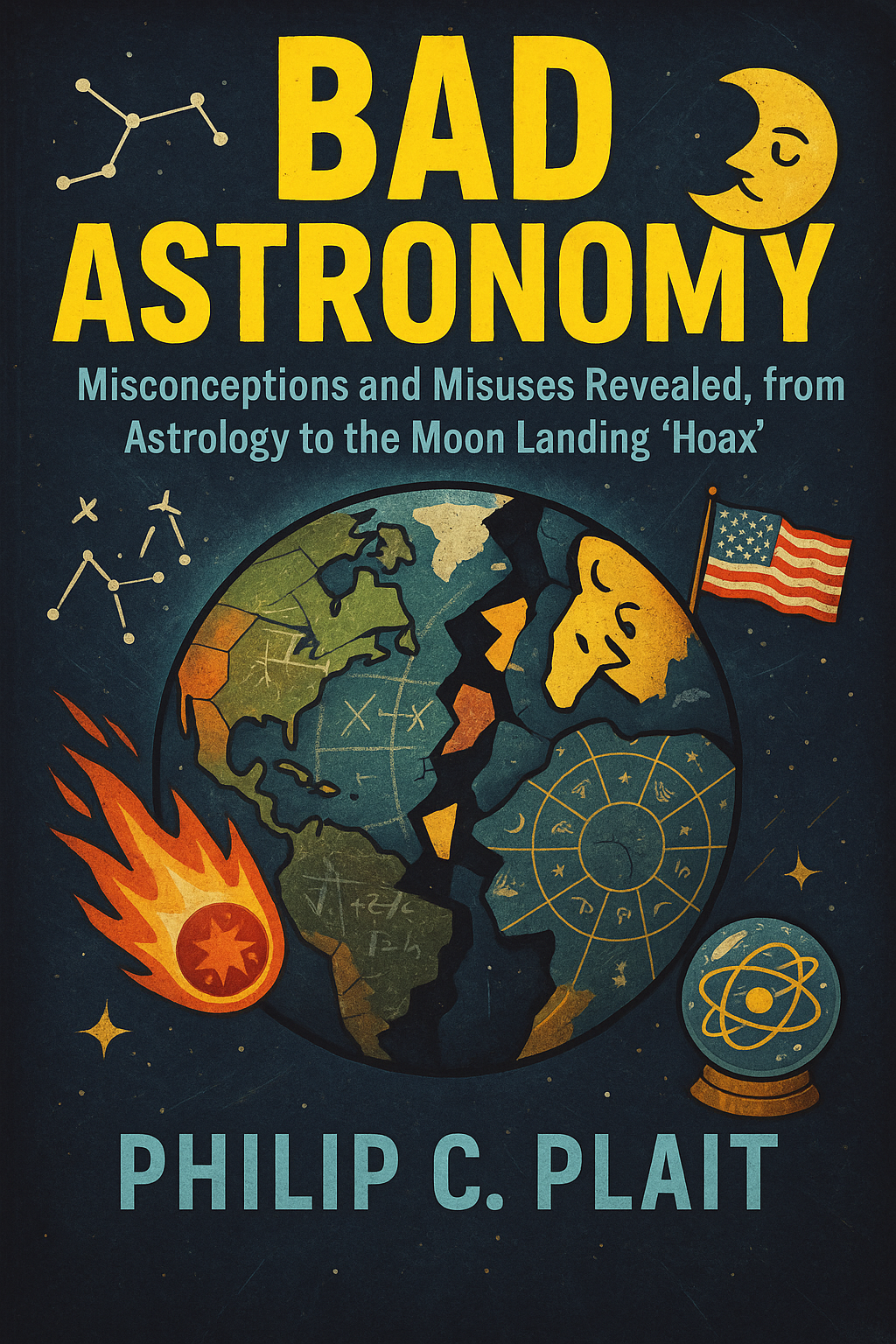
Bad Astronomy: Misconceptions and Misuses Revealed, from Astrology to the Moon Landing "Hoax"
Chapter Summaries
What's Here for You
Prepare to have your cosmic curiosities ignited and your long-held assumptions challenged! In 'Bad Astronomy,' Philip C. Plait doesn't just point out the flaws in our understanding of the universe; he masterfully dismantles them, revealing the elegant truths that lie beneath. This book is your personal guide to navigating the often-confusing landscape of space and science, transforming everyday wonders into moments of genuine awe. What will you gain? Imagine confidently explaining why the sky is blue, understanding the true cause of seasons, and unraveling the mysteries of the tides – not through rote memorization, but with a deep, intuitive grasp of the underlying principles. You'll learn to distinguish between scientific fact and popular myth, from the egg-balancing equinox trick and the Coriolis effect in your bathroom to the dazzling illusions of the Moon's apparent size and why stars twinkle. Plait tackles everything from the grand narratives of creation and the universe's beginning to the persistent doubts about moon landings and the fallacies of astrology. You'll emerge with a sharper intellect, a newfound appreciation for the scientific method, and the ability to spot astronomical blunders in Hollywood blockbusters and everyday language alike. The tone is one of enthusiastic discovery, laced with playful debunking and a profound respect for the wonders of the cosmos. Plait's approach is both intellectually rigorous and remarkably accessible, making complex concepts feel like engaging conversations. He shares personal anecdotes and relatable examples, ensuring that even the most daunting scientific topics are presented with clarity and charm. Get ready to shed the shackles of misconception and embrace a universe that is far more fascinating, awe-inspiring, and beautifully logical than you ever imagined. This is your invitation to see the cosmos with new, enlightened eyes.
The Yolk's on You: Egg Balancing and the Equinox
The author, Philip C. Plait, embarks on a journey to debunk a persistent myth: that a chicken egg can only be balanced on its end during the spring equinox. He begins by describing the widespread ritual, often featured on news segments and in classrooms, where people attempt to stand an egg upright on or around March 21st, believing it's the only day it's possible due to some alignment of cosmic forces. Plait, ever the skeptic, questions the astronomical basis for such a claim, noting that vague explanations about gravity or planetary alignment fail to hold up under scrutiny. He posits that the true test lies in simple experimentation: if the legend holds, eggs should *not* balance on any other day. Plait then recounts his own experiments, successfully balancing not just one, but seven eggs in his kitchen, photographed months after the supposed magical date, demonstrating that the equinox has no bearing on the feat. He delves into the practicalities, revealing that achieving this balance requires patience, a steady hand, and crucially, the egg's own physical characteristics—specifically, the tiny imperfections or bumps on its shell, which act like miniature legs. He consults with Dr. David Swayne, a poultry veterinarian, who explains the asymmetric formation of an egg within the chicken, a process involving pressure and the addition of albumen and shell, which naturally creates a less-than-perfect shape. Plait also addresses and dismisses the theory that warming the egg thins the albumen, explaining that its viscosity is temperature-independent and crucial for protecting the yolk. The narrative then traces the legend's origins, revealing its likely genesis in a 1945 Life magazine article about a Chinese ritual, which was later amplified by media events and public demonstrations, solidifying it as an urban myth. He highlights how easily such traditions, reinforced by anecdotal evidence and media portrayals, can overshadow empirical testing. Plait concludes by emphasizing that the essence of science lies not just in grand theories, but in persistent questioning, personal experimentation, and the willingness to accept evidence, even when it challenges deeply ingrained beliefs, showing that the most profound insights often come not from the stars, but from the humble imperfections of the world around us, like the bumpy bottom of an egg.
Flushed with Embarrassment: The Coriolis Effect and Your Bathroom
In the heart of Kenya, near the equator, a local man named Peter McLeary performs a demonstration that has captivated tourists and even a television personality like Michael Palin. He shows how water drains clockwise north of the equator and counterclockwise to its south, attributing this to the Earth's rotation and the Coriolis effect. The author, Philip C. Plait, reveals this to be a compelling, yet ultimately fraudulent, demonstration. The Coriolis effect, a real phenomenon first mathematically described by Gustave-Gaspard Coriolis in 1835, arises from the Earth's spin. Imagine standing on the equator, hurtling eastward at over 1,600 kilometers per hour, then moving to the North Pole where you barely move eastward at all; this difference in velocity is key. When an object, like a cannonball or a baseball, is thrown north or south, it carries its initial eastward velocity. As it travels, the ground beneath it moves at a different speed, causing the projectile to deflect. This effect is subtle but accumulates over vast distances and long periods, such as in the formation of large-scale weather systems like hurricanes, where air drawn into a low-pressure center is deflected to create the characteristic spin – counterclockwise in the Northern Hemisphere and clockwise in the Southern. However, the crucial insight is that this effect is negligible on the small scale of a sink, bathtub, or toilet. The author explains that random water motions and the design of plumbing fixtures utterly overwhelm any Coriolis influence. McLeary's demonstration, and similar myths taught in schools, are debunked by the simple fact that the Coriolis effect requires immense distances and time to manifest measurably. Even meticulously controlled experiments with sinks require weeks of stillness and a single drip at a time to even approach detecting it. Toilets, designed to flush effectively, use angled water jets to create spin, a deliberate engineering choice, not a planetary one. Plait concludes that McLeary’s trickery, amplified by the squarish pan and his own rapid spinning, creates the illusion of the Coriolis effect, a deception that unfortunately persists in popular understanding, even though the observed spins in McLeary's demonstration are the *opposite* of what the Coriolis effect would produce in those hemispheres. This chapter serves as a powerful reminder to question seemingly obvious phenomena and to understand that real scientific principles, like the Coriolis effect, operate on scales far grander than our everyday experiences might suggest.
Idiom's Delight: Bad Astronomy in Everyday Language
Philip C. Plait, in 'Idiom's Delight,' embarks on a journey to unravel the common, yet often inaccurate, ways we use astronomical terms in everyday language, revealing how these linguistic slips can obscure our understanding of the cosmos and the scientific principles behind them. He begins by exploring the sheer scale of astronomical distances, noting that while as a child he relished converting colossal numbers into various units, the reality of distances to planets and stars quickly becomes unwieldy, prompting the need for more appropriate scales. This leads to the introduction of the light-year, a unit of distance, not time, representing the vast expanse light travels in a year, approximately 10 trillion kilometers. Plait highlights the common misconception of 'light-years ahead,' often used in advertising to denote advanced progress, but fundamentally flawed as it misinterprets a distance unit as a measure of temporal advancement, akin to an internet provider claiming to be 'light-years faster.' He then delves into the celestial phenomenon of meteors, clarifying that 'shooting stars' are not stars but small particles burning up in the atmosphere, and that a meteoroid becomes a meteor upon entry and a meteorite if it impacts the ground. The author laments the misuse of 'meteoric rise' to describe rapid success, arguing that its literal interpretation suggests a brilliant appearance followed by a rapid burnout, the opposite of what the idiom intends, mirroring the fiery descent of a meteor. Plait also tackles the popular notion of the 'dark side of the moon,' explaining that it's a misnomer for the 'far side' – the hemisphere perpetually unseen from Earth due to tidal locking. The 'dark side' is merely the lunar night, a constantly shifting shadow that cycles as the moon rotates, not a fixed, unknown region. He provocates thought by mentioning deep craters near the lunar poles that might perpetually remain in shadow, a sliver of truth to the 'dark side' concept. Finally, the chapter examines the 'quantum leap,' a term often used to signify a massive, revolutionary advancement. Plait reveals its scientific origin: in quantum mechanics, an electron doesn't gradually move between energy levels but instantaneously 'leaps' from one discrete state to another, a tiny jump on our scale but a fundamental shift for the electron. He concludes that while the literal distance of a quantum leap is minuscule, the phrase accurately captures the essence of a sudden, significant transition between states, accepting its idiomatic validity. Through these examples, Plait underscores the importance of precise language in science and the subtle ways our everyday speech can distort our perception of reality, urging a more accurate appreciation of the universe.
Blue Skies Smiling at Me: Why the Sky Is Blue
The author, Philip C. Plait, embarks on a journey to demystify one of childhood's most enduring questions: why is the sky blue? He notes that while the answer seems simple, it has eluded many for centuries, and often, the explanations found are incorrect. Plait debunks the common myth that the sky reflects the ocean's color, illustrating its fallacy by pointing out the sky's consistent blueness over landlocked regions like Kansas. He also dismisses the idea that dust scattering is the cause, though acknowledging it's closer to the truth than the ocean reflection theory. The core of the explanation, Plait reveals, lies in understanding sunlight, its interaction with our atmosphere, and how our eyes perceive color. Sunlight, he clarifies, is not a single color but a composite of all colors, a fact demonstrable with a prism or the natural spectacle of a rainbow. The crucial phenomenon is Rayleigh scattering, discovered by Lord Rayleigh, which explains that molecules in the atmosphere, primarily nitrogen and oxygen, scatter shorter, bluer wavelengths of light more effectively than longer, redder wavelengths. Imagine sunlight as a stream of tiny, energetic particles, photons, bouncing like miniature billiard balls off atmospheric molecules. While red photons tend to travel straight, blue photons are sent careening in all directions. It's this pervasive scattering of blue light across the entire sky that makes it appear blue to us, as these scattered blue photons reach our eyes from every direction, not just from the sun itself. Plait addresses the natural follow-up: why isn't the sky violet, since violet light scatters even more? The answer, he explains, is twofold: the sun emits less violet light than blue, and our eyes are simply more sensitive to blue. This same scattering principle, he continues, explains the vibrant hues of sunsets and sunrises. As sunlight traverses a thicker layer of atmosphere near the horizon, more blue light is scattered away, leaving the longer, redder wavelengths to dominate, painting the sky in oranges and reds. Even the ocean's blue is attributed to water's property of absorbing red light, allowing blue light to penetrate and reflect. Plait concludes by offering a simple analogy for explaining this complex phenomenon to a child: blue light is like light leaves scattered by the wind, while red light is like heavier nuts falling straight down. He champions the spirit of curiosity, encouraging the persistent asking of 'why' as the engine of great discovery, reminding us that even the simplest observations can lead to profound understanding.
A Dash of Seasons: Why Summer Turns to Fall
The author, Philip C. Plait, invites us to unravel a common yet tenacious astronomical misconception: the cause of Earth's seasons. Many intuitively grasp that proximity to a heat source dictates temperature, and with Earth’s orbit being elliptical, it seems logical that our varying distance from the Sun must be the culprit. This line of reasoning, while appealing to common sense, misses crucial steps. Plait explains that while Johannes Kepler's discovery of elliptical orbits in the early 1600s was revolutionary, it also paved the way for this very misunderstanding. Mathematical analysis, however, reveals a surprising truth: the change in Earth's distance from the Sun over the year accounts for a mere 4-degree Celsius temperature variation, a far cry from the dramatic shifts we experience. The real architect of our seasons, Plait reveals, is the Earth's axial tilt. Imagine Earth as a spinning top, tilted at a constant 23.5 degrees, always pointing in the same direction in space as it orbits the Sun. This tilt means that at different points in the orbit, either the Northern or Southern Hemisphere is angled more directly towards the Sun. When a surface is angled more directly towards a light source, like a flashlight hitting a piece of paper head-on, the light and heat are concentrated, leading to warmer temperatures. Conversely, when the angle is oblique, the light is spread out over a larger area, diminishing its intensity, much like tilting that paper causes the light to diffuse into a dimmer oval. Thus, the Northern Hemisphere experiences summer when its pole tilts towards the Sun, receiving more direct and prolonged sunlight, and winter when it tilts away. It’s a profound revelation that the Sun's apparent height in the sky, dictated by this tilt, directly correlates with the intensity and duration of sunlight, not our proximity to the star. Furthermore, Plait touches upon the subtle influence of precession, the slow wobble of Earth's axis, which over thousands of years can reverse the seasons relative to our calendar and even influence long-term climate shifts, like the Sahara’s desertification. This celestial dance, driven not by distance but by angle and duration, orchestrates the rhythm of our planet's climate, reminding us that understanding the universe often requires looking beyond our immediate, common-sense perceptions.
Phase the Nation: The Moon's Changing Face
Philip C. Plait, in 'Bad Astronomy,' embarks on a captivating exploration of our nearest celestial neighbor, the Moon, revealing how its most obvious characteristic—its changing appearance—is perhaps its most misunderstood. He opens by expressing surprise at the sheer volume of astronomical misconceptions surrounding the Moon, an object so prominent it dominates our night sky, from a blazing full disk to a delicate sliver. The central tension Plait addresses is the persistent, incorrect notion that the Moon's phases are caused by the Earth's shadow. He masterfully debunks this, first by logic—our planet's shadow always points away from the Sun, making it impossible for the Moon to be consistently shadowed as it orbits—and then by illustrating the true mechanics. Through a vivid, imagined demonstration, akin to holding a ball under a lamp, Plait reveals the core insight: the Moon itself is always half-lit by the Sun, and its phases are simply a matter of our perspective from Earth as it orbits. We witness these phases as our vantage point shows us different portions of that sunlit half. He meticulously walks us through the lunar cycle, from the invisible New Moon, when the sunlit side faces away from us, to the First Quarter, where we see a half-lit disk, to the Full Moon, when the entire face visible to Earth is illuminated, and finally to the Third Quarter. The narrative then deepens, explaining the terms 'waxing' and 'waning,' 'crescent' and 'gibbous,' to describe the intermediate phases. A second crucial insight emerges: the Moon's brightness fluctuates dramatically not just because of the illuminated surface area, but due to two fascinating phenomena. Firstly, Plait explains that at Full Moon, sunlight strikes the lunar surface perpendicularly from our perspective, minimizing shadows and maximizing brightness, a stark contrast to the First Quarter where shadows obscure much of the surface. Secondly, he introduces the concept of 'backscatter,' a peculiar property of the Moon's fine, powdery surface, eroded by eons of impacts and solar radiation. This regolith preferentially reflects light directly back to its source. When the Moon is full, we are positioned directly behind the sunlight, allowing us to benefit from this focused reflection, making it appear far brighter than simple geometry would suggest. He even touches upon the ethereal glow of 'earthshine,' where light reflected from our own planet illuminates the dark side of a crescent Moon, a phenomenon poetically termed 'The old Moon in the new Moon's arms.' Ultimately, Plait resolves the initial tension by demonstrating that the Moon's phases are a beautiful, geometric dance, a constant reminder of celestial mechanics, and not a mystery of shadows, offering a profound shift in understanding for anyone who gazes upward.
The Gravity of the Situation: The Moon and the Tides
Philip C. Plait, in 'Bad Astronomy,' embarks on a journey to unravel the mysteries of the tides, a phenomenon so common yet so often misunderstood. He begins by acknowledging the widespread confusion, even admitting his own past errors in explaining this seemingly simple oceanic dance. The central tension arises from the common knowledge that the Moon causes tides, yet the observable reality of two high tides and two low tides per day seems counterintuitive. Plait masterfully dismantles misconceptions, revealing that gravity, while attracting objects, also exerts a differential pull across the Earth. The side nearest the Moon feels a stronger tug, and the far side, though weaker, experiences a pull relative to the Earth's center that effectively stretches the planet. This stretching, this differential gravity, is the key insight: the Earth and Moon are not static partners but are locked in a gravitational embrace, orbiting a common center of mass, the barycenter, which lies beneath Earth's surface. This orbital dance means that the Earth itself is in a constant state of freefall, blurring the lines of perceived gravitational force. As Plait illustrates with the simple metaphor of dancing with his daughter, the larger body (Earth) makes a smaller circle as the smaller body (Moon) makes a larger one, and it's this dynamic that generates the two bulges of water. The narrative then expands, showing how the Sun, despite its immense mass, exerts a lesser tidal influence due to its greater distance, contributing only one-third to the total tidal force compared to the Moon's two-thirds. This interplay creates spring tides when aligned and neap tides when offset. But the story doesn't end with water levels; Plait unveils the profound consequences of tidal forces, revealing how the friction of these bulges against the spinning Earth is gradually slowing our planet's rotation, lengthening our days, and simultaneously pushing the Moon farther away by about 4 centimeters each year. This tidal evolution, he explains, is also the reason the Moon always shows us the same face, a cosmic lock forged over eons. The implications ripple outward, showing how similar tidal forces can rip galaxies apart, heat moons like Io to volcanic fury, and influence stellar evolution. Ultimately, Plait resolves the initial confusion by demonstrating that tides are not merely an oceanic event but a fundamental force shaping celestial bodies and cosmic structures, a constant, subtle, yet powerful reminder of the universe's interconnectedness.
The Moon Hits Your Eye Like a Big Pizza Pie: The Big Moon Illusion
Philip C. Plait invites us to ponder a celestial spectacle, one that has captivated and puzzled observers for millennia: the astonishing apparent size of the full Moon as it hangs low on the horizon. He recounts a personal moment, witnessing the Moon rise, appearing vast and immense, only to observe it seemingly shrink as it climbed higher in the night sky. This dramatic transformation, Plait explains, is the well-known Moon Illusion, a phenomenon that tricks our eyes into believing the Moon is significantly larger when near the horizon than when overhead. For centuries, various explanations have been proposed, yet Plait systematically dismantles the common misconceptions: the Moon is not physically closer when on the horizon, nor does the Earth's atmosphere act as a magnifying lens; in fact, atmospheric refraction slightly squashes the vertical dimension of the Moon near the horizon. The idea that we compare the Moon to terrestrial objects like trees and houses is also debunked, as the illusion persists even over a clear sea or when viewed upside down. The tension, then, lies in reconciling our powerful perception with physical reality. Plait guides us toward the prevailing psychological explanation, weaving together concepts like size constancy—our brain's innate ability to perceive objects as their actual size regardless of retinal image size—and the Ponzo Illusion, where converging lines create a false sense of distance. The key insight here is that our perception of the sky itself is not a perfect hemisphere, but rather a flattened bowl, making objects on the horizon appear farther away. Because our brain interprets the Moon as more distant on the horizon, and knowing that objects of the same physical size appear larger when they are perceived as farther away (a trick of the Ponzo Illusion), we perceive the horizon Moon as enormous. It’s a profound reminder, as Plait emphasizes, that our perceptions often conflict with reality, and it is usually our own interpretation that leads us astray. The illusion, though not fully understood in its every nuance, is a testament to the complex, often deceptive, workings of the human brain.
Twinkle, Twinkle, Little Star: Why Stars Appear to Twinkle
Imagine standing beneath a vast, inky sky, the stars like scattered diamonds. For centuries, we've marveled at their seemingly restless dance, a phenomenon Philip C. Plait, in 'Bad Astronomy,' reveals is not an inherent quality of stars themselves, but a cosmic illusion crafted by our own planet's atmosphere. Plait recounts a personal moment of frustration in 1990, where a stubbornly fuzzy star image on his telescope screen defied all attempts at focus, a puzzle solved only by stepping outside to witness the star's frantic, color-shifting twinkle – a clear sign that the Earth's turbulent air was the culprit. This atmospheric turbulence, a chaotic ballet of air layers with varying temperatures and densities, acts like a cosmic lens, constantly bending and refracting starlight. As light from a distant star passes through these ever-shifting pockets of air, it's nudged this way and that, causing the star's image to jitter and shimmer from our perspective. This bending of light, known as refraction, is something we see daily, from the distorted appearance of a spoon in water to the shimmering heat haze on a summer highway. However, high above, these air cells are far more dynamic, each a few dozen centimeters across and in constant motion, creating the 'seeing' that astronomers measure. While planets, being much closer and appearing as tiny disks rather than pinpoints, are less dramatically affected by this atmospheric dance, even they can twinkle under exceptionally poor conditions, particularly when near the horizon where we view them through a thicker slice of the atmosphere. Plait explains how this 'seeing' can limit astronomical observation, blurring fine details and merging close objects into indistinguishable smudges, a frustrating barrier for those seeking to unravel the universe's secrets. Yet, humanity's ingenuity has found ways to overcome this atmospheric veil: launching telescopes like Hubble above the fray, employing rapid-fire camera exposures to freeze moments of clarity, and developing sophisticated adaptive optics systems that actively warp telescope mirrors to precisely counteract the atmospheric distortion, turning blurry blobs into discernible celestial features. Thus, the twinkling star, a source of poetic wonder, also serves as a profound reminder of the ingenious methods devised to overcome natural impediments, allowing us to peer deeper into the cosmos.
Star Light, Star White: Stars of Many Colors
The author, Philip C. Plait, invites us on a journey to unravel a common misconception: that all stars appear white. He begins with a personal anecdote, sharing the wonder of a neighbor's children seeing Vega through a telescope for the first time, exclaiming about its vivid blue hue. This sparks the central question: if stars have such distinct colors, why do most seem white to us? Plait delves into the physics, explaining that stars are colossal balls of gas where immense pressure at their core ignites nuclear fusion, a process that generates energy and light. This energy travels outwards, and as it interacts with particles, it's absorbed and re-emitted, eventually reaching the star's surface. He introduces the revolutionary concept of quantized energy, pioneered by Max Planck, explaining that energy is not emitted continuously but in discrete packets, or photons. This groundbreaking idea, which paved the way for quantum mechanics, revealed a crucial link: a star's color is intrinsically tied to its temperature. Hotter stars emit bluer, more energetic photons, while cooler stars emit redder ones. A star's light peaks at a specific color, but it emits light across the entire spectrum, and the combination of these colors determines its perceived hue. For instance, our Sun, despite peaking in green, appears white because it emits all colors, much like a chocolate chip cookie is a blend of all its ingredients, not just flour. Plait then addresses the irony that no stars are intrinsically green; any perceived green often arises from binary systems where a white star appears green against a reddish companion. The primary tension then shifts to our perception: why, if stars have color, do fainter ones appear white? The answer lies within our own eyes. Our retinae possess two types of light-sensitive cells: rods, which detect brightness even in low light, and cones, which discern color but require more light to function. When a star is too dim, our rods can detect its presence, but our cones are overwhelmed, leading us to perceive it as white. Telescopes, Plait explains, act like light buckets, collecting more photons. This amplified light allows even faint stars to reveal their true colors, transforming a distant point into a discernible jewel like Vega. He concludes by evoking the magic of sharing the cosmos through a telescope, particularly on Halloween, where even seemingly jaded children are momentarily captivated by the rings of Saturn or the moons of Jupiter, offering a profound reminder of the universe's power to inspire awe and curiosity, proving that wonder is far from extinct.
Well, Well: The Difficulty of Daylight Star Sighting
The author, Philip C. Plait, begins by recounting a classic Boy Scout prank, a tale that immediately sets a tone of skepticism and playful debunking. This anecdote, while humorous, serves as a gateway into a persistent myth: the idea that one can see stars during the day by looking up a well or a chimney. Plait explains that this notion, echoing through history from Aristotle to Charles Dickens, sounds plausible because it taps into our understanding of how darkness aids vision; the reasoning is that by reducing the overwhelming brightness of the sky, fainter objects like stars might become visible. However, he meticulously unravels this misconception through clear scientific reasoning. The core problem, Plait reveals, is not just the brightness of the sky, but its overwhelming dominance. Even if one’s eyes adapt to darkness, as they would at the bottom of a chimney, this adaptation also increases sensitivity to the ambient skyglow, canceling out any potential advantage. It's akin to using a hearing aid in a loud bar; while it amplifies sound, it amplifies everything, including the noise. The sky during the day is, on average, about six million times brighter than a clear, moonless night sky, a luminous blanket that smothers the faint light of stars. To see a star against this glare, Plait explains, requires significant contrast, with the object needing to be roughly 50 percent as bright as the background. Experiments in the 1940s demonstrated that even the brightest star, Sirius, is far too faint to be seen under typical daytime conditions. Yet, the legend persists, partly because of its historical weight and a vague 'scientificness' that bamboozles the uninitiated. Plait then explores a nuanced exception: by drastically limiting the field of view, as a narrow shaft would do, one *can* increase the ability to see fainter objects by cutting out most of the sky's glare. This theoretical possibility suggests that perhaps the brightest stars and planets, like Venus, *might* be visible under extremely specific conditions, especially if they are bright enough to overcome the reduced sky aperture. However, the very narrowness that enhances contrast also drastically reduces the chance of a star appearing in that tiny aperture, making the feat incredibly improbable. To underscore this, Plait recounts an experiment by J. Allen Hynek, who, despite careful planning and even using binoculars, failed to see the bright star Vega from the bottom of a smokestack. This direct, empirical test serves as the resolution, confirming that while the legend has a kernel of truth in the physics of contrast and light reduction, the practicalities render it a myth for all but the most exceptionally bright celestial bodies, like Venus. Even then, Plait notes, such sightings are rare and easily confused with other phenomena, like debris caught in an updraft, proving that our perception can often be more susceptible to myth than to scientific reality.
The Brightest Star: Polaris Just Another Face in the Crowd
Philip C. Plait, in 'Bad Astronomy,' gently guides us through a common celestial misconception, revealing how the star Polaris, despite its fame, is far from the brightest in our night sky. He recounts a personal anecdote where a friend mistook the dazzling planet Venus for Polaris, a confusion Plait attributes not to a lack of observation, but to a potent human tendency: mistaking importance for brilliance. Polaris, he explains, is not a luminous giant, often barely visible in light-polluted skies, but rather a star whose significance stems from its unique position near the North Celestial Pole (NCP). This celestial pole, a reflection of Earth’s spinning axis, serves as a fixed point around which all stars appear to rotate. Imagine yourself at Earth’s North Pole, spinning; the NCP would be directly overhead, a personal anchor in the turning heavens. Similarly, Polaris, by its proximity to the NCP, has served as an unwavering guidepost for navigators for millennia, a constant in a seemingly shifting sky. This fixed quality, this dependable direction, imbues Polaris with a profound importance that often overshadows its actual dimness. Plait clarifies that Polaris's current alignment with the NCP is a cosmic coincidence, a temporary phase in Earth's 26,000-year axial precession, a slow wobble that will eventually place other stars, like the brilliant Vega, in that same pivotal spot. Thus, the narrative unfolds not just as an astronomy lesson, but as a reflection on how we assign value, recognizing that true significance, much like with Polaris, can reside not in outward show, but in steadfast utility and unwavering presence.
Shadows in the Sky: Eclipses and Sun-Watching
The author, Philip C. Plait, invites us on a journey through the celestial ballet of eclipses, beginning with a profound observation: Earth's unique place in the cosmos, not as the center, but as a home graced by an extraordinary cosmic coincidence. The Sun and Moon, though vastly different in size, appear as perfect equals in our sky, a rare alignment that makes total solar eclipses possible. When the Moon slides before the Sun, it doesn't just block a light; it orchestrates a breathtaking spectacle. The sky deepens to twilight hues, the world stills, and then, at the peak of totality, the Sun's ethereal corona, its hidden atmosphere, leaps into view like a celestial halo, often evoking gasps and tears of awe. This cosmic drama, Plait reveals, has been charted for millennia, with ancient astronomers possessing a surprising accuracy in prediction. History is replete with tales, from Mark Twain's fictional use of an eclipse to save a hero, to Christopher Columbus's real-life predicament in Jamaica, where he famously used knowledge of a lunar eclipse to regain the trust of his native hosts. Yet, the predictable beauty of eclipses has also been a source of ancient fear, most notably in China, where it was believed a celestial dragon devoured the Sun. The legend of the astronomers Hsi and Ho, who failed to warn the emperor of an eclipse, serves as a stark, albeit gruesome, reminder of the consequences of failing to communicate vital knowledge, a lesson still relevant today. Plait then confronts a persistent misconception: the danger of looking at an eclipse. While the Sun's unfiltered glare is indeed harmful, he explains, the mechanics of the human eye, particularly pupil constriction, offer surprising protection against casual glances at the uneclipsed Sun. The true danger, however, emerges during an eclipse. As the sky darkens, our pupils dilate to let in more light, and when even a sliver of the Sun reappears, this widened aperture floods the retina with intensely focused, damaging light, particularly the blue wavelengths more harmful to children's developing eyes. This is not the work of X-rays from the corona, a myth easily dispelled by the protective shield of our atmosphere. To safely witness these events, Plait recommends methods like solar projection or specialized, certified filters, warning against dangerous improvisations like unexposed film. He then casts our gaze forward, noting that the Moon's slow recession means this perfect cosmic alignment, the total solar eclipse, is a temporary gift, a unique confluence that will eventually fade, leaving only annular eclipses. Finally, Plait revisits the story of Galileo, dispelling the myth that he went blind from observing the Sun through his telescope, attributing his blindness to cataracts and glaucoma, a testament to how even scientific giants can become subjects of enduring, albeit incorrect, narratives, reminding us that sometimes, we are the ones who are blind to the truth.
The Disaster That Wasn't: The Great Planetary Alignment of 2000
In the spring of 2000, a wave of apprehension swept across the globe, fueled by prophecies of a 'Grand Alignment' – a celestial event on May 5th predicted to unleash catastrophic forces upon Earth. The narrative, however, unfolds not as a doomsday chronicle, but as a testament to the enduring power of scientific reasoning over fear and misinformation. Philip C. Plait, the author, guides us through the origins of such anxieties, tracing them back to humanity's ancient need to find patterns and assign blame, often through the lens of astrology, where celestial bodies were believed to dictate our earthly fates. He explains that while the sky undeniably influences our world, particularly through predictable cycles vital for agriculture, this connection was often misconstrued into a belief in direct, controlling forces. The core of the chapter dissects the scientific reality of planetary alignment: planets orbit the Sun in a relatively flat plane, and from Earth's perspective, they can appear to line up, a phenomenon that is not as rare as doomsayers suggest. Plait meticulously debunks the central claim that the combined gravity of planets could cause destruction, illustrating with clear analogies that the gravitational pull of our own Moon, despite its minuscule size compared to planets like Jupiter, is vastly more significant due to its proximity. Indeed, the author reveals that the gravitational effect of a nearby Volkswagen, or even a person sitting in it, would outweigh that of distant planets. He further dismantles the related fear of planetary tides triggering earthquakes, demonstrating that tidal forces diminish even more rapidly with distance, rendering the planets' tidal influence on Earth immeasurable. This scientific rigor serves as the resolution, a stark contrast to the fear-mongering tactics of some individuals and companies who profited from the public's apprehension, peddling survival gear and baseless predictions. The author highlights specific examples like Richard Noone and the duo behind 'The Jupiter Effect,' whose theories lacked astronomical rigor and mathematical backing, often relying on prophecy and conjecture. Ultimately, Plait champions the scientific method as the ultimate tool against such unfounded fears, emphasizing that while emotions are easily swayed, logic and verifiable data provide a sturdy anchor. The chapter concludes with a touch of wistful observation: the very alignment that caused such panic was, unfortunately, obscured by the Sun, rendering it invisible and denying even a dramatic visual spectacle for the doomsayers to point to, a final, almost ironic, twist in the tale of a disaster that never was.
Meteors, Meteoroids, and Meteorites, Oh My!: The Impact of Meteors and Asteroids
Philip C. Plait, in 'Bad Astronomy,' gently unravels the celestial dance of meteors, meteoroids, and meteorites, revealing common misconceptions with the clarity of a seasoned educator and the narrative charm of a seasoned storyteller. He begins with a compelling anecdote: the curious case of David and Donna Ayoub in New Hampshire, whose backyard was ignited by a mysterious object falling from the sky in 2000. While many assumed it was a meteorite, Plait, ever the skeptic, suspected something else was at play, leading him to dissect the very nature of these cosmic visitors. He explains that what we often call a 'shooting star' is, in fact, a meteoroid – a small piece of rock or metal, perhaps billions of years old, originating from comets or asteroids. As this tiny traveler plunges into Earth's atmosphere at breakneck speeds, it compresses the air before it, generating intense heat not through friction, but through a powerful shockwave. This extreme compression causes the meteoroid's surface to melt and ablate, releasing glowing gases that create the brilliant streak we witness – the meteor. It's only if a fragment survives this fiery descent and impacts the ground that it earns the name meteorite. Plait debunks the popular cinematic image of meteorites starting fires, explaining that these visitors are typically frigid from their journey through space, with their hottest outer layers ablating away, leaving them too cold to ignite anything upon impact. Larger impacts, however, are a different story, as evidenced by the catastrophic Tunguska event and the impact that likely extinguished the dinosaurs, reminding us of the profound power of cosmic collisions. The chapter then pivots to the critical, ongoing effort to detect and potentially deflect asteroids on a collision course with Earth, highlighting the inadequacy of Hollywood's explosive solutions and favoring more nuanced approaches like using solar sails or nuclear explosions to gently nudge these celestial bodies off course. Yet, Plait underscores a crucial dilemma: our limited understanding of asteroid composition, whether they are solid rock or loose rubble, hinders our ability to plan effective diversion strategies, emphasizing the vital role of scientific exploration, like NASA's NEAR mission to Eros, in gathering this essential knowledge. Ultimately, he offers a hopeful perspective, suggesting that mastering diversion could transform potential threats into invaluable resources, with asteroids becoming 'literal gold mines' for humanity, a testament to our capacity to turn cosmic danger into opportunity, a profound shift from simply fearing the unknown to actively engaging with it.
When the Universe Throws You a Curve: Misunderstanding the Beginning of It All
The author, Philip C. Plait, guides us on a profound journey, peeling back layers of human cosmic self-importance, revealing a universe far grander and more humbling than we once imagined. For millennia, we clung to the comforting notion that Earth was the unmoving center, the heavens pirouetting around us, a perspective so deeply ingrained it still echoes in our language today. Yet, as Plait illustrates, the universe is under no obligation to conform to our desires. The elegant, albeit complex, geocentric model of Ptolemy eventually gave way to Nicolaus Copernicus, who dared to place the Sun at the heart of our solar system. Johannes Kepler refined this heliocentric view, discovering the elliptical orbits of planets, bringing us closer to a more accurate celestial map. Then came Jacobus Kapteyn, who, by counting stars, seemingly placed our Sun back at the center of the Milky Way – a fleeting moment of perceived centrality before the humbling truth emerged. Plait masterfully employs the metaphor of standing in a smoke-filled hangar: limited visibility creates the illusion of being at the center of a small, contained space, obscuring the vastness beyond. This was Kapteyn’s predicament; interstellar dust and gas masked the true scale and structure of our galaxy. Harlow Shapley's observations in 1917 shattered this illusion, revealing Earth's suburban location within the Milky Way. The ultimate cosmic dethronement arrived with Edwin Hubble's groundbreaking discovery that our Milky Way is but one of countless galaxies, each rushing away from us, not out of cosmic disdain, but as a consequence of the universe's own expansion. This expansion, Plait explains, is not an explosion *into* space, but an explosion *of* space itself, a concept that redefines our understanding of the Big Bang. He uses the vivid analogy of a movie theater with expanding seats: no matter where you sit, it appears all other seats are moving away from you, and the farthest ones move the fastest, creating a universal illusion of centrality. Einstein, too, grappled with the universe's nature, initially introducing a cosmological constant to counteract gravity's pull, only to later deem it his 'biggest blunder' when the universe's expansion was confirmed. Plait delves into Einstein's revolutionary concept of spacetime, likening space to a tangible fabric, a rubber sheet warped by massive objects, a distortion we perceive as gravity. He then explores the very shape of this cosmic fabric—flat, closed, or open—drawing parallels to an ant on a two-dimensional surface trying to comprehend its own universe. Ultimately, Plait reveals that the universe may not have a center at all, a concept that, while perhaps the ultimate insult to our ego, serves as a profound equalizer, reminding us that if we are not at the center, neither is anyone else. He concludes by noting that the question of 'before the Big Bang' is fundamentally meaningless, akin to asking 'what is north of the North Pole?' – a temporal boundary beyond which our current understanding cannot venture, leaving us with the awe-inspiring realization that we can, in fact, understand such a vast and peculiar universe.
Appalled at Apollo: Uncovering the Moon-Landing Hoax
The author, Philip C. Plait, delves into the persistent myth that the Apollo Moon landings were faked, a story so compelling it even inspired the 1978 film 'Capricorn One.' He reveals that a significant portion of the population, estimated between 10 to 25 million Americans, harbors doubts about humanity's presence on the Moon, a sentiment amplified by media portrayals and online discussions. Plait systematically dismantles the five primary arguments of these 'hoax believers,' starting with the most common: the absence of stars in astronaut photographs. He explains this not as evidence of a staged event, but as a consequence of photography in bright sunlight, where short exposure times, necessary to capture the brilliantly lit lunar surface and spacesuits, are too brief to register the faint light of distant stars. Imagine the stark contrast: a brilliantly illuminated astronaut against a black sky, a scene so bright it washes out the subtler cosmic backdrop, much like trying to spot fireflies during a midday sun. He then addresses the concern about radiation, particularly the Van Allen belts, clarifying that NASA meticulously plotted trajectories to minimize exposure, passing through the less intense outer belts and only briefly nicking the inner ones, with the spacecraft's metal hull providing significant shielding. The astronauts' total radiation dose, he notes, was remarkably low, comparable to what a person might receive over three years at sea level, and the film itself was protected within metal canisters. Plait then tackles the issue of lunar dust. Hoax proponents argue the powerful descent engine should have obliterated the dust, and that footprints shouldn't be possible in dry, dusty soil. However, Plait illustrates that the engine's thrust was throttled down considerably upon landing, and its pressure spread over a wide nozzle meant it didn't create a blast crater. Crucially, he highlights the absence of atmosphere on the Moon; unlike on Earth where breath disperses dust widely, on the Moon, the engine's exhaust primarily affected the area directly beneath it, leaving plenty of dust undisturbed for footprints, much like how flour, though dry, can hold an imprint. The perceived extreme temperatures of the Moon are also demystified; Plait explains that the intense heat is only reached after prolonged exposure to sunlight during the long lunar day, and missions were timed for local morning when the sun was low, resulting in long shadows that are clearly visible in photographs, indicating a low angle of incidence, not a midday inferno. He even shares an anecdote of an astronaut finding a rock so cold it almost caused frostbite, demonstrating the Moon's ability to rapidly lose heat in shadow, contrary to the idea of a uniformly scorching surface. Finally, Plait addresses the seemingly anomalous play of light and shadows. He explains that shadows on the Moon are filled in not by atmospheric scattering, as on Earth, but by light reflected from the bright lunar surface itself, and even by the astronauts' own highly reflective suits and equipment. The perceived 'spotlight' effect on Buzz Aldrin, often cited as proof of artificial lighting, is explained by the Moon's unique 'backscatter' property, where the lunar soil reflects light directly back towards the source, creating a halo-like glow, a phenomenon also observable on Earth with dewy grass or dusty baseball fields. Even the apparent non-parallelism of shadows is attributed to perspective, a common optical illusion, not a staged set. Plait concludes that these arguments, while seemingly compelling on the surface, unravel under scrutiny, revealing a triumph of human ingenuity rather than a grand deception.
Worlds in Derision: Velikovsky vs. Modern Science
In 1950, Immanuel Velikovsky published 'Worlds in Collision,' a book that dared to suggest that ancient catastrophic accounts were not myth but literal astronomical events, proposing a radical reordering of solar system history. He posited that Venus, ejected from Jupiter as a comet, had careened through the solar system, causing Earth's rotation to halt and restart, and triggering a cascade of biblical-style disasters. The author, Philip C. Plait, approaches this thesis not with a nitpicking dismissal, but by examining the broad, fundamental astronomical principles that Velikovsky's ideas contravene, much like dissecting a grand illusion by understanding the physics of light itself. Plait highlights a crucial distinction: while accepted scientific theories like the Big Bang arose from observational evidence that demanded explanation, Velikovsky’s propositions lack such empirical grounding, often contradicting established physics and astronomy. He illustrates the sheer impossibility of Velikovsky’s core claims, such as Jupiter ejecting a planet-sized body like Venus; the energy required would have vaporized it, not created a solid object. Furthermore, the vastly different compositions of Jupiter and Venus, and the undisturbed orbits of Jupiter's moons, offer no support for such a violent genesis. Then there's the matter of Venus’s near-misses with Earth; Plait explains that for Venus to exchange atmospheric contents or exert tidal forces strong enough to halt Earth's rotation, it would have had to pass within a thousand kilometers, an event so catastrophic it would have sterilized the planet, leaving no survivors to record it. The continued existence of the Moon, whose orbit would have been drastically altered or ejected entirely by such a close encounter, and the stable, ancient cycles of the Hebrew calendar, which rely on the Moon's predictable orbit, serve as powerful, irrefutable evidence against Velikovsky’s narrative. Even Venus’s remarkably circular orbit, nearly perfect and unmatched by any body that had undergone such a tumultuous journey, points to its stable, ancient formation. Yet, despite these profound scientific contradictions, Velikovsky’s ideas found a fervent following, partly due to the scientific community’s initial, somewhat heavy-handed, reaction. Harlow Shapley's attempts to pressure Macmillan Publishers, and Carl Sagan's later, arguably flawed, debunking at a public debate, inadvertently lent Velikovsky an air of martyrdom, fueling the mystique for those drawn to intellectual rebellion. The author concludes by noting the irony: while Velikovsky’s specific claims were wrong, his emphasis on catastrophism, a concept then largely out of favor in favor of gradualism (uniformitarianism), has since been recognized as a valid part of solar system history, though science, unlike pseudoscience, learns from its mistakes and abandons theories that don't hold up to evidence, moving forward with or without the initial assertions.
In the Beginning: Creationism and Astronomy
The author, Philip C. Plait, invites us to ponder the fundamental human quest for answers to existence, likening the universe to a vast book written in the language of physics and mathematics. He begins with a familiar, albeit apocryphal, story of a scientist and an old woman, highlighting how even scientific explanations, like the universe's quantum fluctuation origin, can sound extraordinary, perhaps even silly, to the uninitiated. This sets the stage for a central tension: the clash between scientific inquiry, driven by observation and the rigorous scientific method, and creationist viewpoints, which prioritize specific religious texts as absolute truth, often distorting or selectively using scientific data to fit preconceived notions. Plait directly confronts the claims of Young Earth Creationists, particularly those from the Institute for Creation Research, who assert the universe is only a few thousand years old, directly contradicting vast amounts of scientific evidence. He meticulously dissects common creationist arguments concerning the Moon's recession rate, the composition of planets, planetary rotation, the distribution of moons, and the scarcity of old supernova remnants. For instance, he explains that the Moon's recession rate isn't constant and that historical factors account for its current distance, a rate fully compatible with an ancient Earth. Similarly, he clarifies that differences in planetary composition and rotation, which creationists cite as anomalies, are explainable by factors like the initial non-homogeneity of the solar nebula, the loss of lighter elements from smaller, hotter planets, and significant cosmic collisions that can alter planetary spin and tilt. The apparent lack of old supernova remnants, a key creationist talking point, is debunked by pointing out that stars must live for millions of years before exploding, thus any visible remnant implies an age far exceeding the creationist's 6,000-year limit. Plait emphasizes that science evolves, adapting to new evidence, while creationism often discards data that doesn't align with its dogma. He concludes that while respecting religious beliefs is vital, misrepresenting scientific findings to support them is unacceptable, urging readers not to accept flawed arguments disguised as science, a sentiment echoed by the eventual correction of the Kansas School Board's anti-evolution stance.
Misidentified Flying Objects: UFOs and Illusions of the Mind and Eye
Philip C. Plait, an astronomer, recounts a personal encounter with what he initially perceived as multiple UFOs during a Space Shuttle launch in Florida. As he and his father watched the distant launch pad, a dozen or more glowing lights appeared in the night sky, moving slowly and erratically, defying easy explanation. Despite his scientific background, Plait found himself caught in a moment of wonder, his mind racing through possibilities from spotting planes to balloons, before the truth revealed itself: a flock of ducks, their glow merely reflected light from the launch pad's spotlights, their movement explained by distance and direction. This experience, Plait explains, offers profound lessons about our human need to believe in the extraordinary, a deep-seated desire to find mystery in the unknown, often filling the gaps in our mental database of ordinary events. He posits that this innate yearning for wonder, coupled with the eye's and mind's susceptibility to illusion, forms the bedrock of most UFO sightings. Plait delves into the visual phenomena, highlighting how unfamiliarity with the night sky can lead to misidentification, citing Venus as a prime example – its brilliance often mistaken for size, leading to claims of massive objects. Conversely, he notes that amateur astronomers, those most intimately familiar with the sky, rarely report unexplained phenomena, possessing the knowledge to readily identify celestial bodies and atmospheric events. The author further dissects the unreliability of eyewitness accounts and photographic evidence, explaining how distant, blurry objects, camera distortions, and even equipment artifacts can create convincing but ultimately false impressions, as seen in famous UFO footage that can be attributed to common terrestrial objects or technical glitches. He critiques the 'solar obliteration technique' and the misinterpretation of ice particles near the Space Shuttle as alien spacecraft, demonstrating how a lack of critical analysis and basic scientific understanding can lead to dramatic, albeit unfounded, conclusions. Plait concludes by reconciling his belief in the vastness of the universe and the high probability of extraterrestrial life with his skepticism of alien visitation, arguing that the immense distances involved make frequent interstellar travel and casual encounters unlikely, and that the perceived 'evidence' of UFOs is far more readily explained by terrestrial phenomena and human perception than by extraterrestrial visitors. Ultimately, Plait reveals that even in images from the Hubble Space Telescope, what might appear as evidence of intelligent life beyond Earth are, in fact, human-built satellites, underscoring the idea that the intelligent life we encounter in space is, for now, our own.
Mars Is in the Seventh House, but Venus Has Left the Building: Why Astrology Doesn't Work
The author, Philip C. Plait, embarks on a compelling journey to dismantle the pervasive allure of astrology, presenting a case for science as the ultimate arbiter of truth about our universe. He begins by recounting a personal anecdote, a seemingly innocuous conversation at a birthday party, which highlights the common, almost instinctive, belief in astrological pronouncements like 'all Libras do that.' This sets the stage for Plait's central argument: that astrology, unlike science, lacks any self-consistency, testable predictions, or underlying causal mechanisms. Science, he explains, thrives on rigorous testing, modification, or rejection of theories based on evidence, a process that has yielded spectacular success in understanding the cosmos. Astrology, however, operates on vague pronouncements that can be retrospectively fitted to observations, a tactic Plait likens to 'mumbojumbo' designed to bamboozle the public. He meticulously dissects the flawed reasoning behind astrological claims, particularly the reliance on gravity and electromagnetism, demonstrating how these forces, when applied scientifically, do not support astrological tenets. For instance, the gravitational influence of planets diminishes drastically with distance, a fact ignored by horoscopes, and the Sun's electromagnetic output dwarfs that of any planet. Plait provocatively suggests that astrology is not merely fantasy, but closer to magic, operating on a principle of correspondence—analogy rather than physical cause, akin to a sorcerer harming a doll to affect an enemy. The constellations themselves, he reveals, are arbitrary and often don't resemble their supposed figures to modern eyes, further undermining their validity. He addresses common apologetic arguments, such as the historical overlap between astronomy and astrology or the past practice of astrology by famous astronomers, swiftly dismissing them as fallacious. The true weapon of astrology, Plait concludes, is not logic but our own psychology: our tendency to remember the hits and forget the misses, a phenomenon vividly illustrated by James Randi's experiment with identical horoscopes. This pervasive belief, he laments, is not a laughing matter, especially when it influences significant decisions, as seen in the example of Nancy Reagan. Ultimately, Plait argues that the universe operates on consistent physical laws, not on the subjective interpretations and wishful thinking that fuel astrological beliefs, urging a return to rational, evidence-based understanding.
Hubble Trouble: Hubble Space Telescope Misconceptions
Philip C. Plait, in 'Bad Astronomy,' embarks on a journey to demystify the iconic Hubble Space Telescope, revealing that even great achievements can be shrouded in public misconception. It all began with Lyman Spitzer's 'silly idea' in 1946 to place a telescope in space, a vision far ahead of its time, recognizing the profound limitations imposed by Earth's atmosphere—its murkiness, turbulence, and absorption of vital light spectrums like ultraviolet and infrared. This atmospheric veil, Plait explains, distorts images and obscures celestial wonders, a problem solved by launching a telescope beyond its reach. The Hubble Space Telescope, born from this vision and costing billions, has become a household name, yet its fundamental nature is often misunderstood. Many believe it has a lens, a common error Plait corrects by highlighting its mirror-based design, a principle understood since Isaac Newton, which is far more practical for large-scale telescopes due to easier support and less light dimming. Furthermore, while Hubble is indeed large—roughly the size of a school bus—its primary mirror, at 2.4 meters, is surprisingly modest compared to some ground-based telescopes, a size dictated by the constraints of fitting within the Space Shuttle. The true power of a telescope, Plait emphasizes, isn't just magnification, but its ability to collect light, acting like a 'rain bucket' for photons; the larger the mirror, the fainter the objects it can perceive, allowing Hubble to detect objects billions of times fainter than the naked eye can. Despite its orbital perch, Hubble remains relatively close to Earth, never straying more than a few hundred kilometers away, dispelling the myth that it travels to distant cosmic destinations. Another pervasive misconception is that Hubble uses film; in reality, it employs advanced electronic detectors called CCDs, similar to those in digital cameras, which are more sensitive, stable, and allow data to be transmitted back to Earth. The perceived 'secrecy' surrounding Hubble data, often misunderstood as NASA hiding discoveries, is actually a necessary 'proprietary period' of about a year, granting the scientists who painstakingly proposed and executed observations the time to analyze their findings before public release, a crucial step to prevent 'scooping' and ensure fair scientific progress. Finally, Plait tackles the myth that Hubble cannot photograph the Moon due to its brightness, explaining that while its instruments are sensitive, they can be managed, and short exposures allow for clear imaging, even noting that Hubble routinely observes the much brighter Earth for calibration. This entire exploration serves as a testament to how even our most celebrated scientific endeavors can become canvases for popular imagination, often diverging from the elegant, hard-won realities of scientific discovery.
Star Hustlers: Star Naming for Dummies
The vast, silent expanse of the night sky, dotted with an unimaginable number of stars, has long captured the human imagination. Yet, as Philip C. Plait reveals in 'Bad Astronomy,' this cosmic grandeur has also become fertile ground for what he terms 'star hustlers' – companies that offer to sell you the right to name a star. Plait begins by drawing a parallel between his childhood friend's encyclopedic movie knowledge and his own familiarity with the stars; just as a cinephile can recall directors and actors, an astronomer navigates the sky by its established names and designations. This familiarity, he explains, is hard-won. A keen observer can see thousands of stars with the naked eye, hundreds of thousands with a modest telescope, and the Hubble Space Telescope's guidestar catalog alone contains tens of millions. Amidst this celestial abundance, a lucrative industry has emerged, promising immortality through a personalized star name for a fee, often accompanied by a certificate and a map. However, Plait’s central tension emerges here: these stars are not *officially* named. The International Astronomical Union (IAU) is the sole arbiter of celestial nomenclature, a meticulous process governed by rules. Most stars, Plait clarifies, already possess designations derived from their position in the sky, like catalog numbers or Greek letters denoting brightness within a constellation, such as Alpha Centauri or Sigma Octans. Only the brightest, most prominent stars bear proper names like Betelgeuse or Vega. He illustrates this with historical catalogs like Flamsteed's and the Bonner Durchmusterung (BD), and the Henry Draper catalog (HD), underscoring that most stars are burdened with multiple obscure identifiers. A rare few, like van Maanens star or Barnards star, are named after individuals, typically for discovering unique properties, with Cor Coroli being a historical exception named for King Charles II's patronage. The core insight is that the names sold by these companies hold no official validity within the scientific community. Plait recounts the emotional toll this deception can take, particularly when people purchase star names as memorials for deceased loved ones. Astronomers are often faced with the heartbreaking task of gently disabusing grieving individuals of the notion that their star truly bears their name. This led to a notable conflict where Robert Martino, an astronomer, published a critique of the practice, only to face legal pressure from a prominent star-naming company, the International Star Registry (ISR), which ultimately led to the removal of his page due to pressure on his university. The narrative then exposes the questionable practices of these companies, such as the ISR, which has faced accusations of deceptive advertising, including misleading claims about star names being registered in the Library of Congress or stored in Swiss vaults – details that, while technically true in a copyrighted sense, are irrelevant to official astronomical naming. Furthermore, Plait points out the irony of companies selling astronomical knowledge while demonstrating a fundamental misunderstanding of basic astronomy, confusing stars with meteors and providing inaccurate star counts. He concludes with a personal anecdote: his own brother purchased a star for him from the ISR, a dim star already cataloged as BD48 683, highlighting that even his personalized celestial object had a pre-existing, official designation. The resolution offered is a call for transparency and a redirection of intent: if one wishes to honor someone, consider donating to observatories or planetaria, thereby supporting education and allowing many to appreciate the vast, freely available universe, rather than buying a name that exists only on a certificate.
Bad Astronomy Goes Hollywood: The Top-Ten Examples of Bad Astronomy in Major Motion Pictures
The author, Philip C. Plait, invites us on a cinematic journey through the cosmos, not of accurate celestial mechanics, but of Hollywood's most egregious astronomical blunders, revealing how the silver screen often sacrifices scientific truth for dramatic flair. He begins by dissecting a quintessential sci-fi scene: a spaceship roaring through an asteroid field, dodging laser beams, and exploding an enemy craft with a fiery blast, all set against the backdrop of a full moon. Plait meticulously picks apart this illusion, starting with the fundamental flaw that sound, which needs a medium like air, cannot travel in the vacuum of space, a concept often ignored for the dramatic 'whoosh' of starships, a concession even Star Trek's Gene Roddenberry made under network pressure. He then tackles the seemingly impenetrable asteroid fields, illustrating with a striking scale model that in reality, asteroids are so sparsely distributed they'd be more like an 'asteroid vacuum' than a dense swarm, making dramatic evasive maneuvers highly improbable. The act of 'banking' a spaceship to turn, Plait explains, is another cinematic trope rooted in aerodynamics, not the vacuum of space, where directional thrust from engines is the true method of maneuver, though he concedes banking could offer a physiological advantage for pilots by pushing them back into their seats, a point often missed in the narrative. Laser beams, traveling at the speed of light, present a further paradox: they are invisible until they strike, yet movies depict them as visible, dodging beams as if they were slow-moving projectiles, a visual effect achieved by scattering photons, which wouldn't occur in clear space. He then expands our perspective to the mind-boggling distances between stars and galaxies, questioning the logic of aliens traversing millions of light-years solely to steal Earth's water, a resource abundantly available as ice throughout the solar system, likening the premise to a desperate trek for a single drop of water in an ocean. The persistent notion of 'escaping Earth's gravity' is also debunked; Plait clarifies that gravity weakens with distance but never truly disappears, a gradual force rather than an on/off switch that might suddenly trap a ship. The visual spectacle of stars flashing by as a ship moves is another exaggeration, as the sheer scale of space means constellations remain virtually unchanged even across vast solar system distances, rendering the visual effect a dramatic impossibility. Explosions in space, Plait reveals, lack the mushroom clouds and sound effects we associate with terrestrial blasts; without air, they are silent, expanding spheres of debris and light, though he acknowledges the visual appeal of cinematic interpretations like the expanding rings seen in Star Trek VI and Star Wars. Finally, the celestial ballet of the Moon's phases is frequently misrepresented, with films often showing full moons in contexts where they would be impossible, a geometric misunderstanding that baffles the author. Despite his critique, Plait holds a deep affection for science fiction, recognizing its power to ignite curiosity in young minds, even if the science is flawed, suggesting that thoughtful portrayals, like those in '2001: A Space Odyssey,' can enhance narratives and inspire a genuine interest in astronomy, proving that even 'bad astronomy' can, paradoxically, lead to good science.
Conclusion
Philip C. Plait's "Bad Astronomy" serves as a powerful testament to the enduring human fascination with the cosmos, often coupled with a remarkable capacity for misunderstanding. Across its diverse chapters, the book masterfully dismantles pervasive myths and misconceptions, from the mundane (egg balancing) to the profound (the nature of seasons, tides, and the universe's expansion). At its core, Plait champions the scientific method as the ultimate arbiter of truth, urging readers to embrace critical thinking, empirical evidence, and a healthy skepticism. The emotional lessons are subtle yet profound: a sense of wonder is preserved, not diminished, by accurate understanding; the frustration of being misled is replaced by the satisfaction of clarity; and the humility of acknowledging our limitations is fostered. We learn that our senses and intuitive leaps, while useful for navigating everyday life, can be easily deceived by the complexities of the universe. The book's practical wisdom lies in its call to action: question everything, test assumptions, understand scale, and appreciate the elegance of physical laws. Plait demonstrates that true appreciation for the celestial realm comes not from arbitrary naming or fictionalized drama, but from engaging with verifiable scientific principles. The journey through "Bad Astronomy" is a reminder that the universe is not only stranger than we imagine, it is stranger than we *can* imagine, but through diligent inquiry and intellectual honesty, we can peel back its layers of mystery, one debunked myth at a time, revealing a reality far more magnificent than any falsehood.
Key Takeaways
A telescope's primary function is light collection, not just magnification, enabling the detection of fainter and more distant objects.
The belief that an egg can only be balanced on the spring equinox is a persistent myth, not supported by scientific principles or empirical evidence.
Personal experimentation and observation are crucial tools for debunking myths and understanding the natural world, often revealing that physical properties, not astronomical events, are the key.
The physical imperfections of an object, such as the bumps on an egg's shell, can be the very factors that enable seemingly impossible feats of balance.
Urban legends and traditions can gain traction and persist due to media amplification and anecdotal reinforcement, even when contradicted by simple, verifiable facts.
Critical thinking involves questioning assumptions and following through with experiments, rather than relying solely on hearsay or tradition.
The scientific process is iterative and self-correcting, with insights often arising from unexpected sources and challenging established theories, even those of the scientist himself.
The Coriolis effect is a real scientific phenomenon caused by Earth's rotation, measurable only over vast distances and long timescales.
Popular demonstrations and explanations of the Coriolis effect on small scales (like sinks or toilets) are scientifically inaccurate and often fraudulent.
The apparent directional spin of water in drains is determined by the shape of the fixture and random water currents, not planetary forces.
Understanding the scale at which scientific principles operate is crucial for distinguishing between genuine phenomena and persistent myths.
Engineering and deliberate design, not natural forces, dictate the function of everyday objects like toilets.
Critical thinking requires questioning widely accepted 'facts' and seeking empirical evidence, especially when anecdotal demonstrations contradict scientific understanding.
The misuse of astronomical terms like 'light-year' as units of time or speed, rather than distance, distorts our perception of cosmic scales and technological advancement.
The idiom 'meteoric rise' is scientifically inaccurate, as the literal trajectory of a meteor suggests a bright, brief appearance followed by a descent and burnout, not sustained success.
The 'dark side of the moon' is a linguistic confusion for the 'far side'; the moon's darkness is a temporary night, not a permanent, hidden hemisphere, though permanently shadowed craters do exist.
A 'quantum leap' in physics refers to an electron's instantaneous transition between discrete energy levels, a fundamental shift rather than a measure of absolute distance, justifying its idiomatic use for significant advancements.
Accurate scientific language is crucial for conveying understanding, and common linguistic misinterpretations can create a disconnect between scientific reality and public perception.
The sky appears blue due to Rayleigh scattering, where atmospheric molecules scatter shorter blue wavelengths of sunlight more effectively than longer red wavelengths, making blue light appear to come from all directions.
While violet light scatters more than blue, the sky is blue and not violet because the sun emits less violet light and human eyes are more sensitive to blue.
The phenomenon of red and orange sunsets and sunrises is a direct consequence of Rayleigh scattering; as sunlight travels through more atmosphere near the horizon, blue light is scattered away, leaving the longer red wavelengths to reach our eyes.
The blueness of the ocean is not a reflection of the sky but rather water's inherent property to absorb red light, allowing only blue light to pass through and reflect.
The sun itself emits a spectrum of colors, with green being the most abundant, but the combination of all colors is perceived by our eyes as white, or sometimes yellow due to atmospheric effects or comparison.
Admitting a lack of understanding and persisting in asking 'why' is crucial for scientific discovery, as exemplified by the centuries-long quest to understand the sky's color.
The common-sense assumption that Earth's seasons are caused by its changing distance from the Sun is incorrect; the actual temperature variation due to distance is minimal.
Earth's seasons are primarily caused by the 23.5-degree tilt of its axis, which dictates the angle and duration of sunlight hitting different parts of the planet.
When a hemisphere tilts towards the Sun, it receives more concentrated and longer-lasting sunlight, resulting in summer, while tilting away leads to winter.
The apparent height of the Sun in the sky is a direct consequence of Earth's axial tilt and is the key factor in seasonal temperature variations.
Precession, the slow wobble of Earth's axis, causes a gradual shift in which part of the sky the axis points towards, leading to long-term changes in seasonal alignment and intensity over millennia.
The Moon's phases are not caused by Earth's shadow, but by the changing angles at which we view the Moon's sunlit hemisphere as it orbits our planet.
The Moon's surface brightness varies significantly with phase due to the angle of sunlight (minimizing shadows at Full Moon) and the phenomenon of 'backscatter' from its fine regolith.
The Moon is not solely a nocturnal object; its visibility during daylight hours is determined by its position in orbit relative to the Sun and Earth.
Understanding celestial mechanics, like lunar phases, requires careful observation and a willingness to discard intuitive but incorrect explanations.
The phenomenon of 'earthshine' demonstrates the interconnectedness of celestial bodies, where light reflected from Earth can illuminate the Moon.
The two daily high tides are a result of differential gravity, where the Earth is stretched towards and away from the Moon due to the varying gravitational pull across its diameter, not just a single pull towards the Moon.
The Earth-Moon system orbits a common center of mass (barycenter), meaning both bodies are in constant freefall, which is crucial for understanding how perceived forces, like tides, are generated.
While the Sun's gravity is stronger, the Moon's proximity makes it the dominant force (two-thirds) in Earth's tides, illustrating that distance can be as significant as mass in gravitational interactions.
Tidal forces are not limited to water; they cause the solid Earth and atmosphere to bulge, and this friction between the tidal bulge and Earth's rotation is responsible for lengthening our days and pushing the Moon further away.
The phenomenon of the Moon always showing the same face is not a coincidence but a result of tidal locking, where Earth's gravitational pull slowed the Moon's rotation over billions of years to match its orbital period.
Tidal forces have profound cosmic consequences, capable of heating planetary interiors, influencing stellar evolution, and even tearing galaxies apart through galactic cannibalism.
The Moon Illusion, where the Moon appears larger on the horizon than overhead, is a psychological phenomenon, not a physical one, as common explanations involving distance or atmospheric magnification are scientifically inaccurate.
Our brains possess 'size constancy,' a crucial survival mechanism that allows us to perceive objects as their true size regardless of their distance, but this mechanism can be tricked by perceptual cues.
The perceived shape of the sky, often seen as a flattened bowl rather than a true hemisphere, plays a critical role in the Moon Illusion by making the horizon appear farther away than the zenith.
The Ponzo Illusion, where converging lines make a line appear longer by suggesting greater distance, combined with our perceived flattened sky, leads the brain to interpret the horizon Moon as larger because it is perceived as farther away.
Our everyday perceptions can often conflict with objective reality, highlighting the importance of critical thinking and empirical measurement to discern truth from illusion.
The apparent 'twinkling' of stars is not due to the stars themselves but is an optical illusion caused by the Earth's turbulent atmosphere refracting starlight.
Atmospheric refraction, the bending of light through varying air densities, is the fundamental mechanism behind celestial twinkling.
Unlike stars, planets appear as small disks rather than points of light, making them less susceptible to noticeable twinkling because their apparent motion due to refraction is proportionally smaller.
Astronomical 'seeing,' a measure of atmospheric turbulence, directly impacts the clarity and resolution of celestial observations, posing a significant challenge for ground-based telescopes.
Technological advancements like space telescopes (e.g., Hubble), rapid-exposure photography, and adaptive optics have been developed to overcome the limitations imposed by atmospheric seeing.
The phenomenon of twinkling stars can be misinterpreted, sometimes fueling misconceptions like UFO sightings, highlighting the importance of scientific explanation over imaginative leaps.
Stars possess intrinsic colors determined by their surface temperature, with hotter stars appearing bluer and cooler stars redder, a concept rooted in Planck's quantum theory of energy emission.
The perceived color of a star is a combination of all the light it emits, not just its peak emission color, similar to how a blend of flavors creates a unique taste.
The human eye's physiology, specifically the differing light requirements of rods (for brightness) and cones (for color), causes fainter stars to appear white, obscuring their true hues.
Telescopes function as light-gathering tools, enabling the detection of fainter stars and revealing their colors to the naked eye, thereby overcoming the limitations of human vision.
The scientific understanding of stellar color, light emission, and human perception offers a compelling example of how scientific principles can resolve everyday observations and misconceptions.
Despite their vast distance, stars offer a tangible connection to fundamental physics, demonstrating that even immense celestial bodies are governed by the behavior of atoms and photons.
The persistent myth of seeing stars from wells or chimneys stems from a plausible-sounding, yet scientifically flawed, intuition about light and darkness.
Daytime sky brightness is so overwhelming that it effectively 'washes out' the faint light of stars, a phenomenon akin to trying to hear a whisper in a roaring crowd.
While reducing the field of view can enhance contrast and the ability to see faint objects, the extreme improbability of a bright star appearing in a narrow aperture makes daytime star sighting virtually impossible.
Empirical testing, not historical anecdote or intuitive reasoning, is the definitive method for debunking scientific myths.
Even well-intentioned or experienced individuals can cling to misconceptions, highlighting the pervasive power of ingrained beliefs.
The exceptional brightness of planets like Venus allows them to be exceptions to the rule, visible during the day, but this does not validate the broader myth of star sighting.
The common misconception that Polaris is the brightest star arises from confusing its navigational importance with its actual luminosity.
Earth's rotation creates the illusion of a spinning sky with a fixed North Celestial Pole (NCP), around which stars appear to orbit.
Polaris's significance as a navigational aid is due to its proximity to the NCP, making it appear stationary in the northern sky.
The current alignment of Polaris with the NCP is a temporary cosmic coincidence due to Earth's axial precession, not a permanent celestial fixture.
True importance can be found in steadfast utility and consistent presence, rather than mere outward brilliance, a lesson mirrored in both stars and people.
The apparent equal size of the Sun and Moon in Earth's sky is a unique cosmic coincidence of distance and size, enabling total solar eclipses.
Historical accounts and legends surrounding eclipses, while often rooted in superstition or fear, demonstrate humanity's long-standing fascination and attempts to understand celestial events.
The primary danger of viewing a solar eclipse stems not from the corona's X-rays or casual glances at the Sun, but from the dilation of the pupil in darkness followed by the intense, focused light of a re-emerging Sun.
Effective communication of scientific knowledge, particularly regarding safety, is crucial, as demonstrated by historical instances where misinformation or lack of warning led to negative consequences.
The phenomenon of total solar eclipses is a temporary event in cosmic history, destined to cease as the Moon gradually drifts away from Earth.
Commonly held beliefs, even those associated with scientific figures like Galileo, can be persistent misconceptions that require critical examination and accurate retelling.
Recognize that ancient human tendencies to find patterns and assign blame can fuel unfounded fears about celestial events.
Understand that while celestial phenomena are real, their influence on Earth is governed by predictable physical laws, not mystical control.
Dispel the myth that planetary alignments possess the gravitational or tidal power to cause catastrophic Earth-based disasters, as proximity and mass are key factors.
Develop critical thinking skills to discern between scientifically verifiable information and fear-based speculation, especially when profit motives are involved.
Embrace the scientific method as a powerful tool to overcome emotional responses to perceived threats and arrive at factual understanding.
The fiery streak of a meteor is caused by the extreme compression and heating of air by a meteoroid, not by friction, leading to the ablation of the meteoroid's surface.
Small meteorites, contrary to popular depiction, are typically too cold to start fires upon impact due to their frigid origins and the heat loss during atmospheric entry.
Understanding the composition and structure of asteroids and comets is crucial for developing effective strategies to divert potentially hazardous celestial bodies.
Hollywood's dramatic portrayals of asteroid impacts often misrepresent the physics involved, suggesting flawed solutions like explosive disintegration rather than gentle deflection.
Scientific exploration and data gathering are paramount for mitigating the existential threat of large asteroid impacts, potentially turning them into valuable resources.
The common names 'meteor,' 'meteoroid,' and 'meteorite' describe distinct stages of a celestial object's journey, highlighting the importance of precise scientific terminology.
The phenomenon of meteor showers arises from Earth passing through the debris trails of comets or asteroids, creating predictable celestial displays.
The persistent human tendency to anthropocentrically place ourselves at the center of the universe, a bias that has been repeatedly challenged by scientific observation and requires conscious effort to overcome.
The universe's expansion is not an explosion into pre-existing space, but rather an expansion *of* space itself, meaning every point in the universe appears to be receding from every other point.
The concept of spacetime as a tangible, warpable fabric, where gravity is the curvature of this fabric caused by mass and energy, fundamentally alters our understanding of physical interactions.
The universe may possess a geometric shape (flat, closed, or open) that dictates its large-scale properties, and current observations suggest it is flat, though the possibility of a center existing outside our perceivable dimensions remains.
The question of 'what existed before the Big Bang' is an ill-posed query, as time itself began with the Big Bang, rendering the concept of 'before' meaningless in this context.
Seemingly compelling 'evidence' for conspiracy theories often crumbles when basic physics and the unique conditions of the environment (like the Moon's lack of atmosphere) are properly understood.
The absence of expected visual cues (like stars) in photographs is frequently a result of photographic limitations and exposure settings, not a deliberate omission in a staged event.
Radiation concerns about space travel are mitigated by understanding specific trajectories, shielding, and the relatively short duration of missions, making the journey feasible.
The unique properties of extraterrestrial environments, such as lunar dust and the absence of atmosphere, explain phenomena that appear anomalous when viewed through an Earth-centric lens.
Apparent anomalies in lighting and shadows can be explained by natural phenomena like light reflection from the surface, backscatter, and the principles of perspective, rather than artificial staging.
The human tendency to seek patterns and explanations, even when misinterpreting data, fuels the persistence of conspiracy theories, highlighting more about human psychology than the subject of the conspiracy itself.
The demarcation between science and pseudoscience lies in empirical evidence and falsifiability, not just the historical or textual research underpinning a hypothesis.
Radical scientific theories, while potentially revolutionary, must withstand scrutiny against fundamental physical laws and observable data, not merely present compelling narratives.
The scientific community's response to controversial ideas can inadvertently amplify their reach; a measured, evidence-based refutation is more effective than aggressive suppression or flawed attacks.
Even incorrect theories can sometimes touch upon nascent scientific concepts (like catastrophism), but their validity hinges on the accuracy of their specific claims and mechanisms, not just the broad idea.
The persistence of celestial bodies in stable orbits and predictable cycles (like the Moon's) serves as powerful, ongoing evidence against claims of recent, dramatic solar system upheavals.
The scientific method's strength lies in its self-correcting nature; while individual scientists or theories may err, the cumulative process of observation, testing, and revision leads to greater understanding.
Scientific understanding is built upon observation and the iterative refinement of theories through the scientific method, not adherence to dogma.
Creationist arguments often rely on misinterpretations, selective data, or oversimplifications of complex scientific phenomena.
Apparent discrepancies in astronomical observations, when fully investigated, often reveal deeper scientific principles rather than flaws in established theories.
The universe operates according to physical and mathematical laws, which, while complex, are discoverable through diligent inquiry.
Distinguishing between faith-based beliefs and evidence-based scientific conclusions is crucial for intellectual honesty.
The human desire for wonder and mystery can lead to the misinterpretation of ordinary phenomena as extraordinary, forming a significant basis for UFO sightings.
Familiarity with the natural sky is crucial for accurate observation; unfamiliarity breeds misidentification, as common celestial bodies like Venus can be mistaken for unusual objects.
Eyewitness accounts and photographic evidence of UFOs are inherently unreliable due to factors like distance, atmospheric conditions, camera distortions, and psychological biases.
Scientific skepticism requires rigorous testing and critical analysis, as seemingly anomalous events often have mundane explanations that are overlooked when the mind is predisposed to extraordinary conclusions.
The vastness of space makes widespread alien visitation statistically improbable, and the 'evidence' for it is more often a product of misinterpretation than genuine extraterrestrial contact.
Astrology lacks scientific validity due to its absence of self-consistency, testable predictions, and demonstrable causal mechanisms, unlike science which relies on empirical evidence and falsifiable theories.
The persuasive power of astrology stems not from objective truth but from psychological biases, particularly the tendency to recall hits and forget misses, amplified by vague, universally applicable language.
Astrology operates on principles of analogy and correspondence, similar to magic, rather than on verifiable physical forces like gravity or electromagnetism, which do not support its claims when rigorously examined.
The shapes of constellations and the naming conventions of celestial bodies are arbitrary and subjective, failing to provide a stable or logical foundation for astrological interpretations.
The widespread acceptance and influence of astrology, even in critical areas like political decision-making, underscore a societal vulnerability to pseudoscience when rational thinking is overshadowed by belief.
The limitations of Earth's atmosphere necessitate space telescopes, offering clearer views and access to a wider spectrum of light.
Hubble's design relies on mirrors, not lenses, a fundamental principle for large telescopes that is often misunderstood.
The 'proprietary period' for Hubble data is a necessary mechanism to protect scientists' research investment and ensure fair scientific credit, not a cover-up.
Common misconceptions about Hubble, such as its inability to photograph the Moon, often stem from oversimplification or misinterpretation of its technical capabilities and operational constraints.
The scientific community adheres to strict, official naming conventions for celestial objects, managed by bodies like the IAU, rendering commercially sold star names unofficial and without scientific validity.
Companies selling star names often employ deceptive marketing practices, leveraging emotional appeals and misleading claims to capitalize on a desire for personal connection to the cosmos.
The practice of selling star names can cause significant emotional distress to individuals, particularly when used as memorials, as it creates a false sense of connection to a celestial object.
True astronomical familiarity and appreciation stem from understanding existing scientific designations and the vastness of the universe, not from purchasing a personalized, unofficial label.
Supporting astronomical institutions through donations offers a more meaningful and impactful way to honor individuals and foster a wider appreciation for the cosmos than purchasing a non-official star name.
Critical evaluation of claims, especially those involving scientific or official-sounding pronouncements, is essential to avoid falling prey to deceptive commercial practices.
The dramatic conventions of science fiction films often prioritize visual spectacle and narrative convenience over scientific accuracy, leading to widespread misconceptions about fundamental astronomical principles.
The vacuum of space fundamentally alters phenomena like sound propagation and explosions, which are typically depicted in movies with terrestrial, air-dependent characteristics for audience familiarity.
The vast distances and sparse distribution of celestial bodies in space are consistently underestimated in films, creating implausible scenarios like dense asteroid fields or lengthy interstellar journeys for simple resources.
Gravitational forces, while weakening with distance, are a constant, gradual influence rather than an abrupt, binary force that can suddenly trap or release objects in space.
The visual representation of space phenomena, such as the visibility of laser beams or the movement of stars, is often altered for dramatic effect, masking the true nature of light and scale in the universe.
Despite scientific inaccuracies, science fiction films serve a vital role in sparking curiosity and interest in science, potentially leading viewers, especially younger ones, to explore scientific concepts further.
Action Plan
Attempt to balance a chicken egg on its end on a day other than the spring equinox, and observe the results.
Examine the shell of an egg closely to identify any natural bumps or imperfections, particularly on the wider end.
When encountering a popular belief or ritual, question its underlying logic and seek empirical evidence to support or refute it.
Share the findings of your own experiments with others, explaining the scientific reasoning behind the results.
Practice patience and steady hand techniques when attempting a task that requires fine motor skills and focus.
Consider the origins of popular traditions or beliefs, investigating their historical context rather than accepting them at face value.
When encountering explanations for everyday phenomena, consider the scale involved and whether known scientific principles apply.
Seek out scientific explanations from reputable sources to verify popular beliefs or demonstrations.
Apply critical thinking to observations, questioning how apparent effects might be achieved through deliberate design or trickery.
Recognize that scientific principles like the Coriolis effect operate on grand scales, influencing weather and ocean currents, but not typically household drains.
Investigate the engineering and design of everyday objects to understand their functional mechanisms, rather than attributing them to natural forces.
Share accurate scientific information to help dispel common misconceptions encountered in daily life.
When encountering astronomical terms in common language, pause to consider their scientific definition versus their idiomatic usage.
Resist the urge to use 'light-year' as a measure of speed or time; remember it denotes distance.
Recognize that a 'meteoric rise' literally implies a brief, bright ascent followed by a fall, contrary to its common meaning of sustained success.
Distinguish between the 'far side' of the moon (unseen from Earth) and the 'dark side' (the lunar night, which changes).
Understand that a 'quantum leap' signifies a sudden, discrete transition, justifying its use for revolutionary, rather than merely incremental, progress.
When asked 'Why is the sky blue?', explain the concept of light scattering, using the analogy of leaves and nuts or billiard balls bouncing off air molecules.
Observe sunsets and sunrises, noting the color changes and reflecting on how the increased atmospheric path length affects the light reaching your eyes.
Consider the color of water in different depths and contexts, recalling that water absorbs red light, thus appearing blue.
Conduct the prism experiment to observe how white sunlight is composed of a spectrum of colors, reinforcing the idea of light's composite nature.
When encountering a scientific question, resist accepting the first answer, and seek to understand the underlying principles and evidence, much like Plait did.
Re-evaluate everyday assumptions about natural phenomena by seeking scientific explanations beyond common sense.
Visualize Earth's axial tilt by using a flashlight and a globe or ball to demonstrate how angled light causes seasonal changes.
Consider how seemingly small, consistent forces, like Earth's tilt or precession, can lead to significant, long-term effects.
When encountering a popular explanation for a natural event, question its underlying logic and seek empirical evidence or mathematical proof.
Appreciate the difference between intuitive reasoning and scientifically validated understanding in complex systems.
Observe the Moon consistently over a lunar cycle, noting its shape and position in the sky each night.
Use a light source and a ball to physically model the Moon's orbit around Earth, demonstrating how its phases change.
When observing the Moon, especially during its crescent phases, look for the faint outline of the full disk, recognizing it as earthshine.
Challenge the common misconception that the Moon is only visible at night by looking for it in the daytime sky during its quarter phases.
Research the specific terms for lunar phases (waxing, waning, gibbous, crescent) and identify them in the night sky.
Observe the tidal patterns at a local beach and consider the Moon's position, reflecting on the differential gravitational forces at play.
When encountering a seemingly counterintuitive natural phenomenon, actively seek out explanations that address the underlying physics rather than surface-level descriptions.
Recognize that everyday occurrences, like tides, are governed by fundamental physical laws with far-reaching cosmic implications, fostering a sense of wonder.
Consider how the concept of a 'center of mass' applies to other interacting systems, not just celestial bodies.
Appreciate that scientific understanding often involves correcting initial assumptions, as Philip C. Plait himself did, embracing the process of refinement.
When discussing scientific concepts, remember to differentiate between the direct force and the perceived force relative to a moving frame of reference, as with the Earth's center.
When observing the Moon on the horizon, try viewing it upside down by bending over between your legs to see if the illusion diminishes, thus testing its psychological nature.
To empirically test the Moon Illusion, hold a small object like a pencil eraser at arm's length and compare its apparent size to the Moon when it is on the horizon and again when it is high in the sky.
Actively question common explanations for perceived phenomena, seeking evidence-based reasoning over intuitive assumptions, especially when visual perception seems extraordinary.
Consider how the perceived shape of your environment might influence your judgment of size and distance, applying this awareness to other situations beyond celestial observation.
When faced with a discrepancy between what you perceive and what you know to be factually true, prioritize objective data and critical analysis over immediate sensory impressions.
Observe stars near the horizon and note any increased twinkling or color shifts, understanding this is due to looking through more atmosphere.
When seeing a shimmering heat haze on a road, consciously recognize it as atmospheric refraction, similar to what causes stars to twinkle.
Consider the difference in apparent size between stars (pinpoints) and planets (tiny disks) when observing their behavior in the night sky.
Research the Hubble Space Telescope or adaptive optics to appreciate how scientists overcome atmospheric distortions for clearer views.
When encountering an unexplained visual phenomenon, consciously seek a scientific explanation before jumping to imaginative conclusions.
Appreciate the advanced technology that allows astronomers to compensate for atmospheric 'seeing' and resolve finer details in celestial objects.
Observe the night sky with the intention of looking for subtle color differences in bright stars.
Seek out opportunities to look at stars through a telescope, paying attention to any color variations.
Research the concept of quantized energy and its role in quantum mechanics, as introduced by Max Planck.
Learn about the different types of photoreceptor cells in the human eye (rods and cones) and their functions.
Investigate the spectral classes of stars to understand the relationship between temperature and color.
Share the knowledge that stars have colors with others, helping to dispel the common misconception.
Consider how technological tools, like telescopes, enhance human perception and scientific understanding.
When encountering a popular belief, question its underlying scientific plausibility and seek empirical evidence.
Understand that darkness enhances vision by increasing sensitivity, but this sensitivity also applies to ambient light, not just faint objects.
Recognize that contrast is key to visibility; an object must be significantly brighter than its background to be perceived.
When evaluating a scientific claim, prioritize experimental results and data over historical precedent or anecdotal evidence.
Be aware of how personal biases and ingrained beliefs can influence the interpretation of observations, even for those with scientific backgrounds.
Distinguish between exceptional cases (like seeing Venus) and general rules when assessing the validity of a myth.
Verify the apparent brightness of celestial objects using reliable astronomical charts or apps.
Practice identifying Polaris in the night sky using the 'pointer stars' of the Big Dipper or Cassiopeia.
Reflect on instances where you may have mistaken outward appearance for true importance in people or concepts.
Research the phenomenon of Earth's axial precession to understand how celestial alignments change over millennia.
Consider the concept of 'steadfast utility' and how it contributes to lasting significance in your own life or work.
Seek out and utilize certified solar viewing glasses or projection methods to safely observe future solar eclipses.
Critically evaluate common beliefs about astronomical events, especially those related to safety, by consulting scientific sources.
Learn about the historical and cultural interpretations of eclipses to appreciate humanity's evolving understanding of the cosmos.
Understand the specific physiological reasons why viewing an eclipsed Sun can be more dangerous than viewing an uneclipsed Sun.
Recognize and dispel the myth that X-rays from the solar corona pose a threat to eyesight during an eclipse.
Appreciate the temporary nature of certain astronomical alignments, like total solar eclipses, and value them as unique cosmic events.
Challenge and correct misinformation, even when it pertains to well-known historical figures or scientific concepts.
When encountering alarming predictions about celestial events, pause and question the source of the information and its scientific basis.
Actively seek out scientific explanations from reputable sources to counter sensationalized claims.
Evaluate the influence of distance and mass when considering the impact of gravitational forces.
Practice identifying and questioning the underlying motivations of those who promote fear-based narratives.
Engage with scientific reasoning to build resilience against misinformation and emotional manipulation.
Consider the historical context of astrological beliefs to better understand how they differ from astronomical science.
When observing a meteor (shooting star), recall that its brilliance comes from air compression, not friction.
Challenge the cinematic portrayal of small meteorites starting fires; remember they are typically too cold to do so.
Educate yourself on the difference between meteoroids (in space), meteors (in atmosphere), and meteorites (on ground).
Seek out reliable scientific sources, like NASA or reputable astronomy books, to deepen your understanding of celestial events.
Consider the scientific efforts underway to detect and potentially deflect asteroids, appreciating the complexity beyond Hollywood's simplified narratives.
Support or follow scientific missions aimed at studying asteroids and comets up close.
When encountering unexplained phenomena involving falling objects, consider mundane terrestrial causes before assuming a meteorite impact.
When encountering new information, actively question any ingrained assumptions of centrality or specialness, particularly concerning human experience.
Visualize the expanding universe not as an explosion into emptiness, but as the stretching of a fabric, with every point moving away from every other point.
Consider space not as an empty void, but as a dynamic entity that can be shaped and influenced by matter and energy.
Reflect on the nature of time as a dimension that began with the universe, making questions about 'before' conceptually impossible.
Embrace the humility of not being at the center, recognizing that this lack of a singular center can be seen as a form of cosmic equality.
When encountering claims of conspiracy, actively seek out the scientific or logical explanations behind the purported anomalies.
Practice photographic principles by experimenting with camera exposure settings in bright sunlight to observe how faint objects (like distant lights) disappear.
Research the physics of light reflection, scattering, and perspective to better understand optical illusions.
Investigate the environmental conditions of specific locations (like the Moon's vacuum or temperature extremes) to understand how they differ from Earth-based common sense.
When evaluating evidence, consider the source and the potential biases or motivations behind presenting certain information as fact.
Engage with scientific explanations from reputable sources to build a foundation for understanding complex phenomena.
Apply the principle of Occam's Razor: favor the simplest explanation that accounts for all the evidence, rather than complex, unsubstantiated conspiracies.
When encountering extraordinary claims, first seek the underlying empirical evidence and testable predictions, rather than relying solely on historical accounts or narrative appeal.
Familiarize yourself with fundamental scientific principles in fields like physics and astronomy to better identify claims that fundamentally contradict established knowledge.
Consider the impact of scientific community responses on public perception; evaluate whether reactions are based on evidence or dismissiveness.
Recognize that while an idea might be partially correct (e.g., the occurrence of catastrophes), the specific mechanisms and timing proposed must still be scientifically sound.
Examine persistent, observable phenomena (like planetary orbits or celestial cycles) as crucial data points that can confirm or refute historical hypotheses.
Practice distinguishing between a compelling story and a scientifically validated theory by focusing on falsifiability and the quality of supporting data.
Seek out reputable scientific sources (textbooks, peer-reviewed journals, established science communicators) to understand astronomical concepts.
When encountering claims that challenge established science, investigate the evidence and methodology behind them.
Practice identifying logical fallacies and misinterpretations in arguments, especially those that selectively use data.
Engage with scientific explanations by asking clarifying questions and researching unfamiliar terms or concepts.
Recognize that scientific theories are not rigid beliefs but are subject to revision based on new evidence.
Be mindful of the distinction between scientific evidence and personal or religious faith.
Before concluding an observation is unusual, consciously list and evaluate known natural phenomena that could explain it.
Actively seek to increase your familiarity with the night sky by learning to identify common celestial objects and atmospheric effects.
When evaluating photographic or video evidence, critically examine potential equipment malfunctions, camera artifacts, and environmental factors.
Question estimations of size and distance in anecdotal reports, recognizing their inherent unreliability without objective measurement.
Practice the 'solar obliteration technique' or parallax with everyday objects to understand how optical illusions and perspective shifts can occur.
When faced with an unexplained phenomenon, consciously resist the urge to jump to extraordinary conclusions and instead, seek the simplest, most rational explanation first.
When encountering astrological claims, actively seek out the underlying physical principles and test their validity against scientific evidence.
Recognize and consciously counteract the psychological biases, like confirmation bias, that make vague statements seem personally relevant.
When reading horoscopes or similar predictions, critically evaluate whether the statements could apply to a wide range of people, not just yourself.
Engage in discussions about pseudoscientific beliefs by focusing on evidence and logic, rather than dismissing believers outright.
Seek out reliable scientific resources to deepen your understanding of astronomy and physics, which provide concrete explanations for celestial phenomena.
Seek out additional resources from reputable scientific organizations like NASA or ESA to verify information about space telescopes.
When encountering sensational claims about scientific discoveries, pause to consider the underlying technical explanations and potential for misunderstanding.
Appreciate the immense effort and investment required for scientific research, including the proposal and data analysis stages.
Recognize that scientific progress often involves nuanced technical details that can be easily oversimplified or misrepresented in popular media.
Understand that perceived 'secrets' in science are often the result of procedural necessities, like data protection for researchers, rather than malicious intent.
Verify any claims of official naming rights for celestial objects with recognized astronomical bodies like the IAU.
Critically evaluate marketing materials for services that promise unique or official designations for natural phenomena.
If considering a memorial gift, research and donate directly to reputable scientific or charitable organizations.
Educate yourself on the actual methods astronomers use to name and catalog stars through official channels.
Share information about deceptive star-naming practices with friends and family to prevent them from being misled.
Visit a local observatory or planetarium to learn about and appreciate the stars in an officially recognized and educational context.
When encountering overly precise or scientific-sounding claims from commercial entities, question their basis and seek independent verification.
When watching science fiction, actively question the scientific plausibility of scenes involving space travel, phenomena, or celestial bodies.
Research the real scientific principles behind common sci-fi tropes, such as sound in space, asteroid fields, or laser beams.
Look for movies and shows that strive for scientific accuracy and appreciate their efforts to blend entertainment with education.
Use examples of 'bad astronomy' in films as a springboard to discuss fundamental scientific concepts with others, especially younger audiences.
Consider how creative liberties in storytelling can inadvertently reinforce scientific misunderstandings and seek out well-researched alternatives.
Recognize that even flawed scientific portrayals in media can serve as a valuable catalyst for genuine scientific curiosity and learning.