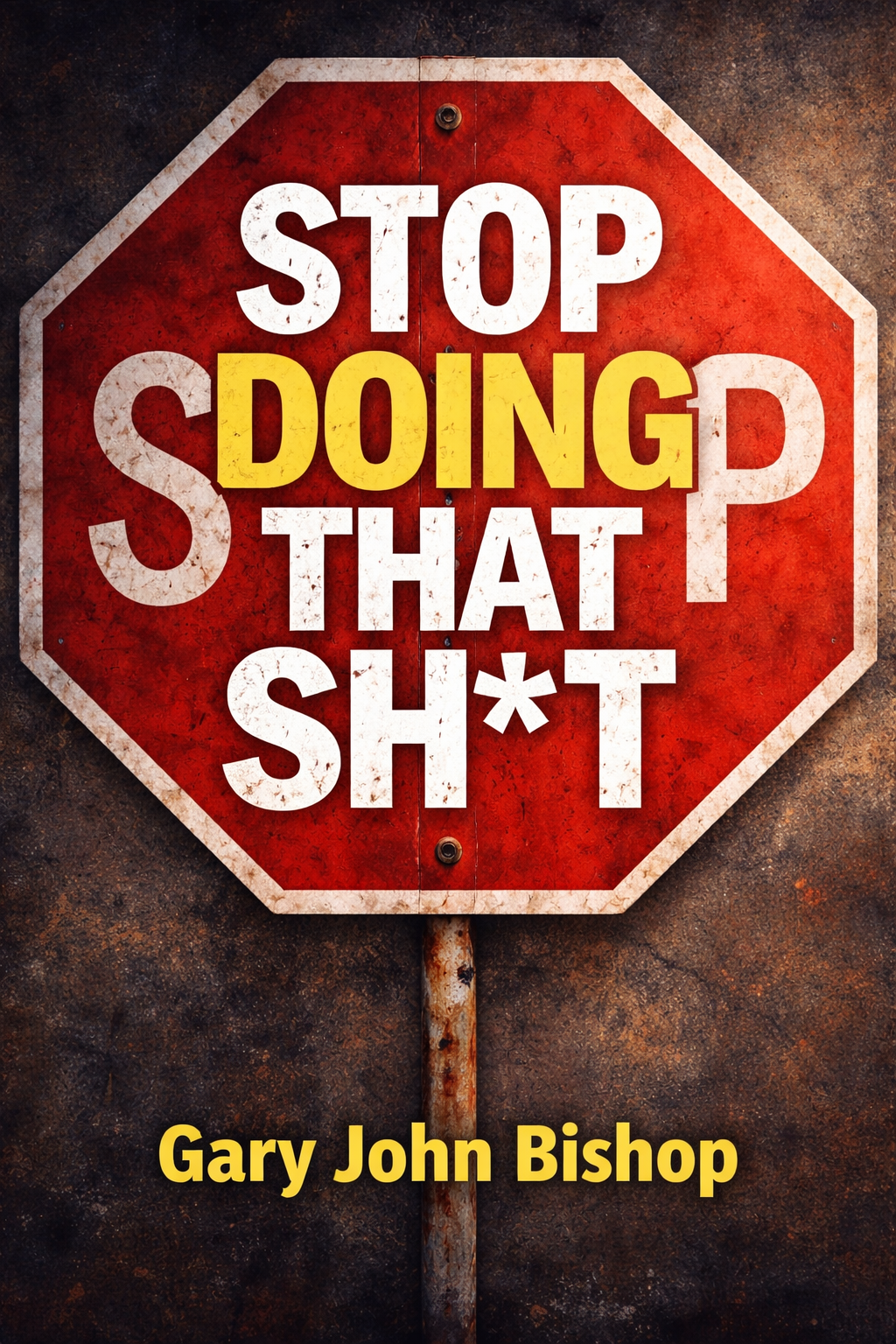
Stop Doing That Sh*t
Chapter Summaries
What's Here for You
Tired of the same old self-help BS? "Stop Doing That Sh*t" is your no-holds-barred wake-up call. Gary John Bishop slices through the platitudes and dives headfirst into the cynical self-talk that's been running your life on autopilot. Prepare to confront the uncomfortable truths about why you keep sabotaging yourself, from the subtle everyday choices to the deeply ingrained beliefs you didn't even know were there. This isn't about quick fixes; it's about dismantling the lies you tell yourself about who you are, who others are, and what life is. Get ready to question everything, challenge your 'established truths', and finally take control. It's time to stop wallowing in your 'thrown-ness' and start redirecting your life towards a future free from the shackles of self-sabotage. This book is a kick in the pants, a dose of reality, and a roadmap to finally stop doing that sh*t… for real.
Here’s the Rub
Gary John Bishop opens by confronting the listener with a stark reality: much of life is lived on autopilot, driven by a conversational bullshit that undermines our potential. He challenges the expectation of new-age platitudes, instead diving into the cynical and repetitive self-talk that sabotages us. Bishop asserts that individuals aren't merely reporting on life, but actively creating their experience through this internal dialogue, a concept supported by philosophers like Gadamer and Heidegger who emphasized the power of language in shaping reality. He argues that our emotions and conversations engage in a constant tango, a dance often unnoticed yet profoundly impactful, highlighting society's addiction to altering emotions without addressing their root causes. Bishop then pivots, clarifying that positive affirmations alone are insufficient to combat deeply ingrained negative self-talk; it's like sweeping cockroaches under the rug—the problem remains. He stresses the importance of confronting this emotional muck to achieve authentic being. Bishop emphasizes that one can only embody a single emotional state at any given moment, either anger or love, resentment or forgiveness. Shifting gears, Bishop shares a bit about himself, his Scottish background, and his mission to empower people through direct, no-nonsense truth, rather than sugar-coated affirmations. He reframes the listener as both the problem and the solution, underscoring that this book is a catalyst for self-discovery, not a provider of easy answers. Like navigating the black-and-white streets of his Glaswegian childhood, the rules are simple, and the consequences clinical. The author urges the reader to embrace the discomfort of challenging their current beliefs, understanding that real thinking—a deliberate engagement with new ideas—is an interruption of automatic responses. He dismisses superficial positivity, like scrolling through quotes on Instagram, and calls for genuine mental stretching, a willingness to connect new concepts to one's own life. Bishop concludes by urging readers to wake up from their autopilot existence, to dare to leap from the anchors of their limiting beliefs, and to engage actively with the book's ideas, promising that by doing so, they can reclaim their lives. It's a journey not through fields of joy, but through decades of strife, a process that might be uncomfortable, but ultimately leads to profound self-understanding and the power to interrupt the cycle of self-sabotage.
A Life of Sabotage
Gary John Bishop, in this chapter of *Stop Doing That Sh*t*, dives into the insidious nature of self-sabotage, revealing it's not just the grand acts of self-destruction we often associate with the term, but the subtle, everyday choices that erode our potential. He begins by dismantling the notion that self-sabotage is limited to extreme cases, suggesting instead that it's a pervasive force, a constant drip eroding our best intentions. Bishop illuminates how seemingly small actions—hitting the snooze button, chronic lateness, or that extra slice of cheesecake—accumulate into a larger pattern, steering us away from our desired outcomes. The author emphasizes that the human desire to be right is a powerful catalyst for self-sabotage, blinding us to the damage we inflict on ourselves and others. He paints a stark picture of relationships crumbling under the weight of nitpicking and imagined slights, a self-fulfilling prophecy of disconnection. Bishop argues that our subconscious beliefs, the "dye" that colors our soul, dictate our path far more than conscious desires or fleeting moments of determination. He introduces the concept of three internal saboteurs, deeply ingrained statements that undermine our efforts and shape our reality. Bishop sets the stage for a deeper exploration, promising to unveil the origins and impact of these saboteurs, offering a path to interrupt the destructive internal dialogues that hold us captive. He urges readers to confront the uncomfortable truths about themselves, to resist the urge to check out when the process becomes challenging, and to recognize that the effort invested in understanding these patterns is commensurate with the effort required to transform one's life, and that telling the truth is a surefire way to free yourself from your own subconscious self-sabotage trap.
The Question
Gary John Bishop opens by wrestling with a universal question: why do we repeat patterns we know are harmful? He reflects on his own cycles of financial and physical self-sabotage, a yo-yo of progress followed by relapse. Bishop challenges the reader to confront the uncomfortable truth: are you headed where you want to be? This digging, he insists, is the first step to freedom. He dismantles the reliance on vague concepts like willpower and discipline, seeing them as empty explanations rather than actionable solutions. For Bishop, labeling oneself a procrastinator is as absurd as calling oneself a "pooper"; it's a description, not a destiny. The real issue is the action itself, the choice to procrastinate in a given moment. He paints a vivid picture of the internal battle: wanting to move forward, yet feeling magnetically drawn back to the familiar, like wrestling with eels. There's a tension between the idealized self and the 'here-we-go-again' self, the one who throws a hand grenade into their own progress. Bishop suggests that we subconsciously set up our lives as a cycle of sabotage and recovery, a conversational trap we can't see. He introduces Coué's concept that when willpower and imagination (the subconscious) clash, the subconscious always wins. However, Bishop offers a glimmer of hope: humans are survival machines, wired to predict and adapt. We remember, we keep score, and we follow the familiar, even when it's detrimental. This prediction-ism, while intended for safety, can limit us, creating a personal Matrix of old emotions and complaints. The crossroads of human existence, Bishop argues, is between the pull to predict and stay safe, and the thirst for the new and a better existence. Ultimately, safety wins, but at what cost? He concludes by posing a potent question: what has been the underlying experience of your life? Are you left exhausted, merely okay? He urges the reader to recognize that this cycle is not accidental; it's a setup. True change demands risk, pushing through predictable self-talk and emotional freeze-frames, reaching for the unknown, understanding that you can't do new without risk.
The Magic Little Sponge
Gary John Bishop invites us to consider the subconscious not as some abstract concept, but as a very real force shaping our lives, often without our awareness. He draws on David Eagleman's work to highlight how little of our mental operations are conscious, suggesting that we are largely driven by subconscious processes formed early in life. Bishop paints a picture of us as 'magic little sponges' at birth, soaking up experiences and beliefs, but as life progresses, these sponges can harden, trapping within them patterns of self-sabotage. He argues that we weren't born with a desire to undermine ourselves, but rather, through a series of shifts in perspective, we've constructed an experience of life that includes self-defeating behaviors. The core tension lies in the contrast between our vast potential at birth and the constricted version of ourselves we often become, addicted to perpetuating a limiting self-image. Bishop suggests that much of our adult life is spent trying to 'improve' this limited self, chasing an elusive happiness that remains perpetually out of reach—a kind of 'clickbait' for the brain, always promising satisfaction but never delivering. He points out the paradox: we're trapped in the struggle to be free, constantly pursuing something external to fix an internal state. Bishop urges a shift in perspective, away from the relentless pursuit of future happiness and toward a present-moment awareness. He challenges the reader to recognize that the life they are living has largely been on autopilot, drifting from one drama to the next without substantive intervention. He asks us to wake up to something grander than our petty concerns, check in with ourselves, and acknowledge the miracle of existence beyond our immediate worries. The invitation is clear: commit to ending the cycle of self-sabotage and begin understanding the hardened patterns within that 'magic little sponge,' interrupting the drift and reclaiming the vast potential we were born with.
A Throne of Throwns
Gary John Bishop, in "Stop Doing That Sh*t," confronts the core reasons behind self-sabotage, beginning with an exploration of what he terms 'thrown-ness'—the circumstances into which we are born without any say. He argues that while it's tempting to blame external factors for our struggles, true freedom begins with radical acceptance. Bishop vividly illustrates this with examples ranging from genetic predispositions to cultural norms, the era of our birth, and even the seemingly immutable laws of nature, painting a picture of a 'magic little sponge' thrown into the 'tide of humanity.' The author emphasizes that blame solves nothing; it merely explains and keeps one stuck, and acceptance doesn't mean agreement or resignation but acknowledging reality as it is. He challenges the listener to consider the conversations they were 'thrown into'—the inherited beliefs and limitations passed down through generations, particularly around topics like finances, relationships, and success, creating a 'giant, meandering forest of opinions.' These conversations sink into the subconscious, driving behavior at an unconscious level for most of the day, influencing choices far more than conscious thought. Bishop urges listeners to confront the uncomfortable truth that their subconscious, a 'gloomy, shifting mass' of experiences, dictates far more than they realize. He stresses that while it's easy to blame parents or others, doing so only perpetuates a cycle of resentment and excuse. Instead, he advocates for releasing blame entirely, owning one's life, and recognizing oneself as the source of change. Ultimately, the choice is stark: fight for the past or the future, self-sabotage or long-awaited freedom, because 'you cannot free yourself with conditions.'
Establishing the Truth
In "Stop Doing That Sh*t," Gary John Bishop delves into the concept of 'established truth,' the personal narratives we construct from our past experiences, shaping our present and future. Bishop illuminates how these truths, though deeply personal, are often mistaken for objective reality, leading to self-sabotage. He paints a vivid scene of a coffee shop mishap, illustrating how different perspectives yield different 'truths,' a microcosm of life itself. The author underscores that our past is not a fixed sentence but a template we can redraw, challenging the notion that our current struggles are solely products of past traumas. Bishop urges us to recognize that clinging to these established truths—like a comforting yet constricting blanket—prevents us from evolving. He confronts the common tendency to explain away our lives rather than intervening, highlighting how we often blame external factors to avoid taking responsibility. Bishop passionately argues that these 'truths' become excuses, heavy get-out-of-jail-free cards that keep us trapped in Groundhog Day-like cycles. He implores us to get sick of our own justifications and to take complete ownership of our lives, understanding that our potential remains untapped as long as we hide behind these self-constructed barriers. The author emphasizes we are not defined by our past; our sabotage stems not from external issues but from internal saboteurs, urging a shift from victimhood to empowered action, breaking free from the illusion that our established truths dictate our destiny. Bishop leaves the reader with a potent challenge: to rewrite their narrative, confront their saboteurs, and finally, step into their full potential.
The Three Saboteurs
In "Stop Doing That Sh*t," Gary John Bishop unveils the core of self-sabotage, likening the human mind to a magic little sponge, initially open and ready, yet molded by uncontrollable circumstances and established truths. He stresses that these truths, though merely perspectives, often dictate our lives, creating a personal drama replayed nightly for an audience of one. Bishop introduces the concept of the 'three saboteurs'—subconscious conclusions about oneself, others, and life itself—formed during our formative years. These saboteurs, indelible marks on the subconscious, act as internal compulsions, drawing us back to familiar, often damaging patterns, much like a moth to a flame. They are not erasable, but understanding them is key. Bishop uses the metaphor of lighthouses, warning us when we veer toward predictable, self-fulfilling prophecies, offering a chance to pivot with awareness. The author emphasizes that our actions align with these conclusions, creating ripples in our lives that reveal their presence. These conclusions about self, others and life, skew and contort our perception, burdening us with the very life we seek to change. Bishop paints a picture of individuals perpetually undermining themselves, only to then heroically rescue themselves from the mess they created, and in doing so, they reinforce the very patterns they wish to escape. This cycle, driven by deeply ingrained views, keeps us trapped in predictability.
You
Gary John Bishop unveils the insidious nature of our self-sabotaging behaviors, pinpointing the origin in what he terms the 'personal conclusion'—a deeply ingrained, negative belief about oneself formed during formative years, a subtle yet pervasive criticism humming beneath the surface of conscious thought. Bishop illustrates how this conclusion, often lurking unnoticed, acts as an internal guide, subtly skewing perceptions and limiting potential, like Vaseline smeared across the lens of daily life, distorting the view. He notes that while positive experiences offer temporary respite, the underlying conclusion inevitably resurfaces, creating a seesaw of self-perception. The author emphasizes that this conclusion, such as 'I'm not smart enough' or 'I'm a loser,' transcends external validation, rendering praise and accomplishments insufficient to dispel its grip, highlighting that circumstances become mere contexts for this conclusion to play out, influencing choices and behaviors. Bishop draws a parallel to Ebenezer Scrooge, a man hardened by a self-imposed exile rooted in the conclusion that he could never be loved, showcasing how such beliefs can shape an entire existence. He challenges readers to confront their own personal conclusion through rigorous self-examination, urging them to look beyond superficial explanations and identify the underlying dilemma they face with themselves; this requires facing the discomfort and pressure that arises from conclusions such as 'I don't fit in' or 'I'm not enough'. Bishop stresses that awareness of one's personal conclusion is the first critical step toward dismantling self-sabotage, providing the means to recognize its influence and ultimately reclaim control over one's life, allowing one to hear themselves when deep in it and feel it in a physical sense before going down the rabbit hole. He broadens the scope, reminding us that these conclusions about ourselves do not exist in a vacuum, but are shaped and influenced by our interactions and relationships with others, even those from whom we are estranged, thereby adding another layer to the complex picture of self-awareness.
Them
Gary John Bishop delves into the second saboteur of self-sabotage: the social conclusion, that fundamental lens through which we view other people. He emphasizes that these conclusions, formed in our formative years from interactions with family, friends, and authority figures, aren't inherent truths but rather personal interpretations solidifying into a distorted reality. Bishop stresses that you are not a victim unless you choose to be, and recognizing your role in creating this perspective is the first step to dismantling it; it's about empowerment, not blame. Like a barcode scanner at a supermarket, we're constantly running people through our internal filters, judging whether they conform to our preconceived notions, such as 'People will use you' or 'People can't be trusted,' leading to a pass/fail system that rarely favors others. Bishop paints a vivid picture of how these conclusions act as an invisible wall, shaping our interactions and limiting our ability to see others as they truly are, not who we expect them to be. He cautions against the trap of collecting agreements through gossip, which only reinforces negative conclusions and distracts from personal growth. Instead, Bishop advocates for upfront, judgment-free authenticity, setting boundaries without becoming resentful or vengeful. He shares his own social conclusion—that people don't care—as an example, illustrating how it manifests in his life, driving him to unnecessary independence and isolation. Bishop then guides the reader to uncover their own hidden conclusions by examining the excuses they make for their unconscious thoughts, the labels they assign to others, and the qualities they automatically avoid; this process reveals the underlying grievance that shapes their experience of people, urging them to fill in the blank: 'People are…' and confront the truth of their social conclusion. Ultimately, the chapter is a call to awaken from the jungle of our own making, to recognize how our social conclusions trap us in a cycle of judgment and isolation, and to choose forgiveness, love, and genuine connection instead.
Life
Gary John Bishop delves into the pervasive conclusions we form about life itself, arguing that these often-subconscious beliefs act as silent saboteurs, shaping our paths and limiting our potential. He critiques the addiction to positivity, suggesting it can mask deeper, unaddressed issues, like a gilded cage concealing a broken spirit. Bishop asserts that many grapple with the underlying conviction that "life is hard," a conclusion that, paradoxically, perpetuates struggle. This manifests in self-sabotage, missed opportunities, and a relentless cycle of problems, as if one is forever wrestling shadows. Even success becomes a battle against this ingrained belief, a fleeting victory before life seemingly reverts to its perceived unfairness. Bishop highlights how some individuals succumb to this conclusion, settling for less, while others tirelessly fight it, driven by a need to validate their internal narrative. He recounts a client who realized her conclusion was "life isn't fair," a lens that colored every relationship and experience, turning life into a constant quest for equitable exchange. For Bishop himself, the conclusion that "life is a struggle" fuels a relentless work ethic, yet paradoxically prevents him from finding peace, even on vacation. The challenge, Bishop emphasizes, lies in unearthing these deeply ingrained life conclusions, often hidden beneath layers of excuses and justifications. The author urges a shift from being a victim to becoming an observer, witnessing the drama of self-sabotage without indulging in it. Ultimately, he calls for a conscious articulation of one's life conclusion—a crucial first step toward transcending its limiting influence, like naming a ghost to dispel its power.
The Point of the Spear
In "Stop Doing That Sh*t," Gary John Bishop delves into the core of self-sabotage, not as a mere collection of bad habits, but as a deeply ingrained 'point of experience.' He illuminates how our subconscious conclusions about ourselves, others, and life itself form the bedrock of this experience, a familiar yet limiting landscape we constantly return to. Like a needle stuck in a groove, we replay the same patterns, even when presented with opportunities for growth. Bishop asserts that the life we desire demands a different version of ourselves, one that feels inherently uncertain and risky, triggering a retreat to the familiar. He paints a vivid picture: imagine cleaning your house with fervor, only to watch it descend back into chaos, a metaphor for our inability to sustain the 'new' self required for lasting change. The author emphasizes that true change isn't about pursuing external goals, but about confronting the internal 'pursuit of being' – the relentless chase to become someone who can solve the perceived inadequacies of our current selves. Bishop challenges the illusion that happiness or confidence can be possessed, urging us to recognize these qualities as expressions already within us. He advocates for staring down the 'carnage of pursuit' – the broken relationships and regrets – and embracing our current reality, however uncomfortable. Like accepting the mundane color of a car, acceptance means letting things be without charge or reaction, allowing the darker parts of our unconscious to simply exist, without the need to fix or change them. Bishop’s core message is that this acceptance is not passive resignation, but an active practice, a constant reminder to break free from automatic reactions and step into a life unshackled by self-sabotage. Only by accepting our starting point, our 'point of experience,' can we truly begin to alter our trajectory and live a more authentic, fully realized life. Ultimately, Bishop urges us to stop running and start being, to awaken to the life already within reach.
Redirecting Your Way Outta This
In "Redirecting Your Way Outta This," Gary John Bishop confronts the reader with a stark reality: they are trapped in a self-sabotaging cycle, forever tethered to past traumas and decisions, a loop replaying on repeat. He likens this to dozing off at the wheel of life, subconsciously seeking to validate old, limiting conclusions. The author argues that traditional self-help often fails because it addresses symptoms rather than the root cause: the individual's own deeply ingrained patterns. Bishop introduces the concept of redirection, drawing a parallel to a parent distracting a child from a tantrum; instead of fighting the past, one must pivot towards something new and engaging, an authentic pivot. He emphasizes that life flows in the direction of one's attention, and dwelling on problems only perpetuates them, like scratching a mosquito bite. Alan Watts's philosophy is invoked to challenge the conventional view of causality, suggesting that we are not merely driven by the past but can be pulled by the future. Bishop urges readers to visualize their future selves and work backward, allowing that vision to shape their present actions. This approach, he contends, transforms one from a warrior battling against themselves into an architect designing a life of purpose, like Michelangelo, who saw David within the marble and simply removed what was not David. The key is to populate the present with activities that invigorate and align with that future vision, trading a life of making a living to revealing a future once deemed impossible. Bishop concludes by highlighting that every moment presents a choice: to be guided by a past one didn't create or to be called forth by a future one designs, it's about choosing the discomfort of creation over the stagnation of repetition.
You Can Finally Stop Doing That Shit—No, Really!
In this culminating chapter, Gary John Bishop urges the reader to embrace the future as an unlimited canvas, free from the constraints of past self-sabotage. He emphasizes that individuals are not broken but rather expressions waiting to unfold, and he challenges the notion that one must have all the answers before acting, instead advocating for life as a grand experiment, a space to shout, love, and live without being paralyzed by the search for the 'right' path. Bishop acknowledges the inevitable presence of doubts, fears, and old patterns, portraying them not as roadblocks but as familiar adversaries to be faced head-on, armed with the awareness gained throughout the book. He introduces the concept of 'thrown-ness,' inspired by Heidegger, suggesting that understanding how one has been 'thrown' into life is the key to unlocking true freedom, but this requires ownership—whatever you own no longer owns you. The author paints a vivid picture: the reader stands before a block of stone, their future self, their 'David,' waiting to be revealed, and the act of creation demands commitment, especially in moments of defeat or confusion. Even when one 'blows it,' the future serves as a guide for cleaning up the mess, demanding ownership and a return to the path. Bishop reframes the pursuit of change not as fixing something broken but as revealing a future, a myriad of futures encompassing finances, love, family, and purpose, urging the reader to define these futures and challenge themselves to live that reality, moment by moment. He dismisses the idea of a magical secret to life, instead presenting life as a body of work, a continuous process of unpacking and exploring new levels of effectiveness and aliveness, and he underscores the importance of not getting hooked on any single human experience, such as anger or depression. The core tension resolves as Bishop reveals that self-sabotage often stems from boredom—a life too predictable, safe, and ordinary. The ultimate call to action is to embrace the future, step into action, and own every aspect of life, waking up to the possibilities each day offers, because the future, in all its potential, has already arrived.
Conclusion
Bishop's 'Stop Doing That Sh*t' is a raw wake-up call, urging readers to confront the subconscious saboteurs hijacking their lives. It's not about surface-level positivity, but excavating deeply ingrained negative conclusions about self, others, and life. The emotional lesson lies in accepting 'thrown-ness' without blame, shifting from victim to owner. Practical wisdom centers on identifying these saboteurs—personal, social, and life conclusions—and consciously redirecting towards a future self, architecting a life of purpose rather than battling a flawed one. The book champions present awareness and future-driven action over past-defined limitations, offering a path to authentic, risk-embracing living.
Key Takeaways
Self-sabotage stems from unnoticed, repetitive negative self-talk that shapes our experience of reality.
Simply changing self-talk to positive affirmations doesn't work because it fails to address the underlying negative emotions and beliefs.
Emotions and conversations are intertwined, constantly influencing each other, yet we often try to change emotions without examining the conversations driving them.
True change requires confronting and uncovering the 'emotional cockroaches'—the hidden negative emotions and beliefs—rather than suppressing them.
We can only embody one emotional state at a time, so shifting from negative to positive requires conscious effort and awareness.
Real thinking involves challenging existing beliefs and engaging deliberately with new ideas to interrupt automatic responses.
The reader is both the problem and the solution, requiring active participation and a willingness to embrace discomfort to achieve lasting change.
Self-sabotage extends beyond obvious acts of self-destruction, manifesting in subtle, daily choices that cumulatively undermine our goals and relationships.
The desire to be right can be a significant driver of self-sabotage, blinding us to the harm we inflict on ourselves and others.
Our subconscious beliefs, shaped by past experiences, exert a powerful influence on our behavior, often overriding our conscious intentions.
Small, seemingly insignificant actions, like skipping a dentist appointment or indulging in extra treats, can be part of a larger pattern that sabotages long-term health and well-being.
Self-sabotage often involves prioritizing petty, meaningless issues over actions that would lead to real progress and purpose.
Disrupting self-sabotage requires uncovering and interrupting the deep, dark internal dialogues that guide our thoughts and emotions.
Addressing self-sabotage demands confronting uncomfortable truths about ourselves and pushing through the challenges of self-reflection.
Repeating harmful patterns stems from a deeper, often subconscious, drive for the familiar, despite wanting change.
Vague concepts like willpower and discipline are often insufficient for breaking self-sabotaging cycles; specific actions are needed.
Self-sabotage isn't always extreme; it manifests in millions of tiny ways that erode progress daily.
Humans are wired for prediction and survival, leading to a preference for the known, even if it's detrimental.
True change requires embracing risk and pushing beyond predictable self-talk and emotional patterns.
The subconscious mind often overrides conscious willpower, perpetuating cycles of sabotage and recovery.
The subconscious profoundly influences our actions, often operating beneath our conscious awareness.
Early life experiences shape our subconscious, potentially leading to self-sabotaging patterns.
We often become addicted to a limited version of ourselves, hindering our potential.
The relentless pursuit of future happiness can trap us in a cycle of dissatisfaction.
True change requires interrupting the autopilot and consciously intervening in our life's direction.
Present-moment awareness is key to breaking free from self-sabotaging patterns and recognizing the richness of existence.
Lasting fulfillment comes not from external achievements but from an internal shift in perspective.
Individuals often unconsciously seek to validate their negative life conclusions, perpetuating cycles of struggle and disappointment.
Acknowledge that much of your life experience is shaped by circumstances you didn't choose ('thrown-ness'), including genetics, culture, and family dynamics.
Shift from blaming external factors to accepting your starting point, understanding that acceptance is the first step toward meaningful change.
Recognize that inherited conversations and beliefs, particularly around money and relationships, often create subconscious limitations that drive self-sabotaging behavior.
Understand that your subconscious, shaped by past experiences, exerts a powerful influence on your daily actions and choices, often without your conscious awareness.
Release the need to blame others, especially parents, for your current circumstances; focus instead on taking ownership of your life and choices moving forward.
Embrace the present moment and make a conscious choice to fight for your future rather than remaining trapped by past resentments and limitations.
View your life as a game that's now 'on,' committing to play it without conditions or excuses, recognizing yourself as the primary agent of change.
Established truths are personal interpretations of past events, not objective realities, and can limit future potential.
Clinging to past narratives as explanations for current struggles perpetuates self-sabotage.
Taking ownership of one's life requires recognizing established truths as choices rather than fixed determinants.
The tendency to explain life's shortcomings often serves as a convenient excuse, hindering personal intervention and growth.
Untapped potential is often obscured by the weight of established truths, preventing individuals from breaking free and contributing fully.
True freedom comes from confronting internal saboteurs rather than blaming external circumstances or past traumas.
Rewriting one's narrative empowers individuals to redefine their destiny, moving beyond victimhood towards proactive change.
Subconscious conclusions formed early in life about oneself, others, and life act as 'saboteurs,' driving self-sabotaging behaviors.
These 'saboteurs' are not erasable but understanding them provides the awareness needed to shift one's actions and break negative patterns.
Self-sabotage often involves creating problems to then 'rescue' oneself, reinforcing negative self-perceptions and life patterns.
Becoming aware of these ingrained saboteurs provides in-the-moment options, shifting from a sense of fate to conscious choice.
Actions are always aligned with one's subconscious conclusions, and observing the effects of these actions reveals the underlying saboteurs at play.
Negative self-conclusions, formed early in life, act as subconscious saboteurs, limiting potential and distorting self-perception despite outward appearances.
Temporary positive experiences offer fleeting relief, but the underlying negative self-conclusion inevitably resurfaces, perpetuating a cycle of self-sabotage.
External validation and achievements often fail to dismantle deeply ingrained negative self-conclusions, as the internal belief overrides external evidence.
Circumstances become mere contexts for personal conclusions to manifest, influencing choices and behaviors in subtle yet pervasive ways.
Confronting and acknowledging one's personal conclusion through rigorous self-examination is the first critical step toward dismantling self-sabotage.
Awareness of one's personal conclusion enables recognition of its influence, empowering individuals to reclaim control over their lives and break free from its grip.
Personal conclusions are not formed in isolation but are significantly shaped by interactions and relationships with others, including those from the past.
Social conclusions, formed early in life, act as filters that distort our perception of others, leading to self-fulfilling prophecies of distrust and isolation.
Recognizing that these conclusions are self-imposed, not externally inflicted, is the first step toward reclaiming personal power and reshaping relationships.
The constant judgment of others against preconceived notions creates a 'pass/fail' system that sets people up to fail, limiting genuine connection.
Engaging in gossip reinforces negative social conclusions, hindering personal growth by focusing on others' flaws rather than one's own.
Authenticity and clear boundaries are essential for healthy relationships, allowing for genuine connection without succumbing to resentment or vengeance.
Uncovering hidden social conclusions requires examining the excuses made for unconscious thoughts and the labels assigned to others, revealing the underlying grievance.
Choosing forgiveness, love, and genuine connection over resentment and isolation is crucial for breaking free from the cycle of negative social conclusions.
Subconscious conclusions about life (e.g., "life is hard") significantly shape behavior and limit potential, often leading to self-sabotage and missed opportunities.
An over-reliance on positivity can mask deeper, unresolved issues and prevent genuine engagement with life's challenges.
True progress requires identifying and articulating one's core life conclusion to break free from its limiting influence.
Shifting from being a victim of circumstance to an observer of one's own patterns is essential for personal growth and change.
Self-sabotage stems from deeply ingrained conclusions about self, others, and life, forming a limiting 'point of experience' that dictates our reality.
The pursuit of external goals is often a disguised attempt to change our internal state, a 'pursuit of being' that's inherently unsatisfying.
True change requires embracing a new, uncertain version of ourselves, which triggers a subconscious retreat to familiar patterns and self-sabotage.
Acceptance of our current reality, including our flaws and past failures, is the crucial first step towards breaking free from self-sabotage.
Lasting change is not about acquiring external achievements or feelings, but about recognizing and expressing the qualities that already exist within us.
Breaking free from self-sabotage requires conscious effort to recognize and override automatic reactions and triggers, creating space for authentic living.
Self-sabotage stems from a subconscious cycle of validating past conclusions, hindering present potential.
Traditional self-help often fails because it treats symptoms rather than addressing the root cause of self-sabotaging patterns.
Authentic redirection involves pivoting attention towards genuinely engaging activities, altering one's current trajectory.
Dwelling on problems perpetuates them; focus instead on building a desired future.
Challenge the conventional view of causality; one can be pulled by the future rather than driven by the past.
Visualize the future self and work backward, allowing that vision to shape present actions and decisions.
Transform from a warrior battling oneself into an architect designing a purposeful and inspiring life.
Embrace the future as an unlimited canvas, actively shaping it rather than being defined by the past.
View life as a grand experiment, prioritizing action and exploration over the paralysis of seeking the 'right' path.
Acknowledge and confront doubts, fears, and old patterns as familiar adversaries, not insurmountable roadblocks.
Understand and own your 'thrown-ness'—the circumstances into which you were born—to unlock true freedom and transcend limitations.
Commit fully to revealing your desired future, especially in moments of defeat or confusion, using it as a guide for corrective action.
Reframe change as an ongoing process of revealing a future self, not fixing a broken one, encompassing various aspects of life.
Recognize that self-sabotage often stems from boredom with a predictable life, and actively seek inspiration and new experiences.
Action Plan
Identify and write down the repetitive negative self-talk that dominates your internal dialogue.
Challenge the validity of these negative thoughts by questioning their origins and accuracy.
Instead of simply trying to replace negative thoughts with positive ones, explore the underlying emotions and beliefs driving them.
Become aware of the emotional states you embody throughout the day and identify the conversations that trigger them.
Deliberately interrupt your automatic responses to challenging situations by pausing and considering alternative perspectives.
Engage in activities that require genuine thinking and mental stretching, such as reading challenging books or engaging in thoughtful discussions.
Take ownership of your choices and actions, recognizing that you have the power to change your life.
Dare to challenge your current beliefs and step outside your comfort zone to explore new possibilities.
Identify one area of your life where you suspect self-sabotage is occurring.
Track your daily actions in that area for a week, noting any patterns of behavior that undermine your goals.
Reflect on the underlying beliefs or fears that might be driving these self-sabotaging behaviors.
Challenge the validity of those beliefs by seeking evidence that contradicts them.
Replace negative self-talk with positive affirmations that support your desired outcomes.
Practice self-compassion when you slip up, recognizing that setbacks are a normal part of the process.
Identify one small, concrete step you can take each day to move closer to your goals in that area.
Seek support from a therapist, coach, or trusted friend to help you stay accountable and overcome obstacles.
Confront the uncomfortable truths about yourself, and resist the urge to check out when the process becomes challenging.
Interrupt conversations you have with yourself and identify your three saboteurs.
Identify a specific area of your life where you consistently experience a cycle of progress and relapse.
Ask yourself: If I continue on this path, where will I realistically be in 5 years?
Challenge one self-limiting belief or prediction you hold about your ability to achieve a specific goal.
Choose one small action you've been procrastinating on and commit to completing it immediately.
When faced with a decision, pause and ask: Am I choosing safety over aliveness?
Recognize and acknowledge the underlying experience of your life; what is the emotional theme?
Identify one risk you can take this week to disrupt a familiar pattern and move towards a desired outcome.
Reflect on early life experiences and identify potential sources of self-sabotaging beliefs.
Pay attention to recurring patterns of thought and behavior that limit your potential.
Challenge the belief that external achievements will bring lasting happiness.
Practice present-moment awareness through mindfulness or meditation.
Identify one small step you can take to interrupt a self-sabotaging pattern.
Commit to actively directing your life instead of drifting from one drama to the next.
Take stock of what you have turned your life into and identify areas for change.
Identify three specific aspects of your 'thrown-ness' (e.g., family dynamics, cultural norms) that you've used to justify current limitations.
Practice radical acceptance by acknowledging these aspects without judgment, focusing on the reality of the situation rather than wishing it were different.
Reflect on inherited conversations and beliefs around a specific area of your life (e.g., finances, relationships) and identify any limiting subconscious rules you've internalized.
Challenge one of these limiting beliefs by consciously choosing a different thought or action that aligns with your desired outcome.
Release blame toward a specific person (e.g., a parent) by writing a letter expressing forgiveness and focusing on taking responsibility for your own choices moving forward.
Commit to spending five minutes each day in mindful awareness, observing your thoughts and feelings without judgment to become more aware of your subconscious patterns.
Identify one area of your life where you've been self-sabotaging and take a small, concrete action to break the cycle and move toward your desired outcome.
Reframe your past as a source of strength and resilience rather than a reason for limitation, focusing on the lessons you've learned and how they can inform your future choices.
Identify and write down your established truths about yourself and your life.
Question whether these truths are empowering or limiting.
Challenge the validity of these truths by considering alternative perspectives.
Take responsibility for how you have used these truths to shape your present and future.
Actively intervene in your life instead of passively explaining it away.
Confront the idea that your past does not define your potential.
Recognize that you are not your established truths.
Start to separate yourself from the damage you've done by taking ownership of your life.
Reflect on early life experiences and identify potential conclusions formed about yourself, others, and life.
Observe your current actions and identify any recurring patterns of self-sabotage.
Treat your 'saboteurs' as warning signs, prompting you to make conscious choices rather than reacting automatically.
Examine the ripples of your actions to trace them back to the underlying subconscious conclusions.
Take ownership of your past experiences and use them as lessons rather than limitations.
Challenge established truths about yourself, others, and life, recognizing them as perspectives rather than fixed realities.
Identify situations where you create problems and then 'rescue' yourself; explore the motivations behind these patterns.
Identify and write down your personal conclusion about yourself, acknowledging it without judgment.
Reflect on past experiences and identify patterns where this conclusion has influenced your decisions and behaviors.
Challenge the validity of your personal conclusion by seeking evidence that contradicts it.
Pay attention to the automatic, reactionary thoughts you have during setbacks and identify how they connect to your personal conclusion.
Examine your relationships and identify if your personal conclusion is affecting how you relate to others.
Practice self-compassion when you notice your personal conclusion influencing your thoughts and actions.
Seek therapy or counseling to explore the origins and impact of your personal conclusion in a safe and supportive environment.
Create a list of positive affirmations that directly counter your personal conclusion and repeat them daily.
Set small, achievable goals that challenge your personal conclusion and celebrate your progress.
Visualize yourself living a life free from the limitations of your personal conclusion and focus on the positive possibilities.
Identify your own social conclusion by completing the sentence: 'People are...'
Reflect on the childhood experiences that may have contributed to forming this conclusion.
Become aware of the times you make excuses for your negative thoughts about others.
Challenge your automatic judgments by seeking evidence that contradicts your social conclusion.
Practice setting clear boundaries in relationships without resorting to resentment or vengeance.
Reduce or eliminate gossip from your conversations and focus on positive, constructive dialogue.
Actively seek out opportunities to connect with others in a genuine and authentic way.
When triggered by someone's behavior, pause and ask yourself if you are projecting your social conclusion onto them.
Make a conscious effort to forgive those who have wronged you, releasing the burden of resentment.
Focus on broadcasting your love and self-expression to the world, rather than allowing others to shut you down.
Identify and articulate your core life conclusion by reflecting on recurring negative thoughts and feelings during times of stress or discouragement.
Examine past experiences and relationships through the lens of your identified life conclusion to understand how it has influenced your choices and behaviors.
Challenge the validity of your life conclusion by seeking evidence that contradicts it and exploring alternative perspectives.
Practice observing your thoughts and actions without judgment, recognizing when your life conclusion is influencing your behavior.
Experiment with small, concrete actions that defy your life conclusion to create new experiences and challenge your limiting beliefs.
Identify your core conclusions about yourself, others, and life that contribute to your 'point of experience.'
Reflect on past instances of self-sabotage and identify the triggers that led to those behaviors.
Practice accepting your current reality, including your flaws and past failures, without judgment.
Recognize and challenge your automatic reactions and triggers in real-time situations.
Focus on expressing the qualities you already possess, such as confidence or passion, rather than pursuing them externally.
Commit to daily practices that reinforce acceptance and self-compassion, such as mindfulness or journaling.
Observe your life as an outsider, separating yourself from your optimism, resignation, or drama.
Identify a recurring self-sabotaging pattern in your life.
Instead of trying to fix the pattern, identify an activity that genuinely engages and excites you.
When you feel the urge to engage in the self-sabotaging behavior, redirect your attention to the engaging activity.
Visualize your future self as if you've already achieved a specific goal.
Identify one action you can take today that aligns with that future vision.
Challenge the belief that your past dictates your future by focusing on creating a new vision.
Ask yourself, 'What am I actually up to that would make this life of mine a truly great one?' and take action accordingly.
Define a clear vision for your future self in various aspects of life (finances, relationships, career).
Identify one small action you can take today that aligns with your future vision.
Acknowledge and challenge any self-defeating thoughts or patterns that arise.
Practice 'chipping away' at obstacles that stand in the way of your desired future.
Embrace experimentation and be willing to try new things without fear of failure.
Identify the areas of your life where you feel bored and seek out new challenges.
Commit to consistent action, even when you experience setbacks or feel discouraged.
Regularly reflect on your progress and adjust your course as needed.
Forgive yourself for mistakes and focus on learning from them.