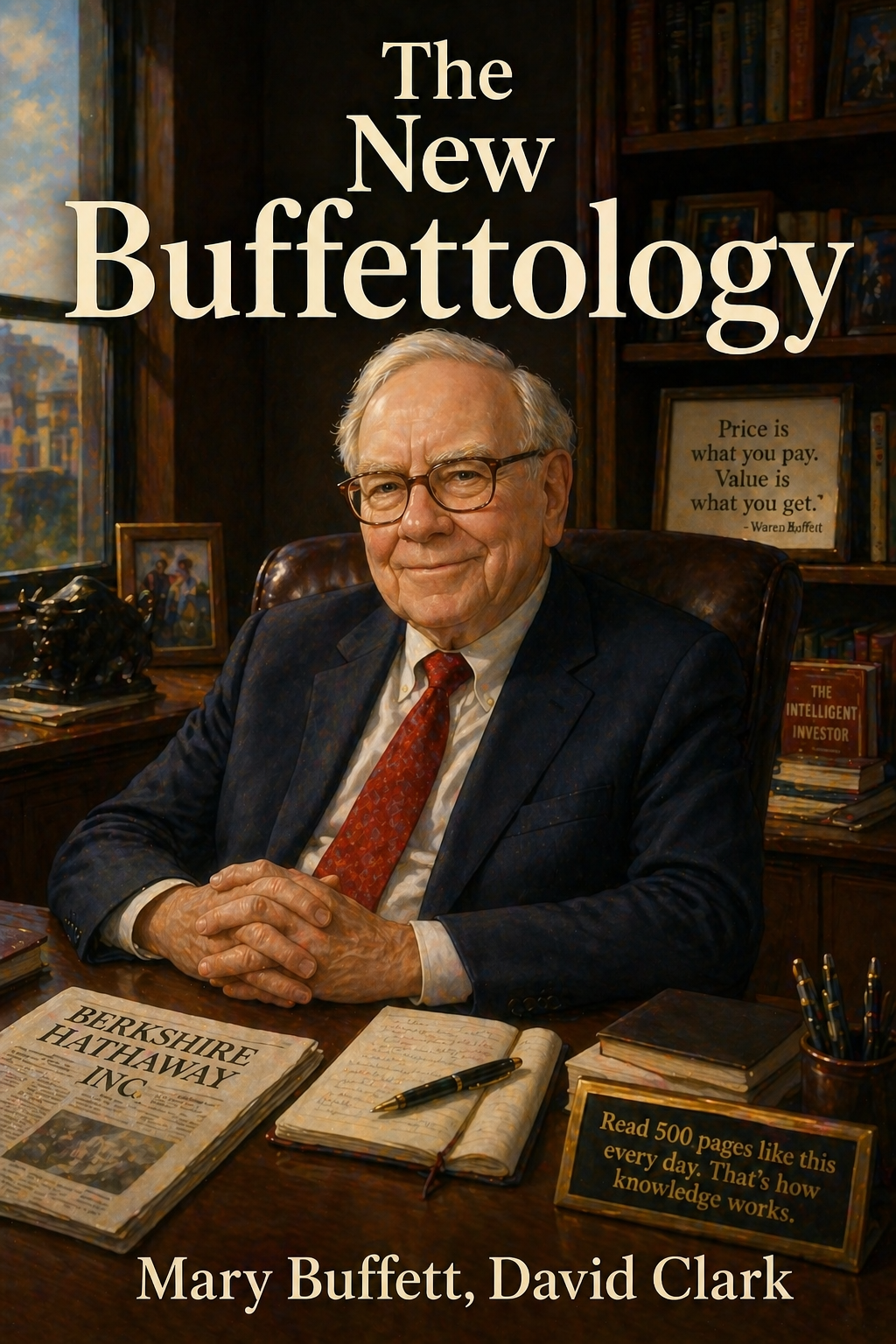
The New Buffettology
Chapter Summaries
What's Here for You
Unlock the secrets to Warren Buffett's unparalleled investing success with *The New Buffettology*. Prepare to journey beyond conventional market wisdom as Mary Buffett and David Clark reveal the strategies that have made Buffett America's #1 investor. This isn't about fleeting trends or risky gambles; it's about understanding the core principles of value investing. You'll learn how to identify companies with durable competitive advantages, capitalize on market mispricing, and think like Buffett himself. Discover how to profit from bad news, exploit market shortsightedness, and avoid dangerous business models. Arm yourself with Buffett's checklist for potential investments and his mathematical toolkit for uncovering hidden wealth. Whether you're a seasoned investor or just starting out, *The New Buffettology* offers a clear, insightful, and actionable path to building long-term wealth, even in today's complex market. Prepare to challenge conventional wisdom and embrace a time-tested approach that prioritizes value, patience, and a deep understanding of business fundamentals.
The Answer to Why Warren Doesn’t Play the Stock Market—and How Not Doing So Has Made Him America’s Number One Investor
In this chapter of *The New Buffettology*, Mary Buffett and David Clark unveil a paradox at the heart of Warren Buffett's success: he doesn't 'play' the stock market in the conventional sense. Buffett isn't swayed by fleeting trends or the siren song of momentum investing; instead, he exploits the very human tendencies that drive market volatility. The authors explain that Buffett sees the market as a stage where most participants are driven by short-term motivations, reacting to daily news cycles and the herd mentality. Buffett, in contrast, remains focused on the long-term economic value of a business, patiently waiting for market overreactions to create opportunities. It's as if he's watching a turbulent sea, waiting for the waves of panic and exuberance to reveal the hidden treasures beneath. Buffett understands that the market's short-sightedness often leads to the gross undervaluation of fundamentally sound companies, creating a fertile ground for his investments. While others chase the 'good news phenomenon,' Buffett embraces the 'bad news phenomenon,' recognizing that pessimism can be the most reliable fountain of wealth. The authors emphasize that Buffett’s genius lies in his ability to see what others miss: the enduring value of a business beyond the noise of the market. He avoids popular investments, understanding that today's darling can quickly become tomorrow's castoff. Instead, he seeks out companies temporarily tarnished by short-term setbacks, knowing that their long-term economic strength will eventually prevail. This contrarian approach, they argue, is the key to Buffett's extraordinary success, turning market foolishness into personal fortune. The market buys on good news and sells on bad; Buffett buys on bad news, and that has made all the difference. He’s not playing the same game.
How Warren Makes Good Profits Out of Bad News About a Company
In "The New Buffettology," Mary Buffett and David Clark unveil Warren Buffett's selective contrarian investment strategy, a method that thrives on market pessimism. The authors explain that Buffett doesn't merely chase falling stock prices; he seeks companies with exceptional business economics and a durable competitive advantage, priced attractively due to the market's shortsightedness. Unlike traditional contrarian investing, which focuses solely on beaten-down stocks, Buffett's approach targets specific companies with proven advantages, selling at a price that would entice a private business owner. Buffett recognized early that most investors, driven by short-term gains, react emotionally to bad news, creating buying opportunities. Buffett uses the analogy of Mr. Market, an erratic partner offering to sell his share of the business daily, to illustrate this point: buy when Mr. Market is pessimistic and offering a low price, not when he's exuberant. The authors highlight that the key is to identify companies with a durable competitive advantage—an economic engine strong enough to weather market storms. This advantage allows these companies to rebound from bad news, making them prime targets for Buffett's investments. It’s a world where patience and foresight triumph, where the ability to see beyond the immediate gloom unlocks extraordinary value. It’s not about predicting the next quarter, but understanding the enduring strength of a business, and acting when the market momentarily loses sight of it. In essence, Warren Buffett transforms market pessimism into a symphony of opportunity, turning bad news into a chorus of profits.
How Warren Exploits the Market’s Shortsightedness
In this chapter of *The New Buffettology*, Mary Buffett and David Clark reveal how Warren Buffett masterfully capitalizes on the stock market's inherent shortsightedness. Buffett, unlike traditional contrarian investors, doesn't simply pick from the bottom; he seeks out America's greatest businesses at bargain prices, made possible by the market's temporary pessimism. The authors illustrate this with a compelling analogy: two racehorses, one healthy and one sickly, both temporarily sidelined by the flu. The wise investor, like Buffett, bets on the fundamentally strong ‘healthy’ horse, understanding its long-term potential far outweighs the short-term setback. Buffett distinguishes between 'sickly' price-competitive businesses, mired in commodity-type markets, and 'healthy' businesses possessing a durable competitive advantage, often through brand-name recognition that allows them to act almost as monopolies. The ability to discern between these two types is paramount. Buffett's approach, inspired by baseball great Ted Williams, involves waiting patiently for the 'perfect pitch': a healthy, oversold company. He carves up the investment world like Williams carved up the strike zone, only swinging at opportunities within his circle of competence. This patience allows him to avoid mediocre businesses and wait for the exceptional ones, a strategy that has yielded returns such as a 5,230% increase in value with Geico and an astounding 8,468% with the Washington Post. Buffett's disciplined approach ensures that he only invests in companies with the economic fortitude to not only recover from market downturns but to thrive long-term, transforming temporary setbacks into opportunities for extraordinary gains. Ultimately, Buffett's success lies in his ability to recognize intrinsic value where others see only risk, turning market pessimism into his greatest advantage. He stands at the plate, bat in hand, as countless pitches fly by, waiting, always waiting, for the fat pitch.
How Companies Make Investors Rich: The Interplay Between Profit Margins and Inventory Turnover and How Warren Uses It to His Advantage
In this chapter of *The New Buffettology*, Mary Buffett and David Clark illuminate the fundamental ways companies generate wealth, a perspective central to Warren Buffett's investment strategy. The authors begin by likening business to a lemonade stand in the desert, emphasizing that profit stems from maximizing profit margins—the difference between cost and selling price—and optimizing inventory turnover, the speed at which products are sold. Buffett understands that a company thrives when it can command high prices due to a competitive advantage, or sell vast quantities, even at lower margins. Buffett and Clark illustrate the critical difference between a price-competitive business, where companies vie solely on price, leading to thin margins and slow turnover, and a business with a durable competitive advantage, capable of setting prices akin to a local monopoly. This distinction is paramount. Buffett seeks out companies poised to rebound from market downturns, those with the resilience born from strong margins or rapid turnover. A vivid example is Jack's lemonade, a superior product that creates its own demand, transcending mere price competition. The authors underscore that while the market may be efficient in the short term, it's long-term inefficiencies that Buffett exploits through selective contrarian investing. He seeks companies undervalued due to temporary setbacks, knowing their intrinsic strengths will prevail. Ultimately, Buffett avoids companies mired in low profit margins and sluggish inventory turnover, recognizing their vulnerability. The ability to discern a company with enduring advantages from a price-competitive one is the cornerstone of Buffett's success, allowing him to capitalize on market mispricing and secure long-term gains. Like a seasoned navigator charting a course through turbulent waters, Warren Buffett focuses on the distant horizon, understanding that true value lies not in fleeting trends, but in the enduring strength of a business model.
The Hidden Danger: The Type of Business Warren Fears and Avoids
In "The New Buffettology," Mary Buffett and David Clark unveil Warren Buffett's strategic aversion to price-competitive businesses, casting these ventures as siren songs for unwary investors. The authors paint a vivid picture: imagine a naturalist navigating a forest, meticulously identifying the 'mediocre creatures of commerce' that define price-competitive industries. These are the companies where the consumer's buying decision hinges almost entirely on price, leading to a relentless race to the bottom. Buffett understands that while these businesses might appear attractive during economic booms, their lack of a durable competitive advantage leaves them vulnerable when the tide turns. The authors highlight that businesses like airlines, raw foodstuff producers, and even automobile manufacturers often fall into this trap, forever caught in a cycle of razor-thin margins and fierce competition. Buffett's wisdom shines through: avoid the illusion of short-term gains in favor of long-term resilience. The authors stress that a price-competitive business is a gamble dependent on management's constant innovation to maintain even a slight edge, and should management falter, the entire enterprise teeters on the brink. Buffett's philosophy underscores that true wealth isn't built on fleeting success but on the enduring strength of a company's competitive moat. The chapter suggests that investors should recognize that companies burdened by massive long-term debt, often incurred to chase fleeting competitive advantages, are inherently riskier. Buffett's perspective is clear: a business with a poor reputation will likely remain so, regardless of managerial talent. The authors ultimately reveal that true contrarian investing, à la Buffett, means sidestepping the tempting but treacherous allure of price-competitive businesses, ensuring a portfolio grounded in lasting value rather than ephemeral gains.
The Kind of Business Warren Loves: How He Identifies and Isolates the Best Companies to Invest In
In this chapter of *The New Buffettology*, Mary Buffett and David Clark unveil Warren Buffett's core investment philosophy, emphasizing the paramount importance of a company's durable competitive advantage. As the authors explain, during the dotcom frenzy, Buffett remained steadfast, prioritizing businesses with enduring moats—those unique products or services that competitors struggle to replicate. Buffett views a company's competitive advantage as its castle, protected by a moat that fends off rivals, ensuring monopolylike profits. The authors highlight that this advantage can stem from a unique product, like Coca-Cola, or a unique service, like HR Block, each offering a regional monopoly. However, the true test lies in its durability; a company must maintain its edge without excessive capital expenditure. Buffett seeks predictability in earning power, favoring companies whose consistent products translate to consistent profits, allowing them to reinvest earnings for shareholder benefit rather than merely sustaining their position. The authors contrast Hershey's, with its unchanging chocolate recipe, against Intel, a company requiring constant innovation and massive R&D spending to stay relevant. Buffett shuns businesses reliant on fleeting intellectual talent, exemplified by his experience with Salomon Brothers, where key employees held the real competitive advantage and could easily defect. The authors underscore that true durable advantage resides in products or services so entrenched in consumers' minds that they remain essential regardless of economic shifts or management quality. Ultimately, Buffett's strategy hinges on identifying companies with products or services that have stood the test of time, ensuring predictable profits even in the face of market volatility; a principle that guides his investment decisions.
Using Warren’s Investment Methods to Avoid the Next High-Tech Massacre
In "The New Buffettology," Mary Buffett and David Clark explore Warren Buffett's investment philosophy, particularly his aversion to investing in rapidly transforming industries like the Internet. The authors reveal that Warren avoids these sectors because they rarely establish durable competitive advantages due to intense competition, a critical element of his investment strategy. Buffett sees the allure of quick riches in these industries as a siren song, drawing investors into bubbles that inevitably burst, leaving behind only bitter memories, like the countless airlines that have declared bankruptcy. Instead of chasing fleeting trends, Buffett focuses on businesses with a proven track record and sustainable earnings. Buffett's approach involves assessing whether he would buy the entire company if he had the capital, a thought experiment that forces investors to consider the true value of the business rather than speculative stock prices. The authors illustrate this with a comparison between Yahoo! in 2000, which had a high market cap but low earnings, and Allstate, an insurance giant with solid profitability. By comparing the potential returns against safer investments like U.S. Treasury bonds, Buffett determines whether the investment makes sound business sense. This method underscores a core principle: avoid buying even a single share if the entire company isn't worth purchasing at its current market price. This contrarian approach, often shunned by Wall Street, prioritizes long-term value over short-term gains, offering a pathway to avoid the pitfalls of speculative bubbles and ensure sustainable investment success, as steady as a gently flowing stream compared to the turbulent rapids of tech stocks.
Interest Rates and Stock Prices—How Warren Capitalizes on What Others Miss
In this chapter of *The New Buffettology*, Mary Buffett and David Clark illuminate the intricate dance between interest rates and stock prices, a waltz that Warren Buffett understands deeply. The authors explain that investment returns are always relative; the earnings of a business are constantly weighed against the returns from other investment vehicles, like bonds. Imagine a seesaw, constantly adjusting to find equilibrium. Buffett believes a business is ultimately worth only what it can earn over the investor's period of ownership, no more, no less. To illustrate this, the authors pose a scenario: a business earning $100,000 annually. Its value isn't fixed but depends on prevailing interest rates. If AAA-rated corporate bonds yield 10%, offering a similar return demands a business selling at or below $1 million; otherwise, the bonds are the wiser investment. Conversely, when interest rates drop, say to 5%, the business becomes more attractive, creating upward pressure on its selling price. Buffett and Clark emphasize that the Federal Reserve's actions—lowering or raising interest rates—directly influence the value of businesses and, consequently, stock prices. Lower rates stimulate the economy, increase business values, and drive stock prices up, while higher rates cool the economy, decrease business values, and drive stock prices down. It's a delicate, often calculated dance, yet sometimes the market lags, especially in bubble situations where momentum overshadows earnings. The Fed, however, remains focused on broader economic health, using interest rates as a tool to manage inflation and recession, not to manipulate stock prices directly. Ultimately, the authors underscore the critical lesson: higher interest rates diminish the present value of a business's future earnings, pushing stock prices down, while lower rates amplify that value, driving prices up; a fundamental principle for any Buffett-inspired investor to grasp.
Solving the Puzzle of the Bear/Bull Market Cycle and How Warren Uses It to His Advantage
In "The New Buffettology," Mary Buffett and David Clark dissect Warren Buffett's selective contrarian investment strategy, revealing how he capitalizes on the predictable chaos of the bear-bull market cycle; it's a strategy not for the faint of heart, but for those who can discern value amidst widespread panic. The authors explain that Buffett's approach hinges on identifying companies with durable competitive advantages and then patiently waiting for the ideal buying opportunity—a price dictated by market conditions, not emotional exuberance. Buffett understands that true bear markets, though rare, are the most fertile ground for spectacular buys, offering companies with solid fundamentals at a fraction of their intrinsic worth, like a treasure chest unearthed after a storm. The key, as Buffett demonstrates, is to be fearful when others are greedy and greedy when others are fearful, using bull markets to validate his bear market investments. Buffett and Clark highlight that stock market corrections and panic selling during bull markets, often triggered by events seemingly disconnected from a company's underlying economics, present further buying opportunities, provided the bull market hasn't yet bubbled. The authors caution that the top of the bull market is signaled when earnings are dismissed as a valuation metric, replaced by total sales and revenues, and when value-oriented investors exit the game, a sign that a crash and subsequent bear market are imminent. Buffett, armed with cash, stands ready to exploit the irrational lows created by the market's overreactions, focusing on industries rejected by momentum investors. Finally, Buffett and Clark underscore that a splitting market, rising interest rates, and value managers leaving are all signs that a bubble is about to burst, creating an opportunity to buy durable-competitive-advantage businesses at prices that make sound business sense, though recovery from such crashes can take years, but the patient investor will be rewarded.
How Warren Discerns Buying Opportunities Others Miss
In this chapter of *The New Buffettology*, Mary Buffett and David Clark explore Warren Buffett's knack for spotting investment opportunities that others overlook, opportunities often born from widespread fear or misunderstanding. The authors highlight how Buffett strategically capitalizes on industry recessions, reminding us that during these downturns, even strong companies can see their stock prices plummet, creating a fertile ground for value investors. Like a seasoned chess player, Buffett anticipates the long game, recognizing that well-capitalized leaders can weather the storm and emerge stronger. Buffett and Clark then pivot to individual company calamities, noting that sometimes, even brilliant companies make mistakes. The key, they emphasize, is to discern whether these errors are fatal or merely temporary setbacks. Buffett's investments in Geico and American Express serve as prime examples, illustrating how a durable competitive advantage can allow a company to recover from near-catastrophic events, rewarding the patient investor who sees beyond the immediate crisis. Structural changes within a company, such as mergers or spin-offs, can also create buying opportunities, as these events often lead to short-term earnings hits and depressed stock prices. Finally, the authors address the war phenomenon, observing that the uncertainty and fear associated with armed conflicts invariably drive stock prices down across the board. Buffett views these moments as golden opportunities, understanding that while fear may disrupt the economy in the short term, life, and business, eventually resume. The authors underscore that these buying opportunities arise from a combination of factors: market corrections, industry recessions, individual calamities, structural changes, and war, each capable of driving prices down, and together creating a perfect storm for the discerning investor.
Where Warren Discovers Companies with Hidden Wealth
In this chapter of *The New Buffettology*, Mary Buffett and David Clark illuminate how Warren Buffett identifies companies possessing 'durable competitive advantages'—a form of hidden wealth forged through competitive struggle. The authors explain that this advantage isn't always about patents or copyrights; sometimes, it emerges when a price-competitive business evolves into a regional monopoly, perhaps like a newspaper that outlasts its rivals, inheriting a debt-free balance sheet and the power to set rates. Buffett and Clark underscore that product specialization can also carve out a brand-name niche, exemplified by Porsche's success in positioning its luxury cars as deliberately expensive, thus boosting profit margins. However, the chapter tempers this with a reminder that even durable advantages can erode, as seen with the rise of countless television channels challenging the dominance of the original networks. Still, Buffett's investment in Philip Morris, buoyed by the enduring popularity of Marlboro cigarettes, demonstrates the resilience of a strong brand. Buffett and Clark then categorize businesses ripe for durable competitive advantages: those fulfilling repetitive consumer needs with branded products, those in the advertising industry (essential for manufacturers), those offering recurring consumer services, and low-cost producers of everyday goods. The authors point to fast-food restaurants, patented prescription drugs, and brand-name foods and beverages as prime examples, noting Buffett's investments in companies like McDonald's, Coca-Cola, and Anheuser-Busch. Buffett and Clark cast advertising as a 'toll bridge' that manufacturers must cross to reach consumers, highlighting Buffett's investments in Interpublic and the Washington Post Company. Furthermore, they explore the appeal of companies providing repetitive consumer services, such as Service Master and HR Block, as well as low-cost producers like Geico and Nebraska Furniture Mart, which achieve dominance through price and volume. To illuminate Warren's approach, the authors share instances of his strategic investments during market downturns, such as his purchase of Bristol-Myers Squibb during the 1993 healthcare scare or Furniture Brands International after the 1999 bubble burst, revealing his knack for spotting undervalued companies with enduring advantages.
Financial Information: Warren’s Secrets for Using the Internet to Beat Wall Street
In this chapter of *The New Buffettology*, Mary Buffett and David Clark unveil Warren Buffett's deep-seated obsession with numbers, a fascination that has evolved from childhood counting games into a sophisticated strategy for investment. The authors reveal how Buffett, even in an age of instant information, maintains his ritualistic reading habits, devouring financial reports with the same zeal he once applied to memorizing license plates. The digital age, however, hasn't been ignored; Buffett leverages online resources like Bloomberg's Professional Service and Value Line to access critical financial data. Buffett emphasizes the importance of understanding a company's financial history, scrutinizing annual reports, 10-Ks, and 10-Qs, seeking at least a decade's worth of data to discern patterns in return on capital, earnings, and debt. A central tension emerges: the struggle to balance the ease of modern data retrieval with the necessity of deep, critical analysis. Buffett's approach isn't just about finding numbers; it's about understanding the underlying business, its competitive advantages, and the integrity of its management. Buffett and Clark stress that even without a computer, one can replicate Buffett’s information-gathering process by visiting libraries, accessing resources like Value Line and Moody's, and directly contacting companies for annual reports. The authors highlight the 'scuttlebutt' approach, where investors directly engage with a company's competitors and customers to gain unfiltered insights, a practice exemplified by Buffett's own deep dive into Geico's business model after a chance encounter facilitated by a janitor. It's a reminder that sometimes, the most valuable information comes from direct human interaction, from asking the right questions and listening intently to the answers, and by understanding the nature of the business, one can assess its durability and potential for long-term success. Buffett's circle of competence serves as a guiding principle: invest only in what you understand, avoiding the allure of complex or rapidly evolving industries where predicting future performance becomes a guessing game. Ultimately, the authors empower the average investor, turning the tables on Wall Street by showing how readily available information, coupled with diligent research and a healthy dose of skepticism, can pave the way for informed and profitable investment decisions.
Warren’s Checklist for Potential Investments: His Ten Points of Light
In "The New Buffettology," Mary Buffett and David Clark unveil Warren Buffett's meticulous approach to identifying companies with durable competitive advantages, those resilient enough to thrive amidst market volatility. Buffett emphasizes the need for a prepared game plan, enabling confident action when others panic, and the wisdom to capitalize on Mr. Market’s irrational offers. The authors stress that a consistently high return on shareholders equity, typically above 12%, signals a strong competitive edge, while low returns often mark price-competitive businesses. However, Buffett also considers the return on total capital, a safety net against manipulated equity bases, seeking consistency in both metrics, especially avoiding banks or financial institutions unless their return on assets exceeds 1%. Buffett's next filter involves examining historical earnings per share, favoring upward trends indicative of durability, while cautioning against erratic patterns common in price-competitive sectors. He approaches debt with nervousness, viewing low long-term debt relative to net earnings as a sign of financial strength, a hallmark of companies with enduring advantages. Buffett then assesses the product or service itself, favoring brand-name offerings that customers repeatedly need, providing a sustainable competitive edge. Organized labor, the authors warn, can erode profits in price-competitive businesses, a situation Buffett avoids by focusing on companies with inherent economic strength. A key consideration is the company's ability to raise prices with inflation without losing demand, maintaining profitability and value. Operational costs also matter; Buffett prefers companies that efficiently deploy retained earnings to enhance shareholder wealth, often demonstrated through consistent share repurchase programs. Ultimately, Buffett seeks companies where retained earnings increase the market value, a testament to sound capital allocation and lasting competitive advantages, turning potential bad news into golden buying opportunities. Like panning for gold, the key is to sift through the stream of market noise, seeking those rare, unmistakable hunks of value.
How to Determine When a Privately Held Business Can Be a Bonanza
In this chapter of *The New Buffettology*, Mary Buffett and David Clark illuminate Warren Buffett's strategy of acquiring privately held businesses, revealing how he identifies hidden bonanzas often overlooked by the broader market. The authors begin by highlighting Buffett's knack for finding companies with durable competitive advantages—regional monopolies or brand-name products—that, while not always scalable for large corporations, become cash-generating machines within Berkshire Hathaway. It's like discovering a secret garden where AAA bonds bloom, offering returns far exceeding the conventional market. Buffett’s approach is not just about the numbers; it's about trust and preserving the unique cultures these family-owned businesses have cultivated, a soft power that gives Berkshire a competitive edge. They illustrate this with the acquisition of Nebraska Furniture Mart from Mrs. B, a deal sealed on a handshake, showcasing Buffett's trust and her deep connection to the business. Buffett and Clark then transition to See's Candy, a brand-name confectionery that, while not a monopoly, held a special place in its customers' hearts, demonstrating the power of brand loyalty. The authors explain how Berkshire’s acquisition strategy extends to public companies as well, citing Johns Manville and Benjamin Moore as examples where Buffett recognized and capitalized on undervalued potential. A crucial element of Buffett’s strategy, the authors emphasize, lies in the tax advantages gained by acquiring entire companies, avoiding dividend taxes and optimizing capital gains. It's a lesson in seeing the whole chessboard, not just individual pieces. The chapter underscores that these privately held businesses, with their durable competitive advantages, act as cash cows for Berkshire, acquired at prices that belie their long-term value, creating a portfolio of investments poised to flourish even in turbulent economic climates.
Warren’s Secret Formula for Getting Out at the Market Top
In this chapter of *The New Buffettology*, Mary Buffett and David Clark dissect Warren Buffett’s approach to selling stocks, a strategy as crucial as his famed buying prowess, revealing that even the Oracle of Omaha knows when to exit. The central tension lies in balancing long-term commitment to companies with durable competitive advantages against the market's irrational exuberance. Buffett, they explain, doesn't blindly hold forever; instead, he watches for signals. One key moment to sell arrives when the market inflates a company's price to unsustainable levels, far beyond what its underlying economics justify, like paying sixty-two times earnings for Coca-Cola. Buffett understood that waiting for the music to stop, before the bubble bursts, is paramount. Another trigger is the emergence of better opportunities. It's not about abandoning a good company for a bad one—selling flowers to buy weeds—but rather reallocating capital to situations with superior potential returns. Buffett also remains vigilant about changes in a company's business model or competitive landscape. This is like a seasoned sailor constantly scanning the horizon for storms, ready to adjust course when the winds shift. The authors illuminate Buffett's strategic brilliance through the General Reinsurance deal, a masterclass in swapping overvalued assets for undervalued ones, all while minimizing taxes. Finally, Buffett also sells when a stock hits its target price, especially in arbitrage situations. The core insight is that investing isn’t just about picking the right companies but also about understanding market cycles, economic realities, and the ever-evolving business environment, selling when the odds shift against you, and always acting with a businesslike perspective, unemotionally.
Where Warren Buffett Is Investing Now!
In this illuminating chapter, Mary Buffett and David Clark guide us through Warren Buffett's investment strategies, revealing both recent and historical investments. The central tension lies in identifying companies with durable competitive advantages and knowing when to strike, a principle Buffett emphasizes repeatedly. It's not enough for a company to simply *be* great; the price has to be right, a concept Buffett refers to as waiting for 'Mr. Market' to become pessimistic. The authors highlight specific examples, such as Aegis Realty and Dun & Bradstreet, illustrating how Buffett capitalizes on market inefficiencies, especially during spin-offs or periods of irrational exuberance elsewhere, like the tech boom. One key insight is understanding that a company's intrinsic value, coupled with patience, often yields substantial returns, as seen with Buffett's investment in First Data Corp during a market contraction. Another crucial element is recognizing the importance of management; Buffett's investment in American Express during Harvey Golub's tenure exemplifies betting on capable leadership to revitalize a fundamentally sound business. The chapter underscores the significance of 'scuttlebutt,' or gathering information through direct observation, as Buffett likely did with Furniture Brands International at the Nebraska Furniture Mart. Buffett's acquisition of Johns Manville, a company burdened by asbestos litigation but possessing strong underlying assets, demonstrates his willingness to navigate complex situations for long-term value. Furthermore, the chapter highlights the benefit of buying during recessions or panic sell-offs, using examples like Cleveland-Cliffs Iron Company, where a downturn in the steel industry created a buying opportunity. Buffett’s historical investments, such as Coca-Cola and Disney, reinforce the power of holding companies with durable competitive advantages over the long term, even through market cycles. Finally, the authors stress the importance of understanding a company's financials and industry dynamics, advocating for resources like Value Line and EDGAR to conduct thorough research. The chapter paints a vivid picture: imagine Wall Street as a crowded marketplace, filled with fleeting trends, while Buffett calmly assesses value, waiting for the opportune moment to invest, much like a seasoned chess player anticipating their opponent's moves. Ultimately, the chapter encourages investors to embrace patience, conduct thorough research, and focus on the long-term potential of companies with enduring competitive advantages, echoing Buffett's philosophy of selective contrarianism.
Stock Arbitrage: Warren’s Best-Kept Secret for Building Wealth
Mary Buffett and David Clark unveil a lesser-known facet of Warren Buffett's investment strategy: stock arbitrage, a technique involving investments in corporate sellouts, reorganizations, mergers, spin-offs, and hostile takeovers. The authors reveal that Buffett, early in his career, discovered the low-risk, high-reward potential of arbitrage through Graham's firm, achieving an average annual return of 20%. The digital revolution has democratized this once exclusive domain, leveling the playing field for individual investors, where commission fees have plummeted, and information access is now instantaneous, a stark contrast to the laborious methods Buffett once employed, sifting through newspapers daily. Buffett and Clark emphasize that arbitrage opportunities, or 'workouts' as Buffett calls them, become particularly attractive when long-term investment prospects wane, offering a more profitable use of capital. They highlight that in the Buffett Partnership's early years, up to 40% of funds were allocated to arbitrage, proving vital during market downturns. Buffett learned to favor 'cash payments on sale or liquidation,' minimizing risk by investing only after a deal's announcement, avoiding speculative rumors that often lure Wall Street. The authors illustrate this with the example of RJR Nabisco, where Buffett profited handsomely from a management buyout offer. They caution that the key to successful arbitrage lies in accurately assessing the time frame for a transaction's completion; the longer the duration, the smaller the annual return, and potential pitfalls like shareholder rejection or regulatory intervention loom large. However, Buffett mitigates these risks by diversifying across numerous arbitrage positions, banking on the collective gains to outweigh isolated losses. Buffett and Clark demystify the process of finding arbitrage opportunities, pointing to online resources like mergerstat.com and msn.com, enabling investors to identify cash-based acquisitions. They provide a step-by-step guide, from identifying a potential deal to calculating the annual rate of return using financial calculators, but they stress that the investor should confirm the deal is still on. The chapter is a guide, but also a warning: arbitrage can yield substantial returns, but only if approached with diligence, caution, and a keen understanding of the risks involved. It's about embracing calculated risks over speculative gambles, a principle that Buffett has followed throughout his career.
For the Hard-Core Buffettologist: Warren Buffett’s Mathematical Equations for Uncovering Great Businesses
In this chapter of *The New Buffettology*, Mary Buffett and David Clark unveil Warren Buffett's mathematical toolkit, essential for discerning a company's true worth. They stress that paying the lowest possible price for a great business is paramount; the authors illustrate with the example of H&R Block, demonstrating how varying purchase prices significantly impact long-term returns—a difference of over $200,000 on a $100,000 investment over a decade, a stark reminder: pay more, earn less. Buffett and Clark introduce a crucial first step: scrutinizing a company's earnings per share over a decade to gauge predictability—consistent upward trends signal strength, while erratic earnings are a red flag. Imagine sifting through financial statements, the numbers blurring until a clear pattern emerges, revealing the company's story. They then present the concept of 'initial rate of return,' viewing earnings in proportion to share ownership, irrespective of dividends, and emphasize that a higher initial rate, achieved through a lower purchase price, accelerates wealth accumulation. Buffett and Clark show how to calculate the annual compounded rate of growth of per share earnings over both ten-year and five-year periods to assess management's effectiveness, adjusting for temporary setbacks by looking at the broader trend. The authors discuss how Buffett values companies relative to treasury bonds, dividing per share earnings by the treasury bond yield to establish a benchmark, understanding that all investments compete for capital. They also detail how to project a stock's future value using its historical per share earnings growth rate, cautioning that this isn't about pinpointing an exact future price, but rather estimating a long-term annual compounding rate of return. Finally, Buffett and Clark explore Buffett's preference for companies with high returns on equity, likening a stock to an 'equitybond' where earnings constitute the yield, and retained earnings fuel further growth. They emphasize that companies with a durable competitive advantage that consistently earn high rates of return on retained earnings are often bargain buys at seemingly high price-to-earnings ratios.
Thinking the Way Warren Does: The Case Studies of His Most Recent Investments
In this chapter from *The New Buffettology*, Mary Buffett and David Clark guide us through Warren Buffett's investment strategies via detailed case studies, offering a masterclass in value investing. They begin by dissecting Buffett's 2000 investments in HR Block and La-Z-Boy, alongside revisiting Gannett Corporation and Freddie Mac from the original *Buffettology*. The authors emphasize the importance of understanding a company's durable competitive advantage, a protective moat that shields it from competitors, as exemplified by HR Block's dominance in tax preparation; Buffett seeks businesses whose fundamental services remain unchanged over time. Buffett's detective work involves assessing whether a company is conservatively financed, examining its earnings trends, and confirming its focus on core competencies; the stability of La-Z-Boy, a name synonymous with reclining chairs, underscores this point. The narrative tension rises as Buffett's methodology demands not just understanding the business but also determining if its stock is available at a sensible price, a calculation involving comparing a stock's initial rate of return to government bonds, viewing the stock as an 'equitybond' with a projected growth rate. The authors illustrate how Buffett projects future earnings by analyzing historical data, return on equity, and management's capital allocation decisions. Buffett's approach to Gannett Corporation highlights the enduring appeal of newspapers with local monopolies and manageable capital expenditures. The shadow of risk, however, always looms; Buffett's eventual departure from Freddie Mac underscores the need for vigilance, even with seemingly secure investments. Buffett's analytical rigor, his ability to see companies as collections of durable strengths, and his disciplined approach to valuation emerge as the keys to his success, a beacon for any investor navigating the complexities of the market.
Putting Buffettology to Work for You
In "The New Buffettology," Mary Buffett and David Clark guide us through Warren Buffett's investment philosophy, emphasizing a shift in mindset. The authors present a series of questions designed to help investors think like Buffett, beginning with the critical assessment of a company's durable competitive advantage. Buffett insists on simplicity, suggesting that if you can't explain a company's advantage to a child, it likely doesn't exist; this initial filter guards against complexity and uncertainty, a common pitfall in investing. Next, Buffett and Clark stress the importance of understanding a product's function to gauge its potential obsolescence, a concept Buffett fears, visualizing potential futures where the product fades into irrelevance. The authors then transition into capital allocation, highlighting the need for companies to invest wisely within their expertise, questioning whether conglomerates are expanding into durable, advantageous businesses or diluting their strength with price-competitive ventures. Earnings history becomes a crucial indicator, with consistent growth signaling health, while erratic performance demands careful scrutiny to discern one-time events from systemic issues. A high return on equity is non-negotiable, acting as the engine for long-term growth, and a high return on total capital echoes this sentiment, ensuring the company's efficiency. Conservative financing is essential, a financial cushion to weather storms, and Buffett favors companies actively buying back their shares, increasing ownership without further investment. The ability to raise prices with inflation is a key indicator of pricing power, separating commodity businesses from those with true market influence, and large capital expenditures are a red flag, potentially indicating a business vulnerable to obsolescence. Finally, the authors advocate for exploiting market downturns and assessing a company's stock price against its intrinsic value, calculated through projected annual compounding returns, and comparing these returns against U.S. Treasury bonds. Buffett and Clark emphasize that patience is paramount, urging investors to wait for the right opportunity, a diamond in the rough served on a platter of gold, rather than rushing into mediocre deals.
Conclusion
"The New Buffettology" distills Warren Buffett's investment philosophy into a strategy centered on exploiting market irrationality. It's about identifying companies with durable competitive advantages—those operating like monopolies—and capitalizing on market pessimism to acquire them at undervalued prices. The emotional lesson is to detach from market sentiments ('Mr. Market') and embrace a contrarian mindset, being greedy when others are fearful. Practical wisdom lies in understanding financial statements, prioritizing high returns on equity, and recognizing the impact of interest rates. Ultimately, Buffett's approach is about long-term value, patience, and investing within one's 'circle of competence,' ensuring a deep understanding of the business before committing capital. It's about buying great businesses at great prices, not just chasing short-term gains.
Key Takeaways
Seek companies with a durable competitive advantage that allows them to set prices and maintain profitability.
Warren Buffett's investment strategy centers on exploiting the short-term focus of most market participants, turning their reactions to news into opportunities to acquire undervalued companies.
The stock market's tendency to overreact to short-term news, either positive or negative, often creates a disconnect between a company's stock price and its true long-term economic value.
Warren Buffett's success is built on his ability to identify and invest in businesses with strong long-term economics that are temporarily undervalued due to market pessimism.
Avoiding popular investments and waiting for short-term bad news to drive down the price of a fundamentally sound business is a key element of Warren Buffett's investment philosophy.
Pessimism in the stock market, though often feared, can be a valuable source of opportunity for investors who focus on long-term value rather than short-term gains.
Employ a selective contrarian investment strategy, focusing on companies with durable competitive advantages, not just falling stock prices.
Recognize that market pessimism and short-sightedness create opportunities to buy exceptional businesses at discount prices.
Understand that the stock market's emotional reactions to bad news can drive down prices, presenting buying opportunities for patient investors.
Seek companies with a 'durable competitive advantage' strong enough to recover from temporary setbacks and market pessimism.
Adopt a long-term perspective, ignoring short-term market fluctuations and focusing on the intrinsic value of the business.
Use the 'Mr. Market' analogy to detach emotionally from market sentiments and make rational investment decisions based on value.
To exploit market shortsightedness, focus on companies with the economic resilience to thrive beyond temporary negative news.
Prioritize companies with 'durable competitive advantages'—those that operate like monopolies due to brand recognition or unique offerings.
Distinguish between 'sickly,' price-competitive businesses and 'healthy' businesses with long-term growth potential to make informed investment decisions.
Adopt a patient investment strategy, waiting for oversold, high-quality companies rather than settling for mediocre opportunities.
Inspired by Ted Williams, focus on your 'strike zone' of expertise, only investing in companies you deeply understand and that meet your criteria.
Recognizing the difference between short-term market fluctuations and long-term business value is crucial for successful investing.
Maximize profit by focusing on either high profit margins or high inventory turnover, or ideally both.
Avoid businesses that compete solely on price, as they typically yield low profit margins and slow inventory turnover.
Understand that the stock market, while efficient in the short term, presents opportunities for long-term investors who can identify undervalued companies.
Differentiate between companies with true competitive advantages and those in price-competitive industries to make informed investment decisions.
Avoid investing in price-competitive businesses, regardless of how attractive the initial opportunity appears, as their lack of durable competitive advantages makes them highly vulnerable.
Recognize that businesses where price is the primary driver of consumer choice often face relentless competition, leading to low profit margins and unstable financial performance.
Understand that companies burdened with significant long-term debt, often accumulated to maintain competitiveness, are at greater risk during economic downturns.
Differentiate between short-term gains during economic booms and the long-term resilience offered by companies with durable competitive advantages.
Acknowledge that even exceptional management cannot transform an inherently poor business into a successful one; the underlying business model is paramount.
Focus on identifying and investing in companies that possess the ability to increase prices along with demand, signifying a true competitive advantage and market dominance.
A durable competitive advantage, not just growth potential, is the cornerstone of Warren Buffett's investment strategy, ensuring long-term profitability.
Companies with unique, unchanging products or services possess a stronger, more durable competitive advantage than those reliant on constant innovation or intellectual talent.
The ability to maintain a competitive advantage without significant capital expenditure is crucial for maximizing shareholder returns and ensuring long-term financial health.
Predictability in a business's earning power, derived from consistent products or services, allows for greater certainty in investment outcomes.
A company's competitive advantage should be deeply entrenched in consumer behavior, ensuring consistent demand regardless of market fluctuations or management changes.
Durable competitive advantage is paramount; avoid industries undergoing rapid transformation where such advantages are difficult to establish, as intense competition erodes profitability.
Evaluate a stock by asking if you would buy the entire company at its current market capitalization, ensuring the business's intrinsic value justifies the investment.
Compare potential investment returns to safer alternatives like treasury bonds to gauge whether the risk-reward profile is favorable, avoiding overvaluation.
Prioritize established businesses with proven earnings over speculative ventures, as economic reality will eventually correct inflated stock prices.
Focus on the long-term value of a business rather than short-term stock price fluctuations, aligning investment decisions with sound business principles.
Investment returns are relative; the earnings of a business must always be compared to returns from other investments like bonds to determine its true value.
A business is worth only what it can earn over the investor's period of ownership; this earning potential, relative to other investment options, dictates its selling price.
Federal Reserve actions—lowering or raising interest rates—directly impact business values and stock prices; lower rates stimulate growth and increase values, while higher rates cool the economy and decrease values.
The market's reaction to interest rate changes isn't always immediate, especially during speculative bubbles where momentum can temporarily overshadow fundamental earnings.
Higher interest rates diminish the present value of a business's future earnings, driving stock prices down, while lower rates amplify that value, driving prices up.
Identify companies with durable competitive advantages and wait for bear markets to buy them at prices below their intrinsic value.
Cultivate a contrarian mindset: be fearful when others are greedy and greedy when others are fearful.
Recognize stock market corrections and panic selling as potential buying opportunities if a bull market has not yet bubbled.
Be alert to the signs of a market bubble, such as earnings being dismissed in favor of revenue, and value investors leaving the game.
Prepare to invest in sectors rejected by momentum investors when a market bifurcation occurs.
Understand that while a bubble bursting can lead to significant losses, it also presents opportunities to acquire durable-competitive-advantage businesses at discounted prices.
Adopt a long-term perspective, recognizing that recovery from bubble bursts can take years, but patient, value-oriented investments will eventually be rewarded.
Industry recessions can create buying opportunities in well-capitalized companies, as temporary setbacks often lead to undervalued stock prices.
Individual company calamities, if not fatal, can present chances to invest in companies with durable competitive advantages at discounted prices.
Structural changes within a company, such as mergers or spin-offs, can lead to temporary earnings hits and undervalued stock prices, creating buying opportunities.
War and geopolitical uncertainty often drive down stock prices, presenting opportunities to invest in fundamentally sound companies at bargain prices.
The ability to discern between temporary setbacks and irreversible damage is crucial for identifying undervalued investment opportunities.
Seek companies with durable competitive advantages, which can arise from regional monopolies, product specialization, or brand strength.
Recognize that industries fulfilling repetitive consumer needs with branded products, advertising, recurring services, and low-cost production often harbor companies with lasting advantages.
Understand that advertising acts as a 'toll bridge,' creating a necessary expense for manufacturers and a potential investment opportunity.
Identify low-cost producers who can establish dominance through economies of scale and buying power, creating barriers to entry for competitors.
Capitalize on market downturns to acquire shares of fundamentally strong companies at discounted prices, mirroring Buffett's strategy of buying during periods of fear or uncertainty.
Leverage readily available online resources to access comprehensive financial data for informed investment decisions.
Prioritize understanding a company's long-term financial history, analyzing trends in return on capital, earnings, and debt over at least a decade.
Balance the convenience of digital data with the necessity of critical analysis to identify sustainable competitive advantages and management integrity.
Replicate Buffett's information-gathering process, even without a computer, by utilizing library resources and directly contacting companies.
Employ the 'scuttlebutt' approach by engaging with competitors and customers to gain unfiltered insights into a company's operations and market position.
Invest within your 'circle of competence,' focusing on businesses you thoroughly understand to mitigate risk and improve long-term investment outcomes.
Prioritize companies with consistently high returns on shareholders equity (above 12%) and total capital as indicators of a durable competitive advantage.
Scrutinize historical earnings per share for an upward trend, avoiding erratic patterns that suggest a price-competitive business.
Favor companies with low long-term debt relative to net earnings, signaling financial strength and resilience.
Seek brand-name products or key services that customers frequently need, ensuring a sustainable competitive advantage.
Assess a company's ability to raise prices with inflation without demand decline, protecting profitability and value.
Evaluate how effectively a company deploys retained earnings to enhance shareholder wealth, as demonstrated through share repurchase programs.
Invest in companies where retained earnings increase the market value, reflecting sound capital allocation and lasting competitive advantages.
Privately held businesses with regional monopolies or strong brand recognition can offer substantial returns if acquired at the right price, often outperforming publicly traded counterparts.
Maintaining the existing management and culture of acquired family-owned businesses can be a competitive advantage, fostering trust and ensuring continued operational success.
Acquiring entire companies offers significant tax advantages, allowing Berkshire to avoid dividend taxes and optimize capital gains, enhancing overall profitability.
A durable competitive advantage, whether through low-cost leadership, brand loyalty, or a unique distribution network, is a key indicator of a business's long-term value and potential for generating consistent cash flow.
Focusing on pretax earnings and potential growth rates allows for a clearer assessment of a business's true profitability and investment potential, independent of market fluctuations.
Sell when a company's market price becomes detached from its underlying economic value, indicating irrational market exuberance.
Reallocate capital from good companies to better opportunities, but avoid selling strong businesses for weaker ones.
Continuously monitor investments for changes in their business model or competitive environment that could erode their durable competitive advantage.
Consider selling when a stock reaches its target price, particularly in arbitrage situations or special situations.
Compare the expected earnings from holding a stock over the next ten years with the potential returns from investing in bonds to make informed selling decisions.
Adopt a business-like perspective by focusing on the underlying economics of a company rather than short-term price fluctuations.
Identify companies with durable competitive advantages and wait for the right price to maximize returns.
Capitalize on market inefficiencies, such as spin-offs or irrational exuberance, to find undervalued opportunities.
Invest in companies with strong leadership and management teams to revitalize fundamentally sound businesses.
Gather information through direct observation and 'scuttlebutt' to gain a deeper understanding of a company's operations.
Consider complex situations, like companies facing litigation, if the underlying assets and long-term value are compelling.
Buy during recessions or panic sell-offs to acquire quality companies at discounted prices.
Focus on long-term potential and hold companies with durable competitive advantages through market cycles for substantial gains.
Stock arbitrage, once exclusive to institutional investors, is now accessible to individuals due to lower transaction fees and increased information availability online.
Arbitrage opportunities are most attractive when long-term investment prospects are limited, offering a more profitable short-term use of capital.
The annual rate of return in arbitrage is inversely proportional to the time it takes for the transaction to close; shorter timeframes yield higher returns.
Investing in announced deals, rather than acting on rumors, significantly reduces risk and aligns with Warren Buffett's conservative approach.
Diversifying across multiple arbitrage positions helps mitigate the impact of potential losses from deals that fail to close.
Online resources like Mergerstat.com and MSN Money provide the necessary tools to identify and track potential arbitrage opportunities.
Paying the lowest possible price for a fundamentally sound business dramatically increases long-term investment returns.
Analyzing a company's earnings per share over a decade reveals its earnings predictability, a key indicator of its ability to weather market volatility.
Viewing company earnings in proportion to share ownership, regardless of dividends, helps determine the initial rate of return and potential for wealth accumulation.
Calculating the annual compounded rate of growth of per share earnings over different periods helps assess management's effectiveness in driving long-term value.
Comparing a company's value relative to treasury bonds provides a business perspective and helps gauge investment attractiveness.
Projecting a stock's future value based on its historical earnings growth rate allows for estimating the long-term annual compounding rate of return.
Prioritizing companies with high returns on equity, akin to 'equitybonds,' maximizes the potential for retained earnings to fuel further growth and wealth creation.
To build a successful investment strategy, prioritize companies with 'durable competitive advantages'—those possessing significant barriers to entry that protect them from competitors.
Assess a company's financial health by examining its debt levels, earnings trends, and return on equity to ensure it's conservatively financed and consistently profitable.
Evaluate management's capital allocation decisions by determining if retained earnings are reinvested effectively to increase per-share earnings and shareholder value.
Determine if a stock is undervalued by comparing its initial rate of return to government bonds, treating it as an 'equitybond' with a coupon projected to grow over time.
Project future earnings growth by analyzing historical data, return on equity, and management's capital allocation decisions to estimate potential returns over a ten-year period.
Remain vigilant and continuously re-evaluate investments, even in seemingly secure companies, as business models and risk levels can change unexpectedly.
Assess a company's 'durable competitive advantage' with childlike simplicity to ensure its genuine and lasting strength.
Understand a product's function deeply to anticipate its potential obsolescence and avoid investing in fleeting trends.
Prioritize companies that allocate capital wisely within their expertise, avoiding diversification into price-competitive ventures.
Demand consistently high returns on equity and total capital as indicators of long-term growth potential and efficient management.
Favor companies with conservative financing and active share buybacks, demonstrating financial strength and increasing investor ownership.
Investigate a company's ability to raise prices with inflation as a sign of pricing power and protection against market volatility.
Exploit market downturns and compare a company's stock price against its intrinsic value to identify undervalued opportunities.
Action Plan
Research and identify companies with strong long-term economics that are currently facing short-term negative news or market pessimism.
Analyze the underlying fundamentals of a business, rather than solely relying on stock price movements or market sentiment.
Develop a contrarian mindset, questioning popular investment trends and seeking out opportunities that others may overlook.
Focus on the long-term economic value of a business, rather than being swayed by short-term market fluctuations.
Practice patience and discipline, waiting for the right opportunities to invest in undervalued companies.
Avoid the temptation to chase quick profits or follow the herd mentality in the stock market.
Embrace pessimism as a potential source of investment opportunities, rather than fearing it.
Identify companies with a durable competitive advantage in industries you understand.
Monitor the stock market for opportunities where pessimistic sentiment has temporarily depressed the price of these companies.
Calculate the intrinsic value of the company independent of market sentiment to determine if it's selling at an attractive price.
Develop a long-term investment horizon, ignoring short-term market fluctuations and focusing on the company's long-term prospects.
Practice emotional detachment from market news and opinions, making investment decisions based on rational analysis.
Use the 'Mr. Market' analogy to guide your buying and selling decisions, taking advantage of market pessimism.
Research and understand the factors that contribute to a company's durable competitive advantage, such as brand recognition, patents, or economies of scale.
Assess your current investment portfolio to identify companies with durable competitive advantages versus those in price-competitive industries.
Research and identify specific industries and companies you understand well, creating your own 'investment strike zone'.
Develop a watchlist of fundamentally strong companies that may become oversold during market downturns.
Practice patience by waiting for the right investment opportunities rather than impulsively buying into trending stocks.
Analyze the long-term economics of potential investments to determine their ability to weather economic storms.
Study successful investors like Warren Buffett and Ted Williams to learn from their disciplined approaches.
Evaluate companies based on their brand recognition and market position to determine their pricing power.
Analyze the profit margins and inventory turnover of companies you are considering investing in.
Identify companies with a durable competitive advantage, such as a strong brand or unique product, that allows them to set prices.
Avoid investing in companies in price-competitive industries where businesses compete solely on price.
Develop a long-term investment strategy focused on identifying undervalued companies with strong fundamentals.
Research and understand the business model of companies to assess their ability to generate sustainable profits.
Identify industries where price is the primary factor driving consumer decisions and exercise caution before investing.
Analyze a company's balance sheet to assess its long-term debt and determine if it poses a significant risk.
Evaluate a company's competitive advantage and determine if it is durable and sustainable over the long term.
Research the historical financial performance of companies to understand their resilience during economic downturns.
Prioritize investing in companies with strong management and a proven track record of creating shareholder value.
Avoid being swayed by short-term market trends and focus on the long-term fundamentals of a business.
Before investing, ask: Does this company possess unique strengths that allow it to command premium pricing?
Identify companies in your portfolio or potential investments and assess the durability of their competitive advantage using the castle-and-moat analogy.
Evaluate the capital expenditure required for a company to maintain its competitive advantage; prioritize those with low-cost durability.
Analyze the consistency of a company's products or services over the past decade to determine the predictability of its future earnings.
Research companies that have maintained a leading position in their industry for several decades, focusing on those with relatively unchanged products or services.
Consider whether the competitive advantage resides in the company's products/services or in its employees; favor companies with product-based advantages.
Assess if the company caters to a repetitive consumer need that is unlikely to change over time, indicating a durable competitive advantage.
Before investing in any company, calculate its market capitalization to understand its overall value.
Ask yourself if you would be willing to purchase the entire company at its current market cap; if not, reconsider buying any shares.
Compare the potential return on investment with the return from safer investments like treasury bonds.
Research the company's historical performance and competitive advantages to assess its durability.
Avoid investing in industries where rapid technological change makes it difficult to establish long-term competitive advantages.
Compare the potential returns of a business with current interest rates on AAA-rated corporate bonds before making an investment decision.
Monitor Federal Reserve interest rate announcements and anticipate their potential impact on stock valuations.
Assess how changes in interest rates might affect the present value of future earnings for companies in your investment portfolio.
Be wary of market bubbles where momentum investing overshadows fundamental earnings, especially when interest rates are fluctuating.
Consider diversifying investments to include bonds when interest rates are high to balance risk and potential returns.
Analyze the potential impact of interest rate changes on major purchases like homes or cars to optimize financial decisions.
Identify companies with durable competitive advantages in your investment portfolio.
Monitor market cycles and economic indicators to anticipate potential bear markets or corrections.
Develop a cash reserve to capitalize on buying opportunities during market downturns.
Practice emotional discipline to avoid being swayed by market sentiment and herd behavior.
Research and understand the fundamentals of companies before investing, focusing on earnings and long-term value.
Be wary of investments that are valued based on revenue rather than earnings, especially during bull markets.
Pay attention to the actions of value-oriented investors and consider their insights when making investment decisions.
If a market bubble bursts, resist the urge to sell and instead look for opportunities to buy undervalued assets.
During industry recessions, identify well-capitalized leaders with strong balance sheets that can weather the downturn.
When a company faces an individual calamity, assess whether the underlying competitive advantage remains intact before investing.
Analyze structural changes within a company to determine if the short-term negative impact on earnings creates a buying opportunity.
During times of war or geopolitical uncertainty, identify fundamentally sound companies whose stock prices have been driven down by fear.
Develop a checklist of factors to consider when evaluating potential investment opportunities during market downturns, including financial strength, competitive advantage, and long-term growth potential.
Analyze companies in your portfolio or watchlist to determine if they possess durable competitive advantages based on the criteria outlined in the chapter.
Identify industries that fulfill repetitive consumer needs and research companies within those sectors for potential investment opportunities.
Evaluate the advertising strategies of companies you follow, considering the 'toll bridge' concept and the sustainability of their competitive positioning.
Seek out low-cost producers in essential industries and assess their ability to maintain their advantage and create barriers to entry.
Monitor market downturns and identify fundamentally strong companies trading at discounted prices, considering them as potential long-term investments.
Explore online resources like Bloomberg, Value Line, Moody's, and SEC EDGAR to gather financial data on companies of interest.
Collect and analyze a company's annual reports, 10-Ks, and 10-Qs for at least ten years to identify long-term trends.
Visit your local library to access resources like Value Line, Moody's, and Standard & Poor's if you lack computer access.
Contact companies directly to request annual reports and other financial documents.
Use the 'Guide to Business Periodicals' to find magazine articles and research on companies you are investigating.
Implement the 'scuttlebutt' approach by contacting competitors and customers to gain additional insights.
Define your 'circle of competence' and focus your investments on businesses you thoroughly understand.
Evaluate a company's management by assessing their capital allocation decisions and shareholder interests.
Screen potential investments for a consistently high return on shareholders equity (above 12%) over at least ten years.
Analyze historical earnings per share to identify companies with a strong upward trend.
Calculate the long-term debt to net earnings ratio to assess a company's financial leverage and resilience.
Research the brand reputation and market position of a company's products or services.
Evaluate a company's ability to increase prices in line with inflation without losing market share.
Review a company's historical share repurchase programs to gauge its commitment to increasing shareholder value.
Compare a company's historical increase in share price with the increase in its per share book value to assess the impact of retained earnings.
Identify privately held businesses in your region with strong local monopolies or recognized brands.
Analyze the pretax earnings of these businesses to determine their potential rate of return on investment.
Assess the management and culture of these businesses to ensure alignment with your values and operational preferences.
Research the tax implications of acquiring entire companies versus minority interests.
Evaluate the long-term growth potential of these businesses, considering factors such as inflation and market trends.
Focus on businesses with durable competitive advantages that are difficult for competitors to replicate.
Consider the importance of maintaining the existing management and culture of acquired businesses to ensure continued success.
Calculate the expected per-share earnings of your stock holdings over the next ten years.
Compare those earnings to the potential returns from investing the same amount in corporate bonds.
Regularly reassess the business model and competitive landscape of your investments for any signs of deterioration.
Establish target prices for your stock holdings based on fundamental analysis and market conditions.
If a stock's price rises significantly above its intrinsic value, consider selling a portion of your holdings.
Evaluate new investment opportunities to determine if reallocating capital from existing holdings would generate higher returns.
Stay informed about macroeconomic trends and their potential impact on your investments.
When investing in financial institutions, exercise extra caution and carefully assess their risk profiles.
Research companies in industries you understand and identify those with durable competitive advantages.
Monitor the stock prices of your target companies and wait for market pessimism to create buying opportunities.
Analyze the management teams of potential investments and assess their ability to execute long-term strategies.
Conduct 'scuttlebutt' by visiting stores, talking to customers, and gathering firsthand information about a company's products or services.
Review a company's financial statements, including 10-K filings, to assess its profitability, debt levels, and growth potential.
Use resources like Value Line and EDGAR to gather historical financial data and industry insights.
Develop a patient investment strategy and be prepared to hold investments for the long term, even through market fluctuations.
During market downturns, reassess your target companies and consider buying more shares at lower prices.
Seek opportunities in industries undergoing recessions or panic sell-offs, focusing on companies with strong fundamentals.
Continuously learn and adapt your investment strategies based on market conditions and company performance.
Explore online resources like mergerstat.com and msn.com to identify potential arbitrage opportunities.
Focus on cash-based acquisitions to simplify the arbitrage process, especially when starting out.
Calculate the potential annual rate of return, considering the estimated time for the transaction to close.
Contact the company being acquired to confirm the acquisition is still on track and verify the expected closing date.
Invest only in deals that have been publicly announced to minimize risk associated with rumors.
Diversify investments across multiple arbitrage positions to mitigate potential losses.
Use a financial calculator to accurately determine the annual rate of return, factoring in the time value of money.
Calculate the potential impact of different purchase prices on long-term investment returns using historical stock data.
Analyze a company's earnings per share over the past decade to assess its earnings predictability and stability.
Determine the initial rate of return for a stock by dividing its earnings per share by its current market price.
Calculate the annual compounded rate of growth of per share earnings for a company over both 5-year and 10-year periods.
Compare a company's value relative to treasury bonds by dividing its per share earnings by the current treasury bond yield.
Project a stock's future value using its historical per share earnings growth rate and a reasonable price-to-earnings ratio.
Identify companies with high returns on equity and durable competitive advantages for potential investment opportunities.
Use a financial calculator to determine the annual compounded rate of return of an investment.
Identify companies in industries you understand and analyze their durable competitive advantages.
Review a company's financial statements, focusing on debt, earnings trends, and return on equity.
Evaluate how management allocates capital by examining retained earnings and their impact on per-share earnings.
Calculate a stock's initial rate of return and compare it to government bond yields to assess its relative value.
Project future earnings growth using historical data and management's capital allocation strategies.
Regularly re-evaluate your investments to ensure they still align with your risk tolerance and investment goals.
Identify a company you're interested in and explain its competitive advantage in simple terms, as if to a child.
Research a product thoroughly to understand how it works and assess its likelihood of becoming obsolete in the next 20 years.
Analyze a company's capital allocation strategy to determine if it's investing within its area of expertise.
Calculate a company's average return on equity over the last ten years to gauge its long-term growth potential.
Assess a company's financial health by calculating how many years of net earnings it would take to pay off its long-term debt.
Check if a company is actively buying back its shares, indicating a commitment to increasing shareholder value.
Investigate a company's ability to raise prices with inflation to determine its pricing power.
Calculate the initial rate of return on an investment and compare it to the return on U.S. Treasury bonds to assess if the stock is overpriced.
Project the future trading price of a company's stock using its average return on equity and PE ratio to estimate potential returns.
Practice patience and wait for market corrections or business calamities to create more attractive buying opportunities.