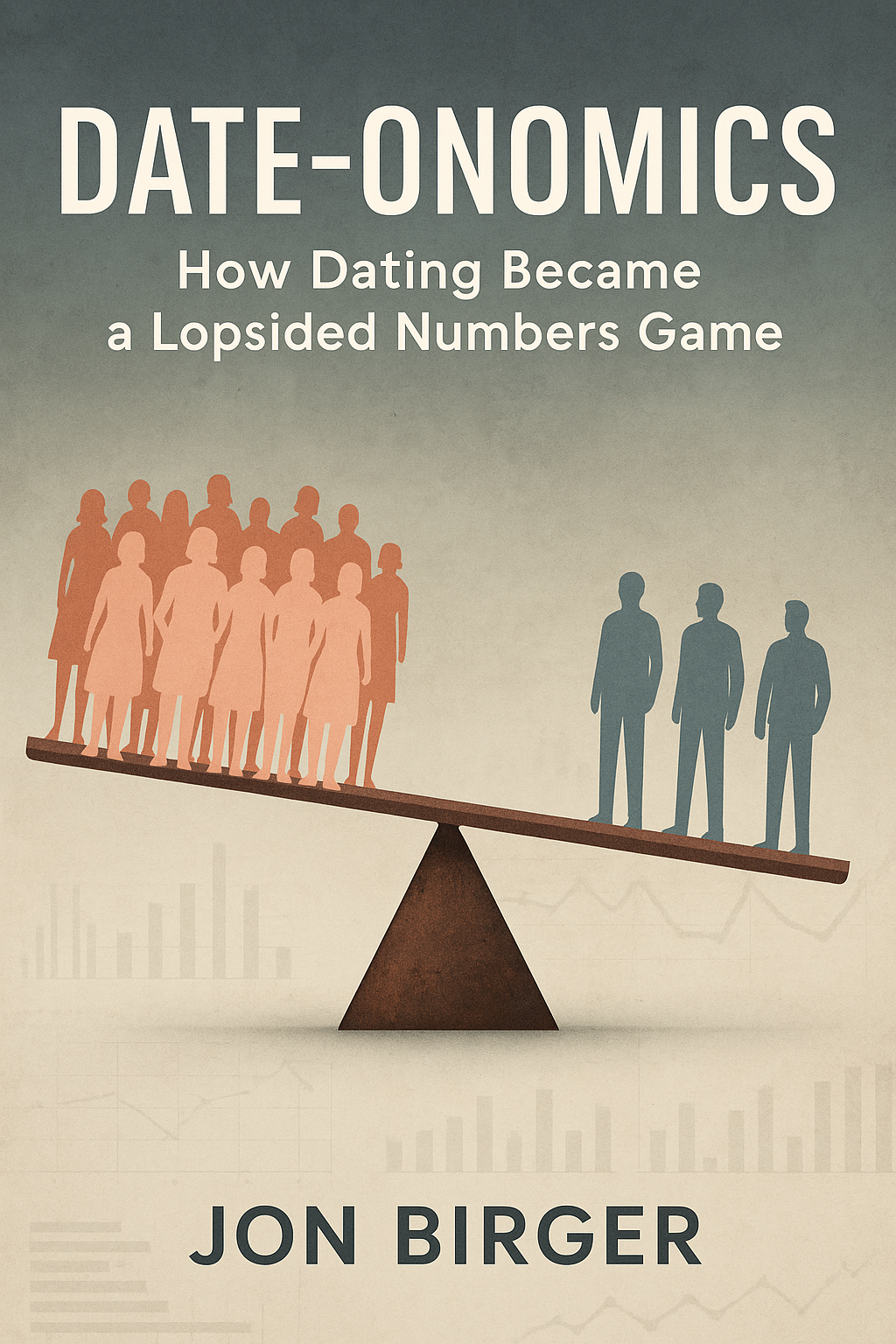
Date-onomics: How Dating Became a Lopsided Numbers Game
Chapter Summaries
What's Here for You
Are you a driven, educated woman finding yourself bewildered by the modern dating scene? Do you feel like you're playing a game with rules you don't understand, where the odds seem stacked against you? Jon Birger's "Date-onomics" invites you to step back from the endless cycle of dating advice and self-help strategies and confront a fundamental, yet often ignored, truth: the numbers. This book isn't about *how* to date better; it's about understanding the powerful, often invisible, demographic forces that have reshaped the dating landscape into a lopsided numbers game. Birger meticulously unpacks the concept of the 'man deficit' and 'woman deficit,' illustrating how skewed sex ratios, from college campuses to bustling cities, create distinct dating cultures and dramatically alter relationship dynamics. You'll explore real-life stories, from women navigating gender-imbalanced universities to individuals experiencing the dating shifts in different geographical locations, revealing how these ratios influence commitment levels, marriage rates, and even hookup culture. Through compelling analysis, drawing parallels from the natural world to sophisticated game theory, Birger demystifies why certain groups face unique dating challenges. Instead of offering superficial fixes, "Date-onomics" equips you with a profound intellectual understanding of the forces at play. You'll gain a data-driven perspective that reframes your dating experiences, empowering you with clarity and insight. Prepare to challenge conventional wisdom and gain a powerful new lens through which to view your romantic life and the broader societal trends that shape it. This is an exploration that is both intellectually stimulating and emotionally validating, promising to transform your understanding of why dating is the way it is.
The Man Deficit
Jon Birger, in his chapter 'The Man Deficit,' invites us to look beyond conventional wisdom and self-help strategies when confronting the perplexing dating struggles of educated, successful women. He introduces us to the archetype of 'Sarah Donovan,' a woman who embodies the frustration of intelligent, attractive individuals finding themselves adrift in a dating pool that seems inexplicably scarce of suitable partners. The author posits that the prevailing narrative—that women simply need to refine their dating tactics or 'play harder to get'—overlooks a fundamental, demographic reality: a genuine and significant 'man deficit' among college-educated demographics. This isn't a mirage, Birger argues, but a stark numerical truth, evidenced by U.S. Census data showing a consistent surplus of college-educated women over men in key age brackets, a gap that widens post-college. This imbalance, he explains, is rooted in women's increased college attendance rates since the 1980s, leading to a situation where, for example, there are four college-educated women for every three college-educated men in their twenties. This demographic skew, far from being confined to urban hubs like New York City, is a nationwide phenomenon, even prevalent in rural areas. Birger challenges the common explanations that attribute dating trends solely to changing values or the influence of hookup culture, suggesting instead that these are often symptoms, not causes, of the underlying gender ratio imbalance. He illustrates this with the example of a New York Times article on hookup culture that failed to mention the stark gender disparity in the city's dating pool, a disparity that can pressure young women and disincentivize men from settling down. The author draws a compelling contrast between cities like New York, with its oversupply of women, and areas like Santa Clara County, Silicon Valley, where the opposite is true, leading to higher marriage rates for women and a more competitive market for men. Ultimately, Birger’s narrative arc moves from the personal frustration of individuals like Sarah Donovan to a data-driven explanation, offering a resolution that shifts the locus of blame from individual strategy to systemic demographics, empowering readers with the understanding that the 'numbers game' of dating is indeed real and profoundly impactful.
How We Got to 57:43
The author, Jon Birger, begins by immersing us in the stark reality of Sarah Lawrence College, a place where a dramatic gender imbalance—75 percent women to 25 percent men—has created a social landscape where men hold an undeniable upper hand in the dating world. We hear from Kerri Detmer, a student who articulates the frustration and emotional toll this imbalance takes on women, describing how many feel forced to accept a "free harem" scenario for men, leading to casual hookups rather than meaningful relationships. This phenomenon, dubbed "Golden Cock Syndrome" by students like senior Jake Leventis, illustrates a culture where male entitlement can flourish due to sheer numbers, a situation that starkly contrasts with the experiences of women who often feel their self-esteem diminish with each rejection. Leventis himself, despite a casual demeanor, admits to a sexual history with at least twenty women, highlighting the pervasive nature of this hookup culture. Birger then broadens this lens, revealing that Sarah Lawrence is not an anomaly but a microcosm of a larger, decades-long trend: women have been outpacing men in college graduation rates since 1981. In 2012, women earned 34 percent more bachelor's degrees than men, a gap projected to widen significantly. This shift, the author explains, is not due to reverse discrimination against men but a complex interplay of factors. Historically, societal barriers and lower expectations for women in education, coupled with discriminatory admissions, meant men dominated higher education. The passage of Title IX in 1972 helped level the playing field, but as educational and career opportunities expanded for women—particularly with the advent of the contraceptive pill in the 1960s, which allowed for delayed marriage and greater career investment—female enrollment surged. Birger introduces the concept that girls' earlier behavioral and intellectual maturity gives them a developmental advantage in academics, leading to better grades and higher college aspirations. This, combined with economic shifts, such as the growth of female-dominated professions like nursing and the higher earning potential for men in blue-collar jobs straight out of high school, further contributes to the widening gap. The author posits that this imbalance, once confined to college campuses, has spilled over into the post-college dating pools, creating a "man deficit" that impacts relationship dynamics for years to come. He challenges the notion that this gender gap is not a problem, citing the distress it causes women and the pressure to conform to hookup culture, even for those who desire more traditional relationships. While college administrators are reluctant to address this "explosive" issue due to Title IX and potential reputational damage, Birger suggests that greater transparency about these gender ratios could empower students to make more informed choices, potentially influencing both college applications and dating strategies.
Sex Ratios 101
The author, Jon Birger, invites us to consider a fundamental, yet often overlooked, driver of human behavior: sex ratios. Drawing parallels from the natural world, like the intricate mating dances of pond cichlids where even slight shifts in male-to-female ratios dramatically alter commitment levels and mating strategies, Birger reveals that these ancient biological principles extend to human societies. He introduces the groundbreaking work of psychologist Marcia Guttentag and her coauthor Paul Secord in 'Too Many Women,' which posited that the availability of potential partners profoundly shapes sexual behaviors, societal norms, and even family structures. Guttentag's epiphany, sparked by Mozart's 'The Magic Flute' and the shift in popular music lyrics, highlighted a cultural transformation from romantic commitment to a more transient sexual ethos, correlating with a national swing from a male surplus to a female surplus in the marriageable population. This demographic shift, exacerbated by the post-WWII Baby Boom, created a 'marriage squeeze' and, as Birger explains, fundamentally altered the dating market. When men are scarce, women are more likely to compete for them, often becoming more discerning and demanding, while men may prioritize commitment and investment. Conversely, when women are abundant, the dynamic shifts: men may become less committed, seeking multiple partners, while women might lower their standards or focus more intensely on careers, as demonstrated by research from psychologists like Joshua Ackerman and Kristina Durante. Ackerman's studies, for instance, show that in cities with a surplus of men, like Columbus, Georgia, consumer debt rises, and financial impulsivity increases, mirroring the mating effort men invest when women are scarce. Conversely, the scarcity of men in places like Caltech fosters a culture of deeper romantic commitment and long-term relationships. Birger emphasizes that this is not a moral failing, but an evolutionary adaptation, akin to Jason Zweig's observations on investor behavior, where understanding instinctive reactions allows for more rational choices. The chapter concludes by underscoring that while these sex-ratio dynamics have profound historical and societal implications, from the rise of feminism to economic growth in places like China, the crucial insight is that awareness of these underlying patterns empowers individuals and societies to navigate them more effectively. The tension between biological imperative and human agency is resolved through understanding, revealing how the numbers game of dating, romance, and even economics is deeply rooted in the simple, yet powerful, imbalance of sexes.
Sex (Ratio) and the City
Jon Birger, in his chapter "Sex (Ratio) and the City" from "Date-onomics," unveils a stark reality: dating, especially in urban centers like New York City, is profoundly shaped by lopsided gender ratios, transforming it into a numbers game with significant emotional and behavioral consequences. The author introduces Lauren Kay, founder of Dating Ring, whose matchmaking service initially grappled with an overwhelming surplus of women seeking partners in New York, a disparity so pronounced that she had to cap her female clientele's age at 32, deeming older women unlikely to find suitable matches. This business decision, though numbers-driven, sparked outrage, highlighting the societal pressure and emotional toll of these demographic imbalances. Kay's discovery of the opposite trend in San Francisco—a surplus of men, particularly in tech-heavy Silicon Valley—underscored the geographic lottery of dating. Birger meticulously dissects the data, revealing how factors like the gay and lesbian population, while not directly impacting heterosexual dynamics nationally, significantly skew the heterosexual dating pool in cities like New York, creating a 'man deficit' that is far more severe than raw census data suggests. This scarcity, he explains, creates intense pressure on women to maintain appearances and fosters a sense of entitlement and casualness among the oversupplied men, leading to behaviors ranging from prioritizing superficial qualities to infidelity and a reluctance to commit. The narrative illustrates this through candid interviews with men like Ben Waterman and Jason Hendriks, who, in the context of Manhattan's skewed market, admit to prioritizing casual sex over commitment, viewing partners as disposable, and rationalizing behavior that would be unacceptable elsewhere. Conversely, women like Sarah Donovan and Carly Hansen describe the exhausting efforts to stay 'presentable' and the emotional distress of constant competition and potential rejection, with some psychotherapists noting that a significant portion of their female clients' issues stem from singleness and the fear of never finding a partner. Birger posits that these market forces even influence relationship choices, with men in scarce-male environments valuing partners more, and women in scarce-female environments becoming more tolerant of infidelity to preserve a relationship, an evolutionary adaptation to ensure a partner and provider. The chapter concludes by suggesting that for many women seeking marriage and family, the 'game' in New York is rigged, prompting a reconsideration of location, with suburbs or even entirely different regions offering a more balanced and potentially more fulfilling dating landscape, a resolution that echoes Kay's own migration to San Francisco and subsequent engagement, proving that sometimes, changing the market is the most impactful step one can take.
The Woman Deficit
Jon Birger, in 'Date-onomics,' unveils a compelling narrative through the story of Abby Evans, whose move from the bustling, seemingly endless dating opportunities of New York City to the smaller, more intimate setting of Aspen, Colorado, serves as a powerful microcosm of a larger demographic shift. Evans, initially adrift in the competitive New York dating scene where she felt inadequate despite her personal qualities, discovered a profound imbalance. Her experience highlights a critical insight: the perceived abundance of options in a large city can mask a deep scarcity of *compatible* partners, especially for women seeking serious relationships. Birger explains that this isn't merely a matter of personal preference but a stark reality dictated by gender ratios within specific educational and professional pools. The chapter reveals that while national numbers suggest an equal distribution of men and women, localized imbalances create distinct dating markets. In college-educated circles, a significant surplus of women exists in many urban centers, a phenomenon that pushes women like Evans into a state of panic and self-doubt, feeling as though their 'clock is running out.' The narrative then pivots to Aspen, where a male-dominated industry creates a rare 'man deficit' for college-educated women, dramatically altering Evans's dating fortunes and leading to a swift, happy marriage. This contrast underscores a core principle: the dating landscape is not uniform, and understanding these demographic tides can illuminate why certain markets feel like a 'husband hunt' while others offer unexpected ease. Birger further dissects this through the lens of the non-college-educated dating pool, where a 'woman deficit' is acutely felt, driven by diverging educational paths and economic opportunities for men. This scarcity, he argues, can lead to increased competition, infidelity, and a sense of resignation among men left behind in these communities. The author masterfully weaves these personal stories into a broader sociological analysis, demonstrating how localized gender imbalances, particularly within the high-tech hubs of Silicon Valley, can foster intense work cultures and even influence economic productivity, as men, deprived of romantic distractions, hyper-focus on career advancement. Ultimately, Birger guides us to see that these 'lopsided numbers games' are not just about finding a partner but are deeply intertwined with economic realities, educational trends, and the very fabric of our social structures, offering a profound insight into the forces shaping modern romance and the differing experiences of men and women across various demographic landscapes.
Mormons and Jews
The author, Jon Birger, embarks on a quest to understand the shifting tides of marriage rates and hookup culture, challenging the notion that changing values alone dictate these societal shifts. He posits, much like Guttentag, that underlying demographic forces, specifically sex ratios, play a crucial, often unseen, role. Birger then turns his investigative lens to seemingly disparate, yet deeply religious, communities: Mormons in Utah and Orthodox Jews in New York. He discovers a striking parallel: both groups, steeped in tradition and emphasizing early marriage, are experiencing a profound marriage crisis, characterized by an excess of single women. In Utah, Birger finds a 50 percent oversupply of Mormon women compared to men, a reality that, according to one interviewee, pushes some women towards premarital sex to secure a partner, creating a more promiscuous dating culture than tradition would suggest. Similarly, in Orthodox Jewish communities, the "Shidduch Crisis" reveals thousands of unmarried women, a situation that causes immense heartache and prompts drastic measures like egg freezing. The author meticulously dissects the perceived cultural reasons for these crises—men being too picky, women holding out for an ideal partner, or a decline in values—but ultimately pinpoints demographics as the true culprit. He reveals that in Utah, a significant exodus of men from the LDS church, often linked to the increasing pressure to serve missions, has widened the gender gap, leaving women with fewer options and men with an inflated sense of choice, leading them to delay marriage and become more selective, a phenomenon Birger dubs the "paradox of choice." This demographic imbalance, he argues, fuels a hypercompetitive dating market where women feel immense pressure to conform, leading to a surge in cosmetic surgery and body image issues, as seen in Salt Lake City's disproportionate demand for plastic surgery. The chapter then pivots to the Orthodox Jewish community, where the Shidduch Crisis, while stemming from different causes—a high birth rate and a traditional age gap in marriage—results in a similar predicament for women. Birger contrasts this with the Hasidic community, where men tend to marry women their own age, effectively eliminating the crisis, thereby providing a natural control group that underscores the demographic explanation. Despite cultural explanations blaming feminism or women's perceived pickiness, Birger asserts that the core issue remains a mathematical one: an imbalance in the number of available men and women, which profoundly shapes social norms, individual behavior, and the very fabric of these communities. The narrative arc moves from questioning societal values to uncovering the stark reality of demographic pressures, culminating in the understanding that behind the cultural anxieties lies a fundamental numbers game.
Game Theory
The author, Jon Birger, delves into the intricate mathematics and psychology behind modern dating, moving beyond simple demographic shifts to explore how game theory shapes our romantic landscape. He begins by dissecting the common paradox: why do 40-year-old college-educated women often face a tougher marriage market than their 27-year-old counterparts, despite graduating into a more skewed gender ratio? While conventional wisdom points to older men preferring younger women, Birger suggests the reality is more complex, involving biological clocks and evolving perceptions of attractiveness, but crucially, he reveals that the primary driver is the mathematical certainty of a shrinking pool of eligible partners as more men marry. This isn't merely a myth, as a famous Newsweek article once suggested; the 'marriage squeeze' is a tangible outcome of men remating, often divorcing to marry younger, never-married women, thus shifting the imbalance. Birger illustrates this with a vivid game of musical chairs, where each round of men marrying increases the odds for the remaining single women, a phenomenon projected to become even more acute for millennial women. He then pivots to another perplexing observation: the single women who struggle most are often the most attractive and accomplished, while the available men tend to be less so. Drawing on auction theory, Birger explains this using 'strong bidders' (confident, attractive women) who hold out for the ideal mate, and 'weak bidders' (less desirable men or women) who must be more aggressive. In this lopsided market, assertive women who pursue aggressively, rather than waiting passively for 'Mr. Right,' are more likely to secure a partner, a concept echoed by matchmakers and rabbis alike, suggesting the 'chase' narrative is often a myth. This leads to the counterintuitive 'Carol syndrome,' where a woman's very attractiveness can deter potential suitors in a man-deficit market, as men perceive rejection as more likely. Finally, Birger uncovers a surprising demographic anomaly: Asian American women, despite high educational attainment and a skewed gender ratio, appear largely immune to the marriage squeeze, exhibiting significantly higher marriage rates than other groups, a shift that has occurred over recent decades and is attributed to increased desirability among men of all races, while Asian American men face disadvantages. Ultimately, Birger demonstrates that understanding these mathematical and psychological dynamics is crucial for navigating the modern dating world, suggesting that strategic decision-making, rather than passive waiting, often dictates romantic outcomes.
Solving the Man Deficit
Jon Birger, in his chapter 'Solving the Man Deficit' from 'Date-onomics,' doesn't offer dating advice but rather a data-driven exploration of how gender ratios shape our lives, particularly in the crucial arenas of education and career. He begins by acknowledging that for many, marriage and romance aren't top priorities, and life decisions shouldn't be dictated by local dating market imbalances. Yet, he argues, ignorance of these imbalances can lead to significant life choices made on faulty assumptions, citing a woman who regretted not marrying sooner, unaware of the stacked odds against her later. Birger then lays out five gender-ratio-related suggestions to inform life decisions. First, he advises careful consideration of college gender ratios. While shy men might thrive in female-dominated environments like Sarah Lawrence, women, he contends, face higher stakes. Attending a school with a significant female majority, like the University of Georgia (62% female), might lead to an unhappy college experience if one is unenthusiastic about hookup culture, a stark contrast to a more relationship-oriented environment like Georgia Tech (66% male). This choice, he illustrates, can directly impact dating prospects and the likelihood of finding a long-term partner, as a substantial percentage of college-educated couples meet in college. Second, Birger highlights that 'holding out' is a risky marriage strategy for college-educated women, as their marriage prospects demonstrably decline with age, urging them to recognize the statistical reality of finding a college-educated husband being easier in their early to mid-twenties. Third, he points out that our workplace is an integral part of our dating ecology, suggesting that career choices, particularly in fields with skewed gender ratios like teaching or mechanical engineering, can subtly dim dating prospects, a factor worth considering if dating isn't a strong suit. Fourth, Birger encourages college-educated women to 'Go West, Young Woman,' identifying counties like Santa Clara and San Francisco in California as having a higher ratio of college-educated men, often with higher incomes, presenting more favorable dating markets. He also notes that for older demographics, different regions like Muscogee County, Georgia, or Travis County, Texas, become more attractive. Finally, he proposes that college-educated women should consider expanding their dating pool to include less-educated men, a trend already prevalent in communities with extreme college gender gaps, like the African American community, and one that could offer a solution for career women seeking partners with more time for family. Birger concludes by addressing the root cause: the man deficit in higher education. While he acknowledges the complexity of Title IX and the reluctance of private colleges to actively recruit more men, he suggests long-term solutions lie in improving academic performance and addressing maturity issues in boys. He references research indicating boys often lag behind girls in social and cognitive development, proposing that delaying their entry into formal schooling, as seen in countries like Finland and Switzerland, could help narrow the college gender gap. Ultimately, Birger argues that market inefficiencies in dating are unsustainable; as information becomes more accessible, individuals will adapt, with men aspiring to college and professional women potentially dating 'down' or relocating, driving the dating market back toward equilibrium, much like Billy Beane’s statistical revolution in baseball.
Conclusion
Jon Birger's "Date-onomics" compellingly reframes the complexities of modern dating not as a series of individual failures or shifting societal values, but as a profound consequence of demographic realities. The core takeaway is the undeniable impact of sex ratios, particularly the 'man deficit' in higher education, on relationship dynamics, sexual mores, and marriage rates. Birger dismantles the notion that women, especially educated ones, are solely to blame for dating frustrations, revealing instead how lopsided gender ratios create inherently unequal dating markets. The book illustrates how these imbalances, driven by factors ranging from Title IX's unintended consequences to evolving economic opportunities, fundamentally alter the 'game' of romance. We learn that in a male-surplus environment, men often wield disproportionate leverage, leading to increased casualness and decreased commitment, while women face intensified competition and emotional labor. Conversely, a scarcity of women can incentivize male commitment and courtship. The emotional lesson is one of empowerment through understanding; recognizing these demographic forces can alleviate self-blame and foster a more realistic approach to relationships. The practical wisdom lies in acknowledging these statistical truths when making life decisions. Birger encourages individuals to be strategic, considering local and institutional gender ratios when choosing educational paths, careers, and even geographic locations. He suggests that expanding one's dating pool beyond narrow educational or geographic confines might be a pragmatic strategy. Ultimately, "Date-onomics" offers a data-driven lens through which to view romantic challenges, advocating for awareness and informed decision-making in a world where the numbers, more than we often admit, dictate the dance of love and commitment.
Key Takeaways
The perceived shortage of marriageable men for educated women is not a strategic dating problem but a demographic reality, termed the 'man deficit,' caused by women's increased college attendance rates.
Lopsided gender ratios, particularly an oversupply of college-educated women compared to men, significantly influence dating behaviors, sexual mores, and marriage rates, rather than solely changing societal values.
Conventional dating advice often fails because it ignores the fundamental statistical imbalance in the dating pool, leading women to internalize blame for issues rooted in demographics.
The 'man deficit' is a nationwide phenomenon, extending beyond major cities to rural areas, and is exacerbated by declining educational intermarriage rates.
Understanding demographic realities, such as gender ratios in specific locations and educational attainment levels, is crucial for making informed decisions about relationships and life choices.
The influence of demographics on dating is so profound that it can create vastly different dating markets, such as the 'Girls' scenario in New York City versus 'The Big Bang Theory' in Silicon Valley.
The widespread imbalance in college gender ratios, favoring women, creates a dating market dynamic where men often hold disproportionate leverage, impacting relationship norms and individual well-being.
The surge in female college enrollment is driven by a confluence of factors including historical educational inequities, expanded career opportunities for women, the contraceptive pill enabling delayed marriage, and girls' developmental advantages in academics.
Economic shifts, such as the growth of female-dominated professions and higher immediate earning potential for men in certain blue-collar fields, contribute to fewer men pursuing higher education.
The "hookup culture" prevalent on many campuses is not merely a matter of personal choice but is significantly influenced by lopsided gender ratios, leading to potential emotional distress and confusion for women.
Addressing the college gender gap requires transparency from institutions about these ratios, enabling students to make more informed decisions about their educational and romantic futures.
While Title IX aimed to create equality, its unintended consequence, when combined with other societal and biological factors, has led to a surplus of women in higher education and a subsequent deficit of men in the dating pool.
Sex ratios, mirroring animal behavior, fundamentally dictate mating patterns, commitment levels, and societal norms for humans.
A surplus of women in a dating market often leads to increased sexual permissiveness, decreased male commitment, and a focus on immediate gratification.
A scarcity of women typically incentivizes male commitment, courtship rituals, and a greater emphasis on long-term relationships and family.
Societal shifts, such as the sexual revolution and the rise of feminism, can be significantly influenced by demographic imbalances in sex ratios.
Understanding the impact of sex ratios provides a framework for explaining diverse economic behaviors, from consumer debt levels to national GDP growth.
Awareness of sex ratio dynamics allows individuals to make more informed and potentially adaptive choices in their romantic and economic lives.
The perceived value of potential mates and competitors is dynamically influenced by the prevailing sex ratio in a population.
The quantitative imbalance of men and women in a dating market directly influences male behavior, fostering casualness, infidelity, and a reduced willingness to commit when men are in surplus.
Urban demographic factors, such as a larger gay male population, can significantly exacerbate the heterosexual 'man deficit,' making the dating market even more challenging for women than superficial census data indicates.
Women in male-scarce dating markets often engage in heightened self-presentation and emotional labor, driven by the intense competition and fear of being overlooked.
The perceived 'value' of a potential partner is subject to supply-and-demand principles, where scarcity increases perceived worth and abundance diminishes it, affecting relationship decisions.
Geographic location plays a critical role in dating prospects, with suburban or less saturated markets potentially offering more balanced opportunities for committed relationships than hyper-competitive urban centers.
Societal expectations and individual choices interact, but the underlying demographic realities of a dating market can pressure even 'nice guys' into less committed or ethically questionable behaviors.
The perceived abundance of dating options in large cities can mask a significant scarcity of compatible partners, particularly for educated women seeking serious relationships, leading to feelings of inadequacy and panic.
Demographic imbalances, specifically the ratio of college-educated men to women in localized areas, create distinct and often unequal dating markets, impacting marriage prospects and relationship dynamics.
A 'woman deficit' in the non-college-educated dating pool, driven by diverging educational paths and economic opportunities, leads to intensified competition, higher marriage expectations for men, and potential infidelity.
The scarcity of women in male-dominated professional environments, like Silicon Valley, can foster hyper-competitive work cultures and drive intense focus on career advancement among men.
Understanding regional gender ratios is crucial for comprehending the differing dating challenges faced by men and women across various socioeconomic and educational strata.
Despite national gender parity, localized surpluses of one gender create significant dating disadvantages for the other, highlighting the importance of demographic analysis in understanding relationship outcomes.
Societal shifts in dating and marriage are not solely driven by evolving values but are significantly influenced by underlying demographic sex ratios.
Imbalanced sex ratios, even within conservative religious communities, can lead to unexpected behavioral changes, such as increased premarital sex and delayed marriage.
The "paradox of choice" arises when a surplus of one gender (typically men) leads to increased selectivity and delayed commitment, while the other gender (typically women) faces intensified competition and pressure.
Demographic realities, rather than cultural or religious failings, are the primary drivers of marriage crises in communities like the Mormons and Orthodox Jews.
When one gender is in the majority, it often gains leverage in the dating market, influencing social norms and leading to adaptive behaviors like increased cosmetic surgery or heightened focus on physical appearance.
The absence of a marriage crisis in a demographic subset (like Hasidic Jews) with different marriage age norms can serve as evidence for demographic explanations over cultural ones.
The marriage market's challenges, particularly for older college-educated women, are primarily driven by mathematical probabilities of a shrinking pool of eligible partners as men marry, not solely by preferences for younger women.
The 'marriage squeeze' is a tangible demographic reality exacerbated by men remating, leading to a widening gap between divorced women and divorced-but-unremarried men.
In a male-deficit dating market, assertive and proactive women are more likely to secure partners than those who passively wait for pursuit, challenging traditional romantic narratives.
A woman's high attractiveness can paradoxically act as a repellent in a man-deficit environment due to the increased perceived risk of rejection for potential suitors (the 'Carol syndrome').
Asian American women demonstrate a unique resilience to the marriage squeeze, benefiting from increased desirability across racial lines while Asian American men face disadvantages in the dating market.
Strategic decision-making, including understanding scarcity and potentially creating it through assertive action, is crucial for navigating romantic outcomes in imbalanced dating markets.
Decisions about education and career should consciously incorporate local and institutional gender ratios, as these imbalances significantly impact relationship and marriage prospects.
For college-educated women, delaying marriage significantly diminishes their prospects of finding a college-educated partner, suggesting a strategic approach to timing is crucial.
The workplace is a significant venue for meeting partners; career choices with extreme gender skews can inadvertently limit dating opportunities.
Geographic location plays a critical role in dating market dynamics, with certain regions offering a more favorable male-to-female ratio for college-educated singles.
Expanding the dating pool to include individuals with different educational backgrounds, particularly for college-educated women, can be a pragmatic strategy to navigate demographic imbalances.
Addressing the college gender gap requires long-term solutions focused on improving boys' academic engagement and maturity, potentially through adjusted educational timelines.
Action Plan
Recognize that dating challenges may stem from demographic imbalances rather than personal failings.
Research the gender ratios within your specific age group and educational attainment level in your geographic area.
Consider how educational and geographic factors might be influencing your dating pool and marriage prospects.
Challenge conventional dating advice by evaluating its applicability in the context of current demographic realities.
Be aware that societal explanations for dating trends, such as hookup culture, may be symptoms rather than root causes.
If seeking marriage, understand that delaying serious dating into one's thirties can present a more challenging market due to the 'man deficit'.
Educate yourself on the gender ratios at colleges you are considering applying to, understanding how they might influence social dynamics.
Engage in open and honest conversations with peers and mentors about the impact of gender imbalances on dating and relationships.
Critically evaluate the prevailing "hookup culture" on campuses and consider whether it aligns with your personal values and long-term goals.
Advocate for transparency from educational institutions regarding their gender demographics and the social implications.
Reframe personal dating challenges not as individual failures, but as potential outcomes of larger demographic trends.
Seek out educational environments that may offer a more balanced gender ratio if a traditional dating experience is a priority for you.
Develop a strong sense of self-worth independent of romantic validation, especially in environments with significant dating market imbalances.
Research the sex ratio of your local dating pool or college campus to understand market dynamics.
Reflect on how perceived mate availability might influence your own romantic expectations and behaviors.
Consider the economic implications of sex ratios when analyzing consumer behavior or personal financial decisions.
Discuss the concept of sex ratios with friends or partners to gain diverse perspectives.
Observe how media and cultural narratives might reflect or shape perceptions of sex ratio imbalances.
Apply the principle of understanding environmental influences to other areas of life, recognizing that context shapes behavior.
Analyze your local dating market's gender ratio and understand its potential impact on your dating experiences.
Evaluate whether your current location aligns with your long-term relationship goals and consider alternatives if it doesn't.
Recognize that relationship behaviors, both your own and others', can be influenced by market dynamics, fostering greater empathy and realistic expectations.
For those in male-scarce markets, practice self-compassion and resist the pressure to over-invest in superficial self-improvement solely for dating.
For those in male-surplus markets, critically assess whether your casual dating behavior serves your ultimate relationship goals or merely exploits current opportunities.
Communicate openly about relationship expectations and intentions early on, acknowledging the potential for differing motivations in competitive dating environments.
Consider the 'commute' factor for relationships, recognizing that men's willingness to travel for work might translate to a willingness to travel for partners, balancing local deficits.
Assess your current dating market by considering the gender ratios within your educational and professional demographic in your geographic area.
Recognize that personal feelings of inadequacy in dating may be amplified by broader demographic imbalances, rather than solely personal failings.
Consider how educational and career choices might influence your dating pool and long-term relationship prospects.
If experiencing significant dating challenges, explore whether relocating to a region with a more favorable gender ratio for your demographic could be a viable option.
Be aware that intense work cultures in male-dominated fields can be influenced by a scarcity of romantic partners, impacting work-life balance.
Understand that the 'dating market' is not monolithic; different educational and socioeconomic groups face vastly different challenges and opportunities.
Analyze personal relationship goals and expectations in light of broader demographic trends.
Critically evaluate cultural explanations for social phenomena, seeking underlying structural causes.
Recognize and challenge the "paradox of choice" by focusing on genuine connection over endless options.
Advocate for balanced perspectives that acknowledge demographic influences on social issues.
Engage in open conversations about sex ratios and their impact within communities.
Consider how perceived scarcity or abundance influences behavior and decision-making in dating and relationships.
Recognize that the dating market is a numbers game influenced by supply and demand; adjust expectations accordingly.
Consider a proactive approach in pursuing relationships rather than passively waiting for others to make the first move.
Evaluate your own position in the dating market and understand how game theory principles might be affecting your interactions.
If seeking marriage, strategically assess the timing of your decisions, understanding that delaying commitment in a man-deficit market increases risk.
Be aware of the 'Carol syndrome' and consider how to signal availability and interest without overwhelming potential partners.
Challenge traditional romantic narratives and embrace a more strategic mindset when making relationship decisions.
Understand that creating 'artificial scarcity' through assertive actions can sometimes be an effective strategy in abundant marketplaces.
Research the gender ratio of colleges and universities when making higher education decisions.
Consider how your chosen career field's gender balance might affect your social and dating life.
Evaluate your geographic location and its demographic makeup for dating opportunities, especially if considering relocation.
Be open to dating individuals with educational backgrounds different from your own.
For women concerned about marriage prospects, assess the statistical reality of age-related declining odds and consider earlier strategic dating.
Explore the possibility of delaying kindergarten entry for boys to potentially improve their academic and social outcomes.
Actively seek out information about local dating market demographics to make more informed personal decisions.