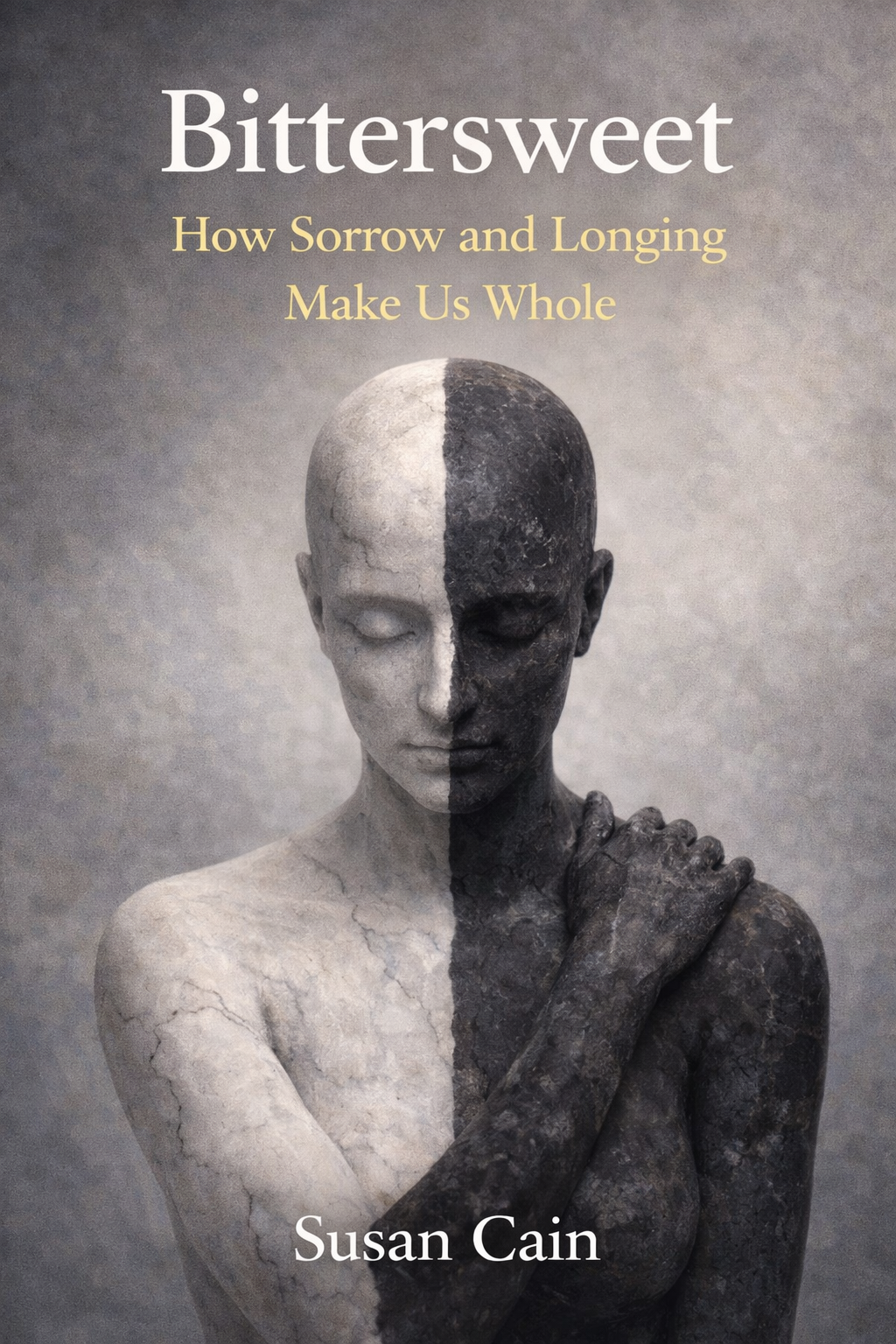
Bittersweet: How Sorrow and Longing Make Us Whole
Chapter Summaries
What's Here for You
In a world that often demands relentless positivity, Susan Cain's 'Bittersweet' offers a radical and deeply human invitation: to embrace the full spectrum of our emotions, finding wholeness not in the absence of sorrow, but in its profound presence. This book promises to transform your understanding of sadness, longing, and loss, revealing them not as weaknesses to be overcome, but as essential ingredients for a rich, creative, and meaningful life. You will gain a profound appreciation for the utility of sadness, understanding how it fuels creativity and deepens our connections, as exemplified by the journeys of artists like Leonard Cohen and filmmakers like Pete Docter. Discover why we yearn for unconditional love and how lost love, though painful, shapes us in indelible ways. Cain challenges the cultural paradox of a nation founded on heartache yet championing smiles, urging us to transcend the 'tyranny of positivity' in our workplaces and personal lives. Explore the human desire to confront mortality and the wisdom in embracing grief and impermanence, rather than trying to 'get over' them, drawing inspiration from the poignant reflections of a Japanese Buddhist poet. You will also confront the echoes of ancestral pain, learning how to transform inherited sorrow into generational strength. The emotional and intellectual tone is one of profound empathy, quiet wisdom, and courageous vulnerability. 'Bittersweet' offers solace, validation, and a powerful new lens through which to view your own life, encouraging you to find beauty, depth, and connection in the very experiences we are often taught to avoid.
What is sadness good for?
The author, Susan Cain, invites us to explore the profound utility of sadness, a sentiment often sidelined in our pursuit of relentless positivity. We begin with the creative journey of Pixar director Pete Docter, who initially cast Fear as the protagonist in his film, only to discover a crucial narrative flaw: Joy needed a deeper teacher. It was in grappling with his own anxieties about professional failure that Docter experienced an epiphany: emotions, especially sadness, serve as powerful agents of connection. This realization, bolstered by the insights of psychologist Dacher Keltner, shifted the film's focus to Sadness, transforming it into an Oscar-winning masterpiece. Keltner, a leading researcher in positive psychology, reveals that sadness is not merely an emotional void but a fundamental human instinct, wired into our nervous system. He explains that our 'compassionate instinct' is triggered by witnessing suffering, whether our own or others', activating ancient neural pathways like the vagus nerve. This instinct, rooted in the primal mother-child bond, compels us to care for the vulnerable, extending empathy beyond our immediate circle. Keltner's research, supported by findings on brain activity during empathetic responses, suggests that sadness is a prosocial emotion, a 'universal unifying force' that fosters community and love. The author illustrates this with a poignant example: a viral Cleveland Clinic video subtitling the hidden struggles of hospital passersby, evoking a visceral sense of shared humanity. This underscores that sorrow, far from being a weakness, is a gateway to deep connection, allowing for vulnerability and honesty in a world often demanding stoicism. Even Charles Darwin, often misconstrued as a proponent of 'survival of the fittest,' recognized compassion as our strongest instinct, a perspective echoed by the Dalai Lama. While positive psychology has historically focused on happiness, a newer wave, championed by researchers like Scott Barry Kaufman and Tim Lomas, acknowledges the essential interplay between positive and negative emotions, recognizing 'transcenders' who experience profound joy alongside a 'cosmic sadness.' Ultimately, Cain argues, embracing sadness can cultivate humility and deepen our capacity for connection, especially in our current fragmented world. Practices like bowing, gratitude journaling, and self-compassion, as advocated by Keltner and others, can help us harness this power, transforming our individual experiences and fostering a more empathetic culture, bridging the gap between souls through shared vulnerability and understanding, much like Keltner's own journey of finding solace after his brother's death.
Why do we long for “perfect” and unconditional love?
Susan Cain's chapter, 'Why do we long for “perfect” and unconditional love?', delves into the profound human yearning for an idealized, complete connection, a desire often misunderstood as mere romantic fantasy. The narrative begins with the poignant story of Francesca from 'The Bridges of Madison County,' a tale that resonates because it taps into our collective longing for an unattainable, perfect love, a love that, once experienced, enriches us even if it cannot be sustained in the everyday. Cain contrasts this with the contemporary wisdom, championed by figures like Alain de Botton, which urges us to abandon the dream of soulmates and embrace the imperfections of real relationships, focusing instead on self-improvement and accepting that no single person can fulfill all our needs. Yet, she argues, this practical view overlooks a deeper, older tradition that sees this longing not as neurotic, but as a normal, even desirable, spiritual and creative state, a 'pothos' or 'Sehnsucht' that fuels art, music, and our connection to the sublime. This yearning, Cain reveals, is not limited to romance; it surfaces in our appreciation for sad songs like Beethoven's 'Moonlight Sonata,' tragic dramas, and even the ephemeral beauty of cherry blossoms, which we cherish precisely because of their impermanence. The chapter explores the neuroscience and psychology behind our attraction to bittersweet experiences, suggesting that empathy and a desire for communion are key, leading us to find solace and transcendence in sorrowful art, as it helps us accept negative emotions and feel less alone. The core tension lies in reconciling the pragmatic advice to 'grow up and get over it' with the deeply ingrained human need for something more, something transcendent. Through the lens of Sufism, particularly the teachings of Llewellyn Vaughan-Lee (LVL), Cain presents longing as the 'pain of separation' from a divine source, a pain that is paradoxically both the wound and the cure, the direct path 'Home.' This Sufi perspective reframes longing not as an unproductive state of craving, but as the soul's intrinsic desire for union, a 'feminine expression of love' that calls us toward wholeness. Ultimately, Cain suggests that our attraction to stories like Francesca's, and our deep engagement with art that blends sorrow and beauty, are not deviations from a well-lived life, but profound expressions of our inherent spiritual instinct, glimpses of an 'Eden' or 'other place' that, while fleeting, imbues our lives with meaning and connects us to something larger than ourselves, reminding us that the ache itself is a form of belonging.
Is creativity associated with sorrow, longing—and transcendence?
Susan Cain, in her exploration of "Bittersweet," delves into the profound connection between sorrow, longing, and the blossoming of creativity, suggesting that our deepest pain can indeed become our most potent offering. She opens with the poignant example of Leonard Cohen, whose childhood loss fueled a six-decade career marked by themes of heartache and longing, illustrating that for some, a state of yearning is where artistic expression thrives, a sentiment echoed in his valedictory nature and songs like 'So Long, Marianne.' Research, from Marvin Eisenstadt's study on orphaned creatives to Kay Redfield Jamison's findings on mood disorders in artists, consistently points to a disproportionate presence of sorrow among the highly creative. Karol Jan Borowiecki's linguistic analysis of composers' letters further revealed that negative emotions, particularly sadness, are not just correlated with but predictive of creative output. This isn't to say pain *equates* to art, but rather that creativity possesses the unique power to confront pain and transmute it. Modupe Akinola's study on DHEAS levels and audience reception demonstrated that students facing disapproval, especially those with lower stress-hormone protection, produced more creative collages, hinting that emotional vulnerability coupled with rejection can spark innovation. The chapter navigates this complex terrain by proposing that creativity is best viewed through the lens of bittersweetness—the simultaneous embrace of darkness and light. It’s not about dwelling in despair, as clinical depression kills creativity, but about finding a 'transcendence delivery system,' as Adam Cohen described his father's work, turning brokenness into something beautiful. This is powerfully exemplified by Beethoven's 'Ode to Joy,' a masterpiece born from decades of struggle, including profound deafness, which the audience experienced not just as exultation, but as sorrow laced with triumph. The author then introduces David Yaden's work on self-transcendent experiences (STEs), suggesting that moments of impermanence and transition, like grief or nearing death, are fertile ground for meaning, communion, and creative awakening. This resonates with cultural rituals and seasonal changes, which traditionally mark life transitions as moments of sacrifice and rebirth. The narrative culminates with the deeply personal story of violinist Min Kym, whose world was shattered by the theft of her beloved Stradivarius. Yet, in the aftermath of this profound loss, Min discovered a new creative force, writing her story and finding a renewed sense of self, demonstrating that even when one door closes, another opens, and that the pain of impermanence can indeed be transformed into something greater, leading to healing, rebirth, and new forms of art. The author concludes by urging us to consider whatever pain we cannot get rid of and make it our creative offering, or find someone who does, recognizing that the journey through sorrow can lead to unexpected depths of wholeness and transcendence.
How should we cope with lost love?
Susan Cain, in her chapter "How should we cope with lost love?", excavates the profound and often painful landscape of human connection and its inevitable ruptures, beginning with a poignant recollection of her own mother, a woman whose luminous presence in childhood was shadowed by deep ancestral sorrows and a consuming fear of loss. This early idyllic image is contrasted with the complex, often fraught reality of their adult relationship, a tension that mirrors the broader human experience of navigating love's bittersweet nature. Cain reveals that the deepest wounds often stem from our most intimate bonds, illustrating how the desire to be loved can lead to a perilous balancing act, where one's authentic self risks becoming a source of profound parental grief, as seen in the author's own struggle to assert independence while desperately trying to preserve her mother's fragile peace. The narrative then shifts to the author's college years, a period of intense separation from her mother, where the phone became a conduit for both connection and conflict, a constant reminder of the unbridgeable gap between her burgeoning adult life and her mother's anxieties. This emotional chasm, Cain explains, can leave one feeling existentially motherless, even when the parent is physically present, a profound realization that fuels the author's introspective journey. The pivotal moment arrives with the author handing her mother her private diaries, an act that, while seemingly a surrender, becomes a profound severing, a recognition that some breaches are so deep they redefine the very nature of love and loss. This leads to Cain's core insight: that our psychic and physical wounds, the losses we endure, are not mere irregularities but fundamental aspects of the human condition, the very ground from which our highest states of awe and joy emerge. She introduces the framework of Acceptance and Commitment Therapy (ACT) as a path toward wholeness, emphasizing the seven skills of accepting the bitter—acknowledging loss, embracing emotions, accepting all thoughts and memories, expecting overwhelm, and watching for unhelpful thoughts—and then committing to the sweet by connecting with what truly matters and taking aligned action. This is powerfully illustrated through figures like Buckminster Fuller, Maya Angelou, and Rene Denfeld, individuals who, in the face of immense suffering, transformed their pain into purpose and healing for others, embodying the archetype of the wounded healer. Cain also explores the practice of lovingkindness meditation, or metta, as a way to actively cultivate love and compassion, even for those who have caused us pain, suggesting that wishing well to others, from a safe distance, can shift our relationship with them and the world. Ultimately, Cain concludes that while we may never reclaim the exact form of what we have lost—be it a relationship, a dream, or a specific time—love itself returns in different guises, a truth beautifully encapsulated by the apocryphal Kafka story of the doll postman. In her mother's final years, as Alzheimer's erases the painful memories, a tender reconciliation emerges, a poignant reminder that even amidst brokenness, love's enduring essence can shine through, offering a path to wholeness by embracing both the bitter and the sweet.
How did a nation founded on so much heartache turn into a culture of normative smiles?
Susan Cain, in this chapter of 'Bittersweet,' probes the curious paradox of American culture: a nation forged in profound struggle, yet one that champions relentless positivity. She begins with the poignant story of Susan David, whose father's fatal cancer was met with the ubiquitous advice to 'stay positive,' a mantra that ultimately left David to navigate immense grief and financial ruin in isolation, her own pain masked by a forced smile. This personal tragedy, Cain explains, mirrors a broader cultural narrative rooted in America's historical self-image as a land of limitless opportunity and self-invention, a narrative that often buries its 'bitter stories' – the sacrifices of the Declaration of Independence, the obliteration of Native American cultures, the blood of slavery, the unfathomable losses of the Civil War, and the silent traumas carried by immigrants. The chapter traces this 'tyranny of positivity' back to early Calvinist beliefs, where outward labor was a sign of predestined salvation, evolving into the 19th-century 'new national religion of business,' where success became the holy grail and failure, branded by the contemptuous term 'loser,' was seen as a personal moral failing rather than a product of circumstance. This cultural shift, amplified by movements like New Thought and later self-help gurus, created an environment where expressing sorrow or longing became taboo, a stark contrast to cultures that ritualize remembrance and acknowledge impermanence. Cain illustrates this with a vivid comparison of American sympathy cards, bright and comforting, versus German ones, somber and acknowledging deep sadness. The narrative then moves to the present day, highlighting how this pressure for outward cheer manifests in elite universities, coining terms like 'effortless perfection,' 'Penn Face,' and 'Duck Syndrome' to describe the intense, often hidden, struggle to maintain an appearance of effortless victory. Students, like the author herself once did, learn to mask their anxieties and griefs, fearing that admitting to struggle marks them as a 'loser' in a society that venerates winners. This cultural legacy, Cain suggests, leaves many feeling less happy than they appear, caught in a cycle of enforced positivity that denies the wholeness that comes from embracing both the bitter and the sweet aspects of the human experience. The chapter sets the stage for exploring how to transcend these codes of enforced positivity, moving towards a more authentic and integrated way of living.
How can we transcend enforced positivity in the workplace, and beyond?
The prevailing culture in many workplaces, and indeed in society at large, enforces a 'tyranny of positivity,' demanding a public smile even when private struggles rage. Susan David, an expert in emotional agility, defines this skill as the capacity to hold difficult emotions and thoughts loosely, face them with courage and compassion, and then move forward to ignite change. Yet, she observes, many are stuck in a state of emotional suppression, where pushing away sorrow and longing only amplifies their power, ultimately undermining us and trickling down to our families and communities. This isn't an argument against happiness, but a plea for embracing life's full, bittersweet spectrum. As psychologist Peter Frost noted, suffering is central to human experience and many religions, yet it remains largely forbidden territory in the workplace. This has led to a burgeoning movement, exemplified by the CompassionLab, to reframe organizations as spaces where compassion can be expressed. Researchers like Jason Kanov and Laura Madden have uncovered a pervasive, yet often unspoken, suffering in professional life—panic attacks disguised as anger, devaluation masked as frustration—a mundane suffering that we endure because we downplay its impact. While acute, universally recognized pains are more acceptable, chronic, everyday struggles—relationship issues, financial worries, office politics—are largely suppressed. Yet, concepts like 'bringing your whole self to work' and the 'gift of failure' are gaining traction, with even the Harvard Business Review highlighting the virtues of compassionate leadership and the unique advantages of melancholic leaders. Research by Juan Madera and D. Brent Smith, further explored by Tanja Schwarzmüller, suggests that while anger might project positional power, sorrow can foster personal power, inspiring loyalty and connection. This doesn't equate a bittersweet temperament with weakness; rather, it suggests integrating our 'core wounds,' as venture capitalist Tim Chang calls them, into a superpower. Chang's own journey, shaped by tiger parents and a deep-seated need for external validation, led him to invest in areas aligned with his passions, melding creativity with business. Similarly, Lara Nuer, facing her own childhood anxieties about being liked, learned that true kindness as a leader requires candor, not just pleasantries. Even in environments as traditionally stoic as an offshore oil rig, Rick Fox, with the help of consultant Claire Nuer, led his team, including his son, through an intensive process of sharing their vulnerabilities, resulting in dramatically improved productivity and safety. This normalization of sorrow, observed by Harvard Business School professor Robin Ely and Stanford professor Debra Meyerson, fosters genuine connection and trust. While openly sharing can be challenging, as Kerry Gibson's research on disclosure suggests, organizations like Midwest Billing demonstrate how a culture that assumes personal troubles are normal, and responds with compassion, can lead to remarkable business success and low turnover. Ultimately, the lesson is that safety, innovation, collaboration, and inclusion are deeply intertwined with an openness to the bittersweet. Even without a supportive organizational culture, James Pennebaker's decades of research on expressive writing offer a powerful private ritual. By writing about our difficulties, even for short periods, we can achieve greater calm, happiness, improved health, and even enhanced career success, transforming misfortunes into seeds of growth through insight. This echoes the poetic spirit of Lisbon and its embrace of 'saudade,' that uniquely Portuguese melancholic longing. In workshops and through simple daily practices, like journaling our 'I am' statements and reflecting on what those closest to us would say, we can begin to welcome our full humanity, acknowledging that the struggles we face are not pathologies, but simply part of the human condition, the very essence of what makes us whole.
Should we try to live forever?
Susan Cain, in her chapter 'Should we try to live forever?', grapples with the profound human desire to transcend mortality, a quest vividly embodied by the 'immortalist' movement she encounters at RAADfest. The author opens with the visceral grief of losing her brother to COVID-19, a loss that crystallizes the painful realization that 'what once was will never be again.' This personal tragedy frames her exploration of the radical life extension advocates who see death not as a natural end, but as a problem to be solved through technology and healthy living. Cain contrasts their fervent optimism and impatience with doubt—'Death is stupid,' as one adherent proclaims—against the philosophical weight of thinkers like Heidegger, who suggest death shapes our lives by giving them urgency. She observes the attendees, a mix of scientists, enthusiasts, and the desperate, all united by a shared belief that aging and death are enemies to be defeated, a sentiment echoed in the conference's theme song, 'I'm gonna live forever.' Cain introduces key figures like Aubrey de Grey, advocating for 'longevity escape velocity,' and Bernadeane, a charismatic eighty-year-old activist who declares, 'I walk out of death like I'm walking out of prison.' The author probes the motivations behind this movement, questioning if immortalists truly seek eternal life or something else, and wonders if death is the essential ingredient that gives life meaning. She also explores the personal histories that fuel this quest, like that of Keith Comito, whose childhood trauma of parental death propelled him into the pursuit of longevity, seeing it as the ultimate hero's journey, echoing ancient epics like The Epic of Gilgamesh. Cain acknowledges the seductive allure of such a vision, particularly the idea that overcoming death could dismantle tribalism and foster global harmony, as suggested by terror management theory. However, she ultimately posits a counter-argument: that our deepest longings may not be for endless life, but for perfect, unconditional love and a world free from suffering, a yearning for an Edenic state. She suggests that the true human challenge lies not in defeating death, but in learning to navigate the inherent sorrows and longings of being alive, proposing that these very experiences, even mortality itself, might be the unifying force that leads us to love, a pathway radically different from the immortalists' technological solution.
Should we try to “get over” grief and impermanence?
Susan Cain, in her exploration of "Bittersweet," challenges the pervasive cultural directive to "get over" grief and impermanence, suggesting instead that a profound strength lies in embracing this inherent human experience. She opens with the poignant example of the Japanese Buddhist poet Issa, who, after enduring immense personal loss, including the deaths of his children, could not accept the Buddhist ideal of nonattachment, famously lamenting, "But even so, but even so, but even so." This "but even so" becomes a central motif, representing a deeply human protest against life's brutal terms, a protest that connects us all across time. Cain argues that our cultural programming, which urges us to "move on" and "let it go," often masks a deeper, more profound truth: that acknowledging and feeling the sting of loss is not a failure but a pathway to wholeness. She introduces the work of psychologist Dr. Laura Carstensen, whose research suggests that an awareness of impermanence, not age itself, leads to greater contentment, gratitude, and a focus on what truly matters – a state of poignancy where happiness and sadness coexist. This bittersweet awareness, Carstensen posits, allows us to live more deeply in the present, forgive more easily, and love more profoundly. Cain illustrates this with the story of her own sons' sadness at leaving donkeys, a sadness that was eased not by dismissal but by the acknowledgment that "the pain of goodbye is part of life." This resonates with the child poet Gerard Manley Hopkins' observation that sorrow is "the blight man was born for." Cain then delves into the differing perspectives on grief and loss, contrasting Western approaches like Freud's "grief work" and George Bonanno's focus on resilience with Eastern traditions of nonattachment. While acknowledging the wisdom in nonattachment, Cain highlights the profound difficulty, particularly for parents, in accepting the loss of a child, as exemplified by Ami Vaidya's halting admission that she "could never do" pediatric oncology. Ultimately, Cain champions a "bittersweet state" as an underappreciated strength, leading to wisdom and communion, drawing parallels between Issa's enduring lament and Nora McInerny's concept of "moving forward with" loss rather than "moving on" from it, emphasizing that some things cannot be fixed, and not all wounds are meant to heal, but rather to become part of the tapestry of a life lived fully, with both joy and sorrow.
Do we inherit the pain of our parents and ancestors? And, if so, can we transform it generations later?
Susan Cain, in her exploration of the bittersweet, delves into the profound question of inherited sorrow, a tension that echoes through generations. At a death awareness workshop, the author encounters Simcha Raphael, a psychotherapist who guides participants through their personal encounters with mortality and grief. Maureen, a social worker, shares how her mother's suppression of grief after her father's death led to a lifetime of unprocessed pain and self-judgment, illustrating how unresolved sorrow can manifest in the body and behavior. Cain herself grapples with tears that seem to surface without direct cause, leading Simcha to suggest she carries not only her own grief but that of her mother, grandmother, and father, a collective sorrow stemming from the Holocaust. This leads to the compelling concept of transgenerational trauma, the idea that profound distress can alter us at a cellular level, passing from one generation to the next. Dr. Rachel Yehuda's research in epigenetics provides a scientific lens, showing how environmental influences, like the trauma experienced by Holocaust survivors, can lead to enduring constitutional changes and even affect the genes of their children, manifesting as increased vulnerability to PTSD, depression, and anxiety. Vivid animal studies, like those with mice exposed to predator scents or electric shocks, further suggest that fear and behavioral changes can be inherited, even without direct experience. This exploration isn't just about the burden of inherited pain; it pivots towards the transformative power of acknowledging and processing it. Cain highlights that if pain can endure across lifetimes, then so too can healing. This resolution is echoed in the work of individuals like Jeri Bingham, who visits Gore Island, the last point of enslavement for her ancestors, and feels not just their fear and hurt, but also their joy, pride, strength, and empowerment, transforming a site of immense suffering into sacred ground. Similarly, Farah Khatib, working with Syrian refugee women, finds a sense of wholeness by helping others process grief, untying the ribbon of sorrow that binds generations. Dr. William Breitbart's meaning-centered psychotherapy with terminally ill patients underscores the human need for meaning as a way to transcend suffering, a concept rooted in his own family's legacy of survival and existential guilt from the Holocaust. Ultimately, Cain suggests that while we may inherit an echo of our ancestors' torment, we are not doomed to repeat their pain. By acknowledging our connection to those who came before us—through storytelling, remembrance, or therapy—we can honor their lives and forge our own, transforming inherited sorrow into a new, vibrant existence, a testament to the bittersweet capacity for both pain and profound healing.
Conclusion
Susan Cain's 'Bittersweet' masterfully dismantles the pervasive cultural narrative that equates sadness and longing with deficiency. Instead, she illuminates these often-maligned emotions as fundamental architects of our humanity, fostering deep connection, profound empathy, and potent creativity. The core takeaway is that embracing the full, 'bittersweet' spectrum of human experience—the interplay of sorrow and joy, longing and fulfillment—is not merely a pathway to well-being, but the very essence of it. Cain argues that our innate 'compassionate instinct,' rooted in our mammalian bonds, is triggered by suffering, urging us toward communal understanding and connection. This vulnerability, when shared, becomes a powerful catalyst for authentic relationships and self-expression. The book challenges the 'tyranny of positivity' that permeates modern culture, particularly in America, revealing how the suppression of negative emotions leads to isolation and diminishes our capacity for genuine resilience and innovation. Emotionally, 'Bittersweet' offers solace by validating the universal experience of longing for perfect love and the ache of impermanence. Cain reframes these as profound spiritual and creative impulses, not signs of immaturity, drawing parallels with Sufi mysticism and the romantic ideal. The practical wisdom lies in cultivating self-compassion as the bedrock for extending compassion outward, and in recognizing that humility is essential for true empathy. Furthermore, Cain posits that creativity is not born from unadulterated happiness, but from the fertile ground of navigating darkness and light simultaneously. The 'wounded healer' archetype is central, demonstrating how personal suffering, when acknowledged and processed, can be transmuted into a powerful capacity for healing others. The book advocates for emotional agility—the courageous and compassionate facing of difficult emotions—as a vital skill for personal growth and societal change. It encourages us to integrate our 'core wounds,' transforming perceived weaknesses into unique strengths. Ultimately, 'Bittersweet' provides a profound re-evaluation of sorrow and longing, not as impediments to a good life, but as indispensable ingredients that lead to wholeness, deeper connection, and a more meaningful, creative, and resilient existence. It is an invitation to move forward with loss, integrating grief and joy, and to recognize that the 'but even so' sentiment is a testament to our enduring human spirit.
Key Takeaways
Sadness is not a deficit but a crucial emotional tool that fosters connection and community by triggering our innate compassionate instinct.
The 'compassionate instinct,' rooted in the mammalian mother-child bond and amplified by our nervous system, drives us to respond to suffering, creating universal empathy.
Vulnerability and shared sorrow, often experienced during difficult times, are powerful catalysts for deep human connection and authentic expression.
Humility is a prerequisite for empathy, as attitudes of superiority can inhibit our capacity to connect with the suffering of others, as demonstrated by research on status.
Positive psychology is evolving to recognize the value of 'bittersweetness,' understanding that well-being involves a dialectical interplay between positive and negative emotional experiences.
Cultivating self-compassion is essential for extending compassion to others, creating a foundation for genuine connection and resilience in the face of hardship.
The deep human longing for perfect, unconditional love, often dismissed as fantasy, is a profound spiritual and creative impulse, not a sign of immaturity.
Our attraction to bittersweet experiences, from sad music to tragic art, stems from empathy and a desire for communion, helping us process emotions and feel connected.
Sufism teaches that the pain of separation, or longing, is not merely suffering but the soul's intrinsic desire for divine union, serving as both the wound and the cure.
The romantic idealization phase in relationships mirrors a spiritual yearning for the transcendent, a glimpse of an 'other place' that, while transient, is deeply meaningful.
Accepting and embracing the 'sweet sorrow' of longing, rather than suppressing it, is the direct path to wholeness and connection with a deeper reality.
Our culture's rejection of the 'feminine' aspect of love—waiting, longing—has led us to undervalue its potency in guiding us toward spiritual fulfillment.
True fulfillment may not be found solely in human relationships, but in acknowledging and acting upon the soul's inherent yearning for a connection beyond the earthly.
Embrace pain and sorrow not as impediments but as catalysts for creativity, understanding that the act of transforming hardship into art is a fundamental human drive.
Creativity thrives not in unadulterated happiness, but in the 'bittersweet' experience of simultaneously navigating darkness and light, where emotional vulnerability can foster profound innovation.
Moments of profound transition, loss, and awareness of impermanence are fertile ground for self-transcendent experiences that can unlock deep meaning, connection, and creative potential.
The creative process is often a journey from brokenness to transcendence, where confronting and processing pain, rather than avoiding it, leads to a more profound and whole expression.
Engaging with creativity, whether as a creator or a consumer, enhances well-being, offering a pathway to greater health, life satisfaction, and a reduction in negative emotional states.
The deep emotional wounds we carry, particularly from early relationships, shape our present interactions, requiring conscious effort to form new emotional habits and break destructive cycles.
Accepting the 'bitter' aspects of life—losses, pain, and difficult emotions—is not about resignation but is a prerequisite for experiencing the 'sweet' aspects of joy, love, and meaning.
The practice of connecting with one's core values and taking committed action based on those values is essential for transforming pain into a source of purpose and a life worth living.
The archetype of the 'wounded healer' demonstrates that immense suffering can be transmuted into a powerful capacity for empathy, healing, and contributing to the well-being of others.
Cultivating lovingkindness, even towards oneself and difficult individuals, is an active, committed practice that can shift our perception of connection and foster resilience against fear and despair.
Love, though it may be lost or transformed, often returns in different forms, teaching us to recognize its enduring essence beyond specific manifestations or past experiences.
American culture's deep-seated 'tyranny of positivity' often compels individuals to mask sorrow and longing, stemming from historical narratives of self-invention and success that stigmatize failure.
The cultural redefinition of 'loser' from someone experiencing loss to a personal moral failing has created a pervasive fear of vulnerability and a pressure to project constant victory.
Societies that ritualize acknowledgment of sorrow and impermanence, unlike the American tendency to suppress or ignore these emotions, foster greater emotional wholeness and resilience.
The pursuit of 'effortless perfection,' particularly prevalent in academic and social settings, highlights the intense pressure to appear successful and happy without visible struggle, often masking significant internal distress.
Embracing both the 'bitter' (sorrow, longing) and the 'sweet' (joy, success) is essential for transcending emotional extremes and achieving a more meaningful, creative, and joyful life.
The 'tyranny of positivity' in workplaces suppresses genuine emotions, leading to amplified inner pain and undermining individual and collective well-being.
Emotional agility, the ability to face difficult emotions courageously and compassionately, is crucial for personal growth and igniting change, rather than suppressing what we feel.
Normalizing suffering and expressing compassion in professional settings, even for mundane or chronic issues, can foster deeper connections, trust, and ultimately, improved business outcomes.
Integrating personal 'core wounds' and perceived weaknesses, rather than overcompensating, can transform them into unique strengths and superpowers for leadership and innovation.
Expressive writing, by allowing us to process difficult emotions and experiences, offers a powerful, private tool for achieving emotional and physical well-being, and even career success.
Embracing the full, bittersweet spectrum of human experience, including sorrow and longing, is not a sign of weakness but a fundamental aspect of being human and achieving wholeness.
The visceral experience of loss reveals the profound truth that 'what once was will never be again,' highlighting the irreplaceable nature of moments and people.
The immortalist movement, driven by a belief that death is a problem to be solved, contrasts with philosophical views that see death as a source of life's urgency and meaning.
The pursuit of radical life extension is often fueled by profound personal experiences of loss or trauma, reframing mortality as a conquerable enemy rather than an inevitable end.
While immortalists believe overcoming death will lead to peace and harmony, a deeper human longing may be for perfect love and a world free from suffering, not necessarily eternal life.
The author proposes that embracing the bittersweet nature of human existence, including sorrow and longing, may be the true pathway to love and connection, rather than its denial through immortality.
The cultural pressure to "get over" grief and impermanence is counterproductive; true wholeness comes from acknowledging and feeling the sting of loss, not from its eradication.
The "but even so" sentiment, as expressed by poet Issa, represents a vital human protest against life's impermanence and a fundamental connection point for all humanity.
An awareness of impermanence, rather than age itself, fosters wisdom, contentment, and a deeper appreciation for meaningful connections and present moments, as demonstrated by Dr. Laura Carstensen's research.
Moving forward with loss, rather than attempting to move on from it, allows for a life that integrates grief and joy, acknowledging that some wounds shape us without necessarily needing to fully heal to allow for continued living.
The human capacity for resilience in the face of loss is profound, often manifesting as an oscillatory state of emotions rather than a linear progression towards resolution, allowing for simultaneous experiences of sadness and happiness.
While Eastern philosophies offer nonattachment as a path to peace, the intense, unique pain of losing a child suggests that some attachments are so profound they challenge even the most developed spiritual frameworks, highlighting the complexity of human love and suffering.
Unprocessed grief and sorrow can be carried physically and behaviorally by subsequent generations, manifesting as self-judgment and emotional distress.
Epigenetics offers a scientific framework suggesting that severe environmental trauma can induce lasting physiological and psychological changes that are passed down through generations.
The legacy of ancestral trauma, though profound, does not predetermine an individual's destiny; rather, it highlights the potential for inherited resilience and adaptability.
Transforming inherited pain into beauty is possible through conscious acknowledgment, connection with ancestors, and acts of healing, both personal and communal.
Finding meaning in life, even amidst profound suffering and loss, is a fundamental human drive that enables transcendence and a sense of wholeness.
We can honor our ancestors by recognizing their stories as part of ours, but crucially, by creating our own distinct narratives free from the burden of their unresolved pain.
Action Plan
Practice seeing love not just in its familiar forms but as an eternal essence that can manifest in unexpected ways.
Practice recognizing and acknowledging your own feelings of sadness, allowing yourself to feel them without judgment.
Engage in activities that foster humility, such as simple acts of bowing or expressing gratitude for others' kindness.
When witnessing suffering, whether personal or observed, intentionally activate your compassionate instinct by focusing on the shared human experience of pain.
Cultivate self-compassion by speaking to yourself with the same tenderness and understanding you would offer a beloved child.
Seek out art, music, or literature that evokes sadness and explore the emotional connections and insights they offer.
Practice a writing exercise by describing a time you received or offered compassion, or keep a log of when you felt more or less engaged with the suffering of others.
Consider how your own experiences of sadness have deepened your capacity for empathy and connection with those around you.
Reflect on your personal experiences with longing, identifying how it manifests in your life beyond romantic relationships (e.g., through music, art, nature).
Explore art and music that blends joy and sorrow, paying attention to the emotions and sensations they evoke, and consider journaling about these experiences.
Practice mindfulness or meditation, not to suppress feelings of longing, but to observe them with gentle curiosity and compassion.
Engage with the concept of 'pothos' or 'Sehnsucht' by seeking out beauty and contemplating its ephemeral nature, such as in watching a sunset or observing the changing seasons.
Consider the Sufi idea that longing is the 'pain of separation' and the 'cure,' and explore how embracing this 'sweet sorrow' might lead to a deeper sense of connection.
When experiencing dissatisfaction in relationships, question if the longing is for a specific person's fulfillment or for a transcendent connection, and adjust your expectations accordingly.
Actively seek moments of beauty and meaning, recognizing that these glimpses of the 'other place' are not the destination, but vital expressions of your inner yearning.
Identify a persistent source of pain or sorrow in your life and explore how you might channel it into a creative act, however small.
Actively seek out and engage with art, music, or literature that embraces bittersweet themes, noticing how it affects your emotional state and perspective.
When facing a significant life transition or loss, intentionally look for opportunities for meaning, connection, and creative expression within the experience.
Practice observing your own emotions, particularly moments of sadness or longing, and consider how these feelings might inform your creative endeavors.
Reflect on a past challenge and consider how the lessons learned or the emotional residue could be transformed into a new project or form of expression.
Share a piece of art or music that resonates with your own experiences of sorrow and transcendence with someone else, fostering connection.
Acknowledge and embrace the difficult emotions (hurt, sorrow, anger) that accompany loss, rather than trying to suppress or distract from them.
Identify your core values and commit to taking concrete actions that align with those values, even when it's challenging.
Explore the practice of lovingkindness meditation (metta) by sending well-wishes to yourself, loved ones, acquaintances, and even difficult people.
Recognize that pain and loss can serve as indicators of what matters most to you, guiding you toward a more meaningful life.
Seek to understand the patterns of your past losses and their impact on your present relationships, actively working to create new emotional habits.
Consider how your own experiences of suffering might equip you to offer support or healing to others, embodying the 'wounded healer' archetype.
Actively question the societal pressure to always 'stay positive' and consider what emotions are being suppressed.
Identify and acknowledge personal 'bitter stories' and losses, rather than attempting to bury them.
Seek out or create spaces where authentic expression of sorrow and longing is accepted and validated.
Challenge the cultural narrative that equates failure with personal worthlessness; reframe 'losers' as individuals experiencing loss.
Practice acknowledging impermanence and difficult emotions through personal rituals or reflections, similar to practices in other cultures.
Recognize and resist the pressure of 'effortless perfection' by allowing yourself and others to show visible effort and vulnerability.
Begin to integrate the 'bitter' and the 'sweet' aspects of your experience to foster greater wholeness.
Practice 'emotional agility' by consciously holding difficult emotions loosely and facing them with compassion, rather than suppression.
Engage in expressive writing for 20 minutes daily, focusing on personal difficulties, to process emotions and foster well-being.
Reflect on personal 'core wounds' and consider how they might be integrated into a unique strength or 'superpower'.
Begin a practice of sharing 'I am' statements about personal struggles, starting with a trusted confidant, to normalize vulnerability.
In professional interactions, consider expressing sorrow or disappointment over negative outcomes instead of just anger, to foster personal power and connection.
Seek opportunities to show compassion to colleagues experiencing difficulties, recognizing that personal troubles are a normal part of life.
When reflecting on personal challenges, use phrases like 'I've learned,' 'It struck me that,' or 'I now realize' to identify insights and growth.
Reflect on a personal experience of loss and the specific realization that 'what once was will never be again.'
Consider the philosophical arguments for and against death giving meaning to life.
Explore personal motivations for desiring a longer life, distinguishing between fear of death and longing for more life experiences.
Examine how embracing difficult emotions like sorrow and longing might foster deeper connections with others.
Contemplate whether the pursuit of a 'perfect' existence necessitates the elimination of all suffering.
Acknowledge and allow yourself to feel the sting of loss and impermanence, rather than trying to suppress or dismiss these emotions.
Practice recognizing the "but even so" moments in your life, where you acknowledge hardship but continue to engage with life and love.
Engage with art, music, or poetry that evokes bittersweet feelings to cultivate a deeper awareness of poignancy and its connection to meaning.
Reflect on the concept of "moving forward with" loss, considering how a lost loved one remains present in your life and who you have become.
When faced with difficult emotions or situations, consciously shift your perspective to focus on what truly matters, prioritizing meaning and connection over ambition or status.
Consider spending time with older individuals to hear their life stories, fostering an appreciation for the passage of time and the preciousness of connection.
Practice mindful observation of nature's impermanence – the changing seasons, falling leaves, or fleeting moments – to deepen your connection to life's ephemeral nature.
Explore family history to identify potential sources of inherited sorrow or resilience.
Practice mindfulness or journaling to differentiate personal feelings from potential ancestral echoes.
Engage in conversations with older family members to hear their stories and acknowledge their experiences.
Seek therapeutic support to process personal grief and understand intergenerational patterns.
Consider visiting places significant to your ancestors' history to foster a sense of connection and understanding.
Engage in creative expression—writing, art, music—as a means to transform difficult emotions and experiences.
Focus on creating a life of meaning and purpose, recognizing that this is a form of honoring one's lineage.