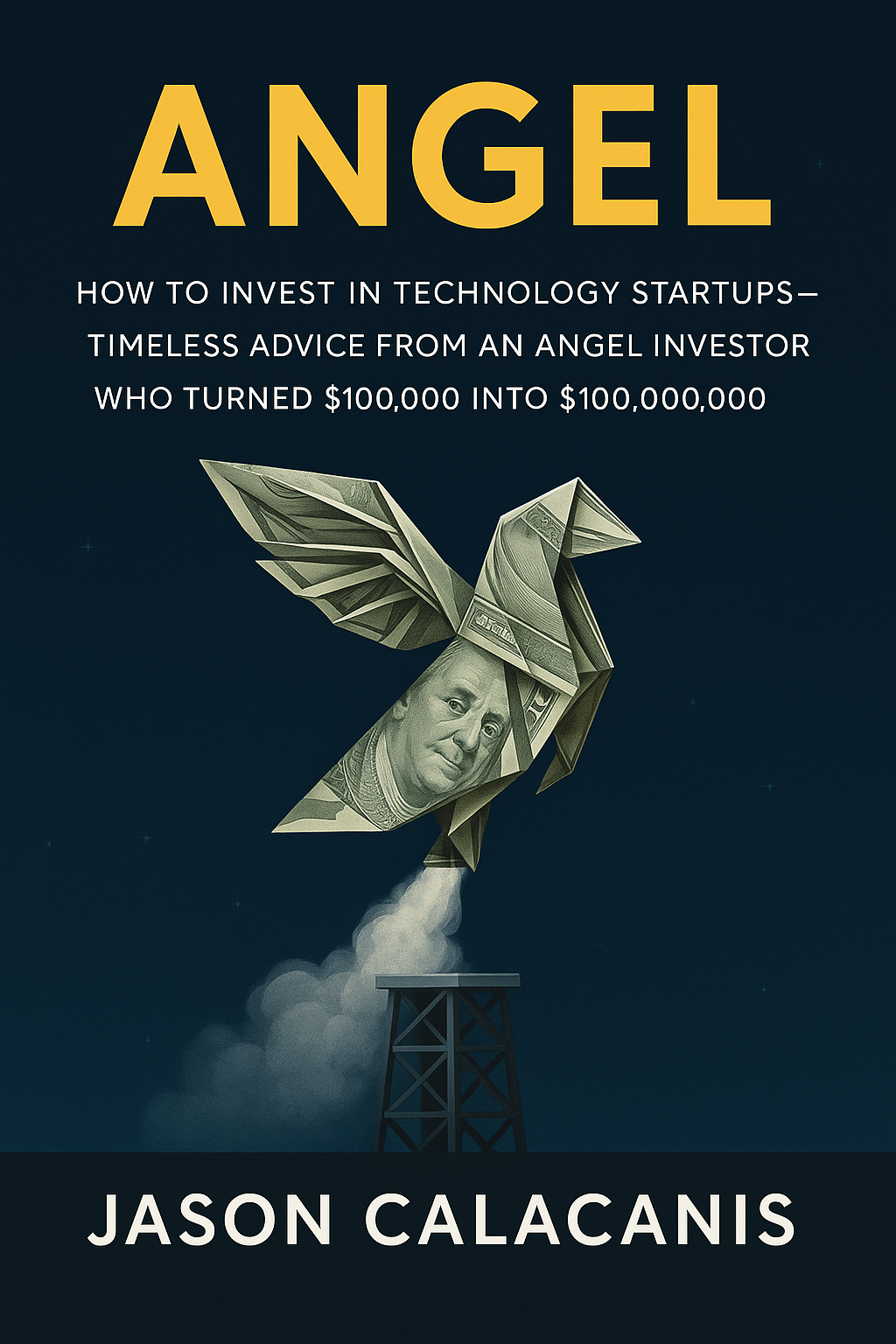
Angel: How to Invest in Technology Startups—Timeless Advice from an Angel Investor Who Turned $100,000 into $100,000,000
Chapter Summaries
What's Here for You
Ever dreamt of turning a modest sum into a fortune by backing the next big thing? Jason Calacanis, a C-minus student who transformed $100,000 into $100,000,000, pulls back the curtain on the electrifying world of angel investing in technology startups. This isn't about insider secrets or a magic formula; it's a raw, honest, and deeply practical guide forged in the trenches of the 21st-century innovation economy. Calacanis demystifies angel investing, revealing it not as a reckless gamble, but as a strategic approach accessible to those with money, time, network, or expertise – even if you don't have all of them starting out. Inside, you'll discover how to navigate the intricate landscape of startup funding, from understanding the different rounds to learning how to get on a company's cap table with little or no money. Calacanis shares timeless advice on building your network, the pros and cons of advising, and why he believes going straight into angel investing after college might be the ultimate hack. Forget the myth that you need to be in Silicon Valley; he shows you how to leverage syndicates to access incredible deals and build a diversified portfolio from month one. You'll master the art of the pitch meeting, learning what to do before, during, and after, and crucially, how to pick billion-dollar founders by asking the right questions and listening deeply. He provides a practical due diligence checklist, guides you through your first 'yes,' and explains why consistent monthly updates from founders are non-negotiable. Prepare for the inevitable 'disastrous' second year, learn to keep your head up through early failures, and understand the realities of company 'exits.' Ultimately, Calacanis invites you to find your groove and define your own angel story. This book offers an intellectual thrill and the potential for immense financial reward, delivered with a candid, no-nonsense tone that will empower you to embark on your own journey to becoming a successful angel investor.
Someone Else Was Supposed to Write This Book
The author, Jason Calacanis, a C-minus student from Brooklyn who defied expectations to amass immense wealth in the tech industry, frames this book not as a secret system but as a raw, honest account of how massive wealth is forged in the 21st century. He reveals a personal narrative of overcoming a childhood marked by his family losing everything when federal agents raided his father's bar, a trauma that fueled a relentless drive to prove himself, leading him from New York to the West Coast. Calacanis posits that the American Dream, while still alive, is not as widely distributed as in previous generations, where stable, lifelong jobs were the norm. Today, he argues, automation and exponential technological growth are displacing these traditional roles, leaving many behind. However, he offers a beacon of hope: by understanding and engaging with this shift, anyone can gain a 'seat at the table' with the innovators and financiers driving this new era. Unlike historical business advice, Calacanis emphasizes a forward-looking approach, recognizing that the pace of change in technology—from the internet and mobile devices to robotics and biology—is unprecedented, rendering much past wisdom obsolete. His work as an angel investor, often placing bets on nascent companies like Uber and Thumbtack when they were valued at mere millions, exemplifies this commitment to identifying and funding the future. He shares the story of Cafe X, a robotic cafe aiming to disrupt the $5 latte market by eliminating costly real estate and human labor, showcasing how innovation can drastically reduce prices and improve efficiency, even if it means displacing millions of jobs. Calacanis confronts the potential societal upheaval, acknowledging the 'jobpocalypse' that looms as artificial intelligence and automation advance, potentially impacting even white-collar professions like law, medicine, and software engineering. He introduces the concept of 'escaping the matrix' by choosing to understand these changes rather than be overwhelmed by them, likening it to taking the 'red pill.' This profound transformation, he suggests, may lead to a future where humanity must grapple with fundamental questions of survival and purpose, as evidenced by the 'billionaire preppers' securing off-grid havens. Ultimately, Calacanis aims to equip readers not just to survive this 'perfect storm' of change but to thrive within it, viewing his role as an investor and author as a means to accelerate positive, world-bettering innovation while still acknowledging the personal fortunes to be made.
The Brooklyn Grinder
In the bustling, often contentious world of technology investing, the author, Jason Calacanis, confronts a fundamental question: Is angel investing a gamble or a calculated strategy? He posits that it hinges entirely on approach. For years, Calacanis has placed what he calls 'bets,' forty a year, aiming for an aggregate return that far surpasses his initial outlay. He reveals a staggering personal journey, having invested just under ten million dollars over six years, resulting in a portfolio now valued at over 150 million – a fifteenfold return. This remarkable achievement, he notes, is even more profound given his upbringing, witnessing his parents' constant financial struggles. A significant portion of this investment, nine million out of ten, was deployed in the last three years, with his earliest investments, Uber and Thumbtack, yielding an astounding fifteen hundred times return within the first two years. While acknowledging that the full story of his impact won't be known for a decade, he confidently places himself among the top angel investors, likening his role to buying lottery tickets, but with a crucial difference: his tickets are already in the top one percent of the winning pool, requiring only two numbers to match instead of seven. He asserts he has 'gamed the system,' rigging the roulette table and starting poker hands with an ace of spades, giving him an undeniable edge. This self-assurance stems from a deep-seated drive forged in his youth, dreaming of the privilege and financial security he lacked. He recounts his days as a broke Fordham student, meticulously budgeting two dollars for sustenance on the subway, a stark contrast to the wealthy elites he observed in Manhattan. This experience fueled a relentless curiosity about wealth creation, leading him to study systems and ultimately champion angel investing in technology as the most efficient path to capital creation. Calacanis shares a pivotal moment: his selection as the first 'Scout' for Sequoia Capital, a legendary venture capital firm. This program, where founders select other founders to back with Sequoia's money, offered Scouts an extraordinary deal, a 45 percent return split, far exceeding typical VC arrangements. He saw this as validation, the 'kid from Brooklyn' anointed by the smartest minds in the business, tasked with finding the next big thing. This opportunity echoed his childhood dreams of a life of financial ease and influence, a stark departure from his reality of living in a cramped attic apartment and struggling for every meal. He explains that while many view gambling negatively, the wisdom of poker players, 'No gamble, no future,' resonates with his philosophy, emphasizing that risk, when intelligently managed, is essential for outsized outcomes. He stresses that this is not recklessness but a calculated approach, focusing on developing an 'unfair advantage' through deep study and strategic deployment of capital, likening it to identifying the 'sucker' at the poker table and ensuring it isn't oneself. Calacanis recognizes his own inherent advantages, born a white male in New York City at a propitious time, with early access to computing technology that provided a critical head start. He acknowledges that many 'outsiders' face systemic disadvantages he did not, and he wrote this book to offer a playbook, however imperfect, to level the playing field for those who have historically been excluded from the world of high finance and innovation.
What Is Angel Investing?
Jason Calacanis, in his chapter 'What Is Angel Investing?', invites us into the high-stakes world of early-stage technology investment, painting a picture of angel investors as the saviors of nascent ventures, stepping in when others see only risk and madness. He defines angel investing as the act of injecting capital into companies less than three years old, often with minimal traction, in pursuit of returns far exceeding those found in safer, more established markets. The core of this endeavor, Calacanis explains, lies in the pursuit of 'product-market fit'—that magical moment when a product truly delights a significant group of users, creating a foundation for scaling and monetization. This fit is the crucial first milestone; without it, even the most promising ideas falter. For founders, success culminates in an 'exit,' typically an acquisition by a larger company or an initial public offering, which allows investors to cash in their shares. Calacanis stresses that the inherent risk is precisely why such opportunities exist; companies with proven product-market fit, established revenue, and millions of customers are no longer accessible to early-stage angels. He draws parallels to tech giants like Apple, Microsoft, Google, and Facebook in their infancy, highlighting the bold bets made by early investors like Mike Markkula, Andy Bechtolsheim, and Peter Thiel. Calacanis shares his own experience with Uber, a $25,000 investment made when the company was a small operation in one city, demonstrating how a belief in the founder and the product, even with uncertain scalability, can lead to astronomical returns—a 'home run of home runs.' This single investment, he notes, underpins his ability to write the book, underscoring the life-changing potential of angel investing. He contrasts this with traditional, 'boring' investments like bonds and ETFs, which offer predictable but modest returns, taking decades to double money, whereas angel investing, though opaque and high-risk, offers the possibility of multi-thousand-fold returns. The author acknowledges the significant odds, comparing it to a casino where the house has an advantage, but posits that the potential upside—turning a $5,000 investment into millions by backing a 'unicorn' or 'decacorn'—justifies the gamble. He provides a stark numerical scenario: with a $2.5 million net worth, allocating $250,000 to angel investing in $5,000 increments across fifty startups could, even with a 70% failure rate, yield substantial returns if just a few investments hit big. The downside, he cautions, is significant; investing requires looking at thousands of startups to find a handful worth backing, demanding a substantial time commitment of twenty to thirty hours per week. Yet, he frames this not as a deterrent, but as the necessary work for potentially life-altering rewards, offering a path to wealth creation for those willing to suspend fear and focus on what could go right.
Is Angel Investing for You?
The path to becoming an effective angel investor, as Jason Calacanis explains, isn't paved with a single, rigid requirement, but rather a flexible combination of resources: money, time, network, and expertise. He reveals that one needn't possess all these assets from the outset; indeed, Calacanis himself began by leveraging his network and knowledge, trading them for equity and advisor roles, demonstrating how even without capital, one can gain a foothold in the startup ecosystem, sometimes yielding significant returns from simply attending board meetings and making introductions. The true mark of a top-tier angel, however, transcends mere resources; it lies in possessing four key qualities: the ability to invest capital, dedicate time to founders' critical issues, deploy a robust network for introductions, and offer crucial expertise to guide startups away from costly mistakes. Yet, beyond these tangible skills, a profound enjoyment of interacting with a diverse spectrum of personalities is paramount. Calacanis paints a vivid picture of the founder landscape, a mix of brilliant visionaries and undeniably difficult 'wild cards'—individuals often perceived as arrogant or stubborn, whose unconventional nature, when channeled effectively, fuels the innovation that can lead to immense success. To thrive here, one must embrace this inherent unpredictability, finding common ground with those who are passionately inflexible, recognizing that these very traits, often initially dismissed as abrasive, are the raw ingredients of world-changing ventures. Ultimately, the question isn't just 'Do you have the resources?' but 'Do you have the temperament to navigate the exhilarating, often chaotic, world of visionary founders?'
Do You Need to Be in Silicon Valley to Be a Great Angel Investor?
Jason Calacanis, in his insightful work 'Angel,' confronts a persistent myth that looms large in the minds of aspiring investors: the absolute necessity of geographical proximity to Silicon Valley to achieve greatness. He contends, with the conviction of a seasoned entrepreneur, that while the Valley possesses a unique ecosystem, it is not the sole crucible for forging exceptional angel investors. The author reveals that the essence of great investing lies not in the zip code, but in the cultivation of a discerning eye, a robust network, and an unwavering commitment to learning, wherever one may be located. Imagine the early days of the internet, a sprawling, untamed frontier; Calacanis suggests that the pioneering spirit required to navigate such a landscape can be found anywhere, not just within the well-trodden paths of Sand Hill Road. He emphasizes that the core skills—identifying promising teams, understanding market dynamics, and possessing the courage to make bold decisions—are transferable and can be honed through dedicated effort and a willingness to engage with the global startup scene. The tension arises from the perceived gatekeeping of innovation, the idea that access to opportunity is geographically constrained. However, Calacanis offers a resolution: the democratization of information and connection through technology itself has leveled the playing field, allowing motivated individuals outside the traditional hubs to build influence and source deals. The narrative arc moves from the initial doubt and the allure of the Valley's magnetic pull to the empowering realization that potential is distributed, not concentrated, and that true investing prowess is an internally cultivated trait, not an externally granted privilege tied to a specific location.
What’s So Special About Silicon Valley?
The author, Jason Calacanis, unveils Silicon Valley not just as a geographical location, but as the pulsating heart of global innovation, a place where the future is not merely conceived but relentlessly engineered. He paints a vivid picture of this Northern California peninsula, a compact region that has become synonymous with the world's most transformative companies – from Google and Apple to Uber and Netflix – which have redefined industries from transportation and lodging to media and politics. The sheer concentration of venture capital, with 30 percent of all US investment flowing into the Bay Area, dwarfs other hubs, creating an unparalleled ecosystem. This isn't just about market capitalization; it's about the very fabric of modern life being rewoven by the region's technological prowess. Calacanis emphasizes that to truly succeed as an angel investor aiming for 'decacorns' – companies valued at over $100 billion – proximity to this epicenter is not merely advantageous, it's essential. He argues that the top talent, the most ambitious founders, and an overwhelming number of experienced investors converge here, creating a powerful network effect where the value of connections grows exponentially with each new participant. It's a place where the ambition is so grand, it includes literal moonshots like colonizing Mars, a boldness that fuels potentially massive returns for those who dare to invest. The author contrasts this with other cities, suggesting that while one might achieve modest success elsewhere, the truly world-changing, billion-dollar exits are overwhelmingly born in the Valley. He likens the experience to starting every hand of poker with an ace of spades, a metaphor for the inherent advantage of being immersed in this unique concentration of talent, capital, and audacious vision, where the greatest product Silicon Valley ever built is, in fact, Silicon Valley itself, continuously reinvesting and propelling itself forward.
Startup Funding Rounds Explained
Jason Calacanis, in his exploration of startup funding, unveils the intricate dance of capital that fuels innovation, guiding us through the evolutionary stages a company navigates from its nascent beginnings to its potential for significant growth. He begins by demystifying the early stages, highlighting 'sweat equity' not as a formal round, but as the foundational commitment of founders pouring their time and talent into a venture before any external capital arrives – a crucial indicator of grit and resilience, separating the builders from the mere talkers. This is followed by 'bootstrapping,' a resourceful extension where a company leverages any available means, often including early customer revenue, to propel itself forward, a testament to ingenuity in the face of scarcity. The 'friends and family' round, while providing initial cash, often reveals a founder's resourcefulness or, conversely, their tendency to become 'check writers,' adept at spending but disconnected from product-market fit. Calacanis then pivots to 'self-funding,' cautioning against founders who risk their entire future by going into debt to bankroll a venture that has already been passed over by professional investors, framing such actions as potentially 'insane' rather than courageous. Incubators and accelerators emerge as a more structured path, offering modest seed funding for a stake in the company, having played a role in the recent startup boom, though the author notes that most iconic companies bypassed this route. The 'seed/angel' round often follows these initial stages, the author explaining that an angel investor's role is akin to a talent scout, sifting through promising candidates emerging from these various channels. A critical juncture is the 'bridge round,' a lifeline thrown when a startup runs out of cash before reaching its next major funding milestone; Calacanis advises investors to scrutinize what has fundamentally changed since their initial investment, warning against throwing 'bad money after good' out of loyalty or ego, and emphasizing the importance of fair valuation, often a point of contention in these rounds. Finally, the 'Series A' marks a significant transition, typically involving professional venture capital firms that introduce formal governance, board structures, and a laser focus on increasing share price, transforming the CEO's role into one that includes significant board management. For angel investors, Calacanis stresses the importance of securing 'pro rata rights' to maintain their ownership percentage in subsequent rounds, viewing its denial as a sign of disrespect and a misalignment of partnership. Beyond Series A, later rounds like Series B, C, and beyond signal a company's maturation, often presenting opportunities for early investors to consider 'secondary stock sales' and realize returns. The overarching narrative is one of discerning genuine entrepreneurial drive, resourcefulness, and potential amidst the complex financial ecosystem of startups, urging investors to develop strategies for picking well, much like a scout spotting future stars on the field.
How to Be an Angel Investor with Little or No Money
Jason Calacanis, in his chapter 'How to Be an Angel Investor with Little or No Money,' guides aspiring investors through the intricate dance of getting onto a startup's cap table, the official ledger of who owns what. He begins by demystifying the cap table itself, explaining it as the foundational document detailing shareholders, their contributions, and their share classes. The author stresses that while direct share purchase is the most straightforward path, it demands both capital and access to promising deals, a rarity for newcomers. Calacanis paints a vivid picture: the truly exceptional founders, those who build the next Zynga or Twitter, are already so well-funded and connected that they don't need or seek out novice angels. Instead, the aspiring investor must diligently seek out those diamonds in the rough, the founders who *will* become the next titans. This initial phase, he advises, is about casting a wide net, meeting many potential founders—going on many dates, as it were—without committing to any single investment. The chapter then breaks down the five key players on any cap table: founders, employees, advisors, angels, and venture capitalists (VCs). Founders are the originators, employees are incentivized through stock options that typically vest over time, aligning their long-term interests with the company's success. Advisors, or 'broke angels,' offer their expertise and network in exchange for equity, serving as a crucial entry point for those with limited capital. Angels, like the reader, provide a mix of money, time, and network, acting as vital early supporters. Finally, VCs enter later, bringing substantial capital to guide the company through its growth phases. Calacanis emphasizes that all these stakeholders should be aligned in their goal: increasing the company's value, a concept illuminated by understanding share price and potential valuations. He then delves into the often-divergent motivations, particularly between angels and VCs, when faced with exit opportunities. Angels, having invested their own capital, might be tempted to secure a solid return, perhaps selling half their stake to de-risk their investment, a strategy he calls 'idiot insurance.' VCs, however, are investing 'Other People's Money' (OPM) and are driven by larger potential gains, often pushing founders to aim for 'unicorn' status, even at the risk of a complete meltdown. This divergence highlights a critical tension: the angel's desire for a healthy, early return versus the VC's pursuit of massive, albeit riskier, upside. The narrative then pivots to potential solutions like secondary share transactions, where founders or early investors can sell a portion of their stake to generate liquidity without cashing out entirely, a mechanism that can satisfy both the need for some immediate return and the drive for future growth. For the individual with truly little or no money, Calacanis points back to the advisor role, trading skills and network for equity, framing it as a valuable stepping stone. He contrasts this with founding or becoming an early employee, which, while offering direct ownership, typically limits an individual to far fewer 'lottery tickets' over a career, with significantly higher odds of no substantial exit compared to a diversified angel portfolio. Ultimately, the path to becoming a successful angel investor, even with limited funds, involves strategic networking, understanding stakeholder motivations, and leveraging non-monetary contributions to gain a foothold on the cap table, always remembering that the true measure of success lies not in paper valuations but in the realized returns from smart selling decisions.
The Pros and Cons of Advising
The author, Jason Calacanis, delves into the world of startup advising, a role distinct from founders, employees, angels, and VCs, where compensation comes not in cash, but in skills, connections, and reputation. He recounts his early career, when lacking capital to invest, he leveraged his Rolodex and startup acumen to join advisory boards of companies like Wealthfront, ThisNext, Savings.com, and Dyn.com, a strategy that yielded significant financial returns, amounting to hundreds of thousands of dollars from just a few of these ventures. This experience highlights a core tension: the potential for substantial upside versus the inherent risks and the critical concept of opportunity cost. Calacanis emphasizes that time is a finite, precious resource, and as he matured as an investor, he became far more selective, only joining boards of companies that are either surging or under severe attack, or if the founders are close friends or the mission deeply resonates. He illustrates opportunity cost with a vivid example: a CEO spending hours learning design to save money versus those same hours spent raising capital, revealing the far greater potential return from the latter, unless the product is fundamentally uninvestable without design improvements. This underscores the need for constant re-evaluation of how one allocates finite time and energy, lest one drift into regret over misspent years. Calacanis shares his personal journey, including a rewarding $16,000 advisor check from ZeroDegrees, a $150,000 payday from Savings.com, and a nearly half-million dollar return from Dyn.com, all achieved without direct investment, showcasing the power of earned advisor shares. However, he also recounts a bitter experience with a startup founder named Alex, who, influenced by a venture capitalist, reneged on advisor shares owed to him and even Jay Z, illustrating the darker side of private company dealings where reputation can be sacrificed for financial gain. This cautionary tale serves as a stark reminder that advisor shares are not guaranteed, and the landscape of private companies is rife with potential pitfalls, necessitating robust legal agreements and careful partner selection. Ultimately, Calacanis posits that while bad experiences can sting, they refine one's ability to identify strong founders, and working with good people, even if one occasionally gets burned, is a small price for the lessons learned and the avoidance of greater future entanglements.
Going Straight from College to Angel Investing
The author, Jason Calacanis, posits a powerful, almost regretful, thesis: that he should have bypassed traditional career paths and plunged directly into angel investing immediately after college. He recounts moments in his youth, like witnessing the seismic shift from DOS to Windows, where he possessed an almost prescient understanding of burgeoning technological giants like Microsoft. This insider knowledge, gleaned from countless hours immersed in the nascent computer ecosystem, was right there, palpable. Yet, a deeply ingrained 'poverty mindset,' as he describes it, prevented him from seizing these monumental opportunities. He paints a vivid picture of what could have been – a family fortune built on a mere $1,000 bet placed decades ago. Calacanis argues passionately that this isn't a tale of lost opportunities unique to him, but a cautionary narrative for anyone today. He dismantles the common excuses of financial constraint, illustrating how modest sacrifices, like forgoing cable TV for five years and repurposing that time towards income generation and deal-seeking, could yield substantial capital for early-stage investments. The average American, he suggests, spends an inordinate amount of time passively consuming media, time that could be actively deployed to build wealth. He frames this societal conditioning – the 'helplessness' that leads to couch-bound inertia and passive consumption – as a form of societal hoodwinking, likening individuals to mere monthly subscriptions for corporate America. The call to action is clear: unplug from this passive existence, break free from the 'Matrix' of consumerism, and embrace intelligent risk-taking. He shares another missed opportunity at Amnesty International, recognizing the explosive potential of early networking technologies and companies like Cisco, yet again failing to capitalize. The core insight here is profound: the future is often visible to those who are paying attention, especially those with a deep understanding of a particular domain. Calacanis advocates for a proactive approach, even if it means starting small, offering consulting in exchange for equity, and embracing the learning process that comes with making dozens of small bets. The narrative arc moves from the sting of missed opportunities to the empowering realization that luck can be manufactured by positioning oneself alongside those already succeeding, transforming the 'sucker at the table' into a savvy participant.
How to Hack Angel Investing: Syndicates
The author, Jason Calacanis, unveils a revolutionary pathway for aspiring angel investors, one that bypasses the steep learning curve and immense capital requirements traditionally associated with Silicon Valley investing. He explains that becoming a successful angel typically demands investing in dozens of companies within the notoriously competitive hotbed of Silicon Valley, a feat made even more daunting by the initial ineptitude most newcomers face in evaluating deals and navigating meetings. Calacanis introduces syndicates as the elegant solution, a mechanism that allows individuals to invest alongside seasoned angels, effectively leveraging their expertise and track record. Platforms like AngelList, SeedInvest, and Funders Club facilitate this by enabling successful investors, known as syndicate leads, to create investment groups. These leads, much like the captains of old who charged a share of cargo profits for safe passage, typically take a 20 percent 'carry'—a share of the profits—while the platform takes a smaller cut, a model distinct from venture capital firms which often impose additional management fees. For the individual investor, this means minimal overhead, with the primary cost being the carry on successful exits, often starting with a commitment as low as $1,000 per deal. A syndicate lead negotiates a chunk of a startup's funding round, say $200,000 to $500,000, and syndicate members can then pledge smaller amounts, gaining exposure to vetted deals without the burden of extensive due diligence or personal meetings. Founders benefit immensely, as syndicates simplify their cap table, presenting a single entity (the Special Purpose Vehicle or SPV) instead of numerous individual investors. The syndicate lead, in turn, can significantly amplify their returns by sharing deal flow and earning carry on the collective investment. For the new angel, the allure is clear: invest in startups validated by experienced eyes, gain invaluable experience with minimal risk, and build a network. Calacanis emphasizes this as a strategic 'hack,' enabling individuals to build reputation, prove worth to founders, and jumpstart their networks for a fraction of the cost of an MBA, all within a month. It's a chance to get on the cap table of multiple startups, amass a network of co-investors and founders, and establish an online presence that can attract future deal flow. Even without a storied last name or a pre-existing track record, this method provides a tangible entry point, a way to be the one to write that crucial first check, thereby becoming an integral part of the startup ecosystem.
Month One: Your First Ten Syndicate Deals
Jason Calacanis, in 'Month One: Your First Ten Syndicate Deals,' guides the aspiring angel investor through the crucial initial steps of building a diversified portfolio, framing the process not just as a financial endeavor, but as a craft honed through experience. He emphasizes that to achieve outsize returns in Silicon Valley, an investor must aim for diversification across fifty startups over three years, deploying roughly $1.5 million, with a strategic allocation that front-loads capital into early deals and reserves more for future winners, a concept he dubs finding 'dragon eggs.' The immediate challenge is to populate one's resume with ten quality angel investments, each featuring a seasoned syndicate lead with a track record of success, a Silicon Valley base, at least two founders to ensure continuity, a product already in market, evidence of six months of continuous user growth or revenue, and sufficient post-funding runway of eighteen months. By investing a modest $2,500 in each of these initial ten deals, a mere fraction of the total 'chip stack' or allocated capital, the new angel investor gains invaluable experience without risking significant ruin—a concept he illustrates by comparing the investor's 'bankroll' to a poker player's total net worth, cautioning against betting it all at once. This initial learning phase is akin to a 'padawan' starting at the low-stakes tables, much like Calacanis's own early poker days learning from 'old biddies' at a $1/$2 table, a stark contrast to risking one's entire fortune. Even within a syndicate, where control is ceded to the lead, active participation is encouraged; investors can offer value through social media amplification, introductions, or expert advice, turning a passive investment into an active contribution. Calacanis stresses the importance of writing 'deal memos' for each investment, documenting the thesis, risks, and success factors, and revisiting them to refine one's thinking, alongside meeting founders and visiting their offices to gauge their resourcefulness and commitment. This rigorous approach, treating angel investing as a vocation akin to teaching or being a Jedi, is what separates seasoned investors from those who merely speculate, a lesson underscored by his own colossal $50 million miss on Twitter, a failure born from ego and an overreliance on understanding the 'what' rather than the 'who'—the founder's 'Force.' The ultimate resolution lies in learning to trust the founder's strength and potential, transforming initial risks into a foundation for significant future success.
Month Two: Thirty Days of Angel and Founder Meetings
The journey into angel investing, as Jason Calacanis lays out in this pivotal month, is less about capital and more about connection. Having completed ten syndicate deals, the aspiring angel investor, let's call her Jane, now possesses a foundational credential. But as Calacanis emphasizes, true deal flow, the kind that yields extraordinary returns, rarely surfaces on public platforms. It flows through networks, a secret current of insider knowledge and elite founder access. To tap into this stream, Jane must actively cultivate her own network, starting with a meticulous spreadsheet of her existing co-investors from those first ten deals. This digital breadcrumb trail, leading to hundreds of potential connections across LinkedIn, AngelList, and Twitter, is the first step. By engaging with these peers, liking, retweeting, and replying, Jane begins to build 'social currency,' a subtle but powerful form of recognition in the Valley's intricate social fabric. This groundwork prepares her for the crucial next phase: direct outreach. The goal is not just to meet other investors, but to understand their investment thesis, their unique value proposition, and to clearly articulate her own. As Calacanis frames it, every meeting is an audition, a chance to demonstrate professionalism, presence, and courtesy, proving that an investor's time is indeed valuable. The art lies in offering value before asking for it, perhaps by introducing promising founders from her own portfolio. Simultaneously, Jane must empower her founders, encouraging them to make direct introductions to other investors, thereby amplifying her reach. This strategic networking is a stark contrast to the passive role in syndicates; here, Jane is actively shaping her own deal flow. The narrative then shifts to the founder meetings, a rigorous process of sifting through twenty-five pitches. The emphasis is on deep listening, careful note-taking, and crucially, the discipline of saying 'no' in the moment, deferring decisions to allow for objective evaluation. Calacanis introduces a powerful framework for sorting opportunities, categorizing them as 'Great,' 'Good,' or 'Okay,' and meticulously documenting the reasons for each decision. This practice of reflective analysis, revisiting past choices to refine future judgment, is the bedrock of developing forecasting acumen. The chapter underscores that the hottest deals are ephemeral, often closing before the uninitiated are even aware. Therefore, the ability to quickly establish credibility and demonstrate genuine insight becomes paramount, transforming Jane from an observer into an active participant in the ecosystem, ready to say her first 'yes' with newfound confidence and discernment.
My Best and Worst Pitch Meetings
The author, Jason Calacanis, opens a window into the high-stakes world of angel investing, revealing how the sheer volume of pitch meetings can erode professionalism and breed bad habits, much like the seasoned EMTs who, amidst life-and-death emergencies, sometimes developed a disturbing indifference. He draws a parallel between the Jedi-like calm of experienced emergency responders and the critical need for investors to maintain composure and consideration, emphasizing that a founder's feeling after a meeting profoundly impacts an investor's success. Calacanis shares a pivotal experience pitching his second company, where legendary investors like Michael Moritz of Sequoia Capital, Mark Cuban, and John Doerr of Kleiner Perkins responded with remarkable speed and enthusiasm, even as Doerr, recovering from a bike accident and on pain medication, famously fell asleep mid-meeting, a testament to his dedication. This contrasts sharply with a less reputable firm, Extra Ventures, whose junior partner, after securing Calacanis's flight to San Francisco for a partner meeting, abruptly canceled via voicemail, leaving Calacanis stranded and infuriated. This egregious lack of courtesy, born from a "second-rate VC firm's" perceived indifference, ignited Calacanis's "Irish temper," leading him to confront the partner publicly. The author reflects on this moment, admitting his younger self's tendency to "explain to stupid people just how stupid they were," a habit he has since shed, recognizing the value of simply avoiding such individuals. This formative experience, both the needless cancellation and his own angry reaction, now informs how Calacanis, from the investor's side of the table, treats founders, understanding that the emotional residue of an interaction can be as impactful as the financial terms. He underscores that founders, like great entrepreneurs, have options, and an investor's reputation for being helpful, present, and considerate is their most valuable currency in securing the best deals, a lesson learned through both exemplary and deeply flawed encounters.
What to Do Before a Pitch Meeting
Jason Calacanis, in his chapter 'What to Do Before a Pitch Meeting,' illuminates a fundamental truth for any aspiring investor: the true value lies not just in writing a check, but in earning the trust and attention of the most promising founders. He reveals that a cursory Google search is woefully insufficient, advocating for a rigorous three-hour preparation framework for each potential investment: one hour for deep research, one hour for direct engagement with the founders, and a crucial hour for post-meeting reflection. This preparation involves dissecting the product, understanding the market landscape, identifying competitors, and assessing existing investor interest. Calacanis illustrates this with historical examples, noting how even for disruptive companies like Facebook, understanding established competitors like MySpace and Friendster offered a rich vein of research. For truly market-transforming ventures like Uber and Airbnb, where direct experience was key, he emphasizes that a single ride or stay offered more insight than many investors bothered to gain. The core tension, he explains, is that many investors mistakenly believe they hold all the power, leading them to treat meetings superficially. However, the real challenge is convincing the *right* founders to accept their capital, a feat that demands genuine preparation and respect. This dedication, Calacanis suggests, not only impresses founders but is the indispensable first step in building a successful investment portfolio, transforming a simple meeting into a strategic advantage.
What to Do During a Pitch Meeting
The author, Jason Calacanis, guides us through the crucial art of the pitch meeting, a space where first impressions and focused attention can make or break a potential investment. He emphasizes that dedicating a full hour, and even leaving buffer time, isn't just about courtesy; it's a profound signal of respect to founders, acknowledging that their vision is worthy of deep consideration. This extended time allows for genuine understanding, moving beyond a superficial glance to the heart of their endeavor, much like a seasoned journalist allowing a story to unfold naturally. Calacanis advocates for flipping the script on traditional investor-led meetings, inviting founders to dictate the flow – whether it's a deck, a product demo, or a free-form discussion. This approach, he explains, positions the investor as more valuable, a beacon of laser focus amidst a sea of distracted contemporaries. The physical act of taking notes becomes a powerful non-verbal cue; Calacanis insists on pen and paper, viewing it as an adult, respectful method that elevates the founder's ideas into something worthy of a permanent record, a stark contrast to the fleeting and dismissive nature of digital note-taking on phones. He stresses the importance of silencing one's phone, a simple yet potent act that communicates presence and respect, signaling that the world can indeed wait for the insights being shared. While coffee shops are a last resort, a professional setting with amenities—from refreshments to charging stations—transforms the meeting into an experience, akin to dining at a Michelin-starred restaurant, reinforcing the investor's professionalism and commitment. The true magic, however, lies not in pre-prepared questions but in active listening, allowing the founder's answers to organically shape the next inquiry, fostering a dynamic conversation rather than a rigid interrogation. This conversational dance, he observes, is a hallmark of truly successful individuals who understand the power of presence and thoughtful silence. Finally, Calacanis cautions against impulsive 'yes' or 'no' decisions during the pitch itself. The founder's persuasive 'reality distortion field' can cloud judgment. Instead, he advises a measured approach: express interest, request time to deliberate, and follow up with a considered decision, thereby embodying the wisdom and methodical nature expected of a seasoned angel investor.
How to Pick a Billion-Dollar Founder
The author, Jason Calacanis, reveals a fundamental truth about angel investing: you don't pick billion-dollar companies, you pick billion-dollar founders. This insight cuts through the noise of the investment world, where the conventional wisdom often clashes – that one must pick the right startups, yet no one can truly predict future success. Calacanis navigates this paradox by focusing on elimination: identifying and discarding weak founders and small ideas with no potential for breakout growth. This clarity allows him to double down on exceptional founders and ambitious visions. He employs a rigorous screening process, eschewing immediate meetings for detailed information gathering via email, probing questions about employee count, revenue, funding history, customer acquisition, and the core motivation behind the business. This method, he explains, serves as a critical filter, allowing him to quickly assess burn rates and remaining capital, often surprising founders with his insight into their financial standing. The author emphasizes the necessity of ruthlessness in angel investing, a field where thousands of interactions and investments yield minimal returns, with a single outlier generating the vast majority of the profit – a phenomenon akin to splitting William Tell's arrow. He contrasts businesses built from 'atoms' – physical, brick-and-mortar ventures like restaurants and clothing lines, which inherently struggle to scale – with those constructed from 'bits,' like software. The latter, he argues, possess exponential scalability; a software company can reach a billion users with minimal incremental cost, a feat that would take decades and immense physical infrastructure for a company like Starbucks. This distinction is crucial for identifying companies capable of achieving billion-dollar valuations within a five-to-ten-year window. Calacanis also cautions against the danger of 'signaling' – the heuristics and patterns an investor develops that can inadvertently create blind spots, potentially causing them to dismiss revolutionary ideas that initially resemble existing ones, much like early Facebook might have appeared to a seasoned investor wary of copycats. Ultimately, the author champions a singular focus: investing in the founder, not merely the idea or the market. He posits that a founder and their company are inextricably linked, and the question for any investor should be profoundly simple: 'Would I buy stock in this person if I could?' Because, as he concludes, people aren't everything; they are the only thing.
The Four Founder Questions
Jason Calacanis, in 'The Four Founder Questions,' unveils the art of discerning promising technology startups, likening the angel investor's journey to a series of 'first dates' where rigorous evaluation is paramount. He emphasizes that while deal flow can be sourced through various channels—following other investors, analyzing metrics, or leveraging personal networks—the most potent tool remains the founder meeting. Calacanis advocates for a deep, empathetic listening approach, akin to a detective like Columbo or a therapist like Dr. Melfi, urging investors to adopt a posture of curiosity rather than arrogance. The core of his methodology lies in four pivotal questions designed to probe the founder's essence and the venture's viability. The first, 'What are you working on?', shifts focus from the product to the person, celebrating the founder's effort and intent. This is followed by 'Why are you doing this?', a question that seeks genuine passion and vision beyond mere financial gain or replicating existing successes, revealing if the founder is driven by a personal mission or a fleeting trend. Then comes 'Why now?', which probes the market's readiness and the confluence of technological and societal factors that make the present moment ripe for this specific idea, separating fleeting fads from sustainable opportunities. Finally, 'What's your unfair advantage?' delves into the unique strengths, insights, or connections that position the founder to outmaneuver competitors. Calacanis posits that mastering these sixteen words, delivered with genuine presence and active listening, allows investors to grasp the founder's motivation, commitment, potential for success, and the ultimate vision of victory, laying a crucial foundation for informed investment decisions before diving into the tactical details.
Going Deeper
The author, Jason Calacanis, guides us through the crucial second half of an investor-founder meeting, emphasizing the art of deep listening and incisive questioning to uncover true potential. He begins by reinforcing the importance of meticulous note-taking, advocating for pen and paper over digital devices, framing it as a sign of respect and intellectual engagement, a practice that transforms the investor into a keen observer, much like a Jedi Knight studying their quarry. Calacanis revisits the four foundational questions every investor must answer: Why this business? How committed is the founder? What are their chances of success? And what does winning look like? He stresses that the first half of a meeting should be dominated by the founder's voice, with the investor speaking no more than five percent of the time, allowing genuine insights to surface. Interrupting with minor questions, he warns, marks an investor as a 'nudge,' potentially alienating the founder and jeopardizing the investment. The narrative then pivots to the tactical second half, where the investor can ask a dozen concise questions to gauge execution. These include inquiries about competition, revenue models, average customer spend, and the top three reasons for potential failure. Calacanis illustrates this with an example of how Airbnb might answer, contrasting it with the often delusional responses of less objective founders, highlighting the delicate balance entrepreneurs must strike between conviction and reality—being 'punk rock' without 'OD-ing.' A particularly revealing tactic is the 'burn rate party trick,' where the investor can accurately estimate a startup's cash runway by combining revenue figures with employee headcount and known funding rounds, often surprising founders with their financial acumen. This ability to perform back-of-the-envelope math demonstrates a deep understanding of the business's operational realities. Finally, Calacanis introduces personal questions, most notably 'What did your parents do?' This seemingly simple inquiry serves as a powerful bonding tool, revealing a founder's background, values, and the inherent drive shaped by their upbringing, whether it involved privilege or hardship. The author posits that while family history isn't a sole determinant, it offers invaluable context for understanding a founder's grit and approach to building a company, ultimately enriching the investor's understanding of the human element at the heart of every startup.
Founder or Fraud?
The author, Jason Calacanis, draws a vivid parallel between the allure of being a tech founder today and the rockstar fantasy of 1960s musicians, a world saturated with media portrayals of legendary figures like Bill Gates, Steve Jobs, and Mark Zuckerberg. He observes how the rise of iconic entrepreneurs, fueled by blockbuster movies and global platforms, creates an aspirational mythos, yet this public image often masks the brutal reality of the founder's role. Calacanis contends that the romanticized vision of innovation and success, often seen through the lens of celebrity founders like Evan Spiegel, fails to capture the relentless pressure and unwavering responsibility that defines true leadership. The core tension emerges: distinguishing between those who merely *play* the founder role and those who embody its essence. He emphasizes that the founder is the ultimate pivot point, the one accountable when the market shifts, the team falters, or unforeseen crises strike – a solitary figure facing a constant barrage of 'unsolvable' problems, where the only metric that matters is winning. This harsh truth is illuminated by the insight that **the number one reason startups fail is not a lack of funding, but the founder giving up**; the author urges investors to look beyond the glossy presentations for signs of genuine grit. Calacanis identifies several red flags for investors: founders fixated on compensation comparable to established tech giants, those unwilling to start work until funded, individuals prioritizing work-life balance over immediate needs, and those who succumb to 'Taj Mahal syndrome' by overspending on lavish offices before product-market fit. He also warns against founders who cash out early, displaying conspicuous consumption, likening such actions to a 'bank heist' that betrays investor trust and the spirit of building. A crucial test for an investor is the founder's communication style: are they concise and direct, or do they offer verbose, tangential responses? This, Calacanis suggests, mirrors the quiet focus of a martial artist progressing through belts, contrasting with the 'empty can' that makes the most noise. Ultimately, the chapter serves as a stark reminder that while the dream of founding a company is intoxicating, the investor's critical task is to discern the deep-seated resilience of a true founder from the fleeting ambition of a fraud.
Evaluating the Deal
Jason Calacanis, in 'Evaluating the Deal,' guides the nascent angel investor through the often-turbulent waters of early-stage startup investment, emphasizing that timing and traction are paramount. He delineates the investment landscape into two primary buckets: 'pre-traction' and 'post-traction.' In the pre-traction phase, where ideas are mere whispers on a napkin or early prototypes, the risk is immense, akin to navigating a minefield blindfolded. Calacanis argues that for new angel investors, with their limited time and finite capital—likened to 'thirty bullets to fire'—the unnecessary risk of investing in pre-traction ventures is simply not worth it. Instead, he stresses the critical importance of 'traction,' defined by people actively using or paying for a product. He paints a stark picture of the startup graveyard, revealing staggering mortality rates: 99 percent of napkin ideas vanish, 95 percent of business plans remain unexecuted, and a significant majority of prototypes and MVPs never reach market viability or secure further funding. The core tension here is the investor's desire for high returns versus the startup's inherent fragility. The resolution? Focus on companies that have already demonstrated product-market fit, secured early adopters, and possess a compelling team capable of building with 'sweat equity.' Beyond traction, Calacanis introduces the concept of 'pro rata,' the vital right to maintain one's ownership percentage in future funding rounds. This isn't about charity; it's about rewarding early belief and allowing investors to double down on success, like a gardener nurturing a promising sapling with consistent water and sunlight. He cautions against deals without this right, seeing it as a red flag. Finally, the chapter tackles 'valuation,' acknowledging its mercurial nature, driven by market competition and founder psychology. While valuations fluctuate, Calacanis advises that a founder's ability to articulate their valuation with data—revenue, user growth—is far more telling than the number itself. The ultimate wisdom? Prioritize experienced teams, demonstrable traction, and the right to participate in future upside, rather than chasing unproven dreams at inflated prices.
Why Angels Should Write Deal Memos
The author, Jason Calacanis, illuminates a critical distinction between angel investing and venture capital, positing that angels, despite their smaller checks and broader portfolio, should adopt the rigorous practice of writing deal memos. Unlike venture capitalists who invest millions, join boards, and engage in extensive partnership debates, angels typically invest tens of thousands across numerous startups, operating largely solo. This difference, Calacanis argues, necessitates a personal system for codifying decisions. He introduces the deal memo not as a bureaucratic hurdle, but as a potent tool for crystallizing immediate thinking and refining future selection abilities by reviewing past assessments. To illustrate its power, he revisits the legendary deal memo penned by Roelof Botha for YouTube, a document that, despite meticulously detailing immense risks—from fierce competition and uncertain revenue models to scalability challenges and a lack of clear exit strategies—ultimately recommended proceeding with the investment. This narrative serves as a powerful testament to how comprehensive risk analysis can coexist with bold conviction. Calacanis then draws parallels to his own evolution, moving from informal journal notes, which offered a valuable distance for metacognition, to the idea of using blog posts as a public-facing deal memo. His experience with blogging, particularly after selling his own company, revealed its potential not only for gaining attention but also for attracting talent and investors, transforming him into what a Sequoia Capital partner called the 'Pied Piper of startups.' He further illustrates this with his investment in Calm.com, initially perceived as a niche, risky venture. Calacanis penned a blog post, a de facto deal memo, outlining the passionate founder, Alex Tew, the strong branding, and the burgeoning metrics, while also preemptively addressing the skepticism of venture capitalists who might shy away from 'left of center' bets. He bravely predicted its potential, comparing the initial absurdity of meditation to the widespread acceptance of yoga, and even acknowledged the inherent 70% chance of failure, a sober acknowledgment of startup reality. This proactive, documented approach, Calacanis suggests, allows angels to navigate the inherent uncertainty of early-stage investing with greater clarity and accountability, turning potential blind spots into opportunities for growth and learning, much like a seasoned captain charting a course through unpredictable seas.
The Perfect Way to Decline a Deal
The journey of an investor, like Jason Calacanis, often involves navigating a delicate dance of saying 'no' to hundreds of founders, a task few find easy. In the high-stakes world of startup funding, clarity can be elusive, with investors sometimes resorting to ambiguous phrases like 'let's keep the dialogue open,' which founders, fueled by hope, might misinterpret as a 'yes.' Calacanis recounts his own evolution in handling these rejections, from testing founders' resolve by delaying responses to offering a stark, unvarnished truth – the 'red pill or blue pill' choice. He discovered that while candor is often appreciated, certain environments, like Y Combinator's Demo Day, can breed a sense of entitlement, where founders, buoyed by program prestige, present audacious valuations for nascent companies. Calacanis shares a poignant anecdote about a Y Combinator company, Weave, whose founder proposed a $10 million valuation based on cohort comparisons rather than tangible progress, a valuation that proved unsustainable. This experience, coupled with negative reviews from candid feedback, led Calacanis to adapt his approach. He now often employs a 'millennial-safe' strategy, highlighting positives and then politely stating a lack of fit with his investment thesis, a subtle way of delivering a 'no' without crushing spirits. This shift reflects a deeper understanding of founder psychology and the importance of preserving relationships. He also cautions against 'incubator fatigue,' advising new angels to avoid herd mentality and instead meticulously evaluate startups, suggesting a period of observation post-incubator to discern genuine potential from hype. The central tension, therefore, lies in balancing directness with empathy, and strategic assessment with emotional intelligence, leading to the elegant resolution of the 'not yet' approach. This phrase, taught to him by Roelof Botha, offers founders a chance to prove themselves while allowing the investor to remain involved and gather more data, a more humane and effective method for both parties. It acknowledges that life, and certainly investing, is a continuous test, and observing execution over time is the most reliable indicator of future success, a stark contrast to the immediate, often harsh, pronouncements of the past. Calacanis learned that sometimes, the kindest act is not to deliver a fatal blow but to offer a gentle redirection, allowing potential to blossom on its own terms.
Due Diligence Checklist
Jason Calacanis, in his chapter 'Due Diligence Checklist,' illuminates the critical, yet often overlooked, process of scrutinizing early-stage investments, transforming the often-voluntary act of looking into a business or individual before parting with capital into a vital detective mission. He reveals that while small investment amounts might tempt some to skip this step, the real risk lies not just in the founders' backgrounds, but in the insidious creep of groupthink and the perception that diligence might strain nascent relationships, much like a prenup can feel unromantic. Calacanis crafts a narrative of investigation, demonstrating through a vivid dialogue with a founder how seemingly impressive numbers can dissolve under closer inspection, revealing 'alternate metrics' where users are mistaken for customers and vague promises replace concrete revenue. This is the investor's first lesson: the most insightful question is often a rephrased version of the last. He then draws a stark line between harmless delusion and outright deception, illustrating how a founder claiming a million-dollar run rate with only a few thousand in actual deposited revenue, or falsely touting signed contracts with tech giants, crosses from optimistic vision into outright fraud. The author stresses that while founders might be delusional about their grand vision—like aiming for Mars or indexing the world's information—they must not lie about the tangible facts of their business. Calacanis shares a cautionary tale of a company built on a lie about pivotal client contracts, a deception that took significant effort to uncover, underscoring the vulnerability of less experienced investors who lack such rigorous inquiry. Even the 'appearance of impropriety,' he argues, is impropriety itself, highlighting that a founder's inability to manage relationships, even with existing investors, signals a fundamental flaw. Ultimately, Calacanis guides us to embrace the delusional visionaries, for they often birth world-changing ideas, but to steer clear of the liars, for relationships built on falsehoods are destined for ruin, leaving a trail of tears and distrust.
Your First Yes
The journey from evaluating thirty startups to making your first investment is a pivotal moment, a threshold crossed after careful deliberation. As Jason Calacanis explains, once a founder has been chosen based on traction, team, and existing investor confidence, the real work of closing the deal begins. This isn't just a handshake; it's a meticulous process requiring legal due diligence. A startup attorney, for a modest fee and minimal time, can review the crucial paperwork, summarizing the deal and flagging any peculiarities, ensuring you understand the terms. A critical point Calacanis emphasizes is verifying the inclusion of pro-rata rights, a vital safeguard for future participation, which founders typically grant without hesitation. Beyond the legalities, the author underscores the importance of signaling your enthusiasm and commitment to the founders, not just as a financier, but as a supportive partner eager to contribute. He advises scheduling brief, non-intrusive follow-up meetings—a hundred-day check-in and a one-year call—just twenty minutes each, a small gesture that signals long-term engagement without overwhelming the entrepreneur. Even when a round appears full, Calacanis suggests a heartfelt appeal to the founder, a plea to be included, highlighting a desire to help the company succeed, a tactic that often yields results, or at least keeps the door open for future investment rounds, as startups, he notes, are perpetually fundraising. The final steps involve signing documents, diligently filing them, and ideally obtaining a cap table, a window into the ownership structure that sharpens one's understanding of investor dynamics. The author also touches on the creative aspect of sharing your investment journey, perhaps through a blog post, but with a crucial caveat: always secure founder approval before speaking on behalf of the company, a lesson learned from his own entrepreneurial experience. Finally, the act of wiring funds and, perhaps, receiving a tangible stock certificate, marks the official transition—you are now an angel investor, a creator of futures.
How Founders Should Treat Their Angels
The author, Jason Calacanis, peels back the curtain on the founder-angel dynamic, framing it not as a transactional relationship, but as a symbiotic partnership where mutual success is the ultimate goal. He begins by acknowledging the founder's cleverness in seeking to understand the investor's mind, likening it to peeking at the test answers, a move that grants a significant advantage. Calacanis reveals that angels, despite their financial stake, are often veterans who, having fought their own battles in the arena, now wish to support the next generation of gladiators – the founders. They aren't just passive money; they are invested emotionally, yearning to be part of something significant, much like a film producer wants to see the dailies. This perspective underscores a crucial insight: founders must discern which angels are industry veterans with valuable contributions and which are simply deploying capital, tailoring their engagement accordingly. The inherent risk for angels is immense, with 80-90% of investments failing, leading to years of quiet suffering through shutdowns, making the rare successes akin to a cherished child's invitation to a White House state dinner. Calacanis emphasizes the importance of transparent communication, urging founders to send regular updates, both good and bad, because angels *want* to help and can only do so if they are informed. This shared journey, often spanning seven years or more before any return, highlights the need for founders to cherish their early supporters. The author illustrates a profound lesson in loyalty and candiff communication through a personal anecdote: his refusal to have his rights as an early investor trampled by a later-stage investor, famously stating, "Jason Calacanis does not eat shit." This moment, where he asserted his value as the "point guard" who brings future deals, not only protected his rights but also solidified a productive working relationship, demonstrating that respecting the contributions of early partners is paramount. The core dilemma for founders, then, is navigating these relationships with integrity and open communication, understanding that loyalty, when earned and reciprocated, becomes the bedrock of lasting partnerships and future opportunities.
There Is Nothing More Important Than Monthly Updates
The author, Jason Calacanis, lays bare a fundamental truth for early-stage technology startups: the absolute criticality of consistent, transparent monthly investor updates. He introduces 'Jason's Rule of Startups,' a stark assertion that a lack of these updates is a near-certain harbinger of impending failure. Calacanis explains that the chaotic nature of early-stage ventures, coupled with the innate human tendency to avoid confronting problems, often leads founders to retreat into their work, burying their heads rather than engaging with their investors. This avoidance, he reveals, stems from a deep-seated dread of discussing challenges that inevitably lead to more complex, unsolved issues. The narrative sharpens with a visceral account of a catastrophic investment where a founder, six months after a co-founder's departure and four months after the company had run out of money, finally disclosed the grim reality. This personal failure ignited Calacanis's 'industry-wide crusade' for monthly updates, not just for his own benefit as an investor eager to help, but to instill a vital discipline in founders and foster an ongoing, productive dialogue. He emphasizes that concise, professional updates position angels to offer more than just capital; they can provide crucial connections and support, making founders feel valued and creating a pipeline for follow-on funding. The author then contrasts this with the 'opposite of monthly updates,' recounting the profoundly frustrating experience with MovieGigs, a promising video production marketplace. The founders, fearing information leaks to the press, refused to provide more than quarterly, minimal updates, despite Calacanis's assurances and pleas. This communication breakdown, born from a flawed logic that press coverage is good but investor transparency is risky, ultimately blinded the founders to their own struggles and eroded investor confidence, leaving Calacanis to explain the silence to his syndicate members. He likens the founder's responsibility to that of a business partner, deserving of basic courtesy and transparency. The chapter concludes with practical advice on managing these updates, advocating for a system of tracking (a Google sheet with zeros for missed updates and ones for received ones), gentle follow-ups when communication lapses, and responsive, supportive engagement with the content of the updates. Calacanis champions a coaching approach, posing questions like 'Have you considered X?' over directives, mirroring effective parenting that fosters growth through supportive guidance rather than incessant instruction. The overarching message is clear: communication is not merely a formality; it is the lifeblood of a startup, a vital signal of health, and the bedrock of the investor-founder partnership, turning potential failure into a solvable problem.
Your Disastrous Second Year as an Angel Investor
As the author, Jason Calacanis, guides us through the often-unseen realities of angel investing, he reveals a crucial, almost inevitable, dip in the second year—a period he aptly terms 'disastrous.' Following a systematic approach, deploying capital across numerous small bets initially, investors will find themselves in their fifth or sixth quarter, facing the stark reality that their early investments are already knocking, seeking more funds. Startups, Calacanis explains, typically operate on a twelve to eighteen-month runway, a delicate balance between cash raised and monthly burn rate. When this runway dwindles, often sooner than anticipated, founders must embark on the arduous journey of raising more capital. This is where the tension mounts, as the author warns, 'You're about to see some of your baby turtles... get ripped limb from limb by a flock of vicious seagulls.' This visceral image captures the brutal Darwinian struggle of early-stage ventures, where founders may face tears, breakdowns, and desperate pleas for capital, all while their teams falter or are lured away by larger, more stable companies. Yet, amidst this raw survival of the fittest, Calacanis introduces the concept of the 'pivot'—a strategic shift in response to new information or changing circumstances. He illustrates this with compelling examples like Twitter emerging from Evan Williams's podcasting venture and Slack, Stewart Butterfield's successful pivot from a failed video game startup, Glitch, which itself was a pivot from another gaming venture that led to Flickr. These stories highlight a profound insight: what appears as failure can often be a crucible, forging the path to greater success. Calacanis reassures the reader that while year two may indeed 'suck,' the subsequent years, particularly three through seven, tend to yield positive, even great, outcomes, suggesting that perseverance through this challenging phase is key to unlocking long-term rewards.
Keep Your Head Up
The journey of angel investing, much like mastering a new skill or navigating a profound relationship, is fraught with initial challenges that can feel overwhelming. Jason Calacanis reveals that the steep learning curve, marked by the sting of early failures, is precisely what builds the resilience and understanding needed for long-term success. He likens the process to fumbling in a pitch-black gymnasium, searching for a light switch that, once found after numerous investments, illuminates the path forward, transforming fear and anxiety into a sense of earned wisdom. The author emphasizes that the psychological toll of startup failures is significant, but panic is a contagious contagion that must be actively managed. He introduces a technique, inspired by Mark Goulston, to navigate these emotional storms by talking oneself down from an "Oh fuck" reaction through stages of "Oh my God," "Oh Jeez," "Oh well," and finally to a calm "Okay, let's focus on what's working." This mental reframing is crucial, as dwelling on losses only amplifies feelings of defeat, diverting energy from nurturing potential winners. Calacanis stresses that founders, and by extension their investors, must act as steady captains, smoothing out the emotional roller coaster for their teams and never letting panic dictate action. A core insight here is the investor's role: to be a supportive, candid presence for the CEO, offering guidance without taking over the controls, much like a seasoned co-pilot. Furthermore, Calacanis strongly advises against becoming a spokesperson for portfolio companies, urging investors to forward all press inquiries to the founders and to refrain from commenting publicly, as misinterpretations and out-of-context remarks can damage relationships and company prospects. He advocates for working behind the scenes to solve problems, rather than creating new ones through public statements. Effective bankroll management is presented as a cornerstone of sustained angel investing, suggesting that allocating a calculated percentage of one's net worth—and making initial, smaller bets—mitigates the devastation of inevitable losses. The author champions a long-term perspective, viewing angel investing not as a series of quick wins, but as a decade-long pursuit where consistent learning and disciplined execution are paramount. Ultimately, Calacanis underscores that starting a company is relatively easy, but achieving a meaningful exit is the true test of grit and strategic acumen, a realization that should guide both founders and investors through the inevitable ups and downs. By embracing failures as data points, meditating on patterns, and focusing effort on controllable elements like knowledge and work ethic, investors can navigate the inherent volatility and move toward sustained success.
Exits: Great Companies Are Bought, Not Sold
Jason Calacanis, in 'Exits: Great Companies Are Bought, Not Sold,' illuminates the often-unseen pathways by which angel investors realize returns, revealing that while the dream of an Initial Public Offering (IPO) offers a grand finale, it's far from the only, or even the most common, act. He begins by dissecting the investor's payoff structure: the IPO, a moment where illiquid shares transform into tangible assets, yet one fraught with the high-stakes decisions of when to sell, a lesson learned by many who saw fortunes shrink or swell based on timing, like those Facebook or Twitter investors who faced drastically different outcomes. Calacanis then pivots to the burgeoning market of secondary shares, a crucial development born from the massive growth of private companies that allows early investors and founders to diversify, a strategy he likens to a poker player taking chips off the table, securing gains to mitigate risk, much like clawing back from a loss to end up slightly ahead, a far cry from risking it all and potentially losing everything, as the cautionary tales of Theranos and Zynga demonstrate. The most frequent outcome, however, is acquisition, a double-edged sword where a company's sale often signifies its inability to thrive independently, as seen with YouTube's acquisition by Google, a deal that, while lucrative, Calacanis argues, likely left immense potential value on the table, a stark reminder that even significant wins can represent missed opportunities. He categorizes acquisitions into 'acquihires' or fire sales, appropriate acquisitions, and premium sales, detailing the grim reality of acquihires where investors often recoup pennies on the dollar while the acquiring company gains talent cheaply, a scenario exemplified by the dire sale of Sparrow, where a failed CEO's severance package devoured a significant portion of the meager sale price, a situation Calacanis navigated by securing advisor shares in the acquirer, demonstrating that even in dire circumstances, a tenacious fight can yield unexpected returns, a principle he applies universally – 'all returns have value.' Ultimately, Calacanis underscores the timeless adage that 'great companies are bought, not sold,' highlighting that a company's desirability, fueled by intense competition among potential acquirers, often dictates its ultimate fate, a dynamic vividly illustrated by Mark Zuckerberg's aggressive personal acquisitions of Instagram and WhatsApp, where strategic necessity trumped traditional board approvals, proving that operators eager to acquire a startup is a powerful signal, second only to a product that has customers raving, serving as a potent reminder that when potential acquirers show little interest, it's time to return to the drawing board and refine the business itself.
Finding Your Groove
The human mind, a brilliant architect of meaning, often constructs unifying theories to navigate the inherent randomness of complex systems, a tendency that profoundly impacts how we view startup success. Jason Calacanis, in 'Finding Your Groove,' unveils this cognitive landscape, urging investors to confront their inherent biases, such as confirmation bias, which makes us seek out evidence that supports our existing beliefs, and negativity bias, where painful experiences overshadow positive ones, potentially blinding us to new opportunities like Instagram, a marvel born from the confluence of mobile technology and accessible photo editing. He posits that successful startups, unlike orphaned failures, often stem from solving significant pain points, drawing a parallel to his early career building document management systems for law firms, which liberated them from cumbersome mailrooms and inefficient typing pools, a clear demonstration of a 'painkiller' solution. Calacanis categorizes these pain points into two archetypes: the urgent, life-or-death 'Indiana Jones' scenario, where a startup offers an antidote to immediate peril, and the more common, yet still critical, problems that plague daily life, like document loss, which cloud services like Dropbox have assuuaged. He contrasts this with the 'Louis C.K.' problem, where modern conveniences, though remarkable, create perceived inconveniences that aren't truly dire, citing inflight Wi-Fi as a prime example of a 'soft' problem that investors, blinded by confirmation bias, mistook for a 'hard' one. The author then introduces the concept of 'delight' startups, exemplified by Apple's premium pricing for aesthetically pleasing products, which create desire rather than solve a direct need, a stark contrast to pain-relief models. Finally, he touches upon the 'market' strategy, where investors bet on large, disruptive industries, but notes its lesser efficacy compared to founder-centric or problem-solving approaches, ultimately advocating for a holistic view, trusting one's gut, and understanding that the most potent ventures often lie at the intersection of intense, frequent pain or profound delight.
Where Does Your Angel Story End?
As Jason Calacanis reflects on his journey, he poses a profound question: Where does your angel story end? He reveals that angel investing, a vocation often compared to being a hospice worker due to its high mortality rate of 80-90%, is a path few tread for a decade, unlike venture capitalists who enjoy a more streamlined, financially rewarding life with lower failure rates and substantial management fees. The allure of a venture capital career, with its guaranteed salary, reduced workload, and less stress, is palpable, even for seasoned angels like Calacanis. He confesses to being tempted by the prospect of more time with family and less hustle, a siren song promising to 'wait under the basket for the next Jason Calacanis to bring the ball all the way down the court before I slam dunk it.' The ultimate danger for successful angels, he explains, is quitting after a massive win, like an Uber, because such outlier events are rare and unlikely to be replicated. Instead, Calacanis meticulously outlines the potential outcomes of investing in 30 startups, as detailed in his book: a scenario where you lose money but gain invaluable experience for future investments, a break-even outcome that builds your network and knowledge for free, a modest return of two to five times your investment, or the spectacular 'supernova' exit that yields a hundredfold return. Each scenario offers a different trajectory: a path back to angel investing with a stronger thesis, an entry into venture capital, or even the ability to raise your own fund. The overarching lesson is that while luck plays a role, it is amplified by surrounding oneself with successful people and, crucially, by doing the work, consistently and deliberately.
Conclusion
Jason Calacanis's 'Angel' offers a profound, no-holds-barred exploration of wealth creation through early-stage technology investing. The core takeaway is that massive financial success in the 21st century is not about clinging to the past but about embracing disruptive innovation and the exponential potential of technology. Calacanis masterfully demystifies angel investing, transforming it from a perceived gamble into a strategic discipline requiring a forward-thinking mindset, rigorous methodology, and an 'unfair advantage.' The book underscores that identifying and backing 'missionary' founders with world-changing ideas is paramount, often outweighing the specifics of the business itself. Emotionally, the journey is one of resilience; the high failure rate demands a robust tolerance for risk and loss, learning to see setbacks not as defeats but as invaluable lessons that refine judgment. The emotional highs of backing a 'unicorn' are tempered by the very real possibility of losing capital on individual bets, necessitating a portfolio approach and a psychological fortitude to navigate the inevitable 'Oh fuck' moments and pivot to 'Okay.' Practically, Calacanis provides a treasure trove of wisdom: from the importance of meticulous preparation and genuine respect during founder meetings to the strategic advantage of Silicon Valley's ecosystem and the democratizing power of syndicates for newer investors. He emphasizes that true value lies in the founder's character, vision, and resilience, advocating for deep listening and founder-centric questioning. The book also highlights the critical need for transparent communication from founders, the strategic importance of pro-rata rights, and the ultimate measure of success being realized returns, not just paper valuations. Ultimately, 'Angel' is a call to action for those willing to engage actively, learn continuously, and take calculated risks, revealing that building significant wealth is a craft honed through dedication, network building, and a deep understanding of both the market and human potential.
Key Takeaways
Massive wealth creation in the 21st century is driven by embracing technological disruption, not by adhering to historical business models.
The accelerating pace of technological advancement necessitates a forward-looking mindset, as past economic paradigms are rapidly becoming obsolete.
Understanding and investing in disruptive technologies, even when they are unproven and face skepticism, offers significant opportunities for wealth creation.
The displacement of jobs by automation and AI presents both a societal challenge and an opportunity for humanity to focus on larger existential and progressive issues.
Proactive engagement with the 'jobpocalypse' through education and adaptation is crucial for individuals to avoid being left behind by technological evolution.
Identifying and supporting 'missionary' founders with world-changing ideas is a core strategy for identifying the next wave of significant innovation and investment returns.
Angel investing, while perceived as gambling by some, is a strategic discipline when approached with a systematic methodology and a focus on achieving an 'unfair advantage.'
Early, high-impact investments in promising startups can yield exponential returns, fundamentally altering an investor's financial trajectory and establishing them as a significant player.
The drive for financial security, born from personal hardship, can be a powerful catalyst for rigorous study, strategic risk-taking, and ultimate success in wealth creation.
Leveraging opportunities like venture capital scouting programs, even for 'non-professional' investors, can provide access to deals and insights that accelerate capital growth.
True success in investing, much like poker, requires understanding the game deeply, identifying opportunities others miss, and developing a methodology that consistently outperforms the average.
Taking calculated risks is not reckless; it is a necessary component for achieving outsized outcomes, especially when informed by thorough research and a strategic edge.
Recognizing and acknowledging one's own inherent advantages, while also understanding the systemic barriers faced by others, is crucial for creating more equitable opportunities in investment.
Angel investing is characterized by high risk and potentially astronomical rewards, targeting companies in their nascent stages before product-market fit is proven, a stage inaccessible to traditional investors.
The concept of 'product-market fit' is the critical initial milestone for startups, representing a product that genuinely delights users, serving as the fundamental predictor for future scaling and monetization.
The immense upside of angel investing, where a single 'home run' investment can offset numerous failures, justifies the high-risk nature and demands a portfolio approach rather than single bets.
While traditional investments offer slow, steady growth, angel investing offers the rare possibility of exponential returns, potentially multiplying capital thousands of times over, making it a unique wealth creation tool.
Successful angel investing requires significant dedication, involving extensive due diligence to vet thousands of startups to identify the few exceptional opportunities, demanding a substantial time commitment.
The primary tension in angel investing lies between the high probability of losing capital on individual investments and the rare but life-changing potential of backing a 'unicorn' company.
Angel investing success hinges on a blend of money, time, network, and expertise, with flexibility in possessing all four.
Early-stage involvement in startups can be achieved through leveraging network and knowledge for equity, even without personal capital.
The most effective angels possess the dual capacity to invest financially and contribute strategically through time, network, and expertise.
Thriving as an angel investor requires a high tolerance for diverse personalities, including brilliant yet difficult 'wild card' founders.
The 'wild card' founder, often perceived negatively initially, is frequently the driving force behind groundbreaking, world-changing ventures.
Enjoying interactions with a wide range of personalities, especially the stubbornly visionary, is a critical, often overlooked, requirement for angel investing.
Exceptional angel investing talent is not confined to Silicon Valley; it can be cultivated anywhere with dedication.
The core competencies of a great angel investor—deal sourcing, team evaluation, and market understanding—are transferable globally.
Technological advancements have democratized access to information and networks, leveling the playing field for investors outside traditional hubs.
Geographical proximity to Silicon Valley is a less critical factor than developing a sharp investment thesis and a strong personal network.
The willingness to learn, adapt, and actively engage with the startup ecosystem is paramount, regardless of location.
Silicon Valley's unparalleled concentration of venture capital, talent, and established tech giants creates a self-reinforcing ecosystem that disproportionately drives global innovation and monumental company growth.
Achieving significant returns in angel investing, particularly aiming for 'decacorns' (companies over $100 billion), necessitates being physically present in Silicon Valley due to its unique density of opportunities and experienced investors.
The 'network effect' in Silicon Valley amplifies the value of connections exponentially, where the sheer number of investors, founders, and service providers creates a powerful engine for accelerating startup success.
Investing in Silicon Valley offers a distinct advantage, akin to starting with a strong hand in poker, due to the region's established track record and the gravitational pull of its innovation culture.
The ambition of Silicon Valley entrepreneurs, exemplified by 'moonshot' goals like space colonization, fosters a bolder investment landscape with the potential for far greater returns than smaller, more conventional objectives.
While other regions may offer niche opportunities, Silicon Valley remains the primary locus for the rare, transformative startups that redefine industries and achieve valuations exceeding $100 billion.
Founders demonstrating 'sweat equity'—building value without initial capital—are more resilient and resourceful, signaling a greater likelihood of navigating future financial challenges by reverting to effort over immediate compensation.
Bootstrapping, which involves resourceful utilization of all available means, including early customer revenue, represents a more robust foundation for a startup than relying solely on founder effort, as it validates market demand.
Self-funding a startup through personal debt after multiple professional investors have passed is a high-risk behavior, often indicative of irresponsibility or delusion rather than courage, especially when a founder has dependents.
Bridge rounds, critical for startups needing to extend their runway, require investors to rigorously assess tangible changes and progress since the initial investment, rather than continuing funding based on sentiment or ego.
The Series A round signifies a critical transition to professional venture capital, introducing formal governance and shifting the CEO's focus from pure product-market fit to investor relations and strategic management.
Angel investors should prioritize securing 'pro rata rights' to maintain their ownership percentage in subsequent funding rounds, as this reflects a partnership based on mutual respect and recognition of early support.
Gaining entry onto a startup's cap table, the ownership registry, is the primary goal for angel investors, achievable through a combination of capital, expertise, network, and time.
Exceptional founders often bypass novice angels, necessitating a strategic approach to identifying and engaging with promising, yet unfunded, early-stage companies.
The five key stakeholders on a cap table—founders, employees, advisors, angels, and VCs—each have distinct motivations and roles that influence company decisions, especially regarding exits.
Angel investors must navigate the divergence in motivations between themselves and VCs, recognizing that VCs, managing OPM, often push for higher-risk, higher-reward outcomes.
Secondary share transactions offer a crucial mechanism for founders and early investors to realize liquidity and de-risk their positions without forfeiting all future upside.
For those with little to no capital, the 'advisor' role, exchanging skills and network for equity, serves as a viable and instructive pathway into angel investing.
The ultimate success of an angel investment is measured by realized returns, not peak paper valuations, underscoring the importance of strategic exit timing.
Advisor shares, earned through expertise and connections rather than cash, offer a high-leverage path to startup returns, but are subject to the founder's discretion and market dynamics.
Opportunity cost is a critical concept in startup engagement, demanding rigorous evaluation of how time and energy are allocated to maximize potential gains and avoid wasted effort.
The potential for significant financial upside as an advisor is balanced by the inherent risks of unproven ventures and the possibility of founders reneging on agreements, especially as companies scale.
Building a strong personal brand and reputation is paramount, as it forms the basis of advisory value and can mitigate some risks, yet it cannot entirely shield one from unethical practices in the private company ecosystem.
While negative experiences with founders can be painful, they serve as invaluable lessons, refining an individual's judgment in selecting future partners and steering clear of individuals prone to unethical behavior.
The pervasive 'poverty mindset' can blind individuals to immense wealth-building opportunities, even when possessing insider knowledge.
Significant investment capital can be generated through deliberate lifestyle adjustments and repurposing time typically spent on passive consumption.
Societal conditioning often fosters a sense of helplessness, leading individuals to passively consume rather than actively pursue financial independence through calculated risks.
Proactive engagement with emerging technologies and industries, even with limited capital, is crucial for identifying and capitalizing on future growth.
Building wealth and gaining investment experience can be achieved by actively seeking out and positioning oneself alongside successful entrepreneurs and innovators, even if starting with small stakes and offering expertise.
The act of making small, consistent investments and learning from both successes and failures is a powerful engine for developing investment acumen and entrepreneurial connections.
Angel investing syndicates offer a low-barrier entry point for new investors by pooling capital and expertise, mitigating the risks associated with individual deal selection.
Syndicates democratize access to high-potential tech startups, allowing individuals to invest alongside experienced angels with smaller capital commitments.
The 'carry' model in syndicates, where leads take a percentage of profits rather than management fees, aligns incentives and reduces costs for individual investors compared to traditional venture capital.
Participating in syndicates allows new angels to rapidly build a diversified portfolio, gain practical experience, and develop valuable networks with founders and other investors.
Leveraging syndicates provides a strategic 'hack' for aspiring angels to establish credibility and attract future deal flow, even without a prior track record in the industry.
Founders benefit from syndicates by accessing a larger pool of capital and simplifying their investor relations through a single SPV entity.
Diversification across a significant number of startups (e.g., fifty over three years) is crucial for achieving outsize returns in angel investing, rather than concentrating capital on a few perceived sure bets.
The initial phase of angel investing should prioritize learning and building a track record through low-risk syndicate investments, akin to a poker player starting at low-stakes tables, to avoid the risk of financial ruin.
Active participation within syndicates, offering value beyond capital through networking, advice, and promotion, is key to becoming a valued investor and potentially securing future opportunities.
Rigorous due diligence, including writing deal memos and meeting founders in person, is essential for validating investment theses and developing a deeper understanding of a startup's potential, even within a syndicate structure.
Assessing the founder's character, drive, and potential ('the Force') is often more critical to a startup's success than understanding the intricacies of the business idea itself, a lesson learned from significant investment misses.
Treating angel investing as a craft or vocation, requiring continuous learning, self-reflection, and a commitment to adding value, is fundamental to long-term success and impact.
The most lucrative investment opportunities are typically found through private networks, not public platforms, necessitating proactive network building.
Cultivating 'social currency' through consistent, thoughtful engagement on professional social platforms is crucial for gaining visibility and access within the investment community.
Every investor meeting is an opportunity to 'audition' for deal flow by demonstrating professionalism, clarity of value, and genuine interest in the other party.
Providing value to the ecosystem, such as introducing promising founders, creates reciprocal opportunities and strengthens one's position within the network.
Developing a rigorous, documented process for evaluating founders, including the discipline of deferring decisions and analyzing past choices, is essential for accurate forecasting and wise investment.
The ability to say 'no' effectively and with clear reasoning is as important as the ability to say 'yes,' forming the basis of a sound investment strategy.
Sustained exposure to high-pressure situations can lead to the development of either exemplary professionalism or detrimental indifference, necessitating conscious habit formation for success.
An investor's reputation is built not just on financial acumen but on consistent helpfulness, presence, and consideration towards founders, influencing their access to top-tier deal flow.
The personal dedication and resilience of investors, even in the face of personal adversity, can be a significant differentiator and a hallmark of their success.
Disrespectful or unprofessional behavior from investors, particularly the abrupt cancellation of meetings after a founder has incurred significant travel and time costs, can irrevocably damage relationships and reputation.
Learning from negative experiences, such as confronting unprofessional behavior, provides invaluable lessons that shape future conduct and decision-making, especially when transitioning roles.
The emotional experience of a founder post-meeting is a critical determinant for investors, highlighting the importance of empathy and respect in sealing deals.
Allocate a minimum of three hours per startup meeting: one for research, one for the meeting, and one for postmortem analysis, to ensure thorough due diligence.
Deeply understand the product, market, competitors, and existing investors before meeting founders to demonstrate genuine interest and insight.
Recognize that truly disruptive companies may require experiential research (e.g., using the product) beyond readily available public information.
The primary challenge for an investor is not capital allocation, but convincing talented founders to accept their investment, which hinges on preparation and respect.
Treating pitch meetings with seriousness and thorough preparation is a key differentiator, as many competitors will not invest this effort.
Allocate a minimum of one hour for pitch meetings, plus buffer time, to demonstrate genuine respect and allow founders to fully articulate their vision.
Empower founders to lead the pitch meeting structure to foster a more valuable and collaborative interaction.
Utilize pen and paper for note-taking to convey a deep level of respect and seriousness towards the founder's ideas.
Cultivate absolute focus during meetings by silencing your phone, signifying your importance and respect for the present conversation.
Transform the meeting environment into a professional and accommodating experience to underscore your commitment and caliber as an investor.
Prioritize active listening to uncover the best follow-up questions organically, turning the pitch into a genuine conversation.
Avoid making immediate 'yes' or 'no' decisions during a pitch; instead, promise thoughtful consideration and a follow-up response to maintain a measured and professional demeanor.
The core of successful angel investing lies not in predicting which companies will succeed, but in identifying and backing exceptionally talented founders who can navigate uncertainty and build massive ventures.
Effective deal flow filtering requires ruthlessly eliminating ideas and founders with limited scaling potential, thereby concentrating resources on those with the highest probability of exponential growth.
Businesses built on digital 'bits' possess a fundamentally different and vastly superior scalability profile compared to physical 'atom'-based businesses, enabling rapid global reach and immense valuation growth.
Investor heuristics, while useful for initial screening, can create dangerous blind spots; it's crucial to remain open to disruptive ideas that might initially resemble existing ones, focusing on the founder's execution capability.
The ultimate investment decision should hinge on an investor's conviction in the founder as an individual – their character, vision, and resilience – recognizing that the founder and the company are one and the same.
The most effective way to evaluate a startup is through deep, empathetic listening during founder meetings, treating it as an investigative or therapeutic process rather than a sales pitch.
Understanding 'Why are you doing this?' is crucial, as a founder's motivation should stem from personal conviction or a unique problem they aim to solve, not solely profit or imitation.
The 'Why now?' question reveals the critical timing and market readiness for a startup, distinguishing truly opportune ventures from those that are ahead of or behind their time.
Identifying a founder's 'unfair advantage' is key to assessing their potential to overcome competition and execute their vision effectively.
Asking concise, founder-centric questions (What are you working on? Why are you doing this? Why now? What's your unfair advantage?) provides a foundational understanding of the venture and the person behind it, guiding investment decisions.
Mastering the investor-founder meeting requires prioritizing founder-led discussion in the first half, with the investor speaking less than 5% of the time, to extract genuine insights rather than appearing as an intrusive 'nudge.'
Effective note-taking, particularly with pen and paper, signifies respect and enhances an investor's ability to absorb critical details and formulate insightful follow-up questions.
Tactical questions about competition, revenue, and failure points in the second half of a meeting reveal a founder's grasp of market realities and their strategic foresight.
An investor's ability to accurately estimate a startup's burn rate and runway through simple calculations demonstrates a deep understanding of operational efficiency and can be a powerful tool for assessing founder awareness.
Exploring a founder's upbringing and parental background provides crucial context for understanding their inherent drive, values, and resilience, even if it doesn't dictate investment decisions.
The line between entrepreneurial passion and delusion is critical; investors must assess how much 'crazy' a founder possesses without it becoming detrimental to the business's survival.
The romanticized image of tech founders often obscures the immense personal responsibility and relentless problem-solving required, leading many to merely 'play the role' rather than embody true leadership.
The primary cause of startup failure is the founder's decision to give up, not necessarily a lack of capital, highlighting the critical need for resilience over financial planning alone.
Investors must identify founders who demonstrate unwavering commitment by being willing to sacrifice personal comfort and compensation when the company faces financial distress.
Distinguishing between genuine founders and 'fauxtrepreneurs' involves scrutinizing their willingness to perform essential tasks (like sales), their focus on immediate business needs over lifestyle perks, and their resistance to 'Taj Mahal syndrome' in office development.
Concise, direct communication is a strong indicator of a founder's focus and effectiveness, whereas rambling or evasive responses suggest a lack of clarity and potential for future failure.
Founders who prioritize personal financial gain and conspicuous consumption over the long-term health of the company and investor trust are likely to be 'frauds' rather than true builders.
Prioritize investing in startups with demonstrable traction (users or revenue) over pre-traction ideas to mitigate unnecessary risk, as the vast majority of early-stage concepts fail to materialize.
Secure pro rata rights in all investment deals to maintain your ownership percentage in future funding rounds, ensuring you can continue to benefit from a company's growth and reward your initial belief.
Understand that startup valuations are fluid and often driven by competition; focus on the founder's rationale and data-backed justifications for valuation rather than solely on the number itself.
Experienced founders who have previously exited companies may command higher initial valuations, but new investors should still be wary if they cannot demonstrate an MVP or beta traction, as this signals a potential lack of execution capability.
Treat angel investing as a strategic allocation of limited capital, akin to a 'war' with 'thirty bullets to fire,' focusing only on the most promising teams and ventures with proven progress.
Angels should write deal memos to force crystallization of thought and improve future decision-making by documenting rationale and outcomes.
Comprehensive risk analysis, as exemplified by Roelof Botha's YouTube memo, can and should coexist with strong conviction in early-stage investments.
Documenting investment decisions, whether through journals, blogs, or formal memos, enhances metacognition and provides a valuable retrospective lens.
Early-stage investing inherently involves high risk, and acknowledging the probability of failure (e.g., 70%) is a necessary component of rational decision-making.
Publicly or privately articulating the 'why' behind an investment can attract talent, investors, and build personal brand, acting as a positive feedback loop.
Investing in contrarian or 'left of center' opportunities requires conviction and the ability to articulate a compelling vision that overcomes conventional skepticism.
Delivering a clear 'no' is crucial in startup investing, but the emotional difficulty often leads to ambiguous rejections that can mislead founders.
Candor, while valuable, must be tempered with emotional intelligence to avoid unnecessarily demoralizing founders, especially in competitive environments.
Valuations should be based on tangible progress and market realities, not solely on prestige or comparison to other startups.
Observing a startup's execution and progress over time is a more reliable indicator of investment potential than initial pitches or incubator affiliations.
The 'not yet' approach offers a constructive alternative to a direct 'no,' allowing founders to prove themselves while giving investors more data and preserving relationships.
Due diligence, though voluntary, is essential to mitigate risk by verifying factual claims, as founders may intentionally or unintentionally create 'alternate metrics' that distort reality.
The most effective way to uncover truth during diligence is to rephrase previous questions, forcing founders to clarify or correct their initial statements.
A clear distinction exists between founder delusion, which can be a powerful motivator for innovation, and outright lying about quantifiable facts, which signals untrustworthiness.
The 'appearance of impropriety' is a sufficient reason to disengage, as a founder's inability to manage relationships and resolve conflicts, even with existing investors, points to a fundamental leadership deficit.
While startups require audacious visions, the foundational business facts must be grounded in verifiable truth; relationships built on lies are unsustainable and will inevitably lead to failure.
The closing of an investment deal requires diligent legal review to ensure all terms are understood and unusual clauses are identified.
Pro-rata rights are essential for angel investors to maintain their ownership stake in future funding rounds, and they should be proactively secured.
Demonstrating genuine enthusiasm and a commitment to ongoing support, beyond financial contribution, is crucial for building strong founder relationships.
Strategic, brief follow-up meetings signal long-term partnership without being overbearing, fostering trust and collaboration.
Heartfelt appeals to founders, even when a round is full, can open doors for future investment by emphasizing a desire to contribute to the company's success.
Understanding cap tables is a key skill for angel investors to decode the strategies and involvement of other capital providers.
Angel investors must always respect the company's narrative by obtaining founder approval before speaking publicly on their behalf.
Founders should proactively understand their angel investors' motivations and evaluation criteria to align expectations and foster a collaborative partnership.
Angel investors are often seasoned veterans seeking to relive the thrill of the arena through supporting founders, making emotional inclusion as important as financial backing.
Transparent, consistent communication from founders is critical, as angels need timely information to effectively support the startup, especially during difficult times.
Loyalty is a cornerstone of the founder-angel relationship; founders must protect and respect their early investors' rights, as this builds trust and secures future opportunities.
Disputes over investor rights should be addressed candidly and firmly, with founders asserting their value and the potential ramifications of disrespecting early partners.
Consistent monthly investor updates are a non-negotiable indicator of a startup's health and a founder's capability to manage challenges.
The fear of confronting problems and the innate human tendency to avoid difficult conversations often lead founders to withhold crucial information from investors.
Transparent communication with investors transforms them from mere funders into active partners who can provide essential support and resources.
A founder's refusal to provide regular updates, even when fearing information leaks, demonstrates a fundamental misunderstanding of partnership and operational maturity.
Establishing a clear expectation for monthly updates upfront, outlining key metrics, wins, losses, and funding status, creates a vital discipline and ongoing dialogue.
Investors are most helpful when they are kept informed, allowing them to offer timely advice, connections, and potential follow-on funding, thereby acting as a safety net.
Effective investor relations mirror supportive mentorship, focusing on collaborative problem-solving through inquiry rather than prescriptive directives.
The second year of angel investing often presents a significant challenge as early portfolio companies require follow-on funding, testing an investor's resolve and capital reserves.
Startup runway is a critical metric, and its limited duration forces founders into frequent, often stressful, fundraising cycles, highlighting the precarious nature of early-stage ventures.
The high mortality rate of startups is a harsh reality, and investors must emotionally prepare for significant losses, viewing them as a natural part of the startup ecosystem.
The concept of 'pivoting' is essential for startup survival, where founders can transform failing businesses into successful ventures by adapting their strategy based on new insights.
Apparent failures in the startup world can serve as crucial learning experiences, paving the way for future, more significant successes for resilient founders.
While the second year of investing is often difficult, sustained commitment through years three to seven typically leads to more positive and rewarding outcomes for angel investors.
Embrace the 'ramp-up time' and initial pain of angel investing as a necessary phase for understanding and long-term payoff, akin to learning to surf or snowboard.
Develop a psychological technique to de-escalate emotional reactions from 'Oh fuck' to 'Okay,' enabling a swift return to productive problem-solving after setbacks.
Act as a supportive, candid anchor for founders, smoothing their emotional roller coaster and offering guidance without taking over, as their passion can easily turn to panic.
Refrain from speaking to the press about portfolio companies, instead forwarding inquiries to founders and working behind the scenes to resolve issues, preserving trust and avoiding misrepresentation.
Implement disciplined bankroll management by allocating a calculated percentage of net worth and making smaller initial bets to absorb losses without derailing the overall investment strategy.
Understand that starting a company is easy, but achieving a successful exit requires sustained effort, learning from failures, and focusing on controllable elements like knowledge and work ethic.
Angel investors realize returns through IPOs, secondary sales, or acquisitions, with each path presenting unique risks and rewards.
Diversification, even by selling a portion of winning investments at a high price, is crucial for mitigating risk and securing gains, akin to a poker player cashing out strategically.
Acquisitions, while common, often signal a company's struggle for independence, and investors must critically assess deal structures like 'acquihires' where value may be significantly diminished.
A company's high desirability to multiple acquirers, driven by fear of missing out, can lead to premium valuations, a powerful indicator of a company's market strength.
When faced with a potential sale or lack of acquisition interest, investors and founders must analyze the underlying business performance and market demand to make informed decisions.
Investors must actively recognize and counteract cognitive biases, like confirmation and negativity bias, as they cloud judgment and obscure potentially groundbreaking opportunities.
Truly impactful startups often function as 'painkillers,' solving urgent or significant problems for users, rather than mere 'vitamins,' offering incremental improvements.
The 'Indiana Jones' problem (immediate, life-threatening need) represents the extreme end of pain relief, while more common 'Louis C.K.' problems (modern inconveniences) are often mistaken for critical issues by investors.
Startups can also succeed through 'delight,' creating products so desirable and aesthetically pleasing that customers are willing to pay a premium, independent of solving a direct pain point.
While market size is a consideration, focusing on the founder's ability to solve a critical problem or create genuine delight is a more effective investment strategy than simply targeting a large industry.
A holistic approach to evaluating startups, integrating insights from problem-solving, delight creation, and market potential, while ultimately trusting one's intuition, leads to better investment decisions.
The high failure rate of angel investments makes it a demanding vocation, distinct from the more predictable and lucrative path of venture capitalism.
The greatest temptation for a successful angel investor is to quit after a monumental win, driven by the rarity of such outlier successes.
Investing in 30 startups, with a disciplined strategy, can lead to diverse outcomes ranging from financial loss with valuable learning to extraordinary wealth.
Even a losing angel investment provides crucial experience and a track record that can open doors to venture capital or other opportunities.
Achieving significant angel investment success is a blend of strategic work and calculated risk-taking, amplified by a supportive network.
Consistent effort and learning from both failures and successes are paramount, as 'luck isn't random' but cultivated through deliberate action.
Action Plan
Actively seek out and learn about emerging technologies that are poised to disrupt established industries.
Adopt a forward-looking perspective by questioning the longevity of current business models and career paths.
Identify innovative founders and startups, even in their nascent stages, and consider how to support their growth.
Engage with the concept of automation and AI by understanding its potential impact on your field and exploring adaptive strategies.
Frame technological change not as a threat, but as an opportunity to focus on higher-value, more impactful pursuits.
Educate yourself on the 'matrix' of modern technological and economic shifts to better navigate future opportunities.
Consider the long-term implications of technological advancement on societal structures and personal preparedness.
Define your personal 'unfair advantage' by identifying your unique skills, network, or insights that can inform your investment decisions.
Treat early-stage investing not as speculation, but as a disciplined practice requiring research and strategic planning, akin to a calculated game.
Cultivate a mindset that embraces calculated risk as a necessary component for achieving significant financial returns.
Seek out opportunities to gain insider knowledge or access to deal flow, whether through networking, programs, or industry engagement.
Continuously study successful investment strategies and adapt them to your own approach, always striving to improve your decision-making process.
Reflect on your own financial journey and identify how past challenges can fuel your motivation and inform your long-term investment goals.
Consider how you can leverage your own experiences to help create more equitable opportunities for others in the investment landscape.
Educate yourself on the definition and purpose of angel investing, understanding it as a high-risk, high-reward endeavor.
Grasp the critical concept of 'product-market fit' as the primary indicator of a startup's early potential.
Recognize that successful angel investing requires a portfolio approach, making numerous smaller bets to diversify risk and increase the chance of hitting a significant winner.
Commit to the significant time investment required, understanding that vetting thousands of startups is necessary to find a few promising ones.
Consider your personal risk tolerance and financial capacity before contemplating any angel investment, acknowledging the potential for total loss on individual investments.
Assess your current combination of money, time, network, and expertise to identify your strengths as a potential angel investor.
Consider how you can leverage your existing network and knowledge to gain experience and potential equity in startups, even without significant capital.
Evaluate your comfort level and enjoyment in interacting with a wide spectrum of personalities, particularly those who are highly driven and potentially difficult.
Develop strategies for providing actionable advice and making valuable introductions to founders, focusing on areas where you possess expertise.
Practice active listening and empathetic engagement when interacting with individuals who have strong, unconventional visions.
Seek out opportunities to observe or participate in startup ecosystem events, such as demo days, to begin building familiarity with founders and their pitches.
Actively seek out and engage with startup communities and founders online, regardless of your physical location.
Prioritize building a diverse and geographically dispersed network of mentors, co-investors, and industry experts.
Develop and refine your personal investment thesis, focusing on your unique insights and areas of expertise.
Commit to continuous learning about market trends and emerging technologies through online resources and publications.
Practice evaluating startups and investment opportunities rigorously, even if you are not yet making significant capital commitments.
Prioritize building a strong network within the Silicon Valley ecosystem if aiming for significant angel investment success.
Evaluate potential investment opportunities by considering their proximity to and integration with the Silicon Valley innovation cluster.
Cultivate a mindset of ambitious goal-setting, mirroring the 'moonshot' mentality prevalent in the Valley, for potentially higher investment returns.
Recognize and leverage the 'network effect' by actively participating in and contributing to the dense web of talent and capital in innovation hubs.
Seek out founders with audacious visions, understanding that bolder goals often correlate with greater potential impact and investor reward.
For founders, understand that strategic location in a major innovation hub like Silicon Valley can significantly accelerate access to capital, talent, and market validation.
Prioritize building and demonstrating value through 'sweat equity' before seeking external funding to prove your commitment and resourcefulness.
Explore 'bootstrapping' by leveraging early customer revenue or strategic partnerships to fund initial growth, validating your product in the market.
When self-funding, critically assess the risks and consider alternative paths like refining your idea or building more sweat equity before taking on personal debt.
For founders seeking bridge funding, clearly articulate the tangible progress and learnings that justify the new capital, not just the need for more runway.
As an angel investor, demand 'pro rata rights' in your investment agreements to protect your ownership stake in future funding rounds.
When evaluating bridge rounds, ask founders pointed questions about valuation changes and what specific factors have shifted since the initial investment to warrant continued or increased funding.
Educate yourself on the different share classes and their implications for ownership and control.
Actively network to identify and build relationships with promising early-stage founders.
Develop a strategy for evaluating startups that focuses on founder quality and market potential, rather than just readily available deals.
Consider taking on an 'advisor' role in a startup to gain cap table access and experience with limited personal capital.
Understand the financial incentives and motivations of VCs to better align expectations or negotiate terms.
Explore secondary share transactions as a potential method for de-risking investments and realizing partial gains.
Focus on the realized financial outcome of your investments rather than chasing hypothetical peak valuations.
Clearly define the scope of your advisory role and compensation in writing before commencing any service.
Rigorously assess the opportunity cost of your time by comparing potential advisory gains against alternative high-impact activities.
Prioritize working with founders who demonstrate integrity and a commitment to fair dealings, even when under pressure.
Leverage your unique skills and network to add demonstrable value to a startup, creating a strong case for your earned equity.
When faced with a negative experience, extract the key lessons learned about founder selection and contractual clarity.
Be prepared for potential disputes in private company dealings and consult with legal counsel when necessary.
Identify one significant area of personal interest or expertise where you can develop 'insider knowledge'.
Calculate the amount of time spent weekly on passive entertainment (e.g., TV, social media) and explore how half of that time could be redirected towards income generation or deal research.
Commit to saving a small, consistent amount ($500-$1,000) as seed capital for potential angel investments.
Actively seek out and connect with entrepreneurs or individuals involved in startups within your area of interest.
Offer your existing skills or knowledge to startup founders in exchange for a small equity stake, even if it's a micro-investment.
Reframe 'missed opportunities' as learning experiences and commit to actively seeking out future technological or market shifts.
Begin researching early-stage companies or investment opportunities, even if just for educational purposes, to build familiarity with the process.
Identify and research reputable angel syndicate platforms such as AngelList, SeedInvest, or Funders Club.
Verify your accredited investor status to qualify for syndicate investments.
Start by making a small, non-binding pledge (e.g., $1,000) to a syndicate deal to gain initial experience.
Review the pitch decks and rationale provided by syndicate leads for each investment opportunity.
Commit to investing in at least ten different syndicate deals over a short period (e.g., 30 days) to build a diversified portfolio.
Leverage your syndicate investments to build your online professional profile and network with founders and co-investors.
Consider participating in syndicates led by investors with strong track records to learn best practices in deal evaluation.
Identify and join syndicate deals on platforms like AngelList, SeedInvest, or Funders Club, prioritizing those led by experienced investors with successful unicorn investments.
Invest a small, manageable amount (e.g., $2,500) in your first ten syndicate deals to gain experience without significant financial risk.
Write a deal memo for each investment, clearly stating your investment thesis, perceived risks, and key success factors.
Actively engage with syndicate startups by providing value beyond capital, such as making introductions or offering expertise.
Meet founders in person, even if it's for a brief visit to their office, to assess their commitment and resourcefulness.
Review your deal memos periodically, especially when a startup raises subsequent rounds, to test and refine your original investment hypotheses.
For startups you pass on, write detailed notes on why you declined to invest, to learn from your rejections and track your improvement.
Focus on the founder as an individual, recognizing that their commitment and vision are as critical as the business idea itself.
Focus on evaluating the founder's character and potential ('the Force') as a primary driver of investment decisions, rather than solely on the perceived viability of the idea.
Create a spreadsheet of all co-investors from previous syndicate deals, gathering their contact and social media information.
Actively engage with these co-investors on social media by favoriting, retweeting, and replying to their content to build social currency.
Initiate brief meetings (e.g., coffee) with key investors in your network to understand their investment focus and articulate your own value.
Offer to make introductions to founders in your portfolio to individuals in your network, thereby providing value.
Empower your own founders to introduce you to other investors or founders without requiring prior permission.
Develop a structured process for evaluating founder pitches, including categorizing them (e.g., Great, Good, Okay) and documenting reasons for investment or non-investment.
Schedule recurring calendar reminders to review past investment decisions and track the progress of companies you passed on, to refine forecasting skills.
Consciously cultivate habits of attentiveness and consideration in all professional interactions, especially when dealing with those seeking your support or investment.
Prioritize clear, timely, and respectful communication with founders, even when delivering difficult news or making difficult decisions.
Reflect on past professional interactions, identifying both exemplary and negative experiences to refine your own conduct.
When faced with potential burnout, draw inspiration from those who maintain professionalism and dedication amidst adversity, rather than succumbing to indifference.
Remember that founders have choices; ensure your interactions leave them feeling respected and valued, regardless of the investment outcome.
If you've been treated unprofessionally, use the experience not for revenge, but as a powerful lesson to guide your own behavior from the other side of the table.
Actively seek to be a resource and a positive force for entrepreneurs, understanding that your reputation for helpfulness is a strategic asset.
Commit to a minimum of three hours of preparation for every significant startup meeting you schedule.
Before a meeting, research the startup's product, market landscape, key competitors, and current investors.
If possible, use the product or service yourself to gain firsthand insights, especially for disruptive technologies.
Analyze the competitive landscape of even well-established companies to understand market dynamics.
After each meeting, dedicate time to review notes, assess the founder's presentation, and identify next steps or key takeaways.
Shift your mindset from 'I have money to invest' to 'How can I earn the founder's trust and convince them I'm the right partner?'
Schedule a minimum of 60 minutes for all investor pitch meetings, and block out additional time afterward.
Begin each pitch meeting by asking founders how they prefer to structure the conversation.
Always bring a physical notebook and pen to meetings and exclusively use them for taking notes.
Before the meeting begins, explicitly turn your phone to silent mode and put it away.
Prepare your meeting space with necessary amenities like chargers, water, and writing materials.
Practice active listening by focusing on understanding the founder's responses before formulating your next question.
When asked for an immediate decision, politely defer by stating you need a few days to consider and will follow up.
When evaluating a startup, prioritize understanding the founder's character, vision, and resilience over the initial idea's perceived brilliance.
Develop a rigorous initial screening process that quickly filters out ventures with inherently limited scaling potential, focusing on founders and markets capable of exponential growth.
Gather essential data points like employee count, revenue, and funding history *before* agreeing to in-person meetings to assess burn rate and financial runway.
Distinguish between 'atom'-based businesses and 'bit'-based businesses, favoring the latter for their potential for rapid, global scalability and exponential returns.
Be aware of personal biases or 'signaling' that might cause you to dismiss promising, albeit initially unconventional, founders or ideas.
Ask yourself critically: 'Would I invest my own money in this person, independent of their current venture?'
Adopt a 'Columbo' mindset in founder meetings: listen more than you speak, ask concise questions, and observe deeply.
When evaluating a startup, prioritize understanding the founder's personal 'why' behind the venture.
Analyze the market timing and technological readiness for a startup by asking 'Why now?'
Seek to identify the unique, defensible advantage that a founder possesses.
Practice asking the four core questions ('What are you working on?', 'Why are you doing this?', 'Why now?', 'What's your unfair advantage?') to gain a comprehensive initial understanding of a founder and their business.
During the first half of investor meetings, commit to speaking no more than 5% of the time, focusing instead on active listening and detailed note-taking with a pen and notebook.
Prepare a concise list of tactical questions covering competition, revenue, and potential failure points to ask during the second half of your meetings.
Practice estimating a startup's monthly burn rate and cash runway during meetings by noting revenue figures, employee count, and known funding, then verify your assumptions gently.
Integrate the question 'What did your parents do?' into your personal conversations and investor meetings to build rapport and understand a founder's background and motivations.
Develop a habit of jotting down unfamiliar terms, acronyms, or concepts mentioned by founders, and follow up to understand their meaning and context.
Reflect on the balance between a founder's visionary zeal and their grounding in reality, assessing how much 'productive delusion' they exhibit.
When evaluating a founder, probe their willingness to endure significant personal financial hardship and sacrifice for the company's survival.
Observe if a founder prioritizes essential business functions (like sales and product development) over lifestyle amenities or external validation (conferences, lavish offices).
Test a founder's communication by asking direct, specific questions and assess the conciseness and clarity of their answers.
Look for founders who demonstrate humility and discretion after initial success, avoiding ostentatious displays of wealth.
Distinguish between founders who are passionate about solving a problem and those who are merely attracted to the status and perceived glamour of the startup world.
As an investor, disregard the 'rockstar' narrative and focus on the founder's demonstrable grit, resilience, and problem-solving capabilities under pressure.
Focus exclusively on startups that have achieved 'traction,' meaning they have users or revenue, for your initial angel investments.
Always negotiate for and secure 'pro rata' rights in any deal you participate in.
When evaluating a startup's valuation, ask the founder directly for their rationale and look for data-backed answers (e.g., revenue, user growth).
Be skeptical of first-time founders seeking investment at the 'idea' or 'business plan' stage; encourage them to build an MVP or prototype first.
If a founder cannot clearly articulate the basis for their valuation, consider it a potential red flag and probe further or walk away.
Prioritize investing in companies led by experienced teams who have demonstrated an ability to build products and achieve milestones.
Treat your investment capital as finite; allocate it strategically to ventures with the highest probability of success based on demonstrated progress, not just potential.
For every potential investment, draft a document outlining the introduction, the deal specifics, competition, hiring plan, key risks, and a clear recommendation.
After making an investment decision, review your written rationale to identify any assumptions or overlooked factors.
Maintain a journal or private log to document your thoughts and decision-making process for each startup you consider or invest in.
When considering an investment, proactively list both the reasons it might fail and the reasons it might succeed, as comprehensively as possible.
Revisit past investment memos or notes periodically to analyze what you got right and wrong, refining your selection criteria.
Practice articulating your conviction for a startup, even when facing significant risks, by writing down your justification.
Consider sharing your investment rationale (or a version of it) publicly or with mentors to gain external feedback and perspective.
When declining a deal, offer a clear but kind 'not yet' instead of a definitive 'no.'
Request to be added to the founder's monthly updates to track progress over time.
Critically evaluate startup valuations based on demonstrated progress, not just market hype or peer comparisons.
Avoid vague reassurances; if a deal is not a fit, communicate that respectfully but directly.
Observe startups for a period post-incubator or post-pitch to assess execution before committing capital.
Develop a structured set of factual questions to ask founders, progressively drilling down into specifics.
Practice rephrasing your questions to founders to uncover inconsistencies and ensure clarity on key metrics.
Distinguish between a founder's ambitious vision (delusion) and their misrepresentation of verifiable data (lying).
When evaluating a deal, consider the founder's ability to manage relationships and resolve conflicts, even if the underlying dispute seems minor.
Verify critical claims made by founders, especially regarding contracts and customer revenue, with backup documentation.
Be wary of any situation that presents an 'appearance of impropriety,' as it often signals deeper issues.
Engage a startup attorney to review all investment documentation and provide a summary.
Verify the inclusion of pro-rata rights in your investment agreement and request them if absent.
Schedule brief (e.g., 20-minute) follow-up meetings with founders for 100 days and one year post-investment.
If a round is full, make a sincere request to the founder to be included, emphasizing your desire to help.
Request a copy of the company's cap table after the investment is finalized.
Always seek founder approval before speaking publicly about the company or your investment.
Wire the investment funds and ensure all paperwork is electronically signed and filed.
Schedule regular monthly (or more frequent) update meetings or emails with your angel investors.
Actively solicit feedback from your angels, asking about their other portfolio companies and general well-being.
When facing a new funding round, carefully scrutinize any demands from new investors that seek to diminish the rights of your existing angel investors.
Clearly articulate your value and the rationale behind your rights (e.g., side letters) to any new investor attempting to renegotiate terms.
If an investor attempts to disrespect your early supporters, calmly explain the long-term consequences for future collaboration and deal flow.
Maintain a record of your angel investors' contributions and remember to acknowledge them during significant company milestones or successes.
Establish a clear policy for monthly investor updates with founders from the outset of any investment.
Implement a tracking system for investor updates, noting timely submissions and identifying communication gaps.
When a founder misses an update, send a gentle, non-accusatory inquiry, offering the possibility of an email oversight.
Upon receiving an update, read it thoroughly and respond with both positive reinforcement for wins and empathetic acknowledgment of losses.
Frame suggestions or advice to founders as questions (e.g., 'Have you considered X?') to foster collaboration and respect.
Proactively offer specific ways to help founders, such as sharing job descriptions on LinkedIn or leveraging your network.
Ensure updates include essential financial metrics: cash on hand, burn rate, and projected runway to cash out.
Systematically deploy capital across a diversified portfolio of early-stage companies to mitigate individual investment risk.
Understand and actively monitor the runway and burn rate of your portfolio companies to anticipate future funding needs.
Mentally prepare for and accept a high failure rate among early-stage investments as a fundamental aspect of angel investing.
Identify and support founders who demonstrate the ability and willingness to pivot their business strategy when necessary.
Recognize that initial business failures can be invaluable learning experiences that lead to future successes.
Maintain a long-term perspective, understanding that significant returns in angel investing often materialize in later years (3-7) after navigating initial challenges.
Practice the 'Oh fuck' to 'Okay' de-escalation technique when facing frustrating situations, moving through stages of acknowledgment to problem-solving.
Forward all press inquiries about your portfolio companies immediately to the respective founders, and refrain from personal commentary.
Allocate only a specific, calculated percentage of your net worth to angel investing, ensuring that losses are manageable within your overall financial plan.
Begin with smaller, syndicate-level investments to gain experience and learn from mistakes without catastrophic financial impact.
Meditate on past investment failures to identify patterns and leaks in your strategy, rather than dwelling on the losses themselves.
Focus your energy on controllable elements like continuous learning and dedicated work ethic, both as an investor and in advising founders.
Develop a strategy for supporting founders through difficult times by offering a calm, candid presence and practical guidance, rather than amplifying their panic.
Evaluate your current investment portfolio for diversification, considering selling portions of highly appreciated assets to reduce risk.
When considering an acquisition, analyze the deal structure to understand how value is distributed among stakeholders, especially in 'acquihires'.
Research potential acquirers for your own ventures and understand what drives their interest and urgency.
When presented with an exit opportunity, assess if selling a portion of your stake can provide liquidity and reduce personal financial pressure.
If a startup you've invested in is underperforming, critically examine the leadership and strategic decisions that led to its current state.
Continuously monitor market trends and competitor activities to gauge your company's desirability and potential acquisition value.
When evaluating a startup, consciously identify and question your own potential cognitive biases, such as confirmation bias and negativity bias.
Categorize the problem your startup solves: is it an urgent 'painkiller' (like an antidote) or a 'vitamin' (an incremental improvement)?
Distinguish between 'hard' problems (requiring urgent solutions) and 'soft' problems (inconveniences that users may tolerate or solve themselves).
Assess whether your product creates genuine delight and 'pricing power' through its unique appeal, or if it primarily addresses a critical need.
Consider the 'Indiana Jones' versus 'Louis C.K.' scale of problems to gauge the true urgency and potential market demand for a solution.
When analyzing a market, look beyond its size to the specific, unmet needs or profound desires that a startup can uniquely address.
Develop a framework that integrates problem-solving potential, delight factor, and market dynamics, but ultimately trust your gut intuition.
Analyze your personal financial situation to determine a sustainable investment amount that won't jeopardize your overall wealth, even in a worst-case scenario.
Develop a clear investment thesis and strategy, understanding that even negative outcomes provide valuable data for refining your approach.
Cultivate a network of successful investors and founders, recognizing that collaboration and shared knowledge are critical components of 'luck'.
Commit to the consistent execution of your investment strategy, understanding that 'doing the work' is the foundation for building a successful angel investing career.
Reflect on your personal motivations and long-term goals to define what a successful 'angel story' looks like for you, beyond just financial returns.