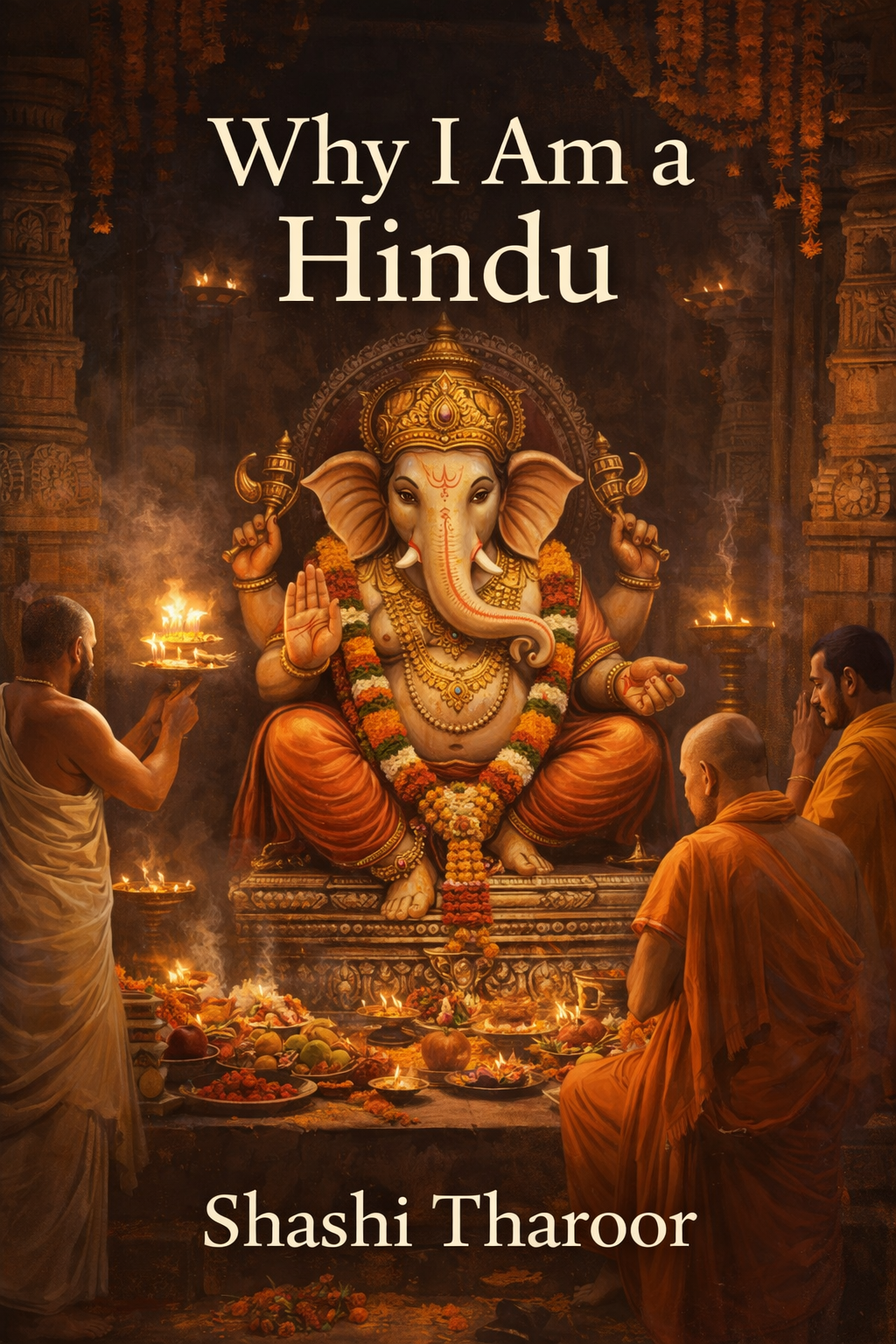
Why I Am a Hindu
Chapter Summaries
What's Here for You
Embark on a journey of intellectual discovery with Shashi Tharoor's "Why I Am a Hindu," an invitation to explore the profound, multifaceted, and often misunderstood landscape of Hindu faith and identity. This book offers more than just a description; it's a personal and deeply considered reflection designed to equip you with a nuanced understanding of what it truly means to be Hindu in the modern world. You will gain a fresh perspective on faith as an inherited legacy, shaped by culture and family, yet also a tradition that thrives on questioning and a remarkable absence of dogma. Tharoor challenges the simplistic labels often imposed on Hinduism, revealing its expansive nature, its embrace of diverse truths, and its philosophical depth that stretches from ancient wisdom to contemporary thought. Prepare to engage with critical examinations of deeply ingrained customs, including the complex and challenging issue of caste, seen not as an immutable aspect of faith but as a societal construct that warrants deep scrutiny. You'll traverse the rich history of Hindu thought, from the Indus Valley Civilization and the profound philosophy of Advaita Vedanta championed by Adi Shankara, to the transformative voices of figures like Swami Vivekananda. Crucially, the book offers a clear-eyed analysis of the distinction between the ancient, tolerant ethos of Hinduism and the political ideology of Hindutva, dissecting its origins, its motivations, and its divergence from the inclusive spirit of dharma. Tharoor argues compellingly that Hindutva is a distortion, born of insecurity rather than confidence, and that the true strength of Hinduism lies in its historical pluralism and inherent tolerance. This book is for anyone seeking to understand the soul of Hinduism beyond the headlines and political rhetoric, to reclaim its intellectual richness, and to appreciate its capacity for inclusivity and critical self-reflection. The tone is one of informed curiosity, intellectual rigor, and a passionate defense of a faith that embraces complexity, questioning, and a generous spirit. You will leave with a deeper appreciation for the 'Hindu Way' and a more confident understanding of its place in the world.
MY HINDUISM
Shashi Tharoor begins his exploration of his Hindu faith not with dogma, but with the profound realization that for most, faith is an inheritance, a birthright shaped by geography and family. Yet, as the world began to label Hinduism with terms like 'fundamentalism,' a term Tharoor finds paradoxical given Hinduism's lack of fixed fundamentals—no single founder, no organized church, no compulsory beliefs—he felt compelled to interrogate his own understanding. His Hinduism, he explains, is one of lived experience, of observation and conversation, learned through English translations and personal reflection, rather than deep scriptural study. This personal journey is anchored by a cultural and geographical allegiance, a conscious claim to a venerable tradition stretching back millennia, a history woven by figures like Swami Vivekananda and scholars like Sarvepalli Radhakrishnan. More importantly, Tharoor finds an intellectual fit in Hinduism's liberal ethos, a faith that allows for individual truth-seeking without rigid dogma or a central authority. He highlights Hinduism's unique embrace of diverse beliefs, from atheism to pantheism, and its capacity to question even the Creator, as evidenced in the Rig Veda's creation hymn, 'Then there was neither nonexistence nor existence... Who really knows?' This inherent skepticism, this virtue of unknowability, resonates deeply, offering a refreshing alternative to faiths that claim sole possession of truth. Unlike the Semitic faiths, Hinduism asserts that all paths are valid, fostering an environment of universal acceptance and respect for other traditions, a cornerstone of India's democratic culture. Tharoor illustrates this with his father's reverence for a Catholic amulet, a testament to a faith that venerates the divine wherever it is found. He delves into the multifaceted nature of the divine, from the formless, all-pervasive Brahman to the saguna Brahman, manifested in deities like the trinity of Brahma, Vishnu, and Shiva, and their avatars. His personal connection is with Ganesh, the elephant-headed god, invoked daily for his role as a remover of obstacles and a symbol of wisdom and devotion, embodying the idea that even imperfections can be sources of strength and knowledge. The narrative tension arises from the perceived clash between this fluid, personal, and accepting form of Hinduism and the rise of more rigid, political assertions of 'Hinduness.' Tharoor's resolution lies in reaffirming his own deeply personal, intellectually satisfying, and culturally rich understanding of his faith, one that celebrates diversity, inquiry, and the embrace of mystery, finding in Ganesh a divine reflection of life's own beautiful imperfections and challenges.
THE HINDU WAY
Shashi Tharoor, in "The Hindu Way," invites us into the expansive, multifaceted landscape of Hinduism, a tradition that, unlike many others, lays no claim to a monopoly on truth. He begins by illustrating this with the ancient sage Yajnavalkya, who, when asked about the number of gods, famously reduced a vast pantheon to the singular, pervasive spirit of Brahman—a concept echoed by Swami Vivekananda's favorite phrase: 'That which exists is One, the sages call It by various names.' This fundamental understanding, Tharoor explains, means that all forms of worship, whether of Vishnu, Shiva, or even Christ on the cross, are equally valid attempts to reach the unknowable divine, reflecting human imagination's limitations rather than the divine's confinement. This acceptance of difference, this profound henotheism, allows Hindus to respect all paths seeking truth, recognizing that these paths vary based on individual circumstances and cultural contexts, a stance famously articulated by Brahmins in the 17th century who, when presented with Christianity, politely suggested it might be good for the French traveler, while their own ways were good for them. The author then delves into the British struggle to comprehend Hinduism, often misinterpreting it as mere 'mystery and muddle,' while simultaneously, the common Hindu peasant held a working theory of concepts like *paramatma*, *karma*, *maya*, and *mukti*. Tharoor introduces the elegant structure of life into four *ashramas*—stages of learning, householding, retirement, and renunciation—and the four *purusharthas*—the pursuit of *dharma* (righteousness), *artha* (prosperity), *kama* (desire), and *moksha* (salvation)—revealing a comprehensive vision that embraces all human needs, from learning and earning to desire and spiritual yearning, and importantly, does not seek to suppress worldly desires but to sublimate them within a larger purpose. This is further exemplified by the notion of *dharma* itself, a concept far broader than mere 'faith' or 'religion,' encompassing a cosmic responsibility, a law that holds existence together, and a way of living in consonance with the truth of things, a path that is eternal yet ever-evolving. The chapter beautifully captures Hinduism's polycentric nature, like a vast banyan tree with countless roots and branches, flourishing with a multiplicity of beliefs, practices, and places of worship, from arduous Himalayan pilgrimages to vibrant local festivals like Holi and the immense Kumbh Melas, each offering a unique spiritual experience. Tharoor highlights the rich tapestry of sacred texts—the *Srutis* (Vedas, Upanishads) and *Smritis* (Dharmashastras), the epics (*Itihasas* like the Ramayana and Mahabharata, including the Bhagavad Gita), and the Puranas—not as dogmatic dictates, but as diverse sources for self-realization, each offering different perspectives that require interpretation, allowing for a continuous process of self-reform and adaptation, much like India itself, a place where any truism can be contradicted by another. Ultimately, Tharoor posits that Hinduism is not a rigid creed but a 'vast, complex, but subtly unified mass of spiritual thought and realisation,' an experience rather than dogma, where intellect is subordinated to intuition, and the inward realization is paramount, emphasizing that the true essence of this faith resides not just in its scholarly texts but in the lived experience of the ordinary believer, a continuous quest for truth that unfolds within each individual's heart and mind.
QUESTIONING HINDU CUSTOMS
Shashi Tharoor, in his exploration of Hinduism, invites us to question deeply ingrained customs, particularly the vexing issue of caste. He begins by painting a picture of architectural beauty in ancient temples like Sree Padmanabhaswamy Kshetram, a testament to a rich history, yet quickly pivots to the stark contrast with certain practices that have marred the faith. The author recounts his own childhood encounter with the caste system at age eleven, a system he found abhorrent from a young age, highlighting how religious texts, like the Purusha Sukta verse, have been interpreted to legitimize this deep-seated discrimination, even as scholars like Dr. Bhimrao Ambedkar challenged its fraudulent origins. Tharoor posits that the rigid caste system we understand today was, in part, an imposition by the British, who sought to categorize and control the populace, forcing a complex stratification onto existing social structures. He notes the paradox of temples forbidding entry to lower castes while simultaneously, and more recently, appointing non-Brahmin priests, including Dalits, demonstrating a slow, often contested, evolution. The narrative then weaves through historical figures like Veda Vyasa and Valmiki, born to lower castes yet revered, suggesting that while caste may have originated as a means of social accommodation, it ossified into impermeable barriers of discrimination and oppression, a reality that persisted despite pre-colonial era 'fuzziness' and instances of social mobility. Tharoor acknowledges the common, albeit potentially dubious, compromise many modern Hindus make: rejecting discrimination while still observing caste preferences in marriage, a practice rooted in a sense of community organization and familial continuity. Yet, he champions the internal reform movements within Hinduism, citing figures like Basava and Sree Narayana Guru, who challenged caste strictures from within, creating their own spiritual paths when denied access to traditional ones. The author then delves into the philosophical underpinnings, explaining how Upanishadic ideals of the unity of being and the atman residing in everyone inherently argue against caste discrimination, a principle echoed in Adi Shankara's profound encounter with an outcaste, whom he revered as his guru. He further illuminates the concept of karma and reincarnation, not as mere fatalism, but as a framework for understanding suffering and a call to action, where one shapes their destiny in partnership with the divine. The pursuit of moksha, union with Brahman, becomes the ultimate incentive for ethical conduct, guiding souls through cycles of rebirth. Tharoor also addresses the 'God Market,' the proliferation of gurus and godmen, distinguishing between genuine spiritual guides and charlatans who exploit societal drift and insecurity, a phenomenon amplified by economic and social disparities that government institutions have failed to adequately address. He critiques the notion of 'caste blindness' as a privilege of the upper castes, emphasizing that for marginalized communities, caste remains a lived reality of humiliation and deprivation, necessitating conscious action rather than willful ignorance. Ultimately, Tharoor argues that while Hinduism has been complicit in caste discrimination, the religion itself is not intrinsically bound to it, and that the faith possesses the philosophical resources for continuous self-critique and reform, urging Hindus to actively work towards eradicating the stain of caste from their practice and society, for as he concludes, the temper of the times demands consciousness and compensatory action, not blindness to historical injustices.
GREAT SOULS OF HINDUISM
The author, Shashi Tharoor, embarks on a profound exploration of Hinduism's rich tapestry, tracing its lineage from the enigmatic Indus Valley Civilization to the influential philosophy of Advaita Vedanta, famously championed by Adi Shankara in the 8th century CE. Tharoor highlights Swami Vivekananda, a pivotal figure who illuminated Hinduism for the global stage, as a personal inspiration, whose own philosophical roots delve deep into the Upanishads and Shankara's teachings, emphasizing the oneness of the ultimate reality, Brahman, and the individual soul, Atman. The narrative then unfolds through centuries of evolution, detailing how Hinduism absorbed diverse practices and ideas, faced challenges from Buddhism and Jainism, and underwent significant reformations, particularly with the rise of the Bhakti movement, which democratized devotion through song and vernacular languages, bringing spiritual solace to the masses. This movement, flourishing between the 12th and 18th centuries, saw luminaries like Ramanuja, Kabir, Mirabai, and Tulsidas bridge the gap between esoteric philosophy and popular faith, fostering a more inclusive and emotionally resonant Hinduism. The chapter confronts the seismic impact of Islamic invasions, which spurred a defensive renewal, and later the arrival of the British, which ignited a wave of intellectual and social reform movements, such as the Brahmo Samaj founded by Raja Rammohan Roy and the Arya Samaj by Swami Dayanand Saraswati, each seeking to rationalize and modernize the faith. Amidst this historical flux, Swami Vivekananda emerges as a transformative voice, advocating for a universalist, rational, and action-oriented Hinduism, famously articulating at the Parliament of the World's Religions that "unity in variety is the plan of nature." He championed the integration of spiritual realization with social service, founding the Ramakrishna Mission to uplift the downtrodden, embodying the ideal of Karma Yoga. The narrative culminates with the enduring legacy of Mahatma Gandhi, who, inspired by Advaita Vedanta and the ethical principles of ahimsa and satya, synthesized Hindu philosophy with political action, demonstrating that true strength lies in inclusive dialogue and the pursuit of truth for all. This journey through Hinduism reveals not a static dogma, but a dynamic, adaptable civilization that has consistently reinvented itself, absorbing external influences and internal reforms to maintain its resilience and relevance across millennia, a testament to its profound capacity for growth and its deep-seated philosophical bedrock of oneness.
HINDUISM AND THE POLITICS OF HINDUTVA
The author, Shashi Tharoor, delves into the complex relationship between Hinduism and the political ideology of Hindutva, tracing its origins and evolution. He begins by exploring the concept of dharma, not merely as religious duty, but as a comprehensive social ethic that integrates worldly pursuits with spiritual emancipation, citing the example of Mr. B. J. K. Tampi's letter which argued that an excessive fear of rebirth led to the neglect of worldly dharma. Tharoor posits that embracing a tolerant, holistic dharma, as articulated by Swami Vivekananda, can bridge the gap between the religious and secular in India, challenging the notion that secularism inherently leads to fundamentalism. He then meticulously dissects the intellectual lineage of Hindutva, beginning with Vinayak Damodar Savarkar, who defined Hindutva in ethnic, cultural, and political terms, viewing Hinduism as a subset of this broader concept, and arguing that a Hindu is one who considers India both motherland and holy land. This ideology was further developed by M. S. Golwalkar, who rejected territorial nationalism in favor of cultural nationalism, emphasizing the purity of Hindu race and culture, and viewing India as the exclusive domain of the Hindu nation, a perspective that starkly contrasted with India's constitutional framework. Golwalkar's ideas, though extreme, laid the groundwork for the Bharatiya Jana Sangh, founded by Syama Prasad Mookerjee in collaboration with the RSS, which eventually evolved into the Bharatiya Janata Party (BJP). The chapter highlights Deen Dayal Upadhyaya as a pivotal ideologue, whose philosophy of Integral Humanism sought to synthesize the material and spiritual, emphasizing duties over rights and advocating for a nation rooted in Indian culture and values, rather than Western constructs. Upadhyaya, while critical of the Indian Constitution for its Western influence, envisioned a Hindu Rashtra that was inclusive, though his vision ultimately demanded submission to Hindu dominance. The narrative then chronicles the BJP's shift towards explicitly embracing Hindutva as its ideology in the late 20th century, marked by campaigns like the Ram Janmabhoomi movement, which, while politically potent, also fueled communal violence and division. Tharoor contrasts the inclusive spirit of Hinduism, as exemplified by Swami Vivekananda and Mahatma Gandhi, with the exclusionary and often divisive nature of Hindutva, arguing that the latter seeks to 'Semitize' Hinduism into a codified, doctrinaire faith, divorced from its inherent eclecticism and diversity. He critically examines the current political landscape where Hindutva ideologues, now in power, appear to honor figures like Upadhyaya in lip service while their actions and rhetoric often diverge significantly from his more nuanced philosophy, raising profound questions about the future of India's secular, democratic constitution and its ability to accommodate the project of Hindutva.
BEYOND HOLY COWS
Shashi Tharoor, in his chapter 'Beyond Holy Cows,' navigates the complex tapestry of Indian secularism and the rising tide of Hindu nationalism, revealing a profound tension between India's historical pluralism and contemporary attempts to forge a monolithic Hindu identity. He begins by illuminating the unique Indian model of secularism, not as irreligiousness, but as a state that indulves all faiths equally, a legacy rooted in the syncretic ethos championed by figures like Vivekananda. This pluralism, Tharoor explains, was paradoxically enabled by a Hindu majority that naturally accepted diverse languages, foods, and beliefs as simply another facet of life, much like the coexistence of mosque calls, temple bells, and gurudwara recitations in his own Calcutta neighborhood. However, this tradition of 'unity in diversity' is now challenged by the Hindutva ideology, which seeks to define Indianness solely through a narrow, exclusive Hindu cultural identity, a stark departure from the inclusive vision of leaders like Gandhi and Nehru. Tharoor illustrates this shift through the lens of historical revisionism, where the contributions of Muslim rulers are demonized, and ancient Indian achievements in science are exaggerated into pseudoscience, a dangerous tactic to assert Hindu primacy. He highlights the absurdity of claims about Vedic aviation and plastic surgery, contrasting them with genuine, yet often overlooked, ancient Indian scientific contributions like algebra and the concept of zero. This rewriting of history, he argues, is not merely academic; it serves a political agenda to create a Hindu state, a project that actively seeks to purge any 'exogenous' influences and create a homogenous culture, even attempting to erase iconic symbols like the Taj Mahal from historical narratives. The chapter then delves into the social and cultural manifestations of this ideological shift, from the politicization of art and literature, as seen in the persecution of M.F. Husain, to the moral policing epitomized by the 'anti-Romeo' squads and the controversial ban on beef, which disproportionately affects minority communities and challenges the very notion of individual freedom. These actions, Tharoor contends, betray a fundamental misunderstanding of Hinduism's own rich history of inclusivity and intellectual dynamism, a history that embraced eroticism in art, celebrated diverse traditions, and understood science and spirituality as complementary rather than opposed. The tension culminates in the author's deep sorrow and shame as he witnesses a faith he holds dear being twisted to justify violence and exclusion, a betrayal of the very principles of tolerance and acceptance that have defined India for millennia. Ultimately, Tharoor calls for a return to the spirit of 'sarva dharma sambhava'—the equality of all religions—and a robust defense of India's pluralist identity against the encroaching shadows of narrow-minded bigotry, urging readers to draw inspiration from the past without allowing it to become a battlefield for present-day political divisions.
TAKING BACK HINDUISM
The author, Shashi Tharoor, embarks on a critical examination of Hindutva, presenting it not as an authentic representation of Hinduism, but as a distortion, a political ideology born from insecurity rather than self-confidence. He argues that India's ancient, eclectic faith, with its inherent tolerance and acceptance of diverse paths, is the true strength that fortifies Indianness, a stark contrast to the exclusionary nature of Hindutva. Tharoor recounts how even international figures like Barack Obama felt compelled to remind India of its pluralistic values, implicitly rebuking the dominant political narrative. He laments that a prime minister, once denied a visa for religious freedom concerns, now leads a party that often prioritizes Hindu chauvinism over the nation's developmental aspirations. The core of his argument rests on the distinction between Hinduism and Hindutva, highlighting that while Hinduism, as exemplified by figures like Swami Vivekananda, champions universal acceptance and sees truth in multiple streams flowing to a single sea, Hindutva reduces this vastness to a narrow, identity-based politics. This manufactured Hinduism, he contends, ignores the sophisticated philosophical traditions, the rationalist history, and the inclusive spirit that have long characterized Indian civilization. Tharoor draws a parallel to the historical respect for other faiths shown even by Maratha ruler Shivaji, a far cry from the divisive rhetoric of contemporary movements. He posits that Hindutva's narrative of victimhood, fueled by historical grievances, prevents India from embracing its future, a future built on the management of diversity, not its suppression. The author’s personal journey reflects this tension; while proud of his Hindu heritage, he is deeply ashamed of the violence and bigotry perpetrated in its name, emphasizing that true Hinduism is about self-punishment, not the persecution of others. He shares a poignant anecdote of his own family, who, despite historical suffering at the hands of Tipu Sultan, did not extend their dislike to an entire community, demonstrating a more profound, inherited tolerance. The chapter culminates with an appeal to reclaim Hinduism's essence: its flexibility, its philosophical depth, its embrace of multiple truths, and its capacity to serve as a cultural framework for all Indians, irrespective of their faith. This, Tharoor asserts, is the Hinduism that can truly strengthen India, a religion for the 21st century, adaptable and inclusive, offering a path not of dogma, but of personal discovery and universal harmony, a stark contrast to the divisive political project that seeks to refashion Hinduism into something it has never been.
Conclusion
Shashi Tharoor's "Why I Am a Hindu" offers a profound and deeply personal reflection on a faith often misunderstood and misrepresented. The core takeaway is Hinduism's inherent fluidity and its remarkable capacity for embracing diversity, a stark contrast to dogmatic, monolithic religious structures. Tharoor emphasizes that Hinduism's strength lies not in rigid adherence to a single creed, but in its decentralized, polycentric nature, allowing for infinite interpretations and a vast array of spiritual and philosophical paths. This eclecticism, born from external observation and internal evolution, has enabled Hinduism to absorb and adapt over millennia, fostering a unique spirit of universalism where multiple paths to truth are acknowledged. The emotional lessons are equally significant. Tharoor navigates the painful realities of the caste system, acknowledging its historical exacerbation by colonial policies while also highlighting Hinduism's internal capacity for reform and critique. He dismantles the misconception of karma as fatalism, reframing it as a principle of agency and responsibility in shaping one's destiny. Furthermore, he addresses the exploitation of spiritual longing in the "God Market," urging a return to genuine faith rooted in ethical conduct and service. Practically, the book serves as a vital guide to distinguishing between the authentic, pluralistic spirit of Hinduism and the exclusionary ideology of Hindutva. Tharoor powerfully argues that Hindutva, rooted in insecurity and a narrative of victimhood, poses a threat to India's secular and democratic foundations. He advocates for a reclamation of Hinduism's historical flexibility and intellectual richness, promoting a vision of Indian identity that transcends religious affiliation and celebrates shared cultural heritage. The wisdom offered is clear: true adherence to Hindu dharma involves active practice of virtues, intellectual inquiry, and a commitment to inclusivity, ultimately contributing to a cohesive and diverse national fabric. Tharoor's work is an impassioned plea to embrace the essence of Hinduism—its tolerance, its philosophical depth, and its lived experience—as a force for unity and understanding in a complex world.
Key Takeaways
Hinduism's defining characteristic is its lack of rigid dogma, compulsory beliefs, or a central authority, allowing for profound individual interpretation and a vast spectrum of philosophical and spiritual paths.
The term 'Hindu' itself originated externally, highlighting the faith's eclectic nature and its historical ability to absorb and integrate diverse traditions rather than impose uniformity.
Hinduism embraces a concept of the divine that spans from the formless, absolute Brahman to personalized deities like Ganesh, reflecting the infinite aspects of divinity and catering to diverse human needs for connection and understanding.
The faith's strength lies in its inherent tolerance and acceptance of other religions, asserting that all paths to truth are potentially valid, which fosters a unique spirit of universalism.
The personal and lived experience of faith, rather than strict adherence to scripture or ritual, is central to many Hindus' understanding of their religious identity, emphasizing personal conviction and cultural connection.
Hinduism's philosophical depth includes a profound capacity for self-questioning and acknowledging the unknowable, even regarding the Creator, fostering intellectual humility and wonder.
Hinduism's core principle is its acceptance of diverse paths to the divine, recognizing the unknowable nature of Brahman and validating multiple forms of worship as expressions of human imagination rather than divine confinement.
The Hindu understanding of *dharma* transcends simple translation, encompassing a broad system of social ethics, cosmic responsibility, and a way of living in harmony with universal truth, which is both eternal and adaptable.
The faith's polycentric structure, like a banyan tree, supports a vast multiplicity of beliefs, practices, and sacred texts, allowing for continuous self-reform and adaptation rather than adherence to a single, immutable dogma.
Hinduism prioritizes inner realization and experience over rigid dogma, encouraging a skeptical, questioning approach where intellect and intuition work together in the personal quest for spiritual truth.
The lived experience of ordinary believers, with their diverse regional and vernacular traditions, is as crucial to Hinduism's essence as its scholarly philosophical and scriptural writings, demonstrating a 'lived Hinduism' of habit and practice.
The Hindu concept of time as cyclical, rather than linear with a definitive end, influences its worldview, emphasizing renewal and continuous evolution over fixed eschatological outcomes.
The rigid caste system, often justified by religious texts, was significantly exacerbated by British colonial policies aimed at categorization and control, rather than being an inherent, immutable aspect of Hinduism.
Hinduism possesses internal philosophical and reformist traditions that critique and challenge caste discrimination, demonstrating that the faith's core tenets can be used to dismantle social iniquities.
The concept of karma and reincarnation, often misinterpreted as fatalism, actually emphasizes individual agency and the shaping of one's destiny through present actions in partnership with the divine, guiding souls toward self-realization.
'Caste blindness' is a privilege exclusive to the upper castes; for marginalized communities, caste is a lived reality of oppression, demanding active consciousness and compensatory action rather than willful ignorance.
The proliferation of 'godmen' and the 'God Market' often stems from societal drift and a failure of institutions to address basic needs, highlighting a genuine human search for meaning and belonging that can be exploited by charlatans.
True adherence to Hindu dharma involves actively practicing virtues like non-violence and truth, and overcoming vices such as greed and hatred, to progress towards moksha, rather than simply accepting one's lot in life.
Hinduism's enduring resilience stems from its inherent adaptability and capacity for self-reform, absorbing external challenges and internal critiques to evolve over millennia.
The Advaita Vedanta philosophy, particularly through Adi Shankara, provides a foundational intellectual framework emphasizing the ultimate oneness of reality (Brahman) and the individual soul (Atman), offering a path to liberation (moksha) through knowledge and experience.
The Bhakti movement democratized spiritual devotion, making it accessible to the masses through vernacular languages and emotional expression, thereby transforming Hinduism from an esoteric tradition to a widely participatory faith.
Swami Vivekananda synthesized ancient wisdom with modern insights, advocating for a universalist, rational, and socially conscious Hinduism, demonstrating that spiritual realization must be coupled with service to humanity.
Mahatma Gandhi exemplified the integration of spiritual principles (ahimsa, satya) with socio-political action, presenting Hinduism as an inclusive path that respects all faiths and strives for universal truth and equality.
Dharma, encompassing social ethics and worldly duty alongside spiritual goals, offers a framework to bridge the religious and secular, counteracting the rise of extremism.
Hindutva, as conceptualized by Savarkar and Golwalkar, defines nationhood based on ethnic, cultural, and political ties to India as a holy land, excluding non-Hindus from its core definition.
Deen Dayal Upadhyaya's Integral Humanism sought a synthesis of material and spiritual needs rooted in Indian culture, advocating for a nation prioritizing duties and collective well-being over Western individualism, though his vision also demanded conformity to Hindu ways.
The BJP's adoption of Hindutva as its ideology, particularly through campaigns like the Ram Janmabhoomi movement, has been politically successful but has also exacerbated communal divisions and violence.
The core tenets of Hinduism, characterized by eclecticism, diversity, and acceptance of difference, are fundamentally at odds with the RSS ideologues' quest to 'Semitize' Hinduism into a codified, exclusionary doctrine.
The current political dominance of Hindutva proponents raises critical questions about whether constitutionalism will temper Hindutva or if Hindutva will transform the workings of India's secular and democratic constitution.
Indian secularism is a unique model of state neutrality and indulgence towards all religions, fostering coexistence, rather than strict separation.
Hindutva ideology represents a dangerous departure from India's historical pluralism, seeking to define national identity through an exclusive Hindu cultural and religious lens.
The manipulation of history and science by proponents of Hindutva serves a political agenda to assert Hindu cultural and political dominance.
Cultural expressions, from art to monuments like the Taj Mahal, are becoming battlegrounds for ideological contests, reflecting a broader societal tension between inclusivity and exclusionary nationalism.
The imposition of narrow, puritanical moral codes in the name of defending Hindu culture betrays Hinduism's own historical traditions of tolerance, intellectual freedom, and diverse spiritual practices.
The core of the debate lies between those who uphold India's pluralistic, multi-identity democracy and those who seek to impose a singular, majoritarian vision, threatening the very soul of the nation.
Distinguish between Hinduism's inherent pluralism and Hindutva's exclusionary ideology to understand the threat to Indian secularism.
Recognize that Hindutva's reassertion stems from insecurity and a narrative of victimhood, hindering genuine national progress.
Embrace Hinduism's core tenets of tolerance, universal acceptance, and philosophical inquiry as the foundation for a cohesive and diverse Indian identity.
Understand that true Indianness transcends religious affiliation, rooted in shared culture and the management of diversity, not in sectarian divisions.
Reclaim Hinduism's historical flexibility and intellectual richness by rejecting dogmatic interpretations and celebrating its capacity for individual spiritual exploration.
Promote a vision of Hinduism as a cultural heritage accessible to all Indians, fostering unity through shared traditions rather than religious exclusivity.
Action Plan
Reflect on your own faith or belief system: what are its core tenets, and how much do they stem from personal conviction versus inherited tradition?
Explore the concept of 'lived experience' in your own life, considering how personal interactions and observations shape your understanding of broader concepts.
Consider the value of intellectual humility by acknowledging the limits of your own knowledge, especially regarding profound existential questions.
Practice acceptance of differing viewpoints by actively seeking to understand and respect beliefs that contrast with your own, even if you do not fully agree.
Identify a personal symbol or deity (whether religious or secular) that represents qualities you admire, and reflect on why those qualities resonate with you.
Engage with diverse perspectives on complex issues, recognizing that multiple viewpoints can coexist and offer valuable insights, much like the varied schools of Hindu thought.
Explore the concept of Brahman by reflecting on the idea of a singular, pervasive spirit underlying all existence.
Engage with the idea of *dharma* by considering how personal actions align with universal truths and ethical responsibilities.
Practice respecting diverse viewpoints and spiritual paths, acknowledging that multiple approaches can lead to similar ultimate goals.
Cultivate a spirit of inner reflection and personal experience in your spiritual or philosophical journey, rather than solely relying on external doctrines.
Seek to understand the 'lived Hinduism' by observing and appreciating the diverse cultural and regional expressions of faith, recognizing their validity.
Embrace the idea of continuous learning and adaptation in your own beliefs, allowing for evolution and questioning of established ideas.
Reflect on how societal structures, historical influences, or perceived religious sanctions might have contributed to current social inequalities.
Explore the core philosophical tenets of one's own faith or belief system to identify inherent principles that advocate for equality and justice.
Challenge the notion of 'blindness' to systemic issues, particularly if one belongs to a privileged group, and instead cultivate conscious awareness of unearned advantages.
Seek out and engage with diverse perspectives and voices, especially from marginalized communities, to gain a fuller understanding of their lived realities.
Examine personal beliefs and practices related to community and belonging, distinguishing between healthy cultural affinity and exclusionary social stratification.
Consider the motivations behind seeking spiritual guidance, differentiating between genuine spiritual development and the exploitation of societal needs or insecurities.
Actively practice virtues like non-violence, truthfulness, and self-control as pathways to personal growth and ethical conduct, independent of reward or punishment in this life or the next.
Reflect on a core philosophical principle of Hinduism, such as Advaita Vedanta's concept of oneness, and consider its implications for your own life.
Explore the devotional poetry or songs of the Bhakti movement, such as those by Mirabai or Kabir, to connect with the emotional dimension of faith.
Identify a personal 'life idea,' as Swami Vivekananda suggested, and dedicate focused thought and effort towards its realization.
Consider how to integrate spiritual principles with practical action and service to your community, inspired by Swami Vivekananda and Mahatma Gandhi.
Practice the principle of 'unity in variety' by seeking to understand and respect different perspectives and beliefs, even when they differ from your own.
Engage with the concept of dharma as a holistic ethic that integrates worldly responsibilities with spiritual aspirations.
Differentiate between Hinduism as a diverse faith and Hindutva as a political ideology, understanding their historical development and ideological distinctions.
Analyze the arguments for and against territorial versus cultural nationalism in the context of nation-building.
Reflect on the tension between secularism and religious fundamentalism, and how societal changes might influence religious extremism.
Examine the role of historical narratives and cultural identity in shaping political movements.
Consider the implications of imposing a singular cultural or national identity on a diverse population.
Evaluate the balance between constitutional principles and the pursuit of specific ideological agendas in governance.
Actively seek out and engage with diverse cultural and religious perspectives to foster understanding and empathy.
Critically examine historical narratives, questioning claims that simplify complex pasts into binary conflicts of good versus evil.
Support intellectual freedom and the pursuit of knowledge, defending artistic and academic expression against censorship and intimidation.
Recognize and challenge the political manipulation of cultural symbols and religious sentiments for divisive ends.
Embrace the principle of 'unity in diversity' by celebrating India's pluralistic heritage rather than promoting a singular, exclusionary identity.
Engage in respectful dialogue about religious and cultural differences, prioritizing understanding over judgment.
Be vigilant against the erosion of secular principles and advocate for a public sphere that respects all citizens regardless of their faith or background.
Actively distinguish between the political ideology of Hindutva and the inclusive philosophy of Hinduism in personal and public discourse.
Engage with the philosophical depth of Hindu texts and traditions to understand their universal principles, moving beyond narrow interpretations.
Foster interfaith dialogue and understanding by highlighting shared values and common cultural touchstones, rather than differences.
Challenge narratives of victimhood and exclusion by championing diversity and inclusivity as strengths of Indian identity.
Seek personal spiritual fulfillment through introspection and exploration, embracing Hinduism's emphasis on individual truth-finding.
Promote the idea of Hinduism as a cultural heritage that enriches all Indians, irrespective of their religious beliefs.
Practice and advocate for the acceptance of multiple perspectives and truths, reflecting Hinduism's inherent flexibility and tolerance.