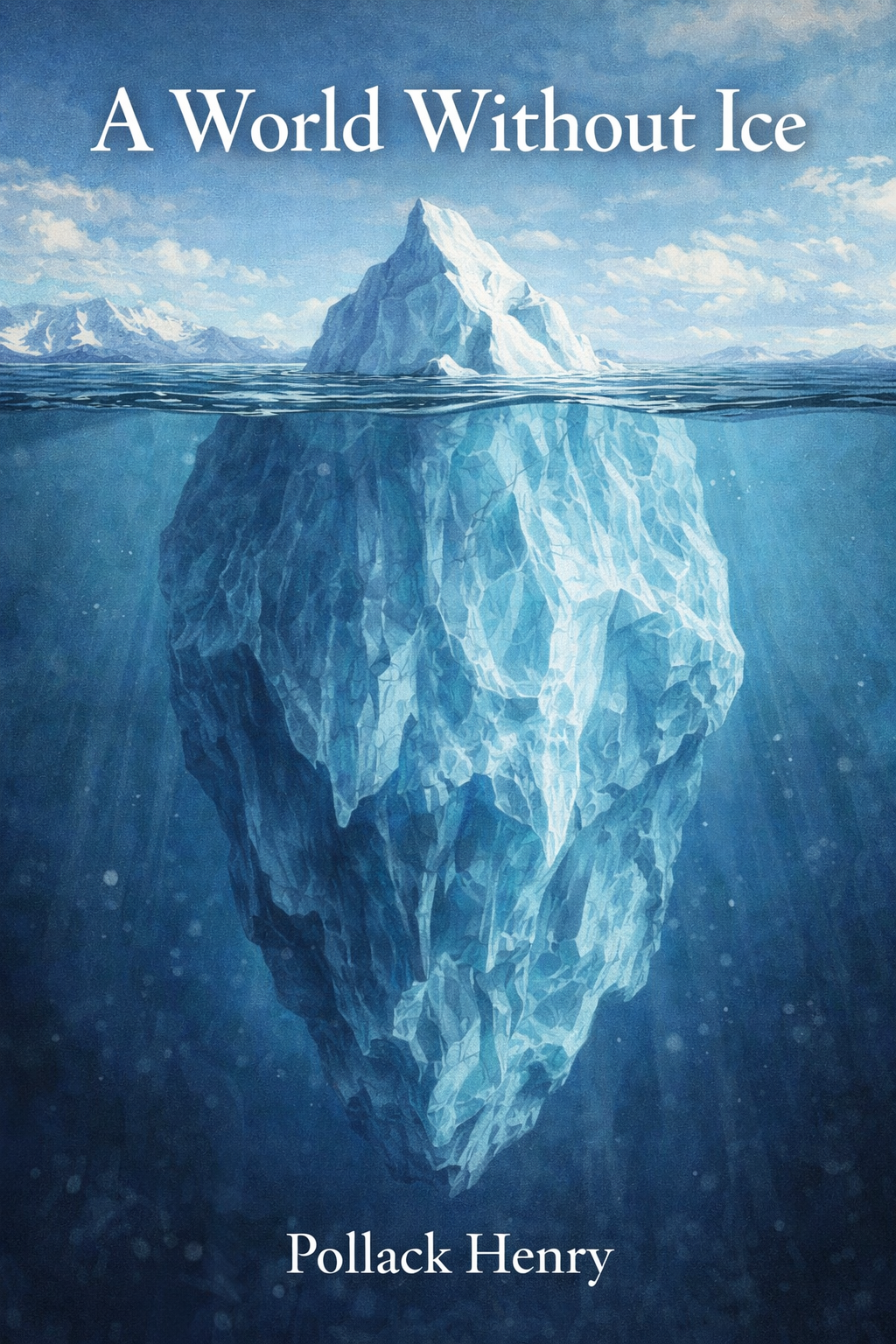
A World Without Ice
Chapter Summaries
What's Here for You
Embark on a captivating journey through the profound history and urgent present of our planet's most dynamic force: ice. In "A World Without Ice," Henry Pollack unveils the extraordinary story of this seemingly simple substance, revealing its ancient power to shape continents, dictate the evolution of life, and even fuel early technological advancements. You'll traverse the icy frontiers with intrepid explorers, delve into the geological epochs when colossal ice sheets dominated the Earth, and understand how scientists have pieced together our planet's climatic narrative. This book isn't just a historical account; it's a powerful exploration of how natural forces, from volcanic eruptions to the subtle cycles of Earth's orbit, have orchestrated dramatic shifts in temperature. But the narrative takes a crucial turn as Pollack meticulously details the undeniable 'Human Footprints' we are leaving on our climate, a force now amplified by billions of us and our machines. You will gain a deep, intellectual understanding of the undeniable science behind global warming and the stark, accelerating reality of melting ice and rising seas, witnessing firsthand the peril faced by vulnerable nations. The emotional tone is one of awe and wonder at the grand scale of Earth's history, tempered by a growing urgency and a profound sense of responsibility. You'll emerge with a clearer, more informed perspective on the monumental choices we face, recognizing that change is not only happening but is now inevitable. This is your invitation to comprehend the critical juncture at which humanity stands and to equip yourself with the knowledge to navigate the profound transformations that lie ahead.
DISCOVERING ICE
The vast, silent world of ice, both Arctic and Antarctic, unfolds through the lens of exploration and scientific discovery. We journey back to Lieutenant James Cook's 1768 voyage, initially tasked with observing the transit of Venus, a celestial event offering a rare chance to measure the Earth-Sun distance. Cook, a meticulous navigator, sailed HMS Endeavour to Tahiti, a journey of twelve thousand miles, demonstrating early awareness of the perils of long voyages, like scurvy, and the importance of crew health, even noting the crew's Christmas Day inebriation. Yet, beneath the scientific veneer lay a secret mission: to search for Terra Australis Incognita, the mythical southern continent. This quest, fueled by ancient notions of symmetry, led Cook to the harsh realities of the Southern Ocean's ice. His circumnavigation revealed not a continent, but an impenetrable ice barrier, a stark contrast to the warmer Arctic. The author reveals how Cook’s observations, though disproving the balanced landmass theory, hinted at a different symmetry—that of ice itself. Later, in the early 1840s, Lieutenant Charles Wilkes of the U.S. Exploring Expedition would trace the coastline of Antarctica, providing proof of a substantial landmass. The chapter then delves into the profound differences between the Arctic and Antarctic poles, one a frozen ocean, the other a continent buried under immense ice sheets. Antarctica, it's revealed, wasn't always at the South Pole; geological evidence, like fossilized tropical ferns, shows it migrated from warmer climes as part of the supercontinent Gondwanaland, its journey shaped by plate tectonics and the eventual opening of the Drake Passage. This isolation, maintained by the Antarctic Circumpolar Current, creates a unique climate, a frigid zone distinct from the more temperate Arctic. The narrative paints a vivid picture of the Antarctic landscape—pristine, silent, and devoid of human artifice, a "world without us" where wind, water, and ice compose the symphony. We witness the awe-inspiring scale of icebergs, sculpted by the elements into fantastical shapes, a visual feast for the imagination. The lure of these polar regions, initially driven by fame, glory, and geopolitical ambition, eventually paved the way for scientific cooperation. The chapter highlights the territorial claims that emerged in the early 20th century, a geopolitical 'pie slicing' that threatened conflict, particularly in the Antarctic. However, the International Geophysical Year of 1957-58, a testament to scientific collaboration and the dawn of the space age with Sputnik and Explorer, became a turning point. This spirit of cooperation culminated in the Antarctic Treaty of 1959, transforming the continent into a realm of peace and scientific endeavor, a remarkable diplomatic achievement. Contrastingly, the Arctic, while militarily significant during the Cold War, saw cooperation emerge later, with the U.S. and Russia sharing geophysical data, leading to the U.S.-Russian Atlas of the Arctic Ocean and a deeper understanding of climate change. Finally, the chapter explores the rise of polar tourism, from the pioneering voyages of Lars-Eric Lindblad to the modern influx of visitors, drawn by the allure of the pristine wilderness. Yet, this accessibility brings its own challenges, as evidenced by the growing number of accidents and the subtle but pervasive impact of human presence. The author concludes with a crucial insight: the true damage to Antarctica isn't from a two-week visit, but from our global consumption of fossil fuels, a stark reminder that the fate of these icy realms is inextricably linked to our actions at home, a tension between preserving a pristine world and our insatiable global demands.
ICE AND LIFE: ON EARTH AND BEYOND
The author, Henry Pollack, invites us to consider ice, a material seemingly mundane yet possessing extraordinary properties that have shaped Earth and life itself. He begins by recalling ice's historical role as a vital refrigerant, the precursor to modern technology, a commodity harvested and distributed, even foreshadowing environmental concerns regarding its quality. This leads to a poignant reflection on how chlorofluorocarbons, once hailed as revolutionary refrigerants, were later discovered to be agents of ozone depletion, a stark reminder of unintended consequences. Pollack then pivots to ice as nature's profound preserver, revealing how frozen mammoths and ancient icemen, entombed in permafrost and glaciers, offer invaluable windows into past climates and human lives, validating paleontological inferences. He delves into the unique physics of ice: its counterintuitive expansion upon freezing, enabling its buoyancy—the iconic iceberg, a mere fraction of its mass visible—and its slow, inexorable flow downhill like a fluid solid, carving landscapes into majestic fjords. This plasticity, he explains, is not just about temperature but also time, a concept echoed in geological forces shaping mountains. The chapter highlights ice's remarkable reflectivity, its albedo, influencing polar navigation through 'ice blink'—the way clouds reflect differently over ice versus open water—and significantly impacting global climate by reflecting solar energy away from the poles. Pollack then expands our view, showing where ice naturally occurs, from atmospheric crystals that catalyze ozone destruction to permafrost locking away ancient landscapes, and even methane hydrates on the seafloor, a potential energy source and a climate concern. He paints a picture of Earth as a 'Goldilocks planet,' uniquely positioned to host liquid water, a delicate balance maintained by a natural greenhouse effect, contrasting it with the frigid, ice-rich worlds beyond. The journey extends to Mars, where polar ice caps hint at a watery past and potential for microbial life, and further out to the icy moons of Jupiter and Saturn, like Europa and Enceladus, where tidal heating can melt subsurface ice, creating environments that might harbor life, echoing Earth's own deep-sea hydrothermal vents. Finally, Pollack brings us back to Earth, to subglacial lakes like Vostok, isolated for millennia, holding potential for unique evolutionary pathways, and to the grand cycle of water, where continental ice sheets wax and wane, dictating sea levels and shaping civilizations, leaving us poised on a cusp where human actions now threaten to melt away Earth's icy heritage, a profound tension between our past and our future.
WHEN ICE RULED THE WORLD
The author Henry Pollack invites us to envision a world dramatically reshaped by ice, a time when colossal ice sheets, two miles thick, once blanketed vast swathes of Europe and North America, forcing life to adapt and migrate. He reveals how geologists decipher this ancient past, not through crystal balls, but by reading the land itself – the scattered boulders, the U-shaped valleys carved with unimaginable force, and the very chemistry of seashells in the ocean depths. Pollack explains that these glacial landscapes are not mere remnants, but powerful testaments to ice's titanic erosive and transportive capabilities, sculptors of mountains and excavators of valleys, leaving behind features like the dramatic fjords and the Great Lakes. He then draws a compelling parallel between the slow, inexorable creep of glaciers and the profound, sometimes catastrophic, shifts in Earth's climate, particularly the dramatic lowering of sea levels during ice ages that exposed land bridges, enabling early humans to embark on epic migrations out of Africa and across continents, a journey of a thousand miles beginning with a single step. The narrative tension builds as we understand the delicate dance of Earth's orbital cycles – the Milankovitch cycles – that, over millennia, subtly altered seasonal sunshine, tipping the balance towards snow accumulation and the onset of ice ages, a cosmic rhythm that dictated the fate of landscapes and the very evolution of humanity. A stark illustration of this power is the Missoula Flood, a cataclysmic outburst of meltwater that reshaped entire regions, demonstrating how even brief, intense events can leave indelible marks on our planet. Pollack concludes by contrasting this ancient reign of ice, where humans were largely passive observers, with our current era, where human activity has become the dominant force reshaping the global environment, a profound resolution that shifts our perspective from adaptation to agency, urging us to consider the long-term consequences of our actions on the very planet that once dictated our survival.
WARMING UP
The author, Henry Pollack, invites us to peer back through the Earth's climatic history, revealing how we've come to understand our planet's warming trend. He begins by describing the vast ice sheets that once covered continents, their slow retreat over millennia, and the subsequent warming that ushered in a period of relative stability, a 'Mid-Holocene Optimum.' This journey into the past is not straightforward; it's akin to assembling a complex jigsaw puzzle with missing pieces, a scientific endeavor known as paleoclimatology. To reconstruct these ancient climates, scientists rely on 'climate proxies'—natural archives like tree rings, ice cores, and coral skeletons that offer year-by-year clues. Trees, for instance, add annual rings, their thickness indicating favorable or stressful growing conditions, with trees at the climatic margins being particularly sensitive indicators. Similarly, layers in ice sheets and coral frameworks record past temperatures and conditions. Even windblown dust and human records, such as agricultural yields or sea ice extent, serve as valuable proxies, painting a global picture of past climates. Pollack then guides us through the instrumental record, beginning with the revolutionary invention of the thermometer in the 17th century and the establishment of temperature scales. While early records were sparse, especially in the Southern Hemisphere and oceans, the growing network of measurements from the mid-19th century onward has provided a clearer, though initially geographically uneven, picture. The verdict from these millions of thermometer readings is undeniable: Earth's average surface temperature has warmed by about 1.8 Fahrenheit degrees over the past 150 years, a trend that is now accelerating. This warming isn't confined to the surface; it extends into the lower atmosphere, the oceans, and the very rocks beneath our feet, as subsurface temperature data reveals. However, this clear scientific consensus has been met with significant resistance, a phenomenon Pollack terms 'the trenches of denial.' He details how misinformation, often fueled by vested interests, has been strategically deployed to cast doubt on the integrity of the instrumental record, the natural causes of climate change, the potential benefits of warming, and the economic feasibility of addressing it. Yet, even as these arguments are debated, nature itself offers its own irrefutable thermometers: the timing of biological events. Phenology, the study of these natural cycles, shows plants blooming earlier, birds migrating later, and ice seasons shrinking across lakes and rivers globally. From the subtle shifts in the timing of bird migrations on Cooper Island to the dramatic retreat of mountain glaciers in the Alps and Kilimanjaro, and the diminishing sea ice in the Arctic Ocean—even the historic Northwest Passage is becoming more accessible—the evidence is overwhelming. The disintegration of massive ice shelves in Antarctica, like Larsen and Wilkins, and the accelerating ice loss from Greenland and Antarctica, are not isolated incidents but clear signals of a warming planet, leading to rising sea levels through meltwater and thermal expansion of ocean water. The author highlights the rigorous, multi-layered peer-review process of the Intergovernmental Panel on Climate Change (IPCC), emphasizing that its conclusions, such as the statement that 'warming of the climate system is unequivocal,' represent a conservative, lowest-common-denominator consensus. Ultimately, Pollack asserts that the language of ice—melting, shrinking, breaking apart—is a powerful, unambiguous message that we ignore at our peril, a call to understand and heed the planet's urgent signals. This journey, from ancient ice sheets to modern scientific consensus, underscores the tension between scientific evidence and the entrenched resistance to acknowledging a warming world.
NATURE AT WORK
In "A World Without Ice," Henry Pollack's "Nature at Work" chapter invites us on a journey through Earth's dramatic climatic past, revealing how forces beyond human control have shaped our planet's temperature. We begin with the cataclysmic eruption of Mount Tambora in 1815, a volcanic fury that sent a veil of ash and aerosols into the atmosphere, plunging the Northern Hemisphere into a year without summer. This wasn't an isolated incident; Pollack illustrates how other massive eruptions, like those of AD 536 and Krakatoa in 1883, have similarly cast shadows over global climate, leading to brutal winters and crop failures, demonstrating nature's potent ability to dim the sun and alter our world. He then shifts focus to the subtle yet profound influences of celestial mechanics and solar evolution. The author explains that Earth's orbit and axial tilt, the Milankovitch cycles, cause long-term variations in solar energy received, while the sun itself has been slowly growing brighter over billions of years. This leads to the intriguing "faint young Sun paradox": how could early Earth have supported liquid water with a dimmer sun? The resolution, Pollack reveals, lies in the evolving atmosphere, where an early methane-rich blanket trapped heat, gradually giving way to carbon dioxide as photosynthesis increased atmospheric oxygen. This dance between solar input and atmospheric composition forms a delicate greenhouse effect, a natural thermostat essential for life, which John Tyndall first measured. This thermostat, however, is intrinsically linked to water, as seen in the stark contrast with Venus. Our neighbor, lacking oceans and a biosphere to sequester carbon, succumbed to a runaway greenhouse effect, becoming a scorching world. The chapter then explores shorter-term fluctuations, noting that while solar activity, evidenced by sunspots, does vary, its recent trends do not align with observed warming. The author meticulously dismantles skeptical arguments, such as the warming of other planets or the cosmic ray-cloud hypothesis, showing them to be either misinterpretations or unsubstantiated theories, much like claiming all modern forest fires are solely due to lightning when arson and carelessness are also factors. Ultimately, Pollack concludes that while nature has long been the conductor of Earth's climate orchestra, human activities have increasingly taken the baton, becoming the dominant force driving contemporary climate change, a subtle yet profound tipping point in our planet's history.
HUMAN FOOTPRINTS
The author, Henry Pollack, reveals a profound truth in 'Human Footprints': our collective actions, amplified by nearly seven billion people and millions of machines, have become a staggering force, fundamentally altering Earth's climate. He explains that while scientists are 90% certain of human influence on recent warming, public skepticism persists, fueled by disinformation, political doubt, and a distrust of science itself, often stemming from conflicts with religious beliefs. This disconnect arises because we struggle with global and intergenerational perspectives, preferring to focus on immediate, local concerns, a habit rooted in our evolutionary past. Furthermore, the separation of our daily activities from their long-term, distant consequences—like turning up a thermostat and its effect on global warming—creates an abstract barrier to understanding. Pollack illustrates how human alteration of land, beginning with deforestation traceable to the use of fire, has changed Earth's albedo and disrupted the natural carbon cycle, leading to atmospheric warming. He meticulously details the exponential growth of the human population over millennia, accelerating dramatically in recent centuries, and how this growth, coupled with technological advancement, has amplified our energy consumption to the equivalent of billions of working horses. This relentless demand has led to immense earthmoving, far exceeding natural erosion rates, as seen in strip mining and agricultural soil loss, and has dramatically altered water systems through damming rivers and draining wetlands, leading to consequences like the vanishing Aral Sea and the creation of oceanic dead zones. The chapter underscores that our 'footprint' extends beyond the physical, creating heat, light, and noise pollution that disrupt ecosystems and biological rhythms. Ultimately, Pollack posits that humanity has unintentionally stepped into the role of planetary managers, a role for which we are ill-prepared, fundamentally shifting Earth's geological trajectory into a new epoch: the Anthropocene, a testament to our pervasive, world-altering influence. The sheer scale of human impact, from altering atmospheric chemistry by burning fossil fuels to impacting oceanic pH, signals a profound, ongoing experiment with our planet's climate, the consequences of which we are only beginning to comprehend.
MELTING ICE, RISING SEAS
The author, Pollack Henry, in 'A World Without Ice,' meticulously details the profound and accelerating impact of a warming planet, revealing how the diminishing cryosphere is fundamentally reshaping our world. We witness the stark reality faced by island nations like Tuvalu and Kiribati, where rising sea levels threaten entire existences, forcing displacement and cultural alienation, a potent reminder that climate change is not an abstract future threat but a present-day crisis unfolding with alarming speed. The narrative then expands, illustrating how melting mountain glaciers, once vital sources of water for agriculture and communities, are receding, leading to water scarcity and impacting hydroelectric power generation, as seen in the Sierra Nevada and the Rhine River basin. This shift from a water-stored-as-ice to a water-released-as-rain regime creates critical mismatches in water availability, particularly for agriculture and during peak summer demands. Furthermore, the chapter unveils the insidious creep of permafrost melt, which destabilizes landscapes, damages infrastructure like the Alaska pipeline, and, crucially, releases potent greenhouse gases like methane, creating a dangerous feedback loop that accelerates warming. The Arctic Ocean, once a vast expanse of ice, is now experiencing dramatic reductions in sea ice cover, leading to increased coastal erosion and impacting wildlife such as polar bears and seals, disrupting ancient hunting traditions and delicate ecosystems. The narrative then draws us to the bottom of the world, Antarctica, where the warming of the Antarctic Peninsula is causing a regime change in its marine ecosystem, with dire consequences for krill populations and the entire food chain, from penguins to whales. The core tension emerges: the undeniable physical reality of melting ice and expanding oceans versus a persistent, often politically motivated, denial or downplaying of the severity and human cause of these changes. Pollack Henry masterfully connects these disparate phenomena—seasonal snow lines creeping upward, glaciers vanishing, permafrost thawing, and Arctic sea ice disappearing—to the overarching consequence: rising sea levels that threaten coastal communities, deltas, and island nations worldwide, rendering millions vulnerable and potentially triggering mass migrations and international conflict. The chapter culminates in a sobering look at the potential for catastrophic sea-level rise from the disintegration of Antarctic ice shelves, a scenario that dwarfs current projections and highlights the profound interconnectedness of Earth's systems and the urgent need for global action.
CHOICES AMID CHANGE
The author, Pollack Henry, begins by posing urgent questions about humanity's direction in the face of climate change, likening our collective journey to an ark adrift without charts or a captain. He explains that change is not only underway but inevitable due to the inertia of both the climate system and the global economy; much like a massive ship, these systems cannot be halted instantly but must be steered with deliberate effort. Even if greenhouse gas emissions were to cease today—an unlikely scenario—the accumulated gases already in the atmosphere would continue to warm the planet for centuries, a concept known as climate commitment. This commitment, Pollack Henry reveals, means we are already committed to a certain degree of warming, continued ice loss, rising sea levels, and altered weather patterns, and these projected outcomes are likely underestimates of the actual consequences. Therefore, the imperative shifts towards adaptation, a process that demands sweeping reassessments of everything we do, from agriculture and public health to infrastructure and urban planning. The opening of the Arctic Ocean, once a frozen barrier, now presents both geopolitical opportunities and tensions over resources, while in places like Ilulissat, Greenland, adaptation is not a future plan but a present reality, with booming tourism contrasting with the challenges faced by local communities. Navigating this uncertain future is further complicated by myriad uncertainties—in climate science, in modeling, and crucially, in human behavior and population growth, which directly impact energy consumption and emission scenarios. The author stresses that while scientific models provide valuable projections, they are imperfect tools, akin to financial models that can mislead if their limitations and ignored factors are not understood; blunt, definitive statements about the future should be met with suspicion. The narrative then pivots to the urgency of mitigation, emphasizing that waiting for certainty is a dangerous delay, an implicit endorsement of the status quo. Pollack Henry outlines numerous mitigation opportunities, from energy conservation and efficiency—highlighting that the cheapest energy is the energy not used—to carbon-free energy sources like solar, wind, and nuclear power, and even geothermal and biomass. He also explores the concept of carbon capture and storage, and the sensitive issue of slowing population growth. The core tension emerges: will these mitigation strategies be swift and comprehensive enough, or will political inertia and the sheer scale of the challenge lead to a 'Type B mistake'—a catastrophic delay with irreversible consequences? The chapter concludes with a powerful call to action, drawing parallels to wartime mobilization, urging collective action and bold governmental policy to steer humanity towards a sustainable future, reminding us that we have not inherited the Earth, but borrowed it from our children, and the choice between a degraded planet and a rescued one is ours to make, an opportunity that must be seized. The author's narrative arc moves from the stark reality of unavoidable change to the potential for informed, collective action, underscoring that while the planet itself is resilient, the civilization it supports is at risk, and our brief time on Earth demands a sober resolve to find a sustainable path.
Conclusion
Henry Pollack's "A World Without Ice" offers a profound and sobering reflection on humanity's intricate relationship with Earth's frozen realms and the delicate balance of its climate. The book masterfully weaves together the thrill of polar exploration, the fundamental role of ice in shaping our planet's history and geography, and the alarming reality of our present-day impact. We learn that scientific curiosity, often driven by distant celestial pursuits, can uncover urgent terrestrial quests, revealing how the seemingly remote polar regions are intrinsically linked to our global well-being. The emotional resonance lies in acknowledging our planet's immense geological past and the humbling realization that we are now the dominant, and often clumsy, geological force. The practical wisdom is stark: the warming of our planet, evidenced by melting ice, is not a future threat but a present crisis demanding immediate and decisive action. Pollack emphasizes that the inertia of the climate system means change is inevitable, compelling us to shift from prevention to adaptation and mitigation. The book's core takeaway is the urgent need to confront the 'disconnect' between our daily lives and their long-term environmental consequences, understanding that individual actions, amplified by collective will and policy, are our only hope in steering away from a catastrophic Anthropocene and towards a sustainable future. The scientific rigor, from geological evidence to climate proxies, underscores the overwhelming consensus on human-driven climate change, while the cautionary tales of Venus and the stark realities of rising seas and thawing permafrost serve as powerful emotional lessons. Ultimately, "A World Without Ice" is a call to embrace responsibility, recognize our profound interconnectedness with Earth's systems, and make 'Type A mistakes' by over-investing in mitigation, for the cost of inaction, a 'Type B mistake,' is immeasurably greater.
Key Takeaways
The pursuit of scientific knowledge, even when ostensibly for celestial observation, often uncovers deeper, hidden terrestrial quests, revealing the layered motivations behind exploration.
Antarctica's unique climatic isolation, driven by ocean currents, creates a distinct environment fundamentally different from the Arctic, despite superficial similarities in ice cover.
Geological evidence demonstrates that continents are not static but dynamic entities, having migrated over millions of years, fundamentally reshaping Earth's geography and climate.
The inherent dangers and immense costs of polar exploration necessitate international cooperation, fostering scientific collaboration and diplomatic solutions to prevent conflict over territorial claims.
The preservation of polar regions is threatened not primarily by direct human activity within them, but by indirect global actions, particularly the consumption of fossil fuels and its impact on climate change.
Despite the immense scale and apparent emptiness of polar landscapes, they are profoundly sensitive ecosystems where even seemingly minor human impacts, like the introduction of non-native species or the physical disturbance of terrain, can have long-lasting consequences.
Ice's unique physical properties, such as expansion upon freezing and slow flow, enable it to sculpt landscapes and preserve ancient life, offering crucial insights into Earth's history and climate.
Technological advancements, like modern refrigeration, have roots in ice harvesting, yet the very chemicals that replaced ice also created new environmental challenges, like ozone depletion, illustrating a recurring pattern of innovation and unintended consequences.
The reflectivity of ice (albedo) plays a critical role in regulating Earth's climate and aiding navigation in polar regions, underscoring the interconnectedness of Earth's systems.
Ice is a ubiquitous feature across the solar system, from Mars' polar caps to the moons of gas giants, suggesting that the conditions for liquid water, and potentially life, may exist far beyond Earth.
Subsurface environments on Earth, such as subglacial lakes, and on other celestial bodies, can harbor unique life forms isolated for vast periods, challenging our definition of habitable zones.
Earth's climate is a delicate balance, influenced by factors like the natural greenhouse effect and ice cover, and is now significantly impacted by human activity, posing a threat to its long-term stability.
Geological evidence, from errant boulders to sculpted valleys, provides a tangible record of past ice ages, demonstrating that the Earth's history is written in its landscapes.
The immense power of moving ice has profoundly shaped Earth's topography, creating features like fjords and the Great Lakes, serving as enduring reminders of past climatic extremes.
Changes in Earth's orbital parameters, known as Milankovitch cycles, are the primary drivers of ice age periodicity, subtly altering seasonal solar radiation and initiating cycles of ice accumulation and retreat.
Lowered sea levels during ice ages created land bridges, facilitating crucial human migrations out of Africa and across continents, highlighting how climate change has historically driven human dispersal.
Catastrophic meltwater floods, such as the Missoula Flood, underscore the potential for sudden, dramatic geological events to rapidly reshape landscapes, challenging purely gradualist views of Earth's history.
Humanity's relationship with climate has evolved from passive adaptation to active global environmental modification, shifting the balance of power from natural forces to human agency.
Reconstructing past climates is a complex art and science, relying on imperfect 'climate proxies' that require careful interpretation to reveal long-term trends.
The instrumental record, despite initial limitations and ongoing debates about data integrity, unequivocally shows a significant and accelerating warming trend across Earth's surface, atmosphere, oceans, and subsurface.
Nature's own observable phenomena, particularly the timing of biological events (phenology) and the state of ice globally, provide compelling, independent evidence of climate change that bypasses instrumental debates.
The organized dissemination of misinformation and doubt by 'climate contrarians' and vested interests represents a deliberate strategy to undermine scientific consensus, often by focusing on perceived flaws in isolated data points rather than the overwhelming body of evidence.
The rigorous, multi-stage peer-review process of the IPCC synthesizes global scientific understanding, yielding conservative and 'unequivocal' conclusions about the reality and significance of climate change.
The accelerating loss of ice from Greenland and Antarctica, alongside shrinking sea ice and mountain glaciers, directly contributes to rising sea levels through meltwater and thermal expansion, posing a clear threat.
Volcanic eruptions can inject massive amounts of debris into the atmosphere, significantly altering global climate by blocking sunlight for years, as evidenced by events like Tambora and Krakatoa.
Earth's climate is influenced by long-term astronomical cycles (Milankovitch cycles) and the Sun's gradual increase in luminosity, creating a historical paradox that highlights the crucial role of atmospheric composition in maintaining habitable temperatures.
The natural greenhouse effect, driven by trace gases like CO2 and methane, is essential for Earth's habitability, acting as a thermostat that has kept surface temperatures within a range suitable for liquid water throughout most of its history.
Venus serves as a cautionary tale, illustrating how the absence of water and a mechanism for carbon sequestration can lead to a runaway greenhouse effect and extreme surface temperatures.
While solar activity fluctuates and has influenced past climate, recent warming trends are not supported by solar output data, challenging the notion that current climate change is solely solar-driven.
Skeptical arguments attributing current warming solely to natural cycles or unproven mechanisms like cosmic ray-cloud formation lack robust observational evidence and fail to account for the significant role of human activities.
Human activities have become the dominant force driving climate change, surpassing natural mechanisms, marking a significant shift in the planet's climatic history.
Humanity's collective actions, amplified by sheer numbers and technology, have become a dominant force reshaping Earth's climate, a reality often obscured by our limited perception of global and intergenerational scales.
The disconnect between daily human activities and their distant, long-term environmental consequences creates a significant barrier to public understanding and acceptance of climate change.
Deforestation, driven by human needs for agriculture and industry since ancient times, has not only altered Earth's reflectivity but also significantly disrupted the natural carbon cycle, contributing to atmospheric warming.
The exponential growth of the human population, combined with a sixteenfold increase in energy consumption during the 20th century alone, has led to human-driven earthmoving and resource depletion rates far exceeding natural processes.
Human alteration of water systems, through damming rivers, diverting water, and draining wetlands, has led to dramatic ecological disruptions, from the disappearance of inland seas to the creation of oceanic 'dead zones'.
The pervasive human-generated 'footprint' of heat, light, and noise pollution impacts ecosystems and biological rhythms, demonstrating our profound, often unintended, influence on the natural world.
Humanity has transitioned from being passive passengers on Earth to its dominant, albeit clumsy, managers, ushering in a new geological epoch, the Anthropocene, defined by our indelible impact on the planet's systems.
The diminishing ice cover on Earth, from mountain glaciers to polar ice sheets, is a direct indicator of a warming climate, leading to a fundamental shift from a solid to a liquid water state with far-reaching global consequences.
Rising sea levels, driven by thermal expansion of seawater and the meltwater from land ice, pose an existential threat to low-lying island nations and coastal communities, necessitating difficult decisions about adaptation and displacement.
The thawing of permafrost not only destabilizes landscapes and infrastructure but also releases potent greenhouse gases, creating a dangerous feedback loop that accelerates global warming.
Changes in seasonal snow and ice patterns disrupt critical water resources for agriculture and human consumption, particularly in regions dependent on glacial meltwater.
The interconnectedness of polar ecosystems, from the decline of krill due to sea ice loss to the impact on polar bears and seals, demonstrates how global warming cascades through the natural world.
Human-caused climate change is accelerating ice loss at rates that outpace natural cycles, challenging previous scientific projections and demanding urgent re-evaluation of future sea-level rise scenarios.
The denial or downplaying of anthropogenic climate change, particularly regarding sea-level rise, masks a deeper resistance to acknowledging the profound societal and geopolitical challenges it presents, especially concerning climate refugees.
Climate change is an unavoidable reality due to system inertia, necessitating a shift from prevention to adaptation and mitigation.
The concept of 'climate commitment' highlights that even immediate emission cessation locks in future warming and associated impacts.
Effective adaptation requires fundamental, sweeping reassessments across all sectors of human activity, from agriculture to infrastructure.
Future climate projections are inherently uncertain due to scientific complexity and unpredictable human behavior, making decisive action challenging but essential.
Mitigation strategies, encompassing conservation, efficiency, and carbon-free energy, are crucial but must be pursued aggressively and collectively.
Delaying action based on uncertainty constitutes a 'Type B mistake,' a far costlier and more destabilizing error than over-investing in mitigation ('Type A mistake').
Individual actions, amplified by collective will and governmental policy, are necessary to steer humanity away from a catastrophic future and towards sustainability.
Action Plan
Contemplate the delicate balance of Earth's climate and humanity's role in influencing it.
Research the geological history of continental drift and its impact on Earth's climate.
Investigate the principles and outcomes of the Antarctic Treaty and its role in international cooperation.
Examine personal energy consumption habits and identify areas for reducing reliance on fossil fuels.
Learn about the specific impacts of climate change on polar ice melt and sea-level rise.
Explore the ethical considerations of tourism in fragile ecosystems and practice responsible travel habits.
Educate oneself on the differences between Arctic and Antarctic environments and their unique challenges.
Consider how everyday technologies, like refrigerators, have historical roots and potential environmental implications.
Reflect on the concept of 'ice blink' and how observing subtle environmental cues can offer deeper insights.
Explore the unique properties of ice and how they shape both Earth's landscapes and its climate.
Investigate the conditions under which life might exist in extreme environments, both on Earth and beyond.
Appreciate the vast water cycle and the significant role ice plays within it, connecting polar regions to global sea levels.
Seek out geological sites in your region that show evidence of past glaciation (e.g., erratics, glacial till, U-shaped valleys) to connect with Earth's deep history.
Research the Milankovitch cycles to understand the astronomical underpinnings of Earth's long-term climate oscillations.
Explore maps detailing past sea-level changes to visualize how lowered sea levels created migration routes for early humans.
Visit natural history museums or parks that feature exhibits on ice ages and glacial landscapes to gain a visual understanding of their scale and impact.
Consider how current human activities are influencing global climate and compare this agency to the passive role of early humans during past ice ages.
Seek out diverse sources of information on climate change, understanding that a robust consensus is built on multiple lines of evidence, not a single argument.
Learn to identify the characteristics of reliable scientific information, such as peer review and consensus, and be wary of claims that dismiss established scientific findings without rigorous counter-evidence.
Observe the natural world around you for signs of seasonal changes and consider how these might be influenced by long-term climatic shifts.
Engage with scientific data and reports, such as those from the IPCC, to understand the evidence base for climate change directly.
Recognize that scientific understanding evolves and that data from natural archives and instrumental records are crucial tools for piecing together complex environmental histories.
Consider the 'Cinderella science' of monitoring—the unglamorous but vital work of collecting long-term environmental data—and appreciate its immense scientific value.
Understand that localized weather events (a cold winter, a hot summer) are distinct from long-term climate trends, which are about average conditions over extended periods.
Seek out and critically evaluate scientific data from reputable sources regarding climate trends and their drivers.
When encountering arguments about climate change, identify the underlying assumptions and test them against observational evidence, much like the author does with skeptical claims.
Consider the long-term perspective of Earth's climate history to contextualize current changes and appreciate the planet's natural regulatory mechanisms.
Recognize the difference between natural climate variability and human-induced changes by examining the specific evidence for each.
Understand the fundamental science behind the greenhouse effect and its role in maintaining Earth's habitability.
Be aware of how analogies, like the forest fire example, can illuminate complex logical flaws in arguments.
Engage with scientific explanations that acknowledge complexity and avoid oversimplified conclusions about climate drivers.
Cultivate a 'deep-time' perspective by reflecting on geological history and the long-term consequences of current actions.
Actively seek out and critically evaluate information regarding climate change, recognizing the potential for disinformation.
Practice mindful consumption by considering the full lifecycle of products and services, from resource extraction to waste disposal.
Support and advocate for policies that promote sustainable energy and reduce greenhouse gas emissions.
Engage in conversations about climate change with others, focusing on shared understanding and actionable solutions.
Reduce personal energy consumption by making conscious choices in transportation, home heating, and electricity use.
Educate yourself on the impact of local land-use changes and water management practices in your community.
Educate yourself on the specific vulnerabilities of low-lying coastal regions and island nations to rising sea levels.
Support policies and initiatives aimed at reducing greenhouse gas emissions and transitioning to renewable energy sources.
Advocate for international cooperation and aid for communities facing displacement due to climate change impacts.
Reduce your personal carbon footprint through conscious choices in transportation, energy consumption, and diet.
Engage in conversations about climate change, sharing accurate information and fostering a greater understanding of its urgency.
Investigate and support organizations actively working on climate research, adaptation strategies, and conservation efforts.
Consider the long-term implications of climate change when making decisions about where to live, work, or invest.
Embrace the necessity of adaptation by reassessing personal and professional practices in light of climate change impacts.
Actively seek and support mitigation strategies, focusing on energy conservation and efficiency in daily life.
Educate yourself and others about the uncertainties in climate projections, understanding that this complexity necessitates action, not inaction.
Advocate for and support governmental policies that promote renewable energy, conservation, and international cooperation on climate issues.
Consider the long-term consequences of individual decisions, from consumption habits to family planning, recognizing their collective impact.
Engage in collective action by joining or supporting organizations that advocate for environmental policies and sustainable practices.
Recognize that delaying decisions due to uncertainty is a choice with significant future costs, akin to a 'Type B mistake'.