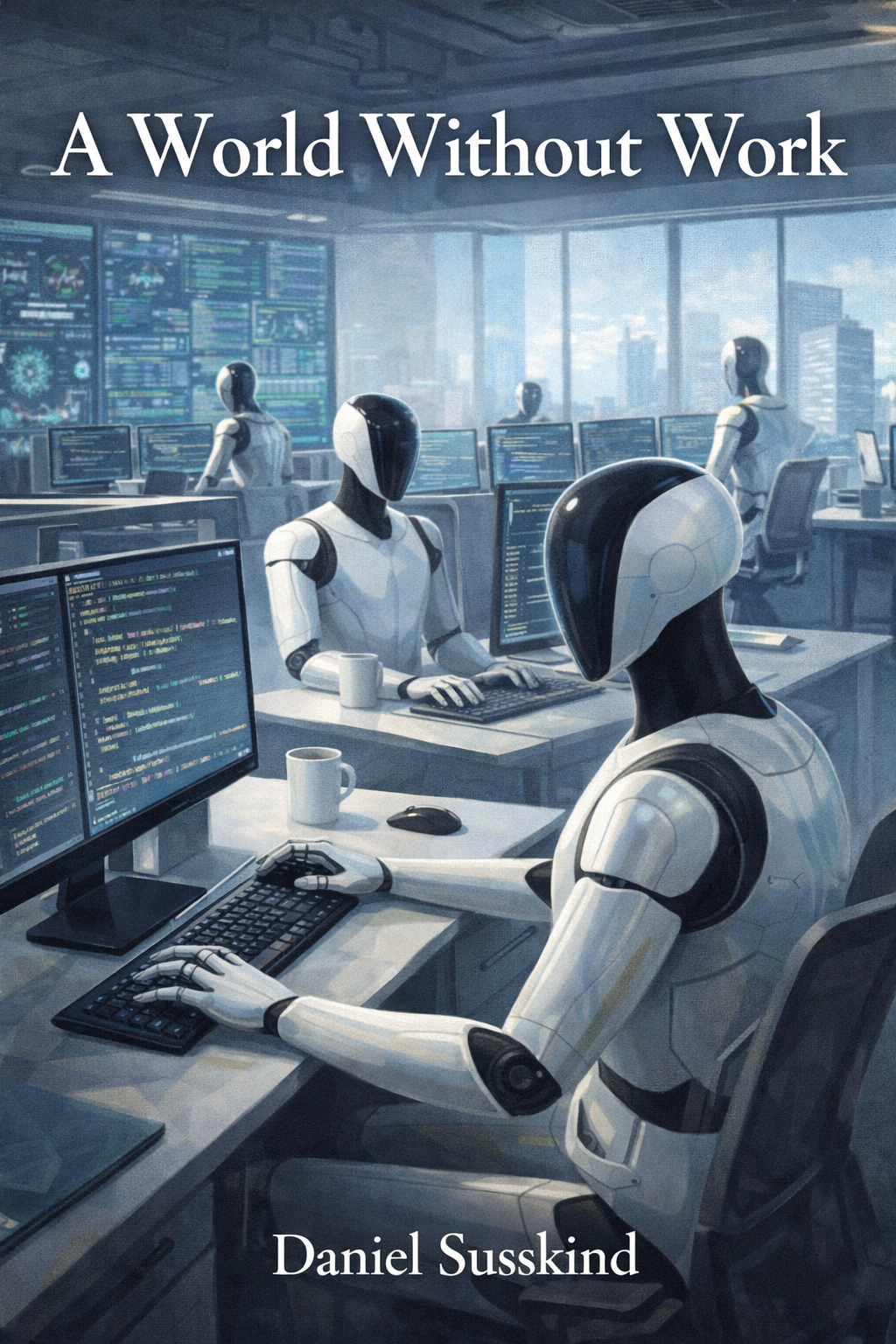
A World Without Work
Chapter Summaries
What's Here for You
Are you feeling a creeping unease about the future of work? Do you wonder if the relentless march of technology, from sophisticated AI to ever-more capable automation, is rendering human labor obsolete? Daniel Susskind's "A World Without Work" is your essential guide to navigating this profound transformation. This book doesn't just present a doomsday prophecy; it offers a clear-eyed, historically informed, and intellectually stimulating exploration of what a future with significantly less human work might actually look like. Susskind masterfully dismantles long-held assumptions, tracing the history of our anxieties about technological unemployment and revealing why past predictions of mass joblessness never quite materialized – until now. You will gain a powerful new framework for understanding the current economic landscape, moving beyond simplistic notions of "skill-biased" progress to grasp the nuanced reality of "task encroachment" and "frictional" unemployment. The book will equip you with the insights to critically assess the limitations of traditional solutions like education and to understand the growing influence of "Big Tech" and the potential role of the state in a post-work society. More than just an economic treatise, "A World Without Work" delves into the deeper, existential questions: what does work provide beyond income, and how will we find meaning and purpose in a world where traditional employment is no longer the central organizing principle of our lives? Prepare to have your assumptions challenged and your perspective expanded. Susskind's tone is both urgent and measured, grounded in rigorous analysis yet deeply empathetic to the human implications of these seismic shifts. This book is for anyone who wants to understand the forces reshaping our world and to begin thinking constructively about the challenges and opportunities that lie ahead.
A History of Misplaced Anxiety
The author Daniel Susskind embarks on a journey through time to unravel the persistent anxiety surrounding technological unemployment, revealing that our fears, while deeply felt, have often been misplaced. For millennia, human economic life was a stagnant stream, but the last few hundred years have seen an explosion of growth, propelled by technological progress that began in Western Europe. This era, the Industrial Revolution, was a seismic shift, transforming production and creating unprecedented wealth, yet it also sowed the seeds of a familiar dread: the fear that machines would render human labor obsolete. We see echoes of this anxiety in the Luddites, the furious weavers who smashed machines, and even in Queen Elizabeth I's refusal of William Lee's knitting machine, fearing it would impoverish her subjects. Economists, too, grappled with this specter, with David Ricardo famously revising his views to acknowledge the potential harm of machinery. This anxiety has echoed through the decades, from John F. Kennedy to Stephen Hawking, each warning of impending industrial dislocation. Yet, Susskind explains, history offers a more nuanced picture. While technology has indeed displaced workers, creating upheaval and hardship, as evidenced by the diminished physical stature of people during the Industrial Revolution, mass, permanent unemployment has not materialized. This is because technology operates with two forces: a substituting force that replaces human tasks, and a helpful complementing force that often goes overlooked. This complementing force works in three ways: the productivity effect, where technology makes workers better at their jobs, like doctors using AI to improve cancer detection; the bigger pie effect, where overall economic growth, fueled by technology, creates more demand and thus more jobs; and the changing pie effect, where economies transform, shifting demand to entirely new sectors and roles, from agriculture to services, creating jobs that were once unimaginable, like cloud computing specialists. The story of the ATM, which displaced some teller tasks but ultimately led to more bank branches and more teller jobs by freeing them for higher-value customer interaction, perfectly illustrates this dynamic. Susskind concludes that while the transition can be brutal, with periods of significant distress, the complementing forces have historically outweighed the substituting ones, ensuring a continued, albeit evolving, demand for human work. The anxiety has been real, the disruption undeniable, but the predicted widespread idleness has, thus far, remained at bay, suggesting that our historical fears, while understandable, have often underestimated humanity's capacity to adapt and find new avenues of contribution.
The Age of Labor
Daniel Susskind, in 'The Age of Labor,' invites us to reconsider the narrative of technology and work, a story economists have long told through the precise language of mathematics. For much of the 20th century, the prevailing economic tale was one of 'skill-biased' technological progress, where advancements, particularly the explosive growth of computing power, disproportionately benefited those with more formal education. This story explained a curious puzzle: why did the wages of college graduates rise even as their numbers swelled? The answer, in this narrative, was that technology's demand for high-skilled workers outstripped the increased supply, a dynamic illustrated by a widening 'skill premium' that saw college graduates earning significantly more than high school graduates. However, Susskind reveals that this is just one chapter in a much longer history. Looking back to 1220 England, the 'skill premium' was measured differently, comparing craftsmen to laborers, and the long-term trend was far from consistent. The Industrial Revolution, for instance, appears to have been 'unskill-biased,' deskilling crafts and making it easier for less-skilled workers to operate new machines, a phenomenon that doubled the share of unskilled labor in England. This historical perspective shatters the 'canonical model' that suggested technology always broadly benefited workers. A new, peculiar trend emerged in the late 20th century: polarization, or the 'hollowing out' of the labor market. Technologies began to help both low- and high-skilled workers simultaneously, while those in the middle saw their pay and job share wither. This phenomenon, clearly visible in employment data, created a two-tiered labor market, with the top earners seeing their incomes soar. The old models, focused only on low- and high-skilled groups, were powerless to explain this. Enter the Autor-Levy-Murnane (ALM) hypothesis, which shifted the focus from jobs to tasks. Susskind explains that economists David Autor, Frank Levy, and Richard Murnane realized that what truly mattered was whether a task was 'routine' or 'nonroutine.' Routine tasks, those easily explained and articulated (explicit knowledge), are amenable to automation. Nonroutine tasks, often requiring tacit knowledge, creativity, judgment, or complex manual dexterity, proved much harder for machines to replicate. This task-based view, a crucial insight, explained the hollowing out: machines readily perform routine tasks, leaving humans to tackle the nonroutine ones at either end of the skill spectrum. This led to a 'task-biased' view of technological progress, where only workers performing nonroutine tasks would benefit. This nuanced understanding, though initially surprising to those accustomed to the old narratives, has become influential, shaping how institutions like the IMF, World Bank, and even former central bank governors discuss automation. It cautions against simplistic predictions of entire jobs disappearing, emphasizing instead that jobs are bundles of tasks, some automatable, others not. While this hypothesis offers an optimistic outlook—that nonroutine tasks will always complement human effort—Susskind hints at a potential flaw in this optimism, suggesting that the future may hold further surprises as we delve into the evolving landscape of artificial intelligence, setting the stage for a deeper exploration of what lies ahead.
The Pragmatist Revolution
The author, Daniel Susskind, takes us on a journey tracing humanity's enduring fascination with intelligent machines, from ancient myths of self-moving stools and golems to the popular automata of centuries past—like Vaucanson's digesting duck and von Kempelen's chess-playing Turk, which, though impressive, often relied on clever trickery. This deep-seated wonder, Susskind explains, was particularly ignited by machines that seemed to possess cognitive abilities, appearing to think and reason. The true shift, however, began in the 20th century with the serious pursuit of artificial intelligence. Initially, in what Susskind terms the 'first wave of AI,' researchers like Alan Turing and the pioneers of the Dartmouth workshop in 1956, including John McCarthy and Marvin Minsky, were driven by a 'purist' approach: attempting to replicate human intelligence by mimicking human brains, thought processes, or the explicit rules derived from human experts. This mimetic strategy, while rooted in a profound intellectual curiosity about the nature of the mind itself, ultimately led to an 'AI winter' as progress faltered and grand ambitions remained unfulfilled. But then, a profound change occurred, a 'pragmatist revolution.' The turning point, marked by IBM's Deep Blue defeating Garry Kasparov in chess in 1997, wasn't about a machine thinking *like* a human, but about a machine performing a task requiring intelligence in a fundamentally different, often vastly more powerful, way. This pragmatist approach, fueled by exponential increases in computing power and data, shifted the focus from mimicking human cognition to achieving task performance through brute force computation and pattern recognition in massive datasets. Think of it like this: instead of meticulously studying a master chef's every move to learn to cook, this new wave of AI simply devours millions of recipes and cooking videos, learning to produce a delicious meal by identifying patterns and correspondences, regardless of whether its process resembles human culinary intuition. This shift is evident in modern breakthroughs in machine translation, image recognition (like the ImageNet contest where machines now far surpass human accuracy), and even complex games like Go, where AlphaGo and its successor AlphaGo Zero learned to master the game through self-play and raw computation, unburdened by human strategies. Even in the messier realm of poker, systems like DeepStack and Pluribus have learned to bluff and strategize by exploring millions of simulated games, demonstrating that remarkable capabilities can emerge from bottom-up, unconscious processes, much like Darwin's theory of evolution by natural selection, rather than solely from top-down intelligent design. This pragmatic evolution, driven by large tech companies and their commercial ambitions, has reoriented AI research, moving away from the philosophical pursuit of understanding human intelligence for its own sake towards building highly capable machines, even if their inner workings bear little resemblance to our own minds. The author concludes by suggesting that terms like 'computational rationality' might better describe these systems, highlighting a fundamental re-evaluation of how we understand intelligence and capability, not just in machines, but by analogy, in ourselves.
Underestimating Machines
Daniel Susskind, in 'Underestimating Machines,' invites us to reconsider our deeply ingrained assumptions about artificial intelligence, moving beyond the human-centric lens that has often clouded our understanding of machine capabilities. He begins by recounting the story of Joseph Weizenbaum and his creation, ELIZA, the first chatbot, a system so surprisingly impactful that it prompted profound existential questions in its creator, who initially dismissed it as a mere parody. This early encounter foreshadows a recurring pattern: the tendency to underestimate machines when they don't mirror human intelligence, a phenomenon Susskind terms the 'AI fallacy.' We see this play out with IBM's Deep Blue and Watson; critics like Douglas Hofstadter and John Searle, purists focused on replicating human consciousness, felt disappointed because these machines didn't 'think' or 'feel' like humans, despite their astonishing performance. This 'intelligence of the gaps' approach, where intelligence is defined as whatever machines *cannot* do yet, leads to a continuous shifting of goalposts, as seen with Garry Kasparov's own evolving views on chess-playing machines. Susskind argues that this fixation on Artificial General Intelligence (AGI) – machines with human-like broad capabilities – distracts from the immense power of Artificial Narrow Intelligence (ANI), the 'army of industrious hedgehogs,' each excelling at specific tasks. This pragmatist revolution has dismantled long-held economic hypotheses like the ALM (routine vs. nonroutine tasks), as machines now learn and derive their own rules from data, performing 'nonroutine' tasks once thought exclusively human. Consider the Stanford freckle-analyzing system or AlphaGo's revolutionary chess moves; these machines don't just uncover human tacit knowledge, they forge entirely new paths, operating in ways fundamentally alien to human cognition. This shift, while powerful, introduces opacity, prompting a need for explainable AI and new regulations. The core insight is that machines don't need to replicate human judgment, creativity, or intuition to perform tasks effectively; they can achieve remarkable feats through entirely different, often data-driven, methods. The narrative moves from the initial shock of ELIZA to the intellectual disappointment of purists, resolving into a call for a more pragmatic, awe-inspired appreciation of machine capabilities, recognizing that human intelligence is but one peak on a vast mountain range of possible designs, and that future machines might ascend to heights we can barely imagine.
Task Encroachment
Daniel Susskind, in his chapter 'Task Encroachment,' invites us to look beyond the fluctuating boundaries of machine capabilities and instead focus on a more profound, relentless trend: machines are gradually, and surely, advancing into more and more tasks once exclusively performed by humans. He argues that trying to pinpoint exact limits is like painting the Forth Rail Bridge—a futile, ever-outdated endeavor. Instead, we must recognize the deeper currents of progress. This encroachment is not confined to one domain; it impacts manual, cognitive, and affective capabilities alike. Consider the physical world: from driverless tractors in agriculture to robots assembling IKEA chairs and 3D printing entire homes, machines are mastering tasks that once demanded human hands and eyes. In the cognitive realm, AI now reviews legal documents in seconds that would take lawyers thousands of hours, diagnoses eye diseases with remarkable accuracy, and even predicts court decisions better than human experts. The author reveals that the distinction between human and machine intelligence is blurring, as seen in AI composing music or drafting political speeches. Even our affective capabilities—our emotions and social interactions—are not immune. Affective computing systems can read facial expressions, and social robots are being developed for healthcare, though Susskind cautions against merely mimicking human emotion, highlighting that machines can excel without imitation. The core tension, then, is not *if* machines will take on more tasks, but *how* this relentless 'task encroachment' will reshape employment and society. A vivid micro-metaphor emerges: imagine a tide slowly, inexorably rising, not with a sudden crash, but with a steady, persistent advance, covering more and more of the shore. While the pace of adoption varies across economies due to differing job compositions, costs of labor, and regulatory environments—China, for example, rapidly embracing automation due to rising wages and supportive policies—the overall direction remains singular. Susskind concludes with a healthy skepticism towards hype, acknowledging that progress isn't always linear, but firmly asserting that the trajectory of machines becoming more capable is as certain as death and taxes, a force reshaping our world one task at a time.
Frictional Technological Unemployment
Daniel Susskind, in 'A World Without Work,' delves into the nuanced reality of technological unemployment, moving beyond simple job displacement to explore the concept of 'frictional' unemployment, a modern-day echo of the myth of Tantalus, where work exists but remains agonizingly out of reach for many. The author explains that while technology has historically created new jobs even as it destroyed old ones, the future may present a significant challenge: the pace of technological advancement is accelerating, and the skills required are becoming increasingly specialized and difficult to attain, leading to a widening gap. This creates a central tension: the 'substituting force' of technology is growing stronger, while the 'complementing force' struggles to keep pace, leaving many workers stranded. Susskind reveals three distinct types of friction that prevent people from accessing available work: a skills mismatch, where individuals lack the advanced qualifications demanded by emerging roles; an identity mismatch, where people reject lower-skilled or less prestigious jobs, even when qualified, preferring unemployment to protect their sense of self; and a place mismatch, where job opportunities are geographically concentrated, and many workers lack the mobility, resources, or desire to relocate. He illustrates this with the example of displaced manufacturing workers in the US, many of whom could not transition to new sectors, and the growing number of educated individuals in South Korea who refuse low-status jobs. The narrative emphasizes that focusing solely on the unemployment rate can be misleading, as many individuals may drop out of the labor market altogether, lowering the participation rate, or end up in 'technological overcrowding,' where a glut of workers competes for a dwindling pool of less desirable jobs, driving down wages and job quality. This creates a precarious 'precariat,' a stark contrast to the romanticized idea of automation freeing humans for more fulfilling tasks. The author warns that the future may not be about a lack of jobs, but about the diminishing quality and accessibility of the work that remains, leaving many in a state of perpetual 'almost,' much like Tantalus reaching for fruit that always recedes, a profound dilemma for the future of labor.
Structural Technological Unemployment
Daniel Susskind, in his chapter 'Structural Technological Unemployment,' challenges the long-held economic assumption that technological progress will always create new jobs to replace those it eliminates. He recounts an exchange between Chris Hughes and Jason Furman, highlighting the common comfort economists find in 'frictional technological unemployment' – a temporary mismatch between available jobs and skilled workers – versus the more profound concern of 'structural technological unemployment,' where there simply aren't enough jobs for everyone. The author posits that while history has shown the 'complementing force' of technology to outweigh the 'substituting force' by creating new demands and increasing productivity, this balance is tipping permanently. Susskind explains how the three historical pillars of this complementing force – the productivity effect, the bigger pie effect, and the changing pie effect – are weakening. The productivity effect falters as machines become not just tools but replacements, making human productivity in certain tasks economically irrelevant, much like a modern-day artisan candle maker compared to automated production. Similarly, the bigger pie effect, which once meant greater overall wealth led to new job opportunities, is now threatened because the demand for goods might simply translate to more demand for machines, not human labor, as seen in the declining employment in UK agriculture and manufacturing despite increased output. The changing pie effect, where new consumer demands and production methods historically created new roles, is also showing cracks; new, highly valuable industries like tech giants employ vastly fewer people than their predecessors, suggesting economic growth doesn't automatically equate to human employment growth. Susskind introduces the 'superiority assumption' – the ingrained belief that humans will always be best suited for new or changing tasks – as the flawed foundation of optimistic predictions. He argues that while some residual tasks, valued for their human element, will remain, it's highly unlikely these will be numerous or large enough to employ everyone, likening it to a ball pit where the few remaining blue balls (human tasks) are too small to support the many looking for work. This leads to the 'Lump of Labor Fallacy Fallacy' (LOLFF), which mistakenly assumes that any growth in the 'lump of work' will inherently involve tasks suited for humans, rather than machines. The author concludes that the Age of Labor is likely ending not with a bang, but a 'withering' of demand for human work, as machines increasingly become the default choice, potentially leading to significant societal instability even before mass unemployment, as history has shown. The timing is uncertain, but the trajectory, Susskind suggests, points towards a future where 'manpower' might become a historical term, much like 'horsepower' today, marking a profound shift in our economic self-perception.
Technology and Inequality
The author, Daniel Susskind, invites us to consider the deep roots of economic inequality, a phenomenon as old as civilization itself, moving beyond the romantic notion of solitary retreat into a state of nature, as imagined by Jean-Jacques Rousseau, to the reality of early human societies where cooperation and sharing, however unevenly distributed, were essential for survival. He reveals that while technological progress has dramatically increased humanity's collective prosperity over centuries, the market mechanism, our primary tool for distributing these riches, is now under immense strain, with rising inequality and the looming threat of technological unemployment poised to leave many without a share of societal wealth. Susskind introduces a crucial distinction between two forms of capital: traditional capital, which encompasses all owned assets like stocks and real estate, and human capital, the bundle of skills and talents each person possesses. He explains that while not everyone owns traditional capital, everyone possesses human capital, which can be invested in through education and yields a return in wages. However, the core challenge of technological unemployment arises when an individual's human capital becomes devalued or obsolete in the labor market, leaving them with no marketable assets. This leads to a stark divergence: those who own valuable traditional capital, especially the new forms of capital driving technological advancement, are likely to see their wealth grow, while those who rely solely on their human capital risk being left behind, creating a deeply divided society. Susskind meticulously unpacks the trends driving this growing chasm, examining income inequality through measures like the Gini coefficient and top income shares, demonstrating how in many developed nations, income growth has stagnated for the majority while soaring for the top 1 percent. He highlights that this rise in labor income inequality is significantly driven by technological progress, which has widened the gap between highly skilled and less skilled workers, and at the very top, the influence of powerful 'supermanagers' who leverage their institutional clout to secure ever-larger pay packages, a trend amplified by technology. Furthermore, Susskind observes a critical shift in the distribution of income between labor and capital, with the labor share of income shrinking while the capital share grows, a decoupling of productivity and pay that is largely attributed to technological advancements encouraging firms to substitute capital for labor, alongside factors like globalization and the rise of 'superstar' firms. The inequality in capital income is even more pronounced, as wealth ownership is extraordinarily uneven, with a tiny fraction of the population holding a disproportionate amount of global wealth, reminiscent of 1930s societal structures. Susskind argues that these trends—uneven distribution of human capital, its diminishing value relative to traditional capital, and the extreme inequality in traditional capital ownership—are largely driven by technological progress, which is both expanding the economic pie and exacerbating its unequal distribution. He draws a parallel between current inequalities and the future threat of technological unemployment, where the market mechanism, which already leaves many with little of value, could fail entirely. Yet, in a move toward resolution, Susskind offers a hopeful perspective, emphasizing that while initial imbalances are unavoidable, the subsequent inequalities are not predetermined; national policies and institutions, from education systems to taxation, play a crucial role in shaping how capital is distributed and how prosperity is shared, suggesting that we possess the power to constrain these economic divisions and that the distribution problem, which Keynes overlooked in his optimistic predictions of a future free from economic struggle, is the central challenge we must address.
Education and Its Limits
Daniel Susskind, in 'Education and Its Limits,' confronts the prevailing wisdom that more education is the ultimate antidote to technological unemployment, a notion deeply rooted in the 'human capital century' of the twentieth century where increased schooling demonstrably boosted worker value. For a time, this held true, with higher education offering substantial financial returns, and nations prospering by investing in their workforces' skills. However, as machines grow ever more capable, Susskind argues this faith in education will prove to be a 'big mistake,' a comforting illusion in the face of relentless technological advancement. He proposes a necessary recalibration: changing *what* we teach, *how* we teach it, and *when* we teach it. This means shifting focus from routine tasks that machines excel at, to skills machines struggle with – creativity, judgment, empathy, or the very design of these machines – and crucially, moving beyond the traditional model of education as a finite, early-life pursuit to embracing lifelong learning, a continuous adaptation to an unknowable future. Imagine, for a moment, a London taxi driver, their mind a labyrinth of street knowledge painstakingly built over years; Susskind questions the feasibility and financial sense of such a seasoned professional retraining for a completely different field, highlighting the first profound limit: unattainability due to natural differences and the sheer difficulty of learning new, complex skills late in life. He reveals that even the best current education systems struggle to equip the majority of adults with skills that demonstrably surpass what computers can already achieve, a sobering reality check against the utopian promise of education as a perpetual solution. Furthermore, Susskind underscores that education can only address one facet of unemployment – the skills gap – and falters when faced with issues of identity mismatch, geographical relocation, or, most critically, insufficient demand for the work itself; even a world-class education is useless if there simply isn't enough work to go around. Ultimately, he posits that while education is our best *current* defense, its effectiveness is diminishing, suggesting that as machines become more capable and the demand for human labor wanes, we must look beyond the labor market for answers, hinting at a future where societal prosperity might be distributed through mechanisms other than traditional employment, a 'Big State' perhaps, to manage the economic pie.
The Big State
The author, Daniel Susskind, begins by revisiting the grand economic debate of the last century: the clash between central planning and free markets, a conflict that seemed decisively settled in favor of markets after the fall of the Soviet Union, whose economic statistics, once lauded, were revealed to be vastly inflated. However, Susskind posits that the future landscape of work, shaped by accelerating technological unemployment, presents a new dilemma. He argues that the state's role must shift from *making* the economic pie larger – a task where markets excel – to ensuring a fairer *distribution* of that pie. This is not a call to resurrect failed central planning, but to embrace a 'Big State' focused on distribution, a role the free market, particularly the labor market, will increasingly fail to fulfill as inequality grows. The historical precedents for reducing vast inequality, like the Black Death or world wars, are grim, underscoring the need for a proactive, less catastrophic approach. The existing welfare state, though designed to support those with insufficient incomes, was built for a world where employment is the norm and unemployment a temporary exception; it acts as a trampoline back to work, which will buckle under the strain of widespread, persistent technological unemployment. Therefore, Susskind proposes the Big State must undertake two primary roles: significantly taxing those who retain wealth and income, and then sharing it effectively. He identifies three key areas for taxation: workers whose human capital continues to increase in value, owners of traditional capital (challenging the prevailing economic view that capital taxes should be near zero), and large corporations that increasingly dominate industries and minimize tax burdens through sophisticated avoidance strategies. This necessitates a correction of theoretical biases and practical challenges in taxing capital and multinational profits, demanding tighter legislation and better international coordination. To share the revenue, Susskind explores the concept of a Universal Basic Income (UBI), noting its broad appeal across the political spectrum but also its limitations. He advocates for a 'Conditional Basic Income' (CBI), which would require an admissions policy to define citizenship and membership, and crucially, impose membership requirements to foster community solidarity and address the 'contribution problem' – the widely held notion that it is unfair for able-bodied individuals to live solely off the labor of others. This contrasts with a UBI, which solves the distribution problem but ignores the need for perceived contribution. Furthermore, Susskind introduces the idea of a 'Capital Sharing State,' suggesting the state could acquire capital on behalf of citizens, similar to sovereign wealth funds, to more directly address the underlying distribution of wealth rather than just income. Finally, he considers the 'Labor Supporting State,' not to halt technological progress, but to smooth the transition for workers by ensuring remaining jobs are well-paid and high-quality, using tax incentives and updated labor laws to rebalance power between employers and employees, and encouraging new forms of organized labor. Ultimately, Susskind concludes that a combination of these state functions will be necessary to navigate a future with less work and prevent societal fragmentation, emphasizing that the precise balance will be a matter for each society to determine.
Big Tech
Daniel Susskind, in his chapter 'Big Tech,' illuminates a profound shift in our economic and political landscape, one increasingly shaped by the colossal power of technology companies. As work diminishes, these giants, from the familiar Big Five to nascent innovators in metaphorical garages, are poised to dominate not just our marketplaces but the very fabric of our societies. The author explains that the immense cost of developing cutting-edge technologies—requiring vast data, sophisticated software, and powerful hardware—naturally concentrates this power in the hands of large firms, echoing the network effects that make platforms like Facebook or Uber exponentially more valuable with each new user. This concentration, however, presents a complex challenge for traditional competition policy. While economists have long grappled with the dangers of monopolies, Susskind reveals that the economic arguments, focused on prices and consumer welfare, often fall short when applied to free digital services or ill-defined markets. Furthermore, he introduces a counter-argument, echoing Joseph Schumpeter, that monopolies can be engines of innovation, fueling further research and development through substantial profits, a model exemplified by Amazon's long-term unprofitability for market dominance. Yet, as Susskind compellingly argues, the most significant threat from Big Tech is not economic but political. Unlike Standard Oil, whose antitrust battles were primarily economic, today's tech giants wield influence over our social structures, shaping our liberty, democracy, and justice through algorithms and data curation. He illustrates this with stark examples: Google's search biases, Facebook's emotional manipulation experiments, Amazon's deletion of e-books, and Apple's app store policies, all demonstrating a profound impact on our collective lives that transcends mere market competition. The core tension arises because we are ill-equipped to regulate this burgeoning political power. While we have frameworks for economic oversight, a comparable mechanism for political influence is absent, leaving Big Tech largely to self-regulate—a prospect Susskind finds dubious, given the differing skill sets of engineers versus ethicists. He rejects state nationalization as a solution, pointing to China's social credit system as a cautionary tale of state overreach. Instead, Susskind proposes a new 'Political Power Oversight Authority,' distinct from economic regulators, staffed by political theorists and moral philosophers to scrutinize the non-economic behavior of these companies, ensuring their influence remains legitimate and does not lead to the privatization of our political lives.
Meaning and Purpose
Daniel Susskind, in his exploration of 'Meaning and Purpose,' delves into the profound human need for work beyond mere economic sustenance, a concept often overlooked in purely utilitarian economic analyses. He posits that while automation threatens livelihoods, its deeper impact lies in potentially hollowing out our sense of significance and purpose. Drawing on thinkers like Alfred Marshall, who saw work as essential for 'fullness of life,' and Sigmund Freud, who viewed it as a vital outlet for primal impulses, Susskind highlights work's role in social order and individual well-being. He further examines Max Weber's notion of work as a 'vocation' or 'calling,' rooted in the Protestant Reformation's emphasis on tireless effort as a sign of salvation, and the striking 1930s Marienthal study by Marie Jahoda, which revealed widespread apathy and loss of direction among the long-term unemployed, underscoring work's crucial function in providing structure and meaning. The author notes how this connection is deeply ingrained, evident in how we ask 'What do you do?' and how social media amplifies work as a source of status and esteem, but also how this link can inflict shame and distress on the jobless, exacerbated by meritocratic ideals that can equate unemployment with a lack of personal merit. Susskind then contrasts this modern view with historical and prehistoric perspectives, where work was often seen as degrading or a punishment, citing ancient Greek philosophy and the biblical story of Adam and Eve, suggesting that the idea of work as inherently meaningful is a relatively recent construct, perhaps even a 'bullshit job' phenomenon for many. He questions whether the privileged, who often romanticize their leisure, offer a reliable model for a society with less work, and controversially reinterprets Marx's 'opium of the people' not as a tool of the elite, but as a self-administered anesthetic by ordinary people to find meaning, a role now largely filled by work itself, intoxicating and disorienting us from seeking meaning elsewhere. This leads to the crucial dilemma: if work, our current 'opium,' recedes, what will fill the void? Susskind proposes that society must develop 'leisure policies' to complement labor market interventions, starting with an educational overhaul that prioritizes flourishing through leisure, not just workplace competence, echoing Rab Butler's dual aspiration for character and competence. He argues that the state already subtly shapes leisure through public broadcasting and cultural initiatives, and suggests a more deliberate, comprehensive approach is needed, moving beyond viewing leisure as a disposable 'fiscal fruit.' For those who still crave purpose through activity, even without economic necessity, Susskind revisits the idea of a 'job guarantee' and the conceptual puzzle of distinguishing work from leisure when income is decoupled. Ultimately, he suggests that in a world where the market's valuation is insufficient, a 'conditional basic income' (CBI) could foster a 'meaning-creating state,' where contributions beyond paid work—such as caregiving, civic engagement, and artistic pursuits—are recognized and valued, repairing the mismatch between societal contribution and market price, and guiding humanity toward a richer, more purposeful existence beyond the confines of traditional labor.
Conclusion
Daniel Susskind's 'A World Without Work' offers a compelling and ultimately sobering reflection on the future of human labor in an era of accelerating technological advancement. The book masterfully dismantles the historical optimism surrounding technological unemployment, demonstrating how past anxieties, while potent, were largely allayed by the 'complementing force' of technology, which historically boosted productivity, expanded economies, and created new roles. Susskind argues that this dynamic, characterized by task-biased rather than purely skill-biased progress, has always absorbed displaced workers. However, he pivots to a more urgent contemporary reality: the 'pragmatist revolution' in AI, driven by data and computational power, is enabling machines to perform an ever-expanding array of tasks, including those requiring creativity and tacit knowledge, a departure from earlier AI paradigms. This 'task encroachment' is not merely replacing routine jobs but is fundamentally altering the economic value of human capabilities. The book meticulously details the emergence of 'frictional' and 'structural' technological unemployment, driven by skills, identity, and location mismatches, and the growing inadequacy of education as a panacea. The historical balance is shifting, leading to a potential 'withering' of demand for human labor. This profound transformation carries significant implications for economic inequality, as wealth concentrates in the hands of capital owners and 'supermanagers,' further straining the traditional link between work, income, and social distribution. Susskind doesn't shy away from the existential implications, highlighting that the erosion of work threatens not just livelihoods but also our primary source of meaning and purpose. The book advocates for a radical reimagining of the state's role, shifting from production to distribution, with taxation and welfare systems adapted for an economy where human capital's value is diminishing. Concepts like Conditional Basic Income and a 'Capital Sharing State' emerge as potential mechanisms to ensure equitable prosperity. Furthermore, the immense power of 'Big Tech' demands new forms of regulatory oversight, extending beyond economic concerns to political and societal impacts. Ultimately, 'A World Without Work' is a call to confront a future where work, as we know it, may no longer be the central organizing principle of society. It urges a proactive societal adaptation, fostering new avenues for meaning, purpose, and solidarity, and challenging us to redefine societal value beyond market-based wages, preparing for a future where human ingenuity must find its purpose in realms beyond traditional employment.
Key Takeaways
Historical anxieties about technological unemployment, while potent and deeply felt, have largely proven misplaced due to the persistent, yet often overlooked, complementary effects of technology on human labor.
Technological progress operates through a dual mechanism: a 'substituting force' that replaces human tasks and a 'complementing force' that enhances human capabilities, increases overall economic output, and transforms industries, thereby creating new demands for work.
Frictional technological unemployment arises not from a lack of work, but from the inability of workers to access available jobs due to skills, identity, or location mismatches.
The 'complementing force' manifests in three key ways: increasing worker productivity (productivity effect), expanding the overall economy leading to greater demand (bigger pie effect), and shifting economic output to new sectors and roles (changing pie effect), all of which historically absorbed displaced workers.
Past fears of mass unemployment often stemmed from an underestimation of the 'complementing force' and an overemphasis on the 'substituting force,' leading to a failure of imagination about how economies and job markets would transform.
While technological transitions can cause significant disruption, hardship, and displacement, the historical pattern suggests that human ingenuity and economic adaptation, driven by these complementary forces, have consistently created sufficient demand for human work, preventing permanent mass unemployment.
Economists often tell stories about the economy through mathematical models, which evolve as new data emerges, demonstrating intellectual adaptability rather than inconsistency.
Technological progress has historically been 'task-biased,' favoring workers whose tasks are difficult to automate (nonroutine) rather than simply benefiting those with higher formal schooling (skill-biased) or disadvantaging all workers (unskill-biased).
The 'hollowing out' of the labor market, where middle-skill jobs decline while high- and low-skill jobs grow, is explained by automation's ability to perform routine tasks, leaving nonroutine tasks for humans.
The distinction between 'routine' (easily articulated, explicit knowledge) and 'nonroutine' (difficult to articulate, tacit knowledge, creativity, manual dexterity) tasks is the critical factor in determining a job's susceptibility to automation.
Predictions about entire jobs being automated are misleading; instead, jobs are comprised of various tasks, some of which are more automatable than others, leading to a transformation rather than elimination of many occupations.
The Autor-Levy-Murnane (ALM) hypothesis suggests that tasks that cannot be substituted by automation are generally complemented by it, offering a foundation for optimism about human work in nonroutine domains.
Despite the optimism surrounding the ALM hypothesis, the author suggests that the future may hold unforeseen challenges, hinting that the current optimistic assumptions about the continuation of the 'Age of Labor' might be incorrect.
The historical pursuit of artificial intelligence was initially dominated by a 'purist' approach, attempting to replicate human intelligence by mimicking human thought processes and structures, a strategy that ultimately proved insufficient for achieving true machine capability.
The 'pragmatist revolution' in AI marked a fundamental shift from 'how humans do it' to 'how well the machine performs,' leveraging massive computational power and data to achieve results through fundamentally different, non-human methods.
Remarkable machine capabilities can emerge from bottom-up, data-driven processes, analogous to Darwinian evolution, rather than solely from top-down intelligent design or direct human imitation.
The rise of large technology companies has redirected AI research towards pragmatic, performance-oriented goals, often prioritizing task-specific capability over the philosophical pursuit of understanding human intelligence itself.
The term 'intelligence' when applied to machines may be a category mistake; 'computational rationality' or similar terms might more accurately describe systems that use computational power to find optimal solutions without necessarily exhibiting human-like consciousness or reasoning.
The evolution of AI mirrors broader intellectual shifts, demonstrating that complex capabilities can arise from simple, iterative processes rather than requiring a conscious, intelligent designer.
The 'AI fallacy' is the mistaken belief that machines must replicate human thought processes to achieve human-level performance, leading to underestimation of their capabilities.
The pragmatist revolution in AI demonstrates that machines can excel at tasks without possessing human-like consciousness, emotion, or general intelligence, challenging economic models like the ALM hypothesis.
Artificial Narrow Intelligence (ANI), comprising specialized 'hedgehog' machines, poses a more immediate and significant force for automation than the pursuit of Artificial General Intelligence (AGI).
Machines can derive novel rules and solutions, independent of human logic or tacit knowledge, thereby redefining task performance and introducing a new level of operational opacity.
True progress in understanding and leveraging machine capabilities requires moving beyond a human-centric definition of intelligence and embracing diverse, non-human approaches to problem-solving.
The relentless trend of 'task encroachment,' where machines gradually perform more human tasks, is a more reliable indicator of future change than attempts to define fixed limits of AI capabilities.
Automation is impacting all human capabilities—manual, cognitive, and affective—blurring traditional distinctions and expanding the scope of machine involvement in work.
The pace of technological adoption is uneven, influenced by economic factors like labor costs and task composition, as well as regulatory and cultural landscapes, rather than being a uniform global phenomenon.
Machines can outperform humans in tasks without needing to replicate human capabilities or emotions, challenging the notion that mimicking human traits is the only path to automation.
Understanding the underlying economic and societal drivers, such as rising labor costs and supportive policies, is crucial for predicting the impact and speed of automation in different regions.
The accelerating pace of technological change demands ever-higher, more specialized skills, making upward mobility in the labor market increasingly difficult and creating a skills gap.
A mismatch of identity can lead individuals to reject available lower-skilled or less prestigious work, choosing unemployment to preserve their self-perception and social status.
Geographical concentration of new jobs and reduced worker mobility create a 'place mismatch,' preventing individuals from relocating to where opportunities exist.
The participation rate, rather than just the unemployment rate, offers a crucial indicator of labor market health, as individuals may drop out of the workforce entirely when facing these frictions.
Technological overcrowding can lead to downward pressure on wages and job quality as more workers compete for a limited pool of accessible roles, creating a 'precariat.'
The future of work may be characterized less by outright joblessness and more by a decline in the accessibility and quality of remaining jobs, creating a state of 'almost' employment.
The historical balance where technological progress created more jobs than it destroyed (the complementing force) is shifting, leading to structural technological unemployment where insufficient jobs exist for the human workforce.
The traditional drivers of job creation – productivity gains, economic expansion (bigger pie), and new industries (changing pie) – are weakening because machines are increasingly capable of performing the tasks associated with these growth areas, diminishing the economic value of human labor in them.
The 'superiority assumption,' the belief that humans will always be uniquely suited for new or evolving tasks, is a flawed premise for future job market optimism, as machines are becoming capable of handling increasingly complex roles.
While unique human-valued tasks (e.g., art, care) will persist, the demand for these residual roles is unlikely to be substantial enough to employ the entire workforce, challenging the notion that there will always be enough 'blue balls' of human-centric work.
The 'Lump of Labor Fallacy Fallacy' (LOLFF) incorrectly assumes that any increase in the total amount of work in the economy will necessarily translate into tasks suitable for humans, ignoring the growing capability of machines.
The transition to a world with less work may not be a sudden collapse but a gradual 'withering' of demand for human labor, posing significant risks of social instability even before mass unemployment occurs, as evidenced by historical economic downturns.
Future generations may view 'manpower' as a historical term, reflecting a time when human labor was the primary economic unit, signaling a profound shift in our economic identity and the default assumption of human capability.
Economic inequality is a persistent human challenge, exacerbated by technological advancement, which strains the market's ability to distribute prosperity evenly.
Human capital (skills and talents) and traditional capital (assets and ownership) are distinct forms of wealth, and the devaluation of human capital due to technological change is a primary driver of future unemployment.
Rising income inequality, particularly the widening gap between top earners and the rest of the population, is significantly influenced by technological progress and the increased power of 'supermanagers'.
The labor share of income is shrinking relative to the capital share, a trend driven by technology favoring capital over labor, globalization, and the rise of dominant 'superstar' firms.
Extreme inequality in the ownership of traditional capital is a critical factor, as wealth is concentrated in the hands of a few, creating a stark divide between capital owners and those without.
While technological progress creates wealth, its distribution is not automatic; national policies and institutions are crucial in shaping inequality and can be leveraged to mitigate the economic imbalances of technological unemployment.
The pervasive belief that more education is the sole solution to technological unemployment is a historical artifact that will become increasingly ineffective as machine capabilities expand.
Education must evolve to prioritize uniquely human skills that machines cannot replicate, such as creativity, judgment, and empathy, alongside the ability to build and direct technology.
Lifelong learning is no longer a supplementary option but a necessity, requiring individuals to adapt and re-skill continuously throughout their careers to navigate an unpredictable job market.
The inherent difficulty and inherent differences in human abilities present significant, often insurmountable, limits to retraining displaced workers for new roles.
Education can only address the skills mismatch aspect of unemployment; it cannot solve problems of insufficient demand for labor or issues related to worker identity or location.
As machines encroach on more complex tasks, the traditional link between education, employment, and economic distribution will weaken, necessitating new societal mechanisms for sharing prosperity.
The primary role of the state in a future of diminishing work should shift from production to distribution, ensuring equitable access to wealth generated by technology.
Existing welfare systems, designed for temporary unemployment, are insufficient for widespread technological displacement and require radical reimagining.
Taxation must adapt to capture wealth from increasingly concentrated sources like high-value human capital, traditional capital ownership, and large corporations.
A Conditional Basic Income (CBI), with clear admissions and membership requirements, is more likely to foster social solidarity and address the 'contribution problem' than a Universal Basic Income (UBI).
Sharing underlying capital through mechanisms like a 'Capital Sharing State' is crucial for addressing deep economic imbalances, not just income distribution.
A 'Labor Supporting State' can help manage the transition to less work by ensuring remaining jobs are high-quality and well-compensated, rebalancing power between workers and employers.
The immense resources required for modern technological innovation—data, software, and hardware—inherently favor large companies, leading to economic concentration and dominance.
Traditional economic arguments against monopolies, focusing on prices and consumer welfare, are often insufficient to address the complexities of free digital services and the broader societal impacts of Big Tech.
The primary concern with Big Tech is shifting from their economic power to their political power, as they increasingly shape societal structures, liberty, democracy, and social justice.
Existing regulatory frameworks are inadequate to address the political power wielded by technology companies, necessitating new institutions and expertise focused on non-economic impacts.
The legitimacy of Big Tech's political power cannot be assumed from consumer satisfaction or product usage; it requires a deliberate and distinct form of oversight to protect citizens' collective lives.
A new 'Political Power Oversight Authority,' staffed by non-economists, is crucial for identifying and constraining the misuse of political power by technology companies, distinct from existing economic regulation.
The threat of technological unemployment extends beyond economic livelihood to a profound loss of meaning and purpose, requiring societal adaptation.
Historically, work was not always viewed as a primary source of meaning; its elevation to this status is a more recent, potentially fragile, cultural construct.
In a future with less paid work, proactive 'leisure policies' and educational reforms are essential to cultivate skills for flourishing and meaningful engagement beyond employment.
The concept of 'work' itself may need redefinition, and societal value must expand beyond market-based wages to recognize unpaid contributions like caregiving and civic engagement.
A 'meaning-creating state' may be necessary to guide individuals and society in finding purpose and solidarity when traditional economic identities diminish, potentially through mechanisms like a conditional basic income.
The current societal reliance on work as a source of meaning can be seen as an 'opium,' intoxicating and disorienting us from exploring alternative avenues for fulfillment.
Action Plan
Recognize that historical anxieties about technology replacing jobs have often been overstated; focus on understanding how technology can also enhance your current role.
Cultivate a mindset of adaptability and continuous learning to prepare for the 'changing pie' of the economy, embracing new skills and roles as they emerge.
Seek to understand the 'complementing force' in your own work by identifying how new tools or processes can augment your productivity and allow you to focus on higher-value tasks.
When evaluating technological changes, consider both the potential for job displacement and the opportunities for new roles and increased overall demand ('bigger pie effect').
Engage with discussions about the future of work by seeking out perspectives that acknowledge both the challenges of substitution and the potential of complementarity.
Analyze your own job or daily tasks to identify which are routine and which are nonroutine.
Seek opportunities to develop skills in nonroutine areas, such as creativity, critical thinking, and complex problem-solving.
Stay informed about technological advancements and their potential impact on your industry and role.
Engage in discussions and learning about the task-based view of automation to better understand future labor market trends.
Consider how your current role might evolve by focusing on the unique human elements that machines cannot easily replicate.
Reflect on the historical narratives of technology and work to gain a broader perspective on current changes.
Prepare for a future where continuous learning and adaptation are paramount for career resilience.
Reflect on tasks you perform that could be approached with a 'pragmatist' mindset, focusing on the desired outcome rather than mimicking existing methods.
Explore resources on machine learning and data science to understand how 'bottom-up' processes generate capabilities.
Consider the distinction between 'purist' and 'pragmatist' approaches in your own learning or problem-solving efforts.
Engage with discussions about the definition and application of 'intelligence' to artificial systems.
Investigate the historical development of AI and its key figures to appreciate the evolution of thought in the field.
Evaluate how large technological shifts, like the availability of massive data, might necessitate new approaches to problem-solving.
Challenge your own assumptions about what constitutes 'intelligence' by examining machine capabilities that don't mirror human methods.
Focus on the specific skills and tasks machines excel at (ANI) rather than solely on the distant goal of human-like general intelligence (AGI).
Recognize that machines may develop solutions and perform tasks in ways fundamentally different from human logic or intuition.
Be aware of the 'AI fallacy' and resist the temptation to dismiss machine achievements simply because they lack human-like qualities.
Explore how tasks previously deemed 'nonroutine' are being automated by machines that learn and adapt, updating your understanding of work's future landscape.
Focus on understanding the broader trend of task encroachment rather than getting caught up in defining precise AI limitations.
Identify which of your own core capabilities (manual, cognitive, affective) are most susceptible to automation and consider how to enhance those that are uniquely human.
Research how automation trends are manifesting in your specific industry or region, considering local economic and cultural factors.
Adopt a mindset of continuous learning and adaptation to navigate the evolving landscape of work.
Consider how machines can augment human capabilities rather than solely focusing on replacement, looking for collaborative opportunities.
Assess your current skills against emerging industry demands to identify potential gaps and areas for upskilling.
Reflect on your personal identity and values in relation to career choices, considering whether perceived job status influences your willingness to accept available work.
Research job market trends in different geographical areas to understand where opportunities are emerging and assess the feasibility of relocation.
Pay attention to the participation rate alongside the unemployment rate to gauge the broader health of the labor market and identify potential hidden underemployment.
Consider how the concept of 'technological overcrowding' might impact your current or future role and explore strategies to enhance your value and distinctiveness in the market.
Engage in continuous learning and adaptation to stay relevant in a rapidly evolving technological landscape.
Advocate for policies and initiatives that address skills training, worker mobility, and support for those displaced by technological change.
Actively question the 'superiority assumption' by analyzing whether human skills remain uniquely advantageous in emerging tasks, rather than assuming they will.
Evaluate industries and roles for their susceptibility to 'task encroachment,' identifying which tasks within them are most likely to be automated.
Consider the 'complementing force' not as a given, but as a dynamic that can be intentionally fostered through policy and innovation aimed at human-machine collaboration.
Recognize that increasing economic output (the 'bigger pie') does not automatically guarantee increased demand for human labor, and explore how to decouple these trends.
Seek out and value 'residual tasks' that are inherently human-centric, but do so with the understanding that these may not form the basis of mass employment.
Challenge the 'lump of labor fallacy' by understanding that technological progress expands the economic pie, but critically assess *who* benefits from that expansion and *what kind* of work it creates.
Engage in public discourse and policy debates about the potential for structural technological unemployment, advocating for proactive strategies rather than reactive measures.
Reflect on the historical trajectory of 'horsepower' and consider the implications of 'manpower' becoming a similar historical descriptor in the future.
Analyze your own human capital: identify skills that are in demand and those that may become obsolete.
Consider diversifying your assets beyond solely relying on labor income.
Stay informed about technological trends and their potential impact on your industry.
Engage in discussions about economic policies that address wealth and income distribution.
Invest in lifelong learning to continually update and enhance your human capital.
Evaluate the role of institutional factors in shaping economic outcomes in your society.
Reflect on how societal policies can influence the distribution of prosperity.
Identify and cultivate skills that machines are currently poor at, such as complex problem-solving, creativity, and interpersonal communication.
Commit to continuous learning by actively seeking out new knowledge and training opportunities throughout your career.
Evaluate educational choices not just for immediate job prospects but for their ability to foster adaptability and critical thinking.
Engage in critical self-reflection about personal talents and limitations to realistically assess the attainability of new skills.
Recognize that education alone may not guarantee employment and begin exploring alternative avenues for economic security and societal contribution.
Advocate for educational reforms that emphasize future-proof skills and lifelong learning models.
Advocate for and support policies that shift taxation towards wealth and capital rather than solely labor income.
Engage in discussions about the design of future social safety nets, considering models like Conditional Basic Income (CBI) that address both distribution and contribution.
Explore the concept of capital ownership and consider how it might be more broadly distributed within society.
Support initiatives that aim to improve the quality and compensation of remaining jobs, rather than solely focusing on job creation.
Educate yourself and others on the historical context of economic debates to better understand current challenges.
Consider the non-economic purposes of work and how they might be fulfilled in a future with less traditional employment.
Educate yourself on the specific ways technology companies influence societal structures beyond economic transactions.
Engage in discussions and advocate for robust regulatory frameworks that address the political power of Big Tech.
Critically evaluate the terms of service and data usage policies of technology platforms to understand what consent truly entails.
Support initiatives and organizations working to establish oversight for the political influence of technology companies.
Consider the ethical implications of technological advancements and their potential impact on liberty, democracy, and social justice in your own life.
Advocate for transparency from technology companies regarding their algorithms, data collection, and decision-making processes.
Reflect on the sources of meaning and purpose in your own life beyond your paid employment.
Explore historical and philosophical perspectives on work to broaden your understanding of its role.
Consider how your current education or skills training prepares you for a future with potentially less traditional work.
Evaluate how societal structures (like public services or cultural institutions) already influence your leisure time.
Contemplate the value of unpaid contributions (caregiving, volunteering, civic engagement) in your community and personal life.
Begin to envision what a 'meaning-creating state' might look like and what role it could play in fostering purpose.
Engage in activities that provide a sense of contribution and fulfillment, even if they are not economically compensated.