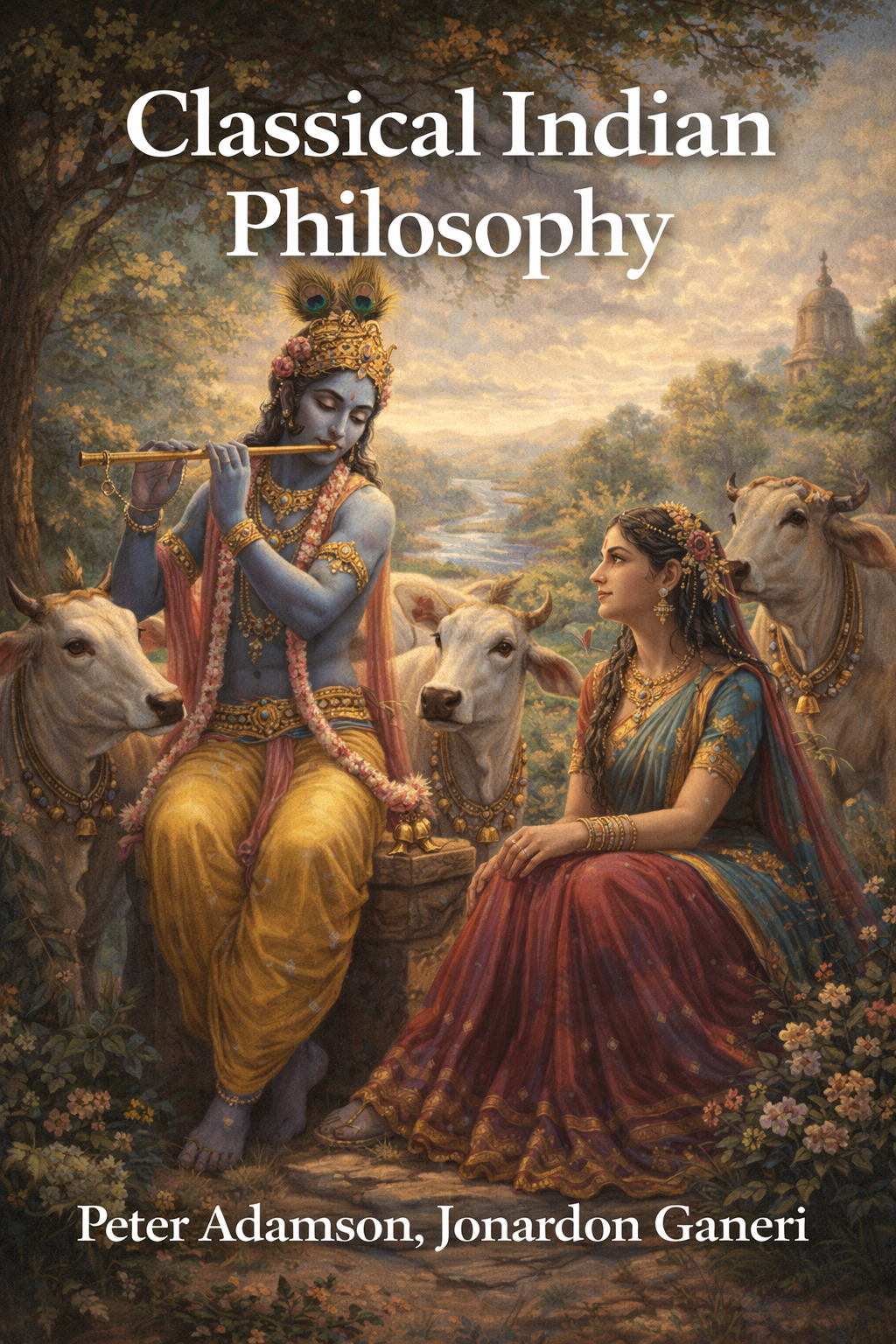
Classical Indian Philosophy
Chapter Summaries
What's Here for You
Embark on a profound intellectual journey with "Classical Indian Philosophy," a comprehensive exploration that shatters the notion of philosophy as a purely Western domain. Peter Adamson and Jonardon Ganeri invite you to delve into a rich, millennia-spanning tradition, revealing how ancient Indian thinkers grappled with fundamental questions about existence, self, consciousness, ethics, and the nature of reality itself. This book promises to equip you with a nuanced understanding of diverse schools of thought, from the Vedic origins and the enigmatic Upanishads to the profound teachings of the Buddha and the intricate logic of the Nyāya school. You will discover the concepts of karma, dharma, and the elusive nature of the self, challenging your preconceptions and expanding your intellectual horizons. Journey through the sophisticated arguments of grammarians, the ethical dilemmas presented in epics like the Mahābhārata, and the radical insights of Nāgārjuna on emptiness and change. Prepare to engage with a vibrant, dialogical tradition that values metaphor, parable, and rigorous debate. The tone is one of intellectual curiosity and respectful inquiry, inviting you to see how ancient Indian philosophy not only anticipates many modern concerns but also offers unique perspectives that can illuminate your own understanding of the world and your place within it. This is an opportunity to broaden your philosophical landscape, connect with a foundational pillar of human thought, and gain invaluable insights into the enduring quest for wisdom.
BEGIN AT THE END AN INTRODUCTION TO PHILOSOPHY IN INDIA
The authors, Peter Adamson and Jonardon Ganeri, invite us into the rich landscape of classical Indian philosophy, challenging the conventional notion that philosophy is solely a Western enterprise born from Greek thought. They begin by highlighting an ancient exhortation from the Bhadrayaka Upanishad: to see, hear, reflect upon, and concentrate on one's self, for in this inward gaze lies the knowledge of the entire world. This introspective imperative, though not using the word 'philosophy,' embodies its very spirit, suggesting that the pursuit of wisdom in India, like in the West, often starts with an understanding of the self and its place in the cosmos. We are introduced to the radical Buddhist thinker Nagarjuna and his text, the 'Dispeller of Disputes,' where he grapples with the concept of 'svabhava' – independent reality – arguing that all things are ultimately empty and dependent. Nagarjuna's dialectical method, where he anticipates and refutes criticisms of his own position, mirrors the rigorous philosophical practices found in Aristotle's Lyceum or medieval European universities, demonstrating that the core mechanics of philosophical inquiry are universal. This exploration reveals that Indian thought, from the Vedic writings to later texts, delves into fundamental philosophical areas: the foundations of knowledge, metaphysics, atomism, concepts of time and space, logic, ethics, and political legitimacy. While acknowledging potential historical influences from Greek thought, such as Alexander the Great's conquests, the authors emphasize studying Indian philosophy as a distinct and valuable tradition in its own right, capable of expanding our very definition of what philosophy can be. The chapter then pivots to a central tension: the perceived contrast between the Greek emphasis on worldly flourishing as the highest good and the Indian focus on 'taming the self' or achieving otherworldly states like moksha, mukti, and nirvana. This is exemplified by the 'Book of Peace' from the Mahabharata, which posits the highest good as the 'taming of the self' – a drawing inward, a mastery of desires and fears, akin to a tortoise withdrawing its limbs. This path of spiritual austerity, or 'tapas,' leads to a life of self-control and equanimity, leaving no trace like birds in the sky. However, this path isn't about extinguishing the self but about understanding its nature and transcending the suffering caused by ignorance and insatiable desire. The authors resolve this tension by arguing that these transcendental ideals, often described in stark, unappealing terms, are not literal destinations but rather guiding stars. The pursuit of these seemingly unattainable goals, like becoming a sage or a Buddha, serves as a 'spiritual exercise,' a practice that itself constitutes a part of the good life and helps individuals navigate their worldly existence with greater wisdom and restraint. The very act of contemplating a life devoid of intense pleasure and pain can lead one to a more balanced appreciation of these experiences, fostering a life built on self-control rather than the relentless pursuit of fleeting satisfiers. Ultimately, the chapter suggests that by beginning at the end—by contemplating our ultimate purpose—we can gain profound insights into the nature of reality and cultivate a life of meaning and well-being, whether viewed through a Greek or an Indian lens.
SCRIPTURES, SCHOOLS, AND SYSTEMS A HISTORICAL OVERVIEW
The authors, Peter Adamson and Jonardon Ganeri, invite us to embark on a journey through the vast and intricate landscape of classical Indian philosophy, cautioning against simplistic parallels with the West. They suggest that the sheer scale and enduring legacy of Indian thought, spanning millennia and diverse languages like Sanskrit, Pali, and Prakrit, demands an approach akin to understanding the entirety of European philosophical history. This is not merely an academic exercise; for in ancient India, philosophy was deeply intertwined with the fabric of life itself, envisioned as a path toward liberation from suffering. The narrative begins not with abstract doctrines, but with the ancient wisdom of the Vedas, the foundational texts of Hinduism, which, though initially focused on ritual, contained seeds of profound philosophical reflection, particularly in the Upanishads. These majestic works began to articulate the unity of humanity, ritual, and the cosmos, even as epic tales like the Mahabharata, with its embedded Bhagavad Gita, explored complex dialogues on duty and existence. Yet, this was far from a monolithic tradition. The emergence of Buddhism and Jainism challenged Vedic norms, offering alternative paths to freedom, the former through the 'truth of the path' leading to nirvana, and the latter through an unwavering ethic of non-violence. The authors acknowledge the inherent uncertainty in dating these early texts and thinkers, a challenge akin to navigating a historical fog where authors and their works often blur. However, they propose a division of Indian intellectual history, moving from the 'philosophies of path and purpose' in the early period (roughly 8th century BCE to 2nd century CE) to the 'Age of the Stra' (c. 100 BCE to 350 CE). This latter period, contemporaneous with the Roman Empire, witnessed a significant shift towards 'system-building', where commentaries called bhashyas sought to weave disparate aphorisms, or 'stras', into coherent philosophical frameworks. This era gave rise to the six orthodox systems—Samkhya, Yoga, Nyaya, Vaisheshika, Mimamsa, and Vedanta—though the authors emphasize that this classification, biased towards Vedic orthodoxy, overlooks crucial dissenting voices like the Buddhists, Jains, and even materialist traditions like Charvaka. A pivotal transformation occurred as Buddhist and Jaina thinkers began to adopt Sanskrit, the language of the Vedic tradition, leading to an era of intense dialogue and intellectual cross-pollination. This linguistic shift, coupled with the development of sophisticated analytical methods, propelled Indian philosophy into a third phase, an 'era of Buddhist analysis and Jaina synthesis' (c. 150 to 550 CE), marked by profound advancements in logic and epistemology, exemplified by figures like Nagarjuna and Vasubandhu, and the flourishing of learning centers like Nalanda. The authors propose that the essence of Indian philosophical inquiry lies not solely in the 'darshana'—a term often translated as 'viewpoint' or 'vision'—but more accurately in 'nyayika', meaning 'critical inquiry' or 'investigation', a term actively used by Indian thinkers themselves, as seen in the Arthashastra, where it's described as a lamp illuminating all branches of knowledge and a means to navigate life's complexities with adroitness. This focus on critical investigation, on the methods of knowing and the nature of reality, underscores the enduring aspiration for wisdom and liberation that has characterized Indian philosophy across its rich and continuous history.
KINGDOM FOR A HORSE INDIA IN THE VEDIC PERIOD
The story of Indian philosophy, the authors Peter Adamson and Jonardon Ganeri reveal, begins not with grand pronouncements but with the humble horse, an animal that migrated into the subcontinent with the Arya people and their Indo-European language, which would evolve into Sanskrit. This arrival predated the sophisticated urban civilizations of the Indus Valley, like Harappa and Mohenjodaro, whose script remains undeciphered but whose trade networks reached Mesopotamia. The Arya brought with them religious beliefs that would coalesce into the Vedas, sacred texts that form the bedrock of much subsequent Indian philosophical inquiry. Central to these early traditions was the elaborate horse sacrifice, a ritual demanding the king's participation and the priests' expertise, symbolizing a profound connection between the earthly and divine realms. This ritual, described in the Rigveda, involved the dismemberment of a stallion offered to the gods, reflecting a social structure deeply intertwined with religious practice. The Vedas, particularly the Rigveda, also offer a cosmological origin story, the sacrifice of Purusha, from which emerged the four classes of society: the Brahmins (priests), the Kshatriyas (warriors), the Vaishyas (merchants/farmers), and the Shudras (laborers). This cosmic division, while seemingly a justification for the emerging caste system, also hinted at a deeper philosophical theme: the interconnectedness of all things. This idea blossomed in the Upanishads, where the universe itself is seen as a sacrificial horse, its parts corresponding to cosmic phenomena—the head the dawn, the body the year, the bones the stars. This analogy illustrates a core insight: understanding the microcosm, whether an animal or a human, provides a pathway to comprehending the macrocosm. The Brahmins, custodians of this ritualistic and philosophical knowledge, held significant sway, exchanging wisdom for material rewards like cattle. However, this intellectual monopoly was challenged, notably by kings like Ajatashatru who questioned priestly pronouncements on ultimate reality, suggesting that wisdom could flow from the Kshatriya class as well. The tension between established Brahmanical thought and emerging critiques intensified around the 5th century BCE with the rise of Buddhism and Jainism, founded by Kshatriyas who questioned the efficacy of Vedic rituals and the very premises of Brahmanical knowledge. These movements, offering liberation from the cycle of reincarnation—a concept alluded to in texts like the Bhagavad Gita—posed a direct challenge to the existing social and spiritual order. The authors emphasize that these were not merely insurgent movements but sophisticated philosophical systems that offered alternative paths to spiritual realization, often appealing to ruling elites, as seen with the Mauryan Empire's patronage under rulers like Ashoka, who embraced Buddhist teachings, and Candragupta Maurya's alleged adherence to Jainism. The interpenetration of Greek and Indian cultures, following Alexander the Great's conquests, further diversified this philosophical landscape, hinting at a rich and complex dialogue that would shape the future of Indian thought. The chapter concludes by underscoring the foundational role of the Upanishads in expounding Vedic texts and rituals, laying the groundwork for a philosophical tradition characterized by suggestive metaphors, argumentative discourse, and profound contemplation.
HIDE AND SEEK THE UPANIṢADS
The ancient Upaniṣads, emerging from the Vedic tradition, offer not dry dogma, but a vibrant, dialogical exploration of profound philosophical questions. As the authors Peter Adamson and Jonardon Ganeri reveal, these texts, often transmitted orally and rich with metaphor, parables, and dialogue, invite us to uncover hidden connections within the universe and ourselves. Much like Plato's dialogues, the Upaniṣads present characters in intellectual exchange, testing ideas and arguments, as seen in the dramatic competition at King Janaka's court where Yjavalkya faces rivals, including the sharp-minded woman Grg Vcaknav. This dialogical spirit, a core tenet, emphasizes that philosophical understanding is forged in the crucible of debate and reasoned defense, or even in the humility of changing one's mind. The central theme, echoed in the very meaning of 'upaniad'—a secret teaching or sitting near a teacher—is the discovery of unseen links between seemingly disparate elements, from the sacrificial horse mirroring the cosmos to the human body as a map of the universe. This exploration often centers on the concept of 'brahman,' the ultimate unifying cosmic principle, and 'ātman,' the individual self. The tension lies in the elusiveness of these ultimate realities; as the Kena Upaniad poses, how can we grasp that which is the very source of sight and thought? The resolution, however, is breathtaking: the Upaniṣads suggest that the order of the mind and the order of the cosmos are fundamentally analogous, even identical. This profound insight, illustrated by Uddālaka's lesson to his son vetaketu about the imperceptible essence of the banyan seed, suggests that by understanding ourselves—peeling back the five sheaths of food, breath, mind, intellect, and bliss—we can indeed understand the world. The ultimate insight is that the reality of the individual self is the key to the reality of the world, a grand integrative vision where all things emerge from and resolve back into a single imperishable unity, much like a spider drawing its threads back into itself.
INDRA’S SEARCH THE SELF IN THE UPANIṢADS
The ancient Indian philosophical landscape, often intertwined with religion, presents a unique challenge and a profound quest for understanding the self. While European thought also grappled with the divine, the Upaniṣads and later texts like the Mahābhārata introduce gods not as creators ex nihilo, but as figures within cyclical cosmologies or, as in the case of Prajāpati, as a more impersonal, foundational principle. Even when gods appear, their role often shifts; the mighty Indra of the Ṛgveda, associated with ritual and cosmic order, transforms in the Chāndogya Upaniṣad into a seeker of wisdom, embodying the Upaniṣadic exhortation to find one's true self. This search, as illustrated by Indra’s arduous journey under Prajāpati, reveals a central dilemma: the self is paradoxically the most familiar yet the most elusive entity. Prajāpati's protracted lessons, beginning with the superficial reflection in water and progressing through dream states and dreamless sleep, underscore a crucial insight: the self cannot be apprehended as an external object or even an object of consciousness. It is not something to be seen, heard, or thought of in the conventional sense. Instead, as the sage Yājñavalkya eloquently explains, the self is discovered indirectly, by 'catching' it in the very act of sensing and thinking, much like one grasps the sound of a drum by holding the drum or the beater. The self, then, is not a core or center, but a pervasive quality of consciousness, a compact mass of cognition, as insubstantial and fundamental as the flavor of a salt-block. This 'do-it-yourself' approach to self-discovery, demanding introspection and the rejection of inadequate formulations, is the resolution to the tension of its elusiveness. It teaches that true understanding emerges not from direct perception, but from the subtle awareness of the very faculty that enables perception, a wisdom so close it is often overlooked, hidden behind the mundane concerns of worldly existence.
YOU ARE WHAT YOU DO KARMA IN THE UPANIṢADS
The ancient Indian concept of karma, often misunderstood as a simple concept of fate, is explored in this chapter, revealing its profound implications for philosophy and religion, particularly within the Upaniṣads. While a pop song might sing of being 'gone forever,' the core of karma lies precisely in the opposite: the inescapable cycle of rebirth, where one's actions inevitably shape future existences. This cycle, far from being a universally welcomed promise of eternal life, was seen by many ancient Indians as a predicament to be escaped, a wheel of redeath from which liberation was the ultimate goal. This pursuit of escape led to extreme practices, such as the immobility asceticism of the early Jainas, who sought to cease all action, believing that even good deeds generate karma, thus binding them to the cycle. More pessimistic were the Ajivikas, like Gola, who viewed the cycle as inescapable, a predetermined course of pleasure and pain dictated by fate (niyati), rendering human effort futile. The origins of karma itself are debated, with some scholars suggesting it was an 'interloper' from the northeastern Ganges valley, rather than a purely Brahmanical Vedic concept, evidenced by the use of rice metaphors, a crop not native to the Indus region. The Great Forest Upaniṣad vividly illustrates this teaching, with Yājñavalkya privately imparting the secret doctrine: 'A man turns into something good by good action and into something bad by bad action,' fundamentally stating, 'we are made into what we are by what we do.' This idea, that our moral choices forge our destiny, challenges simplistic notions of karma as mere moral retribution or justification for social inequality, as some interpretations in the Chāndogya Upaniṣad might suggest. Instead, Peter Adamson and Jonardon Ganeri argue, the doctrine affirms human freedom, providing a powerful motivation for ethical conduct. It stands in stark contrast to the fatalism of the Ajivikas and the materialist skepticism of the Cārvākas, who, believing only in the dissolution of the physical self, saw no basis for morality. The tension arises: how does one ground morality in a universe that might seem indifferent? The doctrine of karma, by positing that the agent of action is the enjoyer of its consequences, implies a universe governed by justice, where each individual reaps what they sow, a cosmic order that needs no divine lawgiver. However, this can appear as a mere appeal to self-interest. The Bhagavad Gita, through the dialogue between Krishna and Arjuna, offers a profound resolution: true virtue lies not in acting for the desire of results (nikmakarma), but in performing one's duty (svadharma) with detachment, a path that transcends the mere pursuit of personal happiness and aligns with a deeper sense of purpose, thus reconciling action with a higher ethical imperative.
CASE WORKER PĀṆINI’S GRAMMAR
In ancient India, power resided not in armies but in knowledge, a truth reflected in the profound reverence for language and its meticulous study. The Brahmins, custodians of this sacred knowledge, understood that words and ritual were the conduits of their authority, a connection deeply etched into texts like the Vedas and Upanishads, which themselves were born from oral traditions. Speech, mind, and breath were seen as the very essence of the self, and ritual efficacy hinged on the perfect harmony of both thought and utterance, much like a cart needing two wheels to roll. It is within this context of linguistic sanctity that Pāṇini emerges, a towering figure of the sixth to fifth centuries BCE, whose monumental work, the *Aṣṭādhyāyī*, or Eight Chapters, provided an astonishingly dense and aphoristic description of Sanskrit grammar. This work, though building on earlier scholarship, stands as a testament to the Indian literary tradition's religious underpinnings, where the sacredness of Sanskrit demanded such granular analysis. Pāṇini’s grammar, far from being a mere linguistic exercise, was deeply intertwined with the preservation of the Vedas, as later commentators like Patañjali would emphasize. Yet, Pāṇini’s scope extended beyond sacred texts to encompass the entirety of Sanskrit, analyzing quotidian language like a pot cooking rice, pushing the boundaries of what grammar could illuminate. His genius lay in abstraction and generalization; he employed abbreviations, akin to logical variables, to create rules that could apply to an infinite array of linguistic expressions, a foundational principle for understanding language structure. This allowed him to build words from basic roots, with affixes indicating grammatical function, a system that, while familiar to those who've studied languages with declensions, offered unique insights. Pāṇini's focus shifted the grammatical center from subject-predicate to action, with the agent and patient of that action becoming the core components, a conceptual leap that underscored the dynamic nature of language. His framework recognized six thematic roles, or *kārakas*, as contributory factors to an action—agent, patient, instrument, donor, target, and locus—each indicated by case endings, a sophisticated system that captured the functional relationships within a sentence, differentiating them from mere grammatical cases. The sheer volume of rules in the *Aṣṭādhyāyī* reflects the complexity of language, addressing exceptions and hierarchies where specific rules override general ones, a principle of linguistic order that mirrors the structured nature of reality itself. Crucially, Pāṇini’s grammar was not merely descriptive but prescriptive, setting a standard for correct usage, a normative stance that distinguished the speech of the learned *śiṣṭa* from the common populace, implying a profound connection between correct speech and correct thought. This prescriptive approach, however, was grounded in actual language use, seeking a compromise between ideal usage and observed patterns, leading to fascinating debates, such as whether inanimate objects like pots could be considered agents, a question that highlighted the tension between linguistic convention and ontological reality. This philosophical quandary, whether grammar mirrors reality or merely describes usage, became a central dilemma, with scholars debating whether Pāṇini’s system delved into semantics or remained purely syntactic. The distinction between using a word and mentioning it, a concept we now mark with quotation marks, was a crucial conceptual tool forged by the grammarians, enabling finer philosophical inquiry. Patañjali's insights, including fundamental logical principles like double negation and the law of the excluded middle, further demonstrate the sophisticated intellectual landscape Pāṇini inhabited, a world where grammar and logic converged, foreshadowing later philosophical schools and solidifying the enduring legacy of Sanskrit’s grammatical tradition.
SUFFERING AND SMILING THE BUDDHA
The journey into understanding the Buddha begins not with comfort, but with a stark admission, much like the first step in recovery: we have a problem. Peter Adamson and Jonardon Ganeri illuminate this foundational truth, revealing the Buddha's central teaching on the Four Noble Truths, the first of which posits that life itself is inherently marked by suffering, a pervasive condition so familiar we often fail to recognize it as such. This isn't merely a fleeting discomfort; even death offers no true escape, but a transition to yet another cycle of existence governed by karma and rebirth. The path to liberation, therefore, lies not in escaping this predicament, but in understanding it, and crucially, in realizing that the 'self' we desperately try to save is itself an illusion. This radical notion directly challenged the Brahmanical tradition's preoccupation with the self, a divergence stemming from the Buddha's own non-Brahmin lineage, born a royal prince into the Kshatriya class. Legends tell of his miraculous birth and precocious declaration upon arrival: that he had come to free beings from misery after countless lifetimes. Yet, his youth was spent in blissful ignorance, shielded from the harsh realities beyond the palace walls. It was only upon encountering old age, sickness, and death that his spiritual quest began, initially leading him to extreme asceticism, which he ultimately found ineffective. His true enlightenment dawned not through self-mortification, but through quiet meditation beneath a tree. This profound wisdom, born from his own struggle and insight, he then shared, gathering his first disciples and establishing the Buddhist tradition, documented in the Pali Canon, a collection of texts set down centuries after his lifetime. As we delve into this early Buddhist literature, including the Nikayas, Vinaya Pitaka, and Abhidhamma, we see a philosophy that, while initially bleak, offers a way out. The smile often associated with the Buddha isn't a denial of suffering, but a testament to the hope found in the subsequent Noble Truths: the cause of suffering, its cessation, and the path to that cessation. The pervasive suffering, or 'dukkha,' is rooted in 'tanha'—craving, desire, and attachment. This desire for pleasure, possessions, and avoidance of death ensnares us in the cycle of rebirth. The Buddha's own renunciation of his princely life exemplifies this, showing a middle way between indulgent living and extreme asceticism. Salvation, he proposed, comes through knowledge, by replacing ignorance with understanding. Ignorance, the root cause, breeds karma, which leads to consciousness, sensation, and ultimately, desire and rebirth. The Vedic sacrifices and ascetic practices of his contemporaries, like the Jains and Ajivikas, were deemed ineffective, as even the gods were subject to this cycle. Early Buddhism sought not to uncover hidden truths, as the Upanishads did, but to unmask conventional reality as precisely that—conventional. The path to liberation, Nirvana, lies in relinquishing the idea of a self that can be benefited, embracing the doctrine of 'anatta' or no-self. While this might seem to foster a desire for liberation that itself becomes a craving, the Buddhist path reframes this: the desire to avoid suffering transforms into a desire to lose all desire, a stepping stone that eventually falls away. The concept of 'no-self' profoundly contrasts with Brahmanical thought, rejecting any unchanging, central identity. Instead, individuals are seen as aggregates of constantly changing 'khandhas'—physical form, feelings, perceptions, mental formations, and consciousness—momentary constituents that form what we conventionally call a person. This understanding, exemplified by the analogy of a chariot or a fist, explains how causal continuity, rather than enduring identity, bridges the gap across lives, resolving the apparent paradox of rebirth without a persistent self. The Buddha's refusal to directly answer questions about the existence of a self, as recorded in the Pali Canon, underscores his strategic approach to philosophical inquiry, focusing on liberation from suffering rather than metaphysical certainty.
CROSSOVER APPEAL THE NATURE OF THE BUDDHA’S TEACHING
Peter Adamson and Jonardon Ganeri, in their exploration of Classical Indian Philosophy, illuminate the profound and sometimes paradoxical nature of the Buddha's teachings, revealing a path that, much like a raft, is meant to be left behind once its purpose is fulfilled. The Buddha, by positing the doctrine of 'noself,' fundamentally diverged from the Upaniadic quest for an enduring self, suggesting such a search was as futile as looking for something that never existed. Yet, in the framework of the Four Noble Truths, he implicitly endorsed the Upaniadic view of philosophy as a journey, a purposeful progression towards a destination, which for him was nibbna, the cessation of craving and attachment. This is where the central tension emerges: how can a teaching designed to be abandoned still hold profound truth and utility? Adamson and Ganeri present two powerful analogies: the raft and the poisonous snake. The raft analogy underscores that the dhamma, the Buddha's teachings, is a tool for crossing over from suffering to liberation, not an object to be clung to. This raises a disquieting question: if the teachings are merely instrumental, does their truthfulness even matter? Could the Buddha, like a parent offering a comforting fib, have offered useful untruths? This is where the narrative pivots, introducing the Buddha's dialogue with Prince Abhaya, where he meticulously outlines categories of speech, notably omitting the possibility of speech that is beneficial without being true. This suggests, as scholar K.N. Jayatilleke posits, that for the Buddha, beneficial untruths are a logical impossibility, as falsehood was considered morally evil and incapable of yielding moral good. However, the chapter acknowledges the later Buddhist tradition, particularly the Lotus Sutra's parable of the father using toys to lure children from a burning house, which suggests a more flexible interpretation of 'expedient means,' hinting at a diversity within Buddhist thought on the ethics of benevolent deception. The poisonous snake analogy then deepens the understanding, warning against a 'wrong grasp' of the dhamma. Misguided students, like those who learn the teachings only to win debates or criticize others, fail to experience the true benefit, mistaking the teaching as an instrument for satisfying egoic desires rather than transforming them. The Buddha's strategy of remaining silent when truth would be unbeneficial, or when the interlocutor is not ready, emerges not as defeat, but as a calibrated act of compassion, a recognition that the student must 'deserve' the answer. This careful, almost tough-love approach is rooted in the understanding that true compassion, 'kusala,' is skillful action born from right understanding, not merely the absence of misdeeds. Ultimately, Adamson and Ganeri reveal that the value and application of the Buddha's teachings are stage-dependent, shifting from a necessary tool for liberation to a natural, effortless way of being for the enlightened sage, suggesting that while truth may set you free, the journey of internalizing that truth is a lifelong commitment, a transformation that begins with dispelling falsehood but culminates in living its profound implications.
CARRY A BIG STICK ANCIENT INDIAN POLITICAL THOUGHT
Imagine stepping into ancient India, not as the sophisticated Brahmin or warrior, but perhaps as a farmer or cowherd. While texts like the Upanishads offer glimpses, it's the monumental Arthashastra that truly illuminates the lives of all, from king to slave. This treatise, attributed to Kauilya, advisor to Chandragupta Maurya, is far more than a historical curiosity; it's a foundational work of political thought, revealing the intricate machinery of a well-run state, composed of seven elements: the ruler, officials, territory, fortification, treasury, allies, and the crucial 'stick' – the army and its power of punishment, known as 'danda'. The Arthashastra itself, meaning 'the art of the advantageous,' is a practical guide, delving into warfare, law, economics, and governance, a stark contrast to the often otherworldly focus perceived in Indian philosophy. Its author, Kauilya, grapples with complex questions, presenting a pragmatic middle ground amidst diverse opinions, much like the dialogues found in the Upanishads, suggesting a vibrant intellectual landscape where political matters were keenly debated. This pragmatic, almost Machiavellian, approach, however, is interwoven with a deep concern for dharma, or upright conduct and duty, and the king's character, emphasizing that a ruler's happiness is intrinsically linked to his subjects'. The text navigates a central tension: the ruler as a moral paragon upholding justice and duty, and the ruler as a shrewd strategist wielding power and deception to maintain stability, a duality starkly embodied by Chandragupta himself, who transitioned from empire builder to Jain ascetic. This tension finds its most dramatic expression in Chandragupta's grandson, Ashoka, who, after a reign of brutal conquest and cruelty—earning him the moniker 'Ashoka the Cruel'—underwent a profound transformation. Witnessing the carnage of the Kalinga war, Ashoka embraced Buddhism, shifting from a 'stick' approach of fear and punishment to a 'carrot' of moral instruction and dharma, aiming to rule by persuasion rather than terror. His edicts, inscribed across his vast empire, reveal a ruler who, while identifying as Buddhist, promoted harmony among diverse religious schools and emphasized ethical conduct, urging his subjects to honor parents, speak truth, and show kindness, thereby integrating a moral dimension into governance. Ashoka's reign thus presents a powerful case study: the potential for political authority to be wielded not just for power, but for the ethical cultivation of its people, a vision that echoes the most idealistic passages of the Arthashastra and demonstrates that even the most pragmatic pursuit of advantage can, and perhaps should, be grounded in a commitment to the common good.
BETTER HALF WOMEN IN ANCIENT INDIA
As we delve into the landscape of ancient India, the authors Peter Adamson and Jonardon Ganeri illuminate a paradox: while women constituted half the population, their voices and experiences were largely absent from the male-dominated philosophical and religious texts. These traditions, often composed by men for men, frequently relegated women to an inferior status, as starkly illustrated by the Laws of Manu, which dictated a wife's absolute dependence, even commanding her to 'worship her lord as a god' regardless of his character. This perspective permeated discussions of reincarnation, political leadership, and philosophical attainment, where being reborn as a woman was considered a lesser fate, and wisdom a male prerogative. Yet, beneath this pervasive misogyny, a more complex reality flickered. The life of renunciation, a path to liberation, was, in principle, open to women, leading to the establishment of Buddhist and Jaina nuns, though their status rarely matched that of their male counterparts. More remarkably, the Upanishads and the Mahabharata feature rare glimpses of female thinkers and sages, like Gargi Vachaknavi and Sulabha, who could hold their own, even defeat men, in philosophical debates. These figures, however, did not fundamentally challenge the prevailing assumption of female inferiority; their participation often served to highlight male intellectual prowess or were framed within masculine archetypes, a subtle but persistent reminder that their voices were filtered through male agency. Kauṭilya's Arthashastra offers a grim socio-legal perspective, detailing regulations on wife-beating, fines for flirting, and a leniency towards rapists of enslaved women, underscoring a societal structure deeply concerned with controlling female sexuality and property within patriarchal frameworks. Even within Brahmanical ritual, the wife's role, though essential for the efficacy of sacrifice—described as 'a full half of ones self'—was primarily to enable the husband's spiritual goals, with symbolism often linking ritual objects to female reproductive organs and male merit acquisition through intercourse. The emphasis on procreation, particularly the birth of sons, reinforced the idea of a husband reproducing himself through his wife, a concept embodied in rituals of karmic transfer between father and son, implicitly centering the male self (Atman) as the primary existent. This makes the emergence of asceticism, a radical departure from householder life and procreation, particularly striking for women who chose monasticism to escape societal expectations of wifehood and motherhood, seeking individual fulfillment, much like their Christian counterparts. This choice, however, was fraught with controversy, leading to schisms within Jainism and Buddha's own initial reluctance to admit women into the Sangha, fearing it would diminish the lifespan of his teachings and requiring nuns to remain subservient to monks. Despite these limitations, texts like the Therigatha, an anthology of poems by Buddhist nuns, reveal a profound rejoicing in freedom from domestic constraints and a stark meditation on impermanence and the suppression of bodily desires, perhaps reflecting a belief that women were more susceptible to sensual allure. Ultimately, while the prevailing narrative in ancient Indian texts often marginalized women, these same texts, through the inclusion of figures like Gargi, Maitreyi, and Sulabha, offer a counter-narrative, hinting at intellectual capabilities and spiritual aspirations that defied the era's constraints, even as their portrayal remained entwined with male perspectives and societal expectations. The journey through these texts is a testament to the enduring human quest for liberation, a quest that, even in its ancient Indian context, found unexpected, albeit often constrained, expressions among women.
GRAND ILLUSION DHARMA AND DECEPTION IN THE MAHĀBHĀRATA
The Mahābhārata, a monumental epic born from generations of oral tradition, invites us not into abstract philosophical discourse, but into the very heart of ethics through compelling narratives. Its authors, Peter Adamson and Jonardon Ganeri, illuminate how this vast work, often called a fifth Veda, explores the profound complexities of moral decision-making, a stark contrast to the structured arguments of Western philosophy. Consider the ancient puzzle, predating Kant, of a priest compelled by his vow of truthfulness to reveal the path of fleeing innocents to their pursuers. This tale, recounted by none other than Krishna himself, illustrates a core tension: the absolute demand for truth versus the devastating consequences of its utterance. The epic’s structure, a nested series of stories within stories, constantly reminds us of its own constructed nature, mirroring the grand illusion it portrays – a world where truth is elusive and moral rightness is ambiguous. Within this grand illusion, characters themselves are often illusionists, their actions driven by deception, lies, and subterfuge, a reflection of the very fabric of the narrative. The central story pits two sets of brothers, the Pāṇḍavas and the Kauravas, in a struggle for their ancestral land, a conflict ignited by the Kaurava leader Duryodhana’s deceitful dice game that robs the Pāṇḍavas of their birthright. The Pāṇḍava leader, Yudhiṣṭhira, renowned for his unwavering truthfulness – symbolized by his chariot that floats slightly above the ground – faces his most profound crisis when he is forced, with Krishna’s suggestion, to participate in a stratagem to defeat the seemingly invincible warrior Droṇa. This involves a cruel deception: announcing the death of Droṇa’s son, when in reality an elephant of the same name has been killed. The weight of this lie, even when Yudhiṣṭhira mutters the truth under his breath, causes his chariot to crash to earth, a potent metaphor for his fall from grace. This profound ethical quandary forces us to grapple with the concept of dharma, a term encompassing law, morality, and duty, which in its earliest Vedic sense meant to 'preserve or support,' upholding the cosmos itself, and later evolved to signify the social order maintained by kings. While dharma eventually took on a universal moral code, particularly with Buddhism, the Mahābhārata reveals its intricate nature through lived experience, where dharma and adharma don't announce themselves; they are discovered in the messy arena of life. The epic, rather than offering simple answers, presents a world where conflicting duties create tragic dilemmas, where the path of dharma is not always clear. Krishna’s own advice to use deceit against powerful enemies, even rationalizing it as a divine strategy, highlights the idea that a good end might justify the means, especially when confronting those who are themselves tricksters. Yet, the narrative doesn't shy away from the consequences of such actions, as seen in Yudhiṣṭhira's subsequent vision of his brothers suffering in hell, a vision revealed as an illusion for his participation in the deception. This ambivalence underscores a crucial insight: that dharma is not a monolithic code, but can be situational and personal, leading to the concept of *svadharma*, one's own specific duty. Yudhiṣṭhira, a truth-teller by nature, finds himself torn between his *svadharma* and his *kṣatriya* (warrior) duty, a conflict that leads him to question the warrior code itself. The Mahābhārata, in its magnificent complexity, suggests that moral agents are intricate beings, their duties often in conflict, and that the best path may sometimes involve transgressing a perceived moral boundary, leading to a profound, albeit painful, resolution. The very dilemmas faced by Yudhiṣṭhira are the crucible from which the Bhagavad Gītā, the epic's most celebrated section, emerges, born from a warrior’s profound reluctance to fight.
WORLD ON A STRING THE BHAGAVAD-GĪTĀ
The Bhagavad Gītā, a sacred text of 700 verses, presents a profound dilemma through the warrior Arjuna, who falters on the brink of a devastating war against his own kin. This existential crisis, rooted in conflicting duties of kshatriya (warrior) dharma and kula (kinship) dharma, becomes the crucible for a divine discourse with Krishna, his charioteer and an avatar of the Supreme Being. Krishna's counsel, unfolding as the 'Song of the Lord,' transcends the immediate battlefield, exploring the very essence of action and duty for all humanity. A core insight emerges: the path to true liberation lies not in avoiding action, but in performing one's svadharma—one's unique duty—without attachment to its fruits. This concept, deeply intertwined with the idea of karma, suggests that even a poorly executed personal duty is superior to another's well-performed one, a radical notion that challenges conventional wisdom. Krishna dismantles Arjuna's fear of death by introducing the concept of the eternal, unchanging self, the purusha, distinct from the transient body, likening the discarding of bodies to changing clothes. He then pivots to a more profound teaching: the importance of unattached action, emphasizing that true renunciation is not the abandonment of deeds, but the relinquishment of their outcomes. As Krishna reveals, inaction is a myth, for nature compels all beings to act, and even inaction carries consequences, like the 'sins of omission.' The text innovates by presenting 'unattached action' as a higher stage than mere relinquishment, employing vivid metaphors like the tortoise drawing in its limbs to illustrate the yogin's withdrawal from sensory distractions to focus on inner insight. The ultimate direction for this insight, however, is devotion to Krishna himself, the cosmic string upon which all existence is strung. This devotional theism, reminiscent of certain Upanishads, reorients sacrifice not as a transactional ritual for worldly gain, but as an act of devotion, aligning one's actions with cosmic harmony, like keeping the wheel of the world turning. Remarkably, this path to liberation is open to all, transcending social strata, including women and the lowborn shudras, a revolutionary idea for its time. Furthermore, the Gītā weaves in threads of Sāṅkhya philosophy, contrasting the material nature (prakriti) with the observing self (purusha), and anticipates the intertwined development of Yoga, presenting it as a discipline for realizing this true, unchanging self and viewing the world from its detached perspective. Ultimately, Krishna's wisdom, termed 'royal knowledge' (rājavidyā), extends even to rulers, guiding them to act out of duty and devotion, not self-interest, providing a stark contrast to the self-serving actions of figures like Duryodhana. The Bhagavad Gītā, therefore, offers not just a resolution to Arjuna's immediate dilemma, but a timeless framework for navigating life's inevitable conflicts with wisdom, detachment, and devotion, even amidst the inevitability of destruction and the need for action.
MOSTLY HARMLESS NON-VIOLENCE
In the grand tapestry of human thought, philosophy might seem like an academic pursuit, tucked away in lecture halls, yet Peter Adamson and Jonardon Ganeri reveal that it’s an inescapable part of our daily lives, particularly when confronting ethical quandaries. Consider the profound question of whether it is morally justifiable to eat animals—a decision every individual faces, regardless of their circumstances, with the choice to abstain or indulge often stemming from a personal calculus of right and wrong. While modern thinkers like Peter Singer champion vegetarianism, ancient European philosophers largely sidestepped this debate, a stark contrast to the vibrant intellectual landscape of ancient India, where nonviolence, or *ahimsā*, emerged as a cornerstone of religious and philosophical culture. Buddhists and Jains, in particular, defined themselves by their commitment to minimizing harm, even as Vedic traditions, while sometimes involving animal sacrifice, paradoxically urged restraint from harming living beings, as seen in texts like the Laws of Manu and the Mahābhārata, despite its martial heart in the Bhagavadgītā. The authors emphasize that the core concept isn't merely vegetarianism, but the expansive principle of *ahimsā*, which extends beyond animals to plants and even elements like fire and water, prompting a deeper inquiry into its origins. Scholars often point to religious practices, suggesting that the fear of retribution for ritual violence may have initially spurred the development of *ahimsā*, leading to practices aimed at deflecting blame, such as symbolic expiation or placing a blade of grass between an axe and a tree—a poignant illustration of how even plants could be seen as vulnerable parties, hinting at an internal anxiety within the Vedic tradition itself rather than an external critique. A central debate then arises: was *ahimsā* pursued for religious reasons, to avoid personal karmic consequences, or for genuine moral concern? While texts like the Laws of Manu suggest a wistful regret, acknowledging that meat consumption hinders a blessed afterlife, other passages, particularly from Buddhist works, echo the Golden Rule, articulating a profound empathy: 'Precisely that which is disagreeable and unpleasant to me is disagreeable and unpleasant also to the other.' Jainism, however, stands out for its unswerving devotion to *ahimsā*, pushing the practice to extreme ascetic measures, with monks wearing masks and sweeping paths to avoid harming the smallest life forms, a commitment named after Mahāvīra, the last of the twenty-four *tīrthaṅkaras*, or 'ford-makers,' who guide souls out of the cycle of rebirth. The Jaina doctrine, rooted in a dualistic understanding of the soul (*jīva*) and the physical world (*ajīva*), views karma as a physical substance that adheres to the soul through passion, or *kāya*—literally 'glue'—and meat consumption is seen as a potent source of negative karma. The pursuit of *ahimsā* in Jainism transcends mere dietary restrictions, encompassing radical asceticism, like prolonged fasting, and even the controversial practice of *sallekhanā*, a ritual fast unto death, undertaken not out of a desire for death, but to prevent the accumulation of new karma and achieve liberation. A vivid parable of an elephant holding its foot aloft for three days to avoid crushing a rabbit, ultimately dying from fatigue but achieving a favorable rebirth, encapsulates the Jaina ideal, even as the authors acknowledge the practical impossibility of living without causing any harm, a dilemma faced even by Jainas who avoid certain fruits and vegetables and strain their water. This leads to the crucial role of the layperson in supporting the monastic ideal, providing boiled water and food prepared without specific intent for the monk, a practice that raises questions of moral complicity, akin to benefiting from a friend's theft. However, the Jaina perspective emphasizes intention: the renouncer, by consuming only leftovers and verifying that food was not prepared *for them*, avoids intending violence, becoming, in essence, an innocent bystander, a principle also seen in King Yaśodhara’s punishment for intending a violent sacrifice even with a flour rooster. The Jaina approach to *ahimsā*, focused on individual purification and liberation from karma, contrasts with modern utilitarianism's goal of minimizing overall harm, leading to debates and disagreements with Buddhism and Hinduism, who viewed Jaina asceticism as excessive and Hindu texts like the Laws of Manu and the Bhagavadgītā using intention to justify ritual sacrifice and even warfare. Ultimately, the chapter reveals *ahimsā* not as a simple taboo, but a complex philosophical and religious concept, a testament to the vibrant, often contentious, intellectual life of ancient India, where subtle debate and even crude insult shaped the understanding of nonviolence and the self.
A TANGLED WEB THE AGE OF THE SŪTRA
We arrive now at a pivotal moment in the tapestry of Indian intellectual history, a period where the threads of philosophical thought become so intricately woven that tracking them all presents a considerable challenge. The authors, Peter Adamson and Jonardon Ganeri, guide us through this complex era, moving beyond simplistic orthodox-heterodox divides. Instead, they propose a more nuanced framework: the Age of the Sūtra, a period roughly spanning the first several centuries AD, defined by its unique literary and intellectual style. This era is characterized by the composition of concise, aphoristic statements known as sūtras, meaning 'threads,' which were dense with meaning and required extensive commentaries, called bhāṣyas, to fully unpack their philosophical import. This method, mirroring the structure of Pāṇini's influential grammar, became the standard for philosophical writing, fostering a move toward systematic inquiry and a deep engagement with rival schools of thought. The dominance of Sanskrit as the language of philosophy during this age further solidified this trend, embedding a particular mode of argumentation and defense against opposing views. The authors reveal that these philosophical systems, far from being static pronouncements, often emerged and refined themselves under the pressure of intellectual debate, with commentators acting as weavers, creating a unified conceptual web, or tantra, from the disparate threads of the sūtras. This era also saw a closing of the gap between Brahmanical and śramaṇa traditions, with motifs like non-attached action and non-violence appearing across different philosophical landscapes, supported by rulers who often patronized diverse intellectual groups. The core debates revolved around enduring questions of the self, the nature of knowledge, and the means of salvation, with schools like Nyāya focusing on epistemology, Vaiśeṣika on metaphysics, and Mīmāṁsā on Vedic interpretation, while Vedānta delved into the Upanishadic quest for cosmic unity. Even the seemingly heterodox traditions, like Buddhism and Jainism, contributed significantly to this philosophical ferment, with Buddhism reserving the term sūtra for the Buddha's words and using krik for epigrammatic statements, while Jainism offered a profound perspectivist approach to truth. Ultimately, the Age of the Sūtra was a period of intense philosophical engagement, where structured argumentation and systematic inquiry flourished, laying the groundwork for much of subsequent Indian thought, all while grappling with fundamental questions about existence, knowledge, and liberation.
WHEN IN DOUBT THE RISE OF SKEPTICISM
In the grand tapestry of classical Indian philosophy, a profound tension emerges, not just between schools of thought, but between the very possibility of knowledge itself and the persistent whisper of doubt. Peter Adamson and Jonardon Ganeri illuminate this intellectual battlefield, tracing a divide between those who built their systems on firm foundations of scripture and commentary, like the Mimamsa and Vedanta schools, and the challenge posed by rival traditions, particularly Buddhism and Jainism. These latter traditions, with their focus on language, mind, self, and action, often raised objections that struck at the core of systematic inquiry, questioning whether true knowledge was even attainable. This wasn't merely an academic exercise; the very opening lines of foundational texts like the Mimamsasutra and the Brahmasutra – 'Now, then, an inquiry into dharma' and 'Now, then, an inquiry into brahman' – implicitly presuppose that such an inquiry is not only possible but also fruitful. Yet, as early commentators like Shabara and Kumarila Bhatta wrestled with the paradox of inquiry – that to desire to know something, one must already know something about it – the specter of skepticism loomed large. This intellectual puzzle, mirrored in Plato's dialogues, forced thinkers to confront the fundamental question: how can we inquire into what we don't know, and if we already know it, what is there to discover? Even the staunch Nyaya school, focused on methods of investigation, seemed to sidestep this deeper meta-philosophical challenge, viewing doubt not as paralysis but as a partial grasp on an object. The narrative then shifts to the more radical expressions of skepticism, found even in ancient Vedic hymns and Upanishads, hinting that ultimate truths might elude even the gods or require mystical insight beyond ordinary comprehension. However, the most potent challenges arose from the *shramana* movements, those philosophical rebels who questioned Vedic authority and efficacy, forcing thinkers like Shabara and later figures like Nagarjuna, Yayar, and Harshara to defend the very possibility of knowledge and its sources. Nagarjuna, for instance, articulated the agonizing regress: if a means of knowing is established by another means of knowing, how is that second means established? This is like trying to confirm the reliability of your eyes by... well, by using your eyes, a circular dance that threatens to trap reason. Yayar pushed further, questioning the very definition of knowledge itself, arguing that without a clear definition, how can we even begin to identify the sources of knowledge? These weren't just abstract intellectual games; they were deeply unsettling challenges to the established order, like a tremor beneath the foundations of a grand temple. Despite the paralyzing potential of these arguments, the chapter reveals a persistent human drive to understand, a refusal to be intellectually immobilized. Thinkers like Shankara, in his commentary on the Brahmasutra, found a way forward by asserting that while we may have partial knowledge of concepts like *Brahman*, the very existence of disagreement and the undeniable awareness of our own self provide a starting point for investigation. He argued that the self, the 'I am,' is directly known, and if this self is identical to *Brahman*, then *Brahman* too is an object of inquiry, even if its true nature remains debated across various schools. This tension between the certainty of self-awareness and the uncertainty of ultimate reality becomes the engine of philosophical exploration, demonstrating that even in the face of profound doubt, the pursuit of knowledge, like a stubborn seedling pushing through stone, can persist.
MASTER OF CEREMONIES JAIMINI’S MĪMĀṂSĀ-SŪTRA
In the intricate tapestry of Brahmanical tradition, ritual wasn't merely a practice; it was the very thread that bound society, a means for householders to commune with the divine and a cornerstone of priestly authority. Yet, this centrality of ritual became a focal point for philosophical contention, particularly with critics like the Buddhists who viewed rituals as mere actions fueled by ultimately futile desires. The Vedic texts, known as *sruti* or 'what is heard,' were considered by adherents to be an authoritative source of knowledge on human duties. Skeptics, however, leveled pointed critiques, as seen in the *Nyya-sutra*, which accused the Vedas of falsity, inconsistency, and repetition. Imagine a householder, hoping for wealth, meticulously performing a ritual with gold coins, only to find their coffers no fuller than before – this is the charge of falsity, that the promised outcomes of Vedic rituals are not always fulfilled. Even shifting the focus to spiritual gains, like attaining heaven, doesn't entirely satisfy the skeptic; if the Vedas falter on material promises, why trust them for celestial ones? The inconsistencies, like contradictory injunctions about performing sacrifices after sunrise, and the sheer repetition, likened to a drunkard's rambling, further fueled doubts about the Vedas' rational trustworthiness. This tension, this need to defend the very rationality of sacred texts, spurred the *Mīmāṁsā* school, founded by Jaimini, to provide a systematic framework for interpreting and harmonizing Vedic injunctions, extending beyond ritual to a general theory of practical action. Their ingenious solution lies in methods like *transfer* (*atidea*) and *adaptation* (*ha*), essentially using analogous situations to fill in the gaps, much like tasting a single grain of rice to infer the readiness of the entire pot. This 'rice-in-the-pan' reasoning, as it's termed, allows for the extrapolation of duties, or *dharma*, even when the Vedic text is incomplete, asserting that while the Veda is the only guide to such knowledge, its authority is universal and eternal, not tied to any specific time or place. Jaimini's *Mīmāṁsā-sūtra*, a monumental work, grapples with these challenges through a dialogue structure, where an initial view (*prvapakṣin*) is met and resolved by a decisive position (*siddhāntin*), often representing Jaimini's own voice. This foundational text of *Pūrva Mīmāṁsā*, intertwined with *Vedanta*, delves into the very meaning of inquiry, or *mīmāṁsā*, into the complex Vedic tradition. At its core, Jaimini posits that all actions, including rituals, are predicated on desire; there is no pure duty without an underlying goal, and even seemingly duty-bound rituals are initiated by a sacrificer's desire, with heaven often serving as the default aspiration. Remarkably, this framework also accommodates women's participation by acknowledging their desires, yet paradoxically, the ultimate value lies not in the fulfillment of human desires but in the ritual itself, which Jaimini suggests uses the human agent as much as it is used by them. In a profound departure from the supernatural focus often seen elsewhere, *Mīmāṁsā* presents ritual as a parallel to everyday actions: if you desire risotto, consult a cookbook; if you desire *dharma*, consult the Veda, an eternal, authorless text transmitted through human conduits, not revealed by divine intermediaries. This profound insight into the nature of action, desire, and the enduring authority of tradition offers a unique perspective on how we navigate our duties and understand the world.
INNOCENT UNTIL PROVEN GUILTY MĪMĀṂSĀ ON KNOWLEDGE AND LANGUAGE
In the grand tapestry of Indian philosophy, the Mīmāṃsā school presents a radical departure from traditions that view sacred texts as divinely revealed. While other traditions, akin to peoples of the book, see their scriptures as messages from God, the Mīmāṃsakas hold a profound and challenging belief: their holy books, the Vedas, are authorless and eternal, permanent (nitya), much like language itself. This wasn't merely an assertion of authority, but a foundational principle rooted in an empiricist and naturalist account of human knowledge. They argued that if the Veda had an author, human or divine, it would be susceptible to error; an author is, after all, capable of making mistakes. But if the Veda is permanent and unauthored, it stands as an unimpeachable source of truth. Their epistemology, echoing Jaimini's aphorism that 'perception is the knowledge which one has by the senses coming in contact with something existent,' posits that sense perception is a primary source of knowledge (pramā). Yet, this bold claim faces the age-old specter of skepticism, which points to the fallibility of our senses – the rice in the pan might be tapioca, or a familiar face might be a twin. The Mīmāṃsakas' elegant response is to champion the principle that sensations are, in essence, 'innocent until proven guilty.' This means we should accept our perceptions as true unless actively contradicted by other, overriding cognitions. Think of it like a trusted friend; you accept their word unless presented with irrefutable evidence otherwise. Commentators like Śabara and later, Kumrila Bhaṭṭa, refined this, with Kumrila introducing the concept of intrinsic validity (svataḥ pramāṇya), suggesting that valid sensations present themselves as true unless a 'defeater'—like intoxication or delusion—undermines them. This doesn't require a leap of faith, but rather a pragmatic trust in our ordinary experience, a trust that can withstand skeptical challenges by avoiding an infinite regress of justification. If every cognition required another to validate it, we'd never be certain of anything. Thus, Mīmāṃsā concludes there must be foundational, self-validating cognitions. This principle extends to their unique stance on the Veda itself: its absolute authority is unchallenged because there is no author to err, and no opposing cognition can overturn it. The Veda, therefore, doesn't describe 'what is' but reveals dharma, guiding us toward 'what ought to be' through ritual injunctions, focusing on unobservable rewards like heaven, a domain beyond the reach of mere sense perception. Furthermore, the Mīmāṃsakas inferred the eternality of language itself from the permanence of the Vedas, arguing that language, like the Vedas, must be passed down, with words like 'cow' or 'go' referring universally and remaining the same word across countless utterances. This leads to a fascinating debate within the school, between Kumrila's theory of the connection of what has been expressed (abhihitānvayavāda), where words have meaning before being combined, and Prabhkara's theory of expression through what has been connected (anvitābhidhānavāda), where words gain meaning only within a sentence. Ultimately, Mīmāṃsā offers a framework for understanding sacred texts and everyday language, grounded in experience and reason, asserting that in the absence of any reason to doubt, we should trust our perceptions and the words that convey them, much like a well-functioning legal system presumes innocence until guilt is proven.
SOURCE CODE BĀDARĀYAṆA’S VEDĀNTA-SŪTRA
The journey into the heart of Indian philosophy continues, moving from the Mīmāṁsā school's focus on Vedic ritual to the profound inquiries of Vedānta, often called Uttara Mīmāṁsā. At its core lies the Vedānta-sūtra, a fifth-century text by Bādarāyaṇa, a work as compressed and challenging as the Upanishads it meticulously interprets. This foundational text, also known as the Brahma-sūtra or Śarīraka-sūtra, grapples with the ultimate source of all existence: Brahman. It seeks to unravel Brahman’s nature, its relationship to our individual selves, and the path to liberation from the cycle of embodied existence. Like ancient cosmic blueprints, the sūtras are dense, often requiring the wisdom of commentators like the renowned Śaṅkara to decode their intricate arguments. Bādarāyaṇa’s project is not merely to interpret the Upanishads, but to establish a coherent doctrine of Brahman, often by refuting other philosophical schools, demonstrating that Vedānta offers a more robust grounding in sacred texts. Unlike Jaimini, who centered on ritual, Bādarāyaṇa shifts the focus to liberation through knowledge of Brahman, emphasizing the ascetic life and the intrinsic value of this knowledge. He posits Brahman as both the efficient and material cause of the universe, a concept that ignites debates with schools like Sāṅkhya, which propose an unintelligent primal matter. Bādarāyaṇa counters that the universe's intricate order points to an intelligent creator, much like the predictable emergence of milk from grass requires a cow. The sūtra navigates complex questions: How can Brahman, transcendent and formless, be the cause of a world of distinct forms? Bādarāyaṇa suggests it is through Brahman's 'play,' a spontaneous act, and frames suffering not as Brahman's failing, but as the consequence of past actions within an eternally recurring cycle of existence. The cosmic unfolding, from space to elements like air, fire, water, and earth, mirrors Upanishadic ideas, with Brahman as the ultimate source and final dissolution point. Yet, the most potent tension arises in the relationship between Brahman and the individual self. While some passages suggest an ultimate identity—Brahman as our very breath, to be meditated upon as our own self—others maintain a distinction. This delicate balance, a tension between identity and difference, is the fertile ground upon which later Vedāntins, particularly Śaṅkara, would build his non-dualist philosophy, resolving the tension in favor of Brahman's absolute oneness.
NO TWO WAYS ABOUT IT ŚAṄKARA AND ADVAITA VEDĀNTA
In the grand tapestry of Indian philosophy, a compelling tension emerges between those who seek to understand the world as it appears and those who strive to reveal its deeper, often hidden, reality. This chapter introduces us to the pivotal figure of Śaṅkara, a commentator on the Vedic tradition, who dared to overturn common sense, proposing that the world we perceive is merely an illusion, a veil masking the singular, unchanging reality of Brahman. Śaṅkara’s doctrine, Advaita Vedānta, or nondual Vedanta, posits that the apparent multiplicity of the world is ignorance (avidy), and liberation is achieved through the profound realization that the individual self (ātman) is identical with Brahman. He grounds this radical vision in numerous Upanishadic passages, insisting, as he states, that Brahman is 'without a before and an after, without an inner and an outer.' Unlike other Vedāntins who saw the perceived world as a modification of Brahman, Śaṅkara vehemently denied any duality, asserting Brahman’s absolute oneness, its supreme, unchanging, and ineffable nature. Though his exact lifespan remains elusive, Śaṅkara was active in the 8th century, leaving an indelible mark through his extensive commentaries, notably on the Vedānta Sūtra, and a more accessible introductory work, the Upadeśasāhasra, which encapsulates his teachings. His arguments are often elaborate, refuting rival schools with compelling analogies—the foam on the sea, a seashell appearing as silver, or a rope mistaken for a snake—to illustrate the illusory nature of everyday experience. He teaches that just as double vision makes one moon appear as two, so the single Brahman can seem manifold due to our clouded perception. The liberated soul, in Śaṅkara’s view, is like a weary carpenter laying down tools or a falcon alighting to rest, finally at peace. While four major Hindu centers honor him as a founder, and his influence is undeniable, Advaita remained one of many Vedānta subschools, facing challenges from rival traditions like Dvaita (dual Vedanta) and Rāmānuja’s Viśiṣṭādvaita (qualified nondualism). Critics like Bhāskara were dismayed by Śaṅkara’s apparent abandonment of Vedic ritual, seeing it as a direct consequence of deeming the world of action and consequence illusory. Yet, scholarly work reveals common ground between these critics and Śaṅkara, suggesting a shared, richer, but largely lost, earlier Vedānta tradition, perhaps even influenced by Śaṅkara’s precursor, Gauḍapāda, from whom many of Śaṅkara’s key ideas and analogies seem to originate. Crucially, Śaṅkara argues that knowledge of Brahman is not attainable through reason or observation of the illusory world, but solely through scripture (śruti), asserting that an empirical approach is misguided because the world itself is an illusion that obscures Brahman. Even in its formless essence, Brahman, he suggests, is akin to pure consciousness, a luminous awareness evident to itself, much like the sun is inherently bright before it illuminates. This echoes the deep sleep state, an experience devoid of specific objects but still containing consciousness. His critique of Buddhist philosophy, particularly the notion of no enduring self (skandhas), is sharp, though perhaps lacking historical nuance, yet philosophically astute in its defense of memory as evidence of self-continuity and its challenge to the Buddhist denial of external causality. Despite apparent contradictions in his own writings—where he sometimes defends the reality of the external world against Buddhists, only to later dismiss it as illusion—a deeper understanding reveals consistency: Śaṅkara’s defense of external reality to Buddhists stems from their rejection of śruti, the very scriptural authority he relies upon. He proposes a gradual path: first, acknowledging Brahman as the cause of real things, then understanding effects as implicitly present in their causes, and finally realizing that effects are nothing but their causes, like pots being merely organized clay. This process of 'superimposition'—mistaking the mask for what lies beneath—is driven by ignorance, and only through the rigorous philosophical path, prompted by the Upanishads, can one reach the radical, nondual truth of Brahman.
COMMUNICATION BREAKDOWN BHARTṚHARI ON LANGUAGE
In the vast landscape of intellectual pursuits, where each discipline claims preeminence, the classical Sanskrit grammarian Bhartṛhari emerges, proposing a radical idea: the study of language is not merely a tool, but the very gateway to liberation. He stands on the shoulders of giants like Pāṇini and Patañjali, yet his own work, particularly the Vākyapadīya, transcends mere grammatical analysis to explore the philosophical underpinnings of communication itself. Bhartṛhari posits that the ultimate reality, Brahman, the single, fundamental principle of all things, is intimately connected to language, not just as a means to interpret sacred texts, but as the very mechanism that accounts for the perceived multiplicity of the world. He introduces the concepts of *śabda* (language) and *sphoṭa* (implicit meaning), suggesting that while *śabda* can be mental or spoken, the true essence, the *sphoṭa*, is a unitary, timeless meaning that is revealed, not constituted, by our words. This contrasts sharply with the Mīmāṃsā view, which sees meaning as emerging from the sequential assembly of linguistic parts. Bhartṛhari argues compellingly that individual words, like fleeting sounds, cannot construct a unified meaning because they don't coexist; instead, meaning is grasped holistically, in a flash of insight—a *pratibh*—akin to understanding a complete pot rather than examining its shattered fragments. He extends this holistic vision to reality itself, proposing that the primacy of universals in meaning—the shared essence that allows us to categorize diverse individuals—reflects a reality that is fundamentally universal, with individuals being mere manifestations. This universal nature of meaning, eternally revealed in language, connects deeply to Brahman, with some scholars suggesting universals act as differentiations of this ultimate source. The tension then arises: does this linguistic structuring of reality, this division of Brahman, lead to illusion, or is it a necessary pathway to understanding? Bhartṛhari, much like the Advaita Vedānta tradition, suggests that while language divides, it also reveals the unified reality, presenting a nuanced view where the world of experience, structured by language, might be a secondary reality or even an illusion, mirroring the ephemeral colors of a peacock's egg before the bird fully emerges. Ultimately, Bhartṛhari's profound exploration of language offers a compelling vision of how our attempts to communicate might be both the means by which we perceive reality and a potential distortion of its singular, underlying truth, leaving us to ponder whether grammar is a ladder to be discarded or a fundamental lens through which to understand existence itself.
THE THEORY OF EVOLUTION ĪŚVARAKṚṢṆA’S SĀṂKHYA-KĀRIKĀ
In the vast landscape of Indian philosophy, a tradition known as Sāṅkhya emerges, its name itself a testament to its love for enumeration and counting, much like the beloved Muppet, Count von Count. This ancient school, arguably the oldest of the Vedic traditions, traces its lineage back to figures like Kapila, with its foundational text, the Sāṅkhyakārikā, attributed to Īśvarakṛṣṇa, who lived around the 4th to 5th century CE. Though Īśvarakṛṣṇa's work represents a later stage, it preserves an inheritance stretching back to the earliest Vedas and Upaniṣads, often presented in concert with the practical teachings of Yoga. The core of Sāṅkhya's philosophical framework, however, lies in its profound dualism, a concept that starkly contrasts with the monistic 'one-ness' of Advaita Vedānta championed by figures like Śaṅkara. Where Vedānta sees a single ultimate reality, Brahman, Sāṅkhya posits two fundamental principles: puruṣa and prakṛti. Puruṣa, a concept evolving from its earlier Vedic sense of an 'originary human,' becomes in Sāṅkhya a principle of pure consciousness, the inactive witness to all existence, akin to the subject underlying every object of awareness. Prakṛti, on the other hand, translates to 'nature' or 'primordial matter,' the active, albeit unintelligent, principle from which all phenomena evolve through a complex, step-by-step process of transformation. This dualistic dance is not one of conflict, but of cooperation, likened to a blind man (prakṛti) guided by a lame man (puruṣa), where consciousness provides awareness to nature's transformations. The system then expands to a grand total of twenty-five principles, or tattvas, which are the evolutes of prakṛti. These principles encompass everything from intellect (buddhi) and self-awareness (ahaṃkāra) to mind (manas), the five sense faculties, and the five motor powers, culminating in the five basic elements of the physical world. This intricate cosmology, however, presents a unique challenge: the principles blur the lines between the cosmic and the human, the mental and the material, suggesting a profound interconnectedness, perhaps even a cosmic mirroring of the individual. A central tension arises in understanding how these evolutes, particularly the physical elements, arise from prakṛti, and how the phenomenal world, described as a dance for the witnessing puruṣa, relates to ultimate reality. The Sāṅkhya system offers a resolution through the concept of the three guṇas—sattva (lightness, pleasure), rajas (change, suffering), and tamas (heaviness, despondency)—which are the inherent forces driving prakṛti's transformation. These guṇas, like intertwined threads, weave the fabric of both the cosmos and the individual psyche, explaining the diversity of realms from the divine to the earthly, and the varying psychological states of beings. Ultimately, Sāṅkhya's profound insight, and its offer of liberation, lies in recognizing the puruṣa as the true self – a pure, contentless consciousness standing apart from the turmoil of the evolving world. Liberation, then, is not about changing the world, but about disidentifying from it, about ceasing to be a performer in nature's grand play and instead embracing the role of the passive, liberated audience. This requires a radical letting go: of physical action, sensation, mental activity, and even the sense of individual self, recognizing that 'I do not exist, nothing is mine, I am not.' By identifying with the unfree puruṣa, one realizes a state of freedom that was never truly lost, an escape from the ignorance that binds us to the phenomenal world.
WHO WANTS TO LIVE FOREVER? EARLY ĀYURVEDIC MEDICINE
In the ancient tapestry of Indian thought, while some sought liberation from suffering and the cycle of existence, a parallel tradition, Āyurveda, emerged with a more immediate, yet profound, aspiration: the knowledge of longevity. Peter Adamson and Jonardon Ganeri illuminate this early medical science, revealing its roots tracing back to mythical physicians, the Avins, and passed down through sages like treya to compilers like Caraka and Suruta, whose treatises, the Carakasahit and Surutasahit, form the bedrock of our understanding. Āyurveda, though aiming to prolong life, recognized its inherent limits, a concept that grappled with the seemingly deterministic nature of karma. Caraka, confronting this, proposed that lifespan is not solely fated but influenced by multiple factors, including our present actions, suggesting a dynamic interplay between destiny and choice. This tension between older cultural beliefs and a burgeoning scientific outlook permeates early Āyurveda, where diseases might be attributed to demons or divine displeasure, yet also to tangible causes like poor judgment and hygiene. The texts weave a sophisticated understanding, acknowledging the body's composition from five elements—aether, wind, earth, fire, and water—and the crucial role of six flavors in food, which, when balanced, can counteract harmful bodily humors, or 'doṣas.' Wind, bile, and phlegm are presented not merely as humors but as primary sources of disease, a concept that, while superficially resembling Greek humoral theory, holds distinct Indian philosophical underpinnings, focusing on their elimination or pacification rather than just qualitative balance. The practice of Āyurveda demanded a synthesis of empirical observation—using all five senses for diagnosis and practical experience akin to learning surgery on gourds before human bodies—with speculative reasoning about the body's elemental basis. This dual approach, like a bird needing two wings, was essential for effective healing. Interestingly, the ethical landscape of early Āyurveda reveals a pragmatic, sometimes stark, approach. Doctors might refuse treatment to those with incurable illnesses, the impoverished unable to afford medicine, or the irredeemably wicked, not out of malice, but from a calculated understanding that such undertakings could be doomed to failure, potentially harming the physician's reputation. The origins of Āyurveda remain a subject of scholarly debate, with suggestions pointing not only to Vedic traditions but also to the ascetic śramaṇa movements and Buddhism, a lineage hinted at by the itinerant nature of early healers and the Buddhist emphasis on alleviating suffering. While the texts themselves assert a divine, Vedic lineage, the sophisticated medical theories, especially regarding anatomy and surgical techniques, suggest a deeper, perhaps non-Vedic, wellspring of knowledge, possibly even engaging with distant Greek medical thought, though concrete evidence remains elusive. Ultimately, early Āyurvedic medicine presents a remarkable fusion of empirical observation, philosophical reasoning, and a profound, practical aim: to navigate the human condition by extending the vibrant span of life, acknowledging that while we may not live forever, we can strive to live well, for as long as our allotted time allows.
PRACTICE MAKES PERFECT PATAÑJALI’S YOGA-SŪTRA
The foundational text of Yoga, the Yoga-Sūtra, penned by Patañjali, a figure shrouded in legend and potentially identical with the grammarian of the same name, and perhaps even a divine serpent incarnation, presents a profound philosophy that, surprisingly, includes the promise of supernatural powers like levitation and mind-reading. While these occult aspects are often downplayed, they underscore the text's core message: the mastery and transcendence of nature itself. Patañjali's work, often viewed in conjunction with the Sāṅkhya school, particularly the Sāṅkhyakārikā by Īśvarakṛṣṇa, offers not just theory but a practical "user's manual" for achieving higher knowledge, or viveka, the discrimination between nature (Prakṛti) and pure consciousness (Puruṣa). The central tension lies in the pursuit of liberation: how can one detach from the world of Prakṛti when the very path to liberation involves action? Patañjali resolves this by introducing *kriyāyoga*, or action yoga, emphasizing ascetic disciplines (tapas), recitation, and devotion as means to eliminate afflictions (kleśas) like desire and egoity. This path requires long practice (*abhyāsa*), a repetition that gradually subdues deep-seated habits (*saṁskāras*) and karmic deposits. The crucial insight here is that it's not action *per se* that binds us, but our attachment to its immediate fruits. Thus, the practice of yoga aims for detachment from these results, a concept echoed in the Bhagavad Gītā, suggesting a path of engaged living without suffering. Even the concept of *Īśvara*, a divine being or God, is introduced not as an object of worship to escape action, but as a model of pure consciousness, liberated yet involved, offering a focus for contemplation that aids in this detachment. The ultimate goal, *kaivalya* or aloneness, is not necessarily a complete withdrawal from the world, but a state of being unaffected by its fluctuations, akin to having one's almond croissant and eating it too, remaining detached as one experiences life. This nuanced view suggests that Yoga doesn't demand a vacant mind but a mind that remains pure and undisturbed, even amidst engagement, allowing for selfless action and a profound sense of peace.
WHERE THERE’S SMOKE THERE’S FIRE GAUTAMA’S NYĀYA-SŪTRA
In the vast landscape of ancient Indian thought, the Nyāya school, as articulated by Gautama and further elucidated by Vātsyāyana and Uddyotakara, emerges as a formidable force in the realm of logic and epistemology, a tradition deeply concerned with the very foundations of knowledge and the art of rigorous debate. While other schools like Mīmāṃsā and Vedānta often focused on scriptural exegesis or the nature of the self, Nyāya carved its niche by specializing in the meticulous examination of 'pramāṇas'—the sources of valid knowledge—and by confronting skeptical challenges, particularly from the Buddhists. The foundational text, the Nyāya-sūtra, presents a system built around sixteen categories, with 'pramāṇa' and 'prameya' (what is known) at its core, framing knowledge not as a passive reception but as an active engagement, much like an artisan using a tool to shape material. Vātsyāyana, in his commentary, emphasizes that without knowledge, securing any desired objective, from the mundane to the spiritual goal of liberation, is impossible, highlighting a profound insight: effort devoid of understanding is futile, like a ship adrift without a rudder. This focus on knowledge as a means to an end, particularly the eradication of suffering, places Nyāya in direct dialogue with its Buddhist rivals, not just on epistemological grounds but on the ultimate promise of freedom. The Nyāya tradition also champions a structured approach to argumentation and debate, distinguishing between honest inquiry ('vāda') aimed at truth and contentious debate ('jalpa') focused on victory, and even the skeptical refutation ('vitānda') of Nārjuna. A core principle emerges: the reliability of our cognitive faculties, the 'pramāṇas,' is a default assumption, a kind of 'innocent until proven guilty' for the mind, with false cognitions only recognizable as such against the backdrop of successful ones, much like a smudge on a clear canvas only stands out because the rest is pristine. Gautama's method of inquiry, designed for honest debate, unfolds through seven essential steps, beginning with doubt, moving through purpose, data, principles, argument, and finally, a conclusion, demonstrating that genuine understanding is a journey from uncertainty to certainty, a path paved with careful consideration. The classic example, 'where there's smoke, there's fire,' illustrates the structure of a five-limbed argument, a formal method designed not just for logical validity but for persuasive engagement in a dialectical setting. Even 'tarka,' or hypothetical reasoning, while powerful for refuting opposing views, is classified not as a source of knowledge itself but as a tool to illuminate what must be true given other established facts, underscoring Nyāya's commitment to grounding knowledge in verifiable experience and inference.
WHAT YOU SEE IS WHAT YOU GET NYĀYA ON PERCEPTION
In the intricate landscape of classical Indian philosophy, the Nyāya school, as laid out by Gautama and meticulously explicated by commentators like Vātsyāyana, grapples with the very nature of perception, asking a profound question: what does it truly mean to perceive? They begin, as all good philosophers should, by defining their terms, distinguishing between aphorisms that introduce, define, and critically evaluate concepts. A sound definition, they propose, must be coextensive with the concept itself, avoiding the pitfalls of being too narrow or too broad – much like defining a cow not by its color, which varies, nor by its horns, which other creatures share, but by its dewlap, a unique and universally present feature. This meticulousness extends to their definition of perception (pratyakṣa): an experience arising from the contact between sense faculty and object, which is nonverbal, unerring, and definite. Gautama’s definition, a robust framework far exceeding a casual dinner-table explanation, stands in contrast to early Buddhist views that emphasized perception as a direct, untainted sensory encounter, a pure residue left after stripping away conceptual constructs and attachments that cause suffering. The Nyāya, however, aims for a more grounded, commonsense articulation, acknowledging the complexity of sensory input. They explore the nature of contact, extending it beyond direct physical touch to include perceiving images, representations, and even absences – a provocative idea, exemplified by recognizing the absence of a person in a chair, which later Nyāya thinkers would embrace as a real entity. This philosophical stance, that 'what you see is what you get,' emphasizes that experience genuinely reveals the world, pushing back against Buddhist skepticism that frames the experienced world as mere conceptual fabrication. The definition also insists perception is nonverbal, not to strip away concepts, but to acknowledge that while unconceptualized perception is possible, so is perception enriched by conceptual understanding. The claim that perception is nondeviating, or unerring, is perhaps the most philosophically challenging, designed to distinguish true knowledge (pramā) from illusion. While acknowledging that illusions like mistaking a rope for a snake involve sensory contact with an object (the rope), the error lies in the misapplication of a concept (snakehood). This leads to a nuanced view where outright misidentifications are impossible; rather, we misdescribe the object we are truly perceiving. Yet, this framework struggles with hallucinations, where no external object exists to be misdescribed. Finally, the stipulation that perception must be definite underscores the necessity of clarity, distinguishing genuine perception from mere sensory contact where the object's identity remains uncertain, like seeing something at a distance and not knowing if it's a post or a person. Even this rudimentary, concept-free perception, devoid of doubt, is considered definite. Underlying these definitions is a sophisticated engagement with opponents, particularly the Buddhists, who argued that all perception is merely disguised inference. The Nyāya, however, defends the perception of wholes, not just parts, asserting that a whole giraffe is perceived directly, not inferred, by perceiving its parts. This philosophical robustness, coupled with a developed theory of inference, showcases Nyāya's commitment to understanding knowledge acquisition in its entirety, acknowledging both its triumphs and its potential for error.
STANDARD DEDUCTIONS NYĀYA ON REASONING
The ancient Indian Nyāya school, as detailed by Peter Adamson and Jonardon Ganeri, presents a sophisticated understanding of reasoning, moving beyond mere perception to the inferences that guide our lives. Imagine walking through a forest, hearing a distant growl; perception tells you of the sound, but it's inference that connects it to an unseen tiger, prompting the vital act of running. This immediate link between perception and inference, termed 'anumna' – that which follows perception – underscores its crucial role in knowledge acquisition, allowing us to grasp what is hidden, like the tiger, or abstract, like the illness inferred from symptoms. Gautama, influenced perhaps by medical texts like the Carakasamhita, places inference alongside perception as a primary source of knowledge, using the classic example: the mountain has fire because it has smoke. Here, smoke becomes the 'hetu' or sign, and fire the 'sadhya,' the inferred reality. Crucially, for an inference to be reliable, the sign must be consistently linked to the signified, a principle illustrated by the need for positive and negative examples – the smoke on the mountain mirroring smoke in the kitchen, or the absence of both on a lake. This case-based reasoning, while seemingly simple, requires a keen eye for genuine resemblances, a challenge that leads directly to the Nyāya's deep dive into fallacies, or 'hetvabhāsa,' the mere appearance of a sign. Gautama identifies five such pitfalls: the deviating, where the sign is present but the inferred property is absent, like calling something intangible and therefore eternal when pain is also intangible but temporary; the incoherent, where the conclusion contradicts established beliefs, such as fire being cold because it's a substance, ignoring fire's inherent heat; the indecisive, where equally strong arguments lead to opposite conclusions, paralyzing judgment; the same predicament, where the sign itself needs proof, like arguing a shadow is a substance because it moves, without first establishing that shadows move; and the mistimed, where a thesis is obviously false or redundant. The Nyāya school's meticulous analysis of these fallacies, as explored by Adamson and Ganeri, reveals not just a system for winning debates, but a profound method for ensuring the dependability of scientific prediction and medical prognosis, demonstrating a keen sensitivity to the nature of philosophical activity and the demands of empirical knowledge.
THE TRUTH SHALL SET YOU FREE NYĀYA ON THE MIND
In the ancient landscape of Indian philosophy, where skepticism often cast long shadows, Gautama and the Nyāya school stood firm, asserting that true knowledge is attainable. This chapter unfolds like a meticulously crafted argument, revealing how we arrive at understanding through various means, or *pramāṇas*, most notably sense perception and rigorous inference. But what, precisely, can we know? Gautama’s Nyāya system, deeply concerned with epistemology and liberation, offers not just methods of knowing, but a framework for what exists, a list that is strikingly human-centric. Of the twelve categories, six delve into the very core of our being: the self, the mind, the body, the senses, the objects of perception, and the tapestry of mental states. The remaining six address the ethical and existential journey: motivation, evil, rebirth, the fruits of action, suffering, and ultimately, liberation itself. Gautama’s exploration of the human subject, particularly the self and mind, is a direct confrontation with opposing views, notably the Buddhist denial of an enduring self and the reductionist tendencies of the Cārvāka. He champions a robust view of the self (*ātman*), distinct from the mind (*manas*), and crucially, from the collection of physical and mental components. This is not mere mind-body dualism; Gautama posits a self *in addition* to mind and body, a concept that challenges even modern philosophical skepticism. The self, he argues, is the essential subject of all mental states – the one who believes, desires, rejoices, and suffers. It’s a theoretical entity, not directly observed, but hypothesized to explain the observable phenomena of conscious experience, much like postulating gravity explains the falling of an apple. This reasoning is elegant, employing methods like elimination – if a mental state isn’t a substance, universal, or motion, it must be a quality belonging to a subject – and negative examples, illustrating that where mental events are absent (like in inanimate objects), so too is the self. The self also acts as the thread binding our experiences across time, enabling recognition and ensuring that karmic consequences, the fruits of our actions, fall upon the same agent who performed them. Imagine remembering the sweet taste of a pastry from years past; this continuity, Gautama suggests, is the work of an enduring self. He further illustrates this with the vivid image of perceiving a crocodile, Gena, simultaneously through sight and touch – a unified experience that demands a single 'judge,' the self, distinct from the senses themselves. Yet, the self is not the entirety of our inner world. The mind (*manas*), a distinct internal sense and faculty of attention, plays a specialized role. It's the instrument through which the self experiences internal states like dreams or reflections, a backstage monitor of our own consciousness, analogous to how the external senses monitor the outer world. The self, as the agent, uses the mind as its instrument, much like one uses a leash to guide a dog. This distinction is crucial: the mind itself is not conscious, but an organ of awareness dependent on the self. The mind’s second, critical function is attention – a bottleneck that channels our awareness, allowing us to focus on one object at a time, a concept remarkably akin to modern filter theories of attention. While we might feel awareness floods us, Gautama posits a sequential flow, a single stream of thought, arguing that apparent simultaneity is an illusion, like the continuous circle of fire from a whirling torch. The ultimate aim of this intricate philosophical edifice? Liberation, the cessation of suffering. By understanding the Nyāya system, we learn to cultivate true beliefs, which lead to benevolent desires, good actions, and ultimately, the avoidance of karmic retribution. The path is clear: rigorous intellectual pursuit, guided by reliable knowledge, is the key to navigating the moral landscape, purifying actions, and escaping the cycle of suffering, thereby fulfilling the promise that truth shall indeed set you free.
FINE-GRAINED ANALYSIS KAṆĀDA’S VAIŚEṢIKA-SŪTRA
In the vast landscape of ancient Indian thought, where some, like Advaita Vedānta, sought unity in a single source, there also existed a powerful current of pluralism. This chapter delves into the world of Kaṇāda's Vaiśeṣika school, a philosophical system that stands as a staunch defender of thoroughgoing realism, positing a structured world independent of our minds. Kaṇāda, also known as Ulka, the 'atom eater,' compiled the Vaiśeṣika Sūtra around the first century AD, laying the groundwork for a metaphysical analysis that sought to classify reality into distinct categories. This ambitious project, later illuminated by the sixth-century Praśastapāda, is inspired by the very structure of language itself, suggesting that reality is organized in a way that our words can describe. The core of Kaṇāda's system lies in its enumeration of six fundamental categories: substance (dravya), quality (guṇa), motion (karma), universal (sāmānya), particularity (viśeṣa), and inherence (samavāya). Substances, the bedrock of reality, include not only observable entities like an owl but also fundamental, unobservable elements such as atoms, space, time, and ether. The Vaiśeṣika school famously champions atomism, arguing that even the smallest perceptible object is composite, ultimately breaking down into indivisible atoms. This atomic theory, while offering a compelling explanation for the composition of the world, grapples with the question of infinite divisibility, proposing that if division were endless, a mountain and a mustard seed would be indistinguishable in size. Yet, unlike some atomistic traditions, Vaiśeṣika insists on the reality of both the atoms and the composite objects, their qualities, and even their absences, extending realism to encompass the full spectrum of existence. The concept of universals, or general classes like 'owl' or 'whiteness,' helps explain how individual entities relate to broader categories, while the principle of particularity, or viseṣa, addresses the unique distinguisher that makes each individual atom, and by extension each object, what it is. Finally, inherence provides the crucial link, the real connection that binds qualities, motions, and universals to the substances they belong to, and even explains how wholes inhere in their parts. This meticulous classification, far from being a mere intellectual exercise, is presented as a pathway to liberation, a means to understanding the true nature of reality and thereby overcoming suffering, standing in direct contrast to the Buddhist approach that seeks liberation by unmasking the unreality of perceived existence. The Vaiśeṣika system, therefore, offers a robust defense of a real, structured, and knowable world, providing a metaphysical foundation for a life lived in accordance with truth.
THE WHOLE STORY VAIŚEṢIKA ON COMPLEXITY AND CAUSATION
Imagine the feeling of watching a film so disjointed, you might lament it's merely the sum of its parts. This feeling, this deep-seated belief in coherence, is what the Vaieṣika philosopher Kaṇāda sought to capture and defend. He argued, much like common sense suggests, that a chariot is more than just a pile of axles and wheels; it’s an organized assembly, a whole that can perform actions its scattered components cannot. This concept extends to us; we are not mere fleeting thoughts but enduring unities of cognition. Kaṇāda, a staunch metaphysical realist, posited that over and above collections of parts, there exists a distinct entity—the whole. This view, echoing Bertrand Russell's sentiment that a whole is a 'new single term, distinct from each of its parts,' found a formidable opponent in Buddhist philosophy. The Buddhists, challenging the reality of such wholes, argued that concepts like chariots or books are mere mental constructions arising from fleeting sensory experiences, and that the notion of an enduring self is an illusion. The Vaieṣikas countered this seemingly outlandish claim by posing a simple, yet powerful question: what differentiates a chariot from a random assortment of unrelated items, like a crocodile, a videotape, and the moon, if both are merely collections of parts? The Buddhists, however, attributed this distinction to convention and human interest, not inherent reality. To bolster their position, the Buddhists pointed to examples like forests or armies, arguing they are nothing more than collections of trees or soldiers, or even a film, which is merely a rapid succession of images creating an illusion of continuity. They suggested that if some apparent wholes are indeed mere illusions, why assume others aren't? This put the Vaieṣikas, who viewed objects as collections of atoms, in a difficult spot. Yet, they distinguished themselves from mere atomists, asserting that since individual atoms are imperceptible, the object we perceive must be a real entity beyond the atoms themselves. The Buddhists then pressed further, questioning the very nature of a whole's relation to its parts, asking if a whole resides entirely within each part, or only partially. This forced the Vaieṣikas to refine their concept of 'inherence,' distinguishing between universals, like the essence of ‘crocodile,’ which depend on instances but can outlive them, and wholes, which are inseparable from their constituent parts. They introduced the idea of a 'substrate cause,' where the parts are essential for the whole's existence, much like threads form a cloth, but unlike a weaver or shuttle which are instrumental. This sophisticated understanding of causation, a recurring theme throughout Indian philosophy from Vedic cosmogony to Sanskrit grammar and epistemology, allowed the Vaieṣikas to address the Buddhist challenge of spatial occupancy; a whole inhering in its parts does not violate the rule of material impenetrability because its existence is tied to the very space occupied by its parts. Even when faced with Dharmakīrti’s argument about a multicolored cloth, where the whole seems to possess contradictory properties based on its parts, the Vaieṣikas responded with nuance. They introduced the distinction between pervasive and nonpervasive properties, explaining that a whole might have a property nonpervasively—meaning it doesn't apply to every single part—thus avoiding contradiction. This intricate dance between the apparent simplicity of everyday experience and the complex philosophical arguments required to defend it reveals the Vaieṣikas' commitment to weaving genuine wholes into the fabric of reality, creating a theory that, much like a well-crafted narrative, becomes more than the sum of its conceptual parts.
A DAY IN THE LIFE THEORIES OF TIME
The author, Peter Adamson and Jonardon Ganeri, invites us to consider the profound Indian engagement with time, a concept often taken for granted in our modern lives. They begin by challenging our dismissive view of astrology, revealing its historical significance not just as a cultural exchange, but as an integral part of understanding the cosmos and humanity's place within it, with figures like Ptolemy bridging astronomy and astrology. Lagadha, an ancient Indian scholar, saw astrology as the very 'science of time,' recognizing that our days and years are astronomically defined, a foundational insight that led to even grander conceptions. The chapter then plunges into the notorious Indian concept of cosmic world cycles, where time stretches into unimaginable lengths – a 'brahm day' lasting 4.32 billion years, and a divine lifespan of 72,000 such days, each cycle encompassing creation, endurance, and destruction. This vastness, particularly the cyclical destruction, found its way into the Mahabharata, where 'time' (kala) became almost synonymous with death, a stark contrast to our contemporary perception. Further, each cosmic cycle is subdivided into four yugas, periods of gradual degradation, with humanity currently residing in the Kaliyuga, the least auspicious, marked by a drastically reduced lifespan. This immense temporal scale, stretching from the very dawn of existence to its eventual dissolution, forms the backdrop for ideas like karma and reincarnation, suggesting that escaping consequences is a near impossibility given the sheer expanse of cosmic time. While the gods themselves are subject to these cycles, with cosmic events mirroring dawn and dusk, the idea of time as a supreme, divine principle, as hinted at in the Atharvaveda where time originates even the creator god Prajapati, proved to be a fleeting notion, explicitly rejected in later Upanishads. The philosophical journey then pivots to a skepticism about time's very reality, particularly within the Vedanta tradition, where Brahman is the sole reality and the phenomenal world, including time, is seen as an illusion or a mere instrument. Bharthari, a grammarian, viewed time as a power through which Brahman manifests the changing world, binding all things like birds in strings, yet from Brahman's perspective, past, present, and future hold no real distinction. This skeptical thread continues with the Sankhya and Yoga schools, which posit time as a mental construct, a product of our minds combining perceived 'moments' (ka) to create an illusion of flow. However, the chapter introduces a counterpoint in the Vaiseṣika school, notably represented by Kaṇāda, who, with their characteristic realism, defended the objective reality of time, much like they did for space. For Kaṇāda, time, like space, is a unique, eternal, and ubiquitous substance that serves as an instrumental cause for all effects, providing the framework for temporal relations – the past, present, and future – just as space provides the framework for spatial relations. This leads to a fascinating debate mirroring Zeno's paradoxes, questioning the reality of the 'present moment' as a mere boundary between past and future, a debate that Nyaya's Gautama resolved by asserting the present's role in sensory perception and its relational nature to past and future. The Vaiseṣika engagement with time extends to motion, where Prajapada proposed concepts like 'vega' or impetus, a quality that explains why moving bodies continue their motion, likening it to elasticity, and distinguishing it from inertia. This impetus, initiated by qualities like weight or the act of throwing, drives motion until it's exhausted, a concept that, while facing later challenges with the introduction of the 'unseen' (adṛśa) to explain phenomena like magnetism, highlights a commitment to naturalistic explanations. Ultimately, the chapter reveals a rich tapestry of thought, from the cyclical immensity of cosmic time and its moral implications to profound philosophical debates about its very existence and nature, culminating in a school that dared to embrace a naturalistic worldview, even to the point of rejecting non-physical entities altogether, setting the stage for further philosophical explorations. The enduring tension lies in reconciling the vast, seemingly objective sweep of cosmic time with the subjective, and perhaps illusory, nature of our lived experience of it.
THE WOLF’S FOOTPRINT INDIAN NATURALISM
In the vibrant intellectual landscape of ancient India, the Brahmanical schools, with their unwavering insistence on the authority of the Vedas, inevitably invited challenge. This chapter delves into the radical response of the Crvka, or Lokyata, school – a group that, while using the familiar straand commentary format, sought to dismantle the very foundations of Vedic thought. Emerging from early materialist ideas, and unfortunately known to us primarily through the critiques of their rivals, the Crvkas stood apart, embracing a philosophy firmly rooted in this world. Their key text, the lost Crvkastra, ascribed to Bhaspati, is pieced together from the fragments of opponents, revealing a philosophy that rejected not only Vedic ritualism but also the ascetic practices of Buddhists and Jainas, viewing them as livelihoods for the ignorant. Bhaspati’s blunt pronouncements, such as 'religious acts are not to be performed' and 'religious instructions are not to be relied upon,' directly challenged the promise of rewards in this life, the next, or future incarnations. This irreverence extended to mocking both Brahmins and ascetics, a stance shared by earlier figures like Ajita Kesakambala, who questioned the consequences of actions and the survival of the soul after death. The Crvka emphasis was on evident, immediate consequences, a stark contrast to the abstract promises of other traditions. While often caricatured as hedonists, with their name perhaps linked to 'pleasant' or 'chewing,' the Crvkas' true stance appears more nuanced; their critique was not that rewards were unattainable, but that Vedic rituals were an ineffective means to achieve them, advocating instead for harvesting fruits 'here and now.' Their most significant contributions, however, lay in their radical epistemology and theory of the self. The Crvkas championed sense perception as the sole reliable source of knowledge, a stance that led some to label them 'pramaikavdins.' While Bhaspati argued that inference and testimony were secondary and less certain, evidence suggests a willingness to accept everyday inferences, particularly those that could be empirically verified, likening the inference of fire from smoke. Their critique, however, was acutely aimed at inferences concerning the other world or an incorporeal self – precisely the ambitious claims made by their rivals. This is beautifully encapsulated in the parable of the wolf's footprints, where a husband, a materialist, creates illusory wolf tracks to convince his wife and local scholars, illustrating how learned pronouncements can mislead. This parable, rather than promoting universal skepticism, serves as a potent critique of the misleading promises and fallible inferences propagated by the Vedic tradition. The Crvkas, unlike Greek Skeptics, did not suspend judgment; they made harsh judgments, dismissing claims lacking empirical proof. Their principle seemed to be: if there is no definite proof, it should not be taken to exist, a stance that, while bold, raises philosophical questions about inferring non-existence from a lack of evidence. Ultimately, the Crvkas invite us to ground our understanding in what is perceptible and verifiable, challenging us to question the certainty we place in abstract doctrines and the pronouncements of authority figures when confronted with the tangible realities of existence.
MIND OUT OF MATTER MATERIALIST THEORIES OF THE SELF
The author, Peter Adamson, and Jonardon Ganeri, invite us to explore ancient Indian philosophy, not just through its profound differences from modern thought, but also through its startling anticipations of contemporary ideas. This chapter delves into the Crvka materialist theory of mind, presenting a view remarkably akin to modern emergentism, where the mind arises from the physical body yet possesses its own causal powers. Imagine, as a metaphor for this emergent property, a spark of flame born from the friction of two sticks; that spark, once ignited, can then become a genuine cause of heat and burning, independent of the sticks themselves. This perspective stands in stark contrast to prevailing Indian philosophies like Vedanta, which posits a mental principle, Brahman, as the ultimate cause, or Skhya and Nyya-Vaieika, which argued for an immaterial psychological aspect capable of surviving bodily death. Early proponents of this materialist stance, like Ajita Kesakambala, asserted that the human person is merely a composite of the four primary elements, dissolving back into them after death. Prince Paysi, another precursor to the Crvka view, famously conducted rather unsettling "experiments"—such as sealing a person in a vessel and heating it—to demonstrate the absence of a separable soul, a soul he argued could not be weighed or extracted like music from a trumpet, as Kyapa, a Buddhist interlocutor, countered. These early naturalists, including Ajita and Paysi, challenged Vedic traditions by dismissing ritualistic paths and the notion of divine intervention, advocating instead for a philosophy focused on the here and now. This naturalistic current eventually coalesced into a formal school, the Crvka, whose foundational text, the Crvkastra attributed to Bhaspati, explicitly states that the reals are earth, fire, air, and water, with consciousness (caitanya) emerging from their combination, much like the intoxicating power arises from fermenting ingredients. Bhaspati's assertion that "thinking is from the body alone" represents a forthright affirmation of physicalism, where the entire human being, including the capacity for thought, is constituted by these elemental combinations. However, the precise relationship between mind and matter remained a point of discussion even within Crvka, with some interpretations suggesting mind is merely a manifestation or byproduct of physical processes, akin to a train's steam whistle having no role in its locomotion, while others, more aligned with emergentism, argued that the mind, once generated, possesses distinct causal powers, like the intoxicating effect of a beverage. Philosophers like Prabhcandra meticulously documented these internal debates, distinguishing between the mind as a mere manifestation, a quality, or an effect of the body, with the latter, the idea of mind as an effect, resonating most strongly with the emergentist spark metaphor. Jayanta, a Nyya philosopher, further articulated the Crvka position by highlighting their epistemological grounding in sense perception, arguing that neither external senses nor introspection could detect a self distinct from the body, and that mental functions like memory could be explained by the body alone, without recourse to an inferred soul. Despite their materialist foundation, the Crvkas did not deny the persistence of mind over time, unlike the Buddhist doctrine of 'no-self,' but rather posited that this enduring mind emerges from and depends on the physical body. Ultimately, the Crvka theory, though lost to us save through the critiques of opponents, offers a profound resonance with contemporary philosophical discussions on the mind-body problem, presenting a "bottom-up" understanding where the mental arises from the material, yet once emerged, can exert its own causal influence, challenging the notion of the thinking subject as a fundamental explanatory principle.
WE BEG TO DIFFER THE BUDDHISTS AND JAINAS
The ancient Indian philosophical landscape, a vibrant tapestry woven from the same Vedic threads, presented a profound dilemma: how to reconcile the dizzying array of contradictory doctrines on fundamental questions of self, mind, and world. As the authors, Peter Adamson and Jonardon Ganeri, reveal, this very plurality, while a strength, posed a significant problem, leading thinkers to explore radical responses. Two such traditions, Buddhism and Jainism, emerged not in intellectual isolation, but in dynamic dialogue with Vedic opponents and each other, refining their thought and even adopting Sanskrit to meet adversaries on their own linguistic ground. We see this in the Buddhist exploration of the self, a concept famously articulated by the Buddha not as a fixed thread in a necklace, but as a flowing river or a flickering candle flame, where liberation, nibbna, is akin to the blowing out of that flame, fueled by craving and attachment. This idea was further explored by figures like Ngasena, who, in his dialogue with King Menander, presented the self as neither the same nor different, likening it to milk transforming into curds, butter, and ghee – a lineage without absolute identity. Subsequent Buddhist schools, the Puggalavda and Sarvstivda, grappled with this, the latter proposing that past and future things possess a reality to explain karmic continuity, a departure from Brahmanical stra traditions. The emergence of Mahyna Buddhism, emphasizing the bodhisattva ideal of compassionately guiding all beings to enlightenment, marked another significant development, introducing concepts like 'skillful means' where the Buddha might utter things not strictly true to aid listeners. Central to this Mahyna evolution was Ngrjuna, the founder of Madhyamaka, the philosophy of the Middle Way, who posited that all conceptual schemes are 'empty' (nya), not in the sense of non-existence, but in their radical interdependence – to be is to be relative, a concept that challenges rigid notions of inherent existence. Complementary to this was the Yogcra school, focusing on psychological and spiritual practice, notably expounded by Dignga and later Dharmakirti, whose work in logic and epistemology set the agenda for centuries. Meanwhile, the Jainas, with their profound inclusivism, offered a different resolution to philosophical diversity through the doctrine of non-onesidedness (anekntavda) and the idea that truth is approached from a specific viewpoint (naya). This philosophy, exemplified by Kundakunda and Umsvati, suggests that reality can be understood from multiple perspectives, leading to a nuanced understanding where a substance is neither simply existent nor non-existent, but rather depends on its modifications. Though often perceived as a tradition of tolerance, the Jainas, like their Buddhist and Brahmanical counterparts, were astute debaters, ready to defend their perspectivalism. Thus, the chapter illuminates how these traditions, far from being monolithic, engaged in a complex dance of critique and synthesis, driven by a shared quest for understanding amidst profound philosophical disagreement, much like scholars spending lifetimes in institutions like Nalanda, or the meticulous commentaries on Dharmakirti’s work, reflecting the immense intellectual labor involved in navigating these rich traditions. The sheer depth and breadth of these philosophical explorations, requiring deep understanding of rival systems for refutation, underscore the intellectual rigor and dedication inherent in these schools.
IT ALL DEPENDS NĀGĀRJUNA ON EMPTINESS
Imagine the world not as a collection of solid, independent objects, but as a vast, intricate web of relationships. This is the profound insight offered by Nāgārjuna, a pivotal figure in Buddhist philosophy, whose chapter in 'Classical Indian Philosophy' challenges our fundamental assumptions about reality itself. Nāgārjuna, writing in the tradition of Madhyamaka, or the Middle Way, argues against the notion of *svabhāva*, or self-nature – the idea that things possess an inherent, independent existence. He contends that everything arises dependently, a concept encapsulated by *pratītyasamutpāda*, or dependent origination, which he equates with emptiness (*śūnyatā*). Think of Mick Jagger, wishing a door to be black to match his mood, yet it stubbornly remains red. We might assume the door's redness is an intrinsic, independent fact. Nāgārjuna, however, would invite us to see that the door's redness, its very existence as a door, depends on countless factors – the light reflecting off it, our perception of it, its relation to Jagger, and so on. This radical idea, that all phenomena are marked by emptiness, has been viewed through many lenses: as skeptical, metaphysical, even contradictory, drawing comparisons to philosophers from Kant to Wittgenstein. Nāgārjuna's work stands in stark contrast to the Vedic schools and even pushes earlier Buddhist thought, like that of the Abhidharma school, further into skepticism. While others might concede the existence of certain entities for conventional understanding, Nāgārjuna insists that all apparent reality is empty. He warns that emptiness, *śūnyatā*, if wrongly conceived, can be as dangerous as a misheld snake or a poorly executed incantation. This emptiness doesn't mean nothingness, or nihilism, a position Nāgārjuna actively avoids by charting a middle path between eternalism (things exist with immutable essences) and annihilationism (things do not exist at all). Instead, things exist, but their existence is entirely relational and dependent. The Sanskrit word for empty, *śūnyatā*, also means zero, a concept that gains value only in its relation to other numbers or positions, much like Nāgārjuna's view of reality. He employs *prasāṅga*, a form of reductio ad absurdum argument, to dismantle the idea of independent reality, showing how concepts like causation, when treated as having intrinsic properties, lead to absurd contradictions. For instance, the notion of origination itself, whether self-caused, other-caused, or a combination, unravels under scrutiny, suggesting that our concepts, like objects, lack independent meaning. This leads to the crucial distinction between two truths: conventional truth (*saṃvṛtisatya*), which governs our everyday interactions and language, and ultimate truth (*paramārthasatya*), the way things truly are, stripped of our conceptual overlays. Nāgārjuna's critique bites when conventional concepts are applied to theorize about ultimate reality. His philosophy is not a denial of existence, but a profound reorientation towards understanding existence as fundamentally interdependent. The challenge of self-refutation, the idea that his own claim of emptiness might be empty, is met with further nuanced arguments, likening his doctrine to an artificial person countering another, or silence that cannot be announced. His words, though seemingly empty, serve to reveal the emptiness of all phenomena, correcting the mistake of believing in independent existence without collapsing into nihilism. Nāgārjuna invites us to see the world not as a stage of solid entities, but as a dynamic, interconnected dance where everything depends on everything else.
MOTION DENIED NĀGĀRJUNA ON CHANGE
Imagine two thinkers, Peter Adamson and Jonardon Ganeri, playfully debating the merits of giraffes and crocodiles, a lighthearted prelude to a profound philosophical journey. Their friendly wager about a race, much like Zeno of Elea's ancient paradoxes, touches upon the very nature of motion. But it's Nāgārjuna, the Indian philosopher, who truly challenges our understanding, asserting that motion, as we conventionally conceive it, is not an objectively real thing but a conceptual construct. He probes the deeply ingrained assumptions we make about movement, asking: where does motion occur, and when does it begin? Through his *prasanga* dialectical method, Nāgārjuna reveals that our common-sense notions, when scrutinized, lead to incoherence. Consider the path of a moving entity, like Gena the crocodile inching along a track; it can be divided into parts already traversed, yet to be traversed, and currently being traversed. Nāgārjuna, with the help of commentators like Candrakīrti, argues that motion cannot be located in any of these segments. It's not in the past or future portions, and crucially, it cannot be in the present moment of traversal itself, because that moment, by definition, has no duration, much like a dividing line between past and future. This leads to the startling conclusion that motion doesn't *begin* anywhere or anytime we can pinpoint. Furthermore, he dismantles the seemingly obvious statements like 'the place of traveling is being traveled' or 'the mover moves,' exposing them as tautologies – informative only in their redundancy, like saying 'a bachelor is unmarried.' This linguistic analysis, deeply rooted in Sanskrit grammar, suggests that we can only truly speak of 'the running Hiawatha' *as* running, not of a separate, abstract 'running' that Hiawatha embodies. This isn't just about motion; it's a demonstration of Nāgārjuna's core idea: dependent origination. Just as motion is dependent on the mover, and the mover on the act of moving, so too are phenomena interdependent, lacking any inherent, independent existence. He applies this same analytical rigor to cognition, challenging the very notion of knowledge and its validation. If every means of knowing (a *prama*) requires a further means to confirm its reliability, we fall into an infinite regress, a snake eating its own tail. Nāgārjuna, through this intricate philosophical dissection, doesn't necessarily deny the *experience* of motion or knowledge but rather deconstructs our conceptual frameworks, urging us to see the emptiness of inherent existence and the interconnectedness of all things. His arguments, though seemingly abstract, serve as a powerful tool to dismantle our fixed notions, clearing the ground for a more profound understanding of reality.
NO FOUR WAYS ABOUT IT NĀGĀRJUNA’S TETRALEMMA
We often navigate life with simple yes-or-no questions, much like classical logic, which, since Aristotle, has favored the law of the excluded middle: a proposition is either true or its negation is. Yet, as Peter Adamson and Jonardon Ganeri explore in this chapter, reality often presents complexities that defy such binary thinking. Consider the nuanced appreciation of the Godfather films – some brilliant, one a letdown – or the very idea of a fourth installment, which challenges the question itself. Philosophers, too, grapple with these subtleties, sometimes by identifying category mistakes, like asking if an immaterial soul has a spatial location. But what if, instead of limiting logic to clear-cut cases, we expanded it? This is the radical path taken by the Buddhist philosopher Nāgārjuna. He introduced the tetralemma, or catuṣkoṭi, a doctrine of four alternatives: a thing is such as it is, not such as it is, both such as it is and not such as it is, and neither such as it is nor not such as it is. Nāgārjuna wielded this tool with formidable rigor, not just to present possibilities but to dismantle them, demonstrating that each position, when exhaustively examined, proves untenable. This approach, which appears to flout logical rules, has led scholars to profound interpretive efforts. Early attempts, like Stanisław Schayer's, tried to fit the tetralemma into classical propositional logic, but this faltered when faced with seemingly contradictory options like 'both true and not true.' Nāgārjuna, however, explicitly upholds the law of non-contradiction, stating, 'Where can existence and nonexistence coexist?' More promising interpretations emerged, such as Richard Robinson's, which shifted the focus from truth values to the attribution of properties to classes of objects, allowing 'both blue and not blue' to mean 'some things are blue and some are not.' Yet, this still struggled with individual cases. K. N. Jayatilleke offered a compelling refinement, suggesting that Nāgārjuna might be exploiting oppositions of contrary properties (like black and white) and the distinction between parts and wholes. For instance, a line could be 'east' of a point for one part and 'west' for another, resolving apparent contradictions. This perspective elegantly handles philosophical discussions, like causation, where Nāgārjuna can refute the notions of self-causation, other-causation, mixed causation, and the absence of causation, ultimately suggesting that the concept of 'cause' itself may lack independent reality or 'svabhāva.' The ultimate resolution, as explored through the work of Bimal Matilal and Jan Westerhoff, lies in understanding Nāgārjuna's use of a specific type of negation, 'prasajya,' which negates the verb rather than the noun. This is not a direct assertion of the opposite, but a withholding of assent, akin to the Buddha's silence when faced with unanswerable or misguided questions. It's a profound gesture, like refusing to engage with the presupposition of a loaded question such as 'Have you stopped beating your wife?' Nāgārjuna's rejection of all four tetralemma options, therefore, signifies not uncertainty, but a radical deconstruction of concepts, urging us to question the very foundations of our assumptions and to recognize when a line of questioning itself is flawed, much like a philosophical concept that has no purchase on reality.
TAKING PERSPECTIVE THE JAINA THEORY OF STANDPOINTS
In the vast landscape of Indian philosophy, where truths often clash like thunder, the Jaina tradition offers a unique and profound perspective, not through rigid dogma, but through a radical embrace of multiplicity. Imagine, as the twelfth-century Jaina thinker Hemacandra illustrates, a wife desperate to win back her husband, who transforms him into a bull with a spell, only to discover an herb that restores him. This tale, the authors Peter Adamson and Jonardon Ganeri explain, is not merely a whimsical narrative, but a powerful metaphor: to attain liberation, one must not cling to a single teaching, but embrace them all. This is the essence of anekntavda, the theory of non-onesidedness, or the theory of standpoints, a sophisticated epistemological framework that challenges the very notion of a singular, absolute truth. The Jainas, rather than falling into the silence of the Buddha on vexing questions or the Vedic schools' insistence on a singular reality, propose that true understanding arises from acknowledging an unlimited number of perspectives. This insight traces back to Mahvra himself, who, when confronted with binary philosophical dilemmas—is the world finite or infinite? Is the soul identical with the body?—did not choose sides but affirmed both. The world, he suggested, is finite in size yet infinite in time and properties; the soul is eternal in its essence but non-eternal in its worldly manifestations. This is a core insight: **the Jaina approach recognizes that seemingly contradictory views can both hold partial truths, mirroring the complex nature of reality.** Their philosophical journey, developed by thinkers like Umsvati, Kundakunda, and Siddhasena Divkara, moved beyond mere exegesis to a systematic exploration of how knowledge is acquired. Most of us rely on indirect means—perception, scripture—but Mahvra, the omniscient Fordmaker, possessed direct omniscience, seeing things from every angle. The Jaina philosopher's task, therefore, is to approximate this omniscience by synthesizing diverse intellectual traditions, understanding that each offers only a partial glimpse. Umsvati, in his Tattvrthadhigama Stra, breaks down these perspectives into seven nayas, or standpoints: the nondistinguished, the general, the practical, the straightthread, the verbal, the subtle, and the thushappened. These categories, moving from affirming substance to focusing on modification, reveal how different philosophical schools, like Advaita Vednta or certain Buddhist doctrines, can be seen as valid, yet limited, viewpoints. For instance, the general standpoint, focusing on broad commonalities, can lead to monism if held exclusively, while the practical standpoint, stressing distinctions, can lead to pluralism. The straightthread standpoint, fixated on the present sensory experience, echoes Buddhist ideas of flux, while the verbal, subtle, and thushappened standpoints delve into the nuances of language and function, anticipating modern logical distinctions. This leads to another crucial insight: **truth is not a monolithic entity, but relative to the viewpoint from which it is apprehended.** The Jainas do not advocate for skepticism; rather, they propose that ultimate truth is achievable by integrating an infinite array of valid perspectives. They acknowledge that other schools are not simply wrong, but partially wrong precisely because they are onesided. This is a subtle but vital distinction: **Jainism doesn't merely tolerate differing views; it actively integrates them to construct a more complete understanding.** The danger, as the authors highlight, lies not in holding a limited perspective, but in mistaking that limited view for the entirety of truth, a pitfall that ensnares many rivals. The theory of standpoints, far from being an abstract intellectual exercise, is deeply connected to the Jaina commitment to non-violence (ahis), not by avoiding disagreement, but by seeking a comprehensive understanding that minimizes intellectual harm. It’s a resolution born from tension: **by embracing a multitude of perspectives, one moves closer to a holistic truth and avoids the intellectual violence of dogmatic exclusivity.** Ultimately, the Jaina approach offers a compelling vision for navigating the complexities of knowledge and existence, suggesting that wisdom lies not in choosing one path, but in walking many, seeing the world, as it were, through a kaleidoscope of infinite possibilities.
WELL QUALIFIED THE JAINAS ON TRUTH
In the intricate landscape of philosophical inquiry, the Jainas present a compelling approach to truth, one that navigates complexity with remarkable nuance. As Peter Adamson and Jonardon Ganeri explore, the Jaina theory of standpoints, or *nayavada*, offers a potent response to the perennial challenge of self-application – the question of whether a theory’s own claims are subject to its principles. When confronted with seemingly contradictory assertions, such as whether the world is infinite or finite, the Jainas, much like Nagarjuna with his tetralemma, refuse to offer simple, absolute answers. Instead, they introduce the concept of *syat*, a crucial qualifier akin to 'perhaps,' 'possibly,' or 'in a sense.' This single word, when appended to statements, transforms them from dogmatic declarations into conditional propositions, each reflecting a partial truth from a specific perspective. Imagine standing before a vast, ancient tree: from one viewpoint, you see its enduring substance, a singular entity; from another, you witness the constant flux of its leaves, a collection of fleeting moments. The Jaina system, through its sevenfold predications or *saptabhagi*, seeks to articulate these multiple, coexisting realities without succumbing to outright contradiction. This elaborate framework, which includes possibilities like 'conditionally, it exists,' 'conditionally, it does not exist,' 'conditionally, it is both,' and even 'conditionally, it is inexpressible,' allows for a richer, more comprehensive understanding of reality. The 'inexpressible' option, a particularly thorny point, is not a surrender to paradox but rather a recognition of linguistic limitations or a state of neutrality from a given standpoint, as illuminated by philosophers like Prabhacandra. This sophisticated epistemology, where even seemingly contradictory positions like the Buddhist notion of no-self and the Advaita concept of Brahman can be seen as capturing elements of truth, ultimately points towards an omniscient perspective, a holistic grasp of reality embodied by figures like Mahavira. For the Jainas, liberation, like true knowledge, is achieved not by refuting opposing views but by integrating their partial insights, moving beyond one-sided dogma towards a comprehensive, liberating wisdom.
CHANGE OF MIND VASUBANDHU AND YOGĀCĀRA BUDDHISM
The intellectual journey of Vasubandhu, a pivotal figure in Buddhist philosophy around the 5th century CE, offers a compelling narrative of intellectual transformation and the evolution of thought. Initially a staunch critic within the Abhidharma tradition, Vasubandhu fiercely debated the nature of reality, particularly the persistence of past and future phenomena. He engaged with the Sarvstivda school, which posited that all dharmas—momentary qualities—were real regardless of their temporal existence, a view Vasubandhu found too close to eternalism. In his early Sautrntika phase, he argued that only present dharmas were truly real, explaining causal continuity through unbroken chains of momentary events, much like a seed giving rise to a sprout, or a flame passed from one candle to another. This was his attempt to reconcile the apparent continuity of experience with the Buddhist rejection of enduring substances. However, a profound shift occurred, legendarily catalyzed by his elder half-brother Asaga, leading Vasubandhu to embrace Mahyna Buddhism and co-found the Yogcra school, also known as Vijnavda or "teaching of consciousness." This new perspective radically reoriented his philosophy, moving from an Abhidharma focus on momentary external dharmas to a "mind-only" or "consciousness-only" view, a form of idealism. The core tension here is how to account for the continuity of experience when enduring self or objects are rejected. Vasubandhu's resolution was to locate reality entirely within consciousness, arguing that external phenomena are mere mental constructions, akin to illusions or dreams, but crucially, caused by prior mental events. He proposed the concept of a "storehouse consciousness" (alayavijnana) to explain how past mental impressions remain accessible, like seeds waiting to sprout and color the petals of present awareness. This radical reductionism, driven by a principle of philosophical economy—eliminating what can be explained away—aimed to dismantle the subject-object duality that fuels suffering. The Yogcra school, thus, represents a "third turning" of Buddhist doctrine, seeking a nondual understanding of reality, a "revolution at the basis." Vasubandhu articulated this through three stages of reality: the constructed nonexistent, the interdependent, and the perfected nondual state where even the mind is not an object. While sharing Mahyna's "middle way" with schools like Madhyamaka in steering between nihilism and eternalism, Yogcra's distinctiveness lies in its thoroughgoing idealism and emphasis on meditative practices, or yoga, for liberation. This journey from dissecting fleeting dharmas to asserting consciousness as the sole reality underscores the dynamic, often personal, nature of philosophical inquiry, seeking an ultimate liberation from suffering by dismantling our deepest illusions about what is real.
WHO’S PULLING YOUR STRINGS? BUDDHAGHOSA ON NO-SELF AND AUTONOMY
We instinctively feel we are the authors of our actions, the pilots of our own lives, in control of our choices. But what if this sense of an inner controller, a singular 'I' pulling the strings, is an illusion? This is the profound challenge posed by the fifth-century Buddhist philosopher Buddhaghosa. While earlier Buddhists understood the doctrine of 'no-self' (anattā) as the person being merely a collection of experiences, Buddhaghosa radically reoriented this concept, arguing it speaks directly to our capacity for agency, for being the source of our own will. Journeying to Sri Lanka, the repository of the Buddha's teachings in the Pāli language, Buddhaghosa immersed himself in ancient texts, eventually tasked with synthesizing this wisdom. His monumental work, the Path of Purification, aimed to clarify Buddhist doctrine and guide practitioners. Yet, paradoxically, this intensely motivated scholar rejected the notion of a self as an origin of willed directives. He saw the prevalent metaphor of a charioteer controlling horses as a form of 'metaphysical magic,' a delusion of an inner controller. Instead, Buddhaghosa offered a striking alternative: the human being as a mechanical doll, a marionette. This image, he explained, highlights that our actions arise not from an independent self, but from the intricate interplay of constituent parts, much like a doll moves through the manipulation of strings and wood. This metaphor, however, teeters on a dangerous edge, potentially suggesting an external puppeteer. Buddhaghosa, though, was not advocating for divine control; he firmly rejected the idea of an external agent, and crucially, he recognized that our ethical framework, our capacity for praise and blame, hinges on genuine intention. If actions were divinely ordained, intentions would be causally inert. His marionette analogy, therefore, was a powerful counter-stroke against the 'charioteer' model, pushing back against the deeply ingrained idea of an internal director. He saw consciousness itself as inherently active; every mental state is an expression of agency, not a passive reception. Imagine, he might say today, a self-driving car: a complex system of sensors, processors, and actuators, but no single driver dictating every move. Buddhaghosa argued that the mind is not a distinct, controlling entity, but a dynamic process. It's the active bending of the mind onto the world, a constant interplay of awareness, attention, and evaluation. Even seemingly passive experiences, like a sudden noise or pain, are, for Buddhaghosa, the result of sophisticated, backstage mental activity, a coordinated effort of various faculties. He reframed the traditional six sense faculties, arguing that 'mind' isn't just another sense, but the very process by which our senses orient, classify, and integrate information, creating a unified awareness. This intricate understanding of the mind, for Buddhaghosa, was not merely an intellectual exercise; it was a pathway to liberation. Recognizing the complex, interdependent nature of each individual, free from a fixed self, fostered empathy and compassion, leading to flourishing communities where individuals, quite literally, keep each other in mind as they interact with their shared world.
UNDER CONSTRUCTION DIGNĀGA ON PERCEPTION AND LANGUAGE
Imagine Jack and Jill, not fetching water, but lost in the clouds, seeing giraffes and crocodiles where only fluff resides. This whimsical scene, as explained by the wise Liza, introduces us to the profound philosophical inquiries of Dignāga, an Indian thinker who revolutionized Buddhist thought. Dignāga, through works like his "Investigation of the Percept" and the "Collected Verses on the Sources of Knowledge," challenged the very nature of what we perceive and how we understand language. He argued, with compelling logic, that the immediate objects of our perception cannot be external things. Consider the cloud: is it the atoms, the conglomerate of atoms, or some intrinsic power that causes our perception? Dignāga systematically dismantled these possibilities, revealing that the 'objects' we grasp are, in fact, internal mental constructions, forms that our minds impose. This leads to a core insight: pure perception, stripped of conceptual overlay—like a flash of unclassified visual awareness—is ineffable and unerring, existing solely within our mental landscape. The tension arises when we try to bridge this internal world with language. Dignāga’s brilliant solution, the theory of exclusion (apoha), posits that words derive their meaning not from positive correspondence to external universals, which he argued don't exist, but from their conceptual relationships, their ability to discriminate and exclude. To call something a 'cow,' for instance, is to say it is not a 'non-cow,' a subtle yet powerful mechanism that allows us to navigate the world without needing to grasp real universals. This insight resolves the dilemma of how language can latch onto reality if universals are mere mental constructs. Even proper names, Dignāga suggests, are conceptual constructions, a combination of perceptions rather than direct labels for external particulars. Thus, we move from the illusory animals in the clouds to a sophisticated understanding of how our minds construct reality and how language navigates this internal, conceptual universe, a journey that profoundly influenced subsequent philosophical discourse, even prompting opponents to subtly adapt their own systems.
FOLLOW THE EVIDENCE DIGNĀGA’S LOGIC
Imagine standing in a courtroom, tasked with discerning truth from falsehood, much like the ancient Indian philosopher Dignāga grappled with the very nature of knowledge. The chapter unfolds, revealing Dignāga's radical departure from tradition, particularly his challenge to the Nyāya school's acceptance of testimony as an independent source of knowledge. He insists, with a Buddhist's keen eye for evidence, that we only truly know through direct perception and inference, arguing that even testimony, when it yields knowledge, does so only after an inferential leap to confirm the speaker's reliability. This isn't mere philosophical quibbling; it's a profound assertion that knowledge must be grounded in individual experience and rational assessment. Dignāga, a rationalist at heart, posits that we impose universal concepts onto our direct perceptions, creating inferences. He masterfully distinguishes between inferring to oneself (reasoning) and inferring for others (demonstration), a crucial step in understanding the mechanics of argumentation. His signal achievement lies in separating the formal validity of arguments from the art of persuasion, establishing rules for sound reasoning itself. Central to this is his celebrated theory of the triple-conditioned sign, or trairpya, which outlines the conditions for a valid inference: the evidential property must be present in the locus, occur in at least one similar case, and be absent from all dissimilar cases. This rigorous framework, exemplified by the classic Nyāya case of smoke indicating fire on a mountain, aims to define the 'right way' evidence connects properties. However, as we journey deeper, we encounter the subtle complexities and criticisms that arose, particularly from Dharmakīrti, who refined Dignāga's conditions to address ambiguities and the persistent problem of induction—how to justify universal generalizations from limited experience. Dharmakīrti's solution points towards identifying 'real links' between properties, such as cause-and-effect or natural essence, offering a more robust foundation for knowledge, a resolution that echoes across centuries of philosophical inquiry.
DOORS OF PERCEPTION DIGNĀGA ON CONSCIOUSNESS
The narrative of consciousness, as explored by Peter Adamson and Jonardon Ganeri, draws us into the profound philosophical landscape of Dignāga, challenging our intuitive understanding of awareness. Imagine Mick Jagger, not just seeing a red door, but is he *aware* of seeing it? This seemingly simple question unlocks a deep tension between two philosophical schools: the Nyāya school, which posits that awareness is a reflective, second-order phenomenon requiring a mental faculty like 'manas' to step back and observe our initial perceptions, much like having a belief about a belief; and Dignāga, who argues for a more radical, reflexive view. For Dignāga, awareness isn't an add-on; it's intrinsically woven into the fabric of perception itself, a self-illumination inherent in the very act of experiencing. He asserts that 'there is no perception without self-awareness,' a concept he terms 'svasaṁvitti' or 'svasaṁvedana.' This isn't about a grand, conscious deliberation on our experiences, but a subtle, often tacit, presence of awareness that accompanies every perception. Dignāga contends that our perceptions are not direct encounters with external objects, but rather interactions with internal representations, akin to how a photograph captures a subject with its own unique qualities of brightness and contrast, distinct from the subject itself. He uses the phenomenon of memory as a crucial piece of evidence: when we recall an event, we don't just remember the objective content, but the subjective awareness we had of it—the way it presented itself to us. To counter the objection that this awareness arises from reflection, Dignāga employs a powerful regress argument: if awareness requires reflection, then that reflection itself must be aware, leading to an infinite chain unless awareness is, as he proposed, inherently present from the first moment. This insight, that awareness is a first-order, reflexive aspect of cognition, resolves the tension by suggesting that our mental lives are not composed of discrete, objective events that we then choose to reflect upon, but rather of a continuous, flowing stream of reflexively self-aware moments, challenging the notion of a static, enduring self. Thus, while we may not always actively *think* about being aware, Dignāga argues, we are never truly oblivious to our own conscious experience.
IN GOOD TASTE THE AESTHETICS OF RASA
The ancient Indian quest to understand why we are moved by fictional worlds, from the thrill of a horror film to the charm of a romantic comedy, led to a profound concept known as rasa. The foundational text, Bharata's Nyastra, explored how dramas, familiar in plot, achieved their power not through surprise but through masterful presentation. At the heart of this lies rasa, an aesthetic savor that, while related to emotion, is distinct. It begins with an emotion, or 'bhava,' felt by the poet, then conveyed by actors through skillful representation, transforming, for instance, erotic love into a series of sidelong glances and gestures. Bharata identified eight primary emotional dispositions, or 'sthayibhava,' around which dramas could be built, supported by fleeting emotional effects, or 'vyabhicara.' These dispositions correspond to eight rasas: the erotic, the comic, the furious, the heroic, the terrible, the odious, the marvelous, and the pathetic. Imagine this like a chef carefully blending spices; the goal is a harmonious overall taste, or rasa, derived from the interplay of these emotions. Alfred Hitchcock's 'Psycho,' for example, masterfully uses music and performance to build a continuous feeling of dread, culminating in the 'rasa of the terrible,' though ancient Indian dramas also aimed for moral instruction. The creation of rasa is an art of balance, where the poet's innate artistry, like Kuntaka describes, imbues the work with a charm that can transport the reader, making their heart overflow like a moonstone liquefying under moonbeams. Yet, this aesthetic experience is not solely the creator's gift; it requires a discerning audience, a 'connoisseur' with a fine appreciation, as Bharata's commentators explained. This audience member seeks a 'sympathy of the heart' with the performers, to fully experience the emotion that gives rise to rasa. However, debate arose on whether rasa was the ultimate aim or a mere ornament. Theorists like nandavardhana argued that a single predominant rasa elevates a work, while others insisted it must be the central purpose. Obstacles to achieving rasa were also identified, such as redundant language or poorly executed puns, as criticized by Mahimabhaa. This concept of rasa extended beyond drama to music, where melody types, 'jatis,' were associated with specific moods. A crucial development was the idea of 'dhvani,' or suggestion, championed by nandavardhana, which posited that aesthetic performance evokes emotion indirectly. The poet suggests, rather than states, the feeling, allowing the audience to infer it, much like understanding a village's holiness simply by knowing it sits on the River Ganges. This indirectness is key, as explicit statements would diminish the effect. The poet, like a divine creator, uses language to convey the rasa originally experienced in a moment of inspiration, allowing the listener to 'taste what he tasted.' Abhinavagupta, a later commentator, proposed that the rasa experienced is a universal emotion, the occasion for the emotion rather than the emotion itself, linking this to detachment and liberation, a sentiment echoed in the ninth rasa, 'tranquillity' or 'shanta,' which he associated with the bliss of realizing one's true self. The performer's role also became a point of discussion: are they merely imitating, or do they fully identify with the character? Mahimabhaa offered a compelling view: the actor is a representation, and the audience infers an 'aesthetic emotion' from aesthetic features, not a real emotion from real causes, leading to the savoring of rasa. This rich, millennium-long discourse reveals how philosophical ideas permeated society, with aestheticians appropriating concepts from grammar and philosophy, demonstrating the enduring fruitfulness of ancient Indian thought.
LEARN BY DOING TANTRA
The authors Peter Adamson and Jonardon Ganeri invite us to look beyond the sensationalized Western image of Tantra, often reduced to mere sexual mysticism, or its Indian counterpart of black magic, to uncover its rich philosophical depth. They reveal that, like Yoga, Tantra is fundamentally about putting philosophical ideas into practice, a tradition that spans Hindu, Buddhist, and Jaina lineages, with a particular focus here on the nondual Śaiva Tantra represented by Abhinavagupta around the year 1000. Contrary to popular misconception, sexual practices were not the primary focus; rather, Tantra is characterized by its inclusivity, embracing participants from all walks of life, men and women alike, and employing a range of concrete rituals – meditation, breath control, mantras, and initiation by a guru – as pathways to wisdom and liberation. These practices, with roots stretching back to the Upanishads' discussions of mantras and initiation, truly emerged as distinct Tantric texts between the 5th and 7th centuries CE. The chapter navigates the historical tension surrounding Tantra, noting how its practices were adopted across traditions while simultaneously being dismissed by thinkers like Vasubandhu as meaningless gibberish. Yet, the authors illuminate the philosophical rationale behind mantras, such as the palindromic structure of *so 'ham* (I am that), which mimics the cyclical production of the universe and the natural rhythm of breath, symbolizing cosmic creation and return. This understanding culminates in Abhinavagupta's sophisticated philosophy, where the universe arises from a vibration of self-awareness within Śiva, the supreme consciousness, in union with Śakti, divine energy. The generation of language, particularly through mantras, is seen not merely as symbolic but as identical to the generation of the universe itself, a profound idea where the cosmic evolution is mapped onto the Sanskrit alphabet. This cosmological view, intricately linked with the philosophy of mind and language, suggests that the body, far from being renounced, is a microcosm containing all paths and divinities, a key insight for Tantra, particularly its nondual Śaiva form. Even the seemingly scandalous 'left-hand' practices, often allegorically interpreted, underscore Tantra's belief in achieving spiritual aims through the body, correcting an ascetic imbalance in other traditions. This integration of abstract understanding with practical, often embodied, action—learning by doing—is presented as the core of Tantric philosophy, offering a compelling parallel to mystical traditions like Sufism, Kabbalah, and medieval Christian mysticism, all seeking to enact philosophical truths through lived experience, moving beyond mere intellectual assent to a profound, embodied realization of unity.
LOOKING EAST INDIAN INFLUENCE ON GREEK THOUGHT
The age-old question, a persistent echo in lectures on ancient philosophy, asks: was Greek thought touched by the wisdom of ancient India? This query, often posed by the public, carries a subtle undertone, a desire to legitimize Indian philosophy by its influence on the West. Yet, as the authors Peter Adamson and Jonardon Ganeri illuminate, the true value of Indian thought lies not in its impact on other cultures, but in its intrinsic, undeniable fascination, a rich tapestry woven over millennia. While direct, profound influence on classical Greek thinkers like Plato and Aristotle remains elusive, the narrative of cultural exchange is undeniably present. Trade routes, like arteries of ancient commerce, pulsed between Europe and India long before the Presocratics, carrying not just pepper and gold, but ideas. The Persian Empire served as a crucial crossroads, a place where Indian soldiers marched alongside Xerxes' army and where scholars might have met. Alexander the Great's conquests, however, marked a pivotal moment, pushing Greek culture into Bactria and India, fostering a more direct engagement. This is most vividly captured in the lost work of Megasthenes, ambassador to the Mauryan court, who described Indian culture, noting ascetic movements and contrasting renunciates who served in cities with those who retreated to the forests. The striking parallels, like matching lists of fundamental elements—air, earth, fire, water—in both traditions, or the idea of a divine force playing like a child, are undeniable. Thomas McEvilly’s extensive work highlights these resonances, from Heraclitus echoing the Vedas to Pythagorean vegetarianism and reincarnation mirroring Upanishadic thought, even noting the similarity between Parmenides and the Chandogya Upanishad's denial of coming into being from nothing. The potential for direct influence, however, faces formidable obstacles: vast distances, linguistic barriers, and the lack of any Sanskrit-Greek translation movement. Yet, the story of Pyrrho of Elis, the founder of Hellenistic Skepticism, offers a tantalizing glimpse. Accompanied by Alexander's army, he encountered Indian sages, leading to his characteristic suspension of judgment, a concept echoed in Buddhist thought. The parallels between Pyrrho's ataraxia, his freedom from disturbance achieved through skepticism, and the Buddhist ideal of liberation are compelling, even if the nuances of their doctrines—Pyrrho's radical suspension versus Buddhism's positive assertions—differ. Later, Plotinus, the Neoplatonist, also showed an interest in Indian philosophy, driven by a desire to learn from Persians and Indians, though his writings don't explicitly mention them. Comparisons between his concept of a single, universal mind and Vedanta, particularly Advaita, emerge, yet the primary influence appears to stem from earlier Platonism. The authors conclude that while ideas undoubtedly filtered into the ancient European world from India, this contribution was intermittent and incidental, unlike the profound impact of Greek thought on the Islamic world. The true takeaway is not about proving influence, but about appreciating the intrinsic philosophical richness of India, a testament to the human mind's capacity for profound thought, regardless of cultural borders.
THE BUDDHA AND I INDIAN INFLUENCE ON ISLAMIC AND EUROPEAN THOUGHT
The narrative of intellectual exchange, often perceived as a modern endeavor, reveals a much deeper, ancient lineage, as the author Peter Adamson, alongside Jonardon Ganeri, illuminates the profound and often overlooked influence of Indian thought on Islamic and European intellectual traditions. We journey back to the 11th century with Al-Biruni, an Arab scholar whose treatise on India systematically juxtaposed Indian ideas with those of Greek philosophy, even noting parallels in concepts like the transmigration of souls, which he identified as a distinctive Indian creed. This comparative project was made possible by a robust Greek-Arabic translation movement that had already introduced classical Greek thought to the Islamic world, alongside an emerging interest in Indian scientific texts, particularly in medicine and astronomy, and even literary works like the Panchatantra, facilitated by influential families like the Barmakids. A pivotal, early encounter, a century before the recognized dawn of Islamic philosophy, involved a debate between the theologian Jahm ibn Safwan and Buddhists in Transoxiana, who challenged the empirical substantiation of Islamic monotheism, hinting at an early awareness of Indian epistemological concepts like 'pramanas'. Al-Biruni, despite his access to scholars brought to the court of Mahmud of Ghazna under duress, significantly advanced this intellectual bridge, producing Arabic versions of Sanskrit texts like Patanjali's Yoga Sutras and the Sankhyakarika, and even Arabic translations of Greek masters into Sanskrit, though these latter works are now lost. His comparative work, while insightful, tended to homogenize Indian thought, often contrasting an idealized elite monotheism with popular idolatry, a tendency mirrored in his observations of Greek and even everyday Muslim practices, yet he notably found an affinity between Indian philosophy and Sufism. This intellectual thread continued through scholars like Al-Shahrastani and Rashid al-Din, and the philosopher Suhrawardi, who claimed his teachings aligned with Indian sages. The reception of Indian mystical traditions, such as yogic meditation through works like 'The Pool of Nectar', offered a narrow but persistent window into Indian religious practices, often indistinguishable from existing Islamic mystical traditions. The true renewal of Al-Biruni's project, however, emerged with Islamic invasions of India, fostering a syncretic trend culminating in the 17th-century work of Dara Shikoh, who translated Upanishads into Persian and authored 'Confluence of the Oceans,' a testament to the convergence of Indian and Islamic philosophical Sufism. Simultaneously, Indian philosophy began to filter into Europe, initially met with mockery, as seen in John Locke's dismissal of Indian cosmology, but defended by Gottfried Wilhelm Leibniz, who recognized its philosophical potential. Intriguing possibilities arise, such as David Hume's potential acquaintance with Buddhist philosophy through Jesuit scholars who had traveled to Siam and Tibet, leading to striking resemblances in Hume's empiricism and skepticism about the self, echoing the Buddhist doctrine of 'no-self'. Further conduits included François Bernier, who served the Mughal prince Dara Shikoh and exchanged ideas with intellectuals involved in translating the Upanishads, even sharing the Indian metaphor of God as a spider, which Hume later referenced, albeit dismissively. The 19th century saw the rise of Indology as a serious academic pursuit in Europe, with figures like Henry T. Colebrooke translating Indian philosophical works and influencing scholars like John Stuart Mill, who, despite his father's colonial ties, exhibited ideas akin to the materialist Crvaka school. In Germany, the Schlegel brothers established Indology, impacting G.W.F. Hegel, who, while acknowledging profound Indian philosophizing, ultimately relegated it to a primitive stage of 'Geist' compared to Greek philosophy. In contrast, Arthur Schopenhauer found immense solace and philosophical resonance in the Upanishads, even describing himself as a Buddhist, though his interpretations, like Hegel's, tended to conflate diverse Indian traditions into a singular doctrine, viewing Brahman through the lens of his own philosophy of will. The author notes that by Schopenhauer's time, despite increased scholarly attention and translations, European reception often projected preconceived notions onto Indian thought, a tendency that persisted even into the 20th century with scholars like Sarvepalli Radhakrishnan and Bimal Krishna Matilal, who introduced figures like P.F. Strawson and Derek Parfit to Indian epistemology and the Buddhist analysis of persons, making it increasingly inexcusable for contemporary philosophers to dismiss Indian thought as secondary to Greek philosophy.
WHAT HAPPENED NEXT INDIAN PHILOSOPHY AFTER DIGNĀGA
The expansive tapestry of Indian philosophy, stretching from ancient reflections on life's purpose to sophisticated metaphysical debates, enters a new epoch with the genius of Dignäga around 600 CE. Up to this point, philosophy was deeply intertwined with the pursuit of liberation, moka or nirvana, a release from suffering, found in the wisdom of the Vedas, the Upanishads, and the teachings of the Buddha and Mahavira, all threads woven into the epic Mahabharata. The Age of the Stra saw highly compressed aphorisms requiring diligent commentary, giving rise to systematic schools like Nyaya, Vaisheshika, Samkhya, Yoga, Mimamsa, Vedanta, and Carvaka. Buddhist thinkers like Nagarjuna, with his profound critique of self-nature (svabhava), and Vasubandhu, who foundationalized Yogacara, alongside Jain philosophers like Umasvati, further enriched this intellectual landscape, with their shift to Sanskrit fundamentally transforming Indian thought. Dignäga, however, stands as an inaugural figure, not only for his theoretical innovations and formalizations of argumentation but for revolutionizing philosophical practice itself—how texts were read, cited, and debated, fostering a cosmopolitan age of dialogue that extended far beyond the subcontinent. His brilliant successor, Dharmakirti, became the new canon, his work widely disseminated, commented upon, and challenged, serving as a focal point for centuries of philosophical development, particularly in Kashmir with thinkers like Utpaladeva, Abhinavagupta, and Jayanta Bhatta. A persistent thread of skepticism ran through this tradition, culminating in the revolutionary critiques of epistemology by Jayarasi and Sridhara, who challenged the very foundations of pramana and the search for definitive answers. Sridhara's "Amassed Morsels of Refutation" was a masterful deconstruction of definitional philosophy, proposing a method of refutation that reconstructed arguments to expose their weaknesses, a testament to his astonishing ability to articulate opposing views with unparalleled clarity. Simultaneously, new developments in Mimamsa questioned the unquestionable authority of the Vedas, prompting reflection on the nature of knowledge and discovery, while Advaita philosophers increasingly challenged the common-sense metaphysics of a world populated by distinct objects and knowers. This intellectual ferment, intensified by encounters with Persian culture, spurred conscious innovation. By the fourteenth century, Gangesa emerged as a transformative figure with his "Jewel That Fulfills the Wish for Truth," introducing Navya-Nyaya, a meticulous method of disambiguation and refutation that permeated all intellectual disciplines, especially jurisprudence. The 16th and 17th centuries, a golden age, saw philosophers like Raghunatha Siromani and his followers in Bengal engage in an exploratory, problem-driven inquiry, a metamorphosis in epistemology, metaphysics, semantics, and logic, characterized by phrases like "this should be considered further." Meanwhile, others in Benares reinterpreted metaphysics, and thinkers like Madhusudana Sarasvati revitalized Advaita Vedanta. Parallel to these Sanskrit developments, Islamic philosophy flourished with bilingual projects translating from Sanskrit, Sufi philosophies, and debates between Avicennan and Illuminationist schools, though the intersections remain rudimentarily understood. The British colonial era, despite its injustices, shifted philosophical focus towards political and social philosophy, with figures like Gandhi, Nehru, Ambedkar, and Tagore grappling with the inherent contradictions of colonial rule and formulating grounds for intellectual decolonization, drawing immense resources from India's philosophical past, particularly its spirit of negotiated pluralism. As India rebuilds and looks to its future, its philosophical traditions, from the holistic ethic of nonviolence (ahimsa) to Nagarjuna's relational metaphysics and the rich epistemological and linguistic analyses, offer profound insights for contemporary global thought, promising a resurgence of philosophy's traditional place at the heart of Indian society and a growing influence worldwide.
Conclusion
Classical Indian Philosophy, as illuminated by Adamson and Ganeri, reveals a vast and interconnected intellectual landscape that profoundly challenges Western-centric views of philosophical history. The core takeaway is the universal human drive for understanding, expressed through diverse methodologies and aiming at similar ultimate goals. From the introspective inquiry into the self in the Upanishads to Nagarjuna's rigorous defense of emptiness and the Buddha's path to liberation from suffering, Indian traditions consistently explore epistemology, metaphysics, ethics, and logic. A key emotional lesson is the understanding of suffering not as an end, but as a catalyst for growth, with the ultimate goal often framed not as detachment from life, but as 'taming the self' to enhance worldly existence through restraint and equanimity. Practical wisdom abounds: the Bhagavad Gita's emphasis on detached action (nikmakarma), the Arthashastra's pragmatic governance, the Jaina embrace of perspectivism (*anekntavda*) for intellectual humility, and the Buddhist focus on understanding desire as the root of suffering offer actionable insights. The book dismantles the notion of a monolithic Indian thought, showcasing a vibrant, contested space where traditions interacted, adapted, and challenged each other. The pervasive influence of language, particularly Sanskrit, and the sophisticated analytical tools developed (like Panini's grammar and Nyaya's logic) underscore the intellectual rigor. Ultimately, Indian philosophy emerges not as a collection of ancient doctrines, but as a living tradition offering profound, timeless wisdom on navigating existence, fostering self-knowledge, and achieving liberation through critical inquiry and embodied practice.
Key Takeaways
Philosophy's definition can be expanded beyond its Greek origins, as ancient Indian texts like the Upanishads demonstrate a profound introspective inquiry into the self as a path to universal knowledge.
The core methods of philosophical argumentation, such as self-critique and refutation of opposing views, are universal, as evidenced by Nagarjuna's rigorous defense of emptiness.
Indian philosophy explores the same fundamental questions as Western philosophy, covering epistemology, metaphysics, ethics, and logic, suggesting a shared human drive for understanding.
The ultimate goal in Indian philosophy, often framed as 'taming the self' or achieving transcendent states, functions as a guiding ideal and a spiritual practice that enhances worldly living rather than demanding complete detachment from it.
Abstract ideals in Indian philosophy, even when described negatively (e.g., absence of pain), serve as catalysts for self-reflection and lead to practical outcomes like restraint and equanimity in daily life.
Contemplating an ideal state devoid of extremes can cultivate a more balanced approach to life's pleasures and pains, fostering self-control and preventing distraction from one's core goals.
Indian philosophy's vastness and continuity necessitate an expansive historical perspective, comparable to the entire history of European philosophy, rather than a narrow 'ancient' categorization.
The pursuit of philosophy in ancient India was fundamentally a 'way of life' aimed at liberation from suffering, a purpose deeply embedded in its foundational texts and early schools.
The development of Indian philosophical systems, particularly during the 'Age of the Stra', was characterized by 'system-building' through commentaries, aiming to synthesize diverse ideas into coherent frameworks.
The adoption of Sanskrit by Buddhist and Jaina thinkers spurred a period of intense intellectual dialogue and transformation, forcing a re-evaluation and adaptation of existing philosophical ideas.
The core of Indian philosophical practice is best understood not as 'darshana' (vision), but as 'nyayika' (critical inquiry), emphasizing methods of investigation and reasoning as central to acquiring knowledge and navigating life.
The historical categorization of Indian philosophy, particularly the 'six systems' model, is often anachronistic and biased, obscuring the contributions of dissenting traditions and non-mainstream movements.
The horse, an imported animal, became a central symbol in Vedic ritual and philosophy, illustrating how external influences can profoundly shape indigenous thought systems.
The Vedic cosmology of Purusha's sacrifice establishes an early framework for understanding societal structure and the interconnectedness of the cosmos, serving as a foundational concept for later philosophical developments.
The Upanishads elevate the concept of 'knowledge of the self' as equivalent to 'knowledge of the universe,' transforming philosophical inquiry from ritualistic practice to introspective exploration.
The symbiotic relationship between Brahmins and Kshatriyas, while appearing transactional, highlights a dynamic tension where intellectual claims and spiritual authority were subject to challenge and negotiation.
The emergence of Buddhism and Jainism signifies a critical turning point, questioning the exclusivity of Brahmanical knowledge and ritual, and offering alternative paths to liberation that resonated across social strata.
The philosophical landscape of ancient India was not monolithic but a vibrant, contested space where traditions interacted, adapted, and challenged each other, influenced by internal developments and external cultural exchanges.
The pursuit of liberation from the cycle of reincarnation became a central goal in Indian philosophical traditions, shifting the focus from worldly concerns to ultimate spiritual emancipation.
Philosophy thrives in dialogue, demanding intellectual rigor and openness to refutation or revision of one's views, rather than mere assertion.
The Upaniṣads reveal a worldview centered on uncovering hidden connections and correspondences between the microcosm (human) and macrocosm (universe), explaining ritual efficacy and natural phenomena.
The ultimate reality, brahman, is an elusive, inexpressible principle that grounds all existence, yet the Upaniṣads propose its identity with the ātman (self) as the key to understanding.
Self-knowledge is presented not as an end in itself, but as the primary method for comprehending the structure and nature of the entire cosmos.
Understanding the self requires progressively peeling back layers of existence, moving from superficial aspects to deeper, more fundamental essences.
The self, unlike external objects, cannot be directly perceived or known as an object of consciousness, creating a tension between its familiarity and elusiveness.
The Upaniṣadic search for the self necessitates an indirect approach, apprehending it through the very acts of sensing and thinking rather than as a separate entity.
True self-knowledge is achieved through a process of elimination and introspection, where inadequate conceptions of the self must be recognized as false before a deeper understanding can emerge.
The self is not a fixed core or center of consciousness but a pervasive quality, a 'compact mass of cognition' that underlies all experience.
The difficulty in finding the self stems from its very proximity; it is so integrated with consciousness that it becomes invisible, like trying to see the eye that sees.
The core of the karma doctrine is not about being 'gone forever' but about the inescapable cycle of rebirth, where actions determine future existences, a concept that drove many to seek liberation from this cycle.
The origins of the karma doctrine are debated, with evidence suggesting it may have been incorporated into Brahmanical traditions from older indigenous cultures in the Ganges valley.
The Upaniṣads reveal karma as a 'hidden teaching' that 'we are made into what we are by what we do,' emphasizing that the moral quality of actions shapes one's future life, thereby affirming human freedom and responsibility.
Karma is presented not merely as moral retribution or a justification for social hierarchy, but as a mechanism that affirms human freedom and provides motivation for ethical action, contrasting with fatalistic or nihilistic viewpoints.
The Bhagavad Gita resolves the tension between self-interest and morality by advocating for action free from desire for results (nikmakarma) and aligned with one's duty (svadharma), suggesting a path of detached action as the highest virtue.
The power of ancient Indian Brahmins stemmed from knowledge, particularly the meticulous study and understanding of language, highlighting language as a core element of authority and culture.
Pāṇini's *Aṣṭādhyāyī* represents a monumental achievement in linguistic analysis, demonstrating the power of abstraction and generalization through aphoristic rules and abbreviations to describe the entirety of Sanskrit.
Pāṇini's grammar shifted the focus from subject-predicate to action, centering analysis on the agent and patient of an action, and introducing the concept of *kārakas* (contributory factors) to describe functional roles within a sentence.
The Pāṇinian grammatical tradition was both descriptive and prescriptive, aiming not only to analyze language but to define correct usage, linking linguistic accuracy to the learned elite (*śiṣṭa*) and implying a connection between correct speech and correct thought.
A central tension in Pāṇinian grammar is whether it merely describes linguistic usage or reflects the underlying structure of reality, sparking debates about semantics versus syntax and the nature of meaning.
The development of the use-mention distinction and the formulation of basic logical laws by Pāṇini's successors underscore the deep philosophical implications and intellectual rigor embedded within the study of grammar.
The primary problem facing humanity, according to the Buddha, is the pervasive nature of suffering ('dukkha') inherent in existence, a condition often unrecognized due to its familiarity.
Liberation from suffering is achieved not by escaping the cycle of rebirth, but by understanding its causes, primarily desire ('tanha') and ignorance, and realizing the illusory nature of the self ('anatta').
The Buddhist path advocates a 'middle way,' avoiding extremes of sensual indulgence and severe asceticism, emphasizing knowledge and understanding over ritual or self-mortification.
The doctrine of 'anatta' (no-self) posits that individuals are not fixed entities but aggregates of constantly changing phenomena ('khandhas'), challenging the traditional concept of an enduring soul or identity.
Causal continuity, rather than a persistent self, explains the process of rebirth and karmic consequences, allowing for ethical accountability across lifetimes.
The Buddha's teachings aim to unmask conventional reality, revealing its impermanent and interdependent nature, thereby freeing individuals from attachment and suffering.
The Buddha's teachings, like a raft, are instruments for liberation, meant to be abandoned once their purpose of crossing from suffering to enlightenment is achieved, challenging the notion of clinging to any doctrine.
The 'noself' doctrine fundamentally reframes the philosophical quest from self-discovery to the cessation of suffering through the extinction of attachment and desire, shifting the goal from finding to letting go.
The Buddha's ethical framework, exemplified in his categories of speech, suggests an inherent connection between truth and benefit, positing that truly beneficial speech cannot be false, thereby challenging the concept of 'white lies.'
Misunderstanding the Buddha's teachings, as illustrated by the poisonous snake analogy, leads to harm when the dhamma is used to fuel egoic desires like winning debates, rather than to transform them.
The Buddha's strategic silence in certain dialogues is not an evasion but a form of 'tough love' compassion, demonstrating that the timing and receptivity of the interlocutor are crucial for beneficial teaching.
The ultimate value of Buddhist teachings is contextual, transforming from a necessary guide for the seeker to an inherent, effortless way of being for the enlightened sage, indicating a progression from understanding to embodiment.
The Arthashastra, far from being merely a historical document, is a foundational text in ancient Indian political thought, establishing principles of statecraft and governance that extend beyond mere pragmatism.
Ancient Indian political philosophy grappled with a fundamental tension between ruthless expediency ('danda' or punishment/force) and moral duty ('dharma'), a duality exemplified by rulers like Chandragupta and Ashoka.
The Arthashastra demonstrates that effective governance requires a sophisticated understanding of social stratification and the strategic use of power, while also emphasizing the ruler's moral character and the interconnectedness of their well-being with that of their subjects.
Ashoka's transformation from a cruel conqueror to a proponent of dharma illustrates the profound impact of ethical and spiritual conversion on leadership, shifting the focus from violent coercion to moral persuasion.
The concept of 'dharma' in ancient Indian political thought was not solely a religious or moral imperative but also a framework for social order and ethical governance, influencing rulers to promote virtue among their populace.
Ancient Indian political discourse was characterized by lively debates and the synthesis of diverse viewpoints, as evidenced by the Arthashastra's method of presenting and resolving differing opinions.
Despite pervasive patriarchal norms in ancient Indian texts that relegated women to subordinate roles and considered their rebirth undesirable, a counter-narrative exists showcasing female philosophical prowess and spiritual aspirations.
The concept of renunciation as a path to liberation, while primarily associated with male ascetics, was also accessible to women, leading to the establishment of monastic orders for nuns, albeit with significantly lower status than monks.
Texts like the Upanishads and the Mahabharata, while often reflecting societal misogyny, also feature remarkable female figures like Gargi, Maitreyi, and Sulabha who engaged in profound philosophical debates, challenging male interlocutors.
The legal and social framework, as depicted in texts like Kauṭilya's Arthashastra, reveals a society deeply concerned with regulating women's sexuality and property, often through harsh penalties and patriarchal control.
Even when women achieved intellectual or spiritual prominence in these texts, their portrayals were often filtered through male perspectives, sometimes emphasizing masculine qualities or placing them in association with prominent male figures to legitimize their discourse.
The emergence of asceticism for women represented a radical escape from prescribed roles of wifehood and motherhood, offering a path to individual fulfillment and a defiance of societal dharma, though this path was met with resistance and controversy.
The Mahābhārata teaches ethics through narrative, demonstrating that moral truths are often best understood through stories and lived dilemmas rather than abstract principles.
Moral decision-making is fraught with complexity, where adherence to one duty (like truthfulness) can lead to the violation of another, creating tragic ethical conflicts.
Dharma is not a rigid, universal code but a multifaceted concept encompassing individual duties, social roles, and situational imperatives, often requiring difficult choices.
Deception, while seemingly adharmic, can be presented within the epic as a necessary, albeit painful, tool to achieve a greater good or defeat greater evil, especially when confronting those who themselves employ trickery.
The concept of *svadharma* highlights that individual duties and moral imperatives can vary significantly based on one's inherent nature and societal role, leading to personalized ethical challenges.
True wisdom lies not in finding a single 'right' answer to moral dilemmas, but in understanding the tragic nature of conflicting duties and navigating them with awareness of the consequences.
The epic's self-awareness as a constructed narrative mirrors the 'grand illusion' of life, where truth is elusive and moral clarity is a constant, difficult pursuit.
Perform one's unique duty (svadharma) without attachment to the results to achieve liberation.
True renunciation lies in relinquishing the fruits of action, not in ceasing action itself.
The eternal self (purusha) is distinct from the transient body and unaffected by worldly events.
Devotion (bhakti) to the Supreme Being provides the ultimate focus and motive for all actions.
Cosmic harmony is maintained through unattached action aligned with a divine plan.
Spiritual insight is cultivated through practices like yoga, leading to a detached perspective on nature (prakriti).
The concept of *ahimsā* (nonviolence) in Indian philosophy is a complex, multifaceted principle extending beyond mere vegetarianism to encompass all forms of harm, demanding a profound re-evaluation of our interactions with all living beings.
The origins of *ahimsā* may lie not solely in external critique but in internal anxieties within Vedic traditions concerning ritual violence and the fear of karmic retribution, highlighting how ethical development can arise from self-interest.
Jainism's extreme commitment to *ahimsā* reveals the tension between the ideal of absolute non-harm and the practical necessities of life, leading to a sophisticated ethical framework that prioritizes intention and minimizes personal complicity.
The Jaina emphasis on intention (*kāya*) as the root of karmic accumulation demonstrates a philosophical understanding where the mental state behind an action is as crucial, if not more so, than the action itself in determining ethical consequence.
Disagreements and competition between Indian philosophical and religious traditions (Jainism, Buddhism, Hinduism) highlight how differing interpretations of core concepts like *ahimsā* lead to distinct practices and a rich, albeit contentious, intellectual heritage.
The line between philosophy and religion is blurred in the study of *ahimsā*, illustrating how profound ethical questions are deeply intertwined with spiritual beliefs and practices, shaping both individual conduct and cultural norms.
The Age of the Sūtra is best understood not by an orthodox-heterodox divide, but by the dominant literary form of sūtras and their commentaries (bhāṣyas), signifying a shift towards systematic philosophical inquiry.
Philosophical systems developed and were refined under the pressure of intellectual rivals, demonstrating that argumentation and defense against criticism were integral to the creation of these traditions.
The increasing dominance of Sanskrit facilitated a pan-Indian philosophical discourse, even as different schools, including Buddhists and Jainas, adopted it for their own traditions.
Despite apparent divisions, there was a significant intermingling of ideas and motifs between Brahmanical and śramaṇa traditions, indicating a complex and evolving intellectual landscape.
The core philosophical debates of this era centered on fundamental questions of the self, epistemology, and metaphysics, reflecting a continuity with earlier concerns while employing new methods of inquiry.
The sūtra-commentary format served a pedagogical purpose, guiding readers through complex ideas by revealing underlying structures and arguments, akin to weaving disparate threads into a coherent whole.
The fundamental paradox of inquiry—that to seek knowledge, one must already possess some knowledge—is a persistent challenge that forces philosophers to define the starting points and limits of investigation.
Skepticism in Indian philosophy, particularly from shramana traditions, directly challenged the authority and efficacy of established Vedic rituals and philosophical systems, demanding rigorous justification for claims of knowledge.
The defense against skeptical challenges often relies on asserting direct, immediate knowledge (like self-awareness) as an irreducible foundation upon which further inquiry can be built, even if the object of inquiry remains debated.
The Nyaya school's approach to doubt as a partial grasp, rather than paralysis, highlights a strategy to keep philosophical inquiry moving forward by focusing on method rather than the absolute possibility of knowledge.
The infinite regress problem, where each means of knowing requires justification by another means of knowing, represents a core skeptical argument that questions the reliability of any epistemological framework.
Despite the paralyzing nature of skeptical arguments, the human drive for understanding and the existence of profound disagreement provide sufficient impetus for continued philosophical exploration and the defense of knowledge claims.
The Mīmāṁsā school provides a framework for interpreting incomplete or seemingly contradictory Vedic injunctions by employing analogical reasoning, similar to tasting one grain of rice to check the whole pot, thereby establishing a systematic approach to ritual and practical action.
Jaimini argues that all actions, including Vedic rituals, are fundamentally driven by desire, and that no ritual injunction is binding without an underlying goal or aspiration, with heaven serving as a default desire when no other outcome is specified.
The ultimate value in Mīmāṁsā philosophy lies in the ritual itself, not solely in the fulfillment of human desires, suggesting a dynamic where the ritual uses the human agent as much as the agent initiates the ritual.
The Vedas, according to Mīmāṁsā, are an eternal, authorless source of knowledge, neither divinely revealed nor humanly composed, with human seers acting merely as conduits for this pre-existing wisdom, thus subordinating human agency to the intrinsic value of the text.
Mīmāṁsā extends the concept of dharma beyond ritual to a universal theory of practical action, suggesting that ethical reasoning itself can be understood through analogy and similarity to situations where duties are already known.
Rituals are presented not as acts of appeasing gods or fulfilling absolute religious obligations, but as practical procedures akin to everyday actions, where achieving a desired outcome requires following a prescribed method, whether for cooking or for attaining spiritual goals.
The Mīmāṃsā school posits the Veda is authorless and eternal, establishing its authority by removing the possibility of authorial error, a radical stance grounded in an empiricist epistemology.
Mīmāṃsā adopts an 'innocent until proven guilty' approach to sense perception, accepting cognitions as true unless actively contradicted by a 'defeater,' thereby grounding knowledge in reliable, albeit fallible, experience.
The principle of intrinsic validity (svataḥ pramāṇya) suggests that valid cognitions present themselves as true, offering a pragmatic basis for knowledge that avoids skeptical paralysis and infinite regress.
The eternality and authorlessness of the Veda are seen as inextricably linked, with its authority derived from the absence of flaws introduced by human or divine authorship.
Mīmāṃsā infers the permanence of language itself from the Veda's eternality, suggesting that words and their meanings are enduring, a concept debated through theories of word-sentence meaning integration.
Ritual injunctions in the Veda reveal dharma by pointing towards unobservable goals (like heaven), establishing their validity beyond sense perception and demonstrating a unique function of language.
Mīmāṃsā’s epistemology, while empiricist in its grounding, asserts trust in normal experience and testimony unless there is good reason to doubt, rejecting claims of supernatural knowledge.
The Vedānta-sūtra, foundational to Uttara Mīmāṁsā, shifts philosophical inquiry from Vedic ritual (Prva Mīmāṁsā) to the nature of Brahman and liberation through knowledge, establishing Brahman as the ultimate source and substance of reality.
Bādarāyaṇa's sūtras, though compressed and dense, systematically interpret Upanishadic texts, using exegesis as a primary tool to refute competing philosophical doctrines and establish a coherent Vedāntic worldview centered on Brahman.
Brahman is posited as both the efficient and material cause of the universe, a concept that challenges materialistic or naturalistic explanations and highlights the need for an intelligent, divine origin, illustrated by the analogy of a cow producing milk from grass.
The sūtra addresses the problem of suffering and inequality by framing it as a consequence of actions within an eternal cycle of rebirth (saṁsāra), rather than a flaw in Brahman's creation.
The fundamental tension between Brahman as the ultimate, undifferentiated source and the apparent individuality of the self is a core dilemma explored in the Vedānta-sūtra, setting the stage for later interpretations like Advaita Vedānta's non-dualism.
The pursuit of knowledge of Brahman is presented as the direct path to liberation, superseding the necessity of ritualistic actions and emphasizing the value of contemplative and ascetic practices.
The Vedānta-sūtra's dialectical method, wherein Bādarāyaṇa raises and refutes objections, reveals a philosophical landscape characterized by rigorous argumentation and engagement with diverse schools of thought within the Brahmanical tradition.
The fundamental tension between accepting perceived reality versus seeking an underlying, often illusory, truth is central to philosophical inquiry, as exemplified by Śaṅkara's Advaita Vedānta.
Liberation from suffering is achieved not through understanding the empirical world, but through the radical realization of the nondual identity between the individual self (ātman) and the ultimate reality (Brahman), as taught by Śaṅkara.
Śaṅkara grounds his philosophy in scripture (śruti), asserting that the ultimate truth of Brahman cannot be discovered through empirical observation or reason alone, as the perceived world is itself an illusion.
The concept of 'superimposition' explains how ignorance leads us to mistake the apparent forms and properties of the world for ultimate reality, obscuring the singular, unchanging nature of Brahman.
While Śaṅkara's Advaita appears to deny the reality of the world, his defense of it against Buddhist philosophy highlights the consistency of relying on scripture (śruti) as the basis for knowledge, even while acknowledging the perceived world's illusory nature.
The path to liberation involves a gradual philosophical ascent, moving from acknowledging Brahman as cause to realizing the ultimate identity of effects with their causes, culminating in the understanding that all apparent multiplicity is Brahman alone.
The study of language, for Bhartṛhari, is not merely analytical but a philosophical path to liberation, revealing the ultimate reality (Brahman) behind perceived multiplicity.
Meaning (sphoṭa) is a unitary, timeless essence revealed by language (śabda), rather than being constructed from the sequential parts of words and sentences.
Our experience of reality is fundamentally shaped by language, with universals playing a crucial role in classifying and understanding the world, reflecting a universal structure of reality itself.
Bhartṛhari's holistic view of language, where the whole sentence conveys meaning before its parts are fully processed, challenges atomistic approaches to communication and cognition.
The relationship between language, universals, and Brahman suggests a complex interplay where language both differentiates and potentially reveals the singular, fundamental reality.
The Sāṅkhya system posits a fundamental dualism of consciousness (puruṣa) and primordial matter (prakṛti) as the basis for reality, offering a framework distinct from monistic philosophies.
The twenty-five principles (tattvas) of Sāṅkhya represent a detailed evolutionary cosmology, mapping the emergence of mind, senses, and the physical world from prakṛti, driven by three guṇas (sattva, rajas, tamas).
Sāṅkhya's unique perspective views the phenomenal world as a 'dance' for the passive, witnessing puruṣa, highlighting the interconnectedness of cosmic and human experience.
Liberation in Sāṅkhya is achieved not by altering the world, but by disidentifying with it and recognizing the true self as the unconditioned, detached consciousness of puruṣa.
The path to liberation involves a radical relinquishing of attachment to actions, sensations, mental states, and even personal identity, embodying the witness rather than the participant.
Ignorance is understood not as the cause of the world's evolution, but as the binding force that keeps individuals trapped in suffering within the phenomenal realm.
Āyurveda's primary goal is the knowledge of longevity, viewed as a prerequisite for pursuing other life goals like wealth or a favorable afterlife.
Lifespan is understood not as strictly fated by karma but as a dynamic outcome influenced by present actions and multiple contributing factors, allowing for human intervention.
Early Āyurvedic medicine integrates empirical observation and practical skill with theoretical understanding of the body's elemental composition and the role of diet.
The concept of 'doṣas' (wind, bile, phlegm) in Āyurveda focuses on their role as sources of disease to be eliminated or pacified, distinct from the Greek concept of humoral balance.
Ethical considerations in early Āyurveda were pragmatic, involving physician discretion in treating patients based on curability, affordability, and the potential for reputational damage.
The origins of Āyurveda may lie in a synthesis of Vedic traditions with non-Vedic influences, possibly from ascetic movements or Buddhism, reflecting a complex cultural interplay.
Early Āyurvedic texts demonstrate a sophisticated understanding of anatomy, diagnosis, and treatment, blending philosophical underpinnings with practical medical science.
Yoga's promise of supernatural powers, though occult, signifies its ultimate aim: mastery and transcendence over nature.
The Yoga-Sūtra acts as a practical manual, contrasting with Sāṅkhya's theoretical blueprint, guiding practitioners toward discriminating between Prakṛti and Puruṣa.
Liberation is achieved not through passive understanding but through active practice (*abhyāsa*), specifically *kriyāyoga* (action yoga), which cultivates detachment from the fruits of action.
Deep-seated habits (*saṁskāras*) and karmic imprints perpetuate bondage, requiring sustained effort to subdue rather than intellectual conviction alone.
Detachment from the *results* of action, not withdrawal from action itself, is the key to breaking the cycle of karma and suffering.
The concept of *Īśvara* serves as a model of pure consciousness, liberated yet capable of selfless involvement, guiding practitioners toward a similar state of unattached engagement.
The ultimate goal of Yoga, *kaivalya*, represents a state of undisturbed awareness, where one can remain engaged with the world without being affected by its fluctuations.
Nyāya establishes knowledge acquisition through 'pramāṇas' as the essential prerequisite for achieving any objective, linking understanding directly to the possibility of success in both mundane and spiritual pursuits.
The Nyāya school asserts a 'default trust' in our cognitive faculties, positing that the reliability of knowledge sources is a foundational assumption, with false cognitions only identifiable by contrast to true ones.
Gautama's structured method of inquiry, beginning with doubt and proceeding through evidence and reasoned argument, provides a systematic framework for moving from uncertainty to validated understanding.
The formal structure of a five-limbed argument, exemplified by 'where there's smoke, there's fire,' serves not only logical validity but also the persuasive purpose of convincing others within a dialectical context.
Hypothetical reasoning ('tarka') is recognized as a potent tool for eliminating falsehoods and illuminating truths, but Nyāya carefully distinguishes it from direct knowledge acquisition, emphasizing its role as a demonstrative aid rather than a primary source of knowing.
A sound definition must be coextensive with the concept it defines, avoiding both under- and over-coverage to accurately capture its essence.
Perception, according to Nyāya, is a multi-faceted experience requiring sensory contact, nonverbal character, unerring accuracy, and definite identification, not merely passive sensory input.
The Nyāya school posits that 'what you see is what you get,' asserting that perception genuinely reveals the external world, contrasting with Buddhist views that see experience as potentially illusory or constructed.
The concept of perceiving absences, alongside objects and their properties, expands the scope of sensory awareness and challenges conventional notions of what can be perceived.
Distinguishing between conceptualized and unconceptualized perception allows for both rich, knowledge-laden awareness and basic sensory contact, acknowledging the spectrum of human experience.
Illusory experiences are not outright misperceptions of a different object, but rather misapplications of concepts to a genuinely perceived object, highlighting the role of conceptualization in error.
Definite perception requires clarity and the absence of doubt, distinguishing true knowledge from mere sensory data that leaves the object's identity ambiguous.
Inference, as a source of knowledge following perception, is essential for understanding the unseen and making vital decisions, extending beyond direct sensory experience.
Reliable inference requires a dependable link between a sign (hetu) and the inferred reality (sadhya), necessitating the use of positive and negative examples to validate the connection.
The Nyāya school's detailed analysis of five fallacies (hetvabhāsa) provides a framework for identifying flawed reasoning, crucial for distinguishing genuine knowledge from mere apparent commonality.
Case-based reasoning, while intuitive, can be undermined by false resemblances, highlighting the importance of rigorously examining the underlying connection between observed signs and inferred conclusions.
Understanding how arguments can go wrong (fallacies) is an indirect but powerful method for understanding what constitutes sound reasoning and dependable knowledge.
The Nyāya school posits that true knowledge is attainable through distinct means of knowing, serving as a foundation for understanding reality and achieving liberation.
Gautama's philosophy identifies the self (ātman) as a distinct, enduring entity, separate from the mind (manas) and the body, which serves as the subject of conscious experience and moral responsibility.
The mind (manas) functions as an internal sense and a faculty of attention, acting as an instrument for the self, rather than being a seat of consciousness itself.
The Nyāya framework argues that cultivating true beliefs is paramount, as they lead to benevolent desires and good actions, thereby preventing negative karmic consequences and paving the way for liberation.
The ultimate goal of Nyāya philosophy is liberation (apavarga), defined as the complete cessation of suffering, achievable through the diligent application of its epistemological and ethical teachings.
The Vaiśeṣika school offers a thoroughgoing realistic metaphysics, positing a structured, mind-independent world, contrasting with monistic or idealistic views.
Reality is systematically classified into six fundamental categories—substance, quality, motion, universal, particularity, and inherence—mirroring the structure of language.
Atomism is a core tenet, asserting that all observable objects are composed of indivisible, eternal atoms, and offering arguments against infinite divisibility.
Vaiśeṣika's realism extends to all aspects of existence, including composite objects, their qualities, and even absences, affirming the reality of both parts and wholes.
The concept of 'particularity' (viśeṣa) serves as a unique identifier for individual entities, particularly crucial for the individuality of atoms and composite objects.
The metaphysical framework of Vaiśeṣika is presented as a path to liberation, where understanding the true nature of reality through its categories leads to overcoming suffering.
The Vaieṣika school posits that the reality of 'wholes' (avayavin) is distinct from and more than the sum of their constituent 'parts' (avayava), defending common-sense perceptions against Buddhist skepticism.
The Buddhist critique challenges the existence of enduring wholes and selves, arguing that perceived objects and individuals are merely constructions from fleeting sensory experiences and conventional designations.
The Vaieṣika concept of 'inherence' (samavāya) explains how universals and wholes relate to their instances and parts, introducing the idea of 'substrate cause' (samavāyin kāraṇa) to highlight the essential role of parts in a whole's existence.
Vaieṣika philosophy distinguishes between pervasive and nonpervasive properties to resolve paradoxes arising from attributing properties of parts to wholes, demonstrating a sophisticated metaphysical framework.
Despite starting from a desire to defend common sense, the Vaieṣika engagement with Buddhist arguments led to the development of highly theoretical distinctions and concepts, showcasing how philosophical dialectic can refine understanding.
Ancient Indian civilizations viewed time not merely as a measurement but as a fundamental cosmic principle, deeply intertwined with ritual, destiny, and the very structure of reality, challenging our modern tendency to compartmentalize knowledge.
The concept of vast cosmic cycles, including creation, destruction, and rebirth over billions of years, profoundly shaped Indian thought, providing a grand temporal canvas for understanding karma, reincarnation, and the cyclical nature of existence.
Indian philosophical traditions wrestled with the ontological status of time, oscillating between viewing it as a real, fundamental substance (Vaiseṣika) and as a mental construct or illusion (Sankhya, Yoga, Vedanta), reflecting a deep inquiry into the nature of reality itself.
The Vaiseṣika school's realist approach to time and space, positing them as objective, continuous substances that enable relative judgments and physical interactions, offered a naturalistic framework for understanding motion and causality, distinct from purely mentalistic or idealistic views.
The debate surrounding the 'present moment' highlights a philosophical tension between its perceived reality as a point of sensory experience and its potential unreality as a mere boundary between past and future, mirroring ancient paradoxes about motion and continuity.
The development of concepts like 'vega' (impetus) within the Vaiseṣika school demonstrates an early, sophisticated attempt to provide naturalistic, quality-based explanations for physical phenomena like motion, moving beyond purely supernatural or simplistic causal accounts.
The Crvka school's radical materialism challenges the certainty of Vedic authority by prioritizing empirical evidence over scripture and tradition.
Crvka philosophy emphasizes the importance of evident, immediate consequences of actions, rejecting abstract promises of future rewards or liberation as unreliable.
The Crvka critique of inference highlights the distinction between verifiable everyday reasoning and unprovable claims about metaphysical realities like the self or the afterlife.
The parable of the wolf's footprints serves as a powerful metaphor for how learned pronouncements and misleading inferences can deceive the public, urging critical evaluation of authority.
Crvka epistemology, centered on sense perception as the sole reliable source of knowledge, advocates for a grounded understanding of reality, questioning beliefs that lie beyond empirical verification.
The Crvka stance, characterized by rejecting claims without definite proof, prompts reflection on the philosophical error of inferring non-existence from a lack of evidence.
The Crvka philosophy anticipated modern emergentism by proposing that consciousness arises from the combination of material elements, possessing its own causal powers rather than being a mere byproduct.
The Crvka materialist stance challenged dominant Indian philosophical traditions by grounding the self and mind entirely in the physical body and the four primary elements, rejecting immaterial souls or mental principles.
Early materialist thinkers like Ajita Kesakambala and Prince Paysi laid the groundwork for the Crvka by questioning Vedic authority and conducting empirical (though ethically questionable) investigations into the nature of the self.
The Crvka theory of mind, exemplified by Bhaspati's aphorisms, posits that consciousness is an emergent property of complex material combinations, akin to the intoxicating nature of fermented ingredients.
Debates within the Crvka school, as documented by later philosophers, explored whether the mind is identical to the body, a quality of the body, or an effect or emergent power of the body, with the latter interpretation aligning with emergentism.
The Crvka epistemology, prioritizing sense perception and rejecting inference for the existence of an independent self, argued that mental phenomena like memory and consciousness are explainable by bodily processes alone.
Unlike Buddhist 'no-self' theories, Crvka affirmed the persistence of mind over time, asserting its emergence from and dependence on the physical body rather than its independent existence.
The inherent tension between the plurality of Indian philosophical systems and the need for coherent truth, resolved by Buddhism's radical critique of inherent existence (emptiness) and Jainism's embrace of perspectivalism (anekntavda).
The Buddhist concept of 'no-self' is not nihilistic materialism but a nuanced understanding of existence as a dynamic process, akin to a flowing river or a flickering flame, challenging static notions of identity.
Mahyna Buddhism's emphasis on the bodhisattva ideal shifts the ultimate goal from individual liberation to universal compassion, fundamentally reorienting ethical priorities.
Ngrjuna's Madhyamaka philosophy, by asserting the emptiness (nya) of all phenomena, argues for a reality defined by interdependence and relativity, not absolute, independent existence.
Jainism's doctrine of anekntavda (non-onesidedness) and naya (viewpoint) offers a model for intellectual humility and inclusivity, recognizing that truth is multifaceted and approached from diverse perspectives.
The development of sophisticated Buddhist and Jaina philosophical systems required extensive textual analysis, debate, and engagement with opposing views, demonstrating a dynamic intellectual ecosystem rather than isolated doctrines.
All phenomena lack inherent, independent existence (*svabhāva*) and are instead characterized by dependent origination (*pratītyasamutpāda*), a concept Nāgārjuna equates with emptiness (*śūnyatā*).
Emptiness (*śūnyatā*) does not imply nihilism or non-existence, but rather a middle way between eternalism and annihilationism, asserting that things exist only through their interdependencies and relations.
Nāgārjuna employs *prasāṅga* arguments to demonstrate that concepts, when treated as having independent reality, lead to logical contradictions, thus revealing their lack of intrinsic meaning.
The distinction between conventional truth (*saṃvṛtisatya*) and ultimate truth (*paramārthasatya*) is crucial; conventional concepts are useful for everyday life but misrepresent reality when applied to ultimate, independent existence.
Nāgārjuna's philosophy is not self-refuting because its 'empty' statements function not to assert a new metaphysical thesis, but to reveal the emptiness of all conceptual frameworks and phenomena.
Motion, as conventionally understood, is a conceptual construct, not an objectively real phenomenon, revealing the limitations of our language and cognition in describing dynamic processes.
Nāgārjuna's analysis of motion's location and beginning demonstrates that any attempt to pinpoint these aspects leads to logical incoherence, highlighting the interdependent nature of movement and time/space.
The linguistic analysis of motion reveals that statements about movement are often tautological or dependent on the agent performing the action, underscoring the idea that phenomena lack independent existence.
Nāgārjuna extends his critique to the concept of knowledge, demonstrating through an infinite regress argument that the validation of any means of knowing is fundamentally problematic, suggesting that our epistemic frameworks are inherently unstable.
The core insight is that Nāgārjuna uses logical and grammatical analysis not to deny experience but to deconstruct our conceptual frameworks, revealing the 'emptiness' of inherent existence and the principle of dependent origination.
By applying the same argumentative template to motion, cognition, and other phenomena, Nāgārjuna illustrates a universal method for uncovering the interdependent and non-substantial nature of reality.
Classical logic's law of the excluded middle, while foundational, can be insufficient for capturing the full complexity of reality, necessitating alternative logical frameworks.
Nāgārjuna's tetralemma provides a four-option logical structure (is, is not, both is and is not, neither is nor is not) to exhaustively analyze concepts and reveal their ultimate lack of inherent existence (svabhāva).
Interpretations of Nāgārjuna's tetralemma must account for his explicit adherence to the law of non-contradiction, avoiding readings that falsely claim he rejects it.
Nāgārjuna's method of refuting all four possibilities within the tetralemma employs a non-assertive negation (prasajya), akin to the Buddha's silence, to deconstruct concepts rather than assert their opposites.
The tetralemma serves as a tool to dismantle dogmatic philosophical systems by demonstrating that conceptual distinctions, when pushed to their limits, do not correspond to an independently real essence.
Challenging the underlying assumptions of a question, rather than simply answering it, can be a more philosophically rigorous approach, as exemplified by the Buddha's silences and Nāgārjuna's refutations.
Embrace multiple viewpoints, as no single perspective captures the entirety of truth, much like the Jaina metaphor of gathering all herbs.
Recognize that seemingly contradictory philosophical stances can coexist by representing different, partial truths about reality.
Understand that true wisdom involves synthesizing diverse intellectual traditions, approximating omniscience by acknowledging the limitations of each.
Identify and critically analyze one's own philosophical assumptions by understanding how different standpoints (e.g., substance vs. modification) frame reality.
Jainism offers a framework for achieving a more holistic understanding by integrating various valid perspectives, moving beyond dogmatic exclusivity.
The pursuit of comprehensive knowledge, rather than adherence to a single doctrine, is the path toward liberation and a more complete truth.
The Jaina theory of standpoints (*nayavada*) offers a framework for reconciling seemingly contradictory philosophical claims by asserting that each view is true from a particular perspective.
The qualifier *syat* ('perhaps,' 'in a sense') is crucial for transforming absolute assertions into conditional statements, preserving logical coherence while acknowledging multiple truths.
The Jaina sevenfold predication (*saptabhagi*) provides a structured method for articulating complex realities, encompassing existence, non-existence, both, and the 'inexpressible,' thereby offering a more nuanced understanding than simple binary logic.
The concept of the 'inexpressible' (*avaktavya*) signifies not a failure of logic but a limitation of language or a standpoint's neutrality, rather than an embrace of self-contradiction.
The ultimate Jaina aim is not to prove others wrong but to integrate partial truths from various standpoints towards a comprehensive, omniscient understanding that leads to liberation.
The apparent continuity of existence can be explained through causal chains of momentary events, even without positing enduring substances.
Radical philosophical shifts, like Vasubandhu's conversion to Mahyna, can emerge from critique and personal influence, leading to entirely new metaphysical frameworks.
The Yogcra school's 'mind-only' doctrine resolves the problem of subjective experience by positing consciousness as the sole reality, with external phenomena being mental constructs.
Suffering arises from the illusion of subject-object duality, and liberation is achieved by realizing a nondual state of consciousness.
Philosophical progress can be understood as a process of elimination, where concepts are discarded if they can be explained by simpler, more fundamental principles.
The ultimate goal of Yogcra is not merely to see reality as mental but to transcend the dualistic structure of mind itself, leading to a perfected, nondual awareness.
The doctrine of 'no-self' (anattā) fundamentally concerns our capacity for agency and the denial of an internal controller, rather than simply stating that a person is a collection of experiences.
The common metaphor of a 'charioteer' controlling a person's actions creates a false sense of an inner director, which Buddhaghosa sought to dismantle.
Buddhaghosa uses the metaphor of a 'mechanical doll' or 'marionette' to illustrate that actions arise from the interplay of constituent parts, not from a singular, independent self, while still preserving genuine agency and moral responsibility.
Consciousness is inherently active, with every mental state being an expression of agency, not a passive reception of external stimuli or internal commands.
Seemingly involuntary experiences, like sudden pain or noise, are actually the result of complex, coordinated mental activities occurring 'backstage' before conscious awareness.
The concept of 'mind' in Buddhist philosophy, as reinterpreted by Buddhaghosa, refers not to a distinct sixth sense faculty but to the dynamic processes of orienting, classifying, and integrating sensory information.
Understanding the interdependent and selfless nature of individuals fosters empathy and compassion, leading to more flourishing communities.
Pure perception is ineffable and unerring, consisting of internal mental constructions rather than external objects.
The meaning of words is not derived from universals existing in nature but from their conceptual relationships and the process of exclusion (apoha).
External objects cannot satisfy the dual criteria of causing perception and matching its form, suggesting perception is fundamentally an internal experience.
Universals are mental constructs, and language functions by discriminating concepts from what they are not (concealed double negations).
Dignāga's radical rethinking of perception and language provides a framework for understanding how the mind constructs reality and uses words to navigate it.
Knowledge is ultimately derived from direct perception and inference, not independently from testimony, which requires an inferential step to confirm reliability.
Sound reasoning necessitates a clear distinction between the internal process of inferring for oneself and the external act of demonstrating for others.
A valid inference requires the evidential property to be present in the locus, to be present in at least one similar case, and to be absent from all dissimilar cases (Dignāga's trairpya).
The problem of induction, justifying universal claims from limited experience, is addressed by identifying 'real links' (cause-effect, natural essence) that explain why properties co-occur.
Philosophical progress often involves refining earlier theories, as seen in Dharmakīrti's improvements on Dignāga's logic to resolve ambiguities and strengthen inductive reasoning.
Awareness is not a secondary reflection on perception but an intrinsic, first-order component of the perceptual act itself.
Dignāga's reflexive theory of awareness posits that 'there is no perception without self-awareness,' meaning every conscious experience inherently includes an awareness of itself.
The Nyāya school's reflective theory suggests awareness arises from a mental faculty reflecting on initial perceptions, creating a potential infinite regress if not grounded.
Memory serves as evidence for reflexive awareness, as we recall not just events but the subjective *experience* of those events.
Dignāga's argument against reflective awareness leads to an infinite regress, suggesting awareness must be inherent to avoid this logical loop.
The Buddhist emphasis on the impermanent self does not negate the existence of a stream of reflexively self-aware conscious moments.
Our immediate objects of perception are internal representations, and awareness is what grants us access to these representations.
Rasa is not merely emotion but an aesthetic savor derived from emotions, achieved through skillful representation and audience engagement, offering a distinct mode of experience beyond everyday feelings.
The indirect evocation of emotion through suggestion (dhvani) is paramount in creating rasa, as explicit statements or overt emotional displays can diminish the aesthetic impact and audience's imaginative participation.
The creation and appreciation of rasa require both artistic mastery from the creator and a refined sensibility from the audience, akin to a chef and a connoisseur, highlighting the reciprocal nature of aesthetic experience.
The concept of rasa, particularly the ninth rasa of tranquillity (shanta), can be linked to philosophical ideals of detachment and liberation, suggesting aesthetic enjoyment as a pathway to inner peace and self-realization.
The debate surrounding actors' emotional states reveals that aesthetic experiences are distinct from real-life emotions; the audience responds to a representation, inferring an 'aesthetic emotion' rather than a literal one.
Tantra, often misunderstood, is a tradition of embodied philosophical practice aiming for liberation, not merely mysticism or ritualistic sex.
Mantras, far from being gibberish, are poetic and symbolic language mirroring cosmic cycles and the breath’s rhythm, offering a philosophical rationale for their efficacy.
The universe's creation is intrinsically linked to the production of language and sound, with cosmic evolution mapped onto the Sanskrit alphabet in sophisticated Tantric cosmologies.
Abhinavagupta's nondual Śaiva Tantra posits that the empirical, bodily realm is a manifestation of pure consciousness, Śiva, and realizing one's identity with the divine is achieved through practices mirroring cosmic processes.
Tantra champions the spiritual potential of the human body, asserting that it is a microcosm containing divine principles and can be a direct path to spiritual realization, correcting an overemphasis on asceticism.
The core of Tantric philosophy lies in marrying abstract understanding with practical, embodied action – 'learning by doing' – to enact philosophical truths and overcome the illusion of separation from the absolute.
The intrinsic philosophical value of Indian thought stands independently of its influence on other cultures, challenging the need for external validation.
While direct intellectual influence between ancient India and Greece is difficult to definitively prove due to significant cultural and linguistic barriers, evidence of cultural exchange and striking conceptual parallels suggests a porous boundary between these ancient worlds.
The story of Pyrrho of Elis offers a potential, albeit complex, case of Indian thought influencing Greek philosophy, particularly in the development of skepticism and the pursuit of inner peace (ataraxia), though significant doctrinal differences remain.
Plotinus's Neoplatonism, while showing conceptual echoes reminiscent of Indian thought, can largely be explained through the internal development of Greek philosophy, highlighting the challenge of distinguishing genuine influence from independent parallel development.
The limited and often distorted transmission of Indian ideas to the ancient West underscores the formidable obstacles to deep intercultural philosophical engagement, suggesting that such profound exchanges often require deliberate translation efforts not present in this historical context.
The sustained intellectual engagement between Indian, Islamic, and European thought spans centuries, demonstrating a persistent human impulse to find common ground and understand diverse philosophical systems, challenging the notion of isolated intellectual traditions.
Early Islamic scholars like Al-Biruni and the Barmakid family acted as crucial bridges, translating, comparing, and disseminating Indian knowledge, revealing a proactive cross-cultural intellectual project predating modern scholarship.
The influence of Indian philosophy, particularly Buddhist concepts like 'no-self' and epistemological ideas, subtly permeated Western thought through intermediaries and translations, often manifesting in the works of prominent philosophers like Hume, challenging their originality and revealing deeper connections.
European reception of Indian philosophy has historically been a double-edged sword, marked by both profound admiration (Leibniz, Schopenhauer) and reductionist tendencies (Hegel, Schopenhauer), often imposing Western philosophical frameworks onto Indian ideas rather than appreciating them on their own terms.
The comparative method, while valuable for understanding connections, can lead to the homogenization of diverse philosophical traditions, as seen in the tendency to lump various Indian schools of thought into a single doctrine, obscuring their internal complexities and oppositions.
The development of Indology as a serious academic discipline in the 19th century marked a significant shift, enabling more rigorous study and translation, yet the legacy of pre-existing assumptions continued to shape interpretations.
Contemporary philosophical discourse has no excuse to neglect Indian thought, as sustained scholarly efforts in the 20th and 21st centuries have made its richness accessible, demanding a more inclusive understanding of philosophical history.
The evolution of Indian philosophy transitioned from a life-path focus on liberation to sophisticated systematic schools, driven by the need for interpretation and rigorous argumentation.
Dignaga's innovation was not just theoretical but also practical, revolutionizing how philosophy was written, read, and debated, fostering a new era of intellectual cosmopolitanism.
Skepticism served as a potent catalyst for philosophical progress, prompting rigorous critiques of foundational concepts like epistemology and leading to the development of new methods of inquiry and refutation.
The Navya-Nyaya method, pioneered by Gangesa, offered a precise technique for disambiguation and refutation, profoundly influencing multiple intellectual disciplines and becoming a hallmark of philosophical rigor.
Indian philosophical traditions, particularly the holistic ethic of nonviolence (ahimsa) and Nagarjuna's relational metaphysics, offer distinct and potentially transformative perspectives for contemporary global ethical and metaphysical debates.
The colonial encounter, while disruptive, catalyzed a shift towards political and social philosophy, leading Indian thinkers to leverage their philosophical heritage for intellectual decolonization and national identity.
Despite historical shifts and challenges, Indian philosophy continues to offer rich interpretive possibilities and novel ideas that can significantly benefit contemporary global philosophical discourse.
Action Plan
Dedicate time to 'see, hear, reflect upon, and concentrate on oneself' as a practice for gaining self-knowledge.
Engage with a philosophical argument by anticipating potential criticisms of your own beliefs and formulating responses.
Identify a core philosophical concept, such as 'independent reality' or 'the highest good,' and explore its meaning in your own life.
Consider the 'taming of the self' not as suppression, but as a practice of self-control and equanimity in the face of external circumstances.
Practice leaving 'no trail behind' by acting with mindfulness and consideration, minimizing unnecessary impact on the world.
Use abstract ideals or transcendent goals as 'anchors' or 'compasses' to guide your actions and choices in daily life.
Reflect on the role of pleasure and pain in your life, seeking balance rather than solely pursuing pleasure or avoiding pain.
Recognize that understanding Indian philosophy requires a broad historical perspective, similar to studying the entirety of Western philosophy.
Explore early Vedic texts and the Upanishads to understand the foundational concepts of Indian philosophy and its connection to a life of purpose.
Investigate the emergence of Buddhism and Jainism as challenges and alternatives to existing traditions, noting their distinct paths to liberation.
Consider how the adoption of a common language like Sanskrit fostered intellectual exchange and the development of systematic philosophical thought.
Embrace the concept of 'nyayika' – critical inquiry – as a vital tool for understanding philosophical texts and applying them to life's challenges.
Be aware that established classifications of Indian philosophy may be biased and seek out diverse and dissenting voices within the tradition.
Reflect on how external influences have shaped your own beliefs or practices.
Consider the interconnectedness of different aspects of your life, much like the Vedic concept of Purusha.
Explore the idea that understanding a small part of yourself or your immediate world can lead to broader insights.
Examine the dynamics of knowledge exchange and challenge in your own relationships or professional life.
Investigate alternative perspectives and belief systems, recognizing that truth can be multifaceted.
Contemplate the concept of liberation or escape from cycles you find limiting in your own life.
Seek out foundational texts or concepts within your chosen field of interest to build a deeper understanding.
Engage in thoughtful discussions about your core beliefs, being open to counterarguments and the possibility of revising your perspective.
Look for connections between different aspects of your life and the world around you, treating them as potential 'hidden connections' to explore.
Practice introspection by considering the different 'layers' of your own self, moving beyond superficial aspects to deeper motivations and thoughts.
Reflect on the idea that understanding your own inner world might offer insights into the broader workings of reality.
Seek out and analyze metaphorical or allegorical stories to grasp abstract concepts, recognizing their power to convey complex truths.
When faced with a complex phenomenon, ask foundational questions about its underlying principles, similar to the regressions explored in the Upaniṣads.
When engaged in an activity like sensing or thinking, consciously try to 'catch' the awareness of that activity, rather than focusing solely on the object of your sensation or thought.
Reflect on moments when you've felt most intensely 'yourself' and analyze what qualities of consciousness were present.
Practice observing your thoughts and sensations without judgment, noticing the underlying awareness that accompanies them.
Consider how worldly desires might obscure your perception of the self, and attempt to observe these desires without being consumed by them.
When contemplating the self, consciously move away from defining it by what it *is* (an object) and instead consider what it *enables* (the capacity for experience).
Reflect on your daily actions and consider how they might shape your future, both immediate and long-term.
Examine the motivations behind your actions: are they driven by desire for outcomes or by a sense of duty and inherent rightness?
Consider the concept of 'svadharma' – your own nature or duty – and explore how acting in accordance with it, detached from results, might influence your perspective.
Contemplate the idea that your character is your destiny and evaluate the moral quality of your choices.
Engage with philosophical texts that challenge your assumptions about fate, free will, and the nature of consequence.
Reflect on how the structure of your native language shapes your perception of actions and participants.
Consider the distinction between describing how language is used versus prescribing how it ought to be used in your own communication.
Practice identifying the 'agent' and 'patient' roles in sentences, even in languages without explicit case markings.
Explore the concept of specialized terminology within a field, recognizing how precise language can define its boundaries.
Analyze a complex set of rules (e.g., in a game, a legal document, or a technical manual) to understand how general principles interact with specific exceptions.
Engage with the idea that correct language use might imply a form of 'correct thinking' within a specific cultural or professional context.
Reflect on personal experiences of suffering and identify potential sources of attachment or desire in your own life.
Begin to observe your thoughts and feelings without immediately identifying with them, noting their transient nature.
Explore the concept of 'no-self' by considering how your physical and mental components change over time.
Practice mindful awareness of your surroundings and experiences, recognizing them as conventional realities rather than fixed entities.
Engage in practices that cultivate detachment from outcomes, understanding that striving for desires often leads to further dissatisfaction.
Seek out further study of Buddhist texts or teachings to deepen your understanding of the Four Noble Truths and the Eightfold Path.
Reflect on your own beliefs and practices: are you clinging to teachings or tools that have served their purpose?
Examine your desires: are you using knowledge or teachings to satisfy egoic goals, or to transform them?
When encountering challenging ideas, consider the 'poisonous snake' analogy: are you grasping the teachings correctly for your own benefit?
Practice discerning when to speak and when to remain silent, considering the potential benefit and receptivity of your audience.
Cultivate 'skillful action' (kusala) by aligning your understanding of the world with compassionate and morally upright behavior.
Recognize that true understanding of profound teachings is not just intellectual but requires sustained practice and living in accordance with the principles.
Examine the core principles of 'danda' (power/punishment) and 'dharma' (duty/ethics) in your own leadership or decision-making, seeking a balanced approach.
Reflect on how societal structures and individual roles contribute to the overall stability and prosperity of a community, similar to the Arthashastra's analysis of social classes.
Consider the long-term impact of governance decisions, evaluating whether they prioritize immediate advantage or the enduring ethical well-being of those governed.
Explore personal moments of transformation or significant shifts in perspective that have altered your approach to challenges, drawing parallels to Ashoka's conversion.
Seek out diverse viewpoints on complex issues before settling on a course of action, recognizing the value of intellectual debate as presented in the Arthashastra.
Apply the principle that a leader's success is intrinsically linked to the welfare of their followers, fostering a sense of shared purpose and mutual benefit.
Seek out and critically examine primary texts that may have been historically marginalized, looking for voices that challenge dominant narratives.
When encountering historical accounts, consider the author's perspective and potential biases, especially concerning gender, class, and social status.
Recognize that societal norms, even those deeply ingrained, can be challenged and that individual agency can lead to profound shifts in understanding and practice.
Explore the concept of liberation or self-fulfillment beyond prescribed societal roles, understanding that paths to spiritual or intellectual freedom can be diverse.
Actively question assumptions about inherent superiority or inferiority based on gender or any other group identity.
Engage with narratives that depict women in positions of intellectual or spiritual authority, even if their portrayals are complex or contested, to broaden our understanding of historical possibilities.
Reflect on a recent moral dilemma you faced: identify the conflicting duties or values involved.
Consider the concept of *svadharma* in your own life: what are your unique responsibilities and how might they sometimes conflict with broader moral codes?
When facing a difficult decision, explore the narrative of the situation: what stories are at play, and what are the potential consequences of each path?
Practice acknowledging the ambiguity of moral situations instead of seeking a perfect, painless solution.
Recognize that sometimes, the 'right' choice may still have negative repercussions, and prepare to accept those consequences with awareness.
Engage with narratives, whether in literature or personal stories, to explore ethical complexities from multiple perspectives.
Identify your unique duty (svadharma) in your current life circumstances.
Practice performing your daily tasks with full attention, consciously letting go of the desired outcome.
Reflect on the impermanence of the physical body and the enduring nature of your true self.
Cultivate a sense of devotion, directing your thoughts and actions towards a higher purpose or ideal.
Engage in practices that foster inner insight and detachment, such as meditation or mindful observation.
Strive to act in ways that contribute to cosmic harmony or the well-being of the larger whole.
Reflect on the principle of *ahimsā* and consider how it might apply to your daily choices, beyond just dietary habits.
Examine your own intentions behind actions that might cause harm, however unintentional, and consider how to cultivate greater awareness.
Explore the concept of 'innocent bystander' ethics by considering situations where you benefit from actions you would not perform yourself.
Research the historical development of nonviolence as a philosophical and religious concept in different cultural contexts.
Consider the practical challenges of adhering to strict ethical principles in everyday life and the role of community support.
Engage with the idea that 'food cannot be consumed without destroying another life form' and contemplate its implications for your relationship with sustenance.
Recognize how the structure of a text (like sūtras) can shape its meaning and reception.
Appreciate that philosophical systems often evolve through debate and engagement with opposing viewpoints.
Understand that historical intellectual traditions are rarely monolithic but exhibit internal diversity and cross-pollination of ideas.
Identify the key questions and debates that drove philosophical inquiry in the Age of the Sūtra, such as the nature of the self and knowledge.
Examine how commentary and interpretation are crucial for understanding dense or aphoristic texts.
Consider the role of language, like Sanskrit, in shaping and unifying intellectual discourse across different traditions.
When beginning a new area of study, identify the foundational questions or 'inquiries' that drive the field, as exemplified by the opening lines of the sutras.
When encountering a strong claim, ask: 'What is the basis for this knowledge?' and 'How is that basis itself justified?' to engage with potential skeptical challenges.
Reflect on your own 'self-awareness' as a direct form of knowledge and consider how this might serve as a secure starting point for understanding more complex concepts.
Recognize that disagreement is not necessarily a sign of futility, but can be a catalyst for deeper investigation, as demonstrated by the response to differing views on Brahman.
When faced with a complex definition or concept, consider its etymology or underlying principles, much like Shankara's analysis of the word 'Brahman,' to gain partial understanding.
Practice articulating the assumptions behind your own beliefs and knowledge claims, anticipating how a skeptic might question them, to strengthen your reasoning.
When faced with an incomplete or ambiguous instruction, identify analogous situations where you understand the task and adapt the known procedure to the new context.
Reflect on your own actions: what underlying desires or goals motivate them, even in seemingly mundane tasks?
Consider the intrinsic value of activities you engage in, beyond the immediate outcomes they promise.
When encountering authoritative texts or traditions, explore the principles of interpretation that allow for application across different circumstances.
Recognize that established knowledge, whether from ancient texts or personal experience, often serves as a conduit rather than an ultimate source, and strive to be a clear conduit yourself.
Examine your own motivations for engaging in certain duties or practices, distinguishing between obligation and genuine aspiration.
Adopt the 'innocent until proven guilty' principle for your own perceptions: accept sensory data as true unless a clear reason arises to doubt it.
When encountering a belief or piece of information, actively look for 'defeaters' or contradictory evidence before dismissing it.
Reflect on the sources of your own deeply held beliefs, considering whether they are based on direct experience or external authority.
When learning a new concept or word, pay attention to how it functions within a larger context or sentence to grasp its full meaning.
Challenge your assumptions about the origin and permanence of things you take for granted, such as language or established traditions.
Recognize that some knowledge, particularly concerning values or future goals (like dharma), may extend beyond what can be empirically verified.
Practice discerning between descriptions of 'what is' and injunctions about 'what ought to be' in various forms of communication.
Engage with primary Upanishadic texts to grasp the source material Bādarāyaṇa interprets.
Explore commentaries on the Vedānta-sūtra, such as Śaṅkara's, to understand its exegetical depth.
Reflect on the concept of Brahman as both efficient and material cause in relation to your understanding of the universe.
Consider the Sāṅkhya school's perspective on primal matter to better appreciate Bādarāyaṇa's critique.
Meditate on the relationship between your individual self and the concept of an ultimate reality.
Analyze instances of suffering in the world through the lens of karmic consequences and rebirth cycles.
Contemplate the idea of liberation not through ritual, but through profound knowledge and self-awareness.
Reflect on the distinction between perceived reality and underlying truth in your own experiences.
Explore key Upanishadic passages cited by Śaṅkara to deepen your understanding of Brahman.
Practice identifying instances where you might be mistaking apparent qualities (the mask) for fundamental reality.
Consider how the concept of 'illusion' might apply to commonly accepted truths in your daily life.
Engage with Śaṅkara's analogies to grasp the illusory nature of everyday experience.
Meditate on the idea of a singular, unchanging reality beyond sensory perception.
Reflect on how individual words and sentence structures influence your understanding of a message.
Consider the underlying, unified meaning you intend to convey before or during communication.
Explore the 'universals' or concepts that shape your perception of individual objects or experiences.
Analyze how language might be structuring your own understanding of reality.
Practice listening for the holistic meaning of a conversation rather than just individual words.
Contemplate the idea that language might be both a revealer and a potential distorter of truth.
Cultivate a practice of detached observation, noticing thoughts and sensations without identifying with them.
Reflect on the concept of puruṣa as pure consciousness, distinct from the evolving phenomena of mind and body.
Identify personal attachments to actions, outcomes, and self-identity, and consider the possibility of relinquishing them.
Explore the three guṇas (sattva, rajas, tamas) in your own experience, observing how they influence your moods, actions, and perceptions.
Practice mindful awareness of the 'inner organ' (buddhi, ahaṃkāra, manas) as distinct from the external senses and the body.
Contemplate the idea of the world as a 'dance' and yourself as an observer, rather than solely a participant, to foster equanimity.
Reflect on the concept of 'knowledge of longevity' and how it informs your personal health goals.
Consider how your present actions might be influencing your long-term well-being, beyond immediate desires.
Explore the five elements and six flavors in relation to your own diet and their potential impact on your body's balance.
Evaluate the balance between theoretical knowledge and practical experience in an area of your own life.
Contemplate the ethical considerations involved in decision-making, particularly when faced with difficult choices or resource limitations.
Research the historical influences on modern practices, whether in medicine, philosophy, or other fields, to appreciate their complex origins.
Practice mindful observation of your own bodily sensations and environmental factors that might influence your health.
Identify one deeply ingrained habit that causes suffering and commit to consistent, deliberate practice (*abhyāsa*) to gradually subdue it.
Engage in daily activities with a conscious intention to detach from their immediate pleasant or unpleasant outcomes.
Incorporate recitation, ascetic discipline, or devotion into your routine as forms of *kriyāyoga* to eliminate afflictions.
Contemplate the nature of *Īśvara* as a model of pure consciousness that is both liberated and potentially involved, shifting your perspective on your own actions.
Practice noticing your reactions to external events and strive to remain mentally unaffected, as if observing from a distance.
When faced with a strong desire, acknowledge it without immediate indulgence and practice disengaging from the anticipated pleasure.
Explore the concept of identifying with your pure consciousness (Puruṣa) rather than your phenomenal self when experiencing the world.
Identify a belief or assumption you hold and analyze it through the lens of Nyāya's 'pramāṇas'—perception, inference, comparison, and testimony—to assess its foundation.
When encountering a skeptical argument, reflect on Nyāya's principle of 'default trust' and consider whether a presumption of reliability is warranted.
Practice constructing a five-limbed argument for a point you wish to make, ensuring each step—thesis, reason, universal rule with example, application, and conclusion—is clearly articulated.
Engage in a 'vāda'-style debate with someone, focusing on the shared goal of discovering truth rather than simply defeating the opponent.
When faced with uncertainty, consciously apply Gautama's seven ingredients of inquiry: identify the doubt, the purpose, the data, background principles, and then construct a reasoned argument.
When defining a concept, consciously check if your definition is too broad or too narrow, ensuring it accurately covers all instances without including extraneous ones.
Practice mindful observation, noting the sensory input without immediately applying labels or judgments, to understand the difference between raw perception and conceptualized awareness.
When you experience something unexpected or illusory, pause to analyze whether you are misidentifying the object or misapplying a concept to it.
Consider instances where you perceive an absence (e.g., an empty chair) and reflect on how this is distinct from perceiving a presence.
Engage in critical evaluation of your own beliefs and perceptions by asking: 'What evidence supports this view, and could there be alternative interpretations?'
When encountering new information, differentiate between the factual data and the conceptual framework you are using to understand it.
When encountering new information, consciously identify what is directly perceived versus what is inferred.
Practice constructing arguments by providing both positive examples (where sign and signified are present) and negative examples (where both are absent).
When evaluating an argument, actively look for potential fallacies by asking if the sign truly and consistently leads to the conclusion.
When making an inference, ask yourself: 'What are other possible explanations for this sign?' to avoid jumping to conclusions.
Analyze a recent argument you've made or heard, identifying its hetu, sadhya, and any potential hetvabhāsa.
Reflect on your own mental states (beliefs, desires, pains) and identify the 'subject' to whom they belong, considering the Nyāya argument for the self.
Distinguish between your 'self' as the experiencer and your 'mind' as the instrument of attention and internal sensing in your daily thoughts.
Evaluate a recent action by tracing it back to the underlying beliefs and desires, noting how true beliefs might have led to a different outcome.
Consider how the Nyāya emphasis on true beliefs could inform your learning process and information consumption.
Meditate on the concept of liberation as the absence of suffering, and how cultivating right action, stemming from right belief, might contribute to inner peace.
Analyze a common object in your environment and attempt to break it down into its constituent parts and qualities, considering their potential underlying substances.
Reflect on the relationship between words you use and the things they signify, exploring how language might shape your perception of reality.
Consider how the concept of 'particularity' might apply to your own unique experiences and traits, distinguishing you from others.
Explore the idea that understanding the fundamental structure of something (whether an object or a concept) can lead to greater clarity and insight.
Contemplate the Vaiśeṣika argument that perceived reality is composite, and consider what might lie beyond immediate perception.
Examine the difference between an individual instance (e.g., this specific chair) and the universal class it belongs to (e.g., 'chairness').
Reflect on everyday objects you interact with and consider how they are more than just their constituent parts.
Analyze a complex system (e.g., a team, a project, a natural phenomenon) and identify how its emergent properties differ from the sum of its individual components.
When encountering an argument, differentiate between claims based on direct perception and those relying on convention or mental construction.
Examine a situation where an apparent contradiction arises and explore if a nuanced distinction, similar to pervasive vs. nonpervasive properties, can resolve it.
Consider how the 'parts' of your own life (experiences, skills, relationships) contribute to the 'whole' of your identity and capabilities.
Reflect on how astronomical events (days, years) structure your own life and consider the deeper implications of these cycles.
Explore the concept of vast cosmic timescales and contemplate how they might reframe personal challenges and the urgency of daily concerns.
Consider the different philosophical perspectives on the reality of time (as real substance, mental construct, or illusion) and how these views might influence your own perception of past, present, and future.
Investigate the Vaiseṣika school's naturalistic approach to explaining physical phenomena like motion and consider how empirical observation and the postulation of underlying qualities can illuminate the world.
Engage with the idea that 'time' can be a destructive force and consider how acknowledging this might foster a greater appreciation for the present moment.
Examine the role of 'impetus' or inherent disposition in explaining continuous action, both in the physical world and in personal endeavors.
Evaluate claims by asking what empirical evidence, if any, could support them.
Distinguish between everyday inferences that are verifiable and abstract claims that are not.
Question pronouncements from authority figures or traditions when they lack clear, observable justification.
Consider the immediate, tangible consequences of your actions in the present moment.
Practice grounding your beliefs in direct sensory experience whenever possible.
Reflect on instances where you might have inferred non-existence from a lack of evidence.
Reflect on the emergentist metaphor of the spark and flame: consider aspects of your own life or skills that feel like they emerged from a combination of foundational elements.
Examine your own assumptions about the mind and body by contrasting the Crvka view with other philosophical or religious beliefs you hold.
Consider the Crvka emphasis on sense perception; practice grounding your understanding of the world in direct sensory experience for a day.
Engage with the idea that complex phenomena can arise from simpler constituents by observing natural processes around you, from plant growth to weather patterns.
Challenge yourself to explain a mental capacity, like memory or emotion, without invoking a separate, non-physical self, focusing on bodily or neurological processes.
Reflect on a deeply held belief and consider how it might be viewed from an entirely different perspective.
When encountering opposing viewpoints, practice active listening, seeking to understand the underlying perspective (naya) rather than immediately refuting it.
Recognize that your own understanding of reality is a 'conceptual scheme' and explore its potential 'emptiness' or interdependence with other concepts.
Embrace the idea that personal identity, like Buddhist teachings on the self, is a process of change rather than a fixed entity.
Consider the 'skillful means' in your own communication, adjusting your approach to help others understand complex ideas.
When faced with conflicting information, explore the possibility of multiple truths rather than seeking a single, absolute answer.
When encountering a phenomenon, pause to identify its various causes and conditions, rather than assuming its independent existence.
Practice observing your own thoughts and concepts, questioning their inherent reality and recognizing their relational nature.
Engage with challenging ideas by seeking to understand their underlying assumptions and potential contradictions, similar to Nāgārjuna's *prasāṅga* method.
Distinguish between using language for practical, conventional purposes and asserting it as absolute truth about reality.
Reflect on the concept of 'zero' as a placeholder and a symbol of relational value, extending this analogy to understanding phenomena.
Consider how your own beliefs or philosophical stances might be challenged by examining their dependencies and potential inconsistencies.
When describing a dynamic event, pause to consider if your language accurately reflects the process or merely labels a static concept.
Analyze a common assumption you hold about the world, such as the nature of time or personal identity, and try to deconstruct it using logical questioning.
Examine everyday statements about actions or events and identify any underlying tautologies or dependencies on the performer.
Reflect on a belief you hold and trace the chain of evidence or reasoning that supports it, considering if that chain itself requires further validation.
Practice articulating the interconnectedness of phenomena in your own life, noting how one element depends on another for its existence or meaning.
Consider how grammatical structures in your language might shape your perception of reality, particularly concerning actions and states of being.
When faced with a complex question, consciously consider if a simple yes/no answer is sufficient or if alternative possibilities exist.
Practice deconstructing a concept by examining its potential presence, absence, co-presence, and mutual absence in various contexts.
When analyzing philosophical arguments, look for the underlying assumptions and whether the question itself is well-posed.
Explore the distinction between negating a noun (e.g., 'non-apple') and negating a verb (e.g., 'I do not eat apples') in your own reasoning.
Reflect on instances where silence or withholding assent might be a more profound response than offering a definitive answer.
Consider whether concepts you use daily, like 'cause' or 'self,' possess the inherent reality you assume them to have.
Apply the tetralemma's structure to everyday dilemmas to identify the limitations of binary thinking.
When faced with a complex issue, consciously identify at least three different perspectives from which it can be viewed.
Actively seek out and engage with viewpoints that challenge your own deeply held beliefs.
Instead of immediately dismissing a differing opinion, try to articulate the partial truth or valid reasoning behind it.
Analyze your own strong convictions by asking: 'What standpoint am I adopting, and what might I be missing by focusing solely on this one?'
When learning about a new topic, explore resources from various traditions or schools of thought, rather than relying on a single source.
Practice reframing problems by considering how someone with a fundamentally different background or philosophy might approach them.
Recognize that your current understanding is a 'standpoint' and remain open to refining it as you encounter new information and perspectives.
When encountering a strong, absolute statement, pause and consider from what specific perspective it might be true.
Practice qualifying your own assertions with phrases like 'in a sense,' 'from this viewpoint,' or 'it seems that' to encourage nuanced thinking.
When faced with disagreement, actively seek to identify the partial truths or valid standpoints within opposing arguments.
Reflect on situations where a simple yes or no feels inadequate, recognizing that an 'inexpressible' or neutral response might be appropriate.
Strive to integrate different perspectives in your understanding of complex issues, aiming for a more holistic view rather than favoring a single dogma.
Reflect on experiences where continuity is perceived despite the absence of a stable, enduring entity, and consider how Buddhist philosophy might explain them.
Examine your own 'subject-object' dualities in daily life and consider how they contribute to your emotional responses.
Practice mindful awareness to observe mental constructions and their apparent external correlates without immediate judgment.
Explore the principle of philosophical economy by identifying beliefs or assumptions that could be explained by simpler underlying concepts.
Engage in practices that foster a sense of nonduality, such as meditation or contemplative exercises, to reduce the sense of separation between self and other.
Consider the implications of 'mind-only' or 'consciousness-only' perspectives for your understanding of reality and personal experience.
Reflect on your own actions and consider whether they arise from a perceived 'controller self' or from the interplay of various mental and physical processes.
Practice observing your mental states without immediately identifying them as 'yours,' recognizing them as transient phenomena.
When experiencing a strong emotion or reaction, pause and try to discern the complex interplay of factors that led to it, rather than attributing it to a singular 'self'.
Engage in activities that require focused attention, such as reading or a craft, and notice how different mental faculties work together to achieve the task.
Cultivate empathy by consciously trying to understand the perspective and mental states of others, recognizing their own complex interplay of experiences.
Consider the implications of the 'no-self' doctrine for personal responsibility and ethical decision-making.
Reflect on a recent perception: identify the 'internal forms' your mind might have imposed.
When encountering a new concept, consider its defining characteristics by what it excludes, rather than just what it is.
Analyze a common word: deconstruct its meaning by exploring its relationship and exclusion from other concepts.
Practice differentiating between direct sensory experience and the conceptual labels applied to it.
Consider how your own language might be constructing your understanding of reality through exclusion.
When presented with information from others, consciously identify the inferential steps required to accept it as knowledge.
Practice distinguishing between an argument's logical validity and its persuasive power.
When making an inference, consciously check if the evidential property is present in the object, present in similar cases, and absent in dissimilar cases.
Seek to understand the underlying 'why' or 'how' that connects two related phenomena, rather than just observing their co-occurrence.
Reflect on instances where generalizations might be flawed due to insufficient evidence or a lack of underlying causal links.
Reflect on a recent sensory experience and consider whether awareness of the experience was present from the outset or arose later.
When recalling a memory, pay attention not just to the event's details but also to the feeling or manner in which you experienced it.
Consider the difference between simply seeing a red door and being aware of seeing a red door, and how these might be inseparable.
Explore how your own internal representations might shape your perception of the world.
Engage with the idea that consciousness might be a continuous stream rather than a series of isolated events.
Actively identify the dominant 'rasa' or aesthetic savor in a piece of art, literature, or film you consume.
Practice appreciating the indirect methods of suggestion ('dhvani') used by artists to evoke emotions, rather than seeking explicit statements.
Engage with art and performances by adopting the mindset of a 'connoisseur,' seeking a deeper, more nuanced appreciation.
Reflect on how fictional experiences, like those in a movie or book, create aesthetic emotions distinct from real-life emotional responses.
Experiment with conveying emotions indirectly in your own communication, focusing on suggestion rather than direct assertion, to see how it impacts reception.
Consider the role of 'tranquillity' or 'shanta' as a potential ultimate aesthetic goal, observing how works might lead to a sense of inner peace.
Investigate the philosophical underpinnings of your own practices, whether spiritual, meditative, or everyday routines.
Explore the symbolic language of mantras or chants, considering their structure and potential connection to natural rhythms.
Reflect on how abstract concepts of creation or consciousness might be mirrored in the processes of language and communication.
Consider the body not as a hindrance but as a potential vehicle for spiritual or philosophical realization, examining its connection to your mental state.
Seek out traditions or practices that emphasize the integration of theory and practice, 'learning by doing'.
Challenge common assumptions about spiritual or philosophical traditions by seeking deeper historical and conceptual understanding.
Seek out and explore primary philosophical texts from both ancient Indian and Greek traditions to identify conceptual parallels firsthand.
When encountering striking similarities between philosophical ideas from different cultures, consider multiple explanations beyond direct influence, such as coincidence or shared human cognitive tendencies.
Research the historical context of ancient trade routes and cultural exchanges to better understand the mechanisms and limitations of idea transmission.
Engage with scholarly debates on intercultural influence by reading works that present arguments for and against historical connections, fostering critical thinking.
Reflect on the intrinsic value of philosophical traditions, appreciating their depth and complexity regardless of their perceived influence on other traditions.
Actively seek out and compare philosophical ideas from different cultural traditions, looking for points of convergence and divergence.
Investigate the historical transmission of ideas, tracing how concepts traveled across geographical and cultural boundaries.
Critically examine how philosophical traditions are presented, questioning potential biases or oversimplifications.
Explore the concept of 'no-self' in Buddhist philosophy and consider its parallels or contrasts with Western notions of the self.
Engage with scholarly works that bridge different philosophical traditions, such as those by scholars like Bimal Krishna Matilal.
Reflect on how personal philosophical assumptions might shape the interpretation of other systems of thought.
Seek out translations and analyses of primary texts from non-Western philosophical traditions to gain direct insight.
Explore the concept of ahimsa not just as non-harming, but as a holistic attitude towards all living things and even inanimate objects.
Re-examine your own understanding of reality by considering Nagarjuna's idea that the being of things might be purely relational rather than based on fixed intrinsic natures.
Practice the method of disambiguation by carefully breaking down complex statements or arguments into their various possible interpretations before evaluating them.
Engage with skeptical arguments not as a dismissal, but as an opportunity to rigorously test the foundations of your own beliefs and knowledge claims.
Reflect on how philosophical practices—reading, citation, debate—shape the very content and direction of thought.
Consider how the historical context, including cultural encounters and political shifts, influences the evolution of philosophical priorities.
Seek out diverse philosophical traditions to gain a more cosmopolitan and nuanced understanding of the human condition.