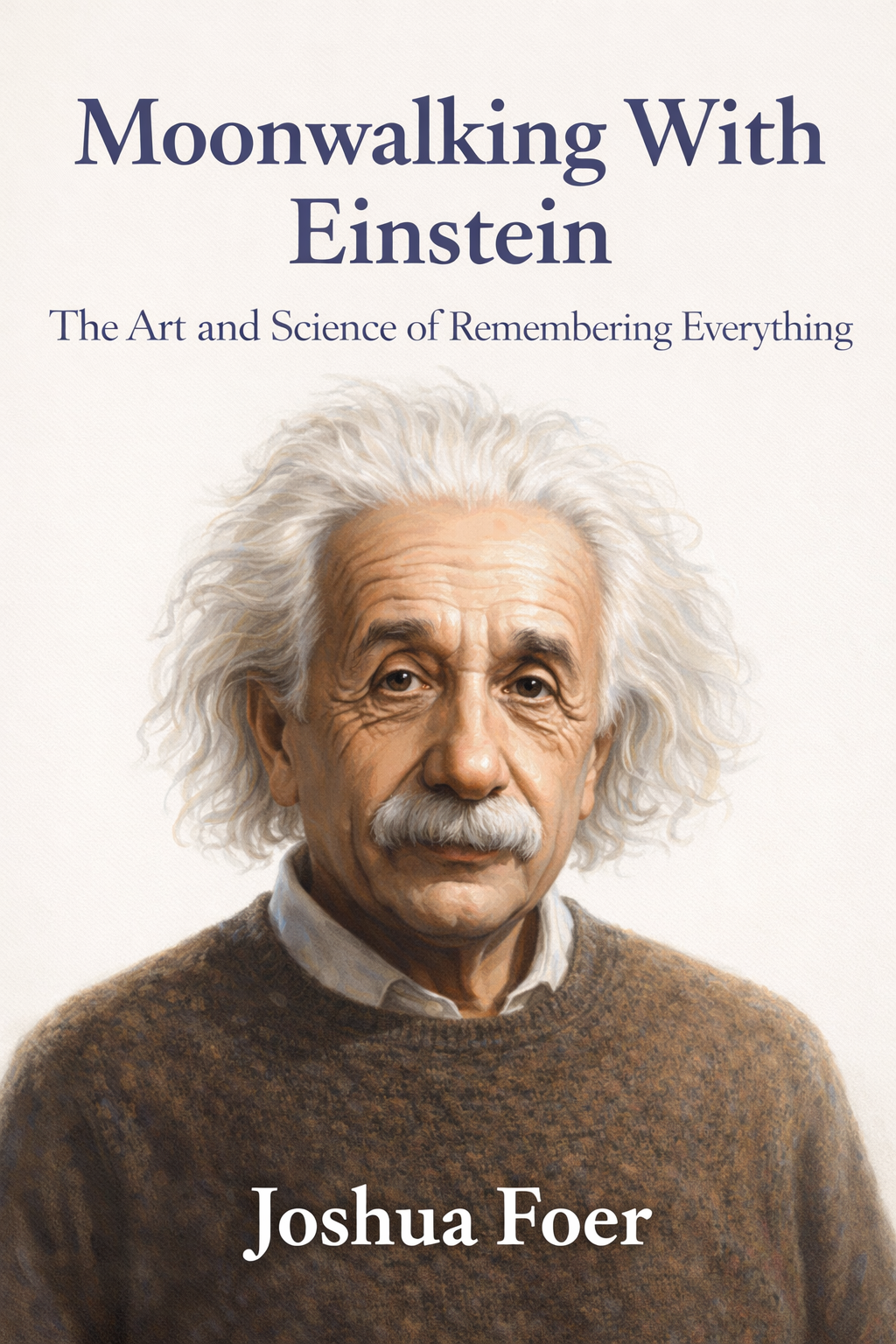
Moonwalking With Einstein: The Art and Science of Remembering Everything
Chapter Summaries
What's Here for You
Embark on an extraordinary intellectual adventure with Joshua Foer as he navigates the fascinating, and often surprising, landscape of human memory. 'Moonwalking With Einstein' is more than just a book; it's an invitation to unlock the hidden potential within your own mind. Have you ever marveled at the seemingly effortless recall of others, or felt frustrated by your own forgetfulness? Foer's journey, from a curious journalist to a competitor in the U.S. Memory Championship, reveals that exceptional memory isn't a rare gift, but a skill that can be cultivated. You'll discover the ingenious techniques employed by memory champions, including the legendary 'memory palace,' a mental construct that transforms abstract information into vivid, unforgettable imagery. But this exploration goes beyond mere memorization. Foer delves into the science behind memory, introducing us to individuals with astonishing recall and others who have lost theirs entirely, offering profound insights into how our brains work. He challenges the notion that modern technology has rendered memory obsolete, arguing instead for the enduring power of a well-honed mind. Prepare to be intellectually stimulated and emotionally engaged as you learn how to transform everyday moments into mnemonic exercises, enhance your ability to learn and retain information, and ultimately, gain a deeper understanding of yourself and the world around you. This book promises to leave you with a renewed appreciation for the art and science of remembering, empowering you with practical tools to navigate the information age with confidence and clarity. It's a journey that is as much about the joy of discovery as it is about the power of remembering.
THE SMARTEST MAN IS HARD TO FIND
The author, Joshua Foer, finds himself unexpectedly in the finals of the U.S. Memory Championship, a situation as bizarre as the vivid, almost hallucinatory mental images he used to construct memories, such as Dom DeLuise spitting on Albert Einstein. This unlikely journey began a year prior, sparked by a visit to the Weightlifting Hall of Fame and a question: who is the world's smartest person, as easily identifiable as the world's strongest? While the strongest were clear, the smartest proved elusive, a tangled web of high IQs and extraordinary calculative abilities. Yet, in this quest, Foer discovered Ben Pridmore, the reigning world memory champion, a man who could memorize vast quantities of digits and poems. This revelation struck a chord with Foer's own average, forgetful mind, plagued by lost keys and forgotten birthdays, contrasting sharply with Pridmore's seemingly effortless recall. The sheer amount of information in modern life, Foer muses, makes the squandering of days on forgotten details a profound inefficiency. He pondered what it would mean to have that lost knowledge at one's fingertips, imagining a more persuasive, confident, and fundamentally wiser self. This desire led him to observe the 2005 U.S. Memory Championship, a gathering of 'mental athletes' who, contrary to Foer's expectation of savants, insisted that their abilities were not innate genius but the result of learned techniques, particularly the ancient 'memory palace' method. Ed Cooke, a grand master, dispelled the myth of photographic memory, stating that all 'mental athletes' possess average memories, amplified by technique. This ancient art, once a cornerstone of classical and medieval education, had been relegated to the fringes, only to be revived by figures like Tony Buzan, who championed memory training as a 'global education revolution' and a way to counter the brain's 'anti-Olympic training' of modern life. Buzan's vision, though tinged with the hyperbole of self-help gurus, presented a compelling argument: the brain is a muscle, and memory is a skill to be trained, not a fixed quantity. Foer, initially skeptical of the hype, began to question the very nature of his own memory, realizing its inexplicable quirks and failures. The central tension emerged: are these memory champions exceptional individuals, or is their mastery accessible to all? The chapter concludes with Foer's burgeoning realization that the skills of these 'mental athletes' might indeed be learnable, setting the stage for his year-long exploration into training and understanding his own memory, a journey that would uncover the rich, forgotten history of mnemonic techniques and their profound impact on Western culture, revealing how the externalization of memory has reshaped our understanding of intelligence, and perhaps, what we've traded away in our pursuit of externalized knowledge. The memory championship itself, a quiet affair of scribbled answers and displayed scores, lacked public drama, yet held profound internal stakes for its participants, mirroring Foer's own internal struggle to grasp the mechanics of memory.
THE MAN WHO REMEMBERED TOO MUCH
Joshua Foer's "The Man Who Remembered Too Much" plunges us into the astonishing world of S, a journalist whose seemingly effortless recall baffled neuropsychologist A. R. Luria, leading to a thirty-year study and the classic "The Mind of a Mnemonist." Initially unaware his memory was extraordinary, S could recall seventy digits forward and backward, and seemingly retained information indefinitely, defying Hermann Ebbinghaus's curve of forgetting. This remarkable case, once considered unique, begins to reveal a profound truth: our own memories, often perceived as faulty, are far more powerful than we realize, particularly for visual information, as demonstrated by Ed Cooke's rapid-fire picture recognition test where participants excelled even with thousands of images. The chapter explores the long-held belief, championed by figures like Wilder Penfield and Elizabeth Loftus, that our brains are perfect recorders, a notion challenged by the understanding of memory decay at a cellular level, and the possibility that Penfield's eliciting of memories might have been more akin to vivid hallucinations. Foer then introduces the myth of the photographic memory, debunking it through the case of 'Elizabeth' and John Merritt's subsequent research, suggesting that the extraordinary feats of individuals like the Talmudic scholars are born of sheer perseverance, not innate perfect recall. The real key, Foer uncovers through S's synesthesia—where sounds, words, and numbers evoked vivid, multisensory imagery—is the power of transforming abstract information into concrete, spatialized mental constructs. This insight is amplified by the study of London cabbies, whose extensive spatial navigation physically enlarged their hippocampi, and by neuroscientist Eleanor Maguire's finding that elite memorizers, despite having structurally average brains, activate visual and spatial memory regions during learning, effectively teaching themselves to remember like S. This leads to the central tension: while S's memory was a powerful tool, it also crippled him, making him unemployable, a poignant echo of Jorge Luis Borges's Funes, the Memorious, who was paralyzed by an inability to forget, suggesting that perhaps forgetting is essential to human thought itself. The chapter resolves with the practical application of these principles: Ed Cooke's technique of creating vivid, often bizarre, visual associations for names and information, a method akin to manufactured synesthesia that leverages our innate spatial memory, demonstrating that while we may not be mnemonists by birth, the capacity to remember more, to actively engage our brains through visualization and spatial mapping, lies dormant within us all, waiting to be awakened through practice and intention.
THE EXPERT EXPERT
Joshua Foer's exploration into expertise begins with a surprising subject: the humble chicken sexer. It's a stark illustration of how specialized knowledge can become incredibly valuable, yet deeply mysterious. For decades, egg farmers struggled to differentiate male chicks from females until they were weeks old, a costly delay. The breakthrough came from Japanese scientists who discovered subtle, almost invisible cues in a day-old chick's cloaca. This seemingly arcane skill, honed over years of rigorous training at institutions like the Zen-Nippon Chick Sexing School, allowed graduates to earn fortunes, becoming highly sought-after consultants worldwide. The best sexers, performing their delicate work with Zen-like concentration and surgical precision, could identify gender in a fraction of a second, often unable to articulate *how* they knew. Their knowledge, they explained, was simply intuition. This enigma of inexplicable expertise is precisely what drew Foer into the scientific literature, seeking evidence for improvable memory. He found a guiding light in K. Anders Ericsson, whose research on 'Skilled Memory Theory' offered a scientific counterpoint to the idea that memory capacity is fixed. Ericsson’s seminal experiment with a student codenamed SF demonstrated that with dedicated practice—250 hours over two years—one could dramatically expand the ability to recall numbers, shattering previous notions of cognitive limits. This wasn't about innate talent; it was about a developed skill. The chapter then pivots to the broader implications of this research, highlighting that exceptional memory isn't confined to memorizing digits. Researchers have documented superior memories in diverse fields: London cabbies remembering intricate street maps, waiters recalling complex orders, actors mastering lines, and even elite athletes reconstructing game scenarios from brief glances. The core question arises: what is this 'something' that mastery breeds into memory, and can it be generalized? Foer’s visit to Ericsson’s Human Performance Lab reveals the meticulous study of experts. Through simulations, like testing SWAT officers' reactions to high-stress scenarios, researchers aim to dissect the cognitive underpinnings of expertise. The striking observation is that experienced officers, much like the chicken sexers, perceive the world differently. They notice what others miss, focusing on critical information and processing it with sophisticated, almost automatic, efficiency. This ability to overcome cognitive constraints, particularly George Miller's 'magical number seven'—our limited working memory capacity—is key. Experts don't just hold more information; they structure it. This is where the concept of 'chunking' becomes paramount. SF, the student memorizing numbers, discovered this himself, transforming abstract digits into meaningful running times, leveraging his existing knowledge of running to create larger, more memorable units. The principle holds true across domains: chess grandmasters don't just see individual pieces; they perceive patterns and systems, 'chunks' of information built from thousands of hours of experience. A board of randomly arranged pieces, devoid of context, becomes unmemorable, even to a master, because it cannot be chunked. This reveals a profound truth: we remember in context, and our existing knowledge acts as the scaffolding for new learning. Expertise, then, is not just about raw intelligence, but about a vast, pattern-based retrieval system, honed by experience, that allows experts to interpret the present through the lens of the past. It’s a continuous feedback loop where perception and memory are inextricably linked, shaping not only how we see the world but the very actions we take within it. Foer's own baseline tests reveal an average digit span but abysmal poetry recall, setting the stage for his own journey into memory improvement, a journey that begins by understanding that true mastery, whether of chicken sexing or chess, is built on the foundation of how we learn to remember.
THE MOST FORGETFUL MAN IN THE WORLD
Joshua Foer, in his exploration of memory's frontiers, turns his gaze from the exceptional recall of memory champions to the profound absence of memory in EP, an eighty-four-year-old retired lab technician whose condition represents one of the most severe cases of amnesia ever documented. We journey with neuroscientist Larry Squire and research coordinator Jen Frascino to EP's home, a place where familiarity is a foreign concept; each visit, EP greets Frascino as a stranger, a poignant illustration of his anterograde and retrograde amnesia, a cruel precision of a herpes simplex virus that ravaged his medial temporal lobes, destroying his hippocampus, the brain's crucial memory-making machinery. Despite an intact IQ of 103 and unimpaired short-term memory, EP cannot form new long-term memories, nor recall much beyond 1950, living in an eternal present, a state that, while devoid of the stress of worry, also strips away the narrative thread of a cohesive self. This devastating condition, akin to that of Clive Wearing, highlights how memory is not merely an archive of facts but the very scaffolding of our subjective experience of time, a concept further illuminated by the author's encounter with Ed Cooke, who sought to slow life's passage by creating more memories, and by the extreme isolation experiment of Michel Siffre, where monotony collapsed time into an indistinguishable blob. The chapter delves into the science of memory, contrasting declarative memories, which EP and HM, another famous amnesiac, have lost, with nondeclarative memories—skills and unconscious learning that persist, demonstrating that a person is more than their conscious recall. The distinction between episodic memories, anchored in time and space, and semantic memories, free-floating knowledge, further refines our understanding of what is lost. The phenomenon of Ribot's Law, where recent memories fade first, suggests that memories are not static recordings but are continually reconstructed, becoming more stable yet also more transformed with each retrieval. Foer poses the profound question: are memories truly obliterated or merely inaccessible, a puzzle deepened by the role of sleep and dreams in memory consolidation. Ultimately, EP's existence, though hollowed out by memory loss, still contains a personhood, a charming personality shaped by implicit values and habits, a testament to the enduring self, even when adrift in an eternal present, a stark reminder that without memory, our experience of time, our sense of self, and our very humanity are profoundly altered, leaving us to ponder whether an unremembered life can be truly said to have happened at all.
THE MEMORY PALACE
In the biting wind of Central Park, Joshua Foer encounters Ed Cooke, a master mnemonist, who begins to demystify the art of remembering. Cooke reveals that our memories, shaped by the demands of hunter-gatherer ancestors, are not inherently suited for the information overload of the modern age; they excel at spatial and visual recall, not abstract data. The core principle of memory techniques, he explains, is elaborative encoding: transforming forgettable information into vivid, unusual, and engaging images. This ancient practice, known as the method of loci or the memory palace, traces its roots to the poet Simonides of Ceos, who discovered that spatial memory could be leveraged to recall lists and sequences. The anonymous author of the *Rhetorica ad Herennium*, a foundational text on rhetoric, detailed this method, distinguishing between natural memory and the *artificial memory* built through disciplined practice using *images* and *places*. Cooke guides Foer through his childhood home, transforming a mundane to-do list into a series of bizarre, multisensory images—pickled garlic at the driveway's foot, Claudia Schiffer in a tub of cottage cheese at the front door, peatsmoked salmon on a piano—demonstrating how the brain’s innate ability to learn spaces can be harnessed to store abstract information. The effectiveness lies in the vividness, emotional charge, and sheer novelty of these mental constructs; the more outlandish, the more memorable. This technique, far from being a mere trick, is presented as a creative act, a way to imbue otherwise forgettable data with life, making recall as intuitive as walking through a familiar house. The tension between our evolutionary memory and contemporary needs is resolved by understanding and applying these time-tested, creative mnemonic strategies, turning the abstract into the unforgettable.
HOW TO MEMORIZE A POEM
The author, Joshua Foer, embarks on a quest to master the art of memory, beginning with the foundational practice of building 'memory palaces' – mental constructs of familiar places imbued with vivid imagery. His initial attempts to memorize to-do lists using these palaces, while successful, prove exhausting and reveal a deeper yearning for the art's more profound applications. He turns to poetry, inspired by historical figures like Simonides and his mentor Ed, who champions memory training not just for information recall but for character development and becoming a more complete person. Foer grapples with the abstract nature of poetry, finding it far more challenging than concrete tasks, as nonsense words and complex lines resist simple visualization. This struggle highlights a central tension: the difficulty of translating the 'memory for words' (memoria verborum) into the more robust 'memory for things' (memoria rerum) that our brains naturally favor. He discovers that ancient texts emphasize the value of memorization precisely because it is hard, a rigorous discipline that shapes judgment and piety. This leads him to the World Memory Championship in Oxford, a vibrant subculture where mental athletes like Ed, Ben Pridmore, and Gunther Karsten push the boundaries of mnemonic skill. Here, the ancient art of memory is celebrated, albeit in a modern, competitive context. The poetry event, universally dreaded, becomes a focal point, revealing different strategies: men often employ a methodical, word-for-word approach, assigning images to every syllable, while women, like Corinna Draschl, find success by connecting with the emotional resonance of the text. Foer observes that while our modern, text-saturated world relies less on internal recall, the principles of oral traditions—rhythm, rhyme, and vivid imagery—remain the bedrock of effective memorization. The chapter concludes with a poignant reflection on how, in an age of externalized memory aids, the internal art of remembering has become marginalized, celebrated only in these peculiar competitions, prompting a question about our collective forgetting of how to truly remember.
THE END OF REMEMBERING
Once, memory was the sole vessel for preserving thought, a vital necessity in a world without alphabets or paper. Today, our lives are interwoven with technological crutches – from GPS devices to digital recorders – that have supplanted our natural capacity to remember. Joshua Foer, in 'The End of Remembering,' traces this profound shift, beginning with the ancient Greek philosopher Socrates' prescient warning that writing would implant forgetfulness, offering a mere semblance of wisdom rather than true knowledge. He illustrates how early books, far from being replacements for memory, served as memory aids, their cumbersome scroll format and lack of punctuation demanding recitation and internalization. The evolution of the codex, the invention of indexes, and the rise of page numbers gradually transformed books into consultable resources, diminishing the imperative to memorize. This shift, Foer explains, changed the very definition of erudition from possessing knowledge internally to knowing where to find it externally, a transition mirrored in the modern era's deluge of easily accessible digital information. He delves into the Renaissance's 'art of memory,' a mystical pursuit exemplified by Giulio Camillo's 'Theater of Memory' and Giordano Bruno's complex mnemonic devices, highlighting a period where memory techniques were both esoteric and highly prized. This historical arc leads us to the present, where technology has accelerated the externalization of memory to an extreme, exemplified by Gordon Bell's 'lifelogging' – a constant, digital archiving of one's life. Bell's project, capturing every sight and sound, represents the logical, perhaps final, step in a millennia-long journey of offloading memory, raising profound questions about the future of human cognition and the very nature of selfhood when our internal and external memories begin to blur, potentially connecting directly to the vast collective memory of the internet. The tension lies in this accelerating reliance on external aids, from ancient writing to modern AI, prompting a reflection on what we gain in accessibility and what we might lose in the depth and essence of our own remembered lives.
THE OK PLATEAU
Joshua Foer, embarking on his journey toward the U.S. Memory Championship, found himself transforming everyday moments into rigorous mnemonic exercises, a shift from mundane procrastination to a dedicated pursuit of memory enhancement. He discovered techniques like the Major System, a simple number-to-sound code, and the more sophisticated Person-Action-Object (PAO) system, where two-digit numbers are encoded as unique images. This PAO system, a descendant of ancient mnemonic traditions, allows for the creation of vivid, often bizarre, images for vast sequences of numbers, a cornerstone for mental athletes. The narrative then delves into the intense, almost arms-race-like, innovation within the competitive memory circuit, exemplified by Ed Cooke's development of a three-digit PAO system, a 'mnemonic behemoth' designed to encode numbers up to 999,999,999. This pursuit of ever more elaborate techniques highlights a core tension: how to break through performance plateaus. Foer's own progress stalled, leading him to consult with Anders Ericsson, the renowned expert on skill acquisition. Ericsson introduced the concept of the 'OK Plateau,' a point where individuals, having reached a satisfactory level of competence, cease conscious effort and enter an 'autonomous stage,' halting improvement. This plateau, once thought to be an innate limit, is reframed by Ericsson as a self-imposed ceiling, a psychological barrier rather than a biological one. The path beyond this plateau, Ericsson explains, lies in 'deliberate practice'—a focused, goal-oriented approach involving conscious effort, constant feedback, and a willingness to push beyond comfort zones. This involves actively seeking out challenges, much like how top musicians practice tedious exercises or skaters attempt difficult jumps they might not land. Foer’s own experience with deliberate practice, guided by Ed, involved pushing his card memorization speed with a metronome, meticulously analyzing his data, and refining his PAO images. The story culminates in a vivid scene at Ed Cooke's birthday party, a 'maximally memorable' event designed as a memory palace itself, featuring a dramatic card-memorization showdown between Ben Pridmore and Ed Cooke. This event, while entertaining, underscores the intense dedication and psychological fortitude required in this unique sport. Ultimately, Foer learns that true mastery isn't about innate talent but about the disciplined, relentless pursuit of improvement, pushing past the 'OK Plateau' by embracing difficulty and continuous self-analysis, transforming memory not as a fixed attribute but as a skill to be honed with scientific rigor and creative application.
THE TALENTED TENTH
The author, Joshua Foer, recounts his intense focus on competitors, particularly Maurice Stoll, a formidable German memory athlete, revealing a growing unease about the practical utility of such intense mnemonic training. He questions if these ancient techniques are merely "intellectual fossils," citing historical resistance from figures like Francis Bacon and Matteo Ricci, who deemed memory arts impressive but ultimately barren. This skepticism is juxtaposed with the inspiring work of Raemon Matthews, an American history teacher at Samuel Gompers Vocational High School in the Bronx. Matthews trains a group of students, whom he calls the "Talented Tenth," using memory techniques not for competition, but as a vital tool for academic success and social mobility. He believes these skills are a "ticket out of a neighborhood" plagued by poverty and low educational attainment, emphasizing that memorizing quotes and facts provides a foundation for deeper learning and critical thinking. Foer witnesses firsthand how Matthews transforms abstract historical concepts into vivid, memorable images for his students, a stark contrast to the author's own education, which largely shunned memorization in favor of experiential learning, a trend influenced by philosophers like Jean-Jacques Rousseau and educators like John Dewey. This shift away from rote learning, however, began to be questioned by researchers like William James and Edward Thorndike, who found little evidence for the broad transferability of mental discipline. The narrative then pivots to the charismatic Tony Buzan, a proponent of memory enhancement and creator of Mind Mapping, who champions a global educational revolution, albeit one built on a commercial empire. While Buzan’s pronouncements can veer into hyperbole, his core message resonates with Matthews: the importance of memory as a skill, not a burden. Buzan’s Mind Mapping, though perhaps overhyped, offers a visually engaging method for organizing information, requiring a mindfulness that standard note-taking often lacks. Matthews’ students, armed with intricate Mind Maps of their entire history textbook, demonstrate the power of these techniques, turning complex historical causation into accessible mental imagery, like Lenin on the toilet or a machine gun in running shoes. The chapter concludes by revisiting the central tension: while progressive education rightly moved away from dehumanizing rote memorization, it may have inadvertently stripped students of foundational knowledge. Foer posits that knowledge itself acts as a web, with each new fact caught and retained, growing the web and enhancing the ability to learn more. Ultimately, the author suggests that memory and intelligence are intertwined, a feedback loop where a well-furnished memory facilitates deeper understanding and greater cognitive capacity, underscoring that while facts alone don't guarantee understanding, understanding is impossible without them.
THE LITTLE RAIN MAN IN ALL OF US
Joshua Foer, in "The Little Rain Man in All of Us," delves into the surprising landscape of memory, moving from his own burgeoning skills as a mental athlete to the extraordinary abilities of savants, revealing a profound tension between learned techniques and innate gifts. As February approached, Foer’s practice scores for the U.S. Memory Championship were climbing, even surpassing a one-minute-and-fifty-five-second memorization of a deck of cards, a pace that hinted at a potential win, transforming his journalistic exercise into an obsession. Yet, the established wisdom from experts like Ed, Tony Buzan, and Anders Ericsson suggested that such feats required arduous, tedious training, with no one born with an inborn ability for lightning-fast recall. This notion was challenged by the existence of rare savants, individuals whose exceptional memories, often termed 'memory without reckoning,' coexisted with profound disabilities. Foer introduces Daniel Tammet, a twenty-six-year-old British savant with an extraordinary mind, altered by an epileptic seizure in childhood. Tammet possessed a remarkable capacity for complex mental calculations, an encyclopedic knowledge of numbers (identifying primes up to ten thousand), and was a hyperpolyglot, learning Icelandic in a week and inventing his own language. Scientists like V.S. Ramachandran and Simon Baron-Cohen marveled at Tammet, with some calling him a 'one-of-a-kind phenomenon' and a potential 'linchpin for a new field of research.' Tammet’s abilities, including reciting over 22,000 digits of pi from memory, seemed to arise effortlessly, a stark contrast to Foer’s own laborious construction of memory palaces. This ignited a central question: how did Tammet’s brain differ, and could his seemingly innate powers offer an advantage? Meeting Tammet, Foer found not a freak, but a gentle, soft-spoken man who, despite a difficult childhood marked by undiagnosed Asperger's syndrome, had worked hard to appear 'normal.' Tammet explained his synesthesia, where numbers possess distinct shapes, colors, and emotional tones, enabling intuitive mental math – a stark difference from the learned mnemonic techniques Foer was employing. However, Foer uncovered a twist: Tammet had previously competed under the name Daniel Corney, even criticizing the memory sport he now seemed to be masking his participation in. This revelation blurred the lines, suggesting that Tammet’s 'natural gifts' might, in fact, be the product of methodical training, a possibility that unsettled the established narrative of savantism. The chapter then pivots to Kim Peek, the inspiration for 'Rain Man,' a prodigious savant with arguably the best memory in the world, who reads at an astonishing pace and retains vast amounts of information, yet possesses an IQ of 87 and struggles with social appropriateness. Peek’s brain shows a missing corpus callosum and a distended cerebellum, a neuroanatomical anomaly that scientists are still trying to understand. While Foer attempted to match Peek’s memory recall of phone books, he struggled, while Peek simply stated, 'I just remember.' This encounter, along with the scientific theory that damage to the left brain might liberate latent right-brain abilities, including the case of Orlando Serrell who gained calendar-calculating skills after a head injury, and patients with frontotemporal dementia developing artistic skills, leads to a compelling insight: the potential for savant-like abilities might lie dormant within us all, perhaps suppressed by the dominant left hemisphere. The chapter concludes with Foer confronting Daniel Tammet about his past as a memory competitor and his advertised 'Mindpower formula' courses, which directly contradicted his savant narrative. Tammet admitted to selling the courses out of financial desperation, using mnemonic techniques inspired by Tony Buzan, though he maintained his core abilities were genuine. Despite scientific tests showing inconsistencies in his synesthetic descriptions and an fMRI scan not revealing typical synesthetic brain activity, scientists like Simon Baron-Cohen still found him to be a genuine synesthete. Ultimately, Foer grapples with the definition of savantism, questioning whether Tammet, if he is a trained mnemonist, is less incredible or more so than someone like Kim Peek. The chapter resolves with the idea that perhaps the most inspiring notion isn't the existence of innate savants, but the realization that remarkable capacities might lie dormant within everyone, waiting to be awakened, challenging the perceived gulf between the ordinary and the extraordinary.
THE U.S. MEMORY CHAMPIONSHIP
The narrative plunges into the high-stakes tension of the 2006 U.S. Memory Championship, introducing a new, television-friendly event: 'Three Strikes and You're Out of the Tea Party,' designed to test competitors on memorizing personal details of strangers, a task mirroring real-life demands. Joshua Foer, guided by Ed Cooke, crafts elaborate memory palaces for this event, each a unique architectural style, a testament to the intricate systems required for peak mental performance. As the championship nears, the pressure mounts, amplified by Ed's unexpected departure for Australia, leaving Foer to confront his anxieties and formidable rivals like Ram Kolli and Maurice Stoll. The chapter vividly portrays the mental athletes' pre-competition rituals, from 'spring cleaning' memory palaces to the profound isolation some seek, highlighting the psychological warfare and intense focus involved. Foer's own struggles with insomnia and self-doubt, symbolized by a bizarre dream and accidental double shampooing, underscore the human vulnerability beneath the mental prowess. The competition unfolds with classic memory events: 'Names and Faces,' where a young swimmer, Erin Hope Luley, sets a new record, and 'Speed Numbers,' a challenge for Foer, where Maurice Stoll also establishes a new U.S. record. The 'Speed Cards' event becomes a turning point, with Foer leveraging his advanced PAO system, developed with Ed, to shatter the existing U.S. record, a moment of triumph tinged with the realization of his progress. The narrative then shifts to the television-friendly finals, featuring 'Random Words' and the pivotal 'Tea Party' event. Here, Foer navigates the pressures, making strategic choices, like accepting a strike to avoid a potential memory lapse, demonstrating a nuanced approach to competition. Ultimately, through a grueling 'Double Deckr Bust' card memorization showdown against Ram Kolli, Foer secures victory, not with immediate elation, but with profound exhaustion, revealing the deep personal cost of such intense mental exertion and the quiet, internal world of a memory champion.
Conclusion
Joshua Foer's "Moonwalking With Einstein" offers a profound exploration into the human capacity for memory, revealing it not as an immutable trait but as a cultivated art. The core takeaway is that extraordinary memory is not the exclusive domain of geniuses but a skill accessible through ancient techniques like the memory palace and modern methods like chunking. Foer masterfully illustrates how our modern reliance on external aids has potentially atrophied our internal memory, leading to a shallower engagement with knowledge and ourselves. The emotional lesson lies in the discovery of untapped potential; by actively engaging with information, transforming abstract data into vivid, spatialized experiences, we can overcome perceived limitations and foster a deeper sense of self-efficacy. The book champions memory training not just for recall, but as a form of mental exercise that sharpens cognitive function, enhances creativity, and can even lead to wisdom. It challenges the notion of inevitable age-related memory decline, suggesting it's more a consequence of disuse than biology. Practically, Foer provides a compelling argument for the utility of mnemonic techniques, demonstrating their power to improve learning, foster expertise, and even offer a unique form of emotional resolution through intense focus. The journey from a curious journalist to a memory championship competitor underscores the transformative power of deliberate practice, pushing past 'OK Plateaus' and embracing difficulty. Ultimately, "Moonwalking With Einstein" is a celebration of the mind's potential, an invitation to reclaim our internal cognitive resources, and a reminder that our memories are not passive recordings but the very architects of our subjective experience and identity.
Key Takeaways
Extraordinary memory abilities are not necessarily innate genius but can be cultivated through learned techniques, challenging the notion of fixed mental capacity.
The ancient art of memory, particularly the 'memory palace' technique, offers a powerful, accessible method for enhancing recall and understanding information.
Modern culture's over-reliance on external memory aids has led to a devaluing of internal memory skills, potentially impacting our cognitive abilities and sense of intelligence.
Memory training is presented not just as a skill for recalling facts, but as a form of mental exercise that can improve cognitive function and potentially foster wisdom.
The perceived decline in memory with age may be a result of disuse and poor cognitive habits ('anti-Olympic training') rather than an inevitable biological process.
Understanding the mechanics and potential of one's own memory is crucial for personal growth, effective learning, and a deeper connection with knowledge and self.
Our capacity for visual and spatial memory is vastly underestimated, serving as a powerful, often untapped, resource for learning and recall.
Extraordinary memory is not a passive recording but an active, often trained, construction, transforming abstract data into vivid, spatialized mental experiences.
The ability to "forget" is as crucial as the ability to remember, allowing us to filter information, generalize, and make sense of the world.
Synesthesia, or the involuntary linking of sensory experiences, offers a glimpse into how intense sensory association can profoundly enhance memory.
Practiced techniques, such as creating vivid visual metaphors and mapping information onto familiar spatial journeys, can consciously train the brain to remember more effectively.
The perceived limitations of our memory are often a result of passive reception rather than active engagement with information.
True expertise, even in seemingly simple tasks like chicken sexing, often involves a deep, intuitive understanding that is difficult for the expert to articulate, suggesting that knowledge can transcend conscious reasoning.
Memory capacity is not a fixed biological limit but a skill that can be dramatically improved through dedicated practice and strategic techniques like chunking, as demonstrated by K. Anders Ericsson's research.
Chunking, the process of reinterpreting small bits of information into larger, meaningful units by leveraging existing knowledge, is fundamental to overcoming working memory limitations and is a core mechanism of expertise across diverse fields.
Experts perceive the world differently because their accumulated experience allows them to recognize patterns and relevant information that novices overlook, enabling faster, more accurate decision-making.
Memory operates not as a passive storage bank but as an active, contextual system where past experiences shape current perceptions and actions, creating a continuous feedback loop that defines our understanding and behavior.
The ability to recall vast amounts of domain-specific information, like chess positions or chicken vent configurations, is not a general cognitive advantage but a result of specialized pattern recognition built through extensive experience.
Memory is the fundamental architect of our subjective experience of time; its absence collapses time into an undifferentiated present, altering our perception of life's duration.
While declarative memory is crucial for narrative and conscious recall, nondeclarative memory (skills, habits, implicit learning) allows for continued functioning and personality expression even in the absence of conscious recollection.
Our memories are not static recordings but are continuously reconstructed and integrated, transforming over time and through retrieval, making older memories potentially more stable but also more altered than recent ones.
The loss of episodic memory, which anchors experiences in time and space, severs the continuity of self, preventing the formation of a cohesive personal narrative and impacting emotional depth and relational capacity.
The human experience is intrinsically linked to memory, raising philosophical questions about the nature of existence and the meaning of events that are not remembered.
Even in profound amnesia, residual personality and implicit learning persist, suggesting that personhood is a complex construct influenced by more than just conscious memory.
Human memory evolved for survival in a Pleistocene environment, making it naturally adept at remembering spatial information and visual imagery, but less so for abstract data common today.
The core of memory enhancement lies in elaborative encoding, transforming unmemorable information into vivid, unusual, and multisensory mental images that leverage our innate spatial memory.
The 'memory palace' or method of loci, an ancient technique, utilizes familiar spatial environments to structure and recall information by placing vivid images sequentially along a mental journey.
The effectiveness of mnemonic images is directly proportional to their novelty, emotional impact, and bizarreness, as these qualities capture attention and create more durable neural connections.
Artificial memory, built through disciplined practice, complements natural memory by providing a system (images and places) to store and retrieve information efficiently, akin to installing specialized software.
Mastering mnemonic techniques requires a creative act of 'painting' memorable scenes in the mind, turning the process of memorization into an engaging, even artistic, endeavor.
Memorizing abstract concepts like poetry requires a deliberate, often arduous, transformation of words into tangible images, challenging the brain's natural inclination towards concrete recall.
The true value of memory training lies not merely in storing information but in its power to cultivate character, judgment, and a more profound understanding of oneself and the world.
Ancient oral traditions reveal that effective memorization relies on structured, rhythmic, and visually evocative techniques, principles that remain fundamental to cognitive recall.
The difficulty of memorizing texts is not a deterrent but the very essence of its value, as struggle forges deeper understanding and personal growth.
While modern society relies heavily on external memory aids, the internal art of remembering, once central to cultural transmission, is now largely confined to niche competitive arenas.
The development of external memory technologies, from writing to digital archives, has fundamentally altered human cognition, shifting the emphasis from internal recall to external retrieval.
Ancient texts, unlike modern ones, served as memory aids rather than replacements, demanding deep engagement and internalization due to their format and lack of navigational tools.
The evolution of the book itself, with innovations like pagination and indexing, mirrored the shift in how knowledge was accessed, moving from exhaustive memorization to selective consultation.
The pursuit of memory enhancement has a long history, evolving from ancient rhetorical techniques to Renaissance mystical arts and modern 'get smart quick' schemes, reflecting an enduring human desire to overcome forgetfulness.
Modern 'lifelogging' represents an extreme externalization of memory, raising questions about the definition of self and the future integration of human brains with vast digital repositories.
Our reliance on external memory tools may create a superficial understanding of knowledge, trading the depth of internal recall for the breadth of easily accessible information.
Performance plateaus, often perceived as innate limits, are frequently self-imposed psychological barriers ('OK Plateaus') that can be overcome with deliberate practice.
Deliberate practice, characterized by focused attention, goal-orientation, immediate feedback, and pushing beyond comfort zones, is the key to breaking through performance plateaus and achieving expertise.
The development of advanced mnemonic techniques, like the PAO system, requires significant upfront investment but offers profound gains in memory capacity, illustrating innovation driven by competitive pressure.
The 'autonomous stage' of skill acquisition, where tasks become unconscious, leads to stagnation; conscious control and active analysis of performance are necessary to remain in a learning state.
Memory is not a singular, monolithic capacity but a collection of independent systems that can be trained and improved through specialized techniques and rigorous, data-driven practice.
Embracing difficulty and discomfort, rather than avoiding it, is essential for growth, as pushing against limitations reveals obstacles and fosters resilience.
The perceived "uselessness" of memory techniques is challenged by educators who use them as tools for academic achievement and social uplift, demonstrating their practical utility beyond mere competition.
While progressive education rightly rejected rote memorization as dehumanizing, it may have inadvertently minimized the foundational role of factual knowledge in building deeper understanding and cognitive capacity.
Intelligence and memory are deeply intertwined in a feedback loop: a well-organized memory provides the scaffolding for acquiring more knowledge, which in turn enhances the ability to process the world and learn further.
Effective memory techniques, like those employed by Raemon Matthews and promoted by Tony Buzan, transform abstract information into vivid, image-based associations, making knowledge more accessible and retrievable.
The ability to recall and connect disparate pieces of information, facilitated by a strong memory, is crucial for invention, creativity, and the development of new ideas, linking memory directly to innovation.
Despite critiques of decontextualized knowledge, the ability to store and retrieve basic facts serves as essential 'signposts' that guide lifelong learning and enable deeper comprehension of complex subjects.
The distinction between learned memory techniques and seemingly innate savant abilities raises questions about the nature of exceptional talent.
Savant syndrome, characterized by extraordinary skills coexisting with disabilities, suggests that profound cognitive abilities may exist independently of typical intellectual functioning.
The potential for savant-like capacities might be latent within the general population, possibly unlocked by altered brain function or focused training that bypasses conscious processing.
The narrative of savantism can be complex, with individuals sometimes leveraging public perception of innate genius to mask rigorous, learned skill development.
The human brain possesses remarkable, often untapped, capacities that can be accessed through dedicated effort or unusual neurological circumstances.
The definition of 'savant' is fluid and subject to interpretation, highlighting the need to distinguish between natural endowment and cultivated expertise.
Developing sophisticated memory techniques, like the PAO system and memory palaces, requires dedicated, personalized construction and practice to achieve peak performance in memory competitions.
The psychological landscape of high-stakes competition involves managing self-doubt, external pressures, and rivalries, often demanding mental resilience beyond rote memorization.
Strategic decision-making in memory contests extends beyond raw memorization capacity to include risk assessment, choosing battles, and understanding the unique demands of televised events.
The pursuit of mastery in memory arts necessitates rigorous training, but also crucial periods of rest and mental 'cleaning' to ensure optimal recall and prevent interference.
Success in memory championships is a blend of innate talent, advanced technique, strategic acumen, and the ability to perform under immense psychological pressure, often overcoming personal anxieties.
The intense focus required for memory feats can create a profound internal experience, where the memorized world momentarily feels more real than the physical stage, leading to a unique form of emotional resolution.
The evolution of memory sports, particularly with television integration, introduces new challenges and strategies, blending traditional mnemonic techniques with performance art.
Action Plan
Explore the 'memory palace' (method of loci) technique to create mental frameworks for memorization.
Begin a daily practice of memory training, even if for short durations, to 'exercise' the brain.
Actively question and observe your own memory's quirks and failures to understand its mechanics.
Seek out resources on mnemonic techniques to learn practical methods for information recall.
Consider the balance between relying on external memory aids and cultivating internal memory skills.
Engage in activities that challenge your cognitive abilities, viewing them as a form of mental workout.
Reflect on how the 'externalization of memory' in modern society might be influencing your own cognitive habits.
When learning new information, consciously try to create a vivid, unusual, or even bizarre visual image associated with it.
Practice mentally 'walking' through a familiar place, placing images representing pieces of information at specific locations along the route.
For names, create a memorable visual association that links the sound of the name to a characteristic of the person or a related concept.
Engage in activities that require spatial navigation, such as exploring new routes or playing memory games involving maps, to strengthen related brain regions.
Recognize that memory is not just about storage but active construction; experiment with different mnemonic techniques to find what works best for you.
Embrace the idea that forgetting can be a skill; consciously decide what information is less important to retain to make room for what is.
Seek out opportunities to test your memory in low-stakes situations, like recalling details from a conversation or a brief lecture, to build confidence.
Identify a skill you wish to master and research its core patterns and information structures.
Practice 'chunking' by breaking down complex information into smaller, meaningful units, linking them to what you already know.
Actively seek out experiences and deliberate practice in your chosen domain to build a rich bank of contextual knowledge.
Pay close attention to how experts in a field perceive and react, noting the subtle cues and patterns they seem to recognize instinctively.
Challenge your own perceived memory limits by engaging in memory-testing exercises, focusing on consistent, deliberate practice.
Reframe seemingly meaningless data by looking for connections and associations with existing knowledge, turning noise into signal.
Recognize that expertise is built through sustained effort and pattern recognition, not solely through innate intelligence.
Actively seek out novel experiences, however small, to create more distinct chronological landmarks in your life.
Engage in activities that promote mindfulness and present moment awareness to better anchor your experiences.
Reflect on the narrative of your own life, consciously connecting past events to your present identity.
Practice recalling details from recent events to strengthen the consolidation of declarative memories.
Appreciate the implicit learning that occurs daily, recognizing that memory operates on multiple, often unconscious, levels.
Consider how routines can both anchor and, if unchecked, blur the passage of time, and intentionally vary them.
When recalling memories, be aware that they are reconstructions, not perfect recordings, and may evolve over time.
Identify a familiar location (like your home) to serve as your first 'memory palace'.
Choose a short list of items or facts you wish to memorize.
For each item, create a vivid, unusual, and multisensory mental image.
Mentally place each image in a distinct location along a predetermined route within your chosen memory palace.
When recalling the list, mentally walk through your memory palace, 'seeing' the images and translating them back into the original information.
Practice revisiting your memory palace periodically to reinforce the memories.
When creating images, incorporate elements of humor, exaggeration, or the bizarre to enhance memorability.
Engage as many senses as possible when visualizing each image (sight, sound, smell, taste, touch).
Identify a familiar place (your home, a frequent route) and mentally map its distinct features to serve as a 'memory palace'.
Practice transforming abstract words or concepts from a poem into vivid, unusual, and even absurd visual images.
Experiment with associating emotions with specific lines or stanzas of a poem to enhance recall, similar to Method acting.
Seek out and read aloud poetry that employs strong rhythm, rhyme, and recurring imagery.
Explore the historical context of oral traditions and how they utilized mnemonic principles for cultural transmission.
Engage in deliberate practice, even for short periods daily, to build the mental stamina required for complex memorization tasks.
Consider the 'why' behind memorization: reflect on how deeply understanding and internalizing texts can shape personal values and perspectives.
Reflect on which personal memories have been outsourced to technology and consider consciously retaining a few key pieces of information.
When reading, pause periodically to actively recall and summarize what has been read, rather than simply skimming.
Explore historical methods of memory enhancement, such as the loci method, to understand how internal memory can be actively trained.
Consider the 'why' behind your need to access information: is it for superficial recall or for deeper understanding and integration?
Be mindful of the potential for 'information barbs' to become a crutch; practice retrieving information from internal memory first, if possible.
Evaluate your own digital footprint and consider the implications of externalizing so much of your life's data.
Identify a skill you've plateaued in and consciously push beyond your comfort zone by increasing the difficulty or speed of practice.
Seek immediate and specific feedback on your performance, analyzing mistakes to understand their root cause.
Break down complex skills into smaller components and focus deliberate practice on the most challenging elements.
Adopt a scientific approach to your learning by tracking your practice sessions, recording data, and analyzing results.
Actively seek out mentors or models who excel in your area of interest and study their methods and thinking processes.
Reframe challenges and failures not as endpoints, but as opportunities for analysis and improvement, embracing the 'hurt' of learning.
Develop personalized mnemonic systems or mental models to encode and retrieve information more effectively.
Explore and experiment with memory techniques, such as creating vivid images or Mind Maps, to encode important information.
Re-evaluate your own educational experiences and consider how memorization might have been unfairly dismissed or could be reintegrated as a valuable skill.
Seek out resources that explain the science behind memory and cognitive function to better understand how your brain learns.
Practice transforming abstract concepts into concrete visual metaphors, as demonstrated by Raemon Matthews, to enhance retention and understanding.
Actively work to build a strong foundation of factual knowledge in areas of interest, recognizing that this knowledge base will facilitate future learning.
Consciously engage with new information by trying to connect it to what you already know, thereby strengthening your mental 'web'.
Explore personal learning styles to identify potential dormant cognitive abilities.
Research mnemonic techniques and practice them consistently to strengthen memory recall.
Observe personal experiences of 'effortless' understanding or intuition, and investigate their underlying mechanisms.
Engage with scientific literature or documentaries on brain function, synesthesia, and savant syndrome to deepen understanding.
Consider the potential for developing skills through rigorous training, rather than solely relying on perceived natural talent.
Reflect on the definitions of 'genius' and 'savant,' distinguishing between innate gifts and cultivated expertise in personal and societal contexts.
Construct personalized memory palaces, experimenting with different architectural styles to find what best suits your mnemonic needs.
Practice 'spring cleaning' your memory palaces regularly to clear out old associations and prepare for new memorization tasks.
Develop and refine mnemonic techniques, such as the PAO system or linking images, to encode information more efficiently.
Identify and mitigate personal performance anxieties, such as insomnia or self-doubt, before significant mental challenges.
Analyze competition rules and adapt your memorization strategy to maximize performance within those specific constraints.
Embrace the process of memorization, focusing on the vividness and enjoyment of the imagery rather than solely on the outcome.
Seek opportunities to apply memorization techniques in everyday life to strengthen recall and cognitive flexibility.