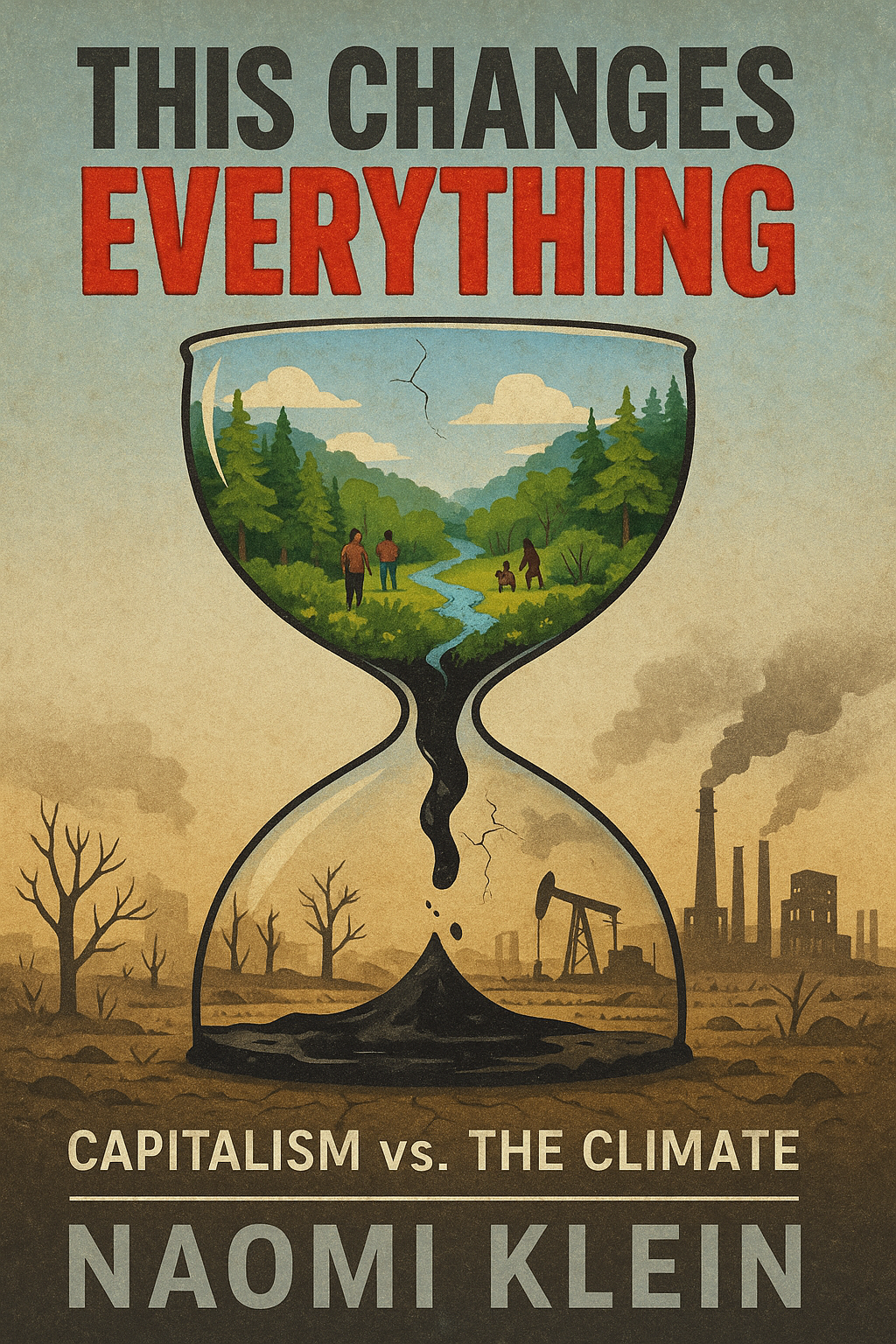
This Changes Everything: Capitalism vs. The Climate
Chapter Summaries
What's Here for You
Are you ready to confront the most defining crisis of our time and discover that the solutions are not only possible but are already unfolding around us? Naomi Klein's "This Changes Everything: Capitalism vs. The Climate" is more than a book; it's an urgent call to action and a profound re-imagining of our world. Klein masterfully dismantles the myth that individual actions alone can solve the climate crisis, instead exposing the deep, systemic roots of the problem: a form of capitalism that thrives on endless growth and extraction, actively resisting the fundamental changes needed to protect our planet. You will gain an incisive understanding of how free-market fundamentalism, corporate influence, and ideological denial have actively worked to overheat the planet, blocking vital climate action and hollowing out our public spheres. Prepare to be intellectually challenged as Klein reveals how the very systems that created the crisis are ill-equipped to solve it, and why the promises of 'green billionaires' and technological fixes like geoengineering are insufficient distractions. But this book is not about despair; it's about empowerment. You will be inspired by the burgeoning global resistance, the 'Blockadia' where communities are rising to defend their lands and waters, and the powerful leadership of Indigenous peoples who hold vital knowledge for a regenerative future. Klein illuminates the crucial role of democratic movements, divestment campaigns, and the unwavering spirit of those fighting for justice and ecological integrity. The emotional tone is one of fierce urgency, intellectual rigor, and ultimately, hopeful determination. You will leave this book not with a sense of doom, but with a clear-eyed understanding of the stakes, a powerful critique of the forces holding us back, and a deep wellspring of inspiration to join the fight for a livable future. This is your invitation to move beyond the limitations of our current system and embrace the 'impossible' – the necessary transformations that can regenerate our planet and our communities. This book offers the intellectual tools and the stirring examples to understand what's at stake and, more importantly, what's possible when we dare to demand that everything change.
THE RIGHT IS RIGHT: The Revolutionary Power of Climate Change
Naomi Klein, in 'This Changes Everything,' unveils a profound tension: the overwhelming scientific consensus on human-caused climate change clashes with a powerful, ideologically driven denial movement. We see this starkly at gatherings like the Heartland Institute's International Conference on Climate Change, where the science, accepted by 97 percent of experts, is dismissed not with reasoned debate, but with a barrage of often contradictory claims and historical comparisons to Nazism and Stalinism. The author explains that this isn't merely a disagreement about data; it's a strategic defense of a deeply entrenched economic and political worldview, a crusade to protect capitalism from what is perceived as a Marxist threat. This denial, Klein reveals, is not organic but meticulously funded, with billions flowing from fossil fuel interests and conservative foundations to think tanks that sow doubt and paralyze action. We learn that this manufactured uncertainty has led to a precipitous collapse in media coverage and a dramatic drop in public belief in climate change, particularly on the right, creating a deep political chasm. The core insight here is that for many conservatives, particularly those with hierarchical and individualistic worldviews, accepting climate science would shatter their vision of a free society and the inherent goodness of limitless profit. It's not about the climate; it's about the perceived threat to their way of life, a fear that climate action necessitates massive government intervention and wealth redistribution, which they see as an attack on freedom itself. This denial, Klein argues, is a form of 'cultural cognition,' where deeply held beliefs act as intellectual antibodies against inconvenient truths. The chapter highlights a disturbing corollary: a growing callousness, a 'disaster capitalism,' where privilege allows some to insulate themselves from the consequences of warming, while others are left to suffer. The author concludes with a compelling, almost unthinkable truth: the deniers, in their fervent defense of their economic system, understand the revolutionary scale of change required by climate science better than many moderates who seek painless solutions. Their resistance, therefore, is not just about protecting their worldview, but about preserving an entire economic paradigm that, Klein suggests, is fundamentally at odds with the habitability of the planet.
HOT MONEY: How Free Market Fundamentalism Helped Overheat the Planet
Naomi Klein’s chapter, "Hot Money," unveils a critical, often overlooked conflict at the heart of our climate crisis: the clash between international free trade agreements and effective climate action. We learn how, in the midst of an escalating climate emergency, global powers like the U.S., China, and the EU have been using the World Trade Organization (WTO) to challenge and dismantle green energy programs, particularly those that include provisions for local content and job creation. The author uses the poignant story of Paolo Maccario and his solar factory in Ontario, Canada, to illustrate this tension; a promising green energy initiative, lauded internationally and designed to revive local manufacturing, was ultimately undone by WTO rulings that prioritized the principle of national treatment over climate goals. This highlights a core insight: the deeply embedded ideology of free market fundamentalism, which champions deregulation and the unfettered flow of capital, actively obstructs the bold, coordinated government interventions necessary to combat climate change. Klein reveals that the very trade architecture established in the 1990s, designed to boost corporate freedom and global commerce, inadvertently multiplied emissions by facilitating the offshoring of production to countries with cheap labor and lax environmental regulations, effectively creating a "package deal" of exploited workers and an exploited planet. The chapter underscores the profound disconnect between climate science, which demands urgent, radical action, and trade law, which often penalizes such measures, illustrating a fundamental dilemma: how can we achieve necessary emissions reductions when the rules of global commerce are structured to resist them? The narrative shifts from the tension of these trade wars to the insight that the problem is structural, requiring a rewriting of trade rules that have, for decades, treated climate action as a secondary concern, subservient to economic growth. Klein concludes that the "growth-based economic logic" inherent in our current system is in direct conflict with atmospheric limits, suggesting that a genuine response necessitates challenging this logic, not merely painting it green, and perhaps embracing a "great transition" toward a more localized, less consumption-driven economy, a path that promises not just environmental salvation but also greater equity and fulfilling human connection.
PUBLIC AND PAID FOR: Overcoming the Ideological Blocks to the Next Economy
Naomi Klein, in "Public and Paid For," unveils a critical tension: the collision between the urgent demands of the climate crisis and the entrenched ideology of market fundamentalism that has hollowed out our public spheres. The narrative begins with a spark of rebellion in Hamburg, Germany, where citizens voted to reclaim their energy grids, a move driven by a desire for local control and a faster transition to renewables, illustrating a powerful insight: **public ownership is a crucial, often overlooked, enabler of ambitious climate action.** This sentiment echoes in Boulder, Colorado, where a similar movement arose, not initially from anti-privatization sentiment, but from the undeniable need for clean energy, leading residents to discover that regaining control of essential services was paramount. Klein emphasizes that while private markets can innovate, they are inherently volatile and often prioritize profit over planetary well-being, a stark contrast to the potential of publicly accountable systems. She paints a vivid picture of the post-Superstorm Sandy landscape in the Rockaways, New York, where the abandonment of vulnerable communities by both the state and aid agencies laid bare the catastrophic consequences of decades of austerity, revealing a second core insight: **neglecting the public sphere turns natural disasters into unnatural catastrophes.** This neglect, Klein argues, is a suicidal choice in the face of climate change, as it cripples our capacity to respond to escalating extreme weather events. The chapter then pivots to the question of funding this necessary transition, proposing a robust "polluter pays" principle. This principle, Klein explains, is not merely punitive but a matter of justice and fairness, drawing parallels to wartime rationing where shared sacrifice was underpinned by a sense of equity. A third crucial insight emerges: **a just transition requires redistributing the costs of climate action, ensuring that those most responsible for emissions bear the financial burden, not solely individual consumers.** She meticulously outlines various revenue streams – carbon taxes, financial transaction taxes, closing tax havens, and reallocating military spending – to fund essential public infrastructure and climate resilience. The narrative builds to a powerful resolution, asserting that the primary obstacles to climate action are not technical or financial, but deeply ideological and political. The author concludes that breaking free from fossilized free-market rules and reviving the lost arts of long-term public planning, while firmly saying no to powerful corporations, is the only path forward to building a resilient and equitable future.
PLANNING AND BANNING: Slapping the Invisible Hand, Building a Movement
Naomi Klein's "This Changes Everything" delves into a pivotal missed opportunity in 2009, a moment when the world teetered on the brink of financial collapse and a nascent climate crisis, presenting a unique confluence of power and public will. The author explains that with a democratically elected president, a shattered faith in laissez-faire economics, and major industries like banking and auto manufacturing dependent on government intervention, there existed an extraordinary window to enact transformative green policies. Klein paints a vivid picture of what might have been: a stimulus package not just for economic recovery, but as the bedrock for a new energy economy, rebuilding infrastructure with public transit and smart grids, and repurposing auto factories for green technology, echoing the potential of worker cooperatives that emerged in Argentina after its own economic crisis. This vision, however, was stifled by the pervasive ideology of free-market fundamentalism, which equated government planning with communism and instilled a deep-seated fear of intervening in corporate affairs, even when those corporations were failing. Klein reveals that the true obstacle wasn't a lack of resources or power, but an ideological confinement that prevented leaders like President Obama from embracing bold, long-term economic planning. The chapter highlights the critical insight that genuine climate action requires not just incentives, but direct intervention and planning, a stark contrast to the prevailing neoliberal orthodoxy. It underscores how the fossil fuel industry, driven by its imperative for perpetual growth and profit, actively obstructs necessary change, investing billions to maintain its dominance and lobbying fiercely against any meaningful regulation. The narrative then shifts to the power of 'saying no'—rejecting pipelines like Keystone XL and, more broadly, imposing strict limits on fossil fuel extraction, a concept that was once an accepted part of governance but has since been eroded. Klein argues that the German energy transition, while successful in expanding renewables through strong government planning and community ownership, also reveals the limitations of relying solely on incentives when the powerful coal lobby remains unchecked, demonstrating that progress requires not just saying 'yes' to green alternatives, but a firm 'no' to polluting industries. Ultimately, the author posits that the climate crisis, by its very urgency and universal impact, can serve as a unifying force, a powerful argument against unfettered capitalism and a catalyst for building a more just and sustainable economy, urging a shift from incremental victories to systemic change and emphasizing that the fight for climate justice is inextricably linked to the fight for a new economy, a new democracy, and a new relationship with the planet and each other, recognizing that true transformation demands not just new tools, but a profound reconnection with place and time, moving beyond the perpetual now to embrace a future where collective action and systemic change are paramount.
BEYOND EXTRACTIVISM: Confronting the Climate Denier Within
The author, Naomi Klein, invites us to confront a profound dissonance: our awareness of the climate crisis versus our ingrained behaviors, a phenomenon she terms 'the climate denier within.' She illustrates this with the tragic story of Nauru, a once-prosperous island nation whose phosphate-rich core was mined to utter depletion, leaving it ecologically bankrupt and vulnerable to rising seas, a stark metaphor for a global economy built on unsustainable extraction. This story of Nauru, a place developed to disappear, mirrors our collective predicament of treating Earth's finite resources as if they were infinite, leading to a breakdown of reality that is no longer sustainable. Klein traces the roots of this destructive mindset back to Francis Bacon's Enlightenment vision of nature as a mere object to be dominated and controlled, a philosophy that fueled colonialism and found its ultimate expression in the industrial revolution powered by coal. James Watt's steam engine, a marvel of its time, liberated industry from natural constraints, enabling unprecedented growth but also solidifying a non-reciprocal relationship with the planet. This extractivist logic, characterized by taking without regard for regeneration, has permeated not only capitalism but also many socialist ideologies, demonstrating a shared tendency to view humans and nature as resources to be exploited. The chapter reveals that this deeply embedded worldview, where sacrifice zones are created and consequences are ignored, is the true engine behind our environmental crisis. Even progressive movements often struggle to break free, sometimes prioritizing the redistribution of extractive wealth over fundamentally challenging the extraction itself. The author emphasizes that true progress requires a radical shift from this dominant narrative of endless growth and control to one of interconnectedness and stewardship, acknowledging our vulnerability and embracing a regenerative relationship with the Earth. This calls for a profound redefinition of development, moving beyond the elimination of poverty to the elimination of the poor, and embracing Indigenous wisdom that honors reciprocity and the intrinsic value of all life. Ultimately, the lesson from Nauru, and indeed from the history of fossil fuels, is that there is no 'middle of nowhere'; every action has a consequence, and the Earth's capacity to absorb our waste is reaching its limit, demanding that we finally let the dead rest and amplify life instead.
FRUITS, NOT ROOTS: The Disastrous Merger of Big Business and Big Green
Naomi Klein, in 'Fruits, Not Roots,' unveils a deeply unsettling truth about the modern environmental movement: its insidious merger with the very corporate interests it was meant to challenge. The narrative unfurls like a cautionary tale, beginning with the seemingly noble act of The Nature Conservancy accepting a donation of land from Mobil, a fossil fuel giant, to save the endangered Attwaters prairie chicken. This moment, presented as a triumph of partnership, soon curdles into a stark illustration of compromised principles when the Conservancy itself begins extracting fossil fuels on the preserve, directly impacting the bird's habitat and leading to a devastating decline in their numbers. This stark paradox, where the protector becomes the exploiter, serves as a potent metaphor for a broader trend Klein meticulously documents: how many large environmental organizations, once radical agents of change, have become entangled with corporations through donations, investments, and strategic partnerships. We see how this entanglement shifts the focus from demanding fundamental systemic change—like banning harmful substances or regulating polluters—to a preference for market-based solutions, such as carbon trading and the championing of natural gas as a 'bridge fuel.' This shift, Klein argues, effectively dilutes the urgency of the climate crisis, framing it as a technical problem solvable by financial mechanisms rather than a fundamental challenge to our economic model and way of life. The author reveals how this 'low-hanging fruit' strategy, prioritizing easier wins like consumer choices or complex trading schemes over confronting powerful fossil fuel interests, has hobbled the movement's effectiveness, as evidenced by soaring emissions since the 1990s. The chapter critiques the corporate-influenced environmentalism that emerged in the 1980s, a 'probusiness, nonconfrontational' approach that traded radical action for insider access and philanthropic dollars, leading to a profound ideological conformity that prioritizes market logic over ecological necessity. This is the central tension: the environmental movement's struggle between its foundational mission and the seductive, often corrupting, influence of corporate capital, a struggle that risks sacrificing genuine ecological solutions for the illusion of progress and profit. The story of the Attwaters prairie chicken, vanishing from its last known refuge under the stewardship of a major green group, becomes a poignant, almost elegiac, symbol of this profound betrayal.
NO MESSIAHS: The Green Billionaires Won’t Save Us
Naomi Klein, in "This Changes Everything," probes the grand pronouncements of green billionaires, revealing a persistent tension between their public vows to combat climate change and their ongoing entrenchment in industries that fuel the crisis. Richard Branson, a figurehead of this movement, famously pledged $3 billion over a decade, a sum intended to divert profits from his fossil-fuel-dependent transportation empire into developing clean energy solutions. Yet, as Klein meticulously details, this pledge has largely materialized as a 'gesture,' with investments falling far short of the promised amount and a significant expansion of Virgin's carbon-intensive airline fleet occurring concurrently. This pattern mirrors the actions of other prominent figures like Bill Gates, Michael Bloomberg, and Warren Buffett, who, despite expressing concern for the climate, maintain substantial investments in fossil fuels, often benefiting from the very disruptions they acknowledge. The chapter highlights a core insight: the allure of technological fixes and market-based solutions, championed by these billionaires, often serves as a narrative to delay meaningful regulatory action and maintain profitable, albeit destructive, business-as-usual practices. Klein illustrates this with the Virgin Earth Challenge, initially conceived as a prize for carbon sequestration, which later shifted its focus in Calgary, the heart of the tar sands industry, toward technologies that could supply CO2 for enhanced oil recovery—effectively turning a climate solution into a tool to extract more fossil fuels. This reveals a second crucial insight: the profit motive, deeply embedded within current capitalist structures, frequently supersedes genuine commitment to environmental solutions, turning potential climate saviors into beneficiaries of planetary destabilization. The narrative arc moves from the initial hope inspired by these figures to the stark realization that their strategies, while sometimes creative, ultimately serve to protect existing empires rather than dismantle the systems that perpetuate climate change. A third key takeaway is that the belief in a techno-wizard savior, a narrative deeply ingrained in our culture, distracts from the urgent need for systemic change and robust government regulation, a point underscored by Branson's lobbying against climate policies that threatened his industry's profit margins. The chapter leaves us with the sobering conclusion that while bold initiatives are necessary, relying on the voluntary actions of those who profit from the problem is a gamble with our planet's habitability, a realization akin to watching a dazzling, but ultimately empty, spectacle unfold against a ticking clock.
DIMMING THE SUN: The Solution to Pollution Is … Pollution?
Naomi Klein's chapter, 'Dimming the Sun,' immerses us in a tense, anachronistic retreat at Chicheley Hall, where scientists, lawyers, and environmentalists grapple with the radical notion of geoengineering—specifically Solar Radiation Management (SRM)—as a last-ditch effort against climate change. The author reveals a stark dilemma: the very technologies proposed to cool the planet, like spraying sulfate aerosols into the stratosphere to mimic volcanic eruptions, do not address the root cause of warming—greenhouse gas emissions—and carry immense, unpredictable risks. Klein paints a picture of a "Geoclique," a tight-knit group of scientists and inventors, often with vested financial interests, pushing for research and potential deployment of these technologies, funded by figures like Bill Gates and supported by entities like Richard Branson's Carbon War Room. This "Plan B" is presented not as a last resort but, by some, as a preferred alternative to the economic and social upheaval of transitioning away from fossil fuels, a move that echoes the historical logic of industrialization and colonial expansion that led us to this crisis. The narrative highlights the profound ethical quandaries: who decides if these global-scale experiments proceed, and who bears the brunt of their potentially devastating side effects, such as altered rainfall patterns that could trigger droughts in Africa and Asia while sparing North America and Europe? History, through events like the Mount Pinatubo eruption, offers a grim counterpoint to the optimistic claims of geoengineering proponents, showing that such interventions can indeed lead to widespread famine and suffering. Klein underscores the danger of viewing Earth from an "astronaut's eye view," detached from local realities and human consequences, which allows for the rationalization of risky technologies that could exacerbate existing inequalities and become a tool for maintaining the fossil fuel economy. The chapter concludes with a powerful call to recognize that the true solution lies not in technological fixes, but in fundamentally changing human behavior and confronting the crisis with a "real Plan A" rooted in emission reduction, rather than succumbing to the seductive logic of a high-risk, potentially catastrophic geoengineered future that risks becoming humanity's last tragic act of control.
BLOCKADIA: The New Climate Warriors
Naomi Klein, in her chapter 'BLOCKADIA: The New Climate Warriors,' unveils a potent, decentralized global resistance emerging wherever extractive projects threaten ecological integrity and community well-being. The author begins by immersing us in a tense, almost absurd scene of being detained by riot police on a Greek dirt road, a stark contrast to the idyllic tourist destination it is meant to be. This arbitrary show of force, Klein explains, is our introduction to 'Blockadia'—not a fixed place, but a roving transnational conflict zone where communities rise up against fossil fuel extraction. What unites these diverse, grassroots movements, from Greece and Romania to Canada and the UK, is a shared desire for genuine democracy and control over their most critical resources—water, air, and soil. These are not the polished activists of yesteryear; they are shop owners, grandmothers, and students, embodying the places they fight to protect. Klein highlights how this movement represents a fundamental shift, moving from closed-door policy debates to direct action on the ground, a 'lowercase earth' approach that eschews abstract global models for tangible, place-based stands. The narrative then sweeps across continents, illustrating the common threads of resistance: the courage of Indigenous communities like the Elsipogtog First Nation in New Brunswick, the tenacity of farmers in Pungesti, Romania, and the deep connection to land felt by those in the Alberta tar sands region. We witness the raw power of women on the front lines, their images becoming potent symbols of defiance, and the shared slogans—'Water is life,' 'You can't eat money'—that echo across these disparate struggles. The chapter powerfully argues that the extractive industries, accustomed to unchecked power, are being caught off guard by this interconnected web of resistance, a phenomenon fueled by the escalating risks of extreme energy extraction—tar sands, fracking, deepwater drilling—and the erosion of the 'sacrifice zone' myth. The disastrous spills, like BP's Deepwater Horizon and Enbridge's Kalamazoo River incident, serve as potent reminders, shattering industry assurances and fostering a deep-seated mistrust. This leads to a resurgence of the precautionary principle: the idea that when risks are high, action is needed even without absolute scientific certainty, shifting the burden of proof onto the industry. Ultimately, Klein reveals that Blockadia is more than just a protest movement; it's a profound reassertion of collective power, a demand for a future where the planet's health and human well-being are prioritized over endless extraction, a defiant 'None of the below' in the face of an 'all of the above' energy strategy.
LOVE WILL SAVE THIS PLACE: Democracy, Divestment, and the Wins So Far
Naomi Klein's chapter, 'LOVE WILL SAVE THIS PLACE,' unfolds not as a dry recitation of facts, but as a powerful narrative of resistance, beginning with the unyielding spirit of the Heiltsuk First Nation in Bella Bella, British Columbia. When a government review panel arrived to consider the Enbridge Northern Gateway pipeline, a project threatening the very heart of their coastal ecosystem and ancient way of life, the community, led by its youth, responded with a profound display of dignity and love for their land. Students, galvanized by the legacy of environmental devastation like the Exxon Valdez spill, meticulously researched the dangers, transforming their school into a hub of activism. Their protests, adorned with symbols of their heritage and the threatened wildlife, were not born of anger, but of a fierce, protective love for the intricate web of life that sustains them, a love that resource companies, driven by profit, fundamentally fail to comprehend. This deep-rooted connection to place, Klein reveals, is the defining characteristic of 'Blockadia,' the global frontlines of environmental struggle. From the farmers of Halkidiki, Greece, to the goat ranchers of Montana, the fight is consistently framed not as an abstract environmental issue, but as a defense of identity, culture, and ancestral lands. The chapter masterfully contrasts this profound, place-based love with the rootless, transient culture of the fossil fuel industry, where workers often see their jobs as temporary means to escape poverty, rather than as a permanent connection to the land. This collision of worlds, Klein explains, ignites an even deeper cherishing of what is at stake, transforming communities into fierce defenders of their water, their health, and their very existence. The pro-water movement, in particular, emerges as a powerful unifying force, binding diverse groups through the shared threat to this essential resource. Yet, the struggle is not without its victories. Klein meticulously details a wave of wins, from fracking bans in numerous towns and countries to the scuttling of coal plants and the successful blocking of coal export terminals. The divestment movement, targeting the financial underpinnings of the fossil fuel industry, gains momentum, challenging the industry's social license to operate and bankrupting its reputation. However, this rising tide of resistance is met with a fierce backlash, as extractive companies weaponize free trade agreements to sue governments, revealing a profound democratic crisis where corporate power often trumps the will of the people. This chapter, therefore, traces a vital arc: from the initial spark of community defiance in Bella Bella, through the global emergence of 'Blockadia' and the strategic power of divestment, to the sobering realization that the fight for the planet is inseparable from the fight for genuine democracy, ultimately suggesting that while the path is arduous, the deep love for place and the growing interconnectedness of movements offer a potent, albeit uncertain, hope for the future.
YOU AND WHAT ARMY?: Indigenous Rights and the Power of Keeping Our Word
Naomi Klein's chapter, 'You and What Army?', illuminates a profound shift in the power dynamics surrounding Indigenous land rights and their critical role in the fight against climate change. The narrative begins with a stark scene in 2004: Arthur Manuel, a First Nations leader, and Guujaaw, president of the Haida Nation, meeting with a representative from Standard & Poor's. Manuel's argument was audacious: Canada's pristine credit rating was built on a foundation of unacknowledged debt, extracted wealth from Indigenous lands without consent, and a fundamental failure to uphold treaty rights. Yet, the response from Standard & Poor's was dismissive, a question echoing the historical power imbalance: 'You and what army?' This question, Klein reveals, underscored the perceived lack of enforcement power for Indigenous rights, a perception actively reinforced by governments and corporate media. However, the chapter charts a dramatic transformation, showcasing how Indigenous land and treaty rights have become a formidable barrier against extractive industries, a 'last line of defense' against ecological crisis. Landmark Supreme Court decisions, like Delgamuukw and Marshall, began to affirm that Aboriginal title had not been extinguished and that treaties were agreements of shared use, not surrender. This legal recognition, though often ignored by governments, empowered Indigenous peoples to assert their rights on the ground, leading to significant victories in halting fossil fuel projects. The narrative vividly contrasts the violent backlash during the Burnt Church Crisis with the unifying, diverse protests against fracking in New Brunswick, demonstrating a growing understanding among non-Natives that these rights are crucial for collective environmental protection and that Indigenous ways of life offer vital lessons in sustainable coexistence. Klein emphasizes that these rights are not mere theoretical concepts but hard economic realities, capable of halting massive projects and challenging the very model of extractive development. The chapter further explores the immense legal power Indigenous peoples hold, particularly as vast carbon reserves lie beneath their territories, a power exemplified by successful legal challenges against Shell's Arctic drilling and the derailment of major LNG projects. Yet, Klein unflinchingly confronts the stark reality of the 'might vs. rights' dilemma: the systemic economic disenfranchisement that often leaves Indigenous communities with few viable options, forcing them into difficult compromises with extractive industries. This creates a moral imperative for non-Natives to move beyond simply lauding these rights and to become genuine treaty and land-sharing partners, offering real alternatives and addressing the underlying issues of poverty and lack of basic services. The chapter culminates with the inspiring rise of movements like Idle No More and Neil Young's 'Honour the Treaties' tour, illustrating how coalitions of rights-rich but cash-poor Indigenous peoples and cash-rich but rights-poor non-Natives are building a powerful collective force, capable of demanding that governments honor their commitments and potentially securing a future hospitable to all life.
SHARING THE SKY: The Atmospheric Commons and the Power of Paying Our Debts
Naomi Klein, in "Sharing the Sky: The Atmospheric Commons and the Power of Paying Our Debts," navigates the complex terrain of climate action, revealing how entrenched capitalist logic obstructs necessary large-scale investments, particularly in the Global South. The author illustrates this struggle through the lens of the Northern Cheyenne Nation's fight against coal extraction, a battle marked by internal divisions fueled by economic desperation—high unemployment and substance abuse—and external pressures from mining companies promising jobs. Alexis Bonogofsky, working with the Northern Cheyenne, champions their legal rights, leveraging their Class I air quality status to challenge polluting projects. This fight highlights a core tension: the immediate need for economic survival versus the long-term imperative of environmental stewardship, encapsulated by the Cheyenne proverb that the word for water is the same as the word for life. Klein introduces a hopeful counter-narrative through the work of Henry Red Cloud, a Lakota social entrepreneur, who brings solar power training to the Northern Cheyenne, teaching them to harness the sun's energy not just as a power source, but as a way to reconnect with their culture and traditions. This initiative demonstrates a crucial insight: that **true climate solutions must offer tangible economic alternatives, fostering self-determination and cultural integrity, rather than merely demanding sacrifice.** The narrative then expands to the global stage, examining Ecuador's Yasuní-ITT initiative—a proposal to forgo oil extraction in exchange for international compensation—as a powerful example of the 'climate debt' argument. This concept posits that wealthy nations, historically responsible for the vast majority of cumulative emissions, owe a debt to developing nations for the atmospheric commons they have overused. This moral and legal argument, however, faces significant resistance, underscoring another key insight: **international climate agreements often stall due to the unwillingness of the powerful to acknowledge historical responsibility and redistribute wealth.** Klein further illustrates the necessity of building alternatives by contrasting the extractive model with the potential of renewable energy, likening extractive energy sources to "NFL football players, bashing away at the earth," while renewables are "surfers, riding the swells as they come." This leads to the realization that **embracing renewables requires a fundamental shift in our relationship with nature, moving from mastery to a partnership ethic.** The chapter powerfully argues that the fossil fuel divestment movement must be coupled with reinvestment in community-controlled renewable energy projects, creating jobs and bolstering local economies. This is exemplified by the farmers who built a wind- and solar-powered barn in the path of the Keystone XL pipeline, demonstrating that **resistance against destructive projects must be intrinsically linked to the simultaneous construction of viable, sustainable alternatives.** Ultimately, Klein concludes that the true battle for our planet's future will be fought and won by movements in the Global South, demanding their own clean energy revolutions and green jobs, and that the industrialized North must not only cease obstructing these efforts but actively support them by paying its climate debts. The narrative arc moves from the immediate, localized struggle of the Northern Cheyenne to the global implications of climate finance and historical responsibility, culminating in the understanding that **addressing the climate crisis necessitates a profound rebalancing of global power and resources, moving beyond mere negation to active, constructive rebuilding.** The chapter emphasizes that, like the Indigenous land rights movements, the fight for climate justice requires people to step into leadership vacuums when governments fail, forging a path toward a life-based economy rooted in shared responsibility and ecological stewardship.
THE RIGHT TO REGENERATE: Moving from Extraction to Renewal
Naomi Klein, in her chapter 'The Right to Regenerate,' draws a profound parallel between the personal struggles of infertility and the ecological crisis facing our planet, urging a shift from a mindset of extraction to one of renewal. She recounts her own deeply personal journey through multiple miscarriages and the invasive 'fertility factory,' a process that mirrored the relentless, often harmful, industrial approach to exploiting resources. This personal crucible, Klein explains, illuminated the broader ecological devastation, where the very systems of life—from soil to precipitation, from fish larvae to developing embryos—are being assaulted, leading to widespread infertility across species. She reveals a crucial insight: our culture largely fails to value or even notice fertility, focusing instead on adult resilience while overlooking the vulnerability of developing life, a pattern seen in communities near toxic industrial sites and in the devastating impacts of the BP oil spill on marine life's reproductive cycles. Klein introduces a powerful concept: the Earth, like a mother, is facing her own fertility challenges, and our industrial activities are directly interfering with these vital cycles. This leads to a core understanding: the fight for reproductive rights must extend beyond humans to encompass the reproductive rights of the planet itself. She argues that Indigenous worldviews, emphasizing a generative, life-promoting existence rather than extraction, offer a vital alternative, a path towards 'continuous rebirth.' This perspective calls for embracing 'fallow time'—periods of rest and regeneration—both personally and ecologically, moving away from a relentless push and towards a more harmonious, reciprocal relationship with nature. Klein underscores that resilience, while a gift, is passive; regeneration is active, demanding our participation in maximizing life's creativity. She concludes with a hopeful vision, exemplified by efforts like perennial agriculture and salmon restoration, where human labor is directed towards healing and renewal, not just survival, recognizing that while life can bend, it also breaks if pushed beyond its limits, and that true thriving requires a commitment to nurturing the cycles of life for all beings.
The Leap Years: Just Enough Time for Impossible
Naomi Klein, in her chapter 'The Leap Years: Just Enough Time for Impossible,' confronts the stark reality that our current global capitalist system, driven by relentless resource depletion, has brought Earth's human systems to a dangerous precipice. She draws a parallel to Martin Luther King Jr.'s call for a radical shift from a 'thing-oriented' to a 'person-oriented' society, arguing that developed nations have fostered a crisis rooted in flawed values, and the solutions must not echo these same destructive principles. Klein introduces the work of complex systems researcher Brad Werner, whose models suggest that while global capitalism accelerates resource depletion, a powerful counter-dynamic exists: resistance. This resistance, manifested in movements like environmental direct action, Indigenous-led protests, and activist groups, represents the most viable friction against an out-of-control economic machine. History, Klein emphasizes, teaches us that mass social movements have profoundly shaped dominant cultures and are, therefore, not merely an opinion but a geophysical necessity for our planet's future. The chapter highlights nascent movements—Blockadia, fossil fuel divestment, legal challenges by Indigenous groups—as early signs of this necessary friction, not only slowing expansion but also proposing economic alternatives rooted in reciprocal relationships and planetary boundaries. Klein reflects on the painful and hopeful moments witnessed during her writing, from despair at climate deniers to the burgeoning strength of movements that were once isolated but are now multiplying and connecting. She posits that while the carbon record shows emissions are still rising, resistance is also beginning to 'boil,' offering glimpses of the dedication needed for this 'climate change's decade zero.' The immense scale of change required—forcing profitable companies to forfeit trillions and investing trillions more in societal transformation—demands a shift from above, akin to wartime mobilization, but crucially, also from below, by ordinary people. Klein delves into historical precedents, examining the successes and limitations of past social movements like civil rights, women's rights, and the labor movement. While these movements achieved significant legal and cultural victories, their economic demands for massive investments in jobs and equitable resource distribution often remained elusive, a stark reminder that legal status is one thing, sharing resources quite another. She finds a more potent, though imperfect, parallel in the abolition of slavery and Third World independence movements, which forced elites to relinquish immensely profitable practices. The abolition of slavery, Klein explains, akin to the proposed transition from fossil fuels, represented a monumental economic blow to ruling classes, with slaves as property valued at trillions in today's terms, a figure comparable to the carbon reserves that must remain in the ground. However, she cautions that these historical liberations were not always followed by equitable distribution of wealth, often leaving newly freed people burdened by debt or exploitation, a stark contrast to the potential for true independence. In this light, the immense global investments needed for climate action are framed not just as a response to crisis, but as an opportunity to fulfill the 'unfinished business of liberation'—to finally achieve the equitable redistribution of land, jobs, and basic services that past movements fought for, presenting a 'Marshall Plan for the Earth.' The author argues that the greatest barrier to climate action is not a lack of time or solutions, but a pervasive fear rooted in the perceived incapacity of our political class and ourselves to enact such profound change, a fear amplified by a dominant ideology that promotes hyperindividualism and disconnects us from our collective power. Klein calls for a fundamental battle of worldviews, a rebuilding of the collective, the communal, and the civic, suggesting that game-changing policy battles, like those for a guaranteed minimum income, can open spaces for crucial debates about values and replace failed narratives with new stories that champion interdependence, reciprocity, and cooperation. She concludes by emphasizing that the climate movement must find its moral voice, asserting the intrinsic value of life over mere cost-benefit calculations, and drawing strength from the young, social justice movements, and those on the front lines of Blockadia. These 'effervescence of rebellion' moments, though unpredictable, are opportunities to harness collective power, not just to protest, but to build a world that ensures safety for all, reminding us that history has knocked, and we must answer.
Conclusion
Naomi Klein's 'This Changes Everything' delivers a powerful and urgent call to recognize that the climate crisis is not merely an environmental issue, but a fundamental challenge to the prevailing ideology of free-market capitalism and its inherent drive for perpetual growth and extraction. The book masterfully dismantles the notion that scientific denial is rooted in genuine doubt, revealing it instead as a sophisticated, well-funded defense mechanism for an economic system that profits from planetary destruction. Klein compels us to confront the emotional and intellectual resistance to accepting climate science, a resistance often born from a worldview that positions humanity as separate from and dominant over nature. The emotional core of the book lies in its exposure of the callousness and privilege that allow some to insulate themselves from the consequences of environmental degradation, while others bear the brunt of climate-related disasters. It highlights the deep-seated conflict between the deregulation and austerity championed by market fundamentalism and the robust, collective action required to address the climate crisis. The narrative exposes how international trade agreements, prioritizing corporate profit over planetary health, actively undermine green initiatives, and how the globalization of production exacerbates emissions by exploiting both labor and the environment. The practical wisdom gleaned from Klein's extensive research is multifaceted. It underscores that the primary barriers to climate action are ideological and political, not technical or financial. The book champions a radical shift away from extractivism towards a regenerative paradigm, emphasizing the importance of public ownership, long-term planning, and a 'polluter pays' principle. It critiques market-based solutions like carbon trading and the seductive allure of technological fixes such as geoengineering, arguing instead for direct government intervention and a fundamental rewrite of our economic rules. The emergence of 'Blockadia'—a decentralized, grassroots resistance movement—and the strategic power of divestment are presented as vital forces challenging the fossil fuel industry's social and financial license. Furthermore, Klein emphasizes the indispensable role of Indigenous rights and knowledge in safeguarding ecosystems and the necessity of genuine democracy, where communities have control over their resources. Ultimately, 'This Changes Everything' asserts that the climate crisis offers a profound opportunity to address the 'unfinished business of liberation,' demanding a rebalancing of global power and resources, a reconnection with place and time, and a collective embrace of interdependence and regeneration to ensure a just and sustainable future.
Key Takeaways
Climate change denial is fundamentally an ideological defense of free-market capitalism and individualistic worldviews, rather than a genuine scientific dispute.
The organized denial of climate science is heavily funded by fossil fuel interests, demonstrating how economic power can actively shape public discourse and policy.
Acceptance of climate science challenges deeply ingrained beliefs about human mastery over nature and the inherent goodness of profit-driven economies, leading to emotional and intellectual resistance.
The privilege associated with conservative, white, male demographics can foster a sense of insulation from climate impacts, enabling a callousness towards victims and a rationalization of profiting from environmental degradation.
The scale of change required to address climate change directly contradicts the principles of deregulation and austerity that underpin contemporary conservatism, creating an existential threat to that ideology.
While scientific consensus is clear, the political and cultural narratives surrounding climate change have been so distorted by denial that meaningful action is blocked, necessitating a battle of worldviews and values.
International trade agreements, particularly WTO rules, actively undermine and challenge national green energy initiatives by prioritizing free market principles over climate action, as seen in the Ontario solar program's demise.
The ideology of free market fundamentalism, emphasizing deregulation and corporate freedom, inherently conflicts with the robust, government-led interventions required to address the climate crisis.
The globalization of production, facilitated by free trade deals, has led to a significant increase in global emissions by concentrating manufacturing in regions with lower environmental standards and cheaper labor, creating a linked exploitation of both workers and the planet.
The current international trade architecture is structurally flawed, failing to account for climate change and often penalizing or blocking the very policies needed for emissions reduction, necessitating a fundamental rewrite of trade rules.
The dominant economic logic of perpetual GDP growth is fundamentally incompatible with planetary ecological limits, requiring a shift towards 'degrowth' or 'selective degrowth' strategies in developed nations to allow developing countries space to transition sustainably.
Addressing climate change effectively requires challenging the entrenched economic orthodoxy that prioritizes unchecked consumption and trade, advocating instead for localized economies, reduced consumption, and increased public investment in sustainable infrastructure.
Public ownership of essential services, such as energy grids, is a vital, often unacknowledged, mechanism for accelerating the transition to renewable energy and prioritizing community well-being over corporate profit.
The systematic erosion of public services and infrastructure, driven by austerity, directly exacerbates the impact of climate-related disasters, transforming natural events into human-made catastrophes.
A just and effective response to the climate crisis necessitates a 'polluter pays' principle, wherein the financial burden of mitigation and adaptation is placed on those most responsible for emissions, rather than disproportionately affecting individual consumers.
The primary barriers to climate action are ideological and political, stemming from an unwillingness to challenge market fundamentalism and powerful corporate interests, rather than a lack of technical solutions or financial resources.
Reviving long-term public planning and establishing a perception of fairness in shared sacrifice are essential for mobilizing public support and ensuring the equitable distribution of costs and benefits during the necessary societal transition.
The 2009 financial crisis presented a rare, potent opportunity for transformative green economic policy, thwarted by dominant free-market ideology that prioritized corporate autonomy over necessary planning and intervention.
Effective climate action requires direct government planning and intervention, not merely market-based incentives, to overcome the inherent profit-driven resistance of the fossil fuel industry.
The fossil fuel industry's deep-seated imperative for perpetual growth and its immense political influence create a fundamental conflict with the planet's need for drastic emissions reductions, necessitating a firm 'no' to continued extraction.
Successful transitions, like Germany's renewable energy expansion, demonstrate the power of government planning and community ownership, but also highlight the necessity of actively phasing out deeply entrenched polluting industries, not just incentivizing alternatives.
The climate crisis, by its existential nature, can serve as a unifying force for diverse social and economic justice movements, offering a compelling argument for systemic change and a new, equitable economic model.
Transformative climate action requires a fundamental reconnection with place and time, moving beyond short-term thinking to embrace long-term planning and collective responsibility for ecological and economic well-being.
Extractivism, a mindset of taking without regard for regeneration, underpins both historical colonialism and modern capitalism, driving environmental destruction and social inequality.
The 'climate denier within' describes our collective cognitive dissonance, where we intellectually grasp the climate crisis but struggle to alter behaviors rooted in an extractivist worldview.
The history of fossil fuels, particularly the steam engine, enabled a perceived liberation from nature's constraints, solidifying a dangerous illusion of human domination and control over the planet.
Many political ideologies, including some progressive movements, remain trapped within an extractivist framework, prioritizing the redistribution of spoils over challenging the fundamental logic of resource depletion.
True solutions to the climate crisis require a fundamental shift from an anthropocentric, growth-oriented paradigm to one that embraces ecological interdependence, regeneration, and Indigenous wisdom.
Sacrifice zones, whether ecological or human, are an inherent outcome of extractivism, revealing a deep-seated disregard for the value of life beyond its utility to a dominant center.
The core mission of environmentalism is compromised when large organizations accept funding and form partnerships with the very fossil fuel industries responsible for climate change, leading to a shift from confrontation to collaboration that dilutes activism.
Market-based solutions like carbon trading, while appearing pragmatic, often serve to legitimize and perpetuate the fossil fuel industry by framing emissions as abstract commodities rather than dangerous pollutants, thus obscuring the need for fundamental systemic change.
The strategy of focusing on 'low-hanging fruit'—consumer choices and complex financial mechanisms—instead of directly confronting powerful corporate polluters, has proven ineffective in reducing emissions and allows the root causes of the climate crisis to persist.
The historical shift in the environmental movement from direct action and regulation to insider lobbying and corporate partnerships has created a dependency on philanthropic and corporate funding, subtly shaping the movement's agenda towards less confrontational, more market-friendly solutions.
The embrace of natural gas as a 'bridge fuel,' despite mounting evidence of its significant methane leakage and warming potential, exemplifies how the environmental movement's entanglement with industry interests can lead to the promotion of risky, inadequate solutions that delay a true transition to renewables.
The environmental movement's perceived 'insider' status and reliance on elite backing can alienate grassroots movements and hinder the development of broad-based public pressure necessary to challenge entrenched corporate power and achieve meaningful climate action.
The profit motive within current capitalist structures often impedes genuine climate action, leading to a prioritization of maintaining existing profitable industries over systemic change.
Technological 'silver bullets' and market-based solutions promoted by wealthy individuals can serve as a narrative distraction, delaying necessary regulatory interventions and systemic shifts.
Public pledges for climate action by billionaires, while appearing altruistic, can function as a strategy to enhance personal and corporate brands while avoiding impactful regulations that threaten established business models.
The belief in a singular 'techno-wizard' savior, particularly in the context of climate change, can foster a dangerous complacency that diverts attention from collective action and policy-driven solutions.
Genuine climate solutions require robust legislative action and higher taxes/royalties on polluting industries, rather than relying on the voluntary goodwill or profit-driven initiatives of those who benefit from the status quo.
Geoengineering, particularly Solar Radiation Management (SRM), offers a tempting technological 'fix' for climate change but fails to address the root cause of greenhouse gas emissions, treating only the symptom of rising temperatures.
The proponents of geoengineering, often referred to as the 'Geoclique,' frequently have vested financial interests, raising concerns about conflicts of interest and the prioritization of profit over planetary well-being.
Historical evidence from volcanic eruptions like Mount Pinatubo, coupled with climate models, suggests that SRM interventions could lead to severe regional droughts and famines, disproportionately impacting vulnerable populations.
The 'astronaut's eye view' perspective, detached from local realities, risks rationalizing geoengineering by obscuring its potentially devastating consequences for specific communities and perpetuating the fossil fuel economy.
The promotion of geoengineering by fossil fuel industries and their allies serves as a distraction from the urgent need for a 'real Plan A' focused on drastic emission reductions and a transition to renewable energy.
The allure of geoengineering, especially in times of crisis, reflects a dangerous faith in technology and a desire for control, potentially leading to a 'shock doctrine' scenario where hasty, high-risk decisions are made without adequate deliberation.
True solutions to the climate crisis require a fundamental shift in human behavior and societal structures, rather than relying on technological interventions that risk creating new, potentially more catastrophic problems.
The emergence of 'Blockadia' signifies a global, decentralized resistance movement where communities directly confront extractive industries, prioritizing democratic control over resources essential for survival.
Grassroots activism, driven by local inhabitants rather than traditional environmental organizations, is redefining climate action by focusing on place-based stands and direct confrontation with destructive projects.
The escalating risks and environmental devastation associated with extreme energy extraction methods (like tar sands and fracking) have eroded public trust in industry assurances, leading to a resurgence of the precautionary principle.
The 'sacrifice zone' concept is breaking down as extractive industries push into historically protected territories, inadvertently uniting diverse populations against common threats and fostering unlikely alliances.
The core philosophy of Blockadia is a demand to 'stop digging' and cease new fossil fuel infrastructure investments, advocating for a transition to renewable energy based on ecological preservation and community sovereignty.
The profound, place-based love for one's home and heritage is a powerful, often underestimated, force capable of driving sustained resistance against extractive industries, a force that purely profit-driven entities fail to grasp.
The global struggle against fossil fuel extraction, termed 'Blockadia,' is fundamentally a movement rooted in the defense of essential resources like water, uniting diverse communities through a shared threat to their health and existence.
The divestment movement strategically targets the financial logic and social license of fossil fuel companies, aiming to delegitimize their business model and erode their political power, rather than solely focusing on individual projects.
The increasing use of investor protection clauses in trade agreements by fossil fuel companies represents a significant democratic crisis, allowing corporate interests to override environmental regulations and the will of local communities.
The fight for environmental protection is intrinsically linked to the fight for genuine democracy, as communities increasingly assert their right to self-determination and local control over decisions affecting their land, water, and air.
Despite significant challenges and corporate opposition, a growing wave of grassroots victories and strategic movements like divestment demonstrate the potential for collective action to slow the expansion of fossil fuel extraction and create space for sustainable alternatives.
Indigenous land and treaty rights, when actively asserted and legally recognized, serve as the most robust existing barriers against destructive extractive industries and climate catastrophe.
The historical power imbalance, where Indigenous rights were dismissed for lack of enforcement 'army,' is being overcome by evolving legal recognition and growing non-Native solidarity.
Systemic economic disenfranchisement within Indigenous communities creates a moral dilemma, necessitating genuine partnership and alternative economic development beyond extractive industries.
Legal recognition of Indigenous rights, particularly concerning land and resource use, provides a powerful framework for demanding governmental accountability and protecting shared environments.
The collaboration between Indigenous peoples and non-Native allies, fueled by a shared understanding of environmental threats, represents a potent force for political and social change, capable of compelling governments to honor treaty obligations.
True climate solutions require offering tangible economic alternatives that foster self-determination and cultural integrity, not just demanding sacrifice.
International climate agreements are often hindered by the powerful's reluctance to acknowledge historical emissions responsibility and redistribute wealth.
Shifting to renewable energy necessitates a fundamental reorientation of humanity's relationship with nature, from one of dominion to one of partnership.
The fossil fuel divestment movement must be paired with strategic reinvestment in community-controlled renewable energy to build local economies and empower resistance.
Resistance against destructive fossil fuel projects must be intrinsically linked to the simultaneous construction of viable, sustainable economic alternatives.
Addressing the climate crisis demands a global rebalancing of power and resources, recognizing historical climate debts owed by industrialized nations to developing ones.
Movements in the Global South are pivotal in the climate fight, and industrialized nations must support their demand for clean energy revolutions and green jobs.
The personal experience of infertility can serve as a profound metaphor for the widespread ecological crisis, highlighting how industrial extraction damages the reproductive capacities of both humans and the natural world.
Our modern culture neglects the fundamental importance of fertility across all life, often overlooking the vulnerability of developing life stages and the cumulative impact of environmental toxins.
The concept of 'regeneration,' emphasizing active participation in restoring and nurturing life cycles, offers a vital counterpoint to mere 'resilience,' which is a passive ability to withstand damage.
Shifting from an extractivist mindset to a regenerative one, inspired by Indigenous worldviews, is essential for the survival and thriving of both human societies and the planet's ecosystems.
Valuing 'fallow time'—periods of rest and intentional healing—is crucial for restoring balance and capacity, both in personal lives and in ecological systems.
The fight for reproductive rights must be expanded to recognize the inherent right of the planet and its ecosystems to regenerate and heal.
Humanity's role is not merely to survive but to actively promote and participate in the creation and continuation of life, aligning our actions with the Earth's healing powers.
Mass social movements, not top-down directives, are the most potent force capable of creating the necessary friction to slow and redirect the destructive trajectory of global capitalism.
Historical movements, while achieving significant legal and cultural victories, often fell short on economic redistribution, highlighting that true liberation requires addressing both rights and resources.
The transition away from fossil fuels represents an unprecedented economic shift, demanding a willingness from elites to relinquish immense wealth, a parallel to the abolition of slavery but without the compensatory mechanisms that historically cushioned such losses.
Overcoming the climate crisis necessitates a fundamental battle of worldviews, shifting from hyperindividualism to interdependence and rebuilding a sense of the collective, the communal, and the civic.
Finding a moral voice, emphasizing the intrinsic value of life and justice over purely pragmatic or economic calculations, is crucial for the climate movement to gain traction and inspire transformative action.
The current moment, despite its daunting challenges, offers a unique opportunity to fulfill the 'unfinished business of liberation' by enacting the equitable redistribution and social programs that past movements fought for.
Action Plan
Recognize that opposition to climate action often stems from ideological commitments rather than scientific disagreement.
Investigate the funding sources behind climate change denial to understand the economic interests at play.
Challenge the narrative that environmental action inherently conflicts with economic prosperity or personal freedom.
Seek out and support media and institutions that prioritize scientific accuracy and ethical reporting on climate change.
Engage in conversations that explore the underlying values and worldviews that shape opinions on climate change.
Consider how personal economic stakes or ideological beliefs might influence one's own perception of climate risks.
Advocate for policies that address climate change by strengthening collective action and promoting shared responsibility.
Educate yourself on the specific trade agreements your country is party to and their potential impact on environmental regulations.
Support and advocate for policy changes that allow for 'local content' provisions in green energy projects to foster domestic job creation and manufacturing.
Challenge the narrative that blames developing nations solely for climate change by understanding and articulating the role of Western consumption and corporate practices.
Investigate and support businesses and initiatives that prioritize local production, reduced consumption, and sustainable supply chains.
Engage in discussions about the limitations of 'green growth' and advocate for policies that promote 'degrowth' or 'selective degrowth' in developed economies.
Demand greater transparency and public scrutiny of international trade agreements, particularly regarding their environmental clauses.
Consider how your own consumption patterns contribute to global emissions and explore ways to reduce your personal carbon footprint through conscious choices.
Advocate for and support the remunicipalization of essential services like energy and water in your community.
Engage in local political processes to demand greater public investment in resilient infrastructure and social programs.
Support policies that implement a 'polluter pays' principle, such as carbon taxes or increased royalty rates for fossil fuel extraction.
Challenge the narrative of austerity by highlighting the critical role of public services in disaster preparedness and response.
Educate yourself and others about the ideological underpinnings of market fundamentalism and its impact on climate action.
Demand transparency and accountability from corporations regarding their environmental impact and financial contributions.
Support initiatives that promote fair distribution of costs and benefits in climate solutions, ensuring that sacrifices are shared equitably.
Identify and challenge the ideological assumptions that limit bold, long-term planning in your own sphere of influence.
Advocate for policies that go beyond market incentives to directly regulate and plan for a transition away from fossil fuels.
Support and participate in movements that demand democratic control over energy and economic resources.
Recognize the interconnectedness of climate action with other social and economic justice issues and seek opportunities for coalition building.
Educate yourself and others about the true costs and impacts of unconventional fossil fuel extraction methods.
Demand greater transparency and accountability from corporations regarding their environmental impact and political spending.
Practice and promote deeper engagement with place and time, fostering a sense of long-term responsibility and connection to the natural world.
Actively question and identify personal behaviors that reflect an extractivist mindset, seeking opportunities for regenerative alternatives.
Study the historical connections between colonialism, industrialization, and the fossil fuel economy to understand the deep roots of our current challenges.
Explore and engage with Indigenous philosophies and practices that emphasize reciprocity and interconnectedness with the natural world.
Critically assess the definitions of 'progress' and 'development' in personal and societal contexts, prioritizing ecological and social well-being over pure growth.
Seek out and support movements and initiatives that advocate for a transition away from extractive industries towards sustainable, life-amplifying economies.
Practice acknowledging and integrating the 'climate denier within' by consciously aligning actions with environmental awareness, even when uncomfortable.
Critically evaluate the funding sources and partnerships of environmental organizations to understand potential biases and conflicts of interest.
Prioritize understanding and advocating for direct regulatory measures and bans on harmful activities rather than solely relying on market-based mechanisms.
Question the framing of climate change as a purely technical or market-solvable problem, and seek solutions that address root causes in consumption and economic systems.
Support and engage with grassroots environmental movements that employ direct action and confrontational tactics against polluters, rather than solely relying on established 'Big Green' organizations.
Investigate the true climate impact of 'bridge fuels' like natural gas and advocate for a rapid transition to fully renewable energy sources.
Demand transparency from environmental organizations regarding their financial ties and investment portfolios, especially concerning fossil fuel companies.
Be wary of 'offsetting' schemes that allow polluters to continue emissions by paying for carbon sequestration elsewhere, and advocate for direct emissions reductions at the source.
Critically evaluate grand pronouncements and large financial pledges from corporations and wealthy individuals regarding environmental initiatives.
Investigate the actual business practices and investments of companies and individuals making climate-friendly claims to identify potential contradictions.
Advocate for and support strong governmental regulations, carbon taxes, and royalty increases for industries contributing to climate change.
Prioritize systemic solutions and collective action over reliance on individual 'savior' figures or technological fixes.
Educate yourself on the political and economic structures that enable industries to profit from environmental degradation.
Question the narrative that technological innovation alone, divorced from regulation and behavioral change, can solve the climate crisis.
Critically evaluate any proposed technological 'fixes' for climate change by examining whether they address the root causes or merely the symptoms.
Investigate the vested interests and potential conflicts of interest behind proposed geoengineering solutions.
Seek out and consider historical precedents and scientific modeling regarding the potential unintended consequences of large-scale environmental interventions.
Advocate for and support policies focused on drastic emission reductions and a rapid transition to renewable energy sources (Plan A) rather than relying on speculative geoengineering (Plan B).
Engage in informed public discourse about the ethical, social, and political implications of geoengineering, ensuring diverse voices are heard, especially from vulnerable communities.
Challenge the 'astronaut's eye view' by grounding discussions in local realities and respecting the rights and knowledge of affected populations.
Resist the temptation of 'shock doctrine' solutions during crises; prioritize calm deliberation and ethical considerations over immediate, high-risk interventions.
Identify and research extractive projects proposed or operating in your local area or region.
Connect with or support existing grassroots organizations fighting against these projects.
Educate yourself and others about the specific risks and impacts of extreme energy extraction methods.
Practice the precautionary principle by questioning industry assurances and demanding proof of safety.
Share stories of resistance and ecological threats through social media and community networks to build transnational solidarity.
Consider adopting a 'None of the below' philosophy regarding new fossil fuel infrastructure in your community and beyond.
Identify and articulate what deep-rooted connections to place, community, or heritage you cherish and are willing to defend.
Educate yourself and your community about the specific environmental threats posed by extractive industries in your region or globally.
Explore opportunities to support or join local, regional, or global movements advocating for water protection and the transition to renewable energy.
Investigate the fossil fuel holdings of institutions you are part of (e.g., universities, faith organizations, pension funds) and consider advocating for divestment.
Engage in conversations about the democratic implications of trade agreements and corporate influence on environmental policy.
Support initiatives that strengthen community resilience, such as local food systems, shared public spaces, and civic engagement.
Educate yourself on the specific treaties and land rights relevant to your region and the Indigenous nations whose territories you inhabit.
Support Indigenous-led legal challenges and direct actions by amplifying their messages and contributing financially or through volunteer work.
Engage in conversations with non-Native friends, family, and colleagues to build awareness and foster solidarity around Indigenous rights and environmental protection.
Advocate for policies that uphold and strengthen Indigenous sovereignty, free, prior, and informed consent, and the protection of natural resources.
Seek out and support Indigenous-owned businesses and initiatives that promote sustainable economic alternatives and community well-being.
Challenge narratives that frame Indigenous rights as obstacles to development, instead highlighting them as essential safeguards for a healthy planet and just society.
Actively look for opportunities to be a treaty and land-sharing partner, contributing to the creation of economic and social alternatives that do not jeopardize traditional ways of life.
Support and advocate for policies that facilitate the transfer of green technology and financial resources from developed to developing nations to aid in their clean energy transitions.
Investigate and support community-led renewable energy projects in your local area or in regions disproportionately affected by climate change.
Educate yourself and others on the concept of 'climate debt' and the historical responsibility of industrialized nations for cumulative greenhouse gas emissions.
Engage in local and national political processes to advocate for government policies that prioritize green jobs and sustainable infrastructure over fossil fuel development.
Consider the principles of 'DivestInvest' by examining institutional or personal investments and seeking opportunities to redirect capital towards sustainable and ethical enterprises.
Champion the rights and self-determination of Indigenous communities on the front lines of climate change and resource extraction, by amplifying their voices and supporting their initiatives.
Seek out and support organizations working on the ground to build tangible economic alternatives to extractive industries in vulnerable communities.
Reflect on personal experiences of loss or struggle (infertility, ecological grief) and consider how they might inform a broader understanding of planetary health.
Seek out and support regenerative practices in agriculture, energy, and community development, such as local food systems or renewable energy initiatives.
Explore Indigenous perspectives on ecological stewardship and the concept of living in relationship with the Earth.
Practice 'fallow time' in personal life—consciously incorporating periods of rest, reflection, and reduced external demands to foster well-being and capacity.
Educate yourself about the impact of industrial toxins and extraction on local ecosystems and human health, particularly on vulnerable populations and developing life.
Advocate for policies and community initiatives that recognize and protect the 'rights of nature' and prioritize ecological regeneration over extraction.
Engage in thoughtful, concerted action aimed at restoring and regenerating living systems, even in small, local ways, recognizing our role as a keystone species.
Identify and connect with existing social and environmental movements in your community or online to contribute to collective action.
Engage in conversations that challenge the dominant ideology of hyperindividualism and explore alternative values centered on interdependence and the common good.
Support or advocate for policies that promote equitable redistribution of wealth and resources, framing them as the 'unfinished business of liberation'.
Seek out and share stories that highlight human capacity for empathy and cooperation, countering narratives of inherent selfishness and greed.
Educate yourself on the historical precedents of social movements, understanding both their triumphs and their limitations in achieving economic justice.
Articulate the moral dimensions of the climate crisis, emphasizing the intrinsic value of life and justice over purely economic arguments.
Find and utilize collective spaces, both online and offline, to process the emotional and psychological toll of the climate crisis with others.