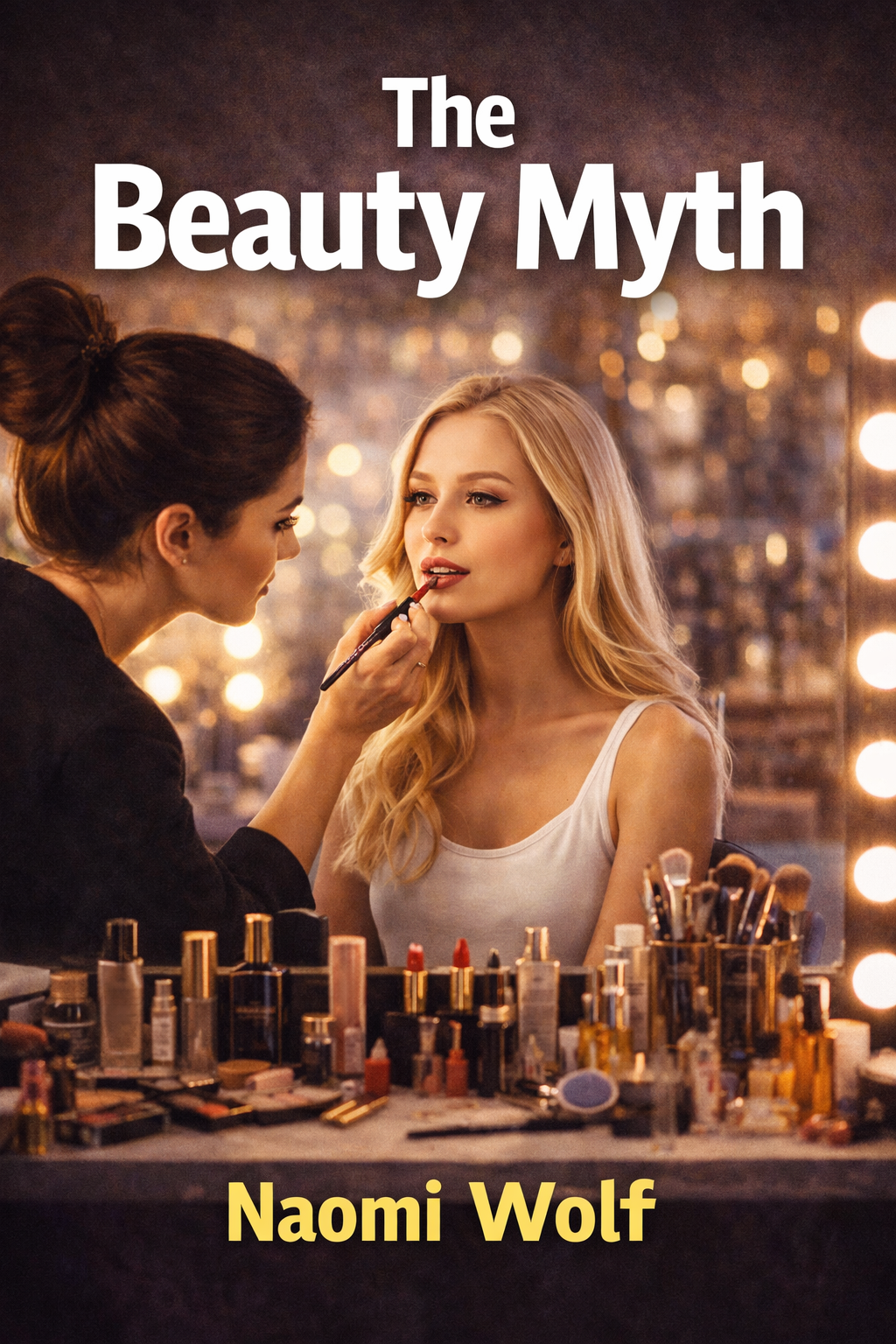
The Beauty Myth: How Images of Beauty Are Used Against Women
Chapter Summaries
What's Here for You
Prepare to have your perceptions challenged and your understanding deepened. In "The Beauty Myth," Naomi Wolf dismantles the pervasive and often-unseen ways that societal ideals of beauty are weaponized against women. This book is your guide to understanding how the 'beauty myth' functions not just as a standard, but as a powerful tool that undermines women's progress in work, culture, religion, sex, and even our own bodies. You'll confront uncomfortable truths about eating disorders, violence, and the subtle ways that media and cultural norms shape our self-perception. But this isn't just a book of critique; it's a call to action. You will gain the knowledge and tools to recognize and resist these insidious forces, empowering you to envision and create a future where women are truly free to define themselves, beyond the suffocating constraints of the beauty myth. Brace yourself for an intellectually stimulating and emotionally resonant journey that will leave you questioning everything you thought you knew about beauty, power, and the female experience.
The Beauty Myth
In this chapter of *The Beauty Myth*, Naomi Wolf casts a stark light on the insidious ways images of female beauty are weaponized against women's progress. She observes that despite the gains of the feminist movement, women still grapple with a profound sense of unfreedom, shackled by the relentless pressure to conform to an ever-narrowing ideal. Wolf argues that this isn't a mere coincidence; it's a deliberate backlash, a new iteration of social control that has taken over from myths of domesticity and motherhood. The beauty myth, she asserts, functions as a currency system, dictating a woman's worth based on culturally imposed physical standards, fostering competition where there should be solidarity. Like an economy rigged from the start, it demands women unnaturally compete for resources men have already commandeered. The author dismantles the illusion that beauty is universal or rooted in biology, revealing it instead as a tool of power, prescribing behavior rather than appearance. The modern beauty myth, Wolf contends, emerged with industrialization, as women's roles shifted and new technologies enabled the mass dissemination of unattainable ideals. Like the Iron Maiden, a medieval torture device disguised as a beautiful woman, the beauty myth entraps women, directing attention to formulaic imagery while censoring real faces and bodies. Wolf suggests that the economy is complicit, as industries profit from female anxiety and insecurity, perpetuating a cycle of self-hatred and obsession. The caricature of the "Ugly Feminist" is resurrected to punish women for daring to step outside prescribed boundaries, undermining their hard-won gains. Ultimately, Wolf calls for a new way of seeing, urging women to recognize the beauty myth for what it is: a political construct designed to keep them in check, and to reclaim their sense of self beyond its suffocating constraints. The path to freedom, she implies, begins with awareness, with dismantling the illusions that bind us, and forging a new vision of female identity rooted in strength, authenticity, and solidarity.
Work
In this chapter of *The Beauty Myth*, Naomi Wolf unveils a disturbing parallel: as women surged into the workforce, the ‘beauty myth’ evolved into a tool to undermine their progress, not unlike how currency is used among men, where a woman is seen as a ‘first-class beauty’ or her ‘face is her fortune.’ Wolf argues that this isn't merely about attraction; it's a calculated political maneuver. She describes the beauty myth as a ‘transformer’ that weakens women's energy while ensuring their input aligns with the power structure. The author highlights the double standard women face—working harder, often twice as hard as men, yet receiving less recognition and pay. Women are used to working more than twice as hard and long as men, and not only for less pay; for none. Wolf illuminates how the ‘professional beauty qualification’ (PBQ) has insidiously become a requirement for women's hiring and promotion, camouflaged by lies that beauty is a legitimate qualification earned through hard work. As Wolf puts it, ‘For every feminist action there is an equal and opposite beauty myth reaction.’ The closer women come to power, the more physical self-consciousness and sacrifice are asked of them. The author dissects legal cases where a woman's appearance was used against her, creating a no-win situation, like a hall of mirrors where every choice reflects back a distorted image. She reveals how the PBQ drains women's energy, time, and money, exhausting them to the point where activism and critical thought become luxuries. The author underscores how the PBQ inverts the male career span, pushing women to prioritize beauty in their youth while their male counterparts gain power with age. She points out the social consequences, including isolation and the reinforcement of a double standard, and stresses that the professional beauty qualification works smoothly to put back into employment relations the grounds for exploitation that recent equal opportunity laws have threatened. Ultimately, Wolf implores women to recognize the beauty myth for what it is: a barrier to equality, a system designed to keep them from realizing their full potential, and a call to action to dismantle these oppressive structures and reclaim their worth beyond the confines of physical appearance. The author leaves us contemplating the words of Patricia Ireland of the National Organization for Women: ‘A real meritocracy means for men more competition at work and more housework at home,’ driving home the point that equality demands a redistribution of power and labor.
Culture
In this exploration of culture's impact on women, Naomi Wolf casts a critical eye on the forces shaping female identity. She begins by highlighting how women, often sequestered from the broader world and each other, become overly reliant on cultural models, especially images, for self-definition, a stark contrast to men who don't internalize male fashion models as paradigms. Wolf draws on John Berger's observation that "men look at women; women watch themselves being looked at," illustrating how this dynamic permeates Western culture and dictates not only male-female relations, but a woman's relationship with herself. The author argues that ideal imagery's obsessive importance to women is by design, meant to keep culture male-dominated, where women showing character are deemed less desirable than the artless ingenue. In male-dominated narratives, women are often stereotyped, forced to choose between beauty and intelligence, a false dichotomy perpetuated through archetypal pairings like Leah and Rachel or Ginger and Mary Ann. Wolf contrasts this with women's writing, where heroines seek a deeper radiance, challenging the overvaluation of mere beauty, presenting the heroine's inner beauty as the hero's true test. The author then pivots to the role of women's magazines, institutions that simultaneously reflect and determine historical change, and glamorize whatever roles serve the economy or government at a given moment. During wartime, they promote female competence, yet also reinforce traditional femininity, a duality that persists. Post-war, magazines swung back to domesticity, reflecting anxieties about women's roles in a changing workforce. Wolf dissects how advertising, especially in the 1950s, manipulated housewives into insecure consumers and how this dynamic has evolved to target working women, creating a "briefcase-sized neurosis" centered on beauty ideals. The beauty myth, she asserts, arose to replace the Feminine Mystique, saving magazines and advertisers from the fallout of the women's revolution. As the women's movement gained momentum, magazines responded by focusing on the body, inventing a new culture centered on dieting and beauty, resurrecting the transfer of guilt. Wolf analyzes the media's caricature of feminists, often depicted as unattractive or unsexed, a tactic to undermine their message. The author notes how even the new wave of women's magazines, while seemingly revolutionary with their can-do tone and focus on female ambition, perpetuate the myth through diet and skincare features, creating a cycle of product lust and a longing for transformation. She underscores that women's magazines represent women's mass culture, unique in their focus on female issues and concerns, and that their contradictions reflect women's own uneasy truce between scope and power. Ultimately, Wolf reveals that advertisers act as courteous censors, shaping the content of women's magazines to promote their products, creating a self-censored medium where beauty editors cannot tell the whole truth. This censorship extends to airbrushing age from women's faces, erasing their identity and history, all in service of maintaining the myth. The author suggests that a truly revolutionary women's magazine would challenge these norms, positively featuring diverse women and avoiding harmful messaging, but acknowledges the economic realities that make this difficult. As visual competition intensifies and pornography becomes more prevalent, the pressures on women to conform to beauty ideals only increase. Despite the West's professed hatred of censorship, women's magazines operate within a heavily self-censored environment, where freedom of speech is curtailed by advertising demands. Wolf concludes with a call for women to take their own mass media seriously, resist its expectations, and demand a wider measure of free speech, recognizing that the beauty myth is a political construct, designed to control and limit their potential.
Religion
In "The Beauty Myth," Naomi Wolf unveils a piercing critique of how the beauty myth functions as a new religion, subtly and powerfully supplanting traditional faiths, particularly for women. She argues that magazines serve as the gospel of this new religion, guiding women to recreate a belief system that rivals the authority of established churches. Wolf casts the Church of Beauty as a double-edged sword, embraced by women seeking spiritual fulfillment, yet imposed by a social order aiming to control their lives. The author explains that the rites of beauty, archaic and primitive, keep a core part of female consciousness locked in the past, creating a divide between the modern and medieval aspects of female identity. Wolf notes that this belief system is upheld with a faith usually reserved for the divine, unquestioned even by those skeptical in other areas. A critical insight emerges: beauty standards are presented not as constructs of politics and history, but as divine decrees, with figures like pageant officials and photographers acting as earthly representatives. She draws parallels between beauty rituals and religious ones, highlighting how language in diet books echoes religious ideas of temptation and sin, and how weight-loss groups mirror Christian evangelism. Wolf asserts that these beauty rituals don't just resemble religions, they functionally replace them, employing mystification and thought control techniques to sway women as profoundly as any evangelical wave. The author elaborates that this new religion cobbles together elements from various faiths, crudely imitating medieval Catholicism, with fashion models as the elect and consumerism offering a path to heaven through lucrative good works. The author underscores that the Rites of Beauty thrive by exploiting women’s feelings of lost moral purpose, reconstructing traditional roles in physical terms, and instilling an internal police force more effective than older religions. Wolf illuminates the historical context, noting that the relegation of women to the private sphere assigned piety to femininity, justifying their exclusion from public life. This designation as the beautiful sex serves a similar purpose today, preoccupying women with protecting that beauty. The core of this religion lies in the Judeo-Christian creation story, specifically Genesis, where women are made from Adam’s rib, instilling a sense of inferiority and incompleteness. To counter this, the Rites of Beauty offer completion through man-made means, promising to purge the female body of its perceived flaws. Original sin is redefined as being born female, with no escape from the stains of ugliness, age, or fat. The author explains that this new religion replaces sexual guilt with a taboo against oral appetite, mirroring Victorian repression of female sexuality. Wolf then dissects the cycle of purification, where beauty is heaven, skin or fat cell count is the soul, and ugliness is hell. Women are placed under constant surveillance, internalizing Big Brother’s eye, and continually scrutinizing themselves. The author underscores that this constant surveillance aims not to ensure goodness, but to ensure awareness of being watched. Finally, Naomi Wolf explains that the Rites of Beauty cultivate a morbid obsession with aging, urging women to imagine the life span of beauty as men once contemplated death. They sell an imitation of the light that women already possess, trapping them in a cycle of fear and self-consciousness, deterring them from fully embracing their erotic and political power. As a result, women are politically sedated, their freedoms curtailed by the daily premise of eternal deferral, waiting for an apotheosis that never arrives, forever mourning the past and fearing the future.
Sex
In her chapter "Sex," Naomi Wolf dissects how the beauty myth has insidiously reshaped female sexuality, a force once feared by patriarchal religions for its untamed potential. The author explains that while women possess an extraordinary capacity for sexual pleasure, research reveals a troubling disconnect: the sexual revolution, paradoxically, left many women feeling stranded, distant from their own desires. Like a sculptor imposing form onto clay, society molds the sexual urge, and Wolf argues that beauty pornography and sadomasochism have become the chisels, reshaping female sexuality into something more 'manageable.' These images, ubiquitous in advertising and media, present a distorted reality where female desire is either a perfected, vacant ecstasy or a submission to control, further complicated by the rise of violent sexual imagery, normalizing abuse and recasting tender intimacy as 'boring.' Wolf highlights how the commodification of sex through beauty standards has created a consumer culture that thrives on sexual estrangement, where products stand in for genuine connection, and the military industrial complex benefits from the divide between men and women, love threatens established power structures. The author notes the censorship inherent in the representation of women's bodies, a stark contrast to the supposed freedom of expression, what circulates are 'mock-ups of living mannequins,' devoid of authentic desire, and the chapter exposes a double standard where sexual violence against women is less obscene than female sexual curiosity itself. Wolf then examines the impact on women's self-perception, revealing how beauty pornography fosters self-hatred and a sense of sexual inadequacy. She explains that this is because 'the myth wants to discourage women from seeing themselves unequivocally as sexually beautiful,' leading to a quiet dismay that transcends political divides. Finally, Wolf connects the beauty myth to the prevalence of sexual violence, arguing that the constant bombardment of violent imagery normalizes abuse and makes women fear their own sexuality. To counteract this harmful trend, Wolf urges a redefinition of female sexuality, one that celebrates women's innate beauty and empowers them to reclaim their desires, to see men and women beyond the myth in order to bring greater eroticism between the sexes as well as greater honesty.
Hunger
In "Hunger," Naomi Wolf confronts the disturbing epidemic of eating disorders among Western women, painting a grim picture of young minds and bodies held hostage by the beauty myth. She opens with a stark image: America's brightest sons wasting away from self-inflicted starvation, a tragedy that would spark national outrage if it weren't young women silently succumbing to the same disease. Wolf argues that up to one-tenth of young American women are trapped in 'hunger camps,' their suffering met with institutional indifference. Virginia Woolf's vision of women striding freely across university quads is now tainted, their minds admitted but their bodies left to self-destruct. The author reveals that anorexia and bulimia, female maladies, disproportionately affect women, particularly in America, which leads the world in female presence in male spheres and in rates of anorexia. Wolf traces the historical roots of this obsession, noting how the ideal female form has progressively thinned alongside women's emancipation. She observes that dieting became a female preoccupation around 1920, coinciding with women gaining the vote, and intensified as women entered male-dominated spheres. The 'Iron Maiden' ideal, a near-skeleton with male musculature, has become the standard, pushing women to self-hatred and compulsive dieting. Wolf pinpoints the 'One Stone Solution,' where a slight weight reduction below a woman's natural level triggers a cycle of self-loathing and failure, elegantly fulfilling a collective wish to undermine female success. She challenges the notion that the fixation on female fatness is about sex or health, arguing it’s about female obedience, a social concession exacted by the community. Dieting, Wolf asserts, is a potent political sedative, leading to a collapse of self-esteem and effectiveness, traits that counteract the gains of female liberation. She connects modern Western female dieting to a long history of women eating less and worse than men, a pattern perpetuated by a culture of female caloric self-deprivation. The author dismantles the portrayal of fat as 'expendable female filth,' emphasizing its role in female sexuality and fertility. She reveals that dieting, euphemistically called 'slimming,' is self-inflicted semistarvation, with psychological effects identical to involuntary semistarvation, and can be triggered by the effort to achieve an ultra-lean body. The thin ideal, therefore, isn't aesthetic but a political solution, compelling women to grow thin to safeguard existing power structures. This ideology of semistarvation, Wolf warns, undoes feminism, eroding self-esteem and reinforcing the notion that women are inherently wrong. The author then recounts her own descent into anorexia as a teenager, a stark illustration of how easily young girls internalize these destructive messages. She indicts a culture that rewards starving girls while ignoring the devastating consequences, urging institutions to unequivocally condemn this intolerable epidemic. Finally, Wolf laments the absence of a vibrant feminist movement among young women, many of whom are too physically and mentally ill to take up the cause. She highlights the pressures on young women to conform to masculine norms in educational institutions while maintaining impeccable femininity, a double bind that perpetuates the cycle of self-destruction, leaving them frozen in motion, haunted by a beauty myth that demands they sacrifice themselves for a world that scarcely values their true potential.
Violence
In "Violence," Naomi Wolf unveils a disturbing paradox: as women have gained unprecedented social and sexual freedom, a new form of pain—the beauty myth—has risen to take its place, leaving many feeling lost without the familiar ache of female suffering. Wolf guides us through history, revealing how, for centuries, pain was intertwined with a woman's identity, from the perils of childbirth to the societal punishments for sexual expression; but with the advent of contraception and greater economic independence, the author observes, this pain began to recede, creating a void the beauty myth eagerly filled. The cosmetic surgery industry, Wolf argues, has capitalized on this void, reclassifying normal female physiology as pathological, echoing the Victorian era's obsession with female invalidism. Like doctors of the past, surgeons now act as gatekeepers, imposing societal expectations on women's bodies, fueled by a twisted notion of health as beauty. One crucial insight Wolf offers is that the medical establishment has historically redefined healthy femaleness into grotesque abnormality to control women, turning pregnancy and menopause into diseases and menstruation into a chronic disorder. The author paints a stark picture of the Surgical Age, where women are being persuaded that they can buy a cure for female ugliness, a condition as subjective and manipulated as a belief about the stain on a woman’s soul. As the beauty myth tightens its grip, Wolf highlights how women internalize its symptoms, mirroring mental illnesses like schizophrenia and psychosis, with disturbed body boundaries and a sense of disintegration. A key tension emerges: society rewards external beauty over internal health, incentivizing women to choose short-term fixes that harm their long-term well-being. Wolf challenges the hypocrisy of using health as a gloss for the Surgical Age, exposing how the myth’s true message is that a woman should live hungry, die young, and leave a pretty corpse. The author urges us to recognize that the maturing of a woman is a beautiful thing to behold, as lines trace her thoughts and emotions, and her body fills into itself. Wolf criticizes the cosmetic surgery industry's reliance on warping female self-perception and multiplying female self-hatred for profit, creating a market where none biologically exists. The author underscores the ethical void surrounding cosmetic surgery, contrasting it with the stringent debates and legislation governing other body-related issues, questioning why what is wrong in the body politic is not only right but necessary on the female body. As the chapter crescendos, Wolf argues that the beauty myth rests on the fallacy that beauty is a form of Darwinism, ignoring the fact that civilized people should recognize and condemn excesses, just as they do in military conflicts. In a chilling conclusion, Wolf warns of a surgical future where technology destabilizes the social value of the female body, urging us to resist the notion that anything can be done for beauty, as this quickly becomes anything must be done, because the machine is at the door, ready to replace the woman with its inhuman ideal.
Beyond the Beauty Myth
In this chapter, Naomi Wolf urges us to envision a future where women are vibrantly alive, liberated from the constraints of the beauty myth, which has insidiously transposed societal limits onto our bodies and faces. Wolf begins by posing a series of fundamental questions: What truly defines a woman? Does her worth lie in external appearances, or does her lived experience hold intrinsic value? She challenges the notion that women should feel ashamed of showing the signs of life, questioning the obsession with youthfulness. The author reveals a core tension: the beauty myth thrives on limiting women's choices, forcing them into a false dilemma between being sexual or serious, a dichotomy not imposed on men. To dismantle this myth, Wolf advocates for a feminist third wave, one that rejects the idea that a woman's appearance is her speech. Imagine the myth as a hall of mirrors, each reflection distorting and diminishing a woman's true self; to break free, women must turn away from these false images and look directly at one another, finding alternative visions of beauty in female subculture. Wolf underscores that blame fuels the beauty myth, and to dismantle it, women must refuse to blame themselves or each other for its effects, recognizing that attacks on their appearance are impersonal and political. She calls for a reclamation of female sexuality, urging women to cherish and nurture it, consciously avoiding exploitative images and seeking out visions of equality and mutual pleasure. Wolf proposes practical steps: dismantling the 'Pretty-Beauty Quotient,' supporting unionization of women's jobs, and making beauty harassment a labor negotiation issue. She cautions against naively hoping for inclusion in mainstream advertising, which profits from lowered self-esteem, and instead encourages women to create their own culture, celebrating their desires and undermining the 'Iron Maiden' of unattainable beauty standards. Finally, Wolf emphasizes the need for intergenerational collaboration among women, urging them to resist the divide-and-conquer tactics of the beauty myth and to recognize each other as natural allies. The ultimate victory, she suggests, lies in creating a non-competitive, non-hierarchical, and non-violent interpretation of beauty, one that celebrates the individuality of female features and unites women in a shared pleasure of their bodies, making the beauty myth a relic of the past.
Conclusion
Naomi Wolf's 'The Beauty Myth' unveils a disturbing reality: the societal obsession with female beauty isn't natural but a calculated political tool to undermine women's progress. It thrives when women advance, morphing to control their self-perception and limit their power. From the workplace, where appearance dictates professional value, to media, which perpetuates unrealistic ideals, this myth permeates every aspect of a woman's life. It's a 'new religion' that dictates behavior and fosters self-doubt, replacing genuine self-worth with a relentless pursuit of unattainable standards. The book compels us to dismantle this construct, challenge its influence in media and culture, and reclaim the right to self-definition. By recognizing the myth's political nature, women can cultivate inner strength, embrace authenticity, and build solidarity, freeing themselves from its oppressive grip. Ultimately, 'The Beauty Myth' is a call to action, urging women to redefine beauty on their own terms, prioritize collective progress over individual solutions, and create a future where their worth is measured by their intellect, character, and contributions to society, not by their adherence to harmful and artificial standards.
Key Takeaways
Recognize that the beauty myth is a political construct, not an objective standard, designed to maintain male dominance by controlling female behavior and self-perception.
Understand that the beauty myth intensifies when women gain freedom and power, serving as a reactionary force to undermine their progress through internalized self-doubt and competition.
Dismantle the notion that beauty is rooted in biology or evolution, and see it as a culturally imposed system of value that changes rapidly to serve the interests of the prevailing power structure.
Identify how industries profit from the beauty myth by exploiting female anxieties and insecurities, perpetuating a cycle of consumerism and self-objectification.
Challenge the caricature of the 'Ugly Feminist' as a tool to punish women for challenging societal norms and reclaim your right to define your own identity and worth.
Cultivate a new way of seeing beauty that transcends external appearances and embraces inner strength, authenticity, and solidarity among women.
Recognize the 'beauty myth' as a political tool used to undermine women's professional advancement, not merely a standard of attraction.
Challenge the 'professional beauty qualification' (PBQ) by understanding how it's institutionalized as a condition for women's hiring and promotion.
Resist the pressure to conform to beauty standards by recognizing that it drains energy, time, and money, hindering activism and critical thought.
Acknowledge the double standard in appearance expectations between men and women in the workplace, and advocate for equal treatment.
Recognize that the beauty myth inverts the male career span, pushing women to prioritize beauty in their youth while men gain power with age.
Understand that the beauty myth isolates women by fostering competition and undermining collective solidarity in the workplace.
Women are more susceptible to cultural beauty ideals due to historical and social isolation, leading them to seek role models in media.
The beauty myth serves to maintain male dominance in culture by prioritizing women's appearance over their character or intellect.
Women's magazines simultaneously reflect and shape societal changes, often reinforcing traditional gender roles while appearing to promote female empowerment.
Advertising in women's magazines manipulates insecurities to drive consumerism, creating a 'briefcase-sized neurosis' centered on beauty.
Media caricatures of feminists undermine their message by focusing on physical appearance, preventing identification with their agenda.
Women's magazines, despite their flaws, provide a unique platform for female voices and perspectives, addressing issues often ignored by mainstream media.
Advertisers act as 'courteous censors,' shaping magazine content and suppressing dissenting views on beauty to protect their financial interests.
The beauty myth functions as a new religion, supplanting traditional faiths and exerting control over women's lives through rituals and beliefs.
Beauty standards are presented as divine decrees rather than social constructs, perpetuating a system of inequality and control.
The beauty industry exploits women's feelings of lost moral purpose, reconstructing traditional roles in physical terms and instilling an internal police force.
The Judeo-Christian creation story reinforces a sense of female inferiority, driving the need for man-made means of perfection.
Constant surveillance and self-scrutiny aim to ensure women are aware of being watched, rather than promoting genuine self-improvement.
The Rites of Beauty cultivate a morbid obsession with aging, trapping women in a cycle of fear and self-consciousness and deterring them from embracing their full potential.
This new religion politically sedates women, curtailing their freedoms through the premise of eternal deferral and preventing them from fully inhabiting their bodies.
Beauty pornography and sadomasochism reshape female sexuality into a manageable form, suppressing true desire and reinforcing patriarchal control.
Consumer culture thrives on sexual estrangement between men and women, using sexual discontent to fuel the 1.5-trillion retail-sales industry.
Violent sexual imagery normalizes abuse, influencing both men and women to eroticize violence and redefine sex in legal and social contexts.
Beauty pornography fosters self-hatred and sexual inadequacy in women, making them feel unlovely and driving them to seek unattainable standards.
A distorted cultural perspective and fear and distrust their own beauty and feel ambivalent about physically expressing their own sexuality.
True freedom requires a positive definition of female sexuality, challenging the negative construction imposed by the beauty myth and societal pressures.
Recognize the 'One Stone Solution' as a deliberate societal tactic to undermine women's self-esteem and maintain power imbalances by setting unrealistic weight standards.
Challenge the cultural narrative that equates female thinness with beauty and health, understanding it instead as a form of social control and a means of exacting obedience.
Understand that dieting, often trivialized, is a form of self-inflicted semistarvation with profound psychological consequences that can erode self-esteem and limit potential.
Acknowledge the historical context of women's relationship with food, recognizing that patterns of self-deprivation are rooted in a long history of unequal access and social inferiority.
Recognize the role of institutions, particularly schools and universities, in perpetuating the beauty myth by failing to actively condemn eating disorders and promote the value of women beyond their appearance.
Identify the unique pressures faced by young women today, who are expected to compete in traditionally male spheres while simultaneously adhering to rigid standards of femininity, creating a double bind that can lead to self-destruction.
Understand that the beauty myth is not just about aesthetics but a political force that actively inhibits women's progress by diverting their energy and attention toward unattainable ideals.
Recognize that the beauty myth often fills a void left by the lessening of traditional female pain, exploiting a deep-seated expectation that being female inherently involves suffering.
Understand how the medical establishment can reclassify normal female characteristics as diseases or abnormalities to exert control and generate profit, perpetuating cycles of medical coercion.
Challenge the societal double standard that prioritizes external beauty over internal health, and acknowledge how this incentivizes women to make choices detrimental to their long-term well-being.
Resist the trivialization of cosmetic surgery and acknowledge the psychological and physical pain it inflicts, recognizing that this pain is often dismissed or minimized due to societal expectations.
Question the concept of 'choice' in the context of cosmetic surgery, recognizing that women's decisions are often constrained by societal pressures, professional requirements, and fears of losing identity and community.
Be aware of the insidious influence of eugenics in the language and practices of the cosmetic surgery industry, recognizing how certain physical traits are deemed inferior and targeted for alteration.
Recognize the threat that technology poses to the social value of the female body and resist the pressure to conform to increasingly inhuman ideals, asserting the right to define oneself outside of surgical alterations.
Reject the false choice between being sexual and serious, embracing the full spectrum of human expression.
Recognize that attacks on appearance are political, not personal, and refuse to internalize blame.
Reclaim female sexuality by consciously seeking out images of equality and mutual pleasure.
Cultivate intergenerational collaboration to dismantle the beauty myth's divide-and-conquer tactics.
Create a non-competitive interpretation of beauty that celebrates individuality and unites women.
Understand that the marketplace profits from lowered self-esteem and seek alternative sources of validation.
Redefine self-esteem as a political resource and prioritize collective progress over individual solutions.
Action Plan
Critically analyze the images of beauty you encounter in media and advertising, questioning the messages they convey and the power structures they reinforce.
Challenge internalised beliefs about beauty by identifying and reframing negative self-talk related to your appearance.
Support media and art that portray diverse and authentic representations of women, celebrating different body types, ages, and ethnicities.
Engage in conversations with other women about the pressures of the beauty myth, fostering solidarity and shared understanding.
Prioritize self-care activities that promote inner well-being and self-acceptance, rather than focusing solely on external appearance.
Advocate for policies and initiatives that challenge discrimination based on appearance and promote body positivity.
Practice self-compassion and celebrate your unique qualities and strengths, independent of societal beauty standards.
Actively challenge beauty standards by questioning their validity and impact on professional opportunities.
Support policies and initiatives that promote equal pay and opportunities for women in the workplace.
Prioritize self-care and well-being to combat exhaustion and maintain the energy needed for activism and critical thought.
Seek out and support female mentors and role models who defy traditional beauty standards.
Advocate for transparency and accountability in hiring and promotion processes to eliminate bias.
Educate others about the beauty myth and its impact on women's lives.
Create a supportive network of women who challenge and uplift each other.
Invest in personal and professional development to build confidence and skills beyond physical appearance.
Critically analyze the messages conveyed by women's magazines and advertisements, recognizing their potential biases and manipulative tactics.
Challenge the false dichotomy between beauty and intelligence, valuing women for their character, skills, and contributions.
Support media outlets that promote diverse representations of women and challenge unrealistic beauty standards.
Engage in conversations with other women about the pressures of the beauty myth, fostering solidarity and shared resistance.
Question the influence of advertisers on media content, advocating for greater transparency and editorial independence.
Practice self-compassion and body positivity, rejecting the self-hatred promoted by the beauty myth.
Seek out and celebrate female role models who prioritize substance over appearance, inspiring a broader definition of success.
Critically analyze media messages and advertising to identify the ways in which beauty standards are presented as divine or unquestionable.
Examine your own beliefs and behaviors related to beauty to identify areas where you may be internalizing societal pressures.
Challenge the notion that beauty is a moral imperative or a measure of worth, and focus on cultivating inner qualities and strengths.
Practice self-compassion and acceptance, recognizing that imperfections are a natural part of being human.
Support initiatives and organizations that promote body positivity and challenge unrealistic beauty standards.
Engage in conversations with friends and family members about the impact of the beauty myth and encourage them to question its messages.
Explore alternative sources of spiritual fulfillment and meaning that are not tied to physical appearance.
Seek out positive role models and mentors who embody self-acceptance and challenge societal expectations.
Take steps to disconnect from social media and other sources of beauty-related pressure, and focus on activities that promote well-being and self-care.
Critically analyze media images for beauty pornography and sadomasochistic themes, recognizing their potential to distort perceptions of female sexuality.
Challenge societal norms that equate beauty with sexuality, advocating for a broader definition of beauty that encompasses inner qualities and individuality.
Support media literacy programs that educate young people about the harmful effects of beauty pornography and the importance of healthy sexual expression.
Promote open and honest conversations about sex and relationships, challenging the stigma surrounding female desire and pleasure.
Practice self-compassion and body positivity, rejecting the self-critical gaze and embracing one's unique physical attributes.
Seek out and support media that portrays diverse and empowering images of women, celebrating their strength, intelligence, and sexuality.
Advocate for policies that protect women and children from sexual violence and exploitation, challenging the normalization of abuse in media and culture.
Educate yourself and others about the impact of consumer culture on self-esteem and relationships, resisting the pressure to define oneself through material possessions.
Challenge double standards in representations of nakedness, in mainstream culture that bolsters power inequities.
Challenge internal beliefs that equate thinness with worth, actively questioning the societal messages that promote unrealistic body ideals.
Support and advocate for media representations of diverse body types, promoting a more inclusive and realistic definition of beauty.
Engage in open conversations with young women about the pressures they face regarding body image, providing a safe space to express their concerns and challenge harmful beliefs.
Advocate for policy changes in schools and universities that prioritize the well-being of female students and actively combat the normalization of eating disorders.
Practice self-compassion and body acceptance, focusing on health and well-being rather than striving for an unattainable ideal.
Support organizations and initiatives that promote body positivity and challenge the beauty myth, contributing to a more equitable and accepting society.
Be mindful of language used when discussing body image, avoiding comments that perpetuate harmful stereotypes or promote dieting culture.
Educate others about the political and social forces that contribute to eating disorders, raising awareness and promoting critical thinking about beauty standards.
Critically examine media representations of women and challenge images that promote unrealistic beauty standards.
Question medical advice that pathologizes normal female physiology, seeking second opinions and researching alternative perspectives.
Prioritize internal health and well-being over external appearance, engaging in activities that nourish your body and mind.
Challenge societal conversations that trivialize the pain and risks associated with cosmetic surgery, advocating for greater transparency and ethical oversight.
Support body positivity movements and initiatives that celebrate diverse body types and challenge narrow definitions of beauty.
Practice self-compassion and cultivate a positive body image, focusing on your strengths and inner qualities.
Engage in open and honest conversations with friends and family about the pressures of the beauty myth, fostering a supportive community.
Advocate for policies that protect women from discrimination based on appearance in the workplace and other areas of life.
Actively challenge the false dichotomy between sexuality and seriousness in your own life and in the media you consume.
When faced with criticism about your appearance, recognize it as a political tactic and refuse to internalize it.
Seek out and support media that promotes diverse and empowering representations of female sexuality.
Connect with women of different generations to share experiences and strategies for resisting the beauty myth.
Practice complimenting and celebrating the individuality of other women's appearances.
Be conscious of the ways in which advertising lowers self-esteem and seek alternative sources of validation.
Engage in political activism and advocacy to promote policies that support women's equality and autonomy.
Create or participate in rituals and celebrations that honor the female life cycle.
Consciously avoid sexually violent or exploitative images and cultivate fantasies of equality and mutual pleasure.
When someone discusses a woman’s appearance to her face, ask yourself, Is it that person's business? Are the power relations equal?