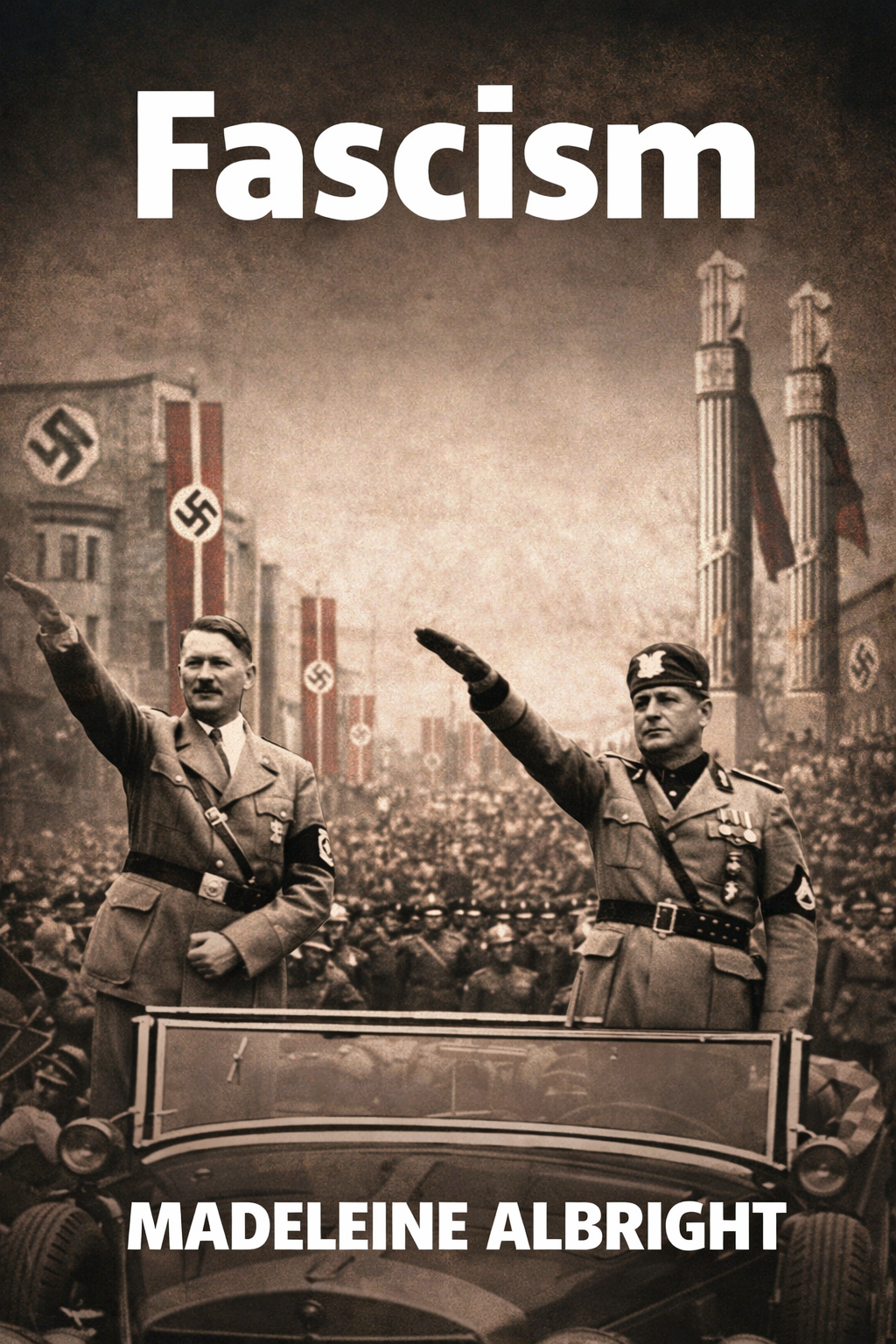
Fascism
Chapter Summaries
What's Here for You
In "Fascism," Madeleine Albright, a witness to history's darkest chapters, offers a chillingly relevant exploration of fascism's enduring appeal and devastating consequences. Prepare to confront the seductive power of demagogues, the insidious creep of nationalism, and the fragility of democracy itself. Through historical case studies – from Mussolini and Hitler to Chávez, Erdoğan, Putin, and even a reflection on the American presidency – you'll gain a deeper understanding of the warning signs and the human vulnerabilities that allow fascism to take root. This isn't just a history lesson; it's a wake-up call, a passionate defense of freedom, and a guide to recognizing and resisting the forces that threaten to undermine it. Expect a blend of personal reflection, rigorous analysis, and a clear-eyed assessment of the present, leaving you both informed and deeply concerned about the future of democracy.
A Doctrine of Anger and Fear
In this chapter of *Fascism*, Madeleine Albright reflects on her personal history, marked by escapes from both Nazi and Communist regimes, and how these experiences shaped her understanding of freedom's fragility. She recounts her family's repeated exiles, highlighting their eventual refuge in the United States and her father's prescient warnings about taking democracy for granted. Albright paints a vivid picture of post-World War II America, a time seemingly idyllic but underscored by Cold War anxieties and the lingering shadow of Fascism, a period where even children carried identification tags in preparation for the worst. She juxtaposes this with the miraculous fall of the Iron Curtain, symbolized by the Velvet Revolution in Czechoslovakia, a moment when democracy seemed to have triumphed. However, Albright questions the current erosion of this vision, pointing to Donald Trump's presidency as a catalyst, like picking at a barely healed wound. She argues that Trump's rhetoric and actions, which denigrate democratic institutions and values, provide comfort to autocratic leaders worldwide, undermining America's traditional role as a champion of international cooperation and democratic ideals. Albright then explores the term Fascism itself, noting its overused and diluted meaning in contemporary discourse, where it's become a casual insult, losing its true potency. Through a classroom discussion, she distills Fascism's core characteristics: an us-against-them mentality, rabid nationalism, authoritarianism, and a willingness to use violence. Fascism, she suggests, is less a political ideology and more a means of seizing and holding power, exploiting societal resentments and the desire for belonging, often through charismatic leaders who orchestrate mass spectacles. The chapter concludes by tracing Fascism's historical roots to the early 20th century, a period of rapid technological change, intellectual ferment, and widespread disillusionment with democracy, setting the stage for the rise of authoritarian movements. Albright reminds us that while technology offers connection, it also presents opportunities for manipulation and control, echoing the chilling potential for history to repeat itself. Ultimately, she defines a Fascist as someone who identifies strongly with a nation or group, disregards the rights of others, and is prepared to use any means, including violence, to achieve their goals, stirring up fervor where kings try to settle people down.
The Greatest Show on Earth
Madeleine Albright paints a portrait of Benito Mussolini's ascent, revealing a man of contradictions and calculated ambition. Initially a socialist, Mussolini swiftly transformed into a fervent nationalist, a shift perhaps fueled by genuine conviction or the allure of financial backing from French business interests and weapons manufacturers. Albright highlights Mussolini’s keen understanding of mass psychology; he presented himself as a strongman, a 'Duce,' capable of uniting a fractured Italy, promising prosperity through self-sufficiency and respect through fear. His Fascist movement, born from widespread dissatisfaction, offered a seductive alternative to both capitalism and socialism, preying on the disillusionment of jobless veterans and stoking fears of Bolshevik Russia. The author notes the critical role of violence, as Mussolini's 'Combat Leagues' suppressed dissent, with the police often turning a blind eye. The narrative tension peaks with the March on Rome, a theatrical power grab that succeeded due to the King's indecision and the paralysis of centrist politicians. Albright underscores how Mussolini, despite his initial focus on efficient governance, gradually consolidated power, crushing opposition and molding Italy into a Fascist state. He understood that to maintain control, he needed to provide a constant spectacle, projecting an image of strength and infallibility, even as his economic policies faltered and his diplomatic skills proved inadequate. Albright suggests that Mussolini’s charisma and understanding of the masses were ultimately overshadowed by his strategic missteps and the inherent unsustainability of his vision, revealing that even the most captivating showman cannot defy reality forever. Like a conductor leading an orchestra towards a crescendo, Mussolini commanded attention, but the symphony he composed was ultimately discordant.
“We Want to Be Barbarians”
In Madeleine Albright's *Fascism*, we witness Adolf Hitler's ascent, a chilling case study in how a demagogue can exploit national trauma and manipulate democratic institutions. The chapter opens with a stark scene: a sneering young man in a German inn, foreshadowing the rising tide of resentment and xenophobia. Albright then transports us to the Kroll Opera House, where Hitler, cloaked in deceptive promises, secures the Enabling Law, a pivotal moment where democracy willingly hands over its power. We learn of Hitler’s early life – the failed artist, the resentful veteran – a portrait of a man fueled by grievance and a messianic sense of destiny. His embrace of anti-Semitism, his talent for oratory, and his knack for simplifying complex issues into easily digestible hatreds are all key ingredients in his recipe for power. Albright emphasizes how Hitler, despite his lack of formal education, shrewdly assessed the political landscape, understanding the yearning for order amidst chaos. The failed Beer Hall Putsch becomes a turning point, teaching Hitler the need for a veneer of legality. As the Great Depression ravages Germany, Hitler finds his stage, offering himself as a savior, a bullhorn for the nation’s misery. The traditional elites, underestimating Hitler’s ambition and blinded by their own agendas, pave his path to power. The author underscores a critical insight: Hitler's appeal wasn't rooted in the quality of his ideas, but in his ruthless drive to enact them, a chilling reminder that conviction, untethered to morality, becomes a destructive force. Like a chameleon, he shifted his message to mirror the crowd's desires, exploiting their fears and promising a return to greatness. Even as he lied shamelessly, he projected an image of authenticity, a dark mirror reflecting the people's own distorted aspirations. The Night of the Long Knives reveals his brutal pragmatism, eliminating rivals and consolidating his grip on power. Despite early economic improvements, Hitler's true aim – war – remained constant, a drumbeat growing louder beneath the surface of his deceptive pronouncements. Albright’s narrative serves as a potent warning: that unchecked ambition, coupled with the exploitation of societal vulnerabilities, can lead to the unthinkable, and that even seemingly marginal figures can rise to power when a society loses its way.
“Close Your Hearts to Pity”
In Madeleine Albright's "Fascism," the chapter “Close Your Hearts to Pity” draws a compelling, if unsettling, parallel between Hitler and Mussolini, revealing how their personal insecurities and craving for recognition fueled their destructive ideologies. The author paints a scene of Chaplin's satire mirroring a dark reality, where two dictators, driven by ego and resentment, found common ground in machismo-laden rhetoric, nationalism, and anti-communism. Yet, their alliance was fraught with comical and consequential missteps, a diplomatic dance of dominance where a salty coffee or a misspoken word could reveal deeper tensions. Albright underscores that Mussolini, despite his initial shock at Hitler's cruelty, was ultimately undone by his own hubris, believing so deeply in his instincts that he disregarded sound advice, a flaw that led to Italy's unpreparedness for war. The chapter highlights a critical insight: Fascism's seductive appeal lies in its exploitation of personal vulnerabilities, transforming individual grievances into nationalistic fervor. The narrative then shifts to Franco's Spain, illustrating how the Spanish Civil War became a testing ground for Fascist tactics, with both sides committing atrocities, and Franco emerging as a calculating leader who prioritized strategic gains over ideological purity, even resisting Hitler's advances when it suited his interests. Albright reveals how Franco's ability to delay gratification and carefully calculate risks allowed him to outmaneuver more impulsive actors on the world stage. The chapter delivers a sobering lesson: Fascism's success often hinges on the exploitation of chaos and the willingness to employ terror as a tool of control, a strategy that demands constant vigilance and resistance. The tragic reality is, as Hitler declared, that the victor is not asked afterward whether he told the truth, a chilling reminder of the amorality at the heart of Fascist ideology. Ultimately, the chapter is a study in contrasts, showing how personal flaws, strategic calculation, and ideological fervor intertwine to create a dangerous, destabilizing force in the world.
Victory of the Caesars
In "Victory of the Caesars," Madeleine Albright navigates the turbulent interwar period, revealing how the embers of World War I ignited the tinder of Fascism across Europe and even in pockets of America. She begins with Hungary, a nation dismembered and yearning for lost territories, ripe for the picking by movements like the Arrow Cross, who promised a return to glory, but delivered only terror. The narrative broadens, illustrating how technology-driven angst and disillusionment with corrupt governments created fertile ground for charismatic leaders peddling simple solutions to complex problems. Albright introduces Oswald Spengler, who prophesied the coming of "Caesars," strongmen who would seize power amidst societal decay. Figures like Sir Oswald Mosley, a British aristocrat attempting to emulate Mussolini, emerge, illustrating how the allure of Fascism transcended national borders, yet ultimately faded as the true horrors of Hitler's regime became undeniable. Albright notes that while few outside of Italy and Germany achieved top power, Fascism's influence was more insidious; it was diluted into the mainstream, driving nationalist passions and subtly shifting political landscapes. The author shines a light on Konrad Henlein in Czechoslovakia, a man who used Nazi lies to manipulate public opinion and dismantle his nation from within, a chilling example of how propaganda can pave the road to tyranny. Even in India, Hindu nationalists, chafing under British rule, saw a kindred spirit in Mussolini's militaristic vision. Albright then crosses the Atlantic, exposing American iterations of Fascism, from William Pelley's Silver Legion to Fritz Kuhn's German American Bund, revealing the unsettling reality that these ideologies found purchase even in the land of the free. The author cautions against dismissing these figures as mere lunatics, warning that Fascism is a human phenomenon, fueled by ambition, greed, and a desperate search for meaning. She paints a vivid picture of Fascist rallies, where ordinary people found a sense of belonging, purpose, and the promise of a better future, a siren song that masked the true cost of their allegiance. The chapter culminates with a sobering reminder that Fascism's appeal lay in its ability to tap into the zeitgeist, offering seemingly simple answers and a sense of collective identity in a world adrift, a lesson that remains starkly relevant today.
The Fall
In “The Fall,” Madeleine Albright traces the unraveling of Fascist regimes, starting with Rena Spieglov's poignant journal entries that highlight the empathy which acts as a powerful counterforce to the moral numbness that allows Fascism to thrive. Albright frames the summer of 1940 as the Third Reich's apex, when it held sway over vast swathes of Europe, yet notes that Hitler's descent began with his failure to subdue Britain, illustrating that even immense power can be checked by unwavering resistance. The Blitz, with Londoners adapting amidst constant bombardment, serves as a visceral example of resilience, a spirit mirrored by the Czech workers who sabotaged explosives. Albright then pivots to the cynical pact between Germany and the Soviet Union, revealing Hitler's ambition to expand Lebensraum, a plan built on ruthless disregard for human life, a chilling reminder that ideological alliances can mask brutal intentions. The invasion of the Soviet Union marked a turning point, as Russia's vastness and harsh climate, coupled with fierce resistance, exposed the limits of Hitler's hubris, teaching us that underestimating an opponent is a fatal flaw. Albright contrasts the idealized image of totalitarian states with the messy reality, noting the Gestapo's inefficiencies and the surprising pockets of dissent within Nazi Germany, demonstrating that even in oppressive regimes, cracks of resistance appear. She recounts the July 20, 1944, plot to assassinate Hitler, underscoring that dissent can arise from the most unexpected corners, even within the military elite. The downfall of Mussolini, orchestrated by his own party, reveals the fragility of dictatorial power when faced with military failures and popular discontent. Albright highlights Mussolini's final months marked by paranoia and regret, a stark contrast to the swaggering dictator he once was, cautioning us that unchecked ambition leads to isolation and delusion. Finally, Albright dissects the "Hitler myth," perpetuated by Goebbels' propaganda, illustrating how easily a nation can be seduced by a charismatic leader, blind to the atrocities committed in his name, yet notes that even the most fervent propaganda cannot mask the truth forever, as the liberation of concentration camps exposed the horrors of the Nazi regime. The chapter closes with Charlie Chaplin's powerful message in *The Great Dictator*, a reminder that the hate of men will pass, and dictators die, and the power they took from the people will return to the people, a testament to the enduring hope for liberty.
Dictatorship of Democracy
In this chapter of *Fascism*, Madeleine Albright navigates the complex relationship between Fascism and Communism, revealing their shared disdain for democracy while highlighting key differences in ideology and practice. She notes how Stalin, despite condemning Fascism, employed similar tactics of repression and control, blurring the lines between these seemingly opposing forces. Albright underscores the utopian aspirations inherent in both Fascism and Communism, their rise amidst social upheaval, and their appeal in offering emotional solace that liberal systems often lacked. Yet, she clarifies that while Nazis focused on race and nationality, Communists prioritized class, leading to distinct patterns of persecution. The author paints vivid portraits of Hitler and Stalin, contrasting their leadership styles, personal habits, and yet similar reliance on violence and suppression. The chapter pivots to Czechoslovakia's postwar struggle, where the nation teetered between Soviet-style oppression and democratic ideals. Albright recounts the Communist takeover in 1948, a stark reminder that democratic processes can be manipulated to dismantle democracy itself. A key lesson emerges: the desire for liberty, though innate, can be overshadowed by complacency and fear. The tragic fate of Jan Masaryk, a symbol of truth, underscores the human cost of political extremism. Albright then shifts to the post-World War II era, highlighting the international community's efforts to prevent a resurgence of Fascism through multilateral organizations and alliances. However, the rise of McCarthyism in the United States reveals how easily fear can erode democratic values, as Senator Joseph McCarthy exploited anxieties about Communism to launch reckless accusations, demonstrating how a skilled prevaricator can manipulate public opinion. Albright poignantly illustrates how the Cold War's black-and-white narrative led democratic nations to align with repressive anti-Communist regimes, diluting their moral authority. She concludes with a call for governments to aim higher than mere opposition, urging a commitment to individual rights and liberal norms to earn true respect, a lesson echoing through the corridors of history.
“There Are a Lot of Bodies Up There”
In this chapter of *Fascism*, Madeleine Albright reflects on the insidious nature of nationalism and its potential to devolve into fascism, a lesson underscored by the conflicts in the Balkans. Albright begins by recounting Truman's warning that fascism's ideas persist even after the fall of dictators, ideas rooted in the belief of national superiority. She illustrates how nationalism, while often benign in expressions of cultural pride, contains a tipping point where loyalty transforms into resentment and aggression. The narrative then shifts to the Balkans, a region scarred by ethnic divisions, where Slobodan Milošević exploited nationalist sentiments to fuel conflict. Like a puppeteer, he manipulated historical grievances and stoked fears to consolidate power, leading to horrific atrocities in Bosnia and Kosovo. Albright vividly portrays the aftermath of these conflicts, describing a garbage dump concealing the bodies of murdered Croat hospital patients, a stark reminder of the human cost of unchecked hatred. The chapter highlights the international community's struggle to respond effectively to these crises, with Albright recounting her own experiences as U.S. Secretary of State, navigating the complexities of intervention and diplomacy. She reveals how the massacre at Račak, where civilians were brutally murdered, served as a catalyst for NATO's involvement in Kosovo. The core insight emerges: that national sovereignty cannot be absolute when it enables or conceals crimes against humanity. Albright emphasizes the importance of international institutions and the establishment of accountability for individual perpetrators of violence, rather than attributing guilt to entire groups, which only perpetuates cycles of vengeance. She underscores the need for vigilance against the manipulation of ethnic and religious differences, advocating for a world where human rights transcend national borders. The chapter concludes with a sense of cautious optimism, recognizing the promise of the post-Cold War era, while acknowledging the ongoing challenges of consolidating democratic gains and preventing the resurgence of fascism in new forms, urging us to remember that “already, never again was happening.”
A Difficult Art
In this chapter of *Fascism*, Madeleine Albright reflects on the delicate and demanding nature of democracy, likening its imperfect state to a curate's half-eaten egg, where some parts are excellent but require careful attention and repair. Albright, drawing from her extensive experience with the National Democratic Institute, emphasizes that democracy is more than just elections; it's about safeguarding individual rights, even when inconvenient. The author cautions against the arrogance of leaders who believe their electoral victory grants them unchecked power, echoing Hitler's insidious strategy of manipulating constitutional power to reshape the state. She highlights the global challenges that fuel discontent, such as economic inequality, technological disruption leading to job losses, and the erosion of trust in institutions, noting that The Economist's Democracy Index even downgraded the United States to a flawed democracy. These conditions, she warns, create fertile ground for authoritarianism, as people, hungry and disillusioned, become curious about alternatives to democracy. Albright paints a vivid picture of the modern information landscape, where disinformation campaigns, spread like a relentless surf, erode public trust and make it difficult for leaders to govern effectively. She urges social media platforms to re-examine their role in screening content, lest governments resort to draconian measures that stifle freedom. The chapter serves as a potent reminder that maintaining democracy requires constant vigilance, a willingness to address its flaws, and a deep-seated belief in humanity, as Tom Garrigue Masaryk articulated. Ultimately, Albright underscores that the insidious creep of Fascism often begins subtly, like plucking a chicken feather by feather, with disguised attacks on institutions and freedoms, concluding that while Fascism may seem excellent in parts, especially for the privileged, its long-term consequences are devastating, demanding we actively defend democratic values against those who seek to undermine them.
President for Life
In this chapter from *Fascism*, Madeleine Albright presents the complex trajectory of Hugo Chvez, a leader who initially sparked hope but ultimately succumbed to the temptations of power. Albright begins by recounting an early meeting with Chvez, painting him as a charismatic figure who promised to uplift Venezuela's poor, a vision that intrigued even seasoned diplomats like Bill Clinton. However, this promise quickly erodes as Chvez's response to a devastating natural disaster reveals a reluctance to fully embrace international aid, foreshadowing his increasing isolation and authoritarian tendencies. Albright draws parallels between Chvez and historical figures like Juan Pern, illustrating how leaders who initially champion social change can be drawn to the darker aspects of populism and control. The narrative then shifts to Chvez's early life and rise to power, highlighting his charisma and ability to connect with the disenfranchised, noting how he capitalized on the failures of previous administrations and the economic hardships faced by Venezuelans, but also how his initial coup attempt mirrored Hitler's failed putsch, a foreshadowing of authoritarian tendencies. Albright emphasizes that Chvez's initial appeal stemmed from his promise to be a voice for the unheard, yet his subsequent actions, including constitutional changes and the suppression of dissent, revealed a growing desire for absolute power. The author illustrates how Chvez's communications strategy was to light rhetorical fireworks, creating a spectacle of good versus bad, and how he skillfully exploited the deep-seated grievances of the Venezuelan people, creating a cult of personality. As Albright notes, Chvez’s presidency became a study in contrasts: a blend of authentic democracy and a slide toward authoritarianism, a leader who improved living standards for many while simultaneously eroding democratic institutions. The chapter culminates with an assessment of Chvez's legacy, noting the economic devastation and political repression that followed his rule, especially under his successor, Nicols Maduro. The author concludes by observing that the Venezuelan experience serves as a cautionary tale, illustrating how the allure of a charismatic leader can be hard to resist when democratic institutions falter, and how the pursuit of power, unchecked by democratic norms, can lead a nation down a dangerous path, a path where the leader's personal ambitions overshadow the needs of the people, leaving a legacy of poverty and oppression, a land where the shadows of the past haunt the present.
Erdoğan the Magnificent
In Madeleine Albright's *Fascism*, the chapter "Erdoğan the Magnificent" unveils the complex trajectory of Recep Tayyip Erdoğan, a figure who rose from a convicted mayor to a dominant leader in Turkey. The narrative begins with Erdoğan's infamous speech that led to his arrest, a moment that inadvertently catapulted him into the spotlight. Albright frames Turkey as a nation at a crossroads, a land bridging East and West, tradition and modernity, constantly navigating its identity. Atatürk's legacy looms large, a secular vision imposed upon a deeply religious society, setting the stage for Erdoğan's ascent. The author highlights how Erdoğan, a product of Istanbul's working class, initially presented himself as a moderate, focusing on economic prosperity and European integration, a stark contrast to the religious zealot his detractors feared. This initial pragmatism allowed him to gain widespread support, tripling the economy and improving living standards. However, Albright reveals that Erdoğan's consolidation of power involved dismantling the very institutions that once threatened him, mirroring Atatürk's heavy-handed methods, a chilling echo of history. The attempted coup in 2016 becomes a turning point, providing Erdoğan with the justification to purge dissent and consolidate his authority, a moment when the line between strong leadership and authoritarianism blurred. Albright underscores the deep divisions within Turkish society, a chasm between secularists and conservatives, a divide Erdoğan exploited, shifting from unifier to polarizer. The author notes that Erdoğan's economic policies, though globally oriented, are increasingly overshadowed by his strained relationships with the West and his suppression of internal opposition. The chapter closes with a question: can Erdoğan reconcile his ambition with the need for a pluralistic, democratic society? Albright suggests that Erdoğan's greatest obstacle may not be external forces, but his own conviction that he alone knows what is best for Turkey, a siren song that could lead towards tyranny, transforming power into an end in itself.
Man from the KGB
In Madeleine Albright's analysis, Vladimir Putin emerges as a figure shaped by a past he seeks to redeem, a man who pledges no allegiance to democratic ideals yet doesn't explicitly renounce them, creating a perplexing ambiguity. The narrative begins with Putin's parents' harrowing survival during World War II, a near-death experience for his mother during the Siege of Leningrad and his father's perilous missions, highlighting the fragility from which Putin's existence springs. Albright reveals how Putin, a product of Soviet patriotic education, channeled his energy into martial arts and later the KGB, his worldview forged in the Cold War's crucible, though from the opposite end of the telescope. The fall of the Berlin Wall became a personal cataclysm, fueling his redemptive purpose. Albright, in her meeting with Putin, observed his cold, almost reptilian demeanor, a stark contrast to Yeltsin's style, as he subtly accused the U.S. of pressuring Russia, showcasing his strategic manipulation. Putin's early success was built on rising oil prices and the reforms of his predecessor, allowing him to restore salaries and pensions, creating a sense of national revival. However, Albright argues that Putin has exploited the debacle of the 1990s to discredit democratic institutions, fostering a narrative of American encirclement, refusing to acknowledge other nations' rights to choose their paths. Like a modern-day Potemkin village, Putin's Russia features opposition parties and elections that are often mere illusions of competition, television networks acting as propaganda organs, and civil society suppressed. The author underscores Putin's accumulation of power at the expense of various institutions, creating a vertical state dominated by KGB alumni and state-run corporations, which raises concerns about corruption and authoritarianism. Albright points out how Putin uses allegations of treason to silence dissent, projecting an image of invincibility while skillfully manipulating public perception. The narrative escalates as Albright details Russia's cyberwarfare tactics, aimed at discrediting democracy and dividing Europe, a strategy rooted in Putin's KGB past. Putin's aggressive moves in Ukraine, including the annexation of Crimea and support for separatists, further strain relations with the West, marked by lies and disinformation, like the tragic downing of Malaysia Airlines Flight MH17. Albright concludes by highlighting Putin's cynicism, a danger that he will serve as a model for other leaders seeking to retain power through autocratic means, despite the long-term unsustainability of his approach, as free enterprise withers and wealth inequality grows, yet his influence persists, a chilling prospect for the future of global democracy.
“We Are Who We Were”
In this chapter, Madeleine Albright masterfully dissects the rise of nationalist sentiments in Hungary and Poland, drawing a sobering parallel to the insidious creep of Fascism. She begins with Viktor Orbn, once a beacon of youthful idealism, now a controversial figure embracing illiberal democracy, a system prioritizing the collective over individual rights, echoing the jingoistic nationalism of Mussolini. Albright paints a vivid picture: Orbn, a chameleon-like figure, skillfully manipulates national grievances, fostering a sense of unity defined by bloodlines rather than borderlines, turning to leaders like Putin and Erdoan for inspiration. The scene shifts to Poland, where Jarosaw Kaczyski, driven by rigid conservatism and personal resentments, attempts to consolidate power, subverting constitutional checks and balances, his charisma stemming from an oddness that both attracts and repels. Albright observes that Kaczynski's actions reveal a crucial tension: the allure of a strong national identity versus the essential need to protect democratic institutions. Like a creeping fog, the echoes of historical grievances and the fear of external threats—especially immigration—blur the lines. The author then broadens the scope, examining the EU's struggle to maintain unity against the rising tide of nationalism, a project born from the ashes of World War II, now challenged by anxieties over sovereignty and cultural identity. She argues that the EU, though economically beneficial, faces an Achilles' heel: a top-down approach that has failed to fully capture the hearts of its citizens. The rise of hyper-nationalist entities, fueled by fears of decadence, immigration, and a longing for greater authority, further complicates the landscape, creating a sense of unease, like distant thunder on the horizon. Albright, a refugee herself, underscores the human cost of these political machinations, reminding us of the moral imperative to offer haven to those fleeing persecution and strife. She acknowledges the complexities of immigration but condemns the vilification of newcomers, emphasizing the need for policies that address the root causes of displacement. In a final, poignant reflection, Albright contrasts Orbn's message of exclusivity with the ambition and openness necessary for progress, reminding us that history is stained by the blood of nations who chose to go it alone, blinded by prejudice.
“The Leader Will Always Be with Us”
In this chapter from *Fascism*, Madeleine Albright casts a stark light on North Korea's Kim dynasty, a lineage steeped in totalitarian control. She begins by framing Korea's historical context, emphasizing its long-held identity disrupted by external forces, setting the stage for the rise of Kim Il-sung, a figure hand-picked by the Soviets. Albright elucidates how Kim, leveraging a fabricated narrative of American aggression, constructed the world's most totalitarian regime, a chilling echo of historical Fascist tactics. The narrative underscores a central tension: North Korea's unwavering belief in its self-reliance, Juche, starkly contrasts its dependence on external aid, revealing a nation built on paradoxes. She paints a vivid picture of Pyongyang, a metropolis of bustling sterility, where the cult of personality overshadows daily life, exemplified by the towering Juche Tower, a monument to Kim Il-sung's manufactured legacy. Albright recounts her personal encounter with Kim Jong-il, offering a rare glimpse behind the curtain of the Hermit Kingdom, describing him as surprisingly normal, yet firmly committed to his nation's course. A pivotal insight emerges: North Korea's need for enemies to legitimize its harsh rule, a strategy that perpetuates a cycle of isolation and aggression. The chapter navigates the delicate dance of foreign policy, illustrating the array of tools available, from polite requests to displays of military might, all aimed at influencing a nation seemingly impervious to outside pressure. Albright laments the missed opportunity for denuclearization during the Clinton era, a moment when American leverage was at its peak. The lesson here is stark: inaction can have dire consequences. She then explores the profound human cost of DPRK Fascism, painting a grim picture of systemic repression, where loyalty determines survival, and dissent is met with brutal force. The author argues that the very essence of civil liberties has been repressed, and offers a final poignant insight: North Korea's existence serves as a chilling reminder of the tragedy that unfolds when power is concentrated in too few hands for too long, a cautionary tale etched in the suffering of its people. The chapter serves as a warning and a call to remain vigilant against the insidious creep of totalitarianism in any form.
President of the United States
In this chapter of *Fascism*, Madeleine Albright examines the role of the U.S. presidency in the context of rising authoritarianism, painting a portrait of contrasts between historical expectations and contemporary realities. She begins by invoking America's foundational ideals, recalling Benjamin Franklin's vision of the U.S. as an asylum for liberty and the international support for the Union cause during the Civil War, setting a high bar for presidential conduct. Albright then introduces a jarring counterpoint: Adolf Hitler's distorted admiration for America's racist policies, illustrating how even the most malevolent regimes can find twisted justifications for their actions. The central tension emerges: the U.S. presidency, traditionally a beacon of democratic values, now seems vulnerable to a leader who openly admires autocrats. Albright highlights Donald Trump's fondness for strongmen like Rodrigo Duterte and Abdel Fattah el-Sisi, whose actions directly contradict American ideals of human rights and due process. She notes Trump's disturbing habit of praising dictators while denigrating democratic institutions and allies, a stark departure from the nation's historical role as a defender of freedom. The author emphasizes how Trump's rhetoric undermines the credibility of essential democratic pillars such as the press and the judiciary, a gift to dictators seeking to silence dissent. Albright argues that Trump's "America First" policy, reminiscent of the isolationist America First Committee, lacks a vision for global cooperation and offers no incentive for friendship, potentially leading to a world where every nation is at odds. She critiques Trump's transactional view of alliances like NATO, missing the deeper political and military value. Albright then raises concerns about Trump's steadiness and ego, observing the decline in international respect for the United States under his leadership. The chapter crescendos with a warning: Trump's actions risk a return to the fragmented international climate of the 1920s and 30s, where narrow self-interests trumped collective security. Albright concludes with a blend of optimism and worry, acknowledging America's reservoir of goodwill while fearing lasting damage from the current administration's policies, and she sees troubling signs reminiscent of the path to Fascism, including the denial of truth, the undermining of justice, and the spread of dehumanizing rhetoric, like signposts on a dangerous road.
Bad Dreams
In this chapter, Madeleine Albright uses Bertolt Brecht's play, *The Resistible Rise of Arturo Ui*, as a starting point to dissect how Fascism insinuates itself into society, not as a sudden coup, but as a gradual erosion, a chicken plucked feather by feather. Albright cautions against dismissing Fascism as merely a populist movement, reminding us that populism itself isn't inherently biased or intolerant, but a belief in the wisdom of the common people. She traces the varied history of populism in American politics, from James B. Weaver to Huey Long, George Wallace, and Ross Perot, revealing how figures from across the political spectrum have appealed to the common person. The core tension arises when Albright challenges the easy conflation of populism with Fascism, arguing that elitism can be just as dangerous to freedom. She stresses that Fascism requires not just a popular base, but also money, ambition, and twisted ideas, a deadly combination that can transform the fears and hopes of average people into tyranny. Albright vividly paints three nightmares: one of right-wing billionaires controlling media and rigging elections, another of wealthy liberals enforcing rigid political correctness, and a third of a charismatic leader exploiting terror attacks to seize power. These scenarios serve as a stark warning against complacency, highlighting how easily democratic institutions can be undermined. One key insight emerges: the most insidious threat is the incremental erosion of democratic norms, so subtle that it's hard to notice until it's too late, like a farmer not seeing the corn grow, only to one day find everything changed. Albright underscores the importance of Congress fulfilling its constitutional duties, particularly regarding declarations of war, and warns against the dangers of unchecked executive power. She also points to the role of social and economic grievances in fueling Fascism, exacerbated by echo chambers that reinforce existing biases and breed contempt for opposing viewpoints. The path forward, as Albright suggests, involves building trust, fostering open dialogue, and remembering the ideals that unite us, before the waxing hostility tears the nation apart. The essence of resisting Fascism lies not in ideological purity, but in a steadfast commitment to democratic means, safeguarding the rights of others, and opposing the use of force to achieve political ends.
The Right Questions
In "The Right Questions," Madeleine Albright delves into humanity's complex relationship with freedom and authority, a dance where the yearning for liberty often clashes with the desire for direction, especially when fear clouds judgment. She opens with Nietzsche’s caution against becoming the monster one fights, setting the stage for exploring how societies, caught between discipline and curiosity, can unwittingly embrace fascism. Albright illustrates this tension by highlighting our tendency to favor decisive, even if wrong, leaders over those who are right but perceived as weak, particularly during crises when patience wanes and the demand for immediate solutions surges. She paints a vivid picture of societies, scarred by conflict or economic hardship, seeking refuge in strongmen who promise order, drawing parallels from Mussolini and Hitler to contemporary figures like Erdoan and Putin. The chapter underscores a critical insight: the seductive allure of easy answers to complex problems, reminiscent of Hitler's oversimplified solutions that captivated the German masses. Albright recounts George W. Bush's warning against the degradation of political discourse and the dangers of isolationism, emphasizing the importance of international cooperation and adherence to democratic ideals. She then casts a shadow, noting Donald Trump’s anti-democratic tendencies and his potential to inspire a global shift towards authoritarianism, a herd mentality where leaders mimic each other's power grabs. She argues that while think tank reports offer solutions, a deeper issue persists: a potential impatience with democracy's pace and a susceptibility to manipulation. Albright urges a reflective pause, suggesting that perhaps the questions we ask are flawed, leading us to prioritize appearances over truth. Drawing strength from historical examples, she contrasts the initial scorn faced by Abraham Lincoln with his eventual recognition as a strong leader who prioritized national unity over personal glory. Similarly, she highlights Nelson Mandela's transformative act of understanding and forgiving his oppressors, choosing reconciliation over vengeance. Albright concludes with a call to vigilance, urging readers to recognize leaders who exploit prejudices, stoke anger, and undermine democratic institutions, and to instead seek those who foster inclusivity, honor the social contract, and champion the freedom for all to dream and grow, reminding us that the questions we ask of our leaders ultimately reflect what we value in ourselves.
Conclusion
Albright's 'Fascism' is a sobering reflection on democracy's fragility, urging vigilance against authoritarian creep. It reveals how easily societies, grappling with trauma, inequality, and fear, can be seduced by charismatic leaders offering simplistic solutions and nationalistic fervor. The book underscores that Fascism thrives on exploiting vulnerabilities – personal insecurities, societal divisions, and economic anxieties – twisting them into a lust for power and a disregard for individual rights. The emotional lesson is a stark reminder of the human cost of complacency and the importance of empathy as a bulwark against dehumanization. Practical wisdom lies in recognizing that democracy requires constant tending: active civic engagement, critical thinking, and a willingness to challenge abuses of power. It is a call to understand history, resist the allure of strongman politics, and defend the fundamental values of freedom and inclusivity, lest we repeat the errors of the past.
Key Takeaways
Unchecked ambition and a thirst for power lead to delusion, isolation, and ultimately, downfall.
Propaganda can create a distorted reality, but it cannot indefinitely mask the truth about atrocities and failures.
The human spirit's inherent desire for liberty will eventually overcome even the most oppressive regimes.
Personal history profoundly shapes one's understanding of democracy's fragility and the ever-present threat of tyranny.
Complacency towards democratic values can create vulnerabilities exploited by authoritarian forces.
The erosion of international cooperation and democratic norms weakens global safeguards against Fascism.
Overusing the term 'Fascism' dilutes its meaning and obscures the recognition of its true manifestations.
Fascism thrives by exploiting societal resentments, promising renewal, and fostering a sense of belonging through exclusion.
Technological advancements, while offering connectivity, can be manipulated to spread misinformation and control populations, serving authoritarian agendas.
A willingness to disregard the rights of others and employ violence are defining characteristics of a Fascist, regardless of political labels.
Exploiting widespread dissatisfaction with simple solutions can rapidly mobilize a political movement, but it risks oversimplifying complex problems.
A charismatic leader can unite disparate groups by appealing to shared national identity and promising security and prosperity, but this unity may be superficial and unsustainable.
The use of violence and intimidation can effectively suppress opposition in the short term, but it undermines the legitimacy and stability of a regime in the long run.
Maintaining power requires a constant performance of strength and infallibility, but this facade can mask underlying weaknesses and strategic errors.
Economic policies driven by ideology rather than practicality can lead to unforeseen consequences and undermine a nation's prosperity.
A leader's failure to listen to advisors and acknowledge their own limitations can lead to disastrous decisions, especially in complex situations.
The allure of a strong leader promising order and national glory can be particularly appealing in times of crisis, but it often comes at the cost of individual freedoms and critical thinking.
Exploiting national trauma and societal vulnerabilities allows demagogues to rise to power by offering simplistic solutions and scapegoating.
The appearance of legality can be a powerful tool for dismantling democracy, as seen in Hitler's strategic use of the Enabling Act.
Underestimating a political opponent due to perceived lack of sophistication or education can be a fatal error in judgment.
A leader's appeal can stem not from the validity of their ideas but from their perceived authenticity and ability to channel popular sentiment.
The consolidation of power often requires ruthless elimination of rivals and the strategic use of violence to enforce conformity.
Economic instability and social unrest create fertile ground for extremist ideologies to take root and spread rapidly.
Unchecked ambition, coupled with a willingness to act without moral constraints, can lead to catastrophic consequences.
Fascism exploits personal vulnerabilities, transforming individual grievances into nationalistic fervor and a lust for power.
A leader's hubris and faith in their own instincts, without heeding counsel, can lead to disastrous strategic miscalculations.
Fascism thrives on chaos and employs terror as a tool of control, demanding constant vigilance and resistance.
Strategic calculation, even without ideological purity, can allow a leader to outmaneuver impulsive actors.
The amorality at the heart of Fascist ideology allows leaders to disregard truth in pursuit of victory.
Disillusionment and national trauma create fertile ground for extremist ideologies offering simplistic solutions.
Charismatic leaders exploit societal anxieties by promising a return to past glory and a sense of belonging.
Propaganda and misinformation are powerful tools used to manipulate public opinion and dismantle democratic institutions.
Fascism's appeal lies in its ability to provide a sense of purpose and community to those feeling lost or disenfranchised.
The allure of strong leadership can blind individuals to the ethical compromises required by authoritarian regimes.
Nationalism, when unchecked, can morph into dangerous ideologies that prioritize the collective over individual rights and freedoms.
Complacency and the failure to address societal problems can allow extremist movements to gain traction and power.
Empathy and compassion are crucial defenses against the dehumanization that fuels Fascism.
Unwavering resistance, even from seemingly weaker opponents, can halt the advance of aggressive regimes.
Underestimating the resilience and resources of an adversary is a critical strategic error.
Totalitarian states are never as monolithic as they appear; dissent and resistance always find a way to surface.
Fascism and Communism, despite their ideological differences, share a common ground in their rejection of democratic principles and their reliance on state control.
Utopian aspirations, when coupled with authoritarian methods, can lead to the suppression of individual freedoms and the manipulation of entire societies.
Fear, if unchecked, can erode democratic values, leading to the persecution of innocent individuals and the betrayal of fundamental principles.
The manipulation of democratic processes can be a tool for dismantling democracy itself, highlighting the need for vigilance and the protection of civil liberties.
Aligning with repressive regimes, even in the name of opposition to a greater evil, compromises moral authority and undermines the principles one seeks to defend.
True respect is earned not through mere opposition but through a steadfast commitment to individual rights, liberal norms, and ethical governance.
Unbridled nationalism poses a grave danger, as it can easily be manipulated to justify aggression and violence against others.
International institutions and interventions are sometimes necessary to prevent crimes against humanity, even when they challenge traditional notions of national sovereignty.
Holding individuals accountable for atrocities is crucial to breaking cycles of violence and preventing collective guilt from fueling further conflict.
Exploiting historical grievances and stoking fears are common tactics used by nationalist leaders to consolidate power and incite hatred.
Vigilance against the manipulation of ethnic and religious differences is essential for maintaining peace and preventing the resurgence of fascism.
A delicate balance must be struck between celebrating cultural identity and guarding against the darker impulses of nationalism.
The international community must be prepared to act decisively when governments fail to protect their own citizens from mass atrocities.
Democracy requires more than just elections; it necessitates the protection of minority rights and individual freedoms, even when politically inconvenient.
Economic inequality and technological disruption can erode trust in democratic institutions, creating opportunities for authoritarianism.
Disinformation campaigns pose a significant threat to democracy by eroding public trust and making it difficult for leaders to govern effectively.
Social media platforms have a responsibility to combat the spread of false information to safeguard democratic processes.
Citizens must demand more of themselves, matching their expectations of government with a commitment to civic engagement and critical thinking.
Ignoring the accomplishments of freedom and giving up on democracy because it is difficult is a betrayal of its underlying values.
Vigilance is essential to recognize and resist the subtle erosion of democratic norms, as despots rarely reveal their intentions openly.
Charismatic leaders can initially inspire hope but may succumb to authoritarian tendencies if unchecked by democratic institutions and a commitment to inclusive governance.
Exploiting societal grievances and divisions can be a potent tool for gaining power, but it often leads to further polarization and instability rather than genuine progress.
Populist leaders often promise radical change but may lack the expertise or willingness to address complex economic and social problems effectively, resulting in unintended negative consequences.
The concentration of power in the hands of a single individual, even with popular support, can erode democratic norms and lead to the suppression of dissent and the erosion of individual freedoms.
Economic mismanagement and corruption can undermine even the most well-intentioned social programs, leading to widespread poverty and disillusionment.
A leader's legacy is ultimately determined not only by their initial promises but also by the long-term impact of their policies on the lives of ordinary citizens and the health of democratic institutions.
Exploit moments of perceived persecution to cultivate a narrative of victimhood and galvanize support.
Focus on tangible economic improvements to build a broad coalition that transcends ideological divides.
Consolidate power by strategically dismantling institutions that pose a threat, even while mirroring the tactics of predecessors.
Use crises as opportunities to justify the suppression of dissent and the expansion of executive authority.
Recognize that true statesmanship lies in fostering inclusivity and dialogue, rather than equating opposition with treason.
Beware the seductive voice of absolute conviction, which can transform power into an end in itself and lead toward tyranny.
To understand a leader, examine the formative experiences that shaped their worldview and motivations.
Authoritarian leaders often exploit past grievances and external threats to consolidate power and suppress dissent.
The manipulation of information and the spread of disinformation are key tools for undermining democracy and sowing discord.
A leader's personal ambition, when unchecked, can lead to the erosion of democratic institutions and international norms.
Economic success can be a powerful tool for legitimizing authoritarian rule, but it is often unsustainable in the long term without genuine reform.
The failure of a previous political and economic system can be exploited to discredit alternative systems, even if those systems offer a better path forward.
The erosion of democratic values often begins subtly, with leaders exploiting national grievances and fears to consolidate power.
Illiberal democracy prioritizes the perceived needs of the majority over the inalienable rights of individuals, posing a threat to minority groups.
Nationalism, when fueled by xenophobia and historical revisionism, can lead to the exclusion and persecution of marginalized communities.
Economic anxieties and cultural fears, particularly regarding immigration, are potent forces that can be manipulated to undermine support for international cooperation and democratic institutions.
The misuse of democratic tools, such as plebiscites, to spread falsehoods can erode public trust and legitimize authoritarian policies.
A society's reluctance to share resources and opportunities can exacerbate tensions between native populations and newcomers, hindering integration and fostering resentment.
Fabricated narratives, especially those exploiting historical grievances, can be potent tools for establishing and maintaining totalitarian regimes.
A nation's proclaimed self-reliance may mask a critical dependence on external support, revealing a fundamental hypocrisy at the heart of its ideology.
Totalitarian regimes often require external enemies to legitimize their harsh rule and maintain internal control.
Missed diplomatic opportunities, particularly during periods of heightened leverage, can lead to severe and lasting consequences in international relations.
The concentration of power in too few hands for extended periods inevitably leads to the repression of civil liberties and profound human suffering.
In dealing with isolated regimes, understanding their internal logic and motivations is crucial, even if those motivations appear irrational from an outside perspective.
A president's admiration for autocrats normalizes authoritarian behavior, undermining democratic values both domestically and internationally.
Devaluing institutions like the press and judiciary emboldens regimes to suppress dissent and manipulate information.
An 'America First' approach devoid of global cooperation incentives can lead to isolation and distrust, weakening alliances.
A president's rhetoric shapes global perceptions of a nation, impacting its influence and ability to lead.
Disrespect for truth and the spread of dehumanizing rhetoric are early warning signs of a slide towards authoritarianism.
Fascism advances incrementally, making it difficult to detect until its grasp is firm; vigilance requires constant scrutiny of subtle changes in societal norms and governance.
Populism, while often associated with Fascism, is not inherently dangerous; it's the exploitation of popular sentiment by those with wealth, ambition, and twisted ideologies that creates tyranny.
The erosion of trust in institutions and leaders, coupled with the rise of echo chambers, amplifies social and economic grievances, creating fertile ground for demagogues.
A critical defense against Fascism is the unwavering commitment to democratic processes, including protecting the rights of all citizens, even those with whom one disagrees.
Complacency poses a significant risk to democratic institutions; active engagement in public affairs and a willingness to challenge abuses of power are essential.
The unchecked accumulation of power, particularly within the executive branch, creates vulnerabilities that can be exploited by those seeking to undermine democracy.
Societies often trade freedom for perceived security, especially when fear and uncertainty prevail.
Demagogues exploit the desire for quick solutions, often overshadowing the nuanced approaches of democratic leaders.
The allure of simplified answers to complex problems can pave the way for authoritarianism.
True strength in leadership lies not in displays of power, but in the ability to unite, reconcile, and uphold democratic values.
Vigilance is essential to defend democracy, requiring the exposure of lies and the active defense of freedom.
The questions we ask of our leaders reveal our own values and priorities as a society.
Action Plan
Recognize and challenge dehumanizing language or rhetoric in public discourse.
Reflect on personal experiences that have shaped your understanding of freedom and democracy.
Actively engage in civil discourse, supporting arguments with facts and avoiding the casual use of loaded terms like 'Fascist'.
Critically evaluate political rhetoric, identifying appeals to fear, nationalism, and exclusion.
Support independent journalism and fact-checking organizations to combat the spread of misinformation.
Engage in local community initiatives that promote inclusivity, understanding, and respect for diverse perspectives.
Advocate for policies that protect democratic institutions and promote international cooperation.
Be vigilant about online echo chambers and actively seek out diverse sources of information.
Educate yourself and others about the historical roots and characteristics of Fascism.
Speak out against acts of intolerance, discrimination, and violence, standing up for the rights of others.
Support educational programs that promote critical thinking, media literacy, and civic engagement.
Critically evaluate the promises of political leaders, looking beyond charisma and grand visions to assess the feasibility and consequences of their policies.
Be wary of leaders who demonize opposition and promote a sense of national unity at the expense of individual freedoms.
Actively engage in civic discourse and support institutions that promote transparency, accountability, and the rule of law.
Resist the temptation to embrace simple solutions to complex problems, and seek out diverse perspectives and evidence-based analysis.
Cultivate critical thinking skills and media literacy to discern fact from fiction and resist manipulation.
Support independent journalism and organizations that hold power accountable.
Learn about the history of authoritarianism and the warning signs of its resurgence.
Promote empathy and understanding across social and political divides.
Actively question simplistic narratives and identify potential scapegoats in political discourse.
Support and defend democratic institutions against attempts to undermine their legitimacy.
Seek out diverse perspectives and challenge your own biases to avoid underestimating opponents.
Prioritize ethical leadership and hold leaders accountable for their actions and rhetoric.
Promote critical thinking skills and media literacy to combat the spread of misinformation.
Engage in constructive dialogue and bridge divides to counter polarization and extremism.
Be vigilant about the erosion of civil liberties and speak out against injustice and discrimination.
Advocate for economic policies that address inequality and promote social stability.
Critically evaluate the rhetoric of political leaders, looking for appeals to emotion and nationalistic fervor.
Seek diverse perspectives and challenge your own assumptions to avoid the dangers of echo chambers.
Support independent journalism and fact-checking organizations to combat the spread of misinformation.
Engage in civil dialogue with those who hold different political views to foster understanding and empathy.
Advocate for policies that promote social justice and address the root causes of political extremism.
Be vigilant against the erosion of democratic norms and the rise of authoritarian tendencies.
Learn from history and remember the consequences of unchecked power and ideological extremism.
Cultivate critical thinking skills to resist propaganda and manipulation.
Actively participate in the democratic process and hold leaders accountable for their actions.
Recognize personal vulnerabilities and biases that might make you susceptible to manipulation.
Actively engage in critical thinking to evaluate information and resist manipulation.
Support institutions and organizations that promote democratic values and civic engagement.
Challenge and condemn expressions of prejudice, discrimination, and intolerance.
Seek out diverse perspectives and engage in respectful dialogue with those holding different views.
Stay informed about current events and the rise of extremist ideologies in your community and around the world.
Promote education and awareness about the dangers of Fascism and other forms of totalitarianism.
Be vigilant against the erosion of democratic norms and institutions.
Support fact-based journalism and combat the spread of misinformation and disinformation.
Cultivate empathy by actively listening to and understanding the experiences of others, especially those different from yourself.
Support organizations and initiatives that promote human rights and social justice.
Seek out diverse sources of information to avoid being swayed by propaganda or biased narratives.
Be willing to speak out against injustice and oppression, even when it is difficult or unpopular.
Learn from history to identify patterns of authoritarianism and resist their resurgence.
Reflect on your own values and principles and commit to living in accordance with them, even in the face of adversity.
Engage in acts of kindness and compassion to counteract the negativity and division in the world.
Support leaders who champion democratic values and resist those who seek to undermine them.
Critically evaluate political rhetoric and identify instances of manipulation or fearmongering.
Actively defend civil liberties and challenge attempts to suppress dissent or restrict freedom of expression.
Support organizations that promote human rights and democratic values.
Engage in informed and respectful dialogue with those who hold different political views.
Hold leaders accountable for their actions and demand ethical governance.
Stay informed about current events and the challenges facing democracy around the world.
Educate yourself on the history of fascism and nationalism to recognize its warning signs.
Support international organizations that promote human rights and prevent mass atrocities.
Challenge nationalist rhetoric and propaganda that demonizes other groups.
Advocate for accountability for perpetrators of war crimes and crimes against humanity.
Promote intercultural understanding and dialogue to bridge ethnic and religious divides.
Be vigilant against the manipulation of historical narratives for political purposes.
Support policies that protect minority rights and promote inclusivity within societies.
Speak out against injustice and oppression, even when it is unpopular or uncomfortable.
Actively seek out diverse and reliable sources of information to combat the spread of disinformation.
Engage in respectful dialogue with people who hold different political views to foster understanding and bridge divides.
Support organizations that promote civic engagement and defend democratic values.
Hold elected officials accountable for their actions and demand transparency in government.
Advocate for policies that address economic inequality and create opportunities for all citizens.
Be vigilant in recognizing and resisting the erosion of democratic norms and institutions.
Educate yourself and others about the history and dangers of authoritarianism.
Use social media responsibly and avoid spreading misinformation or hate speech.
Participate in the democratic process by voting and engaging in peaceful activism.
Support a free and independent press.
Critically evaluate the promises of political leaders, looking beyond charisma to assess their plans for addressing complex problems.
Actively participate in democratic processes, including voting, engaging in civil discourse, and holding elected officials accountable.
Support independent media and organizations that promote transparency and accountability in government.
Advocate for policies that promote economic opportunity and social justice for all citizens.
Educate yourself about the history and challenges of democracy in different parts of the world.
Be wary of leaders who exploit societal divisions and demonize their opponents.
Promote inclusive governance and respect for the rule of law.
Engage in community initiatives to address local needs and build social cohesion.
Analyze how leaders frame their narratives during times of crisis and assess their impact on public opinion.
Evaluate the long-term consequences of consolidating power through the dismantling of existing institutions.
Examine the role of economic policies in shaping political landscapes and influencing voter behavior.
Identify the warning signs of authoritarianism and develop strategies to safeguard civil liberties.
Promote dialogue and inclusivity to bridge societal divisions and foster a more tolerant political climate.
Cultivate critical self-reflection to avoid the trap of believing that one's own perspective is the only valid one.
Research the historical events and personal experiences that have shaped the worldview of a leader you admire or oppose.
Analyze the ways in which political leaders use rhetoric and propaganda to manipulate public opinion.
Critically evaluate the sources of information you consume, and be wary of disinformation campaigns.
Support organizations that promote democracy and combat authoritarianism.
Engage in civil discourse with people who hold different political views, and seek to understand their perspectives.
Advocate for policies that promote transparency and accountability in government.
Be aware of the potential for economic inequality to undermine democracy, and support policies that promote economic fairness.
Critically evaluate political rhetoric for appeals to fear, division, and historical grievances.
Support organizations that promote democratic values, human rights, and the rule of law.
Engage in respectful dialogue with people who hold different views on immigration and cultural identity.
Advocate for policies that address the root causes of displacement and promote international cooperation.
Challenge misinformation and disinformation that fuel xenophobia and prejudice.
Educate yourself about the history of Fascism and its contemporary manifestations.
Support independent journalism and fact-checking initiatives.
Actively participate in democratic processes, such as voting and contacting elected officials.
Critically analyze the narratives presented by political leaders, particularly those that exploit historical grievances or promote a sense of victimhood.
Examine the stated goals of political regimes in light of their actions, looking for inconsistencies between rhetoric and reality.
Support organizations that advocate for human rights and civil liberties in countries with repressive governments.
Stay informed about international affairs and the diplomatic efforts aimed at resolving conflicts with isolated states.
Consider the long-term consequences of both action and inaction in foreign policy decisions.
Seek out diverse perspectives and challenge your own assumptions when evaluating complex geopolitical situations.
Critically evaluate political rhetoric for signs of authoritarian tendencies, such as admiration for strongmen and attacks on democratic institutions.
Support independent journalism and fact-checking organizations to combat the spread of misinformation.
Advocate for policies that promote international cooperation and human rights.
Engage in civil discourse and challenge dehumanizing language to foster a more inclusive society.
Stay informed about global affairs and the impact of U.S. foreign policy on other nations.
Contact elected officials to express concerns about policies that undermine democratic values.
Promote education about the history of fascism and its warning signs.
Actively seek out diverse sources of information to challenge your own biases and assumptions.
Engage in respectful dialogue with people who hold different political views, even when it's uncomfortable.
Hold elected officials accountable for upholding democratic principles and protecting the rights of all citizens.
Participate in civic activities, such as voting, attending town hall meetings, and volunteering for political campaigns.
Support organizations that promote civil liberties, freedom of the press, and fair elections.
Educate yourself and others about the history of Fascism and its warning signs.
Be vigilant in monitoring the actions of those in power and speaking out against abuses of authority.
Build trust within your community by fostering open communication and collaboration.
Challenge echo chambers by actively seeking out and engaging with diverse perspectives online and offline.
Actively question and critically evaluate the promises of political leaders, looking beyond superficial displays of strength.
Engage in civil discourse and seek to understand different perspectives, even those that challenge your own beliefs.
Support and defend democratic institutions, such as an independent press and a professional judiciary.
Resist the temptation to seek easy answers to complex problems, and instead embrace nuanced and thoughtful solutions.
Be vigilant against the exploitation of prejudices and the stoking of anger, and instead promote inclusivity and respect for all.
Learn from historical examples of ethical leadership and strive to emulate the qualities of courage, compassion, and integrity.
Participate actively in the democratic process, including voting, volunteering, and advocating for policies that promote freedom and justice.
Cultivate a sense of personal responsibility for safeguarding democracy and upholding its values.