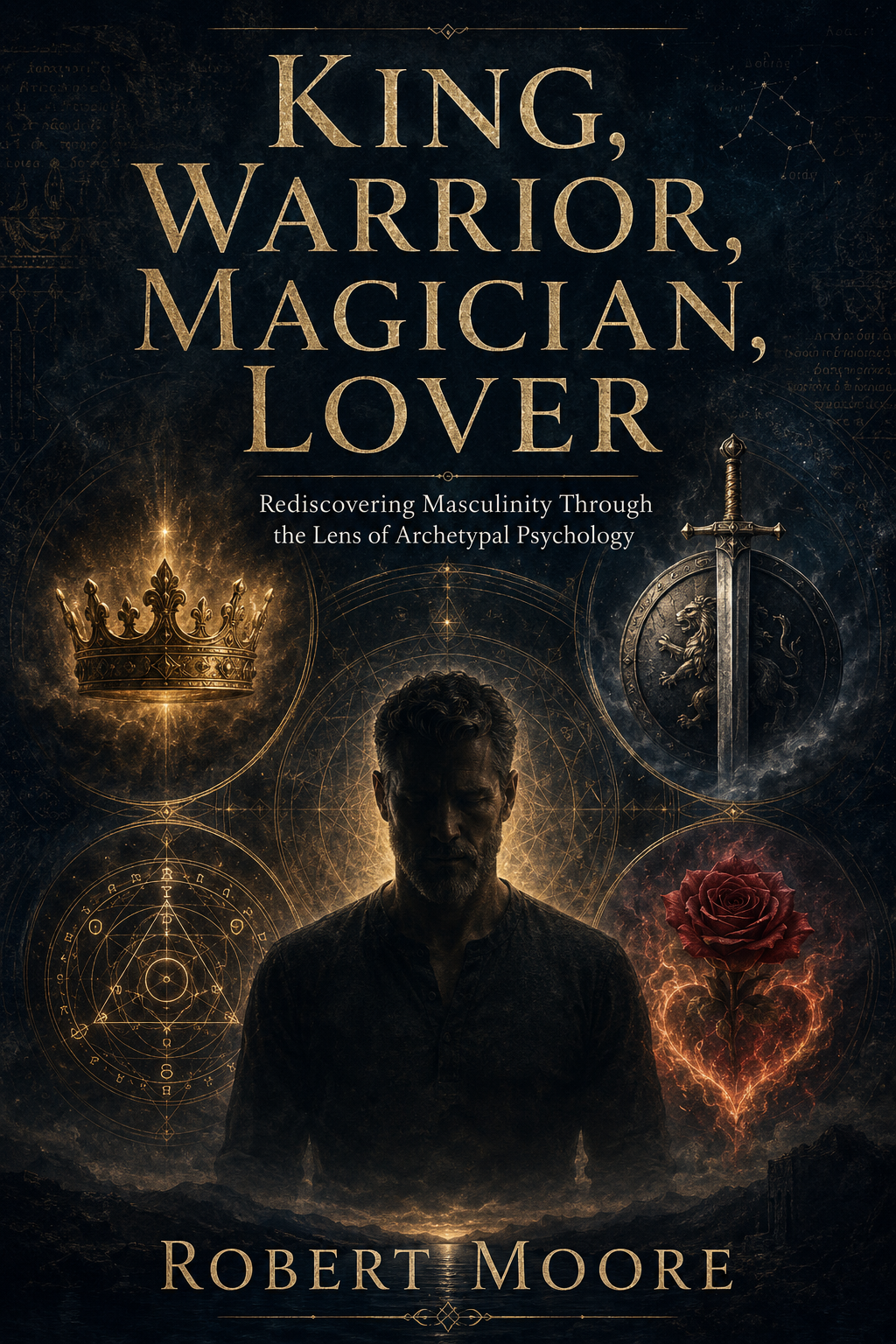
King, Warrior, Magician, Lover
Chapter Summaries
What's Here for You
Are you ready to embark on a transformative journey into the very heart of masculinity? "King, Warrior, Magician, Lover" offers a powerful framework for understanding and integrating the core archetypes that shape a man's inner world. This book isn't just a theoretical exploration; it's a practical guide designed to help you break free from immature patterns and step into your full potential. Prepare to confront the 'boy psychology' that may be holding you back, and discover how to cultivate the balanced energies of the King, the focused strength of the Warrior, the insightful wisdom of the Magician, and the passionate vitality of the Lover. Through Jungian psychology and insightful analysis, you'll gain a profound understanding of the masculine psyche and learn how to access the archetypal powers within. This is an invitation to reclaim your masculine birthright, heal old wounds, and forge a path towards authentic, integrated manhood. Expect a challenging yet ultimately empowering experience, filled with introspection, self-discovery, and the promise of a richer, more fulfilling life.
The Crisis in Masculine Ritual Process
In this chapter, Robert Moore addresses the modern crisis of masculinity, suggesting that men often struggle to integrate their personalities due to a lack of initiation into mature manhood. He paints a vivid picture, recalling ancient Cro-Magnon cave paintings, where rituals once transformed boys into men. Moore draws a parallel with tribal societies, like the one depicted in 'The Emerald Forest,' where a boy undergoes a symbolic death and rebirth to assume his adult role, guided by tribal elders. The author argues that modern society offers only pseudo-rituals, such as military conscription or gang initiation, which often lead to skewed, patriarchal versions of masculinity. These pseudo-initiations fail because they lack the essential components of true ritual: sacred space and a wise elder. Moore emphasizes that genuine initiation requires the death of the boy ego, paving the way for a new, mature masculine identity characterized by calm, compassion, and clarity. Without such rituals and mature male role models, men are left adrift, often feeling anxious and unappreciated, struggling in a 'dog-eat-dog world.' The absence of a generative, affirming father figure further exacerbates this crisis, leaving men yearning for a connection they may never have experienced. Moore, however, offers hope, suggesting that understanding human mythology and Jungian psychology can provide a path forward, signaling good news for both men and women seeking wholeness. The core tension lies in the contrast between authentic, transformative rituals and the inadequate substitutes offered by contemporary society, highlighting the urgent need for men to find pathways to mature masculinity. He suggests the modern man is like a ship without a rudder, lost at sea, desperately needing a map to navigate the turbulent waters of his own psyche. The lack of initiation leaves men fragmented, their potential untapped, and their identities unformed, emphasizing the importance of structured processes guided by wisdom to foster genuine growth and integration.
Masculine Potentials
Robert Moore, drawing from Jungian psychology, illuminates the inherent potential for mature masculinity residing within every man, suggesting that even in the face of absent or inadequate father figures and societal rituals, a blueprint for positive masculine traits exists deep within. He explains that Jung's concept of archetypes, primordial images residing in the collective unconscious, forms the bedrock of human behavior, influencing our thoughts, feelings, and reactions. Moore uses the analogy of a duckling imprinting on a caretaker to illustrate how these archetypes function; even if the external figure doesn't match the ideal, the archetype shapes the duckling's behavior nevertheless. Similarly, humans are wired for various relationships and experiences, and while our real-world interactions may fall short, the archetype remains a constant, universal influence. The author highlights how disastrous encounters with inadequate parents can skew these archetypal patterns, leading to psychological problems, painting a vivid picture of inner potentials obscured by outer realities. But there’s hope: Moore emphasizes that the existence of these archetypes is supported by extensive clinical evidence, dreams, mythology, and cross-cultural studies, offering a sense of universality and shared human experience. He further notes that Jungians have identified masculine and feminine subpersonalities, the Animus and Anima, respectively, within each individual, broadening the spectrum of human potential. Moore underscores that we all access these archetypes, consciously or unconsciously, in our interactions, recognizing that the field of archetypal psychology is still nascent, yet full of promise. The chapter resolves with a call to action, encouraging men to tap into these positive archetypal potentials for personal growth and the betterment of the world, like unlocking a hidden room filled with forgotten treasures.
Boy Psychology
Robert Moore unveils a critical truth: many men, despite outward appearances, are still boys pretending to be men, trapped in immature patterns because they never learned mature masculinity. He explains that these men often mistake controlling and hostile behaviors for strength, masking their underlying vulnerability. Moore introduces the concept of archetypes within the male psyche, each with a triune structure, highlighting the contrast between immature and mature forms; he illuminates the archetypes of Boy psychology—the Divine Child, the Precocious Child, the Oedipal Child, and the Hero—and how they can manifest in shadow forms when not properly integrated. The Divine Child, primal and full of potential, can devolve into the High Chair Tyrant or the Weakling Prince, each representing extremes of grandiosity and helplessness; the Precocious Child, eager to learn, risks becoming the Know-It-All Trickster or the naive Dummy, showing how knowledge can be wielded destructively or remain unexpressed. Similarly, the Oedipal Child, yearning for connection, might turn into the Mamas Boy or the Dreamer, forever bound to or detached from the maternal figure, and the Hero, meant to establish independence, can become the Grandstander Bully or the Coward, each avoiding true vulnerability. Moore emphasizes the importance of acknowledging these archetypes without identifying with them, encouraging men to connect with the creative, playful aspects of the Divine Child, for instance, to avoid feeling washed up or bored; he warns against therapists who depreciate the grandiose Self, potentially stifling ambition and greatness. Moore suggests that the Hero, while necessary for breaking away from the Mother and establishing independence, must eventually die to give way to true manhood, marked by an encounter with limitations and the embrace of humility; he envisions this death as a transformation, an ascent into a higher state of being, where true limitations are understood and help is sought, illustrating that the journey from boyhood to manhood is about integrating these archetypes, facing shadows, and ultimately, embracing vulnerability and interdependence.
Man Psychology
Robert Moore illuminates the arduous journey of men towards their full potential, emphasizing the internal struggle against infantile tendencies that hinder mature masculinity. He introduces the concept of building 'pyramids' of boyhood and manhood, structures representing the core of the masculine Self, drawing a parallel to the ancient Maya who integrated, rather than destroyed, earlier structures. Moore suggests various techniques for this construction, including dream analysis, active imagination, psychotherapy, and spiritual disciplines. The chapter identifies four major forms of mature masculine energy: the King, Warrior, Magician, and Lover, each overlapping and enriching the others, mirroring how boy energies like the Divine Child, Oedipal Child, and Precocious Child, culminate in the Hero archetype, freeing the boy from the feminine unconscious and establishing individual identity. Moore uses a vivid metaphor of archetypes as magnets beneath paper, their forces unseen but revealed through patterns of iron filings—art, behavior, thought, and feeling. He proposes that understanding and remixing these archetypes is akin to a well-run board meeting, where each member (archetype) voices their opinion, and the Ego, acting as the chair, makes the final decision, balancing internal influences. The author acknowledges the rarity of developed man psychology, attributing it to hostile environments that stunt growth, and calls for taking responsibility for what we are not responsible for, addressing early fixations. He notes that in our individualistic Western culture, the development of mature masculine identity requires conscious, individual effort, a shift from relying on institutional structures and rituals. Moore urges readers to actively engage in this psychological age, connecting with their inner selves to cultivate mature masculinity, rather than remaining trapped in immature patterns, emphasizing that personal growth demands facing the seriousness of our situation and acting to enhance our own lives and the lives of others.
The KING
Robert Moore, in exploring the King archetype, reveals it as the primal masculine energy within all men, a seasoned Divine Child embodying wisdom and selflessness. The King energy underlies the Warrior, Magician, and Lover, yet often awakens last. Moore highlights the historical sacredness of kingship, an energy embodied temporarily by mortal men in service to the realm. The death of the Hero archetype marks the King's emergence, illustrated by a dream of a soldier submitting to the compassionate Emperor, signaling a transition from boyhood to manhood. Drawing on John W. Perry's work, Moore emphasizes the King's organizing and healing power, a central archetype around which the psyche aligns. The King's two primary functions—ordering and providing fertility and blessing—facilitate this transition. Like the Divine Child, the King resides at the world's center, radiating order and defining reality through words and laws. Moore paints a vivid picture: Hammurabi receiving laws from Shamash, Moses receiving the Torah, each scene underscoring the King's role in establishing cosmic order. The mortal king embodies this order, ensuring the realm's well-being; failure leads to chaos, as Nefer-rohu describes the consequences of illegitimate rule. Fertility and blessing, the King's second function, stem from his creative ordering and partnership with the feminine, ensuring bounty for the kingdom. Blessing, a psychological event, involves recognizing and affirming others, bestowing honors and fostering wholeness. However, the Shadow King manifests as either the Tyrant or the Weakling. The Tyrant, exemplified by Herod and Saul, fears new life and exploits others, stemming from inner insecurity. The Weakling, the passive pole, lacks centeredness and projects power onto others, leading to paranoia and abdication of responsibility. Accessing the King energy requires disidentifying the Ego, recognizing it as a servant of a transpersonal will. Avoiding both usurpation—Ego inflation—and abdication—projecting the King energy—is crucial. Moore illustrates this with Corts's conquest, where the Mexican warriors' belief in their leader's power led to their downfall upon his death. By embracing the inner King, men can cultivate calmness, authority, and genuine care for themselves and others, becoming stewards of a more just and creative world.
The WARRIOR
Robert Moore delves into the complex and often misunderstood archetype of the Warrior, a form of masculine energy frequently viewed with discomfort in contemporary society. He notes the paradoxical nature of attempts to suppress the Warrior, arguing that such repression only drives it underground, leading to explosive outbursts of violence, much like a dormant volcano gathering pressure. Moore challenges the notion that human aggressiveness is merely infantile rage, instead positing the Warrior as a fundamental, possibly genetic, component of the male psyche, a building block. He illustrates this through historical examples, from the Egyptians who transformed from a peaceful society to fierce empire builders after embracing their inner Warrior, to the biblical Hebrews and the Roman emperors, demonstrating how the Warrior energy, when integrated, can extend civilization and spread cultural achievements. Moore emphasizes that the Warrior, in his fullness, embodies a way of life characterized by aggressiveness—a proactive stance that energizes and motivates. A warrior possesses clarity of thinking, strategic acumen, and tactical flexibility, adapting to circumstances with mindful awareness, always alert, like a hunter. The awareness of one's own mortality sharpens focus, turning every action into a meaningful act. Training, self-discipline, and mastery of skills, both physical and mental, are paramount, enabling decisive action without hesitation. The Warrior's transpersonal commitment, loyalty to something greater than oneself, tempers ego and pettiness. However, Moore cautions that the Warrior operating in isolation, detached from human connection, risks succumbing to the Shadow, manifesting as either a sadist or a masochist. The sadistic Warrior, exemplified by characters like the Great Santini, inflicts cruelty and seeks to dominate, while the masochistic Warrior internalizes abuse and becomes powerless. Moore underscores the importance of integrating the Warrior with the King, Magician, and Lover archetypes to temper its destructive potential with creativity, wisdom, and compassion. Only then can the Warrior's energy be channeled towards building a better world, fighting for justice and freedom, and fostering genuine care for oneself and others, a harmonious blend where strength serves creation.
The MAGICIAN
In Robert Moore's exploration of the Magician archetype, we find ourselves peering into the duality of knowledge and power. Like the aborigine elder in *The Right Stuff*, the Magician knows, sees beyond the surface, and channels unseen energies. Moore posits that this archetype, present throughout history in shamans, scientists, and even wizards like Merlin, embodies both the knower and the master of technology. The central tension arises: how does one wield this power responsibly? The mature Magician understands initiation, the ritual process of transformation, guiding others through the labyrinth of hidden knowledge, knowledge that demands dedicated training, akin to the modern apprentice electrician or medical student, each undergoing their own trial by fire. This archetype, the author explains, once inseparable from the King, Warrior, and Lover, became distinct as societies evolved, specializing in secret knowledge, predicting events, and understanding the human psyche. He was the civilization builder, the deflator of arrogance, a kind of ancient psychotherapist, whose wisdom served to temper power, as seen in Nathan's counsel to King David. The archetype's presence resurfaced as Gnosticism, an emphasis on inner knowing, and later as alchemy, a spiritual technique cloaked in the guise of material transformation. The modern age, Moore argues, is the age of the Magician, dominated by technology, yet often lacking in psychological or spiritual depth. Subatomic physics and depth psychology emerge as the new alchemy, probing hidden energies, revealing that reality is but the tip of an iceberg, a notion echoed by Jung's exploration of the collective unconscious. But the Magician has a shadow, a dark bipolarity. The Manipulator withholds knowledge, directing others for self-gain, a power shadow seen in academia, medicine, and advertising. The Naive or Innocent One, the passive pole, desires power without responsibility, blocking the efforts of others out of envy, creating a fog of ineffectual intentions. To access the Magician within, one must cultivate the observing Ego, detaching from emotions, regulating internal energies like a hydroelectric dam operator, allowing the Magician to guide decisions. Practices like focusing, separating Ego from emotions, and channeling rage into constructive action, as with the young man transforming tornado dreams into artistic power, are key. Ultimately, Moore resolves, the mature Magician integrates with the King's generativity, the Warrior's courage, and the Lover's connectedness, using knowledge for the benefit of all, a path toward wholeness. The challenge is to avoid the shadows, to ground the volatile energies unleashed, lest we become sorcerer's apprentices drowning in a flood of our own making.
The LOVER
Robert Moore, in exploring the Lover archetype, begins with a vivid image: the Elephanta Caves, pulsating with life-force. He explains that the Lover, often symbolized by the phallus, represents not just sexuality but the life-force itself, the divine entering the human. The author clarifies that this archetype encompasses various forms of love—agape, eros, amor—expressing vividness, aliveness, and passion, driving us toward sex, food, well-being, and meaning. Moore highlights the Lover's sensitivity to the outer environment, akin to an ancient survival instinct now manifesting as deep empathy and connection. He shares the story of a young boy who empathized with ants and lichen, illustrating the Lover's potential to access a collective unconscious, even a universal consciousness. The author underscores that this connection isn't merely intellectual; it's felt passionately, blurring boundaries and seeking to experience the world sensuously, aesthetically. Moore then introduces a critical tension: the conflict between the Lover and societal norms, particularly in Western religions that often persecute the Lover, fearing sensuality. Hinduism, by contrast, celebrates the Lover's erotic aspect, integrating it into spirituality. Moore uses the dream of an accountant revitalized by a sensuous experience in India to illustrate accessing the mature Lover. The author identifies artists and psychics as those who often embody the Lover, living close to the creative unconscious. Moore acknowledges that the Lover brings not only joy but also pain, a duality reflected in the image of Jesus weeping. The author distinguishes between monogamy, rooted in deep centeredness, and promiscuity, driven by a search for an elusive wholeness. He warns of the Shadow Lover, appearing as the Addict, lost in a sea of senses, or the Impotent Lover, marked by depression and disconnection. Moore illustrates the Addict's restlessness, forever seeking the ultimate orgasm, and the Impotent Lover's lack of motivation, leading to a stagnant life. The author resolves by stating that accessing the Lover appropriately, with strong Ego structures, fosters relatedness, compassion, and a sense of meaning. He concludes that the Lover humanizes the other masculine energies—King, Warrior, Magician—preventing them from becoming sadistic, while also needing their structure and discipline to avoid chaos. Moore urges listeners to find spontaneity and joy, enabling both themselves and others to live more abundantly.
Accessing the Archetypal Powers of the Mature Masculine
In this chapter, Robert Moore confronts a pressing irony: civilization's advance toward wholeness occurs just as the rituals that once transformed boys into men have vanished. He paints a vivid picture of a world teetering on the edge, desperately needing mature masculine energies, yet struggling with widespread immaturity, a 'puerarchy' reminiscent of 'Lord of the Flies.' Moore suggests that evolution has internalized these archetypal forces within modern men, urging them to embrace individuality and rise to the challenge of saving a world in crisis. The effectiveness in meeting global challenges hinges on individual men confronting their own immaturity, moving from boy psychology to manhood, and this transformation will decisively shape the world's future. Moore introduces techniques to reconnect with masculine maturity, beginning with critical self-appraisal, emphasizing humility—knowing limitations and seeking help. He then explores active imagination dialogue, where the conscious Ego converses with unconscious entities, the archetypes, to face rebellious energies before they manifest negatively, which is akin to holding a board meeting with timeless, universal aspects of the self. Moore also introduces invocation, a focused method of calling upon positive archetypal energies through images and spoken words, and the importance of admiring other men, living or dead, as a means of invoking lacking strengths; it’s like holding up a mirror to the soul, reflecting back the qualities one wishes to embody. He concludes with the technique of 'acting as if,' embodying desired traits to internalize them, whether it's appreciating a sunset to access the Lover or forcing oneself into action to embody the Warrior. Moore urges men to cease accepting blame for all the world's ills, advocating instead for maturation and stewardship, recognizing that the true enemy is infantile grandiosity and the splitting of the Self. Ultimately, the journey toward maturity is a psychological, moral, and spiritual imperative, a call to initiate oneself from boyhood to manhood, potentially averting the apocalyptic fantasy of infantile rage and paving the way for a generative future.
Conclusion
Moore's work illuminates a profound crisis: the absence of genuine initiation rituals leaves men adrift, unable to access their inherent potential for mature masculinity. He posits that men are not inherently flawed, but rather, are lacking the necessary structures and guidance to transition from boyhood to manhood. The core message is one of hope and empowerment: every man possesses the archetypal blueprints for King, Warrior, Magician, and Lover. By understanding and integrating these archetypes, men can overcome the shadow aspects of their boyhood psychology and cultivate a balanced, generative masculinity. This journey requires conscious effort, self-awareness, and a willingness to embrace the 'death' of the immature ego, paving the way for true strength, wisdom, and compassion. The ultimate goal is not just personal fulfillment, but the responsible stewardship of masculine energy for the betterment of society.
Key Takeaways
The absence of ritual initiation leaves men fragmented and unable to access their full potential, leading to a crisis in mature masculinity.
Modern pseudo-rituals, like military conscription or gang initiation, often reinforce skewed and patriarchal versions of masculinity rather than fostering genuine growth.
True initiation requires the symbolic death of the boy ego to make way for a mature masculine identity marked by calm, compassion, and generativity.
Sacred space and the guidance of a wise elder are essential components of effective ritual process, elements often missing in modern pseudo-initiations.
The lack of mature male role models and societal structures for ritual process leaves men feeling anxious, unappreciated, and lost in their striving for manhood.
Understanding human mythology and Jungian psychology can provide a path forward for men seeking to overcome the crisis in masculinity and achieve wholeness.
Every man possesses an inherent blueprint for mature masculinity, regardless of external deficiencies in father figures or rituals.
Archetypes, as defined by Jung, are primordial images within the collective unconscious that shape our behaviors and reactions.
Negative experiences with parents can skew archetypal patterns, leading to psychological problems, but the underlying potential remains.
Clinical evidence, dreams, mythology, and cross-cultural studies support the existence and influence of archetypes.
Both men and women possess masculine and feminine subpersonalities (Animus and Anima) that expand the spectrum of human potential.
Accessing and integrating positive archetypal potentials can lead to personal growth and positive impact on the world.
Many men are stuck in boyhood, mistaking control for strength due to a lack of mature masculine role models.
Each masculine archetype (Divine Child, Precocious Child, Oedipal Child, Hero) has a shadow side that manifests when not integrated.
The Divine Child archetype, when unintegrated, can manifest as the High Chair Tyrant (arrogance) or the Weakling Prince (helplessness).
The Precocious Child archetype, when unintegrated, can manifest as the Know-It-All Trickster (manipulation) or the Dummy (feigned ignorance).
The Oedipal Child archetype, when unintegrated, can manifest as the Mamas Boy (over-attachment) or the Dreamer (detachment).
The Hero archetype, while necessary for independence, must 'die' to allow for true manhood and humility.
Acknowledging and integrating these archetypes is essential for men to transition from boyhood to mature masculinity.
Achieving full adult potential requires actively combating infantile tendencies that exert a strong pull against growth.
Mature masculinity is built through a process of integrating past experiences and developing new structures, rather than simply discarding the old.
The archetypes of King, Warrior, Magician, and Lover represent overlapping and mutually enriching forms of mature masculine energy.
Archetypes, though hidden, manifest through human creativity, behavior, and thought, influencing our patterns and interactions.
Understanding and balancing archetypes involves a process akin to a board meeting, where each inner voice is heard before the Ego makes a decision.
Developing mature masculinity requires conscious, individual effort, especially in a culture that emphasizes individualism over collective processes.
Taking responsibility for the impacts of early experiences, even if not directly responsible for them, is crucial for psychological growth.
Embrace the King archetype to integrate masculine energies, balancing wisdom, order, and generativity in life.
Recognize and manage the Shadow King within to avoid tyrannical behavior or passive weakness, fostering healthy leadership.
Cultivate inner order and stability to radiate positive influence, creating a more balanced and harmonious environment.
Seek to embody the King's blessing by acknowledging and affirming others' worth, fostering their growth and well-being.
Understand the King's role in providing both order and fertility, ensuring growth and abundance in all aspects of life.
Disidentify the Ego from the King archetype to serve as a steward, not a usurper, of power and influence.
Repressing the Warrior archetype leads to uncontrolled outbursts of aggression; face and integrate it instead.
The Warrior archetype, when mature, provides the energy to defend, build, and extend civilization, making it vital for societal advancement.
Clarity of thought, strategic thinking, and tactical adaptation are hallmarks of the Warrior, essential for navigating life's challenges effectively.
Awareness of mortality sharpens the Warrior's focus, transforming everyday actions into meaningful endeavors.
Transpersonal commitment tempers the Warrior's ego, fostering loyalty to causes greater than oneself and eliminating pettiness.
The Warrior's detachment, if unchecked, can lead to cruelty and the Shadow Warrior's sadism or masochism.
Integrating the Warrior with the King, Magician, and Lover archetypes tempers its destructive potential with creativity, wisdom, and compassion.
The Magician archetype embodies both knowledge and the responsible application of technology, requiring initiation and ongoing self-awareness.
Secret knowledge grants power, but the mature Magician uses this power to deflate arrogance and guide transformation in others.
Modern society, while technologically advanced, often lacks the psychological and spiritual depth of the Magician archetype.
The Shadow Magician manifests as the Manipulator, who withholds knowledge for self-gain, and the Innocent One, who avoids responsibility and blocks others' progress.
Accessing the Magician requires cultivating the observing Ego, detaching from emotions, and channeling inner energies constructively.
Integrating the Magician with the King, Warrior, and Lover archetypes is essential for balanced and beneficial use of knowledge and power.
The ultimate aim of the Magician is to restore wholeness and fullness of being through the compassionate application of knowledge and technology.
The Lover archetype represents not just sexual desire, but the life-force itself, bridging the divine and human realms.
The Lover archetype encompasses various forms of love, driving us toward essential needs like sex, food, well-being, and a sense of meaning.
Accessing the Lover archetype allows for deep empathy and connection to the world, potentially tapping into a collective unconscious.
A key tension exists between the Lover archetype's sensuality and the moralistic constraints often imposed by Western religions.
The Shadow Lover manifests in two destructive forms: the Addict, lost in sensory indulgence, and the Impotent Lover, marked by depression and disconnection.
The Addict's restless search for the 'ultimate orgasm' reveals a deeper longing for spirituality, often misdirected into harmful behaviors.
Accessing the Lover archetype appropriately, with strong ego boundaries, fosters compassion, meaning, and a balanced integration with other masculine energies.
Civilization's progress ironically coincides with a loss of traditional rites of passage, placing greater emphasis on individual self-initiation into mature masculinity.
True humility, essential for masculine maturity, involves recognizing one's limitations and actively seeking support to overcome them.
Active imagination dialogue allows individuals to engage with conflicting inner voices, fostering understanding and integration of shadow aspects.
Invocation, through focused imagery and prayer, can harness the positive energies of masculine archetypes, catalyzing personal transformation.
Admiration of other men, both living and historical, provides a pathway for embodying desired qualities and overcoming personal weaknesses.
The 'acting as if' technique facilitates embodying archetypal traits, bridging the gap between intention and authentic experience.
Men should focus on personal maturation and stewardship rather than accepting blame for societal problems, recognizing that infantile grandiosity is the true adversary.
Action Plan
Reflect on the ways you may be stuck in 'boy psychology' and identify specific behaviors you want to change.
Seek out a mentor or elder who embodies the qualities of mature masculinity that you admire.
Create a personal 'sacred space' where you can engage in introspection and self-reflection.
Identify and challenge any pseudo-initiations you may have experienced that have led to skewed or unhealthy masculine behaviors.
Explore your own personal mythology and archetypes to gain a deeper understanding of your masculine identity.
Engage in activities that foster calm, compassion, and generativity, such as volunteering or creative pursuits.
Identify areas where your ego may be hindering your growth and practice surrendering to a higher power or purpose.
Reflect on your relationship with your father or male role models and identify any patterns that may have skewed your perception of masculinity.
Explore your dreams and daydreams for recurring symbols or figures that may represent archetypal patterns in your unconscious.
Research different mythologies and folklore to identify archetypes that resonate with you and reflect your own inner landscape.
Identify and challenge any negative beliefs or behaviors that may be stemming from skewed archetypal patterns.
Seek out positive male role models or mentors who embody the qualities of mature masculinity.
Engage in activities that help you connect with your own inner masculine and feminine aspects, such as creative expression, physical activity, or introspection.
Practice self-compassion and acceptance as you navigate your journey of self-discovery and integration.
Reflect on which of the four archetypes (Divine Child, Precocious Child, Oedipal Child, Hero) resonate most strongly with you.
Identify the shadow aspects (High Chair Tyrant/Weakling Prince, Know-It-All/Dummy, Mamas Boy/Dreamer, Grandstander/Coward) that you may be manifesting.
Explore how your relationship with your mother and father may have influenced the development of these archetypes within you.
Practice acknowledging and appreciating the positive aspects of the Divine Child within you, such as creativity and playfulness.
Work on integrating the shadow aspects by recognizing your limitations and seeking help when needed.
Challenge yourself to step outside your comfort zone and take calculated risks, while remaining aware of your limitations.
Cultivate humility by acknowledging the contributions of others and seeking feedback on your behavior.
Find a mentor or role model who embodies mature masculinity and can provide guidance and support.
Engage in activities that foster self-awareness, such as journaling, meditation, or therapy.
Examine your motivations for seeking power and control, and explore healthier ways to meet your needs.
Engage in dream analysis to uncover unconscious patterns and archetypal influences.
Practice active imagination to dialogue with inner energies and differentiate from them.
Reflect on the qualities of the King, Warrior, Magician, and Lover archetypes, and identify areas for development.
Identify early experiences that may have stunted or fixated your development, and explore their impact.
Consciously work to integrate different aspects of your personality, like a chair managing a board meeting.
Take responsibility for your psychological growth, even in areas where you feel you are not directly responsible.
Seek out a spiritual elder or mentor to guide you through spiritual discipline.
Engage in psychotherapy to address unresolved issues and promote personal growth.
Reflect on personal experiences with King energy, both positive and negative, to identify patterns.
Identify areas where you may be exhibiting Tyrant or Weakling behaviors and develop strategies to shift towards balance.
Practice recognizing and affirming the worth of others through specific praise and support.
Cultivate inner calmness and centeredness through mindfulness or meditation practices.
Seek out mentors or role models who embody the qualities of the good King archetype.
Identify a personal 'realm' (family, work, community) and consider how to bring more order, blessing, and fertility to it.
Actively disidentify with the ego's desire for power and control, focusing instead on serving a higher purpose.
Identify areas in your life where you tend to repress your assertiveness and explore ways to express yourself more directly and powerfully.
Reflect on your relationship with aggression and identify healthy outlets for channeling this energy.
Practice mindful awareness in daily activities to cultivate clarity of thought and strategic thinking.
Contemplate your mortality to gain a deeper appreciation for life and prioritize meaningful actions.
Identify a cause or ideal greater than yourself and commit to serving it with loyalty and dedication.
Examine your relationships for signs of sadistic or masochistic tendencies and seek to establish healthier boundaries.
Cultivate the qualities of the King, Magician, and Lover archetypes to balance your Warrior energy with wisdom, compassion, and creativity.
Practice self-discipline to develop mastery over your thoughts, feelings, and actions.
Assess your current level of self-care and make a plan to prioritize your mental and physical well-being.
Identify any compulsive behaviors and begin to address the underlying anxieties that drive them.
Identify areas in your life where you possess specialized knowledge and consider how you can share it to benefit others.
Practice observing your emotions without judgment, creating a mental space to detach from their immediate influence.
Reflect on situations where you may have withheld information or used your knowledge to manipulate others, and commit to more transparent communication.
Explore practices like meditation, mindfulness, or spending time in nature to cultivate inner calmness and clarity.
Identify a mentor or guide who embodies the qualities of the mature Magician, and seek their wisdom and support.
Engage in activities that allow you to channel your energy constructively, such as creative projects, physical exercise, or acts of service.
Assess whether you fall into the shadow of the Manipulator or the Innocent One, and actively work on the attributes of the other archetypes to achieve balance.
Develop a ritual or routine that helps you access a sacred space within yourself, where you can connect with your inner wisdom and intuition.
Engage in a sensory experience (e.g., listening to music, tasting fine food) and consciously notice the feelings and sensations it evokes.
Identify a boundary you struggle with and consciously practice setting and maintaining it.
Reflect on your own experiences with the Addict and Impotent Lover shadow aspects.
Explore a creative outlet (e.g., painting, writing, dancing) to connect with your inner Lover.
Practice empathy by actively listening to others and trying to understand their perspectives.
Identify a passion you've neglected and commit to spending time pursuing it.
Reflect on your relationship to sensuality and sexuality, and challenge any limiting beliefs.
Spend time in nature, observing and appreciating the beauty and interconnectedness of all things.
Engage in critical self-appraisal to identify areas where immature masculine energies are manifesting.
Practice active imagination dialogue to converse with and understand conflicting inner voices.
Identify and admire men, living or dead, who embody qualities you wish to develop.
Use invocation to call upon positive archetypal energies through focused imagery and prayer.
Employ the 'acting as if' technique to embody desired traits and integrate them into your personality.
Set reasonable limits in relationships, balancing love and respect for personal boundaries.
Take concrete actions to address unpaid bills, start an exercise program, or engage in a martial art to embody the Warrior archetype.
When someone seeks your wisdom, actively listen and offer thoughtful advice, consciously accessing the Magician archetype.